July 2025

  • Leader Manager Coach: Mastering the 3 States of Being

    The Leadership Trinity: The 3 Essential States of Being for any Leader

    Picture this: You’re sitting in your office at 10 pm, staring at a mountain of unfinished tasks while your phone buzzes with urgent messages from three different time zones. Your head of sales is demanding clearer targets, your engineering team needs inspiration for the next breakthrough, and your newest hire just submitted their resignation because they felt “unsupported.”

    Sound familiar?

    Here’s what nobody will tell you: You’re not failing because you lack skills or knowledge. You’re struggling because you’re trying to be everything to everyone while being unclear about which version of yourself to show up as in each moment.

    After working with hundreds of leaders who’ve gone from feeling like they’re drowning in their own success to becoming unstoppable forces of positive change, I’ve discovered that every business owner must master not just one but three essential states of being: Leader, Manager, and Coach.

    The Problem

    Let me share Sonia’s story. She built a startup from her garage to a $50M valuation in four years. Impressive, right? But when I met her, she was burned out, her team was confused, and her company culture was toxic despite all their external success.

    The problem? Sonia was switching between being a leader, manager, and coach without understanding the distinction. In Monday morning meetings, she’d inspire her team with grand visions (Leader), then immediately micromanage their daily tasks (Manager), before asking them to figure out their own solutions (Coach) – all within the same conversation.

    Her team was getting whiplash. They didn’t know which Sonia would show up, so they learned to wait for instructions instead of taking initiative. Innovation stopped. Engagement went down.

    Sonia’s mistake is the same one I see everywhere: treating leadership as a single skill instead of recognizing it as three distinct states of being, each with its own purpose, energy, and impact.
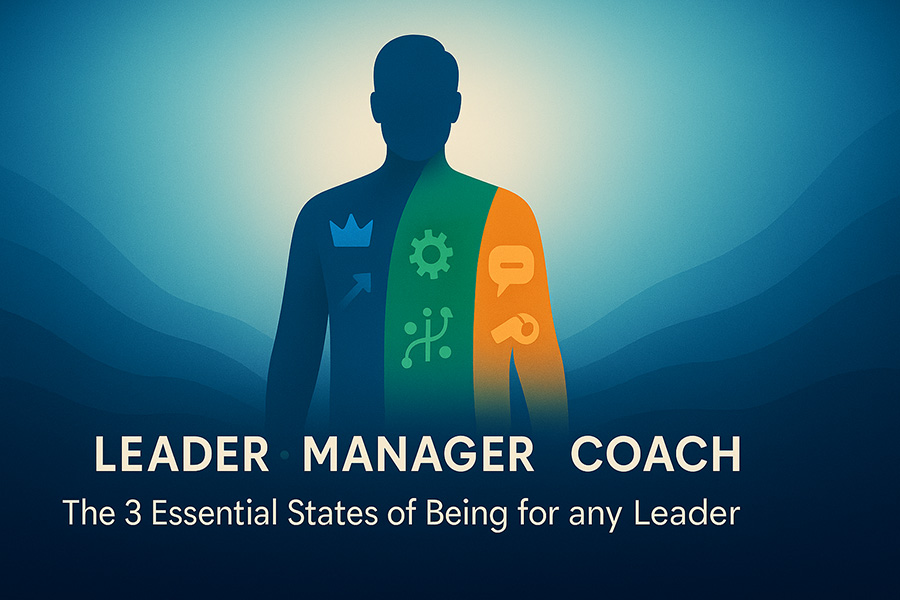
    The Three States of Being: Your Leadership Trinity

    Think of these three states like instruments in an orchestra. Each has its unique sound, purpose, and moment to shine. A symphony fails when the violins try to be drums, just like your organization fails when you bring the wrong energy to each situation.

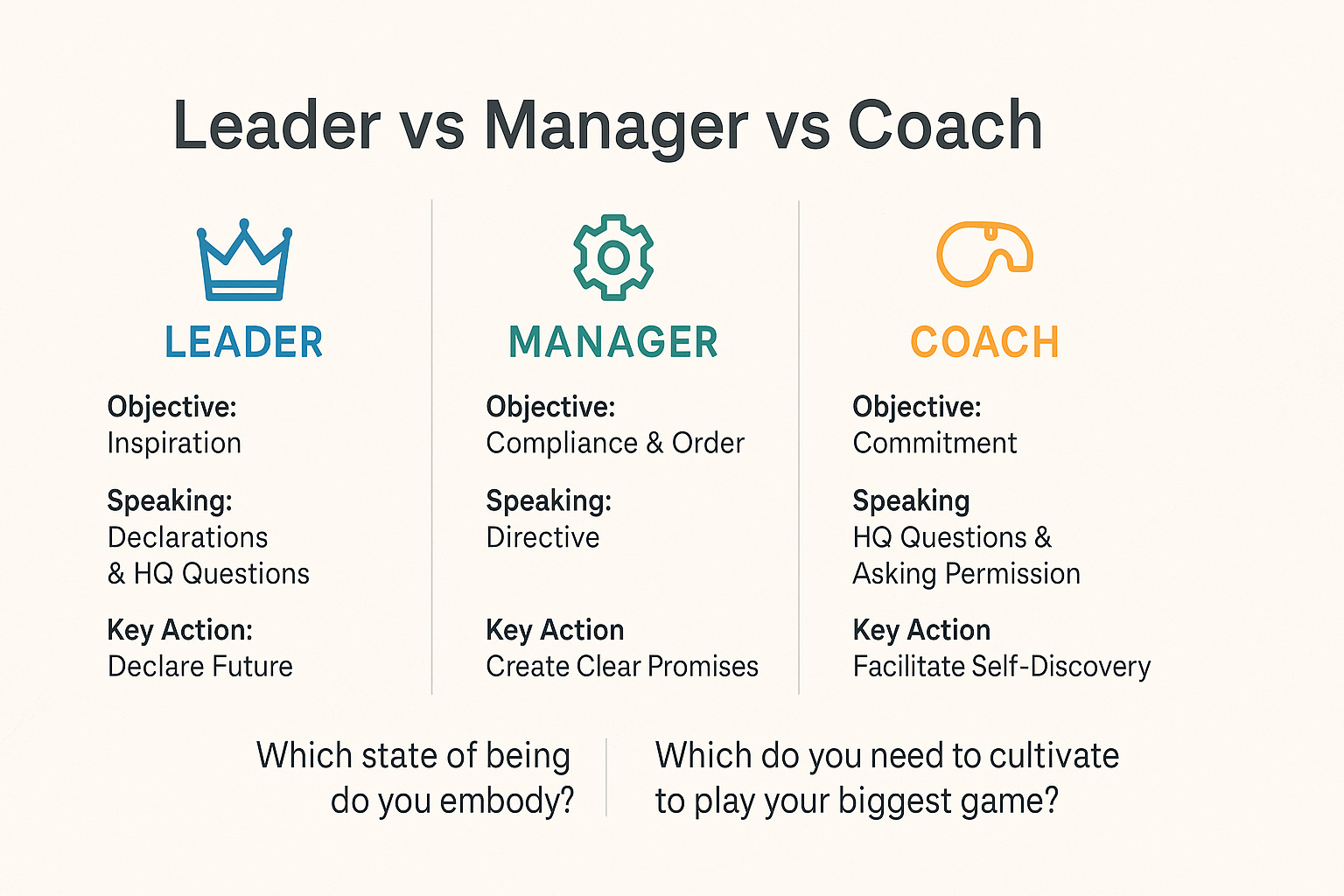
    State 1: The Leader – The Visionary Who Ignites Possibility

    Objective: Inspiration

    Speaking Style: Declarations, Asking High-Quality Questions

    Listens for: Points of View

    Body Disposition: Flexible

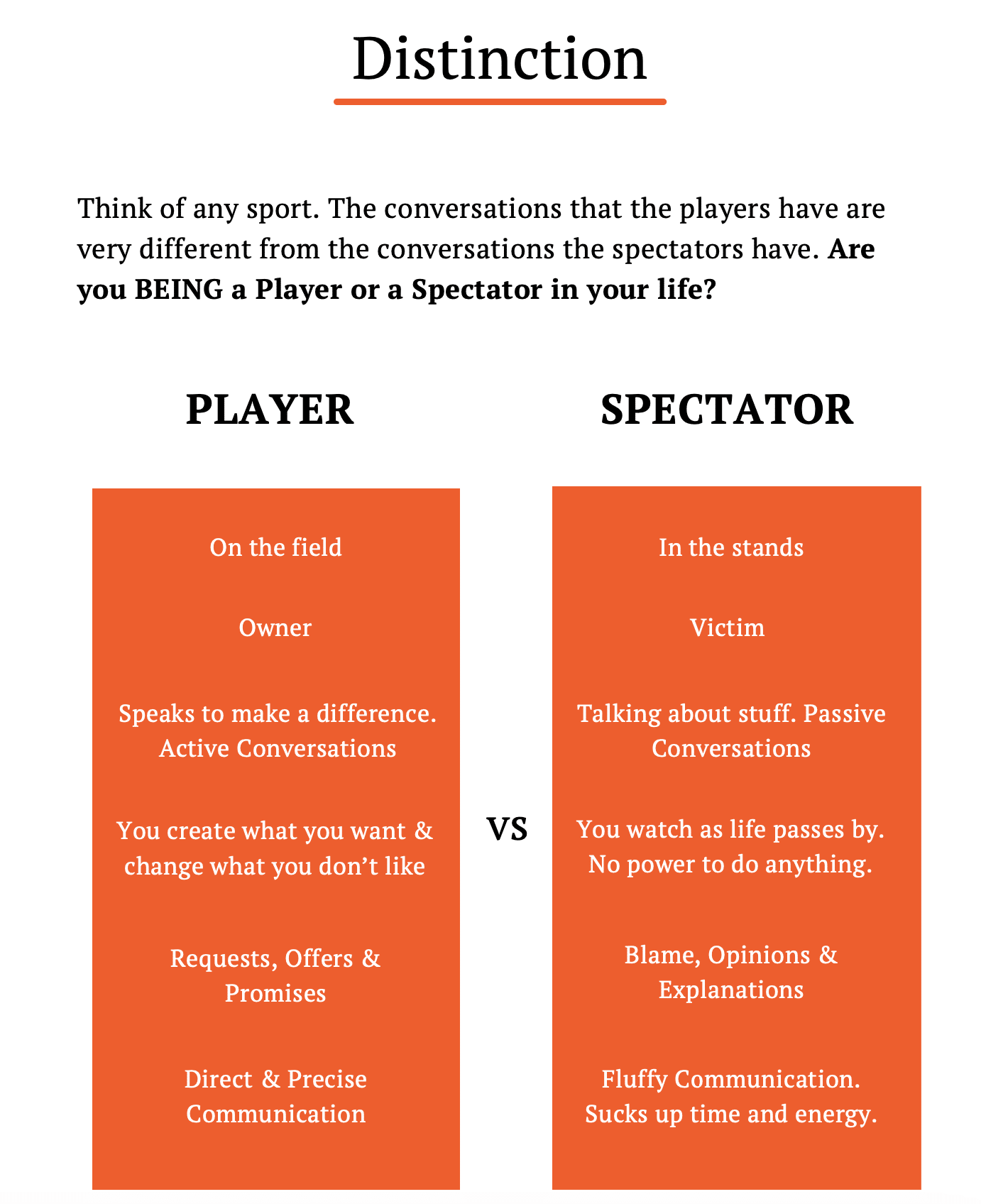
    Core Distinction: Player vs Spectator

    When you embody the Leader state, you’re not managing what is – you’re creating what could be. You’re the person who walks into a room and shifts the energy simply by declaring a possibility that didn’t exist before.

    I think of Hitesh, a CEO who inherited a struggling manufacturing company from his father. The business was bleeding money, morale was at rock bottom, and everyone expected him to announce layoffs. Instead, Hitesh stood before his 200 employees and declared: “In 18 months, we’re going to be the most innovative, employee-loved manufacturing company in our region, and every person in this room is going to be proud to tell their family where they work.”

    Crazy? Maybe. But he wasn’t predicting the future – he was creating it through his declaration. That’s what Leaders do. They don’t manage reality; they create the future.

    Key Actions of a Leader:

    Declare a Future: Paint a vivid picture that makes people’s hearts race. Not goals, not targets – futures that feel inevitable once spoken. When Elon Musk declared we’d colonize Mars, he wasn’t setting a goal. He was creating a future that thousands of brilliant minds could step into.

    Ask Insightful Questions: The right question can change everything. Instead of “How do we cut costs?” ask “What would we do if money wasn’t the constraint?” Instead of “Why is this taking so long?” ask “What would make this project irresistible to work on?”

    Engage Perspectives: Leaders listen to different viewpoints without agreeing to disagreeing with any. They know that breakthrough thinking emerges from the collision of different perspectives. They ask “What am I not seeing?” and actually listen to the answers.

    Example: “What would our ideal customer experience look like in five years if we had unlimited resources and complete customer trust?” Notice how this question immediately expands thinking beyond current limitations.

    Being a Leader requires you to be a Player, not a Spectator.

    Spectators observe, explain and comment.

    Players step onto the field and influence outcomes through their presence and actions (requests and promises).
    State 2: The Manager – Coordinating Human Behaviour And Creating Order

    Objective: Compliance, Order, Coordinating Action

    Speaking Style: Directive (Do this, not that)

    Listens for: Right and Wrong / Information

    Body Disposition: Resolution

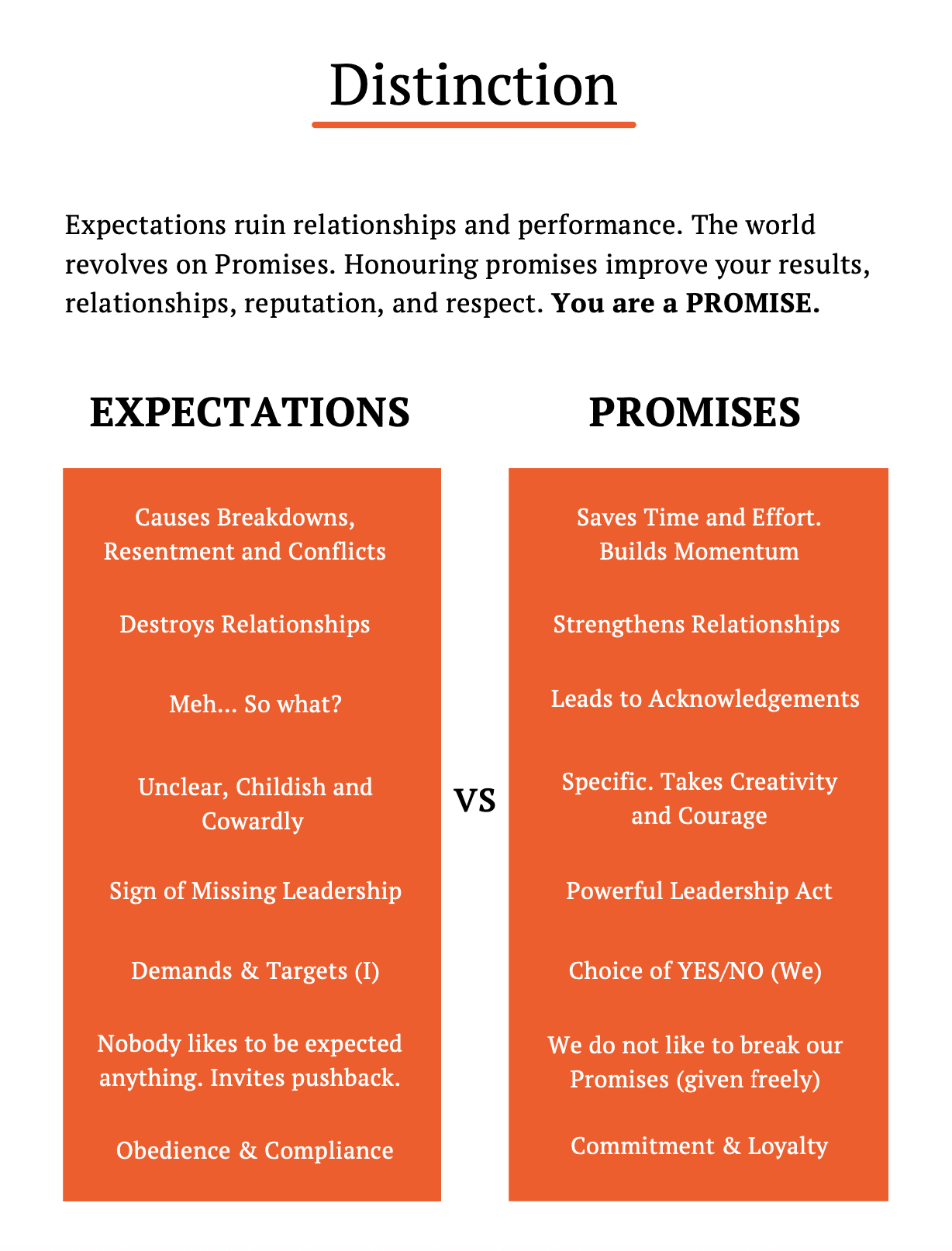
    Core Distinction: Promises vs Expectations

    If the Leader creates the vision, the Manager makes it real. This is where inspiration meets execution, where dreams get translated into deliverable actions.

    I worked with Alex, a brilliant visionary who could inspire a team to climb mountains but couldn’t get them to complete a simple project on time. His company was full of motivated people going in seventeen different directions. Alex had mastered the Leader state but was afraid to be a Manager, thinking it would make him “controlling” or “micromanaging.”

    Here’s what I told him: “Alex, your team doesn’t need another inspiring speech. They need clarity. They need to know exactly what success looks like and when it’s done. That’s not controlling – that’s caring.”

    The Manager state isn’t about being a dictator. It’s about creating the structure that allows brilliance to flourish. Think of it like being a conductor – you don’t play every instrument, but you ensure everyone plays in harmony and on time. It is about coordinating human behaviour and actions so that who will do what by when is clear to everyone involved.

    Key Actions of a Manager:

    Create Clear Promises: This is where most leaders fail. They create expectations instead of promises. An expectation is something you hope will happen. A promise is something you can count on. “I expect you to improve customer satisfaction” is weak. “Can you reduce customer complaint resolution time to under 24 hours by month-end?” is a promise when responded to by a clear YES or NO.

    Provide Directives: Be specific. Be clear. Be unambiguous. “Complete the quarterly report by Friday following the outlined template, including the three scenario analyses we discussed, and send it to me and the board by 5 PM EST. Can you do that?” No guessing. No interpretation needed.

    Monitor Compliance: This isn’t about micromanaging – it’s about caring enough to ensure promises are kept. Set up systems that make success visible and failure impossible to ignore.

    Accountability Conversations: While being a manager includes holding others accountable, if you create PROMISES properly, people will hold themselves accountable on their own – as progress would be self-evident, measured and visible – leaving nothing to guessing.

    The Manager state requires understanding the distinction between Promises and Expectations. Promises are commitments with specific deliverables and timelines. Expectations are wishes disguised as requirements. Which one do you think gets results?
    State 3: The Coach – The Developer Who Unleashes Potential

    Objective: Creating Commitment

    Speaking Style: Asking High-Quality Questions / Asking Permission

    Listens for: Insight

    Body Disposition: Open

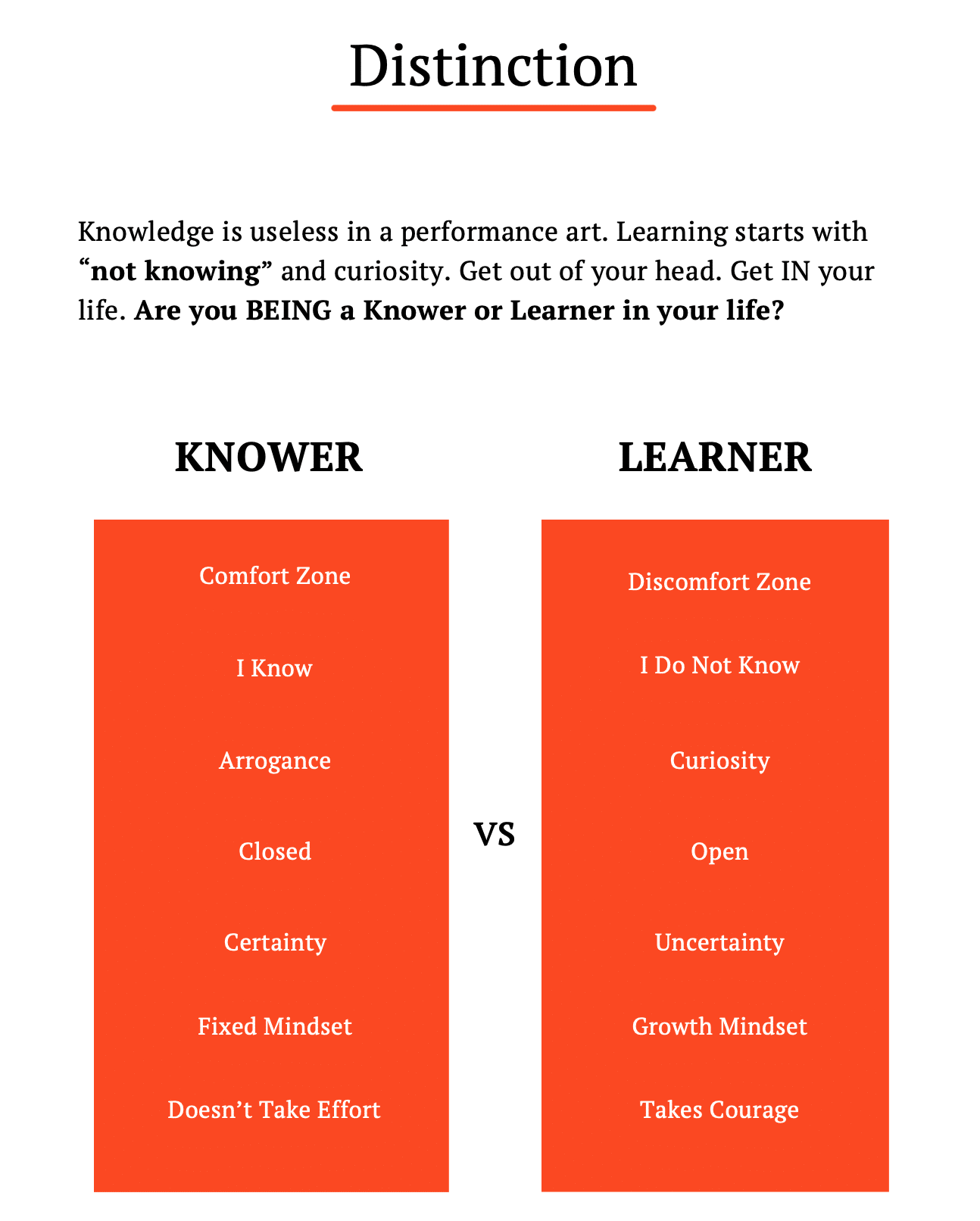
    Core Distinction: Learner vs Knower

    The Coach state is perhaps the most misunderstood of the three. It’s not about being nice or supportive (though those can be byproducts). It’s about creating an environment where people discover their own answers and commit to the way forward.

    Lisa, a VP of Engineering, came to me frustrated because her team kept coming to her with problems instead of solutions. “I’ve tried everything,” she said. “I’ve given them frameworks, sent them to training, even hired consultants. Nothing works.”

    “Have you tried asking them what they think?” I asked.

    “Of course I—” she stopped mid-sentence. “Actually, no. I tell them what I think they should think.”

    That’s the difference between a Knower and a Learner. Knowers have all the answers (or pretend to). Learners have all the questions.

    A leader creates, a manager knows, and a coach is always open to learning about themselves and the person in front of them.

    The next week, Lisa tried something different. Instead of solving her team’s problems, she asked: “What do you think is the best approach here? What would need to be true for this to work? What support do you need from me?”

    Magic happened. Not only did her team come up with better solutions than she would have provided, but they also became committed to implementing them because the ideas were theirs.

    (if coaching is not familiar to you, it is never as easy as the above example – though it can be)

    Key Actions of a Coach:

    Facilitate Self-Discovery: Your job isn’t to have all the answers – it’s to ask the questions that help others find their answers. “What would you do if you knew you couldn’t fail?” “What’s the smallest step you could take today?” “What would success look like to you?”

    Encourage Growth: Create psychological safety where people can experiment, fail, and learn without judgment. Celebrate attempts as much as achievements. Growth happens at the edge of comfort zones. Stay in your center and make sure the person in front of you stays in theirs.

    Support Autonomy: Give people ownership of their development. Ask permission before giving advice: “Would you like my perspective on this?” “Are you looking for solutions or just someone to listen?” Respect their autonomy to choose.

    Coaching is not manipulation. Coaching is treating the other person as an equal with complete autonomy – even if the topic of discussion is incompetence, confusion, or failure.

    Example in action: “What do you think is the best way to tackle this challenge, and how can I support you?” Notice how this question puts ownership squarely on their shoulders while offering support.

    The Coach state requires being a Learner, not a Knower. Learners are curious, open, and comfortable with not having all the answers. Knowers are rigid, closed, and need to be right.
    The Art of State Switching: When to Be What

    Here’s where most leaders crash and burn: they don’t know when to switch states. They bring Leader energy to operational meetings, Manager energy to coaching conversations, and Coach energy to crisis situations.

    Let me paint you some scenarios:

    Crisis Management: Your biggest client just threatened to leave unless you fix a critical bug by tomorrow. This is Manager time – clear directives, specific timelines, no ambiguity. “Sachin, drop everything and focus on the authentication module. Leslie, you’re handling client communication every two hours with updates. Everyone else, clear their calendar until this is resolved.”

    Strategic Planning: You’re designing the company’s five-year vision. This is Leader territory – declarations, questions, possibility. “What if we could make our industry irrelevant? What would we build if we started from scratch today? What future are we most excited to create?”

    Performance Development: An employee is struggling with confidence after a failed project. Coach mode activated – questions, permission, insight. “What did you learn from this experience? What would you do differently next time? What support would help you feel more prepared for similar challenges?”

    The key is reading the room and the moment. What does this situation call for? What does this person need right now? What state of being will serve the highest good?

    Your Leadership Audit

    Now comes the uncomfortable truth-telling moment. Most leaders have a dominant state – one they default to because it feels safe or familiar. But your default might be exactly what’s limiting your impact.

    Take a moment and honestly assess yourself:

    Which state do you most easily embody?

    Are you naturally the visionary who paints compelling futures but struggles with follow-through? The organized executor who gets things done but rarely inspires? The supportive developer who coaches everyone but never makes tough decisions?

    I was naturally a Coach – I loved asking questions and helping people discover their own answers. But I was afraid of being directive (Manager) because I thought it made me controlling. And I avoided making bold declarations (Leader) because I was scared of being wrong and responsible.

    My breakthrough came when I realized that serving others sometimes means being the Manager who sets clear boundaries or the Leader who declares an uncomfortable truth. My natural Coach state was actually a limitation when it prevented me from giving people the clarity or inspiration they needed.

    Being a coach allowed me to become one of the best at coaching.

    Being a manager allowed me to create a thriving coaching business.

    Being a leader allowed me to inspire the best of the best – both the CEOs and other coaches I work with today.

    The last two – I had to learn. It was the tough pill and learning I needed to do what I do today.

    Which state do you need to cultivate to win at your biggest game?

    This question will reveal your growth edge. Maybe you’re brilliant at execution but your team is uninspired because you never paint the bigger picture. Maybe you’re amazing at inspiring people but projects fail because you avoid creating clear accountability.

    The fintech CEO I mentioned earlier, realized she was avoiding the Coach state because she equated it with being “soft.” She thought successful CEOs had to be always-on, always-directive. But her team needed space to think, to contribute, to feel heard. When she learned to ask instead of tell, magic happened.

    The visionaries and coaches often have to embrace their inner Manager. They have to learn that structure isn’t the enemy of creativity – it’s creativity’s best friend. Clear agreements frees teams to innovate within defined boundaries.
    The Ripple Effect: How Being Centered Transforms Everything

    When you are Centered, you can choose Who to BE – Leader, Manager or Coach.

    When you can choose these three states of being, something profound happens. Your organization stops being dependent on your mood, your energy level, or your latest management book. Instead, it becomes a living system that can handle complexity because everyone knows what to expect and when.

    Your team stops walking on eggshells, wondering which version of you will show up. They learn to recognize the states and respond appropriately. When you’re in Leader mode, they bring their biggest thinking. When you’re in Manager mode, they focus on execution. When you’re in Coach mode, they open up and share their real challenges.

    But here’s the deeper transformation: you stop being exhausted by leadership. Instead of trying to be everything to everyone, you become exactly what each moment requires.

    Read the above again. One more time. You stop fighting your natural state and start leveraging all three.

    The manufacturing CEO told me six months after we worked together: “I used to dread Monday mornings because I never knew what crisis I’d have to solve. Now I look forward to them because I know I have three different ways to approach any situation. I’m not just reacting anymore – I’m responding from center and choice.”

    Your Next Move

    So here’s my challenge to you: For the next week, before every important interaction, center yourself & ask: “What does this situation call for? What state of being will serve the highest good right now?”

    Don’t try to be perfect. Don’t try to master all three states at once. Just become conscious of which one you’re in and whether it’s serving you and others.

    Start with your natural state and get even better at it. Then gradually expand into the other two. Remember, this isn’t about becoming someone you’re not – it’s about becoming all of who you are.

    The world needs leaders who can hold all three states with equal mastery. Leaders who can inspire the impossible, create order from chaos, and develop others to exceed their own potential.

    The question isn’t whether you have the capacity for this – you do. The question is whether you’re willing to stop being comfortable and embrace the full spectrum of your leadership power.

    Which state of being will you choose to step into in your next conversation?

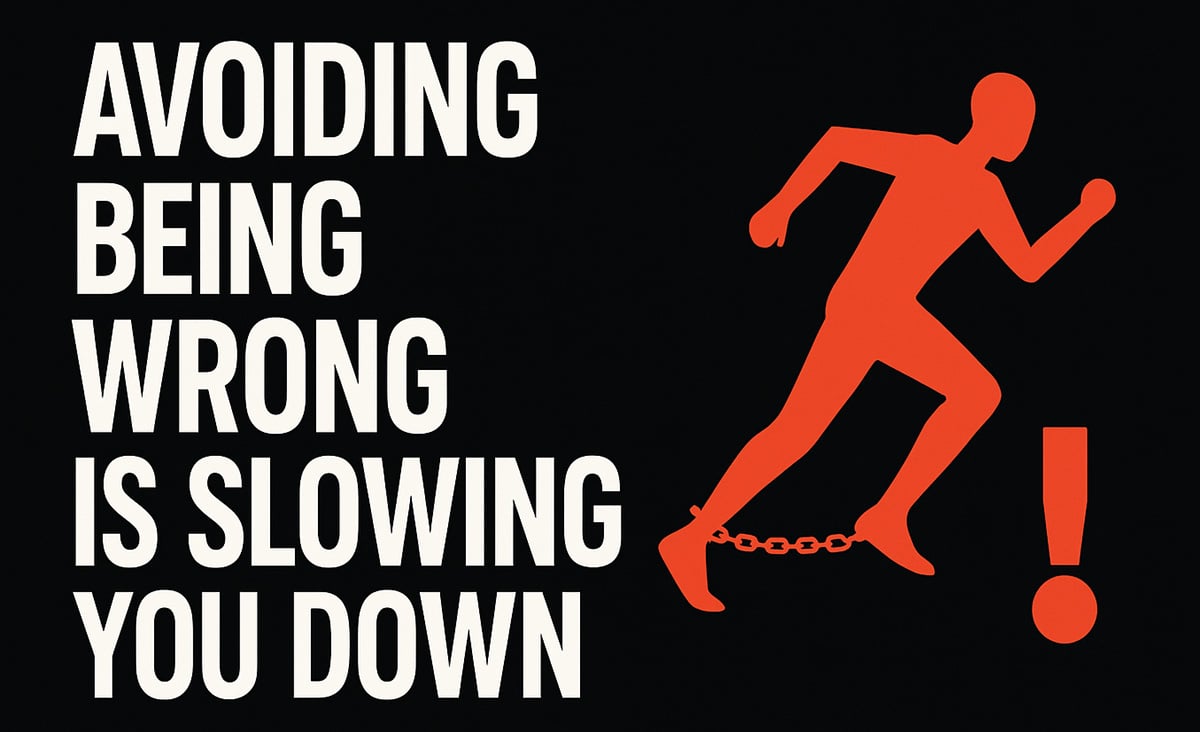
  • Stop avoiding being wrong (you are addicted to being right)

    In 2000, Blockbuster’s leadership team had a meeting that would go down in business history as one of the most expensive examples of righteous stupidity ever.

    Netflix founders Reed Hastings and Marc Randolph flew to Dallas to pitch a partnership to Blockbuster CEO John Antioco. Netflix was struggling – they were losing money, had only 300,000 subscribers, and were desperate. They offered to sell Netflix to Blockbuster for $50 million and run Blockbuster’s online division.

    The Blockbuster executives literally laughed them out of the room.

    Why? Because they were “right.” They had 9,000 stores, 60 million customers, and $6 billion in revenue. They were the undisputed kings of home entertainment. These Netflix guys with their silly mail-order DVD service? Please.

    Blockbuster’s leadership was so committed to being right about their existing model that they couldn’t see the future coming. They were so attached to their righteousness – “We’re the biggest, we’re the best, we know this industry” – that they missed the greatest opportunity in entertainment history.

    By 2010, Blockbuster filed for bankruptcy. Netflix, the company they could have bought for $50 million, was worth $13 billion.

    The Blockbuster executives were technically “right” in 2000 – they were bigger, more profitable, and had more customers. But their need to be right, their attachment to their existing success, their inability to be wrong about their core assumptions, killed them.

    Being right is killing your momentum and sucking joy out of your life

    Here’s the brutal truth that most leaders won’t admit: you’re so terrified of being wrong that you’ve turned your entire leadership style into one giant hedge bet. And it’s absolutely destroying or slowing down everything you’re trying to build.

    But let’s zoom out for a second and look at the bigger picture. This isn’t just a business problem. This is a human epidemic. We live in a world where people are literally willing to get fired, resign from prestigious positions, lose promotions they’ve worked decades for, go to war, and even commit acts of violence – all to protect their righteousness and avoid looking wrong.

    Think about that for a moment. Our beings are so fragile, our egos so brittle, that we’ll sacrifice our happiness, our relationships, our success, even our lives, just to avoid the temporary discomfort of being incorrect about something.

    I see it everywhere. In boardrooms where leaders speak in corporate-speak instead of taking clear positions. In strategy meetings where everyone’s “testing the waters” instead of making bold calls. In conversations where executives say things like “we’ll see how it goes” or “let’s wait and see what the data shows” when what their company actually needs is someone to plant their flag and say “this is what we’re doing.”

    But it goes deeper than business. Look at the political landscape – politicians destroying their careers rather than admitting they were wrong about a policy. Look at international relations – nations sending their young people to die rather than backing down from a position. Look at corporate scandals where executives double down on obviously failing strategies because admitting error feels like death.

    You know what this really is? It’s not prudent leadership. It’s not being strategic. It’s cowardice dressed up in business casual, and it’s the same cowardice that’s tearing apart families, organizations, and entire countries.

    The Global Pandemic of Fake Righteousness

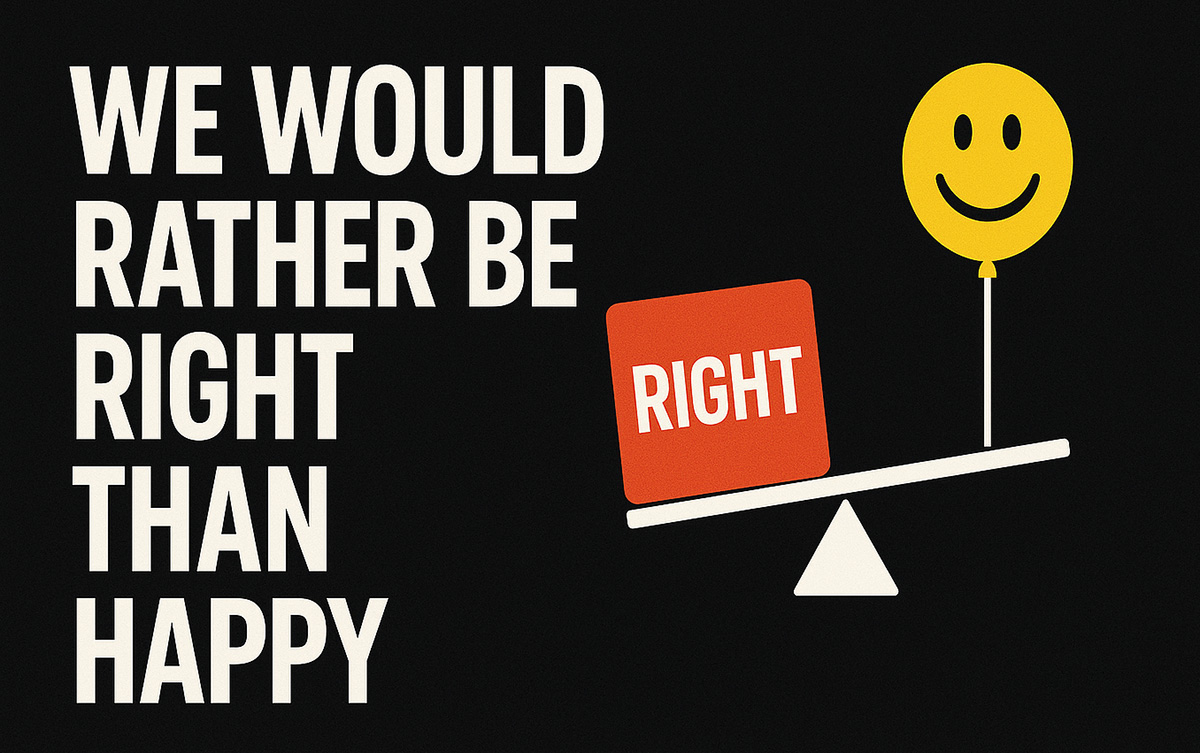
    Here’s what’s absolutely insane: we’d rather be right than happy. We’d rather be right than successful. We’d rather be right than loved. Left to our own devices, most of us would choose the bitter satisfaction of righteousness over the joy of actually getting what we want in life.

    And the most tragic part? Half the time, we’re not even actually right. We’re just committed to a position we took years ago that we can’t let go of because our entire identity has become wrapped up in it.

    I’ve watched CEOs tank their companies rather than admit their strategic vision was flawed. I’ve seen leaders in every industry – from tech to healthcare to government – choose career suicide over the simple phrase “I was wrong, let’s try something different.”

    We’ve created a world where being wrong is treated like a moral failing instead of what it actually is: information. Valuable, necessary information that helps us course-correct and improve.

    The Million-Dollar Lesson from an 80-Year-Old Badass

    Let me tell you about Mary Shakun, who didn’t start coaching until she was 65 and now charges over a million dollars a year. At 80 years old, she’s still cold-calling potential clients. But here’s what makes her extraordinary: when she sits across from someone with billion-dollar problems, she looks them in the eye and says, “I’m the only person in the world qualified to help you with this.”

    The kicker? She quietly admits that most of the time, that’s actually true.

    Think about that for a second. She shows up with 100% certainty while acknowledging she might be wrong some of the time. She’s not attached to being right – she’s committed to being certain.

    And that distinction is everything.

    While the rest of us are so terrified of that 1% chance of being wrong that we never show up powerfully at all, Mary has built a million-dollar business by being willing to be wrong occasionally in service of being powerful consistently.

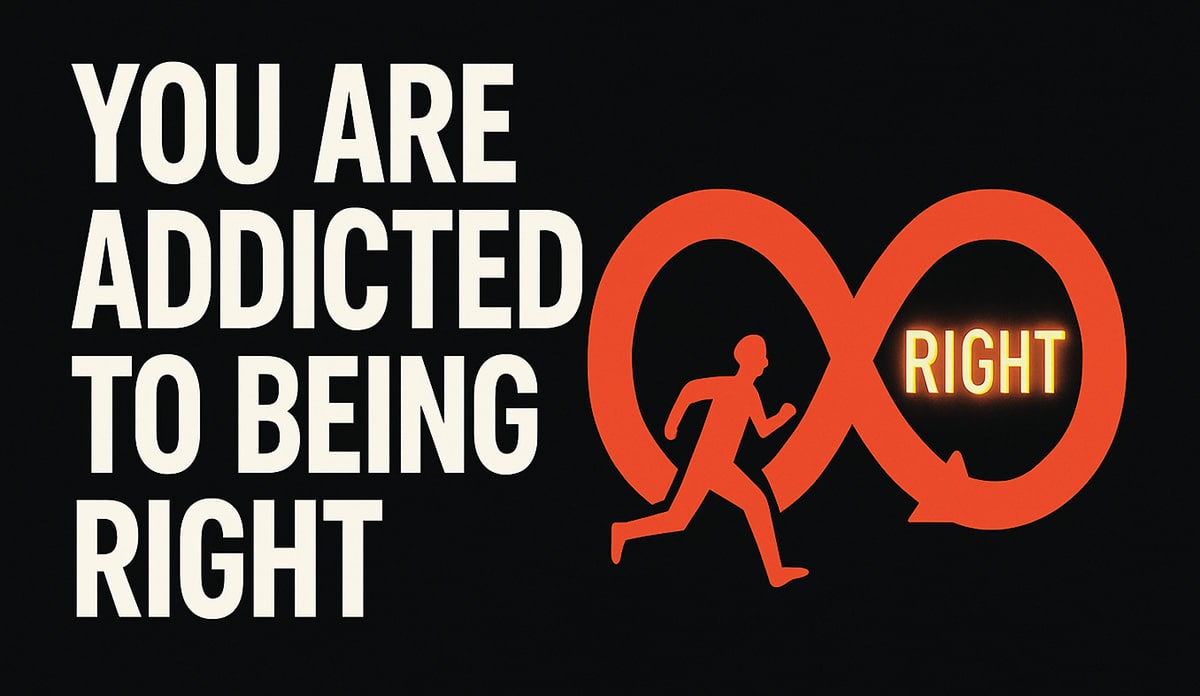
    You are addicted to being right

    Most leaders have this completely backwards. They think certainty means you have to be right all the time. So they hedge. They qualify. They create escape routes in every sentence they speak.

    “Well, if the market conditions remain favorable…” “Assuming our projections are accurate…” “We’re cautiously optimistic that…”

    Stop it. Just stop.

    This hedging isn’t just killing your business momentum – it’s killing your soul. Every time you refuse to take a stand, every time you speak in maybes and possibles, you’re slowly dying inside. Because deep down, you know you’re capable of so much more than this watered-down, committee-approved version of leadership.

    Certainty isn’t about being right. It’s about taking a position and moving powerfully from that place. Certainty is about taking action and making shit happen.

    Being right is just the post-game analysis – it’s what happened after you already took action. Being right is only about looking good and posturing.

    When you’re obsessed with being right, you’re living in the future results instead of the present moment where all your power actually lives. You’re so busy protecting yourself from the possibility of being wrong that you never fully commit to anything. And uncommitted leadership? That’s not leadership at all.

    Kodak

    In 1975, a Kodak engineer named Steve Sasson invented the world’s first digital camera. He presented his toaster-sized, 0.01-megapixel creation to company executives. Their reaction was not excitement, but fear. Kodak was a company built on film, paper, and chemicals—a highly profitable “razor and blades” business model. The executives were addicted to the “rightness” and profitability of this model.

    They asked Sasson, “Why would anyone ever want to look at their pictures on a television set?” Their entire worldview was based on physical prints. Admitting that Sasson’s invention was the future would mean admitting that their entire business model was, eventually, going to be wrong. So they did the unthinkable: they buried the technology. They told Sasson to keep his invention quiet, convinced that they could control the transition and protect their film empire forever.

    The Damage: Kodak’s addiction to being right about the supremacy of film was a corporate death sentence. While they sat on the patent, other companies like Sony, Canon, and Fuji developed their own digital cameras. When the digital wave finally crested, Kodak was woefully unprepared. They were too slow, too attached to their legacy, and too convinced of their own infallibility. The company that had once been a symbol of American innovation filed for bankruptcy in 2012.

    Your Rightness Addiction Is Costing You Everything

    Let’s get brutally honest about what this addiction to being right is actually costing you – because it’s not just professional, it’s existential:

    Your team’s respect. They can smell your uncertainty from a mile away. When you hedge every decision, speak in maybes, and constantly cover your bases, your people lose confidence in your ability to lead them anywhere worth going. They’d rather follow someone who’s wrong occasionally but decisive than someone who’s never wrong because they never actually say anything.

    Your company’s momentum. Momentum requires decisive action. When you’re always waiting for more data, more proof, more certainty that you’ll be right, opportunities slip by. Your competitors – the ones willing to be wrong sometimes – are eating your lunch while you’re still in analysis paralysis.

    Your own joy and aliveness. Think about the last time you felt truly alive as a leader. I bet it wasn’t during a meeting where you carefully managed everyone’s expectations. It was probably when you took a bold stand, made a big bet, or fought for something you believed in. That’s what certainty feels like – and you’ve been starving yourself of it.

    Your capacity to inspire. People don’t follow hedge bets. They follow vision, conviction, and leaders who are willing to put their reputation on the line for something bigger than themselves. When you’re more committed to being right than being powerful, you become utterly uninspiring.

    Your relationships. This doesn’t stop at work. How many marriages have been destroyed by the need to be right? How many friendships have ended because someone couldn’t just say “you know what, I was wrong about that”? Our addiction to righteousness is literally destroying our capacity for love and connection.

    The Global Cost of Our Fragile Beings

    Look around at the world we’ve created with this pathology. Political leaders who would rather watch their countries burn than admit their policies aren’t working. Business leaders who would rather see their companies fail than acknowledge their strategies are flawed. Religious and ideological leaders who would rather see their followers suffer than question their doctrines.

    We’re living in a world where people are willing to die – and kill – for the right to be right. Where entire industries collapse because no one in leadership has the courage to say “we got this wrong, let’s pivot.” Where families are torn apart over political disagreements that, in the grand scheme of things, matter far less than love and connection.

    This isn’t strength. This is the ultimate fragility – beings so terrified of being seen as fallible that they’ll sacrifice everything real and meaningful to maintain the illusion of infallibility.

    John McEnroe was a tennis genius, a player of sublime touch and creativity. But he was equally famous for being pathologically addicted to being right. For McEnroe, every line call he disagreed with wasn’t a judgment call—it was a clear and obvious error by an incompetent official. This conviction fueled his legendary on-court tantrums. His cry of “You cannot be serious!” to an umpire at Wimbledon in 1981 became his global catchphrase.

    Throughout his career, he refused to accept an official’s verdict if it contradicted his own. This wasn’t just theatrics; it was a core part of his psyche. He was so certain of his own perception that he couldn’t mentally proceed until he had raged against the injustice of being proven “wrong.” He berated umpires, smashed rackets, and argued endlessly, believing he was the sole arbiter of truth on the court.

    The Damage: McEnroe’s addiction to being right cost him dearly. His tirades led to countless point penalties, game penalties, and fines that lost him momentum and matches at crucial moments. Most famously, it led to him being defaulted from the 1990 Australian Open, a Grand Slam he had a real chance of winning.

    The Hedge Fund Life (And Why It’s Killing You)

    You know what a hedge fund is? It’s a financial instrument that pays off when everyone else is wrong. It’s literally designed to profit from other people’s failures.

    And that’s exactly how most leaders are living their lives – like one big hedge fund. Always positioning themselves to be able to say “I told you so” if things go south, always creating plausible deniability, always having an out.

    But here’s the thing about hedge fund thinking: it might protect you from being spectacularly wrong, but it also prevents you from being spectacularly right. It keeps you playing small, playing safe, playing not to lose instead of playing to win.

    Your people don’t need another hedge fund manager. They need a leader who’s willing to be wrong in service of something greater. They need someone who values progress over perfection, results over righteousness.

    The Courage to Be Wrong in Service of Being Powerful

    I’m not suggesting you become reckless or stop using your brain. I’m suggesting something far more radical: that you become willing to be wrong in service of being powerful.

    This is perhaps the most counterintuitive leadership principle of all time, but it’s also the most liberating. When you’re willing to be wrong, you can:

    • Make decisions faster while others are still gathering data
    • Communicate with clarity and conviction instead of corporate speak
    • Inspire others to follow your vision instead of your hedge bets
    • Take the risks that create breakthrough results
    • Learn and adapt quickly when things don’t go as planned
    • Actually enjoy the process of building something instead of constantly protecting yourself

    The best leaders I know aren’t right more often than everyone else. They’re just more willing to be wrong, which paradoxically makes them more powerful and, ultimately, more successful.

    They’ve learned that being wrong occasionally is the price of admission to playing a big game. And they’ve decided that price is worth paying.

    What Your Team Actually Needs From You

    Your team doesn’t need you to be right all the time. They need you to be certain about the direction you’re going, even when you don’t know exactly how you’ll get there.

    They need you to say things like:

    • “This is what we’re doing.”
    • “I’m confident we’ll figure it out.”
    • “We’re going to make this work.”
    • “I believe in this vision completely.”

    Not because you have a crystal ball, but because someone has to plant the flag. Someone has to say “we’re going this way” so everyone else can stop looking around wondering what the plan is.

    Your people are drowning in uncertainty. They don’t need more analysis or more hedging. They need someone willing to take a stand, point in a direction, and say “follow me” – even if there’s a chance that direction might need to change later.

    The Daily Practice of Certainty

    So how do you break this addiction to being right and start living from certainty? Start small, but start today:

    In your next meeting, instead of saying “I think maybe we should consider…” try “Here’s what we’re going to do…”

    When someone asks for your opinion, give it without hedging. Not “Well, there are pros and cons to both approaches…” but “My recommendation is X because…”

    In your personal life, practice certainty in low-stakes situations. “It’s going to be a great day.” “We’ll get a good table at the restaurant.” “This project is going to work out perfectly.”

    With your team, communicate vision and direction as certainties, not possibilities. Instead of “If everything goes according to plan, we might be able to…” try “When we achieve this goal…”

    When you’re wrong, practice saying “I was wrong about that” without immediately explaining why you were wrong or how it wasn’t really your fault. Just own it, learn from it, and move on.

    The Liberation of Letting Go

    Here’s what happens when you stop needing to be right all the time: you become free. Free to take bigger swings. Free to communicate with power and conviction. Free to inspire others. Free to fail spectacularly and learn rapidly. Free to change your mind when new information comes in. Free to be human.

    You know what the most successful entrepreneurs and CEOs have in common? They’ve all been wrong. A lot. Publicly. Expensively. And they kept going anyway.

    Jeff Bezos was wrong about the Fire Phone. Steve Jobs was wrong about the Lisa computer. Elon Musk has been wrong about Tesla production timelines approximately 47,000 times. But they’re all still willing to make bold predictions and take big stands.

    Because they understand what you’re learning right now: being wrong occasionally is the price of admission to playing a big game. And playing it safe? That’s not safety – that’s just a slow death.

    Your Certainty Challenge

    Here’s your challenge for the next 30 days: Practice showing up with certainty in at least one interaction every day. Not because you know you’ll be right, but because someone needs to take a stand.

    Make predictions. Give recommendations without qualifiers. Take positions. Communicate your vision as if it’s inevitable, not just possible.

    And when you’re wrong – because you will be sometimes – practice taking that with grace and moving on. Don’t let the fear of those moments keep you from the power and joy that comes from living with certainty.

    Your company needs a leader, not a hedge fund manager. Your team needs someone with conviction, not someone who’s always covering their bases. Your family needs someone who values relationship over righteousness. And you deserve to experience the aliveness that comes from playing full out, even when you can’t guarantee the outcome.

    Stop saving your certainty for when you know you’ll be right. By then, it’s too late. The opportunity, the moment, the chance to lead – it’s all passed you by.

    The world is waiting for what you have to offer. But it needs you to offer it with certainty, not hesitation. It needs leaders who are more committed to creating results than protecting their image. It needs people who would rather be happy than right, successful than righteous, powerful than perfect.

    Your being is not as fragile as you think. You can survive being wrong. You might not survive never trying.


  • Leadership Journeys [234] – Siddhi Joshi – “Being a CEO & the only female employee was adventurous”

    This is the Leadership Journey series on the Choosing Leadership Podcast.

    I believe we all have a lot to learn from each other’s stories – of where we started, where we are now, and our successes and struggles on the way. With this series of interviews, my attempt is to give leaders an opportunity to share their stories and for all of us to learn from their generous sharing. If you know a leader whom you would like to see celebrated on the show, please send me a message on LinkedIn with their name.

    What does it take to lead in an industry that tells you you don’t belong?

    In this powerful conversation, Siddhi Joshi, CEO of Emos UAE, shares how she broke barriers, built the region’s top relocation company, and created space for women to lead boldly.

    From emotional intelligence to Gen Z leadership hacks, she drops real-world insights you can apply today—whether you’re managing a team or building one from scratch.

    We also dive into how she scales culture with intentional themes like “License to Question” and why she believes human connection is the ultimate leadership edge.

    If you’re ready to rethink what’s possible in your leadership, this episode is your permission slip.

    You can find Siddhi Joshi at the below links

    In the interview, Siddhi shares

    • “Leadership is not about serving content—it’s about shifting the context.”
    • “I was told logistics wasn’t a space for women. So I built a team of all-female packers instead.” – Siddhi Joshi
    • “You don’t need industry experience to lead—you need vision, courage, and emotional intelligence.”
    • “My father led without boundaries. I’ve made that philosophy my legacy too.” – Siddhi Joshi
    • “Micromanagement is out. Clear goals and empowered teams are the future.”
    • “Gen Z doesn’t want a boss—they want a partner in growth. Adapt or get left behind.”
    • “Leadership isn’t about knowing it all. It’s about creating the space for others to shine.”
    • “We introduced a company theme: ‘License to Question.’ Because culture changes when conversations change.”
    • “Emotional intelligence isn’t soft. It’s the hardest, most human edge in leadership today.”
    • “If you want to lead, get personal. Understand your people beyond their job titles.”
  • Leadership Journeys [233] – Bidhan Baruah – “ I spend 70% of my time in one-on-ones with my teams”

    This is the Leadership Journey series on the Choosing Leadership Podcast.

    I believe we all have a lot to learn from each other’s stories – of where we started, where we are now, and our successes and struggles on the way. With this series of interviews, my attempt is to give leaders an opportunity to share their stories and for all of us to learn from their generous sharing. If you know a leader whom you would like to see celebrated on the show, please send me a message on LinkedIn with their name.

    What does it take to grow a company from a basement startup to a 400-person powerhouse?

    In this episode, Bidhan Baruah, co-founder and COO of Taazaa Inc., shares how he chose leadership not as a position, but as a mindset—grounded in empathy, accountability, and bold vision.

    We dive into how he spends 70% of his time in one-on-ones, why balancing psychological safety with performance matters, and how he’s future-proofing his business through AI.

    If you’re a leader feeling stuck or navigating change, this conversation is a practical and inspiring nudge forward.

    Tune in to be reminded that you can lead with heart, and still build something extraordinary.

    You can find Bidhan Baruah at the below links

    In the interview, Bidhan shares

    • “Leadership is a choice—and Bidhan Baruah chose courage over comfort when he left the safety of a stable job to build a company from a basement.”
    • “Empathy isn’t a buzzword for Bidhan—it’s a strategy. He spends 70% of his time in 1:1s to build trust, reduce attrition, and create loyalty.”
    • “Leadership isn’t about having all the answers—it’s about being willing to ask the hard questions while making people feel safe to do the same.”
    • “In a world rushing toward AI, Bidhan is not just adapting—he’s educating. Because future-proofing means teaching before transforming.”
    • “Culture isn’t created by accident. It’s built moment by moment—in how you listen, how you lead, and how you show up for your team.”
    • “From off-roading to running a 400-person tech company, Bidhan thrives at the edge of risk and precision. That’s where real growth lives.”
    • “True leadership is being willing to step into the unknown—with empathy in one hand and accountability in the other.”
    • “If you want to build something that lasts, start by understanding your people—not just their skills, but their stories.”
    • “AI might be the future, but leadership remains deeply human. That’s Bidhan’s secret: embracing both.”
    • “Choosing leadership isn’t about titles—it’s about taking ownership, staying curious, and committing to continuous reinvention.”
  • Stop Pleasing People. Start Serving Them (Distinction)

    The Leadership Trap: Why Serving Beats Pleasing Every Time

    How breaking free from this childhood programming of pleasing others can transform your leadership and life


    Picture this: You’re in a meeting, and something isn’t right. The project is headed toward disaster, but everyone’s nodding along. You know you should speak up, but… what if they don’t like what you have to say? What if it makes waves? So you stay quiet, smile, and hope someone else will be the bad guy.

    Sound familiar? Welcome to the pleasing trap – the invisible prison that’s keeping most leaders from their true potential.

    The Programming We Can’t See

    Here’s the uncomfortable truth: We’re all walking around with childhood software that’s completely obsolete for adult leadership. As kids, our survival literally depended on pleasing the giants (our parents, teachers, etc) who fed us, sheltered us, and kept us safe.

    How We Got Programmed to Please:

    • Survival Strategy: Small children learned that pleasing powerful adults meant getting food, shelter, and safety
    • Parental Reinforcement: “Good job, sweetheart!” “You were so well-behaved today!” “Mommy’s so proud when you’re nice to everyone!”
    • Personality Formation: We built our entire identity around what worked to win approval
    • Biological Programming: Our psychological “brain” got hardwired to seek approval first, serve second

    This is not wrong or bad. This is just what it is. This is how kids grow up. This is how we treat kids to help them grow up.

    The Invisible Impact (Fish in Water Effect):

    This programming runs so deep it’s like being a fish in water – we can’t see it because we’re swimming in it. Every day, leaders unconsciously deploy these same tactics:

    • Communication: Carefully crafted emails that say nothing substantial
    • Meetings: Everyone agrees but nothing actually gets decided or done
    • Feedback: Dancing around real issues to avoid discomfort
    • Decision-Making: Choosing what’s popular over what’s right

    But here’s the kicker – what kept us alive as children is killing our leadership as adults.

    The Hidden Cost of Pleasing

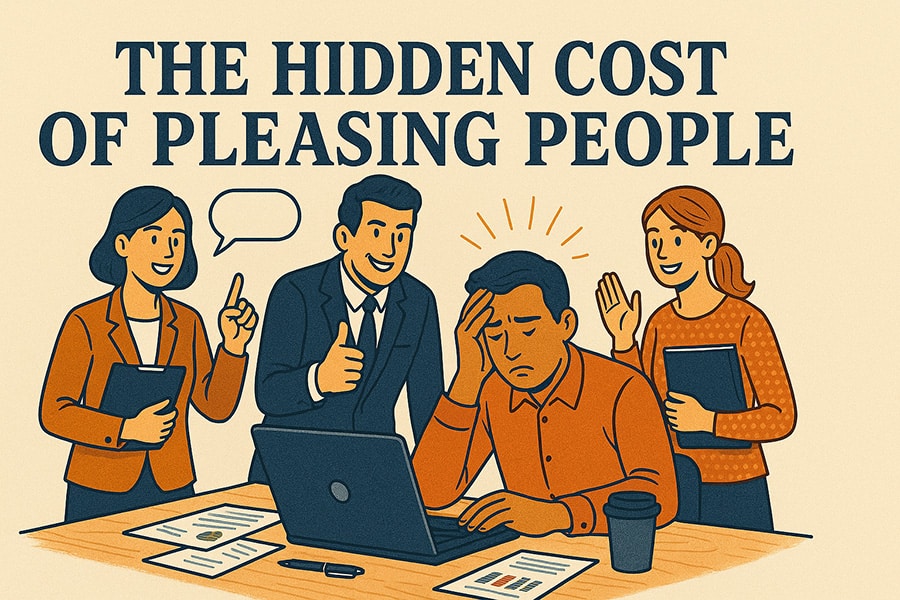
    When leaders operate from a pleasing mindset, they’re not just being ineffective – they’re creating a slow-motion disaster.

    The Organizational Impact:

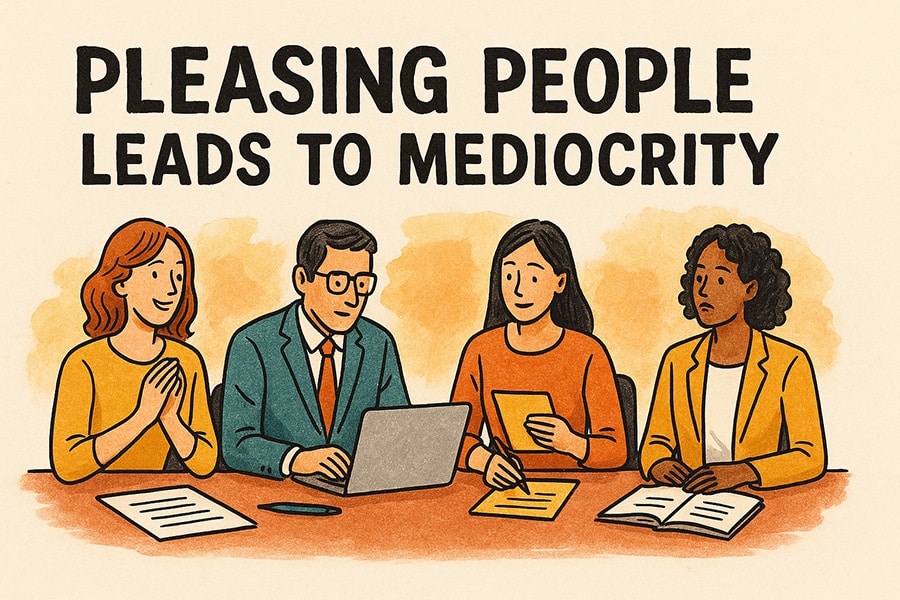
    • Mediocrity Becomes Normal: Every avoided difficult conversation teaches your team that “good enough” is acceptable
    • Problems Fester: Issues that could be solved early become organizational cancer
    • Trust Erodes: People sense the inauthenticity and distance themselves
    • Results Suffer: Short-term comfort destroys long-term success

    The Personal Cost:

    Leaders who default to pleasing report:

    • Chronic Exhaustion: Constantly performing drains your energy
    • Emotional Isolation: Never sure if people like you or just your pleasing persona
    • Frustration: Knowing you’re not operating at your full potential
    • Disconnection: Relationships feel surface-level and transactional
    • Imposter Syndrome: Living as a performing self instead of authentic self

    It’s a lonely, miserable way to live – and it shows up in everything from their energy levels to their ability to inspire genuine loyalty.

    I speak from personal experience. I have spent most of my life pleasing people and avoiding any uncomfortable situation.

    The Service Revolution

    Now let’s talk about the alternative that changes everything: service (of the person in front of you). Real service isn’t about being nice or making people happy – it’s about making their lives genuinely better, even when it’s uncomfortable to you or them.

    Giving alcohol to an alcoholic would be pleasing them.

    Sending them to rehab would be serving them, even though that would not please them and they might even hate you for it.

    That’s what real leadership looks like – sometimes you have to disturb the peace to create something better.

    What Service Requires (That Pleasing Never Does):

    • Courage: Telling someone what they need to hear instead of what they want to hear
    • Strength: Holding your ground when your service isn’t immediately appreciated
    • Wisdom: Knowing that sometimes the most loving thing you can do is be the villain in someone else’s story
    • Confidence: Believing in your ability to add value, even when it’s not immediately recognized
    • Authenticity: Operating from your true self, not your performing self

    Service in Action: Growing Up as a Leader

    1. Team Alignment: The Truth-Telling Leader

    The Situation: Gunjan, a VP at a tech startup, noticed her team was consistently missing deadlines.

    The Pleasing Approach Would Have Been:

    • Work around the problem (hire more people, extend timelines)
    • Avoid confrontation
    • Hope things improve naturally
    • Make excuses for the team

    The Service Approach:

    • Called a direct meeting: “We need to talk about what’s really happening here”
    • Created space for honest conversation
    • Uncovered the real issues: team conflict, personal overwhelm, secret drowning in stress
    • Focused on solutions, not blame

    The Result: Team hit their next three deadlines ahead of schedule.

    2. Sales: The Demonstration of Value

    Instead of the typical pleasing approach:

    • Song-and-dance of features and benefits
    • Trying to “win over” prospects
    • Focusing on what they want to hear
    • Building fake rapport

    Service-oriented leaders focus on:

    • Immediate value demonstration
    • Asking: “What’s the biggest challenge you’re facing right now?”
    • Spending time actually helping them (for free) and not chit-chatting
    • Refusing to spend time on frivolous issues or waiting
    • Making their life better before asking for anything

    Example: Shiv, a consultant, stops trying to “win over” prospects and instead spends 15 minutes helping them think through their biggest challenge. He raises an objection and is willing to walk away if he is made to wait for the potential client and not treated as an equal.

    This isn’t a sales tactic; it’s genuine service. People don’t need to be convinced to work with someone who’s already making their life better.

    3. Trust Building: The Accountability Partner

    Service-Based Trust Building:

    • Do what you say you’ll do (reliability)
    • Hold others accountable to their commitments. Don’t let them slip.
    • Refuse to let people settle for less than their potential
    • Create psychological safety through consistency

    Example: Jennifer, a CEO, serves her leadership team with monthly “reality check” sessions. She asks each leader:

    • Where are you struggling?
    • What support do you need?
    • What’s one thing you’re avoiding?
    • How can we help you succeed?

    It’s not comfortable, but it’s transformed how they work together because everyone knows they can count on honest feedback and real support.

    4. Holding Others Accountable: The Courageous Conversation

    This might be the ultimate test of service versus pleasing.

    The Pleasing Approach:

    • Let underperforming team members slide
    • Avoid difficult conversations
    • Hope things improve on their own
    • Enable mediocrity to keep peace

    The Service Approach:

    • “I care about your success too much to let this continue”
    • “Let’s figure out what needs to change”
    • Be willing to be the bad guy today to help someone become better tomorrow
    • Focus on their growth, not their comfort

    Key Mindset Shift: You’re not being mean; you’re being loving enough to have the hard conversation.

    5. Living a Happy and Joyful Life: The Authentic Path

    The Pleasing Paradox: The more you try to make everyone happy, the more miserable you become.

    Benefits of Serving irrespective of how it is received:

    • Live from your authentic self instead of your performing self
    • Stop exhausting yourself trying to be everything to everyone
    • Start energizing yourself by making a real difference
    • Feel more connected, purposeful, and genuinely happy

    What Service-Oriented Leaders Report:

    • Better sleep (knowing they’re making a genuine difference)
    • More energy (excited about problems to solve and people to help)
    • Deeper relationships (based on authenticity, not performance)
    • Greater life satisfaction (purpose-driven instead of approval-driven)

    The Uncomfortable Truth About Service

    Let’s be honest: service isn’t always popular. When you serve people, sometimes they don’t like it. Sometimes they resist. Sometimes they push back. And that’s okay – it’s part of the job.

    Why Service Can Be Uncomfortable:

    • Immediate Resistance: People might not want what they need
    • Short-term Friction: Disturbing the status quo creates temporary discomfort
    • Rejection Risk: Some people will say no to being served
    • Misunderstanding: Your motives might be questioned initially
    • Responsibility: You’re accountable for the outcomes you create

    That’s what service looks like in leadership – you’re willing to risk the rejection because you believe in the value you’re providing.

    The Deathbed Question

    Steve Chandler asks a powerful question: When you’re on your deathbed, what will you ask yourself?

    • “How many people did I please?”
    • “Did I avoid enough conflicts?”
    • “Was I liked by everyone?”
    • A career of avoided conflicts, missed opportunities, and relationships that never quite felt real

    OR

    • “How many people did I serve?”
    • “What difference did I make?”
    • “Is life different because I was here?”
    • A life of genuine impact, authentic relationships, and problems solved

    Making the Switch: From Pleasing to Service

    Start Small – Daily Practice Questions:

    In your next meeting, ask yourself:

    • “What would serve this group right now?”
    • “What question needs to be asked that no one wants to ask?”
    • “What’s the elephant in the room?”
    • “What assumption is holding everyone back?”

    In your next one-on-one:

    • Instead of: “How can I help you?” (often leads to pleasing)
    • Ask: “What do you need to hear right now that you’re not hearing?”

    In your next difficult conversation:

    • Instead of softening the message to make it palatable
    • Deliver it with love but without dilution

    The Three-Step Service Framework:

    1. Identify the Need: What does this person/situation actually need (not want)?
    2. Assess Your Ability: Can you genuinely serve this need?
    3. Deliver with Love: Provide the service, even if it’s uncomfortable

    The Service Mindset: Key Mental Shifts

    From Pleasing Questions to Service Questions:

    PleasingServing
    “How can I make this person happy?”“How can I make this person better?”
    “What do they want to hear?”“What do they need to hear?”
    “How can I avoid conflict?”“How can I create value?”
    “Will they like me?”“Will this help them?”
    “What’s the safe thing to do?”“What’s the right thing to do?”

    Service = Ownership: Taking full responsibility for demonstrating value and making someone’s life better

    Pleasing = Victim: Believing all power is outside of you, requiring approval from others to feel safe

    The Ripple Effect: What Changes When You Serve

    For Your Team:

    • Real Conversations: Replace polite agreements with honest dialogue
    • Problem-Solving: Address actual issues instead of managing around them
    • Psychological Safety: People feel safe to be authentic and vulnerable
    • Higher Performance: Standards rise when mediocrity is no longer acceptable

    For Your Organization:

    • Culture Shift: From artificial harmony to genuine collaboration
    • Innovation: People feel safe to challenge assumptions and propose bold ideas
    • Accountability: Everyone holds themselves and others to higher standards
    • Results: Better outcomes because truth drives decision-making

    For You:

    • Authenticity: Finally get to be yourself instead of performing
    • Energy: Feel energized by making a difference instead of drained by performance
    • Relationships: Build connections based on genuine value, not transactions
    • Legacy: Look back on a life well-lived and say, “I made a difference”

    The choice is yours: Will you spend your career trying to please everyone, or will you commit to serving them?

    Make It Count

    • This Week: Identify one difficult conversation you’ve been avoiding and schedule it
    • This Month: Ask your team what they need to hear that they’re not hearing
    • This Quarter: Implement one uncomfortable change that will genuinely serve your organization
    • This Year: Build a reputation as someone who makes people’s lives better, not just happier

    The difference isn’t just in the results you’ll produce – it’s in the person you’ll become.

    Remember: Service isn’t about being perfect. It’s about being willing to risk temporary discomfort for lasting value. That’s not just better leadership – that’s a better life.

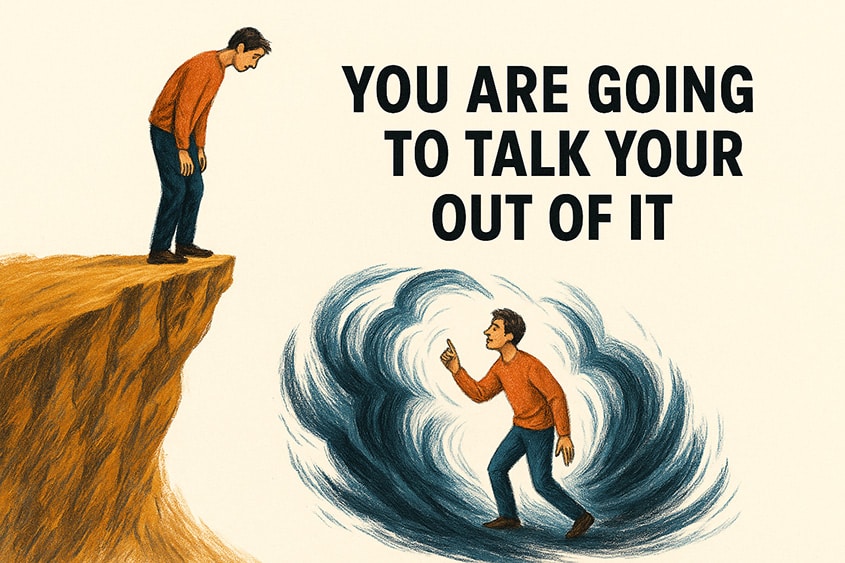
  • You Are Going to Talk Yourself Out of It

    We all do this – Talk Ourselves Out of Our Commitments

    And that’s exactly what we need to talk about.

    If you’ve just had a powerful conversation with me about your future—the one that made your heart race and your mind light up with possibility—I need you to know something important: you’re probably going to talk yourself out of it.

    Not because you don’t want it (the new possibility). Not because it’s not right for you. But because your brain is about to do what brains do when faced with something bigger than they’re used to: protect you from what it perceives as danger.

    I’m writing this because I’ve seen it happen hundreds of times. Someone leaves our call feeling electric, inspired, clear about what they want to create. Then, 24 to 48 hours later, the doubts creep in. The “what ifs” start multiplying. The practical concerns suddenly seem insurmountable.

    And if I don’t hear from them, I know exactly what’s happening. They’re sitting at their kitchen table or in their car, having a mental wrestling match with themselves. They’re building a case for why now isn’t the right time, why they should wait, why they need to be more prepared.

    We all talk ourselves out of our dreams and commitment. And we always have good reasons for that.

    Here’s what I want you to know is:

    • This is not a character flaw
    • This is not weakness. There is nothing wrong with you.
    • This is not a sign that you’re not ready or that the dream isn’t real
    • This is your nervous system doing exactly what it was designed to do—keep you safe and comfortable

    Your Brain Doesn’t Know the Difference Between a Tiger and a Dream

    Let me tell you about Shruti, a tech company CEO who came to me feeling stuck. She’d been in the same role for three years, comfortable but unfulfilled. She had a vision of starting her own consulting firm, helping companies build more human-centered cultures. When we talked, her eyes lit up. She could see it all—the clients she’d work with, the impact she’d make, the freedom she’d have.

    Two weeks later, she hadn’t returned my call.

    When we finally connected, she was embarrassed. “I got scared,” she admitted. “I started thinking about everything that could go wrong. What if I can’t get clients? What if I fail? What if I’m not as good as I think I am?”

    Her brain couldn’t tell the difference between a sabre-toothed tiger and starting a consulting firm. Both triggered the same ancient alarm system: DANGER. THREAT. RETREAT.

    Your brain evolved in a world where taking big risks often meant death. The person who decided to explore that dark cave might have found food—or they might have become food. The brain that kept humans alive was the one that said, “Better safe than sorry.”

    That same brain is now trying to keep you “safe” from your dreams. It’s flooding you with cortisol and adrenaline, making you feel anxious and overwhelmed. It’s not trying to sabotage you—it’s trying to save you.

    The Committee Meeting in Your Head

    After a coaching conversation (sometimes even a regular conversation) with me – especially if you find it insightful or powerful, something predictable is going to happen. Your brain is going to call a committee meeting. And this committee is not your friend.

    The committee members include:

    The Accountant: “Do you know how much this costs? You could use that money for so many other things. What about the roof? What about retirement? This is irresponsible.”

    The Comfort-Seeker: “You’re already so busy. Do you really want to add more stress to your life? Things are fine the way they are. Why rock the boat?”

    The Inner Critic: “Remember when you tried that other thing and it didn’t work out? You’re not disciplined enough for this. You’re going to disappoint everyone, including yourself.”

    The Social Worrier: “What will your spouse think? Your friends? Your colleagues? They’ll think you’re going through a midlife crisis. They’ll think you’re being frivolous.”

    This committee’s job is to maintain the status quo. They’re not interested in your growth or your dreams. They’re interested in keeping everything exactly as it is, because that feels safe.

    And here’s the kicker: they’re going to make very logical, rational-sounding arguments.

    They’re not going to say, “Don’t do this because you’re scared.”

    They’re going to say, “Don’t do this because it’s financially irresponsible” or “Don’t do this because the timing isn’t right.”

    PS – The committee is just a dramatic name for your brain and nervous system.

    The Vulnerability Hangover

    Let me tell you about Marcus, a successful lawyer who came to me feeling empty despite his achievements. In our session, he shared something he’d never said out loud: he wanted to write a book about his experience growing up in foster care and how it shaped his drive to help others.

    He left our call feeling alive, purposeful, clear. Three days later, he was mortified. “I can’t believe I told you that,” he said. “I sound like such a cliché. A lawyer who wants to write a book? How original.”

    This is what I call the vulnerability hangover. When you share your deepest dreams with someone, you’re being incredibly vulnerable. In the moment, it feels amazing—like you’re finally being seen for who you really are. But later, when the emotional high fades, that vulnerability can feel terrifying – like a hangover.

    Your brain starts saying:

    • “Why did you tell them that? Now they know.”
    • “What if you can’t do it? What if you fail?”
    • “You’ll look like a fool.”

    The easiest way to deal with this discomfort is to distance yourself from the person who witnessed your vulnerability.

    If you avoid me, you can avoid the reminder of what you shared. You can avoid the accountability. You can avoid the possibility of disappointment.

    But you can not avoid that dream that you have hiding and holding down for years – sometimes even for – decades.

    The Gap Between Who You Are and Who You Could Be

    Here’s what’s really happening: in our conversation, I helped you see a version of yourself that’s bigger than your current reality. I held up a mirror that showed not who you are today, but who you could become.

    This creates what I call the “aspiration gap“—the space between your current self and your potential self. This gap is both incredibly exciting and absolutely terrifying.

    On one hand, it’s thrilling to see what’s possible. On the other hand, it’s overwhelming to think about all the changes you’d need to make to get there.

    Let me tell you about Jennifer, a marketing director who came to me feeling burned out. She had a vision of creating a more balanced life, maybe even starting her own agency. When we talked, she could see it all clearly. But a week later, she was paralyzed.

    “I was so excited on our call,” she told me. “But now I’m looking at my life and I don’t know how to get from here to there. It feels impossible.”

    Jennifer wasn’t backing away from her dream. She was backing away from the seemingly impossible journey between where she was and where she wanted to be.

    What I Want You to Know About Me

    If you’re reading this and feeling called out, if you’re recognizing yourself in these stories, I need you to know something important: I am the last person you need to worry about disappointing.

    Here’s what I’m NOT here to do:

    • to judge you
    • to be disappointed in you
    • to make you feel guilty or ashamed
    • to keep score of your progress
    • to wait for you to prove yourself

    Here’s what I AM:

    • Someone who’s been where you are
    • Your thinking partner and reality check
    • Your reminder of what’s possible
    • Here to help you take the next step
    • Someone who will never judge you
    • Someone who will never give up on you
    • Someone whom you can always count on

    I’ve been where you are. I’ve had the dreams that seemed too big, the visions that felt too scary to pursue. I’ve felt the vulnerability hangover after sharing something deeply personal. I’ve had my own committee meetings where every logical voice said, “Don’t do it.”

    When I decided to leave my lucrative tech career to become a coach (which took me 8 years), my own brain went into overdrive. “You’re giving up a sure thing for what? To help people? That’s not a real job. You’re being irresponsible. You’re going to fail.”

    I almost talked myself out of it a dozen times. The only difference is that I had someone in my corner who understood what was happening—someone who helped me see that the fear was not a stop sign but a sign that I was onto something important.

    I’m that person for you now.

    The Fear Is Not the Enemy

    Here’s what I’ve learned: the fear you’re feeling isn’t a bug in the system—it’s a feature. It’s your brain’s way of saying, “This matters. This is important. This could change everything.”

    The bigger the dream, the bigger the fear. If you weren’t scared, it would mean the goal wasn’t significant enough to trigger your growth edge.

    Let me tell you about Ahmed, a CEO who came to me wanting to transform his company culture. He had a vision of creating a workplace where people actually wanted to be, where they felt valued and heard. In our session, he was passionate, clear, committed.

    A week later, he was second-guessing everything. “Maybe I’m being too idealistic,” he said. “Maybe this is just how business works. Maybe I should focus on the numbers and leave the touchy-feely stuff alone.”

    “Ahmed,” I said, “if this were easy, if it didn’t scare you, would it be worth doing?”

    He was quiet for a long moment. Then: “No. If it were easy, someone would have done it already.”

    The fear wasn’t telling him to stop. It was telling him he was onto something that mattered.

    What to Do When the Committee Convenes

    So what do you do when the committee in your head starts its meeting? When the doubts creep in and the excuses start forming?

    Your Four-Step Process:

    1. Expect it. Don’t be surprised when it happens. Say to yourself, “Oh, there’s my brain trying to keep me safe. Right on schedule.”
    2. Don’t fight it. Don’t try to push the fear away or pretend it doesn’t exist. Acknowledge it. “I hear you, brain. You’re scared. Thank you for trying to protect me.”
    3. Remember who’s in charge. The committee doesn’t get to make the final decision. They get to voice their concerns, but they don’t get to vote on your future. Only you get to do that.
    4. Call me. Seriously. Don’t sit with this alone. Don’t let the committee be the only voices in your head. Let me be your thinking partner, your reality check, your reminder of what’s possible.

    The Smallest Possible Step

    One of the reasons people retreat is because the dream feels too big, too overwhelming. Going from where you are to where you want to be feels like trying to leap across the Grand Canyon.

    But here’s the thing: you don’t need to leap across the Grand Canyon. You just need to take one step in the right direction.

    Real examples of first steps:

    Shruti (VP who wanted to start consulting): Her first step wasn’t quitting her job or finding clients. It was spending 15 minutes writing down what she’d learned about culture change in her current role.

    Marcus (lawyer who wanted to write a book): His first step wasn’t writing a book proposal or finding a publisher. It was spending 10 minutes journaling about one memory from his childhood.

    Jennifer (marketing director who wanted more balance): Her first step wasn’t starting an agency or negotiating a new work arrangement. It was blocking out 30 minutes on her calendar for a walk.

    The goal isn’t to solve everything at once. The goal is to take one small step that proves to yourself that change is possible.

    You Don’t Have to Be Ready

    Let me tell you a secret: no one is ever really ready for the thing that will change their life. You don’t become ready by waiting, by preparing more, by getting all your ducks in a row. You become ready by starting.

    You are waiting for readiness to start. Without realising that you become ready by starting.

    Every successful person I know—every leader who’s created something meaningful, every entrepreneur who’s built something lasting, every person who’s made a significant change—they all started before they were ready.

    They started:

    • Scared
    • Uncertain
    • With incomplete information
    • With imperfect plans

    But they started.

    An Invitation, Not a Demand

    I’m writing this to help you understand what’s happening in your brain so you can make a conscious choice instead of an unconscious one.

    If you decide that now isn’t the right time, that’s okay. If you decide that the dream isn’t worth the discomfort, that’s your choice to make.

    But I want you to make that choice consciously, not because your brain hijacked the decision-making process.

    And if you do decide to move forward, I want you to know that you don’t have to do it alone. You don’t have to figure it all out by yourself. You don’t have to be perfect or have all the answers.

    You just have to be willing to take the next step.

    The Dream Is Still There

    Here’s what I know about you: the dream that showed up in our conversation is still there. The vision you had, the excitement you felt, the clarity you experienced—that wasn’t fake. That wasn’t a moment of delusion. That was you catching a glimpse of who you really are and what you’re really capable of.

    Remember:

    • The fear might have dimmed that light, but it hasn’t extinguished it. It’s still there, waiting for you to fan it back into a flame.
    • The committee in your head is loud, but it’s not the only voice. There’s another voice—quieter, gentler, but infinitely wiser
    • It’s the voice that brought you to our conversation in the first place. It’s the voice that knows what you’re capable of

    Listen to that voice. Trust that voice. Follow that voice.

    And when you’re ready—not when you’re fearless, but when you’re ready to move forward despite the fear—I’ll be here. Not to judge you or pressure you or make you feel guilty, but to remind you of what’s possible and to help you take the next step.

    Your dream is still valid. Your vision is still real. Your future is still waiting.

    And I’m still here, ready to help you create it.

    The only question is: are you ready to stop talking yourself out of it?

  • Leadership Journeys [232] – Craig Dunham – “ You can be direct and transparent without being mean.”

    This is the Leadership Journey series on the Choosing Leadership Podcast.

    I believe we all have a lot to learn from each other’s stories – of where we started, where we are now, and our successes and struggles on the way. With this series of interviews, my attempt is to give leaders an opportunity to share their stories and for all of us to learn from their generous sharing. If you know a leader whom you would like to see celebrated on the show, please send me a message on LinkedIn with their name.

    What does it really take to lead with both courage and clarity in today’s chaotic business world?

    In this episode, Craig Dunham, CEO of Voltron Data, shares raw and practical lessons from the trenches—from making tough career pivots to leading teams through high-stakes acquisitions.

    He talks about the power of directness, why transparency beats politeness, and how routine and self-care fuel high-performance leadership.

    If you’ve ever struggled with balancing empathy and honesty, or felt overwhelmed by shifting priorities, this conversation is your compass.

    Tune in to discover how choosing leadership—again and again—isn’t about perfection, but about presence, priorities, and purpose.

    You can find Craig Dunham at the below links

    In the interview, Craig shares

    • “Leadership is a conscious choice—it’s about stepping into discomfort, not away from it.” 
    • “You can be direct and transparent without being harsh. Honesty builds trust when it’s delivered with empathy.” 
    • “The most transformative growth often follows the most difficult decisions.” 
    • “Being a repeat CEO doesn’t make the job easier—it just sharpens your ability to prioritize and stay even-tempered.” 
    • “I’ve learned that switching contexts rapidly—without losing focus—is a leadership muscle you have to build over time.”
    • “Taking care of your body and mind isn’t optional. It’s the foundation of sustainable leadership.” 
    • “In a noisy market, clarity of mission and message is what makes a company stand out.” 
    • “As your company grows, your leadership must evolve. What got you here won’t get you there.” 
    • “Leadership is less about knowing all the answers, and more about being willing to navigate uncertainty with integrity.”
  • Leadership Journeys [231] – Crafting a Meaningful Legacy: KK Gupta’s Leap into Entrepreneurship

    This is the Leadership Journey series on the Choosing Leadership Podcast.

    I believe we all have a lot to learn from each other’s stories – of where we started, where we are now, and our successes and struggles on the way. With this series of interviews, my attempt is to give leaders an opportunity to share their stories and for all of us to learn from their generous sharing. If you know a leader whom you would like to see celebrated on the show, please send me a message on LinkedIn with their name.

    What does it really take to walk away from a 30-year global banking career and start over — completely from scratch?

    In this powerful episode, KK Gupta shares his courageous leap into entrepreneurship, revealing what most leaders don’t talk about: the fear, the loneliness, and the deep desire to build something that actually matters.

    If you’re feeling stuck in a successful-but-unfulfilling role, this conversation will challenge you to rethink what legacy and leadership really mean.

    KK doesn’t just talk strategy — he opens up about identity, discipline, culture, and how introverts can lead with quiet strength.

    Tune in to hear how doing one thing well (and saying “no” to everything else) might be the boldest move you make as a leader.

    You can find KK Gupta at the below links

    In the interview, KK shares

    • “I wanted to create something, craft something, and solve a problem deeply — not just clock in and clock out.”
    • “Leaving behind the security of a 30-year career wasn’t easy — but staying would’ve meant ignoring a calling I couldn’t unhear.”
    • “When you go from leading thousands to a team of one, the silence can be deafening — but also clarifying.”
    • “Factum isn’t just a business — it’s a culture experiment in kindness, clarity, and doing one thing exceptionally well.”
    • “Saying no is a leadership skill. Focus is how we honor what truly matters.”
    • “You don’t have to be loud to lead. Introverts can lead just as powerfully — through intention, empathy, and presence.”
    • “Covid didn’t just change the world — it gave me the courage to change mine.”
    • “We’re not just solving problems. We’re building a place where people feel seen, supported, and challenged to grow.”
    • “Authentic leadership is less about charisma — and more about the willingness to keep learning, listening, and leading with care.”
    • “Legacy isn’t built in boardrooms. It’s built in the moments where you choose courage over comfort.”

brain care coaching commitment communication conflict conflicts conversation culture deployyourself deploy yourself emotional intelligence emotions empathy energy feedback freedom future gold habits hope john maxwell language leadership lessons listening performance perspective preparation productive productivity psychological safety purpose questions relationships resolution ryan holiday seth godin simon sinek strengths struggle team trust values words