Welcome to the Deploy Yourself Newsletter. Every two weeks I share about what impactful leadership looks like. I also share the most insightful lessons and stories I encountered in the last two weeks. You can also read this issue online.
Hey,
Usually, we go through our days at 100 miles per hour in the pursuit of “success” and “achievement”. Yet, when we continue moving at such a fast pace for a long period of time, we can lose track of our purpose and other human needs that we all have.
We all have needs of community, friendships, love, joy, happiness, and wonder besides success and achievement. As 2020 comes to an end, it is an apt time to slow down, reflect, and create space to meet more of our needs. This doesn’t mean achievement isn’t important. It just means that slowing down can allow us to breathe deeply and wander around, marvel at the gift of life, and wonder at the beautiful world around us.
Stop moving towards achievement and allow your mind and body to wander. And as you go sideways instead of moving forward, notice the flowers on the roadside, and the blue sky and white clouds above. Notice the various smells you can sense, and the numerous sounds you can hear. Just wonder (don’t think, evaluate or judge) what you sense all around you.
This will help release all the tension you have been carrying in your body all this time. It will allow for more of your important human needs to be fulfilled. After doing this “Wander and Wonder” exercise, you can come back to moving forward towards achievement again, but now you will do so in a more spacious and wholesome way.
Reply to this email right now and tell me one thing where you can slow down and just “wander and wonder”?
Articles and Stories Which Have Fascinated Me
One
How To See The World Differently – To Create New Possibilities, New Actions, and New Results
Have you ever stopped yourself to ask the below questions :-
Why do I observe the world that I observe?
Is the way I am interpreting this event grounded in facts and proper reasoning, or am I choosing this interpretation only because it is convenient to my identity?
Is there another way of observing the same event? Is there a different perspective that would serve my needs and goals, instead of just serving my ego and primitive identity which is constantly seeking safety and comfort?
What will happen if you are wearing dark glasses but forget that you are wearing them? The whole world would appear darker, wouldn’t it?
What if you are wearing pink glasses instead? The whole world would appear pink, right?
I and you (all of us) are wearing our own versions of colored glasses, and we have no idea that we are wearing them.
I believe changing the way we look at things is a superpower that can produce transformational results. This ability to shift the way we see things is all the more important in the ever-changing and chaotic world we live in today.
Send A Gratitude Postcard From Beautiful Amsterdam
As I shared in my last newsletter, I am still sending Thank You Postcards with one of my beautiful Amsterdam photographs to anyone you want me to. If you have a friend, colleague, or family member you want to express gratitude to, just send me their name, the message you want to send, and their address to me.
I will print up one of my Amsterdam photos on a postcard, write down your message, and mail it to them, no matter where in the world they are. You can see my favorite photos from Amsterdam here. If you want to choose which photo should I send for you, just let me know and I will do the rest.
This year has been a year of reflection for me. I have written a lot about my thoughts at DeployYourself this year, and this is my way of Deploying Myself.
If anyone comes to mind after reading this, send me their name, address, and your message for them. They will have a beautiful Amsterdam postcard coming their way soon.
That’s it for now. If you have any questions, just hit reply. All the best,
I have a confession to make – I know almost nothing about people management and motivation. The more I learn about leadership and what motivates people to do their best work, the more I realise how little I know.
Although few managers would admit they lack the skills required to do their job, the reality is that most don’t have a clue. According to Gallup, organisations fail to choose the right person for the job 82% of the time.
In their book, “What I didn’t learn in Business School: How Strategy Works in the Real World,” Barney and Trish assert that the biggest challenges people face when starting in management roles involve building trust and learning to motivate people with varying backgrounds. In a managerial position, the surprises never stop because there’s always something to learn. Here is why more managers should admit that they don’t have a clue.
1. Management Is An Art As Well As A Science
Nobody knows how to do management well. Gallup estimates that only one in ten employees have the skills required to become a manager. Another two out of ten possess some of these skills and can get there with the right training. While there are ways you can learn management in a scientific manner which is practical and measurable, a huge aspect of dealing with people is instinctive and like art. You know a good leader when you see one, but you can’t always explain their actions rationally.
Clearly, good managers are rare. The five core talents associated with management include: motivating employees, asserting oneself to overcome obstacles, creating a culture of accountability, building solid relationships, and making unbiased decisions for the company. With many organisations choosing to hire managers for reasons other than talent, the majority of managers are way in over their heads.
2. Human Psychology and Behavior Can Surprise You
Human psychology and behaviour is complex and difficult to predict. When you’re dealing with people, accept that surprises will happen. As a manager, you will encounter situations you haven’t experienced before. Researchers are discovering new and surprising elements of human psychology every day.
If you are a manager, the least you can do is admit that you have a lot more to learn. Human behaviour is unpredictable and still a mystery in many ways. While we have made great progress in the last 2 centuries, there are many elements which are still not understood about why we behave the way we do.
3. Management is Learnt Through Experience
You don’t learn the most important management skills in school. Formal education on management is not a good predictor of success in the workplace. Admittedly, we have all learned to be managers from our experiences.
In their research paper, “Leadership: Experience is the Best Teacher,” Robert Thomas and Peter Cheese propose an experience-based approach in developing leaders rather than formal classes and programs that are hardly linked to career development or business goals.
They base their conclusions on a previous Accenture study that surveyed leaders under the age of 35 and over the age of 75. The study found that leaders learn more about leadership from work and life experiences than from leadership development courses and MBA programs.
Leadership and management is like riding a bike. No matter how many books you read on biking, you start to learn how to ride a bike once you get on an actual bike and start biking.
Getting People Together Aligned on Common Values Is What Management and Leadership Is
Be Humble And Acknowledge How Little You Know
In a culture where confidence is praised and mistakes ridiculed, admitting your ignorance may seem unnatural. But as one study found out, intellectually humble people are more motivated to learn. To become a better manager, you must be ready to admit you know little about leading and motivating people. Then you can focus your energy on learning and gaining more experience.
“Saying I Don’t Know” Opens the Door to Learning and Growth
Accepting you don’t know something opens the door to learning and growth. Admitting you have shortcomings sets you on a path of knowledge seeking. As Nobel Prize winner Subrahmanyan Chandrasekhar remarked, “Believing that you must be right, in other words, lacking intellectual humility-can actually stymie discovery, learning, and progress.”
Having a growth mindset means that intelligence can be improved over time. If you believe that intelligence is permanent, however, you will rarely seek learning opportunities.
10 Prerequisites to Have Before Managing and Leading People
In my experience, I have learned that there are 10 skills which are pre-requisites before you start managing people. They are:
1. Self-Leadership
Successful leaders manage themselves first before managing others. The first step to better self-management is self-awareness. This involves introspection and reflection to understand your values, strengths, and weaknesses in the most objective manner. Having a deeper understanding of your own self can help you identify your shortcomings and empathise more with other people.
Self-leadership means learning to manage your emotions instead of letting them manage you. For instance, instead of losing your temper when a situation gets out of hand, you can listen to your emotions and address the issue according to your values. Emotions can teach you a lot about yourself, but they should not dictate your responses.
You must also learn how to manage your time and energy. This will enhance your productivity and, consequently, inspire your employees to follow your lead. Your relationship with your team will be determined more by your trustworthiness than by any other skill or talent you might possess. Trust is the foundation of leadership, and you build trust by leading yourself first – by holding yourself accountable for what you demand from your team.
2. Optimism and Positive Outlook
Positivity is a key ingredient of success in the workplace. It improves interactions in the workplace and can benefit your organisation’s bottom line. If you hope to inspire positivity, you have to exhibit it first.
For example, when experiencing a failure, choose to focus on the brighter side of things instead of complaining. Cheer at the prospect of learning something new and start seeing challenges as opportunities to grow. When you embody positivity, your team will emulate your attitude.
In the chaotic world of business, it is very easy to feel cynical and resigned. Managers who see the world with optimism and can see and communicate a better future for their team and organisations will actually end up creating that future.
3. Relationship Building
Employees who have a best friend at work are seven times more likely to be engaged in their work. While you shouldn’t go around making everyone your best friend, research has shown that creating healthy working relationships can lead to more engagement and higher profitability.
If you don’t trust each other in your team, you will waste a lot of time politicking and backbiting. Hence building strong relationships based on trust and mutual respect is an essential pre-requisite before stepping into management. Leaders build strong relationships by understanding people’s deepest beliefs and ambitions, by coaching them to figure out their values and empowering them by setting relevant milestones and then providing support along the way.
To create an environment of trust in the workplace, you must trust first and at times give your people the benefit of the doubt. When problems arise, be ready to hear their side of the story and try to see things from their perspective. You must also always communicate openly and honestly, even if you have to share bad news.
4. Fair and Balanced Decision Making
Good managers take time to ensure they are acting fairly. But inevitably, some people will deem your decisions to be fair while others will not. Be clear about your decisions and why you are making them anyway.
For example, if you promote one employee over another, be open about why you made that choice and convey your reasons in a clear and concise manner.
Although sometimes it’s okay to follow your gut, your business decisions should be based on facts, figures, and metrics related to your organization’s goals and objectives. Data-driven decision making leads tofairness and objectivity.
At the same time, you should know your own and your organisation’s values, and never make decisions that go against them. Strong managers stand by these values and lead by example – even when it leads to short term negative economic impact.
5. Resilience, Patience and Perseverance
While passion makes you start, it is persistence that carries you through. Ups and downs are not just part of life but work too. If you can handle the pressure and keep powering through, you will face reality with staunchness and look for creative solutions instead of crying out in despair.
Granted, setbacks will occur, but persistence will get you past the speed bumps. The key to remaining steadfast and persistent is keeping your eyes on the right priorities and laying down simple action plans. It is like when you are driving at night with your car’s headlights on. You can only see a little bit ahead, but you have faith that you will reach your destination this way.
6. Demand and Hold Yourself and Others Accountable
Being accountable means taking responsibility not just for your own work but also for that of your team. To be a good manager, you must accept the blame when things go wrong instead of passing the buck.
Employees look up to those in authority. If you are always taking responsibility for your actions and that of your team, you will inspire confidence and discourage the “me first” attitude in the team. A strong leader knows how to manage any intimidating employee with poise and confidence.
7. Clear Communication
A big part of management is clear and transparent communication. If you fail to communicate clearly and accurately, you will create confusion. Sharing the correct information (even if it means sharing bad news) will help you connect with and persuade others, and to make them listen to your ideas.
We should treat our employees like adults. To become a more effective communicator, learn to use both verbal and nonverbal communication well. For example, nodding and maintaining an open body posture is equally important as the words you use.
Leaders should stop using complicated language or hiding behind jargon. Share documents openly. Let people ask anything about everything. Transparent communication involves people in problem-solving and they see the team’s or the company’s problems as their own.
8. Valuing Teamwork
Success is almost always a result of collaboration and not the work of one individual. Teamwork fosters productivity by bringing together multiple perspectives, experiences, and skillsets.
A good manager always puts the team ahead of individuals when it comes to making decisions. A team of 5 superstars doesn’t necessarily make a good team, and a strong manager knows better than to tolerate awesome jerks (high-performing people who behave arrogantly).
9. Coach People to Be More Empowered
A good manager knows how to coach people to help them chart their own destiny and make independent choices. Coaching not only solves the problem but also helps people grow. When you help people think things through, that leads to long-term behavior change. As a coach, you empower and help people build their own critical thinking and problem-solving skills.
The role of the coach is to help the coachee think without any shackles and decide for themselves what to do. Coaching starts with being curious and asking powerful questions. Coaching creates a space for people to express their feelings and validate their ideas. It says to them: I see you, I hear you, and I value you.
How well you coach people will be directly proportional to the results the team produces. Investing in learning these skills and making coaching a priority will be your best investment ever.
10. Teach “Management” as Part of Your Role
If you have managers reporting to you, teach them how to do their job well. Since so few managers are trained on how to do their job well, most people learn from their own managers. As a manager, teaching (combined with coaching as mentioned above) others how to manage is an inescapable part of your job.
Conclusion
The road to becoming a good manager is not smooth, and the best way to learn is through doing. And if you’re like me and everybody else, you are bound to make many mistakes along the way. The ten prerequisites listed above are important lessons I have learned from bad bosses and being a leader myself. Today, I believe that leadership is standing for something bigger than yourselves, and any leadership and management role must not be taken lightly.
In summary, a good manager is self-driven and always maintains a positive look on life. They recognise that teamwork is necessary for success and will inspire others by leading from the front. Instead of passing the buck, they will take responsibility for their team’s actions. And all the time, they will make fair and balanced decisions.
Your manager is most likely a bad fit for being in a managerial role. I was a bad fit too when I got promoted to management as nobody told me that management is a completely different role that requires a new set of skills.
People get promoted to management when they are good at their current jobs. I got promoted to management this way too. However, this is a flawed strategy, and it leads to multiple problems in the future. Both new managers and their teams tend to suffer a lack of happiness and productivity when that happens.
Promoting people based on their success in their previous role fails because of three main reasons.
1. Management is a Totally Different Role
Management is a different role altogether, not an extension of your current “individual contributor” role. Yet, most people are promoted or rewarded with a “management role” for succeeding in their previous role. Organisations must recognise the difference between being a manager and being good at a certain role, and that the skills required for both are completely different.
According to Gallup, the best managers have a unique set of skills. They know how to make sound decisions, build trusting relationships, motivate their team, overcome obstacles, and create a culture of accountability. Managers without these skills often turn to manipulative tactics and unhealthy office politics when they face challenges in the workplace.
Transitioning from an individual role to a manager is one of the most challenging moves you can make in the corporate world. Becoming a manager comes with new responsibilities and requires a new perspective about work and the people involved. It also requires you to form new types of relationships with your former peers, your new colleagues, and other stakeholders.
2. New Managers Rarely Have a Clue What Good Management Looks Like
New managers usually have no idea what it means to be a manager and only have bad examples to follow from their own untrained managers. According to a study by Grovo, a whopping 98% of managers feel that they need the training to learn how to handle critical issues such as conflict resolution, professional development, time management, employee turnover, and project management. 87% of middle managers who participated in the study wish they had been trained after landing their first management role.
A manager wears many hats in the workplace, depending on the situation. Therefore, being a manager calls for an entirely different set of skills as opposed to technical ones. Leaders should stop underestimating the complexity of the role.
As long as organisations think they can throw in anyone into a management role without preparation, both new managers and their teams will continue to suffer. This results in a lack of trust, high levels of stress and conflict, and a negative impact on workplace culture and productivity.
3. Most Managers are Never Trained
Managers (new and old) never learn the skills required for their new role before getting promoted. Nobody shows them how to develop a leadership style that is authentic as well as results-driven. Such disregard for management skills can derail an individual’s career and negatively affect the organisation’s productivity.
It’s no wonder that most managers who receive no training fail or struggle in their first few years. Those who are lucky to survive pick up undesirable habits that are often difficult to change later on. These habits could hinder their teams’ productivity as well as well-being.
If an organisation trusts you enough to offer you a managerial position, it should also provide you with the right training and support to help you succeed in the role. Management fundamentals such as motivating people, assigning responsibilities, growing your team members professionally, coaching them, decision-making, giving and asking for feedback, team-building, and evaluating performance, can be easily passed down from experienced managers to new ones.
Were You Promoted To Management Because You Did Well At Your Previous Role?
What Should Happen Instead?
Traditional methods of promoting managers create disengaged managers and frustrated teams.Engagement is strongly linked to business outcomes, including profitability, productivity, and customer ratings. Engaged employees are more likely to foster innovation and promote growth in a company.
So what should be done instead when it comes to promoting new managers? There are 3 steps organisations and leaders can take to make sure new managers start on the right footing:-
1. Management Roles Should Not Be Handed Out As A “Reward”
A popular myth is that if an employee is good at their current job, they will naturally succeed at managing others doing the same job. Nothing could be further from the truth. You need a different skillset from that of a persuasive salesman to become a good sales manager, for example.
Of course, top performers need to be rewarded for their work. But they don’t necessarily have to be rewarded with managerial roles. Top performers are vital to a company’s performance. They deserve rewards like higher pay and bonuses, whether they serve as managers or in front-line roles.
There is nothing wrong if they get more pay than their own managers in higher positions. When organisations associate compensation with managerial status, they back themselves into a corner since employees will start competing for roles for which they don’t qualify.
Dangling the managerial role as a carrot result in skewed incentives. People who have no interest or talent for building strong teams will end up in management roles. This leads to a vicious cycle of bad management, poor workplace culture, and limited employee performance.
2. Those Who Wish To Be Managers Should Get Trained To Understand What Is Good Management
The organisation should train and educate people interested in management to understand what makes a good manager. A management role should not be seen as the end result of good performance, which usually leads to a fixed mindset and overconfidence. Instead, it should be seen as a new beginning with lots of learning ahead. New managers should be humble. curious, and approach their new roles with a growth mindset.
Companies should invest in their managers by providing them with the right tools, resources, and support they need to hone their management skills and refine their strengths. Good managers are always looking to improve themselves, and organisations should provide the right environment for growth. This can be done through mentorship, coaching, conferences, or providing opportunities for online learning.
New managers often try to prove they deserve the promotion. But since they are new at it, they’re usually not sure how to do this. They will thus concentrate on doing as much as possible on their own, just like they did in their previous role.
But the DIY attitude is a mark of poor leadership and leads to burnouts. To be a successful manager, first-timers must be taught to let go of their old habits. The best manager succeeds by empowering their team and delegating work, thus creating trust and autonomy in the team.
A new manager must listen to and acknowledge their team members’ needs. They need to lead by example and continuously strive to create an environment that allows their teams to do the best work possible.
Make Sure You Start The Journey of Leadership On The Right Footing
3. Workers Who Exhibit Managerial Traits Should Get Promoted
Organisations that hire/promote people to management roles based on strong desire and relevant skills have a better chance of ensuring success. These managers would be better at engaging employees to create productive teams as they will be using skills which they are already good at, instead of learning them from scratch..
Therefore, people who want to move into management and show strength in relevant skills should get management positions. These skills are motivating people, clear communication, overcoming challenges and obstacles, fostering accountability, building strong relationships, and good decision making.
A talented manager will motivate themselves and members of their team to continually become better and deliver higher results. When challenges and obstacles emerge along the way, they will overcome them by learning new skills and humbly acknowledging their mistakes when required.
They will take responsibility for the successes and failures of their team and develop structures and processes to hold their people accountable. They understand the importance of building strong relationships with and among their team members.
Instead of following their intuition when dealing with complex issues, they will analyse, think ahead, and successfully balance competing interests to arrive at a decision. They will end up not only creating better business results, but also a growth-oriented culture and strong relationships on the way.
Conclusion
Organizations should desist from promoting their managers based on the level of experience they have in the company or the success they had in previous roles. Instead, people who exhibit the unique skills and desire to be a manager should get the job.
Management is a special responsibility that requires abilities different from other roles. This includes strong communication skills, making sound decisions, building relationships, being accountable, and motivating others.
Organisations should not assume that new managers know what they are doing because they were good at their previous job. Instead, they should continually educate their managers and help them overcome the challenges they may be going through in their new roles.
You are moving teams within your company today. Today is the first day you meet your new colleagues, and they greet you warmly. You meet your new boss, and he asks about your well-being and informs you about the team and the wonderful work they do. He gives you space to settle in, provide all the help and support you need to do your job.
When you do settle in, you find that you onboard quickly and are productive very soon. In fact, you feel much more comfortable in your body, much more open in your emotions, and much more productive in your work compared to your previous team. The nature of work has not changed, and your skill has not changed, so what allowed you to do much better work?
If your answer is the culture of the new team, you are right but that is only one half of the story. The new environment allowed you to observe the world around you differently, which opened up a new set of actions that weren’t available to you earlier.
“We see the world not as it is, but as we are” Albert Einstein
What Albert Einstein means by “as we are” here is our way of being in the world. Our body and associated physiology, our thoughts and language, and the emotions we are in currently define our “being” in any given moment. And it is from this way of being, which is unique for everyone, we observe one way or the other. This is the reason the same world (events) is seen differently by different people, allowing them a different set of actions.
But have you ever stopped yourself to ask the below questions :-
Why do I observe the world that I observe?
Is the way I am interpreting this event grounded in facts and proper reasoning, or am I choosing this interpretation only because it is convenient to my ego and my identity?
Is there another way of observing the same event? Is there a different perspective that would serve my needs and goals, instead of just serving my ego and primitive identity which is constantly seeking safety and comfort?
If your view is blurry, maybe you need to refocus and observe differently
Wearing Colored Glasses And Not Realising We Are Wearing Them
What will happen if you are wearing dark glasses but forget that you are wearing them? The whole world would appear darker, wouldn’t it?
What if you are wearing pink glasses instead? The whole world would appear pink, right?
And what will happen if the person wearing dark glasses and the one wearing pink ones start arguing about the color of things they see? They will argue endlessly about things being “their way” because they are both being different observers. They both would be right, and they both would be wrong at another level. If you can imagine this situation, it might look funny from the outside, but let me tell you that there is nothing funny about being trapped in such a situation.
Who are the people wearing the pink and the dark glasses?
They are not the people in your family, or your colleagues, or your friends. They are you, and they are me. I and you (all of us) are wearing our own versions of colored glasses, and we have no idea that we are wearing them. No wonder we are endlessly arguing about things. Now does it sound funny?
“You never change things by fighting the existing reality. To change something, build a new model that makes the existing model obsolete.” ― Buckminster Fuller
The O-A-R Model From Ontology
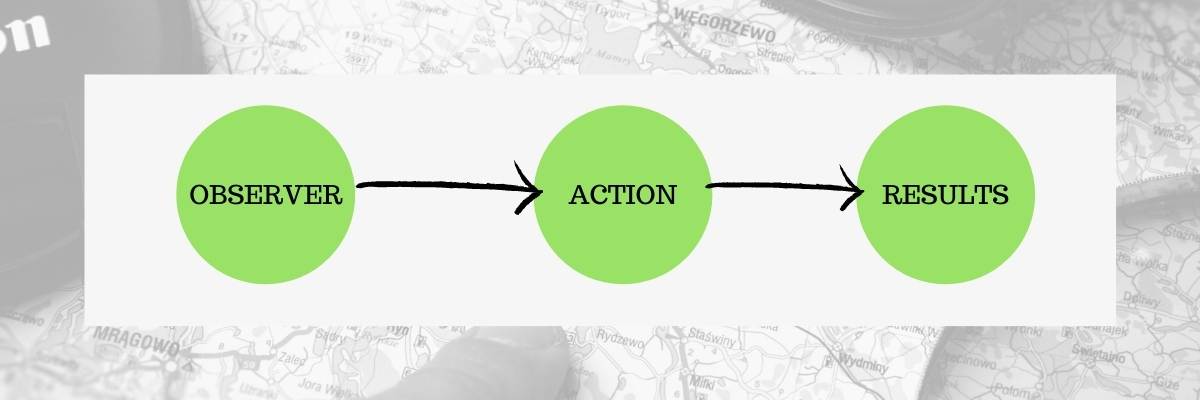
What I have described above is called the Observer – Action – Results model, which I have learned in my Ontological studies. It is a very simple but powerful way to understand how we act in this world, in the pursuit of whatever results we want. As Chalmer Brothers write in his book “Language and the Pursuit of Happiness” –
First Order Learning has to do with changing our actions (which of course include changing our speaking) for the purpose of producing new results. In some ways, First Order Learning represents our traditional approach to problem-solving. It implies that there is an objective problem “out there,” and in order to solve it we must take actions which are effective in producing some desired result. It has everything to do with cause and effect.
Let’s explore the Observer portion of the model now. Many of us have been in situations similar to this: You find yourself struggling with a problem, trying to figure out what to do, and it appears you’ve run out of options. You’ve tried several alternatives, none of which seemed to work, and you just don’t see any more good possibilities left. At some point another person comes into the room, and in 5 minutes of conversation with you they offer a fresh new alternative, and you say “Oh, I didn’t see it that way!”
Many of us have had this experience. We say that this occurs precisely because a new observer has appeared – someone with a different view, a different perspective, a different way of looking at something. Notice how all the metaphors here are visual metaphors – they have a great deal to do with the observer. They all point to a central claim of this model: Our results have a great deal to do with our actions or lack of actions. This is well-known. What’s less clear is that our actions themselves have a great deal to do with the observer that we are, with how we “see things”.
Human perception is strange and unpredictable. We like to believe that the way we see the world is the way it is. But in fact, there is no reality, only perspectives. We are deeply affected by forces we don’t see or feel. Our parents, our language, our culture, and our beliefs all influence and create the world around us.
For example – We (people who speak English) often refer to the future as forward and our past as backward. We use phrases such as “what’s coming ahead?” “next year”. We right things from left to right when we have to indicate a sequence of things.
However, in Chinese Mandarin, time is denoted along a vertical time axis. The word xià (down) is used to talk about future events, so when referring to “next week” a Mandarin Chinese speaker would literally say “down week”. The word shàng (up) is used to talk about the past – so “last week” becomes “up one week”. Watch the video at the end of this article for more on how language shapes our reality.
Others have seen what is and asked why. I have seen what could be and asked why not. – Pablo Picasso
The O-A-R Model
You Can’t Change What You Can’t See
In first-order learning, we take our observations for granted and do not question the world we see. However, as we have seen, language, culture, emotions, our moods, and our bodily sensations are important factors that determine the world we see. We have rarely questioned these factors which determine the way we see the world, which in turn determines every action we take or do not take.
Second-order learning does not focus directly on the actions we take, but on the observer that we are when we take those actions. In this way, second-order goes one level deeper and operates at a more abstract level than first-order learning. This opens new possibilities of action which weren’t available to us before as we a new world, or a different reality than before.
The ontological interpretation of the observer that we are, or in other words, our being, is constituted by three inter-related areas of our existence – language, emotions, and body. Observing what is happening in our language, emotions, and body gives us a window into how we are “being“? And making changes in our language, emotions, and body are the tools we need to enable a new way of “being”.
Our language, emotions, and body are the colored glasses we all wear and through which we view the world. We already read about the impact of language on our world above. Let’s consider emotions now. We are always in some emotional state or mood. And every time we interact with the world, new emotions are triggered based on our unique listening filters.
And if we reflect a bit, we will realize that we all see very different worlds depending on whether we are in a good mood or a bad one. If we can learn to observe our emotions as they arise instead of getting sucked into their temptation, we can use second-order learning and become a more powerful observer of our being.
If you are only seeing problems and not possibilities, maybe you are unaware that you are wearing “problem” glasses, and you need to replace them with “possibility” glasses. When we can change our glasses, or shift the observer that we are being, we can see a totally different world and a new set of actions to go along with it.
I believe changing the way we look at things is a superpower that can produce transformational results. This ability to shift the way we see things is all the more important in the ever-changing and chaotic world we live in today. I will end this article with what Don Miguel Ruiz says in his book The Four Agreements.
“We make the assumption that everyone sees life the way that we do. We assume that others think the way we think, feel the way we feel, judge the way we judge. This is the biggest assumption that humans make.”
Culture plays a key role in determining an organization’s overall performance. It determines how employees interact with others within and outside the organization and give them a sense of direction. Ironically, executives rarely give culture the attention it deserves, and the consequences are always detrimental. If you fail to shape your culture, the culture will shape you and your business results.
If your culture is working against your organization’s goals and objectives, you may need to change your style of doing things. One sign of a bad culture you should look out for is the tendency to assign blame. When something goes wrong, the default in blame culture for many is to point fingers. Instead of trying to understand the problem, they direct their attention to finding the culprit in an attempt to get the problem off their shoulders. However, the culture of blame only succeeds in sweeping the problem under the carpet and never at fostering accountability.
Blame And Finger Pointing Doesn’t Work
Why Blame Doesn’t Work
Accountability is taking responsibility for the outcome, whether positive or negative. On the other hand, blame only takes shortcuts by closing the mind and quashing the need to understand the system better and finding the root cause. Such narrow thinking shifts focus away from the actual problem to the individual, failing to acknowledge the role the bigger system and culture played in what happened.
Blame culture is more about ego-pleasing and getting the weight off your shoulders (psychologically) instead of the accountability of the person being blamed. Assigning blame shifts the responsibility from yourself to others, boosting your ego. When you attribute a good outcome to your personal characteristics, you get a confidence boost. Also, by attributing a bad outcome to the failure of outside forces, you protect your self-esteem and absolve yourself.
Blame stops learning, as people get defensive and hold onto their positions. As a consequence, both the individual and the organization do not enjoy the benefits of learning from their mistakes. In a culture of blame, people start hiding mistakes, which is even worse. On the other hand, accountability means recognizing that anybody can err and viewing mistakes as opportunities for learning and growing.
Reducing the problem to the fault of one individual is trying to simplify a complex issue without seeing the bigger picture. This is what blame does. It focuses on the past and not on the future with the aim of punishing the offender in the hope that they will rectify their behaviour. Conversely, accountability is forward-thinking. It means taking responsibility for the successes and the failures and learning from the mistakes to better your results in the future.
Blame also destroys trust and psychological safety in the workplace and makes people recoil back to their cocoons. It makes people fear their leaders and each other, creating mistrust. The fear takes away an employee’s confidence making it harder for them to take any initiative. As a result, they lack the courage to handle obstacles. Additionally, when people spend their time defending their turf and pointing fingers, they waste valuable time and hinder cooperation.
A hallmark of a healthy creative culture is that its people feel free to share ideas, opinions, and criticisms. Lack of candor, if unchecked, ultimately leads to dysfunctional environments.
— Ed Catmull, President of Pixar
From Blame Culture to Accountability: How to Get There
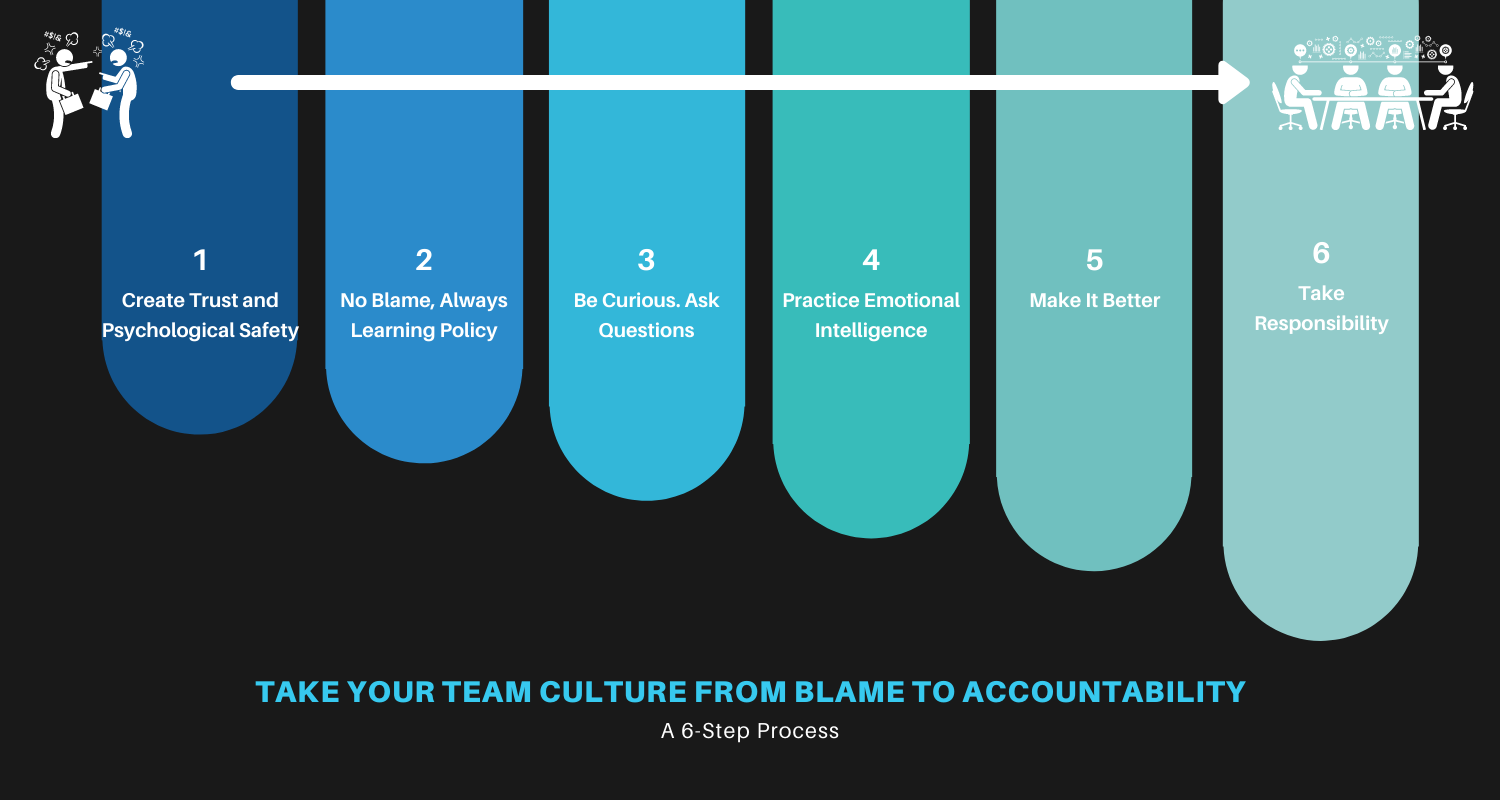
As you must have realized by now, it is critical to creating a culture of accountability in any organization. The following are 6 steps to take your team culture from blame to accountability.
1. Create Trust and Psychological Safety
Creating a safe environment is the first step in creating trust and psychological safety. When people feel safe, trust builds, and people interact with each other without being suspicious. This interaction breeds cooperation, which is key to an organization’s success. Without trust, it is difficult to bring people together.
Employees who enjoy psychological safety in the workplace will be more open about their mistakes and more willing to learn from them. They will perform their duties and responsibilities without fear and judgment, taking the organization a step closer to achieving its objectives.
Gordon Bethune joined Continental Airlines when the company was losing hundreds of millions and successfully transformed it into a respectable leader in the airline business. He advises CEOs to take over the responsibility of creating a safe working environment for their employees. In his time at continental, Gordon always took the time to visit his employees in their crew room or the baggage room.
Focusing on the person instead of the problem shifts attention away from the real issue and prevents learning. Once you identify the culprit, the next step is usually how to deal with them. As a result, further inquiry into the problem ceases, hampering effective problem-solving. Finger-pointing denies the organization information about the reality on the ground and makes decision making impossible.
When you focus on accountability, you don’t assign blame to individuals. Instead, you view mistakes as opportunities to facilitate learning and growth and encourage constructive conversations that seek to find the root of the problem. People appreciate this and are more willing to share and discuss their mistakes and challenges in such an environment.
Akio Morita was an innovator and co-founder of Sony. When speaking about his success at the company, he highlighted communication as one important ingredient for success. One of his popular quotes reads: “I believe one of the reasons we went through such a remarkable growth period was that we had this atmosphere of free discussion.” Morita also created a culture of accountability by trusting in his employees’ ability—he believed that everyone had creative abilities.
3. Be Curious. Ask Questions To Figure Out Why The Problem Happened?
A blame culture will tempt people to ask, “Who did it?” but a culture of accountability encourages people to find out the root of the problem by asking more important questions related to the problem. For example, they will ask, “Why did it happen?” “What did we ignore?’’ What could we have done to prevent this?’’
You need to be constantly curious (and not jump to conclusions). Asking these questions encourages openness and inspires constructive engagement. Consequently, it spurs meaningful conversations and encourages a collective approach to addressing the problem from happening again in the future.
Accountability focuses on addressing the problem from a system’s perspective that will enable you to identify flaws in the system, which may not be obvious at first glance. When holding accountability conversations, be clear about your intentions from the onset and remember to focus on inquiry rather than an inquisition. Also, encourage everyone to accept the role they played in the system.
Pixar’s Ed Catmull attributes his company’s (Pixar) success to feedback. The company makes films through a deeply collaborative process that hinges on productive feedback. Such feedback is based on trust and focuses on moving the project forward rather than expressing personal opinions.
4. Build and Practice Emotional Intelligence
Anger is a natural emotional response that you have when something goes wrong or when you experience unfairness and injustice. Although it is an involuntary response, you can always listen to what it has to say, and then respond in a way you can be proud of. Otherwise, the emotion can consume you, making you do things you will later regret. For instance, anger can make you lash out at others unfairly.
Instead of aggravating the problem, remain calm and focus your energy on addressing the problem. Always demonstrate this to set the right example for your team. It is important for them to know that assigning blame is destructive in the workplace. Coach them to deal with their anger and frustrations without blaming others.
When conflict situations arise in the workplace, people tend to justify their behaviour and point of view while failing to consider the other person’s side of the story to escape blame. However, it is your responsibility to discourage this trend in your organization. You can achieve this goal by creating a safe environment that values empathy over blame. Always encourage your team members tolisten first, and then express their concerns without holding back.
Alan Mulally exceeded expectations when he turned around Ford Motor from a company that was progressively going out of business to a giant that dominated the industry. He realized that teamwork was the only way out of the mess and led by example in appreciating everyone’s contribution. He also encouraged his team to open up about their failures and support each other.
5. Make It Better
After identifying the problem, you need to figure out what you can do to prevent it from recurring. Ask yourself what you could have done to prevent the problem? After looking inward, engage your team and work together to find what you can tweak in the processes, tools, and systems to prevent a similar problem in the future.
Sometimes problems arise due to a lack of clear expectations. Take this opportunity to communicate your expectations clearly and concisely. If your team does not fully understand their roles and responsibilities, go through them again together. You also need to review their progress constantly and provide regular feedback.
Steve Jobs, who co-founded Apple from his mother’s garage, faced an ouster in 1985. When he came back to Apple in 1997, the company was struggling to survive, and its stock prices had taken a dip. Instead of blaming others for his exit, he used his unique vision and ideas to turn the company around. By the time he died, Apple’s stocks had increased by more than 9,000%.
6. As a Leader, Take Responsibility for Your Team’s Actions
A good leader will accept blame when things go wrong and pass along the credit when things go right. When others face problems, they will learn by using each mistake as an opportunity. Before pointing fingers, they will ask themselves what they could have done differently. If someone slips up, they will offer their support and create a more robust system. Instead of throwing people under the bus, they realize that everyone is human and can make a mistake.
As a leader, the buck stops with you. If you lead by example, you can encourage your team not to fear mistakes but to view them as opportunities to learn and grow. You will also inspire them to emulate your actions, which will include taking responsibility for their mistakes. But if you are constantly pointing fingers, you will lose their trust and respect. You have to lead by example.
Blame Statements
When blame is prevalent in your team culture, you will hear people make statements (either out loud or to themselves) like the below:
Who did this? This is wrong and should not have happened. Let’s find out who did it.
This is completely wrong. You should not have done this.
This is your fault and there will be consequences.
I made a mistake but I won’t say anything and try to hide it, otherwise, I might face repercussions.
Accountability Statements
When your team culture is one of accountability, you will hear people say:
How can we make sure that this kind of mistake doesn’t happen again? What processes/systems can be changed?
What can we learn from this situation?
What was really the cause of this? Do we know the root cause? How do we plan to fix the problem?
I made this mistake. I want to share with everyone so that no one makes this mistake and can learn from my experience.
Conclusion
Blame culture creates divisions and separates people and teams. It also causes mistrust between employees and creates an environment of fear. Consequently, it makes it harder for the organization to achieve its goals. Fear also paralyzes workers, making them reluctant to take new initiatives.
Accountability culture brings everyone together as part of a bigger whole. It encourages people to take blows for each other as comrades and friends rather than as competitors. Since it addresses mistakes from a systems point of view, identifying flaws and rectifying them becomes easier.
Welcome to the Deploy Yourself Newsletter. Every two weeks I share about what impactful leadership looks like. I also share the most insightful lessons and stories I encountered in the last two weeks. You can also read this issue online.
Send A Gratitude Post Card From Beautiful Amsterdam To Your Loved Ones
Ever since I shared the benefits of gratitude in my last newsletter, I have been thinking about how to express gratitude myself. Then, during one of my photo walks in Amsterdam last week, it all clicked together. I spend hours photographing Amsterdam every week, and it is a kind of meditation for me. I love those moments when I forget myself behind the camera and focus entirely on the beautiful city in front of me.
So I thought – what if I use my photographs, which provide so much calm and joy to me, to express gratitude to people this festive season? 2020 has been a tough year for all of us, and many of us have been directly or indirectly impacted by it. We can all use a little gratitude.
We are also entering a festive season soon, with Diwali – the festival of lights, coming up on the 14th of November, and Christmas and New Year coming up soon after that. It is a tradition to share gifts during both Diwali and Christmas, and I think this is all the more important this year given that we have all been locked up inside our homes. We have spent this entire year without being able to meet and spend time with our friends and family.
As a gesture of gratitude, I will send out Thank You Postcards with one of my beautiful Amsterdam photographs to anyone you want me to. If you have a friend, colleague, or a family member you want to express gratitude to, just send me their name, the message you want to send, and their address to me.
I will print up one of my Amsterdam photos on a postcard, write down your message, and mail it to them, no matter where in the world they are. You can see my favorite photos from Amsterdam here. If you want to choose which photo should I send for you, just let me know and I will do the rest.
This year has been a year of reflection for me. I have written a lot about my thoughts at DeployYourself this year, and this is my way of Deploying Myself.
If anyone comes to mind after reading this, send me their name, address, and your message for them. They will have a beautiful Amsterdam postcard coming their way soon.
Articles and Stories Which Have Fascinated Me
One
How To Use Both Conscious and Subconscious Mind to Solve Our Biggest Problems?
Our mind is often categorized into two categories – the conscious and the subconscious. Everywhere where we use rational thought, we are using our conscious mind. For example – we are using our conscious mind when we apply logic to solve a math problem. Similarly, we use our conscious mind when we use our intellect to plan for the future. It is our conscious mind that leads us to speak, write, move our body, or plan. We use our conscious mind whenever “we” decide to do something.
The subconsciousmind, on the other hand, is where our intuition lies. This is the part of the mind where all our memories and past experiences lie. This is the part of the mind which knows how to breathe, how our vital organs function without our making any decisions. It is through our subconscious mind that we form beliefs and intuition about what is happening around us. Our subconscious mind is where our feelings and emotions originate.
We might think that when we develop ideas and solve problems, it is only our conscious mind at work. But our subconscious mind also plays a big role in the background. This is the part of the mind’s functioning which most people are unaware of. At the same time, this is exactly the information which can make us much more productive if we were to know how it works.
A lot of scientific discoveries and achievements have been accidental, or not what the scientists were working towards. Even in our lives, we can see that trying too hard to solve a problem can lead to frustration, yet when we step aside and do something else we can suddenly see the solution. This kind of idea generation and making connections between different ideas are a result of our intuitive and subconscious mind.
Only Thing We Have to Fear Is Fear Itself – One Of My Favorite Speeches
So, first of all, let me assert my firm belief that the only thing we have to fear is fear itself—nameless, unreasoning, unjustified terror which paralyzes needed efforts to convert retreat into advance.
We would all agree that our mind is our most important asset. The human brain is often called the most sophisticated machine in the universe. Everything we do is only possible because of our brains. Be it writing a letter, loving our family members, playing a game, preparing a presentation, or planning for the future – none of these tasks are possible without our brains. Yet isn’t it surprising that our brain doesn’t come with an owner’s guide? Also, our education rarely teaches us how to make the best use of our brains.
Scientists have come to know a lot about the human body in the last century, which has improved medical science and human quality of life by leaps and bounds. The kind of life we all live today is better than the lives lived by the kings and presidents a century ago. Isn’t it amazing? Yet, for all the medical discoveries, we still know very little about the human brain. And whatever little we know about our brains, the content has not made it to our textbooks and education.
Either at school or at work, nobody educates us about how our mind works, which is a pity. Even though a lot is unknown about how our mind works, there has been considerable progress in neuroscience in the last two decades. If the average human being knows about what we now know about our brains, I believe we can vastly increase our performance in all aspects of our lives. After all, understanding how our mind works is the first step towards using it in the most effective way.
“Scientists may have sophisticated laboratories, But never forget ‘eureka’ was inspired in a bathtub.” ― Toba Beta
Conscious and Subconscious Minds
Our mind is often categorized into two categories – the conscious and the subconscious. Everywhere where we use rational thought, we are using our conscious mind. For example – we are using our conscious mind when we apply logic to solve a math problem. Similarly, we use our conscious mind when we use our intellect to plan for the future. It is our conscious mind that leads us to speak, write, move our body, or plan. We use our conscious mind whenever “we” decide to do something.
The subconscious mind, on the other hand, is where our intuition lies. This is the part of the mind where all our memories and past experiences lie. This is the part of the mind which knows how to breathe, how our vital organs function without our making any decisions. It is through our subconscious mind that we form beliefs and intuition about what is happening around us. Our subconscious mind is where our feelings and emotions originate.
We might think that when we develop ideas and solve problems, it is only our conscious mind at work. But our subconscious mind also plays a big role in the background. This is the part of the mind’s functioning which most people are unaware of. At the same time, this is exactly the information which can make us much more productive if we were to know how it works.
“The subconscious mind is ruled by suggestion, it accepts all suggestions – it does not argue with you – it fulfils your wishes.” – Joseph Murphy
Accidental Discoveries
We have used our intellect to achieve great things for humanity in the last 70 years. However, a lot of scientific discoveries and achievements have been accidental, or not what the scientists were working towards. Even in our lives, we can see that trying too hard to solve a problem can lead to frustration sometimes, yet when we step aside and do something else we can suddenly see the solution. This kind of idea generation and making connections between different ideas are a result of our intuitive and subconscious processes. For example –
Archimedes discovered the principle of buoyancy while bathing at his home.
The fall of the apple on Newton’s head leading to the discovery of gravitation is probably the most well known eureka moment in history.
Einstein’s idea of general relativity came to him while working as a clerk in the patent office in Bern
Niels Bohr said that he developed his atomic theory based on a dream he had.
In science, these accidental discoveries are often called “Eureka” moments, and they look unpredictable on the surface. But if we look deeper, we can see the common threads across many such eureka moments. One such common element is taking a break from whatever problem you have been working on and doing something else for a while. Focussing on something else for a while gives our brains a break which can yield novel insights.
“If you realized how powerful your thoughts are, you would never think a negative thought.” – Anonymous
How to Engage Your Subconscious Mind
Scientists have discovered that taking long walks in nature is one such mind wandering activity that can generate creative insights for problem solvers. There is evidence that spending just a few minutes outside in nature can improve people’s moods and generate positive emotions, which in turn can improve our intuitive idea generation.
Negative emotions like stress and anxiety which are the result of focussing on a problem too hard, can on the other hand stifle creativity. If we want to be more creative, it helps to not take things too seriously from time to time and to loosen up and allow our minds to wander.
The subconscious mind delves on certain ideas and concepts and perceives information in a manner that the established logical thought process cannot. Therefore, insights are most common when a person is taking a break and not using the conscious mind. There are times when the conscious brain hits a mental impasse – a point where they hit a block. At these times, insight – a sudden stroke of genius or a perfect solution – breaks the impasse.
Give Yourself Space To Be Creative
We should all allow ourselves to be surprised by the power of our subconscious mind, and let work flow from the deep confines of our subconscious. When I write articles or poems I often get stuck. What I have noticed in those moments is that no matter how hard I try it is almost impossible to force myself to write. At the same time, if I take a break and do something else for a while, I suddenly feel an urge to write and am then able to complete the article or poem in no time. I have written a few poems which later I had no idea how I wrote it.
In the book “Daily Rituals: How Artists Work”, the author Mason Curry has researched and shown that many creative artists do their best work in short bursts interspersed by breaks which often included long walks in nature. By taking regular replenishing breaks, we can also use our subconscious mind to our advantage. When we do so, we turn off our rational brain and give ourselves the freedom to wander off-topic. This often results in new idea generation and pattern recognition which we would not have done otherwise.
People perform best when they feel safe and don’t have to watch over their shoulders. These days, uncertainty looms in almost every element of our lives. Hence, creating a safe workplace for people is in the best interest of any organization.
At work, the greatest threat people perceive these days is harm to their psychological identity – which stops them from sharing their opinions and ideas. For this reason, it’s important for leaders and managers to create psychological safety in the workplace.
When people have to wear a mask at work and can’t be who they really are, how can you expect any creative thinking or productivity? It is simply not possible to do your best in a place where you have to watch over your shoulders all the time.
She calls Psychological Safety “A shared belief held by members of a team that the team is safe for interpersonal risk-taking,” adding that, “It describes a team climate characterized by interpersonal trust and mutual respect in which people are comfortable being themselves.”
Psychological Safety is achieved when people feel they will face no negative consequence for expressing themselves fully. An organization that does not attempt to create psychological safety will risk creating an unsafe environment with low trust and engagement.
Why Is Psychological Safety Important?
Psychological Safety makes it easier for the thinking and feeling parts of our brain to stay active without triggering the amygdala. The amygdala is the most primitive part of our brain, which controls our flight or fight response, and is activated when we feel fear.
What happens at work should not trigger our primitive biological fear and flight response. However, it often does. In my experience leading teams since 2008 across different continents, I have learned that managers can take the below 6 steps to create psychological safety in their teams:
Psychological Safety Comes Before Performance
1.) Begin With Trust And Respect (Not Suspicion)
Imagine entering a space for the first time to meet people who view you with skepticism. A good example is a job interview. If the interviewer sends the signal that you are unskilled until you prove otherwise, you can easily feel threatened, even frightened. This is on top of the nerves you are already carrying to the interview.
Now, think of it in reverse. Imagine an interviewer who projects immediate trust and respect. They thank you for the opportunity to interview you, compliment your achievements, and note some highlights from your resume.
Naturally, that will put you at ease and help you relax. At the same time, the interview will also go more smoothly, as the interviewee is relaxed and able to interact sincerely.
Let’s take another example. Consider that you are a team leader at the beginning of a project. If you begin by assuming everyone in the room have the skills to achieve the goal (trust), and you project that everyone’s role is valuable (respect), the team will feel safer. The project can begin with freshness and excitement.
Conversely, if you view people with suspicion before work has even started, it will create a culture that is neither psychologically safe nor productive. If you start a project by reviewing previous mistakes, stressing the importance of achieving an outcome, or risk being penalized, you communicate a lack of trust and suspicion.
The Neuroscience of Trust, And Treating People Like Adults
The latest neuroscience research has found that the hormone oxytocin reduces fear and increases trust and empathy in the workplace. If you are wondering why trust is important, it leads to 74% less stress, 106% more energy at work, 50% higher productivity, 13% fewer sick days, 76% more engagement, 29% more life satisfaction, and 40% less burnout.
Beginning with trust and respect is not only a more effective means of creating psychological safety, but it also improves your chances of success. Below are 6 simple ways I have found to foster trust and improve performance. This is especially important if you are in a managerial position.
Give recognition immediately after a task well done
Give people autonomy to decide how they do their work
Flexible job responsibilities based on people’s strengths and project requirements
Transparency in communication
Caring about the whole person, and not just the employee
Being vulnerable and sharing honestly
You cultivate trust by setting a clear direction, giving people what they need to see it through, and getting out of their way. It’s not about being easy on your employees or expecting less from them. High-trust leaders hold people accountable but without micromanaging them. They treat people like responsible adults.
“Too many companies believe people are interchangeable. Truly gifted people never are. They have unique talents. Such people cannot be forced into roles they are not suited for, nor should they be. Effective leaders allow great people to do the work they were born to do.” – Warren Bennis
2.) Listen Empathetically
Your people will have concerns. They will have questions that are not only related to a project or task but also questions coming from a deeper search for security. You need to be aware of this in order to practice empathetic listening.
To create Psychological Safety, you must demonstrate that you care for the entire human being before you, not just the role they play in the organization. And this requires empathy.
For example, you can ask “You don’t seem yourself today. Would you like to take a break and chat?”, or “I would hate to see you burn out. Are you taking care of yourself? Is there anything I can do?”. Simple statements like these can go a long way in showing your care for people as human beings.
A few words, said at the right time, can make a world of difference. And we all have the power to make a difference by practicing empathetic listening and noticing emotional cues. You never know what your support at the right moment might mean for someone else.
Can You Be Yourself At Work?
3.) See Conflict As An Opportunity To Find Out What People Care About
Conflicts are a natural order of life, and if we step back and see the bigger picture, there is nothing unexpected around them. They are inevitable when we work with people who think differently. If you don’t see any conflicts, perhaps people are not speaking up enough, and that is a bigger problem for any society or organization.
Conflicts are about different perspectives, and each perspective is valid for the one holding it. A perspective becomes right or wrong only when we get attached to a particular point of view. The only question is – Can we channel the energy in conflicts into productive conversations that can lead to creative solutions and better results?
Don’t Rush. Use Disagreements To Strengthen People
Yet when conflict arises between employees or within a team, you might look at it as an obstacle in need of a quick resolution so that the “real work” can continue. This approach can do more harm than good, as it can keep you from listening empathetically with respect and trust.
Use conflict and disagreements to go deep into what people care about, and bring it out in a way that builds self-awareness and strengthens people. Disagreements occur because people care about their work. Keep the focus on the “care”, not on the “disagreement”.
Attack The Problem. Not Each Other
Instead of criticizing each other in a conflict, begin by communicating that you notice how much they care. This will allow you to confront the problem, not each other.
Help people understand that different perspectives are natural. Promote mutual respect and flexibility. Clarify confusion by stressing the need for healthy friction and working towards shared goals and values.
Help People See Different Perspectives
Look at any problem or dispute as an attempt to build a bridge between two sides of a river. Perhaps one employee wants it of wood while another wants metal. Both of these employees share one thing in common: the desire to build a bridge.
Perhaps the one who wants wood has material costs in mind, while the employee who wants metal is thinking about longevity. Neither employee wants a bad bridge, and neither employee wants the bridge to fail.
This is important to note. The conflict is part of the process of building a bridge. It is not an obstacle to bridge building. The same thing is true of any project you might undertake: disagreement is inevitable, and can result in a better end result.
People feel psychologically safe when their ideas are heard as possibilities versus obstacles. When disagreements are managed in the context of completing a project collaboratively, the end result is often better than what anyone side could come up with.
Disagreement can lead to innovation, especially if you tell people, “Ok, I see we are worried about cost and longevity. Is there a way we can use to build a bridge that is both cost-effective and durable?”
This question does not dismiss the core of the idea presented by people. Instead, it shows that employees’ concerns are valued, and it encourages the kind of thinking that can lead to an even better bridge.
The focus is not on “winning” or “losing” an argument. It is on seeing conflict as a bedrock upon which great successes and deep relationships can be built.
4.) Embrace The Unique Creativity of People
The fact of the matter is that most people are risk-averse and biased against creativity. When confronted with unique ideas, people’s natural biases, regular habits, and old expectations can lead them to dismiss a valid, innovative idea simply because, at first glance, it seems weird.
Among the greatest obstacles to building Psychological Safety comes from trying to fit or mold employees into particular roles, especially when these roles don’t allow for flexibility.
Accountants calculate, lawyers argue, and coders program. At the same time, coders calculate, accountants argue, and lawyers program much more often than most would think.
Give people the flexibility to bring their own unique skills and experience to the table. Do not dismiss a marketing idea only because it is coming from an engineer, or vice-versa. You might have engineers and marketers, but do not chain them in their roles that you ignore valuable ideas when people express their unique selves.
Can You Be Yourself At Work?
5.) Provide Feedback More Often
Yearly and half-yearly performance reviews are of limited value and usually stressful. By their nature, they can stress your employees in ways similar to a job interview. This is especially true when an employee has received little to no feedback in the rest of the year, has worked on a project that may not have turned out as expected, or found oneself in the middle of a disagreement that saw one of their ideas rejected.
Giving feedback regularly (every few weeks) gives people an accurate understanding of how they are doing at work, and what needs to change/improve. In our fast-changing and dynamic world, you need to give people continuous feedback to stay on top of things.
Ongoing feedback reinforces the right behavior soon after it happens, rather than waiting for the end of the year. It is more casual, and people are more at ease, in comparison to a yearly process which is also tied to compensation.
It helps clear expectations on a regular basis, and allow for any course-correction sooner than later. This reduces stress, prevents waste of energy and repeated work, and improves productivity and employee confidence.
The feedback they receive will be more applicable to their immediate work, and increase employee engagement and hence productivity, instead of causing stress and burnout.
6.) Coach by Asking Questions
During one-on-one meetings or informal conversations with employees, be curious and ask questions – about their lives, desires, and ambitions. Powerful questions allow people to think deeply and come up with original answers.
Questions that go deep help connect people with their intrinsic motivation and their values. “I’m wondering what inspired you to think of the idea you presented at the last meeting.” These kinds of curious statements show leadership is listening and paying attention.
Asking questions creates space for people to express their feelings and validate their ideas. It says to them: I see you, I hear you, and I value you. Powerful open-ended questions take longer to answer, but they often end up revealing something important about yourself which you were not aware of before.
Some examples of powerful questions are :
What is “on hold” in your life? What do you want to do someday? What are you waiting for?
How do you hope to personally and professionally benefit from working on this project?
Define what your perfect day would look like?
What is your best experience in life so far? What is your worst?
Conclusion
The best work happens in an environment of trust and respect for people who are different and think differently. People feel valued not only when their success is celebrated but also when they’re acknowledged for their humanity and ideas.
A disagreement is not an obstacle to work but part of work. Employees who sense that disagreements are welcome at work will feel safer and offer insights more often.
I think it was 1989 when I, for the first time, realized that the 1st of January was a special day. The biggest change for me, one that always took a few weeks to get used to, was to write 1990 instead of 1989 in our school notebooks daily. While the whole world celebrated and wished each other on the 1st of Jan, nothing much else seemed to have changed (for me).
Very soon, as we stand at the cusp of another new year (2026), 36 years have passed since then. Though the fact still remains that nothing much changes between Dec 31 and 1 Jan, if we look at the last 36 years, then we can no doubt say that the whole world and each of our individual lives have changed immensely.
While we may not always notice and acknowledge it, change is the only constant in life. A New Year is our annual reminder that the time has come to move on and prepare ourselves for the changes coming.
Today I want to ponder and write about how to powerfully step into the new year so that we are not surprised or shocked by the changes it will bring along. Over the years I have realized that we might very well let the years slide by without much attention; there always comes a time when we are made aware, often not subtly, that time has moved on.
So read on if you prefer to enter the new year on your own terms, or skip this article if you feel a new year is too insignificant an event to trouble your brain cells.
1. Complete The Current Year (2025)
The first step before starting anything new is to complete what you are doing now. Just like we put the first foot down before lifting the other one while jogging, just like we get our raw vegetables and spices ready before cooking our food, it is imperative that we finish 2025 before we even start thinking about 2026. If we ignore this first step, the result will be the same when we start cooking a delicious dish only to realize later we never got the required ingredients.
What I mean by completing the current year is taking some dedicated time before the new year to –
1. Introspect your goals (if any) at the start of the year and make peace with where you are now. 2. Celebrate your achievements (big and small) and laugh about your failures (missed opportunities) 3. Reflect upon what you have learned, and how you have changed or grown over the year. 4. Free your mind from the grip of the difficult people and hard situations you have encountered this year. 5. Apologize if you realize you have been a difficult person in someone else’s life. 6. Give up any blame, regret or shame gathered this year. There will be new to collect in 2026 🙂 7. Thank and express gratitude to everyone who has made a difference in your life.
2. Know Yourself
The next step before moving ahead is to take some time to know yourself better. That doesn’t mean finding out your blood group or body weight or exam grades or other people’s predictions about your future but rather looking deep inside yourself to discover your deepest values and motivations. You can do so by answering questions such as –
1. What are your deepest motivations? What have you always wanted to do? 2. What are you really passionate about? Is there something worth devoting your life to? 3. What drives your actions and decisions? What are the values you hold most dearly? 4. What makes you really happy or angry? 5. Who are your biggest inspirations in life, and who are the people you can’t stand? Why?
Answering these questions is anything but simple and there can never be final answers to them. But if we take time and ponder over them and come up with some ideas, we will know ourselves better than anybody else (our parents, friends, grades, achievements, money) can tell us about.
3. Where do you want to be in the next 5 or 10 years?
The next step is to think about the future and exercise your imagination muscles. Think about the kind of person you want to be in the next 3, 5, or 10 years. This might seem too far ahead in the future, but it doesn’t take long for these years to roll by. Just think about how quickly the last 10 years have passed by. Imagining your own future can feel a bit strange and uncomfortable at first, but soon it will become a lot of fun – just like a game.
Do not let this question overwhelm you (which it can), and instead, play it like a game and see what you come up with.
While you imagine your future, think about your deepest desires and ambitions. What do you want to accomplish that will give you the most satisfaction? What changes do you want to see in yourself, your family, your society, your company, your city, and your country?
What are the dreams that you haven’t even dreamt yet? How do you want people to relate to you after 10 years? In this step, you do not need concrete answers, but a vague image of where you want to be. The intention of this exercise is to get you thinking about your future, the actual answers you come up with are not so relevant.
4. Decide milestones or checkpoints on the way
The next step is to identify milestones for the next 1 year for the ambitions which you discovered in the previous step. Don’t let this step scare you. You don’t have to decide on milestones for each one of your ambitions – you can choose a few which are the most important to you. Also don’t worry or bother about “how” you will reach your milestones as you have the whole year to think about that.
These milestones will serve as checkpoints which will measure your progress towards your long-term ambitions. These milestones can be broken down into quarterly and monthly milestones depending on what you prefer. The only thing to take care of while marking these milestones is to make sure they can be observed and measured by anyone easily and are not vague.
Make sure to be clear about what you want to achieve, when and where you will achieve that and with whom. The more numbers you can use the better this step will be in its fruitfulness, and it is best to avoid vague words like soon, sometime, in a few weeks, improvement, better, more, etc.
In the above two steps, it is very important to also include and keep time for recreation, fun, sports, and other forms of entertainment. The whole idea of this exercise is to be more aware of yourself and prepared for the coming year, and it is very important to not take it too seriously and think only about work and professional stuff. If you are a movie buff and want to watch 100 movies or visit a few movie festivals next year, plan your milestones for it.
Deploy Yourself Powerfully in The New Year
With the above four steps, you can step into the new year and make a powerful “start“. Of course, that doesn’t mean that your life will pan out exactly as you imagined or that the next year is going to be your best year. It just doesn’t work that way. But knowing where you want to go is always better than hoping to get “somewhere”.
I can write another article about what you can do in the new year to make sure you hit your milestones, but we must always remember that change is the only constant in life, and it can come up in unexpected ways and mess up our plans anytime. But having messed up plans is still better than having no plans at all, and we can repeat the above process anytime to plan afresh for the future – we need not wait for the next “New Year” to repeat this process.
I use cookies on this website to give you the most relevant experience and for analytics purposes. Any personal data collected will never be shared with any third party, or used to spam you. That is my promise. - Sumit By clicking “Accept”, you consent to the use of ALL the cookies.
This website uses cookies to improve your experience while you navigate through the website. Out of these, the cookies that are categorized as necessary are stored on your browser as they are essential for the working of basic functionalities of the website. We also use third-party cookies that help us analyze and understand how you use this website. These cookies will be stored in your browser only with your consent. You also have the option to opt-out of these cookies. But opting out of some of these cookies may affect your browsing experience.
Necessary cookies are absolutely essential for the website to function properly. This category only includes cookies that ensures basic functionalities and security features of the website. These cookies do not store any personal information.
Any cookies that may not be particularly necessary for the website to function and is used specifically to collect user personal data via analytics, ads, other embedded contents are termed as non-necessary cookies. It is mandatory to procure user consent prior to running these cookies on your website.