trust

  • 7 Steps To Build A Highly Effective Team

    Every team is different as human beings are complex. And organizations can be even more complex. If the team members do not gel and work together effectively, problems can arise very quickly or they can slowly simmer under the surface. Talk about missed deadlines, infighting, declining productivity, poor customer service, etc. All of these have a bearing on the team’s output and the company’s bottom line.

    Finding the right people is the first step in building a high-performing team. However, bringing several talented individuals together under one roof is not enough to make an effective team. So what can you do to ensure the group of people becomes an effective unit which works together? Here are 7 common attributes of highly effective teams, and how to build such a team?

    1. Good Leadership

    Leadership has less to do with positions and more to do with the ability to influence. Today, leadership is no longer reserved for those at the top. Everyone has within them the ability to become a leader in their own sphere.

    Effective teams don’t necessarily have one great leader. Instead, they promote a culture of leadership. That doesn’t mean multiple people competing to become leaders. It is about each individual playing their part and supporting each other for the benefit of the team.

    Every team needs a north star—a clear and shared vision. Each member should know the direction and purpose behind what they are doing. A team without a united vision is like a group of chickens with a lot of energy. They will continuously be busy running around but never make any progress. 

    Therefore, a team should first co-create the shared vision, objectives, and outcomes before undertaking a project. Moreover, the vision should be restated often. It is not enough to engrain it on the door or post it on the website.

    According to research by Rungway, 52% of employees don’t know their company’s vision. The same research shows employees want to be involved more in actualizing the company’s vision and values. Even when working on different facets of a project, team members should know the end goal. 

    When the team is involved in setting goals and objectives, they are more willing to rally behind them. As John F. Kennedy noted, “Effort and courage are not enough without purpose and direction”.

    It is hard to focus when multiple needs are competing for your attention. And when the team is overloaded with tasks, chances are that people will struggle with one thing or another. With so many buttons to push and levers to pull, the team can get easily frustrated.

    Highly effective teams navigate these muddy waters by focusing and prioritizing. Establishing priorities ensures that set goals are met on time. Unfortunately, it is human nature to want to accomplish everything at the same time. However, that is a surefire way of producing shoddy work.

    Instead, it is better to prioritize your tasks according to their importance and urgency. That will involve listing down all your goals, and then deciding how long you would like to spend on each goal. 

    However, keep in mind that goals are not the actual actions taken, but rather the metrics you intend on hitting. Those metrics are what allow you to know whether the team is moving in the right direction. As such, to get closer to achieving those metrics, you must determine what projects need to be fulfilled first to get there.

    So, how do you go about prioritizing projects?

    Simply choose the 3 most important priorities and start working on them. People work better with clear and attainable goals. Therefore, choose 3 projects that will allow you to make a significant advancement towards a longer-term goal, and then set deadlines for their completion. 

    By putting the team’s focus on a few defined priorities, you will evade the all-too-common syndrome of spreading yourself thin trying to accomplish everything at the same time. 

    A good leader also understands the critical role shared values, standards, and boundaries play in the development of a high-performing team. This is because it is impossible to sustain high-performance standards without shared values.

    Shared values ensure that your team does not always depend on you or policies to tell them what to do. Those values guide their behavior. The former EVP at Advanced Micro Devices, Tim McCoy, put it best, “values tell you what to do when you do not know what to do.”

    A good example of how shared values can have a monumental impact on a team’s success is the Mayo Clinic. During the Civil War, a group of individuals known as the “Mayo Family” formed a medical practice whose entire operation was guided by two primary values:

    • The only interest to be considered is the patient’s best interests
    • Nobody is big or good enough to be independent of others

    Guided by those values, the Mayo Clinic has gone on to become one of the world’s most reputable nonprofit hospital systems, with a net worth of around $17 billion. 

    Collaborate with your team to develop a set of values and standards to uphold. Those values should act as moral and operational compasses. In other words, they should guide the behaviors of the team. 

    In addition to shared values and standards, it is crucial to establish boundaries within the team. Boundaries prevent conflict within the team. Conflict (not disagreement, which is natural and healthy) is one of the biggest deterrents to productivity. With boundaries, everyone knows what is considered acceptable behavior, and what is not. 

    One of the most critical benefits of setting boundaries is the clear expectations that come with it. When everyone knows what is considered acceptable, they are more likely to uphold those standards.

    2. Working Together and Collaborating 

    It might look safe to work with people who don’t ask a lot of questions. Effective teams understand that such behavior hinders collaboration. Instead, successful teams embrace challenging each other in a space of trust and psychological safety. 

    Good teams focus on tackling the problems together. They share knowledge across different departments, which enables the organization to adopt a unified approach in handling issues.

    Collaboration brings unique skill sets and mindsets together to create a team that can overcome any obstacles together. A highly effective team understands and leverages each individual member’s strengths to create momentum. 

    Highly effective teams understand that friction is natural when working with others. They welcome the friction and use its energy to enhance relationships and improve productivity rather than the other way around. Strong teams work together rather than against each other.

    3. Performing Team Rituals 

    Outside the workplace, rituals are often used to unite, motivate and rally people behind a common cause. A good example is an annual family holiday that brings everyone together. Rituals also have a place in the organization.

    Apart from defining the team’s culture, they increase employee engagement and help create lasting bonds between individual members.

    Employees in an organization work together for more than eight hours a day. That means they see and spend more time with their colleagues than they do with friends and family. It is imperative that they build strong bonds when working and also in their social lives. 

    Celebrating rituals such as birthdays by bringing a cake and holding parties is a great way to create and foster long-lasting bonds.

    Many organizations insist that fun is ingrained in their culture. But many often struggle to create an environment where workers are truly happy. Like everything else, fun needs to be structured. Otherwise, it will get lost in the busyness of daily life. 

    Think about lunch outings, comedy nights, and beach days. A team that has fun together is more productive. That’s because work is likely to be less stressful and frustrating when you are having fun. Downtime decreases and job satisfaction and loyalty increases with fun. 

    Apart from celebrating wins and forging lasting relationships, some rituals also promote growth. For instance, having regular brainstorming or knowledge-sharing sessions enables each member to share their skills and talents. 

    Participating in weakly share-outs, team-bonding events, and daily scrums can also help the team become more productive, creative, and adaptable.

    4. Safe Environment 

    According to a study by Google, psychological safety is one of the most vital dynamics that sets effective teams apart. Employees should be free to be who they are. And they should share their ideas and opinions without feeling insecure or afraid.

    When a team member shares an idea in a meeting or opens up to a colleague about a bad experience, they are taking risks. Therefore, they need to feel safe enough to take the risk. If they can’t open up, they will end up putting a mask at work. Doing so drains a lot of productive energy which could otherwise be used for productive work.

    Individuals should be able to ask questions without feeling lost. Granted, it is natural to want to protect one’s personal image. After all, no one wants to look like a fool in front of colleagues. However, when there is psychological safety, everyone supports you. When everyone feels free to look like a fool, there is so much possibility of awareness about matters which are otherwise never spoken about.

    Even in the face of disagreements, everyone in an effective team knows they are on the same side. It is easier to share ideas, admit to mistakes, collaborate, and resolve any underlying conflicts. Consequently, it makes the team more productive.

    With technological growth and increasing pressure to perform, people are finding it hard to make personal connections and friendships in the workplace. In fact, there is growing disconnectedness. 

    The importance of meaningful connections and deep conversations cannot be overstated. Research has demonstrated that having high-quality connections in the workplace leads to more creativity and resilience. 

    5. Open, Honest, and Trust-Filled Communication

    Although the advent of technology has made communication faster, it has led to an information overload that has made it harder to communicate. Nowadays, you have to sift through countless emails and attend regular meetings to get information. 

    The annual total estimated cost of poor communication in the corporate scene is as high as $37 billion. Such losses can be mitigated by fostering honest communication. Open dialogue is the only way a team can achieve more than the sum of its parts.

    Open communication allows everyone to have a voice. When employees know their opinion counts, they feel a great sense of ownership. They are also more willing to positively contribute to the organization’s success. The manner and frequency of communication also matter. The more freely and often the team communicates the more comfortable people are in sharing their ideas and insights.

    It is through communication that ideas are birthed and nurtured. A team where members are not communicating encourages wrong assumptions. That’s because everyone is forced to join the dots alone. 

    As a result, many arrive at the wrong conclusions. For instance, when discussing growth, some may be thinking about market share while others may be referring to revenue. It is only through open communication that such differences can be brought to light.

    Sometimes communicating means offering constructive criticism. Highly effective teams create an environment that encourages members to offer honest feedback. Although nobody likes to be criticized, there is no learning without honest feedback. And in a safe environment, feedback doesn’t look like a threat. 

    6. They Embrace Empathy 

    A team that cares for each other performs better. And highly effective teams value empathetic listening and compassionate conversations. 

    Often in movies, when the ship goes down, the captain and crew are ready to sacrifice their lives to save others. That is only possible because they know they are part of something bigger than themselves.

    Likewise, in highly effective teams employees are willing to come together and take one for the team. They shelve their own self-interests and put the needs of the organization and their team ahead of their own. And that is only possible with empathy and care for others.

    Empathy is the ability to put yourself in someone else’s shoes. It is a deep and compassionate understanding of what others are going through.

    Without empathy, organizations and individuals run the risk of becoming too self-absorbed. This can affect all aspects of the business and the team’s productivity as well as their well-being. 

    According to a study by Google called Project Oxygen, employees prefer managers who care about their well-being than those with technical skills. When leaders and team members embrace empathy, everybody feels appreciated and valued. 

    Consequently, this creates trust and fosters high performance among individuals. Although it is not natural for most people to generate empathy, it is an emotional competence that anyone can learn.

    7. Diverse Team Composition

    One of the greatest advantages of working as a team is being around people with varying skills and talents. It doesn’t matter who does what, so long as the team has all the right skills. Highly effective teams include a diverse set of people who complement one another in talent, thinking, and personalities. 

    Diversity is not only about gender, ethnicity, and skin color. Real diversity is having people in the team who think and act differently. People who don’t just look different, but are so from the inside. When such people come together in a safe environment where they feel safe to speak up, wonders can happen. 

    A team’s main priority is to achieve the organization’s goals and objectives. Therefore, having someone who makes the team great is more valuable than a great individual. No matter how skilled a person is, they are not important if they don’t contribute to the overall strengths of the team.

    What exact roles belong on each team depends on what a team’s goals and purpose are. Highly effective teams create a platform where individuals can both absorb and teach. No matter how talented or experienced one is, there is always room for learning. 

    Working alongside other equally talented individuals in diverse fields is a great way to learn and share knowledge and skills. 

    Final Thoughts

    To create a high-performing team, good leadership is paramount. Without a clear and set-out vision, a team will only be groping in the dark. Collaboration is also key. The silo mentality fails to capitalize on the advantages of pooling different skill sets together to tackle problems. Honest communication, team rituals, and embracing empathy help create a fertile ground for such collaboration. But it takes a diverse team composition to make any meaningful impact.

    Building a successful team might sound simple, but implementing the above takes practice, which is not easy. To succeed, team members need to share and jointly own the team’s goals and objectives. They must also put the team’s needs ahead of their own. Moreover, everybody should be free to be who they are. They should feel safe to share their ideas and opinions without fear of judgment. As I said, simple, but not easy.


  • Know What Great Managers Do? A List of 8 Expectations From Managers That Employees Have.

    According to research by Gallup, the most common reason why people leave their jobs is bad managers and bosses. The study, which questioned more than one million working Americans, revealed that 75% of workers who left their jobs did so because of their managers and not necessarily the position itself. No matter how many perks a position offers, people often quit when they don’t enjoy a healthy working relationship with their boss.

    Most people get promoted to management because they did well at their previous non-management job. Just because you excelled in your individual contributor role doesn’t mean you can seamlessly transfer over those skills to a management role. For instance, when an all-star football player becomes a manager after retirement, success is not always replicated in their new role.

    People often forget that management is a totally separate role. Yet, most people are promoted or rewarded with a “management role” for succeeding in their previous role. The skills required to manage a football player or a software engineer are different from being a good football player or a good software engineer.

    Do Managers Even Know What People Expect From Them?

    However, a bad manager is not a bad person. They are just unaware and trapped between a rock and a hard place. Managers are rarely trained or educated about how to do their job well. It’s no wonder that they end up managing people like they were managed. Most of them don’t even understand what management is and what people expect from them.

    Transitioning from an individual role to a manager is one of the most challenging moves you can make in the corporate world. Becoming a manager comes with new responsibilities and requires a new perspective about work and the people involved. It also requires you to form new types of relationships with your former peers, your new colleagues, and other stakeholders.

    Nobody shows new managers how to develop a leadership style that is authentic as well as results-driven. Such disregard for management skills can derail an individual’s career and negatively affect the organization’s productivity. Great managers don’t happen by accident. They learn from their mistakes and invest in developing their skills. I have worked with many great managers myself, and below is what I have learned about people’s expectations from their managers.

    Every 2 weeks I share my most valuable learnings from living life fully in my Deploy Yourself Newsletter. Sign up now to download a workbook with 164 Powerful Questions which I use daily in my work and coaching. Allow these questions to transform your life and leadership.

    A List of 8 Expectations From Managers That Employees Have

    While it is almost never voiced, employees have certain expectations from their managers. The following are expectations you must fulfil when managing any group of people.

    1. Trustworthiness

    Employees want a trustworthy manager. If you don’t measure up, you will not get their best efforts. Trust is the bedrock of any organization’s success because it makes a big part of the organizational culture. Employees are more likely to actualize goals set by leaders they trust and are honest about what is happening in the organization. The best way of developing trust is leading by example and becoming a role model. Be the kind of manager you would expect to have.

    It is easy to bark orders and tell people what to do or how to behave, but you can’t get away with preaching water and drinking wine. If you expect your people to be accountable, you need to hold yourself to a higher standard. So be the first one to uphold company values and hold others accountable who don’t. And yes, don’t consider your position as a license to slack off or use company resources for your own gain. 

    2. Vision

    Employees expect managers to have a clear vision and know where the team is heading. This gives meaning and purpose to their work. Having a purpose motivates and inspires people to keep going in spite of the circumstances – which can be chaotic and dynamic. When faced with obstacles, they are less likely to get demotivated. Your vision, therefore, should be strong enough to carry your team through the tough times that will eventually come. 

    Visionary leadership provides clarity, as people will look up to you for providing direction. You need to spend time with the team regularly to discuss, revisit, or reshape the team’s purpose. Ensuring each member understands the team’s purpose and their role in the team will empower them to prioritize their tasks effectively.

    Everyone wants to contribute to something bigger than themselves and make a difference. Strong leaders and great managers show people how their work impacts the customer and the wider benefits to the industry/society.

    “When corporate executives get really excited, they leverage their learnings against comprehension to revolutionize English.”

    ― Tanya Thompson

    3. Effective Communication

    Effective communication leads to high employee engagement. Therefore, it is imperative to be clear, consistent, and transparent when communicating. Leaders should stop using complicated language or hiding behind jargon. Trust people and share information openly.

    For instance, if you promote an employee, you might want to clarify why you made the choice. Likewise, if there has been a change in strategy, you might want to inform them how the change will impact the team’s objectives. The aim here is to filter out the unnecessary noise around the main message, which could be anything from corporate jargon that could cloud the message to a funny anecdote for the wrong audience.

    Transparent communication is essential for building trust within your team. You should, therefore, communicate with your team openly and honestly. Share what you know when you know it to avoid rumors and misinformation. And when there are no clear answers, communicate the same.

    You should also clarify when the information is subject to change and update it when it does. When you communicate openly and honestly, the message gets home, and employees will consider you more credible and trustworthy.

    4. Psychological Safety

    Make work fun by bringing the team together and creating a safe space where people can be themselves. Building a psychologically safe and inclusive team culture will encourage your employees to voice their opinions without fearing judgment. It will build stronger relationships that foster better collaboration. Moreover, it will inspire creativity and innovation. Consequently, you will have increased employee engagement and even higher performance.

    You can create a psychologically safe environment in the workplace by embracing mistakes. Instead of calling out your employees when they err, give them permission to try and fail and allow them to come up with out-of-the-box ideas and solutions. This will create a culture that encourages learning from mistakes. Such freedom to experiment will also make work both educational and fun. In a safe environment, you don’t have to wear a mask and can be completely honest about what you know and what you don’t.

    5. Career and Professional Development Support

    Employees need continuous career and professional development support beyond the once or twice per year performance cycle. A year is too long a time to wait for feedback, and such evaluation is rarely based on data. Managers also often take a one-sided approach, taking it upon themselves to decide how good or bad an employee did.

    Continuous career and professional development demand that you meet with your employees frequently. It is helpful to inform your employees about your shared goals and objectives and what milestones they need to reach within reasonable time frames. You may want to have frequent team meetings and one-on-one sessions.

    Such meetings should be conversational. Instead of repeating what you already know, ask how the employee is fairing, and how you can help them get better. People are mostly unaware of how they can grow in their careers, and as a coach, you can help them figure this out. These conversations help provide clarity on how best to make meaningful progress.

    6. Coaching

    Employees don’t want someone who just expects results without providing any resources or coaching support. So if you want better results, perhaps it’s time to roll up those sleeves and start coaching. Great managers see coaching as essential to their employees’ growth and development. It helps them become a better version of themselves. Check-in with each member of your team regularly and schedule one-on-ones no matter how busy you are. Use those meetings to learn about their challenges and help people see and overcome their own blind spots.

    Coach people first before offering advice. Coaching enables long term behavior change, while advice is short term. The truth is people already have the answers to their challenges within themselves. Your only task is to help them learn how to find theirs. As a manager, you can see coaching as a tool to empower your people – helping you to take a hands-off approach. Coaching creates a space for people to express their feelings and validate their ideas. It says to them: I see you, I hear you, and I value you.  

    “If you focus on people’s weaknesses, they lose confidence.”

    ― Tom Rath

    7. Strengths-Based Development

    Too often, managers focus on an employee’s weaknesses. However, this approach drains people, and research has proven that strengths-based management works better. Understandably, no employee appreciates it when a manager highlights their weaknesses while ignoring their strengths. At the end of the day, people expect recognition and praise. Accordingly, you have to identify your employee’s talents and passions and focus your energy on improving them. 

    You can start by delegating responsibilities based on strengths. When your employees are doing what they are good at, they will be intrinsically motivated, and their performance will improve as a result. When evaluating this performance, center your performance review conversations on their strengths and how to better them. Also, do not forget to encourage them to align their goals with their strengths. 

    Focusing on weaknesses creates friction which leads to demotivation. Everyone has weaknesses. Who doesn’t? Stop making everyone into the “perfect” this or that. Accept people for who they are. Fixing people takes an “I know better” attitude. Instead “care” for your people. Great managers work together with people to see where learning is needed, rather than imposing their own standards. Focussing on strengths lead to work becoming more fun, in addition to enhanced productivity and employee well-being.

    8. Autonomy in Work and Decision Making 

    A modern employee wants a leader who can coach them and not someone to tell them what to do. Micromanagement often kills motivation and engagement. Checking up on your team members at every chance you get lets them know you lack confidence in their skills and abilities. So instead of telling them what to do, let them take the lead on tasks. And when they get stuck on a project, guide them to figure out the solutions by themselves instead of providing all the answers.

    If you hope to inspire your employees to be the best they can be, allow them to make decisions for themselves. For instance, let them decide how best to get their work done. At the end of the day, all that matters is that they create value for the company. Allowing your people to do what they do best without interference will, however, lead to better results in the long-run.

    In an environment where people are free to make mistakes and failure is embraced as a learning opportunity, employees feel comfortable when trying new things. Give them ownership, so the work is theirs, not yours. This makes their tasks, their projects, and their responsibilities more meaningful.

    Conclusion

    When you are a manager, there is an initial belief that your team will naturally respect you and follow your lead, but nothing could be farther from the truth. On the contrary, it is your actions as a leader that will lead to high productivity, respect, and trust

    If you can’t live by your ideals and your company’s values, you will lose their trust and respect. While management isn’t about you, you must be able to manage yourself first before you can manage others. Ultimately, you want to inspire people and expand their capacity beyond what even they think is possible.

  • How To Create Psychological Safety At Work

    People perform best when they feel safe and don’t have to watch over their shoulders. These days, uncertainty looms in almost every element of our lives. Hence, creating a safe workplace for people is in the best interest of any organization. 

    At work, the greatest threat people perceive these days is harm to their psychological identity – which stops them from sharing their opinions and ideas. For this reason, it’s important for leaders and managers to create psychological safety in the workplace. 

    When people have to wear a mask at work and can’t be who they really are, how can you expect any creative thinking or productivity? It is simply not possible to do your best in a place where you have to watch over your shoulders all the time.

    What Is Psychological Safety? 

    The term was coined by Amy C. Edmundson, a researcher at Harvard Business School, and author of The Fearless Organization: Creating Psychological Safety in the Workplace for Learning, Innovation, and Growth

    She calls Psychological Safety “A shared belief held by members of a team that the team is safe for interpersonal risk-taking,” adding that, “It describes a team climate characterized by interpersonal trust and mutual respect in which people are comfortable being themselves.” 

    Psychological Safety is achieved when people feel they will face no negative consequence for expressing themselves fully. An organization that does not attempt to create psychological safety will risk creating an unsafe environment with low trust and engagement.

    Why Is Psychological Safety Important?

    Psychological Safety makes it easier for the thinking and feeling parts of our brain to stay active without triggering the amygdala. The amygdala is the most primitive part of our brain, which controls our flight or fight response, and is activated when we feel fear.

    What happens at work should not trigger our primitive biological fear and flight response. However, it often does. In my experience leading teams since 2008 across different continents, I have learned that managers can take the below 6 steps to create psychological safety in their teams:

    1.) Begin With Trust And Respect (Not Suspicion)

    Imagine entering a space for the first time to meet people who view you with skepticism. A good example is a job interview. If the interviewer sends the signal that you are unskilled until you prove otherwise, you can easily feel threatened, even frightened. This is on top of the nerves you are already carrying to the interview.

    Now, think of it in reverse. Imagine an interviewer who projects immediate trust and respect. They thank you for the opportunity to interview you, compliment your achievements, and note some highlights from your resume. 

    Naturally, that will put you at ease and help you relax. At the same time, the interview will also go more smoothly, as the interviewee is relaxed and able to interact sincerely.   

    Let’s take another example. Consider that you are a team leader at the beginning of a project. If you begin by assuming everyone in the room have the skills to achieve the goal (trust), and you project that everyone’s role is valuable (respect), the team will feel safer. The project can begin with freshness and excitement. 

    Conversely, if you view people with suspicion before work has even started, it will create a culture that is neither psychologically safe nor productive.  If you start a project by reviewing previous mistakes, stressing the importance of achieving an outcome, or risk being penalized, you communicate a lack of trust and suspicion.

    The Neuroscience of Trust, And Treating People Like Adults

    The latest neuroscience research has found that the hormone oxytocin reduces fear and increases trust and empathy in the workplace. If you are wondering why trust is important, it leads to 74% less stress, 106% more energy at work, 50% higher productivity, 13% fewer sick days, 76% more engagement, 29% more life satisfaction, and 40% less burnout.

    Beginning with trust and respect is not only a more effective means of creating psychological safety, but it also improves your chances of success. Below are 6 simple ways I have found to foster trust and improve performance. This is especially important if you are in a managerial position.

    1. Give recognition immediately after a task well done
    2. Give people autonomy to decide how they do their work
    3. Flexible job responsibilities based on people’s strengths and project requirements
    4. Transparency in communication
    5. Caring about the whole person, and not just the employee
    6. Being vulnerable and sharing honestly

    You cultivate trust by setting a clear direction, giving people what they need to see it through, and getting out of their way. It’s not about being easy on your employees or expecting less from them. High-trust leaders hold people accountable but without micromanaging them. They treat people like responsible adults.

    “Too many companies believe people are interchangeable. Truly gifted people never are. They have unique talents. Such people cannot be forced into roles they are not suited for, nor should they be. Effective leaders allow great people to do the work they were born to do.” – Warren Bennis

    2.) Listen Empathetically

    Your people will have concerns. They will have questions that are not only related to a project or task but also questions coming from a deeper search for security. You need to be aware of this in order to practice empathetic listening. 

    To create Psychological Safety, you must demonstrate that you care for the entire human being before you, not just the role they play in the organization. And this requires empathy. 

    Empathy is the ability to understand and step into the shoes of another person.  It requires listening not just for what information an employee lacks, but also to infer what emotional security they need. 

    For example, you can ask “You don’t seem yourself today. Would you like to take a break and chat?”, or “I would hate to see you burn out. Are you taking care of yourself? Is there anything I can do?”. Simple statements like these can go a long way in showing your care for people as human beings.

    A few words, said at the right time, can make a world of difference. And we all have the power to make a difference by practicing empathetic listening and noticing emotional cues. You never know what your support at the right moment might mean for someone else. 

    3.) See Conflict As An Opportunity To Find Out What People Care About

    Conflicts are a natural order of life, and if we step back and see the bigger picture, there is nothing unexpected around them. They are inevitable when we work with people who think differently. If you don’t see any conflicts, perhaps people are not speaking up enough, and that is a bigger problem for any society or organization.

    Conflicts are about different perspectives, and each perspective is valid for the one holding it. A perspective becomes right or wrong only when we get attached to a particular point of view. The only question is – Can we channel the energy in conflicts into productive conversations that can lead to creative solutions and better results?

    Don’t Rush. Use Disagreements To Strengthen People

    Yet when conflict arises between employees or within a team, you might look at it as an obstacle in need of a quick resolution so that the “real work” can continue. This approach can do more harm than good, as it can keep you from listening empathetically with respect and trust. 

    Use conflict and disagreements to go deep into what people care about, and bring it out in a way that builds self-awareness and strengthens people. Disagreements occur because people care about their work. Keep the focus on the “care”, not on the “disagreement”.

    Attack The Problem. Not Each Other

    Instead of criticizing each other in a conflict, begin by communicating that you notice how much they care. This will allow you to confront the problem, not each other. 

    Help people understand that different perspectives are natural. Promote mutual respect and flexibility. Clarify confusion by stressing the need for healthy friction and working towards shared goals and values.

    Help People See Different Perspectives 

    Look at any problem or dispute as an attempt to build a bridge between two sides of a river. Perhaps one employee wants it of wood while another wants metal. Both of these employees share one thing in common: the desire to build a bridge. 

    Perhaps the one who wants wood has material costs in mind, while the employee who wants metal is thinking about longevity. Neither employee wants a bad bridge, and neither employee wants the bridge to fail. 

    This is important to note. The conflict is part of the process of building a bridge. It is not an obstacle to bridge building. The same thing is true of any project you might undertake: disagreement is inevitable, and can result in a better end result. 

    People feel psychologically safe when their ideas are heard as possibilities versus obstacles. When disagreements are managed in the context of completing a project collaboratively, the end result is often better than what anyone side could come up with. 

    Disagreement can lead to innovation, especially if you tell people, “Ok, I see we are worried about cost and longevity. Is there a way we can use to build a bridge that is both cost-effective and durable?” 

    This question does not dismiss the core of the idea presented by people. Instead, it shows that employees’ concerns are valued, and it encourages the kind of thinking that can lead to an even better bridge. 

    The focus is not on  “winning” or “losing”  an argument. It is on seeing conflict as a bedrock upon which great successes and deep relationships can be built. 

    4.) Embrace The Unique Creativity of People

    The fact of the matter is that most people are risk-averse and biased against creativity. When confronted with unique ideas, people’s natural biases, regular habits, and old expectations can lead them to dismiss a valid, innovative idea simply because, at first glance, it seems weird. 

    “Let’s make a cartoon about a mouse that drives a steamboat.” Foolish! 

    “Let’s sell cars entirely on the internet.” It will never work!

    Among the greatest obstacles to building Psychological Safety comes from trying to fit or mold employees into particular roles, especially when these roles don’t allow for flexibility. 

    Accountants calculate, lawyers argue, and coders program. At the same time, coders calculate, accountants argue, and lawyers program much more often than most would think. 

    Give people the flexibility to bring their own unique skills and experience to the table. Do not dismiss a marketing idea only because it is coming from an engineer, or vice-versa. You might have engineers and marketers, but do not chain them in their roles that you ignore valuable ideas when people express their unique selves.

    5.) Provide Feedback More Often

    Yearly and half-yearly performance reviews are of limited value and usually stressful. By their nature, they can stress your employees in ways similar to a job interview. This is especially true when an employee has received little to no feedback in the rest of the year, has worked on a project that may not have turned out as expected, or found oneself in the middle of a disagreement that saw one of their ideas rejected. 

    Giving feedback regularly (every few weeks) gives people an accurate understanding of how they are doing at work, and what needs to change/improve. In our fast-changing and dynamic world, you need to give people continuous feedback to stay on top of things.

    Ongoing feedback reinforces the right behavior soon after it happens, rather than waiting for the end of the year. It is more casual, and people are more at ease, in comparison to a yearly process which is also tied to compensation.

    It helps clear expectations on a regular basis, and allow for any course-correction sooner than later. This reduces stress, prevents waste of energy and repeated work, and improves productivity and employee confidence. 

    The feedback they receive will be more applicable to their immediate work, and increase employee engagement and hence productivity, instead of causing stress and burnout. 

    6.) Coach by Asking Questions

    During one-on-one meetings or informal conversations with employees, be curious and ask questions – about their lives, desires, and ambitions. Powerful questions allow people to think deeply and come up with original answers.

    Questions that go deep help connect people with their intrinsic motivation and their values. “I’m wondering what inspired you to think of the idea you presented at the last meeting.” These kinds of curious statements show leadership is listening and paying attention.

    Asking questions creates space for people to express their feelings and validate their ideas. It says to them: I see you, I hear you, and I value you. Powerful open-ended questions take longer to answer, but they often end up revealing something important about yourself which you were not aware of before.

    Some examples of powerful questions are :

    1. What is “on hold” in your life? What do you want to do someday? What are you waiting for?
    2. How do you hope to personally and professionally benefit from working on this project?
    3. Define what your perfect day would look like?
    4. What is your best experience in life so far? What is your worst?

    Conclusion

    The best work happens in an environment of trust and respect for people who are different and think differently. People feel valued not only when their success is celebrated but also when they’re acknowledged for their humanity and ideas. 

    A disagreement is not an obstacle to work but part of work. Employees who sense that disagreements are welcome at work will feel safer and offer insights more often. 

    When employees’ creativity peaks, they form meaningful connections and do their best work. Their happiness increases, as does their productivity. And the key to unlocking employee happiness is Psychological Safety.

  • 8 Things Leaders Can Do To Create a High Trust, High Engagement, and High-Performance Team

    Many people have a rather simplistic view of how people and teams perform. People don’t perform based on their abilities alone. Any person’s performance is the sum total of their own abilities and effort plus the prevalent culture in the company (and team). A high-trust and high engagement culture can enhance performance just like bad culture can degrade performance

    Engagement and trust are incredibly important facets of a high-performance team yet according to Gallup, employee engagement is now at an all-time low. The benefits of high engagement at work are numerous. Here are some of the key advantages of an engaged workforce:

    • A more positive job outlook
    • Willingness to share opinions
    • Readiness to ask for help when needed
    • The inclination to offer alternative solutions
    • Eagerness to achieve more and improve on a personal level
    • Providing guidance for colleagues
    • Understanding the importance of their contributions

    Conversely, disengaged employees tend to :

    • Become easily frustrated
    • Develop unclear/unrealistic expectations
    • Feel undervalued and demotivated
    • Become complacent and disinterested
    • Fail to understand the importance of their contributions

    It is estimated that just over half of workers in America (and an even higher proportion worldwide) are not engaged in their jobs. The figure for engaged employees worldwide could be as low as 13% (Crabtree, 2013). Therefore, It is clear that it is within a company’s interests to increase engagement and trust in order to boost team performance.

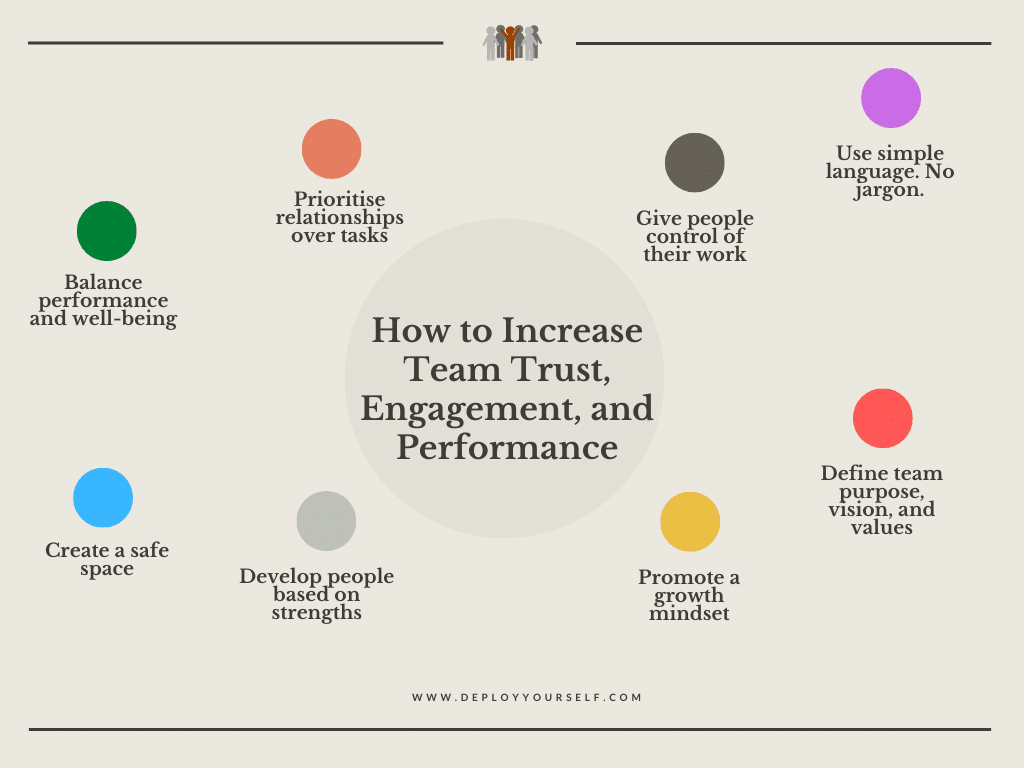
    8 Things Leaders Can Do To Increase Trust, Engagement, and Performance

    1.  Prioritise Trust and Relationships Over Tasks and Projects

    Too many companies believe people are interchangeable, and treat them as just resources to get work done. That is why most work conversations revolve around what we do – the tasks, projects, deadlines, budgeting, strategy, etc. I believe we are missing a trick here if only focus on the tasks, and ignore the relationships between people who do these tasks.

    Good leaders understand that it is the people and the relationships among them which decide the quality of work done. Hence they focus on building strong relationships and creating a culture where trust, honesty, and accountability are prioritized.

    Leaders build strong relationships by understanding people’s deepest beliefs and ambitions, by coaching them to figure out their values and empowering them by setting relevant milestones and then providing support along the way. This way the relationship becomes the bedrock of everything being done and the conversations shift from being project-based to relationship-based.

    Gallup found that people who have a good friend in the workplace are more likely to be satisfied. With good relationships, precious time and energy that would have been spent in fixing bad relationships and solving conflicts is now instead spent productively. This results not just in increased wellbeing but also increased business productivity.

    2.  Give People Control of Their Work

    Giving people more control over their day-to-day decisions and work is a fantastic way to improve engagement. Autonomy creates accountability and accountability leads to engagement (Saragih, 2011).

    Good leaders allow people to have a greater say in their work and they become more involved and engaged by extension. Nobody likes to be told what to do. Nobody likes to be micromanaged. We hire people after extensive interviews. I think we disrespect their skills when we don’t listen to them.

    Resisting the temptation to micromanage and involve yourself in every task can be difficult. Allowing your people to do what they do best without interference will, however, lead to better results in the long-run. Provide them the assurance and freedom they need and desire to do their job. Give them ownership, so the work is theirs, not yours. This makes their tasks, their projects, and their responsibilities more meaningful.

    3.  Promote a Growth Mindset

    Mistakes are unavoidable when chasing big goals but how you deal with them can make a world of difference. Instead of viewing mistakes as negative, strong leaders see them as an opportunity to learn. This begins by showing your own vulnerabilities as a leader. If you make a mistake, it’s important to admit it. Be willing to accept feedback on your performance and then use the information for positive change.

    Strong leaders promote a “growth mindset” among their people. This growth mindset is based on the belief that your basic qualities are things you can cultivate through your efforts. As Carol Dweck, who studies human motivation, says in her book Mindset : The New Psychology of Success, “The passion for stretching yourself and sticking to it, even (or especially) when it’s not going well, is the hallmark of the growth mindset. This is the mindset that allows people to thrive during some of the most challenging times in their lives.”

    With the growth mindset, people become students for life and see each success and failure as opportunities to learn. With this attitude, everything becomes a journey and people avoid getting stuck in defeating self-talk like “I can’t do this.”, or “This is beyond my abilities”.

    Strong leaders create a growth mindset by promoting a culture where people are not blamed for mistakes and failures, which will eventually happen. Instead these are seen as learning opportunities so that the same mistakes are not repeated in the future.

    4.  Develop People Based on Their Strengths

    Have you worked in a company or with a manager where every conversation focussed on what you are not doing well, and what you need to do to improve your weaknesses? Have you been asked to create measurable goals to show progress in an area where you have not been doing so well? How does it feel when your manager talks about your weakness in every 1-on-1?

    If you are like most people, you will find this experience extremely frustrating. As human beings, there are always skills that we do well and some skills where we don’t do as well. Focussing on weaknesses brings our fears, insecurity, and anxiety to the fore, and impairs learning and growth.

    In a massive study by Gallup involving 1.2 million employees across 22 organizations in seven industries and 45 countries, it was found that focussing on strengths leads to increased sales, profits, high engagement for employees, and safety. By focusing on weaknesses, the true potential of employees where they can shine and do their best work is often neglected.

    Researchers have also found that receiving praise releases dopamine, which is the chemical associated with rewards in our brain. Praise basically tells our brain “Do that again.” This is why, when good work is praised and recognized, people will tend to do more of the same in the future.

    Praise works best when it is specific and not vague. So instead of praising someone’s work as “brilliant” or “wonderful”, be more specific in appreciating the effort. Below are some specific examples of praise done well :

    • “I liked how you have used juxtapositions to add humor to your sentences.”
    • “I loved the report, especially the solid research you did and can be seen in the statistics you presented.”

    “If you focus on people’s weaknesses, they lose confidence.”

    ― Tom Rath

    5.  Balance Performance and Wellbeing

    Performance needs to be balanced with employees’ health and wellbeing for the best results. Overworking employees leads to a decline in engagement and performance over time. Instead, good leaders encourage days off, reduce overtime, and allow weekends off to ensure people get enough rest to recover and come back fresh to work every week.

    Overworking will have detrimental effects on your employees’ physical and mental health in the long-run (Wong, Chan & Ngan, 2019). It goes without saying that this is not a good outcome. Your people’s health and wellbeing should be your number one concern, as it can impact everything the business does.

    There are no winners when people are overworked and it is bad for the long-term success of your company. Managers should encourage people to focus on their health by providing and promoting adequate health insurance, healthy food, and sports facilities – whether inside or outside the physical space of organizations.

    Just like overplanting plants drain the soil of all its nutrients and lead to failed crops, overworking people leads to sick employees and poor work performance.

    6.  Create A Safe Space Where Employees Feel Comfortable

    The working environment you create is vital to the performance of your team. Employees should feel comfortable to voice concerns, open up, and make suggestions. They should not fear repercussions for taking initiative or speaking up. Everyone should be aware that they are working in a safe space absent of blame or retaliation.

    Organizational behavioral scientist Amy Edmondson defines psychological safety as “a shared belief held by members of a team that the team is safe for interpersonal risk-taking.” Psychologically safe teams understand and give the opportunity for people to stand out because of their uniqueness, rather than attempting to fit people in boxes (or roles, titles, etc).

    In a safe environment, you don’t have to wear a mask and can be completely honest about what you know and what you don’t. When you do that, others step in to help and close the gaps in skill and knowledge, leading to faster learning and better execution. This is leaps and bounds better than the alternative – when people fake knowing something they don’t, and this leads to mistakes or other faults down the line.

    Some ways in which you can create a safe and comfortable workspace include:

    • Listen to and take action based on inputs and feedback provided by your team.
    • Remove blame and punishing people from your culture. Instead, focus on learning from mistakes.
    • Delegate decision making and remove unnecessary processes and approvals. Let your team own their own decisions.
    • Lead by example by sharing your own vulnerabilities.
    • Ask for support from your team when you need help. Show them that this doesn’t make you weak. It only shows you are human.

    “Teamwork begins by building trust. And the only way to do that is to overcome our need for invulnerability.” – Patrick Lencioni

    7.  Define Team Purpose, Vision, and Values

    The ‘why’ is arguably more important than the ‘what’ and the ‘how’. In more specific terms, the purpose, vision, and values behind a project have the potential to influence its success as much as the details of the project itself.

    Continuously offering reminders of the bigger picture when working on daily tasks is key. People are motivated by meaning and this concept is perfectly illustrated by Dan Ariely. Research has shown that acknowledgment or meaning behind work, even in small quantities, is associated with more engagement and higher ownership.

    Ariely research indicated that not only are people motivated by meaning, but they are also aware of this. When asked to predict their output for two conditions of varying acknowledgment, participants correctly predicted a greater output in the meaning condition. Perhaps most interestingly, it has been suggested that even if you like something, you are still demotivated by a lack of meaning.

    Everyone wants to contribute to something bigger than themselves and make a difference. Strong leaders show people how their work impacts the customer and the wider benefits to the industry/society. A wonderful example of this is the below story –

    During a visit to the NASA space center in 1962, President John F. Kennedy noticed a janitor carrying a broom. He interrupted his tour, walked over to the man, and said, “Hi, I’m Jack Kennedy. What are you doing?”

    “Well, Mr. President,” the janitor responded, “I’m helping put a man on the moon.”

    “Coming together is a beginning, staying together is progress, and working together is success.” – Henry Ford

    8.  Use Simple Language to Make Expectations Clear

    Corporate language is known for being unnecessarily complicated and boring. Cutting down on corporate jargon increases engagement, transparency, and understanding. Often, simple and clear statements will get the point across. Corporate jargon is unpopular and often confusing, so use it sparingly, if at all. There is research to suggests that plain and simple language is effective in a business setting.

    Leaders should stop using complicated language or hiding behind jargon. Trust people and share information openly. Let people ask anything about everything. Transparent communication involves people in problem-solving and they see the team’s or the company’s problems as their own. And, you never know where a good solution to your biggest challenges might come from.

    A few simple tips for clearer language in the workplace are –

    • Use shorter sentences
    • Make your most important point first
    • Use headings and bullet points to make your message easier to skim
    • Keep your target audience in mind when communicating
    • Use visuals aids like graphs and chart to make it easier for people

    “When corporate executives get really excited, they leverage their learnings against comprehension to revolutionize English.”

    ― Tanya Thompson

    Conclusion

    Treating your employees as just employees will make them just employees. Treating them as people will unlock their full potential by creating more trust, higher engagement, and better performance.

    Finding out what your employees need and providing the opportunities to access them is one of your primary goals as a leader. Create stronger relationships, communicate transparently and regularly, and encourage participation. These are all key to an engaged and trusting workforce, that will perform better as a result.

    The single best way to increase performance is to create a culture that enables people to do their best work. Culture should enable performance, rather than stand in its way. By using the 8 things presented in this article, leaders can ensure people feel connected to the larger vision of the organization and supported by peers, subordinates, and leaders.

    References

    1. Historic Drop in Employee Engagement Follows Record Rise
    2. Worldwide, 13% of Employees Are Engaged at Work
    3. The “IKEA Effect”: When Labor Leads to Love Working Paper
    4. THE FUTURE WORKPLACE
    5. Inbound Recruiting: HubSpot’s Approach to Employer Branding
    6. The Effect of Long Working Hours and Overtime on Occupational Health: A Meta-Analysis of Evidence from 1998 to 2018
    7. How to Create Safe Spaces at Work
    8. If We All Hate Business Jargon, Why Do We Keep Using It?
    9. Why Plain Language is Good for Business –
    10. (PDF) The Effects of Job Autonomy on Work Outcomes: Self Efficacy as an Intervening Variable
    11. Trust Employees: 3 studies showing the power of trust in the workplace
  • The 7 Most Powerful Investments You Can Make. They Are Not What You Think

    What comes to your mind when you are asked about the most powerful investments you should make? Is it stocks? Is it bonds? Or a new house? Real estate is the safest investment, you might have heard.

    If you ask me, I would say, neither!

    Over the course of my life, with its few successes and numerous failures, I have come to see another type of investment that will give you the maximum returns – investing in yourself.

    All of us want to lead a life of high quality and success, isn’t it? We all want to be satisfied and productive.

    Most of the time when we talk or think about investing, we limit our thoughts to financial investing and to maximize our monetary returns. We believe doing so will maximize the quality of our lives in the long term.

    All that is good thinking, but I have discovered that there are some simple investments we can make in ourselves which we tend to miss or neglect. And for most of these are not even financial. You don’t need to have money to do this kind of investing.

    “Investing in yourself is the best thing you can do. If you’ve got talents, no one can take them from you.” — Warren Buffett

    Investing in yourself is a continuous process. The effort and time you put in to invest in yourself consistently will determine the quality of life you would be leading in the future.

    Below are the 7 most powerful investments you can make:-

    1. Reading Books

    I have discovered books to be like ‘power banks‘ that revitalize the human mind. They pack knowledge, wisdom, and valuable lessons from people who have lived life before us.

    My favorite books are often memoirs of successful people from different fields like business, sports, politics, activism, art, etc. Reading them gives you a whole new perspective of how they looked at life, and their struggles and achievements.

    Books can lead you to locations you have never been to. For example – reading Theodore Roosevelt’s biography by Edmund Morris took me to New York in the late 1800s and early 1900s. They can give you many interesting ideas you never would have thought of otherwise, as you relate and compare your own life to the protagonist of the book.

    Take some time out each day to read books. Audiobooks are also available these days and you can tune into your favorite book even when you are on the move. Reading for just 10 minutes daily would help you finish around 15-20 books every year. Does that sound too difficult?

    2. Foundational Knowledge of How The World Works

    The most successful people are used to thinking and reasoning from First Principles. Some notable example thinkers are inventor Johannes Gutenberg, the Greek philosopher Aristotle, and entrepreneur Elon Musk – the founder of SpaceX and Tesla.

    First Principles Thinking starts with learning about the essentials which are always true – in the world we live in, and how the people in it operate. Subjects like physics, math, economics, and psychology are the foundation of how our world works.

    The laws of physics define how the material world behaves, psychology tells you how human beings behave and how irrational we can be, economics defines how the financial world behaves – the world of money and markets which affect us all, and math is often the foundation of every kind of reasoning and logic.

    Investing time in knowing and understanding these basic foundational subjects, irrespective of your job or industry, will help you make better decisions for you and the people around you.

    You wouldn’t go to a new city without looking at its map. So why would you want to interact with people, handle your money, and live in this physical world without the basic knowledge of psychology, economics, math, and physics?

    “An investment in knowledge pays the best interest.” – Benjamin Franklin

    3. Nurturing ‘Positive’ Habits

    By ‘positive’ habits, I mean the habits that serve you and help you achieve what you want to achieve. As most people do, I have been setting goals for myself – both at work and personal – for most of my life. And as most people discover at some point, I now realize that goals (like new year resolutions) never work – at least not as well as we expect them to.

    Neuroscience and psychology research proves that habits are better than goals when we look for iterative and long term results. Goals require willpower and discipline, and still, the desired result might not be in our control. On the other hand, habits are totally in our control and take little motivation as they become part of our routine.

    The best thing about habits is that once formed, they run in the background without taking our mental cycles, just like many software programs run in the background on your computer. This leaves us free to focus on other important things.

    Habits powerfully influence our behavior. And because of the fact that they work as part of our subconscious, bad habits can be just as damaging as good habits can be beneficial.

    “Habits are powerful but delicate. They can emerge outside our consciousness or can be deliberately designed. They often occur without our permission but can be reshaped by fiddling with their parts. They shape our lives far more than we realize—they are so strong, in fact, that they cause our brains to cling to them at the exclusion of all else, including common sense.” – Charles Duhigg

    Some of the ‘positive’ habits that have been very beneficial to me are:-

    • The habit of reading books in every 5 or 10-minute gap I found in my day, instead of making a goal to read 20 books in a year. Now, I automatically default to reading whenever I have a little time and finish over 40-50 books every year.
    • The habit of writing for 30 minutes as soon as I get up in the morning, vs making a goal of writing 2 articles every week. Writing is still the most painful task I do (from a willpower point of view), and having this simple daily habit means now I don’t worry about the number of articles and just focus on writing right after getting up. Usually, the 30 minutes stretch to 60 minutes, and I have been pretty happy with the outcome.
    • The habit of exercising for at least half an hour every day, instead of making goals like running a marathon or so. Be it walking, cycling, or simple exercises in my living room, I am happy now as long as I do 30 minutes of it. In addition to the attached health benefits, this has broken the monotony of everyday life.

    Invest in Yourself
    Invest in Yourself

    4. Communication and Interpersonal Skills

    No matter what we do for a living, we all work with other human beings. Learning to communicate better is one investment we can all make, and it will produce compounded results over time.

    Understanding how human beings behave, and what it takes to convince, persuade, and influence people is as fundamental a skill as any.

    Make a habit of listening to people and giving them the value they deserve. Understand where they are coming from. Make them feel important. Learn how to put the message across, how to talk to different types of people, and how to express yourself with clarity and purpose.

    Let go of the habit of blaming others or yourself when you mess up. Own up and apologize if you need it. Build the foundations that strengthen every relationship. Focus on relationships instead of negotiating when you talk.

    5. Writing Skills

    Writing could be private (a journal) or public (a blog, book, etc). It is not only a skill to communicate and express yourself, but also to think. As you put your thoughts to paper, it helps you to clarify your thinking and form a comprehensive picture of the topic at hand.

    Research shows that writing makes you healthier and happier. It helps you deal with various difficulties life throws in a way you can be proud of. Writing about what makes you grateful helps your mental health and makes you look at life more cheerfully.

    Powerful Investments in Life

    6. Trusting People by Default

    Trust people when you first meet them. Rather than fear the worst-case scenario, have faith that the best case will turn out to be true.

    Give your energy, time, gratitude, and appreciation to people around you. See it as an investment – in people. Investment in people always tends to come back in life, and in proportions we can’t imagine.

    “Everyone thinks of changing the world, but no one thinks of changing himself.” ― Leo Tolstoy

    7. Knowing What You Stand For

    Just like ships need a compass and a lighthouse to navigate in vast oceans, we all need to understand what we stand for, to guide us in difficult times. Our deepest held values, standards, and boundaries can be that guide and keep us in check.

    When we accept the standards and values others’ have set for us, we surrender our own will and judgment. By figuring out what we stand for, we allow our unique light to shine upon the world.

    Conclusion

    As you must have realized, the above-mentioned ‘investments’ do not cost you much (money). You do not need to spend money to make any of these investments. But, you need to be consistent and invest “brick-by-brick” with your time.

    References

    1. The Health Benefits of Writing about Life Goals – Laura A. King, 2001
    2. Top 11 Scientific Benefits of Writing [INFOGRAPHIC]
    3. Have You Discovered Your Leadership Lighthouse? Why Should You?
  • How to Prepare for a Conflict Resolution Conversation?

    A conflict resolution conversation is one of the most critical conversations in any organization. The success or failure of this conversation will determine how the inherent energy in a conflict will be used, and how the relationship between the involved parties will be in the future.

    As I have written previously, conflicts have a lot of energy, like an overflowing river. It is up to us to build a dam and channel all this extra water (energy) into electricity? Because if left unchecked, all this extra water can cause flooding and devastation in its path. The most effective tool to prevent the flooding and use the energy in each conflict productively is the Conflict Resolution Conversation.

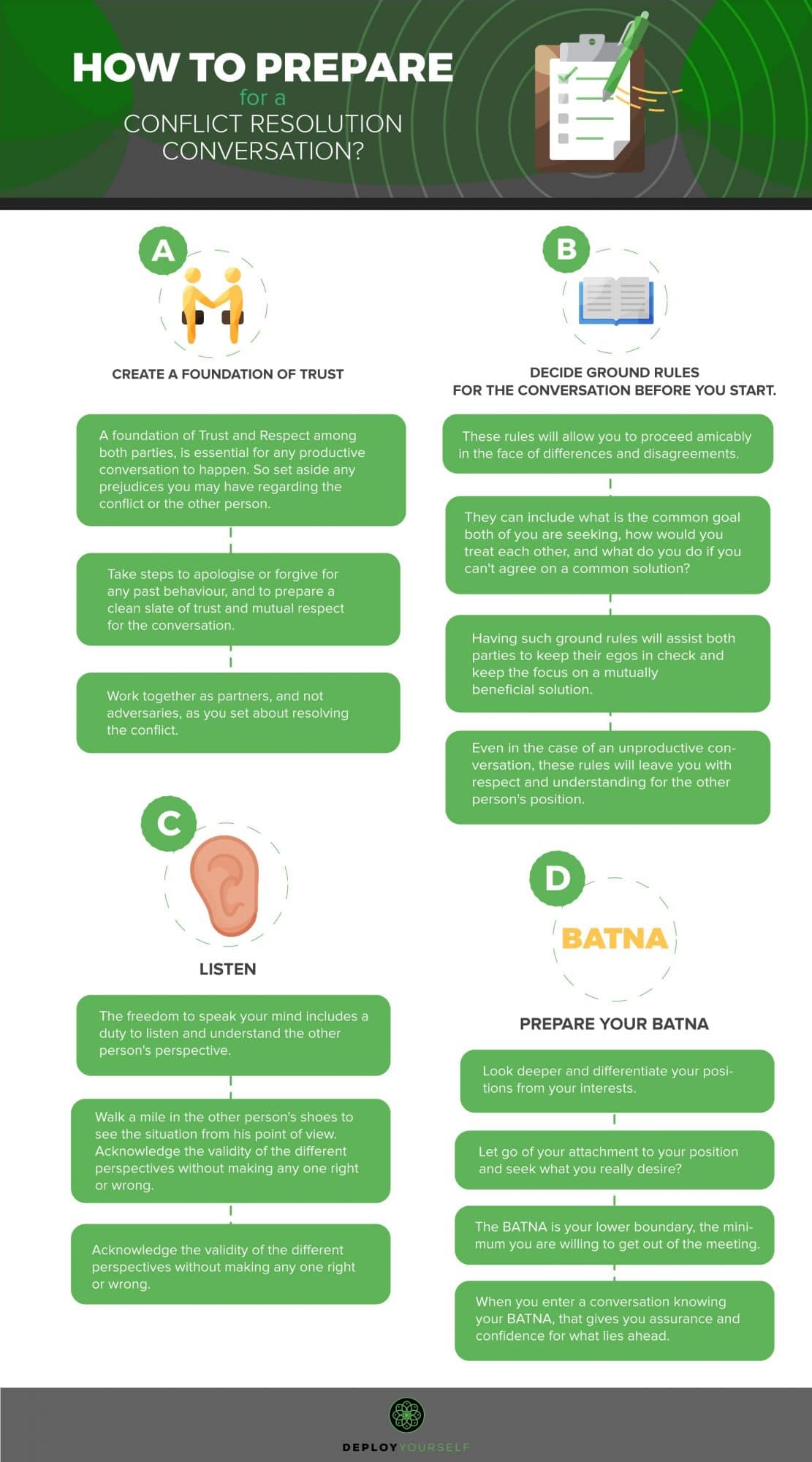
    Below are the 5 steps I think all of us must take before/in any conflict resolution conversation:-

    1. Create A Foundation of Trust and Respect among all involved parties, which is essential for any productive conversation to happen. This is more like a step 0, as trust is like oxygen in a conversation.

    Take steps to apologize or forgive for any past behavior, and prepare a clean slate by setting any prejudices aside. This will help create an environment of trust and mutual respect. Work together as partners, and not adversaries, as you set about resolving the conflict.

    2. Decide Ground Rules for the conversation before you start. These rules will allow you to proceed amicably in the face of differences and disagreements. They can include what is the common goal both parties are seeking, how would you treat each other, and what do you do if you can’t agree on a common solution?

    Having such ground rules will assist both parties to keep their egos in check and keep the focus on a mutually beneficial solution. Even in the case of an unproductive conversation, these rules will leave you with respect and understanding for the other person’s position, rather than with resentment and cynicism.

    3. Listen. The freedom to speak your mind includes a duty to listen and understand the other person’s perspective. Walk a mile in the other person’s shoes to see the situation from his point of view. Acknowledge the validity of the different perspectives without making any one perspective right or wrong.

    Walk into the conversation with an empathetic attitude and care for the other party’s concerns. Understand that the conversation is not productive unless the concerns of both parties are met. If you work to address what the other person cares about, you create the possibility of a win-win result which might be even better than what you initially wanted.

    “Courtesy towards opponents and eagerness to understand their viewpoint is the ABC of non-violence.” – Mahatma Gandhi

    4. Differentiate Your Positions from your Interests – Ask yourself what do you really desire? And why? Let go of your attachment to your position and seek to discover yours and others’ common desires. Asking the question “why” a couple of times can help you do that.

    This will help you understand the other person better and create space for collaboration and flexibility. Understanding the concerns of each other will turn you into partners rather than adversaries, and it opens up the possibility of making 2 + 2 = 5 happen.

    5. Prepare your BATNA (Best Alternative to a Negotiable Agreement) – The BATNA is your lower boundary, the minimum you are willing to get out of the conversation. Knowing your BATNA increases your negotiating power.

    When you enter a conversation knowing your BATNA, that gives you assurance and confidence. If nothing else works, you walk out with your BATNA.

    To sum it up, doing this preparation before any conflict resolution conversation prevents us from reacting impulsively when the going gets tough. Conflicts are a natural order of life, and being prepared will allow us to turn them into an opportunity to build a strong foundation (relationship) not just for immediate but also long term results.

    It is also important to note that the above steps do not guarantee a successful conversation or the results we desire. But they will equip us to deal with conflicts with steady and not shaky hands, which is always a good skill to have.

  • Five Things A Leader Must Do By Default

    In today’s corporate environment, after a few years of doing your job well enough, chances are that you will be asked to step up and lead a team. You trained and studied to be good at your job, and now getting to manage people seems like a reward for a job well done.

    By promoting the good performers to be managers and leaders, people have assumed for centuries that the skills that made you successful as an individual contributor would also make you successful as a manager. If you have led people for any considerable amount of time, you would know how false this assumption is. Yet in the business world, this continues to be the norm.

    Today I want to list down five things which you must do, or are expected to do by default, to be effective as a manager/leader. And it is likely that nobody told you this when you were promoted. I have only figured them out after leading teams for over a decade, and I believe I am on a continuous journey to learn and know more about leadership.

    1. Lead Yourself

    The first thing you must do to be effective as a leader is to lead yourself. Your relationship with your team will be determined more by your trustworthiness than by any other skill or talent you might possess. Trust is the foundation of leadership, and you build trust by leading yourself first – by holding yourself accountable for what you demand from your team. Like any worthwhile endeavor, it takes time, effort, and daily investments to build trust with your team.

    If you want your team members to honour their promises, honour your promises to them. If you ask them to be on time for meetings, you must be on time first. Or you will lose their trust. If you ask them to be respectful to each other, you must respect them first. Or you will lose their trust. If you want them to be humble, you need to exemplify that in your behaviour. If you need them to be honest and sincere, you need to acknowledge your mistakes publicly and make amends for them. You can not lead a team if you can’t lead yourself.

    2. Know Where You are Headed

    When you are leading a team, people will look up to you for providing direction. Having a well-defined purpose clarifies why the team exists in the first place. Coming up with the team’s purpose together with your team will empower them to take decisions that are in the best interest of the team.

    Listening to your team and engaging in a dialogue will allow the team to define and own its purpose. You need to spend time with the team regularly to discuss, revisit, or reshape the team’s purpose. Ensuring each member understands the team’s purpose and their role in the team will empower them to prioritize their tasks effectively.

    3. Be a Coach


    If you have people reporting to you, then you are their coach by default. You don’t have a choice in being their coach as people will approach you anyway. When they are demotivated, when they have a conflict, or when they need help for any other reason; it is your responsibility to listen, understand their concerns, and then coach them to align their personal motivations with the team’s shared purpose and goals. If you can’t do that effectively, it will impact the results the team intends to produce in the future.

    While I assert that you are a coach by default, the skills and conversations required to be a coach don’t come by default. You must invest time and effort in learning and practicing your coaching skills. How well you coach people will be directly proportional to the results the team produces. Investing in learning these skills and making coaching a priority will be your best investment ever.

    4. Demand Commitment and Accountability

    Just as every sport has a certain set of rules, each business team can come up with rules (or standards) which apply to their business and industry. These rules will govern how you work and define success and failure. Examples could be how you treat your colleagues, how complaints are handled, and what boundaries you set in matters important to the team. Once these standards are set, it frees up everyone to exercise their own creativity in making decisions. This gives shape to the ‘culture’ in the team.

    After you set up these standards together with your team, you have to demand them. Of course, for this to work, you have to exemplify them yourself. Holding your team accountable to these standards (or rules) will bring the team members together and set the team up for high performance. The intention behind it is not to punish or penalise people when they slip up, but to ensure an open, fair and supportive culture in the team.

    5. Serve Your People

    I believe that leadership is a privilege, and that each leader is a custodian of the company’s values, beliefs, and ambitions for the future. Leadership will require you to think beyond your own self-interest, and from your team or company’s point of view. In order to lead, you must be willing to serve – to put your team’s interest in front of any individual interests, which might lead you to make some difficult decisions from time to time.

    Leadership is not about power or authority, nor is it about popularity. Leadership is about character – which you will need to express yourself authentically, compassion – which you will need to grow and develop your people, and integrity – which you will need to serve your people with the respect and transparency they deserve.

    I believe that leadership is standing for something bigger than yourselves. You show your team the way, give it what it needs to do the job, and then get out of the way. Your biggest job is to create an environment of respect and accountability, where people have fun and express themselves freely by continuously moving forward towards the team’s goals.

    To sum it up, these five points above are not strategies or tactics which you can incorporate in your leadership style to get better results. These are the bedrock which will give rise to a myriad of strategies and tactics, which in turn will lead to those results. If you try to fake them, your people will call your bluff sooner or later, and you will lose all credibility and trust. An attitude of humble service will enable you to become a better leader, while taking care of your team and company’s needs.

brain care coaching commitment communication conflict conflicts conversation culture deployyourself deploy yourself emotional intelligence emotions empathy energy feedback freedom future gold habits hope john maxwell language leadership lessons listening performance perspective preparation productive productivity psychological safety purpose questions relationships resolution ryan holiday seth godin simon sinek strengths struggle team trust values words