energy

  • How To Run Effective And Quick Meetings? Are You Making These Mistakes?

    Meetings can be among the biggest time and energy suckers in an organization if you let them be. According to a survey done by the Harvard Business Review, over 70% of senior managers consider meetings to be unproductive and ineffective. Additionally, 65% of the respondents said meetings routinely hindered them from completing their own work.

    What’s more, meetings can be not only time wasters but also money wasters. According to a study carried out by Bain & Company, weekly meetings of mid-level managers cost organizations up to $15 million a year in lost productivity.

    Nevertheless, meetings have their place in organizations. They can be the birthplace of groundbreaking ideas or solutions to major problems. That is because meetings allow you to take advantage of the combined creativity and experience of your team in a single room. 

    If one member has a half-baked solution, the other members’ creativity can help take that idea to the next stage. What’s more, the brainstorming and collaboration that can happen in a meeting save a lot of time and effort.

    If that is the case, why are meetings considered unproductive? For starters, most meetings are unnecessary, to begin with. Having a meeting should never itself be the goal. You should not hold a meeting just to pass information, which, unfortunately, is the reason for most meetings taking place. A meeting should have a specific goal in the larger context of making the business successful. 

    How to Run Quick and Effective Meetings

    An unnecessarily lengthy and ineffective meeting is a waste of crucial resources. Also, a meeting that ends up solving an irrelevant problem is ineffective and unjustifiable. The following are 8 steps to run an effective meeting.

    1. Set The Agenda and Expectations Before the Meeting Begins

    What is the purpose of the meeting? Are you looking to gather information, generate new ideas, or make a decision? 

    Remember, if you are not sure about what you want to accomplish in the meeting, you can be certain you will achieve nothing. As such, the most crucial factor for a productive and successful meeting is having a concrete agenda, a clear goal or objective you want to accomplish.

    Therefore, the purpose of a meeting should never be to share information – that is what emails are for. In the same light, a meeting is not a social gathering.

    At the very least, the purpose of a meeting should be to provide an avenue for a productive discussion that cannot be held asynchronously via email. However, the most critical function of a meeting should be to create an idea, solve a problem, or make a decision collaboratively.

    Therefore, evaluate your agenda to see whether it is worth the resulting cost in lost productivity from pulling people off their desks.

    1. Circulate the agenda, any preparatory documents, and any important proposal before the meeting. 

    Once you have a clear agenda, distribute copies of the agenda, as well as other documents in advance to all the relevant parties. Make sure to enunciate the goal of the meeting and the anticipated outcomes.  

    Doing that allows team members to prepare talking points, ideas, and potential arguments, resulting in a productive meeting. Circulating the agenda in advance also prevents the meeting from veering off track, allowing you to stick to the time limit.

    Some of the items to include in the agenda include:

    • Time and location 
    • A brief summary of the meeting’s objectives
    • A list of the attendees
    • Topics to be covered
    •  Who will address each topic
    • Any other information the attendees should know beforehand

    Everyone should come to the meeting only after reading the agenda and other required documentation. This ensures the time spent in the meeting is only on discussions and tasks which can’t happen asynchronously.

    For impromptu meetings, consider allowing the participants between 10 and 15 minutes to digest the meeting’s agenda and other preparatory documents before beginning it officially.

    1. Invite only those people who are needed

    Meetings are expensive, as they use the productive time of every participant. Therefore, you want to keep the number of attendees at a minimum. Nonetheless, you also want to have diverse perspectives and ideas in the meeting.

    To find that balance, only invite people whose skills or knowledge is beneficial to the agenda. As mentioned, the purpose of meetings is to create solutions, not share information. Consequently, inviting people who cannot make significant contributions to the meeting’s topics is simply a waste of time.

    Consider using Jeff Bezos’ Two Pizza Rule, which states that a meeting should not have more participants than can be fed by a pair of pepperoni pies. Having fewer people in your meeting not only allows you to save time and money but also promotes faster decision-making. 

    Managers should also ensure decision-making is delegated to their team and responsible people. If this is done well, the manager need not attend every meeting of their team and can focus their time on other important issues. A delegation of decision-making not only increases autonomy and accountability it also makes meetings shorter and smaller.

    1.  Keep the meeting short. 

    You will note that your team’s attention typically begins to wane about 30 minutes into the meeting. It is not that they are distracted or bored; there are simply trying to process everything. Consequently, the longer the meeting goes, the less productive it becomes since people are no longer actively engaged.

    According to studies, the longest time people can remain genuinely engaged in a subject is 52 minutes. Therefore, one of the best ways of improving the effectiveness of your meetings is by keeping them short.

    Do not do standard 1 hour or 90-minute meetings as is the norm in many companies. Schedule meetings for the time you think are appropriate – even if it is 10 or 20 minutes. A duration of 15 to 45 minutes is sufficient for 95% of the meetings you might want to have if you have done the other steps in this list well.

    What’s more, short meetings force you to condense your agenda to only topics that matter. Keeping your meetings short also shows your team members that you value their time. Most importantly, it ensures that you do not lose many productive hours in the process.

    1. End every meeting with a few action points with clear owners. Who is responsible for what by when?

    Too often, people come from meetings feeling like they were just in another social gathering, as they have no idea who will work on what to bring the meeting’s objectives into fruition.

    Therefore, to prevent that from happening, make sure to assign actionable follow-up tasks at the end of the meeting. Be specific about each person’s responsibilities so that everyone knows what they are accountable for.

    When people know there are follow-up tasks after each meeting, it brings clarity and accountability. If a group of people is responsible for doing something, then no one is responsible. Ending meetings with action points also helps team members to prepare for any follow-up meetings. 

    1. Have follow-up discussions and feedback via email asynchronously before organizing another meeting.

    How many times have you walked out of the same meeting with your colleague, only to discover you came out with entirely different interpretations of what went on? Needless to say, it is a common occurrence since human beings are subjective beings. 

    Different interpretations, when left unclarified, can be a huge impediment to the company’s progress, as everyone needs to be on the same page for the organization to achieve its goals.

    Therefore, it is important to document all the important discussion points, assigned roles and responsibilities, and deadlines, and share with everyone via email. While at it, ask for feedback about the meeting. This will allow you to know whether everyone is on the same page.

    It is also a good idea to let your team know that you (or an assigned note-taker) will be distributing that information after the meeting. Doing that will increase engagement tremendously, as it will free them from having to take notes during the meeting.

    1. Use clear and crisp language. Do not tolerate vague statements full of jargon.

    As mentioned earlier, people can come out of the same meeting with different interpretations of what was discussed. One of the biggest causes of misinterpretations is the use of vague statements and jargon.

    Unfortunately, the use of business jargon and technical language is common. That is because people mistakenly believe that using fancy terms makes them sound well informed. As such, many people use jargon to impress others rather than bring clarity.

    As you can imagine, jargon is a hindrance to productivity. The following are some of the reasons why jargon and vague statements should be avoided in a meeting.

     Jargon Causes Confusion

    Often, people overuse jargon to a point where one statement can mean different things. For example, while phrases such as “burning platform” or “drinking the Kool-aid” might be familiar to your team, they may not know what to make of them since those phrases carry both positive and negative connotations.

    Unfortunately, more often than not, people will not ask you to explain what you meant. Consequently, they end up deriving their own conclusions from what they think you meant.

    Jargon Can be Offending

    The unfortunate thing about most jargon is that most people learn it from others and start using it without looking deeper into its origins. As a result, people use several terms and phrases in the workplace innocently without knowing they are highly offensive to some individuals.

    It can Lead to Costly Mistakes

    To avoid confusion and misinterpretations, explain to your team members that jargon is unacceptable in meetings or work documents. Encourage them to strive for clarity and simplicity instead of trying to impress. Doing that will ensure smooth and effective communication.

    1. Be strict with start and end times. Keep a no-distractions rule. No coffee or electronic devices. If required, remove all chairs from meeting rooms to keep the meetings crisp and to the point.

    Meetings are expensive. Therefore, you want to make every minute spent in a meeting count. One way to do that is by being strict with start and end times. Doing that will let people know that the designated meeting time is to be respected. 

    Distractions are one of the biggest hindrances to productive meetings. Distractions typically result from the need to multitask. For instance, some people might use their time in the meeting to respond to emails or check their phones while thinking they are not missing out on anything.

    According to experts, multitasking makes an individual less effective, increases their stress levels, costing the global economy approximately $450 billion a year. And that’s not all. According to a Harvard Business Review report, multitasking can lead to a 40% drop in productivity and a 10-point drop in IQ.

    Take steps to proactively prevent distractions in your meetings, as they can have a significant impact. You can do that by:-

    Assign Roles

    Give each member a task to perform in the meeting. For example, one could facilitate the meeting, and another can take notes. Assigning roles ensures everyone stays focused on the proceedings.

    Have a Timed Agenda

    Give each discussion point a timeframe to ensure that all issues are discussed within the meeting’s timeframe. 

    Discourage Phone and Laptop Use

    Unless required for the meeting itself, ask people not to engage with any devices during the meeting. This will eliminate distractions from notifications from new emails or messages unrelated to the topic of the meeting.

    It might sound like an extreme step but you can remove all chairs from meeting rooms to shake people off their bad meeting habits. Standing meetings convey urgency, forcing people to develop ideas or make decisions quickly. As you can imagine, you are less likely to be distracted when you are in a stand-up meeting.

    Conclusion

    Meetings can provide an avenue for collaboration, allowing team members to brainstorm and come up with practical solutions which are not possible individually. However, meetings can also be one of the biggest time and money suckers in an organization without the right approach. The above steps will help make your meetings quicker and more effective at the same time.

  • How To Respond To Anger Like The Adults We Are Supposed To Be?

    In my previous article on anger, we saw that anger hides what we care about. If we look deeper and take the time to introspect, anger can tell us what we really value, and which value has been violated that resulted in the anger. Anger can communicate a lot of important information, but only if we are willing to listen.

    Can you control the emotion of anger? NO. Can you control how you respond to it? YES

    Life is unpredictable, and you can’t stop yourself from getting angry or frustrated at times, but can you control how you respond to it?

    Do you think you can’t control your reaction when angry?

    The truth is that anger is not the culprit behind this feeling of helplessness. It is our inability to understand and handle it. We banish anger and put a leash around it – by terming it as wrong, immoral, bad to talk about, bad to feel, etc. Rarely do we educate ourselves and our children about what anger really is and how to deal with it.

    Anger has a lot of energy, and it is up to us to use it destructively or productively. We can allow anger to reveal the love and care beneath it. We can allow anger to strengthen ourselves and our relationships. To do this we have to be willing to be vulnerable and listen to our anger. And there is a lot of power in that vulnerability.

    “Remember not only to say the right thing in the right place, but far more difficult still, to leave unsaid the wrong thing at the tempting moment.”

    ― Benjamin Franklin

    The Primitive Way of Responding To Anger

    There are 2 primitive ways of responding to anger:-

    1. Suppression

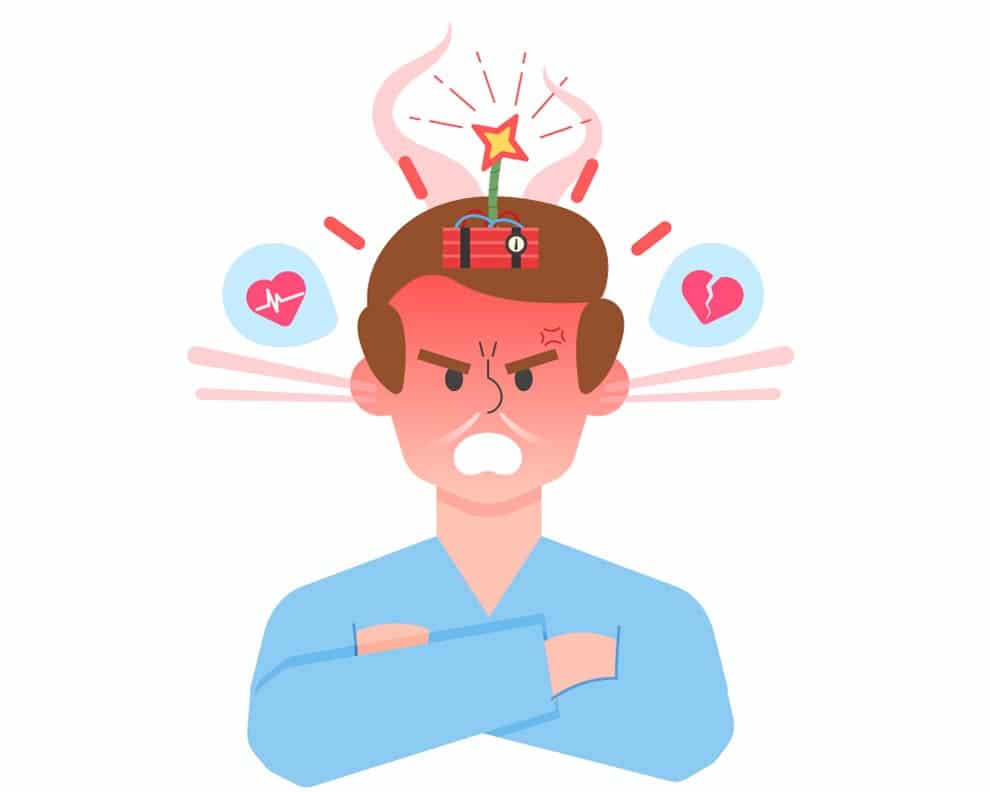
    People respond to anger in different ways. You can suppress it, try to hide it, or you can just go silent and not say anything. If you do that, it leads to stress, bad health and can be the cause of major diseases in the future. And suppression never really works because people around us can see we are angry or frustrated. People close to us can always see through our masks. When we suppress our anger and other emotions, we lose the vitality of life. Suppressing anger is like drinking poison and then expecting somebody else will die. Even if we can suppress anger very well, it keeps on building inside us and will end up in an explosion sooner or later. The more we suppress the bigger the explosion will be.

    2. Explosion

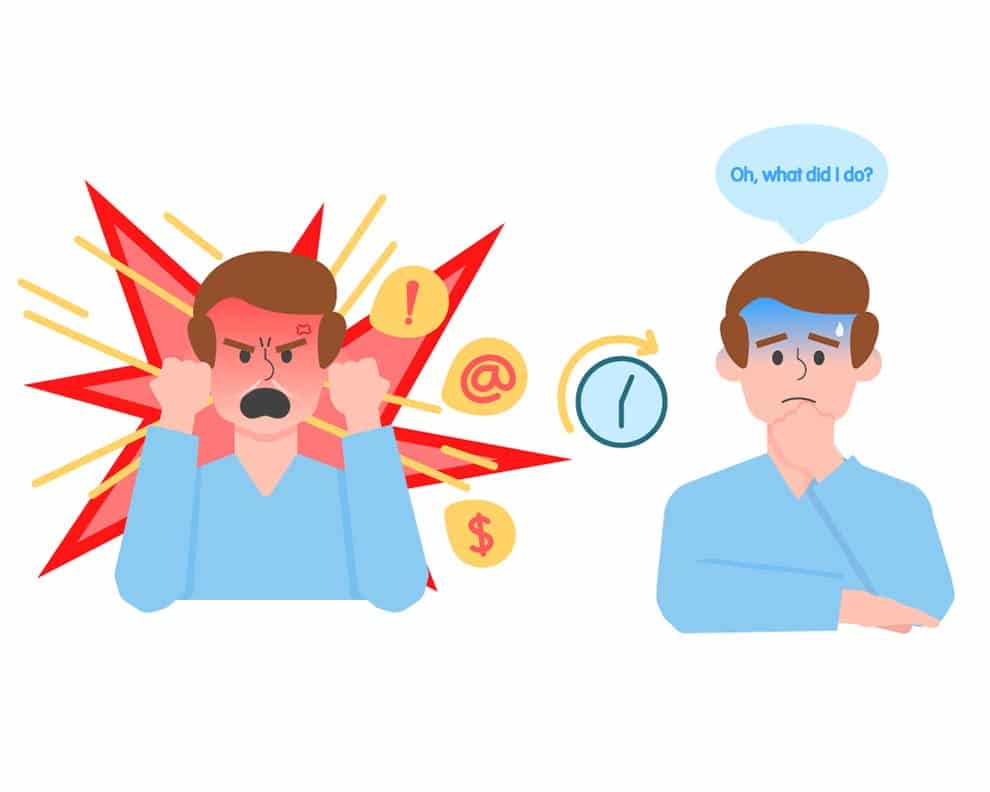
    The second way people react to anger is by exploding and causing a lot of damage. The damage can be to yourself, to the people around you, and to your relationships. When you explode in anger, you can lose control and get carried away. And an out of control human being is a very dangerous thing. In such a situation, we often end up doing something which we regret later. This could range from saying harsh words to using physical violence to harm ourselves or others.

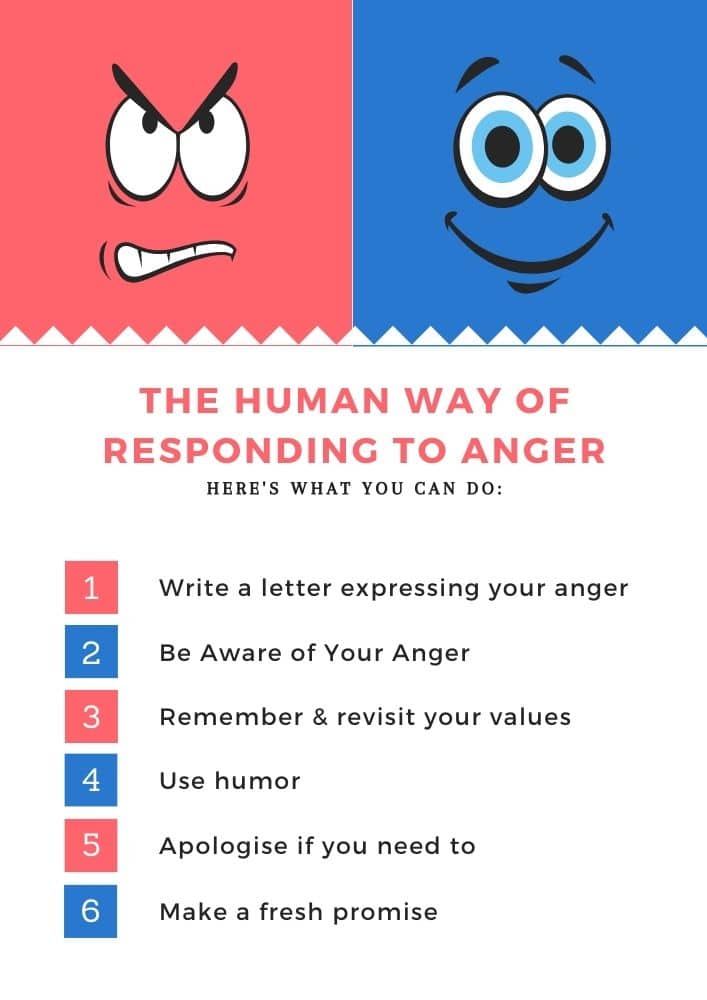
    The Human Way of Responding To Anger

    We may be primates, but we need not be primitive. One thing that separates our species from other animals is that we can choose our response despite our circumstances. We, as human beings, have the capability to go beyond our impulsive emotional reaction to choose a reaction that suits our long term needs better. The primitive way of reacting to anger does give a short term instant gratification, but it can cause long term damage.

    The perfect way to express anger is to express it according to our values, and it is also the key to releasing the positive energy of anger. The earlier we can express our anger, the less damaging it will be – for us and the people around us. You can’t always control if something will irritate and frustrate you, but you can always control how you respond to it. Don’t focus on what made you angry, focus on how you want to react. Let’s see how can we do that.

    1. Controlled Explosions

    To manage our anger better, we can have mini controlled explosions. Just like bomb squads do controlled explosions to limit the damage of an unexploded bomb, we can express our rage by shouting or screaming in private. We can write a letter where we can express our anger and vent out everything we are keeping bottled inside us. Obviously, we should never send this letter, and it makes sense to just destroy it afterward. Just the act of writing what you feel will make you feel better. These are not perfect solutions, they can still help us to defuse an otherwise alarming situation.

    2. In The Heat of The Moment – Be Aware of Your Anger

    What we can do in the heat of the moment is to be aware of our anger and not get sucked into reacting impulsively. We can focus on our breathing, and on what is happening in our body because of the anger. There are often physical symptoms of anger like a racing heart, and being present to these changes can help reduce them. You always have the power to choose how to respond to anger, and you do that by being present to and taking control of what is happening in your body.

    One way of being aware of what is going on in your body without reacting is to detach ourselves from the situation. You can take a break from whatever you are doing – take a walk and get yourself moving. If you’re inside a building, try to get outside and get some fresh air. Within a few minutes, you will start to feel better. Moving our body physically reduces stress and the level of the stress hormone – cortisol. It has been clinically proven that exercise improves not just our bodily metabolism, but also our spirits. A little exercise can prevent things from going outside of your control.

    3. What To Do When You Have Calmed Down?

    Every now and then it is important to remember and revisit our values. As they will determine how you want to act in the face of anger. A good question to ask yourself is – How do you want to act in anger so that you don’t regret it later on?

    We can learn to communicate and express our anger in a way we can be proud of. We can do that by not jumping to conclusions when our emotions are triggered. Research has proven that we don’t make good decisions when we are angry or in a heightened emotional state. Hence, it would be prudent not to believe what comes to our mind in such a state. We can make better decisions by slowing down, sleeping over it, and giving it time before making any life-changing decisions.

    “Speak when you are angry and you will make the best speech you will ever regret.”

    ― Ambrose Bierce

    Once we are calmer, we can listen to what others have to say without getting defensive. Everyone is entitled to their point of view, no matter how different it is from ours. It is very important to let others make their own choices, and not force our opinions on them. When you do that, people naturally tend to push back creating further friction and frustration.

    To make the most of the energy present in anger, we should remind ourselves of our values and seek win-win solutions together with people. Commit to finding a mutually agreeable solution rather than winning your argument and proving yourself right. At such moments, it is important to work with people, not against each other. Even if you prove yourself right or win an argument, give others an opportunity to save face.

    Don’t embarrass or humiliate people even when you know you’re right. Seek solutions where two plus two become five, where the sum is greater than the sum of the parts.

    4. Using Humor

    Humor is another way to defuse anger. The more you suppress or hide anger, the stronger it gets on the inside. Humor can help you look at a situation lightly, and help others relax too. The humor that comes out of deep emotional suffering can help you build connections with people. Humor loosens the grip of anger on our bodies and brings a smile to our face, which can be seen as diametrically opposite of anger.

    Humor allows us to see the big picture and the comedy in life. While life can be and is often painful, humor can prevent us from taking ourselves too seriously. Most stand-up comedians know this well, and that is they joke about our biggest challenges and problems. Laughing at a problem or a tough situation not only heals our bodies and souls but also empowers us for the future. Humor gives you power over your anger, instead of letting your anger have all the power.

    The best type of humor is self-deprecating humor. Don’t take yourself too seriously. Anger can hide our blind spots, which when seen from a different perspective, can make you laugh. And above all, it feels a lot better to laugh than to hate and cuss.

    “Anger is an acid that can do more harm to the vessel in which it is stored than to anything on which it is poured.”

    ― Mark Twain

    What To Do If Damage Has Already Been Done?

    Sometimes we can’t stop ourselves from venting in anger, and it is already too late for the above steps. In that case, it is important to apologize and fix the damage – as soon as we can see it.

    A powerful apology can go a long way

    A Powerful Apology

    A powerful apology is sincere, responsible, and makes amends for the future. You express your apology by saying what are you sorry for. Clearly state what happened and how you reacted to anger. Take full responsibility for what you did without blaming anyone else, the situation, or the emotion. It’s very powerful, though not easy, to say, “There’s no excuse for my behavior, and I take full responsibility for how I acted.” However, do it only if you can do it sincerely. There is nothing more offending than an insincere apology. If you are still holding a grudge, it can further damage the relationship.

    Once you have apologized sincerely, give the other person the choice to accept your apology or not. Be patient. You can never force an apology onto others. People might take time to come around and trust you again. Or they never might. Be ok with it. Own what you did and its consequences.

    The last step is to make a fresh and sincere promise to make amends. What will you do differently the next time? How will you clean up the mess caused by your anger? It is often a good idea to ask the offended person what you can do to undo the damage. Make a sincere promise and then live up to it. You will lose trust if you mess up again. People are often willing to give everyone a second chance. But a third chance is rare.

    In conclusion, anger can be poetically beautiful if we can see its value. Anger is an emotion that connects us all. Its what makes us human and everyone gets angry at one point or another. We can learn to see the lighter side of it, laugh over our mistakes, and learn from them. At the same time, it is important to realize that anger is just another natural human emotion and we should not beat ourselves over it. Instead, if we can make a powerful apology and live up to our promises, it can be a wonderful opportunity to use the energy of anger to strengthen your relationships and to set an example for others to follow.

    Resources

    1. https://www.apa.org/helpcenter/recognize-anger
    2. https://www.ncbi.nlm.nih.gov/pmc/articles/PMC5681963/
    3. https://ggia.berkeley.edu/practice/making_an_effective_apology
  • How Can We Overcome Negative Emotions And Create Positive Energy To Achieve Joy And Fulfilment?

    We all experience a wide range of emotions. If we are human, we can not escape feeling the same emotions as everyone else. In fact, the more psychology and neuroscience research I encounter, I wonder that a better name for us would be “emotional beings” rather than “human beings“. Emotions (not logic) are what decide each and every action we take, and it is emotions that make us human.

    The 6 basic human emotions are happiness, sadness, fear, disgust, anger, and surprise. However, all of us are capable of experiencing a much wider set of emotions like excitement, contempt, guilt, relief, embarrassment, shame, joy, inspiration, numbness, horror, and so on. It is natural that we will all experience the above emotions at some point or another.

    While all of these emotions might be natural, they are not all helpful. Many emotions leave us in a positive and empowered state while others leave us worse off. We also experience these emotions in different combinations and intensity.

     Plutchik Wheel of Emotions
    Plutchik Wheel of Emotions

    For example – anticipation and joy together become optimism, trust and fear become submission, and anger and disgust become contempt. Plutchik’s wheel of emotions provides a good framework to understand emotions, how they mix together, and how they can vary in levels of intensity.

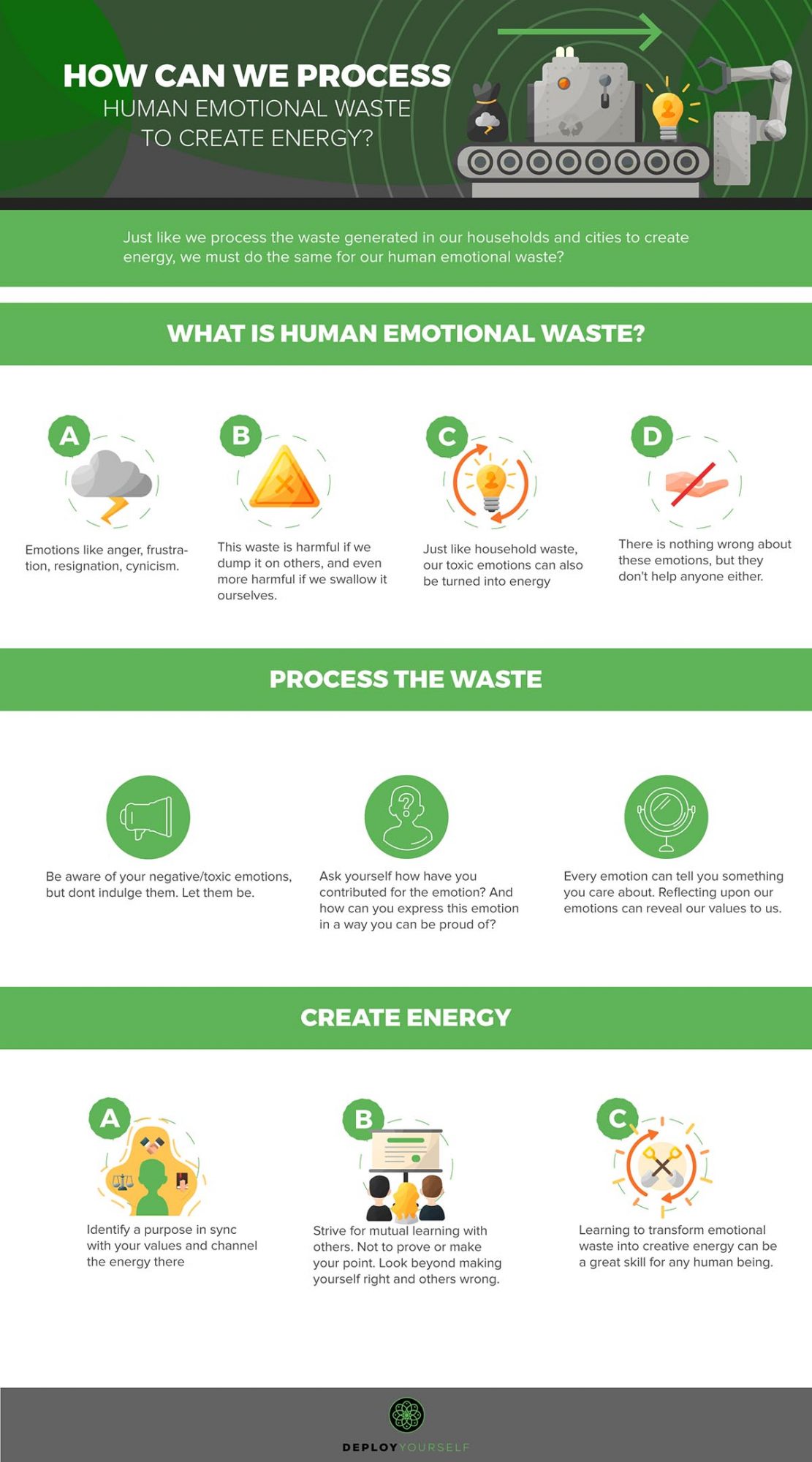
    In this article, I want to talk about our emotional waste, or what is often termed as negative emotions. Just like the waste generated in our households and cities is processed to create energy, we can and must process our emotional waste too. If we know how to deal with our emotions, they can be used to generate productive energy.

    “Clouds come floating into my life, no longer to carry rain or usher storm, but to add color to my sunset sky.”

    ― Rabindranath Tagore

    What Are So-Called Negative Emotions, or Human Emotional Waste?

    What I call Human Emotional Waste are emotions like anger, frustration, resignation, cynicism, guilt, and other so-called negative emotions. They are usually called “negative” in popular nomenclature, but I must clarify that there is nothing wrong with these emotions. Experiencing them is as natural as experiencing any other emotion. If you are a human being, you will experience these emotions in your life. There is no escaping them.

    Having said that, these emotions don’t help us either. The waste of these emotions is harmful if we dump it on others, and even more harmful if we swallow it ourselves. But just like household waste, these toxic emotions can also be turned into positive energyJust like crude oil can turn to fuel used to drive vehicles, these toxic emotions can also be turned into fuel to power something beneficial in our lives.

    Every Emotion Has Energy. It's Up To Us How We Use It
    Every Emotion Has Energy. It’s Up To Us How We Use It

    How Can We Process This Emotional Waste?

    The first step to productively process our toxic emotions is to stop fighting them. We must be aware of these emotions as they arise, but we should not indulge them. The more we indulge them, the more we risk slipping into the rabbit hole of disempowering thoughts and harmful actions. We must realize that having these emotions are natural, and we should just let them be.

    At this juncture, it is also important to note that we should not resist them either. Saying “I shouldn’t feel this way, or I will not get angry” will only make it more difficult to let these emotions go. The more we resist them, the more they will persist.

    Once we have done that, we can take the next step, which is to ask ourselves a few questions to understand what these emotions are trying to tell us:-

    • How have I contributed to the emotion to arise that I am experiencing right now?
    • What is it that I deeply care about and has been violated, which has stirred up this emotion?
    • How can I express this emotion in a way that I can be proud of?

    Answering these questions can be hard and intimidating, but this is the hard work required to “recycle” such emotions and gain some valuable insights from them. The more attention we pay to our emotions, the more aware we can be of what they are trying to tell us.

    Every emotion can tell us something we care about. Answering the above questions and reflecting upon our emotions can reveal our values and what is important to us. Once we realize which of our deeply held values was violated resulting in the emotion, we can take the next step.

    Suppressing our emotions can cause a lot of damage
    Suppressing our emotions can cause a lot of damage

    How Can We Create Positive Energy?

    Once we have identified what our emotions are trying to tell us, we must think about expressing these emotions in sync with our values. At such moments, we need to take the driver’s seat and prevent our emotions from taking over. Emotions are very good messengers but can be equally bad masters.

    We must channel the energy from understanding our emotions towards expressing them without suppression or explosion. Shouting at others (explosion), or sulking in silence (suppression) never solves any problem. It often only makes it worse. We can always choose to act according to our values — even in the face of failure, disappointment, and other strong feelings.

    We can’t always control our circumstances, but we can always act in ways congruent with our values. When we give in to the temptation of an impulsive emotional reaction, we try to win the argument and prove that our point of view is the correct one.

    “Everything can be taken from a man but one thing: the last of the human freedoms—to choose one’s attitude in any given set of circumstances, to choose one’s own way.”

    ― Viktor E. Frankl

    However, we must strive for mutual learning with others when expressing our emotions. The purpose is not to prove or make our point. We must look beyond making ourselves right and others wrong. For example:-

    • When we are sad about experiencing a loss, an impulsive reaction could be resignation and cynicism about the future. But a conscious expression of sadness would be to just grieve and acknowledge your loss.
    • When we feel anger and frustration, an impulsive reaction could be to get into a fight or suppress our feelings. But a conscious expression of anger would be to make a complaint and sharing our concerns.
    • When we feel guilt after a mistake, an impulsive reaction could be to beat ourselves up and sulking in shame. But a conscious expression of guilt would be to make a sincere apology and repair the broken trust.

    Learning to transform emotional waste into creative energy for a common or higher purpose is a skill. And just like other skills, it can be learned and developed. We can all use our emotional intelligence to make productive use of our emotions. If we can do that, these emotions will stop being “negative” for us. And we will end up with stronger relationships and a better world for all of us – not just you and me.

    How Can We Overcome Negative Emotions And Create Positive Energy To Achieve Joy And Fulfilment?
    How Can We Overcome Negative Emotions And Create Positive Energy To Achieve Joy And Fulfilment?

  • Understanding Conflicts Better – The First Step to Conflict Resolution

    CONFLICT!

    Is that a word that scares you? Is that something that makes you run in the opposite direction? Do you wish you had the skills to handle conflicts better?

    If you are like most people, you are no fan of conflicts and have often been caught up in the maze of a conflict. I certainly have, and I can honestly attest that conflict (or the fear of it) has given me many sleepless nights.

    In my 12 years of professional life, I have spent many a moment amidst conflicts, and many more reflecting upon them. Why do they happen? How can I best handle them? Can I still achieve my goals and enrich my relationships with conflict all around me? Can I beat the stress and anxiety which comes with conflict and still be happy and peaceful? Can I deal with conflict in a way that I can be proud of?

    There has been wise advice shared with me which I have ignored out of arrogance or ignorance, only to stumble upon and be humbled by the same realization later. Over time I have written down some notes which I have referenced later in times of conflict. This article is the first in a series of articles I am writing from these notes which revolve around the subject of handling conflict in our professional and personal lives.

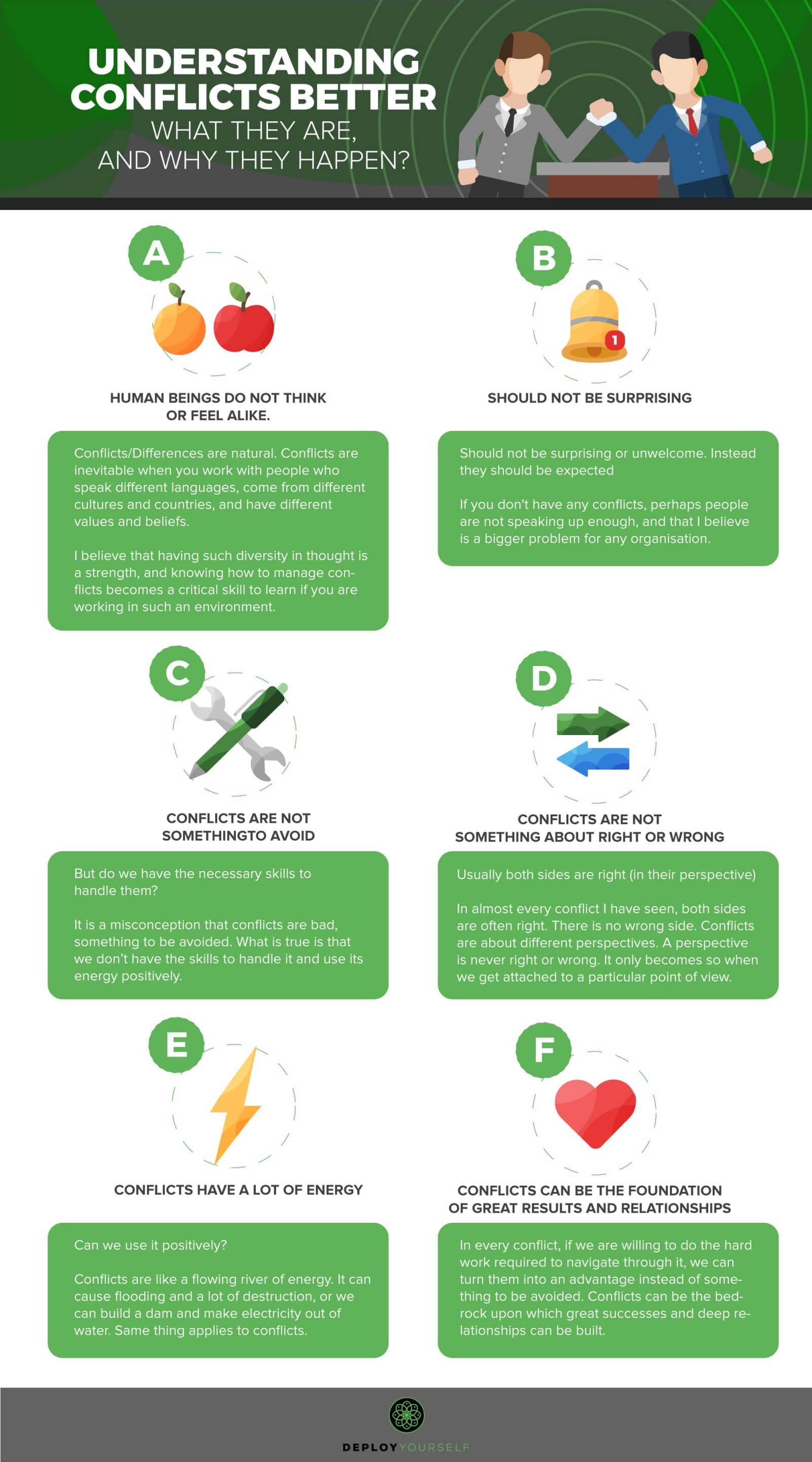
    Human Beings Do Not Think or Feel Alike. Conflicts are Natural.

    Wherever there is life, there is conflict. Every species on this planet experiences conflict in its fight for survival. Plants and animals strive for limited food, space, and mates in the wild, often giving rise to conflict. Humans are much more complex. In addition to food, space, and sex; we want power, fame, and money; giving rise to even more conflicts.

    Conflicts are a natural order of life, and if we step back and see the bigger picture, there is nothing unexpected around them. They are inevitable when we work with people who speak different languages, come from different cultures and countries, and have different values and beliefs.

    They Should Not Be Surprising. Instead They Should Be Expected.

    Today we live in a world driven by democratic and secular values (in most countries). If you don’t see any conflicts, perhaps people are not speaking up enough, and that I believe is a bigger problem for any society or organisation.

    In democratic societies, differences of opinion are not only expected but it is also a duty of each citizen to express himself without fear or hesitation. I believe that having diversity in thought is a strength, and knowing how to manage conflicts becomes a critical skill to learn if we are to live and work in such an environment.

    Understanding Conflicts Better Infographic
    Understanding Conflicts Better Infographic

    Are Conflicts Bad? Or Do We Lack The Skills To Handle Them?

    After facing and trying to avoid many conflicts over the years, I have come to believe that conflicts are not bad or something to be avoided. However, it is a common misconception and I have seen people do anything to avoid them.

    We have no choice or power over when a conflict is going to present itself. Our only choice is in responding to them. We find them undesirable or unproductive not because they are unpleasant but because we have no idea about how to handle them.

    Conflicts Are Not About Right or Wrong. Usually Both Sides Are Right.

    In almost every conflict I have seen, both sides are right. There is no wrong side. Conflicts are about different perspectives, and each perspective is valid for the one holding it. A perspective becomes right or wrong only when we get attached to a particular point of view.

    Can we see that we are all seeking to express the truth as we see it? Can we acknowledge that everyone sees the world differently and form their own perception of events? Conflicts happen not because of different perceptions, but because of our inability to acknowledge another’s point of view.

    Conflicts Have A Lot of Energy. Can We Use It Productively?

    Conflicts are like a flowing river. If left unchecked, they can cause flooding and destruction. But if we can build a dam and channel the water in the right direction, we can turn it into electricity.

    The same thing applies to conflicts. The only question is – Can we use the energy in conflict productively? Can we channel this energy into productive conversations that can lead to creative solutions and better results?

    However, if we can’t control the energy in a conflict, it can result in damage (stress, frustration, bad results) and lost opportunity.

    Conflicts Can Be The Foundation for Great Results and Relationships.

    Healthy disagreement creates friction and energy. If we look back at history we will find that every great accomplishment has come out of differing opinions of people who have found a way to work together.

    In every conflict, if we are willing to do the hard work required to navigate through it, we can turn them into an advantage instead of something to be avoided. Conflicts can be the bedrock upon which great successes and deep relationships can be built.

    “An enemy is a person whose story we have not heard.” – Gene Knudsen Hoffman

    In the next article, I will share a few things which most of us have done in the past amidst a conflict, but which I have learned that we MUST NOT DO when we encounter a conflict.