deploy yourself

  • 5 Steps To Deploy Yourself And Live An Authentic Life

    A lot of us, especially in our youthful days, struggle with how to deploy ourselves in the world. Instead of being true to ourselves and charting our own unique course, we tend to follow paths that others have decided on our behalf. However, if we take the long-term view, taking the path less traveled and Deploying Ourselves can make all the difference in the long run.

    Unfortunately, most of us prefer to stay in our comfort zones instead of striving to become the best version of ourselves. In this article, I will share 5 things that you are probably not doing but which could help you thrive and not just survive.

    To get fulfillment in life, we must understand who we are and lead an authentic life – one that is based on our values, and that utilizes our strengths and talents. The following are five key things that you can do to take charge of your life and Deploy Yourself.

    1. Understand Yourself – Your Values, Emotions, Desires, Strengths, and Weaknesses

    The first step towards Deploying Yourself is to understand what you care about and what is important to you. Identifying your unique set of values can be the first step towards building self-awareness. Often in life, most of us don’t know what we care about and what matters to us. As a result, we end up accepting the standards and values which other people (parents, society, culture, etc) decide for us. However, trying to live your life by others’ standards is akin to surrendering your own will and judgment.

    On the other hand, understanding your own values and being bold enough to follow them enables your unique light to shine upon the world. Looking back at history, it is clear that people who succeed in business or career are those who choose the path less trodden and follow their own path. Steve Jobs, Apple’s former CEO and co-founder is one example. His unique ideas went against the grain, and this transformed the tech world.

    A big part of understanding yourself also means becoming aware of your emotions and desires. What makes you angry, happy, or sad? What gives meaning to your days and weeks? What do you crave? If you wish to master yourself, you must learn to pay attention to what your emotions and desires are trying to tell you.

    Learning about your strengths and weaknesses enables you to choose a path that aligns with your talents and abilities. Research has proven that we can do much more productive and produce better results when we try to build upon our strengths rather than improve or fix our weaknesses.

    “There is no passion to be found playing small — in settling for a life that is less than the one you are capable of living.” – Nelson Mandela

    2. Realise that You are Unique and Special, Just Like Everyone Else

    No two human beings are like. Each one of us has unique talents and skills that enable us to succeed in our careers and life. All of us have activities that fill us up with joy and satisfaction, whenever we are doing them. Unfortunately, most of us are not comfortable in our own skin, especially when our uniqueness takes us against the norms of society or of our peers. People too often hate that they are different from everybody else and try too hard to become someone they are not.

    Failing to embrace your true self could stem from a desire to fit in with the crowd. What you should understand is that no two people are the same, just like no two flowers or no two birds are the same. Everyone has their own journey. And frankly, the world would be such a boring place if everybody was the same.

    Instead of worrying about what others think, be ok with the fact that no matter what you do, someone somewhere will still find fault in you. If you are always comparing yourself to others and are trying to please everybody, you are allowing yourself to be deployed by others. Having a few people in your life who love you for who you are is better than having many friends who love you for who you pretend to be.

    Martha Graham said, “There is a vitality, a life force, energy, a quickening that is translated through you into action, and because there is only one of you in all time, this expression is unique. And if you block it, it will never exist through any other medium and will be lost.” 

    3. Get Out of Your Comfort Zone, Live on the Edge That’s Where the Real “You” Lies

    If you want to become the best version of yourself, you must be willing to get out of your comfort zone. That means pushing yourself to the edge and not being afraid to take risks. Often what stops us from learning new things are the mental limitations we put on ourselves because of fear of going beyond the comfort zone. Being afraid shrinks our vision and cripples our abilities to try out new possibilities, take new actions, and explore new learning pathways.

    The best thing to do is acknowledge the presence of fear – for it is trying to tell you that the path you are moving towards is meaningful for you. Often the things you are most afraid of have the biggest potential to transform your life. So, instead of cowering when confronted by your fears, move towards them and stay at the edge of learning and new possibilities.

    Remember what Bruce Lee once said, ” Courage is not the absence of fear. It is the ability to act in the presence of fear.”

    Accept that fear is a natural and essential factor for growth to happen. Whenever you summon the confidence to step out of your comfort zone and face your fears head-on, subsequent stumbling blocks will look like stepping stones. Progress becomes faster and obstacles become easier because of the momentum you gain progressively. That is what Jim Collins describes as the Flywheel effect.

    If you are given the task of rotating a heavy flywheel mounted on an axle, making the first turn takes a lot of time and effort. But after each successive turn, the wheel will start to pick up speed and momentum. Soon, the wheel’s weight will start working in your favor. Progressively, the effort you put in will be compounded as the wheel turns faster and faster. 

    “To be yourself in a world that is constantly trying to make you something else is the greatest accomplishment.”
    ― Ralph Waldo Emerson

    4. Lead Yourself – Take Control of Your Desires, Emotions, Body and not Be a Slave to Them

    Our emotions can impede our ability to think and act rationally if we allow ourselves to be overwhelmed by them. Most of us have, at some point, let our feelings cloud our judgment and ended up doing something that we regretted almost immediately. Emotions tell us what we care about, but reacting to them impulsively only boosts our ego by giving us instant gratification. This type of behavior feels good in the short term but is detrimental in the long term. 

    The good news is that emotions can be beneficial if you learn how to use them instead of trying to suppress them. Suppressing emotions only results in explosions later on and the emotion continues to keep building up inside. Instead of bottling up your emotions, pay attention to how you feel in your body and what your emotions are trying to tell you. 

    For instance – I once got angry when I got passed up for promotion. An impulsive reaction to that might be letting my frustration, but when I listened, my emotions were telling me that I cared for hard-work and fairness. When you understand your emotions and the motivation behind them, you can embrace them without letting them take the wheel.

    Sometimes your emotions can hold you captive and control your life. They can dictate your actions and prevent you from Deploying Yourself. As Aristotle noted, “I count him braver who overcomes his desires than him who conquers his enemies; for the hardest victory is over self.”

    Desire is insatiable. Once you feed it, it only expands. It disappears temporarily only to come back stronger. Therefore, you cannot overcome them by simply resisting. The key to Deploying Yourself lies in acknowledging your short-term desires and long-term cares and then taking action to take care of your cares.

    For example, do you feed your desire as a way to mask something deeper and much more valuable? Addressing those important issues could help get to the root of the problem, even though that process is usually not very comfortable. If you understand your urges and what fuels them, you will be able to Deploy Yourself instead of being deployed by them.

    5. Stand Up and Speak Up for Yourself and Your Values

    In life, we come across situations that call on us to take a stand for ourselves and what we believe in. Unfortunately, most of the time we struggle with growing a backbone and standing our ground. Any reasonable person wants to avoid conflict whenever possible. That’s understandable. However, being too accommodating can make you a pushover and prevent you from Deploying Yourself. 

    Never leave things unsaid if it is your true self-expression. Irrespective of the circumstances and what happens to you, you always have a choice to express yourself fully in a way that makes you proud. When you express yourself aligned with your values, you will feel good in your body. You will feel aliveness and meaning, even if others’ don’t agree. Sometimes it can be saying something as simple as “No.” Other times, it might mean writing a letter to give ourselves space to express our views authentically.

    Overcome the fear that is holding you back from Deploying Yourself in life. Give it time as you build this new muscle with practice. It won’t happen overnight. But once you start putting your point across without being overly defensive or accommodating, people will be more willing to hear from you. You can start by taking small steps and starting slow. For example, you can tell the person who cuts the line to move back to the start of the line, firmly but politely.

    Standing up for yourself doesn’t mean being aggressive. It is having the courage to stand in the authenticity of your opinion and believing in your self-worth. So, when the situation demands it, stand up and speak up for what you believe. You will find yourself becoming more comfortable in your own skin with time as you build the muscle of Deploying Yourself.

    Final Thoughts

    Take some time to pause and think about what do you really care about. Don’t shy away from asking yourself the hard questions. If you only follow what everyone is doing, you can easily get lost in the crowd. But once you identify your unique set of values, cares, and strengths, and understand your emotions and desires, it can guide you into understanding and deploying yourself.

    History is awash with examples of great individuals and leaders who dared to dream. Their unique ideas managed to change the course of their life while also making a significant impact in their respective fields. If you do the five essential things listed above, you will gain the confidence and assurance needed to chart your unique path instead of following the crowd.

  • How to be Emotionally Intelligent with Written Communication at the Workplace

    Emotions play a big part in our communication in the workplace, either face-to-face or written. The way we express our emotions requires us to be sensitive to others’ emotions. In the same way, we also need to be sensitive to our own emotions and values and respond accordingly. The mastery of our own emotions is a skill that can help us become more productive at work. Working on how we express ourselves can greatly affect how we connect and collaborate with others.

    Expressing ourselves through written communication is a challenging task as we have limited means to express our ideas. Email, chats, and all other sorts of documents in a workplace often focus totally on the subject or topic; which makes it difficult to understand the emotions behind them. However, I feel we need to make space for our emotions, ideas, and thoughts to be freely expressed in any form of communication to build lasting trust and cooperation with our colleagues.

    “People will forget what you said. People will forget what you did. But people will never forget how you made them feel.” – Maya Angelou

    Pros and Cons of Written Communication In The Workplace?

    The digital age has made communication faster and more accessible. We’re able to send messages to people we can’t meet personally in a more efficient manner. Emails and text messages can distribute information to people anywhere in the world while we’re at the comfort of our desk.

    We use written communication in many different situations at the workplace. Some of these situations can be found below :-

    • Sharing important information through emails to different division members
    • Providing feedback on documents sent to us for review
    • Responding to messages asynchronously
    • Requesting permission for vacations leave and other administrative tasks

    These situations can get challenging since you need to fit your message into a certain format and you’re left to express your message often only through text. There are no verbal and nonverbal cues to help you express your thoughts.

    So, where does emotional intelligence fit? Emotional intelligence can help us in phrasing our emotions into words and sentences. The knowledge of our emotions serves as a guide to how we can communicate better with other professionals.

    Communication, in whatever form, is never detached from our personality (thoughts, emotions, beliefs). Even a simple email or letter is already an expression of ourselves. Emotional Intelligence is not just about communicating verbally and listening to others. It is about expressing ourselves clearly regardless of what medium we use for communication.

    Written communication, while it is effective, also has drawbacks. Since messages are limited to written text, they can get lost in translation. The way we choose to express the message can be interpreted differently by the other person. Some parts or the whole intent of the message can be misunderstood.

    When dealing with people, remember you are not dealing with creatures of logic, but with creatures of emotion. – Dale Carnegie

    What Can We Do To Avoid Confusion And Misinterpretation?

    By being careful about a few ideas as listed below, we can make written communication easier for others to process and understand :-

    1. Write messages in simple and short sentences. Written communication is about effectively transferring information. By adopting a simple style of writing, we become more effective since there is less room for misinterpretation.
    2. Ask others if they understand the message you’re expressing. The most effective way to ensure that no miscommunication happens is by confirming the message with others. There’s nothing wrong with asking colleagues if they understood the details you provided.
    3. Be careful about being funny or sarcastic. It’s alright to add some humor to messages, but be sensitive to others who might get offended or misinterpret them.
    4. Avoid emotionally-charged messages. Written communication is not meant for emotional release. Ask yourself if you would have the courage to say the same thing face to face. If not, don’t express it as an email either.
    5. Ask for acknowledgment if you expect something back. Or follow up if you don’t hear back or hear an unsatisfactory response to make things clear.

    When Should We Not Use Written Communication?

    While written communication may be helpful, there are times when its use is not the best choice. Having the presence of mind not to use written communication if the situation calls for it is also being emotionally intelligent. Some situations like those listed below might require a personal conversation instead of written.

    • Discussing sensitive or emotion-loaded discussions – Written communication cannot express the full spectrum of emotions and messages we wish to send to others. Verbal and nonverbal cues are important when talking about sensitive topics to be able to fully express emotions and communicate the message without room for misinterpretation.
    • Personal discussions – Personal discussions often require attention and immediate feedback. The nature of written communication, unfortunately, cannot fit the needs of these important discussions.

    In conclusion, becoming emotionally intelligent requires us to know when and how written communication can be used in a professional setting. Doing it well allows us to capitalize on human relationships and unlock the huge potential when people work together for a common purpose and mission. On the other hand, if not done well, it can also go downhill pretty quickly.

  • The Top Three Tragic Myths Of The Times We Live In

    “It was dark and quiet, and it took me a few seconds to stand steady on my feet. Well, that’s what happens when you have to get up at 2am to go to the bathroom. But things were going to get worse.

    Just as I began to walk, I suddenly jumped and screamed. Something was crawling on my feet. It felt like a spider and I reached for the light switch. When the light turned on it turned out to be a piece of thread that had been lying on the floor. Apart from the disappointment of jumping for no reason, I was wide awake now!”

    Just as it happened to me, we often get scared of an insect or a rat, but when we turn on the light they are just objects lying around. But our senses gave them an illusion of being an insect or a rat. Building upon this analogy, everything else in life – our riches, our troubles, and our possessions are illusions and a mirage created by our mind.

    “Reality is merely an illusion, albeit a very persistent one.” – Albert Einstein.

    Taking this notion forward, this article of mine is going to dwell upon why life itself is a myth, and how each one of us is driven by some ‘absolute‘ truths that are nothing more than widely accepted myths. These myths drain the life out of our days and take us onto paths of mediocrity and obscurity.

    Below are the three such myths I think we all encounter in everyday life. (Give them some time to sink in, as they very well might be absolute truths for you.)

    1. You Have to Work to Survive

    The biggest myth of our times is ‘having to work‘ to earn a living for surviving. Right from our birth, everything is setup to create this illusion. Our education system, the economic system, all the news and shows on TV and the movies we watch. As we grow up, this myth becomes very ‘real‘ for us. The only thing from our childhood which we term as illusions are the cartoons we watch. Did you ever wonder why everyone loves cartoons?

    There is a common misconception that work is necessary. Over decades and centuries, every rock is chipped away into sand and dust. Work can do the same to our lives and souls. Day by day, hour by hour, our work can chip us away into disintegration.

    If someone tells you they are “making a living”, they can’t be more wrong. They are making a dying, and most probably fast spending whatever little time they have doing things out of compulsion rather than the pure desire of doing it.

    Instead, what we can all do is PLAY. Go out and do what you want. Find something you love doing, something you are passionate about.

    DisclaimerWork and Play don’t have to be mutually exclusive. If you can find a way to play while at work, nothing could be better.

    Many people say they don’t know their passion or hobbies, or they have not discovered them yet. Here is a formula – Look into your life, and the things you do for which you pay others are your hobbies and passions, and for which you get paid and compelled to do is work.

    DO NOT spend the vast majority of your life working so that you can play in the end. That end might never come, or which might be tomorrow itself, for all you know.

    2. Planning and Living for the Future

    We live in a world where insurance and pension policies, investments, education, business, almost everything is done with an objective to achieve something in the future. While planning for the future has its benefits, I believe we often take it too far and miss the only time we really have, which is “now”, or this very moment.

    Who gave you the guarantee that you will not die tomorrow, next week or next month? What made you believe that you are going to die at 70 or 80, and not at 20 or 30 or 40. If you don’t believe it, read and watch the news. People are dying every day at all ages. The average age might be 70 or 80, but ask yourself – Do you really want to live your life based on a statistic?

    Instead, LIVE NOW. Enjoy whichever phase of life you are in. Be in each day fully, rather than counting the days. Live your life in a way that you are satisfied even if you die tomorrow or the next second. Make every breath count. Don’t wait for tomorrow if you want to fall in love, travel to your dream destination, or eat that favorite ice-cream of yours. Do it NOW (or at least pick a date in the calendar and book tickets now).

    Fall in LOVE with life, not just with a few selected people, things and ideas. Whether you make 1 grand or 1 million, whether you live in an apartment or a mansion, embrace life fully NOW and don’t let your goals and milestones in life decide the level of your happiness or joy.

    3. Control and Consistency

    The next big myth we base our lives on is aiming for control and consistency. We plan and build systems, and we make rules and processes to make our lives more comfortable and smooth. But the very fact that we can control life is the biggest lie that we tell ourselves.

    Life, by its very nature, is messy and unpredictable. It is not fair and nobody is entitled to get anything out of it. In school, if you study more, you get better grades and vice versa.

    The same doesn’t hold true in life, as there are so many other factors at play other than your efforts. The sooner we realise this the better. Good and bad things will happen to you. Your education, job, the country you live in, or any other reason which gives you the illusion of safety, is a very bad armor against life.

    Instead, be FREE from these controls. Embrace the uncertainty of life and experience real FREEDOM. Go out and play. Learn a new language. Take a new job, or live in different cities/countries and soak in different cultures. Write, paint, or do anything else that makes you experience life rather than draining the life out of you.

    Don’t try to be nice or do what is expected. Don’t live for the gallery. Be authentic. For a change, LIVE for YOURSELF. Let yourself be misunderstood, hated, judged, or whatever, but live by your convictions. It is better to be assassinated by another human being than being assassinated by death.

    Conclusion

    Our thoughts (and perception of reality) shape our decision and in turn our circumstances. It is like watching the same movie again and again. If we want to play a different movie in our life, we have to change the tape.

    And rejecting the above myths might be the first step. Thoughts arise in the mind, and we become aware of them. But over time, we stop seeing them as thoughts and see them as reality. Therefore, we should never stop to question our thoughts and the reality they form.

    Life is a mirage. An earring and a bangle are both made out of gold. But our thoughts make one an earring and another a bangle, but in essence, both are only gold. Yet we only term what we see while asleep as dreams and not what we see while awake. In essence, both are illusions created by our senses. We must never lose sight of that.

  • The Role and Importance of Emotions in Our Professional and Personal Lives

    When I started working at the age of 21, my manager was only a few years older than me. Both of us being very young and passionate about work, we developed a good friendship. As I completed my first year at work, I sat down with this friend (manager) to discuss my performance. I wasn’t ready for what came next.

    In the meeting, he was very formal and distant in his approach which I found unfair. Due to our friendship, I expected an informal conversation. Instead, what I got was “feedback” and “improvement points”. When he was done with the performance cycle, it left me in a very bad mood and it affected our friendship. While he was only performing his job as a manager, I was too naive and felt betrayed as a friend. It took us more than a year to mend our friendship, and I am good friends with him to this day.

    This incident was very tough for me, and it was not until many years later that I recognized why it was so. At first, I blamed my manager friend for being more of a “manager” than a “friend“. Later (after we mend ways) I blamed myself for being too emotional and developing friendships at work. I came to the (wrong) conclusion that emotions and rationality are mutually exclusive, and I shut myself down emotionally.

    It was much later that I realized that emotions were not the culprit. Instead, it was my inability to handle my emotions which led me to react impulsively. With experience, I have come to believe that emotions are absolutely necessary for doing any meaningful work. They only seem tough when we don’t know how to handle them.

    I have already written about how to handle our emotions in the workplace. In this article, I want to stress the importance of emotions as the driving force behind decisions.

    We Experience The World Through Our Emotions

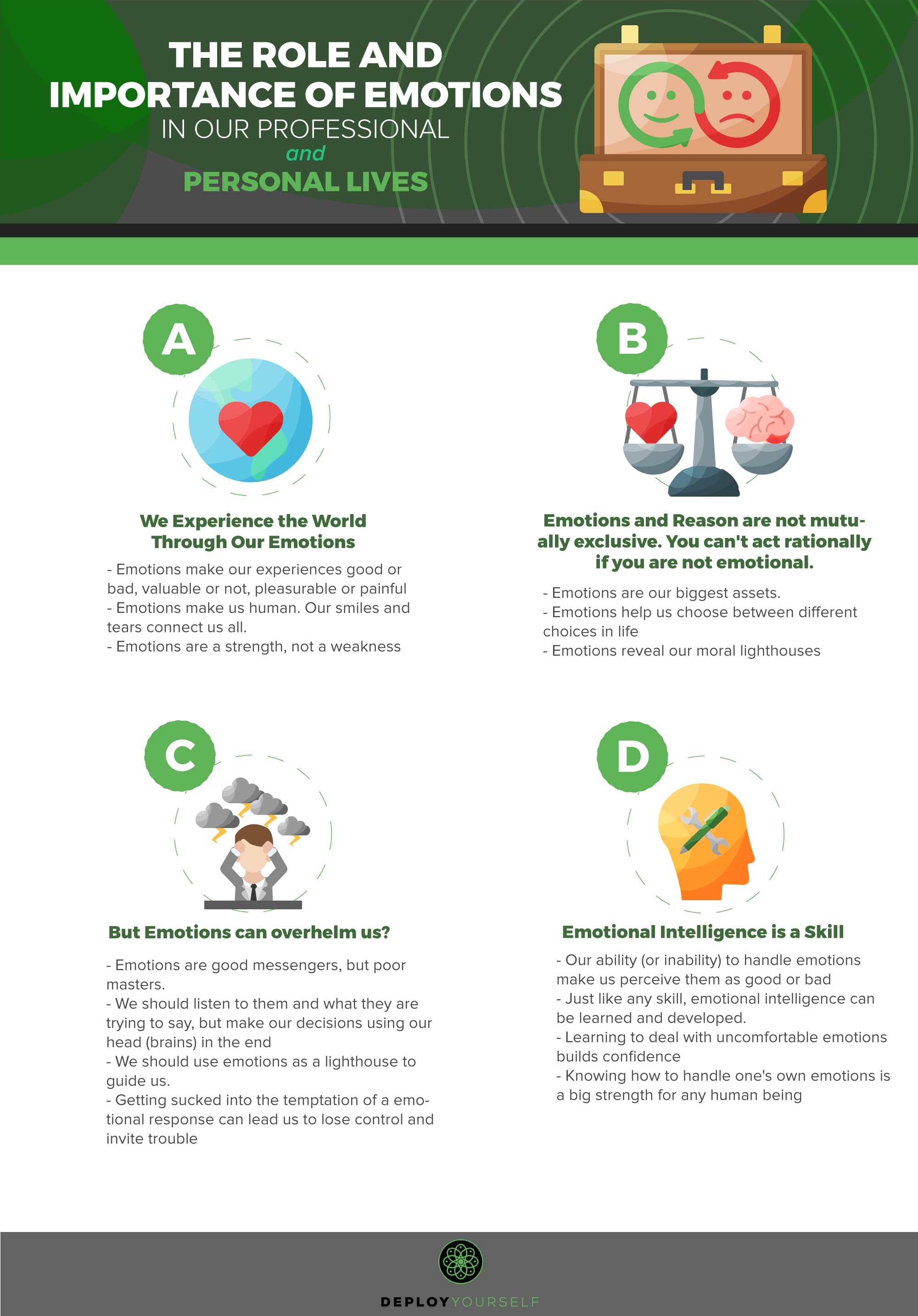
    We walk around the world and make sense of it through our emotions. When we experience an event, different emotions get triggered based on our values and beliefs. Emotions make our experiences good or bad, valuable or not, and pleasurable or painful. If we introspect we will found that every decision we end up taking is derived from an emotion that touched and moved us.

    These emotions can overwhelm us occasionally, but without them, we would have no connection with people or events around us. While emotions can sometimes bring pain and tears, it is only through them that we feel joy, happiness, and peace in life. It is very important to realize that emotions are our strength and not our weakness.

    It is our emotions that make us human. The little moments of joy when we play with our kids, the smile on our faces when we help someone, the tears in our eyes when we see something cruel and terrible (even if it is on TV) – it is these emotions that connect us all as human beings.

    Seeing a tweet by a billionaire CEO and to be able to feel empathy for him/her makes us bridge the economic, physical, and social divides and come closer. On the other hand, if we are privileged in any way, being able to empathize with the less privileged and act for them brings us closer. Emotions help keep our egos in check and prevent us from being indifferent towards the less or more privileged in our society.

    Emotions and Reason are Not Mutually Exclusive

    Most of us believe that emotions and reason are opposites of each other, and it is often presented as a fact that you can’t act rationally if you are emotional. In many workplaces, emotions are frowned upon and an excessive display of emotions (joy, tears, anger) is seen as a liability.

    On the contrary, what I have learned over the years is that emotions can be our biggest asset. They can give us important information that can shape our lives if we listen to what they are trying to tell us. The key is to learn how to express our emotions without repression or explosion.

    Emotions can help us clear the fog of rational choices and reveal our moral lighthouses. They help us choose wisely when presented with two equally good or equally bad choices. Emotions clarify our thinking and help us see rational choices in a new light while pure rationality often makes us run wild with ideas, even at the expense of others. Rationality without emotions can look enticing in the short term, but it can be a menace in the long term.

    It Is Impossible to Be Rational Without Emotions

    While it is true that emotions can overwhelm rationality at times, it is impossible to be rational without being emotional. Today there is scientific evidence to prove that we, as human beings, are incapable of making decisions if we can’t feel our emotions. You can read about the works of neurobiologist Antonio Damasio to see that without emotions, there is no decision making possible. [1][2]

    He worked on a patient with a severed connection between the frontal lobe (where rationality originates) and cerebral amygdala (where emotions originate) in the brain. After the surgery, the patient could think, but he could not feel anything. He noticed that while he was able to engage in rational thought all the time, he was not able to make a choice over the other.

    When Emotions Overwhelm Us?

    We all have been in situations where we don’t want to do what we know is the right thing to do. When emotions overwhelm us, we can get sucked into the temptation of the respective emotion and (re)act in a way that provides us emotional relief. For example – When you couldn’t control your frustration and vented it out on your manager because it felt good to spurt it out.

    Emotions are very good messengers, but poor masters. We should always listen to them and let them play a big role in our rationality, but subjugating reason for emotional whims can cause us short and long-term harm. In the end, we should always use reason to choose the best option available for us, and use emotions as a lighthouse to guide us on the right path. This will help us in making the right choices (which might not be the easy ones) in life with conviction.

    Emotions Intelligence is a Skill. Train Yourself

    Now that we have seen that there is no action possible without emotions, we can conclude that emotions are not bad or good in themselves. It is our ability to handle them that makes us interpret them as so. It is a skill that, just like other skills, can be developed.

    Learning to deal with uncomfortable emotions builds confidence and opens up new pathways that were earlier closed to you. Emotional people are often regarded as weak in certain societies, but I believe that the ability to handle one’s own emotions is one of the most useful skills a human being can acquire.

    Increased emotional awareness can be a great asset we all can make use of not only to make the right decisions for ourselves but also to create a better world around us. A world which is not mine or yours – but ours.

  • How To (and not to) Deal with an Emotional Employee

    As I wrote previously, every human emotion is valid. However, the story behind them might not be, and we always have the choice of how to respond to an emotion. If we want to master how to deal with others’ emotions, our own emotional mastery is the prerequisite.
    Studies have shown that emotions like frustration, cynicism, enthusiasm, etc are as contagious as germs. I believe each human being acts like a tuning fork. Every emotion is like a wave, which when reaches others, either accentuates or dies down depending on whether the frequencies match or not.
    When two people are emotionally reactive, even a small argument can quickly escalate into a fight. When we learn to master our own emotions, it gives us an opportunity to deal with any situation confidently. It will dampen any emotional waves and allows collaboration, even in the face of disagreement. We can strengthen our relationships with others, even in the most stressful and difficult situations.

    1. Learn to Notice Emotional Build Up
    Emotions are like storms. Just as we can forecast most weather storms before they strike, we can always notice and predict “emotional” storms too. If an emotional outburst of an employee is a surprise, then there were some signs we missed.
    Emotional reactions don’t come out of anywhere. Just like storms, they build up over time. There are always signs, physical and behavioral, which we can observe and watch out for. If we notice these signs, we can get advance notice of emotional build-up in people.
    For example – If we notice tightening of muscles and a red face, the person might be getting angry or frustrated. If we notice a trembling voice, sweating, and defensive body language, someone might be feeling scared or anxious. If we notice smiles, laughter, and relaxed body language, the person might be happy about something in his/her life.
    2. Act Early. Validate What You Notice
    When we notice physical signs of an emotional build-up in others, we must act early and validate our assumptions. Obviously, we can’t read another’s mind so whatever we assume about another’s emotional state might or might not be true. So the most prudent way is to state our assumption as just that and ask the other person for validation.
    For example – If your colleague has been quiet and detached for a few days, you can approach them and say – “I see that you have been quiet lately. You seem a bit tensed too. Am I right? Is there something which I don’t know, or can help with?” Never walk up to someone and pass a judgment, “Why are you sad? What’s upsetting you?”
    Remember our assessments about others’ emotional states are just that – assessments. Mistaking them for truth could trigger an emotional reaction and make them defensive, which we don’t want to. What works for me is to state my assessment tentatively, and to always ask for verification.
    3. Listen And Acknowledge. Don’t Judge And React
    It is only human to be emotional. When someone opens up about their emotions to you, it is an act of courage. Don’t dishonor that act by rushing to judgment or suggestion. Just like our own emotions, acknowledge them by listening and understanding their point of view. Try to stand in their shoes and sympathetically feel what they feel.
    Challenging others’ emotions is often counter-productive and makes them feel alienated and disrespected. If their emotion is directed at you or they feel your behavior led to the emotion, you might be tempted to justify yourself. But that never helps anyone. If you can stay calm and relaxed, any emotional attack will eventually diffuse itself.

    Emotions are the result of an internal fire. Reacting emotionally only adds fuel to that fire. Instead, let we can let it run out of fuel by allowing others to express themselves fully while we listen empathically.

    Remember, mastering your own emotions is a prerequisite before handling others' emotions
    Remember, mastering your own emotions is a prerequisite before handling others’ emotions

    4. Let The Storm Pass. Take A Time Out
    When there is damage due to a weather-related storm, we don’t rush out to do repairs while the storm is still on. We wait for the storm to pass before assessing the damage, and doing any repairs. Similarly, if we notice an emotional storm, it is always best to wait for it to pass before jumping in to help.
    There have been many instances when I have been sucked in to respond to an emotional employee. I have always regretted it later as it only made the situation worse. Taking a time out often works for me. A few moments to breathe often allows both parties to stay with their emotions and come to peace with them.
    I believe the best way to understand someone else’s emotions is to observe our own. Becoming aware of our own emotions can help us empathize with others. When we feel compassion for others’ emotional states, regardless of whether we agree with their reasons or not, then we are ready to take the next step — which is asking the right questions and coaching them.
    5. Coach. Inquire. Ask the Right Questions
    The next step is to ask coaching questions and help them understand their own emotions. By genuinely inquiring and listening to others, we can help them clarify their thoughts.

    Coaching via asking open questions is about respecting people as individuals, and giving them a free choice to act in a way that is consistent with their values.

    Coaching someone doesn’t mean fixing other’s problems. We don’t get to be a superhero through coaching. Coaching is about letting others find their own answers – ones they already know but have become masked behind their stirred emotions. Coaching begins with genuine care for your employees and colleagues. It is a skill that requires practice, and you get better at it with each conversation.
    Depending on the emotion, the coaching questions you can ask will differ. Here are a few examples –
    Sadness – What are you sad about? What did you lose? Why did that matter so much for you? How could you grieve or mourn for your loss? Is there something I can do for you to support you?
    Fear – What is scaring you? What are the chances of that happening? How does that impact you? How can you prepare better for it to minimize the damage? What else can you do to feel at peace?
    Anger – Who hurt you? What boundaries did they cross? How can you express your complaint and act in a way consistent with your values? How can you put the issue behind? What would it take for you to forgive them, or let go?
    Guilt – What did you do? What damage did it cause? Who have you hurt? How can you make amends? Have you apologized? How can you be at peace? Can you forgive yourself?