conversation

  • Leadership Without Practice: Why Your Experience Isn’t Making You Better

    Kobe Bryant made 800 shots before breakfast. You wing your most important conversations. One of you is doing it wrong.

    During Team USA training camp, Kobe called a trainer at 4:30 in the morning. He ran conditioning drills until 6. Lifted weights until 7. Then shot baskets until he made 800 of them – not attempted, made – before the team’s official practice even started.

    By the time his teammates arrived for the first drill, Kobe had already done more work than most players did in a full day. He won games because he prepared at a level that made the game itself feel easy.

    But here’s what nobody talks about: this isn’t just a sports thing.

    The best leaders in business do the same thing. They practice. Not occasionally. Not when they feel like it. Deliberately, granularly, obsessively.

    Greatness requires repetition. And most leaders don’t practice at all.

    The Problem: We’ve Confused Repetition with Practice

    You’ve had a hundred difficult conversations. You’ve coached struggling employees. You’ve negotiated deals and handled conflict and tried to inspire your team.

    But doing something repeatedly isn’t the same as practicing it.

    Practice is deliberate. It’s isolated. It’s focused on getting better at a specific skill under controlled conditions. It happens when nothing is at stake so you’re prepared when everything is.

    Athletes understand this intuitively. Kobe didn’t practice his fadeaway jumper during the fourth quarter of the Finals. He drilled it ten thousand times in an empty gym so that when the pressure was on, his body already knew what to do.

    Leaders? We “learn on the job.”

    That’s a polite way of saying we treat every high-stakes moment like a first draft. We walk into boardrooms, investor pitches, difficult terminations, and crisis situations having never practiced the specific skills those moments require.

    Then we wonder why leadership feels so hard. Or why you end up creating a mess and cleaning it up later.

    Leadership Is a Set of Practiceable Skills

    Let’s be specific about what you’re not practicing:

    Speaking boldly. Not in the meeting. Before it. Record yourself delivering the hard truth you need to say. Listen to it. Notice where you hedge, where you apologize, where you dilute your point. Do it again. Most leaders practice being diplomatic. Champions practice being direct.

    Breathing and centering. You can’t regulate your nervous system in real-time if you’ve never practiced doing it when you’re calm. Athletes train their breathing for years. On the other hand, I have seen many leaders hyperventilate through Zoom calls and calling it “intensity.”

    Empathy. You think empathy is about being nice. It’s not. It’s about accurately reading what someone else is experiencing and responding to the real problem, not the surface one. That’s a skill. You can practice it by role-playing situations and forcing yourself to name the emotion you’re observing before you respond.

    Resisting the urge to interrupt. This one’s simple. In practice conversations, put a physical object in your hand and don’t speak until the other person has finished and you’ve counted to three. Your ego will hate this drill. That’s how you know it’s working.

    Listening. Real listening – the kind where you’re actually trying to understand, not just waiting for your turn to talk – is unnatural for most leaders. Not because it is difficult. Not because of instagram notifications. Or Tiktok. Because you have not practiced it enoughl. Practice it by having someone tell you a problem and then forcing yourself to ask three clarifying questions before offering any solution.

    Deal making. You don’t negotiate your biggest deal cold. You role-play it. You practice the concessions you’re willing to make, the points you won’t budge on, the moments where you’ll walk away. You rehearse staying silent after you make an offer.

    Dealing with bullies. You will encounter people who try to dominate you through aggression, condescension, or manipulation. If you haven’t practiced staying grounded and non-reactive when someone’s in your face, you’ll either collapse or escalate. Neither is leadership.

    Inspiring people. You think inspiration is spontaneous. It’s not. It’s clarity about what matters, delivered with conviction at the right moment. You can practice this. Write down what you actually believe about your work, then practice saying it out loud until it doesn’t sound rehearsed.

    Coaching people. Most leaders give advice when they should be asking questions. Practice coaching by forcing yourself to only ask questions for the first five minutes of a conversation. No statements. No suggestions. Just questions that help the other person think more clearly.

    These aren’t abstract concepts. They’re practiceable skills.

    The Mountain with No Top

    Here’s what makes leadership different from almost any other skill: there’s no finish line.

    You don’t “complete” empathy training and move on. You don’t “master” inspiring people. Leadership is a mountain with no top. No matter how good you are at something, you can always practice more and get better at it.

    And here’s the paradox: the people who practice the most aren’t the rookies. They’re the champions.

    Kobe practiced more than the guys fighting for a roster spot. Buffett has read more investor letters than junior analysts will read in their entire careers. The best leaders don’t coast on their experience. They obsessively sharpen the skills that got them there.

    Most business leaders do the opposite – especially when it comes to leadership and people skills. They treat “experience” as if repetition alone makes them better. But repetition without reflection is just rehearsing your mistakes.

    You’re not getting better at difficult conversations by having more of them badly. You’re just reinforcing bad habits.

    How to Actually Practice Leadership

    Here’s the framework:

    1. Isolate the skill. Don’t try to “get better at leadership.” Pick one granular skill. This week, it’s resisting the urge to interrupt. That’s it.

    2. Create low-stakes repetitions. Role-play with a peer. Record yourself. Practice in conversations that don’t matter. The point is to build the muscle memory before the high-pressure moment arrives.

    3. Get feedback. You can’t see your own blind spots. Ask someone to watch you practice and tell you what you’re missing. Athletes have coaches for this reason.

    4. Increase the difficulty. Once you can stay centered in a calm practice conversation, practice staying centered when someone’s deliberately trying to trigger you. Make the drill harder until it’s harder than the real thing.

    5. Repeat until it’s automatic. You’re not done practicing when you can do it right once. You’re done when you can’t do it wrong. When your nervous system responds correctly before your brain even catches up.

    That’s the standard. and today, AI can help you practice all of that.

    The Unfair Advantage

    The gap between good leaders and great ones isn’t intelligence. It’s not charisma. It’s not even strategy.

    It’s that great leaders turn more of their life into a practice that nobody else sees.

    They practice breathing before the meeting starts. They role-play difficult conversations with a trusted peer. They drill staying non-reactive when someone’s being an asshole. They rehearse inspiring people until their conviction sounds natural, not performative.

    They do the work when nothing’s at stake so that when everything’s at stake, their body already knows what to do.

    You’re not going to get better at leadership by reading more books or attending more conferences or gaining more “experience.”

    You’re going to get better by practicing the specific skills you’re currently winging.

    Pick one. Breathing and centering. Speaking boldly. Listening without interrupting. Coaching instead of advising.

    Then practice it like Kobe practiced his basketball skills.

    The game feels hard because you never rehearsed for it. Not because the game (or your job) is hard.

    Now go practice.

  • How to Ask and Get the Feedback You Need Without Any Stress and Awkwardness?

    “I want to give you some feedback.”

    If you are like most people, once you hear the above statement, your heart will start to beat a little faster, your palms might begin to sweat, and in certain situations, you might even begin to shake. Feedback can make anyone anxious and stressed – not because there is something inherently negative or bad about it, but because most people have never been trained in giving and receiving feedback. If you give and get feedback only once a quarter at work (even worse if it is once a year), and without any preparation, obviously it will be a strange conversation.

    What I have learned over my career is that feedback can be an immensely valuable and insightful tool in our growth and progression, but only if we are ready and prepared to digest and use it for our benefit. Today I want to share via this article my thoughts on the value of feedback, what is the best way to receive it, and then what to do with it. I hope that after reading this article, instead of just waiting for feedback you actually start asking for it. If you are thinking why would anyone do that, let’s dive right in.

    Why Do You Need Feedback?

    Feedback is one of the easiest and most insightful tools to uncover your blind spots. A blind spot is anything that others know about you but you yourself don’t. For example – if you think you are confident but others find you arrogant and cocky, how the hell do you figure that out if nobody ever tells you that?

    Feedback is like a beam of light which shows you how others perceive you. It can be the simplest way to uncover your strengths and weaknesses, but it is often not easy to digest and process it. Feedback lets you know how others perceive you and your talent, skills, behaviour, and performance. And knowing them is a good thing. When used correctly, feedback can be a very useful tool to move in the right direction, change course if necessary, and grow in your career (and in life).

    “Criticism may not be agreeable, but it is necessary. It fulfils the same function as pain in the human body. It calls attention to an unhealthy state of things.”
    – Winston Churchill

    How Do You Ask For Feedback?

    Just like hearing feedback can be stressful for you, providing feedback can also be a stressful experience for the person on the other side. But there are a few ways you can make the feedback conversation a pleasant experience:-

    1. The best way to make the process easier for both sides is to actively and explicitly ask for it. When you invite feedback regularly, it removes the formality surrounding the process and makes the conversation more “normal”.
    2. Explain that you see feedback as a tool to learn and grow and that you welcome any negative or uncomfortable feedback. You can also go one step ahead and assure the person that the feedback will not have any negative impact on the relationship. Knowing this always puts the other person at ease and allows the conversation to continue more maturely.
    3. Know what you are looking for in feedback. Feedback is not always critical. You should also ask for acknowledgment or appreciation for a task well done. Positive feedback will help you understand your strengths, and gives you the confidence and assurance required to look objectively at your weaknesses.
    4. Be specific and ask for examples. Don’t let anyone get away with vague feedback. Always dig deeper and ask for specific events and evidence in support of the feedback you receive. Here are a few questions you can ask:-
      a) Can you explain what you mean?
      b) Can you give an example to support your point?
      c) Paraphrase the feedback and ask – Is that what you mean?
    5. Seek feedback from people all around you and not just your boss. Ask people above, below, and sideways in your organization. Multiple sources of feedback can eliminate any outliers and helps to surface any obvious blind spots immediately.


    Powerful Questions

    Whenever you are looking for some powerful and insightful answers, there are always corresponding powerful questions to go with them. Below are a few such questions you can ask to solicit deep and meaningful feedback about yourself:-

    1. If I were to wow you with my performance, what would that look like?
    2. What’s one thing I could improve?
    3. What would you have done differently had you been in my position?
    4. What’s your opinion about how I handled that conversation, presentation, task, etc?
    5. What specifically can I do to handle that task, conversation, project better?
    6. What is one thing you can always count on me for?
    7. What is one thing you will never count on me for?

    What To Do After Receiving The Feedback

    The worst thing that you can do with feedback is to do nothing with it. The feedback conversation is just the beginning on the road to learning and growth. So once you are done with the feedback, you can take the following steps to make the most of it.

    1. Thank the person for providing you feedback. Not only is feedback essential for your growth, it is also often a courageous step to provide it in the first place. Acknowledge the person for the conscious act of providing you feedback.
    2. Do not defend yourself during a feedback conversation. Do not get into a game of blame and justifications. Respond to the feedback, not react to it.
    3. If the feedback is critical, take responsibility (not blame) for what you hear. Let the other person know that you will evaluate the feedback and get back.
    4. Take time to introspect and evaluate the feedback. Does it resonate with feedback from others? Can you gather more data or feedback to validate it? If no, explain to others how you see it. If yes, let them know what you will change. Make certain promises and then do what you say.
    5. Take all the positive feedback and put it into a complements” document. Often we tend to focus too much on the negatives and ignore what we are doing well. Visiting this document regularly will give you motivation and positive reinforcement. Sometimes reading one little positive feedback can make your day.

    Following the above guidelines doesn’t mean that your feedback conversations will be painless, but they will certainly go more smoothly. Once you see feedback for the powerful tool it is in your learning and growth, you will fall in love with it. The more you seek and get feedback, the faster you can move to learn, adapt, and change course if necessary. To conclude I would like to leave you with the below quote by Ken Blanchard.

    “Feedback is the breakfast of champions.”
    – Ken Blanchard

  • How to Give Feedback Effectively? What to do Before, During and After a Feedback Conversation?

    Giving good quality feedback is an important skill to have in any organization. Doing so regularly with our peers gives everyone an accurate understanding of how they are doing at work, and what needs to change/improve. However, I have always felt that the importance of feedback and how to effectively deliver it is something that is rarely stressed and communicated within companies. In this article, I want to share some of the best practices I have learned from different people and mentors over the years about giving feedback.

    Why?

    The first step to giving good feedback is to realize the importance and reason behind doing so. I believe that the only reason to provide feedback is to improve performance while working together. The purpose of giving feedback is never to measure performance, blame, to prove yourself right, to make others wrong, or to put someone in his/her place.

    I believe this is the most important aspect of feedback which we often miss. I see feedback as a ‘gift’ given from one person to another, with the only purpose of improving how they work together. When we see feedback as a ‘gift’, the feedback conversations tend to be more natural and less awkward.

    Before (Preparation)

    “Give me six hours to chop down a tree and I will spend the first four sharpening the axe.”
    ― Abraham Lincoln

    Like most things in life, doing some groundwork before giving feedback is critical. Over time I have come up with a list of steps which helps me prepare for a feedback conversation.

    1. The first step is to collect data and evidence to back up your feedback and to make sure you have seen the situation from different angles and points of view. This might include gathering some tangible data like sales reports, code reviews, etc, or validating your feedback with a different set of people.
    2. Apart from remembering the why behind sharing the feedback, it is also very important to have an open mind going into the conversation. We must be willing to investigate/apologize if things turn out otherwise. If the person you are sharing the feedback with brings up new facts or information you weren’t aware of, make sure to acknowledge them and take a time out to investigate rather than thrusting your feedback upon the person.
    3. Create a comfortable space for providing feedback. Allow enough time so that none of you feel rushed. Depending on the type of feedback, choose an appropriate setting for the feedback. For example – do not choose a place that is overly conspicuous, and never give negative feedback in public.
      If the feedback is on a trivial issue, you can do it while walking back from a meeting, or in a vehicle driving to another destination to make it less formal. But if your conversation is more difficult, you might want to do it in a meeting room. The important thing to realise is that there is no one right place to deliver feedback, and you should choose based on the type of feedback.
    4. Sleep on it! If you feeling angry, upset, or feel an urge to provide feedback; it is often better to sleep on it. Giving feedback at the wrong time can often do more harm than good. Once your emotions are more settled and you have gathered your thoughts, you can then share the feedback as soon as possible.

    During (Process)

    While you can do all the preparation you want, receiving feedback can still be a stressful experience for people (especially if it is critical). To ensure that the conversation goes smoothly you can follow a few guidelines :-

    1. Criticize in Private, Praise in Public. Use this as a golden rule for any feedback conversation.
    2. Never attach adjectives to people. Start by stating why you are providing feedback, which is always to improve performance (of the person, team, organization). You demonstrate that by stressing the impact of the person’s actions (on the team and their performance) and not on the person themselves. For example – Instead of saying “you are a weak communicator”, say “your communication style can be refined to make a better impact in team meetings”.
    3. Be specific in your feedback. Give examples. Do not be vague in your statements.
    4. Be aware of the other person’s body language. Notice if they are getting defensive, angry, upset, and change course if necessary.
    5. Be prepared for an emotional reaction. But do not react yourself. Do not get into a game of arguments and justifications. Stay silent and let people vent out their emotions (if any).
    6. Listen and paraphrase what you hear to ensure there is no confusion and misunderstanding. Understand the situation from the other person’s point of view.
    7. Use non-conflicting language. Use “I” instead of “you”. For example – Say “I felt disappointed when you did that.” rather than “You disappointed me by doing that.”
    8. Don’t Push – When you push people, they will push back. Present your thoughts without trying to push them through. Give people a choice to accept or reject your feedback, as you cannot force them to your point of view anyway.
    9. Give more positive feedback than negative, and always be sincere when giving positive feedback. Remember that there are always positives about people to acknowledge.
    10. Thank them for listening to your feedback. End the conversation on a positive note, with the other person thinking about the next steps. He/she should see the feedback as a stepping stone, not as a stumbling block.

    “Criticism may not be agreeable, but it is necessary. It fulfils the same function as pain in the human body. It calls attention to an unhealthy state of things.”
    – Winston Churchill

    After (Follow Up)

    To make sure that the feedback is serving its intended purpose, i.e., to improve performance, it is important to take a few follow up steps after the feedback conversation :-

    1. Send a brief summation of your meeting if it was important and critical enough. Also, summarise any action points both of you agreed in a follow-up email.
    2. The other person might need some time to process what you discussed. Give them that space. Follow up after a few days for any additional thoughts. Ask for feedback about how you provided the feedback. Anything they would like you to do differently the next time? Let your people know it is ok for them to give you useful feedback.
    3. Make sure to act on your action points, or share your progress on them. If you don’t walk your talk, you lose trust. If that happens, you have bigger problems to worry about.
    4. Follow up and ask for progress on the other person’s action points. Offer your support and help in any way you can.
    5. Thank the person and commend him/her for any change in future behavior. Remember you can never give enough positive feedback.

    To conclude, feedback sharing sessions, when done well, are an incredible tool to build healthy relationships and make teams stronger. By listening and working on feedback, people can learn about themselves (self-awareness) and be more conscious of their choices and decisions (career development). When you encourage people to give and share feedback, it helps create a culture of feedback, which eventually increases the strength and effectiveness of teams in your organization.

  • Focus on Interests, Not on Positions – The One Tip Which Can Make Every Conversation More Productive

    There was once only one orange left in a kitchen and two chefs were fighting over it.
    “I need that orange!”
    “Yes, but I need that orange as well !”
    Time was running out and they both needed an orange to finish their particular recipes for the dinner. They decided on a compromise: they grabbed one of the large kitchen knives that was lying around, split the orange in half, and each went to his corner to finish preparing his meal.
    One chef squeezed the juice from the orange and poured it into the special sauce he was making. It wasn’t quite enough, but it would have to do. The other grated the peel and stirred the scrapings into the batter for his famous cake. He too didn’t have as much as he would have liked, but given the situation, what else could he have done?

    We all love to form, hold, and defend our positions. Whether it is at home with our spouse, or at work with our colleagues, once we form a position on a certain topic, it is going to take some convincing to loosen our hold on our “coveted” position. Isn’t that true?


    As human beings, we function and operate in this world by forming positions on different subjects we face in our day to day interactions. However, when we encounter opposition or resistance to our point of view, or when we oppose others’ points of view, it is very common for us to defend our positions and it takes some convincing for us to yield from our position.


    What I have discovered with my experience of dealing with people over the last many years is that if we focus on people’s interests instead of their positions, it can become much easier to negotiate and converse with them. To clarify my point, and to understand the difference between positions and interests, consider the three points (and corollaries) below.

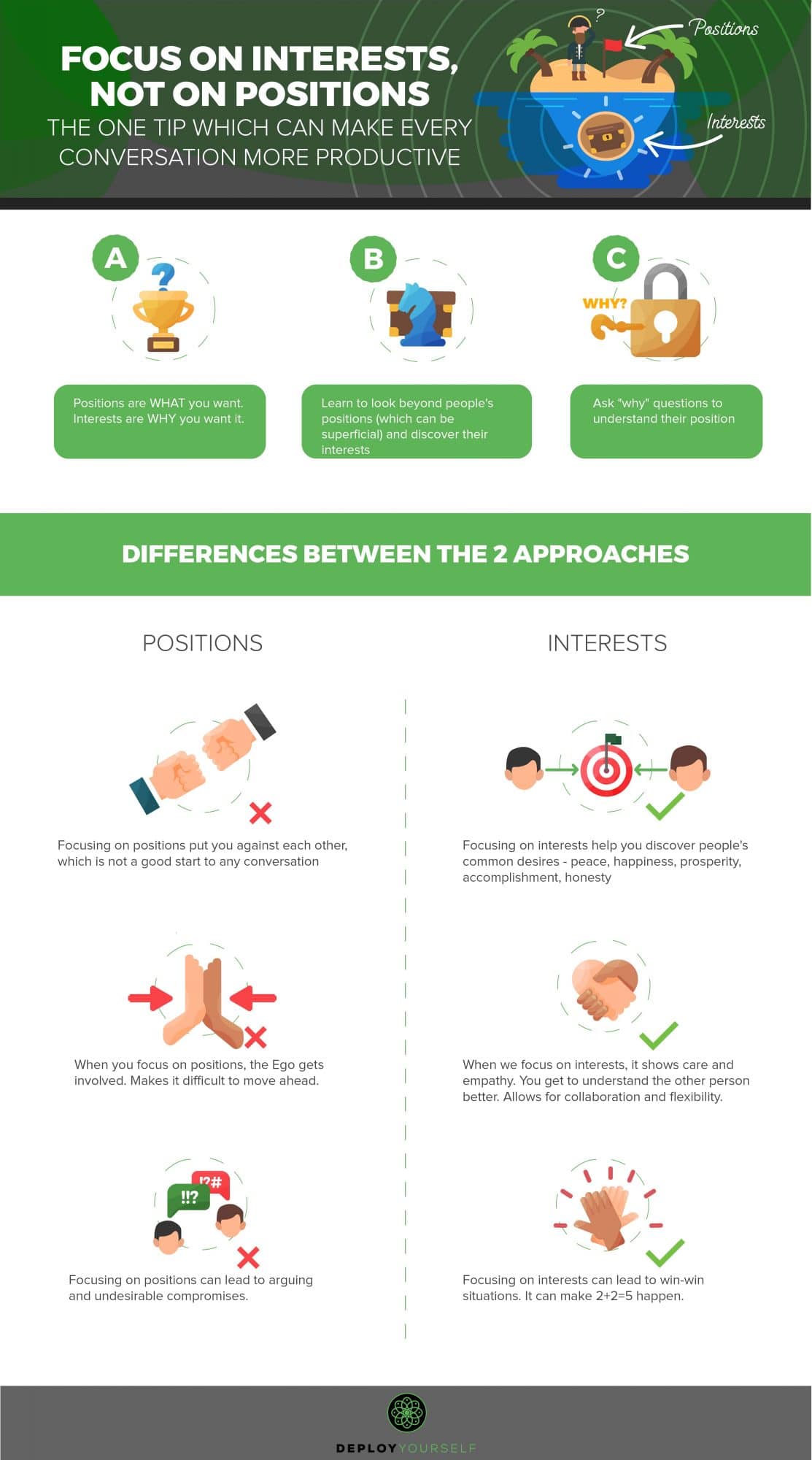
    1. Positions are WHAT You Want. Interests are WHY You Want It.

    In the story above both chefs wanted the orange, and that was their position. What you WANT, the specifics and details of it is your POSITION. One chef wanted the orange for its juice to prepare a sauce while the other for its peel to prepare a cake. This was their INTEREST behind wanting the orange.

    Corollary 1

    Focusing on positions puts us against one another, which is not a good start to any conversation. On the other hand, distinguishing between the positions and interests helps us discover people’s common desires – like fairness, accomplishment, happiness, and prosperity. These desires might not be the same for both parties, but they often are compatible, which makes for easier negotiation.

    2. Look Behind Superficial Positions To Discover People’s Hidden Interests.

    The positions we form can be, and often are, superficial in nature. Considering the above story again, it is obvious now that it would have been better for the chefs to peel the orange and take the part they needed for their respective recipes. However, they choose to focus on each other’s positions (the what) and hence ignored their interests (the why).

    Corollary 2

    When we focus on positions, our EGO gets involved which makes it difficult to move ahead. Looking to discover each other’s interests helps us to understand each other better. It presents an opportunity to collaborate and work together to produce not just better results, but also better relationships.

    3. To Uncover Interests, ask “WHY?”

    In the above story, what the two chefs got was an undesirable compromise, and I am sure their relationship didn’t get any better because of this.
    It is very easy to form positions as human beings, but it is always helpful to ask ourselves why we want what we want. Asking this question can help us discover our hidden interests, which can then lead to many flexible alternatives instead of just one fixed position.

    Corollary 3

    Focusing on positions alone can lead to unpleasant arguments and/or undesirable compromises. Understanding each other’s motivations behind the positions can lead to win-win situations. It can make 2+2=5 happen.

    Conclusion

    It is very common to confuse positions and interests. When we act in a “my way or the highway” manner without considering the views of the other side as legitimate, it becomes very difficult to make progress in conversations. Negotiating in this way can do more harm than good, as people tend to dig-in with their opinions and justifications, and their positions tend to move further apart.


    However, looking to work together by asking the “Why?” question, and taking efforts to understand each other’s concerns can create a pathway where there was none before. It can result in a partial solution in a not-so-ideal case, and it can allow for magic (any solution better than what both sides wanted initially) to happen in the best case.

  • What To Do If You Can’t Achieve Consensus in a Conflict?

    In the previous four articles, I have written about what conflicts are, what not to do when they happen, how to prepare to solve them through a conversation, and some practical tips to follow during the conversation itself. However, doing all this doesn’t guarantee the result you desire.
    Conflicts can be complex, and there are times when people (including you and me) are more interested in winning (or getting our way) rather than working together to get what we really want.  Human beings are complex emotional beings, and often we end up attaching the outcome of a conflict to our personal identification.
    That leaves us with the question of what to do if we can’t achieve consensus in a conflict resolution conversation?

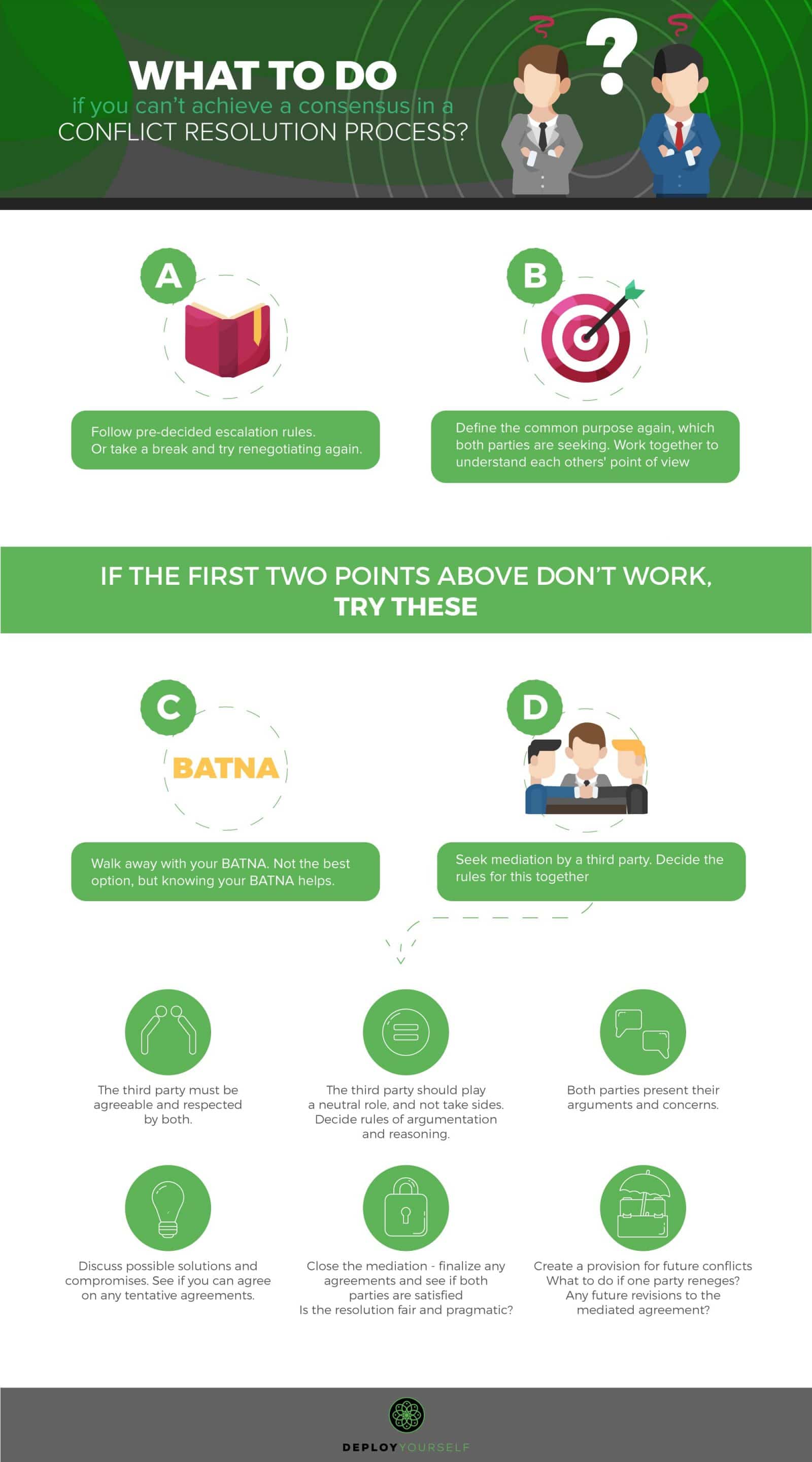
    1.  Follow Pre-Decided Escalation Rules

    If you have done your preparation well, you already know how to escalate the stalemate to your superiors in the organization so that they can help. If you have not decided on any escalation rules earlier, now is not a bad time to do it either.
    The only thing we must keep in mind with deciding escalation rules or escalating an issue itself is to not do it unilaterally. It is always beneficial to work with the other party to decide whatever escalation rules you can come up with, and then if the situation demands, to escalate the issue together.
    Escalating an issue alone without first communicating with the other party hurts the trust and the relationship which might make it even more difficult to resolve the conflict in the future.

    1. Take A Break, And Try Again

    If you have reached a stalemate, one common option is to take a break and reconvene later. Taking a pause at this time gives both sides space to reflect on the discussions so far and evaluate options. You might decide to harden or soften your position during this time and get a different perspective of the big picture.
    When you meet again after a break, it is important to redefine the common purpose which both parties are seeking. Then you can work together to understand each other’s points of view and negotiate again.

    If the above two steps don’t help you in moving forward, you can try these:-

    What To Do If You Can’t Achieve Consensus in a Conflict?
    What To Do If You Can’t Achieve Consensus in a Conflict?

    1. Walk Away With Your BATNA

    If the disagreement has reached a point where you can’t reach a solution acceptable to both parties, it might be prudent for both parties to walk away with their respective BATNAs (Best Alternative To A Negotiated Agreement). Not reaching a consensus in a conflict is not a bad outcome. Sometimes the best outcome is to not agree with the other party while still respecting them and keeping the relationship healthy.
    Once the discussions are over and everyone walks with their BATNAs, you can look back and reflect upon the whole process. There might be lessons for you that might help you in future conflicts, and evaluating the choices you made is a good exercise after the discussion.
    You should also acknowledge yourself for putting in the effort required to resolve the conflict. Give yourself credit for working together and strengthening the relationship, irrespective of whether you got the result you wanted or not.

    1. Seek Mediation By A Third Party

    Another step forward (if both parties agree to it) could be to seek mediation from a third party. This is different from escalation as escalation means involving your managers or seniors in the conversation. The rules of mediation seek the involvement of an independent third party.
    And of course, the rules of mediation should be decided by both parties together. Below are a few ideas to keep in mind before you go down the path of mediation.

    1. The third-party must be agreeable and respected by both of you. Do not accept a third party mediator you don’t trust, and never force a third party on another.
    2. The third-party should play a neutral role and not take sides. It must listen to both sides then make a decision based on the merits of the arguments and facts presented. Decide the rules of argumentation and reasoning together before starting the process.
    3. Discuss possible solutions and compromises. See if you can agree on any tentative agreements. Take it step by step. Even if you can’t reach your desired outcome, see if you can reach halfway.
    4. Close the mediation and finalize any agreements. Do a final check to see if both parties are satisfied? Do both the parties consider the mediation and final resolution fair and pragmatic? Without a YES to the above questions, any solution or agreement is unlikely to last the distance so don’t ignore this step.
    5. Create a provision for future conflicts. What will you do if one party goes back to the mediated settlement? Can any party seek a revision to the mediated agreement?
    “The harder the conflict, the more glorious the triumph. What we obtain too cheap, we esteem too lightly; it is dearness only that gives everything its value. I love the man that can smile in trouble, that can gather strength from distress and grow.”
    ― Thomas Paine

    To sum up, the above four steps will help you to amicably close a conflict resolution process – with or without an agreement. I believe learning to effectively manage conflicts in a constructive and respectful manner is an important skill to learn, and one which gives people more confidence to work together.
    Conflicts can lead to misunderstanding and destroyed relationships, or it can be an opportunity to collaborate constructively and strengthen relationships. In the high-pressure business environment we all live in today, if we can develop this ability to resolve conflicts amicably, it can become a competitive advantage for us and the companies we work in.  

  • Eight Practical Tips for Making A Conflict Resolution Conversation More Effective

    So you have prepared well (read my previous article), and are walking into a conflict resolution conversation with trust and respect for the other person. You have established ground rules for the conversation, and you know your BATNA.

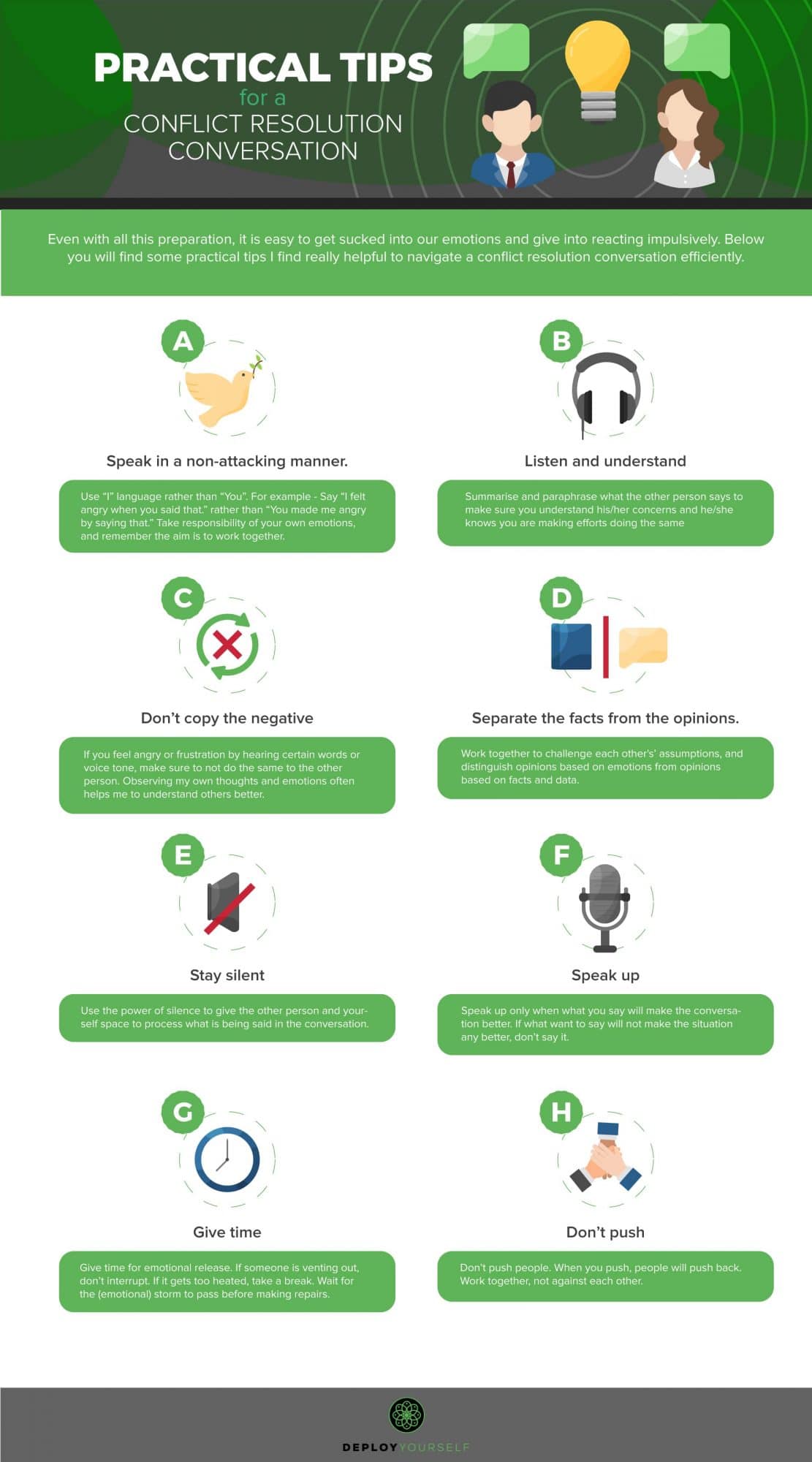
    Even with all this preparation, it is easy to get sucked into our emotions and give into reacting impulsively. Below you will find some practical tips I find really helpful to navigate a conflict resolution conversation efficiently.

    An enemy is a person whose story we have not heard. - Gene Knudsen Hoffman
    An enemy is a person whose story we have not heard. – Gene Knudsen Hoffman

    I have gathered and collected these tips from various books I have read and trainings I have undertaken, apart from my own mistakes and learnings in the past.

    1. Speak in a Non-Attacking Manner – Use “I” language rather than “You” language. For example – Say “I felt angry when you said that.” rather than “You made me angry by saying that.” Take responsibility for your own emotions, and remember the aim is to work together.
    2. Listen and Understand. Summarise and paraphrase what the other person says to make sure you understand his/her concerns and they know it is very important for you to do so.
    3. Walk the Talk – If you feel angry or frustrated by hearing certain words or voice tone, make sure to not use the same words and tone to the other person. I have often seen that observing my own thoughts and emotions helps me to understand others better.
    4. Separate the Facts from the Opinions –  Work together to challenge each other’s assumptions, and distinguish opinions backed by emotions from opinions backed by facts and data.
    5. Stay Silent – Use the power of silence to give the other person and yourself space to process what is being said in the conversation. It creates positive energy instead of building tension and enables us to handle tough situations in a more mature way.
    6. Speak Up Only If It Makes Things Better – Speak Up only when what you have to say will help the conversation in one way or the other. If what you have to say will not make the situation any better, don’t say it. In other words, do not vent or speak only because you had a thought in mind. Speak only when it helps you move towards the desired result.
    7. Give Time for Emotional Release – If someone is venting out, don’t interrupt. If it gets too heated, take a break. Wait for the (emotional) storm to pass before making repairs. Jumping in too early to fix things might backfire and cause more damage despite your good intentions.
    8. Don’t Push –  When you push people, they will push back. Present your thoughts without trying to push them through, and be open and flexible to listen to others’ concerns and thoughts. Give people a choice to accept or reject your ideas, as you cannot force them to your point of view anyway. Work together, not against each other.
  • How to Prepare for a Conflict Resolution Conversation?

    A conflict resolution conversation is one of the most critical conversations in any organization. The success or failure of this conversation will determine how the inherent energy in a conflict will be used, and how the relationship between the involved parties will be in the future.

    As I have written previously, conflicts have a lot of energy, like an overflowing river. It is up to us to build a dam and channel all this extra water (energy) into electricity? Because if left unchecked, all this extra water can cause flooding and devastation in its path. The most effective tool to prevent the flooding and use the energy in each conflict productively is the Conflict Resolution Conversation.

    Below are the 5 steps I think all of us must take before/in any conflict resolution conversation:-

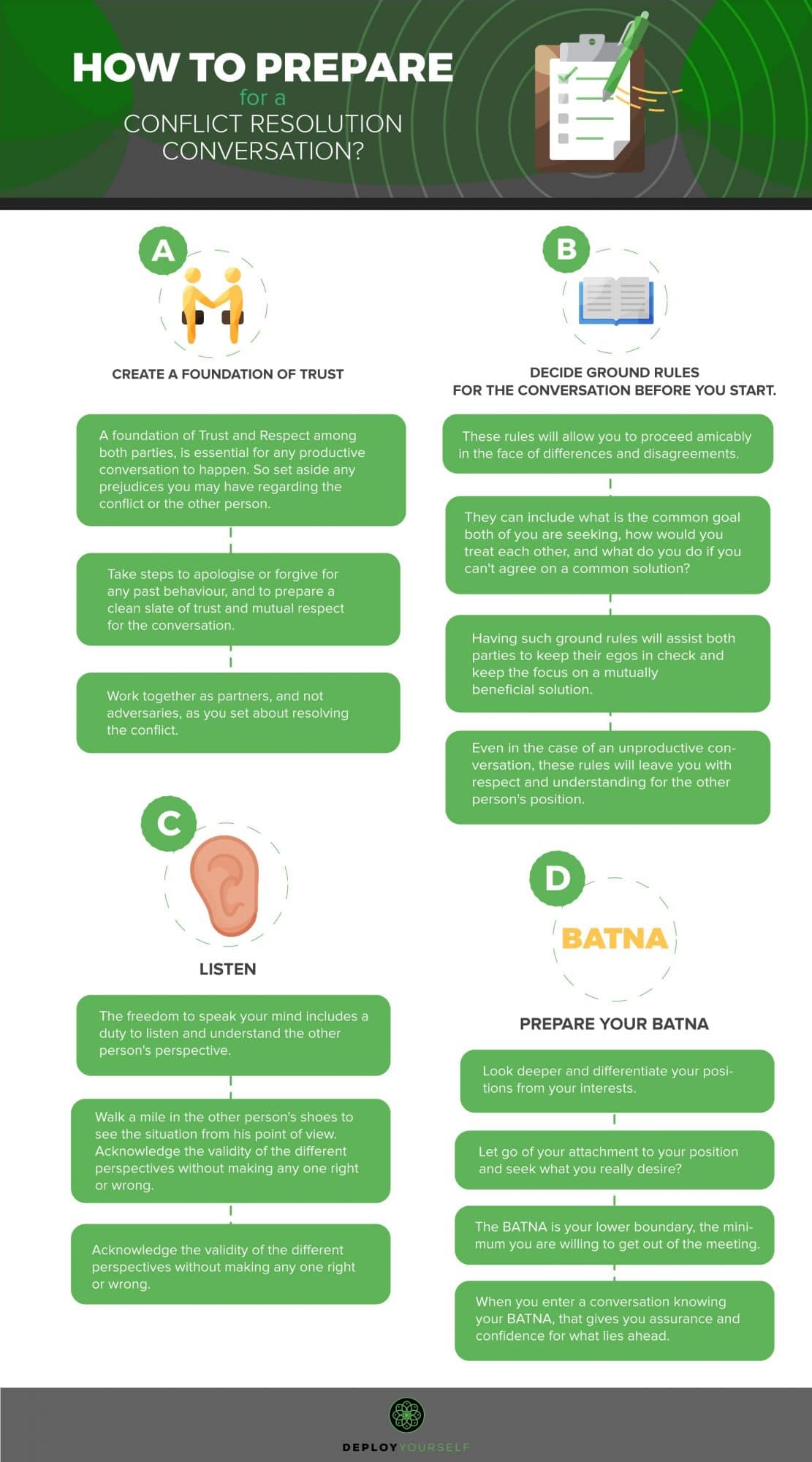
    1. Create A Foundation of Trust and Respect among all involved parties, which is essential for any productive conversation to happen. This is more like a step 0, as trust is like oxygen in a conversation.

    Take steps to apologize or forgive for any past behavior, and prepare a clean slate by setting any prejudices aside. This will help create an environment of trust and mutual respect. Work together as partners, and not adversaries, as you set about resolving the conflict.

    2. Decide Ground Rules for the conversation before you start. These rules will allow you to proceed amicably in the face of differences and disagreements. They can include what is the common goal both parties are seeking, how would you treat each other, and what do you do if you can’t agree on a common solution?

    Having such ground rules will assist both parties to keep their egos in check and keep the focus on a mutually beneficial solution. Even in the case of an unproductive conversation, these rules will leave you with respect and understanding for the other person’s position, rather than with resentment and cynicism.

    3. Listen. The freedom to speak your mind includes a duty to listen and understand the other person’s perspective. Walk a mile in the other person’s shoes to see the situation from his point of view. Acknowledge the validity of the different perspectives without making any one perspective right or wrong.

    Walk into the conversation with an empathetic attitude and care for the other party’s concerns. Understand that the conversation is not productive unless the concerns of both parties are met. If you work to address what the other person cares about, you create the possibility of a win-win result which might be even better than what you initially wanted.

    “Courtesy towards opponents and eagerness to understand their viewpoint is the ABC of non-violence.” – Mahatma Gandhi

    4. Differentiate Your Positions from your Interests – Ask yourself what do you really desire? And why? Let go of your attachment to your position and seek to discover yours and others’ common desires. Asking the question “why” a couple of times can help you do that.

    This will help you understand the other person better and create space for collaboration and flexibility. Understanding the concerns of each other will turn you into partners rather than adversaries, and it opens up the possibility of making 2 + 2 = 5 happen.

    5. Prepare your BATNA (Best Alternative to a Negotiable Agreement) – The BATNA is your lower boundary, the minimum you are willing to get out of the conversation. Knowing your BATNA increases your negotiating power.

    When you enter a conversation knowing your BATNA, that gives you assurance and confidence. If nothing else works, you walk out with your BATNA.

    To sum it up, doing this preparation before any conflict resolution conversation prevents us from reacting impulsively when the going gets tough. Conflicts are a natural order of life, and being prepared will allow us to turn them into an opportunity to build a strong foundation (relationship) not just for immediate but also long term results.

    It is also important to note that the above steps do not guarantee a successful conversation or the results we desire. But they will equip us to deal with conflicts with steady and not shaky hands, which is always a good skill to have.

  • The Power of a Pause

    When Atal Behari Vajpayee was the Prime Minister of India, I always wondered what could be the reason behind the pauses he took while speaking. Sometimes I thought it was because of his old age, and sometimes people even made fun of him for this habit, but I was always amused by the wisdom of his words – not just his political speeches, but his writings and poems in particular.

    If we take a pause and think for a moment, we can all recall such people who take longer than usual while speaking or answering questions. In today’s fast-paced world, I believe such people can teach us some valuable lessons.

    Our Quest for Survival

    Human beings are hard-wired for survival, and that is the reason we are the most evolved species on the planet. Our brains constantly listen for signals from our senses (sight, sound, touch) and act immediately if it senses any danger or threat to our physical well-being. Similarly, our mind always listens to external events, giving us a running commentary as life unfolds around us. When we are conversing, our mind tells us what to speak next or it makes a judgment about the speaker or the spoken. It is the mind’s job to make sure we don’t look bad (or stupid), and it decides (for us) what to do next to save us from (perceived) threats to our social well-being.

    Responsibility is Our Ability To Respond

    Our Ability to Intervene & Take a Pause

    If there is one thing that separates us from other living beings, it is our ability to stop this cycle of action and reaction and to take a pause before deciding how to respond. Most of the time, both action and reaction are simultaneous, with no pause between them. An example could be our spouse asking the same question every morning and we reply with the same response without even blinking. The same happens at work when we talk to our boss or our colleagues.

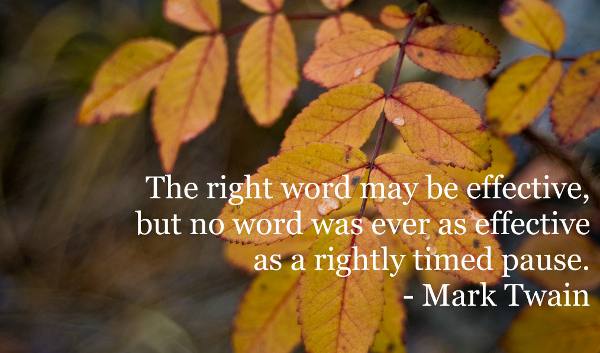
    A small pause before we start to speak or answer can do wonders for a conversation. Most of the time when we are not talking, we are actually waiting to talk. Sometimes the person on the other side has a lot more to say but is hesitant and so he stopped. By taking a pause after he has stopped speaking, and maybe using words like hmm… uh.. ok.. but not jumping in with our views, we can let the other person complete whatever he has in his mind. We can even ask follow-up questions like – “Do you have anything else to add?” before beginning to speak ourselves.

    In my conversations where I have been aware to take a pause, I have noticed that speaking up after letting the other person finish leads to more fruitful conversations and both parties are left satisfied. This satisfaction is of being heard, and of being understood. What’s more strange is that sometimes I don’t even have to speak up, and the conversation automatically leads to where I wanted it to go by just listening. As people are listened to, they let their rigidity of stance soften and consider your viewpoint even without your asking for it. Such is the power of taking a pause and listening.

    Responsibility = Our Ability to Respond

    We live in a world today where we want everyone to be responsible. We want our children, our political leaders, our colleagues, our managers, our neighbors to all be responsible. “Responsibility” is an over-used word in our media-driven society, but I believe being responsible is first and foremost our ability to respond consciously. It can make a huge difference in our lives if we can train ourselves to take a pause often and act not from our mind’s fears and judgments, but from our values, priorities, and goals.

    Taking a pause will force us to think about what is really important to us, and it can have a profound impact on our work and lives. Pausing creates space for ourselves and others to express themselves fully. It creates positive energy instead of building tension and enables us to handle tough situations in a more mature way.

    I want to end with a simple request – to take a pause and think about this article, rather than just believing the commentary your mind has provided you as you were reading it.

brain care coaching commitment communication conflict conflicts conversation culture deployyourself deploy yourself emotional intelligence emotions empathy energy feedback freedom future gold habits hope john maxwell language leadership lessons listening performance perspective preparation productive productivity psychological safety purpose questions relationships resolution ryan holiday seth godin simon sinek strengths struggle team trust values words