How the Quality of Your Questions Shapes the Quality of Your Life
Have you ever noticed how some people seem to move through life with purpose and clarity, while others stay stuck in the same patterns year after year?
I want to share a story that changed how I see everything.
Sarah (name changed) was a talented marketing manager who felt constantly overwhelmed. Every morning, she’d wake up asking herself: “How will I get through all this work today?” Her days were a blur of stress and rushing. She was good at her job but felt like she was drowning.
Then one day, during a workshop, I asked her a simple question: “What if instead of asking how you’ll get through your work, you asked: ‘How can I create the most value today?’”
That single question shift changed everything. Sarah started focusing on impact rather than just activity. She began delegating low-value tasks, saying no to projects that didn’t align with key goals, and prioritizing work that truly mattered. Within months, she was promoted, felt more fulfilled, and—surprisingly—had more free time.
All from changing one question.
The truth is, your life today is largely an answer to the questions you’ve been asking yourself—often without even realizing it.
Think about it. The person who constantly asks “Why does this always happen to me?” experiences life very differently from someone who asks “What can I learn from this?” The questions we ask ourselves act like invisible filters, shaping what we notice, how we feel, and the actions we take.
Here’s what you’ll discover below:
- Why the quality of your life directly reflects the quality of your questions
- How to identify the unconscious questions that might be holding you back
- Simple techniques to transform limiting questions into empowering ones
- Specific question frameworks for different areas of your life
- Practical ways to make asking better questions a daily habit
This isn’t just about positive thinking. It’s about fundamentally changing how your brain processes your experiences and makes decisions.
The best part? You don’t need special skills, expensive tools, or years of practice. You just need to become aware of the questions you’re already asking and learn how to ask better ones.
Part 1: Understanding the Power of Questions
Have you ever noticed how two people can experience the same event completely differently? One person sees an opportunity while another sees only problems. One feels excited while another feels afraid.
What makes the difference? Often, it’s the questions they’re asking themselves.
How Questions Shape Your Reality
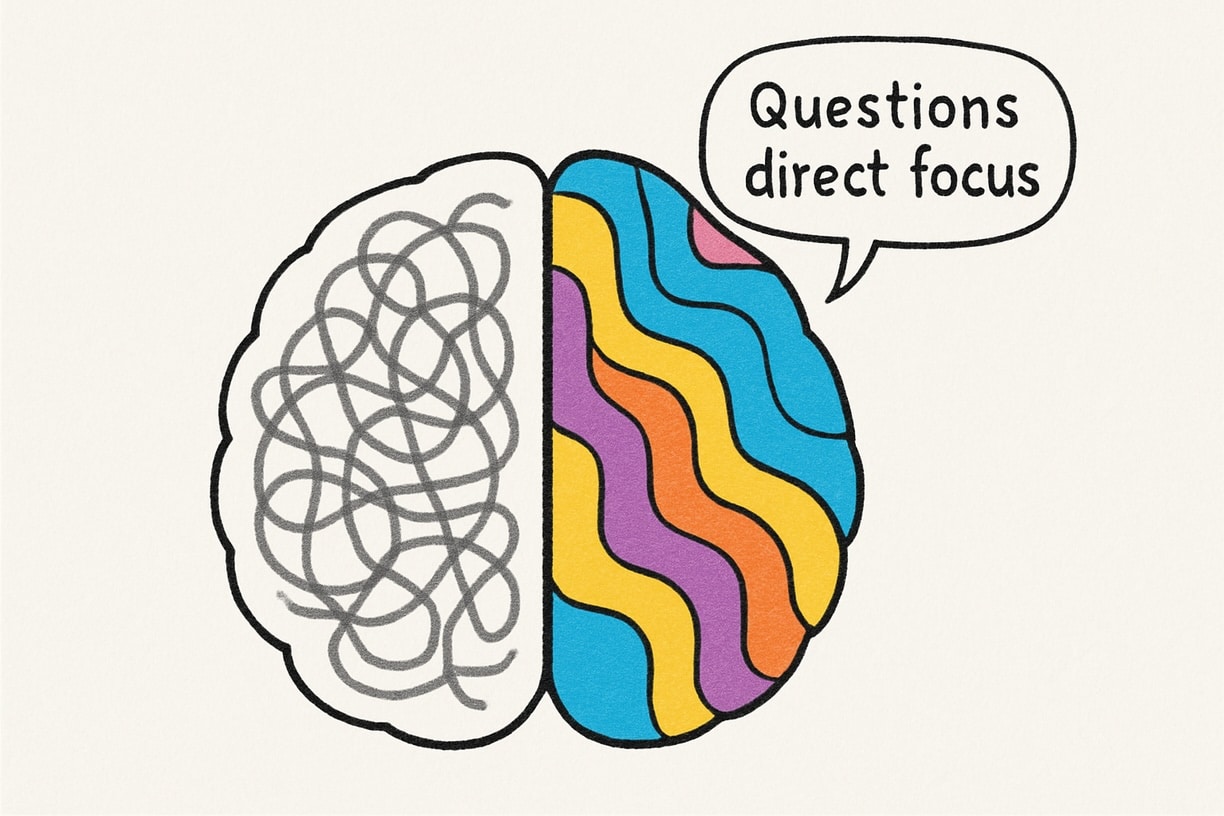
Your brain is constantly trying to make sense of the world. It takes in millions of pieces of information every second, but you only become aware of a tiny fraction of them. How does your brain decide what to pay attention to?
It looks for answers to the questions you’re asking.
Think about it like this: imagine you’re at a party. If you’re asking yourself “Why am I so awkward?” your brain will search for evidence of your awkwardness. You’ll notice every stumbled word and uncomfortable silence.
But what if you asked “Who here might be interesting to talk to?” Your brain would scan for different information entirely. You’d notice people’s expressions, conversations, and potential connections.
Same party. Completely different experience. All because of the question you asked.
This happens in every area of your life:
- When you wake up asking “Why am I so tired?” you feel more tired
- When you approach work asking “How can I just get through this day?” you merely survive
- When you look at challenges asking “Why is this happening to me?” you feel like a victim
But when you change your questions, you change your focus, your emotions, and ultimately your actions.
The Science Behind Questions
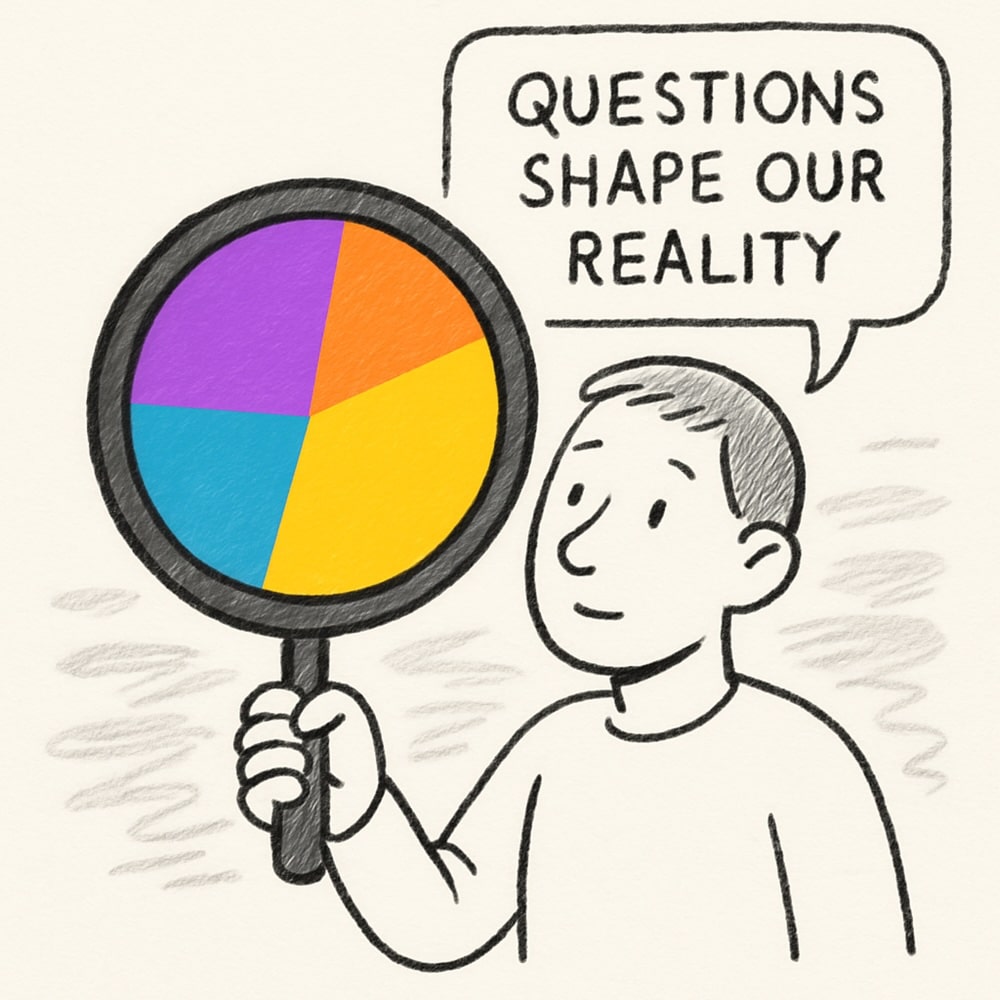
When you ask a question, your brain treats it like a command to find an answer. This activates your Reticular Activating System (RAS), the part of your brain that filters information.
It’s like when you buy a new car and suddenly see that same model everywhere. Those cars were always there, but now your brain is tuned to notice them.
Questions work the same way. They tell your brain what to look for and what to ignore.
Even more fascinating, research shows that questions trigger different brain activity than statements. When you hear or think a statement, your brain processes it passively. But when you encounter a question, your brain actively engages to find an answer.
This is why questions are so much more powerful than statements. Saying “I am confident” might feel good momentarily, but asking “How can I approach this situation with confidence?” engages your problem-solving abilities and creates real change.
Why Most People Ask the Wrong Questions
Most of us don’t choose our questions consciously. We inherit them from:
- Parents and family (“Why can’t you be more like your sister?”)
- Past experiences (“How do I avoid getting hurt again?”)
- Cultural messages (“How can I look successful to others?”)
- Emotional habits (“What might go wrong here?”)
These questions become so automatic that we don’t even realize we’re asking them. They run in the background of our minds, shaping our perceptions and decisions without our awareness.
And here’s the problem: many of these unconscious questions are limiting rather than empowering. They focus on:
- What’s wrong instead of what’s possible
- Why we can’t instead of how we can
- What we should fear instead of what we could create
- Who to blame instead of what to learn
The good news? Once you become aware of these questions, you can change them.
Limiting vs. Empowering Questions
Let’s look at the difference between these two types of questions:
Limiting Questions:
- Why am I so bad at this?
- What if I fail?
- Why don’t people appreciate me?
- How can I avoid looking foolish?
- Why is this happening to me?
These questions assume problems, focus on the negative, and often have no useful answers. They drain your energy and confidence.
Empowering Questions:
- What can I learn from this?
- How can I use this situation to grow?
- What’s one small step I could take?
- How might I approach this differently?
- What am I grateful for right now?
These questions assume possibilities, focus on solutions, and lead to helpful insights. They energize you and expand your thinking.
The difference isn’t just positive versus negative thinking. Empowering questions are practical tools that direct your brain toward useful answers.
Consider this example:
Limiting question: “Why am I so disorganized?”
Your brain’s likely answers: “Because you’re lazy. Because you’ve always been this way. Because you can’t focus.”
Empowering question: “What’s one small way I could be more organized today?”
Your brain’s likely answers: “You could spend 10 minutes clearing your desk. You could use that calendar app. You could handle each piece of mail once.”
See the difference? The first question leads to self-criticism. The second leads to action.
In the next section, we’ll explore how to identify the core questions that are currently guiding your life—often without your awareness. Once you recognize them, you’ll be ready to transform them into questions that serve you better.
Part 2: Identifying Your Core Questions
Have you ever wondered why you keep facing the same challenges or feeling the same emotions over and over again? The answer might be hiding in the questions you unconsciously ask yourself every day.
How to Recognize the Unconscious Questions Guiding Your Life
Your mind is always asking questions, even when you’re not aware of it. These questions are like a GPS system for your brain—they determine where you focus, how you feel, and what actions you take.
But how do you discover questions that operate below your awareness? Here are some practical ways to bring them into the light:
1. Notice Your Emotional Patterns
Your emotions are excellent clues to your underlying questions. When you feel:
Anxious: You might be asking “What could go wrong?” or “What if I’m not prepared?”
Frustrated: You might be asking “Why does this always happen to me?” or “Why don’t people understand?”
Overwhelmed: You might be asking “How will I get everything done?” or “What if I can’t handle this?”
Stuck: You might be asking “Why can’t I figure this out?” or “Why is everyone else moving forward except me?”
The next time you experience a strong emotion, pause and ask yourself: “What question might be creating this feeling?”
2. Listen to Your Self-Talk
The way you talk to yourself reveals your underlying questions. Pay attention to phrases like:
“I always mess this up.”
(Hidden question: “How will I mess up this time?”)
“No one appreciates what I do.”
(Hidden question: “Why don’t people value my contribution?”)
“I’ll never be good enough.”
(Hidden question: “How can I prove I’m worthy?”)
Try keeping a small notebook handy. When you catch yourself in negative self-talk, write it down. Then ask: “What question am I really asking myself here?”
3. Examine Your Recurring Problems
The challenges that keep showing up in your life often reflect your core questions. If you:
- Repeatedly feel taken advantage of, you might be asking “How can I please others?”
- Often feel overwhelmed with responsibilities, you might be asking “How can I do it all myself?”
- Frequently feel unappreciated, you might be asking “What must I do to be valued?”
Think about a problem that keeps appearing in your life. Then ask: “What question might I be asking that keeps creating this situation?”
4. Reflect on Your Decisions
Your choices reveal your underlying questions. When making decisions, are you primarily asking:
“What’s the safest option?”
“What will others think?”
“How can I avoid discomfort?”
“What’s the fastest solution?”
Or are you asking:
“What aligns with my values?”
“What would help me grow?”
“What feels meaningful?”
“What’s the best long-term approach?”
The next time you face a decision, notice which questions naturally arise for you.
Common Limiting Questions Most People Live By
Many of us are guided by questions we didn’t consciously choose. This includes you and me.
Here are some of the most common limiting questions people live by:
The Approval Seeker
“What will others think of me?”
“How can I get everyone to like me?”
“What if they reject me?”
These questions make others’ opinions more important than your own wisdom. They lead to people-pleasing, fear of standing out, and loss of authenticity.
The Perfectionist
“What if I make a mistake?”
“How can I avoid failure?”
“Why am I never good enough?”
These questions create paralyzing standards, fear of trying new things, and constant self-criticism.
The Controller
“How can I make sure nothing goes wrong?”
“What might I be missing?”
“How do I stay in charge?”
These questions lead to micromanaging, anxiety about the future, and difficulty trusting others.
The Victim
“Why does this always happen to me?”
“Who’s to blame for this?”
“Why is life so unfair?”
These questions create feelings of helplessness, resentment, and a focus on problems rather than solutions.
The Comparer
“Why are others doing better than me?”
“How can I prove I’m special?”
“What if I’m falling behind?”
These questions lead to constant dissatisfaction, envy, and tying your worth to external achievements.
Do any of these sound familiar? Most of us have several of these question patterns running in our minds. The key is to recognize them without judgment. Remember, you didn’t consciously choose these questions—they developed based on your experiences and what seemed to keep you safe or help you succeed.
Practical Exercises to Uncover Your Personal Question Patterns
Now let’s get practical about discovering your own core questions. Try these simple exercises:
For the next week, take five minutes each morning to ask yourself:
- What am I worried about today?
- What am I hoping for today?
- What am I assuming will happen today?
Write down your answers, then look for the questions hiding behind them. For example, if you’re worried about a presentation, the hidden question might be “What if I embarrass myself?” If you’re hoping your partner notices your efforts, the question might be “What must I do to be appreciated?”
Each evening for a week, reflect on:
- When did I feel most stressed or upset today?
- What was I saying to myself in those moments?
- What questions might have been running through my mind?
Write these down and look for patterns across different days and situations.
The Body Scan
Our bodies often know our questions before our minds do. Try this:
- Sit quietly and close your eyes
- Notice any tension or discomfort in your body
- Gently ask that area: “What are you trying to tell me?”
- Then ask: “What question am I holding that’s creating this tension?”
You might be surprised by the insights that emerge.
The Trusted Friend Method
Sometimes others can see our patterns more clearly than we can. Ask a trusted friend:
- What do I seem to worry about most?
- What do I frequently complain about?
- What do I seem to be striving for?
Their observations can reveal questions you might not recognize in yourself.
Signs That Your Current Questions Are Holding You Back
How do you know if your questions are limiting rather than empowering you? Look for these signs:
- You feel the same emotions repeatedly- If you’re constantly anxious, frustrated, or disappointed, your questions may be trapping you in these emotional states.
- You can predict your reactions – If you know exactly how you’ll respond to certain situations (with worry, defensiveness, or resignation), you’re likely asking the same old questions.
- You see the same problems recurring – Different circumstances but similar issues suggest your questions are creating consistent patterns.
- You feel stuck or on autopilot – A sense of going through the motions often comes from questions that narrow rather than expand your possibilities.
- Your solutions aren’t working – If you keep trying to solve problems the same way with limited success, your underlying questions may be directing you to ineffective approaches.
Remember, recognizing your limiting questions isn’t about criticizing yourself. It’s about awareness. These questions served a purpose in your life—perhaps they helped you cope, stay safe, or meet expectations. But now you have the opportunity to choose questions that better serve who you want to become.
Part 3: Transforming Your Questions
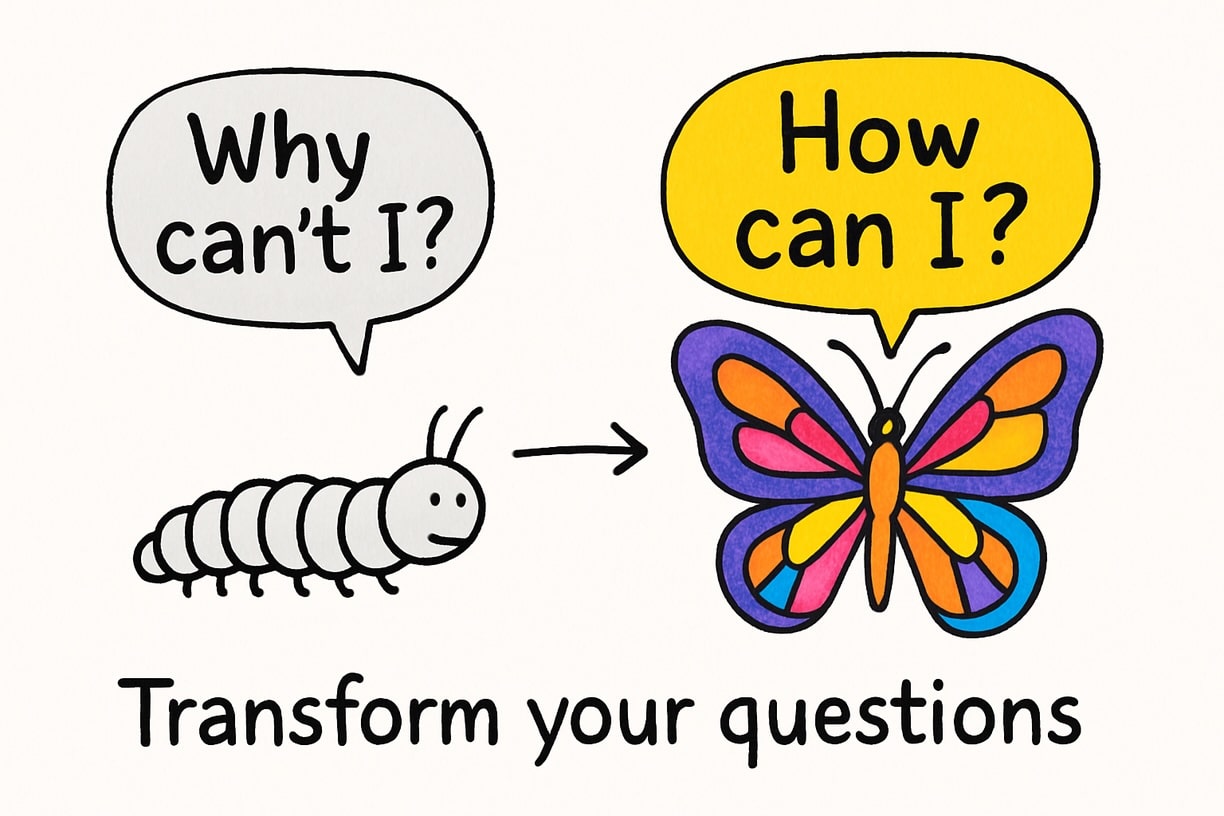
Now that you’ve identified the questions that might be holding you back, it’s time for the exciting part—transforming them into questions that empower and inspire you.
The Anatomy of Powerful, Life-Changing Questions
Not all questions are created equal. Powerful questions have specific qualities that make them effective at changing how you think, feel, and act.
They’re Open-Ended
Powerful questions can’t be answered with a simple “yes” or “no.” They invite exploration and discovery.
Limiting: “Can I handle this challenge?”
Empowering: “What strengths can I bring to this challenge?”
They Assume Possibilities
Powerful questions presuppose that solutions exist and that you have the resources to find them.
Limiting: “Why is this so hard for me?”
Empowering: “How might I approach this differently?”
They Focus Forward
Rather than dwelling on the past or analyzing problems, powerful questions direct your attention toward solutions and future actions.
Limiting: “Why did I fail?”
Empowering: “What can I learn from this experience?”
They Evoke Emotion
Questions that touch your heart as well as your head create deeper motivation and more lasting change.
Limiting: “What’s wrong with my life?”
Empowering: “What kind of life do I truly want to create?”
They’re Specific and Actionable
The best questions lead naturally to concrete steps you can take.
Limiting: “Why am I so disorganized?”
Empowering: “What’s one small step I could take today to feel more organized?”
Step-by-Step Process for Reframing Limiting Questions
Transforming your questions isn’t complicated, but it does take practice. Here’s a simple process you can use:
Step 1: Catch the Limiting Question
Notice when you’re asking yourself a question that makes you feel stuck, anxious, or powerless. Write it down exactly as it comes to mind.
Example: “Why can’t I ever stick to my goals?”
Step 2: Identify What Makes It Limiting
Is it focused on the past? Does it assume failure? Is it blaming or judgmental? Does it have a useful answer?
Example: This question assumes I never stick to goals (which isn’t true), focuses on what’s wrong with me, and doesn’t lead to helpful answers.
Step 3: Flip the Assumption
Take the limiting assumption in your question and flip it to a more empowering one.
Example: Instead of assuming “I can’t stick to goals,” I’ll assume “I can find ways to achieve my goals.”
Step 4: Redirect the Focus
Shift from problems to solutions, from past to future, from blame to responsibility, or from fear to possibility.
Example: Instead of focusing on why I fail, I’ll focus on what helps me succeed.
Step 5: Craft Your New Question
Create a question that embodies the new assumption and focus.
Example: “What conditions help me stay committed to my goals, and how can I create more of those conditions?”
Step 6: Test It
A good empowering question should:
- Make you feel more energized and hopeful
- Lead to useful insights and ideas
- Point toward specific actions you could take
If your new question doesn’t do these things, keep refining it.
Let’s practice with a few more examples:
Limiting Question: “Why am I so bad at relationships?”
Empowering Alternative: “What have I learned from past relationships that can help me create healthier connections now?”
Limiting Question: “How can I stop feeling so overwhelmed?”
Empowering Alternative: “What’s the most important thing for me to focus on right now?”
Limiting Question: “Why don’t people respect my boundaries?”
Empowering Alternative: “How can I communicate and maintain my boundaries more effectively?”
Specific Question Frameworks for Different Life Situations
Different situations call for different types of questions. Here are some powerful frameworks you can adapt to your specific circumstances:
When Facing a Challenge
- “What’s the opportunity hidden in this difficulty?”
- “How would my future self want me to handle this?”
- “What strengths can I bring to this situation?”
- “What would this look like if it were easy?”
When Making a Decision
- “What matters most to me in this situation?”
- “What would I advise someone I love to do?”
- “How will this choice affect who I’m becoming?”
- “What am I not seeing or considering?”
When Feeling Stuck
- “What’s one small step I could take right now?”
- “What would make this more enjoyable or meaningful?”
- “Who has solved a similar problem, and what can I learn from them?”
- “If I knew I couldn’t fail, what would I do?”
When Experiencing Conflict
- “What might the other person be feeling or needing?”
- “What’s more important: being right or maintaining the relationship?”
- “How might we both get what we need?”
- “What haven’t I expressed or asked for clearly?”
When Setting Goals
- “What would make this goal deeply meaningful to me?”
- “How will I know I’ve succeeded beyond just the numbers or outcomes?”
- “What habits or systems would support this goal?”
- “Who do I need to become to achieve this?”
When Feeling Negative Emotions
- “What is this feeling trying to tell me?”
- “How can I show myself compassion right now?”
- “What’s one thing I can appreciate despite this difficulty?”
- “What would help me feel even 10% better?”
How to Make Asking Better Questions a Daily Habit
Knowing about empowering questions isn’t enough—you need to make them part of your daily thinking. Here’s how:
Create Question Triggers
Link the practice of asking better questions to specific situations in your day:
- When you wake up: “What’s one thing I’m looking forward to today?”
- Before meetings: “How can I add the most value here?”
- When facing a setback: “What can I learn from this?”
- Before bed: “What went well today, and what would I do differently?”
Use Visual Reminders
Place sticky notes with your favorite empowering questions where you’ll see them regularly:
- On your bathroom mirror
- On your computer monitor
- In your planner or journal
- As lock screen wallpaper on your phone
Practice Question Substitution
When you catch yourself asking a limiting question, immediately substitute an empowering alternative. With practice, this becomes automatic.
Limiting: “Why am I so stressed?”
Empowering: “What’s one thing I can do to feel more calm right now?”
Create a Question Journal
Keep a small notebook or digital note where you collect powerful questions that resonate with you. Review and add to it regularly.
Find a Question Partner
Share this practice with a friend, family member, or colleague. Check in with each other about the questions you’re asking and help each other reframe limiting ones.
Celebrate Question Wins
Notice when a powerful question leads to a breakthrough or positive change. Acknowledging these successes reinforces the habit.
Remember, transforming your questions isn’t about being perfectly positive all the time. It’s about becoming aware of the questions that guide your life and consciously choosing ones that serve you better.
In the next section, we’ll explore specific question frameworks for different areas of your life, from career and relationships to health and personal growth.
Part 4: Questions for Specific Life Areas
The quality of your questions matters in every area of your life. In this section, we’ll explore powerful questions tailored to different aspects of your life that can help you create breakthroughs where you need them most.
Career and Purpose Questions
Many of us spend more time at work than anywhere else, yet we often ask questions that make our work feel draining rather than fulfilling.
Instead of asking:
- “How can I get through this day?”
- “Why don’t I get the recognition I deserve?”
- “When will I finally get promoted?”
Try asking:
- “How can I bring more of my unique strengths to my work today?”
- “What part of my work feels most meaningful, and how can I do more of that?”
- “How might I serve or contribute in a way no one else can?”
- “What skills would I love to develop that would also add value here?”
- “If I were designing my ideal role, what would it look like?”
For Career Transitions:
- “What work would I do even if I didn’t need the money?”
- “What problems do I feel genuinely motivated to solve?”
- “When have I lost track of time because I was so engaged in what I was doing?”
- “What do people thank me for or come to me for help with?”
- “What feels like play to me but work to others?”
For Leadership:
- “How can I help my team feel both challenged and supported?”
- “What might my team need from me that they’re not expressing?”
- “How can I create more opportunities for others to shine?”
- “What conversations am I avoiding that need to happen?”
- “How can I better align our daily work with our larger purpose?”
Relationship Questions
Our connections with others are fundamental to our happiness, yet we often ask questions that create distance rather than closeness.
Instead of asking:
- “Why don’t they understand me?”
- “How can I get them to change?”
- “What’s wrong with this relationship?”
Try asking:
- “How can I better understand what matters to them?”
- “What might they be feeling or needing right now?”
- “How can I show up as my best self in this relationship?”
- “What am I not seeing from their perspective?”
- “How can we create a win-win in this situation?”
For Family Relationships:
- “What traditions or experiences would create meaningful memories for us?”
- “How can I show each family member I value their unique qualities?”
- “What boundaries would help our family relationships stay healthy?”
- “How can I be more present when we’re together?”
- “What unspoken expectations might be causing friction in our family?”
For Romantic Relationships:
- “How can we bring more play and joy into our relationship?”
- “What makes my partner feel truly seen and appreciated?”
- “How can we support each other’s growth while growing together?”
- “What shared vision would inspire both of us?”
- “How can we turn conflicts into opportunities for deeper connection?”
For Friendships:
- “Which friendships energize me, and how can I nurture them?”
- “How can I be a better friend to the people who matter most to me?”
- “What kind of friend do I want to be known as?”
- “How can I expand my circle to include more diverse perspectives?”
- “What old friendships might be worth reconnecting with?”
Health and Wellbeing Questions
Our physical and mental wellbeing forms the foundation for everything else, yet many of us ask questions that make health feel like a burden rather than a gift.
Instead of asking:
- “Why can’t I stick to a diet?”
- “How can I lose weight fast?”
- “Why am I always tired?”
Try asking:
- “How can I make healthy choices feel good in the moment?”
- “What foods make my body feel energized and strong?”
- “What type of movement brings me joy?”
- “How can I design my environment to make healthy choices easier?”
- “What would a sustainable, enjoyable healthy lifestyle look like for me?”
For Mental Health:
- “What activities help me feel calm and centered?”
- “How can I build more moments of rest and recovery into my day?”
- “What boundaries would protect my mental energy?”
- “What negative thought patterns do I need to question or release?”
- “How can I respond to stress with more self-compassion?”
For Sleep:
- “What evening routine would help my body and mind prepare for rest?”
- “How can I create a sleep environment that supports deep sleep?”
- “What worries or thoughts keep me awake, and how can I address them earlier in the day?”
- “What would a truly restorative morning routine look like?”
- “How might I honor my body’s natural rhythms more fully?”
Personal Growth Questions
Personal development can become another source of pressure if we ask questions that focus on fixing what’s “wrong” with us rather than expanding our potential.
Instead of asking:
- “Why can’t I change?”
- “What’s wrong with me?”
- “How can I fix my weaknesses?”
Try asking:
- “What strengths can I build on?”
- “What matters most to me at this stage of my life?”
- “What kind of person am I becoming, and what kind of person do I want to become?”
- “What would stretch me without breaking me?”
- “What new perspective could transform how I see this situation?”
For Learning:
- “What am I curious about right now?”
- “How can I apply what I’m learning to my daily life?”
- “What skill would be both enjoyable to learn and valuable to have?”
- “Who could mentor or guide me in this area?”
- “How can I create a sustainable learning habit?”
For Creativity:
- “What would I create if I knew no one would judge it?”
- “How can I bring more playfulness to my creative process?”
- “What unique perspective or experience can I bring to my creative work?”
- “How might constraints actually enhance my creativity?”
- “What small creative project could I start today?”
Financial Questions
Money matters can trigger some of our most limiting questions, yet this area especially benefits from more empowering alternatives.
Instead of asking:
- “Why am I always broke?”
- “How can I afford this?”
- “Why is money so stressful?”
Try asking:
- “How can I increase the value I create for others?”
- “What skills could I develop that people would gladly pay for?”
- “How can I align my spending more closely with my true values?”
- “What financial habits would give me more peace of mind?”
- “How can I view money as a tool rather than a source of stress?”
For Saving and Investing:
- “What am I really saving or investing for, and why does that matter to me?”
- “What small, consistent actions would improve my financial future?”
- “How can I make saving feel rewarding in the present?”
- “What financial knowledge would empower me to make better decisions?”
- “How can I balance enjoying today while preparing for tomorrow?”
For Earning:
- “What problems am I well-positioned to solve that others would value?”
- “How might I create multiple streams of income?”
- “What untapped opportunities exist in my current role or business?”
- “How can I provide so much value that money becomes a natural byproduct?”
- “What limiting beliefs about earning money do I need to challenge?”
Remember, the questions in this section are starting points. The most powerful questions are the ones that resonate with your specific situation and values. Experiment with these, adapt them, and create your own questions that spark insight and inspiration in each area of your life.
Part 5: Creating Your Question Practice
Knowing about powerful questions is one thing. Living them daily is another. In this section, we’ll explore how to make empowering questions a natural part of your everyday life.
Morning and Evening Question Rituals
The beginning and end of your day are powerful times to shape your mindset with intentional questions.
Morning Question Ritual
How you start your day sets the tone for everything that follows. Instead of reaching for your phone or immediately thinking about your to-do list, try starting with empowering questions.
Here’s a simple 3-minute morning ritual:
- Gratitude Question: “What am I truly grateful for in my life right now?”
Take a moment to feel the gratitude, not just think about it. - Purpose Question: “What’s one thing I could do today that would matter most?”
This helps you prioritize what’s truly important, not just what’s urgent. - Strength Question: “What quality or strength can I bring to today’s challenges?”
This activates your inner resources before you face the day’s demands.
You can write your answers in a journal or simply reflect on them as you get ready. The key is consistency—even a minute of intentional questions can shift your entire day.
Evening Question Ritual
The questions you ask before sleep influence not only how you process the day but also how your unconscious mind works while you rest.
Try this 5-minute evening practice:
- Reflection Question: “What went well today, and why did it go well?”
This trains your brain to notice and reinforce positive patterns. - Learning Question: “What would I do differently if I could live this day again?”
This creates growth without self-judgment. - Release Question: “What do I need to let go of before I sleep?”
This helps prevent worries from disturbing your rest. - Tomorrow Question: “What am I looking forward to tomorrow?”
This plants seeds of anticipation and positive expectation.
These rituals are simple but powerful. They bookend your day with intentional thinking rather than reactive habits.
Using Questions in Challenging Moments
Life’s difficulties are when we most need empowering questions, yet they’re also when we’re most likely to fall back on limiting ones.
Here’s how to use questions as tools in tough situations:
The Pause Practice
When you feel triggered, overwhelmed, or stuck:
- Pause: Take a deep breath and create a moment of space.
- Notice: What limiting question is running through your mind?
- Choose: What more empowering question could you ask instead?
For example:
When criticized at work:
- Limiting question: “Why am I always messing up?”
- Empowering alternative: “What can I learn from this feedback?”
When facing a setback:
- Limiting question: “Why does this always happen to me?”
- Empowering alternative: “How can I respond to this in a way I’d be proud of?”
When feeling overwhelmed:
- Limiting question: “How will I get through all of this?”
- Empowering alternative: “What’s the next right small step I can take?”
The Question Emergency Kit
Create a personal list of go-to questions for your most common challenging situations. Keep them in your phone, wallet, or somewhere easily accessible.
For example:
For anxiety:
- “What’s the worst that could realistically happen, and how would I handle it?”
- “What’s one small thing I can control right now?”
- “How have I successfully handled similar situations before?”
For conflict:
- “What might they be feeling beneath their words or actions?”
- “What do I really want from this interaction?”
- “How can I respond rather than react?”
For decision paralysis:
- “What would I advise my best friend to do?”
- “Which option aligns best with who I want to become?”
- “What would my future self thank me for choosing?”
Having these questions ready means you don’t have to create them in the moment when your thinking is already stressed.
How to Help Others Ask Better Questions
The quality of your questions doesn’t just impact your life—it can transform your interactions with others too.
With Friends and Family
When someone comes to you with a problem, your instinct might be to offer advice. Instead, try offering a powerful question:
- “What have you tried so far, and what did you learn from that?”
- “What outcome are you really hoping for?”
- “What would make this situation better from your perspective?”
- “What part of this do you have control over?”
These questions show respect for the other person’s wisdom while helping them see new possibilities.
With Children
Children naturally ask lots of questions, but they also learn questioning patterns from adults. Help them develop empowering question habits by:
- Modeling good questions yourself
- Responding to their limiting questions with better alternatives
- Asking them questions that assume capability: “How might you solve this?” instead of “Do you need help?”
- Celebrating their questions and showing that curiosity is valued
In Teams and Workplaces
If you lead others, the questions you ask shape your team’s culture and thinking:
- Replace “Who’s to blame?” with “What can we learn from this?”
- Replace “Why can’t we meet our targets?” with “What would enable us to exceed our targets?”
- Replace “Do you have any questions?” with “What questions do you have?”
- Replace “Can you do this?” with “How might we approach this?”
Notice how the second question in each pair creates more psychological safety and invites more thoughtful responses.
Measuring Your Progress Through Question Quality
How do you know if your question practice is working? Look for these signs:
Emotional Indicators
- You recover more quickly from setbacks
- You feel more curious and less judgmental
- You experience more moments of insight and possibility
- You feel more agency and less victimhood
Behavioral Indicators
- You try new approaches rather than repeating old patterns
- You listen more deeply to others
- You make decisions with more clarity and confidence
- You take more inspired action and less reactive action
Relationship Indicators
- Your conversations have more depth and discovery
- You resolve conflicts more creatively
- Others seem more open and less defensive with you
- You connect more authentically with people
Results Indicators
- You make progress on long-standing challenges
- You notice opportunities you might have missed before
- You create outcomes that exceed your initial expectations
- Your actions align more consistently with your values
Remember, the goal isn’t to ask perfect questions all the time. We all have moments of doubt, fear, and limitation. The goal is to become aware of your questions and gradually shift toward ones that serve you better.
As you practice, you’ll find that better questions become more automatic. What once required conscious effort eventually becomes your natural way of thinking.
Conclusion: The Question Revolution
Recap of Key Insights
we’ve discovered that:
- The quality of your life directly reflects the quality of your questions. The questions you ask—consciously or unconsciously—shape your focus, emotions, decisions, and ultimately your results.
- Most people live by unconscious questions they didn’t choose. These questions often come from past experiences, cultural messages, and emotional habits that may no longer serve who you want to become.
- You can identify your core questions by noticing your emotional patterns, listening to your self-talk, examining recurring problems, and reflecting on your decisions.
- Transforming limiting questions into empowering ones is a learnable skill with a simple process: catch the limiting question, identify what makes it limiting, flip the assumption, redirect the focus, and craft a new question.
- Different life areas benefit from specific types of questions. Whether in your career, relationships, health, personal growth, or finances, intentional questions can create breakthroughs where you need them most.
- Making better questions a daily habit through morning and evening rituals, challenging moment practices, and consistent awareness can transform your default thinking patterns over time.
But perhaps the most important insight is this: You have more power than you realize to shape your experience of life through the questions you ask.
The Ripple Effect of Better Questions
When you change your questions, you don’t just change your own life. Your new way of thinking creates ripples that extend far beyond you:
In Your Relationships
As you ask more empowering questions, you listen differently. You become more curious and less judgmental. Your conversations deepen. Conflicts become opportunities for understanding rather than battles to win. The people around you feel more seen, heard, and valued.
In Your Work
Your questions spark innovation and possibility thinking. You focus on solutions rather than problems. You inspire others to think more expansively. Your contributions become more valuable because you see opportunities others miss.
In Your Community
You bring a different energy to every interaction. You help others reframe their challenges. You model a way of engaging with life that’s more curious, creative, and compassionate. Your presence alone can shift the quality of thinking in a group.
In Our World
Imagine if more people asked questions like:
- “How can we create solutions where everyone wins?”
- “What kind of world do we want to create for future generations?”
- “How can we use our differences as strengths rather than sources of division?”
- “What might be possible if we approached this challenge with fresh eyes?”
The quality of our collective questions determines the quality of our shared future.
Your Question Journey Begins Now
Do not read this once and set it aside. It’s a companion for an ongoing practice of questioning your questions.
Here are some ways to continue this journey:
- Review regularly. Come back to different sections of this guide as you need them. Different parts will resonate at different times in your life.
- Start small. Choose just one area of your life and experiment with new questions there before expanding to others.
- Be patient with yourself. You’ve had years of practice with your current questioning patterns. New habits take time to develop.
- Celebrate progress. Notice and appreciate when you catch yourself in a limiting question and successfully shift to a more empowering one.
- Share what you learn. Teaching others about the power of questions will deepen your own practice.
Remember, the goal isn’t perfection. We all have moments of doubt, fear, and limitation. The goal is awareness and choice—becoming conscious of the questions that guide your life and intentionally choosing ones that lead to growth, connection, and meaning.

A Final Question
As we conclude, I’d like to leave you with two questions to carry forward:
“What question, if I held it in my heart each day, would most transform my life?”
“How would you like to use your precious life? How do you want the world to be different because you were here?”
Take a moment to sit with this. The answer might not come immediately. When it does, write it down somewhere you’ll see it often. Let it be your companion and guide.
Your life is shaped by many forces, some within your control and some beyond it. But in every moment, you have the power to choose the questions you ask. And in that choice lies the potential for transformation.
Thank you for joining me on this exploration of the power of questions.
The next chapter of your story begins with the next question you ask.
Choose wisely. Choose Leadership