Life

  • Five Things A Leader Must Do By Default

    In today’s corporate environment, after a few years of doing your job well enough, chances are that you will be asked to step up and lead a team. You trained and studied to be good at your job, and now getting to manage people seems like a reward for a job well done.

    By promoting the good performers to be managers and leaders, people have assumed for centuries that the skills that made you successful as an individual contributor would also make you successful as a manager. If you have led people for any considerable amount of time, you would know how false this assumption is. Yet in the business world, this continues to be the norm.

    Today I want to list down five things which you must do, or are expected to do by default, to be effective as a manager/leader. And it is likely that nobody told you this when you were promoted. I have only figured them out after leading teams for over a decade, and I believe I am on a continuous journey to learn and know more about leadership.

    1. Lead Yourself

    The first thing you must do to be effective as a leader is to lead yourself. Your relationship with your team will be determined more by your trustworthiness than by any other skill or talent you might possess. Trust is the foundation of leadership, and you build trust by leading yourself first – by holding yourself accountable for what you demand from your team. Like any worthwhile endeavor, it takes time, effort, and daily investments to build trust with your team.

    If you want your team members to honour their promises, honour your promises to them. If you ask them to be on time for meetings, you must be on time first. Or you will lose their trust. If you ask them to be respectful to each other, you must respect them first. Or you will lose their trust. If you want them to be humble, you need to exemplify that in your behaviour. If you need them to be honest and sincere, you need to acknowledge your mistakes publicly and make amends for them. You can not lead a team if you can’t lead yourself.
    2. Know Where You are Headed

    When you are leading a team, people will look up to you for providing direction. Having a well-defined purpose clarifies why the team exists in the first place. Coming up with the team’s purpose together with your team will empower them to take decisions that are in the best interest of the team.

    Listening to your team and engaging in a dialogue will allow the team to define and own its purpose. You need to spend time with the team regularly to discuss, revisit, or reshape the team’s purpose. Ensuring each member understands the team’s purpose and their role in the team will empower them to prioritize their tasks effectively.

    3. Be a Coach


    If you have people reporting to you, then you are their coach by default. You don’t have a choice in being their coach as people will approach you anyway. When they are demotivated, when they have a conflict, or when they need help for any other reason; it is your responsibility to listen, understand their concerns, and then coach them to align their personal motivations with the team’s shared purpose and goals. If you can’t do that effectively, it will impact the results the team intends to produce in the future.

    While I assert that you are a coach by default, the skills and conversations required to be a coach don’t come by default. You must invest time and effort in learning and practicing your coaching skills. How well you coach people will be directly proportional to the results the team produces. Investing in learning these skills and making coaching a priority will be your best investment ever.

    4. Demand Commitment and Accountability

    Just as every sport has a certain set of rules, each business team can come up with rules (or standards) which apply to their business and industry. These rules will govern how you work and define success and failure. Examples could be how you treat your colleagues, how complaints are handled, and what boundaries you set in matters important to the team. Once these standards are set, it frees up everyone to exercise their own creativity in making decisions. This gives shape to the ‘culture’ in the team.

    After you set up these standards together with your team, you have to demand them. Of course, for this to work, you have to exemplify them yourself. Holding your team accountable to these standards (or rules) will bring the team members together and set the team up for high performance. The intention behind it is not to punish or penalise people when they slip up, but to ensure an open, fair and supportive culture in the team.

    5. Serve Your People

    I believe that leadership is a privilege, and that each leader is a custodian of the company’s values, beliefs, and ambitions for the future. Leadership will require you to think beyond your own self-interest, and from your team or company’s point of view. In order to lead, you must be willing to serve – to put your team’s interest in front of any individual interests, which might lead you to make some difficult decisions from time to time.

    Leadership is not about power or authority, nor is it about popularity. Leadership is about character – which you will need to express yourself authentically, compassion – which you will need to grow and develop your people, and integrity – which you will need to serve your people with the respect and transparency they deserve.

    I believe that leadership is standing for something bigger than yourselves. You show your team the way, give it what it needs to do the job, and then get out of the way. Your biggest job is to create an environment of respect and accountability, where people have fun and express themselves freely by continuously moving forward towards the team’s goals.
    To sum it up, these five points above are not strategies or tactics which you can incorporate in your leadership style to get better results. These are the bedrock which will give rise to a myriad of strategies and tactics, which in turn will lead to those results. If you try to fake them, your people will call your bluff sooner or later, and you will lose all credibility and trust. An attitude of humble service will enable you to become a better leader, while taking care of your team and company’s needs.

  • Investing in Yourself and Making Powerful Choices

    John was pushing on the gas as he didn’t want to be late for this meeting. If he can crack this deal, it would be a game changer for his company, and he had worked hard for it. But just as he was visualising what he would say in the meeting, his car engine fell silent and it came to a stop soon after.

    After struggling for a few seconds, he shouted ‘fuck!’ as his eyes went towards the fuel meter. “This can’t be true”, he uttered in complete shock as he looked at the needle towards the E in his car’s dashboard. He got down and started kicking his car in frustration when a passer by stopped and asked – “What’s wrong?”
    “I can’t believe I just ran out of fuel. And I am already running late for this very important meeting.”
    “Why didn’t you stop on the way to refuel your car?”, asked the bystander.
    “Didn’t I just tell you?? I have to make it to the meeting. I am already late.”

    If you are laughing or smiling at the above story, don’t. Because we (Yes! Including you and me) aren’t very different either. In our day to day lives, we are also too often focussed on what is urgent or what seems important today that we end up ignoring what is really important for us in the long run. If we use the “filling the gas” metaphor which I used in the story, then it is evident that it was a case of bad prioritization, but it is not so simple to see the same in our daily lives.

    If you really want to not run out of gas, you need to invest in the person you are, because that will determine how far you will go. Investing in Yourself is the equivalent of “filling up the gas”. Below I am listing down the four steps we all can follow to do so.

    1. Understanding Yourself

    We are all shaped by our surroundings – our parents, our peers at school and work, our friends, our culture, and our experiences as we grow up. It is very rare that we spend time exploring who we are on a deeper level. What are our values? What makes us really happy or angry? What do we want our life to be about?

    Questions like these can help you uncover your personality and understand how you came to be the way you are. By exploring these questions you also get the freedom to choose the kind of person you want to be, or if there is something you want to re-invent or change about yourselves.

    2. Awareness of How You Act

    We all have certain beliefs that explain to us the way things should be or should not be. Almost all of our decisions are based on these beliefs about people and situations in life. It is our mind’s job to ensure our safety and survival in this fast-paced world and it does that by making decisions for us, many times which are even unaware of our conscious self. It is like we are running on auto-pilot.

    Making efforts to uncover your blind spots and to be more conscious requires being more mindful of your daily decisions – both big and small. It is only through focusing attention on your mind that you can be present with the robotic nature of your life. By being present with this routine will lead you to the next step – of making your own conscious choices.

    Powerful Investments in Life
    Powerful Investments in Life

    3. Making our Own Choices

    Once we are aware of how our unconscious mind drives most of our actions, we can be more deliberate about our choices. Each and every choice we make has the potential to change the direction of where we are going, and each choice will have its own consequences.

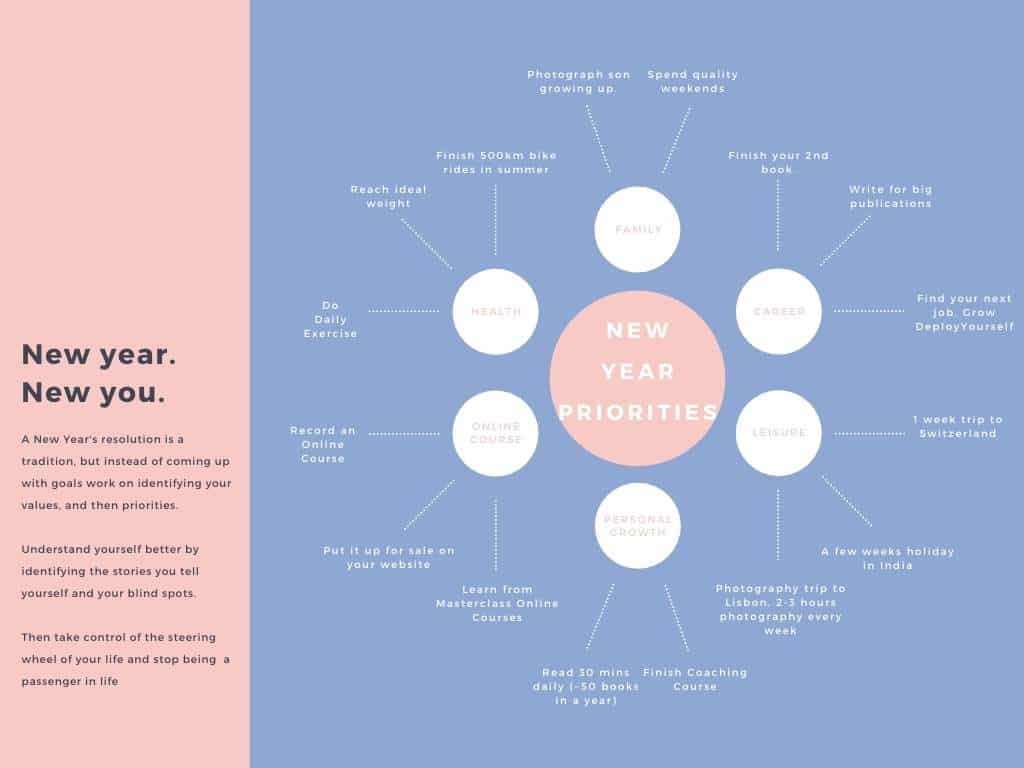
    By being conscious about your own choices based on your values and beliefs, you can take control of the steering wheel of your life and stop being just a passenger in life.

    For example – Rita believes her boss is rude and has a bias against her, based on past experiences. Now every time she gets into a meeting with him, her mind acts overtime to sense any hint of a bias towards her, and as soon as that happens, she start to defend or prove herself right. Often it develops into a behaviour pattern which she can’t help. She feels trapped and not having any other option. Now suppose Rita wants to invest in herself and has taken time to think about her life and understand the events that shaped her personality. She realises that being respected and treating others fairly while working towards common goals are amongst her deepest values.

    Now when she hears something from her boss which sounds biased against her, she gives her boss the option to explain his point or rephrases it to make sure she understands correctly, but doesn’t assume anything. After that, she acts based on her values and makes her point to her boss to find common ground rather than to prove him wrong. If her boss is still unreasonable and rude towards her, she respectfully informs him that his behaviour bothers her and look for ways forward. In this case – either her boss ends up changing his behaviour, or she decides to change her team or job, but either way she feels in control and empowered about her choices.

    4. Mastery via Practice

    Once you have made your own choices, the next step is to practice doing daily whatever is required to stay on course. It takes a great amount of discipline and practice to unlearn old habits and learn new ones. You will obviously fail many times when trying to form new habits, but eventually, these new habits will feel like second nature. Only by being aware (or mindful) of the decisions, you take each day you can be deliberate about them to move your life in the direction you want to go. The challenge is to reflect and learn from your experiences and re-invent yourself if need be.

    Invest in Yourself New Year Plan
    Invest in Yourself New Year Plan

  • The Power of a Pause

    When Atal Behari Vajpayee was the Prime Minister of India, I always wondered what could be the reason behind the pauses he took while speaking. Sometimes I thought it was because of his old age, and sometimes people even made fun of him for this habit, but I was always amused by the wisdom of his words – not just his political speeches, but his writings and poems in particular.

    If we take a pause and think for a moment, we can all recall such people who take longer than usual while speaking or answering questions. In today’s fast-paced world, I believe such people can teach us some valuable lessons.

    Our Quest for Survival

    Human beings are hard-wired for survival, and that is the reason we are the most evolved species on the planet. Our brains constantly listen for signals from our senses (sight, sound, touch) and act immediately if it senses any danger or threat to our physical well-being. Similarly, our mind always listens to external events, giving us a running commentary as life unfolds around us. When we are conversing, our mind tells us what to speak next or it makes a judgment about the speaker or the spoken. It is the mind’s job to make sure we don’t look bad (or stupid), and it decides (for us) what to do next to save us from (perceived) threats to our social well-being.

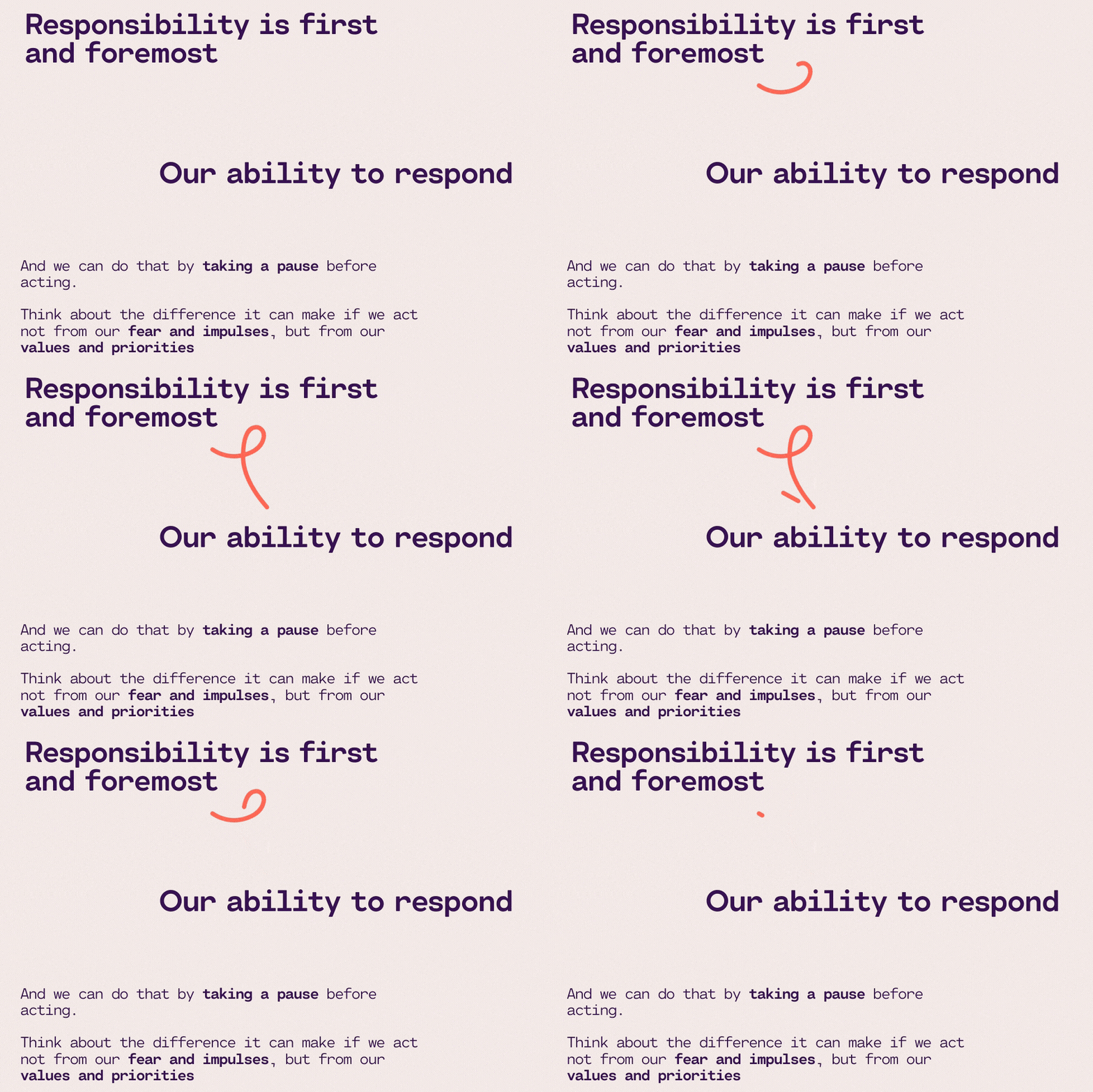
    Responsibility is Our Ability To Respond

    Our Ability to Intervene & Take a Pause

    If there is one thing that separates us from other living beings, it is our ability to stop this cycle of action and reaction and to take a pause before deciding how to respond. Most of the time, both action and reaction are simultaneous, with no pause between them. An example could be our spouse asking the same question every morning and we reply with the same response without even blinking. The same happens at work when we talk to our boss or our colleagues.

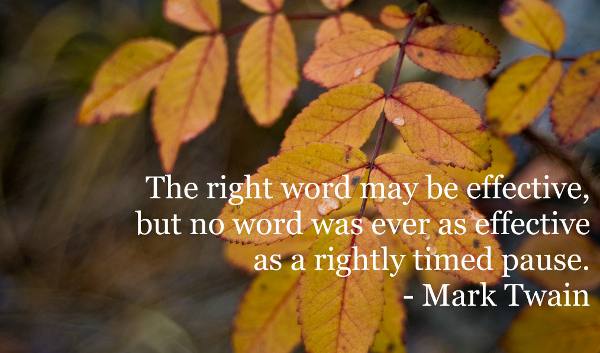
    A small pause before we start to speak or answer can do wonders for a conversation. Most of the time when we are not talking, we are actually waiting to talk. Sometimes the person on the other side has a lot more to say but is hesitant and so he stopped. By taking a pause after he has stopped speaking, and maybe using words like hmm… uh.. ok.. but not jumping in with our views, we can let the other person complete whatever he has in his mind. We can even ask follow-up questions like – “Do you have anything else to add?” before beginning to speak ourselves.

    In my conversations where I have been aware to take a pause, I have noticed that speaking up after letting the other person finish leads to more fruitful conversations and both parties are left satisfied. This satisfaction is of being heard, and of being understood. What’s more strange is that sometimes I don’t even have to speak up, and the conversation automatically leads to where I wanted it to go by just listening. As people are listened to, they let their rigidity of stance soften and consider your viewpoint even without your asking for it. Such is the power of taking a pause and listening.

    Responsibility = Our Ability to Respond

    We live in a world today where we want everyone to be responsible. We want our children, our political leaders, our colleagues, our managers, our neighbors to all be responsible. “Responsibility” is an over-used word in our media-driven society, but I believe being responsible is first and foremost our ability to respond consciously. It can make a huge difference in our lives if we can train ourselves to take a pause often and act not from our mind’s fears and judgments, but from our values, priorities, and goals.

    Taking a pause will force us to think about what is really important to us, and it can have a profound impact on our work and lives. Pausing creates space for ourselves and others to express themselves fully. It creates positive energy instead of building tension and enables us to handle tough situations in a more mature way.

    I want to end with a simple request – to take a pause and think about this article, rather than just believing the commentary your mind has provided you as you were reading it.

  • The Only Real Opponent You Have, In Work or in Life, Is Yourself

    Mahatama Gandhi once said – “As human beings, our greatness lies not so much in being able to remake the world – that is the myth of the atomic age – as in being able to remake ourselves.” And indeed, it is one of the greatest myths of this world that we have to fight our battles in the outside world.

    Everyone who has reached the pinnacle of sport, business, or his/her chosen profession knows that there comes a time when you realize that the real opponent which you have to fight is you yourselves. To take our performance above a certain level, we need to break our safety walls and take new actions which previously we might not have even thought of. By changing ourselves we actually change the world around us.

    Commitment

    If we want to improve our performance manifold, instead of just learning new courses or reading new books, we need to work on our commitment to the goal we are after. We should make that commitment so unwavering that our own lazy and procrastinating self (and yes, we all have that) can’t stop us from doing what is necessary.

    So don’t miss the morning walk, even if you are sick or it is raining outside. Don’t stop doing something just because it is getting tough for you. You have given a commitment, and it is your fight with yourself that you need to win to complete that commitment.

    Excellence

    If we can demand nothing less than excellence from ourselves and others in every little task we do, whether it is watering the plants or giving that presentation, the kind of results we produce will change dramatically.

    We should strive to give our best to every second, and not just in the important events. We have to make things happen, by doing what we have never done before, or by doing them in a way that we have never tried before.

    “Character, like a photograph, develops in darkness.”
    — Yousuf Karsh

    Discover The Strength Inside

    All of us have amazing strengths which we never realize or acknowledge unless we are forced by some sudden situation which requires us to act beyond what we think we are capable of. This is epitomized by the famous saying – “When the going gets tough, the tough get going.”

    So the so-called ‘tough‘ people seem to get their strength out of nowhere in tough times. Our defeats tell us more about ourselves than our victories. We all have tremendous reservoirs of strengths hidden beneath us, but we have to dig deep and defeat our own ‘stay in comfort zone‘ self to uncover it.

    I will end with this powerful quote by Arnold Schwarzenegger

    “Strength does not come from winning. Your struggles develop your strengths. When you go through hardships and decide not to surrender, that is strength.”

  • Are you Interested? or Are you Committed?

    When one says he is committed to something, does it mean a trade? Does it mean that I will do this or that only if you do some other this or that? Does this commitment expect something in return from the other side? Will the commitment waver if one doesn’t get a response from the other side?

    In my experiences over the years, I have realized that our aim should not, and cannot, be to make our commitment contingent on some external factor. If our commitment wavers because of a lack of response from the other side, then maybe that was not even commitment in the first place.

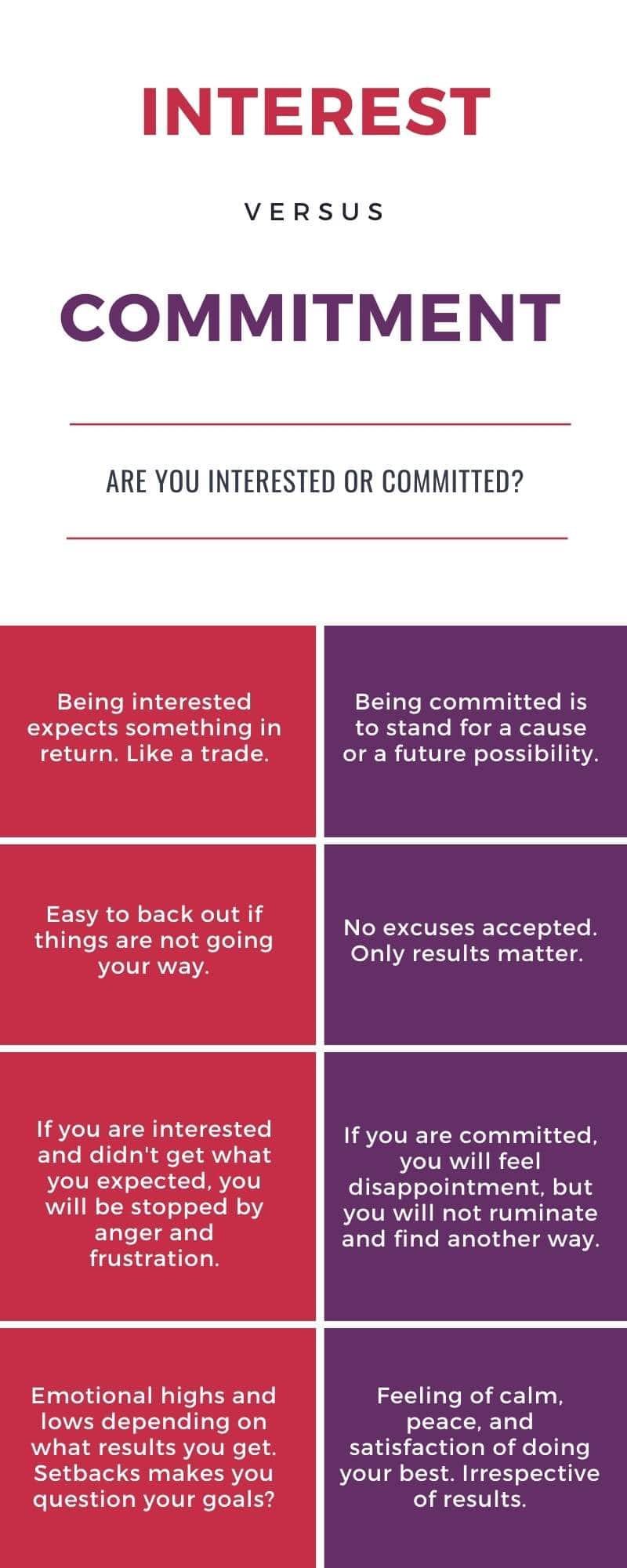
    That is the difference between interest and commitment. If I am interested in some results, I will take steps to get that result. But it will be very easy to give up (in the case of interest) when circumstances turn averse or not as expected. We no longer see the interest getting fulfilled, so we have every reason to back out. Fair enough.

    But a commitment is bigger, it is a promise you make to yourself (more than anybody else) and then there are no excuses, but only results that matter. For example, a mother has a commitment to her child, and she will even go hungry to feed her child. A mother doesn’t demand fairness from her son, she just loves her, for that is her commitment, irrespective of the situation or whatever obstacles life throws in front of her. As they say, any obstacle will have to go over her dead-body.

    So how do we know if we are committed or just interested? Wait for the tough times as real commitment is only tested in the face of obstacles and conflicts, and that is what reveals the true character of all of us.

    If we can let go of our attachment to the outcomes of our efforts and just focus on the fact that we are committed to doing our best, we are more likely to achieve success regardless of how the world shows up. It will always be tempting to give up when we don’t see the outcomes we expect, and that is the threshold of ‘interested‘ and beyond that, the world of ‘commitment‘ starts.

    Every time we experience being upset, irritated or frustrated, we know our commitment is wavering. The question is, “Can we cross this threshold?

    And once we step into the world of commitment, we experience being calm, happy, at peace and confident, even in the face of harsh challenges. An interested person will get angry at an unexpected result, while a committed person will accept that fully, and take the next necessary action to stay committed to his goals without backing out.

    If I reflect on my life, the times I thought were the toughest have given me the best lessons in life. I am really grateful for them for making me who I am today. These tough times have also taught me that we should not define success by the outcome of one’s results, but by the efforts being put in.

    Being committed gives us the freedom of doing our best, yet be completely fine with the final result not being what we expected. No effort is a failure just because it doesn’t result in an expected outcome. It is a success if we gave our best!

    If we notice carefully, this dilemma comes up in every area of our lives. Look at the things that frustrate you, or you got angry over? Were you interested or committed in that situation?

    If commitment is present any setback would not last long. Be open to life’s little surprises, and experience its beauty when it does that. Allowing these surprises to happen without getting upset is one of the best things we can do to fulfill our commitments.