Emotional Intelligence

  • Do You Know your Emotional Triggers? And What To Do When You Are Emotionally Triggered?

    “Mastering others is strength. Mastering yourself is true power” – Lao Tzu

    I am sure we’ve all experienced a sudden emotional reaction. It happens when our thinking starts to become clouded, and feelings (of fear, anger, or sadness) overwhelm us. While it’s not always possible to avoid emotional outbursts, there are always better ways of expressing our emotions without suppression or explosion.

    Our emotions play a crucial role in the workplace too. Anybody who tells us otherwise doesn’t understand that human beings are emotional beings, and just because we are at work we can’t expect to not have any emotions at all.

    Teamwork and cooperation rely heavily on each team members’ communication. Here’s where identifying our emotional triggers becomes important. Understanding our own emotions also helps us understand how we can interact better with others. Rather than suppressing or controlling our emotions, we should be able to express our emotions in a way that we can be proud of in the long term, and which just doesn’t give the kind of short term relief an emotional outburst provides. When we are able to do that, we build trust and cooperation with colleagues which in turn translates into better quality work.

    When Do We Become Emotionally Triggered?

    Every one of us is unique. We have our own likes and dislikes, personalities, and habits. We sometimes refer to this as our “identity” as individuals. We all have our own unique and different emotional triggers as part of our identity, and some of us are more sensitive to these emotional triggers than others.

    Our beliefs, values, culture, and past experiences shape how our identity is formed. In a similar fashion, our means of expressing emotions are shaped over time. They are learned and slowly become habits unless we intervene and decide to change them.

    But what causes our emotions to trigger in the first place? There are different factors that can trigger our emotions. Figuratively, emotional triggers are stimuli that can press our hot buttons. Like an Achilles’ heel, we usually try to guard ourselves against these triggers.

    Understand Science Based Facts About Emotions and Ease Your Shoulders of Their Burden
    Do You Know Your Emotional Triggers?

    What Factors Cause Our Emotions to Trigger?

    These triggers can vary from the simplest things in our daily life to more personal ones, but they can be classified into common factors such as the following:

    • Undesirable memories of people, places, and events – Anything that reminds us of a past traumatic experience can be an emotional trigger. These memories evoke strong emotions that might cause us to behave differently.
    • Stress and lack of comfort – Some situations cause our emotions to stir without us knowing why. The loss of comfort and the built-up stress in these situations weaken us and cause our emotions to trigger.
    • Conflicting beliefs, values, and culture – Our emotions often trigger when we feel that our identity is being attacked. While some of us can be aware when this happens, most of us instinctively have our emotions triggered whenever conflicting beliefs arise without us realizing so.
    • Pet peeves and dislikes – The things we dislike, whether or not we’re aware, also trigger our emotions depending on how much we dislike that thing. While pet peeves don’t always trigger strong emotions, these dislikes may weaken our emotional barriers and make us more emotionally vulnerable.

    Once these emotional triggers press our hot buttons, we often become overwhelmed with emotions. As a result, our actions can often end up sending the wrong message. These can strain our relationships with people around us, or give an impression to others which we might not want to convey.

    Knowing what our emotional triggers are is the first step to expressing them wisely. Becoming less vulnerable to emotional triggers requires knowing where our weak spots hide. As we get to know more about ourselves, we learn our emotional triggers and become more skilled in expressing emotions in a way that we can be proud of. When we think of it this way, we can turn our emotions into a strength rather than a weakness.

    How Do You Identify Your Emotional Triggers?

    “But feelings can’t be ignored, no matter how unjust or ungrateful they seem.” – Anne Frank, The Diary of a Young Girl

    We can’t always avoid stressful situations. At work, we face these situations when heated arguments happen and conflicting views arise.  There will always be times when our emotional triggers suddenly act up. Whether we like it or not, we still need to collaborate with different people and their different identities. It all boils down to how we react to what we face.

    range-of-emotions

    To be able to identify our emotional triggers, we must begin with introspection or the process of examining our emotions. Like a river, our emotions flow continuously. Learning what causes the tides of our emotions to change will help us identify our emotional triggers. Our bodies can also help us identify these changes.

    • Start by identifying the physical symptoms of uneasiness and stress. Our body sends warning signals to our brain without us consciously knowing. These signals manifest into physical symptoms that we can identify. Involuntary shaking, sweating, increased heartbeat, and headaches are common symptoms that our mental state is vulnerable. You’ll notice that these physical symptoms arise when we start becoming highly emotional. By mastering this knowledge, we can identify the emotional triggers that cause us discomfort.
    • Notice changes in our behavior. Our actions and mannerisms usually change when our emotional triggers affect us. Changes in the way we interact with certain people or in our routine are also symptoms of a weakened emotional state. In the same way as physical symptoms, we can also learn more about our emotional triggers by noticing patterns in our behavior.
    • Identify common patterns. Learning more about our emotions and emotional triggers requires us to identify some common patterns. We need to know our dominant emotion before, during, and after periods of being highly emotional. Through this method, we can slowly map out how our emotions play out when we are triggered.
    • Reflect on your actions when you became emotionally triggered. There will be situations when you will not know what exactly triggered your emotions even if you’re already aware of some of your emotional triggers. The best way to adapt to these situations is by reflecting on our actions and identifying what we can do to prevent the same situation from happening again.

    What To Do When You Are Emotionally Triggered?

    “He that knows patience knows peace” – Chinese Proverb

    When worst comes to worst, we need to think and act fast and not panic. Below are some ways to avoid acting impulsively and doing something which we would regret later. 

    • Take a break – Take a pause, right where you are. Stop speaking if you are talking and take some deep breaths.  Get present to your body inhaling and exhaling. Let your body calm down and slowly relax. This will help you diffuse the situation as fast as possible. 
    • Get out of the situation (if possible). If it’s an uncomfortable situation that you can get out of, then do so immediately. You’ll know when you need to leave if you’re starting to feel physical symptoms. Removing yourself from the situation gives you a chance to recover. If you can’t get out of the situation, patiently wait for an opening to excuse yourself.
    • Write it all down in a journal. Feelings of blame, justification, guilt, or regret may often linger after having emotional outbursts. What you can do is to write your experience down in a journal. Keep writing until you have nothing left to say or express. Releasing all of the lingering emotions into a journal not only helps you release those emotions but also helps document your progress. P.S. – Don’t send it to anyone. Read it a few times and delete/destroy it.
    • Reflect and continue learning from the experience. Learning about ourselves is a continuing experience. Reflect on what you did and what you can do differently the next time. By reflecting on our past actions, we can always find ways to express our emotions better. 
    • Seek professional help if you need to. There’s nothing to be ashamed of in seeking professional help. This could range from asking a trusted mentor for advice or seeking intervention from a trained doctor. Some of us have grown up with several emotional triggers that greatly affect our daily life, and seeking professional help is sometimes necessary to live a more meaningful life.

    Avoid Intoxication

    Though there is always a temptation of doing so, we must avoid taking drugs and alcohol to feel better or suppress our emotions in the short term. Drugs and alcohol do not only remove so-called “inhibitors” but also weaken our mental state to the point where we become increasingly sensitive to our emotional triggers. What’s worse is that we tend to act more impulsively under the influence of alcohol that can cause harm to our relationships and people close to us.

    In conclusion, the process of controlling our emotions goes hand-in-hand with learning about our true identity. Like how the seasons change, so too does our identity. Different experiences will eventually lead us to learn more about ourselves. Hopefully, this article will guide you in identifying and adapting to new emotional triggers that you’ll discover.
  • The Role and Importance of Emotions in Our Professional and Personal Lives

    When I started working at the age of 21, my manager was only a few years older than me. Both of us being very young and passionate about work, we developed a good friendship. As I completed my first year at work, I sat down with this friend (manager) to discuss my performance. I wasn’t ready for what came next.

    In the meeting, he was very formal and distant in his approach which I found unfair. Due to our friendship, I expected an informal conversation. Instead, what I got was “feedback” and “improvement points”. When he was done with the performance cycle, it left me in a very bad mood and it affected our friendship. While he was only performing his job as a manager, I was too naive and felt betrayed as a friend. It took us more than a year to mend our friendship, and I am good friends with him to this day.

    This incident was very tough for me, and it was not until many years later that I recognized why it was so. At first, I blamed my manager friend for being more of a “manager” than a “friend“. Later (after we mend ways) I blamed myself for being too emotional and developing friendships at work. I came to the (wrong) conclusion that emotions and rationality are mutually exclusive, and I shut myself down emotionally.

    It was much later that I realized that emotions were not the culprit. Instead, it was my inability to handle my emotions which led me to react impulsively. With experience, I have come to believe that emotions are absolutely necessary for doing any meaningful work. They only seem tough when we don’t know how to handle them.

    I have already written about how to handle our emotions in the workplace. In this article, I want to stress the importance of emotions as the driving force behind decisions.

    We Experience The World Through Our Emotions

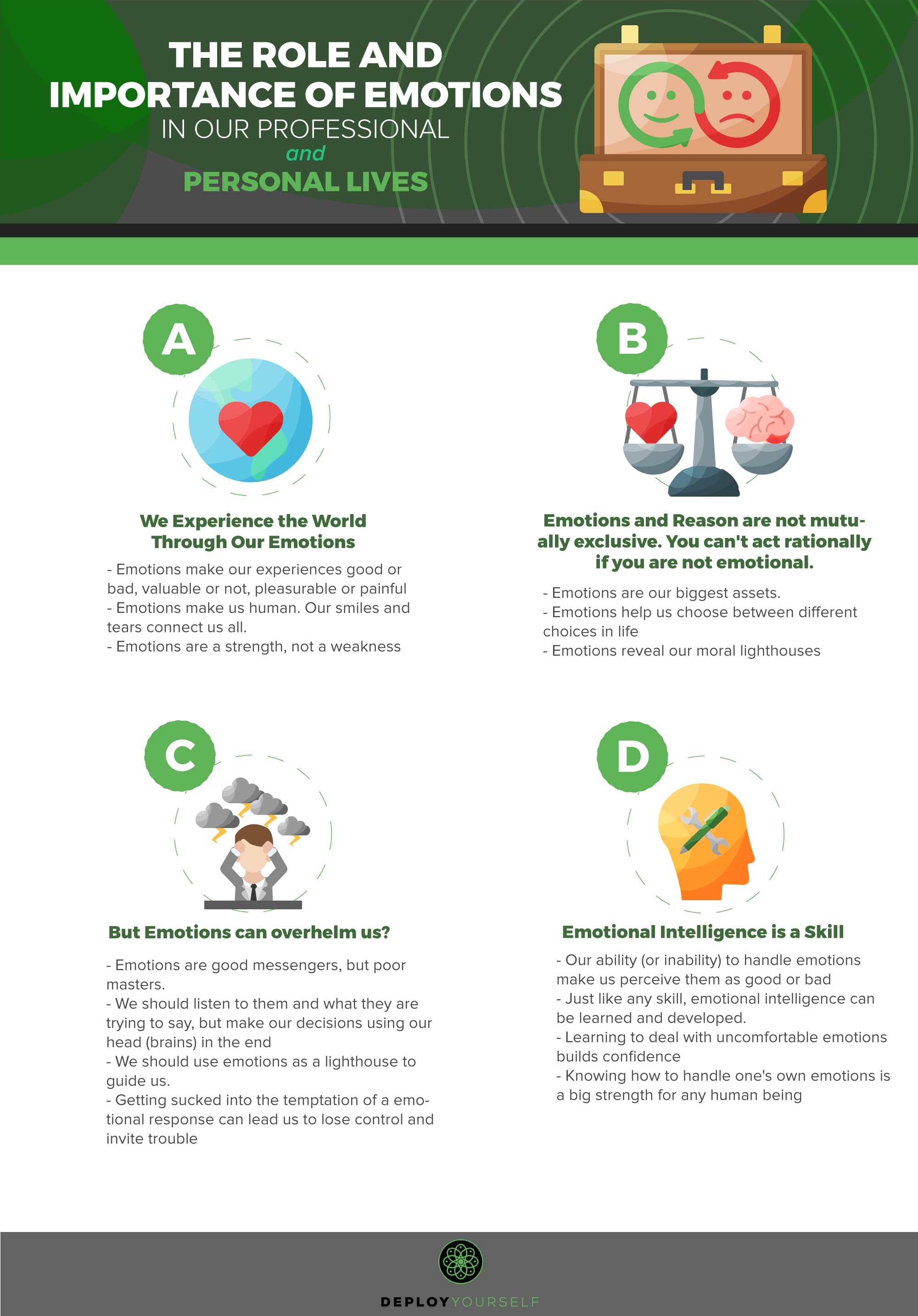
    We walk around the world and make sense of it through our emotions. When we experience an event, different emotions get triggered based on our values and beliefs. Emotions make our experiences good or bad, valuable or not, and pleasurable or painful. If we introspect we will found that every decision we end up taking is derived from an emotion that touched and moved us.

    These emotions can overwhelm us occasionally, but without them, we would have no connection with people or events around us. While emotions can sometimes bring pain and tears, it is only through them that we feel joy, happiness, and peace in life. It is very important to realize that emotions are our strength and not our weakness.

    It is our emotions that make us human. The little moments of joy when we play with our kids, the smile on our faces when we help someone, the tears in our eyes when we see something cruel and terrible (even if it is on TV) – it is these emotions that connect us all as human beings.

    Seeing a tweet by a billionaire CEO and to be able to feel empathy for him/her makes us bridge the economic, physical, and social divides and come closer. On the other hand, if we are privileged in any way, being able to empathize with the less privileged and act for them brings us closer. Emotions help keep our egos in check and prevent us from being indifferent towards the less or more privileged in our society.

    Emotions and Reason are Not Mutually Exclusive

    Most of us believe that emotions and reason are opposites of each other, and it is often presented as a fact that you can’t act rationally if you are emotional. In many workplaces, emotions are frowned upon and an excessive display of emotions (joy, tears, anger) is seen as a liability.

    On the contrary, what I have learned over the years is that emotions can be our biggest asset. They can give us important information that can shape our lives if we listen to what they are trying to tell us. The key is to learn how to express our emotions without repression or explosion.

    Emotions can help us clear the fog of rational choices and reveal our moral lighthouses. They help us choose wisely when presented with two equally good or equally bad choices. Emotions clarify our thinking and help us see rational choices in a new light while pure rationality often makes us run wild with ideas, even at the expense of others. Rationality without emotions can look enticing in the short term, but it can be a menace in the long term.

    It Is Impossible to Be Rational Without Emotions

    While it is true that emotions can overwhelm rationality at times, it is impossible to be rational without being emotional. Today there is scientific evidence to prove that we, as human beings, are incapable of making decisions if we can’t feel our emotions. You can read about the works of neurobiologist Antonio Damasio to see that without emotions, there is no decision making possible. [1][2]

    He worked on a patient with a severed connection between the frontal lobe (where rationality originates) and cerebral amygdala (where emotions originate) in the brain. After the surgery, the patient could think, but he could not feel anything. He noticed that while he was able to engage in rational thought all the time, he was not able to make a choice over the other.

    When Emotions Overwhelm Us?

    We all have been in situations where we don’t want to do what we know is the right thing to do. When emotions overwhelm us, we can get sucked into the temptation of the respective emotion and (re)act in a way that provides us emotional relief. For example – When you couldn’t control your frustration and vented it out on your manager because it felt good to spurt it out.

    Emotions are very good messengers, but poor masters. We should always listen to them and let them play a big role in our rationality, but subjugating reason for emotional whims can cause us short and long-term harm. In the end, we should always use reason to choose the best option available for us, and use emotions as a lighthouse to guide us on the right path. This will help us in making the right choices (which might not be the easy ones) in life with conviction.

    Emotions Intelligence is a Skill. Train Yourself

    Now that we have seen that there is no action possible without emotions, we can conclude that emotions are not bad or good in themselves. It is our ability to handle them that makes us interpret them as so. It is a skill that, just like other skills, can be developed.

    Learning to deal with uncomfortable emotions builds confidence and opens up new pathways that were earlier closed to you. Emotional people are often regarded as weak in certain societies, but I believe that the ability to handle one’s own emotions is one of the most useful skills a human being can acquire.

    Increased emotional awareness can be a great asset we all can make use of not only to make the right decisions for ourselves but also to create a better world around us. A world which is not mine or yours – but ours.

  • There Are Only Perspectives, No Truth. And Five Different Perspectives You Can Apply In Each Situation

    Tom : “I am sorry I am a bit late to this meeting. My previous meeting ran over.”
    Sara : “I am more worried about the missed deadline on the product your team is developing. Your team is slow.”
    Tom : “It’s not my fault. Two members on my team reported sick last week and I can’t help it.”
    Sara : “I don’t really care what happened. But I know I can’t count on your team. This makes me look bad.”
    Tom : “You are not being fair, Sara. “
    Sara (to herself) : “Tom’s lack of experience shows. He doesn’t hold his team accountable, and always has excuses for delays.”

    How many times have we spoken or seen others speak such sentences? As we solve complex business problems, very often we “know” the truth (you are slow, this is not how things work here, etc) and base our actions on it. In this article, I want to stress that there are no truths in the workplace (and life). There are only perspectives, and there can be many different perspectives depending on how you look at the situation. Once we realize that our apparent “truth” is only a perspective, it allows us to view the same situation differently to help us make better decisions.

    How We Form Our Truth?


    The first thing we must do is to take a pause and ponder about how we form our truth in the first place. We (human beings) gather inputs from our five senses – smell, touch, sight, sound, and taste. Anything which is external reaches us via one of the senses. We touch something which is hot, and we “know” it is dangerous and not safe. We hear something from multiple people or from a reliable source, and are inclined to believe it as truth”.

    The quality, source, and frequency of sensory information we gather have a big role in how we interpret it. For example – If you read an article with a lot of grammatical and spelling mistakes (quality), you are less likely to trust the content. Similarly, if you hear about the same thing from multiple people (frequency), you will be more inclined to trust it.

    Once we collect the sensory information from the outside world, our brain makes sense of it. It decides which signals to pay more attention to and which to ignore. Our brains also apply the collective influence of our memories, beliefs, thoughts, and values to every new information, and derive meaning from it. I already wrote about Listening Filters and how they create the “truth“. For example – Growing up in a very hierarchical corporate culture (and society) in India, it still takes effort on my part to see and interact with people above me on the corporate ladder as peers in Amsterdam.

    The Five Different Perspectives


    The important thing to realize here is that the “truth” we form by the above process is only “our” truth and not the absolute truth. Realizing that different people can see and create their own truth in the same situation is the key to working together more productively. Seeing our own truth as a ‘perspective‘ instead of the truth leads to humility and a willingness to consider other perspectives.

    Unless we step down from the high pedestal of truth we often end up placing ourselves on, we can’t see all the other perspectives out there. I believe there are (at least) five different perspectives that can offer tremendous insights to us. However, it is not always easy, nor are we often willing, to view a situation from these perspectives. They might lead to some uncomfortable moments, but the process can often result in new insights and learnings. These not only can lead to better results but also help us become more human in the process.

    As I write down the different perspectives below, I will also specify a few questions we can ask to uncover each perspective :-

    First Person (My) Perspective


    The first person perspective is how I see and perceive things. The biggest clue about the first-person perspective is the usage of pronouns like We, Us, Our, I, Me, Mine in our thoughts, and language. This is the most natural perspective for all living creatures, and we listen and think in a first-person perspective by default. The first person perspective leaves you with ownership, authenticity, and often attachment to your point of view.

    Questions to Uncover First Person Perspective


    1. What conclusion am I arriving at?
    2. Is it the truth or just my opinion?
    3. What reasons/proof do I have in my opinion?
    For Example – Sara’s (in the above conversation) first-person perspective could be – “Tom is a difficult person to deal with because of his immaturity. I can’t trust him or his team as he is not accountable.”

    Second Person (Your) Perspective


    The second person perspective is seeing things from another person’s point of view. Listening to someone and making efforts to understand her perspective shows respect. The second person perspective calls for seeing and feeling the world as another person does. It doesn’t matter if you agree or disagree with it. The second person perspective has a lot to do with listening and it can have a massive impact. The second-person perspective leaves you with empathy and humility.

    Questions to Uncover Second Person Perspective


    1. How would this situation look and feel to him/her?
    2. How would he/she interpret the situation? Can I step in his/her shoes?
    3. Can I feel how he/she might be feeling (anger/joy/frustration) right now?
    For Example – Sara’s second-person perspective could be – “Tom is new to this job and he must be finding it difficult to make demands from his people. He must be really stressed out and might need some help to manage his priorities better. I might only be making matters worse for him. Instead, can I help him somehow?”

    Third Person (His/Her) Perspective


    Another perspective could of a related third party. If you are talking to your colleague, a third party perspective could be of your manager or another colleague. For example – In a workplace, a third-person perspective could be of a colleague whose work will/might be impacted by what you are talking about. Seeing through the third-person perspective leaves you with a big picture view, more options, and opens up blind spots.

    Questions to Uncover Third Person Perspective


    1. How would my boss think about this situation?
    2. How would the sales head think about this conversation?
    3. If I were him/her, how would I have described the situation?
    For Example – Sara’s third-person perspective, from the point of view of another colleague, would be – “Tom is trying hard to keep everyone happy, and failing at it. And Sara is not making it any easier for him by making demands without understanding his situation. How will they make this project succeed? If they fail, it will hurt our team and we will miss our targets.”

    Stranger (Witness) Perspective


    The fourth perspective calls for viewing the situation from the point of view of a witness. A witness is someone who neither has any stake in what you are discussing nor does he knows either of you. The witness perspective is purely objective, and the witness observes the proceedings just like a camera would. Taking this perspective leaves you with detachment and objectivity. You see things as they are, without any judgment and attachment to either side or to a specific outcome.

    Questions to Uncover Stranger Perspective


    1. How would a stranger see and report my situation?
    2. If this were a movie, how would I describe it?
    For Example – Sara’s stranger perspective could be – “Tom is acting like a typical newbie, and is going to make the same mistakes everyone makes. People around him are too busy in their own lives to help or assist him grow through this phase in his career. Sara or Tom’s manager can step in to help, but do they even realize the need for it.”

    God / Compassion Perspective


    The fifth perspective calls for looking at the situation from a place of love, kindness, and compassion. With this perspective, we look at how we can make things better for every party involved, and worse for no-one. We attempt to listen to our inner voice (consciousness) from this perspective. How does it feel? Is there something which I know but am unwilling to acknowledge?

    Questions to Uncover God Perspective


    1. Would I want this conversation to be aired on TV, or reported in tomorrows’ newspapers?
    2. Do I hear an inner voice saying “this doesn’t feel right” or anything else?
    3. How would Jesus / Allah / Buddha / Krishna do in my situation?
    Disclaimer – This perspective has nothing to do with religion or our religious views, but is rather an invitation to stand in a place where we want to see everyone happy. It is about feeling instead of thinking and using our heart for mutual well-being instead of our brain for personal gains and business results.
    For Example – Sara’s fifth perspective could be “Tom must be going through a hard time, and might even be carrying his stress into his personal life. And I am not making it any easier for him. Can I help him manage his priorities better? Can he seek some training or help? The same holds true for me too. Going after business goals is fine, but it doesn’t have to be at the cost of stress and unhappiness.”

    To conclude, asking the above questions and viewing our situation from multiple perspectives can be tremendously liberating. It can provide us with options that weren’t visible to us before. Getting lost in what we believe to be the truth (first-person perspective) can bring us stressful days, broken relationships, and health problems.

    All of this can often be avoided by taking a look at the above five perspectives. It can often ease up any emotional build up (stress, anger, over-excitement) and prevent us from doing something in haste and from our limited viewpoint. It might not solve every business problem we get stuck in, but we can surely finish with better results and make more informed choices after considering these five different perspectives.

  • How To (and not to) Deal with an Emotional Employee

    As I wrote previously, every human emotion is valid. However, the story behind them might not be, and we always have the choice of how to respond to an emotion. If we want to master how to deal with others’ emotions, our own emotional mastery is the prerequisite.
    Studies have shown that emotions like frustration, cynicism, enthusiasm, etc are as contagious as germs. I believe each human being acts like a tuning fork. Every emotion is like a wave, which when reaches others, either accentuates or dies down depending on whether the frequencies match or not.
    When two people are emotionally reactive, even a small argument can quickly escalate into a fight. When we learn to master our own emotions, it gives us an opportunity to deal with any situation confidently. It will dampen any emotional waves and allows collaboration, even in the face of disagreement. We can strengthen our relationships with others, even in the most stressful and difficult situations.

    1. Learn to Notice Emotional Build Up
    Emotions are like storms. Just as we can forecast most weather storms before they strike, we can always notice and predict “emotional” storms too. If an emotional outburst of an employee is a surprise, then there were some signs we missed.
    Emotional reactions don’t come out of anywhere. Just like storms, they build up over time. There are always signs, physical and behavioral, which we can observe and watch out for. If we notice these signs, we can get advance notice of emotional build-up in people.
    For example – If we notice tightening of muscles and a red face, the person might be getting angry or frustrated. If we notice a trembling voice, sweating, and defensive body language, someone might be feeling scared or anxious. If we notice smiles, laughter, and relaxed body language, the person might be happy about something in his/her life.
    2. Act Early. Validate What You Notice
    When we notice physical signs of an emotional build-up in others, we must act early and validate our assumptions. Obviously, we can’t read another’s mind so whatever we assume about another’s emotional state might or might not be true. So the most prudent way is to state our assumption as just that and ask the other person for validation.
    For example – If your colleague has been quiet and detached for a few days, you can approach them and say – “I see that you have been quiet lately. You seem a bit tensed too. Am I right? Is there something which I don’t know, or can help with?” Never walk up to someone and pass a judgment, “Why are you sad? What’s upsetting you?”
    Remember our assessments about others’ emotional states are just that – assessments. Mistaking them for truth could trigger an emotional reaction and make them defensive, which we don’t want to. What works for me is to state my assessment tentatively, and to always ask for verification.
    3. Listen And Acknowledge. Don’t Judge And React
    It is only human to be emotional. When someone opens up about their emotions to you, it is an act of courage. Don’t dishonor that act by rushing to judgment or suggestion. Just like our own emotions, acknowledge them by listening and understanding their point of view. Try to stand in their shoes and sympathetically feel what they feel.
    Challenging others’ emotions is often counter-productive and makes them feel alienated and disrespected. If their emotion is directed at you or they feel your behavior led to the emotion, you might be tempted to justify yourself. But that never helps anyone. If you can stay calm and relaxed, any emotional attack will eventually diffuse itself.

    Emotions are the result of an internal fire. Reacting emotionally only adds fuel to that fire. Instead, let we can let it run out of fuel by allowing others to express themselves fully while we listen empathically.

    Remember, mastering your own emotions is a prerequisite before handling others' emotions
    Remember, mastering your own emotions is a prerequisite before handling others’ emotions

    4. Let The Storm Pass. Take A Time Out
    When there is damage due to a weather-related storm, we don’t rush out to do repairs while the storm is still on. We wait for the storm to pass before assessing the damage, and doing any repairs. Similarly, if we notice an emotional storm, it is always best to wait for it to pass before jumping in to help.
    There have been many instances when I have been sucked in to respond to an emotional employee. I have always regretted it later as it only made the situation worse. Taking a time out often works for me. A few moments to breathe often allows both parties to stay with their emotions and come to peace with them.
    I believe the best way to understand someone else’s emotions is to observe our own. Becoming aware of our own emotions can help us empathize with others. When we feel compassion for others’ emotional states, regardless of whether we agree with their reasons or not, then we are ready to take the next step — which is asking the right questions and coaching them.
    5. Coach. Inquire. Ask the Right Questions
    The next step is to ask coaching questions and help them understand their own emotions. By genuinely inquiring and listening to others, we can help them clarify their thoughts.

    Coaching via asking open questions is about respecting people as individuals, and giving them a free choice to act in a way that is consistent with their values.

    Coaching someone doesn’t mean fixing other’s problems. We don’t get to be a superhero through coaching. Coaching is about letting others find their own answers – ones they already know but have become masked behind their stirred emotions. Coaching begins with genuine care for your employees and colleagues. It is a skill that requires practice, and you get better at it with each conversation.
    Depending on the emotion, the coaching questions you can ask will differ. Here are a few examples –
    Sadness – What are you sad about? What did you lose? Why did that matter so much for you? How could you grieve or mourn for your loss? Is there something I can do for you to support you?
    Fear – What is scaring you? What are the chances of that happening? How does that impact you? How can you prepare better for it to minimize the damage? What else can you do to feel at peace?
    Anger – Who hurt you? What boundaries did they cross? How can you express your complaint and act in a way consistent with your values? How can you put the issue behind? What would it take for you to forgive them, or let go?
    Guilt – What did you do? What damage did it cause? Who have you hurt? How can you make amends? Have you apologized? How can you be at peace? Can you forgive yourself?

  • How to Deal with Your Emotions In The Workplace And Make Them Work For You

    Fresh out of college, when I started to work professionally as a 21 year old, I dived into work passionately and emotionally. Not only did I do great work during that year, but I also had a lot of fun with my team, many of whom are still my good friends. I was emotionally attached to the work and the people around me, and I considered that a strength at that time.

    Not soon after, I had my first performance appraisal along with my friends (colleagues). Very soon, things weren’t as simple and fun as words like bonuses, promotions, and salary increments entered the vocabulary. Emotions flared, arguments ensued, and I had a hard time dealing with my emotions. I gave in to the temptation of reacting emotionally a few times and strained my relationships with some people.

    After a few such incidents, I started to consider my emotions a weakness and shut myself down, creating personal and professional boundaries in the workplace. I am glad that phase didn’t last very long.

    Today, after working for over 15 years in different companies and across continents, I consider emotions an integral part of the workplace, and they can be very powerful if we know what to do with them.

    Below are a few of my observations about dealing with our emotions at work :-

    Every Emotion Tells Us What We Care About

    When I formed great friends during my first year at work, my emotions (of joy) were telling me I care about trust and honesty. Later when I was angry and felt being wronged, my emotions were telling me I cared about everyone being treated fairly and respectfully. And when that expectation was not met, it gave rise to frustration and anger.

    The more attention we pay to our emotions, the more aware we can be of what they are trying to tell us. We can then reflect upon and listen to what they are telling us, and then still act in a way that is consistent with our values and long-term objectives.

    Emotions Are Always Valid. The Stories Behind Them Might Not Be

    There are no right and wrong emotions. There are no positive and negative emotions. Our emotions are always valid, and an inevitable part of being human. But we can examine the stories behind our emotions to separate the useful facts from false beliefs. Each emotion can tell us about something significant in our lives, but only if we are willing to examine the stories behind them objectively.

    For example – I felt angry and frustrated once when I didn’t get an expected bonus. In this case, I embraced the emotion without denial and examined the assessments behind it. I believed I had performed very well and shared the same with my manager. It was then that I got some feedback which made me aware of the gaps in my performance, and which I could improve upon. Thus I came to the realization that while my emotion was valid, the story behind it lacked evidence and was not well-grounded in facts.

    My manager understood my concerns and it strengthened our relationship. He also promised me to deliver any such feedback earlier the next time. In the end, it prevented me from reacting impulsively and judging others, which would have not done any good for both me and my team.

    I have learned that we can always witness our emotions as they arise instead of being sucked in their gravitational power and respond impulsively.

    Emotions Need To Be Expressed. Without Explosion or Repression

    According to Daniel Goleman, the capacity to subordinate immediate gratification to long-term objectives is the most important psychological skill. All emotions lead to one or the other impulse to act, which often are harmful to us in the long term. At such moments, we need to take the driver’s seat and prevent our emotions from taking over. Emotions are very good messengers but very bad masters.

    Just like tying a wild horse only infuriates him, repressing our emotions never works. When we do so, we end up suffering inside while putting up a brave face on the outside. By repressing, we are bound to explode sooner or later and it also results in stress which can end up impacting our health. Shouting at others (explosion), or sulking in silence (repression) never solves any problem. It often only makes it worse.

    Emotional Intelligence involves expressing our emotions, without repression or explosion. If we can understand our emotions and the stories behind them as a third-party observer, we can accept them fully without abdicating our responsibility to them. We can then choose to act according to our values – even in the face of failure and disappointment. We can’t always control our circumstances, but we can always act in ways congruent with our values.

    “To increase your effectiveness, make your emotions subordinate to your commitments.” -Brian Koslow

    Give Up Your Need to Be Right

    The reason we are so tempted to react impulsively to emotion is that it provides our ego instant gratification. When we shout and explode in anger, it makes us right and the other person wrong. Even if we know it is harmful to us in the long term, it gives us an immediate boost of righteousness. To handle our emotions well, we have to give up our need to be right all the time. We have to give up the temptation to “win” in every conversation and situation.

    I feel that we do our best work when we are emotionally engaged. We are our most creative and productive selves when we feel emotionally safe and don’t have to put on a mask at work. However, if we don’t know how to handle our emotions and give in to impulsive responses, we can do more harm than good.

    To sum it up :-

    • When we are happy with a successful result, an impulsive reaction could be to over-promise in excitement. But a conscious expression of happiness would be to just celebrate and acknowledge the hard work.
    • When we are sad about experiencing a loss, an impulsive reaction could be resignation and cynicism about the future. But a conscious expression of sadness would be to just grieve and acknowledge your loss.
    • When we are scared and fearful, an impulsive reaction could be to shut down and seek protection. But a conscious expression of fear would be to take a step back, assess the situation properly, and then act with courage.
    • When we feel anger and frustration, an impulsive reaction could be to explode or repress our feelings. But a conscious expression of anger would be to make a complaint and sharing our concerns.
    • When we feel guilt after a mistake, an impulsive reaction could be to beat ourselves up and sulking in shame. But a conscious expression of guilt would be to make a sincere apology and repair the broken trust with a new promise for the future.