You built a company, decoded markets, led people smarter than you, and made your way into rooms you once only dreamed of. You’re used to knowing things – and preparing yourself thoroughly before you enter a room.
But when you start chasing the impossible (anything beyond what you currently think is possible) – when you step into the domain where no map exists, no playbook works, and no past can predict the future – your intelligence suddenly stops helping you.
In fact, it might start working against you. Here are 5 reasons why:
1. The Trap of Knowing Too Much
Most founders were raised on a diet of certainty: know the facts, plan the steps, solve the problem. Intelligence thrives on clarity. It needs rules, data, models, frameworks, and feedback loops.
But the impossible—creating what’s never been done before—lives in the exact opposite environment: fog, chaos, ambiguity, and doubt.
When you step into the unknown, your intelligence can’t help you beyond a certain extent because it’s designed to answer known questions. It cannot find answers to things you don’t even know you don’t know.
And no matter who you are or what your achievements or resources are, what you do not know will always be larger than what you do know.
That’s what I call the Intelligence Trap. You start applying logic to what doesn’t make sense in the first place. You analyse and strategise when the answers lie in listeningand discovering. You plan when the answer might lie in asking better questions and staying still until the right answer arises by itself(like an idea you get while walking your dog or while taking a shower).
2. When Intelligence Becomes a Ceiling
The same intelligence that built your success can become the gatekeeper of your next level of success. What got you here won’t get you there. Your intelligence whispers, “Plan, prepare, prove it, be certain.” But the impossible can’t be created with certainty.
You can’t think your way into a miracle. You can only commit your way into it.
When you go after a goal that defies reason—when you compress time, disrupt an industry, or reinvent what’s possible—you’re no longer in the realm of problem-solving. You’ve entered the realm of creation – from scratch. You are not improving on what exists – you are starting from a blank canvas and imagining not planning. That is creation.
And creation doesn’t come from logic. It comes from presence, inspiration, surrender, and trust.
3. The Unknown Has Its Own Language
The unknown doesn’t speak in data. It speaks in intuition, instinct, and insight.
It’s what happens when you move faster than your brain can rationalize, when you make decisions before they make sense.
That’s why the most visionary founders sound insane at first. They are operating beyond analysis. They listen and tune into a signal the intelligent mind can’t detect – you can call it intuition or the universe speaking to you.
The trick is not to abandon your intelligence, but to know when to choose it and when to ignore it.Let it serve you but not run you. That is wisdom.
Because the greater the unknown you enter, the less your intelligence knows what to do. It’s like trying to use a compass on Mars—it spins beautifully, but it points nowhere. (Mars has a very weak, highly spatially variable magnetic field, unlike Earth)
4. Beyond IQ: Enter WQ (Wisdom Quotient)
IQ helps you build systems.
EQ helps you build people & teams.
WQ helps you build realities that don’t yet exist.
WQ is the combination of pattern recognition, trust, paradox, and action without proof. It’s knowing that the next step reveals itself only after you take the current one. When you stop waiting for certainty, the unknown starts to respond and move.
You don’t get to “figure out” the impossible. You have to become the person who moves towards the future will full certainty without ever needing to “figure it out”. You have to become the person willing to be wrong rather than always wanting to be right with your intelligence. (and your brain doesn’t like being wrong – hence the resistance)
When you can, you move from predicting the future to creating it. And that shift demands something intelligence alone can’t deliver: faith, surrender, and the courage to move without evidence or certainty – but with complete conviction and commitment.
You know that moment when someone calls you “too intense” in a meeting?
That little sting you feel? That voice whispering you should dial it down, blend in, be more “normal”?
Yeah, screw that voice.
I’ve worked with CEOs who’ve built 8-figure companies while thinking they were fundamentally broken. They spent years trying to shove their square-peg brains into round-hole business models, wondering why everything felt like swimming through concrete.
Here’s the plot twist: Your “broken” brain isn’t your weakness. It’s your unfair advantage.
Most neurodivergent entrepreneurs are playing the wrong game entirely. They’re trying to win at someone else’s game instead of dominating their own.
The Masking Trap That’s Killing Your Business
Tanya, a CEO I worked with, spent seven years burning herself out trying to run her company like every business expert told her to. Daily standups at 9 AM sharp (she’s a night owl). Open office collaboration (she needs quiet to think). Constant networking events (she’s an introvert who recharges alone).
She was making decent money but felt like she was dying inside.
Then we did something radical: We built her business around her actual operating system, not the one she thought she should have.
Morning person? Nope. Her best thinking happens at 10 PM? That’s when she does strategy work.
Needs 3 hours of uninterrupted focus? She blocks it out religiously, no exceptions.
Networking drains her? She hired a business development person who thrives on it.
Result? Revenue doubled in 8 months. But more importantly, she stopped feeling like a fraud in her own company.
Your differences aren’t bugs to fix. They’re features to leverage.
The ADHD Paradox: When “Can’t Focus” Becomes Laser-Sharp
“I can’t focus on anything for more than 5 minutes, but I stayed up until 3 AM redesigning my entire website.”
Sound familiar?
If you have ADHD, you’ve probably been told you have a “focus problem.” That’s like saying a Ferrari has a “speed problem” because it can’t go 5 mph.
Your brain isn’t broken—it’s optimized for different tasks.
Here’s what’s really happening in your ADHD brain:
You have 47 browser tabs open in your mind at all times
You can spot connections others miss because you’re processing multiple streams of information
Your “scattered” thinking actually generates more creative solutions per hour than most people produce in a week
When something clicks, you don’t just focus—you become a human laser beam
Marcus, an ADHD founder, used to beat himself up for “never finishing anything.” Then he realized he wasn’t supposed to finish everything—he was supposed to start everything and systematize the finishing.
He hired a COO who thrived on execution while he focused on innovation and strategy. His company grew more in the next 1 year than in the previous 3.
Hyperfocus: Your Billion-Dollar Superpower
While other entrepreneurs are checking their phones every 3 minutes, you can disappear into a problem for 6 hours straight and emerge with solutions that blow minds.
That’s not obsession. That’s a competitive advantage.
Marcus, an ADHD founder, used to apologize for getting “too into” product development. Then he realized something: While his competitors were doing surface-level market research, he was diving so deep he could predict customer needs they didn’t even know they had yet.
His “obsessive” attention to user experience details created a product so intuitive that customers started recommending it before they even finished the free trial.
Never apologize for your intensity. It’s what separates good from legendary.
Your Brain Sees What Others Miss
Here’s something neurotypical entrepreneurs don’t get: You don’t just see one solution to a problem. You see 2, 3, sometimes 5 different approaches simultaneously.
That’s not scattered thinking. That’s systems-level intelligence.
Take Jamie, who has autism and runs a logistics company. While other CEOs see shipping as “get package from A to B,” Jamie sees the entire ecosystem: weather patterns affecting routes, driver psychology impacting delivery times, customer anxiety levels based on tracking frequency.
Her company has the highest customer satisfaction scores in the industry because she optimizes for variables others don’t even notice exist.
Your “quirky” way of seeing the world is exactly what the market needs.
Reframe Your Story, Change Your Game
Stop calling it a limitation. Start calling it what it is: a different operating system with unique capabilities.
Your dyslexia isn’t a reading problem—it’s pattern recognition that helps you spot market trends others miss
Your ADHD isn’t a focus issue—it’s the ability to rapidly iterate and pivot while others are still planning
Your autism isn’t social awkwardness—it’s systematic thinking that creates efficiency others can’t achieve
Richard Branson didn’t succeed despite his dyslexia. He succeeded because it forced him to simplify complex ideas into brilliant, accessible solutions.
Build Your Dream Team, Not Your Struggle Team
The smartest neurodivergent CEOs I know don’t try to be everything to everyone. They build teams that amplify their superpowers and handle everything else.
Executive function challenges? Hire an operations ninja. Social interactions drain you? Partner with someone who gets energized by people. Details slip through cracks? Invest in systems that catch everything.
You’re not outsourcing weaknesses. You’re optimising strengths.
The Truth About “Different”
Some of the world’s most innovative companies exist because their founders think differently.
They didn’t build great companies despite their neurodivergence. They built them because of it.
Your Square Peg Deserves Its Own Hole
The market doesn’t need another copy-paste entrepreneur following the same playbook as everyone else.
It needs your intensity. Your obsessive attention to detail. Your ability to see solutions others miss. Your systematic approach to problems others give up on.
Your brain isn’t broken. It’s running premium software in a world full of basic programs.
Stop trying to fit into their holes. Build your own.
The world needs what your neurodivergent brain creates. Trust me—that’s your edge.
Let me start with a story to illustrate the benefits of silence
There was an old man whose most beloved possession was a watch left to him by his late wife. He treasured the timepiece and had it on his person wherever he went.
One day, in anticipation of his grandchildren arriving for a visit, he was cleaning out the spare room when he misplaced his watch. His grandchildren arrived to find him distraught and offered to help search the room.
With four children and two adults combing the room, it seemed ever more cluttered and crowded than before, and the watch was still not found. As the others left the room, shaking their heads, the youngest child remained and simply sat on a chair and waited.
A few moments passed and he walked out of the room with the watch in his hand! Overjoyed, his grandfather asked how he’d found it. The boy replied, “I sat in silence and listened for the tick-tock to lead me to it.”
“To a mind that is still the whole universe surrenders.” ― Lao Tzu
Silence is a difficult thing to justify in today’s world (1). Technology has progressed to the point where we are living action-packed lives. If the phone isn’t ringing, notifications aren’t beeping, and we aren’t watching the latest news, there’s an overwhelming sense of missing out on something important.
Have we forgotten the concept and benefits of silence? As the old adage “Silence is golden” says, it was once considered to be a valuable thing. In recent years and in our fast-paced lives, this has changed.
Have our lives become so busy that we have no time for silent moments? Or are we so afraid of silence that we purposely keep our lives filled with noise?
The Benefits of Silence
If you consider silence to be the absence of noise, it can be a little odd to think that something that essentially isn’t even a thing can have benefits. It’s true, though!
Here are 9 benefits of silence in our lives:
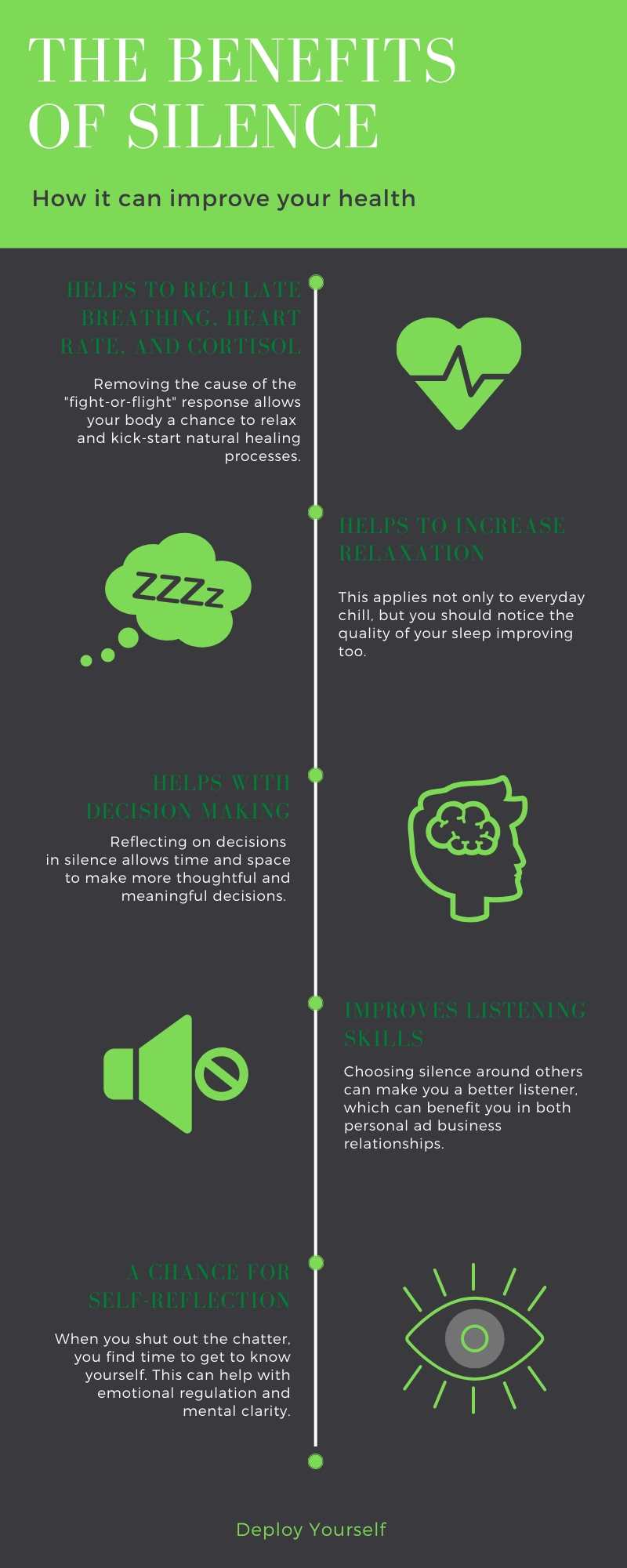
1. Calmer Mind & Body
When you remove the noise stress from your life, it gives your fight-or-flight response a chance to calm down. Your heart rate starts to slow down, your blood pressure lowers, and blood circulation improves (6).
When your body is in alert mode, it’s waiting to do take action to survive a threatening situation. With sound always around us, we find ourselves in a constant wired-up state.
Once the noise causing the stress is removed and you finally relax into silence, your body is free to do what it would normally do, and balance itself once again. As research has shown, even 5 or 10 minutes of silence can have a positive effect on the body (7).
2. Relaxation
If you’ve ever been on the verge of falling asleep and been woken by a sudden but small sound, you’ll understand how noise can affect relaxation.
Placing yourself in silence allows you to be fully present in the moment. No distractions can break your silence when you can’t hear anything!
3. Awareness In Decision Making
Silence invites reflection, and reflection allows you to make more thoughtful and meaningful decisions (8). It’s easier to become aware of the consequences of particular situations when you have uninterrupted time to think about them – and by uninterrupted, I mean free from technology, chatter, and noise.
4. Improved Listening Skills
Silence doesn’t only need to be practised when one is alone. Remain silent when around others and you will be surprised at what all you hear! Learning how to bring silence into your life can help improve listening skills (9) – something that is a valuable skill in both personal and business relationships.
5. Self-Reflection
When you’re constantly bombarded by outside information, it can be hard to know what lies inside us. Many of us simply don’t have time for introspection, and yet becoming self-aware has so many benefits – from mastering your emotions to being more comfortable in your own company.
Spending time in silence allows for space to know yourself in the calm of a restless mind (10) There’s a reason even Bill Gates (11) takes a few weeks off every year to spend alone in silence.
6. Enhanced Creativity
You may be surprised to know that negative emotions can ruin creativity (12). Considering that noise can be an irritation and cause painful physical symptoms, too much noise can cause us to lose our creative spark.
Doing creative work in silence can be a great way of stimulating your creative streak. Also, removing one of the five senses (in this case, hearing) can cause the others to become more sensitive, which could flow over into artistic work.
7. Improved Sleep Quality
Considering the positive effects silence can have – a calmer mind, a healthier body, and improved relationships and communication – it’s no wonder you’ll get better sleep if you have more silence in your life.
If you can make your sleeping environment as quiet as possible, you’ll also fall asleep faster and have less chance of being woken by small sounds.
8. Increased Focus
You learn to be aware of your own thoughts and emotions in silence. This, in turn, leads to being more focused. When we’ve become used to the quiet, it gets easier to direct our mind to whatever we want or need to focus on at the time.
Also, outside noise is a distraction! It’s hard to work properly when you’re always being interrupted by sounds. Bringing in silence can improve your focus, and even if you’re still working in a noisy environment, you will not be as bothered by the noise.
9. Healing of Mind & Body
When your body is no longer in fight-or-flight mode, you’re more relaxed, making better decisions, have a creative outlet, are learning about yourself, and getting better sleep. Your body and mind begin to heal in silence.
Studies have suggested that the brain actually grows when we spend time in silence.
Why We Struggle With Being Silent
If you stop and listen, you’ll notice being surrounded by a lot of noise every moment. Traffic, crowds, the chatter of a conversation, phones ringing, that music coming from somewhere… There’s always some sound. Even at night, when most people consider it to be “silent”, there is a surprising amount of sound.
The more technologically advanced we become, the less silent the world around us is (2). Every sound has a purpose. The TV in the background makes sure you don’t feel so alone. Music in your back pocket means that you have something to see you through every mood. The zing of the phone means someone has made contact with you.
This “usefulness” of sound highlights a prominent modern-world issue – the fact that we’ve evolved to want instant gratification in everything we do, from fun to work to relationships. Why?
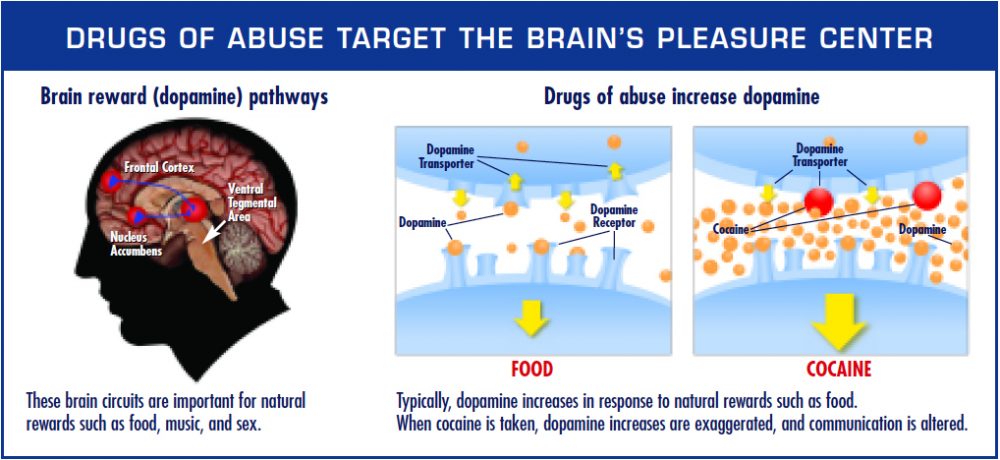
Whether it’s the first bite of that hamburger, the satisfaction of being liked by someone you just met, or the chime of your phone when a message comes through, that feeling of instant gratification sets off a rush of dopamine (3) that makes you feel good.
In the past, drugs and food were the big dopamine spikers – you can see the effects both have in the picture above. Today, the ping of a phone or the pop-up of an email has the same effect on our brains.
There is no instant gratification with silence—and that’s the biggest reason we struggle to deal with it today.
Because of this, it has become something that almost doesn’t exist anymore. When we do encounter it, we don’t know what to do with it. It’s far easier for us to break the silence than to sit through it.
The Harmful Effects of Noise
You may be surprised to know that silence has some amazing benefits. To really understand the significance of this, you need to understand how noise affects us in everyday life.
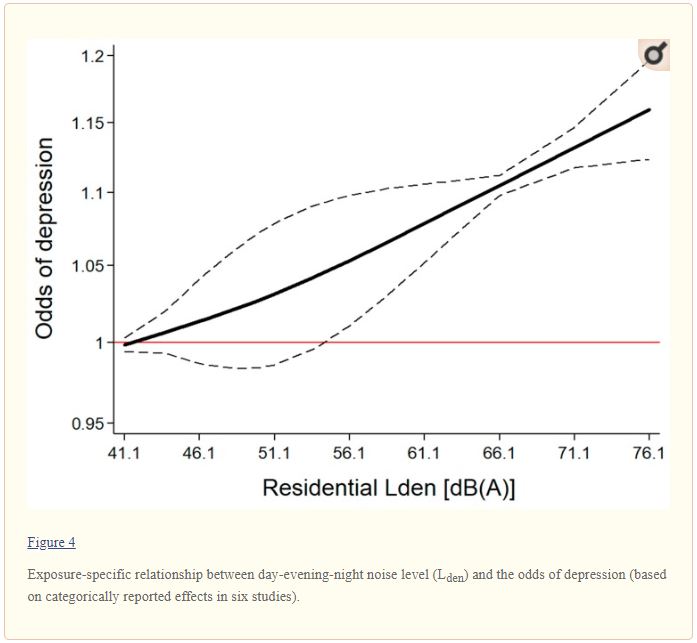
Studies have shown that people living in areas with high noise levels are more likely to suffer from increased stress levels, depression, and heart conditions (4).
Imagine living next to a train stop. You constantly hear the crowd’s chatter, the loudspeaker calling for passengers, and the train arriving, squeaking and rumbling on the tracks. There are some specific problems that come into play here, such as:
Your sleep is constantly disrupted, so you’re not getting enough rest (ie. the body and mind are not healing as they should).
Your communication with your family may be more difficult, leading to misunderstandings and conflict.
Children may struggle to learn correctly, as their hearing is impaired.
Your response to external audio stimuli is actually an important survival mechanism (true for both loud, sudden sound, and more constant background noise (5). The problem is that when you are always surrounded by noise, your fight-or-flight response never really backs down.
“Paradoxically, the ability to be alone is the condition for the ability to love.”
—Erich Fromm
Incorporating periods of silence into your life regularly can be a sort of therapy to reduce stress and start bringing some forgotten goldenness to your days!
How To Add More Silence To Your Day
It’s not hard to add a few minutes of silence to your day. A pair of noise-cancelling headphones is also one way to experience silence in a noisy world.
“Nothing, to my way of thinking, is better proof of a well-ordered mind than a man’s ability to stop just where he is and pass some time in his own company.” ― Seneca
1. Meditation
Don’t be fooled into thinking meditation is a New Age or monks-only thing. It’s a wonderful, meaningful activity (13) to clear your mind, balance your emotions, and prepare yourself for the day (or reflect on the day passed).
Taking 5 minutes every morning to focus on your breathing and become aware of your surroundings is a great way to spend just a short time in silence.
2. Exercise
Exercise can be a way to spend some silent time daily. Focusing on how your body feels, or which muscles are moving is a way of meditating.
This is a perfect opportunity to spend some time in silence. Put your headphones on and concentrate on your exercise, with no external distraction.
3. Listening
We have conversations every day! Whether you’re talking to your parents, your children, your pets, or your colleagues, this is also the perfect time to go shhh.
Take care to really listen – not just hear. Make an effort to not speak unless necessary. You may be surprised at how much you listen.
4. Silent Breaks
Taking intentional silent breaks during your day can be a mood-saver. Just 5 to 10 minutes of distance from the hustle and bustle of work can be enough to relax and reframe your mind.
Take your silent breaks where you need them. Your colleagues and family may find you more relaxed once you start taking regular silent breaks during the day.
5. Journaling
Journaling can be a very therapeutic exercise (15), and is another great exercise to be silent and reflect. When I do it, I prefer doing my journaling in the evening before bed. This allows me the opportunity to reflect on the day.
Journaling in silence allows you to focus entirely on what you’re writing. The act of writing paired with calming silence can be effective in bringing peace to the mind.
6. Nature
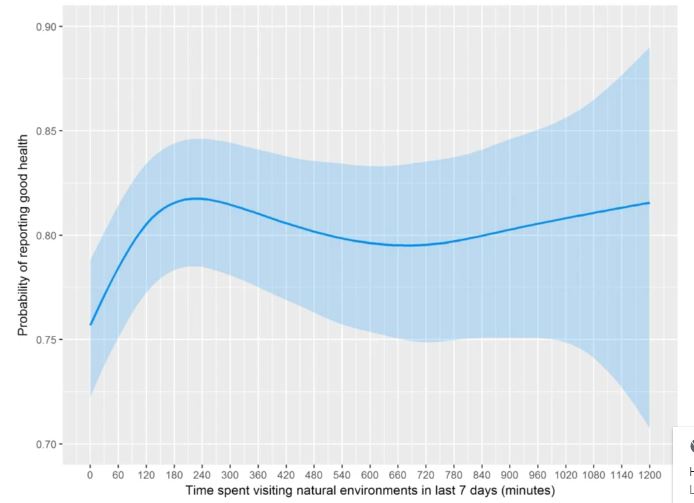
A daily walk in nature has proven health benefits (16). It’s also a lovely environment in which to practice being silent. While this may be different from the concept of true silence, listening to the sounds of nature is a different form of meditation. After moving to Amsterdam, I start taking regular walks of the city during the day. Today these 5-15 minute walks are my favourite moments of the day.
7. Reading
Reading is one of those activities that can transport one’s mind to another place. You only need to read a few pages a day without background noise to get an effective mini-meditation!
When Not To Be Silent
Although silence can add a new meaning to your life, there are some cases when staying silent can do more harm than help.
1. In The Face Of Injustice
“Bad men need nothing more to compass their ends, than that good men should look on and do nothing.” ― John Stuart Mill
When you do, or say nothing, you may as well not be there. Silence serves no good purpose in the face of injustice. Speaking up when something isn’t right can be hard to do – there is often very real risk involved – but we all must speak up against wrong.
Silence benefits nobody in this case. Speaking up not only provides support to someone who may need it, but it also allows you the opportunity to grow emotionally and build courage.
2. When Your Conscience Tells You to Speak Up
Everyone has a conscience (17) – that feeling deep inside that tells you the difference between right and wrong.
When you practice silence often, you will be more in touch with your conscience. When your conscience tells you to speak out, there’s usually a good reason – and you should listen.
“It is a sin to be silent when it is your duty to protest.”
Abraham Lincoln
Conclusion
The World Health Organization recently gave noise pollution the unsavoury description of being a “modern plague” (18). It’s very clear that the constant barrage of noise we’re subjected to, whether overwhelming or subtle, has an effect on the way your brain operates – and in turn, your quality of life.
The fact is, your health is negatively impacted by the amount of noise you’re exposed to every day. The good news is that it isn’t hard to start taking a few small steps to increase the silent moments in life. You’ll start to see the positive change and the benefits of silence almost immediately.
Have you found it challenging dealing with noise in your life? Share your struggles with noise and your own ways to add silence in your life in the comments…
Introverts are comfortable in being by themselves. Instead of getting energy from others, introverts draw it from solitude and quiet places. As a result, resolving conflicts and navigating tough conversations tend to be difficult and scary since it forces them to have conversations that they would rather not have. Unfortunately, avoiding conflict can be extremely limiting when it comes to leadership and producing results.
However, most introverts do not know that their introversion is a superpower when it comes to handling difficult conversations. That is because the nature of an introvert is to be thoughtful. That means you do not enter any situation without preparing for it.
The more you prepare, the more confident you will be. As you can imagine, that confidence will go a long way in helping you manage the nerves of handling difficult conversations and stepping out of your comfort zone as an introvert.
Another superpower introverts have is their excellent listening skills. Most conflicts result from one or both parties feeling like their grievances are being ignored. As you can imagine, listening goes a long way in diffusing the tension in a difficult conversation. Another benefit of being a good listener is that it allows you to understand not just people’s positions but also their underlying interests.
However, since you tend to get worn out quickly when you are around people, you will need to manage your energy appropriately. That means scheduling meetings when you have the most energy and avoiding back-to-back meetings.
Here is everything else you need to know about communicating effectively and handling difficult conversations as an introvert:
How To Communicate and Handle Difficult Conversations as an Introvert
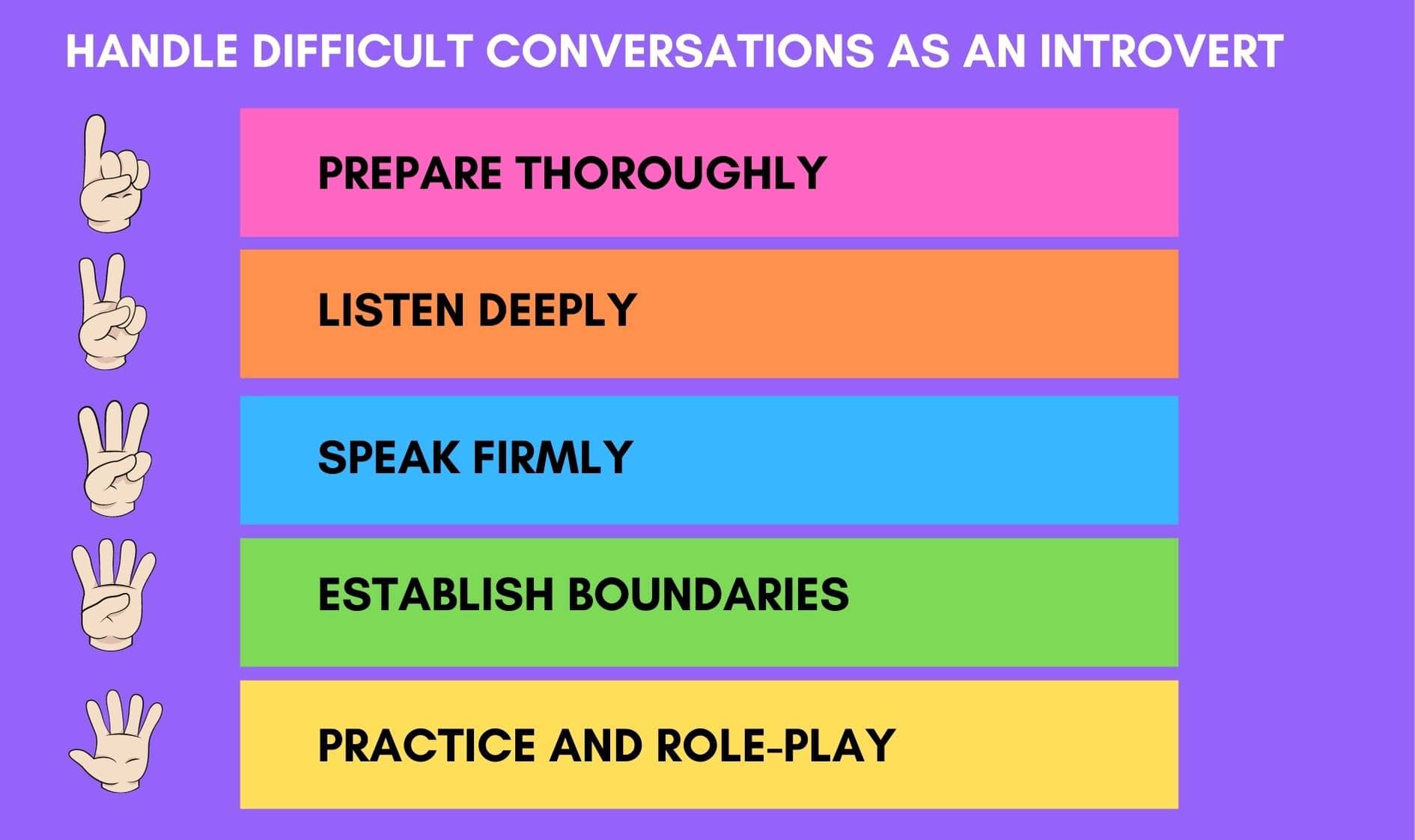
Prepare For Different People and Situations To Remove Uncertainty and Anxiety
Preparation is key to succeeding in anything in life. Fortunately, as an introvert, you excel at preparation due to your thoughtfulness. Here are some questions to ask to prepare yourself for difficult meetings.
What is the meeting about? What material should I read before? Who are the participants in the meeting? What is my history and relationship with them? Can I know them better? What are their personality styles? How can I prepare for dealing with bullying, aggressive, or passive-aggressive comments?
As mentioned, introverts draw their power from within, which is why they do not like having the spotlight on them. Nonetheless, as a leader, you will need to be comfortable with the idea of speaking up.
As mentioned before, good preparation is the key to getting the confidence you need to control any situation. When it comes to meetings, research thoroughly about the topics you will be discussing. Doing that will ensure that any point you bring up will bring value to the conversation.
When people see that you are well-informed, they will be more willing to listen to what you have to say. You can also consider the different people in the meeting and have a plan on how to interact with them, especially if you find working with them challenging.
How should you deal with aggressive, loud, or bullying personalities? For starters, you do not need to be loud; just make sure you speak up when you have to. Here are a few more guidelines:
Take control of the conversation by pulling everyone back to the topic once the conversation becomes derailed
Make a hand gesture before you speak to get their attention
Summarize people’s ideas and point them towards the data you have already prepared.
Can I prepare and circulate my thoughts about the meeting topic before the meeting starts?
As an introvert, you excel at quiet reflection – use that strength to plan for your meeting. That will involve thinking about the topic of discussion and broadcasting them before the meeting. This will help you get a jump start and prevent having to wait for your turn to speak in the meeting.
What are my values? How do I want myself to act? What are my standards and boundaries? What, if violated, I will not stay silent about?
Introverts often struggle with difficult conversations since they have a difficult time believing in their own authority and opinions. A leader is simply someone capable of speaking up for what they believe in strongly. And knowing what you stand for will make that easier for you.
The first step to identify your leadership lighthouse is determining your values. What do you believe in? What are your principles? What about the standards and boundaries you want to stick to? If someone gets out of line, how will you tell him or her that their behavior is not acceptable?
What are my strategies if I get overwhelmed or triggered in the meeting? Can I take a time out; can I ask for time to think? Can I excuse myself for another reason?
You have to reconcile with the idea that things will not always go your way. Therefore, let go of the need to control the outcome of the meeting. Instead, trust your preparation.
Nevertheless, there is still a good chance you will still feel overwhelmed or triggered in the meeting. Pay attention to your breathing to stay centered throughout the conversation or meeting. Whenever you feel nervous or triggered, breathe in deeply and then exhale slowly. You will be surprised how calm you will feel immediately.
Additionally, breathe when you are speaking. This is because we tend to take shallow breaths when we are nervous. Therefore, by breathing normally, you will be letting your body know there is nothing to be afraid of.
Most importantly, fight the urge to speak fast. You have the right to be heard. Again, conscious breathing allows you to communicate calmly, giving you the chance to get your ideas heard effectively.
Use your keen listening skills to go a level deeper and listen to people’s concerns
As mentioned, the introvert’s ability to listen is a superpower. Here is how to use it effectively:
Be curious about not just the topic of the conversation, but also the people involved.
Do not listen just for the sake of it; be curious about what the other person has to say. Doing that allows you to understand where people are coming from. If people feel understood, it builds trust and they are more likely to listen to your ideas.
Additionally, pay attention to the entire person you are talking to. That means not only listening to them but also observing their body language. Doing that gives you deeper insight into what they might not be communicating in words but still expressing otherwise via hand gestures, facial expressions, body posture, etc.
Help people paraphrase each other by listening to people’s concerns. Act as a calming force in the meeting. Acknowledge and validate people’s emotions
The benefit of paraphrasing others is that it allows them to know and verify that you have listened to them. No one likes being ignored. You should also acknowledge the other person’s emotions as they drive most of our communication.
Emotions are the only way people convey what they feel inside and what is important to them. As such, by listening deeply and showing that you understand where they are coming from, you can be a tremendous calming force in the meeting.
Ask questions with compassion to help people understand what is important to them.
Powerful questions can help people understand their point of view better. Being compassionate while doing that is arguably the best gift you can give to that individual.
Therefore, one of the best ways of handling difficult conversations is by allowing the other person to express fully by asking curious questions. That way, you will build trust, get to the heart of the matter, and reach an understanding sooner.
Think about the core issue which needs to be solved. Keep the focus on the problem instead of colliding egos and arguments.
The human condition is prone to our egos getting in the way when communicating. Most times, when people disagree, their immediate response is to defend themselves. As an introvert, you can help people resist the urge to attack each other. Instead, you can help keep the focus on the issue instead of the conflicting egos.
Remind people they are on the same team, and bring up the common desired goals if need be.
The best way to resolve conflict within a team is to remind everyone that they share the same goal. Additionally, remind each individual that their opinions are valued. It is not about massaging egos, but appreciating each person for what they bring to the table.
Use humor or share a story to lighten the mood
When things get heated in conversations, you can use humor to lighten the mood. You can also share a story to lighten the mood and bring the attention of the group to the main point of importance.
Practice and Role-Play To Prepare Yourself if You need to
Needless to say, confrontations and public speaking are not what an introvert look forward to. You can prepare yourself for how various scenarios might play out through role-play with a coach or a trusted partner. You can also practice with a mirror. Consider role-playing the following scenarios:
Practice replying back to aggressive people
As an introvert, nothing can frustrate you like loud and aggressive people. However, you will need to prepare for such behavior. As mentioned earlier, avoid the urge to engage an aggressive individual in their own game.
Instead, let them talk, and then state the facts calmly to them. Practice expressing yourself in alignment with your values while still making your point across clearly. While at it, practice proper breathing, as you will need to stay calm in real situations.
Practice dealing with bullying or passive-aggressive behavior without doing the same
As the saying goes, when you engage a fool at their level, they will beat you with experience. Similarly, avoid engaging a bully at their level. Instead, practice using the guidelines offered earlier on how to deal with such behavior.
You can stand your ground and make your point without being aggressive. Also know that you can raise your voice without being aggressive or rude.
Practice saying no politely but strongly. Be clear about what is non-negotiable for you
If there is one thing that introverts struggle with, it is saying no. However, as mentioned, you can prepare by identifying your values and enforcing your boundaries. The foundation of assertiveness is having the ability to say “NO”. Nothing good ever comes out of being a people pleaser and saying YES when you actually mean NO.
Conclusion
While being introverted comes with its fair share of challenges, it can also give you an edge in difficult conversations. Introversion allows you to be more calculative, prepared, and focused, all of which are important in keeping a cool head under stress and pressure.
Good leadership is characterized by the ability to stay calm and not lose focus in the heat of the moment. Wear your introversion with pride because that is probably what makes you unique and stand out.
Our emotions play a major role in determining the quality of our lives. Have you ever asked yourself why some people live a life full of joy and contentment while others struggle with anger and depression?
It all comes down to how you cope with life’s stressors and unexpected events. No one is immune to emotions like cynicism, anger, and disappointment. While some people go into a frightful or depressive state when faced with stress, others see the same situation as an opportunity for growth.
In this article, let me share 5 research-backed ways to befriend your emotions so that you can navigate through life with choice rather than just being a spectator. Make your emotions work for you, rather than the other way round.
1. Get Good Sleep
Sleeping is a biological function that is as necessary as eating. And when it comes to sleep, the quality does matter.
Sleep deprivation alters the way both your body and brain function. Studies reveal that individuals with chronic sleep deprivation are more susceptible to a host of psychological and physiological issues such as anxiety and depression, memory loss, decreased brain function, weakened immune system, diabetes, obesity, hypertension, lower fertility rates, among others.
How Does Sleep Affect the Brain?
Sleeping allows your brain and body to do more than rest; it allows them to clear out waste byproducts of daytime activities, balance hormones, and repair tissues. Since all those processes are vital for brain health, sleep deprivation has a tremendous effect on brain chemistry and emotions.
Considering how sleep deprivation affects your brain chemistry, it does not come as a surprise that it affects your emotions too. It is the reason why most people tend to be irritable or more vulnerable to stress after a sleepless night, only to get back to normal after a good night’s sleep.
Researchers from the University of Pennsylvania conducted a study on this subject where they had the subjects sleep for only 4.5 hours each night for one week. Findings from the study revealed that the subjects reported experiencing mental exhaustion, higher stress levels, as well as increased feelings of sadness and irritability. When the volunteers resumed regular sleep, they reported experiencing a drastic improvement in their mood, supporting the notion that lack of sleep affects emotions.
According to the Journal of Sleep Research, people with sleep deprivation also tend to be less empathetic. That should not come as a surprise since you are less likely to be understanding when you are sad, irritable, or angry. This means that your lack of sleep will affect how you connect with others.
Studies also reveal that insomnia is one of the core symptoms of depression. 20% of people diagnosed with insomnia end up developing major depression. However, scientists are still trying to determine which comes first between stress and insomnia. For example, it is hard to find sleep when you lose your job. Conversely, the stress is more likely to develop into depression the longer your sleep deprivation continues.
How Well You Sleep Decides How Your Day Goes. Be Mindful of That
Address Sleep Issues
Considering that lack of sleep has a direct link to higher levels of stress, developing healthier sleeping habits can help you curb your sleep-stress relationship. Therefore, even though your lack of sleep might be due to life’s stressors, you should try to put yourself in an environment that allows you to drift off to sleep without a lot of hassle.
Start with making your bedroom a sleep sanctuary. Consider the following tips:
Comfortable Bedding 🛏
For starters, get a comfortable mattress. A good mattress does not have dips or lumps, supports your preferred sleeping style, and does not overheat. Bedding made of linen or cotton is an excellent option since it is breathable, thus preventing overheating.
Keep Your Room Cool 🆒
Cool rooms are more comfortable to sleep in. Consider keeping your bedroom’s temperatures between 16-19 degrees celcius.
Keep the Room Dark
The circadian rhythm – your sleep wake cycle – is controlled by light exposure. Light tells your brain that it is time to be up, while darkness lets your brain know that it is time to rest, thus resulting in the release of sleep hormones such as melatonin. Therefore, by keeping your bedroom dark, you will be allowing your body to follow that rhythm. Use heavy drapes or blackout curtains to keep outside light from entering the room.
Do not Use Screens in Your Bedroom
In the matter of keeping your room dark, you should also avoid using electronic devices when going to sleep. Unfortunately, most people are guilty of this habit. The blue light that electronic devices emit has the same effect as sunlight, thereby inhibiting your brain from releasing melatonin. If you are suffering from chronic insomnia, avoid using any devices at least two hours before bedtime. Read a book instead.
Get Regular Exercise
The fatigue that comes with physical exertion puts your body in a state where it desires to sleep. This is why physically active people are less prone to insomnia.
Good sleep hygiene reduces your susceptibility to stress. Therefore, make sure to get at least seven hours of sleep every night. You will find yourself having better control over your emotions.
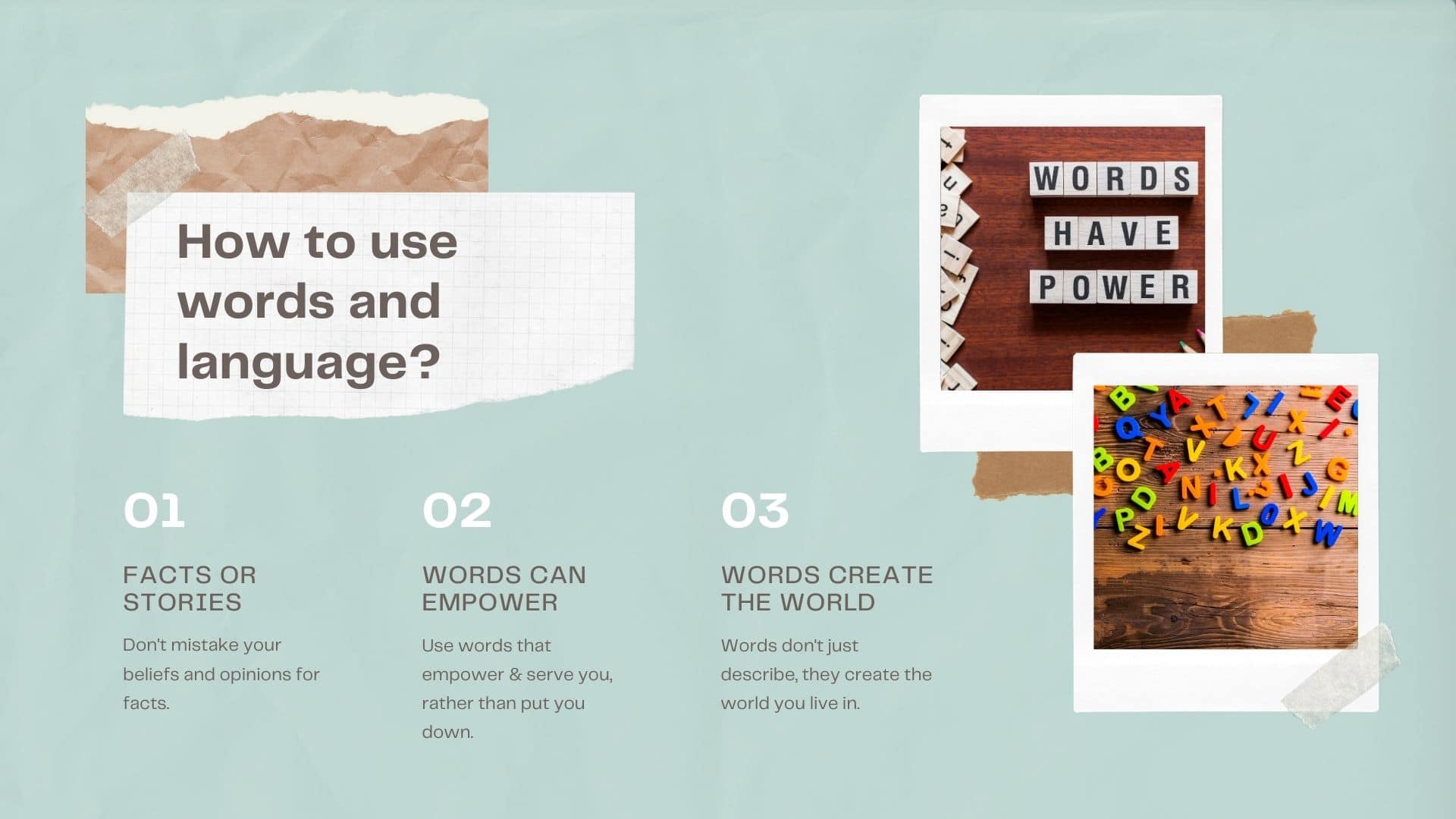
2. Language – Thoughts and Words
“Sticks and stones may break my bones, but words cannot hurt me.” While that saying sounds good when using it against naysayers, you must be very careful about how you interpret it.
Words are powerful. In fact, one could argue that words, and thus language, is the tool that made humans the most powerful species on the planet. Alone, a human is a puny creature that cannot stand its ground against most animals. However, as a team, it is a completely different ball game. Our ability to communicate effectively is what allows us to strategize and use the environment to our advantage.
When used appropriately, words can engage, encourage, and persuade. In the same light, however, words can also dismiss, discourage, dissuade and cause damage.
Using words, therefore, you can plant the seeds of success or failure in your mind or that of another. The words and the language you use also end up defining you, as they reveal your thoughts and attitude.
Words & Language Impact Your Emotions
What are Words?
“We translate experience into language and mistake the language as the actual experience.” – Joseph O’Connor.
Words are labels or descriptions you give to your emotions or feelings. They allow you to express what you are feeling inside so that you can have a better understanding of your circumstances. However, just because you feel a particular way about something does not mean that that’s the reality; it is simply your perception of the situation, or better yet, your assumption.
As such, words can also be described as your biased perceptions of both your internal and external environments. These perceptions or interpretations are biased since they are based on your history, values, beliefs, thoughts, rules, and more.
Therefore, words are simply psychological anchors for emotions. For example, by saying that you are afraid of something, you will fear whenever you come across that situation. Perhaps a past confrontation went bad, leaving you with a fear of confrontations.
However, that is no way to live life, as confrontations are part of everyday life. The problem lies in using certain unhelpful or disempowering words to describe your emotions.
Changing Your Language Patterns
Using positive language is linked to experiencing an uplift in emotions. In one study, the researchers had a group of volunteers write down at least three positive things about their day for three months. By the end of that period, they all revealed feeling happier and better about their lives.
If simply jotting down positive words makes you feel better, it means that you should start becoming conscious of your thoughts and the language you use daily. You will also need to identify how those affect your emotions and thus, your decisions, choices, and actions. It is only when you have a clear understanding of how your language patterns affect you that you will be motivated to make the necessary changes.
Consider the following examples:
“I’m angry” vs “I’m disappointed”
Simply admitting that you are angry will trigger your body to display the necessary neuromuscular response to match that emotion, thus ruining your mood. However, when you say that you are disappointed, your brain will interpret that you are not happy about the situation while not being particularly bothered by it. This means that you will not feel the same impact on your emotions, allowing you to handle the situation more effectively.
“I can’t” vs “What if I could”
Saying that you can’t do something is extremely dangerous, as you will be admitting that the challenge at hand is beyond your abilities. While there are challenges that you might not be equipped to handle, admitting defeat signals your subconscious that it is okay to quit.
However, saying, “what if I could” is extremely empowering, as it is a refusal to accept defeat.
Your words influence your experience of reality. They influence your perceptions, thoughts, evaluations, beliefs, attitude, actions, patterns, behavior, body language, and more. This means that your language influences not only your emotions but also your actions and results. Choose your words wisely.
“Words are, of course, the most powerful drug used by mankind.” – Rudyard Kipling.
3. Breathing/Presence/Mindfulness
How many times have you said to yourself, “I should never have said that or I should not have done that?” This happens to everyone, as you simply cannot live without emotions. However, as mentioned, there is a difference between how we perceive things and what they really are.
Therefore, to avoid knee-jerk emotional reactions, you must learn how to calm yourself down in the heat of the moment so you can analyze the emotional-trigger logically.
One of the best ways of retaining control of your emotions at all times is by practising mindfulness.
Mindfulness can be defined as ‘observing your emotions as they are with openness, curiosity, acceptance, and non-judgement.’
This means that you must first accept that you are susceptible to emotions. Next, you must accept what you are feeling at that moment without judging yourself. Once you do that, you will be in a better position to reframe yourself into a more logical and positive state of mind.
Tools for Mindfulness
Taking control of your emotions, especially in charged moments, can be incredibly difficult. However, it is imperative that you do so to avoid making regrettable choices or decisions. The following tools will prove useful in that quest:
Conscious Breathing
When you find yourself in an emotionally charged state, immediately turn your focus to your breathing. You will find that it is shallow since you are tensed-up, which is a response to stress.
By breathing, therefore, you will loosen yourself up and let go of that stress reaction in the process. You do not have to change how you breathe; simply breathe in slowly and deeply until you feel relaxed.
The benefit of focusing on your breathing is that it allows you to lower your heart rate and release tension from the body. It should be your go-to tool when looking to regulate your emotions in an instant.
Meditation
Regular meditation allows you to take control of your emotions and thus, yourself. Unlike breathing, meditation is not a short-term solution; it requires you to practice it regularly. The biggest advantage meditating has over-breathing is that it puts you in a blissful state where you observe your emotions without even having to think about it.
Meditation, therefore, allows you to escape the reactivity prison and become a conscious creator instead. The beauty of meditation is that you can perform it anywhere, anytime. As such, it will give you a tremendous psychological edge when going into a tense situation.
If you have never meditated before, here is a simple meditation routine to get you started. Consider performing it at least twice a day for five minutes each:
Benefits of Meditation
Find a comfortable sitting position
Sit with your back and neck straight
Relax all your facial muscles including eyes, mouth, and jaw
Close your eyes
Pay attention to all the sounds you e.g. the AC, birds chirping, or cars going by
Gently shift your attention to your breath but do not attempt to alter it
Notice how your breath rises and falls
If your thoughts or emotions keep coming up, do not try to avoid them, as that is not the objective. The aim of meditation is to become mindful; to be present at the moment; to observe your thoughts and emotions, not to wallow in them.
Keep focusing on your breath
Allow your emotions and thoughts to be
That’s it! You have meditated! While it sounds simple, it is crucial that you keep focus on your breath while observing any emotions and thoughts without judgment.
In the beginning stages, you might find it difficult. This is because it is not easy to observe one’s own emotions without having the urge to judge them. What’s more, your brain might trick you into thinking that you are being careless or losing your self-awareness by not judging every little thing you experience.
Nevertheless, to achieve internal peace and, ironically, to heighten your self-awareness, you must learn to let go of the need to judge your emotions by letting them be. For instance, if a situation makes you experience emotions of anger, simply observe it without doing anything.
The more you practice mindfulness, the less susceptible you will be to feel overwhelmed by your emotions.
4. Environment
Owing to the lack of large physical size, early humans were often on the menu of larger carnivores such as sabre-toothed tigers. As such, we evolved to be sensitive to our environments, as one never knew where a predator could be lurking.
Safety and security, therefore, are the primary attributes we look for in an environment so that we can be comfortable. In addition to physical comfort, we also want it to be psychologically comfortable to keep our stress levels low.
Since your surroundings affect your mood, the environment where you live or work plays a big role in your emotions and thus, your mood and productivity.
In today’s world, however, we have different preferences when it comes to the ideal environment. These differences result from factors such as personality, social status, education, cultural influences, professional or personal circumstances, and more.
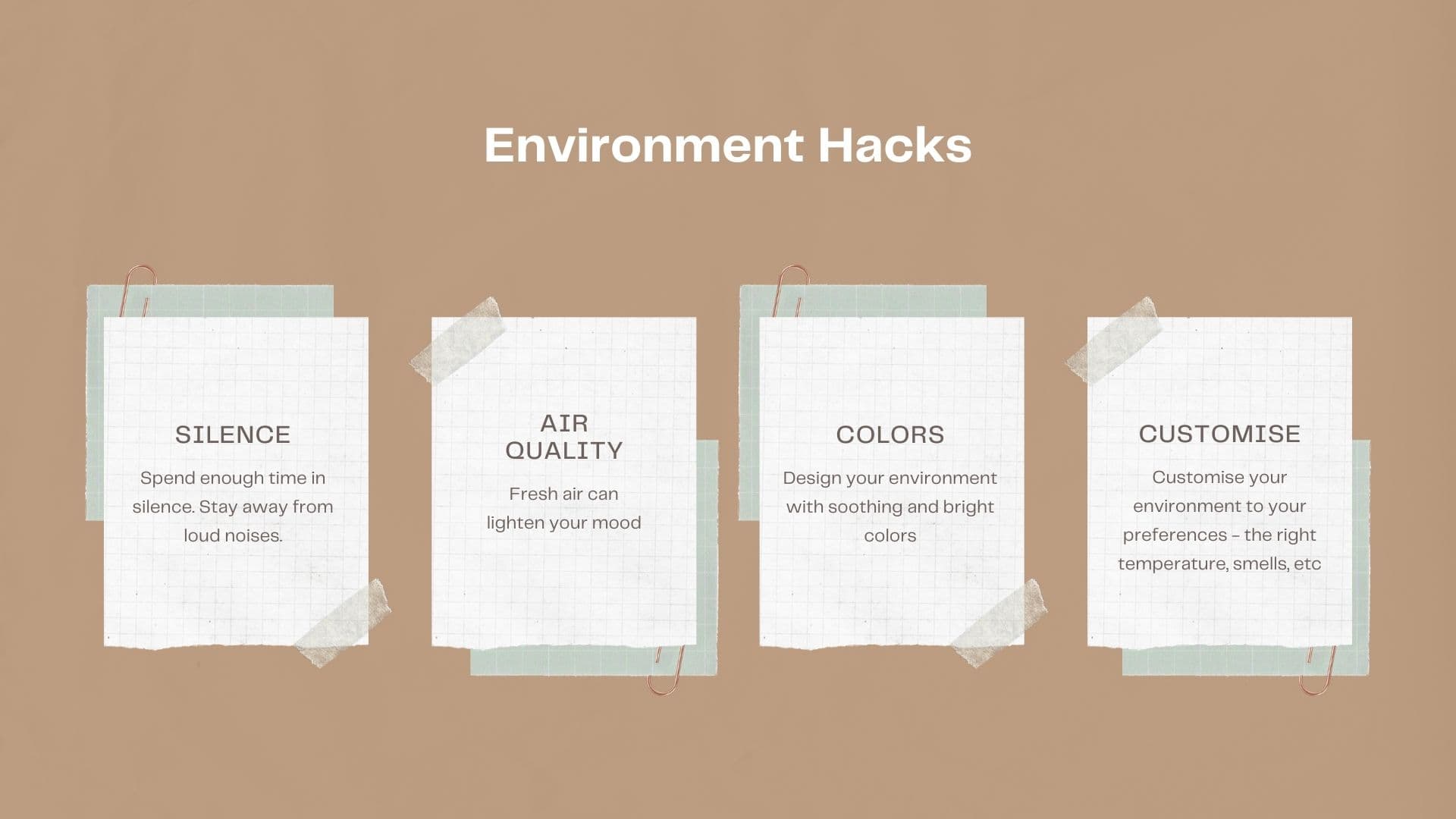
Make Your Environment Work For You
Common Stressors in Environments
Nonetheless, while we may react differently to environments, there are certain elements in any environment that can stress almost everyone. They include:
Loud noises
Low ceilings
Poor air quality
Glare
Unpleasant scents
Uncomfortable temperatures
If you work or live in an environment with such stressors, you will always find yourself on edge. There is a reason monks choose to live in serene environments.
Therefore, if you want to maintain control over your emotions, it is important to ensure that your immediate environment is not one of the causes of stress.
4. Body – Gestures / Postures / Exercising
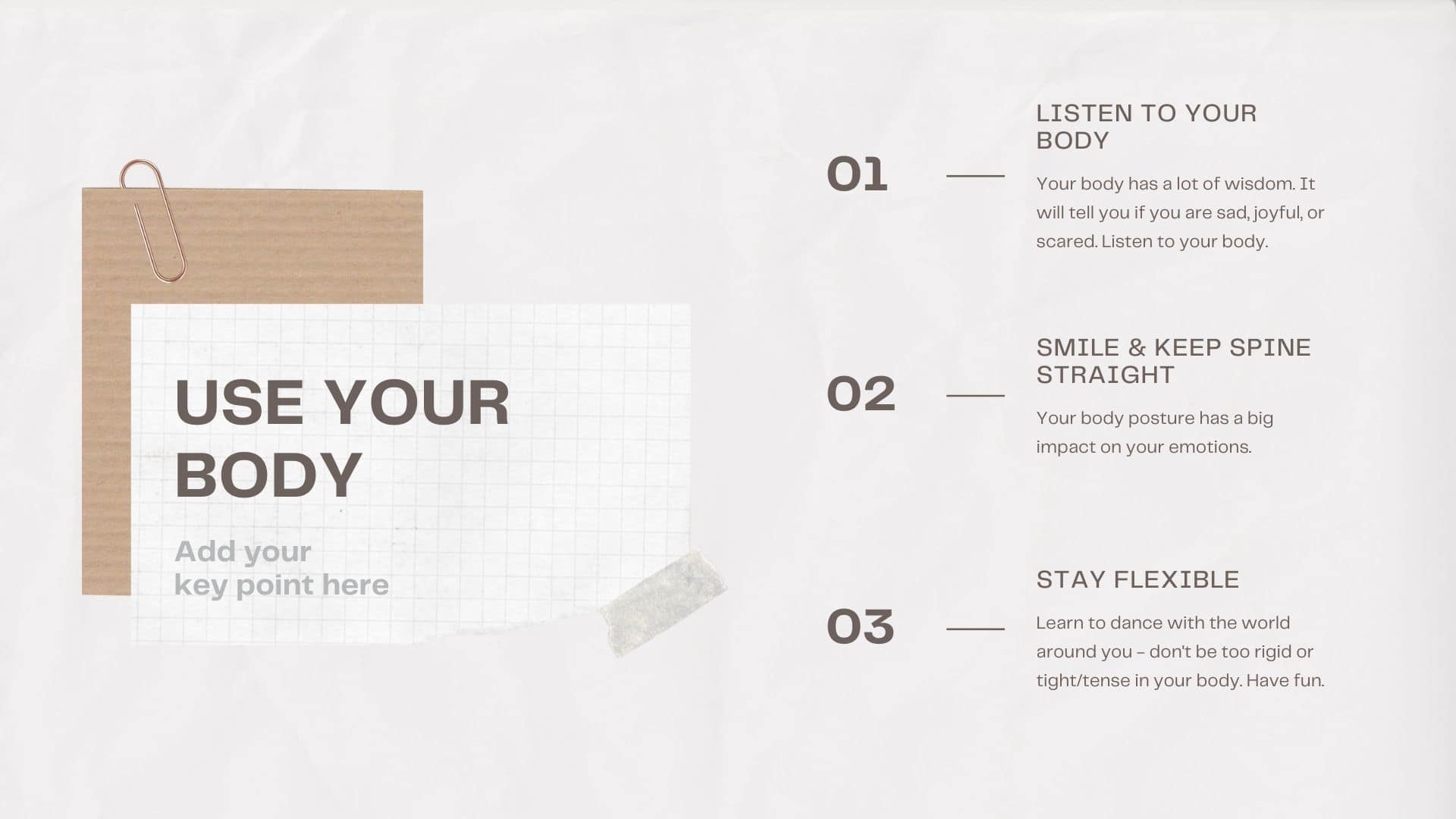
Feeling moody? Try to smile. Believe it or not, it works. In one study, researchers had the subjects adopt a facial expression that mimicked a smile then asked them to fill a questionnaire. Findings revealed that the participants experienced higher levels of amusement than those that attempted other expressions.
The facial feedback hypothesis says that the state of your facial muscles has a direct relationship with the emotions you feel. Variations of facial muscle contractions not only communicate what an individual is feeling to others but also to themselves.
Your Body Posture And Gestures Shift Your Emotions
Therefore, the state of your facial expressions has a direct influence on your mood.
Try this experiment: alter your expression to mimic that associated with displeasure or anger. Do that by creating tension in the area between your eyebrows. It should result in your eyebrows being pulled down and a wrinkle forming on your forehead.
How do you feel? A furrowed brow is a signal to your brain that you are displeased, which is why it is impossible to experience feelings associated with happiness when you are in that state.
The takeaway? Adopting a facial expression or a body posture associated with a particular emotion allows you to experience feelings associated with that emotion. Therefore, being mindful of your body language is a key element when it comes to influencing your emotions.
Conclusion
Emotions are the spark of lives. Think about how dull life would be if you did not experience any emotions. However, as much as they can create beautiful experiences, they can also be the cause for stress if you allow them to overwhelm you.
By making use of what I have shared in this article, you can befriend your emotions, learn from them, and make them work in your favour rather than against you.
In my previous article on anger, we saw that anger hides what we care about. If we look deeper and take the time to introspect, anger can tell us what we really value, and which value has been violated that resulted in the anger. Anger can communicate a lot of important information, but only if we are willing to listen.
Can you control the emotion of anger? NO. Can you control how you respond to it? YES
Life is unpredictable, and you can’t stop yourself from getting angry or frustrated at times, but can you control how you respond to it?
Do you think you can’t control your reaction when angry?
The truth is that anger is not the culprit behind this feeling of helplessness. It is our inability to understand and handle it. We banish anger and put a leash around it – by terming it as wrong, immoral, bad to talk about, bad to feel, etc. Rarely do we educate ourselves and our children about what anger really is and how to deal with it.
Anger has a lot of energy, and it is up to us to use it destructively or productively. We can allow anger to reveal the love and care beneath it. We can allow anger to strengthen ourselves and our relationships. To do this we have to be willing to be vulnerable and listen to our anger. And there is a lot of power in that vulnerability.
“Remember not only to say the right thing in the right place, but far more difficult still, to leave unsaid the wrong thing at the tempting moment.”
― Benjamin Franklin
The Primitive Way of Responding To Anger
There are 2 primitive ways of responding to anger:-
1. Suppression
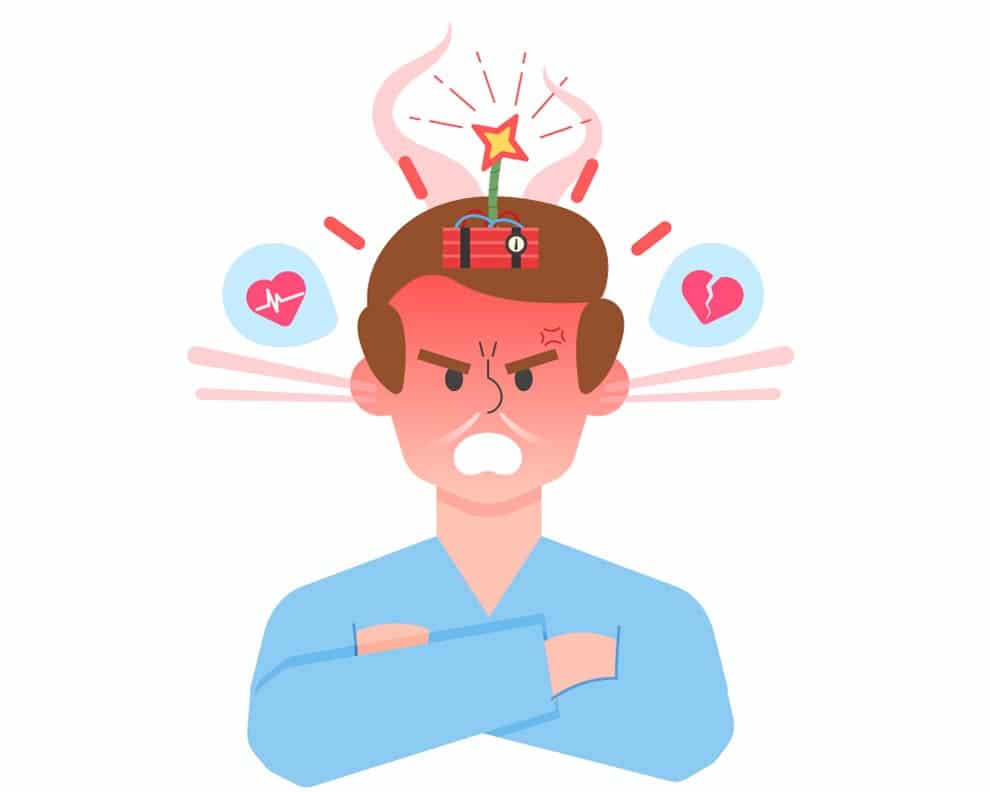
People respond to anger in different ways. You can suppress it, try to hide it, or you can just go silent and not say anything. If you do that, it leads to stress, bad health and can be the cause of major diseases in the future. And suppression never really works because people around us can see we are angry or frustrated. People close to us can always see through our masks. When we suppress our anger and other emotions, we lose the vitality of life. Suppressing anger is like drinking poison and then expecting somebody else will die. Even if we can suppress anger very well, it keeps on building inside us and will end up in an explosion sooner or later. The more we suppress the bigger the explosion will be.
2. Explosion
The second way people react to anger is by exploding and causing a lot of damage. The damage can be to yourself, to the people around you, and to your relationships. When you explode in anger, you can lose control and get carried away. And an out of control human being is a very dangerous thing. In such a situation, we often end up doing something which we regret later. This could range from saying harsh words to using physical violence to harm ourselves or others.
Can you put anger into productive use?
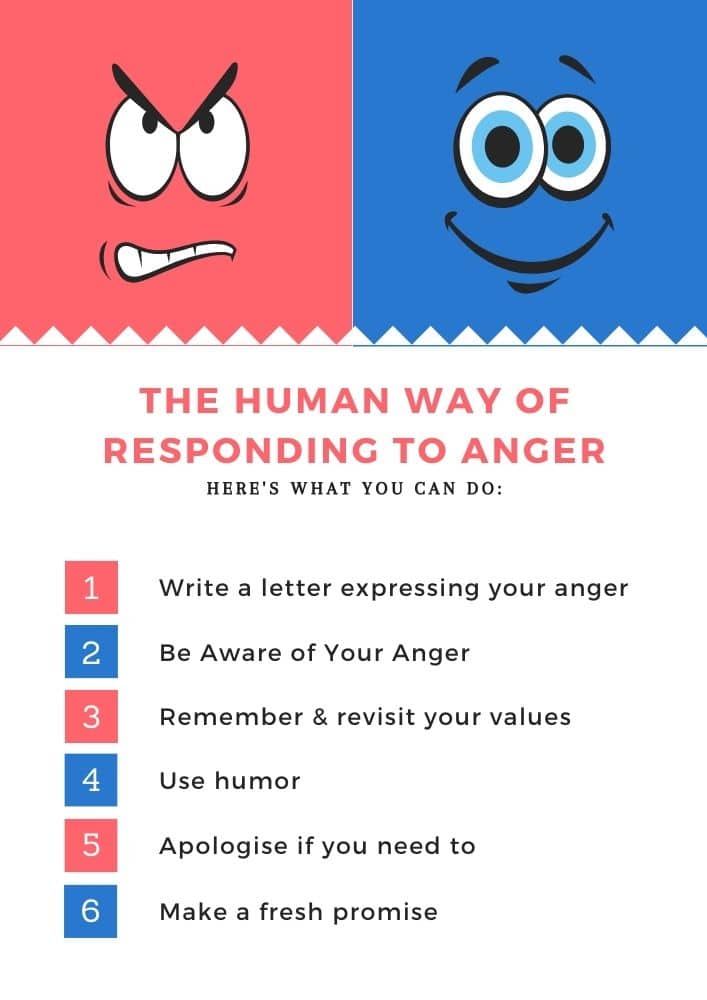
The Human Way of Responding To Anger
We may be primates, but we need not be primitive. One thing that separates our species from other animals is that we can choose our response despite our circumstances. We, as human beings, have the capability to go beyond our impulsive emotional reaction to choose a reaction that suits our long term needs better. The primitive way of reacting to anger does give a short term instant gratification, but it can cause long term damage.
The perfect way to express anger is to express it according to our values, and it is also the key to releasing the positive energy of anger. The earlier we can express our anger, the less damaging it will be – for us and the people around us. You can’t always control if something will irritate and frustrate you, but you can always control how you respond to it. Don’t focus on what made you angry, focus on how you want to react. Let’s see how can we do that.
1. Controlled Explosions
To manage our anger better, we can have mini controlled explosions. Just like bomb squads do controlled explosions to limit the damage of an unexploded bomb, we can express our rage by shouting or screaming in private. We can write a letter where we can express our anger and vent out everything we are keeping bottled inside us. Obviously, we should never send this letter, and it makes sense to just destroy it afterward. Just the act of writing what you feel will make you feel better. These are not perfect solutions, they can still help us to defuse an otherwise alarming situation.
2. In The Heat of The Moment – Be Aware of Your Anger
What we can do in the heat of the moment is to be aware of our anger and not get sucked into reacting impulsively. We can focus on our breathing, and on what is happening in our body because of the anger. There are often physical symptoms of anger like a racing heart, and being present to these changes can help reduce them. You always have the power to choose how to respond to anger, and you do that by being present to and taking control of what is happening in your body.
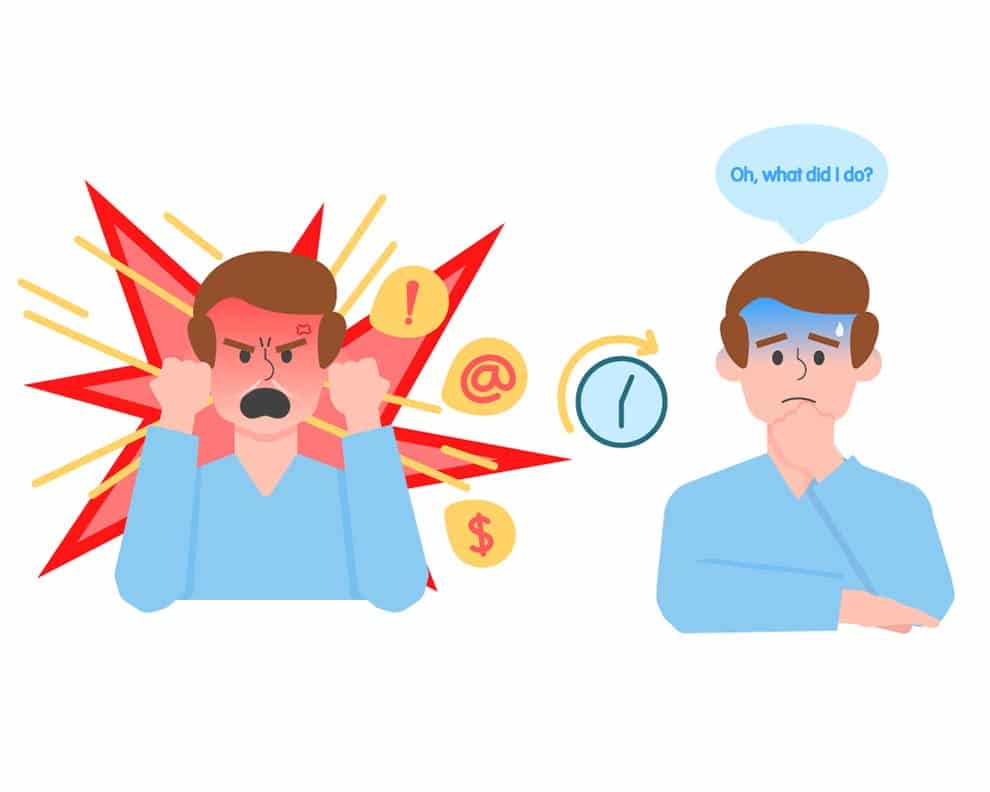
Exploding In Anger Often Leads to Regret Later On
One way of being aware of what is going on in your body without reacting is to detach ourselves from the situation. You can take a break from whatever you are doing – take a walk and get yourself moving. If you’re inside a building, try to get outside and get some fresh air. Within a few minutes, you will start to feel better. Moving our body physically reduces stress and the level of the stress hormone – cortisol. It has been clinically proven that exercise improves not just our bodily metabolism, but also our spirits. A little exercise can prevent things from going outside of your control.
3. What To Do When You Have Calmed Down?
Every now and then it is important to remember and revisit our values. As they will determine how you want to act in the face of anger. A good question to ask yourself is – How do you want to act in anger so that you don’t regret it later on?
We can learn to communicate and express our anger in a way we can be proud of. We can do that by not jumping to conclusions when our emotions are triggered. Research has proven that we don’t make good decisions when we are angry or in a heightened emotional state. Hence, it would be prudent not to believe what comes to our mind in such a state. We can make better decisions by slowing down, sleeping over it, and giving it time before making any life-changing decisions.
“Speak when you are angry and you will make the best speech you will ever regret.”
― Ambrose Bierce
Once we are calmer, we can listen to what others have to say without getting defensive. Everyone is entitled to their point of view, no matter how different it is from ours. It is very important to let others make their own choices, and not force our opinions on them. When you do that, people naturally tend to push back creating further friction and frustration.
To make the most of the energy present in anger, we should remind ourselves of our values and seek win-win solutions together with people. Commit to finding a mutually agreeable solution rather than winning your argument and proving yourself right. At such moments, it is important to work with people, not against each other. Even if you prove yourself right or win an argument, give others an opportunity to save face.
Don’t embarrass or humiliate people even when you know you’re right. Seek solutions where two plus two become five, where the sum is greater than the sum of the parts.
4. Using Humor
Humor is another way to defuse anger. The more you suppress or hide anger, the stronger it gets on the inside. Humor can help you look at a situation lightly, and help others relax too. The humor that comes out of deep emotional suffering can help you build connections with people. Humor loosens the grip of anger on our bodies and brings a smile to our face, which can be seen as diametrically opposite of anger.
Humor allows us to see the big picture and the comedy in life. While life can be and is often painful, humor can prevent us from taking ourselves too seriously. Most stand-up comedians know this well, and that is they joke about our biggest challenges and problems. Laughing at a problem or a tough situation not only heals our bodies and souls but also empowers us for the future. Humor gives you power over your anger, instead of letting your anger have all the power.
The best type of humor is self-deprecating humor. Don’t take yourself too seriously. Anger can hide our blind spots, which when seen from a different perspective, can make you laugh. And above all, it feels a lot better to laugh than to hate and cuss.
“Anger is an acid that can do more harm to the vessel in which it is stored than to anything on which it is poured.”
― Mark Twain
What To Do If Damage Has Already Been Done?
Sometimes we can’t stop ourselves from venting in anger, and it is already too late for the above steps. In that case, it is important to apologize and fix the damage – as soon as we can see it.
A Powerful Apology
A powerful apology is sincere, responsible, and makes amends for the future. You express your apology by saying what are you sorry for. Clearly state what happened and how you reacted to anger. Take full responsibility for what you did without blaming anyone else, the situation, or the emotion. It’s very powerful, though not easy, to say, “There’s no excuse for my behavior, and I take full responsibility for how I acted.” However, do it only if you can do it sincerely. There is nothing more offending than an insincere apology. If you are still holding a grudge, it can further damage the relationship.
Once you have apologized sincerely, give the other person the choice to accept your apology or not. Be patient. You can never force an apology onto others. People might take time to come around and trust you again. Or they never might. Be ok with it. Own what you did and its consequences.
The last step is to make a fresh and sincere promise to make amends. What will you do differently the next time? How will you clean up the mess caused by your anger? It is often a good idea to ask the offended person what you can do to undo the damage. Make a sincere promise and then live up to it. You will lose trust if you mess up again. People are often willing to give everyone a second chance. But a third chance is rare.
In conclusion, anger can be poetically beautiful if we can see its value. Anger is an emotion that connects us all. Its what makes us human and everyone gets angry at one point or another. We can learn to see the lighter side of it, laugh over our mistakes, and learn from them. At the same time, it is important to realize that anger is just another natural human emotion and we should not beat ourselves over it. Instead, if we can make a powerful apology and live up to our promises, it can be a wonderful opportunity to use the energy of anger to strengthen your relationships and to set an example for others to follow.
We all experience a wide range of emotions. If we are human, we can not escape feeling the same emotions as everyone else. In fact, the more psychology and neuroscience research I encounter, I wonder that a better name for us would be “emotional beings” rather than “human beings“. Emotions (not logic) are what decide each and every action we take, and it is emotions that make us human.
The 6 basic human emotions are happiness, sadness, fear, disgust, anger, and surprise. However, all of us are capable of experiencing a much wider set of emotions like excitement, contempt, guilt, relief, embarrassment, shame, joy, inspiration, numbness, horror, and so on. It is natural that we will all experience the above emotions at some point or another.
While all of these emotions might be natural, they are not all helpful. Many emotions leave us in a positive and empowered state while others leave us worse off. We also experience these emotions in different combinations and intensity.
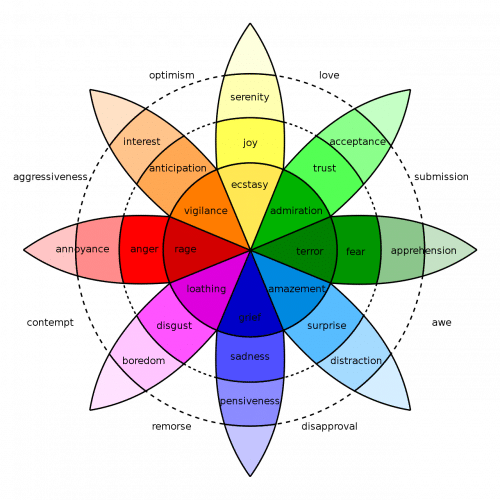
Plutchik Wheel of Emotions
For example – anticipation and joy together become optimism, trust and fear become submission, and anger and disgust become contempt. Plutchik’s wheel of emotions provides a good framework to understand emotions, how they mix together, and how they can vary in levels of intensity.
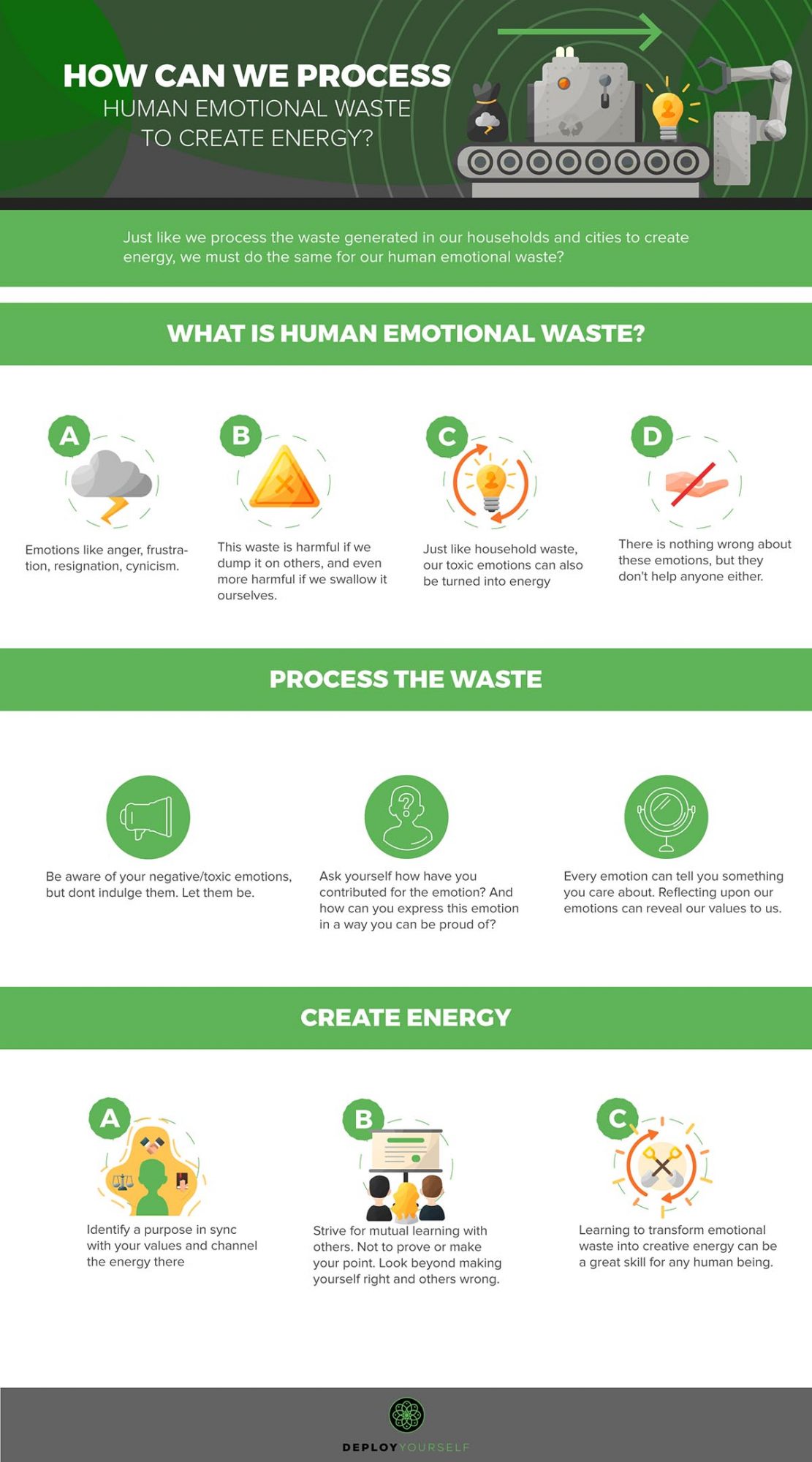
In this article, I want to talk about our emotional waste, or what is often termed as negative emotions. Just like the waste generated in our households and cities is processed to create energy, we can and must process our emotional waste too. If we know how to deal with our emotions, they can be used to generate productive energy.
“Clouds come floating into my life, no longer to carry rain or usher storm, but to add color to my sunset sky.”
― Rabindranath Tagore
What Are So-Called Negative Emotions, or Human Emotional Waste?
What I call Human Emotional Waste are emotions like anger, frustration, resignation, cynicism, guilt, and other so-called negative emotions. They are usually called “negative” in popular nomenclature, but I must clarify that there is nothing wrong with these emotions. Experiencing them is as natural as experiencing any other emotion. If you are a human being, you will experience these emotions in your life. There is no escaping them.
Having said that, these emotions don’t help us either. The waste of these emotions is harmful if we dump it on others, and even more harmful if we swallow it ourselves. But just like household waste, these toxic emotions can also be turned into positive energy. Just like crude oil can turn to fuel used to drive vehicles, these toxic emotions can also be turned into fuel to power something beneficial in our lives.
Every Emotion Has Energy. It’s Up To Us How We Use It
How Can We Process This Emotional Waste?
The first step to productively process our toxic emotions is to stop fighting them. We must be aware of these emotions as they arise, but we should not indulge them. The more we indulge them, the more we risk slipping into the rabbit hole of disempowering thoughts and harmful actions. We must realize that having these emotions are natural, and we should just let them be.
At this juncture, it is also important to note that we should not resist them either. Saying “I shouldn’t feel this way, or I will not get angry” will only make it more difficult to let these emotions go. The more we resist them, the more they will persist.
Once we have done that, we can take the next step, which is to ask ourselves a few questions to understand what these emotions are trying to tell us:-
How have I contributed to the emotion to arise that I am experiencing right now?
What is it that I deeply care about and has been violated, which has stirred up this emotion?
How can I express this emotion in a way that I can be proud of?
Answering these questions can be hard and intimidating, but this is the hard work required to “recycle” such emotions and gain some valuable insights from them. The more attention we pay to our emotions, the more aware we can be of what they are trying to tell us.
Every emotion can tell us something we care about. Answering the above questions and reflecting upon our emotions can reveal our values and what is important to us. Once we realize which of our deeply held values was violated resulting in the emotion, we can take the next step.
Suppressing our emotions can cause a lot of damage
How Can We Create Positive Energy?
Once we have identified what our emotions are trying to tell us, we must think about expressing these emotions in sync with our values. At such moments, we need to take the driver’s seat and prevent our emotions from taking over. Emotions are very good messengers but can be equally bad masters.
We must channel the energy from understanding our emotions towards expressing them without suppression or explosion. Shouting at others (explosion), or sulking in silence (suppression) never solves any problem. It often only makes it worse. We can always choose to act according to our values — even in the face of failure, disappointment, and other strong feelings.
We can’t always control our circumstances, but we can always act in ways congruent with our values. When we give in to the temptation of an impulsive emotional reaction, we try to win the argument and prove that our point of view is the correct one.
“Everything can be taken from a man but one thing: the last of the human freedoms—to choose one’s attitude in any given set of circumstances, to choose one’s own way.”
― Viktor E. Frankl
However, we must strive for mutual learning with others when expressing our emotions. The purpose is not to prove or make our point. We must look beyond making ourselves right and others wrong. For example:-
When we are sad about experiencing a loss, an impulsive reaction could be resignation and cynicism about the future. But a conscious expression of sadness would be to just grieve and acknowledge your loss.
When we feel anger and frustration, an impulsive reaction could be to get into a fight or suppress our feelings. But a conscious expression of anger would be to make a complaint and sharing our concerns.
When we feel guilt after a mistake, an impulsive reaction could be to beat ourselves up and sulking in shame. But a conscious expression of guilt would be to make a sincere apology and repair the broken trust.
Learning to transform emotional waste into creative energy for a common or higher purpose is a skill. And just like other skills, it can be learned and developed. We can all use our emotional intelligence to make productive use of our emotions. If we can do that, these emotions will stop being “negative” for us. And we will end up with stronger relationships and a better world for all of us – not just you and me.
How Can We Overcome Negative Emotions And Create Positive Energy To Achieve Joy And Fulfilment?
“Anger is the deepest form of compassion,” poet and philosopher David Whyte wrote.
Most people do not associate anger with compassion. In fact, at first glance, it looks and feels like the exact opposite of compassion. But as with most emotions, the more attention we pay, the more aware we can be of what our anger is trying to tell us. In this article, I want to present a different take on anger – seeing anger as the most compassionate human emotion. Taking this unusual perspective about anger can reveal a lot of useful insights. Let’s get started.
On the surface, anger looks like an ugly emotion. The feeling of an intense fire that threatens to burn not just the target of the rage but also ourselves. We have all been through that. It is in those moments when we know we are going to explode, but can do very little to stop it — that we realize the energy of anger. Often we end up spending it destructively (shouting, hand waving, punching a wall).
Anger is a natural human emotion. Anger is one of our most primitive biological responses, and everybody experiences it. Anger is a legitimate emotion, and there is nothing wrong with it. As my mom used to say, anger is our inability to deal with what we care about, and the vulnerability that comes along with it. We get angry when we don’t know how to react (to events around us) normally.
A lot of people see anger as a negative emotion. I wouldn’t categorize anger as negative. Instead, anger can be our guiding light. It can be a mobilization force to deploy ourselves in the face of circumstances. Every time we can do that, it strengthens and helps us behave in a way we can be proud of. Seen this way, anger is a very useful emotion.
Anger is very useful to avoid and navigate fear and threat when our survival is at stake. The human species would not have survived unless it had been for anger. I’ve never met a human being who doesn’t feel anger. Everybody gets angry at some point in their life. People might have different thresholds for anger. People might react to anger in different ways, but everyone gets angry.
Can you put anger to productive use?
Anger from Psychological Point of View
Anger is a secondary emotion. What that means is that it can hide more emotions behind it. For example, anger can hide frustration, sadness, or even grief behind it. Anger is also not a static emotion. Your anger can range from mere irritation, on the one hand, to rage on the other hand. Anger can be triggered suddenly or it can linger deep inside yourself.
Physical Manifestation of Anger
Everyone reacts differently to anger, but there are some common physiological changes associated with it. It causes our heart rate and blood pressure to go up, and we feel an adrenaline rush when we get angry. We get a sudden rush of energy and an impulse to react in a particular way – banging our fists, cursing, shouting, venting, throwing things, etc.
Anger is harmful to your health. It causes stress and anxiety, and it can cause long term harm like heart attack and depression. It is not only harmful to our own health, but it is also harmful to people around us, and our relationships. In anger, we tend to lose control, and we can do things that we might regret later. If we look back in our lives we can all see moments of anger where people have left a trail of destruction behind them.
Neuroscience Point of View
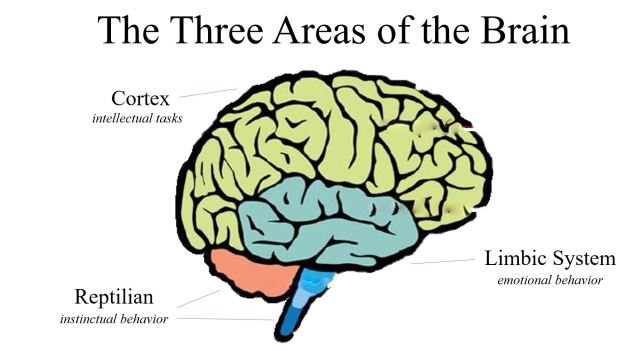
The primary function of our brain is to ensure our survival. When it comes to emotions and how we operate on a day to day basis, our brain comprises of 3 parts – the Neocortex (the thinking brain), the Limbic System (the feeling brain), and the Basal Ganglia (the reptilian brain). The Amygdala is the deepest and most critical part of the limbic system. It is most commonly activated when dealing with intense emotions. It triggers what is called the fight or flight response.
Research proves that when we are emotionally overwhelmed and experience a threat to our physical or psychological safety, our amygdala is triggered before our neocortex (the reasoning part of our brain) even knows about it. When this happens, the amygdala decides our behavior (the fight or flight response) and it is called an “Amygdala Hijack”.
Anger Short Circuits Our Brain
This is what happens when we experience physical symptoms like a racing heart, sweating palms, or a shaking body — even in situations with no physical threat. Our ages-old survival mechanism kicks off and makes us react to things primitively before the rational brain has time to think things over.
This is one of the reasons emotions are good messengers but very bad masters. Our anger can tell us a lot about what we care about, but if we let it take over, it can short circuit the thinking part of our brain. When that happens, we react rather than respond to the situation.
“The truth will set you free, but first it will piss you off.” ― Joe Klaas
At the same time, just like any emotion anger can tell us a lot about ourselves. Anger has the power to clarify our thinking and reveal our moral lighthouses. But only if we are willing to listen. There are 3 ways we can use anger productively rather than let it destroy us and our relationships:-
1) Listening To Anger Reveals What We Care About
If we pause and reflect, anger can reveal what we deeply care about. For example – I once got angry at my manager. After reflection, I came to understand that the anger was not against the manager but against unfair behaviour. Once I realized that I was able to respond in a better way, and it revealed one of my deepest values to me – fairness and justice.
The more attention we pay, the more we can be aware of what our anger is trying to tell us. Anger can be our guiding light and a force to deploy ourselves in the world around us in a healthy and productive way rather than destructively. As I mentioned earlier anger is a secondary emotion. It hides many emotions behind it, but we can look deeper and figure out what those emotions are.
One way we can listen to what anger is trying to tell us is by separating facts from stories and assumptions which we might have made. Our minds can fool us easily. A thought comes into our mind after something happens, and we believe it to be true. In such moments, we can instead stop and validate each assumption which our mind is making before believing it. Whether it is true or not, or is it a story?
Anger can show us the way ahead, and what needs to change. Because anger tells us what is not okay, what we should not do, or that a deeper investigation is required, about something which is bothering us.
2) Anger Is An Opportunity To Practice Emotional Intelligence
Exploding In Anger Often Leads to Regret Later On
In the heat of anger, we stop listening. We are only burning in rage. But after the immediate impulse of the anger is gone, it is an opportunity to practice emotional intelligence. And as with all skills. It gets better with practice and time.
Anger always comes along with a temptation to react. But seen another way, every time we get angry, it is an opportunity to express ourselves in a way that we can be proud of. Venting out in anger can certainly give us immediate relief, but we often end up damaging relationships and our reputation in the process. Not giving in to that impulse is an opportunity to practice emotional intelligence.
You might think that when angry, you can’t stop yourself from reacting. And this is why you hate being angry. But the truth is that anger is not the culprit here. Instead, it is you who lacks the ability to understand, reflect, and act responsibly in the face of your anger. Anger provides us with an opportunity to use the energy of our anger productively. When we do so, we strengthen relationships and build a strong reputation backed by responsible behaviour.
3) Anger is Love, and It Shows Your Commitment
We often get the most frustrated and angry at those whom we love or care deeply about. The opposite of love is not hate or anger, it is indifference. So when we see people in love fighting, it is not that the relationship is going downhill. Instead, it is a sign that the relationship has a lot of care and sincerity that is often expressed in anger. To expect anger to not arise in love is to not understand love at all.
You get angry because you care. You get angry because you love somebody, because you love a cause or because you love a certain value. You get angry because you want to reach an important goal or you see a possibility in the future. Something happened which violates that commitment you have to the person or to the cause or to the future goal. That is what makes you angry, and that is what we need to discover.
Have you noticed that when you are angry, you cannot think of anything else? It is because anger brings tremendous clarity with it, and forces you to focus on the current moment. If we can honor our anger instead of denying it, we can usee its energy. This energy arises because we feel vulnerable in love. If we can see it for what it is, we can use the force of anger to enrich the love which is at the root of anger in the first place.
Every time you are angry at someone you care about, take a moment to celebrate your commitment to the person or the relationship. Your response can change massively if you keep this commitment in mind in that moment of heat. Your anger is there to serve you and your relationships, but only if you are willing to pause and listen. You get angry because you love. Allow this love to strengthen the relationship rather than weaken it.
Conclusion
Understanding anger on a deeper level can be poetically beautiful. Once you learn to stop acting out impulsively and express your anger keeping love and care as the underlying commitment; you can channel it to nurture the relationship. We all feel anger, so in a way, anger connects us all. It is what makes us human.
We all have been in situations where our emotions have overwhelmed us. We all have done something in the heat of the moment that we regretted later. In such situations, our emotions can affect our ability to think and act rationally. We find ourselves unable to think clearly in such a state, and every passing second feels like an added burden. Why does this happen? What can we do to prevent it?
Since emotions is a topic most people find difficult to talk about with others, it is very common for people to suffer alone in a state of emotional overwhelm. And when it gets too much, we often explode – saying or doing stuff which only makes things worse, and which we end up regretting later on. We all remember the Zidane’s head butt in the 2006 Football World Cup Finals in front of 28 million TV viewers. Zidane’s aggressive reaction got him kicked out of the game, France lost the match and the World Cup, and he later ended regretting up and apologizing for what he did.
So what is it about emotions that can cause such reactions? And if everyone experiences this at some point in their lives, why is there no available literature or material which can be of help in such situations? It was to find an answer to this very question and to understand our brains better that I started a new journey (or exploration) around 2010. This journey has over the decade involved doing multiple trainings, reading hundreds of books, undergoing courses in psychology and neuroscience, and experimenting and trying out what I learned in my own personal life.
Regret After An Emotional Reaction – We All Have Been There
This article is an attempt to share what I learned about our brains and emotions in simple and easy to understand language, so that the next time any of us feel emotional overwhelm, we know what is happening inside our brain, and how to deal with it better.
The Neuroscience Behind Emotions
The primary function of our brains is to ensure our survival. When it comes to emotions and how we operate on a day to day basis, our brain can be divided mainly into 3 parts. These three parts of the brain are:-
The Neocortex is the part of the brain where we think consciously and use reason to find our way around problems. When we make logical decisions about the pros and cons of a matter, we are using our neocortex. This is the biggest part of our brains, which is unlike other animals. In most other animals, the neocortex is either very small or completely missing. This is our conscious mind.
The Limbic System is the part of the brain which deals with emotions, behavior, motivation, memories, and sensory information. The amygdala (which we will come to later) is a part of the limbic system. The limbic system controls the functions necessary for our survival and self-preservation – both physical and psychological. All our emotions and matters of the heart have a lot to do with our limbic system. This is our subconscious mind.
Basal Ganglia is that part of the brain which is responsible for voluntary movements of our body which we don’t think consciously about – like our eye movements, how our internal organs work, and so on. For people with damage to their Basal Ganglia, it is difficult to control their speech and posture. When we instinctively know how to catch a ball or use a scissor, we are using our basal ganglia. It is our unconscious mind.
The Three Parts Of The Brain
The Amygdala Hijack
The Amygdala is the deepest and most critical part of the limbic system. So much of our emotions and behavior are controlled by our amygdala that I am surprised this is not part of our elementary education. It is most commonly known for dealing with fear and triggering what is called the fight or flight response. Research says that when we are emotionally overwhelmed and experience fear (to our physical or psychological safety or to our identity), our amygdala is triggered before our neocortex (the reasoning part of our brain) even knows about it. When this happens, the amygdala decides our behavior (the fight or flight response) and it is called the “Amygdala Hijack”.
This kind of immediate response triggered by the amygdala can be very useful when we see a tiger coming our way in the forest. It is the amygdala which makes us run without thinking rationally about the pros and cons of running. In those moments, you want to immediately react to ensure survival. The amygdala makes sure that happens. However, it is not only physical fear like seeing a snake or a tiger that can trigger our amygdala. Experiencing anxiety and surprise can also trigger our amygdala, even when there is no physical threat to our well being. In the world we live in today, our amygdala is mostly triggered to ensure our psychological safety rather than our physical safety.
Our brains have evolved such that our emotions can provide us with what to do without us having to think about it. During an amygdala hijack, it takes over the brain and we immediately react without consulting the thinking part of the brain. It triggers the release of hormones like adrenaline (epinephrine) and cortisol. This is what happens when we explode in anger, or when we experience physical symptoms of fear like a racing heart, sweating palms, or a shaking body even in situations with no physical threat. This survival mechanism makes us react to things before the rational brain has time to think things over.
This is one of the reasons emotions are good messengers (in the sense that they can tell us a lot) but very bad masters. Our emotions can tell us a lot about what we care about, but if we let them take over, they can short circuit the thinking part of our brain. When that happens, we react rather than respond to the situation, and the resulting action might cause us harm or regret in the future.
Suppressing our emotions can cause a lot of damage
Why Do Emotions Hijack our Behaviour and Actions?
Our brain is always in the process of survival. This survival doesn’t necessarily have to be physical in nature, it can also be emotional. For example – We can experience intense emotions (and an amygdala hijack) when our identity gets hurt. It can happen when we hear something about ourselves which we don’t want to hear or discover some truth which was hidden from us for long. When this happens, we feel fear the same way as we would on seeing a tiger.
With fear, a fight or flight response is triggered. This is why people fight and kill each other over football matches. This is why people have very strong arguments and express hate and anger over seemingly trivial matters. In all such instances, the reptilian part of our brain takes over and it tries to do its most important job – to survive. The amygdala cuts off the neocortex, which is what makes the human brain stand apart from other animals.
Needless to say, this kind of living is very effective for surviving, but not so much for thriving in the modern world. It is very difficult to have effective conversations, deal with conflict, and engage emotionally with people around us if we see everything as a threat.
The good news is that an amygdala hijack is temporary. It can feel scary and helpless, but there are ways to deal with it better. We can do so by understanding how our brain works and planning proactively. When we do so, we develop our emotional intelligence and reduce the frequency of our fight and flight responses.
Steps to Deal with an Amygdala Hijack
The Fight or Flight Response
Prevention – The best way to deal with an amygdala hijack is to prevent it from happening. You do that by understanding how our brains and emotions work, and then developing emotional intelligence to pay attention to our emotions as they arise. It is true that emotions bring with them a temptation to react. But it is also true that there is a gap between that temptation and our action. By being more mindful of our emotions, we can learn and train ourselves to engage our neocortex before being sucked into reacting to a particular emotion. You can do that by following step 2.
Don’t Ignore the Emotion. Label and Acknowledge It – If we name the emotions as we experience them, it can help to engage the thinking part of our brain and give us the space to choose our response. Just saying out loud that “I am feeling anger” creates a gap for you to avoid being sucked into an impulsive response. If the emotion is too overwhelming, we can at least ask for a timeout and excuse ourselves from the situation. Once we understand the emotion better, we can come back to deal with the situation in a way we can be proud of.
Understand The Story – Every emotion has a valuable story behind it which can help us understand ourselves better. Understanding what the emotion trying to tell us can reveal our values to us, which can further guide us in deciding a conscious way to respond to it. We can do this self-examination by asking some powerful questions (why am I angry? what do I want? which of my values has been violated? what about this bothers me?) which will also help us develop emotional intelligence.
Creating Space – Once we take a time out and see things in perspective, we can choose better thoughts. We can ask ourselves questions like — Will this issue still matter in a month? In a year? Over time this reduces the probability of having a fight or flight response, as we learn to train ourselves to interrupt the amygdala hijack before it sucks us into any damaging action.
Connect with Our Values and Proactively Decide Our Response – Every emotional reaction can be a good opportunity for us to discover what kind of person we want to be? What are the values we believe in? What is the behavior that we must exhibit to close the gap between our actions today and the ideal way we could have behaved? Whatever actions we take, we have to live with them for the rest of our lives. Our values and purpose will help us choose our actions wisely.
Whether we manage to deal with an amygdala hijack effectively or not, we can later reflect and use the experience to understand ourselves better. We can recognize and accept our imperfections, and forgive ourselves and others when we need to. This way, we can turn emotions into positive energy and work together for a higher purpose instead of just satisfying our egos. That would be thriving at life instead of just surviving it.
Improve your communication skills by discovering how science has busted these 10 myths about emotions. Tap into the deep psyche of human emotions and stop them from holding you back in life. Read this article and understand how it can help you become a more empathetic colleague or leader.
Emotions can be a touchy topic to talk about. Because of the fact that people rarely talk about emotions and feelings, it is very common for people to hold wrong and misguided beliefs about emotions. If I look back, I can see that I spent the first five years of my career living in emotional darkness. It was only when I found myself in a leadership training and the topic of emotions came up that I realized my blind spots.
“The highest forms of understanding we can achieve are laughter and human compassion.”
― Richard P. Feynman
Ever since, I have done multiple trainings and read hundreds of books on human psychology, behavior, and the neuroscience behind it, which has revealed a previously hidden world to me. I can’t even begin to express what a vast difference that has made to my performance and wellbeing.
When people don’t understand how to deal with anger, jealousy, anxiety, and other complex emotions; there is no way they can help themselves and those around them address these emotions. Educating oneself about the scientific and proven truths about emotions is the first step to take any further steps to support and empower people.
Understand Science-Based Facts About Emotions and Ease Your Shoulders of Their Burden
Below are the 10 Myths:-
Weak People Get Emotional, Strong People Don’t – Emotions are as natural as breathing. Every human being has the full range of emotions – joy, anger, sadness, surprise, happiness, frustration, and more. If you are a human being, you will experience these emotions at some point in your lives. The first myth, which is almost accepted as an unspoken truth in society, is that only weak people get emotional. What I have learned is that nothing can be further from the truth. Being aware of our emotions and expressing them consciously demonstrates strength, not weakness.
Showing Emotions is Unprofessional – People are often crucified for showing emotions, especially in the workplace. “Real men don’t show emotions” — We all have been encouraged to hide their emotions or suck it up. This not only impacts our health and well being but also prevents important conversations from taking place. Every emotion tells us what we care about, and to not express them is to miss an opportunity to resolve the underlying matter.
Being Angry or Upset is Wrong – I believe anger is one of the most compassionate human emotion. The more attention we pay to our anger, the more aware we can be of what it is trying to tell us. There are no right and wrong emotions. There are no positive and negative emotions. Our emotions are always valid, and an inevitable part of being human. There is nothing wrong with feeling frustration and anger. It only becomes a problem when we don’t know do what to do with our anger.
We Can’t Control Our Actions When Dealing With Emotions Like Anger, etc – While getting angry or emotional might be natural, we always have a choice to choose our action in the face of our emotions. Over time I have learned that we can always witness our emotions as they arise instead of being sucked into their gravitational power. Although it might feel very tempting to respond impulsively when we face intense emotions, we can always calm ourselves and choose our response consciously.
We Should Suppress Our Emotions – Allowing us to experience the full range of emotions can be overwhelming, but never allowing them to surface has an even bigger impact. Just like tying a wild horse only infuriates him, repressing our emotions never works. When we do so, we end up suffering inside while putting up a brave face on the outside. By suppressing emotions, we are bound to explode sooner or later. It also results in stress which ends up impacting our health in the long term. Emotions need to be expressed, without suppression or explosion.
Every Human Being Experiences the Full Range of Emotions
Venting Makes Us Feel Better – Sometimes people give advice to vent out our emotions, especially when dealing with anger and frustration. This is a commonly held misconception that venting out makes you feel better. Instead what it often does is traps us into a certain way of thinking and rationalizing that might be difficult to get out of. Research shows that venting out to our friends about our boss, or venting our anger out on a punching bag rarely helps. The only thing that actually helps is to consciously choose to address what the emotion is trying to tell us, and then express ourselves in a way we can be proud of.
Others Are Responsible For Our Emotions. We Have No Control Over Them – There are different factors that can trigger our emotions. We often feel helpless when dealing with emotions. What we don’t realize is that dealing with emotions is a skill, and just like any other skill, it can be practiced and improved. Playing victim and blaming others for our emotions might be an easy way out, but seeing this myth for what it is could be the first step to building emotional muscle. As we get to know more about ourselves, we learn our emotional triggers and become more skilled in expressing emotions in a way that we can be proud of.
Negative Emotions (sadness, anger, frustration) Happen to Bad People – There is nothing negative about emotions like sadness and anger just like there is nothing positive about joy and happiness. Emotions are neutral and a part of being human. It is just that we tend to associate and label emotions as positive or negative based on how pleasant or comfortable they make us feel. If I experience fear, sadness, shame, anger, or frustration that doesn’t mean that I am good or bad. There is nothing to be ashamed or scared about if you are experiencing these emotions.
Emotions Are Not Important. We Can Live Without Them. – Many people believe that emotions only make them weak and lead them towards bad decisions, so they decide to not feel anything at all. They go inside their shell and act like they are all rational. Nothing could be further from the truth. Research has proven that emotions are integral to making decisions, and it is emotions that help us choose one choice over another when making decisions. If we were to have no emotions, we would not be able to make any decisions at all. Besides the decision making aspect, we will miss out on joy, love, happiness, excitement, and fun if we choose to live without being emotional. Would such a life be even worth living?
Emotions Suprise Us by Coming Out Of The Blue – There are always warning signs before an emotional storm, though we might not always be aware of them. We can always look out for symptoms for bottled up emotions to suddenly explode. We all have emotional triggers which we are not aware of. With the right effort, we can understand these triggers and increase our self-awareness. With enough practice, we can always learn to identify these signs of emotional distress (in ourselves and others) before it gets too late and difficult to recover from them.
I feel that we do our best work when we are emotionally engaged. Only when we can separate the above myths from the realities about emotions, we can reflect upon and listen to what they are telling us. We can then act in a way that is consistent with our values and long term objectives. When we think of emotions this way, we can turn them into a strength rather than a weakness.
“Man suffers only because he takes seriously what the gods made for fun.”
“It is not enough to be busy. So are the ants. The question is: What are we busy about?”
— Henry David Thoreau
Have you ever found yourself lying awake at night trying to get some sleep, only to discover that you are caught in a seemingly endless loop of random thoughts?
“I’ve got that big presentation so I should probably leave early tomorrow…what’s traffic going to be like, I wonder?… Is my blue shirt clean?…that reminds me, I need to buy laundry detergent…I hope my presentation goes well…that Larry at the office is a funny guy…Whatever happened to ‘The Simpsons?’ It just isn’t that funny anymore, not like Larry…”
And so on and so forth, rinse and repeat.
If you’re not careful, you can choke on this never-ending stream of random thoughts. So much so that it can block the rest of your thinking.
That can prevent you from focusing on what you need to be focused on, and applying clear, deliberate thinking to the problems you face and the goals you’re trying to achieve.
That’s what today’s article is about, the danger of choking on your random thoughts. And the difference between random, fleeting ideas that go through everyone’s mind, and deliberate thinking.
Why So Serious?
We must note take our random, passing thoughts too seriously. As a product of both the conscious and subconscious parts of our minds, these fleeting thoughts are disconnected and random much more than they are profound or interesting.
They can give us wild and crazy ideas. Some of those ideas are funny, like the aforementioned random thoughts about co-workers, friends, places we’ve been, etc.
Some random thoughts can be dangerous too. For instance, it’s easy to get lost in entertaining fantasies about your ideal life rather than doing the concrete work necessary to achieve it. If you get stuck with such fantasies you might let yourself procrastinate and never do the action required to reach that future state. This is one reason we must learn to let them pass like a flowing stream rather than hanging on to them.
“It is the mark of an educated mind to be able to entertain a thought without accepting it.”
– Aristotle
Always remember that just because we have a thought doesn’t make it worth considering or believing. This is where it becomes important to think deliberately.
Thoughts Come and Go
We all have thoughts going through our minds all the time. There is very little we can do about them. Some psychologists suggest that this constant noise of random thoughts running through our minds is the very reason TV is so popular: we watch TV so we don’t have to listen to ourselves think for a little while.
These thoughts are like a flowing stream. If you live near a river you become accustomed to the sound of the water flowing. Similarly, there is hardly a time when we are without thought. But much like with the water in a flowing stream — or with our every breath — we have to learn to let these thoughts flow on. We have to learn to let them go.
That’s because these random thoughts are often useless, and seldom worth paying attention to. Like a breath, you can’t hold onto them for too long or you will choke on them and not get time to think about anything important deliberately. Just like our breath, we should let these thoughts come and go.
Continuing to ponder over these thoughts can deprive us of the time and space needed to consciously examine our life, goals, and plans. By obsessing over our thoughts, we lose the opportunity to think deliberately.
Studies show that experts rely much more on deliberate thinking — and that it helps them to make superior decisions.
You Have The Choice
While your flowing stream of thoughts is bound to continue for the rest of our lives, you can choose which thoughts to consider and act upon. It’s up to you to decide which thoughts to look at more closely, and which ones to ignore and let drift on downstream.
Some thoughts might be useful, but most are not. Consciously choosing if a thought is worth considering is a vital step in learning to think deliberately. Just because you got a thought, it doesn’t mean you have to ponder over it. You can use reason and logic to evaluate and measure your thoughts, and then decide which ones are worth thinking about further.
“To a mind that is still the whole universe surrenders.”
― Lao Tzu
What Is Deliberate Thinking?
A deliberate thinker goes beyond the surface. To think deliberately means you must dig deeper than your preconceived notions and fully analyze a problem. Deliberate thinking is a process as opposed to shallow thinking, which is often just an assumption or an untested opinion.
You must look at the future and higher-order consequences. This means a deliberate thinker assesses not only the immediate outcome but also considers what possible consequences today’s decisions might have on tomorrow’s events.
A deliberate thinker seeks out potential chains of events that might not be too obvious. By thinking deliberately and taking the time to examine a problem, you can figure out hidden connections that might not be obvious at first, and assess them.
Identify the real problem. Shallow thinking happens when people grasp at the easiest answer — an answer that is often wrong or incomplete. Deliberate thinking takes the time to really look at a problem fully. It gets to the root of it rather than settle for a convenient answer that is more often than not unhelpful.
Develop a step by step approach. Deliberate thinking means you can assess and analyze not only the problem you face, but also break down the solutions in a logical, step by step manner, and apply them.
Random Thoughts vs Deliberate Thinking
As we have seen, thinking is not the same as having thoughts. Everyone has thoughts all the time, but not everyone thinks. Deliberate thinking is the process of engaging our creative faculties towards a particular problem or idea.
There are ways you can train your mind to think more deliberately. Here are a few steps toward becoming a more deliberate thinker:
Write down your major goals – You must know what you really want. For each of your objectives, write out clear, honest sub-goals that will get you closer to the final objective.
Take lots of notes – Every great idea in the world came from a kernel of an idea, from a seed. So while lots of thoughts are useless, not all of them are. Keep a journal and take notes as your thoughts come before you forget them. When you come across any that show promise, apply deliberate thought, and develop them further.
Order your physical space – It often helps with deliberate thinking to set aside a “thinking place.” Carve yourself out a physical place for you where you can think with clarity and without distractions
Exercise – Psychologists and doctors say that exercise helps us to think more clearly. A recent study from the University of British Columbia shows that regular exercise increases the heart rate and improves our thinking skills. Next time you’re stuck on a problem, take a break and go on a short run or a quick walk instead.
Reserve time for deliberate thinking every day: Be sure to set aside some time where you can concentrate on your problems and challenges each day.
To conclude, we can either choke on the random, flowing thoughts and not have time and space to think about anything else.
Or we can do more deliberate thinking to be more conscious of our life choices and results. As with most things, the choice is ours.
Infographic – Why We Must Be Careful Not To Choke On Your Thoughts? And How Our Thoughts Are Different From Deliberate Thinking?
On a recent archaeological dig in Man Bac in what is now northern Vietnam, a team of researchers made a remarkable discovery. While unearthing the remains of some Stone Age people who were buried 4,000 years ago, they discovered one young man who had been placed in his grave differently from the others: he was curled in the fetal position.
It turned out he was laid to rest as he lived. Further examination showed that this man suffered from a rare congenital disease that fused the vertebrae of his spine. It would have left him paralyzed from the waist down from the time he was a small child.
Yet the scientists concluded that this young man lived a good ten years past his adolescence. That means that for years, perhaps decades, others had to care for him, feed him, keep him clean, and keep him safe from danger.
Why is this significant? Because this young man’s life and death show us the essence of what it means to ‘walk in someone else’s shoes.’ This profoundly disabled young man lived into his 20s only because others in his little tribe had empathy for him: they imagined what it might be like to be him, they chose to feel his pain, and they chose to experience the difficulty of his life.
And then they chose to care for him since he couldn’t care for himself.
That is walking in someone else’s shoes. That is the beating heart of empathy.
What Do We Mean By Walking in Another Person’s Shoes?
To walk in someone else’s shoes is to make an effort to grasp their point of view emotionally.
‘Empathy‘ is the ability to recognize and understand the feelings and thoughts of another person.
Perhaps most importantly, walking in another person’s shoes is the ability to not only see the world from their perspective but to feel it as if you were them.
The Ability To Walk In Someone Else’s Shoes
Sadly, empathy isn’t taught very well in our schools and workplaces. This is strange given that developing empathy has always been recognized as an important part of human development.
Throughout our lives, we learn many skills that are drilled into us through regular tests, projects, and repetition. But in my experience, I’ve found that it isn’t always the formal skills – the ones like math, history, and physics – that are the most important.
Formal Skills vs. Informal Skills
After going through 21 years of education and now 15 years of work experience, I have learned that while the skills taught in formal education are important, the most crucial skills I have used to succeed in my career and life were never taught to me in an educational setting.
Like most people, I was not even aware that there were other skills that I needed in order to succeed. As many of us do, I was running blind without even knowing that this blind spot was hampering my growth and success. I’ve since learned that there are a few vital informal skills that we can develop, skills that put a powerful compass in our hands to help us navigate the difficult seas of the modern workplace – and life in general.
And the topic of this article, empathy – the ability to walk in another person’s shoes.
Why Are These Skills So Important?
Of course, having the kinds of skills we learn in school and later in the workplace are important. However, knowing how to actually achieve your goals while working together with multiple people within your company is a different matter altogether.
A lack of empathy not only hampers our ability to be productive in the workplace, but it is also foundational to rational decision-making, building lasting relationships, and distinguishing between right and wrong.
Without empathy, that one particular, critical skill in your tool kit – one that often doesn’t appear on a CV – you are likely to face an uphill battle in anything you’re trying to accomplish.
“When you show deep empathy toward others, their defensive energy goes down, and positive energy replaces it. That’s when you can get more creative in solving problems.”
– Stephen Covey
I Hear You, I See You, I Feel You.
To walk in another person’s shoes is to shift perspective, and to see and feel the world as another sees and feels it. The word feel in the previous statement is very important, important enough that we must take a closer look at it.
What I mean by feeling as another person is that you must learn to not only see things intellectually from someone else’s point of view but also to feel the same emotions that the other person feels. This might mean feeling scared, tearful, or elated depending on the situation, and understanding on a profound level what has made the other person feel this way.
Researchers have found that when we feel another person suffering, it activates not only the visual cortex in the brain but also our emotions and physical sensory receptors. Imagine witnessing someone get a paper cut: you not only sympathize with their pain, but you might also wince, or draw your own hand back involuntarily. You can almost feel the slice happening to you.
Developing and nurturing these empathetic abilities rather than shying away from them is like a secret weapon when it comes to working with other people. It’s a foundational component of what made us human in the first place – just ask our Stone Age friend from Man Bac in Vietnam.
So what is it that prevents us from fully understanding what another person is feeling? Why can’t we listen deeply?
That’s because we’ve already filtered it out.
Listening Filters, Empathy and Your Truth
Empathy has deep roots in our evolution as a species. Developmental psychologists say that empathetic behaviors like altruistic helping and comforting others who appear to be in distress emerge in children as young as 12 months! Thus, empathy is built into who and what we are.
However, as we get older, it becomes more and more difficult for us to be empathetic with others.
All of us see the world differently based on our listening filters. We select what to pay attention to and what to ignore, often subconsciously, based on our particular set of experiences and knowledge. Our parents, friends, culture, values, beliefs, expectations, moods, and prejudices all combine to form such filters. These filters help each one of us create our own perceived reality and affect every decision we make.
The important thing to realize here is that the “truth” we form by the above process is only “our” truth and not the absolute truth. Throughout any interaction, understanding that others’ perceptions of the world are equally valid as ours is key to gaining any level of understanding with them.
Everyone has a right to form their own perception based on how they experience the world around them. Indeed, if you stop and think about our listening filters, we quickly realize that it would be literally impossible for two people to share the same “truth” in the deepest sense.
Once we understand that our apparent “truth” is only a perspective, it allows us to view the same situation differently and accommodate someone else’s point of view. This is the foundation of empathy and is of immeasurable help in resolving conflicts.
“Physics isn’t the most important thing. Love is.”
And this is why I believe that seeing and understanding different points of view is a superpower for those who possess it. Friction should be between points of view, not between people, and certainly not between organizations and nations. Empathy allows us to escape unnecessary stress from friction in relationships.
President John F. Kennedy famously brought in advisers from profoundly different backgrounds and political persuasions in order to guarantee he would get the widest possible variety of perspectives. After a pair of advisers went on a fact-finding mission to Vietnam in the early years of the conflict there and came back with wildly differing tales of what the conditions were like on the ground, Kennedy famously quipped, “You both went to the same country?”
When it comes to our own lives, it’s vital to remember that we can all be in the same country, even standing in the same room, but nonetheless perceive our surroundings in profoundly different ways.
Celebrating Difference, Loving Friction
Every great human accomplishment has come out of differing opinions and the energy generated by healthy friction. Seeing things from different perspectives can allow us to create something better than anyone could on their own.
Taking the time to step into the other person’s shoes is the very necessary first step we must take to engage in productive conversations, iron out our differences without making things personal, and reach a win-win solution/agreement. To not do so out of defensiveness or fear is to invite unnecessary conflict and misunderstanding.
How to Build Empathy
Like any skill, empathy can be learned and it gets better over time with practice. Here is how you can do so:-
Pay Attention – Be fully present without distractions when in the company of others.
Active Listening – Stop thinking about what you’re going to say next and just take in what the other person is saying.
Don’t Interrupt – Even with the best intentions, saying things like, ‘It’ll get better,’ or ‘It’s not that bad’ diminish the other person’s problems and may cause them to shut down. Avoid doing that.
Make It About them, Not You – Resist the urge to speak. Use filler words like “umm”, “and”, and “tell me more” to hear them out fully before speaking.
Be Open and Vulnerable – Empathy is a two-way street. We make these connections by sharing our own vulnerabilities and struggles. Don’t be afraid to open up.
You Can Be Right and Still Be Wrong.
In the end, we must ask ourselves this question – Do we want to be right, or effective?
And this is the question that can be answered by seeing things from another’s point of view.
Do we want to be right and prove others wrong and secure a personal victory?
Or is it more important to be effective in dealing with the topic at hand, even with the different points of view we might have?
Once we learn to choose the latter, we can take meaningful steps towards reaching solutions and agreements that are more positive and inclusive than any individual point of view. Developing the ability to empathize and to approach life from this perspective will result in consistently better results for not only you but for everyone around you.
Bryan, an 18-year-old, graduated high school at the top of his class. He then headed off to attend Columbia University. Now, Bryan feels petrified. He is convinced that the admissions department at Columbia has made a terrible mistake. He feels he does not deserve to be in such a prestigious university.
Bryan is one of the many among us who is affected by imposter syndrome. In fact, a major segment of the population has faced this psychological phenomenon at some point or another in their life. Men and women from all sorts of professions are affected by imposter syndrome.
In most cases, imposter syndrome starts with a feeling of inadequacy or unworthiness. This makes people doubt their own accomplishments. This can result in a fear of being taken as a fraud by other colleagues or friends. Any achievements and past successes are overshadowed by this all-consuming feeling of self-doubt.
Even the smartest and the most skilled professionals can suffer from this syndrome. Most of all, this creates a negative impact on their confidence levels. The waves of self-doubt can adversely affect career growth and leadership skills.
But the silver lining is that this is not the end of the road. There are methods to train your mind and regain your confidence. It is important to recognize the signs of the syndrome and acknowledge them…
Impostor Syndrome Is Universal
Confidence Is The Key to Success
“Confidence is contagious. So is lack of confidence.” – Vince Lombardi
Self-confidence and self-esteem are two factors that determine our well-being to a great extent. The best levels of performance and productivity in any field is achieved when you are confident about your skills and abilities. Confidence allows you to make the best use of your knowledge and skills through action.
Below are some of the ways in which confidence helps you to reach your goals.
Earning Respect
Respect is something that you have to earn in your professional life. Consider a person who can confidently perform tasks and meet challenges. Such an individual naturally earns respect from colleagues.
It also helps you to showcase your skills to your superiors. Having said that, it is also necessary for you to listen to and respect other people’s opinions in return.
Increasing Productivity
When you are certain of your abilities to complete a task, your productivity levels rise. Confident employees are not stopped by the fear of failure. They face fear head-on, take necessary precautions, and move ahead. They will be more willing to take on new challenges.
It is the confidence levels of the employees that determine the productivity of work. Confidence also allows us to assess our strengths and take the right steps to improve on the weaknesses. In the end, we can be in a much better position to achieve the goals that we have set.
A Positive Influence
Teamwork is a must in any professional environment. However, all the team members may not have the same levels of capability. A confident individual can motivate and influence others more effectively. A confident leader can boost the morale of the team and make it more productive. You will also find confident individuals being less affected by failures and setbacks.
Standing Out in a Crowd
In a competitive and crowded workplace, confidence allows a person to stand out. In fact, the body language of a confident individual easily stands out. Confident people do not let the fear of failure stop them nor are they afraid to make mistakes. At the same time, confidence does not mean becoming cocky or arrogant. To overcome imposter syndrome you need to find the right balance between humility and confidence.
Confidence Can Make A Huge Difference
Impostor Syndrome Is Universal
“…the exaggerated esteem in which my lifework is held makes me very ill at ease. I feel compelled to think of myself as an involuntary swindler.” – Albert Einstein
Imposter syndrome has affected many famous personalities like Tina Fey, Howard Schultz, Serena Williams and Tom Hanks. While it is normal for anyone to question their abilities at times, imposter syndrome is mostly observed in those who set the bar very high. This can lead to an endless striving for perfection and the feeling of being inadequate.
There are some experts who believe that imposter syndrome is related to anxiety or neuroticism. Others think that it may be linked to the childhood or the family dynamics of an individual. Being brought up in a family where achievement was highly valued can have a lasting impact on a person. Perhaps unsurprisingly, impostor syndrome is more common in women than in men.
Listed below are some common thought patterns associated with imposter syndrome. Basically, all these feelings can erode your confidence and sabotage your chances of growth.
I feel like a fake
I’m totally not qualified
I do not deserve this
It’s all because of luck
I must not fail
My success is no big deal
Success Can Breed Imposter Syndrome
It turns out, imposter syndrome is common among highly successful individuals. So we can say it is not directly associated with a lack of self-confidence. Many people push themselves to the limits to be the best in all aspects of life. Constantly working towards becoming “perfectionists” can make them question their own competence at times.
These “perceptions of impostorism” are also influenced by various social factors. They also affect a large percentage of professionals working in a competitive environment. So it is important to realize you are not the only person disturbed by such feelings.
You are totally fine if you feel self-doubt. The point is – it has nothing to do with your true capabilities.
How to Overcome Impostor Syndrome and Make Confidence a Habit?
Let us take a look at some basic but effective steps to overcome imposter syndrome.
Step 1 – Own Your Narrative
Listen To And Understand Your Story
The first step towards coping with imposter syndrome is to ask yourself the below questions to understand yourself and build self-awareness. Here are a few such questions. Leaders know and understand that their own life stories have true value. They learn from these experiences.
What are your core values and principles?
What kind of person do you want to be?
How do you want to live your life?
What are your biggest successes and failures?
What do did they reveal about you?
Who has had the most influence upon you?
Once you dig deep and find the answers to these questions, it will help you to build self-awareness and understand the narrative of your own life better. Questions like these can help you uncover your personality and understand how you came to be the way you are. By exploring these questions you also get the freedom to choose the kind of person you want to be, or if there is something you want to re-invent or change about yourself.
Recognize Your Values
These questions will also reveal your core values. You will be able to trust your own decisions and judgments without insecurity. Values and principles, along with self-awareness guide leadership. If a leader has firm values and principles, he will establish authentic leadership skills.
All of us are good in certain areas and not so good in a few others. When you make a realistic evaluation of your capabilities, you will recognize the areas where you can improve.
Look Beyond the Negatives
When you find yourself staring into a pit of self-doubt, look back at your roots to boost your confidence.
It is easy to let negative thoughts overpower you when events do not turn out the way you want. What I have learned is that mistakes and losses should not be allowed to drag you down. In fact, they can be used as effective tools for self-improvement.
For example – Let’s see how Oprah Winfrey defines herself. Until she was 36, she blamed herself as a bad girl. She had been raped as a young girl and then as a teenager, she had gotten pregnant. She believed she was responsible for all that trouble.
Her personal narrative and her career totally changed the day that she interviewed Truddi Chase, a writer with multiple personality disorder, who had been sexually abused as a child. “That was the first day I recognized that I was not to blame,” she said. That was her crucible. The interview led her to understand her true purpose in life – to help others along their journey to success.
The above is hard work and not always easy. It is the core part of building up a foundation for your success. But it is very very important. Without doing the hard work required to build self-awareness, the below points won’t work.
How To Make Confidence A Habit?
Step 2 – Use Thoughts, Language and Body Language to Your Advantage
Changing your thought patterns to break the cycle of imposter syndrome can bring about a gradual change in your mindset. Learn to talk yourself into being confident. Positive declarations and visualizations can make a small difference which can compound over time.
We can use our language to effectively counter the feelings generated by imposter syndrome. Overcoming imposter syndrome is about shifting your focus away from playing the victim and instead of thinking and acting like a player. You can think about the difficulties that you have to overcome to reach the present level. This will help you to stop undermining your past achievements. The other way is to challenge any negative thought that arises with a question or a positive statement.
It has been proven that positive assertions can boost confidence levels. In fact, famous personalities like LeBron James and Malala Yousafzai have used this technique with great results. Such positive assertions can transform your thought process by breaking the chain of negative thoughts.
Use Body Language Effectively
“When speechless, let the body do the talk.”― Toba Beta, Master of Stupidity
A major part of our daily communications is through body language. Using it right can make a big difference. The fact that imposter syndrome is not related to muscle memory allows you to use it to your advantage.
For example, during a meeting or a presentation, you can practice slow and deep breathing to ease any negative thoughts. Next, you can use the right gestures (like standing instead of sitting) to overcome them and project your confidence.
Other non-spoken elements of body language include facial expressions and postures. Actions like an open posture, eye contact, and a firm handshake can convey your confidence to others. By being conscious about your own choices based on your values and beliefs, you can take control of the steering wheel of your life and stop being just a passenger in life.
Step 3 – Stop Comparing Yourself With Others
Many times we think that others are sailing through a given situation while we are struggling. In reality, they may have their own internal struggles to deal with. It is no wonder Theodore Roosevelt said “Comparison is the thief of joy.”
While dealing with such thoughts try to keep these points in mind.
Each person has their own journey and comparisons are hardly helpful.
Comparing your weaknesses with the strengths of another person is a mistake.
By being sure that you are delivering your 100% towards any objective, you can step out of the rat race and still be satisfied. That is success beyond success, as defined by John Wooden.
Talk to Those Who Can Help
Quite often, people are ashamed of discussing the conditions of imposter syndrome with others. However, by discussing the issue with the right people, you can get some valuable feedback about dealing with it.
A recent study among students pointed out one aspect of those who were able to cope better with imposter syndrome. These were those who reached out to family, friends, or professors outside their major for support.
Seek Internal Validation Instead of External Validation
If you depend on internal validation, you can better be in control of how you feel about yourself. Relying on external validation and using other people’s opinions to dictate your abilities is a sure-fire way to feeling bad about yourself.
While it is difficult to get rid of imposter syndrome completely, you can definitely prevent it from hindering your growth. It is up to you to realize that the negative voice inside your head doesn’t have to stop you from moving ahead.
Conclusion
Lastly, I will add that each one of us is unique and have tremendous potential. While it is natural for even the best to make mistakes, it is important to see them as learning opportunities and not get demotivated. By reframing your thoughts and actions, you can deal with imposter syndrome effectively.
In truth, we all need support and motivation to build up our confidence. True leaders step out of narrow personal boundaries to encourage and empower others in delivering their best. When you help others through your words and actions, it will also boost your own morale. Everyone needs confidence, whether they acknowledge it or not. Pay it forward by acknowledging the good work done by others to empower them.
“When the eyes say one thing, and the tongue another, a practiced man relies on the language of the first.”― Ralph Waldo Emerson
In recent years, technology has brought in a big change in our ways of communication. With the best tech devices and the most vibrant social media platforms around us, there is so much to watch and listen to. Still, we have all been in situations where our own internal dialogue prevented us from giving full attention to a speaker. So the question is, are we really listening?
Effective listening is not just about hearing what is said but also taking note of things that are left unsaid. Listening to another person may sound like a simple act, but hearing is not the same thing as listening. Nonverbal Communication and Deep listening is not just about listening using the ears, but also listening with our emotions and the entire body. Let’s explore what that means.
It is often mentioned that only 7 per cent of human communication is verbal. In truth, the exact percentage is not so conclusive. The non-verbal portion of a speech can range from anywhere between 65 to 93 per cent.
So spoken language is just one of the many ways by which we communicate. In order to understand the whole picture and listen well, we need to listen and explore beyond the spoken words. Quite often, tone of voice, your eyes, postures, and facial gestures tell a different story than the one the spoken words are telling. However, most people tend to ignore and have rarely learned to listen to the entire body. Hell, it is even difficult to focus on people’s words in this age of distraction.
Strong nonverbal communication and listening is the foundation of any personal or professional relationship. So it is high time that we pay attention to the nonverbal cues, and learn to listen to what is not being said. Can you listen so well that you notice a shift in the other person’s breathing?
How to Listen to What Is Not Being Said?
“Leaders who don’t listen will eventually be surrounded by people who have nothing to say.” – Andy Stanley
Many famous leaders and personalities from the past were great listeners. One example is Sigmund Freud. His manner of listening was by giving complete attention to the speaker while keeping his gaze and words mild and cordial. The level of attention that he offered to the speaker, made them feel special.
To understand the true scenario of any given situation, active listening is a must. This also holds true for any business establishment. Listening to your customers is essential for formulating a successful strategy and making the right decisions. In this article, I will share 3 steps we can all take to listen beyond the spoken word (the emotions, wants, and desires of the speaker), and to what is not being said.
Step 1 – Clear Your Mind
We all have our own internal voice which is ON all the time, giving us a running commentary about events happening in real-time. It is very difficult to listen to anyone else when you are immersed in your own world of thoughts. Only with a clear and calm mind, you can focus on what the speaker is trying to convey. Therefore, it is important to listen with a clear mind – without any fear, judgments, opinions, etc about the other person.
Take A 5 Minute Silent Break Before Important Meetings
One thing you can do before an important meeting is to take a short break of five minutes (or even two minutes) in a quiet space to calm your mind and prepare yourself to pay complete attention to the upcoming meeting. Use this time to block out your mental noise and allow the mind to calm down.
If there is something on your mind, it might be a good idea to write that down somewhere to get to it later. This can be very effective to develop the skill of staying focused during the upcoming conversation. Take a few deep breaths during this small break and reorient yourself if you need to. Connect with your values, purpose, and commitments as you step into the other meeting.
Thoughts arising in our minds can act as distractions. We simply cannot stop these thoughts and any attempt to do that will eventually tire you out. The important thing is to remain aware of them, but not indulge them any further. This will help you to stay on track when your mind starts to drift.
By taking 5 minutes to prepare your mind and body, you will be ready to pay complete attention to the speaker.
Give Up Your Opinions, Fears, and Judgements
It is important to listen to a speaker with an open mind. To listen beyond the spoken words, listen to what is being said without getting filtered by your own prejudices, beliefs, fears, and anxieties. For that, it is important to give up any opinions, judgments, fear, and insecurities you might have about yourself, the other person, or the relationship.
If you are angry, irritated, or fearful about a person or a situation, it will be difficult to pay attention and listen effectively to the nonverbal cues. For example – do not go into a meeting thinking about how someone is always late, or unreliable, or aggressive.
Once you judge someone, it becomes difficult to comprehend their viewpoint or their motive. By being non-judgemental, you will have a better understanding of the events or circumstances. As a result, you will be able to understand not just their words but also their concerns and desires. This will help you make better decisions.
You may feel like replying or arguing to convince the speaker about your views. However, it is important to focus on the speaker’s world and not on our own reply and concerns. Listening is a skill that not only needs complete attention but also requires letting go of our personal biases, that we all have.
See Things From Their Point Of View
“People may not remember what you said, but they will remember how you made them feel”
― Maya Angelou
You have to imagine yourself in the other person’s position to truly understand and feel what they are trying to communicate.
Apart from the literal meaning of the words, pay attention to the emotional content that is being delivered. Keep a close watch on the tone of voice and body language to understand how things look and feel from their point of view. Can you listen to the emotion the other person is feeling? Are they calm, happy, ambitious, frustrated, stressed, or resigned? Can you listen to what the person cares about so much that is making them happy, frustrated, or angry?
We often view the world through a lens clouded by our own beliefs and opinions. Empathy requires that you observe the world from someone else’s point of view. Empathetically listening to nonverbal cues is not easy, but it is a gift that you can offer as a listener to others.
Step 2 – Listen Beyond The Words
To be an effective listener, you need to be a good observer. In fact, body language is a major way through which true feelings and emotions find expression. By reading and interpreting these signs you can use body language to your advantage not only in the workplace but also in your personal life.
Our minds are so prone to distractions that concentrating on the speaker is often difficult. An active listener is present in the moment and watches for subtle changes in the speaker’s body language. Noticing such signs will help you differentiate between what their words are saying, and if they are coherent with what their body is communicating.
Here are some of the signs that you can look out for:
Facial expressions
Quite often the spoken words do not match the inner emotions. In such cases, facial expressions can communicate what the speaker is truly feeling.
Eyes
Human eyes are the best mirrors that reflect the mind. As the saying goes- “the eyes are the windows to the soul.” Here are a few things to watch out for:-
Wide-open eyes indicate surprise
Rapid blinking can indicate stress or dishonesty
Intense eyes usually indicate anger
When the pupils are dilated it can be due to a feeling of fear or romantic interest
Eyebrows
Eyebrows can tell a lot about how the speaker is actually feeling.
Raised and arched eyebrows indicate surprise
A frown or eyebrows knit together indicates anger or irritation
When the inner corners are drawn up it indicates sadness
Mouth
The mouth can also be a good indicator of emotions apart from the usual happy smile. For example:
Biting of lips is usually a sign of anxiety
An open mouth indicates fear while a dropped jaw represents a surprise
A raised corner of the mouth indicates hate or scorn
When the corners are drawn, it indicates sadness
Body Posture
The way people position their bodies and move their hands or shoulders can speak a lot about their feelings. By observing gestures, you can understand whether the speaker truly believes what they are saying or not. Do keep in mind that gestures can have different meanings based on cultures and locations. For example:
Gripping an item, tapping fingers, or adjusting the hair or clothing can indicate tension.
A clenched jaw and tightened neck muscles usually indicate stress.
Shaking of legs can indicate anxiety or irritation.
Hunched shoulders and arms folded tightly indicate anxiety or fear. On the other hand, it can also mean that the person is feeling too cold.
Curving the shoulders forward with folded arms is a defensive posture. The sudden crossing of arms may indicate discomfort or disengagement.
A relaxed speaker will have shoulders in a normal position with hands moving freely without jerkiness.
A pointed finger with the rest of the hand closed is usually a show of power or dominance.
Tone of Voice
A new study has pointed out that listening to the tone of a speaker is often more important for understanding their emotions. For example, even over the phone, we can understand others’ state of mind by their tone of voice. Be it enthusiasm, excitement, or sadness – we can detect all these emotions just from the tone of voice
With practice, we all are capable of detecting the subtle differences between different emotions from tone of voice. You might have noticed that many people tend to ramble when they get excited or agitated. On the other hand, a slow and steady vocal delivery indicates a thoughtful mental state.
Paying attention to the emotions in the voice of a speaker helps you to understand what the person is really feeling. In turn, you will comprehend the message the speaker is trying to deliver more effectively.
Noticing Our Own Body
Another way to go deeper when it comes to nonverbal communication is to notice your own body as you talk to somebody. Our bodies are tuned to react and mirror what they experience in the room, even in a subconscious way. So if you suddenly feel the tension in your body, the other person might be feeling the same. If you suddenly feel your breathing getting shallow, perhaps the other person is also experiencing the same. Listening to your own body is also a signal you can use to listen to what is not being said.
Step 3 – Ask Powerful Open-ended Questions
The first important aspect of deep listening is listening attentively without interrupting. The second is to ask open-ended questions with curiosity to understand the speaker’s concerns, ideas, and emotions better. It also helps you to validate what you are understanding. Never assume on behalf of others. Always validate by paraphrasing or asking questions.
I noticed some frustration. Did you not like something about what was just said?
In the meeting, I saw you disinterested and with a strange smirk when we discussed that project? What concerns do you have?
I could see the surprise and fear on your face. Tell me what worries about this upcoming situation?
Any question that can be answered with a simple “yes,” or “no,” reply is a closed question. Such questions prevent the possibility of continuing communication. Also, closed questions do not provide detailed information.
When we ask open-ended questions, we can understand the thoughts and emotions of the speaker, as they have to think and come up with original answers. Sometimes open-ended questions allow people to think and understand their own concerns and thoughts better.
Remember, while asking open-ended questions, it is best to avoid aggressive questions that can make others defensive. I have observed many managers neglecting this and end up pushing people into a corner.
Benefits of Listening To Nonverbal Communication
“To be a great leader you have to be a great listener.”- Richard Branson
Abraham Lincoln was as good a listener as he was a speaker. The 16th President of the United States gave his full attention to every speaker even if their views were different from his own. Many times, he would “lean forward and clasp his left knee with both hands” while listening to others.
So all his visitors returned with a satisfied feeling. They felt that the president was able to understand their feelings, apprehensions, and motivations. In return, he won their trust and respect.
Likewise, a good listener needs to be focused, engaged, and flexible. The fast pace of life and the numerous distractions around us are eroding our listening skills in a big way. Only the leader who can overcome that to become a good listener can bring out the best from their team members.
By listening without trying to critique or convince we can become more empathetic. It can also offer us an insight into the concerns, hopes, and aspirations of others. Deep listening can not only build trust but can lead to better relationships as it makes us alert and sensitive towards others.
Communication goes much beyond spoken words. The tone of voice and other physical expressions play a hidden but big part in communication. When we can listen to others – both verbally and nonverbally, we move towards creating more meaningful relationships and being more effective at everything we do.
Emotions play a big part in our communication in the workplace, either face-to-face or written. The way we express our emotions requires us to be sensitive to others’ emotions. In the same way, we also need to be sensitive to our own emotions and values and respond accordingly. The mastery of our own emotions is a skill that can help us become more productive at work. Working on how we express ourselves can greatly affect how we connect and collaborate with others.
Expressing ourselves through written communication is a challenging task as we have limited means to express our ideas. Email, chats, and all other sorts of documents in a workplace often focus totally on the subject or topic; which makes it difficult to understand the emotions behind them. However, I feel we need to make space for our emotions, ideas, and thoughts to be freely expressed in any form of communication to build lasting trust and cooperation with our colleagues.
“People will forget what you said. People will forget what you did. But people will never forget how you made them feel.” – Maya Angelou
Pros and Cons of Written Communication In The Workplace?
The digital age has made communication faster and more accessible. We’re able to send messages to people we can’t meet personally in a more efficient manner. Emails and text messages can distribute information to people anywhere in the world while we’re at the comfort of our desk.
We use written communication in many different situations at the workplace. Some of these situations can be found below :-
Sharing important information through emails to different division members
Providing feedback on documents sent to us for review
Responding to messages asynchronously
Requesting permission for vacations leave and other administrative tasks
These situations can get challenging since you need to fit your message into a certain format and you’re left to express your message often only through text. There are no verbal and nonverbal cues to help you express your thoughts.
Mastering your own emotions is a prerequisite before handling others’ emotions
So, where does emotional intelligence fit? Emotional intelligence can help us in phrasing our emotions into words and sentences. The knowledge of our emotions serves as a guide to how we can communicate better with other professionals.
Communication, in whatever form, is never detached from our personality (thoughts, emotions, beliefs). Even a simple email or letter is already an expression of ourselves. Emotional Intelligence is not just about communicating verbally and listening to others. It is about expressing ourselves clearly regardless of what medium we use for communication.
Written communication, while it is effective, also has drawbacks. Since messages are limited to written text, they can get lost in translation. The way we choose to express the message can be interpreted differently by the other person. Some parts or the whole intent of the message can be misunderstood.
When dealing with people, remember you are not dealing with creatures of logic, but with creatures of emotion. – Dale Carnegie
What Can We Do To Avoid Confusion And Misinterpretation?
By being careful about a few ideas as listed below, we can make written communication easier for others to process and understand :-
Write messages in simple and short sentences. Written communication is about effectively transferring information. By adopting a simple style of writing, we become more effective since there is less room for misinterpretation.
Ask others if they understand the message you’re expressing. The most effective way to ensure that no miscommunication happens is by confirming the message with others. There’s nothing wrong with asking colleagues if they understood the details you provided.
Be careful about being funny or sarcastic. It’s alright to add some humor to messages, but be sensitive to others who might get offended or misinterpret them.
Avoid emotionally-charged messages. Written communication is not meant for emotional release. Ask yourself if you would have the courage to say the same thing face to face. If not, don’t express it as an email either.
Ask for acknowledgment if you expect something back. Or follow up if you don’t hear back or hear an unsatisfactory response to make things clear.
When Should We Not Use Written Communication?
While written communication may be helpful, there are times when its use is not the best choice. Having the presence of mind not to use written communication if the situation calls for it is also being emotionally intelligent. Some situations like those listed below might require a personal conversation instead of written.
Discussing sensitive or emotion-loaded discussions – Written communication cannot express the full spectrum of emotions and messages we wish to send to others. Verbal and nonverbal cues are important when talking about sensitive topics to be able to fully express emotions and communicate the message without room for misinterpretation.
Personal discussions – Personal discussions often require attention and immediate feedback. The nature of written communication, unfortunately, cannot fit the needs of these important discussions.
In conclusion, becoming emotionally intelligent requires us to know when and how written communication can be used in a professional setting. Doing it well allows us to capitalize on human relationships and unlock the huge potential when people work together for a common purpose and mission. On the other hand, if not done well, it can also go downhill pretty quickly.
I use cookies on this website to give you the most relevant experience and for analytics purposes. Any personal data collected will never be shared with any third party, or used to spam you. That is my promise. - Sumit By clicking “Accept”, you consent to the use of ALL the cookies.
This website uses cookies to improve your experience while you navigate through the website. Out of these, the cookies that are categorized as necessary are stored on your browser as they are essential for the working of basic functionalities of the website. We also use third-party cookies that help us analyze and understand how you use this website. These cookies will be stored in your browser only with your consent. You also have the option to opt-out of these cookies. But opting out of some of these cookies may affect your browsing experience.
Necessary cookies are absolutely essential for the website to function properly. This category only includes cookies that ensures basic functionalities and security features of the website. These cookies do not store any personal information.
Any cookies that may not be particularly necessary for the website to function and is used specifically to collect user personal data via analytics, ads, other embedded contents are termed as non-necessary cookies. It is mandatory to procure user consent prior to running these cookies on your website.