Communication Skills

  • Toxic Conversations Guide: How to Stay Powerful When Everyone Else Is Losing Their Minds

    The Leadership Challenge Nobody Talks About

    Here’s what they don’t teach you in business school: The hardest part of leadership isn’t strategy, finance, or operations. It’s staying calm and responding powerfully when you’re surrounded by emotionally triggered, defensive, or manipulative people who desperately want you to join them in the chaos.

    Every single day, leaders face situations that can pull them off center, make them defensive, or force them into arguments they can’t win. The person setting the trap usually isn’t even aware they’re doing it – they’re just acting out their own triggers, insecurities, and immature coping mechanisms.

    Most people spend their whole lives trying to bring everyone along, convince everyone, get everyone’s approval. This article is about refusing to be held hostage by someone else’s need to fight. That’s leadership. That’s integrity. That’s you standing in your power without making anyone wrong.

    Here’s what I learned after years of trying to manage everyone’s emotions: Other people’s emotional immaturity is not your responsibility.

    You can be compassionate without being consumed. You can be kind without being compliant. You can lead with love without taking on everyone’s emotions.

    The most powerful thing you can say, in a thousand different ways, is: “I see you’re upset. I’m not joining you there. Here’s what I’m willing to do. Yes or no?”

    This guide is your playbook for staying centered, retaining your power, and leading with integrity even when everyone around you is melting down.


    The 10 Most Common Conversational Traps (And Your Ninja Responses)

    TRAPWHAT IT LOOKS LIKETHE TRAP MOST FALL INTONINJA MOVE #1NINJA MOVE #2NINJA MOVE #3WHY IT WORKS
    #1: The Emotional Hostage SituationSomeone’s melting down, spiraling, dumping their emotions on you. Crying, raging, venting, or going totally silent with the unspoken expectation that you’ll fix their feelings.You jump into rescue mode, trying to solve their emotional state. You absorb their feelings, offer solutions, become their therapist. Now you own their emotional life.“I can see you’re really upset. I’m not the right person to process this with you right now. What do you actually need from me that I can provide?”“I hear you’re struggling. I can’t take that on for you, but I can [specific action you’re willing to do]. Does that work?”“You’re having a lot of feelings about this. That’s valid. I’m not available to manage them for you. What’s the practical issue we need to solve?”You acknowledge their reality without becoming responsible for it. You redirect from emotional dumping to actionable conversation. You refuse to be their emotional support person.
    #2: The Guilt Trip Express“After everything I’ve done for you/this company…” or “I guess my contributions don’t matter…” or “Must be nice to [whatever privilege they think you have].”You apologize profusely, justify your decisions, over-explain to prove you’re not the bad guy. You defend yourself against charges you never committed.“I’m not doing the guilt thing. If there’s something you need to say directly, say it. Otherwise, we’re done here.”“I appreciate what you’ve contributed. That doesn’t change [the decision/boundary/reality]. What else?”“Guilt doesn’t work on me. If you have a legitimate concern about something I’ve done, let’s discuss that specifically. If you’re just trying to make me feel bad, that’s not happening.”You refuse to accept guilt that isn’t legitimately yours. You short-circuit the manipulation by not taking the bait. You call out the dynamic without being cruel.
    #3: The Urgency Ambush“I need an answer RIGHT NOW!” or “This is a crisis!” or “If you don’t respond immediately, everything will fall apart!” Manufactured urgency designed to force a rushed decision.You react to their panic, drop everything, make a rushed decision you’ll regret. Their emergency becomes your emergency.“What’s the actual deadline—not the emotional one? I’ll respond by [your timeline], not [their timeline].”“I hear this feels urgent to you. I’m going to take [amount of time] to think about it. I’ll get back to you by [specific time].”“Interesting. This isn’t urgent for me. I’ll address it when I have bandwidth. If that doesn’t work for you, you’ll need to find another solution.”You refuse to let someone else’s panic dictate your priorities. You lead with your own timeline and sense of urgency, not theirs.
    #4: The Personal Attack Wrapped in “Feedback”“You’re so [dismissive/arrogant/out of touch/uncaring]…” disguised as “I’m just being honest” or “Can I give you some feedback?” Character assassination dressed up as helpfulness.You defend your character, explain your intentions, try to prove they’re wrong about you. You give them all your power by making your identity up for debate.“I’m not interested in character assessments. If there’s a specific behavior or action you want to discuss, I’m listening. Otherwise, we’re done.”“Interesting take. I see myself differently. Moving on – what’s the actual issue we need to solve here?”“Cool. Thanks for sharing.” [Then literally say nothing else and wait]You don’t defend what doesn’t need defending. Your identity isn’t up for negotiation. You redirect to observable behavior, not personality attacks.
    #5: The Hypothetical Spiral“But what if [disaster]?” You answer. “But then what if [more disaster]?” Endless loop of worst-case scenarios that will never happen, designed to paralyze you with fear and uncertainty.You try to address every hypothetical scenario, proving you’ve thought everything through. You end up in anxiety-land with them, planning for 0.001% probabilities.“We could play ‘what if’ all day. I’m not doing that. Here’s what we know, here’s what we’re doing. If something changes, we’ll adapt then.”“That’s not the scenario we’re planning for. If you want to discuss real risks with real mitigation strategies, I’m in. Otherwise, I’m out.”“You’re making stories. I’m staying with what’s factual. When you’re ready to discuss reality, let me know.”You refuse to live in fantasy fear-land. You stay grounded in what’s real and actionable. You don’t let anxiety become the decision-maker.
    #6: The “You Don’t Care” Accusation“You don’t care about [me/the team/this issue/people’s feelings]!” Usually deployed when you’ve made a decision they don’t like or held a boundary they want you to drop.You scramble to prove you DO care, listing all the ways you’ve shown care, trying desperately to convince them of your good intentions and compassion.“I do care. And I’m still making this decision. Both things are true.”“You can think that if you want. Doesn’t change what needs to happen here.”“Caring and agreeing aren’t the same thing. I care about you AND I’m not changing my position. Both of these are true at once.”You don’t let accusations about your character change your course of action. You can care deeply AND still hold your line. You refuse to prove your worth.
    #7: The Gossip Game“Well, [other person] thinks you’re wrong too” or “Everyone’s talking about how you [whatever]” or “I’m not the only one who feels this way.” Bringing other people into the conversation. (gossip)You defend yourself against the invisible accusers, try to figure out who said what, become paranoid about office gossip. You’re now fighting ghosts.“I’m talking to you, not everyone else. If someone else has something to say, they can come to me directly. What’s YOUR issue?”“Not interested in the group chat version of this conversation. If others have concerns, they know where to find me. What do YOU need?”“Anonymous complaints don’t count. Either bring me specific people who want to have a direct conversation, or we’re done with this topic.”You refuse to litigate invisible complaints. You deal with what’s actually in front of you, not shadows and rumors. You force accountability.
    #8: The Historical Grievances Archive“And another thing – two years ago you also…” Proceeds to list every past wrong, real or imagined, going back to the dawn of time. The greatest hits album of your failures.You try to address every historical complaint, apologizing for ancient history, relitigating the past, defending decisions from years ago. Death by a thousand cuts.“We’re not doing the greatest hits of everything I’ve ever done wrong. If there’s something current that needs addressing, let’s talk about that. Everything else stays in the past.”“I hear you have a lot of stored-up frustration. I’m not the person to process that with. What’s the ONE thing we need to resolve today?”“Pick one. You get to bring up one issue from the past that’s still relevant today. Choose wisely because that’s all I’m discussing.”You refuse to be put on trial for ancient history. You stay present. You force them to prioritize what actually matters instead of unloading their emotional backlog.
    #9: The “You Made Me Feel” Blame Game“You made me feel [stupid/small/unimportant/angry]!” with the implicit expectation that you’re responsible for their emotional state and must now fix it or apologize for it.You apologize for their feelings, try to make them feel better, explain that wasn’t your intention. You become responsible for their emotional life.“I don’t make you feel anything. You have feelings about what happened – that’s fair. What do you need to do with those feelings that doesn’t involve me managing them?”“I hear you felt [emotion]. That wasn’t my intention, AND I’m not responsible for your feelings. What do we need to do to move forward?”“Your feelings are yours to manage, not mine to fix. I’m not available to be your emotional caretaker. What else?”You establish that everyone owns their own emotional experience. You can acknowledge their feelings without taking ownership of them. Boundaries around emotional labor.
    #10: The Catastrophic InterpretationYou say something neutral. They hear the worst possible interpretation. “So what you’re saying is [completely insane extrapolation you never said]!” They argue with their own made-up version of your words.You spend 20 minutes explaining what you actually meant, trying to unwind their catastrophic interpretation, getting more and more frustrated as they refuse to hear you.“Nope, that’s not what I said. Here’s what I said: [repeat verbatim]. If you want to discuss what I actually said, I’m here. If you want to argue with what you made up, I’m out.”“That’s a creative interpretation. Not accurate, but creative. Do you want to hear what I actually meant, or are you good with your version?”“You’re putting words in my mouth. Stop. Here’s what I said. Here’s what I meant. If you want to discuss that, great. If not, we’re done.”You don’t chase their narrative. You stay with your actual words. You force them to deal with reality, not their fear-based story about reality.

    A Framework To Tie It All Together

    The responses above might seem like isolated tactics, but they’re actually all built on the same underlying framework. Master this framework, and you’ll be able to respond in real-time, adapted to any situation.

    THE FIVE-STEP FRAMEWORK

    STEP 1: NAME THE GAME (Silently or Aloud)

    Before you can refuse to play, you have to see the game being played. This is the hardest step because these patterns are often invisible until you learn to spot them.

    Silently (in your head):

    • “Oh, this is the guilt trip game.”
    • “Ah, they’re trying to make their urgency my urgency.”
    • “Got it – they need me to be wrong so they can be right.”

    This tiny moment of recognition creates space between stimulus and response. You’re observing the dynamic instead of drowning in it. You’ve moved from participant to witness.

    Aloud (when appropriate):

    • “I notice we’re heading into a debate about who’s right and who’s wrong. I’m not interested in that conversation.”
    • “It sounds like you’re trying to make me responsible for your feelings. That’s not something I’m going to do.”
    • “We seem to be moving from problem-solving into personal attacks. I’m stepping out of that.”

    Naming the game aloud is advanced-level stuff. Use it sparingly, with people who can handle direct feedback, and only when you genuinely want to break the pattern (not just win the fight).

    STEP 2: REFUSE TO PLAY

    This is where most leaders get stuck. They see the trap, they even know they shouldn’t engage, but they engage anyway because:

    • They want to be nice
    • They don’t want to seem uncaring
    • They’re afraid of conflict
    • They think they can reason with the person
    • They need the person to understand their perspective

    Let me be blunt: You don’t need anyone to understand you. You need to lead. (read that again)

    Refusing to play means:

    • Not defending yourself
    • Not justifying your position
    • Not convincing them you’re right
    • Not managing their emotions
    • Not taking on guilt that isn’t yours
    • Not arguing with their interpretation

    It means saying, in a thousand different ways: “I’m not doing this dance.”

    This is very important because defence is the first act of war. The refusal must be clean – no attitude, no contempt, and no defensiveness. Just clear, boundaried, unmovable.

    STEP 3: STATE WHAT YOU’RE WILLING TO DO/DISCUSS

    This is the part most people forget. You can’t just refuse as that makes you seem dismissive or checked out. You have to redirect to what IS available.

    Structure: “I’m not available for [the game], AND I am available for [productive alternative].”

    Examples:

    • “I’m not debating this decision, and I am available to discuss how we implement it effectively.”
    • “I’m not managing your emotions about this, and I am available to problem-solve the practical issues.”
    • “I’m not defending my character, and I am available to hear specific concerns about specific actions.”
    • “I’m not entertaining hypothetical disasters, and I am available to discuss real risks with real mitigation plans.”

    This keeps you in leadership. You’re not just saying no. You’re saying “here’s what yes looks like.”

    STEP 4: GIVE THEM THE CHOICE

    This is the power move that most people miss. After you’ve stated what you’re willing to do, you put the ball in their court.

    • “Are you in or out?”
    • “Does that work for you, or not?”
    • “Do you want to have that conversation, or are we done here?”
    • “You can choose: [option A] or [option B]. What’s it going to be?”

    The choice forces them to step up or step back. It removes you from the middle. They’re now responsible for their next move.

    Critical point: You must be genuinely okay with either choice they make. If you secretly need them to choose or respond a certain way, they’ll feel it, and your power evaporates. (your subconscious communicated more loudly than your words – always)

    STEP 5: BE GENUINELY OKAY WITH EITHER OUTCOME

    This is the difference between manipulation and leadership.

    If you’re “giving them a choice” but secretly hoping they’ll make the “right” choice (the one you want), you’re not leading – you’re manipulating. And they’ll sense it. This article is not a trick or a tactic – it is for genuine leaders who want to stay powerful in leadership without denying others their own power and choice.

    True power comes from being genuinely unbothered by their choice:

    • They choose to engage productively? Great.
    • They choose to stay stuck in their pattern? Also fine.
    • They walk away? Totally okay.
    • They escalate? You’ve got boundaries for that too.

    This doesn’t mean you don’t care about the outcome. You do. In fact, you are committed to it. It just means you’re not attached to controlling their response. You’ve said what’s true, offered what’s available, and now you trust both yourself and them to handle whatever comes next.

    This is the zen state everyone talks about but few achieve: Non-attachment to outcome while remaining fully committed to your values.


    THE ENERGY BEHIND THE WORDS: WHY DELIVERY IS EVERYTHING

    Here’s what nobody tells you: The same words can land as powerful leadership or petty defensiveness depending entirely on your energy when you say them.

    The Energy That Makes It Work:

    Calm, not reactive

    • Your nervous system is regulated
    • Your breath is steady
    • Your body is relaxed
    • Your voice is even

    Clear, not defensive

    • You know what you’re saying and why
    • You’re not second-guessing yourself mid-sentence
    • You’re not over-explaining or justifying
    • Your message is simple and direct

    Boundaried, not cruel

    • You’re firm without being harsh
    • You’re saying no without making them wrong
    • You’re protecting your energy without punishing theirs
    • You’re drawing a line, not building a wall

    Present, not checked out

    • You’re actually there, not dissociating
    • You’re making eye contact (if in person)
    • You’re genuinely listening, even as you refuse to engage
    • You’re human, not robotic

    Powerful, not dominating

    • Your power comes from centeredness, not force
    • You’re standing in your authority, not wielding it as a weapon
    • You’re confident without being arrogant
    • You’re unshakeable without being rigid

    The Energy That Makes It Backfire:

    Condescending or contemptuous

    • Eye rolls, smirks, patronizing tone
    • “Let me explain this to you like you’re five” energy
    • Superior, looking down on them
    • This creates enemies, not boundaries

    Tight, defensive, reactive

    • Clenched jaw, raised voice, aggressive body language
    • Speaking too fast, interrupting, getting louder
    • This signals you’re triggered – they win

    Scared or uncertain

    • Apologetic tone, weak voice, avoiding eye contact
    • Adding “maybe” or “I don’t know” unnecessarily
    • This invites them to push harder

    Detached or cold

    • Robotic, no emotional inflection, distant
    • This reads as not caring (which might be accurate, but it damages relationships you might want to keep)
    THE PHYSICAL HACK: REGULATE YOUR BODY FIRST

    You cannot have powerful energy if your body is in fight-or-flight. Before you respond to any conversational trap, do this:

    The 3-Second Reset:

    1. Feel your feet on the ground. Actually sense the floor beneath you. This drops you out of your head and into your body.
    2. Take one slow belly breath. In through the nose, down into your belly (not your chest), slow exhale. This resets your nervous system from panic to presence.
    3. Soften your jaw and drop your shoulders. We hold defensive tension here. Release it consciously.

    That’s it. Three seconds. Do it while they’re still talking. Do it before you respond. Do it mid-sentence if you need to.

    This isn’t woo-woo nonsense – this is neuroscience. Your body state dictates your brain state. Change your physiology, change your psychology.


    COMMON QUESTIONS ABOUT THE FRAMEWORK

    Q: “What if they get more upset when I refuse to engage?”

    A: They might. That’s not your problem to solve. Their upset is information about their emotional state, not a command for you to change your behavior.

    You can acknowledge it: “I see this is frustrating for you” and still hold your line: “And I’m still not doing [the thing].”

    Their escalation is them testing whether your boundary is real. If you cave when they escalate, you’ve just taught them that escalation works. Hold steady.

    Q: “What if I need them to buy in or cooperate?”

    A: Then the “in or out” ultimatum might not be your best move. If you genuinely need their engagement, you might need to find other ways to create it.

    But be honest: Do you actually need their buy-in, or do you just want it? There’s a huge difference. Often we think we need consensus when we really just need to make a decision and move forward.

    Q: “What if they’re my boss/board member/someone I can’t just dismiss?”

    A: The framework still applies, but the wording adjusts. You’re not dismissing them. You’re redirecting the conversation.

    “I respect that you see it differently. I’m not interested in defending my position. We could debate/argue this all day. What I am interested in is understanding what outcome you actually want here, and whether there’s a path forward. Is that a conversation you want to have?”

    Q: “Isn’t this kind of… cold? Unfeeling?”

    A: No. It’s boundaried. There’s a huge difference.

    Being warm and human doesn’t mean absorbing everyone’s chaos. You can be deeply compassionate AND refuse to rescue people from their own emotional experience.

    In fact, the kindest thing you can do for emotionally immature people is refuse to enable their patterns. When you stop managing their feelings, you force them to develop their own emotional capacity.

    Q: “What if I mess it up and get defensive anyway?”

    A: You will. Often. We all do.

    The goal isn’t perfection – it’s catching yourself faster each time. Maybe today you spend 20 minutes defending yourself before you notice. Next time maybe it’s 10 minutes. Then 5. Then you catch it in real-time.

    This is a practice, not a destination. Be patient with yourself.

    Q: “How do I practice this when I’m not in the moment?”

    A: Replay past conversations in your mind. Think of a time you fell into one of these traps. Now replay it with a different response. Feel what it would be like in your body to hold your ground. Rehearse the words out loud if you need to.

    Your brain doesn’t know the difference between a real experience and a vividly imagined one. Mental rehearsal builds the neural pathways so the response is available when you need it.


    THE DEEPER TRUTH: WHY THIS MATTERS FOR LEADERSHIP

    Here’s what this is really about: Your ability to stay centered and powerful in chaos is the single most important leadership skill you can develop.

    People don’t follow titles or positions – they follow your energy and then your words. They follow people who are unshakeable when everything else is falling apart. They follow people who can stay calm when everyone else is losing their minds. That kind of presence is magnetic.

    Every time you refuse to get pulled into someone else’s drama, you’re demonstrating leadership. You’re showing what’s possible. You’re raising the standard for what conversations can be.

    And here’s the beautiful irony: When you stop trying to convince people, manage their emotions, or win arguments, you become infinitely more influential. Because you’re no longer reactive. You’re generative. You’re not responding to their chaos. You’re responding from your own center.

    This isn’t about being cold or detached. It’s about loving people enough to refuse to enable their dysfunction. It’s about caring enough to hold boundaries. It’s about being powerful enough to stay yourself no matter what energy is swirling around you.

    That’s leadership.

    That’s integrity.

    That’s you refusing to be smaller or shrinking so others can stay stuck in their patterns.


    Final Words: The Permission You Don’t Need But I’ll Give You Anyway

    • You don’t have to manage everyone’s emotions.
    • You don’t have to convince anyone of your worth.
    • You don’t have to win every argument.
    • You don’t have to make everyone understand you.
    • You don’t have to absorb anyone else’s chaos.
    • You can be kind AND boundaried.
    • You can be loving AND firm.
    • You can be present AND untouchable.
    • You can care deeply AND stay in your power.

    That’s not selfish leadership. That’s sustainable leadership. That’s the only kind that lasts.

    Now go practice. Fall on your face. Get back up. It is as simple as that (though not easy).

    You’ve got this.

  • The Hidden Reason 90% of Strategies Fail (and the Missing Conversation)

    Let’s get real for a second (especially if you have a large team)

    Every year, organizations spend more than $60 billion on strategic planning and leadership development. Yet McKinsey, Bain, and Harvard Business Review converge on a sobering truth: roughly 70–90% of strategies fail to achieve their intended outcomes. Not because the ideas are wrong, but because execution breaks down.

    The evidence is overwhelming. A McKinsey Global Survey on strategy implementation found that only 27% of executives believe their organizations are good at translating strategy into action. A Bain & Company study showed that nearly two-thirds of companies struggle to coordinate across business units once execution begins. And even HBR reported that coordination failures—not funding or technology—are now the number-one reason transformation initiatives stall.

    What’s fascinating is that most leaders still misdiagnose the issue. They call it a “change-management issue,” or a “lack of accountability.” But these are merely symptoms of a deeper dysfunction: a breakdown in the coordination of action—the invisible chain that turns intention into results.

    Coordination is the choreography of execution. It’s how commitments are made, tracked, and recovered when they slip. It’s how leaders ensure that promises travel through the organisation without distortion. When this choreography collapses, even brilliant strategies implode under their own complexity.

    It’s not your strategy or vision that’s failing. It’s your coordination of human behaviour and action (often also called execution)

    You can have the smartest people, the boldest goals, and the most inspiring off-sites — and still, your execution limps. Deadlines slip. Priorities clash. You and your team are all busy and working hard, and yet progress seems slow or stalled.

    Every leader knows this feeling. You start the quarter with momentum and clarity. But within weeks, the plan splinters into miscommunication, duplication, and “I thought you meant…” chaos.

    That’s not incompetence. That’s a coordination breakdown.


    What’s Missing in Most Companies Today

    You’ve probably invested heavily in strategy sessions, leadership retreats, or workshops on emotional intelligence. Yet something vital is missing — the shared language and system for making and keeping commitments.

    Most organisations run on what I call hope-based execution:

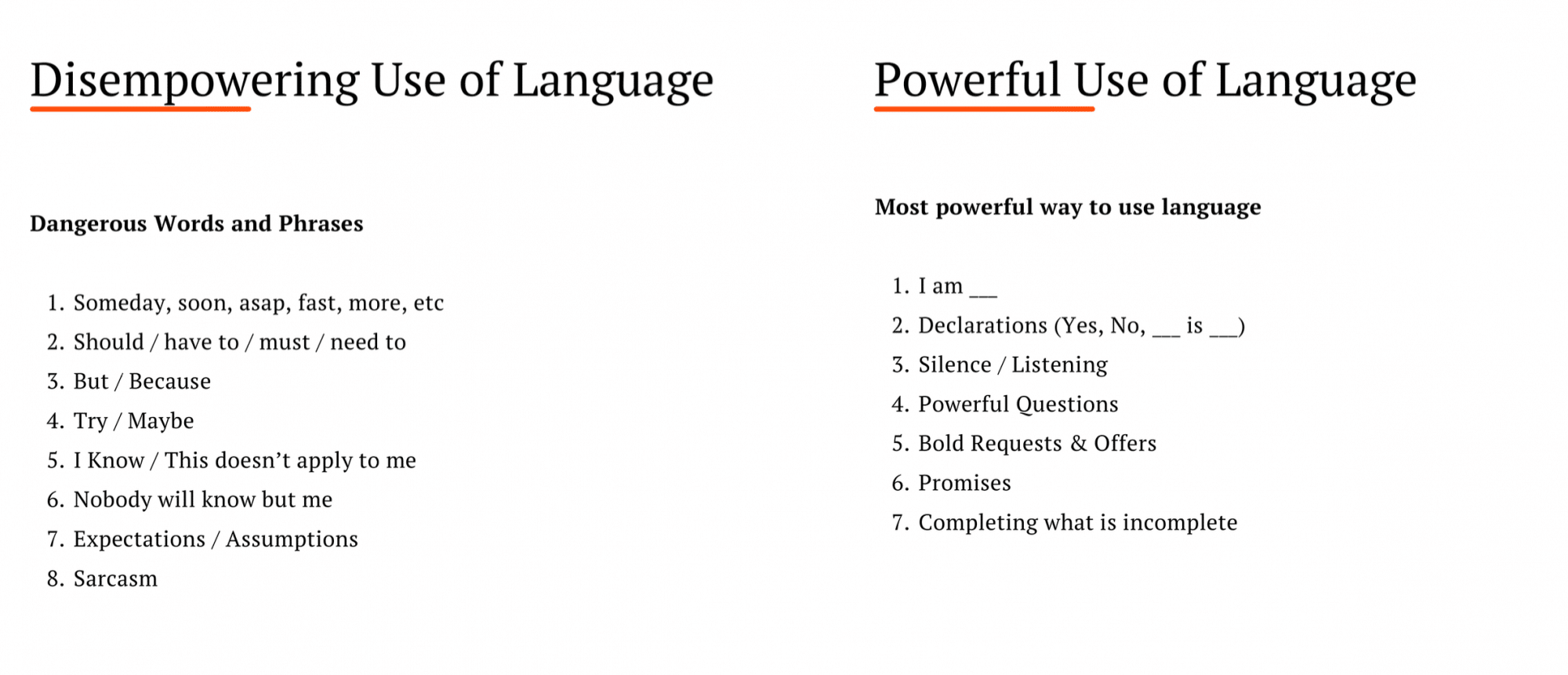
    • “I’ll try.”
    • “We should.”
    • “It’s in progress.”
    • “Almost done.”

    Those phrases sound harmless — but they hide millions of euros in waste, delay, repeated work, and frustration.

    The truth is that all results are produced through conversations. Yet most leaders have never learned how to have the right ones. That’s not a failure of our leaders. That’s a failure of our education system (but that’s a topic for another day).

    The problem isn’t that people don’t care. It’s that they don’t know how to have the right conversations in a rhythm that drives action.

    Work doesn’t just get done because people want to do it. It gets done when requests, promises, completions and incompletions are tracked, owned and closed.

    The truth is: All work is coordination (of human behaviour). And all coordination happens through four simple conversations.


    The Conversation for Coordination of Action

    Every time something gets done, it follows this invisible loop — whether you realize it or not.

    Let’s make it visible. It is the Conversation for Coordination of Action.

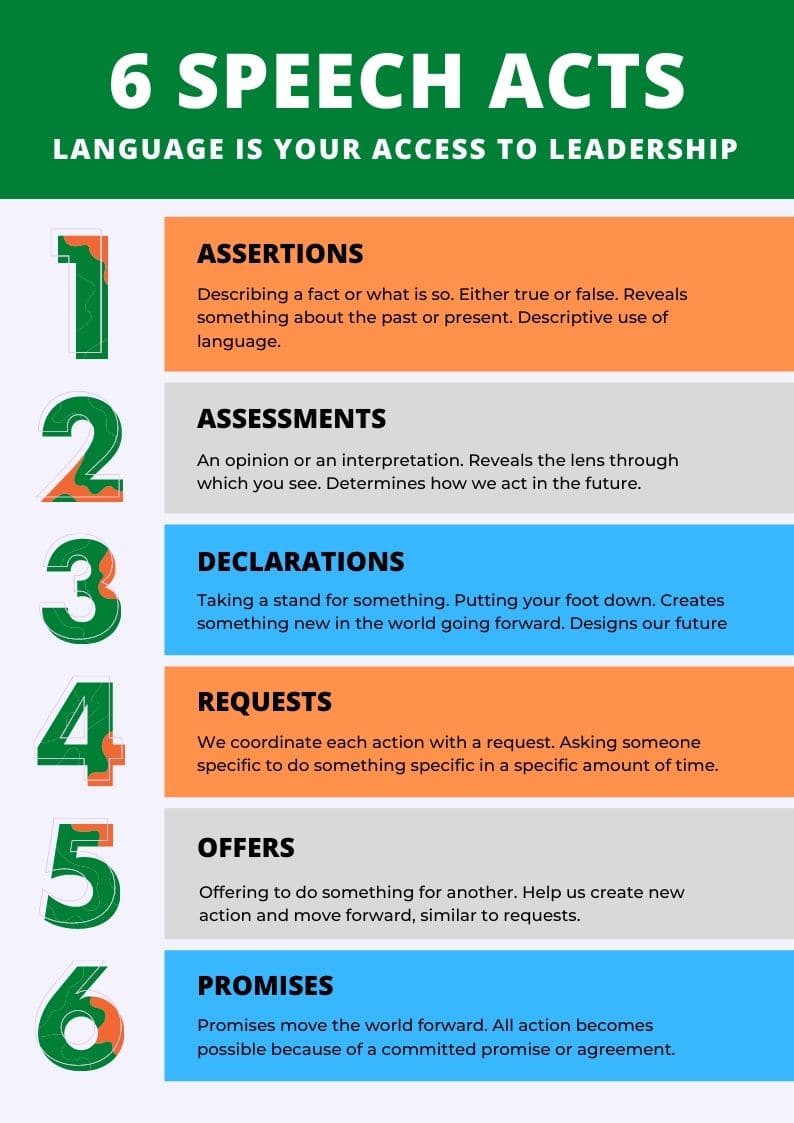
    This framework—the Conversation for Coordination of Action—comes from decades of research in speech act theory, organizational linguistics, and commitment-based management. It was pioneered by Terry Winograd and Fernando Flores in their groundbreaking 1986 work on how language creates action, not just describes it.

    The big insight? Coordination happens through explicit commitments, not assumptions.

    There are four conversations in the conversation of coordination of action:

    Conversation 1: Making a Clear Request or Offer (creating clarity from chaos)

    What’s really happening: You’re creating a possibility out of thin air.

    Every coordination of action starts with a request or an offer:

    • Request: “Can you do X?” (you become the customer of the execution)
    • Offer: “Can I do X?” (you become the performer of the execution)

    Today you’re the customer. Tomorrow you’re the performer. The roles flip constantly – with each request or offer.

    This step breaks down because Vague requests = vague results.

    ❌ “Can you handle this?”
    ❌ “Can we get this done soon?”
    ❌ “Let’s try to improve the deck”

    These aren’t requests. They’re hopes wrapped in politeness.

    Research on commitment-based management shows that unclear requests lead to what organizational psychologists call “fake agreement”—people say yes when they mean maybe, creating a trust debt that compounds over time.

    Real-World Example

    Broken:
    “Hey, can you send me the Q4 data when you get a chance?”

    Fixed:
    “Can you send me the Q4 revenue data by Thursday at 3 PM? I need the breakdown by region, formatted as a CSV, so I can include it in Friday’s board presentation.”

    Notice the difference:

    • What (Q4 revenue data)
    • When (Thursday, 3 PM)
    • How (CSV, by region)
    • Why (board presentation context)

    The Power Move: The “Conditions of Satisfaction” Checklist

    Before making any request, answer:

    1. What specifically do I need?
    2. By when do I need it?
    3. In what format or quality?
    4. Why does this matter? (Context helps people make smart trade-offs)

    Specificity isn’t being demanding—it’s being clear. When you’re clear, you give people what they need to succeed.

    A vague request is like ordering “something nice” at a restaurant. You’ll get something — but not what you want.


    Conversation 2: Negotiation and Promise (creating commitments from wishes)

    What’s really happening: You’re testing reality and building trust by creating trustworthy promises.

    This is where most leaders chicken out. They make the request, and they want the other person just to say “yes” instead of making sure they get an unequivocal, trustworthy YES that they know they can count upon.

    Each request has only four valid responses:

    1. Yes (I commit)
    2. No (I can’t/won’t)
    3. Counteroffer (I can do this instead)
    4. Commit to commit later (I need more info first)

    All four are legitimate. All four are respectful. Anything else is a future disappointment waiting for you.

    Why This Step Breaks Down

    People say “yes” when they mean “maybe” or “no” because:

    • They don’t want to disappoint you
    • They’re afraid of looking incompetent
    • Your culture punishes “no”
    • They genuinely want to help, but haven’t thought through the reality

    Research from organisational behaviour shows that most companies have chronic over-commitment, which leads to burnout, missed deadlines, and erosion of trust.

    You can only get a trustworthy promise if people can actually negotiate on what they will do by when.

    Real-World Example

    Broken:
    Manager: “Can you get this to me by Friday?”
    Employee: “Sure!” (internally screaming)

    Fixed:
    Manager: “Can you get this to me by Friday at noon?”
    Employee: “I’m already committed to the Martinez presentation Friday morning. I can get it to you by Monday at 10 AM, or I can get you a draft Friday afternoon—which works better?”

    See what just happened? The employee:

    • Acknowledged the request
    • Explained the constraint
    • Offered two alternatives
    • Put the decision back in the manager’s court

    That’s a real promise. Not a fake one.

    The Power Move: The “Four Valid Responses” Script

    When someone makes a request, train yourself (and your team) to respond with one of these:

    1. “Yes, I commit to [specific outcome] by [specific time].”
    2. “No, I can’t do that because [reason]. But here’s what I can do: [alternative].”
    3. “I need to check [X] before I can commit. Can I get back to you by [time]?”
    4. “I can do [modified version]. Does that work?”

    The unlock: A “no” is a gift. It means someone respects you enough to tell the truth. If your culture punishes “no,” you’ve just bought yourself a factory of resentment and missed deadlines.

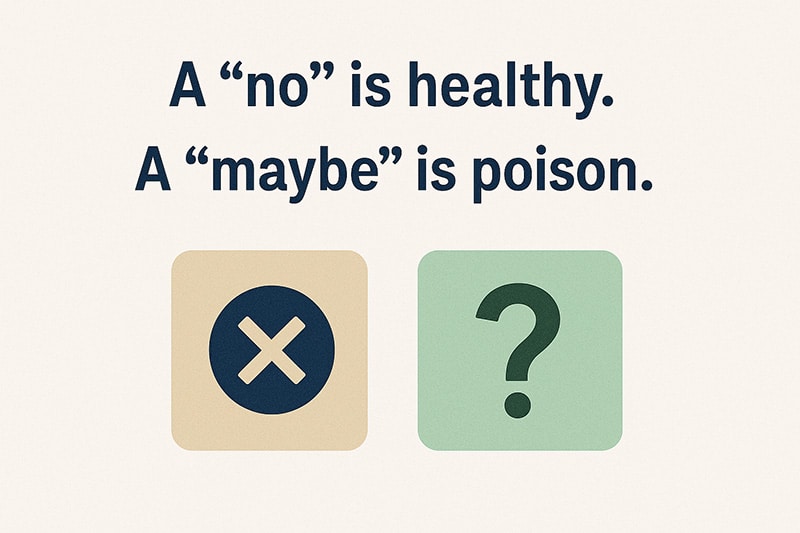
    A “NO” is as much a promise as a “YES”. And your role as a leader is not to get YESes but to create trustworthy promises people can count upon – whether they are a YES or NO. A “no” is healthy. A “maybe” is poison.

    The other person must have the space to say yes, no, or let’s renegotiate. When there’s a clear promise, trust is built. When there’s fake agreement, resentment brews.

    If people can’t say NO to you, their YESes have no value.


    Conversation 3: Execution and Declaration of Completion (creating satisfaction)

    This is the most invisible breakdown. And it’s everywhere. Someone finishes the work but never declares it’s done. The result?

    You’re sitting there waiting. Checking your inbox. Wondering if they forgot. Getting annoyed.

    They think they’re a hero. You think they’re slacking. Both of you are wrong – you just didn’t close the loop.

    Completion is a speech act. It doesn’t happen until someone says “It’s done.”

    But here’s the thing: most people assume that doing the work is enough. It’s not.

    Think about it like landing a plane. You don’t just descend and hope for the best. You announce it: “Touchdown. Wheels down.”

    That declaration closes the loop. Without it, the loop stays open—and open loops drain trust faster than anything else in an organization.

    Real-World Example

    Broken:
    Designer finishes the deck, saves it to Dropbox, goes to lunch. Manager is still waiting three hours later, thinking it’s not done yet.

    Fixed:
    Designer Slacks: “The Q4 deck is done and saved to Dropbox/Projects/Q4-Deck-Final.pptx. All feedback from yesterday’s meeting has been incorporated. Ready for your review.”

    Three sentences. Five seconds. Loop closed.

    The Power Move: The “Completion Declaration” Template

    When you finish something, always include:

    1. “[Task] is complete.”
    2. “It’s located at [place/link].”
    3. “I addressed [key requirements from the original request].”
    4. Optional: “Next steps are [X], or let me know if you need anything else.”

    The unlock: Declaring completion isn’t ego, it’s respect. You’re giving the other person certainty now so they can move forward.


    Conversation 4: Assessment and Feedback (learning & closing the loop)

    The last conversation is – the customer of the execution declares satisfaction or dissatisfaction, and everyone learns.

    Without this last step, loops stay open. Misunderstandings multiply. In research on coordination frameworks, lack of this phase is a major barrier to cross-functional execution.

    Without this step:

    • You repeat the same mistakes
    • Trust erodes silently
    • People invent stories about what “good” looks like
    • Resentment builds

    A feedback loop is essential for learning. This is what organizational learning researchers call “double-loop learning”. You’re not just fixing the task, you’re improving the system.

    But most leaders skip this step because it feels awkward, unnecessary, or confrontational. (read that again)

    Wrong. It’s the most respectful thing you can do.

    When you don’t give feedback, people:

    • Assume you’re unhappy (and invent reasons why)
    • Think they nailed it (and repeat the same mistakes)
    • Guess what “good” looks like (and drift further from your expectations)

    Research shows that feedback, regardless of content, positively influences performance, motivation, and task engagement. But here’s the catch: it has to actually happen. Teams just… never close the loop. And then wonder why coordination falls apart.

    Real-World Example

    Broken:
    Manager reviews the deck, thinks “This is decent, but not quite what I wanted.” Says nothing. Designer thinks they crushed it. Next project, same issues. Slowly, resentment builds and leads to future coflict, “this has happened for the last 3 times” (though I never told you so).

    Fixed:
    Manager responds: “Thanks for getting this done on time. The data visualizations are clear and the flow works. For next time: I need more emphasis on the ‘why it matters’ section—that’s what the board cares about. The current version is 80% there. Can you add one slide that directly addresses ROI implications? That would make it complete.”

    Notice:

    • Acknowledged what worked
    • Named what needs to change
    • Made it specific
    • Gave context (why it matters)
    • Created a path forward

    The Power Move: Acknowledge, Declare Satisfaction, and Make a Fresh Request (if reqd)

    Here’s how to do it right:

    1. Acknowledge completion: “You delivered this on time—thank you.”
    2. Declare satisfaction level: “This meets 80% of what I needed” OR “This fully satisfies the request.”
    3. Name specifics: “The [X] part is great. The [Y] part needs [specific change].”
    4. Explain why: “We need [Y] because [context].”
    5. Confirm next steps: “Can you revise [Y] by [time]?” OR “We’re good to move forward.”

    The unlock: Feedback isn’t criticism—it’s completion. Both “This nailed it” and “This missed the mark” are acts of respect. Silence is the real disrespect.


    Now multiply this loop by hundreds of projects, meetings, and emails inside your company every week.

    If your people don’t close these loops, you lose speed, trust, and energy. That’s why execution feels heavy – because thousands of promises are floating around unkept, unacknowledged, or untracked. Or worse, there are no promises – there are only plans, wishes, hopes, and expectations.

    As I often share, Expectations are the cancer of collaboration.


    The Hidden Cost of Poor Coordination

    Poor coordination isn’t just an organisational headache. It hits hard — financially, culturally, emotionally.

    • Wasted time & energy: If you’re chasing commitments, running after teams, and slotting in rescue meetings, you’re indirectly paying for all those unclosed loops.
    • Burnout & bottlenecks: When leaders become the hub of every decision because no one else is coordinating, you become the chokepoint. That’s a leadership trap.
    • Trust erosion: When people behave like “I’ll try” becomes the norm, you build a culture of maybe, delay, blame. According to research, when alignment is low ~68%, teams believe they’re not moving in the same direction. AchieveIt
    • Strategy drift: You may have a great vision, but if execution spirals out of coordination control, you don’t just miss targets — you lose competitive position. “More than 70 % of strategic growth plans fail … because execution breaks down.” Strategy Ladders

    If you run a €100 M business, even a 2-5 % drag from coordination breakdowns could mean millions in missed margin, customer churn, delayed launches, or wasted talent.

    You can’t scale bold visions on vague agreements and open loops. Period.

    When you master this conversation, you:

    Stop wondering why things aren’t happening (Because you made the invisible visible)
    Build a culture where people can say “no” without fear (Which paradoxically increases commitment)
    Create accountability that doesn’t feel like surveillance (Because it’s based on mutual promises, not control)
    Close loops so fast that momentum becomes your default state (Because nothing stays in limbo)

    Why This Matters More in 2025

    The world has shifted as remote teams, global functions, rapid tech change are the norm. In this environment:

    • You need coordination across functions not just alignment within them. Research shows that cross-functional coordination (or lack thereof) is now the core challenge. infeedo.ai
    • Visibility, accountability and speed matter more than ever. According to McKinsey, the healthiest organisations embed coordination and control and capability and motivation. McKinsey & Company

    What Great Leaders Do Differently

    Great leaders don’t try to do everything themselves. They install a culture of clean promises.

    They train their teams to have these four conversations consciously and explicitly. They build what I call coordination muscle — the ability to move fast without confusion.

    They stop saying: “Who’s on this?”
    and start saying: “Who’s making a promise here, and when will it be complete?”

    They don’t confuse motion with progress. They don’t reward “effort” – they reward closed loops (results).


    A Simple Example

    Let’s say your CMO asks the sales head: “Can you send me your input on the Q2 campaign soon?” That’s a weak request.

    A strong one sounds like:

    “Can you send your input on the Q2 campaign by Wednesday 5pm so we can finalize the copy on Thursday morning?”

    Now the performer can negotiate:

    “Wednesday’s tough, but I can send it Thursday morning at 8am.”

    That’s a clear promise. When it’s done, they declare completion.
    The CMO reviews and says, “Yes, this works,” or “Let’s tweak section two.”

    That’s a clean coordination loop.

    Now imagine 10,000 of those running in your company every week — clean, explicit, complete. That’s not just communication. That’s velocity. That’s the momentum you have been waiting for.


    NASA & Apollo Missions Example

    During the Apollo missions, NASA engineers lived by one simple rhythm: Request. Confirm. Execute. Verify. No vague “ASAPs,” no half-yeses. Every instruction was a clear commitment, every step was verified out loud. That discipline, not technology, is what put humans on the moon with computers weaker than your phone. The secret wasn’t genius; it was coordination done right.

    From Strategy to Execution: The Missing Bridge

    Most strategies fail not because they’re wrong. They fail because they die in the space between intention and execution.

    Leaders often think their job is to design the “what” and “why.” But the real test of leadership is creating and coordinating the chain of commitment conversations that make results that add value inevitable – and not just effort and time spent.

    Your job isn’t to have more meetings. It’s to coordinate human action. And you do that through the conversation for the coordination of action.

    This is how high-performing organisations work — not through charisma or chaos, but through clarity and closure.


    The Opportunity in Front of You

    If you can master this and teach your team to make, keep, and close promises cleanly — everything changes.

    • Execution accelerates.
    • Burnout drops.
    • Trust compounds.
    • Strategy turns into results.
    • You are free to zoom out and think bigger while your team executes on the weekly, monthly, and quarterly.

    Your company becomes a place where people do what they say and say what they’ll do.

    That’s not control. That’s coordination with integrity.

    And that, more than any new strategy, is what will separate your company from the rest.


    MIT’s Sloan Management Review calls coordination “the missing muscle in modern leadership.” It’s rarely taught, often assumed, and almost always under-practiced. Yet it determines whether strategies live or die in the real world.

    The uncomfortable truth? Most leaders don’t have a coordination blind spot. And until that’s addressed, every new strategy is just another expensive rehearsal for failure.

    In Simple Words

    You don’t need another meeting or more time. You need better conversations. Half the talk, double the promises.

    Not more talk — but conversations that coordinate action. Conversations that build trust. Conversations that close loops.

  • Why People Are Not Getting Your Strategy (And How to Fix It)

    The three levels of internal communication that turn confusion into alignment


    A CEO I’ve been working with recently told me something that I have heard too many times.

    “I’ve explained our strategy at least five times this quarter,” she said. “Town halls. Leadership meetings. Email updates. But when I ask people what we’re doing and why, I get five different answers.”

    She wasn’t angry. She was exhausted.

    “I don’t know how to say it any clearer,” she said.

    Here’s what I told her: You’re probably being perfectly clear. You’re just not being meaningful.

    And there’s a big difference.


    Most leaders communicate strategy the way they’d present a quarterly business review—lots of what, not much why, and almost no so what.

    They talk about initiatives, KPIs, market positioning, and organizational priorities.

    All important. All necessary.

    And all completely forgettable.

    Because here’s the truth: people don’t align around strategy. They align around meaning.

    And meaning doesn’t come from telling people what you’re doing. It comes from helping them understand what it does—for them, for the customer, for the mission they signed up for.

    The same three levels of communication that transform how you talk to customers? They’re even more powerful when you use them internally.

    Let me show you how.


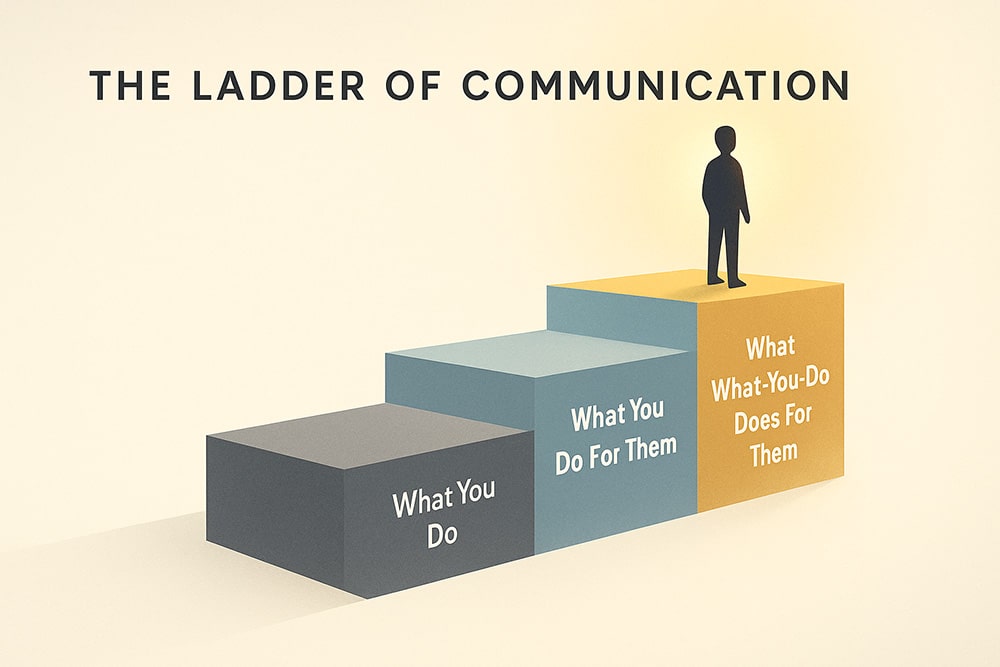
    Level 1: What We’re Doing

    This is where most internal communication lives.

    It’s the initiative. The project name. The reorganization. The new system rollout.

    • “We’re launching a digital transformation initiative.”
    • “We’re restructuring the sales org.”
    • “We’re implementing a new CRM.”
    • “We’re focusing on operational excellence this year.”

    It’s accurate. It’s what’s happening.

    But it doesn’t tell anyone why they should care.

    When you communicate at Level 1 internally, you get compliance, not commitment. People nod in the meeting. They add it to their task list. But they don’t feel connected to it.

    The result? Passive execution. Minimal discretionary effort. And when things get hard, people quietly disengage.

    Because you’ve told them what to do. You haven’t told them why it matters.


    Level 2: What We’re Doing For Them

    This is where leaders start to create relevance.

    Instead of just announcing the initiative, you connect it to the people executing it. You make it personal.

    • “We’re launching a digital transformation so teams can spend less time on manual processes and more time on work that actually moves the needle.”
    • “We’re restructuring the sales org so reps have clearer territories and more support from leadership.”
    • “We’re implementing a new CRM so you’re not juggling three different systems just to update a customer record.”
    • “We’re focusing on operational excellence so we can deliver faster, reduce firefighting, and stop working weekends.”

    See what changed?

    You’ve given people a reason to care. You’ve shown them what’s in it for them.

    Suddenly, it’s not just another corporate initiative. It’s something that could make their day-to-day better.

    Why it works: People support what they understand. And they understand what connects to their reality.

    But even this isn’t enough to create true alignment.


    Level 3: What What-We’re-Doing Does For Them

    This is where strategy becomes a shared mission.

    It’s not just what you’re doing for them. It’s what that outcome enables in their work, their impact, their sense of purpose.

    Let’s push those examples deeper:

    • “We’re launching a digital transformation so teams can spend less time on manual processes” becomes → “We’re doing this so you can focus on the work that made you want to join this company in the first place—solving real problems for customers, not wrestling with spreadsheets.”
    • “We’re restructuring the sales org so reps have clearer territories” becomes → “We’re doing this so you can build real relationships with your accounts, win deals you’re proud of, and finally feel like you’re building something—not just hitting a number.”
    • “We’re implementing a new CRM so you’re not juggling systems” becomes → “We’re doing this so you can serve customers the way you’ve always wanted to—fast, informed, and without having to put them on hold while you dig through three different databases.”
    • “We’re focusing on operational excellence so we can deliver faster” becomes → “We’re doing this so you can go home at a reasonable hour, trust that your work won’t unravel overnight, and feel proud of what we’re building together.”

    This is the level where people stop seeing strategy as a thing being done to them and start seeing it as something they’re part of.

    This is where discretionary effort lives. Where people go the extra mile. Where teams rally during tough moments.

    Because you’ve connected the what to the why—and the why to something they actually care about.


    Why This Matters More Than Ever

    Here’s what I see all the time: CEOs pour energy into crafting the perfect strategy. They workshop it with their leadership team. They refine the slides. They get the messaging just right.

    And then they roll it out like a product launch.

    They present it once. Maybe twice. And then they move on.

    And six months later, they’re frustrated because “people just don’t get it.”

    But here’s the thing: clarity isn’t a one-time event. It’s a drumbeat.

    And the drumbeat has to be meaningful, not just informative.

    People don’t align around a deck. They align around a story they can see themselves in.

    When you communicate at Level 3, you’re not just explaining strategy. You’re giving people a reason to care. A reason to show up. A reason to stay when things get hard.


    How to Do This in Practice

    Here’s how to apply this framework to your internal communication:

    1. Start with the announcement (Level 1)

    State what you’re doing clearly and concisely. Don’t skip this. People need to know the what.

    “We’re launching a new performance management system.”

    2. Add the practical benefit (Level 2)

    Connect it to their day-to-day. Make it relevant.

    “This system will replace the clunky process we’ve been using, so reviews are faster and less painful for everyone.”

    3. Go to the emotional core (Level 3)

    Paint the picture of what this enables.

    “We’re doing this so people actually get the feedback they need to grow—not just once a year in a stressful meeting, but ongoing, in real time, in a way that feels supportive. So you can build your career here, not just survive it.”


    Real Examples from Leaders Who Got It Right

    A manufacturing CEO announcing a safety initiative:

    • Level 1: “We’re implementing new safety protocols across all facilities.”
    • Level 2: “These protocols will reduce accidents and protect you and your teammates.”
    • Level 3: “We’re doing this so every single person here goes home to their family every night—no exceptions, no close calls. Because nothing we build is worth more than that.”

    A tech CEO rolling out a new customer service platform:

    • Level 1: “We’re adopting Zendesk for customer support.”
    • Level 2: “This will give you better tools to respond to customers faster and track issues more easily.”
    • Level 3: “We’re doing this so you can finally give customers the experience you’ve always wanted to give them—where nothing falls through the cracks and you’re the hero who actually solved their problem.”

    A nonprofit executive director announcing a strategic pivot:

    • Level 1: “We’re shifting our focus from direct services to advocacy.”
    • Level 2: “This means we’ll be working on systemic change rather than individual case management.”
    • Level 3: “We’re doing this so the work you do doesn’t just help one person today—it changes the system so thousands of people get the support they deserve, for years to come. So your effort compounds.”

    In every case, the leader took the same journey: from what do we do to what that does for them.

    And in every case, people leaned in.


    What Changed for My CEO Client

    When I walked that CEO through this framework, something clicked.

    She realized she’d been communicating like a strategist when her team needed her to communicate like a leader.

    She wasn’t lacking clarity. She was lacking connection.

    So she tried something different.

    At her next town hall, she didn’t just explain the strategy. She explained what it would do—for customers, for the team, for the mission they’d all signed up for.

    She didn’t just talk about growth targets. She talked about what growth would enable: more investment in people, better tools, less chaos, more impact.

    And for the first time in months, she said, people didn’t just nod politely.

    They asked questions. They pushed back. They engaged.

    Because for the first time, they understood not just what they were doing—but why it mattered.


    The Bottom Line

    If your strategy isn’t landing, it’s probably not because people don’t understand it.

    It’s because they don’t feel it.

    And feelings don’t come from org charts or initiative names.

    They come from meaning. From connection. From understanding what this does for me, for us, for the work we care about.

    When you master these three levels of internal communication—from what we’re doing, to what we’re doing for you, to what that enables—you stop managing and start leading.

    You stop explaining and start inspiring.

    And you stop wondering why people aren’t aligned.

    Because they finally are.


    give it a go in your next all-hands. You’ll feel the difference.

  • SALES – Three Levels of Communicating What You Do

    How shifting from “what you do” to “what it does for them” transforms sales, leadership, and trust


    A CEO I work with runs a successful industrial manufacturing company. His team knows the product inside out. They hit their numbers. But he kept running into the same problem: his salespeople couldn’t articulate value in a way that made customers lean in.

    “They’re technically competent,” he told me. “But when they talk to prospects, something falls flat. It sounds transactional. Forgettable.”

    I asked what they typically say. He laughed. “Exactly what we do. ‘We manufacture industrial pipes.’ Or ‘We provide piping solutions for commercial buildings.’ And the customer nods politely and moves on to the next vendor.”

    The issue wasn’t what they were saying—it was how they were saying it.

    What this CEO’s team lacked wasn’t product knowledge. It was communicative depth.

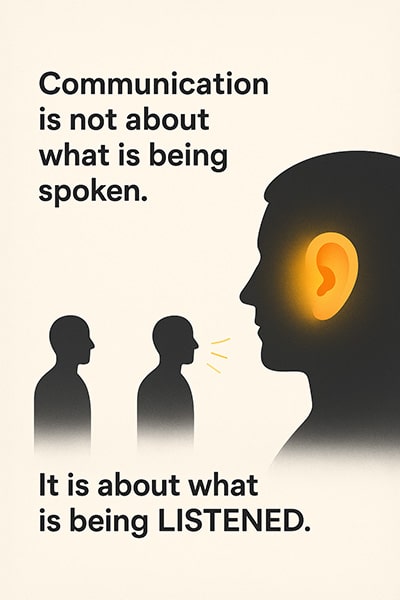
    Because communication is not about what is spoken. It is about what is being LISTENED.

    When two people are talking, all the power lies in the LISTENER. When you understand this, you understand communication.

    And it’s not just a sales problem. It’s a leadership problem. A human connection problem.

    Most professionals—whether they’re selling, leading, or just introducing themselves at a conference—operate at the surface level of communication. They describe what they do, not why it matters.

    But there’s a framework that changes this. Three levels of communication that, when mastered, transform how people perceive you, trust you, and choose to work with you.


    Level 1: What You Do

    This is where most people stop.

    It’s the job title. The function. The category.

    • “I’m a financial advisor.”
    • “I run a marketing agency.”
    • “We manufacture components for the automotive industry.”

    It’s accurate. It’s safe. But it’s also invisible.

    When you communicate at Level 1, you sound like everyone else in your field. You’re describing the work, not the value. You’re naming the category, not the outcome.

    The problem? Categories don’t create differentiation. And they certainly don’t inspire action.

    The risk: You commoditize yourself before the conversation even begins.


    Level 2: What You Do For Them

    This is where things shift.

    Instead of talking about yourself, you pivot toward the person you’re speaking to. You introduce specificity and relevance.

    • “I help families plan their finances so they can retire comfortably.”
    • “We design marketing campaigns that help B2B companies generate qualified leads.”
    • “We provide end-to-end piping systems for commercial buildings—from design to installation.”

    Notice what changes: the listener can now see themselves in the picture. You’ve moved from describing a function to articulating an application.

    You’re no longer just a financial advisor—you’re someone who helps people grow their assets. You’re not just a marketer—you’re someone who solves a revenue problem.

    Why it works: People don’t buy what you do. They buy what it does for them.

    But even this isn’t enough.


    Level 3: What What-You-Do Does For Them

    This is the level where trust is built. Where emotional resonance happens. Where people stop seeing you as a vendor and start seeing you as a partner.

    It’s not just what you do for them—it’s what that outcome enables in their life or business.

    Let’s revisit those examples:

    • “I help families plan their finances so they can retire comfortably” becomes → “I help people sleep peacefully at night, knowing their future is secure.”
    • “We design marketing campaigns that generate qualified leads” becomes → “We help companies grow predictably, so leaders can stop worrying about where the next deal is coming from.”
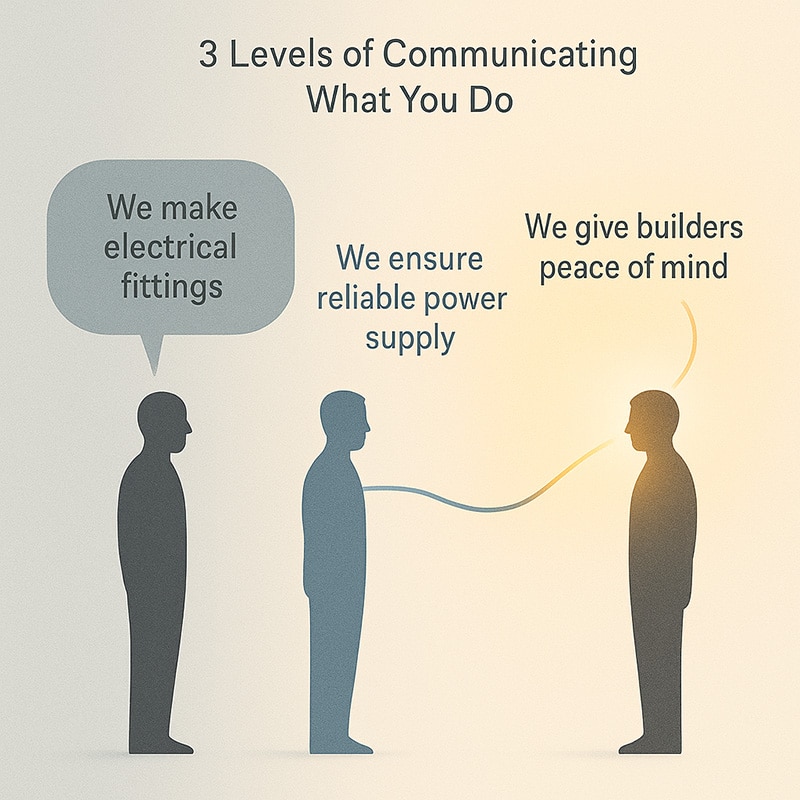
    • “We provide end-to-end piping systems for buildings” becomes → “We make sure when you’re building something, you never have to worry about leaks, fittings, or supply delays—you can focus on delivering your project smoothly and confidently.”

    See the shift?

    You’re no longer selling pipes. You’re selling peace of mind.

    You’re not offering financial planning. You’re offering security.

    You’re not just generating leads. You’re creating predictability.

    This is where great communicators live. They understand that people don’t make decisions based on logic alone—they make them based on how something makes them feel.

    And feelings are born from outcomes, not features.


    Why Most Leaders Never Get Here

    Level 3 requires something most organizations don’t prioritize: empathy.

    It requires you to understand—deeply—what your customer, your team, or your stakeholder actually wants. Not what they say they want in a requirements doc. Not what’s in the RFP. But what they lie awake thinking about at 2 a.m.

    • A CFO doesn’t just want a financial forecast. They want confidence in the board meeting.
    • An operations manager doesn’t just want a vendor. They want someone who won’t let them down when it matters.
    • A new client doesn’t just want a consultant. They want someone who gets it without them having to explain everything.

    When you communicate at Level 3, you stop selling and start connecting and listening. And when you connect, selling happens naturally.


    Practical Application: Give It a Shot

    Here’s how to apply this in your own work:

    Step 1: Write down what you do. One sentence. That’s Level 1.

    Step 2: Ask yourself: What do I do for them? Rewrite it.

    Step 3: Go deeper. Ask: What does that do for them? What’s the real impact on their life, their team, their sleep, their confidence, their results? Rewrite again.

    You’ll end up with something that feels more alive. More human. Something that makes people stop scrolling, stop half-listening, and actually pay attention.


    Examples Across Industries

    A real estate agent:

    • Level 1: “I help people buy and sell homes.”
    • Level 2: “I help families find the right home for their budget and lifestyle.”
    • Level 3: “I help families find that one place where they’ll build memories, raise kids, and feel safe.”

    A SaaS company:

    • Level 1: “We sell project management software.”
    • Level 2: “We help teams manage tasks and deadlines more efficiently.”
    • Level 3: “We help teams stop drowning in chaos so they can focus on doing their best work.”

    A leadership coach:

    • Level 1: “I’m a leadership coach.”
    • Level 2: “I help executives develop their leadership skills.”
    • Level 3: “I help leaders rediscover confidence in who they are and what they’re capable of.”

    Every time you move up a level, you move closer to the heart of what people actually care about.


    What Changed for the CEO

    When I walk my clients through this framework, they often go quiet for a moment. And they see the simplicity and power of the framework – almost like an ‘aha’ moment.

    My client’s sales team wasn’t failing because they didn’t know the product. They were failing because they couldn’t translate what they did into something that mattered to the customer.

    Most of us make the same mistake.

    We get stuck in the “what.” We forget the “why.”

    But when you learn to climb these three levels—from what you do, to what you do for them, to what that enables for them—everything changes.

    People listen differently. Conversations open up. Trust builds faster.

    And honestly? It just feels better.

    Because deep down, we all want the same thing—to be understood.

    And that’s exactly what this kind of communication does.

    It makes you understood.

    And that’s where connection—and trust—begin.


    Give this a shot. Genuinely. Not as a tactic. You’ll see the difference.

  • Empathy without Authenticity is just Mediocrity

    The False Choice Between Empathy and Authenticity: Why True Leaders Need Both

    There is a dangerous myth that I have from multiple leaders that hold them back without they even realising.

    It’s the belief that you must choose between being empathetic and being authentic (or assertive)—that you can have one or the other, but never both. This false dichotomy has weakened leadership at the highest levels and created generations of well-meaning but ineffective executives.

    Read that last sentence again.

    The Empathy Trap

    “I can’t be completely honest because I need to be empathetic.”

    “If I challenge them directly, I won’t be honoring their perspective.”

    These thoughts likely sound familiar. They represent what I call the Empathy Trap—the belief that understanding someone else’s perspective means you must dilute your own truth.

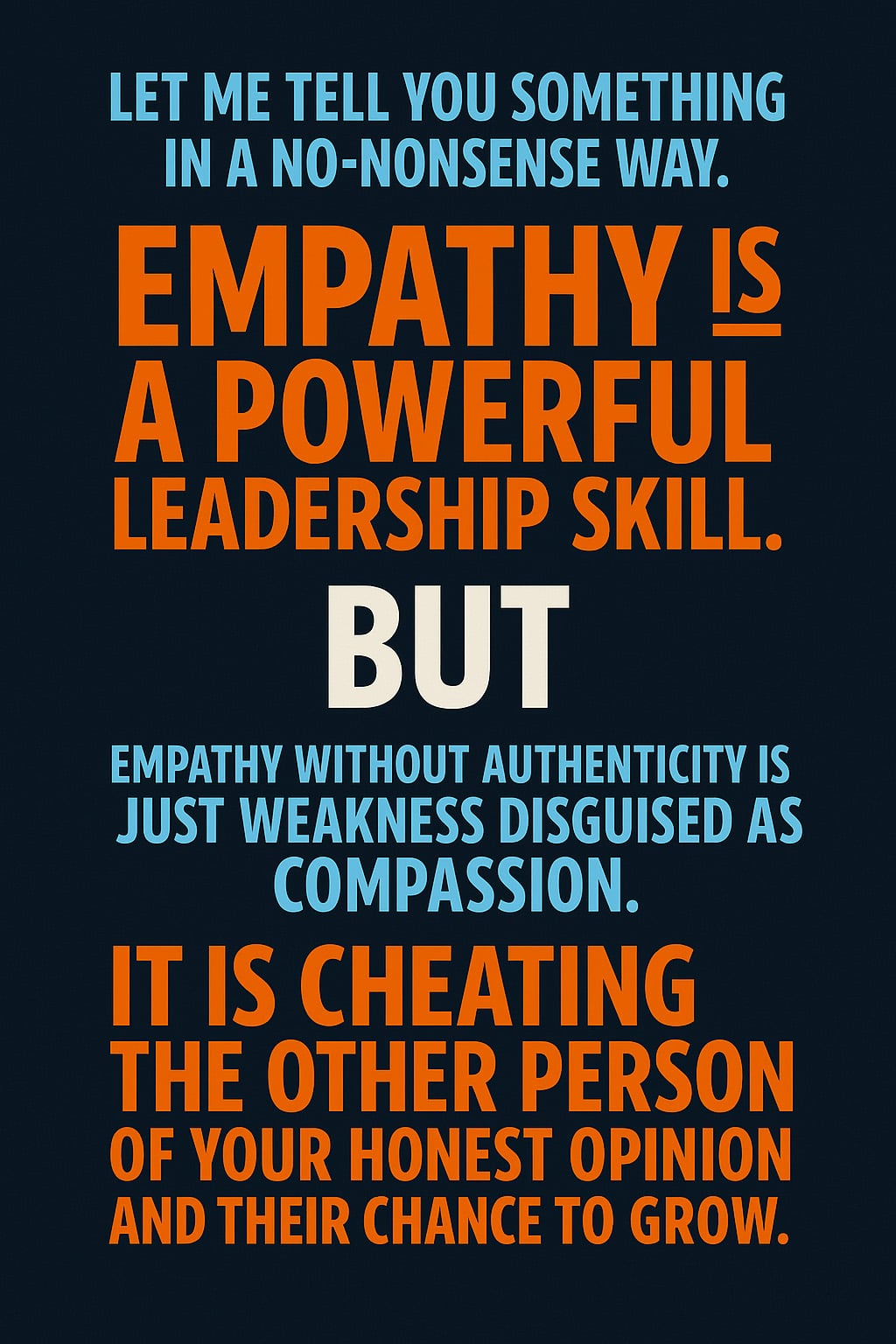
    Let’s be clear: empathy without authenticity is just weakness disguised as compassion.

    When you withhold your honest assessment or avoid necessary confrontation under the guise of being “empathetic,” you’re not serving anyone—not yourself, not your team, not your organization. You’re simply avoiding discomfort.

    Consider this common scenario:


    Leader: “Sarah, your presentation was… interesting. I think clients will appreciate the different approach you’ve taken.”

    What the leader actually thinks: “This presentation has serious flaws that will confuse our clients and potentially lose the account.”

    Sarah: “Great! So I can use this approach for the client meeting next week?”

    Leader: “Sure, maybe just polish it up a bit before then.”


    This leader believes they’re being empathetic by sparing Sarah’s feelings. In reality, they’re setting her up for failure and denying her the chance to improve.

    The Cost of Inauthentic Leadership

    Every time you swallow your truth to spare someone’s feelings, you pay a price:

    1. You deny yourself the opportunity to advocate for your own values and vision
    2. You rob the other person of your genuine perspective—something they might desperately need
    3. You model conflict avoidance rather than healthy engagement
    4. You erode your self-trust and confidence by creating a gap between what you think and what you say

    These costs compound over time. Organizations led by the “empathetically inauthentic” become places where difficult conversations are avoided, mediocrity is tolerated, and real innovation stalls.

    Authentic Leadership Is an Act of True Empathy

    Here’s the paradigm shift every senior leader needs to embrace: true empathy requires authenticity.

    When you approach leadership with complete authenticity—speaking your truth, addressing issues directly, challenging others when necessary—you’re performing the most empathetic act possible. You’re saying, “I respect you enough to give you my unvarnished truth.”

    This isn’t about being harsh or uncaring. It’s about recognizing that authentic communication, even when uncomfortable, is the foundation of genuine respect and trust.

    The Power of Uncomfortable Authenticity

    The most transformative leadership moments often emerge from uncomfortable authenticity:

    • The feedback session where you directly address performance issues others have avoided mentioning
    • The strategic meeting where you challenge a popular but flawed initiative
    • The one-on-one where you express your genuine concerns about someone’s leadership approach

    These moments of authentic leadership create space for growth, clarity, and alignment that polite avoidance never could.

    Let’s revisit the scenario with authentic leadership:


    Leader: “Sarah, can I be direct with you because this presentation matters? (after her ‘yes’) The approach you’ve taken has some fundamental issues that would confuse our clients and potentially put the account at risk.”

    Sarah: “Oh… I thought it was innovative.”

    Leader: “I appreciate your desire to innovate, and that’s exactly why I’m giving you my honest assessment. The core concept has potential, but the execution needs substantial work. Let’s block an hour tomorrow to rethink it together. I believe in your ability to nail this, which is why I’m not just letting it slide.”

    Sarah: “That’s… actually helpful. Thank you for being straight with me.”


    This leader combines empathy (understanding Sarah’s intentions and believing in her potential) with authenticity (providing honest feedback). The result is growth rather than failure.

    Leaders Lead

    The simple truth is that leaders lead. They don’t merely accommodate or placate.

    True leadership means:

    • Setting the standard rather than just meeting it
    • Speaking necessary truths even when silence would be easier
    • Challenging others to rise to their potential, not just accepting where they are

    When you fully embrace authenticity in your leadership, you establish a new standard—not just for yourself, but for everyone around you. This is how cultures transform. This is how organizations evolve. Example:

    Team Member: “I’m not sure we need to focus on quality improvement right now. Our metrics are within acceptable industry standards.”

    Passive Leader: “You make a good point. We should be proud of meeting industry standards.”

    Authentic Leader: “I understand the industry standards, but I didn’t build this company to be standard. Meeting the minimum isn’t our goal. I believe we can do better, and more importantly, our customers deserve better. What would it take to raise our quality score by 20% this quarter?”


    This authentic leader refuses to accept mediocrity, even when it would be easier to do so.

    The Both/And Approach

    The most effective leaders understand that empathy and authenticity aren’t opposing forces—they’re complementary powers.

    Empathy without authenticity becomes empty platitudes and conflict avoidance. Authenticity without empathy becomes harshness and needless pain.

    The leadership sweet spot lies in their integration:

    • Understanding deeply and speaking truthfully
    • Recognizing feelings and addressing realities
    • Acknowledging perspectives and providing clear direction

    Practical Steps Toward Authentic Leadership

    If you’re ready to break free from the false choice between empathy and authenticity, start here:

    1. Audit your communication patterns. Where are you holding back your truth out of misplaced “empathy”?
    2. Reframe difficult conversations. See them not as conflicts to avoid but as opportunities to provide value through honesty.
    3. Practice authentic empathy. Before challenging conversations, ask yourself: “How can I deliver this truth in a way that demonstrates I care about this person’s growth?”
    4. Raise your standards. Commit to being the leader who models authentic engagement, even when—especially when—it’s uncomfortable.
    5. Embrace discomfort as growth. Recognize that the momentary discomfort of authenticity creates space for lasting transformation.

    Team Member: “I’ve been struggling with the new systems. I feel like everyone else adapted quickly, and I’m falling behind.”

    Empathetic But Inauthentic Leader: “Don’t worry about it. You’re doing fine. You will learn everything in time.”

    Authentic But Unempathetic Leader: “You need to get up to speed immediately. This is unacceptable.”

    Leader Using Both: “I appreciate your honesty about the challenges you’re facing. It takes courage to acknowledge when you’re struggling. At the same time, I need to be clear that becoming proficient with these systems is non-negotiable for your role. What specific support do you need to get there in the next two weeks?”


    The leader who combines empathy and authenticity acknowledges feelings while maintaining clear standards.

    The Ultimate Leadership Legacy

    Every senior leader leaves a legacy. Will yours be one of polite avoidance and conflict aversion? Or will it be a legacy of authentic engagement that elevated everyone around you?

    Here is an example of what a CEO client of mine shared with his leadership team: “Let me share something I learned too late in my career. For years, I thought being a good leader meant making everyone comfortable, avoiding conflict, and being universally liked. I was wrong. My greatest contributions came when I found the courage to be authentically myself—to challenge when challenge was needed, to set uncomfortable standards, and to speak difficult truths. Don’t wait as long as I did to discover that empathy without authenticity cheats everyone of their potential.”

    When you are fully authentic, even when it gets uncomfortable, you are setting an example and a high bar—for yourself and others.

    The organizations that thrive in uncertain times aren’t led by people pleasers or conflict avoiders. They’re led by authentic leaders who understand that true empathy isn’t about making people comfortable—it’s about making them better.

    The time for choosing between empathy and authenticity is over. True leadership demands both. Your team deserves both. And ultimately, your own leadership journey requires both.

    The question isn’t whether you can afford to be both empathetic and authentic. The question is: can you afford not to be?

  • The Power of Conviction: How Authentic Belief Drives Powerful Communication

    The Inner Game of Premium Positioning

    Ten years ago, you created something revolutionary. You set the standard. Today, competitors crowd your space, and the risks of commoditization are louder than before. The natural response? Doubt. Hesitation.

    Perhaps even a subtle urge to compete on price rather than value.

    But here’s the uncomfortable truth: your organization will never perform beyond the level of conviction held by its leadership.

    Your product might be excellent. Your team might be talented. But if you secretly wonder “are we really worth the premium?” – you’ve already lost.

    The Conviction Crisis

    I’ve seen it repeatedly in premium brands facing market maturity. The gradual erosion begins invisibly – not in market share or even customer perception, but in the quiet thoughts of leadership:

    • “Are we worth that premium anymore?”
    • “Can we still justify these prices when competitors offer similar features for less?”
    • “Do we still have the right to call ourselves industry leaders?”

    Is your thinking or language during your leadership meetings already showing doubt?

    These doubts seep into executive meetings, color strategy discussions, and eventually transform how you communicate with the market. Your sales team senses it. Your customers detect it. And the race to the bottom begins – not because your offering lost value, but because you stopped believing in it.

    A Story

    A few months ago, I watched a brilliant founder pitch his premium software solution to a roomful of potential clients. His product was genuinely superior, but halfway through, someone questioned his pricing. Instead of standing firm, he hesitated for just a second before responding.

    That tiny pause said everything. Three potential clients who had been nodding along suddenly started checking their phones. The sale was lost before his defense even began.

    Your customers aren’t buying your features. They’re buying your certainty.

    Rediscovering Authentic Conviction

    True conviction isn’t manufactured – it’s rediscovered. It’s about reconnecting with the truth of what you’ve built and deliver:

    1. Conduct a value audit: Document every advancement, innovation, and customer success from the past. This isn’t marketing material; it’s leadership’s reminder of the actual value created. Do not just understand it. Get it in your bones. Feel proud of it.
    2. Seek honest customer testimony and create a success journal: Not satisfaction scores, but genuine conversations about how your solutions transformed their operations. Record these verbatim – they’re your mirror when doubts arise.
    3. Experience your premium difference: Leadership should regularly experience your offering as customers do, contrasted directly with alternatives. The premium difference must be felt, not just described.

    Communicating with Conviction

    When authentic conviction exists, communication transforms:

    • You speak with clarity about your position because you know rather than hope you deliver superior value
    • You discuss price as an investment rather than a cost because you’ve witnessed the returns
    • You lead conversations with value and outcomes rather than features or discounts
    • You take a powerful stand for who you are, why you are unique, and where you are headed
    • You have an answer to “Why working with us is the best decision you will make?”
    • You do not take criticism or sarcasm about your eroding value lightly – even if it means confronting people
    • You stand up and speak powerfully not against others – but from owning your own worth and value

    Your conviction creates permission for clients to believe. When you genuinely know your solution is worth every premium dollar, prospects sense it. They’re not buying features – they’re buying your certainty.

    A Story

    When you truly believe:

    • You discuss price last, not first
    • You talk about transformation, not transactions
    • You share stories, not specifications
    • You listen more than you pitch

    A medical device company I worked with stopped talking about their surgical tool’s technical advantages and instead had surgeons share how it gave them confidence during the most high-stakes moments of their careers. Their sales doubled not because the product changed, but because their message connected to what surgeons truly cared about – being their best when patients needed them most.

    Innovation Flows from Belief

    The most powerful R&D investments emerge not from fear of competition but from deep belief in your mission. When you’re truly convinced of your premium value proposition, innovation becomes an extension of that conviction rather than a desperate attempt to justify it.

    The greatest competitive advantage isn’t your current product superiority – it’s your unshakable belief in the next evolution of value you’ll deliver.

    The Courage to Stand Apart

    The market constantly pressures premium brands toward commoditization. Resisting requires courage – the courage to price based on value rather than competitor benchmarks, to speak differently, to refuse participation in feature-comparison battles.

    This courage comes only from conviction. Not arrogance or wishful thinking, but the quiet certainty born from decades of seeing the transformative impact of your work.

    Remember: if you’re not absolutely convinced of your premium value, no sales technique, marketing campaign, or strategic plan will overcome that fundamental gap. The most urgent work may not be external strategy but internal belief – rediscovering and recommitting to the authentic value that makes your premium position not just defensible but necessary for your customers’ success.

    Your years of experience isn’t a liability – it’s your foundation of credibility. Every problem solved, every customer transformed, every innovation delivered is proof of your promise.

    Believe in that promise again – not as a strategy, but as your truth. When you truly believe, the market feels it. And that belief is worth more than any marketing budget in the world.

    Your greatest competitive edge isn’t your legacy of innovation but your capacity to believe in its continuing value.

  • The Trap of “How” & “How to” Questions for Leaders

    *“How to”* questions focus on tactical, surface-level solutions rather than deep transformation. These questions imply that there’s a specific formula or step-by-step guide to solving complex leadership challenges. leadership isn’t about following a manual—it’s about shifting perspectives, developing emotional intelligence, and leading with authenticity in situations that are unpredictable and nuanced.

    *Here’s why “how” questions miss the mark:*

    *They Assume There’s One Right Way* : When you ask “how,” you’re looking for a fixed answer or a quick-fix solution. leadership is deeply personal. What works for one leader might not work for another because each leader’s context, personality, and challenges are unique. Asking “how” oversimplifies this complexity.

    *They Avoid Self-Reflection:* True leadership growth comes from looking inward, identifying your values, strengths, blind spots, and mindset shifts. “How” questions bypass this inner exploration by seeking an external solution. For example, instead of asking, “How do I motivate my team?” a more powerful question is, “What is it about my leadership that may not be inspiring my team right now?”

    *They Can Create Dependency:* “How” questions often reinforce the idea that someone else has all the answers, which can make a leader dependent on someone else’s guidance rather than trusting their own judgment and instincts. There is no handbook of leadership, even though everyone will give you theirs when you ask “how” questions.

    *They Close Off Possibility:* Leadership is about navigating ambiguity and complexity. Asking “how” limits thinking to one route or solution – to what is already known or achieved in the past. It keeps us in the realm of incremental improvements rather than opening the door to disruptive, exponential growth.

    In contrast, open-ended questions like “What’s possible?” or “What’s standing in my way?” expand thinking and open up a world of possibilities. aThese types of questions lead you into the realm of “what you do not know that you do not even know.” In leadership, this is the fertile ground where breakthroughs happen.

    *They Focus on the Symptoms, Not the Root Cause:* “How” questions often address the immediate problem rather than exploring the deeper issue that’s causing it. If a CEO asks, “How do I improve team communication?” they can instead explore, “What beliefs or behaviors are currently hindering communication in the team?” This leads to more lasting change.

    Many of the world’s greatest innovators, like Steve Jobs or Elon Musk, didn’t ask “how.” They asked questions like, “What if?” or “Why not?” These questions break the mold and allow creativity and visionary thinking to thrive.

    Examples

    Here’s a table that contrasts weak “how” questions with more powerful, expansive questions that unlock greater possibilities:

    Weak “How” QuestionsPowerful, Expansive Questions
    How can I grow my business by 10% this year?What’s possible if I remove all current limits on my business growth?
    How do I get my team to meet their goals?What would it take for my team to consistently exceed their goals?
    How can I solve this problem?What am I not seeing that could transform this situation entirely?
    How do I become a better leader?Who do I need to become to lead in ways that create exponential impact?
    How do I scale my company?What new markets or opportunities could 10x my company’s growth?
    How can I motivate my team?What kind of leader do I need to be to inspire my team to self-motivate?
    How do I manage this challenge?What’s standing in my way, and how can I leverage it as an advantage?
    How can I improve my product?What could I create that revolutionizes my industry?
    How do I get more customers?What untapped audience could I serve that I haven’t even considered?
    How do I increase my efficiency?What systemic changes would allow us to operate on a whole new level?
    How do I handle this conflict?What deeper issue or opportunity is this conflict revealing?
    How can I make time for everything?What truly matters, and how can I focus on that to maximize impact?
    How do I manage my workload?What am I doing that no longer serves me or the bigger vision?
    How do I deal with competition?What new paradigm can I create that makes competition irrelevant?
    How do I prepare for next quarter’s results?What bold moves can I make now that would disrupt next quarter’s expectations?

    This contrast shows that while weak “how” questions tend to focus on specific, immediate tasks or problems, powerful questions invite broader thinking, challenge existing assumptions, and open up pathways to exponential growth.

    Who Not How

    The phrase “Who Not How” is a powerful mindset shift popularized by Dan Sullivan. This concept emphasizes the importance of focusing on who can help you achieve your goals rather than getting bogged down in the how of accomplishing them.

    How ” questions can indeed become a trap in certain situations, particularly when they focus too much on the process rather than the people involved.

    “How” questions often lead to:

    The Trap of “How” Questions

    • Overthinking : They can cause people to get bogged down in details and processes.
    • Limiting creativity : By focusing on the “how,” we may miss innovative solutions.
    • Overwhelm : Complex “how” questions can paralyze action due to perceived difficulty.
    • Individual burden : They can imply that the person being asked must solve the problem alone.

    The Limitations of “How” Questions
    “How” questions can hinder leadership and growth in several ways:

    1. Promotes Micromanagement : “How” questions often focus on specific processes or methods, which can lead leaders to become overly involved in day-to-day operations.
    2. Limits Creativity : By focusing on the “how,” leaders may inadvertently restrict innovative thinking and problem-solving approaches.
    3. Creates Dependency : When leaders constantly provide answers to “how” questions, it can create a culture of dependency where team members always look to the leader for solutions.
    4. Narrows Perspective : “How” questions tend to focus on immediate solutions rather than encouraging broader, strategic thinking

    The Power of “Who” Questions
    In contrast, “who” questions can unlock unlimited growth for leaders:

    1. Encourages Delegation : By asking “who” questions, leaders shift their focus from processes to people, promoting effective delegation and empowerment.
    2. Fosters Collaboration : “Who” questions naturally involve others in problem-solving, leading to more diverse perspectives and innovative solutions.
    3. Develops Team Members : By identifying the right people for tasks, leaders can provide growth opportunities and develop their team’s skills.
    4. Expands Networks : “Who” questions encourage leaders to look beyond their immediate circle, potentially uncovering valuable connections and resources.
    5. Promotes Strategic Thinking : Instead of getting bogged down in details, “who” questions allow leaders to focus on high-level strategy and vision

    Examples

    Weak “How” QuestionsPowerful “Who” Questions
    How can I grow my business by 10% this year?Who can help me achieve 10x growth this year?
    How do I build a marketing strategy?Who is the best marketing strategist I can partner with?
    How can I scale my team without burnout?Who can help me design a scalable and sustainable team structure?
    How do I create more time in my schedule?Who can I delegate tasks to that free up my time for higher value activities?
    How can I improve my leadership skills?Who can mentor me to become a more effective leader?
    How do I solve this technical problem?Who has the expertise to solve this technical problem quickly?
    How can I motivate my team?Who can provide insights on how to inspire and lead my team effectively?
    How do I manage all these projects?Who can take over managing these projects so I can focus on the big picture?
    How do I get more sales leads?Who is the best at generating high-quality leads that I can work with?
    How can I raise capital for my business?Who can connect me with investors or help me with fundraising?
    How do I handle conflict in my team?Who can help mediate and resolve conflicts effectively within my team?
    How can I improve my product design?Who is a product design expert that I can collaborate with?
    How do I expand into new markets?Who has experience in these markets that can guide our expansion?
    How do I improve team communication?Who is the right person to help implement better communication systems?
    How can I innovate in my industry?Who are the top innovators that I can learn from or partner with?
    How do I manage my time better?Who can help streamline my schedule and manage non-essential tasks for me?

    This table illustrates how focusing on “who” instead of “how” allows leaders to leverage the strengths of others, enabling faster growth, more efficiency, and bigger breakthroughs.

  • Why “Try & Hope” Is Weak & Not a Strategy

    Why “Try & Hope” Is Weak & Not a Strategy: Turn Wishful Thinking Into Actionable Results by Speaking Committed Language

    Many leaders fall into the trap of saying, “I’ll try,” or “I hope this works.” It feels harmless, but these words are weak. They give you an easy out, allowing you to escape responsibility. Here’s the truth: hope is not a strategy, and trying is not committing. It’s time to ditch the wishful thinking and start using language that drives results.

    The Problem with “Hope” and “Try”

    When you say, “I’ll try to meet the deadline,” you leave yourself wiggle room. You’re already signaling that failure is an option. And when failure comes, you can shrug and say, “I tried.”

    It’s like hoping your car will make it to the destination on an empty tank. Sure, you might get lucky, but chances are, you’re going to stall. And in business, stalling costs time, money, and trust.

    Hope is a dangerous crutch. When you rely on hope, you’re giving up control. You’re handing over responsibility to chance instead of taking action. And guess what? Hope doesn’t pay your bills. Results do.

    Similarly, saying “I hope we hit our numbers this quarter” is passive. You’re handing over control to fate, waiting for the stars to align instead of taking charge. This attitude creates a culture where no one is truly accountable.

    Example:

    Imagine your sales team saying, “We hope to close this deal next week.” What happens if they don’t? You’ve already set the expectation that hope was your plan all along. Instead, if the team says, “We will close this deal,” the energy shifts. There’s ownership. There’s action.

    Why Committed Language Changes Everything

    To create momentum and real results, you need to replace hope and try with committed language. When you commit, you’re saying, “I will make this happen, no matter what.” If obstacles come up, you deal with them. If delays happen, you communicate them immediately. Commitment removes the backdoor and puts you in control.

    What Committed Language Sounds Like:

    • “I will deliver this project by Tuesday.”
    • “We will hit our targets by implementing these three actions.”
    • “I commit to having a solution by the end of the week.”

    Stop Hoping—Start Acting

    Wishing and hoping give you nothing. They’re words of inaction. You’ve been conditioned to use them because they feel safer. But they’re a lie. True leaders don’t hope; they act. They commit to their word and make sure it’s kept.

    When you eliminate “hope” and “try” from your vocabulary, something amazing happens. You take control. You own your results. And your team follows your lead.

    Take Action Now:

    • Review your recent promises. Did you say, “I’ll try”? Change it to, “I will.”
    • Stop your team from saying, “We hope.” Ask them, “What will you commit to?”
    • Create a culture where committed language is the only language.

    When you stop trying and hoping and start committing, you’ll see immediate results. Integrity and commitment breed trust, drive momentum, and lead to real outcomes.

    Your results are waiting for you. They don’t care about your hope. They care about your action. Turn wishful thinking into committed action, and watch how everything changes.

  • Integrity Isn’t Just a Value—It’s the Foundation for Success

    Leaders in every growing company face a common challenge: creating momentum and increasing revenue while maintaining integrity. The key isn’t in adding more strategies or increasing complexity—it’s about aligning actions with promises and ensuring that integrity is the foundation of every step. Without integrity, nothing works. Here’s how leaders can use it to create immediate momentum, increase profits, and cut costs.

    Step 1: Challenge Vague Commitments

    One of the biggest reasons teams fail is because their commitments are too soft. Leaders need to challenge vague agreements and hold people accountable for their “yes.” When a team member says “yes,” it must be a firm commitment, not a way to end a conversation or avoid conflict.

    One of the most overlooked issues in companies is when team members say “yes” out of politeness or a desire to please their bosses or clients, without fully committing. Leaders must challenge these “polite yeses” to ensure that what’s being promised can actually be delivered.

    Politeness and humility often come in the way here. We don’t want to seem rude or incapable, so we nod and agree. But these half-hearted commitments are the cracks in your team’s integrity. When politeness gets in the way, your team ends up overpromising and underdelivering.

    Example:

    Imagine a project where the marketing department promises to deliver a campaign by the end of the month. Everyone assumes it’s a done deal, but the marketing lead hasn’t nailed down all the resources. By the time the deadline approaches, the campaign isn’t ready, and the sales team scrambles to fill the gap. That “yes” was never solid. If leadership had challenged it, asking for clarity on available resources and potential bottlenecks, this could have been avoided.

    Action: Make sure every “yes” is backed by clear, actionable steps. Ask follow-up questions like:

    • “Do you have the resources?”
    • “Are there any risks we need to know?”
    • “How confident are you in delivering this on time?”
    • “What do you need to make this happen?”
    • “What risks might prevent you from completing this?”

    This way, you challenge ambiguity and turn it into concrete, dependable action. It’s uncomfortable, but integrity requires it.

    Step 2: Stop Relying on Hope

    Hope is not a strategy. Yet many leaders allow their teams to rely on hope when there’s uncertainty. Hope may give a temporary sense of comfort, but it doesn’t create results. You cannot build a business on “I hope this works.” Replace hope with action and certainty.

    Example:

    A tech company hopes its new product launch will meet customer expectations, but the feedback channels are weak. Instead of hoping the product works, they could have set up a structured feedback loop early on. By not relying on hope, they would have caught user concerns faster, saving them from bad reviews and a costly relaunch.

    Action: In every meeting, challenge your team to stop using “hope” and focus on real actions. Ask:

    • “What are the concrete steps we’re taking to ensure this happens?”
    • “How are we monitoring progress?”
    • “What’s the backup plan if this doesn’t go as expected?”

    This approach reduces risk and prevents costly surprises down the road. It forces your team to be accountable and proactive.

    Step 3: Track Every Promise—Even the Small Ones

    Promises get forgotten in the chaos of growing a business. One missed commitment can derail a project, frustrate a client, or cause unnecessary rework, which costs time and money. Leaders must implement a simple system to track promises made across teams and departments.

    Example:

    A software development company promises a client they’ll deliver a new feature by a certain date. But there’s no system in place to track this promise internally. When the deadline arrives, the feature is nowhere near ready. The client is angry, the team scrambles, and costly overtime hours are put in. If that promise had been properly tracked and followed up, this entire mess could have been avoided.

    Action: Use a simple tool—whether it’s a spreadsheet, project management software, or even email—to track every commitment. Make sure there’s clear visibility on who is responsible, what the deadline is, and what needs to be done to follow through.

    This keeps the team accountable and ensures that nothing slips through the cracks. The result? Less rework, happier clients, and reduced costs.

    Step 4: Encourage Open Conversations About Overcommitment

    Teams often overcommit, thinking it shows dedication or ambition. But overcommitting only leads to missed deadlines, burnt-out employees, and projects that don’t deliver results. Leaders need to create an environment where it’s okay to say, “I can’t take this on right now.”

    Example:

    A startup was on the verge of launching its new service, and the CEO asked everyone to pitch in. The head of operations took on additional tasks despite already being overloaded. As a result, mistakes were made, the launch was delayed, and the team had to fix costly errors. If there had been an open conversation about capacity, these mistakes could have been avoided.

    Action: Create a culture where team members feel safe to speak up when they are overcommitted. Encourage honesty, and ask them questions like:

    • “Do you have the capacity to take this on?”
    • “What can we remove from your plate so you can focus on this?”

    When you allow your team to have these conversations, you prevent burnout and ensure that projects are completed efficiently, saving both time and money.

    Step 5: Model Integrity by Following Through on Your Commitments

    As a leader, the quickest way to build momentum and drive performance is to model integrity yourself. This means keeping every commitment you make, or addressing it immediately if you can’t. When leaders are consistent in following through, it sets the tone for the entire organization. This is the cornerstone of trust.

    Example:

    Consider a CEO who makes big promises in all-hands meetings but rarely follows up on them. Over time, employees start to doubt his word, and morale plummets. But imagine if that same CEO was known for always keeping his word or directly addressing when he couldn’t. Trust would be built, teams would work harder, and the company would save time and energy spent on unnecessary follow-ups.

    Action: As a leader, always keep your promises. If something changes and you can’t follow through, be transparent and clean up the situation. Say:

    • “I promised this, but things have changed. Here’s what I’m going to do to make it right.”

    This builds trust and makes people more willing to give their best effort, which increases efficiency and productivity.


    Questions to gently provoke you to see blind spots that are currently producing results in your life that you want to avoid:

    1. Have I said “yes” to any requests because I didn’t want to seem incapable, even though I knew I couldn’t follow through?
    2. Have I ever agreed to a timeline just to avoid confrontation, knowing that I had no intention of meeting it?
    3. Have I ever said “I’ll try” instead of giving a clear commitment, leaving myself an escape route if things get tough?
    4. Am I allowing myself to back out of commitments when a “better” opportunity comes along?
    5. In what situations do I agree to things knowing I’ll probably back out or delay without communicating it clearly?
    6. Am I spending more time fixing problems caused by broken promises than I would if I communicated openly from the start?
    7. What opportunities have I lost because I failed to fully commit, opting instead to make conditional promises that I later dropped?
    8. How much stress, anxiety, or guilt do I experience because of promises I’ve made but can’t or won’t keep?

    In Conclusion: Integrity = Performance

    Integrity isn’t just a nice-to-have value—it’s the foundation for success in any business. Without integrity, teams waste time, money, and energy. By challenging vague commitments, replacing hope with action, tracking promises, encouraging honest conversations about workload, and modeling integrity as a leader, you can generate immediate momentum, increase profits, and cut costs.

    Integrity is not about being perfect. It’s about making clear, actionable promises and following through on them. When your team sees that integrity is non-negotiable, they will rise to the challenge. Performance will skyrocket, and your business will thrive.

    Take Action Now:

    • Challenge the next “yes” you hear.
    • Eliminate hope from your team’s vocabulary.
    • Start tracking every promise, even the small ones.
    • Create a space for open conversations about overcommitment.
    • Model integrity in your own actions.

    When integrity drives your decisions, everything else falls into place. Without it, nothing works.


    If Your Hand Went Rogue? (an example I share often)

    Imagine if your hand had a mind of its own. It moves when it wants, does what it feels like, and ignores your commands. You try to drink a glass of water, but the hand grabs a pen instead. You reach to shake someone’s hand, but it fumbles into your pocket.

    This hand isn’t bad, but it’s no longer useful. It’s unpredictable. You can’t trust it. In fact, it causes more harm than good. Soon, you’d have no choice but to tie it down or, in extreme cases, consider removing it to stop the chaos it causes. The hand is no longer in integrity with the purpose it was designed for.

    Now think of promises in your organization like that hand. When people make promises but don’t follow through, it’s like having a rogue hand. It’s not about being bad, but it makes the team or organization unworkable. A promise is a tool—when it’s out of integrity, the whole system starts to fail.

    Just like you wouldn’t trust that hand, you can’t trust promises that aren’t kept. Deadlines get missed, projects fall apart, and trust erodes. The organization becomes less effective, like a body trying to function with a hand it can’t rely on.

    When promises are out of integrity, the entire organization becomes less usable to the extent its promises are out of integrity. Productivity drops, frustration rises, and trust erodes. Just like the rogue hand, things fall apart.

    To fix this, you don’t need to punish the person or cut them off from the team. You need to restore integrity. Have an honest conversation about what went wrong. Clear up the mess, and get back on track.

  • The Benefits of Silence for a productive and meaningful life

    Let me start with a story to illustrate the benefits of silence

    There was an old man whose most beloved possession was a watch left to him by his late wife. He treasured the timepiece and had it on his person wherever he went. 

    One day, in anticipation of his grandchildren arriving for a visit, he was cleaning out the spare room when he misplaced his watch. His grandchildren arrived to find him distraught and offered to help search the room. 

    With four children and two adults combing the room, it seemed ever more cluttered and crowded than before, and the watch was still not found. As the others left the room, shaking their heads, the youngest child remained and simply sat on a chair and waited. 

    A few moments passed and he walked out of the room with the watch in his hand! Overjoyed, his grandfather asked how he’d found it. The boy replied, I sat in silence and listened for the tick-tock to lead me to it.” 

    Every 2 weeks I share my most valuable learnings from living life fully in my Deploy Yourself Newsletter. Sign up now to download a workbook with 164 Powerful Questions which I use daily in my work and coaching. Allow these questions to transform your life and leadership.

    “To a mind that is still the whole universe surrenders.” ― Lao Tzu     

    Silence is a difficult thing to justify in today’s world (1). Technology has progressed to the point where we are living action-packed lives. If the phone isn’t ringing, notifications aren’t beeping, and we aren’t watching the latest news, there’s an overwhelming sense of missing out on something important. 

    Have we forgotten the concept and benefits of silence? As the old adage “Silence is golden” says, it was once considered to be a valuable thing. In recent years and in our fast-paced lives, this has changed. 

    Have our lives become so busy that we have no time for silent moments? Or are we so afraid of silence that we purposely keep our lives filled with noise? 

    The Benefits of Silence 

    If you consider silence to be the absence of noise, it can be a little odd to think that something that essentially isn’t even a thing can have benefits. It’s true, though! 

    Here are 9 benefits of silence in our lives: 

    1. Calmer Mind & Body 

    When you remove the noise stress from your life, it gives your fight-or-flight response a chance to calm down. Your heart rate starts to slow down, your blood pressure lowers, and blood circulation improves (6). 

    When your body is in alert mode, it’s waiting to do take action to survive a threatening situation. With sound always around us, we find ourselves in a constant wired-up state. 

    Once the noise causing the stress is removed and you finally relax into silence, your body is free to do what it would normally do, and balance itself once again. As research has shown, even 5 or 10 minutes of silence can have a positive effect on the body (7). 

    2. Relaxation

    If you’ve ever been on the verge of falling asleep and been woken by a sudden but small sound, you’ll understand how noise can affect relaxation. 

    Placing yourself in silence allows you to be fully present in the moment. No distractions can break your silence when you can’t hear anything! 

    3. Awareness In Decision Making 

    Silence invites reflection, and reflection allows you to make more thoughtful and meaningful decisions (8). It’s easier to become aware of the consequences of particular situations when you have uninterrupted time to think about them – and by uninterrupted, I mean free from technology, chatter, and noise. 

    4. Improved Listening Skills 

    Silence doesn’t only need to be practised when one is alone. Remain silent when around others and you will be surprised at what all you hear! Learning how to bring silence into your life can help improve listening skills (9) – something that is a valuable skill in both personal and business relationships. 

    5. Self-Reflection 

    When you’re constantly bombarded by outside information, it can be hard to know what lies inside us. Many of us simply don’t have time for introspection, and yet becoming self-aware has so many benefits – from mastering your emotions to being more comfortable in your own company. 

    Spending time in silence allows for space to know yourself in the calm of a restless mind (10) There’s a reason even Bill Gates (11) takes a few weeks off every year to spend alone in silence. 

    6. Enhanced Creativity 

    You may be surprised to know that negative emotions can ruin creativity (12). Considering that noise can be an irritation and cause painful physical symptoms, too much noise can cause us to lose our creative spark. 

    Doing creative work in silence can be a great way of stimulating your creative streak. Also, removing one of the five senses (in this case, hearing) can cause the others to become more sensitive, which could flow over into artistic work. 

    7. Improved Sleep Quality 

    Considering the positive effects silence can have – a calmer mind, a healthier body, and improved relationships and communication – it’s no wonder you’ll get better sleep if you have more silence in your life. 

    If you can make your sleeping environment as quiet as possible, you’ll also fall asleep faster and have less chance of being woken by small sounds. 

    8. Increased Focus 

    You learn to be aware of your own thoughts and emotions in silence. This, in turn, leads to being more focused. When we’ve become used to the quiet, it gets easier to direct our mind to whatever we want or need to focus on at the time. 

    Also, outside noise is a distraction! It’s hard to work properly when you’re always being interrupted by sounds. Bringing in silence can improve your focus, and even if you’re still working in a noisy environment, you will not be as bothered by the noise. 

    9. Healing of Mind & Body 

    When your body is no longer in fight-or-flight mode, you’re more relaxed, making better decisions, have a creative outlet, are learning about yourself, and getting better sleep. Your body and mind begin to heal in silence. 

    Studies have suggested that the brain actually grows when we spend time in silence.

    Why We Struggle With Being Silent 

    If you stop and listen, you’ll notice being surrounded by a lot of noise every moment. Traffic, crowds, the chatter of a conversation, phones ringing, that music coming from somewhere… There’s always some sound. Even at night, when most people consider it to be “silent”, there is a surprising amount of sound.

    The more technologically advanced we become, the less silent the world around us is (2). Every sound has a purpose. The TV in the background makes sure you don’t feel so alone. Music in your back pocket means that you have something to see you through every mood. The zing of the phone means someone has made contact with you. 

    This “usefulness” of sound highlights a prominent modern-world issue – the fact that we’ve evolved to want instant gratification in everything we do, from fun to work to relationships. Why? 

    Whether it’s the first bite of that hamburger, the satisfaction of being liked by someone you just met, or the chime of your phone when a message comes through, that feeling of instant gratification sets off a rush of dopamine (3) that makes you feel good. 

    In the past, drugs and food were the big dopamine spikers – you can see the effects both have in the picture above. Today, the ping of a phone or the pop-up of an email has the same effect on our brains.

    There is no instant gratification with silence—and that’s the biggest reason we struggle to deal with it today. 

    Because of this, it has become something that almost doesn’t exist anymore. When we do encounter it, we don’t know what to do with it. It’s far easier for us to break the silence than to sit through it. 

    The Harmful Effects of Noise 

    You may be surprised to know that silence has some amazing benefits. To really understand the significance of this, you need to understand how noise affects us in everyday life. 

    Studies have shown that people living in areas with high noise levels are more likely to suffer from increased stress levels, depression, and heart conditions (4). 

    Imagine living next to a train stop. You constantly hear the crowd’s chatter, the loudspeaker calling for passengers, and the train arriving, squeaking and rumbling on the tracks. There are some specific problems that come into play here, such as: 

    • Your sleep is constantly disrupted, so you’re not getting enough rest (ie. the body and mind are not healing as they should). 
    • Your communication with your family may be more difficult, leading to misunderstandings and conflict. 
    • Children may struggle to learn correctly, as their hearing is impaired. 

    Your response to external audio stimuli is actually an important survival mechanism (true for both loud, sudden sound, and more constant background noise (5). The problem is that when you are always surrounded by noise, your fight-or-flight response never really backs down. 

    “Paradoxically, the ability to be alone is the condition for the ability to love.”

    —Erich Fromm

    Incorporating periods of silence into your life regularly can be a sort of therapy to reduce stress and start bringing some forgotten goldenness to your days! 

    How To Add More Silence To Your Day 

    It’s not hard to add a few minutes of silence to your day. A pair of noise-cancelling headphones is also one way to experience silence in a noisy world. 

    “Nothing, to my way of thinking, is better proof of a well-ordered mind than a man’s ability to stop just where he is and pass some time in his own company.” ― Seneca

    1. Meditation 

    Don’t be fooled into thinking meditation is a New Age or monks-only thing. It’s a wonderful, meaningful activity (13) to clear your mind, balance your emotions, and prepare yourself for the day (or reflect on the day passed). 

    Taking 5 minutes every morning to focus on your breathing and become aware of your surroundings is a great way to spend just a short time in silence. 

    2. Exercise 

    Exercise can be a way to spend some silent time daily. Focusing on how your body feels, or which muscles are moving is a way of meditating. 

    This is a perfect opportunity to spend some time in silence. Put your headphones on and concentrate on your exercise, with no external distraction. 

    3. Listening 

    We have conversations every day! Whether you’re talking to your parents, your children, your pets, or your colleagues, this is also the perfect time to go shhh. 

    Take care to really listen – not just hear. Make an effort to not speak unless necessary. You may be surprised at how much you listen. 

    4. Silent Breaks 

    Taking intentional silent breaks during your day can be a mood-saver. Just 5 to 10 minutes of distance from the hustle and bustle of work can be enough to relax and reframe your mind. 

    Take your silent breaks where you need them. Your colleagues and family may find you more relaxed once you start taking regular silent breaks during the day.

    5. Journaling 

    Journaling can be a very therapeutic exercise (15), and is another great exercise to be silent and reflect. When I do it, I prefer doing my journaling in the evening before bed. This allows me the opportunity to reflect on the day. 

    Journaling in silence allows you to focus entirely on what you’re writing. The act of writing paired with calming silence can be effective in bringing peace to the mind. 

    6. Nature 

    A daily walk in nature has proven health benefits (16). It’s also a lovely environment in which to practice being silent. While this may be different from the concept of true silence, listening to the sounds of nature is a different form of meditation. After moving to Amsterdam, I start taking regular walks of the city during the day. Today these 5-15 minute walks are my favourite moments of the day.

    7. Reading 

    Reading is one of those activities that can transport one’s mind to another place. You only need to read a few pages a day without background noise to get an effective mini-meditation! 

    When Not To Be Silent 

    Although silence can add a new meaning to your life, there are some cases when staying silent can do more harm than help.

    1. In The Face Of Injustice 

    “Bad men need nothing more to compass their ends, than that good men should look on and do nothing.” ― John Stuart Mill 

    When you do, or say nothing, you may as well not be there. Silence serves no good purpose in the face of injustice. Speaking up when something isn’t right can be hard to do – there is often very real risk involved – but we all must speak up against wrong. 

    Silence benefits nobody in this case. Speaking up not only provides support to someone who may need it, but it also allows you the opportunity to grow emotionally and build courage. 

    2. When Your Conscience Tells You to Speak Up 

    Everyone has a conscience (17) – that feeling deep inside that tells you the difference between right and wrong. 

    When you practice silence often, you will be more in touch with your conscience. When your conscience tells you to speak out, there’s usually a good reason – and you should listen. 

    “It is a sin to be silent when it is your duty to protest.”

    Abraham Lincoln

    Conclusion 

    The World Health Organization recently gave noise pollution the unsavoury description of being a “modern plague” (18). It’s very clear that the constant barrage of noise we’re subjected to, whether overwhelming or subtle, has an effect on the way your brain operates – and in turn, your quality of life. 

    The fact is, your health is negatively impacted by the amount of noise you’re exposed to every day. The good news is that it isn’t hard to start taking a few small steps to increase the silent moments in life. You’ll start to see the positive change and the benefits of silence almost immediately. 

    Have you found it challenging dealing with noise in your life? Share your struggles with noise and your own ways to add silence in your life in the comments… 

  • How To Run Effective And Quick Meetings? Are You Making These Mistakes?

    Meetings can be among the biggest time and energy suckers in an organization if you let them be. According to a survey done by the Harvard Business Review, over 70% of senior managers consider meetings to be unproductive and ineffective. Additionally, 65% of the respondents said meetings routinely hindered them from completing their own work.

    What’s more, meetings can be not only time wasters but also money wasters. According to a study carried out by Bain & Company, weekly meetings of mid-level managers cost organizations up to $15 million a year in lost productivity.

    Nevertheless, meetings have their place in organizations. They can be the birthplace of groundbreaking ideas or solutions to major problems. That is because meetings allow you to take advantage of the combined creativity and experience of your team in a single room. 

    If one member has a half-baked solution, the other members’ creativity can help take that idea to the next stage. What’s more, the brainstorming and collaboration that can happen in a meeting save a lot of time and effort.

    If that is the case, why are meetings considered unproductive? For starters, most meetings are unnecessary, to begin with. Having a meeting should never itself be the goal. You should not hold a meeting just to pass information, which, unfortunately, is the reason for most meetings taking place. A meeting should have a specific goal in the larger context of making the business successful. 

    How to Run Quick and Effective Meetings

    An unnecessarily lengthy and ineffective meeting is a waste of crucial resources. Also, a meeting that ends up solving an irrelevant problem is ineffective and unjustifiable. The following are 8 steps to run an effective meeting.

    1. Set The Agenda and Expectations Before the Meeting Begins

    What is the purpose of the meeting? Are you looking to gather information, generate new ideas, or make a decision? 

    Remember, if you are not sure about what you want to accomplish in the meeting, you can be certain you will achieve nothing. As such, the most crucial factor for a productive and successful meeting is having a concrete agenda, a clear goal or objective you want to accomplish.

    Therefore, the purpose of a meeting should never be to share information – that is what emails are for. In the same light, a meeting is not a social gathering.

    At the very least, the purpose of a meeting should be to provide an avenue for a productive discussion that cannot be held asynchronously via email. However, the most critical function of a meeting should be to create an idea, solve a problem, or make a decision collaboratively.

    Therefore, evaluate your agenda to see whether it is worth the resulting cost in lost productivity from pulling people off their desks.

    1. Circulate the agenda, any preparatory documents, and any important proposal before the meeting. 

    Once you have a clear agenda, distribute copies of the agenda, as well as other documents in advance to all the relevant parties. Make sure to enunciate the goal of the meeting and the anticipated outcomes.  

    Doing that allows team members to prepare talking points, ideas, and potential arguments, resulting in a productive meeting. Circulating the agenda in advance also prevents the meeting from veering off track, allowing you to stick to the time limit.

    Some of the items to include in the agenda include:

    • Time and location 
    • A brief summary of the meeting’s objectives
    • A list of the attendees
    • Topics to be covered
    •  Who will address each topic
    • Any other information the attendees should know beforehand

    Everyone should come to the meeting only after reading the agenda and other required documentation. This ensures the time spent in the meeting is only on discussions and tasks which can’t happen asynchronously.

    For impromptu meetings, consider allowing the participants between 10 and 15 minutes to digest the meeting’s agenda and other preparatory documents before beginning it officially.

    1. Invite only those people who are needed

    Meetings are expensive, as they use the productive time of every participant. Therefore, you want to keep the number of attendees at a minimum. Nonetheless, you also want to have diverse perspectives and ideas in the meeting.

    To find that balance, only invite people whose skills or knowledge is beneficial to the agenda. As mentioned, the purpose of meetings is to create solutions, not share information. Consequently, inviting people who cannot make significant contributions to the meeting’s topics is simply a waste of time.

    Consider using Jeff Bezos’ Two Pizza Rule, which states that a meeting should not have more participants than can be fed by a pair of pepperoni pies. Having fewer people in your meeting not only allows you to save time and money but also promotes faster decision-making. 

    Managers should also ensure decision-making is delegated to their team and responsible people. If this is done well, the manager need not attend every meeting of their team and can focus their time on other important issues. A delegation of decision-making not only increases autonomy and accountability it also makes meetings shorter and smaller.

    1.  Keep the meeting short. 

    You will note that your team’s attention typically begins to wane about 30 minutes into the meeting. It is not that they are distracted or bored; there are simply trying to process everything. Consequently, the longer the meeting goes, the less productive it becomes since people are no longer actively engaged.

    According to studies, the longest time people can remain genuinely engaged in a subject is 52 minutes. Therefore, one of the best ways of improving the effectiveness of your meetings is by keeping them short.

    Do not do standard 1 hour or 90-minute meetings as is the norm in many companies. Schedule meetings for the time you think are appropriate – even if it is 10 or 20 minutes. A duration of 15 to 45 minutes is sufficient for 95% of the meetings you might want to have if you have done the other steps in this list well.

    What’s more, short meetings force you to condense your agenda to only topics that matter. Keeping your meetings short also shows your team members that you value their time. Most importantly, it ensures that you do not lose many productive hours in the process.

    1. End every meeting with a few action points with clear owners. Who is responsible for what by when?

    Too often, people come from meetings feeling like they were just in another social gathering, as they have no idea who will work on what to bring the meeting’s objectives into fruition.

    Therefore, to prevent that from happening, make sure to assign actionable follow-up tasks at the end of the meeting. Be specific about each person’s responsibilities so that everyone knows what they are accountable for.

    When people know there are follow-up tasks after each meeting, it brings clarity and accountability. If a group of people is responsible for doing something, then no one is responsible. Ending meetings with action points also helps team members to prepare for any follow-up meetings. 

    1. Have follow-up discussions and feedback via email asynchronously before organizing another meeting.

    How many times have you walked out of the same meeting with your colleague, only to discover you came out with entirely different interpretations of what went on? Needless to say, it is a common occurrence since human beings are subjective beings. 

    Different interpretations, when left unclarified, can be a huge impediment to the company’s progress, as everyone needs to be on the same page for the organization to achieve its goals.

    Therefore, it is important to document all the important discussion points, assigned roles and responsibilities, and deadlines, and share with everyone via email. While at it, ask for feedback about the meeting. This will allow you to know whether everyone is on the same page.

    It is also a good idea to let your team know that you (or an assigned note-taker) will be distributing that information after the meeting. Doing that will increase engagement tremendously, as it will free them from having to take notes during the meeting.

    1. Use clear and crisp language. Do not tolerate vague statements full of jargon.

    As mentioned earlier, people can come out of the same meeting with different interpretations of what was discussed. One of the biggest causes of misinterpretations is the use of vague statements and jargon.

    Unfortunately, the use of business jargon and technical language is common. That is because people mistakenly believe that using fancy terms makes them sound well informed. As such, many people use jargon to impress others rather than bring clarity.

    As you can imagine, jargon is a hindrance to productivity. The following are some of the reasons why jargon and vague statements should be avoided in a meeting.

     Jargon Causes Confusion

    Often, people overuse jargon to a point where one statement can mean different things. For example, while phrases such as “burning platform” or “drinking the Kool-aid” might be familiar to your team, they may not know what to make of them since those phrases carry both positive and negative connotations.

    Unfortunately, more often than not, people will not ask you to explain what you meant. Consequently, they end up deriving their own conclusions from what they think you meant.

    Jargon Can be Offending

    The unfortunate thing about most jargon is that most people learn it from others and start using it without looking deeper into its origins. As a result, people use several terms and phrases in the workplace innocently without knowing they are highly offensive to some individuals.

    It can Lead to Costly Mistakes

    To avoid confusion and misinterpretations, explain to your team members that jargon is unacceptable in meetings or work documents. Encourage them to strive for clarity and simplicity instead of trying to impress. Doing that will ensure smooth and effective communication.

    1. Be strict with start and end times. Keep a no-distractions rule. No coffee or electronic devices. If required, remove all chairs from meeting rooms to keep the meetings crisp and to the point.

    Meetings are expensive. Therefore, you want to make every minute spent in a meeting count. One way to do that is by being strict with start and end times. Doing that will let people know that the designated meeting time is to be respected. 

    Distractions are one of the biggest hindrances to productive meetings. Distractions typically result from the need to multitask. For instance, some people might use their time in the meeting to respond to emails or check their phones while thinking they are not missing out on anything.

    According to experts, multitasking makes an individual less effective, increases their stress levels, costing the global economy approximately $450 billion a year. And that’s not all. According to a Harvard Business Review report, multitasking can lead to a 40% drop in productivity and a 10-point drop in IQ.

    Take steps to proactively prevent distractions in your meetings, as they can have a significant impact. You can do that by:-

    Assign Roles

    Give each member a task to perform in the meeting. For example, one could facilitate the meeting, and another can take notes. Assigning roles ensures everyone stays focused on the proceedings.

    Have a Timed Agenda

    Give each discussion point a timeframe to ensure that all issues are discussed within the meeting’s timeframe. 

    Discourage Phone and Laptop Use

    Unless required for the meeting itself, ask people not to engage with any devices during the meeting. This will eliminate distractions from notifications from new emails or messages unrelated to the topic of the meeting.

    It might sound like an extreme step but you can remove all chairs from meeting rooms to shake people off their bad meeting habits. Standing meetings convey urgency, forcing people to develop ideas or make decisions quickly. As you can imagine, you are less likely to be distracted when you are in a stand-up meeting.

    Conclusion

    Meetings can provide an avenue for collaboration, allowing team members to brainstorm and come up with practical solutions which are not possible individually. However, meetings can also be one of the biggest time and money suckers in an organization without the right approach. The above steps will help make your meetings quicker and more effective at the same time.

  • 36 Communication Quotes for Better Relationships & Leadership

    Please find below my favourite collection of quotes and one-liners about effective and deep communication, building strong relationships – both at work and in life, and effective team management and leadership.

    “Paradoxically, the ability to be alone is the condition for the ability to love.”

    —Erich Fromm

    “If you judge people, you have no time to love them.”

    ― Mother Teresa

    “The most important thing in communication is to hear what isn’t being said.”

    Peter Drucker

    “There are two things people want more than sex and money… recognition and praise.”
    – Mary Kay Ash

    “When you are 80 years old, and in a quiet moment of reflection narrating for only yourself the most personal version of your life story, the telling that will be most compact and meaningful will be the series of choices you have made. In the end, we are our choices. Build yourself a great story.” — Jeff Bezos

    “You cannot truly listen to anyone and do anything else at the same time.”

    ― M. Scott Peck

    “You can’t let praise or criticism get to you. It’s a weakness to get caught up in either one.” – John Wooden

    “Wise men speak because they have something to say; Fools because they have to say something.”

    Plato

    “Dream more than others think practical. Expect more than others think possible. Care more than others think wise.” Howard Schultz

    “I speak to everyone in the same way, whether he is the garbage man or the president of the university.”

    ― Albert Einstein

    “Effective communication is 20% what you know and 80% how you feel about what you know.”

    Jim Rohn

    “I have always strenuously supported the right of every man to his own opinion, however different that opinion might be to mine. He who denies to another this right, makes a slave of himself to his present opinion, because he precludes himself the right of changing it.”

    ― Thomas Paine

    “There is nothing stronger than gentleness.”

    — John Wooden

    “I am a storyteller, for better and for worse.

    I suspect that a feeling for stories, for narrative, is a universal human disposition, going with our powers of language, consciousness of self, and autobiographical memory.

    The act of writing, when it goes well, gives me a pleasure, a joy, unlike any other. It takes me to another place — irrespective of my subject — where I am totally absorbed and oblivious to distracting thoughts, worries, preoccupations, or indeed the passage of time. In those rare, heavenly states of mind, I may write nonstop until I can no longer see the paper. Only then do I realize that evening has come and that I have been writing all day.

    Over a lifetime, I have written millions of words, but the act of writing seems as fresh, and as much fun, as when I started it nearly seventy years ago”.

    – Oliver Sacks

    “Music is the greatest communication in the world. Even if people don’t understand the language that you’re singing in, they still know good music when they hear it.”

    Lou Rawls

    “The one thing you can’t take away from me is the way I choose to respond to what you do to me. The last of one’s freedoms is to choose one’s attitude in any given circumstance.”

    – Viktor Frankl

    The limits of my language are the limits of my mind. All I know is what I have words for.

    Ludwig Wittgenstein

    “If you have nothing to say, say nothing.”

    Mark Twain

    “When you give yourself permission to communicate what matters to you in every situation you will have peace despite rejection or disapproval. Putting a voice to your soul helps you to let go of the negative energy of fear and regret.”
    ― Shannon L. Alder

    It is a sin to be silent when it is your duty to protest.

    Abraham Lincoln

    “Not the fastest horse can catch a word spoken in anger.”

    Chinese proverb

    “I’ve learned that people will forget what you said, people will forget what you did, but people will never forget how you made them feel.”

    ― Maya Angelou

    “One of the most important things you can do on this earth is to let people know they are not alone.”
    ― Shannon L. Alder

    “I don’t like that man. I must get to know him better.”

    — Abraham Lincoln

    “There is no greater agony than bearing an untold story inside you.”

    ― Maya Angelou

    “When a person can’t find a deep sense of meaning, they distract themselves with pleasure.”

    ― Viktor E. Frankl

    “We can know only that we know nothing. And that is the highest degree of human wisdom.”

    ― Leo Tolstoy

    “When you accept yourself, the whole world accepts you.”

    ― Lao Tzu

    “I would rather have questions that can’t be answered than answers that can’t be questioned.”

    ― Richard Feynman

    “The most important single ingredient in the formula of success is knowing how to get along with people.”―

    Theodore Roosevelt

    “The highest forms of understanding we can achieve are laughter and human compassion.”

    ― Richard P. Feynman

    Opportunities don’t knock, they whisper. So shut up and listen.

    — Thomas Leonard

    “You can talk with someone for years, everyday, and still, it won’t mean as much as what you can have when you sit in front of someone, not saying a word, yet you feel that person with your heart, you feel like you have known the person for forever…. connections are made with the heart, not the tongue.”
    ― C. JoyBell C.

    “Much unhappiness has come into the world because of bewilderment and things left unsaid.”
    ― Fyodor Dostoevsky

    “Assumptions are the termites of relationships.”
    ― Henry Winkler

  • The Power of Words: How Leaders Use Speech Acts to Transform Reality

    Painters have a brush, digital artists use Photoshop, and musicians have their instruments to produce their results. Similarly, leaders have language – to produce results in their teams and organisations via having verbal communication.

    Ask yourself- What do leaders do all day? If you observe leaders operating during a workday via a neutral third party like a camera, you will only observe them having conversations. Leaders have conversations all day. Leaders get paid to have effective conversations. As a corollary, leaders produce all results through prior conversations. The results that work for them, the results that are ineffective, and the results that are totally missing, all are the result of prior conversations.

    In the realm of leadership, words are not merely vehicles for communication—they are instruments of action and catalysts for change. The philosophy of language introduced by J.L. Austin and expanded by John Searle reveals a profound truth: when we speak, we do not simply describe reality; we actively shape it. This insight offers transformative potential for leaders seeking to make a meaningful difference in their organizations and in the world.

    We normally don’t see language as the most important leadership “resource”. This is because normally language’s role is seen as only to describe and communicate. However, language does not only describe and help us communicate. Language generates and creates our world. Our verbal conversations determine and create our experiences, our emotions, our possibilities, our problems, our opportunities, and so on. If you ponder over this fact, the implications are staggering.

    If you don’t like how things are, change it! You’re not a tree. ― Jim Rohn

    The speech act theory was introduced by J.L. Austin (How to Do Things With Words, 1962) and later developed by J.R. Searle. Most of what I have learned about language and words as your most powerful leadership tool comes from the work done by them and developed further by people like Fernando Flores, Rafael Echeverria, Julio Olalla, Robert Dunham, and others. This new model considers the way we use words and language as a type of action rather than just a medium to share and express information.

    In this article, I attempt to show how language is not just a passive activity but instead a very powerful tool for shaping our future. Since leaders shape their future and of their teams and organisation, I found this directly applicable to producing results as a leader. I have used this view of language to produce highly effective teams – both in my role as a leader in several IT companies and also in my role as a leadership coach with my coachees.

    One of the quickest ways to improve your way of being is to change the words you use, to others and to yourself. When I say words, it includes the spoken words and the unspoken thoughts too. Just by changing the words we use, we can release a lot of tension and create joy. Speak words that profit others, depict hope, courage, and inspiration and create positive images. Then notice the difference in how your surroundings and people react. This includes and goes much beyond what we normally understand as verbal and nonverbal communication.

    The speech acts theory says that every conversation that we have involves the below 6 speech acts. We always use these speech acts, though we might not be aware of the distinctions between them. As human beings, we can not not use them. They are:

    • Assertions
    • Assessments
    • Declarations
    • Requests
    • Offers and 
    • Promises

    Assertions

    Assertions are the facts and events which we can objectively identify in the world. This would be something a camera would observe – just the raw facts without adding any interpretations or judgements over it. For example – His height is 165 cm, He came to the meeting 15 minutes late, She is the CEO of XYZ Corporation are all facts that can be verified as true or false. However, he is tall (or short), he is reliable (or not), and she is a good (or bad) leader are not facts. They are the speech act that follows below – Assessments.

    Assertions describe something about the past or the present, and it is where language is most descriptive. It is the job of a leader to separate assertions from assessments. Leaders are paid to make the distinction between the two so that they can trust their decisions and not get lost in action arising from ungrounded assessments.

    Assessments

    Assessments are opinions, judgements, or interpretations of assertions. They are never true or false, as different people can interpret the same event another way. However, they can be grounded or ungrounded, which means finding enough evidence and reasons to trust an assessment.

    Assessments reveal something about the one making the assessment. It reveals the lens through which we see and observe the world. Since assessments are subjective, you can always find someone with the opposite assessment as yours. Our assessments directly impact the way we see the world and how we act or do not act in the future, and in that sense, it is a “generative” use of language and verbal communication.

    Examples of assessments are – “He is not disciplined, I am a slow learner, and she is so clumsy”. It is normal to confuse assertions with assessments. This confusion causes not only personal suffering but can also hurt individual and team performance in organisations. Making grounded assessments are directly related to the amount of value any leader offers in an organisation. Knowing which assessments are not helpful, and then dropping them, is one of the characteristics of a sound leader.

    “Things are as they are. Looking out into the universe at night, we make no comparisons between right and wrong stars, nor between well and badly arranged constellations.”

    ― Alan W. Watts

    Declarations

    Declarations are a powerful leadership move because we create the world we see through our declarations. While we are describing the world when using assertions, we create and form our own reality when we use declarations. Declarations help us design the future, and that makes them a powerful leadership move. The below are examples of some declarations:-

    1. You are guilty of the crime
    2. You are fired
    3. From now on, we will hire employees only after 5 rounds of interviews.
    4. All men and women will be judged by their character rather than the colour of their skin.
    5. We will put a man on the moon by the end of this decade.

    “Whether you say you can, or say you can’t — either way, you are right!”

    Think about the declarations you have consciously or subconsciously made in the past, and the impact it has had on your life? Think about a declaration which you can make which can transform your team or organisation? What is stopping you from making such a declaration?

    Declarations are a powerful tool leaders use to create a new future and inspire people to take action towards realising that future. Leaders make declarations that will take them and their organisations where they want to go. Making powerful declarations might be uncomfortable and uneasy, but all leaders use the leverage of declarations to shift the current situation to where they want to take their teams and organisations.

    Of all speech acts, declarations possess the most direct power to transform reality. When used with proper authority and in appropriate contexts, declarations instantly create new states of affairs.

    When a board chair declares, “The motion passes,” when a CEO declares, “We are entering the healthcare market,” or when a team leader declares, “This project is now our top priority”—these declarations don’t describe change; they create it.

    Leadership Applications:

    • Direction-setting: Make clear declarations about strategic priorities. (“I declare customer experience our primary focus for the coming year.”)
    • Status-changing: Use formal declarations to mark significant transitions. (“I hereby appoint you as the new project lead with full authority to make necessary decisions.”)
    • Crisis-managing: Make clarifying declarations during uncertainty. (“I declare this a situation requiring our emergency protocol, effective immediately.”)

    Requests

    Requests need no introduction. We make them every day – of ourselves and of others. Requests are how we get anything done in interpersonal relationships and communication. Every result you have today is a result of a request (or offer or promise) that you made previously. If you want to produce a result in your life that you currently desire, one question to ask yourself is – “What are the requests that I am not making to produce the result that I want?”

    The ability to make clear, compelling requests is perhaps the most fundamental leadership skill. Effective requests don’t simply ask for action—they create the possibility for coordinated achievement that wouldn’t otherwise exist.

    For example – “Can you help me?” is a very powerful request and yet so many leaders find it so difficult to make it because of the vulnerability it requires. Requests help us move forward. Every time we are stuck, the answer is in a request which you have not made yet.

    A request creates a future that would not have happened otherwise. When you request your friend for a meeting, it creates a new future (the meeting) as soon as your friend says Yes. Requests propel future action. All of this may sound simple, but it is not trivial because while there is nothing new in making requests, so many of us are unaware of what makes a request effective or ineffective.

    Effective requests have the below elements :

    1. A committed speaker – Are you serious when making the request?
    2. A committed listener – Is the person you are making the request to listening and committed?
    3. Conditions of satisfaction – What are the exact requirements for the successful fulfilment of the request? Or have you left it vague or open to interpretation?
    4. Time – As soon as possible, soon, urgently are not acceptable answers. Time has to be specific – like 9 am tomorrow, or by the end of day 20th September.
    5. Context – Why are you making the request? What is the context behind it? Have you shared it with the listener?
    6. How are you making the request? What is the mood and emotion behind the request? The same request when you are angry and when you are happy are two different requests, and will likely produce two different results.

    Ineffective leaders make ambiguous requests, disguise commands as requests, or fail to establish clear conditions for satisfaction. Powerful requests respect autonomy while clearly articulating desired outcomes.

    Offers

    Offers are similar to requests except that you offer to do something for the other person rather than requesting them to do something. Both requests and offers become a Promise when the other person says YES. For example – “Can I prepare you tea?”, “Do you want me to finish the rest of the work?”, and “I can attend that meeting instead of you if you would like me to?” are all offers.

    Offers propose potential actions or resources that the speaker is willing to provide to benefit others.

    How Leaders Use Offers:

    While requests seek action from others, offers extend possibilities. Leaders who master the art of making genuine offers create environments rich with opportunity and support.

    Promises

    We make a request or an offer with the intention of getting a trustworthy declaration “YES” from the other person. When an offer or a request is accepted, it becomes a promise. We swim in a sea of promises every day. Promises are what makes the world operate the way it does. On the other hand, any breakdown in coordination is also a result of weak and ineffective promises.

    Promises commit the speaker to future courses of action, creating obligations and expectations.

    Promises power all business organisations, all trade and purchases, and even simple actions like taking a vacation together involve a myriad of promises. Promises, when managed well, strengthen relationships, produce expected results, and can build a strong reputation. On the other hand, broken and mismanaged promises can lead to broken trust and relationships, breakdowns in results, and can destroy reputations.

    When promises are broken, everybody involves pays a cost. The role of leadership involves making bold and trustworthy promises and also seeking reliable promises from your teams and peers. Our organisations and the world we live in can be seen as a network of promises, agreements, and commitments.

    Every promise a leader makes or breaks shapes the environment of trust within their organization. Promises aren’t simply commitments to actions—they’re the fundamental building blocks of organizational integrity.

    When a CEO promises that no layoffs will occur despite financial pressure, that promise doesn’t just predict the future—it creates a covenant that will either build or destroy trust depending on how it’s honored. When a team leader promises to support a risky initiative, that promise creates psychological safety that enables innovation.

    Conclusion

    Language allows us to not just verbally communicate but also reference the past and imagine and coordinate action for the future. In a way, language is the way we make the past and the future actionable in the present. Without language, we would have no way to imagine a future, inspire a vision, manage commitments, and coordinate successes and failures along the way.

    Seen this way, language and the words we use become the most powerful tool we use as leaders to create all results in our life. It is through language that we create trust and strong relationships. It is through language that we manage complex and complicated projects. It is through language that we inspire and motivate others. Through language, we make all our results meaningful to us and the people around us. If you are a leader, language is your most powerful tool as a leader.

    Through mastery of these six fundamental speech acts, leaders can move beyond mere communication to the active creation of new organizational and social realities.

    The most influential leaders in history—from Martin Luther King Jr. to Steve Jobs, from Nelson Mandela to Angela Merkel—understood intuitively that words don’t just describe the world; they create it. Their assertions shaped how people understood reality. Their assessments established what mattered. Their requests mobilized action. Their offers created opportunity. Their promises built trust. And their declarations transformed institutions.

    For those who aspire to make a meaningful difference in their organizations and in the world, developing mastery of these six speech acts isn’t merely a communication strategy—it’s the fundamental practice of leadership itself. In a very real sense, the leader’s voice doesn’t just describe the future; properly used, it creates it.

  • How To Communicate and Handle Difficult Conversations as an Introvert?

    Introverts are comfortable in being by themselves. Instead of getting energy from others, introverts draw it from solitude and quiet places. As a result, resolving conflicts and navigating tough conversations tend to be difficult and scary since it forces them to have conversations that they would rather not have. Unfortunately, avoiding conflict can be extremely limiting when it comes to leadership and producing results.

    However, most introverts do not know that their introversion is a superpower when it comes to handling difficult conversations. That is because the nature of an introvert is to be thoughtful. That means you do not enter any situation without preparing for it.

    The more you prepare, the more confident you will be. As you can imagine, that confidence will go a long way in helping you manage the nerves of handling difficult conversations and stepping out of your comfort zone as an introvert.

    Another superpower introverts have is their excellent listening skills. Most conflicts result from one or both parties feeling like their grievances are being ignored. As you can imagine, listening goes a long way in diffusing the tension in a difficult conversation. Another benefit of being a good listener is that it allows you to understand not just people’s positions but also their underlying interests.

    However, since you tend to get worn out quickly when you are around people, you will need to manage your energy appropriately. That means scheduling meetings when you have the most energy and avoiding back-to-back meetings. 

    Here is everything else you need to know about communicating effectively and handling difficult conversations as an introvert:

    Prepare For Different People and Situations To Remove Uncertainty and Anxiety

    Preparation is key to succeeding in anything in life. Fortunately, as an introvert, you excel at preparation due to your thoughtfulness. Here are some questions to ask to prepare yourself for difficult meetings.

    1. What is the meeting about? What material should I read before? Who are the participants in the meeting? What is my history and relationship with them? Can I know them better? What are their personality styles? How can I prepare for dealing with bullying, aggressive, or passive-aggressive comments?

    As mentioned, introverts draw their power from within, which is why they do not like having the spotlight on them. Nonetheless, as a leader, you will need to be comfortable with the idea of speaking up. 

    As mentioned before, good preparation is the key to getting the confidence you need to control any situation. When it comes to meetings, research thoroughly about the topics you will be discussing. Doing that will ensure that any point you bring up will bring value to the conversation. 

    When people see that you are well-informed, they will be more willing to listen to what you have to say. You can also consider the different people in the meeting and have a plan on how to interact with them, especially if you find working with them challenging. 

    How should you deal with aggressive, loud, or bullying personalities? For starters, you do not need to be loud; just make sure you speak up when you have to. Here are a few more guidelines:

    • Take control of the conversation by pulling everyone back to the topic once the conversation becomes derailed
    • Make a hand gesture before you speak to get their attention
    • Summarize people’s ideas and point them towards the data you have already prepared.
    1. Can I prepare and circulate my thoughts about the meeting topic before the meeting starts? 

    As an introvert, you excel at quiet reflection – use that strength to plan for your meeting. That will involve thinking about the topic of discussion and broadcasting them before the meeting. This will help you get a jump start and prevent having to wait for your turn to speak in the meeting. 

    1. What are my values? How do I want myself to act? What are my standards and boundaries? What, if violated, I will not stay silent about?

    Introverts often struggle with difficult conversations since they have a difficult time believing in their own authority and opinions. A leader is simply someone capable of speaking up for what they believe in strongly. And knowing what you stand for will make that easier for you.

    The first step to identify your leadership lighthouse is determining your values. What do you believe in? What are your principles? What about the standards and boundaries you want to stick to?  If someone gets out of line, how will you tell him or her that their behavior is not acceptable?

    1. What are my strategies if I get overwhelmed or triggered in the meeting? Can I take a time out; can I ask for time to think? Can I excuse myself for another reason?

    You have to reconcile with the idea that things will not always go your way. Therefore, let go of the need to control the outcome of the meeting. Instead, trust your preparation.

    Nevertheless, there is still a good chance you will still feel overwhelmed or triggered in the meeting. Pay attention to your breathing to stay centered throughout the conversation or meeting. Whenever you feel nervous or triggered, breathe in deeply and then exhale slowly. You will be surprised how calm you will feel immediately. 

    Additionally, breathe when you are speaking. This is because we tend to take shallow breaths when we are nervous. Therefore, by breathing normally, you will be letting your body know there is nothing to be afraid of.

    Most importantly, fight the urge to speak fast. You have the right to be heard. Again, conscious breathing allows you to communicate calmly, giving you the chance to get your ideas heard effectively.

    Use your keen listening skills to go a level deeper and listen to people’s concerns

    As mentioned, the introvert’s ability to listen is a superpower. Here is how to use it effectively:

    1. Be curious about not just the topic of the conversation, but also the people involved.

    Do not listen just for the sake of it; be curious about what the other person has to say. Doing that allows you to understand where people are coming from. If people feel understood, it builds trust and they are more likely to listen to your ideas.

    Additionally, pay attention to the entire person you are talking to. That means not only listening to them but also observing their body language. Doing that gives you deeper insight into what they might not be communicating in words but still expressing otherwise via hand gestures, facial expressions, body posture, etc.

    1. Help people paraphrase each other by listening to people’s concerns. Act as a calming force in the meeting. Acknowledge and validate people’s emotions

    The benefit of paraphrasing others is that it allows them to know and verify that you have listened to them. No one likes being ignored. You should also acknowledge the other person’s emotions as they drive most of our communication. 

    Emotions are the only way people convey what they feel inside and what is important to them. As such, by listening deeply and showing that you understand where they are coming from, you can be a tremendous calming force in the meeting. 

    1. Ask questions with compassion to help people understand what is important to them. 

    Powerful questions can help people understand their point of view better. Being compassionate while doing that is arguably the best gift you can give to that individual. 

    Therefore, one of the best ways of handling difficult conversations is by allowing the other person to express fully by asking curious questions. That way, you will build trust, get to the heart of the matter, and reach an understanding sooner.

    1. Think about the core issue which needs to be solved. Keep the focus on the problem instead of colliding egos and arguments.

    The human condition is prone to our egos getting in the way when communicating. Most times, when people disagree, their immediate response is to defend themselves. As an introvert, you can help people resist the urge to attack each other. Instead, you can help keep the focus on the issue instead of the conflicting egos. 

    1. Remind people they are on the same team, and bring up the common desired goals if need be. 

    The best way to resolve conflict within a team is to remind everyone that they share the same goal. Additionally, remind each individual that their opinions are valued. It is not about massaging egos, but appreciating each person for what they bring to the table.

    1. Use humor or share a story to lighten the mood

    When things get heated in conversations, you can use humor to lighten the mood. You can also share a story to lighten the mood and bring the attention of the group to the main point of importance.

    Practice and Role-Play To Prepare Yourself if You need to

    Needless to say, confrontations and public speaking are not what an introvert look forward to. You can prepare yourself for how various scenarios might play out through role-play with a coach or a trusted partner. You can also practice with a mirror. Consider role-playing the following scenarios:

    1. Practice replying back to aggressive people

    As an introvert, nothing can frustrate you like loud and aggressive people. However, you will need to prepare for such behavior. As mentioned earlier, avoid the urge to engage an aggressive individual in their own game.

    Instead, let them talk, and then state the facts calmly to them. Practice expressing yourself in alignment with your values while still making your point across clearly. While at it, practice proper breathing, as you will need to stay calm in real situations.

    1. Practice dealing with bullying or passive-aggressive behavior without doing the same

    As the saying goes, when you engage a fool at their level, they will beat you with experience. Similarly, avoid engaging a bully at their level. Instead, practice using the guidelines offered earlier on how to deal with such behavior. 

    You can stand your ground and make your point without being aggressive. Also know that you can raise your voice without being aggressive or rude. 

    1. Practice saying no politely but strongly. Be clear about what is non-negotiable for you

    If there is one thing that introverts struggle with, it is saying no. However, as mentioned, you can prepare by identifying your values and enforcing your boundaries. The foundation of assertiveness is having the ability to say “NO”.  Nothing good ever comes out of being a people pleaser and saying YES when you actually mean NO. 

    Conclusion


    While being introverted comes with its fair share of challenges, it can also give you an edge in difficult conversations. Introversion allows you to be more calculative, prepared, and focused, all of which are important in keeping a cool head under stress and pressure. 

    Good leadership is characterized by the ability to stay calm and not lose focus in the heat of the moment. Wear your introversion with pride because that is probably what makes you unique and stand out.

  • How to Answer People’s Questions To Serve Them Best

    Whether it is from those who work under us or our coworkers, we are all faced with questions in our daily lives. Of course, not all questions may warrant a response. But when a reasonable person genuinely enquires about something, it is important to listen and respond in a manner that serves them best. 

    The truth is that answering questions in a way that benefits the questioner requires some skill. Very often we answer people just to get out whatever is in our heads, without thinking about formatting our answers to suit the person’s needs.

    Learning how to answer questions can be very useful. And it is also a very rewarding experience if your answers actually help them. Although there is no holy grail formula for answering questions, here are a few strategies that you can apply.

    1. Go Deeper to Understand the Real Issue

    Not everyone is clear about what they are looking for when asking questions. Understanding what the real concern behind the question is could be very helpful. It will let you know where the questioner is coming from. And it will help you tailor your answer to address the specific concern. Every situation requires a unique solution depending on the circumstances.

    You can help a person clarify their question by prompting them to provide the information they might have left out initially. For instance, if someone asks you how to deal with a client, you can ask them further questions to understand the context. That will help you know what prompted their question, thus enabling you to respond appropriately.

    In some instances, the questioner could be on the wrong path. And answering their (wrong) question will not help their situation at all. For instance, they could ask, “How do I print my proposal in pdf format?” when they should be sending it via email instead. 

    It is upon you to set them on the right path without appearing condescending. Perhaps they want to print it for reasons you don’t know about. One way to approach the situation is to answer the original question first. Then answer the question you think they should really be asking later.

    2. Paraphrase to Make Sure you Got it Right

    Sometimes people do not mean what they say or do not know how to say what they mean. You must find out what they mean if you intend to help. If you want to nail the response, ensure you answer the real question by rephrasing it back to them.

    In our previous example, you could ask, “Are you asking how to deal with an unfavorable client?” The questioner can either agree or disagree. Depending on their response, you will address the actual concern or get clarification if needed.

    Paraphrasing the question back to the questioner can help them find better ways to phrase the question. The clearer the question is, the easier it will be to respond. Getting it right at the start is beneficial to both parties. You waste less time answering the wrong questions. And the answers you give will be more useful since you will answer the real question on their minds.

    “Google can bring you back 100,000 answers. A librarian can bring you back the right one.”

    ― Neil Gaiman

    3. Request to Offer Different Perspectives

    Every problem can be seen and understood through multiple lenses. These could be psychological, neurological, or ontological. Since there are different ways of seeing the same problem, answering the question from different angles could help the questioner understand the matter more clearly. Before answering their query, ask for permission to present different perspectives on the issue. 

    It would also be useful to find out the information they already know before answering the question. Not only will it help you understand their perspective, but it will also save time you would have spent relaying what they already know.

    4. Share Your Own or Other People’s Stories and Experiences

    Often the best way to answer a question is by sharing a story. Stories are more engaging, easy to remember, and more relatable than just laying down the facts. It is easy to forget information, but a story will stick with you. Rather than picking and choosing what information to share, stories present everything in an easy to digest manner.

    The next time a colleague presents a question, try sharing your experience or another person’s story. People learn better by knowing how others dealt with the same problem. However, take care not to leave out important pieces of information. Remember, the questioner is seeking to learn, so do not spare them the essential details. 

    If you want someone to know how you accomplished a task or dealt with a situation, break your personal experience down into actionable steps they can mimic. That might take longer, but it is the most useful way to answer the question. It makes the questioner better equipped for handling a similar situation in the future.

    5. Refer Them to a Reliable Source

    It is good to answer the question directly. But it is better when you back it up with a reliable source. Therefore, it might be important to refer to an article, book, or video that answers the query in-depth, especially if the source could also answer other additional related questions they may have.

    When directing someone to a source, make sure it answers their specific question. Do not hesitate to seek clarification on what the questioner needs to avoid wasting their time. You can also save time by telling them the specific place on the document to get the information, especially if it is very long.

    If you suggest they read a book, for instance, you can point them to the specific chapter. Then they don’t have to read hundreds of pages when looking for a specific thing.

    If you don’t have a source on hand, help them find the information faster. For instance, you can tell them what specific keywords to use when searching. It might be obvious to you, but someone else could benefit from that knowledge. After suggesting sources, always go back to ensure they got the answer they needed.

    If many people keep asking the same question, it would be convenient to write a well-detailed response. It may take longer to write one, but the benefits will be worth your time. Apart from giving a more detailed and comprehensive response, multiple people will benefit from the same resource. It will save you the trouble of answering the same question many times. However, documentation may not be necessary if the answer to the question keeps changing.

    “Every answer begins with a question.”

    ― T.A. Uner

    6. Check if You Answered Satisfactorily

    Sometimes your answer could fail to satisfy the questioner even when you think it did. Checking in to ensure the questioner is satisfied is always advisable. Find out whether you were able to answer their question or whether your response was helpful. Perhaps more questions have popped up based on your answer. Use this opportunity to find that out. 

    Your answer could also inadvertently leave out essential details that the questioner may consider relevant. But you can only know for sure after asking for feedback. You could ask, “Is there anything else you would want to know?” Make sure to pause because not everyone will have the answer on the spot. Give them adequate time to process the information you have just shared.

    Although a phone call or text is convenient, face to face communication works best when answering questions. Thanks to video conferencing, it is now possible to interact visually across distances. Although there is nothing wrong with texting or calling, some things are said better face to face. Here you have the advantage of reading facial expressions and body language. 

    In conclusion

    Granted, not every strategy will be appropriate for every situation. But learning how to answer questions is an invaluable skill. The article is in no way exhaustive, but some of these tips could be very useful when applied rightly. Regardless of the situation, it is imperative to be respectful when answering questions. For instance, don’t make the questioner feel bad because they don’t know something. 

    Before answering any question, ensure you are responding to the right one. Understanding the reason behind it could also help you address the real concern. If possible, you should point the questioner to additional documentation and sources that answer their questions in depth. Additionally, stories, including personal experiences, are always a good option. Finally, you should always request feedback to find out whether you did the question justice with your answer.