This is the Leadership Journey series on the Choosing Leadership Podcast.
I believe we all have a lot to learn from each other’s stories – of where we started, where we are now, and our successes and struggles on the way. With this series of interviews, my attempt is to give leaders an opportunity to share their stories and for all of us to learn from their generous sharing. If you know a leader whom you would like to see celebrated on the show, please send me a message on LinkedIn with their name.
What does it really take to walk away from success and start over—again and again?
In this powerful conversation, Puneet Shivam shares how he’s made bold choices at every turn, trading comfort for challenge in pursuit of deeper growth and impact.
From the chaos of New York City to the cutting edge of AI, Puneet reveals the mindset shifts that have shaped his leadership journey.
If you’ve ever felt stuck at the edge of a big decision, this episode will inspire you to choose courage over certainty.
Tune in to hear how letting go might just be the most powerful leadership move you can make.
“Leadership isn’t a title—it’s a choice you make every time you step into discomfort and say yes to growth.”
“I didn’t plan to become an entrepreneur—it happened when I followed the itch to solve problems and build something better.”
“Leaving a successful company wasn’t easy, but I knew I had to let go of comfort to chase what was truly calling me.”
“Your choices paint the picture of who you are. Every decision, especially the tough ones, becomes part of your identity.”
“New York challenges you like no other city—it demands your best and constantly reminds you of your potential.”
“Entrepreneurship is more than business—it’s about unlocking human potential and moving society forward.” “Financial freedom isn’t a luxury—it’s a mindset. And we must educate ourselves and others to claim it.”
“The real courage lies in choosing to grow, even when it means walking away from what’s already working.”
“At its core, leadership is about trusted partnerships—relationships built on integrity, resilience, and shared purpose.”
“If we can help people believe in themselves again, we’ll witness a tidal wave of innovation, compassion, and impact.”
You’ve been lied to about how sales really works. Every sales training, every “proven system,” every expert who told you to “always be closing” has been feeding you complete nonsense. And you’ve been following it like gospel.
The result? You’re exhausted, you have long sales cycles, your pipeline is full of people who’ll never buy, and you’re competing with every other salesperson who learned the same useless tactics. It is not just killing your sales, it is killing your business from the inside-out.
It’s time to wake up.
What They Got Wrong
Here’s what traditional sales training taught you:
Chase every lead
Never take no for an answer
The customer is always right
Give your time away for free in a long sales process
Solve and address people’s objections
More activity equals more results
Any other version of “this is how it works” specific to your industry or market
Here’s the truth: This advice is designed to keep you small, desperate, stressed and easily replaced.
Sales is a leadership skill.
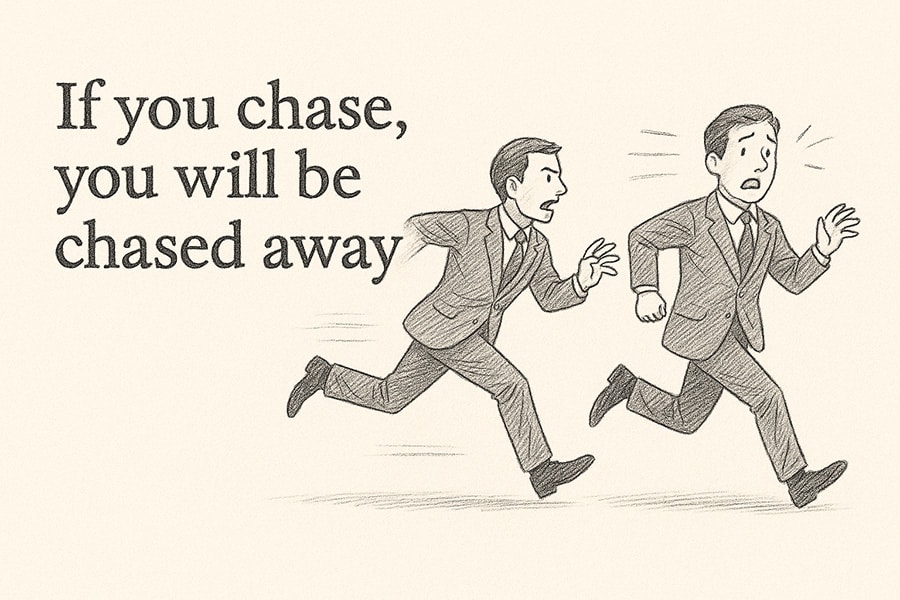
It is one of the most important aspects of being a leader. Sales leaders don’t beg. They don’t chase. They don’t slash prices. They don’t bend. They figure out what’s broken, tell you how to fix it, and get paid well for their expertise.
And at all times, they hold their head high in pride.
(before you read the below, I do not want you to treat my word as gospel either. I do not want you to believe or agree with anything below. All I suggest you do is deeply think about it, give it a chance in real conversations, and then make your own judgement call. whatever works for you, do that. I don’t care whether you believe this or not. I only care that you sell faster, with profit, and with your head held high with pride & honour)
Stop Doing These Things Right Now
Are you chasing people who can’t actually buy? Stop.
Every minute you spend trying to convince someone who has no money or authority is a minute you could be talking to someone who actually needs what you’re selling.
Do this instead: Ask the tough questions upfront. “What’s your budget for fixing this?” isn’t rude – it’s smart business.
Are you jumping straight into your pitch or presentation? Stop.
You’re not a walking product demo. You’re supposed to solve problems. But you’re talking about features and benefits before you even know what’s wrong.
Do this instead: Get obsessed with understanding their problems. The person who asks the best questions runs the conversation. Once you ask questions, shut up and listen. Then ask another question.
Are you competing on price? Stop.
When you lead with how cheap you are, you’re telling everyone you’re just another commodity. Commodities get squeezed and replaced. Experts get respected and paid what they’re worth.
Do this instead: Lead with what you know. Walk into every conversation as the person who fixes their specific kind of problem better than anyone else. I mean it. They should feel your presence and genuine (not fake) expertise before you open your mouth.
Are you taking every meeting that comes your way? Stop.
Your time isn’t free real estate. Every “yes” to the wrong meeting is a “no” to the right opportunity. Being busy doesn’t mean you’re being productive.
Do this instead: Be picky about who gets your time. If they can’t tell you why they need to meet, they probably don’t.
Are you giving away all your best ideas for free? Stop.
Every time you solve their problem during the sales conversation, you’re showing them they don’t need to hire you. Your knowledge is what makes you valuable – stop handing it out like free candy.
Do this instead: Figure out what’s wrong, confirm it hurts, then tell them what they need to buy to fix it.
Here’s What Changes When You Start Showing Up as a Leader in Sales
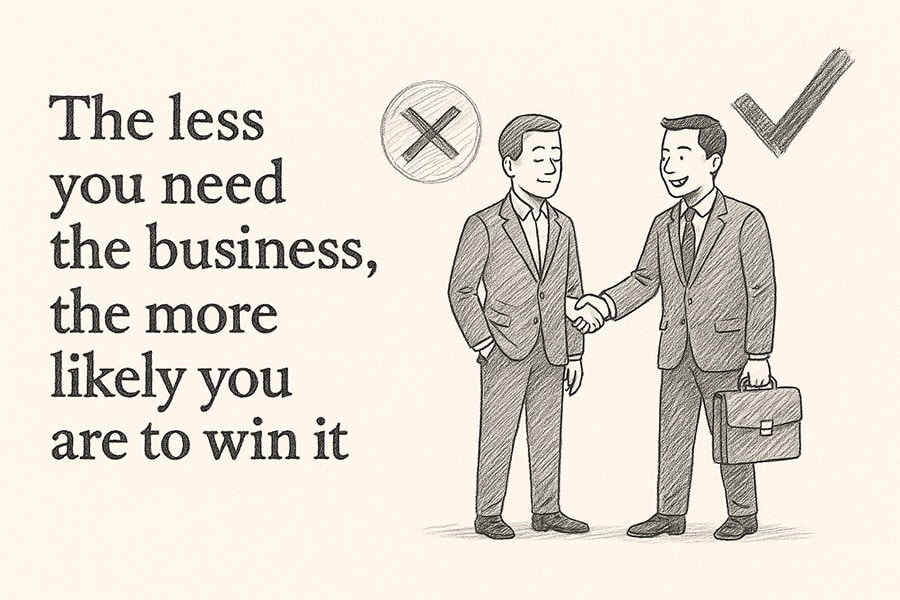
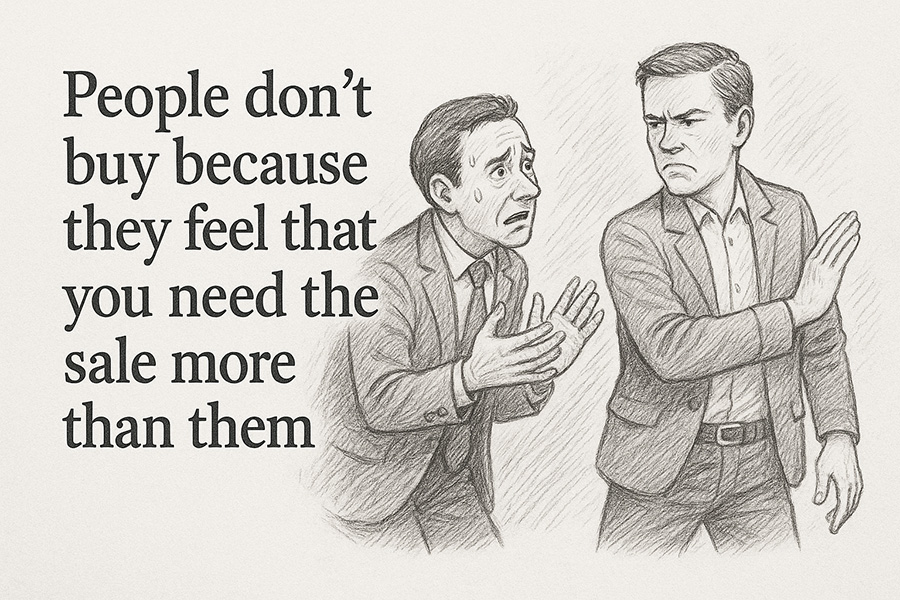
You get better clients. When you’re selective, people think you must be good and respect you for that. When you’re desperate, they can smell it from a mile away.
You make more money. Specialists always charge more than generalists. When you solve specific problems for specific people, price becomes way less important than results. The best buyers never care about paying more. They only care about getting their problem solved well so that they can focus on more valuable things for their business.
People actually respect you. Clients who value expertise treat you like a partner, not just another vendor. They listen to what you recommend instead of telling you what to do.
You close deals faster. People who actually need what you’re selling buy quicker than people who are just shopping around.
The Real Subconscious & Paradoxical Reason This Works Better
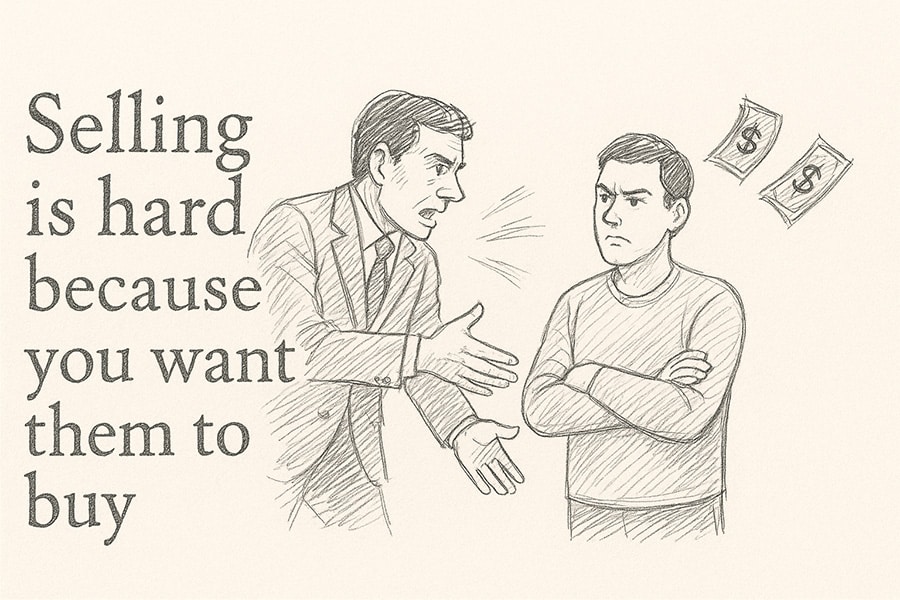
The old way was about convincing, persuading, and fighting through objections. There is no convincing required in sales. If you are convincing someone, you have already lost.
The new way is about owning your worth fully, positioning yourself right, diagnosing problems (like a doctor), and prescribing solutions only if you can help them. Be willing to walk away (and actually walk away) in all other situations.
Old thinking: “How can I talk them into buying?”
New thinking: “Are they even the right fit for what I do?”
Old approach: Present your stuff, send a proposal, pray they say yes.
New approach: Figure out what’s broken, tell them how to fix it, expect them to buy because they need it.
Old relationship: Vendor asking for business.
New relationship: Expert solving real problems and setting clear terms to engage.
Time to Respect Yourself
This isn’t about being a jerk or acting superior. It’s about having some self-respect and owning your worth. You know how to solve problems. People with those problems should be happy you’re willing to help them.
Stop apologizing for what you charge. Stop chasing people who don’t value what you do. Stop giving away your best thinking for nothing.
Start seeing yourself as the person to call when they have this specific problem. And tell others that.
Start asking better questions. Start walking away from deals that don’t make sense.
The Hard Truth About Why Most Sales People Struggle
Most salespeople fail because they’re scared to be choosy. They’re terrified of missing out, so they chase everything and end up with nothing good.
The successful ones are picky. They know what they’re worth. They understand that saying no to bad opportunities makes room for good ones.
Your income comes down to the problems you solve and who you solve them for.
Solve big problems for good people, make good money. Solve small problems for anyone who’ll listen, stay broke.
You Have a Choice
You can keep playing by traditional sales rules – chasing, discounting, begging, competing with every other desperate salesperson who learned the same broken system.
Or you can take back control, position yourself as someone who knows what they’re doing (because you do), and start admitting clients who value your work and pay you fairly. Say NO to everyone else – even if they are ready to pay.
The world doesn’t need another order-taker. It needs problem-solvers who aren’t afraid to charge what they’re worth.
Your future self is counting on you.Your company’s future is counting on you.
To Summarise
It takes courage to say no, to specialize, to charge what you’re worth. It takes discipline to protect your time and to nurture your relationships. But trust me, it’s worth it. When you focus on these things, business success becomes a natural byproduct, not a desperate chase.
It boils down to this: there are things way more important than just making a quick buck or landing every single client.
If you get the above things right, the sales and business success usually follows (paradoxically), and it feels a lot better too.
If you ignore them, you might make some money, but it’ll be a constant struggle, and you’ll probably feel pretty miserable.
So, next time you’re feeling the pressure to take on a bad project, or to lower your prices, or to give away your ideas for free, just ask yourself:
Is this going to help me maintain my self-respect?
Is it going to build my expertise?
Is it a good use of my time?
Is it going to strengthen my relationships?
And most importantly, is it going to contribute to my peace of mind?
If the answer to any of those is no, then maybe, just maybe, it’s time to walk away.
Because some things are just more important than business success.
And when you realize that, you’ll find that true success, the kind that feels good and lasts, will start to find you.
You know that moment when someone calls you “too intense” in a meeting?
That little sting you feel? That voice whispering you should dial it down, blend in, be more “normal”?
Yeah, screw that voice.
I’ve worked with CEOs who’ve built 8-figure companies while thinking they were fundamentally broken. They spent years trying to shove their square-peg brains into round-hole business models, wondering why everything felt like swimming through concrete.
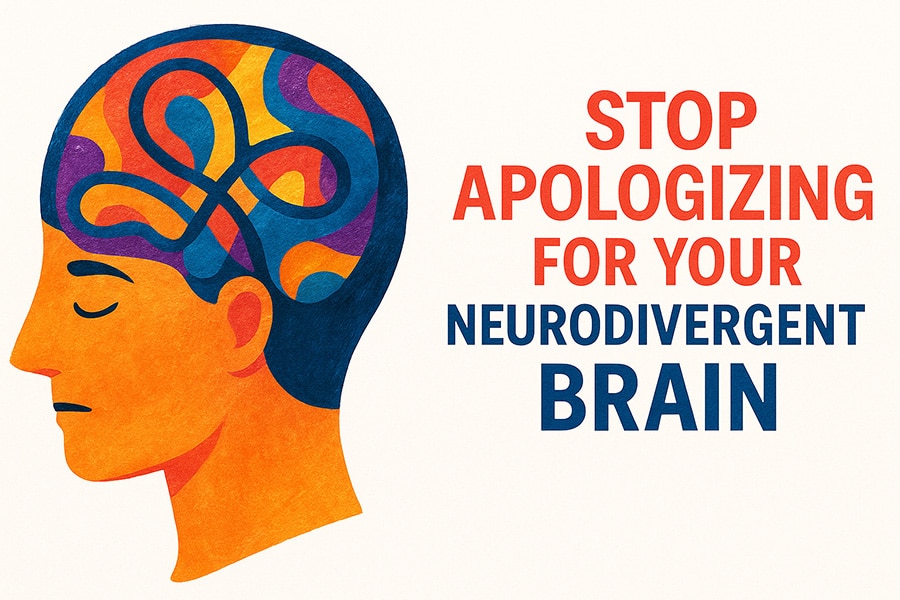
Here’s the plot twist: Your “broken” brain isn’t your weakness. It’s your unfair advantage.
Most neurodivergent entrepreneurs are playing the wrong game entirely. They’re trying to win at someone else’s game instead of dominating their own.
The Masking Trap That’s Killing Your Business
Tanya, a CEO I worked with, spent seven years burning herself out trying to run her company like every business expert told her to. Daily standups at 9 AM sharp (she’s a night owl). Open office collaboration (she needs quiet to think). Constant networking events (she’s an introvert who recharges alone).
She was making decent money but felt like she was dying inside.
Then we did something radical: We built her business around her actual operating system, not the one she thought she should have.
Morning person? Nope. Her best thinking happens at 10 PM? That’s when she does strategy work.
Needs 3 hours of uninterrupted focus? She blocks it out religiously, no exceptions.
Networking drains her? She hired a business development person who thrives on it.
Result? Revenue doubled in 8 months. But more importantly, she stopped feeling like a fraud in her own company.
Your differences aren’t bugs to fix. They’re features to leverage.
The ADHD Paradox: When “Can’t Focus” Becomes Laser-Sharp
“I can’t focus on anything for more than 5 minutes, but I stayed up until 3 AM redesigning my entire website.”
Sound familiar?
If you have ADHD, you’ve probably been told you have a “focus problem.” That’s like saying a Ferrari has a “speed problem” because it can’t go 5 mph.
Your brain isn’t broken—it’s optimized for different tasks.
Here’s what’s really happening in your ADHD brain:
You have 47 browser tabs open in your mind at all times
You can spot connections others miss because you’re processing multiple streams of information
Your “scattered” thinking actually generates more creative solutions per hour than most people produce in a week
When something clicks, you don’t just focus—you become a human laser beam
Marcus, an ADHD founder, used to beat himself up for “never finishing anything.” Then he realized he wasn’t supposed to finish everything—he was supposed to start everything and systematize the finishing.
He hired a COO who thrived on execution while he focused on innovation and strategy. His company grew more in the next 1 year than in the previous 3.
Hyperfocus: Your Billion-Dollar Superpower
While other entrepreneurs are checking their phones every 3 minutes, you can disappear into a problem for 6 hours straight and emerge with solutions that blow minds.
That’s not obsession. That’s a competitive advantage.
Marcus, an ADHD founder, used to apologize for getting “too into” product development. Then he realized something: While his competitors were doing surface-level market research, he was diving so deep he could predict customer needs they didn’t even know they had yet.
His “obsessive” attention to user experience details created a product so intuitive that customers started recommending it before they even finished the free trial.
Never apologize for your intensity. It’s what separates good from legendary.
Your Brain Sees What Others Miss
Here’s something neurotypical entrepreneurs don’t get: You don’t just see one solution to a problem. You see 2, 3, sometimes 5 different approaches simultaneously.
That’s not scattered thinking. That’s systems-level intelligence.
Take Jamie, who has autism and runs a logistics company. While other CEOs see shipping as “get package from A to B,” Jamie sees the entire ecosystem: weather patterns affecting routes, driver psychology impacting delivery times, customer anxiety levels based on tracking frequency.
Her company has the highest customer satisfaction scores in the industry because she optimizes for variables others don’t even notice exist.
Your “quirky” way of seeing the world is exactly what the market needs.
Reframe Your Story, Change Your Game
Stop calling it a limitation. Start calling it what it is: a different operating system with unique capabilities.
Your dyslexia isn’t a reading problem—it’s pattern recognition that helps you spot market trends others miss
Your ADHD isn’t a focus issue—it’s the ability to rapidly iterate and pivot while others are still planning
Your autism isn’t social awkwardness—it’s systematic thinking that creates efficiency others can’t achieve
Richard Branson didn’t succeed despite his dyslexia. He succeeded because it forced him to simplify complex ideas into brilliant, accessible solutions.
Build Your Dream Team, Not Your Struggle Team
The smartest neurodivergent CEOs I know don’t try to be everything to everyone. They build teams that amplify their superpowers and handle everything else.
Executive function challenges? Hire an operations ninja. Social interactions drain you? Partner with someone who gets energized by people. Details slip through cracks? Invest in systems that catch everything.
You’re not outsourcing weaknesses. You’re optimising strengths.
The Truth About “Different”
Some of the world’s most innovative companies exist because their founders think differently.
They didn’t build great companies despite their neurodivergence. They built them because of it.
Your Square Peg Deserves Its Own Hole
The market doesn’t need another copy-paste entrepreneur following the same playbook as everyone else.
It needs your intensity. Your obsessive attention to detail. Your ability to see solutions others miss. Your systematic approach to problems others give up on.
Your brain isn’t broken. It’s running premium software in a world full of basic programs.
Stop trying to fit into their holes. Build your own.
The world needs what your neurodivergent brain creates. Trust me—that’s your edge.
This is the Leadership Journey series on the Choosing Leadership Podcast.
I believe we all have a lot to learn from each other’s stories – of where we started, where we are now, and our successes and struggles on the way. With this series of interviews, my attempt is to give leaders an opportunity to share their stories and for all of us to learn from their generous sharing. If you know a leader whom you would like to see celebrated on the show, please send me a message on LinkedIn with their name.
In this episode, Akhil Shahani—Managing Director of the Shahani Group—reveals how he transformed personal setbacks into a bold vision to revolutionize education across Asia.
From navigating the weight of a century-old family legacy to building an education-to-employment ecosystem, Akhil shares real talk on leadership, resilience, and reinventing outdated systems.
You’ll walk away with fresh insight on bridging the gap between theory and practice—and why empathy, adaptability, and critical thinking are the true markers of future-ready leaders.
If you’re a leader tired of playing by broken rules, this conversation is your permission to reimagine what’s possible.
I had two client conversations today that I will not forget for a while.
Two clients. Both wildly successful. One’s a former pro athlete who’s dominated their sport for years and is now contributing to their sport in an even bigger way after retirement. The other’s a CEO who’s built a company where 4000+ people feel proud to work.
And guess what? Both were drowning in the same damn doubt.
“Maybe I’m too much,” they said. “Maybe I should dial it back.”
Sound familiar?
Here’s what I told them – and what I’m telling you right now: Going all-in and giving all of yourself isn’t your problem. It’s your f*cking superpower.
The World Wants You Small
Let me paint you a picture. You’re out there crushing it, building something that matters, chasing a vision that keeps you up at night (in the best way possible). And what does the world tell you?
“Slow down.” “Be realistic.” “Get some balance.” “Take it easy.”
Nonsense.
You know what balance gets you? Average. And average doesn’t cut it.
I’ve spent 16 years in tech, climbed every ladder they put in front of me, played by every rule in the book. And you know what? It was comfortable. It was safe. It was slowly killing my soul.
The day I stopped playing small and started giving all of myself to what mattered – that’s when everything changed.
That’s when I started actually making a dent in the universe. And not feeling tired and exhausted even if I was spending longer hours.
Working more doesn’t make you tired or exhausted.
Holding yourself back and playing small does.
Take “Balance” Out of Your Vocabulary
Here’s a radical thought: What if I told you to delete the word “balance” from your vocabulary entirely?
Look around. Show me where balance exists in nature.
The mountain doesn’t apologize for being grand. It doesn’t try to balance itself with the valley. It stands tall, unapologetic, magnificent in its commitment to being exactly what it is.
The ocean doesn’t balance its waves. Some are gentle laps on the shore, others are tsunamis that reshape coastlines. The ocean gives what the moment demands.
The lion doesn’t balance its hunt. When it’s time to strike, it gives everything. When it’s time to rest, it rests completely.
Nature doesn’t do balance. Nature does seasons. Cycles. Rhythms of intensity and rest, of growth and dormancy, of all-in effort and complete recovery.
You’re not a spreadsheet that needs equal columns. You’re a force of nature with your own seasons of intensity.
When it’s time to build, build with everything you’ve got.
When it’s time to rest, rest completely.
When it’s time to lead, lead without apology.
The word “balance” is just another way society tries to keep you small, predictable, manageable.
Your greatness isn’t balanced. It’s seasonal, rhythmic, and unapologetically powerful.
Good vs. Going All-In: The Real Talk
Here’s the brutal truth nobody wants to say out loud:
GOOD will get you applause. GOING ALL-IN will get you misunderstood.
Good follows the rules that someone else wrote for a game you didn’t even choose to play. Going all-in? Going all-in throws out the rulebook and writes their own damn game.
Good asks for permission like a kid asking to use the bathroom. Going all-in gives itself the green light and floors it 🙂
Good fits in, plays nice, doesn’t rock the boat. Going all-in builds boats that others can’t even imagine yet.
And here’s the kicker – going all-in gets called crazy. Too much. Too intense. Too focused. Too different.
That’s not criticism. That’s confirmation you’re on the right track.
The Gift Nobody Talks About
True commitment gets a bad rap because mediocre people don’t understand it. They see your fire and think it’s going to burn them. They see your intensity and feel inadequate about their lukewarm approach to life.
But giving all of yourself? It’s a gift.
It’s what drives you to stay up until 3 AM perfecting something that already works because you know it can work better. It’s what makes you see solutions where others see problems. It’s what turns your crazy ideas into world-changing realities.
I’ve seen it with every leader I work with. The ones who change everything – they’re all committed at a level others can’t fathom. Committed to their standard. Committed to their craft. Committed to their calling.
Not sometimes. Not when it’s convenient. Every. Damn. Day.
Plan B Is the Killer of Plan A
Here’s where most people miss. They hedge their bets. They keep Plan B warm and ready, just in case Plan A doesn’t work out.
Let me tell you something I learned the hard way: When you’re built for Plan A, Plan B becomes a safety net that turns into a noose.
Plan B whispers in your ear when things get tough. “Maybe this isn’t working,” it says. “Maybe you should take the safer route.”
Plan B is seductive. It promises comfort, security, the approval of people who never dared to dream as big as you do.
But Plan B kills Plan A every single time.
You know what successful obsessed leaders do? They burn the boats. They stand in the fire. They make Plan A the only option because that’s how you get obsessed enough to make the impossible happen.
The Misunderstood Truth About Balance
Everyone’s preaching balance like it’s the holy grail. Work-life balance. Balanced approach. Balanced perspective.
But here’s what nobody tells you: Balance doesn’t change the world. True commitment does.
Steve Jobs wasn’t balanced. Oprah isn’t balanced. Elon Musk sure as hell isn’t balanced. Every person who’s ever shifted culture, created something revolutionary, or built an empire that matters – they went all-in.
Now, I’m not saying neglect your health or your relationships. I’m saying stop apologizing for caring more, working harder, and dreaming bigger than everyone else around you.
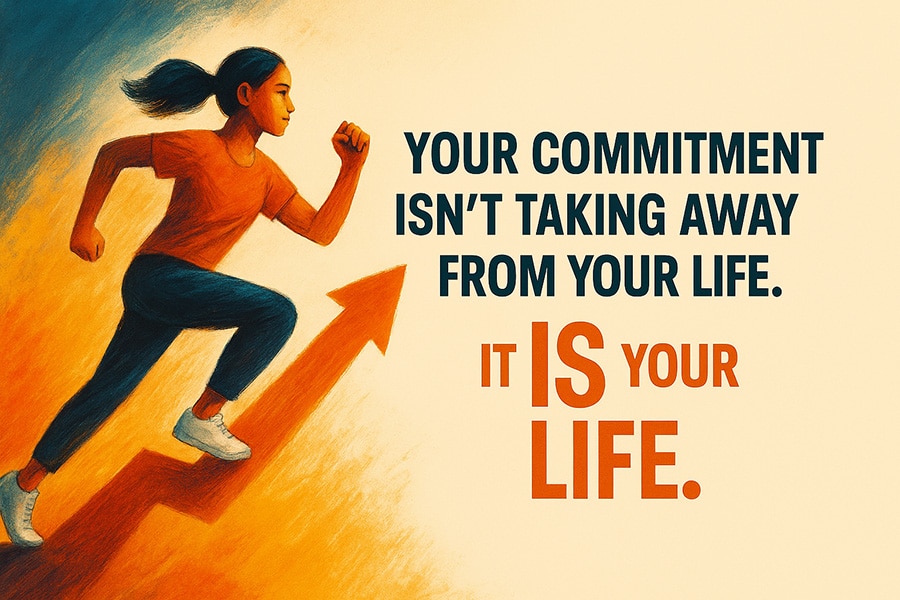
Your commitment isn’t taking away from your life. It IS your life. It’s the thing that makes you come alive, that gives meaning to every breath you take.
What They Don’t Want You to Know
The people telling you to slow down, be realistic, find balance? Most of them are projecting their own fears onto your dreams. and they are not to blame for that.
They see your commitment and it makes them uncomfortable because it highlights their own settling. Your intensity reminds them of dreams they gave up, risks they were too scared to take, visions they let die in the name of being “practical.”
Don’t let their fear dim your fire.
When they call you too much, too intense, too focused, too different – that’s not feedback. That’s confirmation that you’re operating on a frequency they can’t understand.
And that’s exactly where you need to be.
The All-In Manifesto
So here’s what I want you to do. Stop apologizing for your commitment. Stop dimming your light to make others comfortable. Stop second-guessing the fire that burns inside you.
Your willingness to give all of yourself is your compass. It’s pointing you toward the impact you’re meant to make, the legacy you’re meant to leave, the change you’re meant to create.
Let them call you too much. Own it. Let them say you’re too intense. Embrace it. Let them wonder why you can’t just be normal. Thank them for the compliment.
Because normal doesn’t innovate. Normal doesn’t inspire. Normal doesn’t transform industries, lives, or the world.
Your commitment isn’t your weakness. It’s your strength. It’s your edge. It’s your secret weapon in a world full of people who’ve convinced themselves that average is acceptable.
Don’t stop until the vision you carry becomes the reality you live.
The world doesn’t need another balanced leader. It needs more leaders who are willing to go all-in.
This is the Leadership Journey series on the Choosing Leadership Podcast.
I believe we all have a lot to learn from each other’s stories – of where we started, where we are now, and our successes and struggles on the way. With this series of interviews, my attempt is to give leaders an opportunity to share their stories and for all of us to learn from their generous sharing. If you know a leader whom you would like to see celebrated on the show, please send me a message on LinkedIn with their name.
In this candid conversation, James Jackson, CEO and co-founder of Bumper, shares the behind-the-scenes of building a high-growth fintech—while staying humble, hiring intentionally, and protecting company culture across borders.
From fixing tractors on his farm to navigating billion-dollar payments, James proves that great leadership isn’t about titles—it’s about ownership, balance, and grit.
If you’re leading a team through rapid change or wrestling with how to grow without losing your soul, this episode is your playbook.
Tune in to discover how humility, vision, and discipline come together to create lasting impact.
This is the Leadership Journey series on the Choosing Leadership Podcast.
I believe we all have a lot to learn from each other’s stories – of where we started, where we are now, and our successes and struggles on the way. With this series of interviews, my attempt is to give leaders an opportunity to share their stories and for all of us to learn from their generous sharing. If you know a leader whom you would like to see celebrated on the show, please send me a message on LinkedIn with their name.
What happens when you walk away from corporate security to chase a vision only you can see?
In this candid conversation, MJ—Managing Director of UHP Technologies and a serial entrepreneur—shares the raw truth behind 17 years of entrepreneurial grit, resilience, and reinvention.
From navigating early failures to building partnerships rooted in trust, MJ reveals what it really takes to lead with courage and empathy.
If you’re a leader facing uncertainty, struggling with setbacks, or seeking a deeper sense of purpose—this episode is your permission slip to keep going.
Tune in to rediscover why leadership is less about control, and more about choosing to lead with heart.
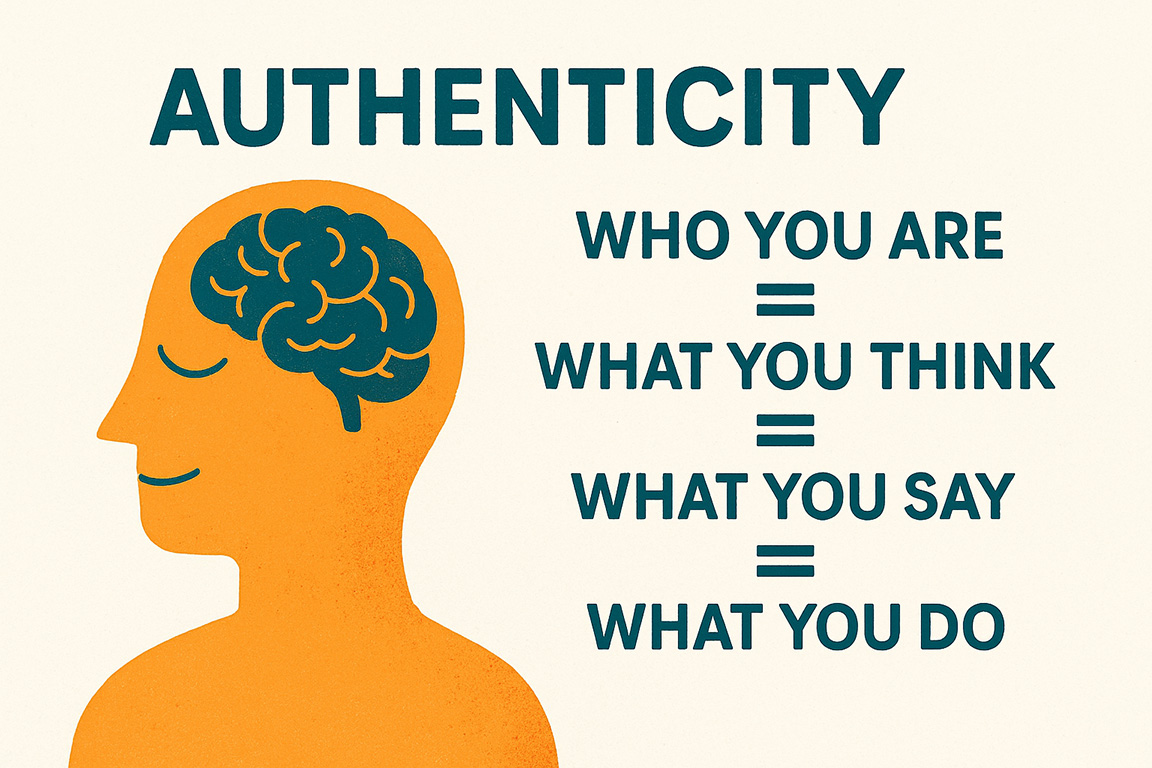
Authenticity is aligning who you are with what you think, what you say and what you do
Let me tell you about Shweta, a VP at a tech company who was known for her “transparency.” She’d stand in front of her team every Monday morning, preaching about open communication and honest feedback. But when her boss questioned her team’s missed deadline, Shweta gave a good sounding reason – the economy and the customer’s mindset in Europe – where they operated – without batting an eye. Later, she’d tell her team member, “I had to say something to protect the bigger picture.”
Sound familiar?
We’ve all been Shweta. We’ve all had our moments where who we think we are, what we say we stand for, and what we actually do are completely out of alignment. And here’s the kicker – everyone around us sees it, even when we don’t.
The Uncomfortable Truth About Being “Authentic”
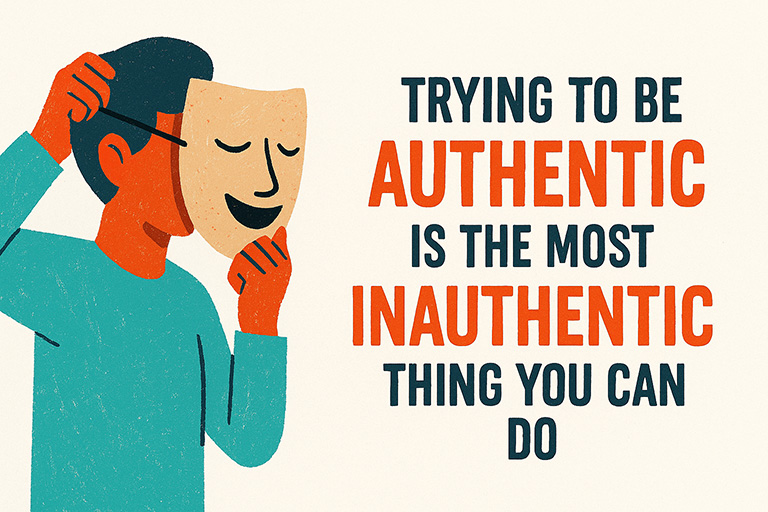
Here’s what nobody talks about at those authenticity trainings: trying to be authentic is the most inauthentic thing you can do. It’s like putting makeup on a bruise and expecting it to heal. The harder you try to appear genuine, the more fake you become.
I’ve sat in countless team meetings where leaders talk about “bringing their authentic selves to work” while simultaneously hiding their real thoughts, fears, and mistakes. They’re performing authenticity, not living it.
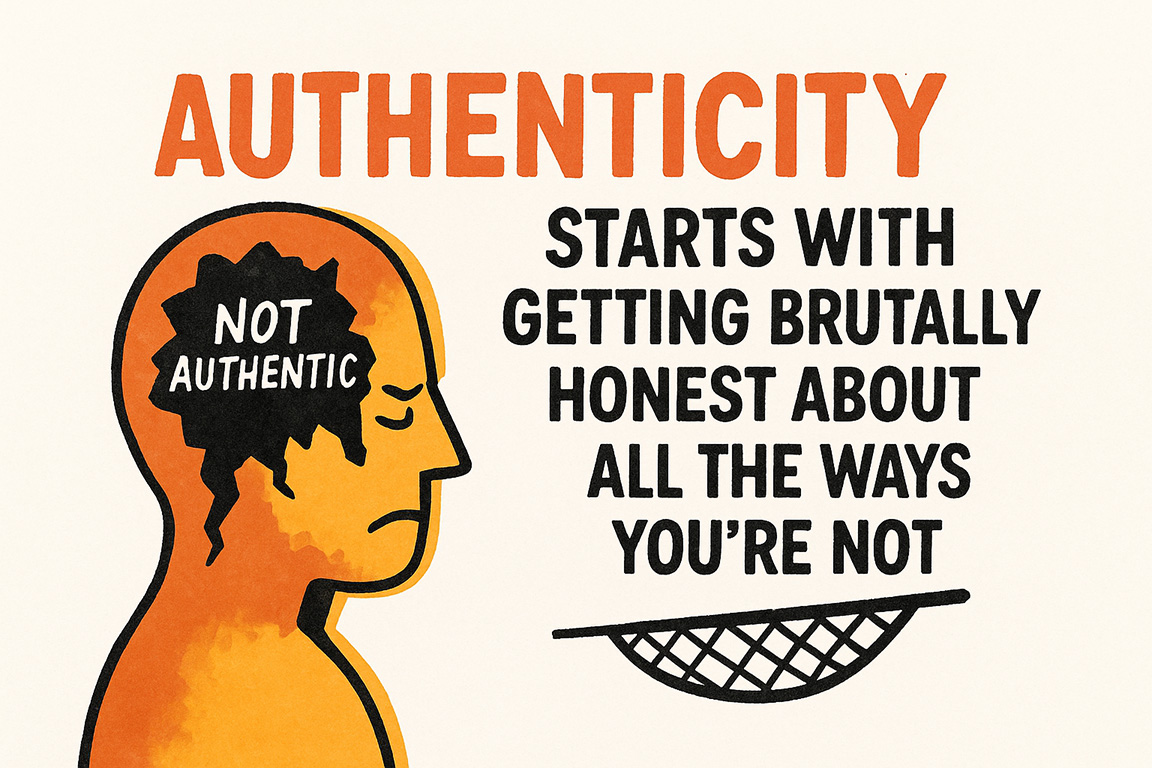
The real path to authenticity isn’t pretty. It starts with getting brutally honest about all the ways you’re NOT authentic. It means admitting where you pretend, where you hide, where you manipulate situations to look good.
Why We All Fake It (And Why It’s Killing Our Leadership)
Let’s get real about what drives our inauthenticity. We’re all desperately hungry for admiration or maintaining a nice image. In the corporate world, admiration is currency – it gets you promoted, respected, included in the important conversations.
Think about the last time you were in a meeting where you didn’t understand something. Did you ask for clarification, or did you nod along and hope nobody noticed? Most of us choose the nod. We’d rather look smart than actually learn something.
Or consider Marcus, a CEO I worked with who built his entire leadership brand around being “the decisive leader.” When his company faced a crisis he’d never dealt with before, instead of admitting uncertainty and asking for help, he made a quick decision that cost the company millions. His need to maintain his image of decisiveness literally cost more than his annual salary.
We sacrifice truth for approval. We sacrifice authenticity for admiration. And in doing so, we create organizations built on pretense rather than performance.
The Loyalty and Empathy Trap That’s Destroying Teams
Here’s another place where leaders lose their authenticity: the loyalty or empathy game. We tell ourselves we’re being “loyal” or “empathetic” when we don’t speak up about a bad decision our boss made. We call it “loyalty” and “empathy” when we don’t give honest feedback to a struggling team member because we don’t want to hurt their feelings.
I watched a senior leadership team spend six months implementing a strategy they all knew was doomed to fail. Not one person spoke up because they didn’t want to seem “disloyal” to the CEO who championed it. Six months, millions of dollars, and countless hours later, the strategy collapsed. That’s not loyalty – that’s cowardice dressed up as virtue.
Real loyalty means caring enough about someone and the organization to tell uncomfortable truths. It means risking short-term discomfort for long-term success.
The Looking Good Disease
Then there’s our obsession with looking good and maintaining appearances and avoid looking bad. This might be the most expensive habit in corporate business. How many projects have failed because someone was too embarrassed to admit they didn’t understand the requirements? How many strategies have crashed because a leader was too proud to acknowledge they needed help?
I remember Fiona, a brilliant engineer who got promoted to head of product. In her first quarterly review meeting, she presented beautifully crafted slides about market opportunities and competitive advantages. Everything looked perfect. Except the product was three months behind schedule because she’d been spending all her time on presentations instead of actually managing the development process.
When her CEO asked direct questions about timeline and delivery, Fiona deflected with more beautiful slides about “long-term vision” and “strategic positioning.” She looked great in that meeting. And six months later, she was looking for a new job.
Looking good is not the same as being good. And the gap between the two will eventually catch up with you.
What Real Authenticity Looks Like in Action
So what does authentic leadership actually look like? It’s messier than the Instagram version, but it’s also more powerful.
Authentic leaders say things like: “I don’t know, but I’ll find out.” They admit when they’ve made mistakes before someone else points them out. They share their struggles, not just their successes.
Take David, a founder I coached who was struggling with investor meetings. Instead of pretending everything was fine, he started his next board meeting with: “I need to be honest with you. I’m in over my head on the financial projections, and I’m scared I’m going to make a decision that kills this company.”
The room went quiet. Then his lead investor said, “Finally, someone who tells the truth in these meetings. Let’s figure this out together.”
That honesty didn’t make David look weak – it made him trustworthy. And trust is the foundation of all great leadership.
The Hidden Price Tag of Fake Leadership
Before we talk about what authenticity creates, let’s get brutally honest about what inauthenticity costs. Because every time you choose appearances over truth, you’re not just compromising your integrity – you’re literally hemorrhaging money, opportunities, and years of your life.
The Business Costs Are Staggering
Remember that CEO who couldn’t admit he didn’t understand the financial projections? His company burned through $2.3 million in six months on a product line that any honest conversation with customers would have killed in week one. But he was too busy looking smart to ask dumb questions.
Here’s what happens when leaders prioritize looking good over being real:
Decision-making becomes dangerously slow. When people are afraid to bring bad news or admit they don’t understand something, critical information gets filtered, delayed, or buried. By the time reality breaks through the pretense, you’re months behind competitors who were dealing with facts instead of managing egos.
Innovation dies. Teams stop proposing breakthrough ideas because breakthrough ideas are risky, and risky ideas might make you look foolish if they fail. So everyone gravitates toward safe, incremental improvements while your competition eats your lunch with bold moves.
Customer relationships become transactional. When your sales team is more focused on looking competent than solving actual problems, they oversell capabilities and under-deliver results. Customer lifetime value plummets, and your reputation becomes your biggest liability instead of your greatest asset.
Top talent walks away. The best people don’t stick around to work for leaders who can’t handle the truth. They go where they can do their best work, not where they have to manage someone else’s ego.
I’ve seen companies lose entire market categories because leadership couldn’t admit their strategy wasn’t working. I’ve watched brilliant teams implode because nobody could say “this isn’t working” without triggering a defensive meltdown from the person in charge.
The Personal Costs Cut Even Deeper
But the business costs are nothing compared to what inauthenticity does to you personally. Every time you choose pretense over truth, you’re trading pieces of yourself for temporary comfort. You are teaching yourself that you can not count on yourself.
Your stress levels skyrocket. Maintaining a false image is exhausting. You’re constantly monitoring what you say, how you say it, and how others might interpret it. You become a full-time actor in your own life, and the performance anxiety never stops.
Relationships become hollow. When people only know the version of you that you think they want to see, you end up surrounded by people but feeling completely alone. You can’t celebrate real victories because nobody knows your real struggles. You can’t get real help because nobody knows your real challenges.
Imposter syndrome becomes your constant companion. Deep down, you know the gap between your public persona and your private reality. That gap breeds a persistent fear that you’ll be “found out.” So instead of growing into your role, you’re constantly defending a position you’re not sure you deserve.
Decision fatigue becomes overwhelming. When every interaction requires you to calculate how to look good instead of simply being honest, the mental load becomes crushing. You’re not just solving business problems – you’re solving perception problems, relationship problems, and ego problems simultaneously.
Your learning stops. You can’t grow when you can’t admit what you don’t know. You get stuck in patterns that used to work instead of evolving with new challenges. Your career plateaus not because you lack capability, but because you lack the courage to be a beginner again.
The Compound Effect of Small Deceptions
Here’s the thing that really gets me: it’s not usually one big lie that derails leaders. It’s a thousand small compromises with truth that compound over time.
You don’t correct someone’s assumption that you understand blockchain technology. Six months later, you’re approving a $500K investment in a crypto project you still don’t understand.
You don’t admit that your “successful” product launch actually missed every meaningful metric. A year later, you’re doubling down on a strategy built on fictional success.
You don’t tell your team that you’re overwhelmed and need help prioritizing. Two years later, you’re burned out, your family relationships are strained, and your company culture is built around heroic overwork instead of sustainable excellence.
Each small inauthenticity creates a debt that compounds with interest. Eventually, reality demands payment – and the bill is always higher than you expect.
The Opportunity Cost Is Massive
But perhaps the biggest cost of all is what you don’t build when you’re busy maintaining appearances.
While you’re managing perceptions, your authentic competitors are building trust with customers, creating psychologically safe environments that unleash team creativity, and developing genuine expertise instead of surface-level credibility.
While you’re worried about looking smart, they’re getting smarter. While you’re protecting your image, they’re building something real. While you’re performing leadership, they’re actually leading.
The gap between authentic and inauthentic leaders isn’t just about style – it’s about substance. And in a world that rewards results over appearances, substance always wins in the long run.
The Business Case for Radical Honesty
Here’s what happens when leaders embrace authentic leadership:
Teams start telling the truth about project status, market feedback, and operational challenges. Instead of managing up with rose-colored reports, people share real data that allows for real solutions.
Innovation accelerates because people aren’t afraid to propose ideas that might fail. They know failure will be met with curiosity, not punishment.
Customer relationships deepen because sales teams stop overpromising and start having honest conversations about capabilities and timelines.
Retention improves because people want to work for leaders who see them as humans, not just resources to be optimized.
The Practice of Authentic Leadership
Being authentic about your inauthenticities isn’t a one-time confession. It’s a daily practice. It means:
Catching yourself in the moment when you’re about to hide, deflect, or pretend. Pausing and choosing truth instead.
Having regular conversations with your team where you share what you’re learning, what you’re struggling with, and where you need their help.
Creating space for others to be equally honest without judgment or punishment.
Measuring success not just by results, but by the quality of relationships and level of trust in your organization.
Why This Matters More Than Ever
In a world where AI can handle data analysis and automation can manage routine processes, the uniquely human capabilities become more valuable. Authenticity, vulnerability, and genuine connection aren’t just nice-to-haves – they’re competitive advantages.
The leaders who thrive in the next decade won’t be the ones who have all the answers. They’ll be the ones brave enough to admit they don’t, curious enough to keep learning, and authentic enough to build organizations where truth travels fast and trust runs deep.
Your Next Move
So here’s my challenge to you: identify one area where you’re not being fully authentic. Maybe it’s admitting you don’t understand a key part of your business. Maybe it’s acknowledging that you’re overwhelmed and need help. Maybe it’s having an honest conversation with someone you’ve been avoiding.
Start there. Start small. But start.
Because authenticity isn’t about being perfect. It’s about being real. And in a world full of polished presentations and carefully crafted personas, real is revolutionary.
The question isn’t whether you have inauthenticities – we all do. The question is whether you’re brave enough to be honest about them. That honesty, that willingness to be human in a world that demands perfection, is what separates great leaders from the rest.
Your people are waiting for you to be real. Your business needs you to be real. And frankly, you need you to be real.
The foundation of all great leadership isn’t having all the answers. It’s having the courage to be authentically human while pursuing extraordinary results.
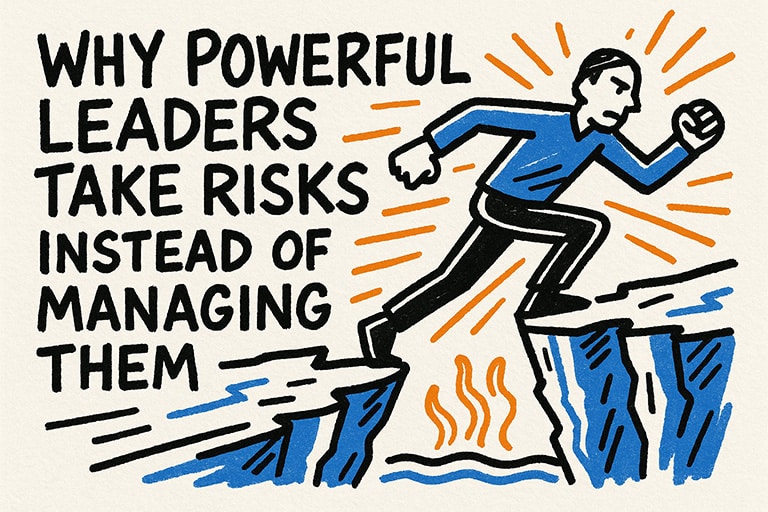
Let me tell you a story that’ll change how you think about risk forever.
In 2007, while every bank was hiring more risk managers and building fancy models to “manage” their exposure, a small hedge fund manager named John Paulson was doing something completely different. He wasn’t managing risk – he was taking it. Massive amounts of it.
While Goldman Sachs had armies of PhDs calculating risk metrics, Paulson bet $15 billion against the housing market. The risk managers called him crazy. The models said he was wrong. But Paulson understood something they didn’t: sometimes the biggest risk is listening to the risk managers.
When the dust settled, Paulson made $4 billion personally in one year. The banks with all their sophisticated risk management? They needed taxpayer bailouts to survive.
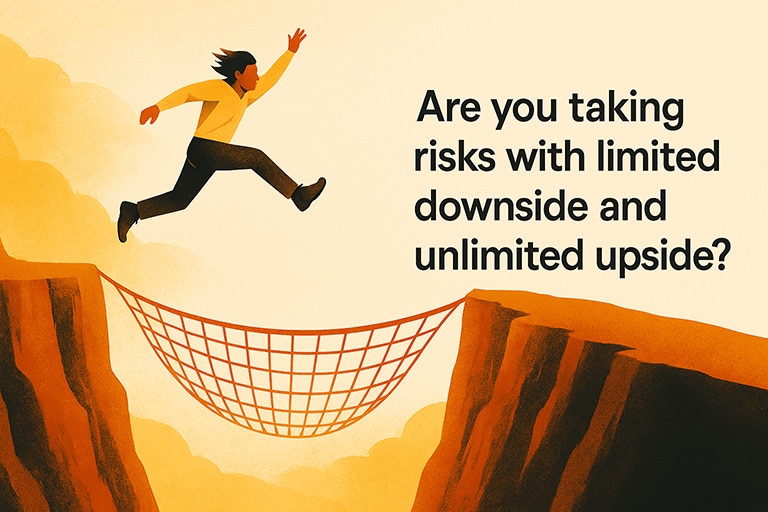
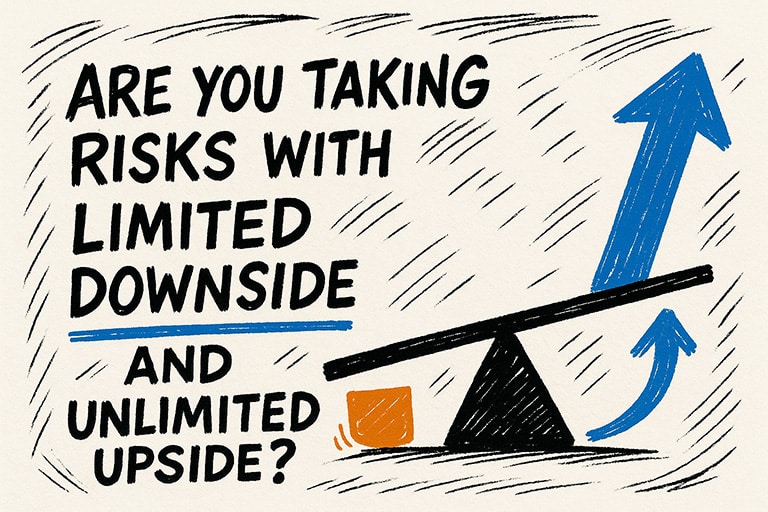
That’s the difference between studying risk taking and studying risk management. Paulson took a risk, not managed it. He took a risk with a massive upside and limited downside.
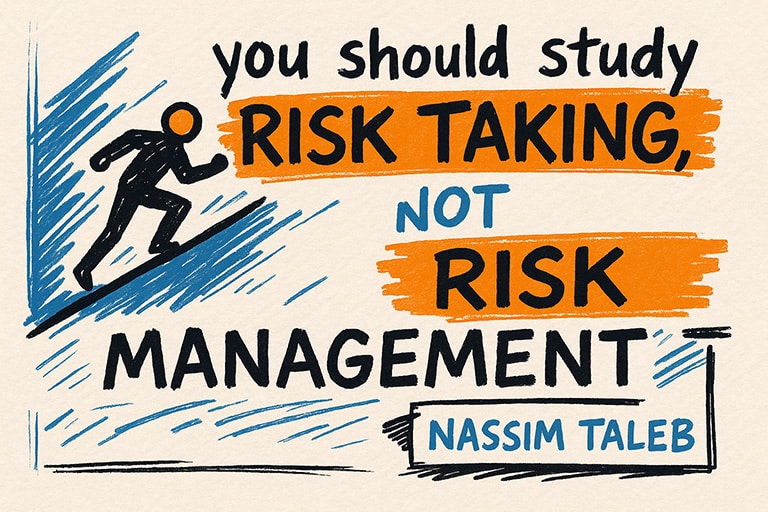
And it’s why Nassim Taleb’s blunt advice – “you should study risk taking, not risk management” – should keep every leader awake at night.
For example, I left a lucrative tech career after 16 stable, successful years. People told me I was crazy—“Why risk it all?” they asked. The downside? Short-term uncertainty, some financial instability, maybe losing my identity. But I could always come back to a job in a few months or years (limited downside)
But the upside was infinite—I was betting on my purpose, my passion, my freedom. Today, I can’t even measure how much this decision has impacted me and the lives of countless others who now believe in their own power because they watched me embrace mine.
What if the biggest risk you are taking is not taking enough risks?
The Problem with Playing It Safe
Here’s what nobody wants to admit: most people who are terrified of making mistakes. They’ve built entire careers on not screwing up, and now they’re in charge of organizations that need to take big swings to survive. This is not wrong. This is not a judgement. This is a honest look at how most of us live our lives – and I do not exclude myself from this.
Take Kodak. They had brilliant risk managers who could calculate the probability of various market scenarios down to the third decimal place. They had committees and processes and approval chains designed to minimize risk. They also invented the digital camera in 1975.
But their risk managers said digital would cannibalize their profitable film business. Too risky. Better to manage that risk by… doing nothing.
Meanwhile, a couple of Stanford students named Larry Page and Sergey Brin were building something called Google. No risk management department. No sophisticated models. Just two guys willing to bet everything on a crazy idea about organizing the world’s information.
Kodak went bankrupt. Google became worth a trillion dollars.
The lesson? When you’re obsessed with managing risk, you often miss the biggest risk of all: becoming irrelevant.
For example, I openly shared provocative and confronting e-books — like the “6 Silent Killers for Organisations” and “5 Invisible Lies That Hold Us Back”—that challenged CEOs to see uncomfortable truths. There was a clear risk of backlash, misunderstandings, or alienating people. Few people even blocked or ghosted me. Limited downside.
But the upside? It became a powerful filter, attracting only those leaders ready to face reality. Now, these frameworks work for me, even when I’m asleep, drawing in exactly the type of bold, committed clients I want to serve.
Example
Another example of a risk with limited downside and unlimited upside: a friend of mine who had just started an NGO in 2011 reached out to 30 celebrities and asked them for brand endorsement.
Everyone advised my friend to do this when they have money or a few years worth of credibility. He did it anyways. 29 people didn’t even reply (limited downside).
One person – a famous cricketer – said YES. (unlimited upside)
As a result, they did in 7 months what the state govt was not able to do in the previous 7 years.
The Big Data Trap That’s Making You Dumber
Everyone thinks more data automatically means better decisions. This is like saying more ingredients automatically make better food. Sometimes they do. Sometimes you end up with a mess.
Netflix figured this out early. They could have built incredibly sophisticated models to predict what shows would succeed. Instead, they developed a different approach: make lots of different shows, see what works, double down on winners, kill the losers fast.
Their risk wasn’t in any single show failing – that was expected. Their risk was in not trying enough different things.
Compare that to traditional TV networks, which spend months analyzing market research, focus groups, and demographic data before green-lighting a show. All that analysis, all that risk management, and most shows still fail.
The difference? Netflix treats content creation like a portfolio of intelligent risks. Traditional networks treat it like a series of bets they’re trying not to lose.
For example, I coached a founder recently whose company had just one month of runway left—and I didn’t ask for payment. I risked never seeing a dime for my efforts. People advised me against it: “You’re crazy. You’re giving too much away.” (limited downside)
But I knew the upside was priceless—trust, reputation, and genuine human connection. That founder later told others about my commitment, cementing my reputation as someone who stands by leaders even in their darkest moments. (huge upside)
The Two Types of Risk (And Why Most People Get This Backwards)
Here’s where most leaders screw up completely. They worry about the wrong risks while ignoring the ones that can actually destroy them.
Think about it like this: there are two types of risk – ruin risk and volatility risk.
Ruin risk can destroy you. Betting your entire company on one product. Taking on so much debt that one bad quarter kills you. These are the risks you should be paranoid about.
There are legitimate situations where a defensive risk-management strategy is appropriate:
– When you’re protecting something valuable that took years to build
– When the consequences of failure are genuinely bad
Volatility risk just makes your life bumpy but doesn’t destroy you. Trying a new marketing channel that might fail. Launching a product that might flop. Hiring someone who might not work out.
Most companies do this backwards. They’re super careful about small decisions (volatility risk) while making huge bets that could sink the company (ruin risk).
Take WeWork. They were incredibly loose with small operational decisions – that’s fine, that’s just volatility. But they also made massive real estate commitments based on projected growth rates that were basically fantasy. That’s ruin risk disguised as a business model.
Smart risk takers like Amazon do the opposite. Jeff Bezos was famous for making lots of small bets (most failed – that’s expected volatility). But he was obsessively careful about anything that could threaten Amazon’s core business (ruin risk).
Why Crises Create Opportunity (If You Know How to Look)
Every crisis sorts people into two groups: those who panic and those who see opportunity.
During the 2008 financial crisis, most companies went into survival mode. Cost cutting, hiring freezes, playing defense. Understandable, but not very smart.
Meanwhile, companies like Apple and Amazon went on the attack. Apple launched the iPhone in 2007, right before the crisis hit. Instead of pulling back, they doubled down on marketing and innovation. Amazon used the crisis to acquire talent and technology cheaply while competitors were cutting costs.
The result? Both companies emerged from the crisis stronger and more dominant than before.
Here’s the thing about crises: they don’t just destroy value, they redistribute it. Resources become available. Talented people become available. Market share becomes available. But only if you’re positioned to take advantage instead of just trying to survive.
This is why risk takers thrive during crises while risk managers just try to minimize damage.
For example, one executive leader I coached had the habit of jumping into every crisis, firefighting daily. They risked stepping back—letting others solve their own issues, even if mistakes happened. The downside? Potential short-term chaos, visible failures, anxiety from surrendering control. But the upside? Leaders emerged beneath them, independent problem-solving thrived, and the team’s performance grew exponentially. They became a coach, not a crutch.
The Facebook Problem: When Winner-Take-All Goes Wrong
Here’s something that should scare every leader: we’re living in a winner-take-all world, and most people don’t understand what that means.
Twenty years ago, if you were a good soccer player, you made decent money playing for your local team. Today, the top 1% of soccer players make millions while everyone else struggles to make a living. Same skill, different world.
This happened because globalization and technology created winner-take-all markets. Facebook doesn’t just compete with other social networks – it dominates so completely that competitors barely exist.
Here’s the scary part: the same forces that let Facebook rise to the top can make them disappear just as quickly. Remember MySpace? They were Facebook before Facebook. Completely dominant until they weren’t.
This creates a paradox for leaders: you need to take bigger risks to reach the top, but being at the top is more fragile than ever. The road up is steep and risky. The road down is just as steep and happens just as fast.
Smart leaders understand this. They know that in a winner-take-all world, playing it safe guarantees you’ll lose. But they also know that winning doesn’t guarantee you’ll stay on top.
How to Build a Risk-Taking Organization
If you want to transform your company from a risk-managing museum into a risk-taking machine, here’s what actually works:
Start with hiring. When you interview candidates, don’t just ask about their successes. Ask about their failures. Specifically, ask about times they took intelligent risks that didn’t work out. If someone has never failed at anything significant, they’ve never risked anything significant.
Change your promotion criteria. Stop promoting people primarily because they “never made mistakes.” Start promoting people who made intelligent mistakes, learned from them, and used that learning to achieve bigger wins.
Create safe-to-fail experiments. Structure decisions so the cost of being wrong is small but the benefit of being right is large. This lets people take risks without betting the company.
Celebrate intelligent failures publicly. When someone takes a smart risk that doesn’t work out, don’t just avoid punishing them – actually celebrate the attempt. This sends a clear message about what behavior you want to see more of.
Put risk takers in charge of important decisions. Don’t let risk managers veto every bold initiative. Put people who understand risk taking in positions where they can actually take risks.
Example
A client of mine who had clients ranging from 0.5-2M$ went after new clients worth 10M$ or more. Most people said they had no business going after such large clients until they have more leverage, clarity, experience, brand value, etc etc.
Going after these huge 10M+ clients was a risk.
The downside – getting rejected, being called bold or audacious, but nothing else. Limited downside.
The upside – even one new client at a 10M+ could change the trajectory of their company. Unlimited upside.
What really happened?
My client got a new client for 5.5M$ after 3 months and 4 rejections. That one YES improved their annual revenue by 50%.
Read that again. That’s one conversation. One YES. 50% annual revenue increase.
That is the power of taking risks with unlimited upside and limited downsides.
The real risk is in not taking these risks.
The Question Every Leader Must Answer
Here’s what it comes down to: Are you building an organization that can win, or just one that won’t lose?
Because in today’s world, those are two completely different things.
Companies that focus on not losing become incredibly good at… not losing. They develop sophisticated systems for avoiding mistakes, minimizing downside, managing risk. They become efficient, predictable, safe.
Nothing wrong with that. But they also become irrelevant when others grab opportunities that they could have done too.
This is often the difference between one company growing at 500% and another growing at 50%. Both good growth. Very different definitions of risk though.
Companies that focus on winning understand that winning requires risking losing. They develop different capabilities: pattern recognition, rapid experimentation, intelligent failure recovery, asymmetric betting.
They become volatile, unpredictable, sometimes messy. They also become the companies that shape the future.
Your Move
The world doesn’t need more risk managers. It has plenty of those already, and look where it’s gotten us – organizations so afraid of making mistakes that they’ve forgotten how to make progress.
What the world needs is more intelligent risk takers. Leaders who understand the difference between ruin risk and volatility risk. People who can see opportunity in uncertainty instead of just threat.
The choice is simple: you can keep building systems to manage risk while your competitors take the risks that create the future. Or you can start attracting and developing the kind of people who understand that in a world of accelerating change, the biggest risk is not taking enough intelligent risks.
Your competitors are making their choice right now. What’s yours going to be?
This is the Leadership Journey series on the Choosing Leadership Podcast.
I believe we all have a lot to learn from each other’s stories – of where we started, where we are now, and our successes and struggles on the way. With this series of interviews, my attempt is to give leaders an opportunity to share their stories and for all of us to learn from their generous sharing. If you know a leader whom you would like to see celebrated on the show, please send me a message on LinkedIn with their name.
What if your next leadership breakthrough came from a snowy day and a bag of leftover food?
In this episode, Tessa Clarke, co-founder and CEO of Olio, shares how she turned a moment of frustration into a global movement against food waste.
You’ll hear raw insights about leaving a corporate career, building something from scratch, and leading with values in a world that often rewards short-term thinking.
This isn’t just a story about sustainability—it’s a masterclass in courage, clarity, and solving real problems with bold leadership.
Tune in if you’re ready to challenge the status quo and lead with purpose, even when the path isn’t clear.
I use cookies on this website to give you the most relevant experience and for analytics purposes. Any personal data collected will never be shared with any third party, or used to spam you. That is my promise. - Sumit By clicking “Accept”, you consent to the use of ALL the cookies.
This website uses cookies to improve your experience while you navigate through the website. Out of these, the cookies that are categorized as necessary are stored on your browser as they are essential for the working of basic functionalities of the website. We also use third-party cookies that help us analyze and understand how you use this website. These cookies will be stored in your browser only with your consent. You also have the option to opt-out of these cookies. But opting out of some of these cookies may affect your browsing experience.
Necessary cookies are absolutely essential for the website to function properly. This category only includes cookies that ensures basic functionalities and security features of the website. These cookies do not store any personal information.
Any cookies that may not be particularly necessary for the website to function and is used specifically to collect user personal data via analytics, ads, other embedded contents are termed as non-necessary cookies. It is mandatory to procure user consent prior to running these cookies on your website.