The False Choice Between Empathy and Authenticity: Why True Leaders Need Both
There is a dangerous myth that I have from multiple leaders that hold them back without they even realising.
It’s the belief that you must choose between being empathetic and being authentic (or assertive)—that you can have one or the other, but never both. This false dichotomy has weakened leadership at the highest levels and created generations of well-meaning but ineffective executives.
Read that last sentence again.
The Empathy Trap
“I can’t be completely honest because I need to be empathetic.”
“If I challenge them directly, I won’t be honoring their perspective.”
These thoughts likely sound familiar. They represent what I call the Empathy Trap—the belief that understanding someone else’s perspective means you must dilute your own truth.
Let’s be clear: empathy without authenticity is just weakness disguised as compassion.
When you withhold your honest assessment or avoid necessary confrontation under the guise of being “empathetic,” you’re not serving anyone—not yourself, not your team, not your organization. You’re simply avoiding discomfort.
Consider this common scenario:
Leader: “Sarah, your presentation was… interesting. I think clients will appreciate the different approach you’ve taken.”
What the leader actually thinks: “This presentation has serious flaws that will confuse our clients and potentially lose the account.”
Sarah: “Great! So I can use this approach for the client meeting next week?”
Leader: “Sure, maybe just polish it up a bit before then.”
This leader believes they’re being empathetic by sparing Sarah’s feelings. In reality, they’re setting her up for failureand denying her the chance to improve.
The Cost of Inauthentic Leadership
Every time you swallow your truth to spare someone’s feelings, you pay a price:
You deny yourself the opportunity to advocate for your own values and vision
You rob the other person of your genuine perspective—something they might desperately need
You model conflict avoidance rather than healthy engagement
You erode your self-trust and confidence by creating a gap between what you think and what you say
These costs compound over time. Organizations led by the “empathetically inauthentic” become places where difficult conversations are avoided, mediocrity is tolerated, and real innovation stalls.
Authentic Leadership Is an Act of True Empathy
Here’s the paradigm shift every senior leader needs to embrace: true empathy requires authenticity.
When you approach leadership with complete authenticity—speaking your truth, addressing issues directly, challenging others when necessary—you’re performing the most empathetic act possible. You’re saying, “I respect you enough to give you my unvarnished truth.”
This isn’t about being harsh or uncaring. It’s about recognizing that authentic communication, even when uncomfortable, is the foundation of genuine respect and trust.
The Power of Uncomfortable Authenticity
The most transformative leadership moments often emerge from uncomfortable authenticity:
The feedback session where you directly address performance issues others have avoided mentioning
The strategic meeting where you challenge a popular but flawed initiative
The one-on-one where you express your genuine concerns about someone’s leadership approach
These moments of authentic leadership create space for growth, clarity, and alignment that polite avoidance never could.
Let’s revisit the scenario with authentic leadership:
Leader: “Sarah, can I be direct with you because this presentation matters? (after her ‘yes’) The approach you’ve taken has some fundamental issues that would confuse our clients and potentially put the account at risk.”
Sarah: “Oh… I thought it was innovative.”
Leader: “I appreciate your desire to innovate, and that’s exactly why I’m giving you my honest assessment. The core concept has potential, but the execution needs substantial work. Let’s block an hour tomorrow to rethink it together. I believe in your ability to nail this, which is why I’m not just letting it slide.”
Sarah: “That’s… actually helpful. Thank you for being straight with me.”
This leader combines empathy (understanding Sarah’s intentions and believing in her potential) with authenticity (providing honest feedback). The result is growth rather than failure.
Leaders Lead
The simple truth is that leaders lead. They don’t merely accommodate or placate.
True leadership means:
Setting the standard rather than just meeting it
Speaking necessary truths even when silence would be easier
Challenging others to rise to their potential, not just accepting where they are
When you fully embrace authenticity in your leadership, you establish a new standard—not just for yourself, but for everyone around you. This is how cultures transform. This is how organizations evolve. Example:
Team Member: “I’m not sure we need to focus on quality improvement right now. Our metrics are within acceptable industry standards.”
Passive Leader: “You make a good point. We should be proud of meeting industry standards.”
Authentic Leader: “I understand the industry standards, but I didn’t build this company to be standard. Meeting the minimum isn’t our goal. I believe we can do better, and more importantly, our customers deserve better. What would it take to raise our quality score by 20% this quarter?”
This authentic leader refuses to accept mediocrity, even when it would be easier to do so.
The Both/And Approach
The most effective leaders understand that empathy and authenticity aren’t opposing forces—they’re complementary powers.
Empathy without authenticity becomes empty platitudes and conflict avoidance. Authenticity without empathy becomes harshness and needless pain.
The leadership sweet spot lies in their integration:
Understanding deeply and speaking truthfully
Recognizing feelings and addressing realities
Acknowledging perspectives and providing clear direction
Practical Steps Toward Authentic Leadership
If you’re ready to break free from the false choice between empathy and authenticity, start here:
Audit your communication patterns. Where are you holding back your truth out of misplaced “empathy”?
Reframe difficult conversations. See them not as conflicts to avoid but as opportunities to provide value through honesty.
Practice authentic empathy. Before challenging conversations, ask yourself: “How can I deliver this truth in a way that demonstrates I care about this person’s growth?”
Raise your standards. Commit to being the leader who models authentic engagement, even when—especially when—it’s uncomfortable.
Embrace discomfort as growth. Recognize that the momentary discomfort of authenticity creates space for lasting transformation.
Team Member: “I’ve been struggling with the new systems. I feel like everyone else adapted quickly, and I’m falling behind.”
Empathetic But Inauthentic Leader: “Don’t worry about it. You’re doing fine. You will learn everything in time.”
Authentic But Unempathetic Leader: “You need to get up to speed immediately. This is unacceptable.”
Leader Using Both: “I appreciate your honesty about the challenges you’re facing. It takes courage to acknowledge when you’re struggling. At the same time, I need to be clear that becoming proficient with these systems is non-negotiable for your role. What specific support do you need to get there in the next two weeks?”
The leader who combines empathy and authenticity acknowledges feelings while maintaining clear standards.
The Ultimate Leadership Legacy
Every senior leader leaves a legacy. Will yours be one of polite avoidance and conflict aversion? Or will it be a legacy of authentic engagement that elevated everyone around you?
Here is an example of what a CEO client of mine shared with his leadership team: “Let me share something I learned too late in my career. For years, I thought being a good leader meant making everyone comfortable, avoiding conflict, and being universally liked. I was wrong. My greatest contributions came when I found the courage to be authentically myself—to challenge when challenge was needed, to set uncomfortable standards, and to speak difficult truths. Don’t wait as long as I did to discover that empathy without authenticity cheats everyone of their potential.”
When you are fully authentic, even when it gets uncomfortable, you are setting an example and a high bar—for yourself and others.
The organizations that thrive in uncertain times aren’t led by people pleasers or conflict avoiders. They’re led by authentic leaders who understand that true empathy isn’t about making people comfortable—it’s about making them better.
The time for choosing between empathy and authenticity is over. True leadership demands both. Your team deserves both. And ultimately, your own leadership journey requires both.
The question isn’t whether you can afford to be both empathetic and authentic. The question is: can you afford not to be?
Leaders frequently pride themselves on data-driven decisions and logical planning. Yet, there’s an often-overlooked leadership muscle that remains dramatically undertrained—the ability to purely and powerfully want something, free from justification, reasoning, or incremental thinking.
This is not about frivolous desire but about tapping into a source of powerful leadership: unfiltered, unreasonable, unapologetic wanting. Let me unpack this for you.
Want vs. Need: Understanding the Crucial Difference
Consider this snippet from a conversation with Alex, a CEO:
Me: “What’s your target revenue for three years from now?”
Alex: “20 million.”
Me: “Why 20 million?”
Alex: “It’s just a logical projection from our current growth.”
Me: “Forget logic. What do you truly want?”
Alex:(pauses, uncomfortable) “Honestly? 30 million with an 18% margin.”
Me: “How does saying that feel?”
Alex: “Powerful, scary, but exciting.”
Key distinction:
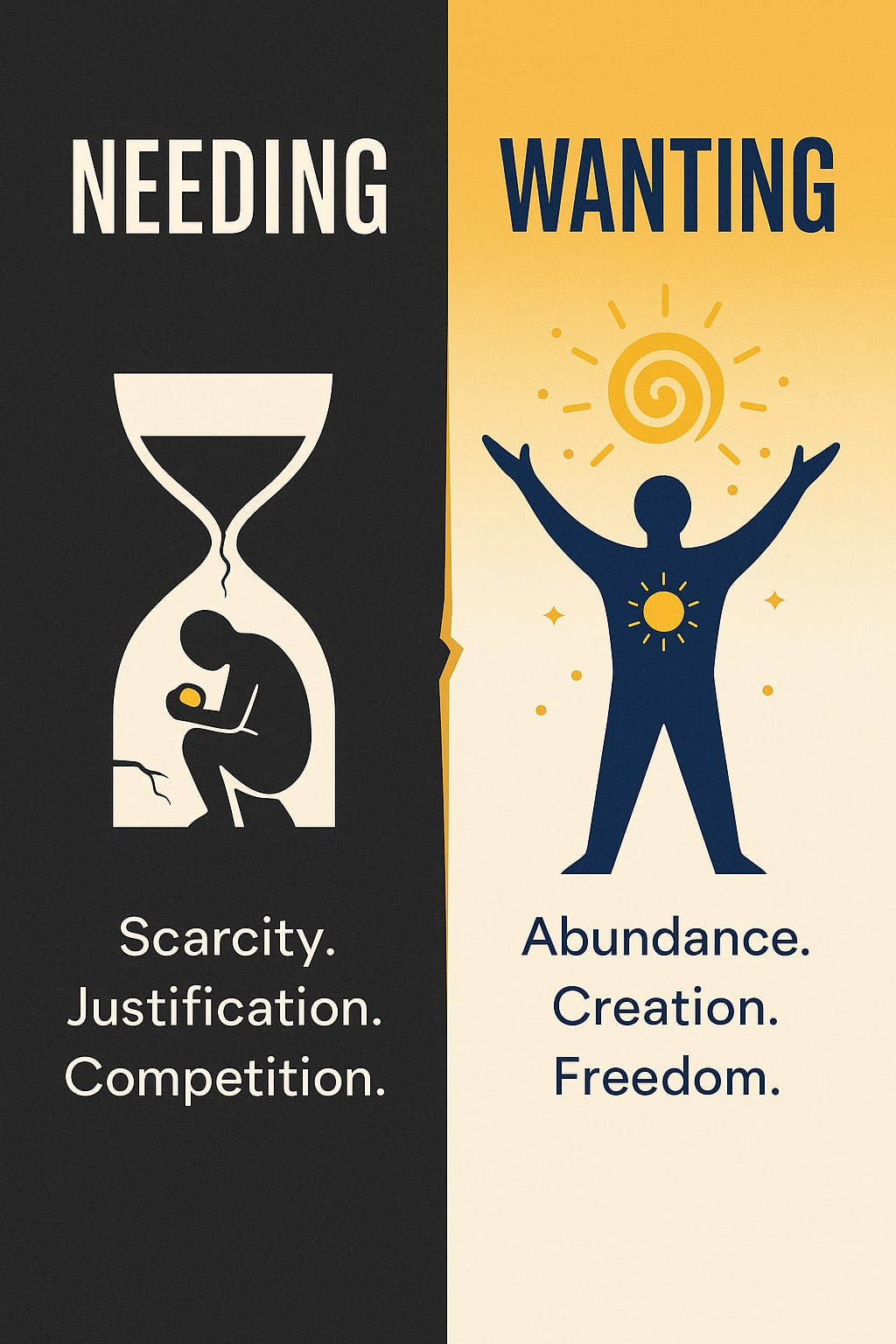
Need: Rational, justified, incremental.
Want: Visionary, bold, free from immediate practicality.
Most leaders confuse wanting with needing. ‘Need’ is rational, safe, and justified. It relies on data, past achievements, and incremental improvements. But ‘want’ is different—it’s free, unbound, and daringly ambitious. It’s not derived from past performance or future projections. It’s rooted purely in what you care about without external justification.
Escaping the Trap of ‘Should’
Consider this dialogue with Sara, a technology executive, which illustrates this well:
Sara: “I should take some time alone tonight; it’s been a stressful day.”
Me: “Notice your justification? Try it again without any reasoning.”
Sara: “I want one hour alone tonight.”
Me: “How does that sound?”
Sara: “Clear. Liberating. Surprisingly simple.”
Why “should” is problematic:
Implies obligation, external expectation, or guilt.
Creates heaviness, stress, and emotional constraint.
Leaders frequently operate within this restrictive frame: “I should achieve this,” “We should improve by this percentage,” “The profit margin should be at least X.” The word ‘should’ introduces heaviness, stress, and constraint—emotionally draining rather than empowering.
The Cost of Ignoring Pure Wanting
Consider Paul, a corporate executive who played it safe:
Paul: “We consistently meet our growth targets.”
Me: “Is that exciting for you or your team?”
Paul:(hesitates) “Honestly, it’s safe but dull.”
Me: “What bold vision do you truly want, without needing logic?”
Paul: “I want us to dominate our industry—not because data says it’s possible, but because I genuinely desire it.”
Me: “How does declaring that feel?”
Paul: “Invigorating. Like fresh energy.”
Ignoring the muscle of pure wanting leads to:
Predictable mediocrity.
Limited innovation.
Reduced team motivation and engagement.
Linda’s experience as a division leader in a multinational corporation illustrates this vividly. Her division consistently achieved its targets yet suffered from chronic disengagement and low innovation. When Linda surveyed her team anonymously, the feedback was clear: employees felt their work lacked real purpose or excitement. Linda realized that her own cautious, data-driven approach was partly to blame.
Only after she publicly shifted from safe, predictable objectives to openly declaring ambitious, passionate goals did the division experience a noticeable revival in creativity, morale, and productivity.
The ability to purely want something without needing rational justification is a muscle that requires intentional cultivation. Leaders conditioned by logic, practicality, and data often find it challenging initially. However, this muscle—once developed—creates visionary breakthroughs, fosters courage, and generates a powerful leadership presence.
When you declare a want, especially something seemingly impossible or unrealistic, you create a space for innovation. There’s no guarantee you’ll immediately know how to achieve it, and that’s precisely the point. Leadership isn’t management. Management handles execution based on what’s already known; leadership thrives in the unknown, carving pathways where none previously existed.
Imagine John F. Kennedy declaring he wanted to land a man on the moon. It wasn’t a need; America didn’t necessarily have to do it. It wasn’t a ‘should’ dictated by societal obligation. It was a pure, bold want. He didn’t have all the data or a proven roadmap, but by boldly declaring the impossible as his desire, he galvanized an entire nation, sparked unprecedented innovation, and ultimately achieved a milestone that seemed unthinkable at the time.
The Life of a Needer
A needer doesn’t chase dreams—they chase survival. They ask themselves, What do I need to do to get by? What do I need to keep things stable? What can I reasonably ask for without rocking the boat?
They settle. They settle for the client that underpays, the partner that drains them, the life that suffocates—but at least feels “secure.” They compromise their time, energy, and joy, not because it’s what they want, but because it’s what they believe they should accept.
In the world of needing, every request, every desire, has to be run through a filter of justification:
“I need this because I’ve worked hard.”
“I deserve this because I’ve sacrificed.”
“I should have this because others have it too.”
It’s exhausting. And worse—it’s a trap. Because needing is always tied to lack. Needing assumes there isn’t enough. If you get more, someone else gets less. So you justify to yourself and to others why you’re allowed to want what you want.
The Shift: From Scarcity to Creation, from Needing to Wanting
But there’s another way. A shift so subtle, it’s easy to miss. But once you cross that line, you never go back.
The shift is this: You stop living from need. And you start living from want.
Wanting, true wanting, doesn’t come with excuses. You don’t need a spreadsheet, a résumé, or a reference to prove your worth. You want because you want.
You want a thriving business? Say it.
You want a loving, spacious relationship? Say it.
You want to take a month off to write, rest, or just breathe? Say it.
And when someone asks you, “Why do you want that?”, your answer isn’t an essay—it’s a sentence:
“Because I want it.”
That’s it.
Strengthening Your “Want” Muscle
Developing your want muscle starts simply. Begin by distinguishing clearly between your ‘wants’ and your ‘needs’ or ‘shoulds.’ Whenever setting a goal, ask yourself, “Do I want this purely because I desire it, or is it driven by reasoning from past data, trends, or external expectations?”
To build this crucial leadership skill, use these practical steps:
Clarify Your Wants Regularly
Regularly ask yourself: “What do I genuinely want, irrespective of feasibility?”
Have your team frequently articulate bold, unreasonable desires.
Conduct “Want” Dialogues
Hold dedicated meetings exploring ambitious wants without immediate practicality.
Celebrate audacious ideas openly, building trust and confidence.
Storytelling and Reflection
Share success stories where bold wants led to major breakthroughs.
Reflect on historical visionary examples (e.g., JFK’s moon landing).
Journal Without Limits
Regularly journal your pure wants without filtering for practicality or logic.
Use these reflections as a springboard for visionary actions.
Transformative Leadership Through Wanting
Leaders who embrace pure, unfiltered wanting often create extraordinary breakthroughs:
Google’s famous “20% Time” policy led employees to freely pursue what they genuinely wanted, producing Gmail and AdSense.
Steve Jobs consistently pursued desires others deemed impractical, revolutionizing entire industries.
Living in the World of Wanting
Living from want isn’t easy. It takes courage. Most people won’t understand you. They’ve been conditioned to chase what’s practical, what’s logical, what’s deserved. They’ve built a life inside a box of justification.
When you step outside that box, you disrupt their system. And they’ll try to pull you back in.
They’ll call you selfish. Unrealistic. Naive.
They’ll say, “You can’t just have whatever you want.”
But you’re not taking anything from anyone. You’re creating something new. That’s the power of wanting.
Because in the world of wanters:
There is no scarcity.
There is no zero-sum game.
There is no competition.
A true wanter doesn’t compete—they create. They invent, initiate, innovate. They carve paths where there were none. They write songs that never existed. Build products no one asked for but everyone needs. Create companies, cultures, communities out of thin air.
Why? Because they wanted to.
Wanting is a Choice.
It’s for the few who say, “I want something wildly beyond what makes sense.”
And the moment you say that, you tap into a part of yourself that most people never access.
It’s not ambition. It’s not ego.
It’s alignment.
It’s the recognition that your true self—your unique ability, your deepest expression, your soul’s work—cannot be reached through logic or need.
It can only be reached through want.
Wanting Requires No Permission
Here’s the truth that shatters most social norms:
You don’t need to justify your desires to anyone. Not even yourself.
Wanting is enough.
This is terrifying for the needers. Because if you don’t justify your wants… they can’t argue with you. They can’t out-reason you.
Provocative Questions for Bold Leaders
To provoke deeper reflection, consider these questions:
What audacious goal would you declare if feasibility wasn’t a factor?
How many of your current goals are set out of obligation rather than genuine desire?
If your entire team started openly expressing ambitious wants, how would your organizational culture change?
For political leaders: If your leadership were guided by bold desire rather than public expectations, how differently would you act?
Ultimately, leadership is about envisioning beyond the visible, feasible, and practical. Ask yourself—and dare to answer honestly—what do you truly want?
We’re at a pivotal moment in European history. The leadership approach that served Europe so well after World War II – focused on stability, consensus, and careful progress – has created remarkable prosperity and peace across our continent. We should be proud of what we’ve accomplished.
For me, as an Indian who grew up reading about and seeing constant wars between India and its neighbours, seeing a borderless continent where the biggest wars of human existence we fought just 70 years ago, is nothing more than a miracle. If you have forgotten it, you have no idea what a privilege crossing country borders without ever being stopped or frisked or killed is.
Yet the world is rapidly transforming, and despite our tremendous achievements, we risk falling behind in the global world for the coming decades.
Our Post-War Leadership Legacy
After the devastation of World War II, our continent needed leaders who could build consensus, create stability, and restore faith in institutions. Leaders like Konrad Adenauer in Germany and Jean Monnet in the European project excelled at methodical rebuilding and careful integration. They were exactly what Europe needed then.
Together, Europeans have rebuilt shattered economies, created unprecedented prosperity, and constructed a peaceful continent from the ashes of conflict. This remains one of humanity’s greatest accomplishments.
But the world has changed dramatically. The leadership qualities that rebuilt our continent aren’t the same ones needed to keep us competitive in an era of technological transformation and global competition.
Warming Up to Change and Discomfort – Or Risk Oblivion
Let’s be candid about what we face: the coming decades will bring unprecedented technological and economic transformation. Artificial intelligence, synthetic biology, quantum computing, and technologies we can’t yet imagine will reshape every industry and institution. This transformation will be uncomfortable, disruptive, and at times alarming – but it’s inevitable.
We in Europe have developed a leadership culture that prioritizes comfort and stability. This was understandable after the chaos of the mid-20th century. But our aversion to discomfort now threatens our future relevance.
Consider Nokia’s fall from dominance. In 2007, the Finnish company controlled nearly 50% of the global smartphone market. When Apple introduced the iPhone, Nokia’s engineers reportedly created a touchscreen prototype that matched or exceeded Apple’s capabilities. But Nokia’s leadership rejected this innovation, considering it too disruptive to their existing business model. By 2013, their market share had collapsed to just 3%, and the company sold its phone business to Microsoft.
This isn’t just a story about one company – it’s a warning about European institutional resistance to uncomfortable change. While our American and Asian competitors embrace creative destruction as necessary for progress, we often try to protect existing structures even when they’ve become obsolete.
The consequences of continued reluctance to embrace discomfort will be profound. We’re already seeing the early signs:
Our declining share of global patents in frontier technologies like artificial intelligence and quantum computing
The migration of our most ambitious entrepreneurs to more dynamic ecosystems abroad
Our growing dependence on foreign platforms for digital infrastructure
The declining global influence of European universities and research institutions
If these trends continue for another two decades, we won’t just be economically disadvantaged – we risk becoming irrelevant in shaping humanity’s future. Our social models, democratic values, and cultural heritage will have diminishing influence in a world increasingly shaped by those willing to embrace disruptive change.
But there’s good news: discomfort is a skill we can develop. Just as athletes train their bodies to perform under physical stress, leaders can train themselves to function effectively amid uncertainty and change. When we repeatedly expose ourselves to controlled discomfort – taking calculated risks, experimenting with new approaches, facing potential failure – we build the capacity to thrive in changing conditions.
Examples from our own continent show this is possible. When Sweden faced a banking crisis in the early 1990s, its leaders made the uncomfortable decision to nationalize failing banks, force shareholders to take losses, and fundamentally restructure the financial system. The short-term pain was significant, but this willingness to embrace discomfort enabled Sweden to emerge stronger, with a more resilient financial system that weathered the 2008 global crisis better than most European counterparts.
We need to cultivate this capacity for productive discomfort throughout our institutions:
In government, by rewarding officials who challenge comfortable but outdated processes
In education, by teaching students to value problems as opportunities rather than threats
In business, by celebrating leaders who cannibalize their own successful products to create better ones
In finance, by developing better mechanisms to fund disruptive innovation
The choice before us is clear: we can continue prioritizing comfort and gradually fade into global irrelevance, or we can embrace the productive discomfort that drives renewal and reinvention. The former path leads to a comfortable decline; the latter offers the possibility of European renaissance.
What We Can Learn from American Entrepreneurs
When I look at American entrepreneurial success, it’s not about abandoning European values – it’s about adapting our approach while maintaining our core principles. America is not perfect by any chance – especially when it comes to quality of life and European values. At the same time, that doesn’t mean we can’t learn from American businesses, where it excels.
Consider how differently leadership operates in American innovation ecosystems. In 2008, when European leaders were managing the financial crisis through careful coordination, Airbnb launched despite the economic downturn. While our financial institutions were understandably tightening lending in response to systemic risks, American venture capitalists were still funding bold ideas that have since transformed industries.
Being transparent about risk while pursuing ambitious visions is something our European leadership culture often discourages.
During the COVID pandemic, we saw how Moderna’s leadership made bold decisions quickly, commenced production at risk, and moved with urgency that many European companies struggled to match. The result wasn’t just business success – it helped save lives.
We don’t need to abandon our thoughtful approach, but we do need to be more decisive with taking action than currently – even if it means going outside our comfort zone or taking bigger risks. American entrepreneurs don’t succeed because they’re reckless – they succeed because they make calculated bets and execute with urgency while still managing risk.
What We Can Learn from Indian Entrepreneurs
India offers us equally valuable lessons in entrepreneurial leadership. Nandan Nilekani’s work with India’s Aadhaar digital identity system shows what’s possible with entrepreneurial leadership in governance. In just a few years, he helped create the world’s largest biometric ID system used by over 1.3 billion people. Meanwhile, our digital identity initiatives, while well-designed, have produced less real-world impact despite greater resources.
Byju Raveendran built BYJU’S from a small tutoring service into a global education technology company by focusing on solving real problems with available resources rather than waiting for perfect conditions – an approach we could benefit from in our European context.
Indian entrepreneurs typically face greater constraints than we do – less capital, weaker infrastructure, more bureaucracy. Yet they’ve built world-class companies by adapting to these limitations rather than being paralyzed by them.
When Falguni Nayar left her investment banking career at age 50 to found beauty retailer Nykaa, she faced skepticism from all sides. But she saw an opportunity and executed her vision decisively. Eight years later, her company went public at a valuation of nearly $13 billion. Her story reminds us that entrepreneurial leadership can emerge at any age and from any background – something we need to encourage more actively in Europe.
EU flags, European Parliament, Strasbourg
A New European Leadership Approach
We don’t need to abandon our European values or social models. We need to apply them differently for a changing world. Here’s what our new leadership approach might embrace:
Balancing Consensus with Action
We excel at building consensus, but sometimes this comes at the cost of timely action. When France’s Xavier Niel disrupted the telecommunications market with Free Mobile, he didn’t wait for industry-wide agreement. He moved decisively with consumer-friendly pricing that ultimately benefited millions. We need more of this willingness to act decisively, even before achieving perfect consensus.
We might ask ourselves: How many opportunities have we missed while seeking unanimous agreement? How might we preserve our collaborative spirit while moving more quickly on critical priorities?
Embracing Thoughtful Risk-Taking
Daniel Ek’s founding of Spotify in Sweden shows both our potential and our challenges. The conventional wisdom said digital music services couldn’t work legally or profitably. While European financial institutions understandably hesitated given the risks, American investors backed his vision. The result? A European-founded company that ultimately went public in New York.
We need to reconsider how we evaluate and approach risk. Not all risks are reckless – some are necessary for progress. How might we better distinguish between reckless gambles and calculated risks worth taking?
Focusing on Outcomes Alongside Process
Estonia’s example shows what’s possible when European governance adopts more entrepreneurial approaches. Their e-Residency program allowing anyone worldwide to establish an EU-based business digitally has created new economic opportunities while strengthening Estonia’s global position. Leaders like Taavi Kotka didn’t get caught in endless feasibility studies – they launched, learned, and improved based on real-world feedback.
For our policy initiatives, we should continue valuing thorough processes while placing greater emphasis on measurable outcomes and real-world impact.
Steps We Can Take Together
Create Entrepreneur-in-Residence Programs in Government: Let’s bring successful entrepreneurs into our ministries and EU institutions for meaningful exchanges. Their approach to problem-solving could greatly enrich our policymaking while helping entrepreneurs better understand governance challenges.
Establish Ambitious Moonshot Challenges: We could set bold, specific goals with clear deadlines – like making Europe the world leader in green hydrogen production by 2030 – and empower leaders to pursue these goals with appropriate urgency and flexibility.
Reconsider How We Handle Failure: We might review how our political and administrative systems respond to failure. When an ambitious public initiative fails for understandable reasons, do we recognize the courage it took to try, or do we penalize the attempt itself?
Create Fast-Track Decision Pathways: For strategic priorities, we could develop mechanisms that preserve necessary oversight while enabling faster action when needed.
Develop Leadership Development Programs: Establish leadership development programs specifically designed to help executives and officials build their capacity to function effectively amid uncertainty and change.
Our European Promise
Europe has everything needed to lead in the 21st century – world-class education, strong infrastructure, and tremendous talent. What we need is an evolution of our leadership approach to meet the demands of rapid change and technological transformation.
The leaders who rebuilt Europe after World War II were exactly right for their time. They created stability and prosperity from chaos, and we honor their legacy. Now we face different challenges that require us to adapt while maintaining our core values.
We don’t need to become America or India – or anybody else. We need to learn from their leadership and entrepreneurial approach while preserving what makes Europe special.
Together, we can create a new European leadership model that combines thoughtful analysis with decisive action, careful planning with appropriate risk-taking, and consensus-building with the courage to move when the moment demands it. We need to become the best version of Europe.
Our future depends not on abandoning our European identity, but on evolving it to meet the needs of our time.
This is the Leadership Journey series on the Choosing Leadership Podcast.
I believe we all have a lot to learn from each other’s stories – of where we started, where we are now, and our successes and struggles on the way. With this series of interviews, my attempt is to give leaders an opportunity to share their stories and for all of us to learn from their generous sharing. If you know a leader whom you would like to see celebrated on the show, please send me a message on LinkedIn with their name.
What does it take to turn obstacles into opportunities and build a thriving business from the ground up?
In this episode of Choosing Leadership, Heather Udo, founder and CEO of Shoppable, shares how she went from growing up on a farm to leading a game-changing e-commerce company.
She reveals the mindset shifts that helped her land Fortune 500 clients, scale her business, and empower her team to operate independently.
If you’re a leader navigating challenges, wondering how to build a resilient team, or looking for fresh insights on adaptive leadership in a remote world, this conversation is packed with practical wisdom.
Tune in to discover how choosing leadership—every single day—can transform your career, business, and impact.
There’s something I need every founder, every entrepreneur, every CEO out there to hear—clearly, directly, and without any fluff:
I will never give up on you.
Even when you want to give up on yourself.
Even when you’re too tired to care.
Even when you feel like a failure and all you want to do is disappear.
Because I’ve been there. Not in your exact shoes, maybe, but in that same space—where the world feels heavy, the pressure won’t let up, and you start wondering if any of it is worth it. I’ve walked through those lonely corridors, and I know exactly how quiet it gets when things start to fall apart.
And that’s the moment where most people will walk away.
But that’s exactly where I step in.
The Founder Who Was Ready to Shut It All Down
A few weeks ago, I had a call with a founder I’ve been coaching for a while. This is not a small-time entrepreneur. He runs a company with 120 people—an ambitious, growing business that’s already scaled more than 50% since we started working together.
But now, things were tight.
He said to me, “We’ve got maybe a month of runway left. We’re thinking about cutting everything. Even coaching.”
I listened. He didn’t say it out of anger or blame. He said it from exhaustion. From overwhelm. From embarrassment. From fear. The kind of fear that hits you when you’ve been holding everything up for too long, and you’re finally too tired to fake it anymore.
And I told him what I want to tell every founder who hits that moment:
“You don’t need to feel ashamed. You don’t need to feel guilty. And you’re not getting rid of me that easy. I’m not here for your money. I’m here for your future.”
I meant every word of that. If I have to write off a payment, I’ll do it. But if you think I’m only doing this because of the payment—then you’ve missed who I am.
I Know What It Feels Like to Stand Alone
Here’s why this matters to me so much.
Growing up, I didn’t have people standing behind me. I didn’t have mentors. I didn’t have powerful role models telling me I could do something great. I didn’t have anyone offering to walk with me through fire.
Except for my parents.
They didn’t have a lot, but they believed in me with everything they had. They stood behind me even when I doubted myself. They stood behind me when I failed, when I struggled, when I couldn’t see anything in myself worth standing for.
And I remember thinking—if I didn’t have them, I would’ve collapsed. Completely. I wouldn’t have made it through the tough times. I wouldn’t have found my voice. I wouldn’t be doing this work today.
So now, when I see a founder on the edge—when I see someone doing everything they can to hold up their company, their team, their vision—and I see them standing there alone…
That’s not okay with me.
You Don’t Need Advice—You Need Someone Who Would Always Have Your Back
The world is full of advisors. Consultants. Gurus.
People who will gladly “support” you as long as you’re doing well, as long as the revenue’s climbing, as long as it looks good on a LinkedIn post.
But when the pressure hits? When the numbers dip? When you feel like you’re drowning?
Most of them vanish.
What I offer is different.
You don’t hire me for advice.
You hire me because when everything feels like it’s falling apart, I’m still here. Still with you. Still fighting for your future.
And when everything is going well, I will challenge you to dream even bigger. I am the one who will ask – “If you can do this, then what else can you do?”
Here’s What Happened
That same founder who was ready to cancel everything—I asked him a question that changed the tone of the entire conversation.
I said, “What would be a dream outcome in the next 30 days?”
Not a practical one. Not a “just survive” scenario. A dream. A miracle.
And he paused. He hadn’t let himself think like that in weeks.
Then I asked him, “Who on your team needs to rise up right now?”
He gave me three names.
And I said, “Great. Let’s build a plan. Use me. Use my time. Use my resources. Let’s create something that not only gets you through the next 30 days—but changes the trajectory of this company forever.”
That was the turning point.
Not because I had a magic answer.
But because I refused to see him as broken or weak or “just surviving.”
I saw him as an entrepreneur. A leader. A creator. And I spoke to that part of him.
That’s what I do.
I have got your back
This Is Bigger Than You
Founders often forget how much is riding on them—not just revenue and metrics, but people. Culture. Families. Purpose.
When you rise, your team rises.
When you remember who you are, others follow.
And when you give up—know that it doesn’t just affect you.
But this is not pressure. This is purpose. With great powers come great responsibility.
This is your invitation to lead from a deeper place.
Not fear.
Not scarcity.
But vision. Belief. Commitment.
Why I’ll Never Give Up On You
Here’s the truth: You can ghost me.
You can miss payments.
You can tell me you’ve lost faith.
You can fall flat on your face.
I’ll still be here. Not chasing you. Not dragging you. But standing right where I’ve always stood—until you’re ready to rise again.
Because I will never give up on you.
Even when you’ve given up on yourself.
And that’s not a branding line.
That’s my life. That’s my stand. That’s who I am.
I’m here because I know what it feels like to be left alone.
And I refuse to let that happen to you.
If you’re a founder right now and you’re struggling—emotionally, financially, mentally—I need you to hear this:
You’re not weak. You’re not broken. And you’re not alone.
You don’t need to hide.
You don’t need to delay.
You don’t need to shut down.
You need to reach out.
You need to rise.
You need to remember who the hell you are.
And if you forget—I’ll remind you.
That’s why I’m here.
This is not my business. This is not a service. This is not a transaction.
This is my life’s work.
I will never give up on you.
Even when you want to give up on yourself.
Because I’m not here for your money. I am here for your impact. I am here for your potential.
This is the Leadership Journey series on the Choosing Leadership Podcast.
I believe we all have a lot to learn from each other’s stories – of where we started, where we are now, and our successes and struggles on the way. With this series of interviews, my attempt is to give leaders an opportunity to share their stories and for all of us to learn from their generous sharing. If you know a leader whom you would like to see celebrated on the show, please send me a message on LinkedIn with their name.
In this episode of Choosing Leadership, Anders Jones, CEO of Facet, shares the hard-won lessons of scaling a disruptive FinTech company while navigating the challenges of modern leadership.
In this episode, James Kellett, founder and CEO of Spot Ship, shares how his journey from hedge funds to entrepreneurship shaped his approach to leadership, innovation, and resilience.
He reveals why investors make great founders, how AI is transforming the $500 billion maritime industry, and the leadership principles that drive his team’s success.
James also opens up about the relentless, high-stakes world of startups—where being ‘unkillable’ is the key to survival.
Whether you’re scaling a business or navigating tough leadership decisions, this conversation offers powerful insights on strategic thinking, autonomy, and adapting to market forces.
Tune in for an unfiltered look at what it takes to build a game-changing company in a rapidly evolving industry!
Have you ever noticed how some leaders seem to create results out of thin air while others struggle to move the needle despite working twice as hard?
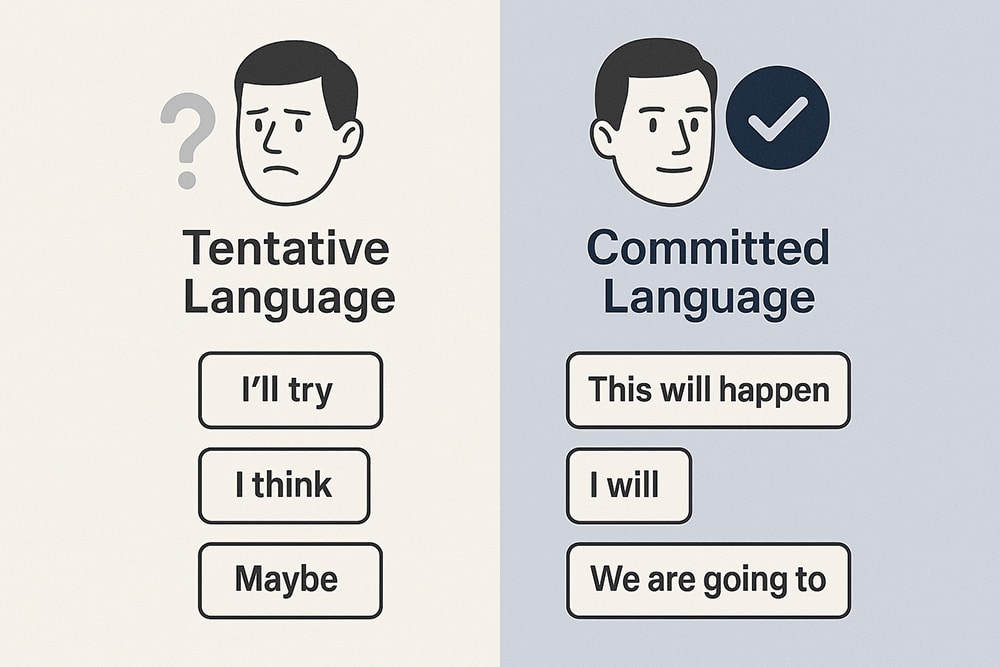
The difference often isn’t found in their strategies, intelligence, or even work ethic. It’s hidden in their language – specifically, whether they speak and then act with commitment or tentativeness when addressing the future.
Let me share what I witnessed in a fascinating leadership session that revealed this crucial distinction. A group of managers was exploring why they habitually used phrases like “I’ll try,” “I hope,” or “Let me see what I can do” – even when they fully intended to complete the task.
Their answers revealed something profound about how most of us operate:
“I’m buying time to make sure I can deliver.” “I don’t want to disappoint people if I can’t follow through.” “I’m avoiding taking full responsibility.” “I’m protecting myself from looking wrong.”
Sound familiar? These are the unconscious calculations we make dozens of times daily.
But here’s the twist: these seemingly harmless verbal cushions aren’t just communication quirks – they fundamentally shape how we think, act, and ultimately, what we achieve.
The Hidden Cost of “I’ll Try”
When you say “I’ll try” instead of “I will,” you’re not just being cautious. You’re unconsciously programming your mind and actions for uncertainty. This tentative language carries hidden costs:
Mental burden and constant background stress
Scattered attention and divided focus
Lower productivity and action velocity
More time spent in indecision and doubt
Uncertainty for everyone involved
As one participant confessed: “When I say I’ll try, I end up working overtime to accommodate everything, constantly juggling priorities, and feeling perpetual stress because I’m not clear about what I’m fully committing to.”
Another revealed: “I find myself overthinking and second-guessing instead of just executing. It’s exhausting.”
These aren’t just personal inconveniences. They represent a massive tax on your leadership energy – energy that could be directed toward creating breakthrough results.
It is not just Semantics
Language shapes thought. Thought drives action. Action creates results. This causal chain, supported by decades of neurolinguistic research, explains why the words leaders choose don’t merely describe their intentions—they fundamentally shape what becomes possible for themselves and their organizations.
As Dr. Guillaume Thierry notes in his groundbreaking research on neurolinguistic relativity, “Language influences—and may be influenced by—nonverbal information processing.” This isn’t about linguistic tricks or superficial changes to your vocabulary. It’s about understanding and harnessing the profound connection between language, thought, and action—a connection that lies at the heart of truly transformational leadership.
When a leader says “We will launch this product by Q3,” they’re not just making a prediction—they’re performing what linguists call a “commissive speech act” that creates a social commitment. This commitment changes the relationship between the speaker and listeners, establishing new expectations and permissions that shape subsequent behavior.
In contrast, when a leader says “We hope to launch this product by Q3,” they’re performing what linguists call an “expressive speech act” that merely describes their current mental state without creating new social commitments. This distinction explains why teams respond so differently to committed versus tentative leadership language—the former creates new social realities that drive action, while the latter merely comments on existing realities.
The Liberation of Clear Commitment
Now consider the alternative. What happens when you simply say “This will happen” or “I will deliver this” – even before you have all the evidence that you can?
The same participants described:
Mental clarity and inner peace
Heightened productivity
Optimal use of time
A healthier communication environment
Faster, more decisive action
One leader noted: “When I commit clearly, I don’t waste time debating with myself. I just find a way to make it happen.”
This is the power of committed language – it creates a different foundation from which you operate and take action. Instead of waiting for certainty before committing, you commit first and then create the certainty through your actions.
When leaders use committed language, they’re not just expressing confidence—they’re creating psychological conditions that automatically trigger action when relevant situations arise, without requiring additional decision-making or motivation.
The psychological power of committed language extends beyond individual cognition to social dynamics. Dr. Robert Cialdini, whose research on influence has transformed our understanding of persuasion, identifies commitment and consistency as one of the fundamental principles of human behavior. Once people make a clear commitment, they experience both internal and external pressure to behave consistently with that commitment.
This commitment-consistency principle explains why leaders who make clear, public commitments using committed language are significantly more likely to follow through than those who use tentative language. The psychological and social forces activated by committed declarations create momentum toward the declared outcome that tentative statements simply cannot generate.
At this point, you might be thinking: “But what if I commit and fail? Isn’t it more honest to say I’ll try?”
This is where courage enters the picture. The truth is, there’s no evidence in the future – only in the past. When you commit to something unprecedented, something you’ve never done before, you’re stepping into territory where failure is possible.
Most people avoid this risk at all costs. They want guarantees before they commit. But that’s precisely why most people don’t create extraordinary results.
Leaders who produce unprecedented outcomes understand a fundamental truth: commitment precedes evidence. They don’t wait for proof they can deliver before they commit – they commit first, then find a way to deliver.
Fear of Disappointment: Many leaders use tentative language to manage expectations—both their own and others’. By saying “I’ll try” rather than “I will,” they create a psychological buffer against the pain of disappointing themselves or others if they fail to deliver.
James, a senior executive at a technology company, recognized this pattern in himself: “I realized I was saying ‘I’ll try’ even when I fully intended to complete the task. It was a way of giving myself an out, of protecting myself from the potential disappointment of failure.”
Fear of Judgment: Leaders often worry that clear commitments will expose them to harsher judgment if they fall short. Tentative language creates plausible deniability—”I only said I would try”—that shields them from full accountability.
Research in social psychology confirms this dynamic. A study published in the Journal of Personality and Social Psychology found that individuals who used tentative language were judged less harshly for identical failures than those who had made clear commitments. This creates a perverse incentive for leaders to hedge their language, even when doing so undermines their effectiveness.
Fear of the Unknown: Perhaps most fundamentally, leaders fear committing to outcomes when they cannot see the full path to achievement. This fear of the unknown drives them toward tentative language that preserves optionality and avoids the discomfort of certainty in uncertain conditions.
Dr. Carol Dweck’s research on mindset provides insight into this fear. Leaders with a fixed mindset—who believe capabilities are static rather than developable—are particularly prone to fear of the unknown. They worry that they may not have the skills or resources to fulfill clear commitments, so they hedge with tentative language.
The Paradox of Leadership Fear
The paradox of leadership fear is that the very language patterns that protect leaders from these fears also prevent them from achieving their full potential. By using tentative language to avoid the risk of being wrong, leaders create conditions that make success less likely and limit what’s possible for themselves and their organizations.
This creates a self-reinforcing cycle: fear leads to tentative language, which leads to diminished results, which reinforces the fear that clear commitments are too risky. Breaking this cycle requires understanding that the apparent safety of tentative language is illusory—it protects you from the risk of being wrong at the cost of ensuring you’ll never be transformatively right.
The Two Operating Systems
Think of these approaches as two distinct operating systems for leadership:
Operating System 1: Evidence-Based Commitment
Wait for evidence before committing
Use tentative language to protect yourself
Avoid disappointing others
Reduce risk of being wrong
Create predictable, incremental results
Operating System 2: Commitment-Based Evidence
Commit first, then create the evidence
Use clear, direct language
Accept that some may be disappointed
Accept the risk of being wrong
Create unprecedented, breakthrough results
Most leaders operate exclusively in System 1. They believe it’s the only responsible way to lead. But what they don’t realize is that System 1 has built-in limitations – it can only produce results that are extensions of what’s already been done.
System 2 is where unprecedented results come from. It’s where you find the leaders who transform industries, redefine what’s possible, and create outcomes that seemed impossible before they arrived.
The Language Patterns of Each System
The distinction between these operating systems is most clearly revealed in language patterns. Leaders operating in Evidence-Based Commitment tend to use:
Conditional statements: “If X happens, then we’ll do Y”
Probability-based phrasing: “There’s a good chance,” “It’s likely that”
Hedging qualifiers: “Assuming all goes well,” “Barring unforeseen circumstances”
In contrast, leaders operating in Commitment-Based Evidence consistently employ:
Declarative statements: “We will,” “This is going to happen”
Time-bound commitments: “By this date,” “Within this timeframe”
Certainty-based phrasing: “This will work,” “We are going to succeed”
Unequivocal language: “No matter what,” “Whatever it takes”
These language patterns aren’t merely stylistic differences—they reflect and reinforce fundamentally different approaches to leadership and possibility. By becoming aware of your own language patterns, you can begin to shift from System 1 to System 2 in the areas where breakthrough results matter most.
The Personal Challenge
One participant shared his personal struggle with this concept:
“I have a long history of blaming myself when things go wrong. I worry that if I commit strongly and then fail, I’ll spiral into self-blame.”
This is a legitimate concern. But notice what’s happening here – the fear of future self-blame is preventing bold commitment in the present.
The solution isn’t to avoid commitment. It’s to develop a healthier relationship with mistakes and failures. As this leader discovered, daily practice in reframing mistakes as learning opportunities gradually reduced his tendency toward self-blame.
He shared: “I started practicing positive daily declarations and focusing on what I can learn from mistakes rather than internalizing them. This has drastically reduced my stress and improved my productivity.”
This inner work is essential. You cannot speak with powerful commitment externally if you’re plagued by self-doubt and harsh self-judgment internally.
Distinguishing Accountability from Self-Blame
A critical distinction for leaders developing the courage for committed language is between healthy accountability and unhealthy self-blame. Both involve taking responsibility for outcomes, but they create fundamentally different psychological conditions for committed language.
The Neuroscience of Self-Blame
Neuroscience research reveals that self-blame activates brain regions associated with shame and avoidance, creating a neurological state that naturally drives tentative rather than committed language. When leaders engage in self-blame after failures, they neurologically prime themselves to hedge future commitments.
In contrast, healthy accountability activates brain regions associated with problem-solving and approach motivation, creating a neurological state conducive to clear, decisive action.
When to Say No
Another crucial aspect of committed language is learning to say a clean, clear “no” when appropriate.
One leader confessed: “I say ‘I’ll try’ when I actually want to say no, because I don’t want to hurt or disappoint people.”
This is where empathy without authenticity becomes weakness. When you say “I’ll try” instead of “no,” you’re not being kind – you’re being unclear. You’re creating false hope and ultimately more disappointment than a clear no would have caused.
“Empathy without authenticity is weakness. Leadership is doing what is required, not what is easy.”
A clean no is far more respectful than a vague, uncommitted maybe. It allows the other person to make clear decisions based on accurate information rather than false hope.
The False Kindness of “Maybe”
When faced with requests they don’t intend to fulfill, many leaders default to tentative responses: “Maybe later,” “I’ll see what I can do,” or “Let me think about it.” They believe these responses are kinder than a direct “no,” sparing the requester immediate disappointment.
This belief, while well-intentioned, reflects what psychologists call the “empathy-accuracy trade-off”—the mistaken assumption that being kind requires being vague or even misleading. Research in communication psychology reveals that this approach actually creates more harm than good.
Dr. Brené Brown, whose research focuses on vulnerability and leadership, explains: “Clear is kind. Unclear is unkind. When we use vague, tentative language instead of a direct ‘no,’ we’re not being kind—we’re avoiding our own discomfort at the expense of the other person.”
This avoidance creates several significant problems:
False hope: The requester often interprets tentative language optimistically, creating expectations that will eventually be disappointed.
Wasted energy: Without clear boundaries, requesters may continue investing time and emotional energy pursuing something that won’t happen.
Delayed disappointment: The disappointment isn’t eliminated—it’s merely postponed, often to a point where the stakes and expectations are higher.
Eroded trust: When patterns of tentative “maybes” consistently become eventual “nos,” trust in your communication deteriorates.
The Practice of Commitment
Transforming your language from tentative to committed isn’t an overnight change. It’s a practice – one that feels uncomfortable at first, especially if you’ve spent years or decades operating from System 1.
Here’s how to begin:
Notice your language patterns. Pay attention to how often you say “I’ll try,” “I hope,” or “Let me see.” Just observing these patterns creates awareness.
Start with low-stakes commitments. Practice committed language in areas where the consequences of failure are minimal. This builds your comfort with commitment.
Examine your fears. When you catch yourself using tentative language, ask: “What am I afraid might happen if I commit clearly here?”
Separate identity from outcomes. Remember that failing at something doesn’t make you a failure. It makes you someone who took a risk.
Create morning intentions. As one participant shared: “I write down my intentions for the day – how I want to show up, what I’m committed to accomplishing. This primes my mind for clear commitment.”
The Leadership Choice
Every day, in countless conversations, you choose how you’ll speak about the future. Most of these choices happen unconsciously, driven by habits and fears you may not even recognize.
But now you have a choice. You can continue operating exclusively from System 1 – waiting for evidence before committing, protecting yourself from being wrong, and creating predictable results.
Or you can begin incorporating System 2 – committing before you have all the evidence, accepting the risk of being wrong, and creating the possibility of unprecedented outcomes.
This isn’t about abandoning careful thinking or responsible planning. It’s about recognizing that for the results that matter most – the breakthrough innovations, the transformative changes, the unprecedented achievements – commitment must precede certainty.
The Spectrum of Commitment
It’s worth noting that this isn’t an all-or-nothing proposition. You don’t have to commit with absolute certainty to everything. Think of it as a spectrum:
For routine, low-impact decisions: Your habitual approach may work fine
For moderate-impact decisions: Consider more committed language
For high-impact, transformative goals: Full commitment is essential
I’m not asking you to jump totally to committed language for everything. But for the things that matter, for the results that matter, you commit. And yes, you can be wrong. And that’s the cost of taking on any big game.
Your Unprecedented Future
Look at the goals you’re currently pursuing. The ones that really matter. The ones that would transform your leadership, your organization, or your life.
Now ask yourself honestly: Am I speaking about these goals with committed language or tentative language?
Am I saying “I’ll try to hit our targets” or “We will hit our targets”?
Am I saying “I hope to transform our culture” or “I will transform our culture”?
Am I saying “Let’s see if we can innovate” or “We will innovate”?
The difference may seem subtle, but it’s everything. In that small linguistic gap lies the difference between leaders who manage the status quo and leaders who create new realities.
The Time for Commitment
Most of us have been conditioned to believe that certainty should precede commitment – that we should only promise what we’re already certain we can deliver.
But that approach has built-in limitations. It confines you to the realm of the proven, the established, the already-done. It makes unprecedented results impossible by definition.
The greatest leaders throughout history have operated differently. They committed to outcomes that seemed impossible at the time:
Landing on the moon before the technology existed
Creating computers that fit in our pockets before the components were invented
Building electric vehicles viable for mass markets before the infrastructure was in place
None of these commitments were “reasonable” when they were made. All required their leaders to stand in a place of commitment before evidence existed.
You have this same power available to you right now. The power to commit to a future that doesn’t yet exist – and through that commitment, begin creating it.
Yes, you might be wrong sometimes. Yes, you might disappoint people occasionally. Yes, you might look foolish in the eyes of those who operate solely from System 1.
But you also might create something unprecedented – something that changes everything.
Isn’t that possibility worth the risk?
The Choice Before You
So here’s the invitation: Choose one important goal – something that matters deeply to you, something that would represent a breakthrough in your leadership or organization.
Now, how do you speak about this goal? With tentative, cautious language? Or with clear, committed language?
If you’re like most leaders, you’ve been operating from System 1 – waiting for certainty before committing. That’s not wrong, but it is limiting.
What would happen if you shifted to System 2 for this one crucial goal? If you spoke with commitment before you had all the evidence? If you said “This will happen” instead of “We’ll try to make this happen”?
You might fail. You might be wrong. You might disappoint yourself or others.
Or you might create something unprecedented – something that changes everything.
The choice is yours.
The journey of committed language begins with a single, powerful choice: the decision to speak with clarity and certainty about the future you will create. This choice—to replace “I’ll try” with “I will”—seems simple on the surface but represents a profound shift in how you relate to possibility, responsibility, and your own capacity for impact.
In making this choice, you join a lineage of transformational leaders throughout history who have used the language of commitment to create unprecedented futures. From Churchill’s defiant “We shall never surrender” to Kennedy’s bold “We will go to the moon” to your own declarations about what will happen in your organization, committed language (or the lack of it) shapes your future.
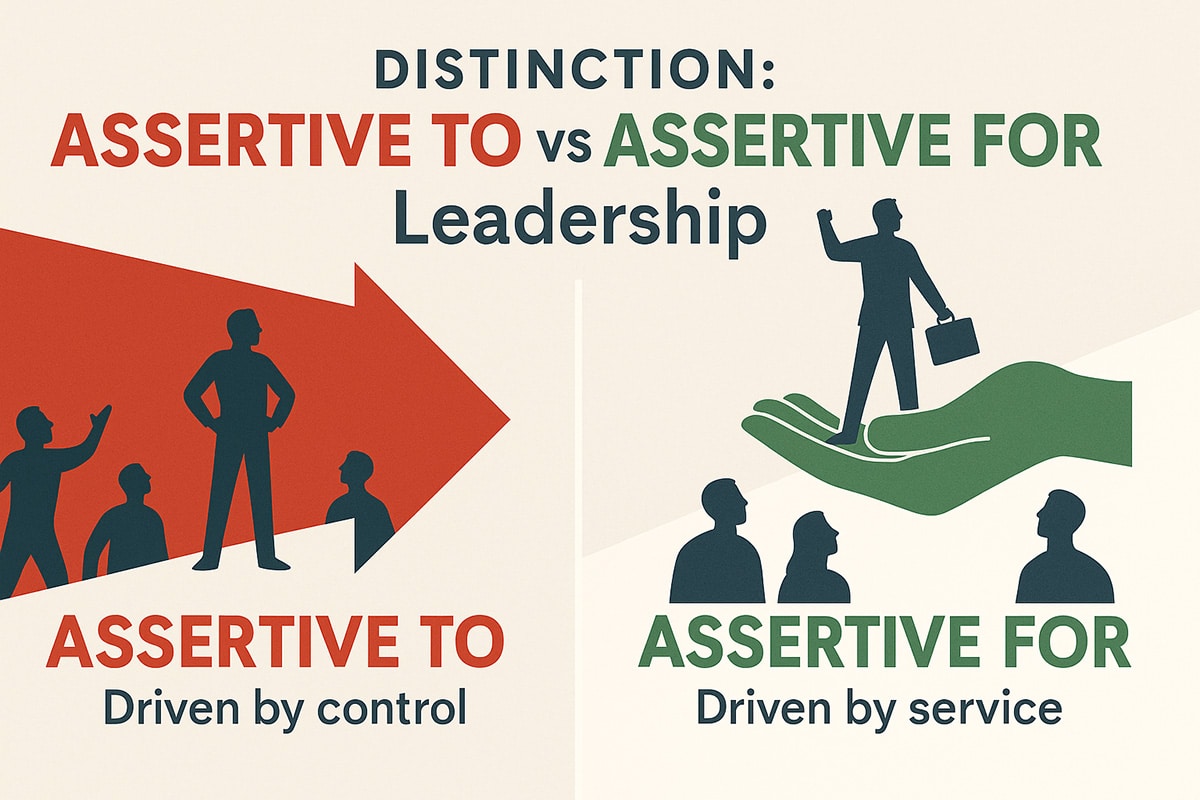
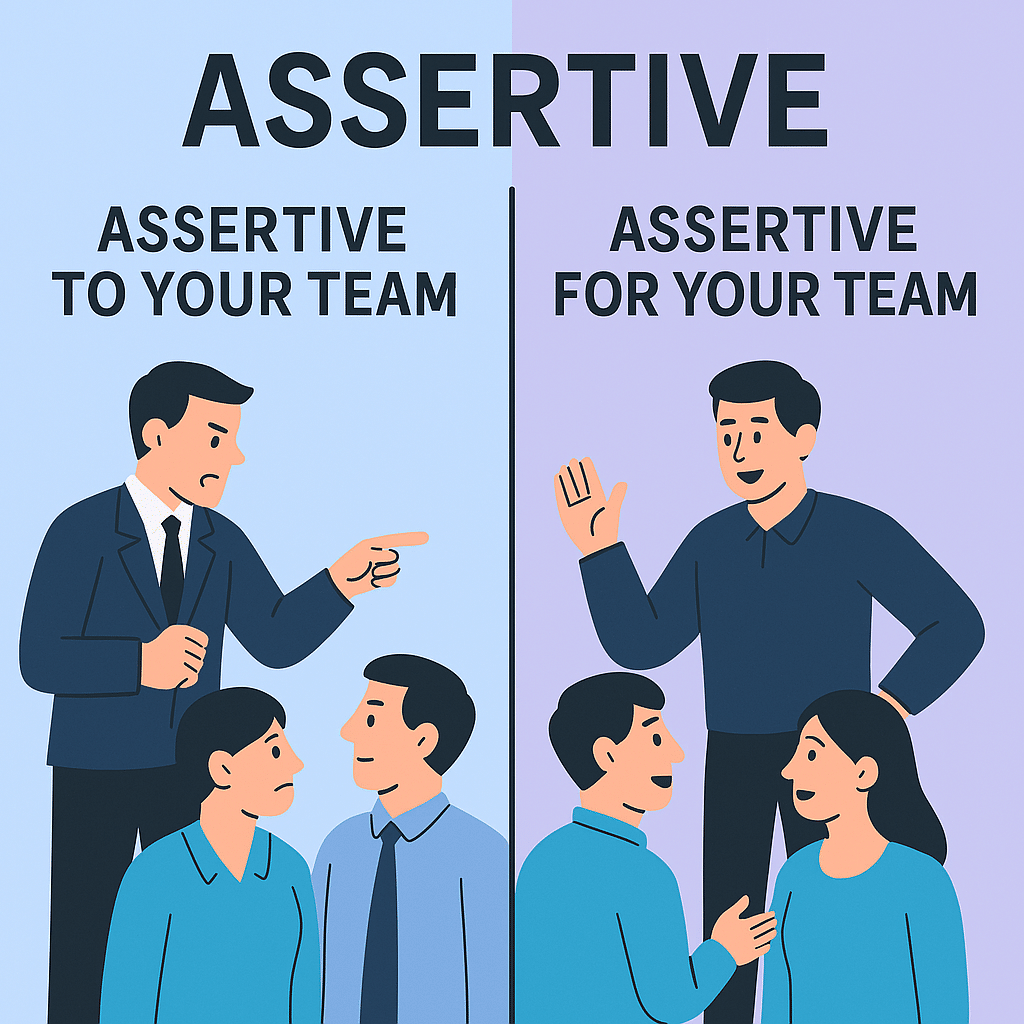
Being Assertive to Your Team vs. Being Assertive for Your Team
In the high-stakes world of executive leadership, how CEOs interact with their leadership teams can make or break an organization’s success. Many CEOs struggle with finding the right balance of assertiveness—push too hard, and you risk creating a culture of fear and compliance; be too passive, and decisions stall while accountability fades.
The key distinction that separates truly transformative leaders from merely effective managers lies in understanding the difference between being assertive to your team versus being assertive for them. See below:
Assertive To Your Team
Assertive For Your Team’s Growth
Mindset
“I need to be in control.” Driven by fear of failure or losing authority Measures success by compliance Worried about what others might think about you
“I want them to step into leadership.” Driven by trust in people’s growth potential Measures success by ownership and initiative Sees assertiveness as a gift to their people’s growth
Communication Style
Directive: “Do this now.” Corrects mistakes immediately Talks at the team
Ask questions supportively: “What’s your approach?” Creates space for reflection and learning Talks with the team, listens deeply
Conflict & Accountability
Blames or points fingers Uses pressure to drive results Reacts emotionally to errors
Holds space for difficult conversations with care Uses clarity and agreements to foster accountability Responds by coaching through the issue
Long-Term Impact
Creates dependency on you Limits innovation & experimentation Exhausts you & bottlenecks scale
Builds leaders who operate without you Encourages ownership and initiative Frees you to lead the company forward
Assertive TO your team
This approach positions the CEO and their leadership team in a subtle but problematic dynamic:
The CEO pushes for results and compliance
Team members focus on meeting expectations rather than solving core problems
Executives filter information to align with what they think the CEO wants to hear
The CEO receives incomplete or sanitized information
Strategic decisions suffer from limited perspective and insufficient challenge
The cycle continues, reinforcing superficial alignment rather than genuine commitment
This dynamic creates fundamental organizational tension. Senior leaders sense they’re being directed rather than developed, managed rather than led. Even when they verbally commit to initiatives, their internal commitment may be lacking, leading to what looks like agreement in meetings but manifests as delayed implementation afterward.
When CEOs are assertive TO their teams in this manner, they:
Generate compliance without commitment
Create environments where people manage up rather than speak truth
Discourage the healthy conflict necessary for optimal decisions
Receive superficial agreement followed by passive resistance
Foster a culture where meetings result in vague action items rather than clear decisions
Being Assertive For Your Team
The alternative approach—being assertive for your leadership team—fundamentally reframes the relationship and purpose of executive interactions. This mindset sees the CEO’s primary responsibility not as directing outcomes but as creating conditions for clear decisions, genuine commitment, and leadership development.
When a CEO is assertive for their team, they:
Challenge indecision and avoidance patterns: By refusing to accept vague commitments or endless analysis, they help executives break through organizational inertia and personal risk aversion.
Demand clarity rather than specific outcomes: The goal isn’t to force agreement with the CEO’s preferred solution but to eliminate the middle ground of “maybe” that keeps organizations stuck.
Hold leaders accountable to their own stated values and goals: If an executive has committed to certain priorities or principles, the CEO reminds them of these commitments when conflicting behaviors emerge.
Force organizational truth-telling: By asking penetrating questions, they help the leadership team confront uncomfortable realities rather than hiding behind comfortable narratives.
Provide structure for consequential decision-making: Many leadership teams struggle with decisions not because they lack information but because they lack frameworks for evaluation and the courage to commit to difficult choices.
A Common Objection to Assertiveness – Empathy
There is a common objection that stops people from being assertive. It is the fear that “I am not being empathetic if I am completely honest and assertive” or “I will not be authentic if challenge that person more. And I understand their point of view.”
Let me tell you something in a no-nonsense way.
Empathy is a powerful leadership skill.
BUT
Empathy without authenticity is just weakness.
It is cheating yourself of your own dreams and values.
It is cheating the other person of your honest opinion and what you have to offer to them (by being authentic or assertive).
Leaders Lead.
And Leaders lead in a way that not only helps them but also inspires and teaches those around them.
If you can be authentic and assertive (while still being empathetic) that is your leadership – for yourself and for others too.
When you are fully authentic, even when it gets uncomfortable, you are setting an example and a high-bar – for yourself and others.
This is why you are here. This is why you are reading this article.
The Distinction in Practice
1. Detailed questioning about implementation plans rather than making judgements
Rather than accepting “We’ll look into it” or “We’ll report back next quarter,” the CEO who is assertive for their team asks:
“What specifically will you be doing between now and our next meeting?”
“What metrics will tell us whether this approach is working?”
“What obstacles do you anticipate, and how will you address them?”
“When exactly will key milestones be reached?”
“How will you communicate progress to the rest of the organization?”
These questions aren’t designed to micromanage but to create clarity and structure around execution.
2. Challenging unnecessary delays in decision-making with curiosity instead of blame
When an executive suggests an extended timeframe for making a strategic decision, the CEO might ask:
“You mentioned needing another month for analysis. What specific information will that additional time provide?”
“We’ve been discussing this issue for the past three quarters. What is preventing us from deciding today?”
“If we truly believe this is the right strategic direction, why would we delay implementation by six weeks?”
These challenges aren’t about rushing decisions but about exposing organizational patterns of avoidance that keep companies from necessary action.
3. Explicit acknowledgment of team and organizational patterns
A CEO being assertive for their leadership team might say:
“I notice we’ve had this same conversation in our last three quarterly reviews. What’s really preventing us from moving forward?”
“Do you recognize that the hesitation we’re seeing reflects the same pattern that delayed our last major initiative?”
“Would you agree that our collective tendency to seek perfect information has cost us market opportunities in the past?”
This approach helps leadership teams see their own behavioral and decision-making patterns more clearly.
4. Forcing explicit choice helps grow others as leaders
Perhaps most powerfully, being assertive for a leadership team means requiring them to make explicit choices between clear alternatives:
“We have two options: commit fully to this market entry strategy with all its risks, or explicitly decide to focus elsewhere. Which are we choosing today?”
“I need a clear decision: either we’re restructuring this division now, or we’re consciously deciding to maintain the current structure despite its challenges.”
“There’s no middle ground here. Either we’re going to invest at the level required for success, or we’re going to exit this business. Which is it?”
This isn’t dictatorial—it’s clarifying. It forces leadership teams to confront the reality that not deciding is itself a decision with consequences.
5. Distinguishing between dialogue and decision
CEOs who are assertive for their teams clearly delineate when conversations are exploratory versus when they require resolution:
“We’re in exploration mode for the next 30 minutes. All ideas are welcome without judgment.”
“We’re now shifting to decision mode. We need to leave this room with a clear choice.”
“This topic requires a decision today. If we can’t reach consensus in the next hour, I’ll make the call, but I’d prefer we arrive there together.”
This clarity about conversation mode prevents the common pattern of endless discussion without resolution.
The Results of This Shift
When CEOs master the art of being assertive for their teams rather than to them, several transformative organizational shifts occur:
Decision velocity increases dramatically: Issues that previously cycled through multiple meetings reach resolution in a single discussion.
Implementation improves: When leaders make clear, specific commitments in front of peers, follow-through improves dramatically.
Strategic clarity emerges: By forcing explicit choices between competing priorities, the organization develops sharper focus.
Leadership capacity expands: Team members develop greater decision-making confidence and skill through the CEO’s modeling.
Organizational politics decrease: When ambiguity is eliminated, the space for political maneuvering shrinks.
The Cultural Dimension
Being assertive for your team rather than to them transforms organizational culture in profound ways:
Truth-telling becomes normalized: When the CEO consistently demands clarity, honesty gradually displaces political calculation.
Respect for leadership deepens: Leaders who challenge their teams to be their best selves, even when uncomfortable, earn deeper respect than those who manage through authority alone.
Psychological safety paradoxically increases: Though the conversations may be more challenging, executives feel safer knowing where they stand and what’s expected.
Decision ownership becomes distributed: When leaders make clear commitments of their own volition (even if prompted), they take ownership of outcomes rather than merely executing the CEO’s will.
Organizational maturity accelerates: The entire leadership system develops greater capacity for handling complexity and ambiguity when clarity of process is demanded.
Implementing the Shift
For CEOs looking to make this crucial shift from being assertive to their teams to being assertive for them:
Examine your relationship with control: Can you genuinely focus on decision quality and clarity rather than directing specific outcomes?
Develop comfort with tension: Practice maintaining productive discomfort in meetings rather than relieving tension prematurely.
Master the art of powerful questions: Learn to ask questions that reveal underlying assumptions and force clarity rather than questions that lead to predetermined answers.
Recognize that your attention is your most powerful tool: What you consistently ask about and focus on will shape your organization more than what you direct.
Lead through curiosity rather than certainty: Position yourself as the chief question-asker rather than the chief answer-provider.
The Broader Impact
This leadership approach extends far beyond the executive suite. When CEOs model being assertive for rather than to their teams:
The pattern cascades: Senior leaders begin using similar approaches with their own teams.
Organizational decision-making improves at all levels: The clarity and commitment modeled at the top becomes the standard throughout.
Talent retention strengthens: High performers are drawn to environments where clarity and decisive action are valued.
Strategic execution accelerates: The gap between decision and implementation narrows dramatically.
Innovation thrives: When leaders know that clear decisions will be made and supported, they’re more willing to propose bold ideas.
The distinction between being assertive to versus for your leadership team may appear subtle, but its organizational impact is profound.
By shifting from a posture of directing outcomes to one of demanding clarity and commitment, CEOs transform from perceived taskmasters to developmental catalysts. They help their leadership teams break through their own avoidance patterns while establishing the conditions for truly distributed leadership.
In an era of unprecedented complexity and rapid change, this approach cuts through organizational noise and politics. It respects leaders’ agency while refusing to enable the indecision that keeps organizations stuck. And it creates the foundation for authentic executive teams based on truth-telling rather than impression management—a foundation that serves both immediate business outcomes and long-term organizational health.
This is the Leadership Journey series on the Choosing Leadership Podcast.
I believe we all have a lot to learn from each other’s stories – of where we started, where we are now, and our successes and struggles on the way. With this series of interviews, my attempt is to give leaders an opportunity to share their stories and for all of us to learn from their generous sharing. If you know a leader whom you would like to see celebrated on the show, please send me a message on LinkedIn with their name.
In this episode, we dive into the extraordinary journey of Rupesh Sanghavi—from selling brass gifts in college to building a multibillion-dollar e-commerce company.
He shares how calculated risks, empowering leadership, and bold decision-making shaped his success, offering invaluable lessons for anyone looking to scale their impact.
Rupesh’s story challenges the notion that leadership is about control—instead, it’s about trust, autonomy, and creating opportunities for others to thrive.
If you’ve ever felt stuck in your career or business, his insights will shift your perspective on what’s truly possible.
Tune in for a conversation that will inspire you to think bigger, lead bolder, and create lasting change.
Ten years ago, you created something revolutionary. You set the standard. Today, competitors crowd your space, and the risks of commoditization are louder than before. The natural response? Doubt. Hesitation.
Perhaps even a subtle urge to compete on price rather than value.
But here’s the uncomfortable truth: your organization will never perform beyond the level of conviction held by its leadership.
Your product might be excellent. Your team might be talented. But if you secretly wonder “are we really worth the premium?” – you’ve already lost.
The Conviction Crisis
I’ve seen it repeatedly in premium brands facing market maturity. The gradual erosion begins invisibly – not in market share or even customer perception, but in the quiet thoughts of leadership:
“Are we worth that premium anymore?”
“Can we still justify these prices when competitors offer similar features for less?”
“Do we still have the right to call ourselves industry leaders?”
Is your thinking or language during your leadership meetings already showing doubt?
These doubts seep into executive meetings, color strategy discussions, and eventually transform how you communicate with the market. Your sales team senses it. Your customers detect it. And the race to the bottom begins – not because your offering lost value, but because you stopped believing in it.
A Story
A few months ago, I watched a brilliant founder pitch his premium software solution to a roomful of potential clients. His product was genuinely superior, but halfway through, someone questioned his pricing. Instead of standing firm, he hesitated for just a second before responding.
That tiny pause said everything. Three potential clients who had been nodding along suddenly started checking their phones. The sale was lost before his defense even began.
Your customers aren’t buying your features. They’re buying your certainty.
Rediscovering Authentic Conviction
True conviction isn’t manufactured – it’s rediscovered. It’s about reconnecting with the truth of what you’ve built and deliver:
Conduct a value audit: Document every advancement, innovation, and customer success from the past. This isn’t marketing material; it’s leadership’s reminder of the actual value created. Do not just understand it. Get it in your bones. Feel proud of it.
Seek honest customer testimony and create a success journal: Not satisfaction scores, but genuine conversations about how your solutions transformed their operations. Record these verbatim – they’re your mirror when doubts arise.
Experience your premium difference: Leadership should regularly experience your offering as customers do, contrasted directly with alternatives. The premium difference must be felt, not just described.
Communicating with Conviction
When authentic conviction exists, communication transforms:
You speak with clarity about your position because you know rather than hope you deliver superior value
You discuss price as an investment rather than a cost because you’ve witnessed the returns
You lead conversations with value and outcomes rather than features or discounts
You take a powerful stand for who you are, why you are unique, and where you are headed
You have an answer to “Why working with us is the best decision you will make?”
You do not take criticism or sarcasm about your eroding value lightly – even if it means confronting people
You stand up and speak powerfully not against others – but from owning your own worth and value
Your conviction creates permission for clients to believe. When you genuinely know your solution is worth every premium dollar, prospects sense it. They’re not buying features – they’re buying your certainty.
A Story
When you truly believe:
You discuss price last, not first
You talk about transformation, not transactions
You share stories, not specifications
You listen more than you pitch
A medical device company I worked with stopped talking about their surgical tool’s technical advantages and instead had surgeons share how it gave them confidence during the most high-stakes moments of their careers. Their sales doubled not because the product changed, but because their message connected to what surgeons truly cared about – being their best when patients needed them most.
Innovation Flows from Belief
The most powerful R&D investments emerge not from fear of competition but from deep belief in your mission. When you’re truly convinced of your premium value proposition, innovation becomes an extension of that conviction rather than a desperate attempt to justify it.
The greatest competitive advantage isn’t your current product superiority – it’s your unshakable belief in the next evolution of value you’ll deliver.
The Courage to Stand Apart
The market constantly pressures premium brands toward commoditization. Resisting requires courage – the courage to price based on value rather than competitor benchmarks, to speak differently, to refuse participation in feature-comparison battles.
This courage comes only from conviction. Not arrogance or wishful thinking, but the quiet certainty born from decades of seeing the transformative impact of your work.
Remember: if you’re not absolutely convinced of your premium value, no sales technique, marketing campaign, or strategic plan will overcome that fundamental gap. The most urgent work may not be external strategy but internal belief – rediscovering and recommitting to the authentic value that makes your premium position not just defensible but necessary for your customers’ success.
Your years of experience isn’t a liability – it’s your foundation of credibility. Every problem solved, every customer transformed, every innovation delivered is proof of your promise.
Believe in that promise again – not as a strategy, but as your truth. When you truly believe, the market feels it. And that belief is worth more than any marketing budget in the world.
Your greatest competitive edge isn’t your legacy of innovation but your capacity to believe in its continuing value.
I use cookies on this website to give you the most relevant experience and for analytics purposes. Any personal data collected will never be shared with any third party, or used to spam you. That is my promise. - Sumit By clicking “Accept”, you consent to the use of ALL the cookies.
This website uses cookies to improve your experience while you navigate through the website. Out of these, the cookies that are categorized as necessary are stored on your browser as they are essential for the working of basic functionalities of the website. We also use third-party cookies that help us analyze and understand how you use this website. These cookies will be stored in your browser only with your consent. You also have the option to opt-out of these cookies. But opting out of some of these cookies may affect your browsing experience.
Necessary cookies are absolutely essential for the website to function properly. This category only includes cookies that ensures basic functionalities and security features of the website. These cookies do not store any personal information.
Any cookies that may not be particularly necessary for the website to function and is used specifically to collect user personal data via analytics, ads, other embedded contents are termed as non-necessary cookies. It is mandatory to procure user consent prior to running these cookies on your website.