This is the Humble Inquiries series. In this episode, Leslie joins me as my co-host to humbly inquire into overwhelm – the feeling of too much to do and too little time – which is a very timely one as we find ourselves in new ways of working. Co-hosted with Leslie Wireback on the Choosing Leadership podcast
In each episode of Humble Inquiries, we are deliberately going to put ourselves in the uncomfortable space of not knowing the answer and humbly inquiring about these challenges – with the aim to provoke new thoughts, actions, and practices – to help us better serve our coaching clients, and also to help the leader in you navigate the biggest challenges – at life and at work.
Show Notes
Sumit – “we see doing more as a badge of honour. we feel that if we are not doing more, if you’re not doing more than our peers, then that’s somehow a weakness or a sign of not being a good professional.”
Sumit – “overwhelm and having this sense of too much to do is basically an invitation to ask better questions”
Leslie – “What do you care about? What are your priorities, really stepping back and looking at that whole big picture and making adjustments – not just once but regularly”
Sumit – “What I’ve found is that I do not have time is always a lie. I think a better, more accurate representation, would be that this is not my priority. “
Sumit – “I do not have time is never the whole truth. There is something deeper beyond that. “
Leslie – “I fell in the trap of my work hours needed to be eight to four, eight to five something typical, whereas that doesn’t necessarily work well or serve me well each and every day”
Sumit – “the first element of really asking ourselves what is the cost of operating this way? And is that okay with me? And if that’s okay with you, then yes, wonderful. Continue on that journey. But if you identify that something is missing and that is not okay. Then the question is staring in your face.”
Leslie – “saying no feels rude. And so then I don’t want to say no, I care too much. And I want to help people and saying no is going to disappoint them. Whereas., if I don’t say no, I may be disappointing myself or someone else because of I’m creating a conflict and an inability to manage all that I have to do.”
Sumit – “No, is the most powerful word. And also one which most people find it difficult to speak.”
Sumit – “A NO doesn’t mean that you are rude doesn’t mean that you are polite. Doesn’t mean that you’re hardworking doesn’t mean that you’re not hardworking. It doesn’t mean anything unless you make it mean, meaning something. So a no is a simple word. No is a full sentence in itself. “
Leslie – “it might take the leader being vulnerable and saying I can’t get it all done. I need help. And that. Your team might finally say, thank you for admitting this, that as a team, they’re all drowning too.”
Sumit – “It’s only about managing your priorities and then your energy”
Sumit – “To realize that everybody has 24 hours, no matter what they do, whether I am an employee as an individual contributor, whether I am a manager of whether I am a president of a country, everybody has 24 hours, not a second more, not a second less for me, realizing that is a very empowering and liberating feeling.”
Sumit – “is it that my time owns me? What is it that I own my time? I do. I get to choose what, and where I spend my time because everybody has 24 hours. The only question. How are you prioritizing? What are you saying? Yes. To what are you saying No to”
Leslie – “as a leader, do you look at the gifts of the individuals on your team and kind of reshuffle responsibilities?”
Leslie – “the stories you tell yourself on the assessment you’re making of, I’m not good at my time management or I’m not good at saying no, all of that, questioning it and changing it to have a different perception”
Sumit – ” every courageous act is a vulnerable act as well.”
As quoted by Edgar Schein in his book Humble Inquiry, an humble inquiry is recognizing that insights most often come from conversations and relationships in which we have learned to listen to each other and have learned to respond appropriately, to make joint sense out of our shared context, rather than arguing with each other into submission.
What do you get when you combine razor-sharp business acumen, a penchant for adventure and fearless risk-taking?
You get Richard Branson!
One of the world’s most imaginative, determined, self-made businessmen who have touched the skies of success. His endeavours to take on challenges and make the most out of failures, make him a unique personality and one of the world’s richest men on earth.
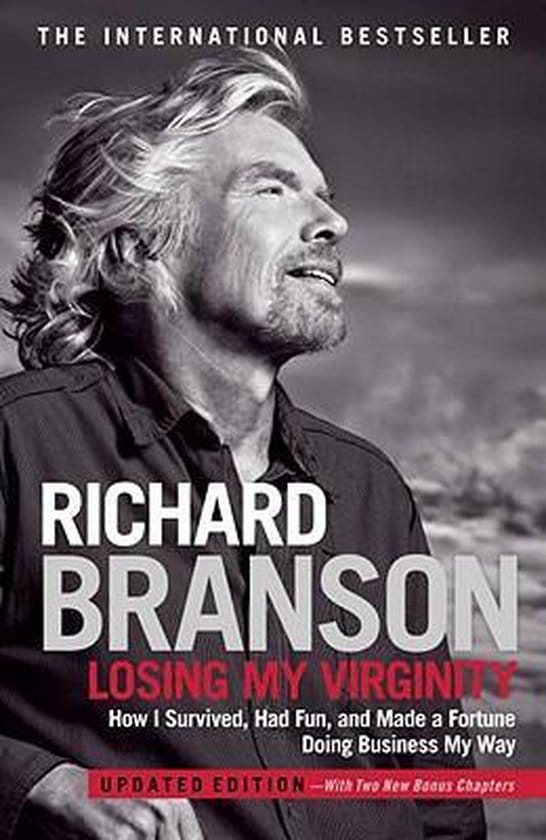
Losing My Virginity is his international best-seller autobiography that takes us through his unpredictable yet exciting life right from his childhood when he dropped out of school, to revolutionizing the airlines, railways and music business with his steely resolve, sense of fun and love for adventure.
The Wonder Years
Branson’s sense of adventure and pushing oneself to the limits of possibility comes from his family. The challenges that his family would present him gave him a taste of adventure early on.
For example, once, at the age of 11, his mother sent him on his bike more than 50 miles away to visit relatives, without directions. This exercise was meant to teach him orientation and stamina. When he returned, he was immediately sent to the Vicar’s house to chop logs, rather than receive any praise for his accomplishment.
Losing my Virginity by Richard Branson
Richard Branson was used to arduous challenges by then. In fact, when he was just 4, his aunt bet him 10 shillings that he wouldn’t be able to learn to swim, by the end of their holiday in Devon. He took up the challenge and spent hours in the sea trying to stay on top of the waves, without success. On their journey back home, he spotted a river. Not wanting to give up he asked his father to stop the car. He sprang out of the car, ripped his clothes off and ran full tilt towards the riverbank.
As soon as he jumped in, he sank. But he was determined, and slowly, kicking and flailing, he managed to make it to the surface. As he came out, he saw his family cheering, his aunt waving a 10 shilling note, and his father, dripping wet as he has jumped in after his son, giving him a big hug!
The Student
Branson was dyslexic, albeit with an independent attitude. This meant that while he struggled academically, failing to get recognition in university, he looked for alternative occupations. Along with his friend and fellow student Jonny Gems, Branson founded the magazine Student.
What started as a magazine for criticism of the school, soon became an outlet for the pop culture and contemporary issues. However, the magazine saw its first roadblocks when Branson and his buddy couldn’t find the funding (in the form of advertisers) to publish the magazine.
Branson, however, found a clever strategy to get those advertisers. He informed the National Westminster Bank that Lloyds Bank had purchased ad space in their publication and got his first check of 250 pounds.
As the writing and editing work for the Student took priority, Branson and Jonny moved into a London basement. Branson put more effort into writing and editing – despite his dyslexia – for the magazine than he did for his coursework.
Jonny and Branson were ambitious. They wanted to cover international events. They wanted to report on the wars in Vietnam and Biafra. They approached the Daily Mirror asking them if they were interested in the story of a young reporter going to Vietnam. When the publication showed interest and bought the story, they sent one of the Student’s staff to Vietnam. They had a similar arrangement for Biafra.
Their political interests aside, the Student’s main involvement was in the current music scene. It features news about concerts and club events, and exclusive interviews with the likes of Keith Richards, John Lennon and Yoko Ono.
The Virgin Mail Order
Branson’s keen business sense and his interest in the music scene made him realise that there was virtually no competition to record stores. People were willing to spend 40 shillings for a Beatles record at the store, mainly because they had no alternative. He saw the potential for a mail-order system, where people his own age would prefer to mail-order those records at a lower price than at retail prices.
Branson discussed the idea with his staff at the Student, and they suggested that the venture have a new appealing, eye-catching name. One of his staff suggested ‘Virgin’ since they were all virgins at business. Thus Virgin Mail Order was born.
Branson placed an ad for record mail-order in the last issue of the Student which received more enquiries and cash for advance orders. This cash was the capital for buying records, and it enabled them to build a large balance rather than having to wait for the money to come in. Branson then roped in his co-contributor from the Student, Nik as an accountant.
Nik and Branson would decide whom to buy records from and how to mail-order them. They made a deal with a local record shop that would obtain records directly from the record companies, enabling the Virgin team to sell records at a discount.
Virgin Mail order flourished through 1970, until January 1971, when the Post Office went on a strike, spelling disaster for them.
Virgin Music Stores
The 1971 postal strike impelled Branson to set up his own record store. Branson wanted to model the record store on the principles of the Student, where people would not only come to buy records, but also a place where people could exchange their views about their interests. They struck up a deal with a shop store owner who had free space above the shop.
Having no money to pay rent, Branson used his charm and business sense to convince the shoe store owner how a record store would increase footfall in his shop as well. They set up the first Virgin Music Store for free.
Riding on the success of the record store, Branson and his partners planned to open more outlets, while keeping the mail order intact, ready for business when the postal strike would cease.
The Virgin Music Store expanded into 14 more stores all over England by Christmas 1972.
As opposed to other record stores which had bland interiors and virtually no excitement as compared to the rock music scene then, Virgin stores were focused on creating an atmosphere where people could relax and hang out. However, while the entertaining atmosphere of the store got the customers in, people weren’t buying anything.
To rectify the problem, Branson installed brighter lights and moved the cash register closer to the window, to reduce the appearance of a club.
The idea worked and the sales improved.
Virgin Expansion
The wild rock and pop culture of the 1960s made Branson realise the potential and profits of owning a recording studio and label. He also saw that the existing record studios worked very formally, with minimal musical instruments, overbooked rooms and strictly appointed slots. This formality was in absolute contradiction to the musical culture brewing in the country.
Hence, at the young age of 21, Branson started looking for a country house that could turn into a recording studio. His search ended with a beautiful 17th-century manor, with iron gates and beautiful countryside, that would appeal to music bands to come and record their music in an attractive environment.
However, the manor was priced at 30,000 pounds, a price that was far expensive considering the sales that Branson’s other successful ventures were bringing in. He approached the British bank Coutts, who estimated a mortgage for the Virgin Music store and Virgin Mail Order at 20,000 pounds. His aunt lent him 7,500 pounds by re-mortgaging her house, and Branson was able to transfer the full amount to the estate agent.
Alongside, Branson founded Virgin Records, his own music label that integrated with the Virgin group, allowing them to sign on their own artists, offer and charge those artists for a place to record, publish and release those records, and promote and sell them at the Virgin Music Stores, all while making profits and retail profit margins as well!
Branson’s foray into skyrocketing success came with Mike Oldfield’s Tubular Bells, which was recorded at the manor through 1972 and 1973. It sold over 13 million copies.
The Sex Pistol Troubles
Towards the mid-’70s, Virgin Records was standing at the doors of trouble. Apart from the Mike Oldfield success, the label was losing money. The emergence of punk music made them desperate to sign on to a new band.
In 1977, Malcolm McLaren, the manager of the band the Sex Pistols signed the band to Virgin Records. He was hoping to get dropped from his contract due to their indecent behaviour, as they had with EMI and A&M. McLaren closed the deal with Virgin, just as they had staged a concert in from of the House of Commons, playing their ‘God Save The Queen’ for Queen Elizabeth’s 25th anniversary as Queen. The concert drew in large publicity, flak and the arrest of McLaren.
McLaren’s hopes of being dropped by the label were dashed as Virgin Records didn’t have any shareholders to protest their actions. In 1977, ‘Never Mind The Bollocks, Here are The Sex Pistols’, the album was widely advertised and released in Virgin stores all over the UK. A Nottingham store manager got arrested for publicly advertising the word ‘bollocks’, and the police threatened to injunct the album.
It was time for Branson to take action. He roped in linguist James Kinsley to fight the court case, who went on record to explain that ‘bollocks’ didn’t mean ‘testicles’ but were rather a nickname for priests. He further argues that not even the Church would get offended by the title, ‘‘Never Mind The Priests, Here are The Sex Pistols’.
When the prosecutor asked why was Kinsley so sure that the title wouldn’t be offensive to the Church, Kinsley simply folded his polo-shirt collar down revealing his clerical collar. Branson had found a Reverend to defend his case! The case was dismissed.
Love, A Tropical Island, And Virgin Airways
In 1978, while Branson was in New York, waiting for his future wife Joan’s divorce to come through, he was asked if he has named his company after the Virgin Islands. Though there was no connection whatsoever, Branson thought that the islands were a perfect getaway for Joan and himself.
Showing interest in buying an island in the Virgin Islands for artists to relax and record, Branson and Joan were put in a villa and were shown one of the remotest islands, Necker Island.
Priced at 3 million pounds, the island was far from Branson’s quote of 150,000 pounds. He was shown the door out!
Once back in London however, Branson learnt that the owner of the island, a British Lord, was desperate to make a quick sale. The lord needed to finance another building that would cost him 200,000 pounds. Branson upped his offer to 175,000 pounds, and the Lord agreed to settle at 180,000!
What started as a hunt for a free holiday ended up in Branson buying an island.
The Virgin Islands are important to Branson for another reason. It was during that trip that Branson came up with his Virgin Airways. The idea came about when Branson’s flight to Puerto Rico got cancelled and he chartered a plane for $2000. He wrote on a blackboard, ‘Virgin Airways: $39 Single Flight To Puerto Rico.’
The CD Era And More Artists
Despite signing the Sex Pistols and many other younger bands, Virgin Records was running at a loss of 900,000 pounds. Even so, Branson kept signing new artists and bands, some of which were Simple Minds, Phil Collins and The Human League.
The financial director, worried about the future of Virgin in the hands of unknown artists, sold his 40% share back to Branson and left, leaving Branson the 100% owner of the Virgin group, on the verge of going bust.
As luck would have it, with the success of the Compact Disc, and the popularity of music CD’s, people wanted to purchase them even though they had vinyl. Branson then resold his back catalogue on CDs. the first record of Mike Oldfield did exceptionally well on CD’s, helping restore Virgin’s cash balance.
Furthermore, the trust Branson had placed in Simon Draper, his musical scout and advisor, started paying off. Almost all the bands that he had roped in, like Human League, had their album dare shoot to the number one spot on the British Charts. It sold 1 million copies in Britain and 3 million worldwide.
The newcomers and young artists that Virgin had launched, like Boy George, Phil Colling, Heaven 17, Culture Club, XTC, Simple Minds, etc. all were making great music and success. Virgin went from a 2 million pounds profit in 1982 from a 50 million pound sales to a whopping 11 million pounds profit in 1983. It had become the undisputed independent label.
Getting Virgin Airways Off The Ground
In the late 1970s, Branson already had dreams of Virgin Airways and was toying with the idea. In 1984, when Randolph Fields, a US attorney came inquiring about Branson’s interest in a transatlantic airline, Branson jumped at the challenge.
Even though his senior management wasn’t keen on the idea, Branson argued his case. He said that by leasing just one aeroplane for a year, they could retreat from the project if it didn’t succeed, thereby limiting the money they could lose. After negotiating with Boeing for two tough months, Branson was able to lease one Jumbo for a year.
Branson’s work was cut out. There were permits to obtain, ticketing systems to be set, time slots to fit in and advertising to be taken care of. In order to obtain the permit, they had to conduct a test flight, with an official onboard. On the test flight, the plane flew into a flock of birds and one of the engines exploded. The plane unfortunately was uninsured due to a lack of license.
With Branson’s first commercial flight scheduled in two days’ time, no license and no engine, and a cost of 600,000 pounds for both, he was in trouble again. He realised that the cost had exceeded the company’s 3 million pounds overdraft. The bank was unwilling to extend, and Virgin was on the brink of insolvency.
Branson’s resolve and penchant for challenges saw him through this as well. He collected as much he could from his overseas stores to keep the airline operating. Under Branson’s watchful entrepreneurship, Virgin Atlantic became legitimate, and a resounding success.
Adventurous Sailing Across The Atlantic
Ted Toleman, in 1984, was seeking sponsors for a cross-Atlantic catamaran he was building that would set a new speed record and re-win the Blue Riband Trophy for Britain. Branson, realising that such a coveted trophy and world record would be just the kind of attention his trans-Atlantic airline needed.
The world record has been set at 3 days, 10 hours and forty minutes. Branson and Toleman, along with round-the-world yachtsman Chay Blyth, set out from New York to England with their sights firm on beating the record. However, three days later, with just 60 miles to cover, the hull of the catamaran was split open in a storm, and the Virgin Challenger sank.
They were rescued by a cruise ship, where Branson got news of the birth of his son from a copy of the Evening Standard, which one of the passengers was carrying. Determined to win the trophy, Branson and Chay decided to beat the record on a single-hulled boat rather than a catamaran. Thus, the Virgin Atlantic Challenger II left New York in 1986.
However, Branson and Chay had another mishap, when the fuel pump filters got clogged and choked the engine. The filters would be needed to get replaced every few hours, pushing their chances of beating the record further away.
Branson cunningly reached out to Downing Street and got an RAF plane to deliver new filters. The Virgin Atlantic Challenger II made the 3000-mile transatlantic journey in 3 days, 8 hours and 31 minutes, setting the new world record and winning the Blue Riband Trophy.
The Kuwait War
Saddam Hussein’s invasion of Kuwait in 1990, stumped the world. The prices of aviation fuel jumped from 75 cents a gallon to $1.50. More than 150,000 refugees had fled from Iraq into Jordan. Despite the help from the Red Cross for setting up the distribution of supplies such as water and blankets, the Jordanian government was still short of about 100,000 blankets for the refugees.
One day, just as Branson was about to take his children to school, he received a call from Queen Noor of Jordan, who was a close friend, seeking help. Branson and his staff got into the action of figuring out the logistics.
He contacted the Red Cross, The Foreign Office and the Overseas Development Office, and was able to gather around 30,000 blankets. UNICEF was to add more supplies to the number, and Sainsbury, a departmental supermarket chain in Britain donated many tons of rice.
In order to fit all these supplies and fly them to Jordan, Branson and his staff decided to take out all the seats from a Boeing 747. They loaded the plane with about 40,000 blankets, rice and medical supplies, and flew into Jordan. On the way back, they also picked up British nationals stranded in Jordan.
However, there were many British Nationals taken hostage in Baghdad. He called his friend the King of Jordan to help negotiate with Saddam Hussein, to release the women and children and the sick men in exchange for medical supplies.
On 23rd October, Branson and a Virgin volunteer crew set out for one of the most dangerous airspaces. While they arrived safely and were able to rescue most of the hostages, they were forced to leave the men at the airport, which was sadly devastated a few days later.
A Daring Hot-Air Balloon Adventure
True to his adventurous nature, Richard Branson had, along with Per Lindstrand, attempted to cross the Pacific in a hot-air balloon in 1989. However, the balloon had fallen apart just before they could lift off.
In 1990, Lindstrand and Branson met again in Japan to attempt to cross the Pacific and set the record for the first and the fastest to cross the ocean in a hot-air balloon. The goal was to reach California in 2 days. About 7 hours after take-off, they had to let off an empty fuel tank to lighten the load and fly faster.
However, a mechanical failure caused them to not only drop off the empty tank but 2 full tanks as well, leaving them with 6000 miles to cover with half the fuel aboard. If things could not get any worse, they lost contact with their control centre after learning of a massive storm below. While they managed to keep ahead in the 200 MPH jet stream at 170/mph, a propane leak caused a fire in the capsule.
Thankfully, their quick actions of taking the balloon to a height of 40,000 feet helped extinguish the fire. With the fire out they managed to recommunicate with their contact centre, only to receive more bad news. Their jet stream had pivoted. Unless they got the balloon to 18,000 feet into another stream that was blowing north towards the Arctic, they would be blown back to Japan. They landed in Canada about 48 hours later, at a speed faster than anyone had, covering 3000 miles more than their original destination.
Dirty Tricks And An Apology
Success always comes with its fair share of jealousy. By 1990, while Branson and Co. were enjoying unrivalled success, the traditional British carrier British Airways was getting increasingly envious of Virgin Airways.
They had started putting up several campaigns to put Branson out of business. Additionally, they had a whole team that was put together only to discredit Virgin Airways and were resorting to dirty tricks such as contacting VA customers and offering them flights at cheaper rates, or claiming that VA flights were cancelled or overbooked. They even went to the extent of hacking the Virgin database to get information. Their desperation reached heights when they contacted private detectives and a team of public relations representatives to investigate Branson’s family and his company to try to tarnish his image.
After viewing a documentary on TV, one customer contacted the Virgin office and reported that she had received a number of calls from people who claimed to work for Virgin. They told her that she had been bounced off her flight, and asked if she would be interested in taking the Concorde the next day.
British Airways denied their involvement, and the officials responsible for viable competition between the two airlines claimed Branson’s reports as unfounded, despite Branson having many BA officials willing to testify.
Finally, Branson received a drive containing logs of conversations of top BA executives, planning to discredit Virgin Atlantic. Branson and his lawyers decided to take BA to court. What ensued was a record for the highest uncontested libel payment, with an amount of £500,000 to Branson and £110,000 to Virgin Atlantic paid as compensation for corporate and personal libel, along with a full public apology.
Conclusion
To many, the business might seem boring. However, Richard Branson is proof that success is sweeter when one is willing to take challenges head-on and be adventurous enough to take risks.
Welcome to the Deploy Yourself Newsletter, where I share what impactful leadership looks like to show your own power. I also share the most insightful lessons and stories I encountered in the last two weeks. You can also read this issue online.
Hey,
Do You Dream During The Day?
I want to start with this quote by TE Lawrence –
“The dreamers of the day are dangerous men, for they may act their dreams with open eyes, to make it possible.”
We all dream during the night, but do you dream during the day?
Or, it would be more appropriate to say, do you give yourself permission to dream during the day?
If you do, then you know that there is something deep inside you that is calling your attention.
If not, it doesn’t mean that you have no deep desires.
It just means that a dream might be buried deep inside, but it is still alive. Because YOU are.
Daydreaming is not a waste of time. Research has shown that daydreaming reduces stress and anxiety, and helps you be more creative by utilising different parts of your brain.
We all do this as children, but we often forget daydreaming as adults, thinking of it as silly, worthless, or a waste of time.
However, the latest research has shown that daydreaming boosts our mood, improves our wellbeing, and allows for novel solutions to problems as we tap into a source of information and wisdom which has been lying dormant.
We are not built to be “on” (or using our analytical brain) all the time. Taking time to wander off not only gives us a much-deserved break, it also improves focus and builds presence which leads to better relationships.
As you start to (or try to) daydream, do not think about the dream you have. Instead, think about the dream which has you. Think about that dream which keeps coming back to you? Perhaps, a desire from childhood? Or a long-lasting wish to see something different in the world around you?
Do not try to think or understand your dreams. Instead, try to listen to them and ask yourself –
What are your dreams inviting you for?
What are your dreams trying to tell you about yourself and what you deeply care about?
Do you give yourself permission to indulge, listen, and engage with your dreams?
Do you give your permission to take the first tiny (or bold) steps in the direction of your dreams?
What would it mean for you if you would work towards making those dreams a reality?
Reply back with any insights from asking the above questions. I am eager to hear what this email triggers. I read and respond to every reply.
Fascinating Articles & Stories
One
Are You Playing to Play, or Playing to Win?
Federer uses a one-handed backhand — a notoriously more difficult technique than the two-handed version. He also happens to make it look easy.
And so to watch Federer play a tennis match is a little like watching God play tennis — or perhaps, more accurately, like watching a version of tennis that is more ballet than racquet sport.
This, I think, is what mastery looks like. Federer, like Ono in Judo, is a maestro. We can’t believe that they do it. But we stand in awe of them because they do it anyway, and win.
In this special-edition, bonus episode of How to Build a Happy Life podcast, the psychotherapist Lori Gottlieb demystifies one of the vital components of a happy life: enjoyment.
As responsibilities multiply exponentially, time grows limited, and challenges mount, it becomes harder to make time for fun, let alone remember what it feels like.
Gottlieb believes that we not only find it challenging to make time for day-to-day enjoyment, but also struggle to identify what it should feel like. In this episode, Arthur C. Brooks and Lori Gottlieb discuss the importance of fun, the cultural distortion of emotions as “good” or “bad,” and how envy points you in the direction of your deepest desires.
New Leadership Journey Interviews on the Choosing Leadership podcast
Listen to the below CEOs and leaders as they reflect and share key learnings from their leadership journeys.
I believe we all have a lot to learn from each other’s stories – of where we started, where we are now, and our successes and struggles on the way. With this series of interviews, my attempt is to give leaders an opportunity to share their stories and for all of us to learn from their generous sharing.
To listen to all previous episodes, find the podcast on my website, or on Apple or Spotify. Leave a rating if you love what you hear.
That’s it for now. If you have any questions or feedback, or if you are new and want to introduce yourself, hit reply. I read and respond to every reply. All the best,
This is the Leadership Journey series on the Choosing Leadership Podcast.
I believe we all have a lot to learn from each other’s stories – of where we started, where we are now, and our successes and struggles on the way. With this series of interviews, my attempt is to give leaders an opportunity to share their stories and for all of us to learn from their generous sharing.
In the interview, Lars shares how he has built his company around the values of transparency and learning. He shared what he learned from working for others – and how that shaped his unique way of doing business. He encourages everyone to come up with suggestions and new ideas as long as people back them up with facts. He shares how openly talking about his values allows him to attract the right kind of employees and clients. He vulnerably opens up about his fears and challenges and yet how he feels in gratitude for the impact he is having on others’ lives through his work.
We combined the businesses in 2018. At that point, we had six people and here we are four years later we grew from 6 to 30.
The first thing that I wanted in the company is complete transparency. All of us staff at the moment know what they are earning, know what the colleagues are earning. They know how much we ask for our clients, how many hours that I was at work that, that represents and same applies to the clients.
In our company, everybody has an opinion. Everybody can come up with improvements or with their reasoning. How they are thinking we basically have one rule and that is okay. You can say everything you want, but you need to back it up with arguments or facts. And whether it’s senior staff or union or trainee or intern, as long as they came up with some good ideas, they can back them up with facts or arguments. We as management or we as a company, owners are willing to listen to that.
Our core values are something that really separates us from a lot of other companies. So it helps us to generate not only clients but also the clients that are thinking the same way as we are which results in. the same applies for getting the right people on the job.
My role has completely changed because I’m not working for clients anymore. I’m there for my staff and I need to help them as soon as they have some problems or as soon as our clients have one of the problems with the work that we are delivering.
Some of the jobs that we are having at this moment, may be gone in, in one or two years or maybe even faster (due to artificial intelligence). We need to make sure that everybody knows what is going on and how do you keep up with that and how to cope with that, to just make sure that everybody keeps, it keeps a job and we still have our clients and have value for our clients.
Everybody in the company has an unlimited study budget, which basically means if you want to go to a seminar and events follow a course, read a book or anything you can just go. We will pay for that. This basically means that I’ve got some colleagues who spent like 30 euros a year on developing while their neighbour is spending like 5,000 euros a year for also developing.
And I think that’s really important because as long as everybody is developing their skills, they will get smarter and better, and it will result in better work for our clients. And it results for a better name for our company. Let’s be honest, as soon as you, as a person stop developing then how do you go forward in life?
One of the things that most people will not know is the fact that in the beginning, I was really scared to do these kinds of talks. And everybody was like how can you do that? But now when, once you’ve done it, a couple of times, you’re not nervous anymore.
The fact that we are able to make an impact on the lives of others. That is the thing that we are most grateful for.
This is the Leadership Journey series on the Choosing Leadership Podcast.
I believe we all have a lot to learn from each other’s stories – of where we started, where we are now, and our successes and struggles on the way. With this series of interviews, my attempt is to give leaders an opportunity to share their stories and for all of us to learn from their generous sharing.
In the interview, Eddie shares with us the difference between TedX like speeches and impromptu speaking, and how to prepare for both. He highlights the importance of storytelling and the power of practice when it comes to becoming good at public speaking, among other lessons he has learned from writing speeches for CEOs. He also talks about the importance of having a team in accomplishing anything worthwhile.
There’s no straight line to success. I think if you ask anyone, it’s very much a very squiggly line with lots of lefts and rights, turns and circles, and trying to find out where it is that you want to be.
And too often, we don’t see the amount of practice that goes into a really good keynote speech or really good TEDx talk. We only see the finished product.
if I could tell anyone out there to get over your fear of public speaking, you have to seek out opportunities to practice your public speaking skills rather than waiting until an opportunity comes up.
I think a lot of people think that impromptu speeches are really, truly off the top of someone’s head and what’s actually going on. Is that someone is reaching into past material that they’ve prepared and they’re just recalling it and they’re ready to go.
So it’s very similar to stand up comedians. It looks like it’s all impromptu, but they’ve been rehearsing that material over and over again to get it down. And it’s just a matter of recall when they’re on the stage.
You’re trying to tell a story, not to boast, but to be instructive, to be a teacher.
I get to really work with very smart, intelligent people that have great stories to tell. And I’m always learning something new with every speech that I get to write for somebody it’s always a new industry. It’s always a new area that I get to learn and grow in.
I have a front-row seat to what these CEOs are telling their companies, and what these keynote speakers are telling their audiences. So I almost get it for free. It’s given me a mini MBA almost in how business works, especially in the areas of leadership and community.
I’ve really developed my conversation skills and ability to ask questions. And that’s really, truly impacted me in terms of being able to talk with almost anyone that I come across.
You need a team behind you in any endeavour to help you succeed in any goal, you do what you are really good at and then let everyone else help you out in the areas where you need the help.
I like to change my environment. And that really helps me think in new ways when I can be around different people and do the work that needs to get done.
You want to seek out people who have already done it and asked them how they accomplished it. So in any type of like large endeavour, you don’t want to go it alone. Find the people that have already done it, find the coaches that are out there, try them out and see who resonates with you.
A majority of the working class get stumped when asked, ‘When was the last time you felt passionate about work?’
It’s sad to see that most trudge through work daily, to simply get through the day, the week, the month, the year. Without realizing it, many wait for retirement to finally pursue passions and interests. However, is this approach to one’s work-life really helping?
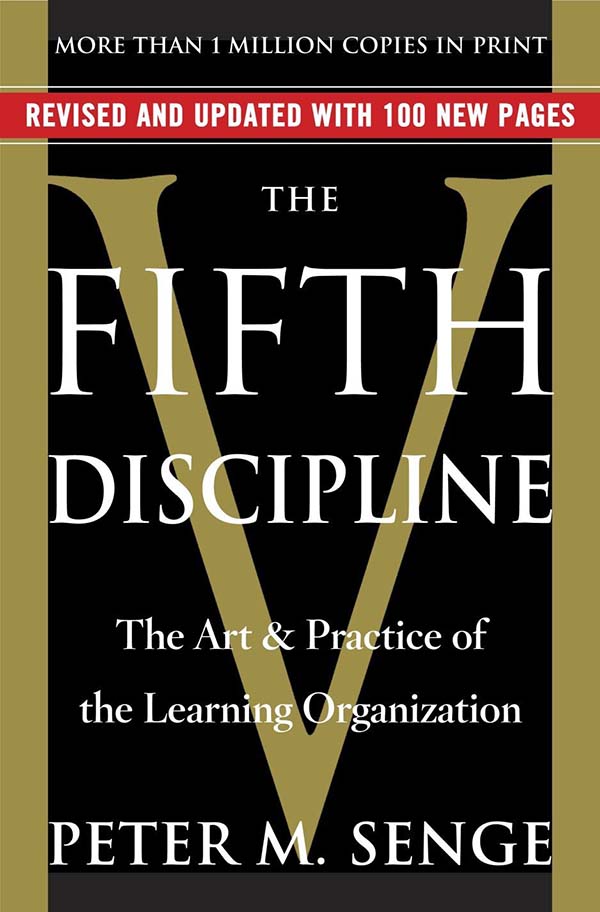
The Fifth Discipline (1990) by Peter Senge shows the world that one can create an organization where creativity thrives, curiosity is encouraged, and where leaders and colleagues are supportive and motivating. It shows that companies that offer employees lifelong opportunities for learning are the ones that transform workplaces into successful organizations.
The book is a guide to creating organizations by applying five key disciplines that shift from being controlling to being learning organizations. It introduces the systems thinking method, a proactive method that helps identify underlying patterns that need change and helps generate innovative solutions to bring about that change.
Why The Workplace Quashes One’s Drive To Learn
If we observe a toddler, we can see learning at its efficient best. The toddler learns and gathers knowledge by observing; smelling, licking, touching, everything around it. It constantly tries to learn new skills – walking, babbling new words, or even learning to identify alphabets, numbers, etc.
This curious toddler lives inside every person. However, modern corporations with their rules surrounding hierarchy, incompetent managers, and limiting job descriptions quash the toddler out!
This begins with narrow job descriptions. Setting limitations to job descriptions greatly hampers learning and kill one’s sense of engagement. The result? Employees end up simply punching the clock, sticking to their specific tasks, never looking at broader perspectives to solve different problems.
They have a myopic view of their roles in the organization, often limited to their department. It is a lack of sense of ownership, the complacency that disallows them to be involved in the organization as a whole, that eventually leads them to apportion blame for things that go wrong to others, rather than to analyze how their actions could have contributed to the problem.
Companies are partially to blame for this. Employees often have no time to analyze their mistakes because they are too busy putting fires out. Such a reactive atmosphere too can kill learning opportunities.
The parable of the ‘boiled frog’ – where the frog complacently sits a pot of cold water on the stove, unable to realize that it will die as the water gradually heats, applies to what is happening to people stuck passionless in their jobs.
Incompetent managers, and often hierarchy too, stamp-out learning and creativity. Managers have no idea how to support subordinates with creative ideas, often because they have stopped developing.
Thankfully, all these issues can be tackled. There are five key disciplines that organizations can follow to develop a passionate, learning organization.
The Five Disciplines
In order to promote learning within organizations, the whole organization needs to change habits. While it is easier said than done, the five key disciplines, if applied diligently, across the organization, can greatly help. They are –
Promotion Of Personal Mastery
The author defines ‘promotion of personal mastery’ as being completely committed to growth and learning. It means to always do one’s best. Working like this, often gives one a deep sense of fulfilment, keeping one excited and motivated.
Mental Models Of The Organization
Every person views the world through filters. These filters, the mental models of perception comprise of life experiences, assumptions and judgments. Finding and understanding the mental models of the people in the organization will help understand the mood of the people, be more open-minded and question thought processes to find better solutions.
Team Learning
Team learning is the third discipline, that takes place once people become aware of their mental models. It happens when, as a team, employees begin to enter into dialogue with each other, questioning, critiquing, probing with questions, and most importantly, by examining their own assumptions and biases. It lays the foundation for the fourth discipline.
Shared Vision
Shared vision doesn’t necessarily mean following a charismatic leader, it involves all the employees of the organization having a sense of ownership towards the organization, towards the work they do, and what they contribute to the company.
Systems Thinking
The fifth, and most important discipline is systems thinking. Such thinking includes examining problems as a whole or taking into account all options and how one aspect affects the other while practising it. It integrates all the disciplines.
Let us discuss these in detail.
Work Motivates
On average, a person works for eight hours a day. However, when asked, ‘what was the last exciting that you did?’ most don’t even think of those eight hours. They think of those eight hours as part of the day they just have to survive and get through.
The Fifth Discipline (1990) by Peter Senge
A person feels excited when they can to develop personal mastery, a feeling of personal fulfilment. When one’s work gives the person an internal, deep purpose in life, one can work towards that vision and devote themselves to it. However, one also has to understand that reality does not measure up to that vision or purpose.
While the thought can be discouraging, one has to view it in the right way and make it motivating by understanding that there is a gap between where one stands, and where one wants to be that needs to be filled. When a person understands that, the creative tension created by the gap will propel and motivate one into action.
Earlier, many employers would consider the promotion of personal mastery among employees irrelevant, threatening, and a difficult task to do. However, the proof that promoting personal mastery works well for business is slowly but surely changing perceptions towards it.
For instance, Kyocera, the Japanese ceramics, electronics, and technology giant was actually a start-up that grew into achieving sales of $9 billion. They managed it by simply putting their employees first. Hanover, a property firm in the US also saw similar growth when the CEO announced to prioritize the well-being of the staff.
Promotion of personal mastery best takes place when the leaders themselves model their growth to the approach. The leaders should be the ones to demonstrate to employees that they too have a hunger for growth and learning while being honest about their limitations. The rest of the employees will follow their lead!
Blinded By Limiting Beliefs
If the story of the ‘Emperors New Clothes’ teaches us anything, it is the fact that people are blinded by their mental models. While the Emperor was blinded by his need to not appear stupid in front of his ministers and subjects, his subjects were blinded by their fear of the Emperor.
Similarly, organizations cling to their own mental models that eventually become stumbling blocks.
The American automobile industry in Detroit stuck to its models and refused to adapt to the changing reality around them. The success of the Japanese auto industry, coupled with the inability of the American industry to adapt to the change led to its downfall.
On the other hand, mental models can lead to innovation too. Consider the example of the oil company Shell. In 1970, a few strategists and senior planners at Shell predicted disruptions in the oil industry and warned managers of the problems to come. The managers, however, were unable to comprehend the forecasted upheaval due to their unprecedentedness.
The planners then offered those managers training, that enabled them to examine their own beliefs and in turn prepare for the changes that could have had a major impact on business for Shell, thus giving them tools to take apart their mental models themselves.
Organizations can offer their employees a ‘learning infrastructure’, a system that makes a conscious assessment of the presiding mental models an important part of the organization’s daily life. Additionally, managers need to create an environment that promotes critical thinking, and openness, where employees are not afraid to change their minds and challenge old methods.
Shared Visions Fuel Learning
The importance of shared vision can be seen in the historical event when America put a man on the moon.
John F. Kennedy, in 1961 promised America that they would send a manned spacecraft to the moon. While it sounded ludicrous then, in 1969 Neil Armstrong created history. Kennedy’s promise worked only because the teams of scientists in the US space program shared that vision.
shared vision energizes a learning organization, and gives employees the push they need when their tireless experimenting and working takes them through disappointments and failures. A shared vision can also be seen in successful companies such as Ford and Apple. For Apple, the vision of creating computers that bought joy to the users, and Ford’s vision of making affordable cars was shared by all the employees. These visions were so powerful that they took the companies to success. The belief, in not only making business profits and money or beating the competition but in working towards changing people’s lives was vital to their success.
While almost every company today has a vision statement, a genuine shared vision cannot be achieved if the vision is preached from the top of the ladder. The employees have to truly believe in it themselves. It cannot be forced upon.
Thus, to help every employee believe in the vision and to achieve a shared vision state, the vision itself has to be relevant to every employee. Organizations have to think and discuss with the employees how the vision fits in their lives, what personal value does it bring, and how it fits with each employee’s values. This dialogue has to begin at the top. Leaders have to be honest and open with employees about how the vision fits in their personal lives, and then give employees the freedom to develop their own inspiration from that vision.
Working Together
An orchestra is a great example of teamwork. While all musicians are engrossed in their own instruments, they are still aligned with and attuned to each other. Finding such alignment at the workplace is rare. One, more often, finds teams of talented individuals trying hard, but ending up nowhere.
the trick lies in practising new ways of communication. People are prone to maintaining and employing fixed behaviours in order to avoid threats. These, according to Harvard researcher Chris Argyris are called ‘defensive routines’. Trying to placate a colleague that challenges one’s thoughts, in order to avoid conflict is an example. On the other hand, one could end up launching a counter-attack to prove a point. Both these mechanisms, however, are against the principle of team learning, mainly because neither promotes genuine communication.
In order to deal with such defensive tactics, one needs to engage in creative dialogue – a type of communication where one works outside assumptions. When one challenges the mental model, one is training to engage in creative dialogue.
Another important necessity is deep listening skills, or simply actively taking the time to hear what team members have to say. This, however, needs a lot of practice. Conducting exercises in dialogue sessions (with clear ground rules) is a great way to implement it at the organizational level. Finally, organizations need to have an appetite for healthy reflection.
Thinking Systematically
The fifth discipline, systems thinking, is the most important discipline of all. Just like rivers have undercurrents, organizations too, have underlying processes that are at play. These processes, if ignored can wreak havoc in the organization, without people even knowing what is happening, or how to break free.
Systems thinking trains the employees of an organization to look at and analyse problems holistically.
Consider an organization with three departments – research, marketing, and manufacturing. The heads of each of the departments are exceptional at their work. They know their department like the back of their hands. However, each of them is not clearly aware of how the work in their department influences or affects the other departments.
In this situation, the organization as a whole will never be able to solve the underlying issues that it faces.
Systems thinking, additionally, focuses on learning and understanding cause and effect. Contrary to what most people believe, they tend to have a linear approach to thinking such as A causes B causes C. however systems thinking shows that cause and effect work, and affect each other in circular, or cyclical ‘feedback loops’.
When one master’s systems thinking, one starts to observe events over time and look for patterns. Such observations lead to understanding the fact that the immediate effects of actions today can be drastically different from what happens over longer periods of time. Additionally, systems thinking also takes into consideration geographical differences, where actions can have different effects over a local area and completely different effects globally.
Systems thinking is vital for learning organizations. It helps in understanding what drives peoples behaviours, gives managers tools that they can apply the five disciplines in a holistic manner, and promotes sophisticated analyses within the organization and across broader industries.
Redefining The Role OF The Leader
Traditionally, leadership is envisioned in a very hierarchical manner, where those holding senior ranks are considered the top management. Such a view however is limiting in nature for learning organizations.
It limits how people perceive the ability of any employee to bring about change. For instance, ‘only leader can make decisions, whereas the lower rungs can only follow their lead and implement those decisions. Such perceptions have done more harm than help.
Today, many organizations call themselves ‘non-hierarchical’. However, it doesn’t imply that there is no management, or that one isn’t needed. Instead, it implies that they have been able to reimagine leadership in a more positive sense.
For instance, perceiving leaders as designers would mean that these leaders are there to create a learning infrastructure, which could include innovative conference formats, virtual meeting spaces, open feedback sessions, etc.
Another way to reimagine leadership roles would be to perceive them as teachers who inspire learning; teachers who want to change lives by simply sharing their love for knowledge. Leaders can also show passion for personal mastery, be curious about what is around them and how they influence others, be courageous to experiment and be humble enough to accept mistakes.
Stewards perhaps, have one of the most powerful leadership roles in learning organizations. They preserve and protect things that are important. They check that the growth of the company is never more important than either the well-being of employees or the larger ideals of the company. They make change less scary by supporting innovation.
Thus, according to Senge, leaders should merge the skills of all three – stewards, teachers, and designers, to empower and support learning.
Conclusion
In order to create learning organizations, where creativity thrives, leaders are supportive and where employees are passionate about their work, organizations have to apply the five key disciplines of promotion of personal mastery, changing mental models of the organization, team learning, shared vision, and systems thinking.
In addition to these, organizations have to redefine the role of leadership where leader empower their employees to be passionate and support a learning environment, by leading by example.
Welcome to the Deploy Yourself Newsletter, where I share what impactful leadership looks like to show your own power. I also share the most insightful lessons and stories I encountered in the last two weeks. You can also read this issue online.
Hey,
Remind people who they are instead of just giving feedback
A popular quote by Thomas Leonard goes like this –
“Remind people who they are instead of just complimenting them on what they’ve done.“
You might have heard that giving positive feedback or compliments can build strong relationships. This advice can be found in hundreds of leadership and management books. However, the “how” to do it is often missing, and today I will share my biggest learning on this topic in the last couple of years of being an executive leadership coach.
How many times has someone given you a “compliment” and you just know they’re trying to get something from you?
There is a huge difference between complimenting someone and acknowledging them.
Compliments and positive feedback are important, but they are often focused on you (the giver) instead of the person in front of you. They often start with “I” and talk about how you loved a particular behaviour or action the other person did. “Great job” is another example of such positive feedback.
Acknowledgements, on the other hand, go deeper. Acknowledgements are about who the person is instead of just what they did.
They take more effort and they focus on who the recipient is “being” rather than what they just “did”.
For example – “Your sincerity and reliability stand out, and yesterday’s project update meeting was a demonstration of that. Keep it up”.
OR
“Everybody around here knows they can count on you when it comes to taking responsibility. You lead by example and that helped the team achieve more than they committed to at the start of the year.”
The part in bold in the above two statements is the acknowledgement part. Acknowledgements make the other person feel understood and valued. They remind people of who they are rather than what they just did.
Before I end, I must add that the above is not a “trick” that you can copy and paste. People can see right through a fake acknowledgement. An acknowledgement must be sincere and genuine – it must come from your heart, and not just your mind.
Give genuine acknowledgements instead of feedback or compliments for a few days. Reply back with what you notice – in your own behaviour as well as the other person. I respond to every reply.
Articles and Stories Which Have Fascinated Me
One
The Art of Framing Problems
Framing is the process of breaking down a problem into a set of choices, trade-offs, and options that enable a team to make a call and move forward.
One of the critical disciplines of framing is to “find the right question.” Too often debates start with “solutions,” before we determine if we’re asking the right questions, in the right order.
It is my view that being a great framer is a magical ability for just about any role, and is also a completely learnable skill.
This video shows how to group your goals together and get them done—at the same time.
The secret is to create “Multipliers”—activities that fulfil multiple goals. This may sound impossible, but once you watch this video, you’ll see how easy it is to do twice as much!
If you find this interesting, do not miss the accompanying resource guide PDF.
Living with so much uncertainty is hard. But sometimes—maybe always—it’s more effective not to attempt to create certainty.
Though evolution might have rigged our brains to resist uncertainty, we can never really know what the future will bring. And in improbable situations like the pandemic, which has massively disrupted our routines and utterly destroyed our best-laid plans, we need to learn to live with ambiguity.
“Uncertainty is the only certainty there is,” wrote mathematician John Allen Paulos. “Knowing how to live with insecurity is the only security.”
A Humble Inquiry on Coaching as a leadership skill
Leslie – “Coaching helps people create lasting change and long-term impact and really is about empowering the coachee to create their own path forward.”
Leslie – “one of my mentors always shared the beautiful analogy of, the Lily pads on the surface of the water. Beautiful flowers come from that, but they have. Come up from the deep murky bottom of the water to come through and shine their light as a beautiful flower. So sometimes what’s stopping an individual or getting in the way is it’s down there deep in the murky, muddy mess, and a coach can help go through there and part the way for the growth to move forward and for others to see that.”
Sumit – “Coaching is showing people the mirror. And what happens when we see the mirror. is we get to see what we cannot see on our own.”
Leslie – “One of the most rewarding things in coaching is when you ask a question and the other person says, wow, that’s a really great question. Or I’ve never thought about that right there. It’s an opportunity for that person to change and look at something differently. “
Leslie – “As the manager, you don’t always have all the answers often. They think you do because you’re in charge of the department, the function, whatever that may be, but you don’t have to have all the answers and you don’t have to have walked the journey before them. That’s where shifting into a coaching conversation really creates so many more possibilities because you don’t have to have the answer”
Leslie – “You don’t know what you don’t know. And sometimes you really just need to experience it.”
Sumit – “the kind of people I am coaching are high-level executives and leaders. What I’ve seen is the most use of coaching can be taken by high performers. People who are already performing or who are already ambitious, they can take their performance and the results they produce to a totally different level, a totally unheard-of level through the process of coaching.”
Sumit – “every business team and every business leader will have a coach in the future because it’s quite natural that if something can help you move towards your future and you get more productive at the same time, and more happy and joyful. Why wouldn’t you have that resource why wouldn’t you avail of that?”
The above are the show notes from the fourth episode of the Humble Inquiries series on the Choosing Leadership podcast, which I am co-hosting with Leslie Wireback. Watch out for more episodes in the coming weeks. If you have missed the previous episodes, you can listen to thefirst, second, and third episodes.
That’s it for now. If you have any questions or feedback, or just want to introduce yourself, hit reply. I read and respond to every reply. All the best,
This is the Leadership Journey series on the Choosing Leadership Podcast.
I believe we all have a lot to learn from each other’s stories – of where we started, where we are now, and our successes and struggles on the way. With this series of interviews, my attempt is to give leaders an opportunity to share their stories and for all of us to learn from their generous sharing.
In the interview, Gastón shares about growing up in a family of entrepreneurs in Argentina, and how that led him to start his own company – but in the Netherlands. He talks about not being afraid of making mistakes, and the importance of listening in his work. He also shares how he has learned to delegate as a leader which has led to lowering the burden he has faced as a founder and CEO on his shoulders.
I come from a family of entrepreneurs, so I always have this heritage, like listening to my father and my grandfather, all the things that they studied or the, that they decide to take the risk and do things. I inherited from them from a family perspective.
Amongst the companies that I worked for before, one was Avon cosmetics. So my boss there, he was extremely straightforward. He was very kind in sharing his learnings.
Don’t be afraid of committing mistakes. Take decisions.
Sometimes they don’t go as expected. So you feel like you’re like this sort of crashing a car constantly until you realize what you have to do. And you are able to turn the wheel and put the car in the right direction. I think you’re doing the things that the market needs that you identify, what are your strengths, and then you’re able to offer that.
I’m a big fan of Argentina entrepreneurs starting businesses. I bow to them. The main difference is that the conditions to start a business in Argentina are extremely difficult.
I’m extremely passionate about identifying gaps in the market and identifying in what way companies can provide a better service.
I’m extremely passionate about that is it’s about people and understanding people. It’s something that I find extremely interesting differences in cultures, in countries.
People are extremely intelligent, but they also like processes.
Listening is absolutely key to not only really understanding what they want to say. And, but also to identify what are the fears that they have, what are they really looking for?
Listening is where the real deal is happening. And as you said it’s when done it’s transparent, it’s not like the visible, but it’s a, especially as a leader, if you put your attention on the listening, then you can change you and the quality of a conversation.
If you’re really listening to what they have to say, you can really identify way more things in an extremely broad range of aspects that talk in the conversation but they are there and they need to be addressed. And that’s the main difference as you were saying, like between a leader or someone that just is like addressing needs.
I’m always paying attention and I’m always learning. So listening and learning from everyone, it’s something that I always put in practice.
With time, I’ve learned that we have grown the team. So I realize that. Delegating in a smart way is extremely key to growth. It provides confidence to the rest of the team. It boosts their confidence. It makes them feel very responsible and accountable for what they are doing.
The first challenge, I think almost everybody is facing is, that the speed of change has increased. And then there is a lot of uncertainty. Almost everybody has to continuously learn and adapt.
I know the effect. Probably situations that we have never thought could happen or never thought that it would affect us suddenly you’re experiencing it and you need to basically serve the way in the best possible way that you can.
Start small, focus and really understand the inside out of that niche. Really understand what your target is looking for. Be extremely critical.
The human brain is perhaps the most fascinating and wondrous machine there is. Its capacity to learn from its surroundings is unparalleled. That said, the machines conceived by the human brain and built by man are constantly evolving and getting more sophisticated than ever. These machines work on algorithms. Moreover, these algorithms influence every aspect of human life and could have the ability to surpass the human brain’s ability to comprehend and compute.
The Master Algorithm (2016) by Pedro Domingos dives into the algorithms that are currently in use, how these algorithms help, the problems they face, and solutions to those problems. It delves into understanding the implications these ever-evolving algorithms can have on the future.
Machine Learning And Algorithms
To begin with, algorithms are defined as, “sequences of precise instructions that produce the same result every time.” They are present everywhere – in the scheduling of flights, for delivery of online consumer products, etc.
Simple, standard algorithms are designed to work on inputs of information, perform a task and then produce and output. For example, for an algorithm designed to give directions, the input includes two destination points, and the output is the shortest route the algorithm computes between these two points.
The Master Algorithm by Pedro Domingos
However, machine learning algorithms are a little more abstract. They output other algorithms, that is, when given a number of input-output pairs, they find an algorithm to turn the inputs into outputs. For example, deciphering handwriting is something that can’t be precisely described. However, if a machine learning algorithm is given a number of handwritten texts as inputs, and the meaning of the text as outputs, the result will be an algorithm that can help decipher one algorithm with the help of another.
This algorithm is exactly how the post office is able to decipher pin codes in different handwritings.
Such machine learning, or ML, algorithms can be used for a number of tasks. What differs is the data collected and the problem that it is used to solve. For example, filtering spam, deciphering the best chess move, or running a medical diagnosis, while needing different algorithms, could use just one ML algorithm with the right type of data.
Hallucinating Patterns And Algorithm Validity
Surprisingly, hallucination is a problem one faces in the world of algorithms. A 1998 bestseller, The Bible Code, claimed that there were hidden predictions in the Bible that could be deciphered selectively skipping letters and lines. This claim was disproven in court when critics shoed that such patterns are seen in Moby Dick too.
These hallucinating patterns in ML context are called overfitting. Overfitting happens when an algorithm becomes powerful enough to learn anything. Thus when a data set like the Bible is the input, with the power of a computer to create complex models, one can always find patterns. However, the resultant model won’t work on any other data. Hence the power of an algorithm should have boundaries and be under control to ensure that the scope of the algorithm isn’t too big. This way results can be kept verifiable and consistent.
However, what does one do if the algorithm discovers a number of patterns that explain the data input, but disagrees on new data? In such cases, which result is accurate, and how does one determine that the results aren’t a fluke?
In such cases, one can use holdout data. A holdout set is data that is used to test the algorithm. Thus, one has to create 2 sets of data from the original data set, one is the training set which is used by the algorithm to learn from and the second is the holdout set for testing. This helps in double-checking patterns and their validity found in the data.
Thus one of the main roles of ML experts is to restrict the power of an algorithm by ensuring that the rules are not too flexible and that the test will perform well for both, the training and the holdout data sets.
Logical Thinking Using Deductive Reasoning And Decision Trees
Pedro Domingo writes that machine Learning experts have specialized branches, their own perspective and their own preferred styles of algorithms. For example, Symbolists create Artificial Intelligence by manipulating symbols and learning rules. Being the oldest branch in AI, symbolists are rationalists who perceive senses as unreliable and trust logic to learn intelligence.
Symbolists, hence, prefer the inverse deduction, that links separate statements. Thus, two statements, “Napoleon is human” and, “Therefore Napoleon is mortal”, linked by the inverse deduction algorithm, will arrive at broad statements such as, “humans are mortal.”
Such an algorithm is good for sorting and data mining, however, it is inefficient and costly for truly large databases. In cases of very large databases, the problem arises because all possible relationships between all variables in the data are considered, resulting in an exponentially increasing complexity.
Hence, decision trees can be used to reduce complexity. Decision trees branch off data into smaller sets by using questions or rules to narrow down the sets further.
For example to sift through a set of medical records data, and then use decision trees such as ‘healthy’, ‘leukaemia’, ‘cancer’, etc. the ML algorithm would then find rules that would result in the division.
Using decision trees prevents overfitting by putting restrictions on the number of questions asked by the decision trees, and ensures that only the most applicable, general rules are applied.
Decision trees are used in medical software that narrow down diagnosis on the basis of symptoms input.
Preventing Overfitting
Another popular branch of ML is Bayesianism. Bayesians are empiricists who opine that true intelligence comes from observation and experimentation, and that logical reasoning is flawed. They use the Bayesian inference that keeps a number of models and hypotheses open simultaneously. How much one believes any one of the hypotheses or models depends on the evidence found in the data.
The Bayesian approach helps in medical diagnosis. Thus, while keeping open to many hypothetical diseases and symptoms, the algorithm sifts through the patient’s record to find the best match. The more data is provided, the more diseases are ruled out leaving one match the statistical winner.
This algorithm prevents overfitting by limiting assumptions about causes and events. Thus to find out that a person having flu also has cough or fever, the algorithm classifies the flu as the cause and cough and fever as the event. The restriction is the assumption that the two events do not influence each other. Thus having a cough does not affect one’s chances of getting a fever. The algorithm focuses only on the cause and effect relationship, thus preventing the algorithm from overfitting.
This can be seen in voice recognition software such as Siri. The Bayesian inference, when a person says, “call the police”, keeps options open to consider the probability of the person saying “call the please”. While sifting through the database, it then checks the frequency of certain words following one another. Thus it becomes clear that the word ‘police’ follows ‘the’ more often than ‘please’.
Unsupervised Learning Algorithms
The human brain has the ability to filter out and focus on relevant information it sees and hears. It is for this reason that one can immediately hear their own name in a noisy crowd, even if it is uttered softly.
An unsupervised learning algorithm works in a similar way. While the previous examples of algorithms use labelled data, such as spam or non-spam, unsupervised learning algorithms are designed to work with raw and noise data.
Clustering algorithms, a type of unsupervised algorithm that works through large amounts of raw data, are often used in voice isolation, or image recognition software. They essentially identify meaningful structure by reducing the dimensionality of the data to its primary essentials.
For example, sketch artists use ten different variations of each facial feature – eyes, nose, ears, etc., narrowing down the options enough to generate a passable drawing based on the description and accurately reproducing faces. Additionally, facial recognition algorithms compare only a few hundred variables instead of a million pixels after pre-processing.
Another type of algorithm, theneural networks, effectively crunch massive amounts of data, processing multiple inputs at the same time, like the human brain. For instance, one neural network algorithm, the biggest ever created, used to sift through randomly selected YouTube videos took only 3 days to go through ten million videos. The program was even able to learn to recognize human faces and cats, without being told what to look for.
All the above-mentioned algorithms work in different ways and are useful for different things. However, what would happen if they were all combined to get one master algorithm?
The Unifying Master Algorithm
The question that arises with all these algorithms is, ‘Which algorithm works best?’
The fact of the matter is that there is no ‘one’ algorithm that is perfect, as all algorithms use different fundamental assumptions. To put this problem into perspective, if an algorithm comes up with something useful for any set of data, a devil’s advocate could spin the same algorithm on another data set, proving that the algorithm is nonsensical. Hence, it is vital to make the right fundamental assumptions about the applied data.
Thankfully, most of the difficult problems in computer science can be solved with one good algorithm, if they are fundamentally related.
Consider a few solved problems such as finding the shortest route in a new city, playing Tetris, controlling urban traffic flow, compressing data, laying out components on a microchip, etc. These were solved when one algorithm was used to find the solution to one of them. It was a wonder in computer science when one algorithm was able to address all these.
However, when it comes to the most pressing important issues that face humanity, one needs to find a more efficient and capable algorithm, which is unfortunately still unavailable. For example, finding a cure for cancer needs an algorithm that can factor in all previously acquired data, as well as keep pace with new scientific discoveries, all while considering the relevance of all the data and discerning and overarching structure that no one has seen yet.
There has been some progress in this field, despite the absence of a comprehensive algorithm. Adam, a research robot at the Manchester Institute of biology learns about genetics, design and carry out experiments, analyse results and thus, suggest hypotheses.
The Key To Success
In the modern business world, ‘data is the new oil’. This means that the business with the best algorithm is the one that will succeed.
In the pre-internet era, problems with reaching a target audience could be solved with better, comprehensive advertising campaigns. However, with the virtually unlimited choices that the internet brings to homes, decision making becomes difficult.
Amazon has, in this respect, been the leader in offering intelligent consumer-centric products and solutions in practically every market. However, it is an ongoing race, and the company with the best data can come up with the best algorithm. Hence, data today is a massive strategic asset. For example, a user’s data trail averages at $1200 per year for the online ad industry. While Google data sells for $20, Facebook’s sells for $5.
It is a gigantic business, and it is paving the way for data unions and data banks that will allow companies, as well as private citizens, to fairly negotiate the usage of their data. While a data bank could allow one to set terms and conditions around the usage and security of the data, data unions would operate like worker unions, where a regulating body of individuals could ensure that the data is being used fairly and responsibly – benefitting everyone.
The Digital Model Of The Individual
Imagine a master algorithm. It would have a vast database comprising of all human knowledge, personalised with all data every individual collects through their life – mails, web searches, phone records, GPD directions, health records, likes, photographs, etc.
Now imagine if all this data, one could download a learned-model digital version of oneself on a flash drive. This digital version could travel in one’s pocket, like a personal butler helping one run one’s life, saving time and reducing hassles.
This butler could file tax returns, send emails, pay credit card bills, plan vacations, etc. in addition to the simple things such as automating web searches or recommending movies. One could even have a conversation with it – exactly like talking to a digital version of oneself.
In an interactive society, it could interact with others on one’s behalf, or apply for jobs on LinkedIn based on learnings from inputs, etc. Imagine a digital personal model interacting with other digital personalities from other companies, applying for personal interviews. The final stage is simply accepting the personal interview, that one’s digital self has confirmed!
The possibilities are simply endless – as described by the author Pedro Domingos.
Conclusion
Using Machine Learning Algorithms that are compiled into one single master algorithm, would help advance humanity towards limitless possibilities. Even with currently available advanced algorithms, that are universal problem solvers, the world has advanced drastically. The sky would then be the limit!!
I use cookies on this website to give you the most relevant experience and for analytics purposes. Any personal data collected will never be shared with any third party, or used to spam you. That is my promise. - Sumit By clicking “Accept”, you consent to the use of ALL the cookies.
This website uses cookies to improve your experience while you navigate through the website. Out of these, the cookies that are categorized as necessary are stored on your browser as they are essential for the working of basic functionalities of the website. We also use third-party cookies that help us analyze and understand how you use this website. These cookies will be stored in your browser only with your consent. You also have the option to opt-out of these cookies. But opting out of some of these cookies may affect your browsing experience.
Necessary cookies are absolutely essential for the website to function properly. This category only includes cookies that ensures basic functionalities and security features of the website. These cookies do not store any personal information.
Any cookies that may not be particularly necessary for the website to function and is used specifically to collect user personal data via analytics, ads, other embedded contents are termed as non-necessary cookies. It is mandatory to procure user consent prior to running these cookies on your website.