This is the Leadership Journey series on the Choosing Leadership Podcast.
I believe we all have a lot to learn from each other’s stories – of where we started, where we are now, and our successes and struggles on the way. With this series of interviews, my attempt is to give leaders an opportunity to share their stories and for all of us to learn from their generous sharing.
Marleen did the interview from a houseboat over the canals of Amsterdam where she was for a management off-site. In the interview, she spoke about her love for mountain climbing, and how that has taught her persistence and patience. She also shares how growing up in Curacao – in the Caribbean – and then moving to Amsterdam at 19 – made her feel like a stranger in her own country – and how that has shaped her as a person and a leader.
“So when I was young, I really got used to getting to know new people, but also saying goodbye again, because every person who get to Curacao, stayed at between one and two years. So you would get very good friends and then they move out again to all kinds of regions of the world.”
“My father was an entrepreneur. He always stimulated me to be very independent. And yeah, I think for me, I don’t necessarily need to be an entrepreneur. Now I enjoy it because I have a lot of freedom.”
“I didn’t realize that, but gold is the best product to what we now call tokenize. Why? Because every gold bar is a unique gold bar. It has a number stamped into it. And because of that. It can change ownership at a distance.”
“I think we actually are in a situation where our resources are basically getting finished. So it (impact investing) is a no brainer that we need to do something about it. Energy prices are going through the roof, et cetera, but you also see if you look at the market, if it’s, if you try to predict where it’s going to be going and what is happening in the rules, then it’s no brainer. Those are the startups that probably has the highest innovation levels and that they get the highest returns in the future.”
“I’m good with numbers. That’s for sure. And I love to build scalable solutions that solve problems. “
“I define freedom as I am in charge and in control. And doing what I feel is necessary to do”
“when something is developed enough, then I can hand it over to a team and move over to the next step. So I do have quite a lot of time. I don’t feel busy. “
“Physically it (mountain climbing) is very hard. At high altitude, your body doesn’t react in a way that you are normally used to how it should react and that’s tough. It’s basically your body against nature and there’s only a limit as to how you can influence that but the beauty of a mountain and how quiet it is. And yeah, I think that the culmination of the two is that it’s amazing. And that is something that triggers me.”
“I strongly believe sitting behind the television doesn’t bring you anything.”
“It is. always important, even if you would have no clue how you’re going to resolve something, that you keep on moving and that’s the same with climbing. If you stop, if you get out of your motion…. So that’s how I think my biggest learning from the mountain. “
“And then next to that, it all sounds very beautiful, but sometimes climbing is days of waiting and boring and seeing feeling crap. And it’s like also doing something with death. How do you structure your thoughts and what do you do with that? So it’s this strange combination of persistency and also finding space. “
“I think my previous CEO at Optiver Randall Meyer shaped a lot in my life because I never wanted to be there in the beginning. I was way too creative to work in the financial sector. But he always supported me and pushed me forwards and he knew that this was my loyalty I would stay. But because of that, I got so many chances in life.”
“I’m usually a very transparent person so I share what I feel and what I think. And what I’ve learned to do is to trust until the opposite is proven.”
“I don’t do things as everybody expects to do it, or according to the rules and sometimes it’s weird but for me, it works.”
“I learned that sometimes you just have to accept that you’re different, but that you can also trust your guts and follow it and do it. And it will be okay. “
“Do what you love and love what you do, but probably that sounds so simple, but it’s so super important and nothing happens out of nothing.”
Somewhere during the latter half of the 1990s, the world of business saw a number of scrappy start-ups suddenly skyrocketing and ballooning into the big, world-conquering giants they are today. Apple, Google, Facebook, Amazon, Microsoft, and about 150 more tech companies of the Silicon Valley, today dominate the world economy. Adding to that list, Uber, Snapchat, Twitter, LinkedIn, and many others have replaced the earlier industrial age giants such as Coca-Cola, Royal Dutch Shell, General Electric, ExxonMobil, etc.
Blitzscaling (2018) by Reid Hoffman and Chris Yeh discusses the new and revolutionary model of growth that has taken the business world by storm.
What Is Blitzscaling?
The word ‘Blitzscaling’ was recently conjoined from the two words, ‘blitz’ meaning lightning, and ‘scaling’ which simply means ‘scaling up’.
The German word ‘blitz’ has been long used in English to describe anything with lighting speed. Thus, if we apply the word to any company’s full-throttle advertising campaign, it would be called ‘marketing blitz’. The word ‘scaling’ in the business sense refers to two things –
Proportionate growth of all parts of a company, and
Operation on a massive scale.
To understand these two clearly, let’s take an example of a kid selling lemonade on the street. If the child wants to sell more and expand the sales of lemonade, considering the word scaling ‘up’ would mean that the child will have to have more lemonade booths. In order to do this, the child will have to scale up raw material (lemon, sugar, water, cups, etc.), increase production (get a few friends or family to help out), and increase advertising (put up pamphlets in the neighbourhood). Expanding, or scaling up just one of these won’t work. All the parts of the business will have to grow simultaneously.
The second meaning of scaling up is then covered when growth in all aspects, leads to operation on a massive scale.
Hence, to sum it up, blitzscaling means rapidly growing a business, albeit proportionately, to sustain it over a period of time. However, there is a caveat in this definition. Considering the aim of all businesses is to grow and seek success, and blitzscaling means growing rapidly with sustainability, then there wouldn’t be more to it than a new word for impressive business success. However, there is much more to blitzscaling than just fast, sustainable growth.
Embracing Uncertainty And Risk
Blitzscaling (2018) by Reid Hoffman and Chris Yeh
The word ‘blitz’ comes from the German ‘blitzkrieg’, the ‘lightning war’ tactic the Germans used in WWII. The strategy completely shifted the tactics in warfare, which was later applied by the British and the other Allied militaries as well. Considering the speed of the strategy in warfare, ‘blitzkrieg’ involved risks. Yet the successes of the strategy often outweighed these risks.
Similarly, ‘blitzscaling’ too, involves taking risks and embracing uncertainty by throwing caution to the winds. Thus embracing risks and uncertainty is the third defining component of the word blitzscaling.
In traditional warfare, prior to the blitzkrieg strategy of the Germans, militaries would advance slowly into enemy territory, strong holding their positions, and securing safe retreat passages before attacking. Similarly, traditional business tactics too involved securing business positions before advancing or expanding. For example, an American company that wanted to expand overseas would first establish and successfully run an overseas branch in another country before expanding to another.
Blitzscaling works the other way. Companies charge ahead with all guns blazing. For example, Airbnb increased its international offices from 0 to 9 between 2011 and 2012. While it was a risky move for the company, a traditional approach was out of the question. Airbnb, had a German company called Wimdu, at their heels, copying their business model. Had Airbnb waited to establish offices internationally one-by-one, Wimdu would have conquered the international market before Airbnb.
Airbnb took the risk and nipped Wimdu in the bud. Their risk paid off as a ten-fold increase in their booking globally!
Prioritizing Speed Over Efficiency, Getting First-Scaler Advantage
In the blitzscaling strategy, businesses prioritize speed over efficiency, as opposed to the traditional methods of efficiently using capital. Let’s consider Uber as an example.
With its peer-to-peer, ridesharing plan, Uber rolled into the market with rock-bottom prices. They didn’t even cover costs.
Traditionally, any company looking at grabbing a share of a competitors market share, would reduce prices to an extent, and balance it by lowering production costs. While this strategy has proved itself time and again, it takes time and allows for a negligible price drop.
How did Uber manage it then?
Uber had its reserves in investment capitals, and used this capital to lose money at the start, simply to conquer the market with speed. Though a risk, the strategy paid off in the form of a first-scaler advantage.Thefirst-scaler advantage is the advantage a company gets by being the first company in the business ecosystem to scale up and dominate, making it tough for others to compete against it. Uber’s aggressive expansion and its preference for speed over efficiency got it dominance in the market.
Similarly, if we look at MySpace, Friendster and Facebook, we all know which of these accounts we are still using!
When a company is pursuing a first-scaler advantage in the blitzscaling strategy, there are four growth factors that need to be maximized – networks, market size, distribution, and high gross margins. Let us look at these in detail.
Growth Factors: Networks Give Access To Sizable Markets
‘Network Effects’ take place when the network’s value increases for users as more people use it. For Airbnb, network effects work when more people offer their properties, more people flock to the website to book homestays. And as more people use Airbnb to book homestays, more people put up property listing on it. It works like a loop giving positive feedback.
This feedback loop is what gives a company with a first-scaler advantage the insurmountable head start in making it to the top of the market, and simultaneously, makes it that much tougher for another competitor.
Wherever there is a network, there is potential for network effects to take place. Moreover, in today’s world, networks are everywhere! Amazon, Uber, eBay, Airbnb, are all networks connecting sellers and buyers, Facebook and Instagram are multibillion networks of connected users. And finally, there is the Internet, the grandmaster network of all! With more than 2 billion smartphone users worldwide, this massive network is available at a tap of a finger!
For many companies, especially tech companies, the internet is a 24×7 open and available marketplace, without the expense of a brick-and-mortar shop. Converting the potential customers on the internet into a sizable market is an important growth factor in the blitzscaling strategy.
Growth Factors: The Simple Concept Of High Growth Margins
Gross margins in a business are a measure of the money the business makes after costs are covered. While it is different from profits (since it can be used for other overheads like paying taxes, etc.), it is still an important component as it is a ready source of funding for any other business initiative, like developing a new product line, or expansion, the company might want to take up.
For example, a product costs a company $0.50 to produce and sell, that is its cost of goods sold (COGs). The product is then sold at $0.75 per unit. That becomes the company’s revenue. When the COGS is subtracted from the revenue, one gets the gross margin, in this case, $0,75 – $0.50 = $0.25.
This amount, available to the company after each sale, is usually represented in percentage, by dividing by the revenue. Hence, $0.25 divided by the revenue of $0.75 gives a gross margin of 33%.
For a company that wants to use the blitzscaling strategy and grow the company on a massive scale, it is crucial to have a high gross margin. For example, Google’s gross margin is at 61%, whereas, Facebook is at 87%. In fact, most tech giants have gross margins ranging between 60 to 90 per cent!
The higher the gross margins of a company, the more funds are available for expansion, and more investors take notice of the company. Similarly, if the company has more investment capital to spend, its ability to expand increases, thus making this another positive feedback loop.
Simply put, Company A with a 66% gross margin versus Company B with a 33% gross margin, will attract more investors.
Why?
Because Company B brings in half the money that Company A brings in will have to generate twice the amount in sales to break even with Company A. To do that, they will need more resources, more infrastructure than Company A will need. Company A will grow faster, more easily, which is exactly what investors look for.
Thus high gross margins allow for massive accumulation of capital, which enables equally massive growth and expansion, and thus a massive scale of blitzscaling.
Growth Factors: The Advantage Of Distribution In Growth
It might not matter if a company’s product is great and has a good market if the company doesn’t have a sound distribution plan. In fact, according to the blitzscaling strategy, distribution is another vital component for growth.
Distribution, as per the blitzscaling strategy, can take place in 2 ways.
Using an existing distribution network – An already existing, well-defined distribution network allows a company that is trying to scale-up reach out to their customer base faster.
For example, when Netflix launched its rent-a-DVD-by-mail service, it collaborated with the USPS – US Postal Service – to reach customers. Similarly, Amazon too, struck a deal with the USPS, allowing shipping of small packages for a low price of $1.
Viral Distribution – Viral distribution uses the concept of the spread of a viral infection. One customer infects a few, each of those few infect a few more, and so on. There are further, two types of viral distribution.
Organic Viral Distribution
Incentivized Viral Distribution
For example, in the early days of PayPal, the company used both organic and incentivized distribution methods. The results were astonishing. For example, every time a person wanted to send a payment via PayPal, the seller would have to set up a PayPal account in order to receive the money. Such organic distribution resulted in wide use of the service.
Additionally, PayPal also incentivized its distribution by offering a referrer and a referral of $10. With both these methods of distribution in play, the company saw a daily growth rate of 7-10 per cent.
The positives of not having to set up any distribution infrastructure, and still be able to reach customers in bulk, happens when the entire set-up is digital – the main reason why most tech companies benefit from blitzscaling, and why there are so many examples of tech companies being successful at blitzscaling.
The cost of doubling sales to meet doubled demands cost virtually nothing for a company that manages its business digitally. Products on a digital are easily scalable, as well as eligible for high gross margins. Such companies also have the Internet at their disposal, getting network effects and access to large markets within reach.
Thus the advantages of all the four growth factors of blitzscaling are within reach if a product or a service is digital.
Growth Limiters: Product-Market Fit And Operational Scalability
Everything has its pros and cons. While blitzscaling has growth factors that can help boost scalability, it also has growth limiters.
The first is being able to achieve a product-market fit within a short period of time which isn’t as easy as it seems. Often, companies have to adjust their product according to the demands of the market to achieve that fit. Making these quick adjustments becomes easier for tech companies when the product is digital. Introducing the new version of the software, or testing new app features will need lesser infrastructure than a physical non-tech product will need.
Additionally, it’s easier for tech companies to pivot, while trying to get one product or market to fit another. If we look at PayPal, it started out under the name Confinity, and pivoted 4 times, moving from cell phone encryption to cell phone payments to PalmPilot payment, to email payments, until it finally settled down to eBay transactions.
The second growth limiter of blitzscaling is operational scalability.
For example, if a company has a perfect product-market fit, and has generated a high demand in the market, without having the capability of mass-producing to fulfil the demand, it will not be able to achieve blitzscaling. Hence, to achieve the required levels of mass production, the company will have to scale up operations too.
While operational scalability can actually make or break companies, it isn’t as daunting for tech companies that do not rely as much on physical infrastructure. Nevertheless, whatever little bit of infrastructure that is there too has to be scaled up proportionately, or the company will still fail.
For example, in 2003, Friendster started its race for the social media network crown by gaining a million users in a matter of months. However, the load soon rendered the website slow, leaving users waiting for it to load for over 40 seconds. The computer servers just couldn’t keep up with the demand. Over the next 2 years, MySpace left Friendster eating dust!
Management Strategy And A Long-Term Growth Plan
As a company grows with the blitzscaling strategy, the challenges get complex.
A company that is run by three people is one where relationships are pretty informal. Including the relationship each person has with the organization itself, there are a total of 6 pairs of unique relationships. If just 2 more people are added to the company, the number of relationships goes up to 15. Adding 20 gives 325 one to one relationships. Now imagine a company like Facebook that has 25,000 employees. With 312 million relationships, the need and the challenges of a more formal organization increase.
Such growth then brings the question of needing more managers, submanagers, management philosophy, company culture, hierarchy, and so on. What makes it challenging is that in the midst of rapid growth, these questions become pressing and need immediate answering. Hence, having a management strategy in place during blitzscaling is vital.
These were some of the problems that hit Uber in 2016/2017, from which they are still recovering. A horde of management issues, turmoil, sexual harassment allegations, resignations of about 8 department heads and VP’s, in addition to exposing of fake accounts creating scheme with Lyft, just to name a few.
In addition to having a management strategy in place, a blitzscaling company will also need a secure long-term business plan.
While blitzscaling can afford a company to lose money for rapid growth, it can afford it only for a little while. Once the company has achieved dominance in the market, the profits need to start pouring in. Without this shift, the company stands to risk losing the investors backing that allows for those temporary losses.
This becomes a major challenge for companies with digital services and products. For instance, if users were charged a quarter every time they logged into Facebook, would they be checking their feeds every fifteen minutes?
A blitzscaled company with all growth factors maximized will reach for the stars in the initial days, but will still require a good business plan for long-term profits. Craigslist is a good example here. While it blitzscaled by optimizing growth factors of network effects and product-market fit, they don’t earn much.
How can companies then make money?
Patterns That Were Proven Successful
Blitzscaling doesn’t have a one-size-fits-all solution that converts a business plan into massive growth and success. Nevertheless, there are seven patterns that companies have followed and proved that they successfully work. Of these seven, three are directly advantageous for digital business. Let us understand these first.
A Purely Digital Product – A purely digital product that uses virtually no infrastructure to produce and sell has the ability to get a company almost 100% gross margins. Tech companies, especially those in the video game industry have benefitted from this lucrative advantage. For example, a gaming company that sells a purchasable ‘skin’ for a character, will have virtually no cost for upgrading and modifications.
Harnessing The Power Of Digital – The first is difficult for a physical product. However, there are ways to go digital and harness the advantages, even for physical products. For example, Amazon works with millions of physical products that can be purchased online. However, Amazon has cleverly and most efficiently used digital management systems to manage their inventory. Additionally, it has heavily invested in its software-as-a-service (SaaS) division Amazon Web Services that in 2016, it helped generate 150% of Amazon’s operational profit, enough to cover the losses in retail business.
SaaS – SaaS is the third pattern. It involves selling software on a subscription model rather than licensing or one-time-purchase models. Initially, software were sold using the licensing model, and was meant for organizations. It’s expensive nature meant that small and medium businesses couldn’t afford it, reducing the market size for software products.
The introduction of the SaaS model enabled companies like Salesforce to sell their software products at a lower cost to a wider market.
The potential of any business for outsized profits increases when they can conduct their business digitally. Moreover for digital companies, it is far more lucrative to facilitate the digital endeavours of other companies.
The Next Four Patterns: Leveraging Digital Advantages
Most companies in today’s age know and use digital platforms to conduct their businesses. This leveraging these digital advantages in the blitzscaling strategy comprise the next four of the seven tried-and-tested patterns for success.
The Power Of Platforms – Companies that leverage the power of digital platforms by establishing their service or product as the standard platform for any revenue-generating digital activity needed to run a business, can manage to capture a large share of that revenue itself. For example, Apple takes a 30% from products that are sold on iTunes.
Tapping The Potential Of Online Marketplaces – Online marketplaces have a massive growth potential. These platforms are not limited to just buying and selling, but also allow them to set their own prices depending on the supple and demand forces, and take a cut from those transactions. Airbnb and eBay have seen success by tapping into these.
Capturing Attention With Content Sharing Feeds – Facebook, Instagram and Twitter are content-sharing platforms that have the power to capture attention of users. These are used by advertisers to insert their sponsored content and ads into information and entertainment streams, at a premium price.
Advertising, Free Upgrades – Apart from the above six, many companies offer free services or products, free trials, and other forms of advertising, wherein users can upgrade to a premium service after availing the free one. DropBox, for instance, offers 2 gigabytes of free cloud-based storage. If users want more, they have to pay for it.
These seven patterns have been used by many successful companies in their blitzscaling strategy. They have led these companies to massive profits and growth, and outrageous success.
Conclusion
Blitzscaling the new business mantra. It is an ambitious strategy that involves speed over efficiency and taking big risks for a massive pay-off. Any company that looks at up-scaling with the blitzscaling strategy should use the four growth factors and navigate around the growth limiters.
Finding a veritable mix of patterns to apply to their blitzscaling, one can steer their company towards sustainability, growth and success.
Welcome to the Deploy Yourself Newsletter, where I share what impactful leadership looks like to show your own power. I also share the most insightful lessons and stories I encountered in the last two weeks. You can also read this issue online.
Hey,
How to listen (and lead) people on video calls?
Most of us are working remotely or hybrid these days. Whether we like it or not, we can not deny that we are living in a video-based world.
It is not like listening and other soft skills were not important before, but now they are even more important given you are competing with all other open windows on a person’s computer.
Here are 3 practices if you want to capture attention and lead people over video calls
Get the technicals right – get a good quality camera and microphone, a properly lit room, and a non-distracting and good quality background. It makes a massive difference if people can not see or hear you well, or if they are always distracted by the mess in your background. And if your face is not well lit, what you have to say might be misinterpreted, and I am sure you don’t want that.
Positioning in the camera frame – If you are a leader, the way you position yourself in front of the camera has a massive impact on the “body-language” part of communication (which is close to 70%). Ensure you keep the camera at eye level and avoid either looking down (by placing yourself above the camera) or looking up (by placing yourself below) at the other person. Subtle positioning shifts can create or destroy psychological safety (often subconsciously).
Focus and listen to the full body of the person in front of you. This is even more important in a remote world as only the upper part of the other person’s body is visible to you. My coach once said that deep listening is when you can notice a shift in the breathing of the person in front of you. You do not have to do that, but can you notice a subtle shift in someone’s voice? Can you notice a sudden tightening of someone’s jaw and face muscles? Can you notice a smile or a tear – and then humbly inquire into what they might be communicating?
All of the above is meaningful communication and important signals for you as a leader.
The only question is – are you paying attention and listening?
I know the above can lead to more questions than answers, so feel free to reach out if you would like a conversation to talk more on any of the above points. I respond to every reply.
Articles and Stories Which Have Fascinated Me
One
Digital Body Language: how to prevent producing anxiety in others?
In this podcast episode, Erica Dhawan talks about some mistakes leaders can make to produce unnecessary anxiety for others. Among other things, she talks about:-
How all of us are now immigrants, processing more interactions in a digital world
Excessive brevity may save a few keystrokes or seconds but can generate lots of extra work for the team and organization.
The power of being explicit about our expectations on response time and teaching others what to expect from us.
Seemingly unimportant choices like who we list first on emails can generate assumptions from those we’re communicating to.
Find a podcast on the Coaching for Leaders podcast
Two
The Distinction Between Meaningless Activity and Meaningful Actions
In contrast with the above, any activity which adds meaning to your life, or takes you in the direction of a conscious intention (or a goal), is what I would term meaningful.
What is meaningless and meaningful is different for everyone. Only you can define that. No-one else can make that distinction for you.
Doing things that we find meaningful is essential to our well being. But how many of us spend time wondering about what gives our life meaning, and what is really important to us?
I believe the intersection of answers to the below three questions will be the most meaningful work for you.
What are you good at?
What do you love doing?
What need can you serve?
Once you have these answers, it will give you the clarity to prioritize tasks and the courage to say “No” to anything that doesn’t align with what you discover.
Most of us take situations personally — we feel hurt, neglected, offended or betrayed by others.
Our ego thinks others should take us into consideration. Our ego doesn’t want to be criticized. Our ego wants to be acknowledged and told we’re always right.
When our egos take over, it’s exhausting.
Some strategies to stop taking everything personally :
Realise it is not about you
Give yourself some empathy. See if you are at fault?
Open up, be vulnerable, and speak up without blaming the other person.
Sumit – “Everybody is different. Every family is different. Every society and every group is different. So there is also that something very localized, very personal. , To this challenge, we cannot really predict. We cannot really guess what is happening to somebody. ”
Sumit – “what makes it, I think even worse or what compounds the problem is, we don’t talk about all of this stuff. This is very human stuff. This is not alien stuff, This is very human stuff. And yet we don’t talk about it.”
Leslie – “And because we don’t talk about it. We don’t even know how to talk about it. And the sensitivity around that creates even more hesitation.”
Sumit – ” It takes a moment to shift ourselves to do, to bring up a smile on our faces.”
Leslie – “just as we learn and grow all throughout our lives and career, this is another step in the journey and another opportunity to change how we work moving forward, how our world is moving forward.”
Sumit – “there are a lot of things which we are on top of it, but at the same time to make it an assumption that I can be on top of everything can become a very heavy place to operate from. It can almost become self-defeating.”
Sumit – “letting go of control is actually not anxiety is actually curiosity.”
Leslie – “The individual may have depression or anxiety, but that doesn’t shape everything. That’s not who they are. They are not a depressed and anxious person. They are someone who has depression and anxiety.”
Sumit – ” The external does not control the internal in a deterministic way. So we still do have a choice, to choose how to react to situations. And our well-being is not a function of what is happening outside. Nobody can take that away from us.”
Leslie – “Creating the space to talk about mental health and wellbeing. And allowing that to be accepted is a powerful piece of what each and every one of us brings to every day and every conversation.”
Sumit – “the neutral state of any human being is wellbeing is peace. That’s a neutral state. It’s not like jumping with joy, but it’s also not being depressed or sad, the neutral state. We don’t really have to do anything if we just let things go that we are trying to control. That’s where (the neutral state) we will land automatically.”
That’s it for now. If you have any questions or feedback, or just want to introduce yourself, hit reply. I read and respond to every reply. All the best,
This is the Humble Inquiries series. In this episode, Leslie joins me as my co-host to humbly inquire into coaching as a leadership skill – and a very timely one for leaders as we find ourselves in new ways of working. Co-hosted with Leslie Wireback on the Choosing Leadership podcast
In each episode of Humble Inquiries, we are deliberately going to put ourselves in the uncomfortable space of not knowing the answer and humbly inquiring about these challenges – with the aim to provoke new thoughts, actions, and practices – to help us better serve our coaching clients, and also to help the leader in you navigate the biggest challenges – at life and at work.
Show Notes
Leslie – “Coaching helps people create lasting change and long-term impact and really is about empowering the coachee to create their own path forward.”
Sumit – “A coach helps the coaches see where they want to go. What stands in their way. And once people see what stands in their way, they also know what to do about it,”
Leslie – “one of my mentors always shared the beautiful analogy of, the Lily pads on the surface of the water. Beautiful flowers come from that, but they have. Come up from the deep murky bottom of the water to come through and shine their light as a beautiful flower. So sometimes what’s stopping an individual or getting in the way is it’s down there deep in the murky, muddy mess, and a coach can help go through there and part the way for the growth to move forward and for others to see that.”
Sumit – “Coaching is showing people the mirror. And what happens when we see the mirror. is we get to see what we cannot see on our own.”
Leslie – “you don’t need to spend years being trained as a coach. One of the keys is listening and asking questions and anyone can do that.”
Sumit – “there is no one style of leadership which fits every person, every situation, every organization and coaching, I think, might be the leadership style of the future.”
Leslie – “One of the most rewarding things in coaching is when you ask a question and the other person says, wow, that’s a really great question. Or I’ve never thought about that right there. It’s an opportunity for that person to change and look at something differently. “
Sumit – “a fear-based management style can create compliance. It can create obedience. But it cannot create the kind of creativity and innovation that we require from our leaders today. And coaching can actually make that happen naturally. So as a style, coaching is not fear-based or not based on incentives, but getting somebody to connect very deeply with what is it that you care about and then how do you want to lead?”
Leslie – “As the manager, you don’t always have all the answers often. They think you do because you’re in charge of the department, the function, whatever that may be, but you don’t have to have all the answers and you don’t have to have walked the journey before them. That’s where shifting into a coaching conversation really creates so many more possibilities because you don’t have to have the answer”
Sumit – “What coaching does is basically allows or honours that there is more to being human than our brains and analytical minds and create space for all of those emotions to be expressed, honoured, acknowledged, and that immediately shifts the well being, because then that creates a space for listening.”
Leslie – “You don’t know what you don’t know. And sometimes you really just need to experience it.”
Sumit – “the kind of people I am coaching are high-level executives and leaders. What I’ve seen is the most use of coaching can be taken by high performers. People who are already performing or who are already ambitious, they can take their performance and the results they produce to a totally different level, a totally unheard-of level through the process of coaching.”
Leslie – ” in those high performers, coaching is incredibly effective because they continually want to advance themselves. They always want to learn. They always want to do better.”
Sumit – “every business team and every business leader will have a coach in the future because it’s quite natural that if something can help you move towards your future and you get more productive at the same time, and more happy and joyful. Why wouldn’t you have that resource why wouldn’t you avail of that?”
As quoted by Edgar Schein in his book Humble Inquiry, an humble inquiry is recognizing that insights most often come from conversations and relationships in which we have learned to listen to each other and have learned to respond appropriately, to make joint sense out of our shared context, rather than arguing with each other into submission.
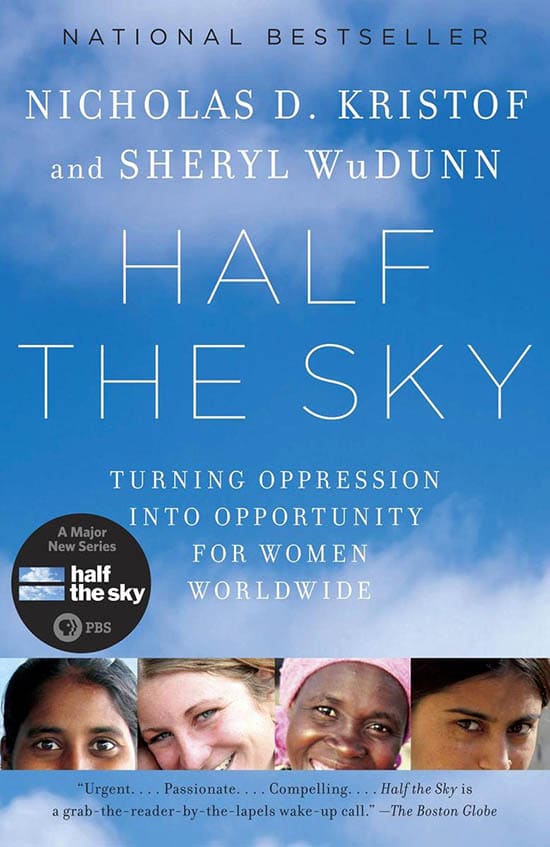
Gender equality, the world over is a serious concern that needs radical amends. Women all over the world have been subject to crimes such as human trafficking, sexual and domestic violence, and slavery. The roots of these evils are sown deep into a misogynistic, worldwide culture.
Half The Sky by Nicholas D Kristof addresses these gender-biased and inequality issues, how certain actions taken in the modern world actually worsen them, and what can be done to right the wrongs against women. It also outlines how women, the biggest untapped source in the world, can actually help in creating a better tomorrow, and what the world stands to gain from it.
The “Discounted humans”
The female gender has bared the brunt of centuries of inequality. The number of women trafficked into brothels every year keeps increasing, and is even higher than the 18th and 19th century Africans who were forced into slavery.
How is this possible in today’s modern world where education for all in most countries is a mandate, and perceptions surrounding women equality, seem to appear important?
Firstly, it is essential to understand the difference between sex slavery and prostitution. Prostitution is voluntary whereas sex slavery is forced. Prostitutes the world over are most commonly pressured into it due to economic and financial pressures, while sex slaves are physically forced. They are beaten, their spirits broken, and are subjected to about fifteen hours a day, seven days a week of unpaid, humiliating work – all to satisfy the needs of men.
While China has the largest number of prostitutes, India has the largest number of sex slaves. Sex slavery is an implicit contract to uphold the virtues of upper-class women by allowing men to trample on the virtues of the lower class.
The perception of women (especially lower class and peasant) as discounted humans causes border officers in India to allow slaves and their traffickers to get into the country. While there are tighter rules and stricter punishments for terrorism, smuggled weapons and private goods, the belief that prostitution is an inevitable cause that lets the men have an easy outlet for their physical needs and keeps good, middle and upper-class Indian girls safe by the sacrifice of these slaves, is the reason that people get away with these atrocities even today.
Half The Sky by Nicholas D Kristof
The Movement Needs Momentum
The very premise that prostitution is ok if it is legalized and regulated is wrong. Yet there are those who find it utterly and inherently degrading.
Zach Hunter, the leader of LC2LC – Loose Change To Loosen Chains – a campaign against modern slavery run by students, started the campaign when he was only in the 7th grade. The world needs more crusaders like Hunter.
However, the campaigns against sex slavery the world over need to be unified. Despite there being a consensus that forced prostitution is incorrect, opinions are still divided over consented prostitution among adults. There are laws of legalization and regulation to reduce the ill effects of prostitution such as AIDS and underage recruitment. However, the world needs to have stricter monitoring and crackdowns on brothels, provide victims with rehabilitation, opportunities to work and a more active part played by social services.
The worry isn’t rescuing victims of forced prostitution from brothels. That is the easier part. The challenge is to stop the rescued victims from going back. The social stigma that follows these victims once they are out and addiction to drugs are some of the major challenges that need to be addressed and rectified.
For example, a Cambodian brothel worker Srey Momm was rescued by the world Assistance for Cambodia many times. She would end up going back to a life of prostitution because she was addicted to the methamphetamine easily available to her there.
These women need a strong support system. To prevent them from getting back into prostitution the world has to firstly, invest in their education, and secondly provide them with a strong support system. This means that strong local women have to be educated and made capable of supporting the rehabilitated prostitutes. Most importantly, these women have to be able to let go of the belief that they are feminine only if they are submissive.
Sexism And Misogyny Are Deeply Rooted
The fact that misogyny is so deeply rooted in the weave of human culture, it is very difficult to bring about a meaningful change.
To sound off some facts –
Girls aged 14 and 15 years get killed more by male violence than traffic accidents, war, malaria and cancer put together.
Sexism is perpetuated not only by males, but by women in communities too.
More brothels are run by women.
In some communities, mothers feed their sons before their daughters, while in others, girls are genitally mutilated.
Women themselves opine that they deserve to get beaten by male member of their family, if they are not obedient.
In countries like Congo, young male soldiers believe that soldiers have a right to rape.
Rape and violence towards women occur due to more than just opportunism and male libidos.
There are many such examples that prove how deeply misogyny is rooted in human culture. Misogyny can only be undone with education and strong local leadership. However, on the ground, it is easier said than done.
In one of the regions in Nigeria, it was a tradition that the males would manage cash crops and the women would look after the staples. A UN project gave the local women a new type of cassava that resulted in better yield and was a cash crop that helped them make more money. Soon, the men took over the crop sales and used the money for beer, leaving the women poorer than they were before the project started.
Such initiative, unfortunately, end up doing more harm than good, as foreigners do not know or understand these local traditions.
Socio-Biological Reasons For Maternal Mortality
Maternal mortality is a bigger concern than it is projected. In fact, an alarmingly large number of women world-over die due to childbirth.
While many effective solutions to avoid maternal mortality are cheaper and even less complicated, in many cases, they are not even implemented because people aren’t aware of them.
A study conducted revealed, that by simply providing girls with a $6 uniform every 18 months, chances of staying in school and thus, chances of pregnancy decreased. Furthermore, keeping these girls in school for longer delayed chances of early marriage, enabling them to bear children at an appropriate age and more safely.
In Ethiopia, a 21-year-old was left crippled with a fistula, leaking faeces and urine during childbirth. She lost her baby, and her husband and parents had no money to treat her condition. Though they had saved some money to take her by bus to a hospital, the passengers refused to let them on due to the smell. For two years she was left curled up in a separate hut. Eventually, her husband left her. The parents then sold all their belongings and managed to save $250 to hire a car to take her to the hospital. She underwent painful therapy and surgeries to correct her bent legs and fistula.
Lack of education, infrastructure, rural health regards and the general disregard for women are some of the main causes for maternal mortality. Had Segaye, and the people surrounding her been educated and had more respect for women, she would not have been in pain for two long years.
How Religion Affects Gender Inequality
The religions of the world have equally contributed to gender inequality. While they aren’t misogynists in particular they do not have any measures in place to address the rising gender inequality all around the world.
For instance, in many Christian countries, the ‘God Gulf’, or the secular liberals and conservative Christians that square off abortions shapes family planning amongst the Christian population. Moreover, the ban on abortion and lack of funding lead to unwanted and unsafe pregnancies and illegal and unsafe abortions, increasing the death rate among women and girls. This is true for all religions that denounce abortions.
For instance, in Sub-Saharan Africa, one out of 150 unsafe abortions result in death. In Islamic countries, women have to endure honour killings, which adds to the skewed gender ratios.
A surprising fact is that when Muhammad introduced Islam in the 7th Century, it was more progressive than Christianity was. The fact that the Quran reads more literally than the Torah or the Bible, it is harder for Muslims to shrug off gender inequality and discrimination in their Holy Book than it is for Christians or Jews.
The earlier deep-rooted ties that Islam had to slavery, were eventually eradicated. Similarly, it is possible for Muslims to offer women complete emancipation. Islamic feminists thus argue that the religion can continue its progressive spirit and help women rise. Albeit slowly, the Muslim leaders are now realizing that discrimination against women prevents them from tapping into a formidable, unexploited resource – women.
Education Is The Only Way
There is a lot that needs to be done in order to eradicate gender inequality and empower women all over the world. While education is a vital necessity to empower women and ensure that they get integrated into the economy of the world, education involves more than simply putting up more schools for women.
Studies have found that iodine deficiencies among children can actually take off 10-15 points from a child’s IQ. Ensuring that children get iodized salt can prevent brain damage. Moreover, the reason that girls drop out of school after puberty is due to the use of cloth pads, which increase the risks of spotting and possible leaks. Such girls get embarrassed to attend school and skip it altogether. Providing them with better feminine hygiene products such as tampons and pads can reduce the school drop-out rates among girls. These simpler solutions can be easily implemented along with education.
Movements for improving gender equality need to follow certain guidelines.
The gap between the conservatives and the liberals needs to be bridged to link the God gulf with the need for gender equality.
Humanitarian communities should stop exaggerating their findings. This has led to other being sceptical of what they have to say.
Financing local projects and women volunteers needs encouragement.
The narrow-mindedness with respect to human life has to be eliminated. If there is a value to the life of unborn foetuses, there has to be a value for the life of those young mothers who are at risk of sex-slavery. Women, whether in the US or in Asia, should have the same status.
These are just a few ideas. The impact of media – television and advertising – can be used to educate women, improve children health and even create a just society.
Conclusion
The evils of gender inequality and oppression against women are still by and large prevalent in the world today. Women are subjected to sex slavery, trafficking, and violence.
It is thus necessary to empower women through education and other means if the human potential of women is to be harnessed to make the world a better place. There has to be equality for all – men and women.
This is the Humble Inquiries series. In this episode, Leslie joins me as my co-host to humbly inquire into Mental Health and Burnout – a huge challenge for leaders and everyone else in the era of Covid-19, hybrid work, sudden changes, and all the uncertainty.
In each episode of Humble Inquiries, we are deliberately going to put ourselves in the uncomfortable space of not knowing the answer and humbly inquiring about these challenges – with the aim to provoke new thoughts, actions, and practices – to help us better serve our coaching clients, and also to help the leader in you navigate the biggest challenges – at life and at work.
Show Notes
Leslie – “The key theme is taking that moment to pause, whatever that may be, pause to find out what your emotion or your reaction is positive for you. Pause before you react.”
Sumit – “Everybody is different. Every family is different. Every society and every group is different. So there is also that something very localized, very personal. , To this challenge, we cannot really predict. We cannot really guess what is happening to somebody. ”
Sumit – “what makes it, I think even worse or what compounds the problem is, we don’t talk about all of this stuff. This is very human stuff. This is not alien stuff, This is very human stuff. And yet we don’t talk about it.”
Leslie – “And because we don’t talk about it. We don’t even know how to talk about it. And the sensitivity around that creates even more hesitation.”
Sumit – ” It takes a moment to shift ourselves to do, to bring up a smile on our faces.”
Leslie – “just as we learn and grow all throughout our lives and career, this is another step in the journey and another opportunity to change how we work moving forward, how our world is moving forward.”
Sumit – “there are a lot of things which we are on top of it, but at the same time to make it an assumption that I can be on top of everything can become a very heavy place to operate from. It can almost become self-defeating.”
Sumit – “letting go of control is actually not anxiety is actually curiosity.”
Leslie – “The individual may have depression or anxiety, but that doesn’t shape everything. That’s not who they are. They are not a depressed and anxious person. They are someone who has depression and anxiety.”
Sumit – ” The external does not control the internal in a deterministic way. So we still do have a choice, to choose how to react to situations. And our well-being is not a function of what is happening outside. Nobody can take that away from us.”
Leslie – “Creating the space to talk about mental health and wellbeing. And allowing that to be accepted is a powerful piece of what each and every one of us brings to every day and every conversation.”
Sumit – “the neutral state of any human being is wellbeing is peace. That’s a neutral state. It’s not like jumping with joy, but it’s also not being depressed or sad, the neutral state. We don’t really have to do anything if we just let things go that we are trying to control. That’s where (the neutral state) we will land automatically.”
As quoted by Edgar Schein in his book Humble Inquiry, an humble inquiry is recognizing that insights most often come from conversations and relationships in which we have learned to listen to each other and have learned to respond appropriately, to make joint sense out of our shared context, rather than arguing with each other into submission.
Who doesn’t want to live the BIG dream? The Amazons, Apples, and Microsofts of the world are truly shining beacons that beckon every entrepreneur and charm them enough to want to pursue BIG successes.
At the same time, it isn’t everyone’s cup of tea. And it shouldn’t be. While it’s true that reaching out for the moon is a goal that every entrepreneur aims for, thinking about success this way can be daunting. Playing in the big markets, managing an ever-increasing large organization, and spending a life pursuing the ‘bigger is better’ dream is indeed, the sacrifice of a lifetime.
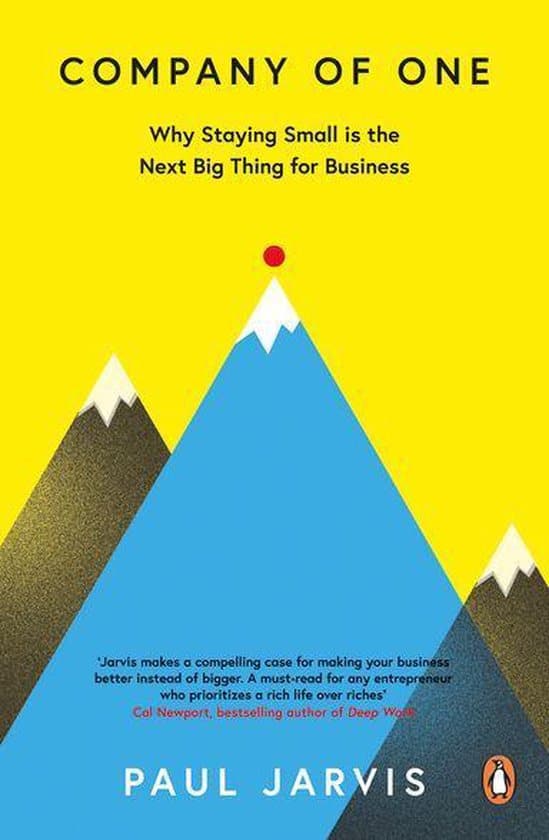
Company Of One (2019) by Paul Jarvis looks at an alternative to the conventional pursuits of success. The philosophy places a higher value on having less over more, staying small rather than making it big and prizing niche over the mass. It shows how small-scale business enterprises today, trump being a global giant, offer more freedom, independence, and enough wealth to live a life where friends, family, hobbies, and quality time are equally important.
A Holistic View Of Life
The mantra of modern capitalism is ‘more’. Consumers want more products, businesses want to sell more products, make more money, and have more profit. It’s a never-ending, insatiable desire for growth and consumption.
Company of One – Paul Jarvis
There is, however, small, a shift in this trend. Many consumers are focusing on limited consumption. Businesses too are now seeking a more sustainable, stable, and satiable approach to growth. These exceptions are focusing on earning just enough to enable employees and owners to live comfortably, with autonomy, and freedom to do what they want along with their work. They revolve around the employees, rather than making their employees revolve around the goals of the business.
Such companies, whether they are single owner-operator enterprises, or have a strength of a few hundred employees, are called companies of one. These are the companies that make the individual the unit of measure of the business.
Companies of one set growth limits as opposed to conventional businesses that have an ever-escalating scale of growth. For instance, Psychotactics, a consultancy services firm run by Sean D’Souza, limits itself to a $ 500,000 per year profit. While it could make more money, D’Souza purposefully restricts its growth.
Why??
An ever-escalating scale of growth needs more production, more customer sales lead to more employees, bureaucracy, and infrastructure. This inadvertently translates to more exhaustion, more work time and oversight. With more growth, one has less autonomy, lesser free time, and even lesser comfort. After all, rapper Notorious B.I.G. got it right – more money, more problems!!
And that defeats the purpose of the ideology of the company of one.
D’Souza would rather be spending more time with his kids on vacations and making enough to keep comfortable and keep taking those vacations!!
Not Free-lance Employment, Neither A Traditional Small Business
Companies of one differ from both, traditional small businesses and free-lance self-employment. For example, most small businesses are limited successes and want to aim higher. They want to grow, expand and, they, by definition, believe in the ‘bigger is better’ mantra, seizing any given opportunity for growth and profits.
Companies of one, on the other hand, don’t leap at opportunities for growth if they have met their profit targets. Achieving, and sustaining their self-defined levels of income are v the very definitions of their success.
However, both, small businesses, and companies of one have a similarity. They both look for profit by investing a certain amount of time and money, once. For instance, the investment could mean an upfront expense of labour into making a product or service. Once done, they reap the benefits and profits from that product without needing to do much further, thus repeatedly earning from it.
Freelancers, on the other hand, stop generating income as soon as they stop working. Their income depends on work per hour, or per piece. A freelancer’s income depends on the time put in. They have a one-time contract with their clients, and unlike companies of one, they do not repeatedly earn from one project. The owner of a company of one could be vacationing while still reaping the benefits of a project that was done months ago.
However, freelancing is often a stepping-stone to becoming a company of one.
Starting A Company Of One
Let us now get into the process of starting a company of one – step-by-step – and discuss goals, strategies, and distinguishing features.
1.Not Quitting The Day Job
It is often seen that companies of one emerge from side gigs. That said, quitting one’s day job isn’t really a good idea. Before the company of one becomes a sustainable success, one must be able to sustain oneself. Diving headlong into the company of one before it becomes a full-fledged business could get excruciatingly expensive, and defeat the purpose of starting a company of one altogether.
Take, for example, Tom Fishburne, a marketing executive of 20 years and owner of Marketoonist, his company of one based out of his Marin County, California home.
He started pursuing his childhood hobby of cartooning for fun. Soon, he started taking on small gigs, drawing for clients during his free time. He built a solid roster of clients and built a runway buffer (saved up enough to sustain living expenses in case he had a few slow months). Only after he achieved that, did he finally dive headlong into cartooning and quit his marketing job.
Seven years into pursuing small gigs, he started making 2-3 times more than he did as a marketing executive. Furthermore, he not only changed a hobby he loved into a business but also enjoyed plenty of time with his family.
Today, Fishburne runs Marketoonist with his wife. They do employ freelancers, but only on an ‘as-needed’ basis. While they have a waiting list of clients too, they prefer to keep it comfortable. They do not want to expand into a giant with satellite offices.
We can learn a very important fact from Tom. The point where growth means to make unacceptable sacrifices in life is the point where the company of one has reached its growth limit.
2.Work Should Be Passion
Most business writers and speakers advise budding entrepreneurs to follow their passions. However, it isn’t always the case that one finds their passion easily. Additionally, not everyone’s passion is an ‘in-demand’, financially viable, and marketable skill. In fact, most passions are often out of sync with market demands.
How does one then, find the side gig that can become a company if one?
A study conducted by Robert Vallerand, a professor of psychology at the University of Quebec in 2003, asked a few students, “What’s your passion?” Most of the students answered music, art, or sports instead of their majors. Considering that these three fields make up only 3% of all the jobs available, pursuing them as passions is futile for starting a company of one.
What most of these students needed to keep in mind, is that while football might be a passion, becoming the next Ronaldo would be a distant dream. It is the same for other passions that make up minuscule percentages of the successful ‘company of one’ markets.
The questions that need to be answered then, are – “What is it that I’m already good at, that people would be willing to pay for?”, or “What could I get better at and make it a marketable skill?”
Paul Jarvis, though not feeling passion for web designing, had become extremely good at it, and sharpened his skill sets to start a company of one. In due course, he got better at it, began to feel satisfied with his work, and was enthusiastic to do more. That feeling was a form of passion.
Hence, it is vital that one understands the marketability of one’s passion and can turn work (or something one is decently good at) into a passion.
3.Finding A Niche
There are two common assumptions made in the business. First, the larger the number of people who want the product or service, the better it is. Secondly, people often believe that the bigger the market, the number of potential customers will be bigger.
However, the catch with that is – while appealing to a larger target audience, the product or service needs to be more generic. This can end up diminishing the allure of the product or service.
For instance, when Starbucks initially started out, they positioned themselves as a chain of coffee shops that gave people the experience of a local coffee boutique. However, by the mid-2000s, that experience became bland as they started expanding with coffee shops on every street, sandwiches, fancy beverages, CDs and more. The high-quality coffee experience suffered, and they had to scale back shutting about 900 stores. They had to refocus on their niche, original branding.
What is important to remember is that the number of competitors increases in larger markets. Finding a niche thus is essential. It is easier to connect with, and gain the trust of a select few with specific needs, and create a tailored product that customers will be willing to pay a premium for.
4.Personality And Simplicity Have Power
Simplicity and personality are extremely important when one wants to narrow their focus and appeal to the niche.
Consider Casper – a small company that sells mattresses. While they have tapped into a huge market, what sets them apart is the fact that they,
a. Target only the younger audience, who prefer to buy online rather than go through the hassles of physically visiting the store, and
b. They only offer 3 styles of mattresses.
This has helped them to do both, narrow their target audience as well as offer their customers simplified options. Their proposition is straightforward – buy online, without hassles, and if one doesn’t like the product after using it for 100 days, it can be returned with a full refund.
The second strategy – personality – involves using the uniqueness of personality and integrating it with the message that surrounds the service or product. That involves everything from communication with customers, advertising, branding, right down to the designing. The trick is to keep it simple, yet unique. For example, an entrepreneur could take a simple adjective like ‘loyal’ that best describes himself, and then put a unique spin on it that brings out an authentic expression of what the product stands for.
This helps when despite the niche market one targets, there could be bigger, more established players in the field. Personality is unique. Hence, even though a competitor can replicate the product, they can’t replicate their personality.
5.Establishing A Relationship With The Audience
Once the product is developed with a unique personality, the next step is to reach out to the audience and convince them that the service or product is worth their money.
While it’s easier said than done, there is a lot that goes into establishing a relationship with the customer. Understanding what the customers need is a vital step towards being able to fulfil those needs.
One of the ways to reach out to potential customers is to offer them a no-strings-attached, free consultancy. For example, a web designer looking to start a company of one should start by looking for people who need a web designer and understand exactly what they want. Additionally, one can learn about their past experiences with web designers they have worked with before. This helps in getting vital information about the current market, how and where customers look for web designers, why they hire particular people, and what objectives do they want fulfilled from the web designer they hire. It also gives an insight into what accounts for a bad experience, and what do customers expect.
This information can then be analyzed and used to position one’s own product. However, at this point, the aim is still to get to know the customer market and to build a relationship, not to make money. Moreover, one should remember that having collected the information, the aim at this point is to answer questions and help in small meaningful ways, and not to design the website for free altogether.
Such ‘mini’ consultations work in two ways.
a. By helping the customers understand what they should look for, what’s good and what’s not, and
b. At the same time, gathering information about the customers’ needs, wants, and experiences.
It’s a give and takes relationship, where both parties end up helping each other, without the need for any monetary transaction. Indeed, when the time comes for the customer to actually look for paid web-designing services, the customer is going to turn to someone they already know is an authority on the subject – the web designer who helped them with ‘free’ consultancy in the first place!
6.Inexpensive, Quick Profit, Without Large Investment
With the passion found, the product design, and the relationship with the audience established, it is time to think about spending, and making money. So ideally, one starts to look for office space, make business cards and quit that day job.
However, the company of one is still at its embryonic stage, and it is too early to start thinking about making ‘real’ money.
The most important thing budding entrepreneurs should think of is how to avoid large investments. Technology, today, has made it easier to bypass many large investments that were earlier necessary. For example, several free analytics software available has made it easier to collate valuable data without the need of hiring a cyber guru. Similarly, remote contractors can help in providing services that an entire IT department could do.
The idea is to think small. If the plan needs larger investments, it defeats the purpose of a company of one. Expensive investments are features of small traditional start-ups that aim for ever-increasing profits in the future. Companies of one aim at getting profits as cost-effectively and as quickly as possible, without the need to increase the returns year on year.
Once the entrepreneur falls into the trap of wanting ever-increasing profits, it becomes difficult to avoid external investors’ money, which leads to loss of freedom, autonomy, and independence.
In fact, not needing large investments is good for a company of one. That is because the more money one invests to set up the company, the larger are the upfront costs, making it necessary that the revenue generated is higher and faster to break even. Similarly, if the company spends more time setting up, it takes the company more time to start generating revenue faster.
Instead, the company of one should focus on spending just enough for a saleable product or service, which is just enough to set the ball rolling. The profits then grow through the snowball effect, gradually.
7.The Snowball Effect
With a few projects or sales in hand, the company of one begins its first steps towards its goal. These few clients or sales, lead to a few more, who in turn start recommending the services or products to other customers. This gradual build of a customer base called is the snowball effect.
Consider the case of Ugmonk, a highly successful yet small clothing company started by Jeff Sheldon. He started the company on a $2000 loan, making about 200 T-shirts of only 4 designs. These T-shirts sold out quickly, encouraging a second and the third run of sales. Sheldon paid back his loan and almost immediately started making a profit.
While continuing his day job, Sheldon re-invested his profit into the production of more garments, at absolutely zero investment. He ran Ugmonk out of the apartment for 2 years, and only invested in a warehouse much later when he really needed to.
The point is, it’s ok to make large investments, but it is vital to make them at the right time, only if they are essential, and only if the revenue allows it. Trying to anticipate everything that the company might need in the future and jumping towards those purchases and investments defeats the purpose of keeping it small, capping expenditure and growth.
An owner of a company of one additionally needs to be a jack-of-all, often doing the jobs that customer support, marketing, and accounts do, if the snowball effect must work.
8.Customer Retention And Service
The small size of a company of one is its competitive edge. It makes room for adding a personal touch to a service or product, especially when it comes to communicating with customers and clients. It is this personal touch that keeps them coming back.
When it comes to customer service, it is the most important mantra of running a successful company – big or small. People value good customer service and are willing to drop a product if they have a bad experience with it.
Some large companies, while also at risk of losing their personal touch due to customer service, don’t mind it at times. They follow a churn and burn strategy, wherein they aim at getting as many customers as possible, wring as much revenue out of them as fast as they can; and if the customer is dissatisfied, well, they move on to getting the next set of customers, without bothering about why the previous ones were dissatisfied.
The churn and burn strategy, however, doesn’t serve the purpose for a company of one. Apart from it being a question of ethics, it also is a matter of cost. According to research by Econsultancy and Responsys, it cost five times more to bring in new customers than to keep old ones. Moreover, happy customers are more likely to refer the company to others. In fact, word-of-mouth referrals are the most important way companies of one acquire new customers. Burning those bridges is surely an expensive affair!
Conclusion
Companies of one are the smart way to run a business today. While the aim is to stay small and make manageable profits rather than ever-increasing ones, the upside is a higher level of independence and a better work-life balance.
Welcome to the Deploy Yourself Newsletter, where I share what impactful leadership looks like to show your own power. I also share the most insightful lessons and stories I encountered in the last two weeks. You can also read this issue online.
Hey,
Why do we love sports (and sportspeople)?
We all have our favourite sport that we enjoy watching. Even otherwise, the thrill of an exciting moment in a game is hard to avoid – even if we are unaware of the sport or the sportsperson involved…
I was wondering today why is that so. Why do we love sports and sportspeople? It is because they are out on the court (or stadium) chasing their dreams. They put their heart and sweat into practising for weeks, months, and years so that they can perform and win during a game. They give it their all – in front of everybody else.
This is why we do not just cheer for those who win. We cheer for those who give a good fight and go beyond themselves – irrespective of whether they win or not.
This is why we cheer for the underdog. For it is not about the dog in the fight. It is about the fight in the dog, as Mark Twain said.
Perhaps it is time to ask yourself – In your life, are you on the court playing the game of life? Or, are you in the stands watching others play?
Your dreams might be buried deep inside, but they are still alive in there. This is why you cheer for your favourite team, enjoy a sports movie, or laugh or cry while watching a good performance.
Shake off the dirt if you are not playing the game already. Shake off the heaviness of circumstances, past delays and frustration, and try again.
Leadership is the choice to shake off the dirt and start again. And again. And again.
Yes. Leadership is a choice. Your choice. And yes, you have the choice to be a leader – in each moment.
Believing in yourself is a choice. Making a commitment is a choice.
Are you giving yourself permission to make that choice every day? Or not? What are you waiting for?
Make a choice to reply back and your answers to the above question. I read and respond to every reply.
Articles and Stories Which Have Fascinated Me
One
The future of work is written
Writing can transcend our distances in all their forms and lengths. Constitutional governments are great examples of how written artifacts can survive—and influence work—across centuries.
Some decisions require presence and discussion, certainly, but not all. Many can be made both responsibly and asynchronously. Collaborative documents, for instance, can become self-documenting meetings, and writing the foundations and reasoning for critical decisions might produce a better result, even when brainstorming.
Writing, though, offers us possibilities far beyond meeting documentation. When we write, we get to freeze ideas: They stop evolving and become accessible to others to establish a consensus or working frame, which later can be collaboratively reshaped.
Knowing and then deciding what to write is often more valuable than writing everything, but knowing what matters is more of an art than a science. Writing is hard. Doing it well takes time. Comfortably sharing work in progress requires psychological safety, so ideas can see the light and be nurtured when they’re the most fragile.
If we embark on a journey of communicating better at a distance, we’ll have to consider that we’re all still human. We interpret differently. We require safety. We react well to stories. Our sarcastic humor doesn’t always travel well in written form. Leaders who move us closer to a written and remote future, who truly understand the value of communication, will invest holistically in tools, staff, ideas, and infrastructure.
10 Prerequisites for Being a Good Manager– Lessons I learned the hard way
The more I learn about leadership and what motivates people to do their best work, the more I realise how little I know.
Although few managers would admit they lack the skills required to do their job, the reality is that most don’t have a clue. According to Gallup, organisations fail to choose the right person for the job 82% of the time.
In a culture where confidence is praised and mistakes ridiculed, admitting your ignorance may seem unnatural. But as one study found out, intellectually humble people are more motivated to learn. To become a better manager, you must be ready to admit you know little about leading and motivating people.
Accepting you don’t know something opens the door to learning and growth. Admitting you have shortcomings sets you on a path of knowledge seeking. As Nobel Prize winner Subrahmanyan Chandrasekhar remarked, “Believing that you must be right, in other words, lacking intellectual humility-can actually stymie discovery, learning, and progress.”
Asking useful questions is a skill, and it requires practice. If you want useful answers, learn to ask better questions.
Keys to information-seeking questions:
Be specific about the information you’re looking to obtain.
Give context by referencing why you’re contacting them and how you found their contact information.
Make it easy for the recipient to refer you to the best resource as quickly as possible, which will save you both time.
Keys to clarification questions:
Include a short summary of the topic for context.
“It sounds like…” leaves room for clarification without being confrontational.
“Is that correct?” (or a close variant) is clear, concise, direct, and polite.
Keys for asking for assistance:
Be clear and precise about what you’re trying to do.
Give context by including what you’ve tried so far, which makes it clear that you’re doing your own work and not asking the recipient to solve your problems for you.
Keys for asking for advice:
Be clear and precise about what you’re trying to achieve.
Be clear about your priorities, and include any known tradeoffs. The recipient can’t read your mind or set your priorities for you.
Make it clear you’re asking for advice or perspective, not for the recipient to decide for you.
Give the recipient an easy out – you’re asking for a favor, so be polite.
Leslie – “Everyone wants to be valued and to have a purpose in their work”
Sumit – “Communication is not only about what is being said. Communication is also about what is not being said, which needs to be said, and what is being said, but which you are not hearing.”
Leslie – “It really is about creating space. Before you created that space physically, you created a lunchroom, you created a little lounge, and you created some space built within your culture that fostered that. Now that space needs to be created virtually or in a hybrid format to be able to continue to cultivate those relationships and conversations.”
Leslie – “The leader doesn’t have to have those solutions. The leader needs to create the environment, to have the conversations, to be able to come up with those solutions.”
Sumit – “If we can help leaders get better at the conversations they are having that will also solve not just the productivity problem, but also the hiring problem. Coaching is just a way to have conversations more effectively.”
Sumit – “Vacation should not be taken to distress or to avoid burnout. Everybody should be free to use their vacation days for travelling, practising their hobbies, any other passions, spending time with family. But if you use vacation for de-stressing. Then it means that something is wrong in the workplace itself. And that’s where we can focus our attention.”
Leslie – “When your talented employees and the driven ones become silent, that’s the really scary moment because something is wrong.”
That’s it for now. If you have any questions or feedback, or just want to introduce yourself, hit reply. I read and respond to every reply. All the best,
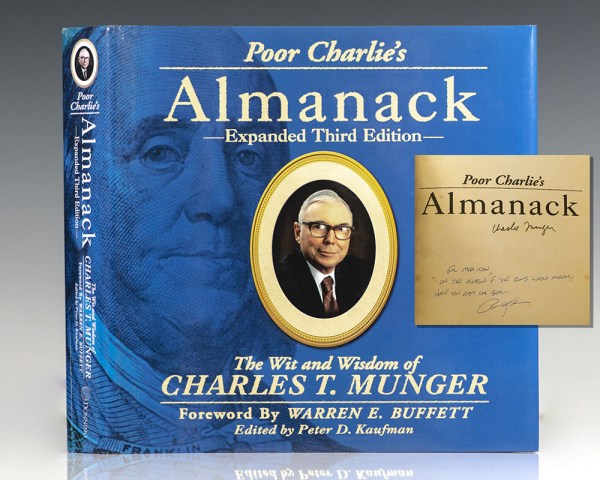
A devoted philanthropist, a dedicated and highly disciplined investor, and a down-to-earth reclusive billionaire are possibly the most uncommon adjectives put together to describe one of the world’s billionaires – especially in today’s flashy ‘Insta-era’. Charles Munger, the Vice Chairman of Berkshire Hathaway is one of the world’s wealthiest businessmen, sans the social media displays of wealth and power.
Poor Charlie’s Alamanck (2005), by Peter D. Kaufman, is a window into Munger’s investment philosophies, that have gained the company millions of dollars. Additionally, his inspiring ‘etiquettes’ towards keeping numbers honest, sticking to principles, a deep belief and trust in Wall Street, and his dedication to paying taxes rather than having money in tax havens, is proof of how his principles are not just about doing the right thing, but also about how they are actually good for business.
A Strong Work Ethic And Philanthropy
Munger, as a youth, worked in a grocery store that was run by Warren Buffet’s grandfather. With a 12-hour, no-breaks shift, he would earn $2. However, it was this gruelling experience that instilled in him a work ethic that stuck with him through the journey of his career from a grocery stacker to a billionaire.
His single-minded focus on his work and his ability to tune out distractions (albeit having 8 children at home) is fondly remembered by his children even today. In fact, his son William Borthwick remembers how his father worked hard to instil his work ethic in his children.
Borthwick remembers the time when his job was to drive into town, to pick up the housekeeper and collect the newspaper. The journey involved taking a short boat ride and then driving into town. One stormy day, Borthwick, focussing on the weather, forgot the newspaper. Munger sent him back out in the storm to get it! This lesson in getting a job done right the first time, though harsh, was effective, teaching Borthwick to do his work effectively at the outset.
Munger was a strict father, yes, but his dedication to caring for his children, and his commitment to their education and careers, have left them with fond memories.
Growing up during the Great Depression, Munger was a first-hand witness to poverty. His experiences as a child instilled a need to help others around him. Along with his wife Nancy, Munger has made valuable contributions to hospitals and universities, supported a number of causes like Planned Parenthood. Munger believes that as it is important to work hard, it is equally important to give back.
Poor Charlie’s Alamanck (2005), by Peter D. Kaufman
An Unconventional Academic Career
Munger sought knowledge wherever and whenever he could. As a child, his parents always encouraged reading. As a teen, Munger would spend hours in the library of a doctor family friend, where he would immerse himself in medical journals. Thus began his fascination with medicine and science.
In college, he decided to pursue mathematics and later physics at the University of Michigan. Munger believes that his ability to apply logical theory and solve complex problems evolved during this period. However, his education was interrupted by World War II, and after his sophomore year, Munger joined the Army Air Corps. He was sent to the University of New Mexico to study engineering and science to become a pilot. Next, he studied meteorology at the California Institute of Technology.
In 1946, after he was discharged as an officer from the Army Air Corps, his education was a patchwork of sorts. Having studied different subjects in many prestigious institutes, Munger still did not have a degree in anything! At this point in his educational career, Munger, with a little help from a family friend, applied and got through Harvard Law. Munger’s intellect and IQ, and his achievement of the magna cum laude proved that having a bachelor’s degree really didn’t matter!
World War II, albeit a disruption in Munger’s education, was a blessing in disguise. It led Munger down an unconventional path towards independence and original thinking that have been valuable to him through his life!
The Beginnings Of A Career In Investments
After graduating, Munger joined a Californian law firm and thus began his prosperous career, and had founded Munger, Tolles, and Olson, a successful law firm. However, Munger still wanted more. He was restless as he didn’t want to settle for a career in law. He wanted to apply his intellect and skills in other areas too.
In 1959, Munger returned to Omaha to wrap up his father’s estate after his death. Later, he attended a dinner with some family friends, who had also invited Warren Buffet. Buffet, at 29, was passionate about investing and business and was a perfect match for Munger’s intellectual curiosity. They hit it off instantly. What started as a dinner conversation that fateful night, turned into a partnership that has lasted more than half a century!
Warren Buffet managed to convince Munger that his skills would be best used in the fields of investment and finance. Finally, after gradually extricating himself from his firm in 1965, he started his own investment partnership with a law colleague. Munger found success in that venture too. However, he decided that he would rather build his wealth through owning stock in company holdings, than managing funds directly for investors.
He finally joined Buffet at Berkshire Hathaway, making it one of the most respected investment companies in the world. The companies spectacular successes are evidence of Munger’s unique contributions, derived from his training in math, physics and law, to run a tight, scrupulous, and clean business. While Buffet, for his part, keeps Munger on his feet by giving Munger a myriad of intellectual challenges.
Today, well into their nineties, Buffet and Munger are still at the top of the investing game!
Commitment, Principles, And High Ethical Standards
In the world of business, finance, and investing, unethical people and practices are rampant! Wall Street too, has seen its fair share of crooks. Movies like The Wolf Of Wall Street open only a small window into how bad the situation can really get!
On the other hand, there are principled investors like Charlie Munger, and hence companies like Berkshire Hathaway, that believe in and keep their investing practices righteous. Considering Berkshire Hathaway is a mammoth organization of 175,000 employees, it has had very few scandals or litigations, enabling clients to put their trust in the company. Moreover, with strict principles like Munger’s, practices such as insider trading or doctoring books are simply crushed out!
The temptation and pressure are enormous, as investors need to build the trust of clients and show that they can add true value to portfolios. Many even break the law by cutting corners. The frequency of such practices has, in fact, made it a norm, where investors and managers rationalize the practices with excuses. It is the same with tax evasion. In fact, even big conglomerates like Amazon set up headquarters in tax havens such as The British Isles or Dublin to avoid paying taxes.
Munger, however, has no patience for such ‘socially accepted’ ways of law-breaking. He is strict with Berkshire Hathaway employees and shareholders to refrain from grey areas and law-breaking. The company has maintained its reputation where others like Enron have been tainted with scandal.
Despite Munger’s strict vigil, there have, however, been close calls.
Berkshire Hathaway had once invested in a bank, Salomon Brothers. The bank, despite advice and warning from Munger and Buffet, chose to conduct business with the notorious fraud Robert Maxwell. The disastrous allegiance and its repercussions further cemented Munger belief in partnering with those who are aligned with the ethical standards he has.
Munger’s belief in ethics is especially notable in the 2008 Global Financial Crisis. Even before the crisis hit, Munger was vocal about ‘creative accounting’ and accountants who fudged clients books. He called it the ‘moral decay of corporate accounting firms’, where principled firms shifted their moral compasses to help clients fudge books to get ‘filthy rich’. He has seen principled companies from his youth lose their ethical standards and find loopholes in the law.
According to Munger, accounting for derivatives is perhaps one of the most unethical practices. It involves creating financial contracts based on a speculated value of an underlying asset. For example, student loans are bundled and sold to investors based on projected values in future, when debtors will pay up, rather than clear, established values of the present. This practice is what makes derivatives risky, especially if the debtors don’t pay, rendering the contracts worthless.
Munger knew the danger that speculation and derivatives posed. He also warned that companies practising it should be prepared for a ‘significant blow-up’. Munger’s words were prescient of the 2008 crisis. When housing prices crashed, debtors were unable to pay off loans, derivatives were rendered worthless, and the market crashed.
Berkshire Hathaway was one of the only companies to emerge unscathed, due to Munger’s strict rules surrounding unethical creative accounting. His resistance to unethical practices proved to be a blessing.
What Makes A Good Investor: Accepting Mistakes
Munger has always had a zero-tolerance policy against liars. Above all, he values honesty the most. At the same time, he has always had a pragmatic view towards mistakes. In fact, one of his favourite stories is about how one of the financial officers in his company made a mistake that cost the company thousands of dollars. As soon as the officer realised his mistake, he headed to the president and owned up.
At that point, while the president agreed that it was costly oversight, he let the officer keep his job because the officer had, rather than a cover-up, owned his mistake. What mattered most was that the officer had learnt from the mistake he made.
Munger believes in practising what he preaches. And true to his belief, he admits to having made a number of errors through his investing career, especially ‘errors of omission’ – failing to buy enough stock or not recognising a valuable investment opportunity. For instance, one of the errors include not investing in Walmart, a decision that cost them over billions of dollars, just because they thought the stocks were too costly then.
Another example of oversight was when Munger and Buffet, both, nearly declined to invest in See’s Company – a high-quality confectionery company – due to its high pricing and did not recognize its value. However, after a colleague made them see the value of quality, they changed their minds. The ‘in-the-nick-of-time’ investment turned out to be a lucrative one, earning them more than $2 billion in profits.
Munger’s ability to change his mind in situations such as these is one of his key assets. In fact, Munger sees ideas like tools. If a new one is more useful, discard the old one. He has the ability to not take it personally when a colleague or employee disagrees with his opinion. Munger demonstrates the fact that only those who are strong and confident are able to own up to their mistakes.
What Makes A Good Investor: Focus And Patience
Charlie Munger believes that patience is one of the most important qualities an investor should have.
Buffet and Munger are, in fact, known to wait patiently for a good opportunity. Once they find it, (for example, undervalued stock in a company they predict will be profitable) they pounce, buying large parts of the company. Once they own shares, they keep those shares, and at times for decades.
Such a ‘wait and watch’ investment style isn’t exciting enough, but has proven to be lucrative time and again. For example, after the 1987 stock crash, they saw an opportunity to acquire Coca-Cola stock at a very good price. Though the market was down and the value of Coca-Cola’s stock value had sunk, they knew that the value would eventually recover due to the solid brand value of the company.
They invested around $1.3 billion, making Berkshire Hathaway the biggest shareholder. Those shares are worth more than 8 billion today, proving that patience and focus pay back big!
Many investment companies apply a strategy called diversification, which involves hedging bets and investing smaller amounts in a wider range of companies. Berkshire Hathaway, however, prefers quality over quantity. They invest in a smaller number of companies and hence are able to hold a majority stake. This gives them more influence over the decision in those companies. Munger also advocates that when one chooses to invest wisely, one need not have a broad portfolio. Ten solid quality companies are better than a mix of a dozen over and under-achievers.
Munger’s investment policy is akin to the proverbial slow tortoise rather than the fast hare. Though it doesn’t look glamourous from the outside, the results speak for themselves.
What Makes A Good Investor: The Ability To Draw On Diverse Mental Models
Let’s consider a workman with only a hammer as a tool to work with. Because of the limited options he has, the workman starts to see bludgeoning as the only possible solution to fix every task or problem he encounters.
Munger often uses this parable to explain the fact that an investor with only one way, or tool, to approach a problem, will suffer in the longer run. He will try to fit every reality to suit his ‘only known’ approach. In order to be successful, one has to have a broad range of tools from different disciplines. Using different approaches give one the mental acuity that is required to adapt ones thinking to different problems.
The problem is that the Harvards’ of the world often train in only one discipline, with different departments of academia fighting for superiority. This is detrimental. However, if one considers how pilots are trained to think out of the box and apply mental agility to different problems encountered in theory and in practical application, all while updating their knowledge base throughout their lives, it becomes evident that applying one school of thought or one manner of problem-solving to everything one encounters is not the route to success.
Pilots are trained to make mental inventory ‘checklists’, of all possible problems that they could encounter and all possible solutions that they could apply. This practice helps pilots in considering counterintuitive possibilities and thus, encourages mental agility.
Similarly, if young investors were to perceive their education in this manner, by constantly applying multidisciplinary knowledge while updating their skills regularly, and conducting mental checklists, they would become more adept at making good judgements and solving complex problems. They would simply be more successful at thinking.
What Makes A Good Investor: Understanding Psychological imitations
A good investor should have sound knowledge of psychology, and above else, a good understanding of the limitations of their own thinking. Humans are sadly, easily manipulated by the subconscious, have blind spots and limited knowledge. It is the reason why advertising works so well!
In order to combat the limitations of one’s own psychology while investing, Munger suggests a ‘two-track analysis’. It involves taking a step back first and then rationally considering all data available. What are the real risks involved? What are the possible benefits of investing?
Next, one has to consider the psychological factors that could be influencing, at a subconscious level, one decision as an investor, that could be leading to conclusions but are actually incorrect. For instance, is the investor drawn to the company because the management is flattering? Or has the investor drawn conclusions about the company based on prejudices or feelings of antipathy, that could lead him to turn down an otherwise sound investment opportunity?
Having an understanding of what one doesn’t know can be a good thing. It can be used to one’s advantage. For instance, Buffet and Munger have a defined ‘circle of competence’ which they use to decide while qualifying an investment. On principle, they do not invest in ‘high-tech industries’ such as internet-based offerings or computers as they do not have much knowledge about them. While this has closed them off to some very lucrative opportunities, it also has saved them from possible huge losses.
One can, of course, broaden one’s circle of competence, however, within reason. Essentially, a person can gain more knowledge about law and specialize in one area. However, if one doesn’t know how to play tennis at all, one cant acquire championship skills very fast. The trick is to understand the difference between the two!
What Makes A Good Investor: Spotting The Crest Of The Wave
The investor Benjamin Graham pioneered the strategy of value investing, wherein he calculated the value of a company if it were to be sold privately he then divided the price by the number of shares available. He would deem investing in the company worthwhile if those shares were on the market for not more than one-fifth of the company’s actual value.
This strategy has been successfully applied by many investors including Berkshire Hathaway. However, such companies are failing often. Munger believes in using another strategy. He finds investing in good companies, rather than looking for companies that have gone bust, far more lucrative.
How then, can one define and spot a good company?
According to Munger, one has to consider several important factors.
Management
The management of a company is an essential factor to consider, as a good manager can completely turn a company around. For example, Jack Welch had a tough policy for General Electric (GE). He would dictate that if any division of the company wasn’t first or second on whichever market they were in, he would shut it down. This policy was brutal and even controversial, but ambitious and good for the health of the company. Hence, GE was good for investors!
Product Placing
The second important factor is how the product of the company is placed in the market. Products with strong and established international distribution networks and unparalleled brand recognition like Gillette and Coca-Cola are infallible. Additionally, companies like Gillette that invests in the most cutting-edge tech are able to maintain their competitive edge in the market.
While both, good management and product, are essential to make a sound investment, the best way to make a skyrocketing successful investment is to find a company that is poised for success, at the crest of the wave. A company like Microsoft, at the beginning of the PC boom, was poised for success, had the savvy and skill to capitalize on its positions. Such a company is akin to a surfer’s dream wave!
Conclusion
Charlie Munger’s mantras for investment success have made him the success he is today. He staunchly believes that good investors need to be cool-headed, focus on quality investments rather than quantity, uphold their principles and ethics and guard them with the highest priority, have patience and above all have an understanding of what makes a good investment.
This is the Humble Inquiries series. In this episode, Leslie joins me as my co-host to humbly inquire into Hiring, engaging and retaining people – a huge challenge for leaders in the era of the great resignation and talent shortages.
In each episode of Humble Inquiries, we are deliberately going to put ourselves in the uncomfortable space of not knowing the answer and humbly inquiring about these challenges – with the aim to provoke new thoughts, actions, and practices – to help us better serve our coaching clients, and also to help the leader in you navigate the biggest challenges – at life and at work.
Show Notes
Leslie – “Everyone wants to be valued and to have a purpose in their work”
Sumit – “Communication is not only about what is being said. Communication is also about what is not being said, which needs to be said, and what is being said, but which you are not hearing.”
Sumit – “Good leadership improves the productivity of those people you already have. Hiring is a challenge because there is more demand for work. But another way to address it rather than just adding more people is to increase the productivity and wellbeing of those whom you already have and good leadership skills, good listening skills, especially coaching as a skill for managers become very important.”
Leslie – “You can’t have the typical water cooler conversation that you may have had around the coffee pot in the morning. How do you create the space for that?”
Sumit – “People are also demanding fairness, honesty and transparency, and equal pay for equal work.”
Leslie – “It really is about creating space. Before you created that space physically, you created a lunchroom, you created a little lounge, and you created some space built within your culture that fostered that. Now that space needs to be created virtually or in a hybrid format to be able to continue to cultivate those relationships and conversations.”
Sumit – “People do not just want a place to work or a place to get a salary. They want meaning, purpose and they want to work in a company where they feel loved and valued.”
Leslie – “The leader doesn’t have to have those solutions. The leader needs to create the environment, to have the conversations, to be able to come up with those solutions.”
Sumit – “If we can help leaders get better at the conversations they are having that will also solve not just the productivity problem, but also the hiring problem. Coaching is just a way to have conversations more effectively.”
Sumit – “The point of feedback is not to show people where they are wrong. It’s not to fix them. It’s not to put them into boxes of underperforming, exceeding expectations, and so on. It’s to help them get better so that the team gets better and so that the company gets better.”
Sumit – “This is also an opportunity to involve people and to listen to, and do and implement what they feel is the right thing to do rather than what you can plan or devise as a leader.”
Sumit – “Vacation should not be taken to distress or to avoid burnout. Everybody should be free to use their vacation days for travelling, practising their hobbies, any other passions, spending time with family. But if you use vacation for de-stressing. Then it means that something is wrong in the workplace itself. And that’s where we can focus our attention.”
Leslie – “When your talented employees and the driven ones become silent, that’s the really scary moment because something is wrong.”
As quoted by Edgar Schein in his book Humble Inquiry, an humble inquiry is recognizing that insights most often come from conversations and relationships in which we have learned to listen to each other and have learned to respond appropriately, to make joint sense out of our shared context, rather than arguing with each other into submission.
I use cookies on this website to give you the most relevant experience and for analytics purposes. Any personal data collected will never be shared with any third party, or used to spam you. That is my promise. - Sumit By clicking “Accept”, you consent to the use of ALL the cookies.
This website uses cookies to improve your experience while you navigate through the website. Out of these, the cookies that are categorized as necessary are stored on your browser as they are essential for the working of basic functionalities of the website. We also use third-party cookies that help us analyze and understand how you use this website. These cookies will be stored in your browser only with your consent. You also have the option to opt-out of these cookies. But opting out of some of these cookies may affect your browsing experience.
Necessary cookies are absolutely essential for the website to function properly. This category only includes cookies that ensures basic functionalities and security features of the website. These cookies do not store any personal information.
Any cookies that may not be particularly necessary for the website to function and is used specifically to collect user personal data via analytics, ads, other embedded contents are termed as non-necessary cookies. It is mandatory to procure user consent prior to running these cookies on your website.