October 2021

  • The Rise of Superman by Steven Kotler – Book Review & Summary

    Achieving Peak Performance With Flow

    Achieving a ‘state of flow’ is touted as a sure formula for success in any endeavor. It is a transcendental state wherein one is at the optimal best while truly enjoying the task at hand and achieving peak performance. The Rise of Superman by Steven Kotler offers an insight into how top performers in extreme sports can push boundaries, and achieve feats time and again. It examines the correlation between their peak performances and their ability to get into the ‘flowstate’ or ‘the zone’.

    With examples of performers from extreme sports, Kotler shows the connections between neurology and flow state, how to induce it, achieve it, and how to use it to enhance performances.

    What is the Flow State?

    The flow state is a state of the mind where the performance of an individual is at the peak. It is a state wherein the individual is completely immersed in the activity, task, or work at hand – so much so that the surrounding environment seems to melt away, making the experience profoundly spiritual.

    In the flow state, often, creative output and problem-solving capabilities are enhanced. When Laird Hamilton rode the ‘Millennium Wave’ off the Tahiti coast, he performed a ‘never-been-done-before’ move of placing his hands on the opposite side of his board in the water, to prevent himself from getting sucked into the hydraulic, just as the wave began to break near the coast ridden with reefs. This creative insight came to him because he was in a state of flow during the surf, without which, he would have died.

    Many describe the flow state as a spiritual experience, where they have heard the voice of their subconscious creative intuition.

    Dean Potter, the famous climber, attributes his success at climbing the Fitz Roy icy mountain (three times the size of New York’s Chrysler building), to his inner Voice that guided him. During his climb, he made 670 ‘correct moves’ without any equipment. Even one wrong move would have resulted in death.

    In the flow state, many have experienced the phenomenon ‘egoloss’, a sense of becoming one with their sport, where they cease to exist as individuals.

    Flow State And Neurochemistry

    The experience of ‘flow state is tied to neurochemistry. As an individual experiences flow, the brain releases chemicals that help augment the state and its experience.

    • Dopamine – Dopamine helps in sharpening one’s focus and finding new solutions. It helps the brain in adjusting signal-to-noise ratios, essentially to filter what is useful from all the information received. It also helps manage the feeling of excitement, desire, and engagement to explore and reward with the ‘good feeling’ for exploratory behaviour.
    • Norepinephrine – It boosts skill and helps in maintaining focus. It also increases blood sugar and thus energy. Norepinephrine is known to speed respiration and heart rate, making sure that the muscles don’t wear out. It also helps in increasing arousal, attention, and emotional control, keeping one focussed.
    • Anandamide – Combined with norepinephrine, anandamide boosts creativity, increases lateral thinking (the brain’s ability to make new connections), and helps reducing feelings of fear. This makes one more comfortable with testing new ideas.
    • Endorphins – Endorphins primarily relieve muscle pain, giving extreme athletes the ability to endure when they push their bodies to the limit. They are more powerful by a factor of one hundred than any medical morphine.
    • Serotonin – Serotonin is released in the body after one achieves the state of flow. It gives one the ‘afterglow’, and keeps one coming back for more

    The neurochemicals are vital in the experience of the flow state and are responsible for the ‘feeling’ itself, as well as the physical abilities that are connected with being in the flow state.

    Parts Of The Brain That ‘Switch Off’

    If the flow is a state of peak performance, the brain must work in overdrive, ensuring that the parts responsible for complex thought are whirring in action.

    However, on the contrary, some parts of the brain actually switch off during the flow state. This happens due to the process of transient hypofrontality, in which parts of the prefrontal cortex that controls complex thought shuts down. The superior frontal gyrus, responsible for introspection and self-awareness, begins to shut down when a person gets immersed in any task.

    Additionally, the orientation adjustment area that helps a person orient oneself in relation to their surrounding environment slows down as well. This leads to the feeling of ‘oneness’ during an intense flow state, for example, the feeling of being one with the universe during deep meditation.

    If the brain slows down or shuts down certain parts, what leads to peak performance?

    A decrease in self-awareness leads to less doubt and increased action on novel ideas. While it can be argued that in extreme situations, for example, living in the wilderness, will require extreme prudence, a decreased self-awareness is detrimental. However, in extreme sports, where split-second decisions are required to escape death, not being able to second-guess can have its pros.

    The lack of inhibition when these parts of the brain turn off, prove to be advantageous when success is dependent on creative split-second decision.

    Flow Means Engagement And Setting Achievable Goals

    Once a person experiences the flow state, it is natural to want to re-experience it. In order to recreate that experience, one must endure meeting the following conditions – 

    • Firstly, the activity itself should be its own reward, essentially, the task should be rewarding intrinsically. For example, a person who wants to run a marathon should firstly, love running, thereby feeling a sense of accomplishment even after a long run. This condition is essential for others to follow and help achieve the flow state.
    • Second, one needs to achieve a high level of absorption and concentration on the task at hand. One needs to be focused on the present moment to achieve this. Thus, while training for the marathon, the person will have to concentrate on his breathing to avoid thought that could distract.
    • Thirdly, the task should be challenging and not impossible to do. the task needs to have the right level of difficulty, without which, entering a state of concentration to achieve flow state is near impossible. Studies have placed a difficulty level of 4% higher than a person’s current skill level to successfully concentrate.
    • Once a person enters the flow state, they will need to achieve continuity. In order to continue to be in the state of flow, one has to have clear goals to maintain concentration. These goals have to be immediately attainable. They cannot be the same as the life goals one set. For example, if the person’s life goal is to run the marathon, then the immediate goal to maintain the concentration for the flow state could be keeping a track of the number of road signs he/she passes. Each sign passed becomes the immediate goal achieved.

    The Right Mindset

    What makes the top performers of extreme sports excel? Is it hard work and dedication, or natural talent?

    The way one chooses to answer these questions determines one’s ability to perform at the highest level. This brings up the difference between a fixed mindset and a growth mindset.

    • Fixed Mindset – A fixed mindset is a belief that skills and talent are innate, that one cannot change this fact, and that one has to work with a limited, predetermined level of skill. Such people think, ‘I wish I had the talent’, rather than, ‘What can I do to achieve that?’ 

    They perceive growth as futile by placing unnecessary limits on their ability and progress, making it harder for them to push themselves towards set goals. They believe that they can’t improve, and thus see little improvement.

    • Growth Mindset – People with a growth mindset, on the other hand, perceive talent and skill as results of determination and hard work. They are more open to the possible improvement and potential for growth. They are able to, thus, push themselves out of their comfort zones, and reach their true potential.

    An experiment conducted on fort race-car drivers showed that those who had a growth mindset entered flow states faster irrespective of the dangers and misfortunes they encountered and proved to be the top performers out of the group of forty as well.

    Thus approaching the flowstate with the right mindset is vital.

    Finding Like-Minded, Passionate People

    In order to make achieving and maintaining a flow state is to find like-minded people that share the same interests, or join a community that is as dedicated.

    Human neurology and the release of neurochemicals, thankfully make creating strong social bonds within communities of like-minded people easier along with enhancing performances. For example, a mountaineering group, which has nothing else in common but the intense climb ahead of them will have a strong social bond form within it. 

    This is because being part of a group that shares similar interests can help enhance performances. Moreover, neurochemicals have nothing whatsoever to do with the social backgrounds or political views of others.

    Individually, humans tend to attribute extraordinary achievements to flukes. In a group that shares similar interests, any extraordinary feat garners admiration and compliments that increase confidence, encouraging one to further push their limits in achieving the extraordinary.

    One of the world’s most extreme sports, double ski BASE-jumping was born from a simple bet. In the days when bungee jumping was new, a group called the Primal House had an ongoing bet. The one, who would come up with the best bungee trick, would win a $2 bill that was tacked to the wall. This bet soon grew to see the formation of BASE jumping and then to double ski BASE-jumping, which included BASE jumping and landing on a ski slope, skiing, and BASE jumping off the mountain again – all in one single move!

    Understanding Flow

    The mind is perhaps the least understood, most powerful tool humankind has. Its strength, still untapped, can be seen in nascent studies that have been conducted so far.

    In an experiment conducted to measure how visualization exercises affect one’s physical strength, participants were divided into 3 study groups. The first group included those who did nothing. The second was asked to increase strength with exercises, and the third group was asked to only visualize themselves doing exercises to build strength.

    While it was obvious that the second group showed the most results in terms of increase in strength, it was also found that the third group saw an increase in their strength by 35%, by merely visualizing.

    Even novel technologies have shown that neurology affects performance. Technologies such as fMRI and EEG, which measure blood flow and electrical brain activity respectively, have helped understand how the brain state, or the chemical configuration of the brain changes when one enters the flow state. 

    These technologies, such as the EEG-based unit BrainSport, are more widely available and compact enough, thus not needing athletes to visit labs to get reading. Additionally, they have reduced the need for anecdotal evidence to understand the how and why of flow, and have created a pool of information to help understand how to use flow.

    Pushing To Set The Bar Higher

    Humanity has the ability to push the limits and set higher milestones with each passing year. Moreover, with every milestone reached, or groundbreaking innovation made, humans learn something new about possibilities, and that the sky is the limit. This effect of learning is called the Roger Bannister Effect.

    Roger Bannister was the first person  – out of many who tried – to break the record of running an under a four-minute mile in 1954, clocking a 3 minute and 59.4 seconds. Bannister’s record was broken only two months later, and then twice again within 5 years. A high school student was able to break the record ten years later.

    This showed that Bannister broke the ‘under four-minute mile impossible run’ psychological barriers and changed the perceptions of what is achievable. People’s perception of what is achievable changes with every new milestone that is reached.

    In the 1999 X Games, Tony Hawk broke the records in skating by achieving the first-ever 900 tricks (2.5 turns in the air). Tom Schaar, broke the record in 2012 with 1080 (3 complete turns) at the mere age of 12.

    Schaar had the benefit of a long line of positive role models, and was able to look beyond possibilities. He, in other words, had a mindset of flow.

    Conclusion

    A flow state is a state of performing at one peak and doing the absolute best. It isn’t only attributed to talent but has its roots in neurochemistry. Everyone can harness it, because one will have more information on achieving flow in one’s respective field, than the person who achieves greatness before.

    The more information available, and the greater the knowledge on peak performances and flow, every next generation will be able to achieve amazing feats!


  • The Benefits of Silence for a productive and meaningful life

    Let me start with a story to illustrate the benefits of silence

    There was an old man whose most beloved possession was a watch left to him by his late wife. He treasured the timepiece and had it on his person wherever he went. 

    One day, in anticipation of his grandchildren arriving for a visit, he was cleaning out the spare room when he misplaced his watch. His grandchildren arrived to find him distraught and offered to help search the room. 

    With four children and two adults combing the room, it seemed ever more cluttered and crowded than before, and the watch was still not found. As the others left the room, shaking their heads, the youngest child remained and simply sat on a chair and waited. 

    A few moments passed and he walked out of the room with the watch in his hand! Overjoyed, his grandfather asked how he’d found it. The boy replied, I sat in silence and listened for the tick-tock to lead me to it.” 

    Every 2 weeks I share my most valuable learnings from living life fully in my Deploy Yourself Newsletter. Sign up now to download a workbook with 164 Powerful Questions which I use daily in my work and coaching. Allow these questions to transform your life and leadership.

    “To a mind that is still the whole universe surrenders.” ― Lao Tzu     

    Silence is a difficult thing to justify in today’s world (1). Technology has progressed to the point where we are living action-packed lives. If the phone isn’t ringing, notifications aren’t beeping, and we aren’t watching the latest news, there’s an overwhelming sense of missing out on something important. 

    Have we forgotten the concept and benefits of silence? As the old adage “Silence is golden” says, it was once considered to be a valuable thing. In recent years and in our fast-paced lives, this has changed. 

    Have our lives become so busy that we have no time for silent moments? Or are we so afraid of silence that we purposely keep our lives filled with noise? 

    The Benefits of Silence 

    If you consider silence to be the absence of noise, it can be a little odd to think that something that essentially isn’t even a thing can have benefits. It’s true, though! 

    Here are 9 benefits of silence in our lives: 

    1. Calmer Mind & Body 

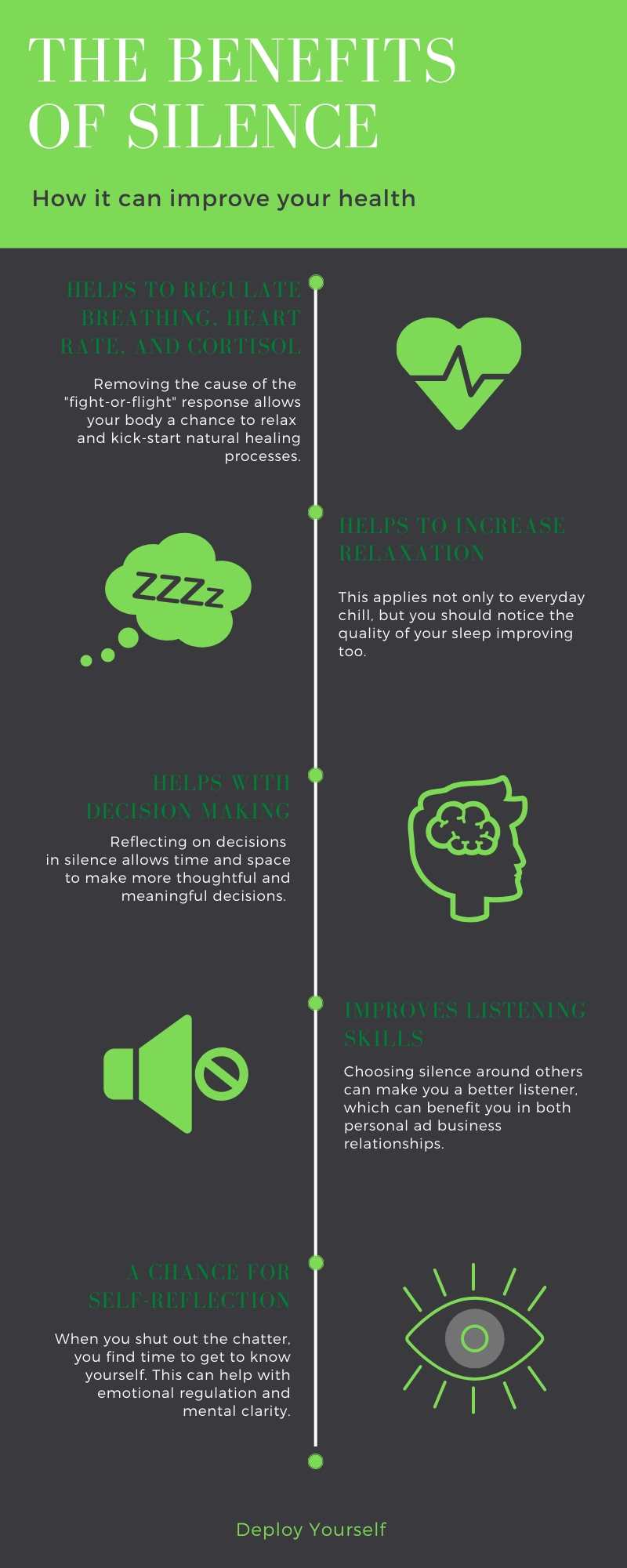
    When you remove the noise stress from your life, it gives your fight-or-flight response a chance to calm down. Your heart rate starts to slow down, your blood pressure lowers, and blood circulation improves (6). 

    When your body is in alert mode, it’s waiting to do take action to survive a threatening situation. With sound always around us, we find ourselves in a constant wired-up state. 

    Once the noise causing the stress is removed and you finally relax into silence, your body is free to do what it would normally do, and balance itself once again. As research has shown, even 5 or 10 minutes of silence can have a positive effect on the body (7). 

    2. Relaxation

    If you’ve ever been on the verge of falling asleep and been woken by a sudden but small sound, you’ll understand how noise can affect relaxation. 

    Placing yourself in silence allows you to be fully present in the moment. No distractions can break your silence when you can’t hear anything! 

    3. Awareness In Decision Making 

    Silence invites reflection, and reflection allows you to make more thoughtful and meaningful decisions (8). It’s easier to become aware of the consequences of particular situations when you have uninterrupted time to think about them – and by uninterrupted, I mean free from technology, chatter, and noise. 

    4. Improved Listening Skills 

    Silence doesn’t only need to be practised when one is alone. Remain silent when around others and you will be surprised at what all you hear! Learning how to bring silence into your life can help improve listening skills (9) – something that is a valuable skill in both personal and business relationships. 

    5. Self-Reflection 

    When you’re constantly bombarded by outside information, it can be hard to know what lies inside us. Many of us simply don’t have time for introspection, and yet becoming self-aware has so many benefits – from mastering your emotions to being more comfortable in your own company. 

    Spending time in silence allows for space to know yourself in the calm of a restless mind (10) There’s a reason even Bill Gates (11) takes a few weeks off every year to spend alone in silence. 

    6. Enhanced Creativity 

    You may be surprised to know that negative emotions can ruin creativity (12). Considering that noise can be an irritation and cause painful physical symptoms, too much noise can cause us to lose our creative spark. 

    Doing creative work in silence can be a great way of stimulating your creative streak. Also, removing one of the five senses (in this case, hearing) can cause the others to become more sensitive, which could flow over into artistic work. 

    7. Improved Sleep Quality 

    Considering the positive effects silence can have – a calmer mind, a healthier body, and improved relationships and communication – it’s no wonder you’ll get better sleep if you have more silence in your life. 

    If you can make your sleeping environment as quiet as possible, you’ll also fall asleep faster and have less chance of being woken by small sounds. 

    8. Increased Focus 

    You learn to be aware of your own thoughts and emotions in silence. This, in turn, leads to being more focused. When we’ve become used to the quiet, it gets easier to direct our mind to whatever we want or need to focus on at the time. 

    Also, outside noise is a distraction! It’s hard to work properly when you’re always being interrupted by sounds. Bringing in silence can improve your focus, and even if you’re still working in a noisy environment, you will not be as bothered by the noise. 

    9. Healing of Mind & Body 

    When your body is no longer in fight-or-flight mode, you’re more relaxed, making better decisions, have a creative outlet, are learning about yourself, and getting better sleep. Your body and mind begin to heal in silence. 

    Studies have suggested that the brain actually grows when we spend time in silence.

    Why We Struggle With Being Silent 

    If you stop and listen, you’ll notice being surrounded by a lot of noise every moment. Traffic, crowds, the chatter of a conversation, phones ringing, that music coming from somewhere… There’s always some sound. Even at night, when most people consider it to be “silent”, there is a surprising amount of sound.

    The more technologically advanced we become, the less silent the world around us is (2). Every sound has a purpose. The TV in the background makes sure you don’t feel so alone. Music in your back pocket means that you have something to see you through every mood. The zing of the phone means someone has made contact with you. 

    This “usefulness” of sound highlights a prominent modern-world issue – the fact that we’ve evolved to want instant gratification in everything we do, from fun to work to relationships. Why? 

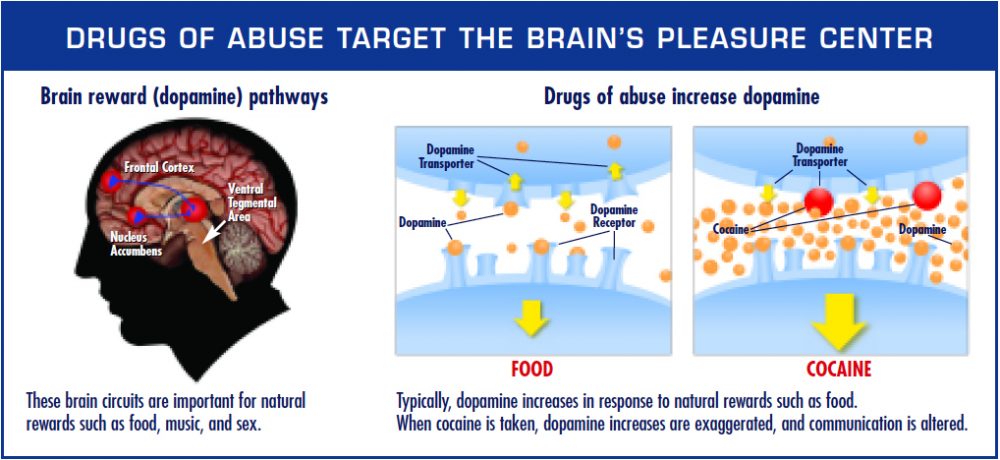
    Whether it’s the first bite of that hamburger, the satisfaction of being liked by someone you just met, or the chime of your phone when a message comes through, that feeling of instant gratification sets off a rush of dopamine (3) that makes you feel good. 

    In the past, drugs and food were the big dopamine spikers – you can see the effects both have in the picture above. Today, the ping of a phone or the pop-up of an email has the same effect on our brains.

    There is no instant gratification with silence—and that’s the biggest reason we struggle to deal with it today. 

    Because of this, it has become something that almost doesn’t exist anymore. When we do encounter it, we don’t know what to do with it. It’s far easier for us to break the silence than to sit through it. 

    The Harmful Effects of Noise 

    You may be surprised to know that silence has some amazing benefits. To really understand the significance of this, you need to understand how noise affects us in everyday life. 

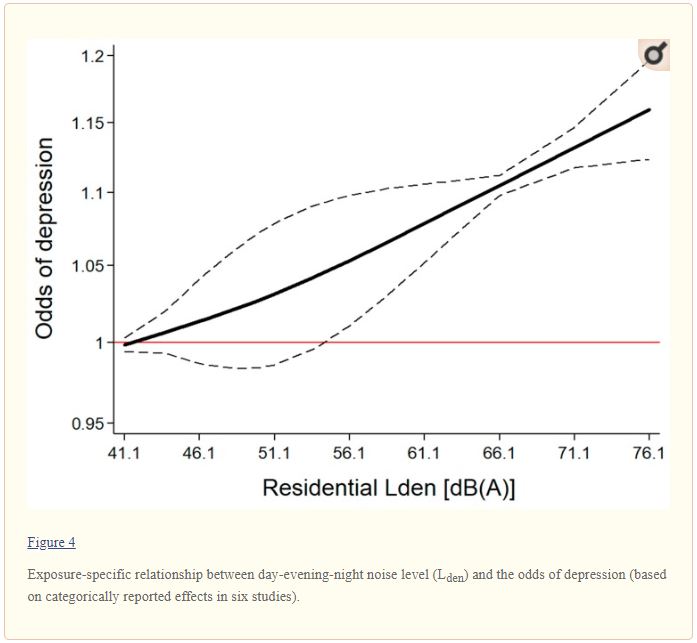
    Studies have shown that people living in areas with high noise levels are more likely to suffer from increased stress levels, depression, and heart conditions (4). 

    Imagine living next to a train stop. You constantly hear the crowd’s chatter, the loudspeaker calling for passengers, and the train arriving, squeaking and rumbling on the tracks. There are some specific problems that come into play here, such as: 

    • Your sleep is constantly disrupted, so you’re not getting enough rest (ie. the body and mind are not healing as they should). 
    • Your communication with your family may be more difficult, leading to misunderstandings and conflict. 
    • Children may struggle to learn correctly, as their hearing is impaired. 

    Your response to external audio stimuli is actually an important survival mechanism (true for both loud, sudden sound, and more constant background noise (5). The problem is that when you are always surrounded by noise, your fight-or-flight response never really backs down. 

    “Paradoxically, the ability to be alone is the condition for the ability to love.”

    —Erich Fromm

    Incorporating periods of silence into your life regularly can be a sort of therapy to reduce stress and start bringing some forgotten goldenness to your days! 

    How To Add More Silence To Your Day 

    It’s not hard to add a few minutes of silence to your day. A pair of noise-cancelling headphones is also one way to experience silence in a noisy world. 

    “Nothing, to my way of thinking, is better proof of a well-ordered mind than a man’s ability to stop just where he is and pass some time in his own company.” ― Seneca

    1. Meditation 

    Don’t be fooled into thinking meditation is a New Age or monks-only thing. It’s a wonderful, meaningful activity (13) to clear your mind, balance your emotions, and prepare yourself for the day (or reflect on the day passed). 

    Taking 5 minutes every morning to focus on your breathing and become aware of your surroundings is a great way to spend just a short time in silence. 

    2. Exercise 

    Exercise can be a way to spend some silent time daily. Focusing on how your body feels, or which muscles are moving is a way of meditating. 

    This is a perfect opportunity to spend some time in silence. Put your headphones on and concentrate on your exercise, with no external distraction. 

    3. Listening 

    We have conversations every day! Whether you’re talking to your parents, your children, your pets, or your colleagues, this is also the perfect time to go shhh. 

    Take care to really listen – not just hear. Make an effort to not speak unless necessary. You may be surprised at how much you listen. 

    4. Silent Breaks 

    Taking intentional silent breaks during your day can be a mood-saver. Just 5 to 10 minutes of distance from the hustle and bustle of work can be enough to relax and reframe your mind. 

    Take your silent breaks where you need them. Your colleagues and family may find you more relaxed once you start taking regular silent breaks during the day.

    5. Journaling 

    Journaling can be a very therapeutic exercise (15), and is another great exercise to be silent and reflect. When I do it, I prefer doing my journaling in the evening before bed. This allows me the opportunity to reflect on the day. 

    Journaling in silence allows you to focus entirely on what you’re writing. The act of writing paired with calming silence can be effective in bringing peace to the mind. 

    6. Nature 

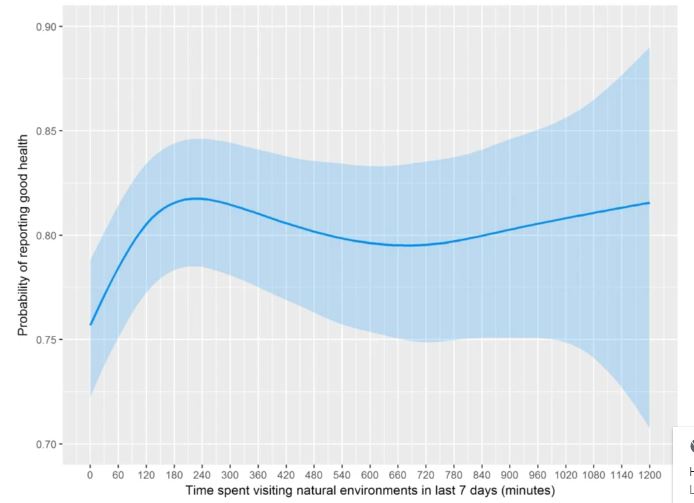
    A daily walk in nature has proven health benefits (16). It’s also a lovely environment in which to practice being silent. While this may be different from the concept of true silence, listening to the sounds of nature is a different form of meditation. After moving to Amsterdam, I start taking regular walks of the city during the day. Today these 5-15 minute walks are my favourite moments of the day.

    7. Reading 

    Reading is one of those activities that can transport one’s mind to another place. You only need to read a few pages a day without background noise to get an effective mini-meditation! 

    When Not To Be Silent 

    Although silence can add a new meaning to your life, there are some cases when staying silent can do more harm than help.

    1. In The Face Of Injustice 

    “Bad men need nothing more to compass their ends, than that good men should look on and do nothing.” ― John Stuart Mill 

    When you do, or say nothing, you may as well not be there. Silence serves no good purpose in the face of injustice. Speaking up when something isn’t right can be hard to do – there is often very real risk involved – but we all must speak up against wrong. 

    Silence benefits nobody in this case. Speaking up not only provides support to someone who may need it, but it also allows you the opportunity to grow emotionally and build courage. 

    2. When Your Conscience Tells You to Speak Up 

    Everyone has a conscience (17) – that feeling deep inside that tells you the difference between right and wrong. 

    When you practice silence often, you will be more in touch with your conscience. When your conscience tells you to speak out, there’s usually a good reason – and you should listen. 

    “It is a sin to be silent when it is your duty to protest.”

    Abraham Lincoln

    Conclusion 

    The World Health Organization recently gave noise pollution the unsavoury description of being a “modern plague” (18). It’s very clear that the constant barrage of noise we’re subjected to, whether overwhelming or subtle, has an effect on the way your brain operates – and in turn, your quality of life. 

    The fact is, your health is negatively impacted by the amount of noise you’re exposed to every day. The good news is that it isn’t hard to start taking a few small steps to increase the silent moments in life. You’ll start to see the positive change and the benefits of silence almost immediately. 

    Have you found it challenging dealing with noise in your life? Share your struggles with noise and your own ways to add silence in your life in the comments… 

  • Lisa May – “There’s a different way to lead and there’s a different way to serve!”

    This interview is part of a new series where leaders in influential positions share their leadership journey – how they got to where they are today. I believe we all have a lot to learn from our stories of where we started, our successes and struggles, and important lessons learned on the way.

    This interview is with Lisa May. She is the founder of Fülle – Holistic Leadership Development and her mission is to help busy executives maximize their fulfilment without sacrificing their success – or anything else that matters to them. You can find her on LinkedIn.

    Can you start by sharing your story and how you got where you are today? And if it helps, can you share one or two examples of events, whether positive or negative from your life that shaped where you are today? 

    So nice to be with you, first of all. And thank you for the invitation.

    So, I spent most of my career in the medical industry and the healthcare industry with Johnson and Johnson and had really amazing experiences throughout that journey. And I had a couple of specific things. Throughout my progression and through my evolution there are a few salient points that jump out.

    So I’ll just share a little bit of the background and then I’ll, I’ll hone in on those, those experiences that really were formative if you will. So I started, with Ethicon in 1999 and had a number of opportunities in sales, marketing, operations, lots of different things to observe and understand the business.

    And, and so that was wonderful, wonderful development as like, as a professional. And after about, you know, many, many years in that space, I was doing well, “achieving success”, if you will, in the external environment and the business and lots of promotions, lots of opportunities, all of which were good, but I really found it interesting that as I ascended in the hierarchy within the company, I started to feel worse within.

    And in 2008, I actually had a pivotal moment and a really clear message come through a clear download if you will. And I was leading a large team at this time in an amazing space. I was working in surgical obesity and helping patients with morbid obesity and was really inspiring work.

    And we were doing really well. The business was performing amazingly. I had very solid external relationships outside of work but yet I felt really empty inside. All the success critical to quality measures were being met, but I felt empty. And so this was really perplexing and I had a message come through that.

    It was that there’s a different way to live. There’s a different way to lead and there’s a different way to serve. And that was it. That was the message. And so I heard it and felt it loud and clear, but I didn’t really know what to do with it if you know what I mean. And so it took me some time, um, about 10 years of time or, you know, five, five to 10 years of time to assemble what that really meant.

    And it meant for me to understand myself. I had to study different philosophies. I had to explore some different modalities and methodologies so that I could put the pieces together in this puzzle. That was really me. And through that journey, I actually ended up leaving corporate so that I can serve from the other side in a holistic way.

    I started a development practice called Fulle and fulle of means abundance and fulfilment. And so it took quite some time. But what I realized is that I had become my achievements, my identity, and a lot of my worth and value as a human had been trained to be connected to milestones outcomes, performance. And that’s simply not true.

    We all know that, but I’ll pause. Those were some, some important moments for me. 

    Can you share a little bit more about those five to 10 years that it took to discover a different part of yourself?

    Yes. For sure.

    So I stayed for, for a portion, a good portion of that time. I stayed in the corporate realm actually until around 2014, but while I was still performing in the corporate space. My evenings and weekend time was spent studying. I went back for many certifications to pursue different thought leaders, different philosophers, different spiritual leaders.

    And so it was not one thing. It was many things. And I was intuitively called to fight and it helped me begin to deconstruct some of what had transpired. And I was able to observe myself in a different way and to use what helped me a lot with science-based tools and technologies, because coming from J and J, as you can imagine, it’s all founded in science and root cause.

    And what are the features and the benefits of that that add up to an effective product? So that was helpful for me. So it was everything from, like I said, spiritual guides to understanding neuroscience and how the brain and the body connect in states of chronic stress. And what happens over time when we subject ourselves to continuous stress in the body, which is what I had experienced and endured for probably 12 plus years in a row.

    And so it was just very helpful to deconstruct. 

    The story which you shared is something that I hear often from people I’ve worked with. As you talked about the spiritual, the philosophical, and the brain, what have you discovered in the context of leadership?

    Yeah. Great question. So what I’ve discovered is that there’s a different way to lead and what I mean by that there actually needs to be different constructs and companies that are quickly evolving the ones that are becoming leading companies of this next evolution.

    We are going to look at leadership differently. We’re not only going to reward the leaders that can deliver and execute. In chronic emergency situations under high pressure, under high stress, we will actually begin to form what I call evolutionary leaders that will be trained to not only deliver during an emergency and crisis situation but will also understand and embody the art of recovery. They truly allow their brain and their body to recalibrate and recover from the stressors and performance will actually go up. That’s how I see leadership tipping its scales.

    What do you like the most about the work that you currently do? 

    I love the work I do because every engagement is unique and every individual is unique.

    I love that the breadth of training that I’ve received and the knowledge that I’ve acquired enables me to serve in a very custom manner. Whatever the tools and resources we applied to the leaders’ needs, they end up better. And so this is such a co-creative and beautiful journey because the leaders that I work with, the leaders that find me and that we find each other are of a very like frequency and in a very like mindset.

    And it really is about the unlocking. And if we can get out of our own way to live, to lead, to serve better, we will do it. Not out of pain and suffering and out of pushing and driving through, but out of a place of deep, deep balance and inspiration. So that’s what I love the most. 

    In our society, there is an emphasis on hard work, of equating success with being busy. There is that narrative, which we live in. So given that and given everything which you shared earlier, what are the challenges you face in doing the work that you do today?

    I wouldn’t call them challenges. I think there are opportunities to shift our understanding. So with the leaders, like I said, that I’m able to support in the companies that I engage with to drive cultural shift are ready for this evolution they’re facing with open hearts and they’re really excited to shift.

    So I don’t see it as challenging. But the resistance is real. And what I mean by that is we’re trained in a particular way. For me personally, since 1999, when I entered the corporate realm all the way through to when I stepped off that train, it was a repeatable pattern. That the drive and the push were equated to success, as you just mentioned.

    And so overcoming those memorized states of being and those memorized neural pathways takes time. Not a lot of time, actually. It can be very, very efficient, but that’s the resistance because the body knows better. We’ve literally memorized a state of being and that if we’re not running Mach three to chase down and put out a fire, then we don’t feel alive or that we’re doing “good work”.

    That was the misbelief, the limiting belief that I had deeply stored in my system. So dance with it and opportunities will emerge and every, every leader has their own narrative. Every leader has different, you know, different minute chronicles of this same theme I find. And so that’s the opportunity for us to rewrite what success means.

    It doesn’t mean we’re not going to perform. That actually means we’re going to perform better because we won’t be trying to push and perform from a place of emptiness.

    We spoke about the past, but what is it that you see in the future that is the kind of work that we will all be doing? And what are you passionate about in creating that possibility? 

    I think the rewrite is underway and I think those of us like you and me and others that are serving in this space, That we can, we can help accelerate, not in a pushing manner, in an inviting manner that enables more balance and homeostasis where true leadership lives.

    Because I think we can agree that when we are shining our brightest lights and speaking our greatest and deepest truths, we’re most alive. And that’s what we need in leaders from the future. So leaders from the future will be able to demonstrate neuroplasticity, meaning that they’re going to be able to unwire and rewire quickly and easily with tools that are sustainable like we’re discussing.

    And that means unlearning some of the patterns and habits that have been formed over time. And so neuroplasticity is a key facet. In addition to resilience, these are the two core principles, the core foundations that will, I believe define leadership in the future and resilience is the ability to overcome stressors or changes in the environment with ease and allow the recovery process to occur and not just stay in high gear all the time.

    So neuro-plasticity and resilience are the keys to this. 

    How do you manage pressure and overwhelm yourself? Not just because of the resistance of the old patterns, but also because you want to create change and you are ambitious about the future.

    There’s a tendency to fall back into the same trap of doing more aiming for one milestone after the other. So what advice would you give for leaders who are ambitious and want to make a change, but yet at the same time, find a lot of pressure?

    Yeah. Great question. Really great question.

    And this is, this is the heart of it. If we can actually observe ourselves and recognize when we are going into patterns from the past, it’s all about the how. And so we’re not going to change our level of aspiration. We’re not going to change our level of fire in the belly to change the world on whatever topic that we’re passionate about.

    I don’t want that to change. What I want to invite is how we do the work. And so if we can notice with clear observation, our own behaviour, when we are going into an overt push state where we’re out of flow, then we’re in stress. And if we can identify just that alone, it can change the game. Because if we’re going through the to-do list in a state of stress and the body and the brain are out of balance and out of coherence, the work isn’t actually as good as it could be.

    And so if we can just observe when we flip into that state of push that state of stress, where we’re doing, doing, doing, just to do, and instead of focusing on the, how I think it would make a major change in different states. We can actually achieve more by this new way of working. 

    And it is the ultimate form of trickery our brain can play on us. When it is wash, rinse, repeat, perform, go, go, go, acknowledge that it is a pattern and we can really, really do better work if we give ourselves a little bit more space and live in that flow.

    I have one last question for you. Who has had the most impact on your leadership? And if you can share a story to illustrate your point. 

    Great question. Well, it would have to be my dad. My dad, Peter amazing inspiration for me from a very, very, very early age and all my memories about performance and, and unconditional love, honestly stem back to my family and still what my dad taught me and what he demonstrated was sheer drive.

    He went back to medical school with three young children. I was a young child at the time. And then he and my mom had two more kids along the way as my dad went back to undergrad to prepare to go to medical school. And so it was not an easy journey. I saw stamina and I saw perseverance and I saw true commitment to the work and to the mission from him at a very early age.

    It was beautiful. But what I also saw in him is that he was able to be truly present with our family and with me at those pivotal points in my life where he could have been too busy and just pushing, pushing, pushing to keep going with the achievements. But he didn’t, he would stop and he would be present and he would rebalance and he would really be there.

    And so that, he is probably the greatest influencer that I’ve had in my life. Is he proud of achievements that were made along the journey and my corporate-run and in my business now? Of course, he is. But it’s the how and his way of being throughout that journey of his ascension professionally was so beautiful, so beautifully executed.

    So he’s probably one of the greatest influencers for me. And the other, I would say is Dr Joe Dispenza, an amazing teacher. He helped to crack the code on me with one book. And that book is called Breaking the habit of being Yourself. And it was introduced to me by a coworker at the very tail end of my corporate career.

    And he sent it to me for Christmas and I opened the cover and it said when the student’s ready, the teacher appears. And I don’t read books, sequentially. I read many things over time in different orders and, you know, very non-linearly, but this one was different. I started this book and I finished this book and it changed me. It changed my life because I understood the science of what had happened to me.

    And so he is the other huge, huge influencer in my life that I’m deeply grateful for.

    Thank you Lisa for sharing about your journey so eloquently. 

    For more such Leadership Journeys, click here.


    Your Leadership story deserves to be heard

    Each one of us is on a leadership journey of our own. Our journeys might not look alike, they might resemble more of a roller-coaster than a race track, and that is what makes each one of us special and unique in our own ways.

    I am deeply touched when someone takes the time to share their story with me. The readers of my Deploy Yourself newsletter and the leaders I work with are also left inspired when we listen to each other’s leadership journeys.

    If you think that your leadership journey is worth sharing and would be valuable to others, reach out and allow me the privilege to interview you. You can send me a message on LinkedIn or send me an email at sumit@deployyourself.com if you would be interested.

  • Issue #38, 26 Oct 2021 – Make decisions thinking 20 years into the future

    Welcome to the Deploy Yourself Newsletter. Every two weeks I share what impactful leadership looks like to show your own power. I also share the most insightful lessons and stories I encountered in the last two weeks. You can also read this issue online.

    Hey,

    Make decisions thinking 20 years into the future

    We normally make decisions with an “If [this] then [that]” mindset. We look at what will happen immediately after making the decision. If we like that, we make the decision. Otherwise not. It is simple and easy.

    This is also called first-order thinking. It is like saying, “I will do this if it will lead to what I want tomorrow”. For example – If I switch jobs then I will make more money and buy a bigger house. Almost everybody makes decisions this way.

    The problem with the above is that we do not consider what might happen much later in the future depending on our decision. A powerful question to ask ourselves is – What can happen in 5,10, or 20 years if I make this decision? What can happen if I do not?

    This is called second-order thinking. It is when you think much ahead into the future, and look at the various possibilities much further ahead. For example – If I quit my job and start my company now, then I might be able to create employment and make a big difference in the world later down the line (even if the immediate future seems stormy).

    Extraordinary results come from seeing things that other people can’t see. And one way to do that is by looking at the impact of your decisions on not just tomorrow but also months and decades into the future. This will allow you to make powerful decisions that others can’t. Because you will be able to see what others don’t.

    You can start using second-order thinking by asking yourself :

    1. If I make this decision, what could happen as a result in a few weeks, months, and years?
    2. If I do not make this decision, what might be the likely future in a few weeks, months, and years?
    3. Could it be that the immediate result of this decision is negative, but the future results can be massively positive?

    Like the above, my coaching conversations are often not comfortable but they can be magical and transformative. If you want to make a massive impact with your leadership, I have only a few 1-on-1 coaching spots available for 2021.

    My challenge to you is to 10x whatever goals you are considering. Now, does that scare you? If yes, that is a good place for us to talk. Write to me. I read and respond to every reply.

    Articles and Stories Which Have Fascinated Me

    One

    “I want to be like Dale Carnegie for people with communication disorders!” – Katie Schwartz

    I interviewed Katie Schwartz who deployed herself and founded the Corporate Speech Pathology Network after she was fired from her job. In her own words, “My path towards leadership started with having a radical idea and thinking “Why can’t I do this?” The rest of my education in leadership came from the School of Hard Knocks, with a major in Trial and Error.”

    On managing pressure, she says “I take time for myself, my family and friends, and enjoy hobbies. I also prioritize tasks and limit my work hours, which can be a challenge when working from home. There is life beyond the computer screen!

    When I asked her who has had the most influence on her leadership, she said – “My mother has had the most influence on my leadership. As the co-leader of our large family, she made sure that each of us felt as if we mattered. She taught through example and through direct coaching, basic cooking skills, for example, and was quick to praise us when we learned a new skill. Too many leaders do not take the time to recognize each employee for what he or she is doing right for the organization.”

    Read the full interview on DeployYourself.com. To give you more value, I will be interviewing more leaders and sharing lessons from their leadership journeys in a separate email in the gap week between each newsletter.

    Two

    Leadership and Trust

    I publish new transformational articles from time to time. I thought I’d share with you three of my most popular articles on trust. Even if you’ve seen them before, you’ll find something new each time you read them:

    1. Want to improve performance? Before giving feedback, give people these four things
    2. 8 things leaders can do to create high trust, high engagement, and high-performance team
    3. 7 empathetic questions to ask at work to understand and support your colleagues

    Three

    Stanford researchers identify four causes for ‘Zoom fatigue’ and their simple fixes

    Popular video chat platforms have design flaws that exhaust the human mind and body. But there are easy ways to mitigate their effects. Four reasons why

    1) Excessive amounts of close-up eye contact is highly intense.

    Solution: Take Zoom out of the full-screen option and reduce the size of the Zoom window relative to the monitor to minimize face size, and use an external keyboard to allow an increase in the personal space bubble between oneself and the grid.

    2) Seeing yourself during video chats constantly in real-time is fatiguing.

    Solution: Use the “hide self-view” button, which one can access by right-clicking their own photo, once they see their face is framed properly in the video.

    3) Video chats dramatically reduce our usual mobility.

    Solution: An external camera farther away from the screen will allow you to pace and doodle in virtual meetings just like we do in real ones. And of course, turning one’s video off periodically during meetings is a good ground rule to set for groups, just to give oneself a brief nonverbal rest.

    4) The cognitive load is much higher in video chats.

    Solution: During long stretches of meetings, give yourself an “audio-only” break. “This is not simply you turning off your camera to take a break from having to be nonverbally active, but also turning your body away from the screen.”

    From an article on Stanford News on Zoom Fatigue

    That’s it for now. If you have any questions or feedback, or just want to introduce yourself, hit reply. I read and respond to every reply. All the best,

    Sumit

    (Twitter) @SumitGupta
    (LinkedIn) Connect

  • An Audience Of One by Srinivas Rao – Book Review & Summary

    Cultivating One’s Own Creative Voice

    Every individual has a creative impulse in them, albeit in varying degrees. However, everyone has also faced that little bit of hesitation in following their creative voices, either because there is another dissuading voice in the conscience that tells them, ‘What’s the point if you’re not going to make a career out of it, or its not going to get you money?’ Perhaps, many even have friends and family who have been that voice!

    Podcast guru Srinivas Rao, in his An Audience Of One, reinforces the positive thought that creativity is a reward in itself and that there is no satisfaction in trying to please others. With excerpts from his own life and from stories of creative and artists, he shows the rewards one can gain by pursuing their own creative impulses and that it is all about embracing one’s own vision by following a process that involves being true to oneself.

    He builds on the premise that creativity becomes stronger in a person the moment the person stops bothering about the potential audience. The moment creativity has an audience of one – essentially oneself – it blooms, becomes more personal and engaging, and thus has a higher potential of winning an audience of many.

    You Don’t Need Extra Validation

    With creativity, the dilemma of either appealing to what a wider audience wants or staying true to oneself always arises. However, when creativity is fuelled by the expectations of others, the creator is bound to be unhappy and dissatisfied with the creation. 

    Financial rewards, critical reviews, and audience accolades are all extrinsic motivators, or responses one has no control over. Whether others find the creative work boring or a masterpiece are personal opinions, which one can do nothing about. Thus by worrying over extrinsic motivators one only sets themselves up for disappointment. 

    Trying to make one’s creative work appealing to others always makes its way away from the originally intended vision one has for the creative work. Compromising on one’s own vision leads to regret, especially if the process of appealing to others doesn’t yield the desired results.

    The true reward of creativity is the satisfaction one gets when they follow their own vision and it becomes reality. The creator thus has discretion and control over their own work.

    David Bowie never created music to be famous. He in fact always stressed the importance of understanding why one feels the personal urge to be creative in the first place and aimed to create to-do something artistically important.

    The final reward of creativity is when a person’s creation is received well enough to encourage the person to continue creating, to continue doing what they love, and revel in the satisfaction of the creative process itself. 

    The Myth Of ‘Making It’

    Creativity that aims at monetary gains often leads to not only dissatisfying but also unsuccessful creations. This is because creativity with monetary pursuits lacks a strong personal vision. Thus, when one focuses on an audience of one – namely oneself – one ends up happier, with results that have a higher chance at garnering more fans. 

    The entire idea of ‘making it’, or reaching the final step of success (achieving fame and fortune), is a fickle friend. In today’s day and age, when attention spans are minimal, instant gratification is important and there are newer pursuits available to everyone at every nook and corner, the concept of ‘making it’ and resting on laurels is virtually impossible.

    To hone creativity and reap its benefits, one has to remember that the reward lies in the process and not the final outcome.

    Honing one’s own creativity takes time and requires patience for trial and error. Moreover, this experimentation should be done away from the public eye, as this process needs one to learn from mistakes and work on them to improve. For example, if a person has an eye for painting, without really trying a few times and refining techniques with practice, showcasing the first paintings to a large audience will definitely get harsh criticisms.

    Hence, it is essential to create for oneself, fail and learn from repeated failings to get a final, polished and refined creative, rather than chase the idea of ‘making it’.

    Embracing one’s creativity involves three main ways. These include three types of listening that will help in adding a more personal touch to the creative work and make it stronger. They are,

    • Listening to oneself, 
    • Listening to one’s environment, 
    • Listening to others. 

    Listening to Oneself: Trust, Presence, And Solitude 

    Listening to oneself needs trust, presence, and solitude.

    • Trust – Listening to oneself firstly involves trusting oneself and what one stands for. It means having confidence in one’s own values. To be sure of one’s own values, it is important to have answers to what makes one angry, excited, joyful, and what does one wants others to experience when they enter that world. One can also write a manifesto.
    • Presence – The habit of thinking about the future takes on away from the present. One then tends to miss out on the profound moment when creative inspirations hit and misses out on the experiences that will work.
    • Solitude – Cultivating solitude is another essential factor that helps to cultivate creativity. Often, when people indulge in self-judgment and criticism, they lost touch with the present. Criticism and creation did work together, and hence, it is vital to create a judgment-free headspace while cultivating solitude.

    The moments that one spends ‘thinking’ are a great way to embrace solitude. However, it isn’t as easy to put into practice. Therefore, one must make a deliberate effort to embrace and cultivate solitude. Some methods include meditation to connect with one’s inner voice, or even using noise-canceling headphones.

    Listening to Oneself: Listen To Your Body Too

    Creativity equals productivity. And to be productive, one must focus on overall well-being and health. Additionally, a healthy mind and a healthy body go hand-in-hand, and these are vital prerequisites of listening to oneself.

    For boosting one’s productivity and hence, one’s creativity, one needs to ensure that one gets a good amount of sleep. Additionally, it is proven that sleep in itself is productive. For example, dreams are long known to boost creativity. Thus, it helps to keep a dream journal, which can, in the long run, emerge as a source of inspiration and creative ideas.

    Another example of enhancing productivity while sleeping is to ask oneself an important question before sleeping. It is surprising, but often the answer to these questions comes while one is asleep.

    The next on the list of creativity-boosting essentials is maintaining a good diet. Foods that contain Omega 3’s and B vitamins are known to boost cognitive power, and thus help creativity. One can maintain productivity versus a diet chart to find what diet suits best. Take a note of the days when creative inspiration was highest and check what foods were consumed on those days. 

    The final pre-requisite is exercise. Exercise is proven to boost brain and brain energy by creating essential mitochondria. Additionally, exercise also makes way for solitude by giving one personal time and space for deep, meaningful thinking.

    Listening To One’s Environment

    The next type of listening is listening to one’s environment. This not only includes one’s immediate surroundings, but also the extended environment, including sights, sounds, and smells.

    To begin with, focus on physical space. Marie Kondo’s The Life-Changing Magic of Tidying Up discusses the process of decluttering the physical space in order to declutter the mind. How does one actually do it?

    To decide whether an object needs to be discarded or not, one should simply ask, “Do I love this? How does this enrich my life?’ The answers to these questions will help one understand whether that object needs to be discarded or not. Objects that one does not ‘love’ add to the clutter in the physical space.

    Additionally, it is found that natural spaces often do wonders for the psyche. A walk in the woods or near the ocean helps in gaining solitude and boosts deep thinking, as well as helps in keeping away from distractions such as technology and noise. Nature therapy has been linked to a reduction in the stress-causing hormone cortisol by 12%.

    In addition to removing ‘noise’, it is also found that ‘white noise’ helps in boosting one’s capacity for concentration. Certain types of music, especially instrumental music or music that are not lyrics-heavy are beneficial. On the other hand, for visual art such as paintings, music with lyrics often boost creative ideas. So artists even find that cultivating a musical habit – listening to the same music while creating – is beneficial too.

    Technology, especially smartphones are the biggest distractions today. Social media is built on the premise that users should be constantly logged on. The need to constantly check emails and messages can keep one from getting into the state of flow –or the state where one is completely immersed in their creation and enjoy it so much that they do not notice time flying by.

    Eliminating Distractions From The Environment

    Everyone knows how distracting smartphones are. But that doesn’t make people discard their phones and ignore emails. Therefore, what can be done to reduce distractions?

    Firstly, it should be kept in mind that people control devices, and not vice-versa. Therefore, one can opt to turn off notifications that keep pinging for attention, unsubscribe from mailers that are not needed. In fact, one should unsubscribe from everything, and then start over with adding and subscribing to only those apps and mailers that add value. Services such as Unroll.Me, are good options to de-clutter your virtual space.

    Another simpler way is to simply switch off the phone, or keep it in another room during the time of work. Scheduling an ‘unplugging time’ works wonders for creativity, whether one is currently working on a project or not. Tools such as RescueTime, Focus, or the Facebook News Feed Eradicator plug-in are helpful.

    Apart from technology, distractions also come in the form of people. Sometimes, there are people in one’s life who drain positivity by bringing others down. While it could be a difficult task to eliminate such people instantaneously, once such individuals are cut off, life will seem lighter.

    Distractions in one’s environment can be compared to food. In order to live a healthy life, one has to eliminate the junk that makes one feel insecure and bad.

    Productivity-Boosting Good Habits

    Cultivating creativity requires one to imbibe certain good habits. There are few methods one can inculcate good habits.

    • Certainty Anchor – A certainty anchor is a habit that ‘anchors’ the mind to get into the work mode. Often, due to distractions or unavoidable chaos in ones surrounding, focussing becomes a problem. Let’s say a painter has a habit of brewing a cup of coffee just before he gets to his studio to paint. Such simple habits in the day-to-day routine can act as signals to the mind to start focussing on the work that lies ahead.
    • Reduce decision Fatigue – The average human makes about 300 decisions in a day, ranging from what to eat to what to wear, cook, etc. The sheer number itself unknowingly causes cognitive fatigue. One can reduce the number of decisions in many ways to preserve energy for creativity. For example, Apple’s Steve Jobs had a set of clothes he always wore, thus reducing the time taken for deciding what to wear daily. Many creative people apply this method to reduce energy waste on non-creative thinking.
    • Understanding the gradual process – Habit formation doesn’t happen in a day. It is a gradual process that sets itself with the passage of time. For example, if a writer aims to write a thousand words per day, trying to reach the goal in one day, could result in failure, and he could give up completely without even giving it a second shot. Goals, like habits, should be given time and increased gradually in order to succeed. For example, the writer could begin with a paragraph per day and continue for a week. Then he could increase the limit to say, 500 words in the second, and then 1000 in the third and fourth week.

    Finally, one should keep in mind that it takes about an hour of focus to get into the state of flow. Therefore, one should make schedules accordingly. If the writer aims to write only for an hour, he could well be stopping his creative work just before the good stuff starts flowing in.

    Hear Others Out, But Always Stay True To Oneself

    The final listening type is listening to others. When it comes to creativity, listening to oneself is always on top of the list. However, it is important to hear out what others have to say too.

    That said, one has to keep in mind that when it comes to other’s opinions, it is wiser to surround oneself with good influences, essentially, people who help one succeed, rather than weigh them down with negativity.

    To do this, one can surround oneself with like-minded people, or join a community of creative individuals. Like-minded creative people not only provide inspiration and sound advice but also act as a safety net when one wishes to challenge oneself and take bolder steps. Forming a community or club can help streamline one’s network.

    The concept of a ‘lone creator’ is a myth. Almost every creative endeavor is a product of collaboration, whether it’s a movie director who works with a huge crew or a writer who needs an editor. It is important to remember that every piece of art has influences or traces of artists that came before, and thus it is essential to view influence as positive.

    At the same time, one has to take measured steps and be careful when it comes to influencing. Influence should always be positive and inspirational, else it often leads to plagiarism.

    Finally, one can take inspiration from any direction for their work. It isn’t necessary that to write a blog, one must go through other blogs for inspiration. Maybe, singling out artists from another creative line, such as sculptors or painters can help in giving one’s creative work uniqueness.

    Conclusion

    Creativity needs to be cultivated. Whether it is to pursue a creative career or to simply polish one’s own creative instincts, one should always create for an audience of one. 

    Cultivating creativity involves listening first to oneself, followed by paying attention to one’s surroundings, and then lastly, listening to the opinions of others. 

    One should always remember that cultivating one’s own creative voice always begins by staying true to oneself because only the audience one can lead to an audience of many!

  • Antonio Potenza – “Money has the power to be a force for good!”

    This interview is part of a new series where leaders in influential positions share their leadership journey – how they got to where they are today. I believe we all have a lot to learn from our stories of where we started, our successes and struggles, and important lessons learned on the way.

    This interview is with Antonio Potenza. He is the CEO & Founder of Proodos Capital, which invests in early-stage impact enterprises that pursue a positive social and/or environmental impact alongside an economic return. He is also the COO & Co-Founder of Fund4Impact, which leverages deep and trustworthy relations to help their partners augment their impact and advance the UN Sustainable Development Goals. You can find Antonio on LinkedIn here.

    Share your backstory and how you got where you are today. Can you share one or two events (positive or negative) in life that shaped who you are as a person and leader?

    After an illustrious career as Investment Banker and Corporate Financier in the Mineral and Mining Sector, I realized that a mind shift in how financial resources are deployed was needed. A significant paradigm shift was needed for the advancement and betterment of society, and to repurpose businesses towards profits that have a fully integral positive impact on the effects to planet and people. I deliberately put the planet first because if we don’t safeguard the planet we don’t need to worry about the rest

    A negative aspect of my earlier career was the mindset of exclusive profit thinking and creating value only for shareholders. The discourse is much broader, and my activities today consider a much larger group of stakeholders. Creating Stakeholder Value rather than illusionary Shareholder Value is much more gratifying. 

    A pivotal moment in my career was when one of my clients in the Mineral and Mining sector approached me to develop a corporate bond, a debt finance instrument. Funds from this capital raise were programmed to be invested into upgrading existing production facilities AND to build infrastructure for the community and the workers of the factory. This was very unusual to declare it so publicly. This is the moment I consciously realized that capital is agnostic, and it is down to our own actions and respect for the people and the planet in how we put this capital at work. 

    Soon thereafter two more clients approached me with a similar request and that was my “man-in-the-mirror” moment. It literally was during a morning shave in front of a hotel room mirror that it suddenly struck me that I had to change things for me, my family, and my professional progression.

    Clearly, the need for change was slumbering in my subconscious for some time, but it was this defining moment on that particular morning on that particular day where it became obvious to me. It wasn’t long and I resigned from my C-Suite position in the South of France. I took a sabbatical and took my wife on an extended regenerative and reflective trip onto an Island in the middle of the Mediterranean Sea. 

    This “off” time helped me clear my view and building on the “Money for Good” experience I decided that I need to dig deeper. Out came the decision that I go back to University and get some updates on novel investment theories.  I applied, and to my amazement and disbelief, was accepted into the University of Oxford Executive MBA program. A 21-month educational and academic program that would change my life forever.

    The University of Oxford is one of the first academic institutions that provide an Executive MBA centred around Social Finance and Impact Investing. I met incredible people, with incredible life stories and realized that I did not need to throw overboard my financial background, my know-how. I needed to reskill myself and learn a “new language” that would help conventional financial assumptions to be transferred into a more equitable, fair and just capital redistribution. It was only after I got back to University that I realized that my late work actually was Social Impact Bonds and Impact Investing. 

    Fast forward 21 months – this is how Proodos Capital, a Social Impact VC/PE Fund that seeks to invest into climate-smart Agriculture and climate-smart Energy in emerging markets and Fund4Impact, a FinTech product that connects early-stage ventures with a Sustainable mission with Socially Responsible capital owners through Grants and Venture Philanthropy. Fund4Impact is a project that is also backed by the UK Government and received twice funding through Innovate UK. 

    Upon completion of my Oxford Studies, I also completed a further degree in High Impact Leadership with the University of Cambridge

    I am still engaged with the Business School by tutoring their online programs on Venture Creation and Venture Finance, and with Oxford Summer Courses for Business & Entrepreneurship and Leadership. This allows me to stay in touch with the community of upcoming and very innovative global business ideas. 

    What do you like about the work you do? What do you find most challenging?

    What I like most is that we can give money a more positive connotation; that it has the power to be an agent for positive change and we can be stewards for the present and future generation to provide a positive outlook for all life on earth. 

    One of the biggest challenges is to create awareness and provoke a mind shift in the conventional capital markets and to ensure that they walk the talk and not just lip service. 

    What are you passionate about? (or what dreams keep you up at night?)

    My passion is money and the power it has to be a force for good if it is employed in the right manner. Money is not bad per se, it’s what we do with it that makes all the difference. So, what keeps me up at night is to make sure that we do all we can to ensure that we detect, build, mentor, and execute the investment strategies that have the power to fuel game-changing outcomes through our support to innovation and research and entrepreneurship. 

    How do you manage pressure and overwhelm?

    This was clearly harder when I was younger but with age comes wisdom and experience and the ability to make more informed judgement and prioritize. Strict time management and a strong team are very important too. I always try to surround myself with people that are better skilled than me and I am also much more selective in engaging in new ventures and commitments to find a good balance. 

    Enough sleep, a balanced life, family time and a nice dose of “me-time” are equally essential. I like to walk in the Parks and the Streets of London and let my thoughts wander and be inspired by the beautiful nature and architecture that surrounds me. I also like to read a lot. 

    Who has had the most influence on your leadership? Share a story to illustrate your point.

    Most probably my mother. She lost her husband at a very young age and had to raise two very small children in a foreign country and struggle hard to make ends meet to allow my sister and me a good education and a better life. I learned that with passion, devotion, patience, focus and resilience you can achieve great goals and build that inner core that lets you advance against all adversities and obstacles that life (and business) throws at you. To give up easily is not part of my DNA, but to realize when it is time to go, and change is a virtue. 

    My late father, whom I never met because he died in a car accident the day I was born, is another source of inspiration. I carry his name and what I know about him through the stories that I am told is that he was a hardworking and just man. 

    Leadership is about empowering others to grow, progress and allowing them to take on responsibility and accountability. I can only be a good leader by leading by a good example. Leadership is also down to followership. I need to be capable of grouping the right people alongside me and taking them on a common journey towards our common goals and desired outcomes. 

    What are your goals or aspirations for this year?

    1. Take stock of the lessons learned during the very hard COVID lockdowns we’ve had in the UK.
    2. Continue building our Investment Fund and unlock additional capital to allow upcoming and inspiring new generations of entrepreneurs to build a better world and see them grow and succeed in realizing their dreams and aspirations.
    3. To be a good and loving husband, a reliable and inspirational partner/father for my wife and daughter, as well as the people around me. 

    For more such Leadership Journeys, click here.


    Your Leadership story deserves to be heard

    Each one of us is on a leadership journey of our own. Our journeys might not look alike, they might resemble more of a roller-coaster than a race track, and that is what makes each one of us special and unique in our own ways.

    I am deeply touched when someone takes the time to share their story with me. The readers of my Deploy Yourself newsletter and the leaders I work with are also left inspired when we listen to each other’s leadership journeys.

    If you think that your leadership journey is worth sharing and would be valuable to others, reach out and allow me the privilege to interview you. You can send me a message on LinkedIn or send me an email at sumit@deployyourself.com if you would be interested.

  • Katie Schwartz – “I want to be like Dale Carnegie for people with communication disorders!”

    This interview is part of a new series where leaders in influential positions share their leadership journey – how they got to where they are today. I believe we all have a lot to learn from our stories of where we started, our successes and struggles, and important lessons learned on the way.

    This interview is with Katie Schwartz. She is the founder and currently the President Emeritus of the Corporate Speech Pathology Network and Director at Business Speech Improvement (website). You can find her on LinkedIn.

    Question – Share your backstory and how you got where you are today. Can you share one or two events (positive or negative) in life that shaped who you are as a person and leader?

    Some people plan to become leaders. They study leadership, get MBA’s, get on a career path towards leadership and get voted class or organization president. My path towards leadership started with having a radical idea and thinking “Why can’t I do this?” The rest of my education in leadership came from the School of Hard Knocks, with a major in Trial and Error.

    I started out as a certified, licensed speech-language pathologist working in a traditional setting, a community hospital. I had been there a whole week, as a department of one, when I was told I would be let go one day before they had to give me benefits, after the 90-day probation. This was happening because allegedly I hadn’t earned the hospital enough profit that week. I was offered the job as a contractor after that period, if I wanted it; I didn’t. I was stunned.

    As I left the hospital that day, I thought, “what do I like to do as a speech-language pathologist?” I knew professionals in my community had communication disorders but were not coming for help. I thought, “I want to be like Dale Carnegie for people with communication disorders and offer courses! Why can’t I?” I was licensed; I couldn’t think of a reason this would be illegal or improper. 

    That night I went through my women’s networking group’s directory and called someone who had the title of “corporate trainer” to find out how to get business. As soon as I told her what I could do, she responded, “I have been looking for someone like you all day! Won’t you please come work for my company?” My second contact at another company was even more excited; my business was launched.

    Later I decided to write an article for a magazine for training professionals. As soon as it was accepted, it dawned on me that I was only licensed in one state as a healthcare professional; what would I do if I got calls from other states? So I sent a second article to my professional association’s magazine, with 5 pages of information about what I was doing. I knew the exact day it arrived on people’s desks.

    New to journalism, I hadn’t thought to include my contact information in the article or to put a FAQ on my new website. That meant that over 1000 interested readers had to contact my professional association to find out how to connect with me, and they did! Readers wanted to get more training from me on how to do what I called corporate speech pathology – working as speech-language pathologists in the industry – so I offered seminars.

    A publisher attended one and offered me a book contract to write my first book. Then the people wanted me to form an association, and lead it. Leadership was new to me, and their enthusiasm and questions were overwhelming at times. (I also had a business to run and a young family.)  After my book was published, I learned that authors are then considered authorities, which led to speaking gigs. I loved doing it all, but that was a lot to do at once!

    I formed the association, the Corporate Speech Pathology Network, CORSPAN, and after a year, I selected someone with an MBA and also the professional credentials to be the next president. I was so relieved when he took over. He did a great job! However, I had not thought to put in a leadership pathway to encourage future leaders into the organization; twice more the board of the organization asked me to resume leadership due to presidents having to resign due to illness or other personal factors.

    Now I serve as President Emeritus of the International Corporate Speech Pathology Network I welcome the contributions of so many members who have embraced and expanded my original idea. I see my role in the organization as being the cheerleader-in-chief, answering questions from the board, responding to questions from potential members who have read my articles in the ASHA Leader and other publications, and doing other projects involving publicity. I also continue to run my business.

    What do you like about the work you do? What do you find most challenging?

    As a president emeritus, I have the luxury of being able to focus on the future, without the details of running the organization now. For example, I met with the current and future president recently and suggested the board discuss a leadership pathway, with board members keeping a watch out for members who take the initiative, have backgrounds or former careers of special value to the organization, or show other signs of leadership, and give them small jobs on the board to start them out. Those who do well could be considered for additional opportunities as needs arise.

    Our organization is virtual and I have never met most of the members in person. It is challenging to keep up with their career needs that the organization might be able to meet if we knew of them. We have monthly online networking sessions online that any member can attend, but I do not have time to attend many of them. I rely on the excellent board members who run the sessions to notice these details.

    What are you passionate about? (or what dreams keep you up at night?)

    I am passionate about the services corporate speech pathologists can provide in the workplace. I coach my clients in public speaking, clear pronunciation so that ideas can be exchanged efficiently, communication skills for leadership such as meeting management, executive presence and questioning/listening skills.

    If clients have communication disorders such as a speech or language impairment, I can help there too, either directly or through referrals to others who are licensed in their states in the USA. I also work with clients in other countries.

    I want my colleagues around the world to see that they, too, can work with professionals in the workplace; we are communication problem-solvers!

    How do you manage pressure and overwhelm?

    A work-life balance is vital. I take time for myself, my family and friends,  and enjoy hobbies. I also prioritize tasks and limit my work hours, which can be a challenge when working from home. There is life beyond the computer screen!

    Who has had the most influence on your leadership? Share a story to illustrate your point.

    My mother has had the most influence on my leadership. As the co-leader of our large family, she made sure that each of us felt as if we mattered.  She taught through example and through direct coaching, basic cooking skills, for example, and was quick to praise us when we learned a new skill.  Too many leaders do not take the time to recognize each employee for what he or she is doing right for the organization.

    What are your goals or aspirations for this year?

    My goals are to

     1) continue learning through reading and taking online courses  several times a week

    2) continue working on projects of importance to furthering corporate speech pathology

    3) seeking other opportunities to network with other professionals in many fields, develop my skills and mentor others

    For more such Leadership Journeys, click here.


    Your Leadership story deserves to be heard

    Each one of us is on a leadership journey of our own. Our journeys might not look alike, they might resemble more of a roller-coaster than a race track, and that is what makes each one of us special and unique in our own ways.

    I am deeply touched when someone takes the time to share their story with me. The readers of my Deploy Yourself newsletter and the leaders I work with are also left inspired when we listen to each other’s leadership journeys.

    If you think that your leadership journey is worth sharing and would be valuable to others, reach out and allow me the privilege to interview you. You can send me a message on LinkedIn or send me an email at sumit@deployyourself.com if you would be interested.

  • Small Giants by Bo Burlingham – Book Review & Summary

    Small And Successful

    The traditional business mantra of expansion through sales and a larger customer base doesn’t hold much merit in today’s economy. Growth is overrated, and many small businesses, driven by mere hearty enthusiasm are showing the way. Bo Burlingham’s Small Giants examines companies that have made it big by shifting the focus to quality and caring for their workforce.

    Choosing To Stay Small

    The emphasis and importance that CEO’s of big, publicly traded companies place on growth are evident in many interviews they have given. However, the trend is shifting. Many companies today are going against the tradition of expansion in order to stay true to their missions.

    Bill Butler, the owner of W. L. Butler Construction Inc., saw his company expanding rapidly between the 1970s and 1980s, and despite having annual sales of $20 million and 129 employees, he felt unhappy. 

    He realised that expansion only meant that he would not be able to have a personal connection with all of his employees. Thus with a focus on narrowing, he reduced his clientele from 25 to 10. He even let go of his largest client, who accounted for about 50% of his project value. This was a bold move to align his company with his personal mission of achieving personal relations with his employees.

    Anchor Brewing the Californian brewery has had not more than 50 employees for the past twenty years. This decision has not only led to fostering better relationships between employees but also allows them to see the outcomes of their hard work, faster.

    Smaller companies are able to foster a healthier work environment. Additionally, functions like customer service tend to be better due to higher levels of personal interaction. Employees and owners alike, can foster closer relations with clients and even know them by face and name, which is often difficult in huge corporations.

    Control And Passion

    Big corporations mostly have a large number of shareholders. When a company’s stock is in the hands of outside investors, it often becomes difficult to keep control of the company, as some of the oversight lies at the discretion of those shareholders. Hence, owners often prefer to keep the company stock in the hands of a few.

    Burlingham’s for example has only 4 ‘outside’ shareholders, who don’t directly work for the company. For small giants, ensuring control over the company, especially the stock, is crucial. This enables company owners to pursue their passions and focus attention on quality rather than profits.

    Anchor Brewing is dedicated to traditional methods of brewing. Their philosophy focuses on ensuring a quality beer rather than crunching profit numbers. Hence, they prefer to use copper kettles rather than stainless steel ones, and choose to ferment their beer in the naturally cold night air, rather than use ice. 

    While these methods take time and can prove to be a little more expensive than modern ones, they result in a better quality beer. For the company, better quality trumps profits any day.

    Zingerman’s Deli’s vision reads, ‘“to sell sandwiches so big you needed two hands to hold them and the dressing would roll down your forearms.” In order to stay true to their vision, they decided against franchising, as it would jeopardize quality, and go against their vision. Instead, they developed Zingerman’s Community of Businesses, a network of businesses working under the name, and having their own distinct identities. This move helped retain the passion for high-quality sandwiches.

    Staying Local

    The local community plays an important role in shaping a company. 

    If we consider a restaurant business, the local community is intrinsic to its success. Right from the staff it employs, the customers that visit the restaurant, to the dishes that are influenced by the geography of the location, the local food producers the restaurant depends on for fresh produce, etc. These factors amount to what the French call the ‘terroir’. ‘Terroir’ is an important factor that affects the success of the restaurant.

    Small giants depend on these factors. Furthermore, they are able to actively give back to the communities they are situated in.

    Ani DiFranco, the label owner of Righteous Babe Records, the Buffalo-based music label, helped rescue an old church in downtown Buffalo that was about to be demolished. She financed emergency repairs in the church and was allowed to set up her business inside the church, as a reward for her kindness towards the community.

    For small giants, such local interaction and community consciousness can pay back in many ways.

    Loyalty

    Loyalty is a valued virtue for small giants. They put the needs of their employees before profits. Moreover, they are able to do this purely because their focus doesn’t lie on expansion and growth like bigger corporations. Being small, they are able to create personal connections with employees, thereby harbouring an employee-centric work atmosphere.

    Michele Howard started working for ECCO, the shoe brand. With no education and a single mother of three, the experience she gained working as part-time manual labour, enabled her to later work full-time in the customer services department.

    By loaning money from the company’s pension account, she eventually bought a house for herself. In the following years, she became a shareholder by participating in the employee stock ownership plan that holds 58% of the company’s shares.

    Obert Tanner, the late owner of the O.C. Tanner Co., an HR consultancy that focuses on employee recognition, was known for engaging in personal conversations with employees. He knew the names of almost every employee in the 1700-employee organisation.

    He also arranged for 65% of his stock in the company to be transferred to a 100-year-old trust. This ensured that the company could never be merged, sold, or taken public. His endeavour helped guarantee employees their jobs.

    Such actions that instil loyalty among employees are rarely found in bigger corporations.

    The benefit of caring for employees strengthens loyalty. This can be seen at Artists Frame Service (AFS), a Chicago-based picture framing company. One of the managers was offered a $10000 raise to change jobs. However, the manager refused the offer because he felt the competitor did not treat employees as well as AFS did.

    Passionate Employees

    Small giants are known to punch passion in what they do and stand for. One often hears employees in bigger organizations complain that they are ‘faceless cogs in a machine, and don’t feel passionate for either the organization or the work they do.

    Small giants, on the other hand, work to cultivating an atmosphere that is motivating, meaningful, and exciting for their employees to work in. They imbue their organization with soul by encouraging employees to reflect on what they feel about the work atmosphere and why they value it.

    For instance, one of the employees at Clif Bar, the organic food company, summed up the soul of the organization in one sentence – “You got that engine running, baby, and the sky’s the limit!”

    Once again, not focussing on growth or profits makes employees of small giants intrinsically motivated and passionate about what they do. It is because these small companies started with a passion, the people who are hired are chosen because they share the same passion as the founders did.

    Zingerman’s Deli is a great example. The passion for cooking that employees have enables them to consider and understand factors – such as the smell of the food they serve – that many other businesses don’t.

    Such employees are the company’s biggest fans.

    Happy Just Where They Are

    The setting and location of a business are vital to how it impacts patrons. For example, the Mona Lisa would never have attained the fame it has if it wasn’t placed at the Louvre.

    Danny Meyer, the owner of Union Square Hospitality Group, the New York-based chain of restaurants, passed an opportunity to open branches in Las Vegas. He valued the setting of the restaurant and understood how it affects the dining experience.

    Understanding these factors is what makes small giants happily stay where they are and not run after expansion. However, the ability to create a strong network in one location, have partners who are essential to help maintain quality, and the time such endeavours need are other practical reasons why small giants prefer to stay put.

    Righteous Babe Records knew that staying put in Buffalo, which has a very low cost of living, would enable them to focus on developing a signature style rather than pursue profit generation. They understood that the competition in other cities would never have enabled them to find dedicated musicians or even build their style at the pace they did.

    Conclusion

    There certainly are benefits to running or working in a smaller company. The successes of many small giants can be credited to the fact that they do not focus on growth, expansion, and profits. Staying true to their ideals and passions, they are able to create a more cohesive work atmosphere and find individuals who truly care and are equally passionate about the company.

  • Unleashing the Ideavirus by Seth Godin – Book Review & Summary

    Ideavirus

    The decline of advertising in the Internet Age has made the marketing community see the need for a radically new, effective strategy of reaching customers. Seth Godin’s Unleashing the Ideavirus (2000) takes us through the concept of ‘going viral’, and what implications it has in ensuring a successful marketing campaign.

    Today, any content on the Internet can become contagious. Ideas, concepts, messages, ads, information, etc. can snowball to fame with everyone not only viewing the content but talking about it too. It spreads like a virus.

    Such virulence of content can mean big bucks for those in marketing. Simply imagine the potential of information that is viewed by millions and that spreads organically from customer to customer, without needing to empty out wallets on mainstream advertisements!

    The Ideal Conditions For An Ideavirus

    The basic concept of an ‘Ideavirus’ has been around for ages. The spread of ideas, information, education, and culture via person-to-person communication has indeed been the way throughout history. Even word-of-mouth marketing has been a well-used concept in the field of marketing for decades.

    However, with the advent of the Internet, the buzzword is ‘Ideavirus’. It is a science and an art, and everyone can learn to use it.

    While earlier, ideas, concepts, and information would spread via word-of-mouth, its spread was limited to smaller circles, the process was slow and the content would either die-out, or lose its charm before really becoming ‘the big news’.

    Today, it takes but one share of information, or an idea to reach hundreds and thousands of people. And each of the hundreds and thousands can share the information further to another hundred and thousands, exponentially expanding the reach of the information or idea. This is the word-of-mouse marketing!

    Additionally, culture is undergoing a transformation too. Earlier, people would value the tried, tested, and true, while today, the culture is shifting towards valuing the cutting-edge, and seeking new products and services. People crave to own the newest, latest product on offer, proving that the shift in culture has been a game-changer too.

    This new culture of valuing and craving newer products has made people more receptive to new information than it did earlier when people valued tried and tested products. It makes the concept of the ‘Ideavirus’ an ideal strategy in this Internet age.

    Increasingly Ineffective Advertising 

    Mainstream advertising, which was the star strategy in the latter half of the last century is slowly dying out. Whether it was the brilliance of well-timed TV or radio ad, a catchy jingle that was augmented by a huge strategically placed billboard, or the idea of reaching millions via a newspaper print ad, the underlying strategy was an interruption. It was to capture the attention of customers unaware, with an unwanted message.

    However, when customer’s attention is the aim of every marketer, the competition is fierce, especially with the increasing number of mediums in the form of social media platforms, websites, TV channels, or magazines available. Essentially, the same information and message are available everywhere, all at once. Moreover, the number of product options available to the customer has increased exponentially too.

    This combination of increased ads, products, and media has forced the customer to learn to tune out. Year-on-year, as this number increases, the value of advertising decreases whereas its inefficiency increases.

    Today, marketers need a shift in paradigm, where the focus lies not on getting customers to listen but encouraging talking about the product. That’s where, word-of-mouth and word-of-mouse marketing are needed, with an aim to unleash the Ideavirus.

    It’s Really, Actually Marketing An Idea

    Even the economy has seen a shift due to the decline of advertising. In this scenario, the concept of an Ideavirus becomes the key to a successful economy as well.

    Earlier, when the economy was simply either agrarian or industrial, churning out a good crop or manufacturing machines would rake in the cash. Today, the culture values intellectual property and ideas more than physical products. Ideas such as songs, software, websites, technologies, or even diets, are examples of intellectual property. Even physical products that are revolutionized with new ideas change the way people think. For example, Hotmail popularized the concept of free email. 

    Additionally, ideas also add value to physical products. For example, Nike’s Air Jordan’s are priced at a whopping $100 because of what the shoes represent and the way they have been branded, and not just their quality.

    There is no sure-fire formula for creating a veritable idea. Yet, it is certain that for an idea to be successful in today’s times, it has to spread, and spread exponentially for people to take notice and get persuaded.

    In other words, an idea is like a declaration or a manifesto of a product or a service, which conveys a novel way of doing something – no matter how small the idea could be in the grander scheme of things.

    Thus the main of marketing in the Internet Age is to spread a manifesto-like idea, within a sought-after target audience and try to reach as many within that target as possible. Moreover, if the idea spreads throughout the targeted segment, seemingly having a life of its own, it becomes an ‘Ideavirus’.

    Spreading The Ideavirus: Resonance

    For an idea to become an Ideavirus and spread, it has to be compelling enough to be worth spreading. However, ‘compelling’ is subjective, and which idea works, turns into a fad or a fashion, dies or makes a comeback, etc. requires marketers to have their finger on the pulse, have the understanding of what constitutes the ‘right moment’, have a great sense of timing and of course, an in-depth understanding of their target audience.

    The target audience is like a hive. A group of people, interconnected with common interests, ways of communicating, standards, rules, fashion, leaders, traditions, etc. Marketers should ideally, choose a hive and then create a tailored product to cater to that hive. Marketers can even choose to tap into a consumer group by creating a product that brings them together to form a hive.

    For example, the magazine Fast Company, first identified an untapped consumer group that wasn’t part of any hive and then launched their magazine. They targeted those who worked in mid to large-sized companies, with an ambition to succeed but limited by the slow pace of workplace bureaucracy. Fast Company achieved viral success by helping them become a hive. The magazine helped them form connections with like-minded people, and soon, a global network of support groups sprang up, which were Fast Company inspired.

    Therefore, getting one’s hive to be the pillars of marketing the product can help in unleashing the Ideavirus.

    Spreading The Ideavirus: Selecting A Hive

    Whether a marketer chooses to select a hive first and then tailors a product for it, or vice versa, selecting and targeting the right hive is vital.

    It is natural to want to go ‘guns blazing’ for the largest hive. However, the largest isn’t always the best, as marketing to a bigger hive makes spreading the message harder. The obvious reasons being, the fierce competition to reach the large hive. Getting one’s message through the noise becomes tougher.

    For example, trying to market an Ideavirus at a huge trade show such as the Consumer Electronics Show at Las Vegas will be a herculean task as compared to marketing it a smaller trade show like a DEMO conference.

    One of the biggest hazards of aiming for a big hive is that while trying to get the product to appeal to everyone, it might end up not attracting anyone. The smaller and more tightly knit the hive is the easier it will be to spread the message within the group. Additionally, it will be easier to tailor an idea to specific desires common to those in the hive. 

    To be able to successfully unleash an Ideavirus, one has to be able to reach the nearly whole hive. Thus, if one targets a big hive, even with the advantages of the Internet, it becomes virtually impossible for a company to reach the numbers needed for an Ideavirus. It is thus wiser to target a specific demographic or a specific segment of the population.

    Spreading The Ideavirus: Finding The ‘Sneezers’

    A virus needs spreaders. Similarly, an Ideavirus needs ‘sneezers’ within the hive. Therefore it is essential to take a closer look at the people who are part of the hive. These ‘sneezers’ are people or organizations that are habituated to telling others about a new idea.

    There are two types of sneezers – promiscuous sneezers, and powerful sneezers.

    • Promiscuous Sneezers – They are the people who are talkative and over-eager to share their new idea with anyone and everyone who is there to listen to them.
    • Powerful Sneezers – These are highly influential people who those in the hive hold in high esteem. For example, the publisher Warner Books, while promoting The Bridges of Madison County, reached out to the powerful sneezers of the hive of book readers, the independent bookstores.

    To make an idea an Ideavirus, one should have a good mix or promiscuous and powerful sneezers who will spread the Ideavirus in all directions.

    Spreading The Ideavirus: Recruiting The ‘Sneezers’

    Once the sneezers are identified, they have to be wooed and recruited into believing in the idea. Let’s understand how promiscuous and powerful sneezers work.

    • Promiscuous Sneezers – By comparison, promiscuous sneezers are not as selective about the ideas that they endorse and spread. They can be easily motivated with incentives, and thus are easily persuaded too. 

    However, because they are easily persuaded, their ‘sneezes’ can be less infectious. That said, within a hive, if a good number of promiscuous sneezers sneeze on a good number of people, many times, they can be effective in spreading the Ideavirus.

    With promiscuous sneezers, getting them to leave a review or signing them up for an affiliate program are the things that work.

    • Powerful Sneezers – Powerful sneezers have a very powerful and infectious sneeze. They are also extremely selective about the ideas they endorse and spread and are very difficult to trigger into spreading an idea. This is because the public perceives them as having integrity and relies on their selectivity, and their power depends on this very fact. If a powerful sneezer can be bribed with incentives, they will lose their integrity and hence, the trust of the public. 

    In order to court powerful sneezers, simply telling them about the idea isn’t going to suffice. These are the people who will need to be convinced with testimonials, prototypes, and free samples. They ask questions and will expect a one-on-one session where their questions need to be answered. 

    With powerful sneezers, there is no guarantee that they will spread the idea. However, without being infected you can be sure that they won’t spread the idea at all!

    Spreading The Ideavirus: Making It Easy To Spread

    If we look at an actual virus, its spread depends on how easy it is to spread it from one host to another. An Ideavirus works in the same manner. Its spread is smoother if it is easy to spread.

    For example, some services and products are so smooth that they spread when people simply use them. The instant Polaroid camera is a great example. When one takes a photo with it, the value of ‘instant’ is promoted instantly, as one sees the photo develop then and there.

    Conversely, some ideas are tough to spread. For example, for a reflexology therapist to promote his services, he will have to first tackle the fact that not many even know what reflexology is, which can be a difficult concept to explain, let alone spread.

    There are, however, ways to make a difficult idea easier and make its transmission smoother. The Toyota Prius for example, if marketed in the 1900s would have been difficult to convert into an Ideavirus, especially considering the fact that its technology would have been difficult to explain then. How would its makers have then marketed it?

    Firstly, it could have been given another name. Even when it debuted, people were confused whether its pronunciation was ‘Pree-us’ or ‘Pry-us’. Thus to even bring it up in conversation, the name of the product or service should be catchy and easy.

    Next, the makers would have needed to work on a design that appealed to the masses then. For example, designing it like the Volkswagon Beetle would have made it a billboard in itself!

    Finally, the makers would have needed to work on conveying the car’s ‘manifesto’ – of being a low fuel consumption, money-saving automobile. This could have been done by probably having a digital bumper sticker that would display the car’s mileage.

    Therefore, for an Ideavirus to spread, it has to be easy, and expressing its idea should be easy enough to persuade people to spread it.

    Conclusion

    With mainstream advertising on the decline, marketing now relies on the success of ideas and intellectual content, rather than simply physical products and services. These ideas become successful within an evolving economy when they become Ideaviruses and spread exponentially among the right people. 

    An Ideavirus, is essentially marketing an idea the right way, by connecting and creating hives of like-minded people, finding the effective sneezers within that hive, and most importantly making the idea easily spreadable to resonate with those in the hive.

  • Issue #37, 12 Oct 2021 – Serve Your Family by Playing Big, Not Safe

    Welcome to the Deploy Yourself Newsletter. Every two weeks I share what impactful leadership looks like to show your own power. I also share the most insightful lessons and stories I encountered in the last two weeks. You can also read this issue online.

    Hey,

    Serve your family by playing big rather than playing safe

    He told me he was not playing BIG in life because of his family commitments. When we started coaching together, he genuinely believed he didn’t have any time to play any BIGGER than he was currently playing. Yet, the hope of one day being able to do so was clearly evident in his eyes. When we talked about his ambitions, his eyes lit up and his entire body came to life.

    Now, it is wonderful to be committed to your family. I totally get that and respect people who set healthy boundaries when it comes to their work. However, the story that you can not go after your dreams because you have family commitments is just that – a story. With this coachee of mine, we talked about him serving his family by playing BIG instead of playing safe.

    What if we can serve our families better by playing big rather than playing safe? What if we can serve our families by going after our passions and dreams instead of getting used to the mundaneness of everyday life?

    What if we give them an example rather than safety? What if we can live in a way that fills our every moment with joy, meaning, and aliveness? What would serve them better? What would serve you better?

    After a few months of life, he is playing BIGGER than ever and loving every moment of it. And he shares his successes, his struggles, and his learnings with his kids and wife after work. Both he and his family love the idea of serving by leaving an example?

    Just a few days ago, he (my coachee) proudly shared something his 9-year old daughter asked him. She said, “Dad, I am not being treated well at school by this one other girl. I am wondering how can I react in a way that I leave an example?”

    He told me that this was a PRICELESS moment for him. Irrespective of the results he produces in his own BIG dreams or not, he said the coaching has already been worth his investment.

    And that was a PRICELESS moment for me.

    PS – As a coach, my promise is to serve you and not to please you. These conversations are often not comfortable but they can be magical and transformative. If you want to make a massive impact with your leadership, I have only a few 1-on-1 coaching spots available for 2021.

    My challenge to you is to 10x whatever goals you are considering. Now, does that scare you? If yes, that is a good place for us to talk. Write to me. I read and respond to every reply.

    Articles and Stories Which Have Fascinated Me

    One

    Optimise for the right outcome – Joy

    Back when I was a consultant, we had this thing we called “solving for the answer.” We would take the outcome that the client wanted and try to build a model to solve for it.

    It’s easy to keep doing what you are doing out of habit and wait to see where it gets you. But picking an outcome – in this case, joy – changes the required inputs of your model completely. Those who have joy in their lives had this in common: 

    1. They know where they are meant to be
    2. They work and live in a state of flow
    3. They don’t know the answers, but they see the path they want to be on

    Some tactics I’ve found helpful for seeking joy:

    • Find people in your life who have joy and ask how they achieved it.
    • Look back at the moments when you’ve experienced joy and ask yourself what those situations all had in common.
    • Start with the outcome of joy and work backwards to where you are. What would it take for you to get from here to there? 

     As you write your own story, solve for joy, and the rest will follow. 

    From an article by Deb Lio – Solve for Joy

    Two

    Why Is This Idiot Running My Engineering Org?

    People tend to think that the biggest deciding factor in their career is their talent or skill, but I don’t believe that. The way you process risk and handle fear has more impact on what kind of career you have than any other single factor.

    A lot of getting people to perform well as their manager is about anticipating their decision making, and a lot of that is about understanding two things:

    • How are they incentivized?
    • How do they perceive and process risk?

    When you are the leader, you are the person who is held accountable for failure. The higher up you go, the more you are accountable for and the less you have control over it.

    No one is born knowing how to run a 1,000 person engineering organization. Eventually, you end up spending all your time trying to look busy, avoid responsibility and save face by scapegoating others. The end result of this is that it often feels like everyone at the top is maliciously incompetent.

    From an article about the lack of good leadership training by Marianne Bellotti – Why Is This Idiot Running My Engineering Org?

    Three

    Why do we glorify overwork and busyness?

    The tendency to devote ourselves to work and glamourise long-hours culture remains as pervasive as ever. New studies show that workers around the world are putting in an average of 9.2 hours of unpaid overtime per week – up from 7.3 hours just a year ago. Co-working spaces are filled with posters urging us to “rise and grind” or “hustle harder”. 

    Billionaire tech entrepreneurs advocate sacrificing sleep so that people can “change the world”. Millions of us overwork because somehow we think it’s exciting – a status symbol that puts us on the path to success, whether we define that by wealth or an Instagram post that makes it seem like we’re living a dream life with a dream job.

    These days, many people work long hours to pay off debt, to simply keep their jobs or to make that crucial next step up the ladder. Glamourising overwork has existed for decades, whether it’s been about glorifying prestigious jobs in fancy offices or hustling and grinding to pursue a passion.

    The World Health Organization defines burnout as a syndrome “resulting from chronic workplace stress that has not been successfully managed”, characterised by feelings of exhaustion, negative feelings about a job and reduced professional efficacy. We’re at a crossroads: we can prioritise our wellbeing, or prioritise sending an email at 0300 because it’ll impress the boss.

    Letting people work from home can only go so far in easing the burden – it has to be up to the workers to stop making burnout somehow desirable, and up to the companies to stop making the workers feel like they should.

    From an article on BBC by Bryan Lufkin

    That’s it for now. If you have any questions or feedback, or just want to introduce yourself, hit reply. I read and respond to every reply. All the best,

    Sumit

    (Twitter) @SumitGupta
    (LinkedIn) Connect

  • Why Love Matters (2004) by Sue Gerhardt – Book Review & Summary

    The Social Brain And Babyhood

    What shapes us into the people we grow up to become? This question has had scientists and researchers drawing conclusions over nature, nurture, or both debates for more than a century. Is it one’s genes, or environment, that define who we grow up to be?

    Why Love Matters (2004) by Sue Gerhardt looks deep into the latest research in neuroscience, psychoanalysis, and biochemistry to give an insight into the early years of an individual are intrinsic to shaping the humans they become in later life.

    Her research brought up a new thought – that it is during the first two years of life that genetics and social environment work together to inscribe our personalities into the brain. How an individual is treated as an infant, creates permanent neurological patterns that stay with people for life. 

    Furthermore, it discusses the implications this new information has for parents.

    How The Brain Evolved

    Humans are social animals. As opposed to a tiger that remains a tiger whether it wanders alone in the forest, or is kept with other tigers in a zoo, social relations define humans. Essentially, it is the social brain that differentiates humans from animals.

    According to neuroscientists, humans have triune brains – that is three brains in one – that reflect a different stage of evolution.

    In the first stage of evolution, the brain development was similar to those of reptiles, which had a simple cognitive setup based on the brain stem allowing basic life functions like breathing. In the second stage, the brain evolved into a mammalian brain that developed around the reptilian brain, making way for basic emotions that helped in nurture. In the third stage, the human brain evolved further, where the cerebral cortex developed around the outer layers of the mammalian brain, making it a social brain, and giving humans their ‘human’ qualities.

    This social evolution of the brain allows humans to go beyond instinctive ways of behaving and gets activated when humans experience empathy, follow social cues, and control their emotions.

    This evolution enables humans to experience more than just primary emotions such as satisfaction, anger, and fear; intermediary emotions that are a diversification of the basic emotions, such as sadness, guilt, love, shame, pleasure, etc. can be experienced too.

    In a newborn baby, the brain relies on several systems to ensure survival. The functional nervous system helps it breathe, the visual system tracks movement, and a core consciousness in the brainstem enables it to react to sensory stimuli such as temperature. However, its social brain is not developed yet.

    Quality Of Social Interaction

    Babies don’t have the brain capacity to control their behavior, as their social brains are not developed. Thus, when parents try to ‘discipline’ a baby that is refusing to eat vegetables for over an hour, they can’t understand the parent’s frustration. It does not understand that eating the veggies will make the mother happy.

    The development of the social brain is a complex process. The orbitofrontal cortex, a key part of the social brain responsible for ‘emotional intelligence’ needs to develop. According to neuroscientist Daniel Goleman, without this part of the brain, social life gets impaired. People with injuries to the orbitofrontal cortex find it difficult to understand social and emotional cues, and could even be sociopathic.

    The orbitofrontal cortex develops and gets molded by one’s experiences in the formative years of childhood. The development of the brain that takes place due to experiences is called ‘experience dependency’, which can be attributed to evolution. Essentially, humans can learn to ‘fit into’ the culture they are born within and pick up the norms and rules of the culture. However, the brain’s plasticity, or its ability to be molded, makes it vulnerable to damage too.

    Harry Harlow the primate researcher conducted an experiment in the 1930s. He found that when a monkey is isolated for the first year of its life, it effectively becomes autistic. Thus sociability is dependent on social interaction.

    In recent research conducted in Romania, researchers who studied brain scans of orphaned three-year-old children born in the orphanage found that they had large empty spaces where the orbitofrontal cortices should have been found. Having little adult contact, these children had been neglected, proving that social deprivation in infancy led to permanent brain damage.

    Senses That Make Social Interaction Pleasurable For Babies

    A baby, before it learns about human culture, has to be invited into it. This invitation to participate depends on the interlinking of the biochemical in its brain and the behavior of caregivers. Together, these make social interaction pleasurable for a baby.

    Pleasurable social interactions help foster an infant’s cognitive development that in turn, strongholds the base for emotional control in adult life, as pleasure stimulates the orbitofrontal cortex. Hence, as long as parents take pleasure in the relationship with their babies, there is nothing to be concerned about.

    An infant first finds pleasure in the sense of touch. For example, when a father lovingly cradles his baby in his arms, the sense of warmth and safety has an immediate physiological effect. Firstly, the baby relaxes and its breathing slows down. Next, the baby’s nervous system and heart rate synchronize with the father’s. 

    These slow but sure physiological experiences are the foundations of human culture. They are the reason why, while comforting a bereaved person, we hug. They are also the reasons why a good massage helps relieve stress and tensions better than most other things.

    Looking, or visual sense is the next source of pleasure. A mother’s pupils dilate when she sees her baby up close. Thus, as the baby looks into its mother’s eyes, it ‘reads’ this dilation as pleasure, which triggers a biochemical chain reaction that is triggered by its aroused nervous system. As the infant’s heart rate increases, neurons release beta-endorphins – opioid-like molecules – into the orbitofrontal cortex region. These trigger a sense of pleasure, which regulates levels of glucose and insulin, stimulating neuron growth in turn.

    Simultaneously, dopamine is released in the prefrontal cortex by the brainstem, enhancing the uptake of glucose and promoting the growth of prefrontal brain tissue.

    This is a microscopic description of what happens when a baby feels pleasure. However, if we look at it from a social interaction standpoint, we can see that looking at a parent’s eyes is pleasurable for a baby, and the more it looks at its parents, the more its social brain grows.

    Social Patterns Determine The Brain’s Neural Network

    Our genes are essentially a blueprint or a sketch, rather than the actuals of structure. However, the process of building the structure also takes into consideration social inputs from the brain to determine how much of the genetic sketch is realized in the new individual.

    Humans are born with all the neurons they will ever have in their lifespans, and genes determine this. But as the baby grows, and its brain grows twice in size in the first year itself, these neurons require to be connected. Essentially, genetics and the baby’s social interaction factors combine to work out the shape of its brain.

    Between six to twelve months of a baby’s birth, cognitive construction is at its peak. By the end of this peak period, a dense network of cognitive possibilities emerges. Though still incomplete, it is the foundation that eventually becomes the mind.

    In the next phase, the brain begins ‘pruning’, or gets rid of those connections that are rarely used. Obsolete brain cells die, shrinking the vast network. According to the American neuroscientist Daniel Siegel, the brain works as an anticipating machine that helps in navigating the world around us by providing expectations of possible outcomes. Thus, a baby unconsciously starts noticing patterns as its brain starts categorizing experiences. The brain thus keeps the information that doesn’t help it navigate.

    For example, a baby registers that diaper changing is an unpleasant activity, as it registers that its mother wrinkles up her nose in disgust, every time she changes its diapers. The repetition leads to expectation.

    The Human Stress Response

    Stress, in any form, can be overwhelming and draining. While in conversation, it is often associated with having a tough day, or mostly being an integral part of adult life, it, in fact, is present throughout.

    Response to stress can be dated back to prehistoric ancestors and is an evolutionary reflex. When our ancestors faced life-threatening dangers, the brain released cortisol. Cortisol worked like a red signal to the other organs, to redirect all resources to deal with the emergency.

    While modern society is much safer, survival today encompasses social acceptance and status, which when threatened, leading to the release of cortisol, triggering the old stress response.

    Cortisol, in the short term, can be useful to help break down protein and fat, converting them into energy. While this extra energy can help in a life-threatening situation, or save one’s job by working extra hours, its long-term effects include damage to the immune system, if the spike in cortisol levels doesn’t normalize after some time. It is the reason why people who experience regular stress fall sick easily.

    While adults can, fortunately, find ways to reduce stress levels, babies cannot. And if caregivers do not manage these stress levels, continuous and/or high levels of stress can be damaging in the long term.

    Absence Of Parents Can Be Distressing

    Stressful situations can be unpredictable and/or uncontrollable. For babies, their entire existence is uncontrollable and unpredictable. Considering this, it is very stressful for babies. The only thing that babies can do to gain attention, whether they are hungry or cold, is cry. They cannot survive without their caregivers. Thus, when their desperate cries for attention are not answered, they feel profound powerlessness.

    According to neuroscientists, corticotropin release factor, or CRF, also described as a fear hormone is the body’s response to fear and can be linked with the fear babies feel when they are separated from caregivers.

    In the journal Biological Psychiatry, a 2002 published study showed higher levels of cortisol among mammals that are separated from their mothers at a young age. Thus, the cortisol levels increased in a squirrel monkey, every time it was separated from its mother. Even if it was only for five hours, the repeated separation led to an increase in its feedback sensitivity, resulting in its behavior changing to being clingier, less playful, and easily distressed. Studies suggest similar results among human babies with high levels of cortisol in early life. Additionally, it can lead to a reduced number of cortisol receptors that help in absorbing cortisol and managing its levels. Therefore, with lesser receptors, the ability of a person to manage stress reduces too.

    Moreover, babies that were held by their caregivers and experienced the pleasure of the sense of touch have a higher number of cortisol receptors, thus having an increased capacity for managing stress in adulthood.

    Stressed Children Have Stressed Parents

    An article published in Biological Psychiatry discussed a study wherein scientists subjected monkeys to ‘unpredictable foraging’ – a process where the mother did not know where the next meal would be from. Considering it was the mother’s duty to find food, it was more stressful than having less to eat. 

    However, scientists found that because the mother was often unavailable, looking for food, her young ones did not have her calming presence that helped them relax. Thus, the baby monkeys too had stress hormones flooded in their brains and were in a constant state of anxiety. 

    In humans too, a mother’s presence (or lack of) can have a profound biochemical effect on the stress levels in a baby. Often, when the quality of a caregiver’s presence is poor, either due to being mentally unavailable, or having an alcohol addiction, babies, despite being with their biological parents, have higher levels of cortisol and thus stress.

    The effect of stressed parents having stressed babies was perhaps seen in a study conducted by University of Wisconsin’s Marilyn Essex in 2002.

    She conducted regular tests measuring the levels of stress of a study group of 570 families, between the first five years of the birth of the children in those families. When she measured the children for levels of stress at 4.5 years, she found that children who were currently living with stressed-out mothers had higher levels of stress, only if the mothers had been stressed while they were infants too.

    It proved that as compared to babies with happy and easier baby hoods, babies with stressed childhoods are more likely to produce more cortisol under pressure, find it harder to face difficulties in later life, and experience tensions.

    Social Deprivation And Depression

    Babies that are protected from discomfort and that lead to happy peaceful babyhood, produce more cortisol receptors. However, without this, a baby’s brain develops an overactive stress response. While in the short-term it leads to permanent stress and very high levels of cortisol, in the long run, it could result in an anxious personality.

    With more cortisol receptors, the brain can easily clear up the stress hormones, which in turn makes it easier for the brain to stop producing cortisol when it is no longer needed and prevent long-term damage.

    When a baby with an overactive stress response system experiences stress, its brain gets over-flooded with cortisol and the cortisol receptors shut down. With the receptors shut down, the cortisol hormones stay in the brain for a longer than intended time, causing damage such as depression in adulthood.

    Impairment in the social brain can lead to lesser production of norepinephrine, which is required for concentration and sustained effort. Also, people with depression issues are known to have lower levels of norepinephrine. It is therefore tough for people suffering from depression to stop actions that are harmful.

    In addition to these, social deprivation in infancy is also linked with a permanent reduction in dopamine synapses. A child with happy babyhood has a lot of dopamine flowing in its orbitofrontal cortex. It learns new things because it feels positive about them and also learns to adapt to new challenges. But a child that lacks these synapses in the brain will not be able to focus on positive rewards well, will have less adaptability, and be more susceptible to depression.

    Conclusion

    This makes it clear that the more loved and protected children are in their babyhood, the more likely they are to lead happy adult lives.

    Proper growth of the social brain is vital and positive social interactions are instrumental for its growth. Nature – our biochemistry and genes – and nurture – the loving surroundings, caring parents, and attentive caregivers – are both equally vital in shaping the brains and thus the personality of a person. And this shaping takes place right from the time a baby is born.

  • This Is Marketing by Seth Godin – Book Summary & Review

    Effective Marketing In The Internet Age

    Marketing and advertising have been so closely related to each other. Additionally, for the traditional marketer, advertising is the center of the marketing universe. However, today, there is a clear shift in how both these are viewed, as well as how they work. The world of marketing needs to be revamped.

    Marketing, today, goes much beyond advertising, and advertising is now an accompaniment to other marketing strategies if not a dead-end for many. Marketing has taken a deeper meaning and needs a new approach.

    This Is Marketing (2018) by Seth Godin delves deeper into what marketing actually stands for today and how marketers and companies can align their marketing strategies with the new age!

    The Redundancy Of Mass Advertising

    Traditionally, mass advertising aimed at reaching the masses. Also known as ‘the Coca Cola method’, is focused on getting a lot of ads to reach as many people as they could, via different media, mostly print, radio, or television. The keyword was ‘mass’ and included mass media to reach the masses.

    Coca-Cola has, year after year flooded media with ads, with an aim to convince that everyone drinks coke. It was a great strategy in the 1960s when there were only 3 television channels broadcasting, and catching a slot on prime time reached millions. However, today, one has a million options right from channels on TV, to platforms such as Netflix and Amazon, and even different media such as smartphones, tablets, etc.

    The Internet has been a game-changer for marketing. While on one hand, it has proven to be the biggest mass medium that has connected millions across the globe, it also has proven to be the least massive, because people can customize their viewing, have personalized Facebook and Twitter feeds, and even have tailored Spotify and YouTube playlists.

    This splintering of mass media also resulted in the fracturing of mass culture that once surrounded mass media. Mad Men, which showcased the early world of advertising ran from 2007 to 2015. It adeptly narrated the shift and was itself an example of how media and the masses have changed. While it was touted to be a great show, it was reported that only 1% of the US population watched the show in actuality.

    The Features And Limitations Of Internet Advertising

    The Internet, like all other mediums, has its pros and cons. While it doesn’t provide the mass reach that a prime-time slot on a popular channel would earlier, it gives marketers the ability to target a precise group – a more effective strategy to reaching prospective customers.

    Websites such as Facebook, YouTube, and Google, can help one find the right demographic and reach them at the click of a button. Additionally, the Internet does not have limitations on geography, and customers, literally the world over, can be reached anytime. No need to wait for that prime-time program.

    Perhaps, the more useful feature of the Internet for marketers has been the ability to measure the success of their ads – a feature that advertisers back in 1960 could only dream of. Marketers can see the number of people their ad has reached, the number of people that clicked on it, and the number of people who purchased a product after viewing the ad. Thus marketers today are able to tweak content based on actuals and optimize their advertising budgets.

    However, the Internet has but one major drawback. It’s available to everyone, everyone uses it to measure the success of their ads, work with optimized budgets, and reach a targeted audience. Thus, the target audience is bombarded with a million ads, and finally, end up ignoring most ads even though they are the correct demographic targeted.

    There is a viable solution to this problem – Search Engine Optimization (SEO). Using optimized or the right keywords can help searches lead customers right to you. However, even this can be tough as not everyone can get the right mix of keywords that lands them on the first page of a search; and search engines, especially Google, yields so many pages with so many other competitors vying for the audience’s attention.

    There are however, other approaches to get the right marketing strategies in the Internet era.

    Make It Worth Buying

    To begin with, marketers should make their product ‘worth buying’, a feat that is easier said than done. While many would argue that this is in the hands of the designers, marketers play an essential role too. How?

    Take an example of a quarter-inch drill bit. No one wants to buy a quarter-inch drill for its own sake. They buy it for the hole it makes. At the same time, no one needs the quarter-inch hole in itself either. They need it for, perhaps, putting up wall shelves. 

    And why would people need wall shelves? To make their homes look tidy by organizing things, to have a little bit of semblance or organization in their environment, or even perhaps, to make their homes look good so that their visitors admire and respect them for the way they manage the look of their home.

    Therefore, the quarter-inch drill becomes only a tool to satisfying another need, a point that was made by Harvard’s marketing professor, Theodore Levitt.

    Similarly, effective marketing begins by understanding the underlying needs and wants of customers, which often lead to emotionally resonant aspirations like adventure, strength, belonging, freedom, etc. that are buried deep down. People buy a product when it can resonate with these aspirations.

    For example, when a man buys an SUV, he may have made his buying decisions on the premise that he can go off-roading with it. While he might never actually go off-roading, the mere promise of the ability is what attracts him. It perhaps resonates with his underlying need for adventure.

    Thus effective marketing begins at the designing and manufacturing stage, where our man with the SUV and his thirst for adventure is kept in mind to build a compelling product that helps identify with people’s aspirations.

    What Desire Means To The Target Audience

    Everyone has different needs and desires. Additionally, people define the same desires differently. For example, for one adventure could mean thrill, whereas, for another, it could mean travel.

    Every product embodies the definition of the desires it satisfies. More importantly, marketers should remember that their target audience shares that definition and desire. This target audience can further be classified into adopters and adapters.

    While adopters are thrilled by the prospect of trying new, innovative products, which they have never encountered before, adapters prefer the sense of security and comfort of familiarity. They tend to shy away from new products, preferring to use products that they are used to. Adapters, when given no choice, will adapt.

    For example, people who still use flip-phones will eventually, yet reluctantly adapt to smartphones.

    Marketing should first target adopters, because they will be excited to try out something new that offers them a novel way to fulfill their desires. Adapters, on the other hand, won’t be comfortable making changes to their already successful ways of fulfilling their desires and turning to something new that is unproven.

    For an initial target, adopters are the audiences to aim for, even if they make up the smallest viable market that can make a product profitable.

    How Personal Values Affect Buying Decisions

    In addition to deep-seated desires and needs, people also make buying decisions based on the things they care about while they pursue what they want. These are their personal values.

    For example, a person, wanting to satisfy the basic need of nutrition, will choose a snack based on the values that define him. Thus, if the person cares more about affordability and popularity, the choice would waver to the cheapest ‘big-name’ brand on the shelf. However, if health and sustainability are the values that influence the choice, then the person will opt for a local, organic brand.

    Each value can be paired with its opposite, forming the extremes of a spectrum, such as trendiness and old-fashionedness, professionalism and casualness, dependability and risk, etc.

    As a marketer, one can either choose the middle ground on the spectrum of values chosen or aim for an extreme. For example, a popular extreme for most marketers is affordability, as the value resonates with most buyers. However, one should also remember, that these safe or middle-ground values are where most products are marketed. The competition becomes fierce and thus it becomes difficult to stand out from the crowd, especially if the company is a start-up.

    It is often seen that the ‘smallest viable market’ lies at the extremes of the spectrums and isn’t overcrowded by many competitors. The trick to finding one’s smallest viable market is to probably try linking two opposite values together or have a combination of extreme values to reach out to.

    For example, the rock band Grateful Dead, despite having only one Top 40 Billboard hit from 1965 to 1995, became one of the most commercially successful rock bands in history. They chose two extremes in opposing musical values. They would give perform long jams at concerts giving the audience raw and loose music. However, their albums were 13 slickly produce, polished and concise, with songs that were cut shorter.

    They gained a die-hard fan following that comprised audiences from a core group. This led to them grossing more than $450 million in sales from records alone.

    The Tribe And Its Shared Worldview

    To find the smallest viable market for any product, marketers need to keep in mind that this very ‘core group’ of loyal customers already exists. It is simply a matter of showing these fans that the values governing their desires and needs connect with the products the marketer has on offer. Thus marketers have to find a way to connect all like-minded customers into a new ‘tribe’.

    A tribe can be defined as a group of people that share a similar worldview and have affiliations with each other. These affiliations, and their shared worldview, tell them how to pursue what they want, need, and desire.

     Thus, the next strategy is to create, connect, and lead tribes by telling them stories that match their worldviews. In order to tell a successful story, it has to put forth a promise in the language the tribe understands. 

    By appealing to the assumptions that lie at the base of the tribe’s worldview, the language of the story can make the promise believable. For example, JCPenney, the discount American departmental store, wanted to connect and create a tribe of shoppers who valued affordability and a desire to play above all. JCPenney put forth the promise that their customers’ need for bargain hunting and deals would be fulfilled. They made their promise feel believable with coupons, clearance sales, and discounts, held every other day; symbols that made the tribe associate JCPenney with bargains and deals.

    JCPenney also implicitly sent a message to the world, ‘this is how we are and how people like us do things’. The ‘we’ and ‘people like us’ bring the tribe closer.

    In 2011, when Ron Johnson took over as CEO of JCPenney, he got rid of the ‘coupons and bargains’ culture, because that was too tacky for a high-end store. This resulted in about a fifty percent drop in sales, as the bargain-hunters lost interest.

    Thus ignoring the shared worldview of the tribe and its symbols can indeed be a major misstep.

    Challenge Statuses And Create Tension

    The next step after creating and connecting with a tribe is to get them to actually go out and buy the product. Marketers have to create – within their customers – a pressure of discomfort, for which their product becomes the antidote. In other words, they have to create a sense of tension, which can be only relived with the purchase of your product.

    Every tribe has a hierarchy or a sense of hierarchy that dictates it. In this case, marketers can create tension by challenging the status of the members of the tribe, with respect to owning it, being a champion for it, or even having first-hand experience knowledge of the product, etc. Members of the tribe will feel their statuses challenged if they sense the threat of separation from the tribe. 

    Once a person feels part of a tribe, they don’t want to get left behind, especially when it changes direction or moves forward. Marketers should create this sense of ‘being part’ of the tribe by broadcasting this message to the members that the only way, is to adopt the product.

    Additionally, marketers have to understand the types of people who belong to the tribe. Members are of two types, depending on how they approach the status relationship.

    • Affiliation Approach: The members seeking affiliation within the tribe look for kinship and status within the hierarchy of the tribe. Such members respond to signals of popularity. For example, having celebrities attending the launch of the product is one way of attracting them.
    • Domination Approach: People of this category have three aims: to reach the top of the hierarchy of the tribe, to make their own group outrank other groups or a combination of the two. For them, signals of domination, and a “winner” attitude works best. Uber, for example, during its early days took on conflicts with competitors and even local governments, sending out the message to domination-oriented customers and investors.

    Expanding Beyond The Tribe

    The aim of all marketing is to keep expanding the customer base beyond the tribe, to the general public, unless the product is super-specialized for a niche customer. Thus, effective marketing requires marketers to build a bridge that helps the product spread to a larger audience. To do this, marketers have to have an understanding of how wide the gap between the tribe and the others is. 

    To a marketer, all the members of his tribe are essentially adopters, whereas the general public can be classified as adapters. Thus, due to the basic differences between these two groups of “disrupting the old way of doing things,” the product is a hit with adopters (fans) and not necessarily with the adapters (others). The trick is to build a bridge to the adapters or the general public using a strategy called the ‘network effect’.

    The network effect takes place when any product becomes more valuable as more and more people use it, setting a stage for a loop of positive feedback.

    An online collaboration platform for co-workers called Slack is a great example. In the initial stages, it had a small fan base of those interested in learning a new program that wasn’t used by others. Once this small base learned it, they started converting their co-workers into users, because the platform became more useful as more co-workers started using it. Soon, as its popularity increased, even adapters within the crowd, otherwise resistant to change, wanted to be part of the collaborations and conversations that others were having.

    Thus network effects can help a product reach the mainstream audience – and it will be the tribe, or the fans that help build that bridge.

    Conclusion

    The redundancy of mainstream advertising in today’s times has created the need for effective marketing strategies that keep up with the technological advancements of the Internet age.

    Strategies such as specializing products to the needs and wants of customers at the manufacturing and R&D stage itself, analyzing how needs desires, and values of buyers influence buying decisions, creating a tribe and aligning its shared worldview, and finally using network effects to expand to the mainstream audience.

brain care coaching commitment communication conflict conflicts conversation culture deployyourself deploy yourself emotional intelligence emotions empathy energy feedback freedom future gold habits hope john maxwell language leadership lessons listening performance perspective preparation productive productivity psychological safety purpose questions relationships resolution ryan holiday seth godin simon sinek strengths struggle team trust values words