June 2021

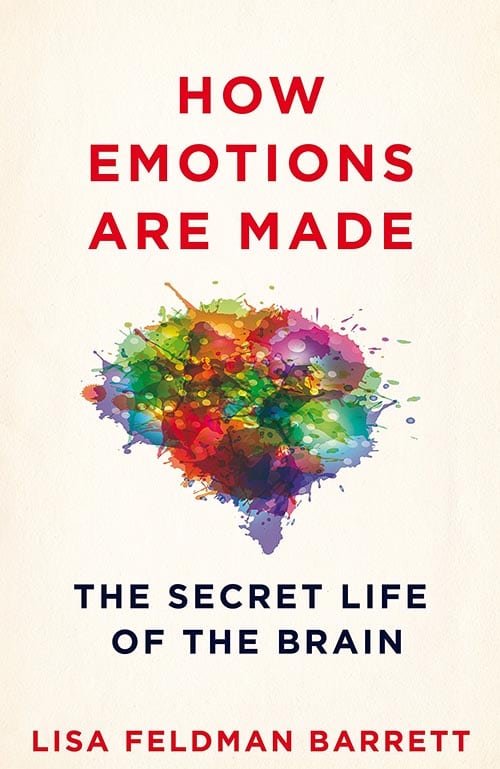
  • How Emotions Are Made by Lisa Feldman Barrett – Book Review & Summary

    The Factory Of Human Emotions

    Pixar’s 2015 movie Inside Out, cartoonified human emotions of joy, sadness, fear, anger, and disgust. The movie not only touched the heartstrings of adults and children alike, but it also gave us a deeper insight into how humans perceive emotions. Lisa Feldman Barrett’s How Emotions Are Made (2017) gives a completely different view of how we understand our emotions. She shows how culture influences one’s emotions and how the human brain processes them.

    We often think of our emotions as fundamental forces that develop from the very nature of humans – fully formed. We perceive them as distinct sentiments that need to be mastered. Barrett shows that emotions do not merely emerge. They are constructed in the mind and shaped by culture.

    The Classical Perception Of Emotions

    For more than thousands of years, humans have understood emotions to be reflexes, often influenced by evolution and existing beyond rationality. It is believed that one cannot truly control one’s emotions. Thinkers, philosophers, and even modern-day psychologists such as Aristotle, Darwin, The Buddha, Freud, Descartes, The Dalai Lama, Steven Pinker, Paul Ekman, and many others ratified this classical perception. 

    This perception of emotions is understood as universal, taught in psychology textbooks the world over, and is even reflected in the manner in which media depicts and discusses them. It is believed that emotions get triggered in different regions of the brain automatically and are hardwired.

    The views show that each emotion has an underlying property and some can be ‘universally’ seen all over the world. This connotation of having ‘essence’ is called ‘essentialism’. It stands by the assumption that every person can equally express these emotions and also recognize them within others around them.

    Biologically, the view propounds the fact that the brain is pre-wired with certain specific neurons linked to specific emotions, and once triggered, they generate physical responses. These specific characteristics are called fingerprints that help identify emotions. For example, an irritating friend triggers anger neurons, generating a physical response of a scowl on the face. Similarly, the death of a relative triggers sadness neurons generating a response of crying.

    New Scientific Evidence

    In reality, everyone does not respond in the same way to the same emotions. Nor do they have the same physical reactions to set emotions. These differences challenge the assumptions of the classical views of emotions.

    For example, we do not have the same responses for sadness, happiness, anger, awe, etc. There is a whole range of reactions that depend on the situations that trigger them. Moreover, experiments conducted have proved that emotions or any specific emotion aren’t restricted to any one region of the brain. Therefore, new scientific evidence disproves the fingerprint theory too.

    Barrett’s team of neurologists at her Interdisciplinary Affective Science Laboratory analyzed brain-imagery between 1990 and 2011. As a patient experienced emotions of happiness, anger, sadness, fear, etc., they computed the probability of increased brain activation by dividing the brain into small, virtual 3D pixel cubes and analyzing the responses within each cube.

    Their experiment showed that the brain regions get activated during non-emotional perceptions and thoughts as well. This proved that there are no obligatory, or single responses in the brain regions for emotions, even though the classical view places expressive patterns to emotions in society. For example, just because a person smiles, does not mean that they are happy.

    In 2007, the Transportation Security Administration (TSA) developed a method called SPOT (Screening Passengers by Observation Techniques). The technique was used to identify potential suspicious terrorists based on body movements and facial patterns. Given the new scientific evidence, this initiative was a flop, costing the American taxpayer 900 million dollars.
    Spontaneous, Concurrent, And Experience-Based Emotions

    Barrett believes in the theory of constructed emotions. The theory believes that emotions develop spontaneously, simultaneously, and concurrently in different regions of the brain. This would imply that emotions are not innate, involuntarily triggered, or natural responses, even though it seems counterintuitive.

    The theory states that each emotion is influenced by people’s experiences. Sensory inputs, whether visual, auditory, olfactory, or gustatory, pre-dictate responses, which the brain either affirms or alters based on prior experiences along with the sensory inputs to guide actions. According to Barrett, all emotional responses are created in a similar manner.

    For example, the emotion anger can generate myriad responses, each having its own neural pattern and generating unique bodily movements and changes. The brain has a selection of mechanisms to determine which situation needs which anger response. For example, in anger, one might scowl in one situation, yell in another, and completely quiet down in a third. Variations in emotional responses are quite normal because it is the context that determines which response gets stimulated out of those myriad responses.

    For Barrett, emotions are not innate or fixed but are constructed by humans who are the architects of their own experiences.

    The System Of Emotion Is Predictive

    The brain runs most of the body functions, especially the involuntary, on ‘autopilot’. Just like a person driving for a long time tends to engage the clutch and shift gears without much thought, the brain smoothly manages the systems that are predictive and ongoing. This ‘autopilot’ system is called interoception.

    The brain is constantly processing external and internal sensations, which get repurposed as emotions due to the process of interoception. Thus, interoception is at the base of creating emotions and is predictive.

    Interoception has two basic spectrums. Each spectrum covers two Affects. Affects are the aspects of consciousness, whether the brain is using them to create emotions perceptions or thought, or not. The first spectrum manages effects of pleasure and displeasure, whereas, agitation and calmness are managed by the second spectrum.

    For example, the calmness that one feels while hearing the waves at the seashore, the pleasant feeling of a summer breeze, or the agitation one feels during a tummy-ache, one experiences affective feelings. However, they are not actually emotions and don’t make one feel happy or sad in themselves.

    Babies can perceive affects of pleasure and displeasure from birth. These affects result in wailing, cooing, or crying.

    The Interoception System Is Regulatory

    During interoception, a number of regions of the brain get activated at the same time to implement it. This interoceptive network contains two components.

    • The Body Budgeting System – Using past experiences, this system estimates what the body needs, and controls the body’s internal environment by sending pre-empted messages throughout the body. For example, when one decides to amp up their exercise routine by an hour, it tells the heart to pump faster and instructs the metabolic system to break down more glucose to incorporate the new change.
    • The Primary Interoceptive Cortex – The Primary Interoceptive Cortex manages the sensations we feel inside the body, for example, the heartbeat.

    Both these systems help the body budget its resources by forming a loop of feedback. It is this budgeting that helps the body regulate resources such as cortisol, glucose, and involuntary actions such as heart rate and breathing. 

    This system of budgeting also helps stimulate emotions. The body is constantly working. Even while one is working, or merely sitting down and thinking, the budgeting system works in the background. For example, while writing an examination, and the invigilator announces that there are only five more minutes, you panic, the heart starts pounding faster, and you start increasing the speed of writing. These emotions and movements, voluntary and involuntary, are all regulated by interoception’s body budgeting system.

    In a scenario, if the body’s budget gets imbalanced, one feels agitation, a response to the body having a lack of resources to function normally in the situation. The brain then starts firing emotions to counter the imbalance. To explain it in terms of effects, when a person is displeased and aroused, one can experience the emotion of fear.

    Emotions And The Influence Of Culture

    In Tahitian culture, sadness is explained by a word that means, ‘fatigue that is associated with the flu’. In different cultures, sadness would have different meanings and connotations. This shows that people understand concepts, and emotions, based on the connotations they see in their environment. Therefore, one’s culture influences one’s understanding of certain concepts.

    For example, people argue about the difference between a cupcake and a muffin. Though both are more-or-less the same, made with similar ingredients, the difference lies in their culturally associated meanings. Cupcakes are desserts, and muffins are eaten at breakfast. Thus the differences are based on the social reality that is defined by social agreement.

    The social agreement can be seen all around us in many examples, such as paper money. While the paper has no inherent value, it is via a social agreement that people know and understand that different sized and colored paper denote the difference between one US dollar, 20 Euros, or 100 Indian rupees.

    Similarly, emotions ride on cultural conventions too. In ancient Greek and Roman civilizations, there was no word for ‘smiling’. This was because, as opposed to today, smiling wasn’t culturally associated with happiness.

    Emotions Are Learnt From Birth, And We Can Learn More

    We have already seen how babies have effects that help them emote. However, emotional concepts are explicitly learned as we grow from parents, culture, and society. Therefore, the author says that emotions such as anger, depression, happiness, fear, etc. are not universal.

    For example, if a parent asks a crying toddler, “Are you crying because you’re angry that it’s time to sleep?” the parent has inherently linked crying with anger, disappointment, or sadness. This linking continues from one’s childhood, as the brain uses past and new experiences to reshape old concepts and learn new ones.

    This learning capacity of the brain helps us to regulate emotion concepts by getting better at distinguishing between them. For example, until recently, there was no word in English that described feeling happiness at someone else’s hardships. There was simply no word to describe it, even though the feeling wasn’t a new one. The German word Schadenfreude was borrowed by the English language to explain the feeling.

    Similarly, if a new expression is heard frequently, the brain tries to link it with similar past experiences, enabling one to ‘feel’ it. This amounts to practicing ‘feeling emotions’, making people better at distinguishing them. Hence, as a person invests in creating new experiences, they, in turn, become the base of new emotions of the future.

    Conclusion

    Emotions are not innate or inborn. They are shaped by culture, society, and the environment that surrounds us. Emotions are constructed and regulated by systems of the brain that enables humans to identify, understand and distinguish emotion concepts, based on the brain’s past experiences through observing and understanding the culture that surrounds us.

  • How To Communicate and Handle Difficult Conversations as an Introvert?

    Introverts are comfortable in being by themselves. Instead of getting energy from others, introverts draw it from solitude and quiet places. As a result, resolving conflicts and navigating tough conversations tend to be difficult and scary since it forces them to have conversations that they would rather not have. Unfortunately, avoiding conflict can be extremely limiting when it comes to leadership and producing results.

    However, most introverts do not know that their introversion is a superpower when it comes to handling difficult conversations. That is because the nature of an introvert is to be thoughtful. That means you do not enter any situation without preparing for it.

    The more you prepare, the more confident you will be. As you can imagine, that confidence will go a long way in helping you manage the nerves of handling difficult conversations and stepping out of your comfort zone as an introvert.

    Another superpower introverts have is their excellent listening skills. Most conflicts result from one or both parties feeling like their grievances are being ignored. As you can imagine, listening goes a long way in diffusing the tension in a difficult conversation. Another benefit of being a good listener is that it allows you to understand not just people’s positions but also their underlying interests.

    However, since you tend to get worn out quickly when you are around people, you will need to manage your energy appropriately. That means scheduling meetings when you have the most energy and avoiding back-to-back meetings. 

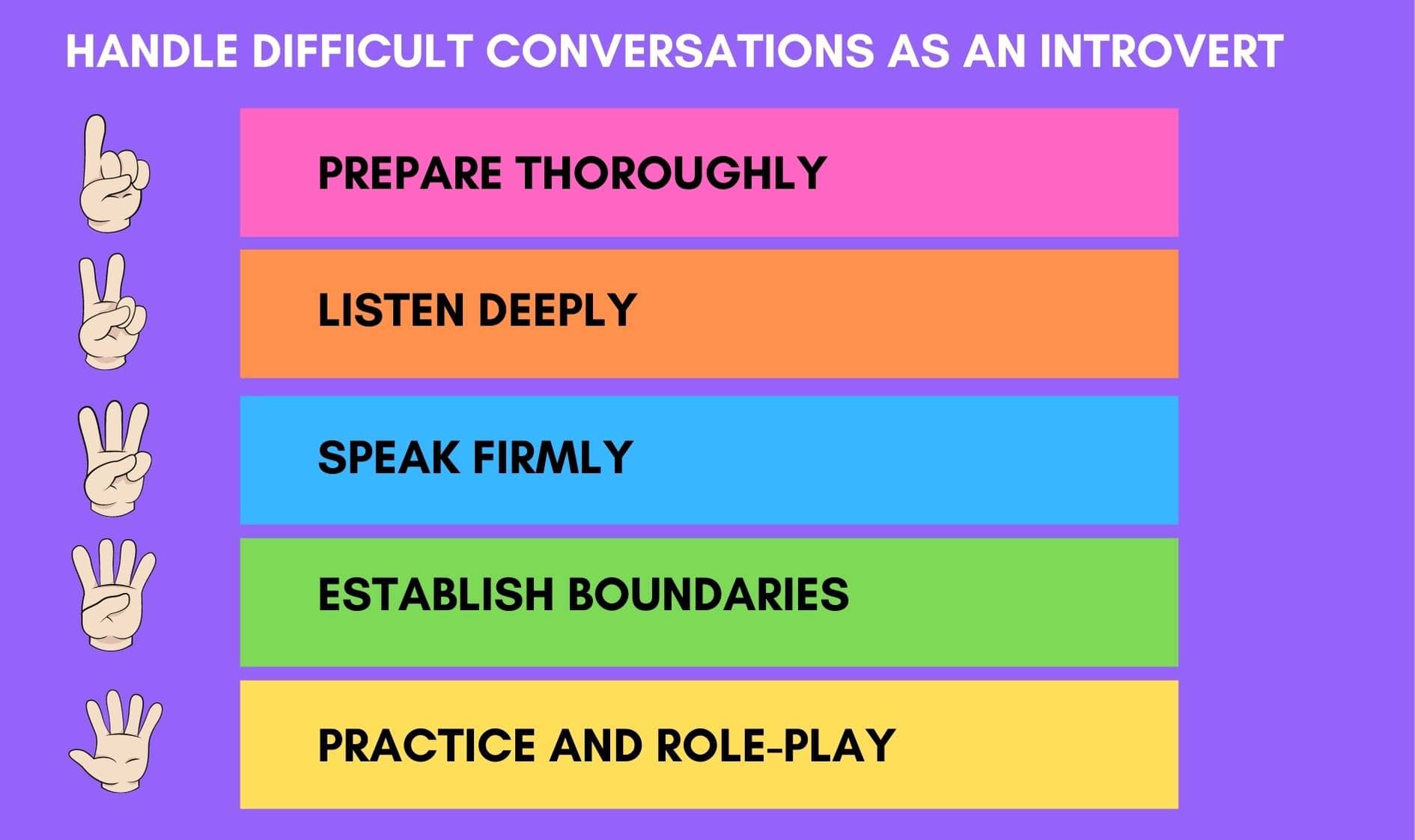
    Here is everything else you need to know about communicating effectively and handling difficult conversations as an introvert:

    Prepare For Different People and Situations To Remove Uncertainty and Anxiety

    Preparation is key to succeeding in anything in life. Fortunately, as an introvert, you excel at preparation due to your thoughtfulness. Here are some questions to ask to prepare yourself for difficult meetings.

    1. What is the meeting about? What material should I read before? Who are the participants in the meeting? What is my history and relationship with them? Can I know them better? What are their personality styles? How can I prepare for dealing with bullying, aggressive, or passive-aggressive comments?

    As mentioned, introverts draw their power from within, which is why they do not like having the spotlight on them. Nonetheless, as a leader, you will need to be comfortable with the idea of speaking up. 

    As mentioned before, good preparation is the key to getting the confidence you need to control any situation. When it comes to meetings, research thoroughly about the topics you will be discussing. Doing that will ensure that any point you bring up will bring value to the conversation. 

    When people see that you are well-informed, they will be more willing to listen to what you have to say. You can also consider the different people in the meeting and have a plan on how to interact with them, especially if you find working with them challenging. 

    How should you deal with aggressive, loud, or bullying personalities? For starters, you do not need to be loud; just make sure you speak up when you have to. Here are a few more guidelines:

    • Take control of the conversation by pulling everyone back to the topic once the conversation becomes derailed
    • Make a hand gesture before you speak to get their attention
    • Summarize people’s ideas and point them towards the data you have already prepared.
    1. Can I prepare and circulate my thoughts about the meeting topic before the meeting starts? 

    As an introvert, you excel at quiet reflection – use that strength to plan for your meeting. That will involve thinking about the topic of discussion and broadcasting them before the meeting. This will help you get a jump start and prevent having to wait for your turn to speak in the meeting. 

    1. What are my values? How do I want myself to act? What are my standards and boundaries? What, if violated, I will not stay silent about?

    Introverts often struggle with difficult conversations since they have a difficult time believing in their own authority and opinions. A leader is simply someone capable of speaking up for what they believe in strongly. And knowing what you stand for will make that easier for you.

    The first step to identify your leadership lighthouse is determining your values. What do you believe in? What are your principles? What about the standards and boundaries you want to stick to?  If someone gets out of line, how will you tell him or her that their behavior is not acceptable?

    1. What are my strategies if I get overwhelmed or triggered in the meeting? Can I take a time out; can I ask for time to think? Can I excuse myself for another reason?

    You have to reconcile with the idea that things will not always go your way. Therefore, let go of the need to control the outcome of the meeting. Instead, trust your preparation.

    Nevertheless, there is still a good chance you will still feel overwhelmed or triggered in the meeting. Pay attention to your breathing to stay centered throughout the conversation or meeting. Whenever you feel nervous or triggered, breathe in deeply and then exhale slowly. You will be surprised how calm you will feel immediately. 

    Additionally, breathe when you are speaking. This is because we tend to take shallow breaths when we are nervous. Therefore, by breathing normally, you will be letting your body know there is nothing to be afraid of.

    Most importantly, fight the urge to speak fast. You have the right to be heard. Again, conscious breathing allows you to communicate calmly, giving you the chance to get your ideas heard effectively.

    Use your keen listening skills to go a level deeper and listen to people’s concerns

    As mentioned, the introvert’s ability to listen is a superpower. Here is how to use it effectively:

    1. Be curious about not just the topic of the conversation, but also the people involved.

    Do not listen just for the sake of it; be curious about what the other person has to say. Doing that allows you to understand where people are coming from. If people feel understood, it builds trust and they are more likely to listen to your ideas.

    Additionally, pay attention to the entire person you are talking to. That means not only listening to them but also observing their body language. Doing that gives you deeper insight into what they might not be communicating in words but still expressing otherwise via hand gestures, facial expressions, body posture, etc.

    1. Help people paraphrase each other by listening to people’s concerns. Act as a calming force in the meeting. Acknowledge and validate people’s emotions

    The benefit of paraphrasing others is that it allows them to know and verify that you have listened to them. No one likes being ignored. You should also acknowledge the other person’s emotions as they drive most of our communication. 

    Emotions are the only way people convey what they feel inside and what is important to them. As such, by listening deeply and showing that you understand where they are coming from, you can be a tremendous calming force in the meeting. 

    1. Ask questions with compassion to help people understand what is important to them. 

    Powerful questions can help people understand their point of view better. Being compassionate while doing that is arguably the best gift you can give to that individual. 

    Therefore, one of the best ways of handling difficult conversations is by allowing the other person to express fully by asking curious questions. That way, you will build trust, get to the heart of the matter, and reach an understanding sooner.

    1. Think about the core issue which needs to be solved. Keep the focus on the problem instead of colliding egos and arguments.

    The human condition is prone to our egos getting in the way when communicating. Most times, when people disagree, their immediate response is to defend themselves. As an introvert, you can help people resist the urge to attack each other. Instead, you can help keep the focus on the issue instead of the conflicting egos. 

    1. Remind people they are on the same team, and bring up the common desired goals if need be. 

    The best way to resolve conflict within a team is to remind everyone that they share the same goal. Additionally, remind each individual that their opinions are valued. It is not about massaging egos, but appreciating each person for what they bring to the table.

    1. Use humor or share a story to lighten the mood

    When things get heated in conversations, you can use humor to lighten the mood. You can also share a story to lighten the mood and bring the attention of the group to the main point of importance.

    Practice and Role-Play To Prepare Yourself if You need to

    Needless to say, confrontations and public speaking are not what an introvert look forward to. You can prepare yourself for how various scenarios might play out through role-play with a coach or a trusted partner. You can also practice with a mirror. Consider role-playing the following scenarios:

    1. Practice replying back to aggressive people

    As an introvert, nothing can frustrate you like loud and aggressive people. However, you will need to prepare for such behavior. As mentioned earlier, avoid the urge to engage an aggressive individual in their own game.

    Instead, let them talk, and then state the facts calmly to them. Practice expressing yourself in alignment with your values while still making your point across clearly. While at it, practice proper breathing, as you will need to stay calm in real situations.

    1. Practice dealing with bullying or passive-aggressive behavior without doing the same

    As the saying goes, when you engage a fool at their level, they will beat you with experience. Similarly, avoid engaging a bully at their level. Instead, practice using the guidelines offered earlier on how to deal with such behavior. 

    You can stand your ground and make your point without being aggressive. Also know that you can raise your voice without being aggressive or rude. 

    1. Practice saying no politely but strongly. Be clear about what is non-negotiable for you

    If there is one thing that introverts struggle with, it is saying no. However, as mentioned, you can prepare by identifying your values and enforcing your boundaries. The foundation of assertiveness is having the ability to say “NO”.  Nothing good ever comes out of being a people pleaser and saying YES when you actually mean NO. 

    Conclusion


    While being introverted comes with its fair share of challenges, it can also give you an edge in difficult conversations. Introversion allows you to be more calculative, prepared, and focused, all of which are important in keeping a cool head under stress and pressure. 

    Good leadership is characterized by the ability to stay calm and not lose focus in the heat of the moment. Wear your introversion with pride because that is probably what makes you unique and stand out.

  • Issue #29, 22 June 2021 – Get Out of Your Own Way

    Welcome to the Deploy Yourself Newsletter. Every two weeks I share what impactful leadership looks like to show your own power. I also share the most insightful lessons and stories I encountered in the last two weeks. You can also read this issue online.

    Hey,

    You Are Your Own Biggest Enemy

    The biggest challenge success brings is success itself. The strengths that made you successful in the past often become your biggest barrier in the future, as they stop you from seeing new ways of growing further. Every strength has a dark side, and you soon realize that what got you here won’t get you to the next level of success.

    This is why so many people are struggling to understand why doing MORE of what made them successful in the past just isn’t working anymore. What makes the problem worse is that this is often a blind spot for high performers. And it is scary when they realize this paradox. If you want to constantly make the “impossible” happen, you also have to constantly re-invent yourself – again and again.

    What stands in the way of your “impossible” goals is not something out there (money, people, skills, etc) but your own unexamined patterns of thinking. They are thoughts like – “I am an executioner, not a visionary.”, “I am a slow learner”, “I am an introvert.”, “I do not know how to do XYZ”, or “I am not smart/good/talented enough”. What might that be for you?

    The only enemy you need to worry about is you yourself. Because only you decide how small or big you dream. Only you decide when to quit and give up. Only you can decide what to do next – irrespective of your situation. And, it is only you who decides the way you experience the world, the emotions you experience, and the attitude you take as you move forward.

    Where are you being your biggest enemy? What dreams might be possible if you get out of your own way?

    If you want to share your impossible dreams and the thoughts that might be blocking you, reply to this email. I read and respond to every reply.

    Articles and Stories Which Have Fascinated Me

    One

    8 Reasons We Should Know Our Values, Worth, and Purpose

    I often wonder why we don’t know our values as adult human beings? Why don’t we know what is important to us and what we care for? Why don’t we know our worth? It seems to be an important question, yet most of us face this question by accident, and not by design.

    It is not possible to have a fulfilling life unless you take care of what you care about. When you connect to the things that matter most, you experience true joy. Otherwise, you may end up doubting yourself and questioning why you are doing what you are doing, even when you achieve success by society’s standards.

    Self-awareness begins with knowing what makes you tick, and what is most important to you. The following are some benefits to be gained from knowing your worth – your values and what you stand for.

    1. Knowing your values may not lead to fame or fortune, but it will foster maturity and help you stay grounded.
    2. Values Help You Find Your Purpose. You won’t know what you want out of life if you don’t figure out what is important to you.
    3. You can use your values to determine your actions in moments of crisis. Your values can serve as a moral lighthouse in those tough times.
    4. They are Valuable in Decision Making
    5. Identifying your values will help you clear out the clutter. It will help you clear the mud from the water allowing you to see clearly. You can then focus your time and energy on what matters and brings value, satisfaction, and aliveness into your life.
    6. They Help You Choose the Right Career. Knowing what you stand for, and what matters to you, will help you consciously take your life and career forward, rather than just drifting with the flow.
    7. Knowing your values and worth shapes your beliefs. It enables you to develop strong opinions about key subjects.
    8. When you take action aligned with your values and to take care of what you care about, the result will be a more meaningful and happier life.

    From an article from my desk titled 8 Reasons We Should Know Our Values, Worth, and Purpose

    Two

    How a Question May Be the Best Answer

    It is so easy to jump to “solution mode” and later find we have missed valuable insights, barriers, or perspectives. So I ask you – when posed with a question do you jump to the “answer” which is formulated from your own perspective, desires, and, priorities or do you hold in your response and ask another question?

    The below article poses a challenge to the reader when asked a question :-

    • Resist the temptation to answer immediately, instead take a breath and allow for a moment of pause which gives the other person permission to elaborate or clarify. Count slowly to 3 before responding.
    • Notice your own 125-400 rule, how accurately does your spoken word reflect your true thoughts and intentions? This will require insight and deep reflection. Does what you say reflect what you mean? Remember, the other person is not in your head and will only know the words you speak.

    From an article titled – How a Question May Be the Best Answer

    Three

    Gandhi on Changing The World vs Changing Ourselves

    As human beings, our greatness lies not so much in being able to remake the world — that is the myth of the atomic age — as in being able to remake ourselves.

    ~ Mahatma Gandhi

    That’s it for now. If you have any questions or feedback, or just want to introduce yourself, hit reply. I read and respond to every reply. All the best,

    Sumit

    (Twitter) @SumitGupta
    (LinkedIn) Connect

  • Maps of Meaning by Jordan B Peterson – Book Review & Summary

    Meaningful Living Through Myths

    Legends, myths, and stories have been part of our lives since the time we were born, and part of civilization since ancient times. These myths and legends were intrinsic to communicating, teaching, and imbibing various lessons of culture, morality and lend meaning to the lives of the people in a community and society at large.

    Jordan B. Peterson, in his Maps of Meaning (1999), uses historical analysis, social, and psychoanalysis to understand how these myths and legends have shaped the culture and in turn, shaped humans. He argues that myths that have been handed down from generation to generation are the way to not only understand present human nature and culture but also derive meaning from our lives and reach individual potential.

    The Fear Of The Unknown

    Let’s take rats for example. A rat freezes when it is put in a new cage. Its reaction to unfamiliar territory is primarily caution. The rat will slowly explore its new cage by scratching, sniffing, and licking its new cage, getting accustomed to this new surrounding, and becoming calmer.

    Humans, though more complex than rats, understand the world in a similar manner. For humans too, the world is divided into the known, and the unknown. 

    While the known comprises of all things familiar where things that have been previously explored, things that make sense, things that are known due to shared culture, things that give a sense of calm and safety. The unknown is the unfamiliar – a new situation, unexpected behaviour, unexplained phenomenon, etc. Anything that is an anomaly will throw humans off their guard and make them stop in their tracks.

    However, anomalies rake up dual feelings – of being promising and threatening at the same time. Moreover, the intensity of unexpectedness determines whether it is fear or curiosity that will dominate the senses. For example, a letter with ‘open at your own risk’ written on top will generate feelings of anxiousness as well as excitement. However, if the letter is from a known friend, the feeling of curiosity will take over and one will feel less anxious to open it.

    Once the initial fear of the unknown passes, humans tend to have a natural proclivity to explore the unknown – to make the unfamiliar, familiar. The goal is to reduce anxiety and attach a sense of safety.

    Humans, unlike rats, have the ability of thought, in addition to action to rationalize the unknown. For example, apart from smelling the unopened letter, holding it against the light to check its insides, or ripping it open, we have the ability to ponder and think about who sent it, and why. This ability to rationalize is what has shaped the world today and is continuing to shape it.

    How Stories Give Meaning To Our World

    Science and scientific development help us understand our surroundings rationally. However, feelings and emotions are critical to understanding the world too. The judgment of whether something is bad or good is determined by emotions and feelings, in turn determining how we approach the unknown. It is the social and cultural context with which we approach any situation or thing in life to derive meaning. 

    For example, one’s liking for a piece of cheesecake depends on the effective, or emotional meaning one attaches to it. While rationally – and scientifically – the cheesecake is the same, its affective meaning changes depending on whether offered by a stranger or a loved one, or whether one is on a diet. Therefore, science in itself cannot help one understand the world, let alone navigate it because feelings and emotions are always tied to the fact.

    Humans have stories, an ingenious way of deriving meaning. Shared stories, myths, and legends such as The Passion of the Christ, tales of Greek and Roman Gods, cosmologic stories of the ancient Egyptians, stories of monsters, kings, heroes, etc., are some of the most important stories that have hidden cultural meaning.

    In the book Maps of Meaning, Jordan Peterson emphasises that in the modern context, these stories are considered fabulations, yet they have cultural and psychological significance. They give meaning to major human experiences such as the creation of man, forces of nature, and the origin of the cosmos that would otherwise, have been unfamiliar and frightening to ancient humans.

    The Basic Structure Of Myths

    Myths from different places of the world have some common characteristics because of shared human nature. Whether it is the story of Homer’s Odyssey, the Passion of the Christ, stories of creation in Mesopotamia or Egypt, they all have one commonality – the journey of a brave hero and his triumphant return from the unknown.

    The primal forces of nature form the basis of most myths. They represent the unknown, from wherein all life originates. Its creative and destructive nature is mostly represented as feminine. For example, according to the Mesopotamian myth of creation, the unknown is a ferocious Mother Dragon Tiamat from whose pieces the cosmos was created. In Sumerian creation myth, the sea goddess Nammu birthed the sky and the earth.

    The feminine, often the mother, is portrayed as either ‘great’, or ‘terrible’, where the terrible unknown is shown in forms of an evil monster, a stepmother, or a storm; the great, or promising unknown is often characterized by a fairy godmother, a treasure or a magical place.

    In mythology, the opposite of the Great and Terrible Mother, is the Great and Terrible Father. The father represents the structured, known territories of culture that man has built for protection. The father is most often represented as an old, wise king – great when he is just, protective and wise, and terrible when he is oppressive, tyrannical, or evil.

    Finally, the hero of the story is the brave explorer, trapped between the unknown forces of the Mother and Father – or nature and culture. He is the one who fights the negatives of nature and culture and wins by bringing out the positives, proving to be a role model for humans.

    Myths Are A Framework For Humans And Society

    All myths and legends are a framework idealizing how society should be built and how individuals should behave within it. It is often seen that myths are based on stories of kings, queens, princes, etc. They justify authoritarian culture, legitimize them, and at the same time provide templates and examples of how power should be used (or not).

    For example, the Mesopotamian emperor was believed to be an emissary of the hero Marduk, who constructed the cosmos from pieces of Tiamat. The emperor, just like Marduk was to bring order from the chaos in society.

    Myths describe the dualities of the Mother (nature) and the Father (culture). Where the Mother is creative and destructive, the Father is protective and tyrannical. These differences described in stories of kings or gods show to balance tradition and innovation in culture and society. 

    The Egyptian story of Horus is a great example. The divine king Osiris is too fixated on traditional ways and doesn’t see the evil nature of his brother Seth, who eventually kills him to get the throne. Horus, Osiris’ son is an ‘updated’ version of Osiris himself, ventures into the underworld (unknown) to find his father. Seeing his father blind, he gives Osiris one of his own eyes, and the two emerge from the underworld to reclaim their throne.

    Myths also chart out the ideal behaviour for individuals in society. They are guidelines that teach people to face challenges (venturing into the unknown) and not hide from them. The hero, opposed by an evil tyrant shows society behaviours that are not accepted and that reward-punishment. For example, Seth shows disrespect for the divine order by murdering Osiris and gets duly punished. Thus, myths were a moral compass for individuals to learn and follow, before laws were written or before behavioural rules were formalized by institutional religion.

    Lessons Of Growing Up In Myths

    Children are protected from the dangers of the unknown by their parents. Parents, by embodying the values of their culture teach children moral and behavioural values. Thus protection and values of parents take an upper hand over the values and protection given by culture. As a child grows up, these parental values and the protection get replaced with those of the culture surrounding them.

    The first step of this shift can be seen when teenagers rebel against parental authority, in order to embrace the values of their friends. Teenage rebellion is, therefore, a natural socialization process. However, this growing-up phase leads to a paradox, where as soon as children are liberated from the authority of parents, they have to embrace the values, rules, and norms of society, which are just as arbitrary.

    For example, people in the West are expected to have or learn a specialized profession. While humans could have perfectly well survived without the need to have a profession, they have to function within this framework that is set by the culture. This framework, though arbitrary, helps humans to make their surroundings familiar and keep the unknown at bay.

    Myths and legends are a device to encode these very rules, norms, and values of the culture. The downsides to abiding blindly to this framework of culture lead to succumbing to the tyrannical side of culture (Father), and are often known to encourage fascism and authoritarianism.

    However, on the upside, myths also give humans a way to identify with heroes and thus focus on individuality, rather than just identifying with the rules of culture. They show that the hero isn’t afraid to overthrow the power of the Father if needed for the greater social good. This is one of the main messages of the book “Maps of Meaning” by the author.

    Anomalies Make Humans Adapt

    The existence of the unfamiliar and unknown is a given. There will always be things that man will never understand. While culture provides protection from the unknown, it is also a fact that the chaos of the unknown will show itself when least expected.

    Just as for rats, the unknown is unsettling for humans too, especially when they are unexpected. Moreover, if the intensity of the unknown anomaly is too high to be comprehended, it turns into a crisis. These crises can be on an individual level or at a cultural level. For example, political crises, a natural disaster, or a war can be cultural crises, whereas the death of a loved one, an uncomfortable realization, or a career setback can be individual crises.

    Cultural or individual, these anomalies of the unknown always force people to adapt. Minor crises lead to normal adaptation. For example, if you spill coffee on your new dress, you adapt to the unknown unexpected situation by changing your dress and getting it dry-cleaned.

    Major crises lead to evolutionary adaptation. Here, encountering the unknown forces to change one’s own outlook and perspective, and of the world too. We then end up changing our values, goals, and even our behaviours to accommodate the crises. Major crises and revolutionary adaptation can lead to major psychological crises on an individual level and social crises on a cultural level.

    Revolutionary adaptation always leads to using the anomaly to update one’s view of the world. However, if such anomalies keep piling up, it becomes a clear indication of the fact that the existing model of the world isn’t working.

    How Limitations Lead To A Meaningful Existence

    A symbol of a self-consuming snake, or an ouroboros, can be found in many cultures in India, Mexico, and Africa. It is first known to have appeared in Babylon and represents the primordial state of the cosmos. It represents a pre-existent state, where everything is in perfect harmony. It is the state where there is no distinction between the known and the unknown, order and chaos because humans do not exist to know the difference.

    This state of pre-existence is represented as the Garden of Eden in Christian mythology, where Adam and Eve are not humans, as we understand today. They do not know pain, sorrow or death, or anything much. It is only after they eat the Forbidden Fruit of the Tree of Knowledge, do they become self-conscious – differentiating themselves from animals. They become aware of their nudity and cover themselves up with fig leaves.

    However, they get expelled from paradise for their transgression – a heavy price for their consciousness. This is the point in Christian mythology where the primordial pre-existence state is broken, dividing order and chaos, good and evil, and life and death. It is the point of birth of humans, where Adam and Eve get the responsibility to navigate and make sense of their new world. This view shows that the limitations and faults of humans are the preconditions for our very existence.

    The Christian myth emphasizes the fact that humans have the responsibility to chart out their own meaningful path. Because without this basic limitation, how would humans do good without evil, strive for order without chaos, do the right without any wrong in the world, or even understand the meaning of life without death?

    The Human Capacity For Evil

    When we speak of evil, we often consider it to be the product of an unjust social or economic condition, a bad upbringing, or a psychological defect. However, Hanna Arendt, the German philosopher, said that everyone, even ordinary people are capable of true evil. She understood this ‘banality of evil’ when she was contemplating the evil that penetrated the Third Reich.

    Most myths, especially the religious ones, address this evil that resides within all of us. In myths, this evil is often portrayed as a hero’s evil brother, or an evil conniving king’s advisor, etc. 

    Christianity gives perhaps the most impressive version of evil, Satan – a fallen angel having delusions of grandeur, arrogance, ignorance, and self-deceit. In the play Faust, by Goethe, Satan claims to be the ‘spirit that denies’. 

    What does Satan deny?

    Satan (or evil) denies that the unknown exists at all. While the unknown can be frightening, it isn’t evil. As we have seen, exploration of the unknown can bring rewards too. It is the base of knowledge and growth for humans. Satan denies this very possibility for knowledge and growth – a truly arrogant, cowardly belief that is the basis of true evil. Satan represents the antihero, who rejects creative exploration and anomaly, and hence a chance for growth and adaptation.

    The evil that rejects the unknown pushes humans towards two options – 

    • First, blindly adhering to culture and tradition, leads to fascism. For example, the Nazis who committed atrocities and then claimed that they were only ‘following orders.
    • Second, losing oneself to self-indulgence and adulation, leading to decadence, wherein individuals are too lazy to accept any responsibility for the current state of the world.

    Myths, therefore, help us understand that we are all capable of evil and that we can choose the better path.

    How To Reach One’s Own Potential

    Humans have devised many strategies to avoid facing the uncomfortable unknown. One strategy is to lose oneself in ideology. However, being an ideologist translates to rejecting creative exploration and thus growth.

    For example, a person who is a national supremacist will believe that his country is better than others so vehemently, that he will actively deny, avoid, and suppress any anomalies that suggest an alternative truth or go against his narrative. 

    Ideologists seek solace in their own readymade worldview rather than embarking on their own creative exploration. Their ideology and its perusal replace identification with a mythical hero. Some ideologists perceive their own culture, race, or nationality as superior, encourage individual identities that align with their own, and consider others out of their culture, race, or nationality as anomalies. For them, anything foreign becomes evil. Some other ideologies completely reject culture itself, blame anomalies on everyone else, and do not take responsibility for their states.

    Thus, ideologists do not accept any discrepancies between their perceptions of the world and their experiences. They deny and reject anything other than their static perceptions of their world. Considering the Christian myth, where the rejection of creative exploration is true evil, any ideologies, and atrocities committed under them (like fascism and communism), prove the Christian myth as true.

    Conclusion

    Resorting to the comfort of any ideology, therefore, means not being able to live a meaningful life. It means rejecting growth and learning, as it rejects the idea of a mythical hero and perceiving life as a fulfilling journey. 

    Humans, therefore, have the responsibility to perceive culture as their framework and use myths to create a sense of individuality, to add meaning to their journey into the unknown. This is what Jordan Peterson has tried to convey in this book titled Maps of Meaning.

  • Truth, Lies, and Advertising by Jon Steel – Book Review & Summary

    Bridging The Gap With Account Planning

    Don Draper romanticized the world of advertising. He made the world believe that advertising is all about the handsomely suited men in penthouses cleverly dishing out an award-winning copy for massive clients. However, the real world of advertising is completely different. Leading account planner Jon Steel unveils the real world in his Truth, Lies, and Advertising (1998), and shows that without the genius of the account planner, there would be a clear disconnect between the consumer, the client, the rest of the advertising team and their clever ad campaigns.

    The Most Important Link – The Account Planner

    The account planner, though it seems otherwise holds the most important position in an advertising agency. The planner is the one who links the client and the creative, does the research, analyses the feedback, and ensures that the client’s interests are paid attention to. He is the one who knows the consumer and works hard to connect the ever-elusive consumer to the client’s brand, products, and services, ensuring that the client gets exactly what they pay for.

    An account planner is intrinsic to ensuring that the agency produces next-level advertising that focuses on really reaching out to consumers’ needs. It is his responsibility to get information on the customer’s needs – by conducting customer interviews, or gathering market and sales data – to solve the client’s problems.

    It is also his responsibility to ensure that the creative team gets the necessary information and works in line with what the client wants and the information given. An account planner makes ideas happen rather than just make the decisions for the agency.

    When Steel was working on a project for Isuzu’s Rodeo model, he hosted various focus groups at dealerships to get a clear idea of the customer base for individual models. Based on the information he relayed, the creative team came up with a commercial of a father and a son visiting a toy store and finding a Rodeo packaged like a toy car. The tagline for the commercial was, “The Rodeo. Grow up. Not old.”

    The success of the campaign was not only about the creative team’s work but also more about the in-depth research the account planner put in to get the information for the creative team.

    It is for this reason that account planners should not work with more than three clients at a time. To ensure that the project is successful and that lasting relationships are built with the clients, planners should avoid overwhelming work pressure. Not cutting corners with existing clients, after all, will help in building an impressive portfolio and make profits for the agency.

    The Account Planners Research

    How does an ad agency ensure a perfect liaison between the client’s needs and the creative team’s output? The answer is a resounding, “Listen well, and ask the obvious questions.”

    An account planner needs to talk to customers, ask even the most obvious questions, and most importantly listen well to what they have to say.  For example, when the author asked a focus group how much milk did they drink every day, most of the participants of the group answered, “Very little.” They did not factor in the amount of milk they added to their cereal and coffee daily.

    Similarly, in a blind survey for a new formula conducted by Coca-Cola, most testers preferred the new product to the original taste. However, when based on this survey, the new version was launched, it failed. This was because the public emotionally resonated with the original Coca-Cola. 

    Thus, the opinion of focus groups can have a major impact on business, and the account planner has to keep in mind the fact that while conducting customer interviews, it is better to interview them within the comforts of their homes, rather than in an impersonal, shiny conference room, a strategy that worked well for Sega. Sega conducted interviews of kids playing games in their own homes and asked them questions immediately after.

    Another important factor that planners need to keep in mind, is to have a comfortable interviewing style, where focus groups are encouraged to participate rather than interrogated.

    The Creative Team’s Guide

    The account planner’s next responsibilities are to gather the research information and hand it over to the creative team. This research information is presented as a creative brief, which is a structured report of the overall strategy of the creative campaign.

    The creative brief, whether presented in a written form or orally conveyed, should include the following information.

    • The business problems that the campaign should solve for the client. For example, why didn’t the product work earlier?
    • The desired effects of the campaign and the objectives. For example, is the aim to attract new customers, to encourage old ones or enter a new market altogether. The priority of these objectives should also be clearly laid out.
    • Specify the target audience. Is the campaign targeting women of a specific demographic? Mothers of infants?
    • Concrete information about the target customers. How does the product or the service feature or change the lives of the target audience?

    While these points make up the chunk of the report, the proposition lies at its core. The proposition is the core message, written in one single sentence, that the creative team will convey in their final advert. The proposition of the creative brief communicates the specialties of the product in an entertaining fashion to the team, which then relays that information in their ads.

    For example, when the Cuervo focus group was asked to think of a guest arriving with a Cuervo bottle in hand, the participants started laughing. This reaction told the account planner that Cuervo means party, a vital piece of information, that he included in the creative brief, with a proposition sentence, “A party waiting to happen.”

    Merging Client Expectation With Campaign Concept

    The creative team adds flair to the creative brief given by the planner. When Steel was working on the Sega account, he noticed that children preferred the Sega console to Nintendo’s. he compared the experience of using the console to getting chosen in a baseball Major League in his creative brief. He called it ‘The show’.

    While the author took two weeks to get his idea, the creative team to a mere 30 seconds to come up with the tagline, “Welcome to the next level,” translating baseball jargon into gamer-speak!

    Once the creative team develops the campaign, the planner has to test it and make improvements by checking consumer response data and incorporating client feedback.

    When Steel was working on the Foster Farms account, the core message of the campaign was that the Californian company’s chicken was more expensive yet it was natural, local, and fresh, and not frozen and imported.

    The creative team developed an ad where they showed chicken puppets driving to California, to pass themselves off as Foster Farms high-quality chickens. The car was cluttered with beer cans and cigarettes. The client, not approving the beer and cigarettes, scrapped the idea, asking for two new concepts. The creative came up with what the client wanted but also changed the beer and cigarettes to junk food in the original idea.

    However, during consumer testing, the author found that the focus group was more excited about the chicken puppets. The results of the testing convinced the President of Foster Farms to go with the chicken puppets idea. While the account planner didn’t really give the client what he had asked for, he gave the client a solution that eventually won him over.

    The Account Planning Process – Start To Finish

    Jon Steel emphasizes the importance of following the account planning process. His experience in one of the most famous campaigns, “Got Milk” of all times, for the California Fluid Milk Processors Advisory Board (CFMPAB), is a great example.

    The client wanted to increase the consumption of milk. Steel started researching the reasons for the decreasing milk consumption levels. In his research to understand how milk features in the lives of the target customers, he found that the decrease was due to the fact that people found milk fatty, childish and boring. He also found that people do drink consume milk, mostly combined with other things.

    He then conducted a focus group, where he paid the participants to forego milk for a week. In the resultant discussion, he found the participants describing how they actually liked milk and missed having it with cookies or a sandwich. His creative brief then included the strategy to remind people to stock up on mild, to avoid feeling deprived when they wanted to augment their food with milk. He had understood that creating a desire for certain foods will, in turn, create a desire for milk.

    The creative team used this brief to portray milk as the essential companion to other foods. Thus the ‘Got milk?’  tagline was developed. The CFMPAB liked the idea. Additionally, since the author’s research showed that milk is most often consumed at home, the campaign was first tested on TV and next on billboards near grocery stores. They also ran print ads in magazines with a bitten chocolate chip cookie with “Got Milk?” written underneath.

    Focus group data showed that the campaign increased the consumption of milk in California by raising awareness about milk, and in 1993 when the campaign ran, the consumption of milk outpaced the consumption in every other state. The campaign also achieved similar success when the campaign ran nationally in 1995.

    Conclusion

    The role of the account planner in advertising is intrinsic to bridging the gap between the client, the creative, and the consumer. The planner is at the crux and has the most important responsibility to conduct meaningful research that can be used to create great ad campaigns.

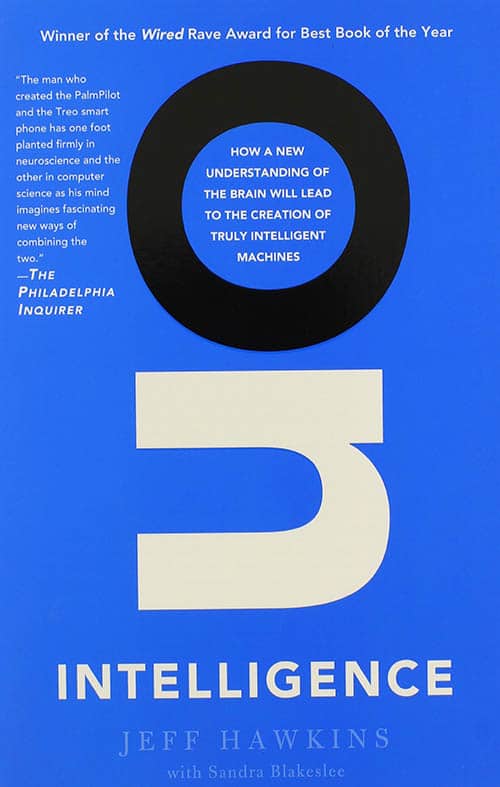
  • On Intelligence by Jeff Hawkins and Sandra Blakeslee – Book Review & Summary

    The Future Of Intelligence

    The entire concept of Artificial Intelligence (AI) has its basis on the workings of the human brain. The human brain is a wonder. Humans have been trying to understand its workings for centuries. Moreover, since the conception of computational tasks, humans have been trying to dabble in the field of AI. On Intelligence by Jeff Hawkins and Sandra Blakeslee delve into the workings of the human brain, its ability to compare new experiences to old memories, why machines are still unable to mimic this capability, and what lies in store for intelligent machines in the future.

    More Power Doesn’t Translate To More Intelligent

    As smaller computers became more powerful than their huge ancestors, scientists and researchers have been dreaming about a computer that can think like the human brain. Yet, humanity is miles away from developing machines as intelligent and capable of creative thought and understanding, as the human brain is. This is due to the fact that computers and the human brain are based on totally different principles.

    Computers are made for the storage of information. This information programs a computer to perform certain tasks based on the command or code it is given. Fundamentally, a computer cannot use the stored information later on and use it to understand and process other information, and neither can it learn new information.

    The human brain, however, has the ability to learn, apply previous experiences to new ones, understand and apply the information it acquires, via observation. This is what makes it intelligent.

    When the supercomputer Deep Blue beat the world chess champion, Garry Kasparov, it was able to do so merely due to the fact that it was able to calculate the probabilities of winning by running the numbers of each and every move and counter-move, and not because it was more intelligent than Kasparov.

    Increasing power, therefore, doesn’t translate into being more intelligent, because more power will only increase a computer’s ability to compute faster. Computers will never be able to think as the human brain does. For that, a computer will have to have the ability to understand how the human brain works.

    Information Processing

    The human brain processes information brilliantly. It combines the information received by the senses with existing memories, making humans capable of experiencing their surroundings.

    The neocortex is responsible for sensory perception and conscious thought processes. It is made of a number of layers that combine and relate new information to stored memories. The new raw sensory information passes through these layers, to which previously experienced details are added.

    For example, when one sees the face of a school friend, the eyes pass on this visual information to the brain. The lower layers of the neocortex further pass the information to a higher-layer that combines stored memory information, links it to the new visual, and thus helps us recognize the friend. This process is so fast that it enables us to experience our surroundings seamlessly and fluidly.

    When the information sent to the brain is absolutely new and the neocortex has no data to reference it with, the information is sent to the higher layer, where it is stored as a new memory. Thus the brain builds its ever-growing database of memories.

    Connecting The Past And Future

    How do we know for a fact that when we turn the knob on a door, it will open the door? How do we, so easily, predict this future?

    The brain stores different memories in different regions that get activated in a sequence or a pattern, when it receives familiar information. If we take listening to a favorite song as an example, one region of the brain recognizes the music notes from a previous memory, while another region references previously-stored memories of the lyrics, and yet another region links the two. Thus we recognize the song every time we hear it.

    These sequences and patterns essentially help us predict the future. Every time we experience something, the brain combs through different regions, looking for similar memories, activating the same nerve cells that were activated then. In this manner, the brain can dig up former reactions and reactions after that, enabling us to know what reactions to expect this time around. For example, the brain is able to predict that cars begin to move when the signal lights turn green, purely based on past experiences and stored memory.

    The human brain therefore, makes predictions and adapts those predictions every time there is a new experience. This is the process of learning.

    The Brains Unique Complexity

    After scientists realized that Artificial Intelligence lacks intelligence because it is based on traditional machines, they started to develop models based on the human brain – neural networks. Neural networks, like the human brain, use pathways of artificial neurons to pass information.

    Unlike the central storage unit in a computer, there is a vast network of neurons in the brain, in which information is stored. Scientists are trying to emulate this network to pass information.

    In a neural network, one neuron causes the reception of information to activate other connected neurons. Each neuron, in turn, sends the signal of the input to other selective neurons, triggering a wave of input signals. Based on how sensitive a neuron is to a particular information input, the strength of the signal that is passed on increases or decreases. The strongest signals end up being the output of the wave.

    Thus, if one inputs the alphabets ‘a’ and ‘n’ in a neuron, it will send the signal to other connected neurons and so on. Thus the neurons that are related to ‘a’, ‘n’, and ‘an’ will be the strongest signals that will be the output.

    Yet, these artificial neural networks are no closer to the sophistication and complexity of the human brain. They are limited by a one-sided flow of information, unlike the brain, where information can be affected by feedback loops from the higher parts of the brain, thereby affecting signals. It is these feedback loops that help us remember a mathematical formula learned when we were in school after trying hard to recollect.

    Neural networks also do not have the ability to build memory banks as the brain does. Thus previously received inputs cannot be stored for later use.

    Will Computers Be Intelligent?

    While humanity is still far from creating truly intelligent machines, we might be closer than expected. The biggest obstacle that scientists still have to overcome is to provide a computer a memory capacity as large as the human brain. This would mean having a memory of about 8 trillion bytes to replicate the brain’s synapses. Today, a computer has only 100 billion bytes.

    Despite the size of memory, it could be a feasible prospect today, if not for the second obstacle that scientists face – to make a computer with such a large memory in a feasible size to enable practical use.

    The answer to this problem could be solved by silicon chips that not only consume less power but also fast and robust. Silicon chips that could exceed the memory capacity of the human brain are not too distant a possibility!

    However, the third obstacle that challenges is that in the human brain, one nerve cell is connected to a thousand others. In AI, scientists still have not discovered how to achieve this kind of byte connectivity in silicon chips.

    The possible solution? Single fiber optic cables. These cables are used in telecommunications to transmit more than a million concurrent conversations over a single cable.

    If scientists are able to over come these three obstacles, more intelligent computers might as well be on their way!

    Intelligence Machines: Threat Or Benefit?

    The world of entertainment has already cast AI as a threat to humanity. Many movies and novels about killer, self-aware sentient beings have made greens at the box office. However, thankfully reality will be a far cry away from these!

    AI machines will have their intelligence modeled around the neocortex of the brain. The neocortex does not process emotions and feelings such as love, hate, anger, fear, and desire. These emotions are generated and processed in a more primitive, older part of the brain.

    As long as this part does not feature in the making of AI, the machines will remain unemotional, only capable of emulating the brain’s ability to learn, understand and link new information to stored memory. Essentially, they will be able to think, but not feel.

    To think of it, the benefits of AI as intelligent as the human brain will eventually far outweigh the risks and threats imagined. Considering the fact that a machine will never ‘die’, it could end up have a memory that would exceed that of humans, and be able to accumulate even more knowledge than humans do in a lifespan. While it is possible that AI could surpass the human ability to think and process knowledge, it would never become a threat.

    Conclusion

    Today the human brain outweighs computers in knowledge and the ability to learn, experience, and think due to the way the neocortex works. Technological development and neural networks bring the possibility of machines being smarter than humans, better at the memory, and more knowledgeable in the future. However, the perception that AI could bring about the extermination of the human race is merely a good movie concept.

  • Issue #28, 8 June 2021 – Where To Focus Your Attention?

    Welcome to the Deploy Yourself Newsletter. Every two weeks I share what impactful leadership looks like to show your own power. I also share the most insightful lessons and stories I encountered in the last two weeks. You can also read this issue online.

    Hey,

    Where To Focus Our Attention?

    Our attention is like the blade of the sword for the warrior. Where a warrior points the blade of their swords determines their success or failure in war. Similarly, where we choose to point our attention determines the results (both quantitative and qualitative) we produce in life.

    So, where shall we put our attention at this moment? Do we put it on what is immediately in front of me (news, social media, etc), or what brings us long-term joy and satisfaction? Do we put it on the risks, pressures, fears, and uncertainties of the world around us (especially during covid)? Or, do we focus our attention on what is in our control – our efforts, our planning, our moods, and our attitude towards life? The choice is ours.

    We can also choose to move the attention needle depending on what stage we are at.

    If we are a beginner at something, we can focus our attention on execution so that we move fast and learn as much as possible.

    If we are at intermediate at something, we can focus our attention on creating a strategy and going after our goals in a more planned way.

    And if we are nearing expertise in a domain, we can focus our attention on the way we see the world, and if there is a way to see it differently. For the expert, focusing on the observer that they are is often the biggest leverage point they need.

    What is your biggest leverage point right now – in different areas of life? Are you focusing your attention to those leverage points? Or, are you letting your attention drift to whatever is in front of you right now?

    Your attention is the blade of your “leadership” sword. If you want to sharpen more or find out what would that mean for your life, reply to this email. I read and respond to every reply.

    Articles and Stories Which Have Fascinated Me

    One

    6 Things To Avoid As A Leader to Ensure High Team Performance

    It is easier to cause damage as a leader by ignorance than it is to improve performance by deliberate intervention. Here are 6 things that you must avoid doing if you want to be a successful leader. 

    1. Do not accept mediocrity or low standards. Whatever standards you accept will become the norm. 
    2. Don’t treat people with disrespect. Even when they mess up. 
    3. Don’t force people to commit to deadlines or take on work that would mean spending time away from their families or ignoring their health.
    4. Don’t put profits over employee well-being. Don’t push people to stress and burnout
    5. Don’t bias your decisions because of who and what you like. 
    6. Don’t micromanage. Trust people and let them do the work they were hired for.

    While there are a lot of guides on what to do as a leader, these above 6 things are a simple reminder of what you should not do. Sometimes it is easier to cause damage to team morale and engagement with one small misstep. If you keep the above guidelines in mind, you will set the foundation for a strong team.

    From an article from my desk titled 6 Things You Must Not Do As a Leader To Ensure High Team Performance

    Two

    100 Tips For A Better Life

    This article lists down simple guidelines for life (I also see them applicable to leadership) divided across categories such as possessions, productivity, health, success, relationship, and above all, joy. Below are some of my favorites:

    1. Done is better than perfect. 
    2. Reward yourself after completing challenges, even badly. 
    3. If you’re not that smart but can communicate ideas clearly, you have a great advantage over everybody who can’t communicate clearly.
    4. If you’re under 90, try things. 
    5. Compliment people more. Many people have trouble thinking of themselves as smart, or pretty, or kind unless told by someone else. You can help them out. 
    6. Don’t punish people for admitting they were wrong, you make it harder for them to improve. 
    7. Human mood and well-being are heavily influenced by simple things: Exercise, good sleep, light, being in nature.
    8. Bad things happen dramatically (a pandemic). Good things happen gradually (malaria deaths dropping annually) and don’t feel like ‘news’. Endeavor to keep track of the good things to avoid an inaccurate and dismal view of the world. 

    From an article on LessWrong – 100 Tips for a Better Life

    Three

    George Bernard Shaw on Living a Life That Burns Bright

    “This is the true joy in life: being used for a purpose recognized by yourself as a mighty one;

    being a force of nature instead of a feverish, selfish little clod of ailments and grievances complaining that the world will not devote itself to making you happy.

    I am of the opinion that my life belongs to the whole community, and as long as I live it is my privilege to do for it whatever I can. I want to be thoroughly used up when I die, for the harder I work the more I live.

    I rejoice in life for its own sake. Life is no “brief candle” for me. It is a sort of splendid torch which I have got hold of for the moment, and I want to make it burn as brightly as possible before handing it on to future generations.”

    That’s it for now. If you have any questions or feedback, or just want to introduce yourself, hit reply. I read and respond to every reply. All the best,

    Sumit

    (Twitter) @SumitGupta
    (LinkedIn) Connect

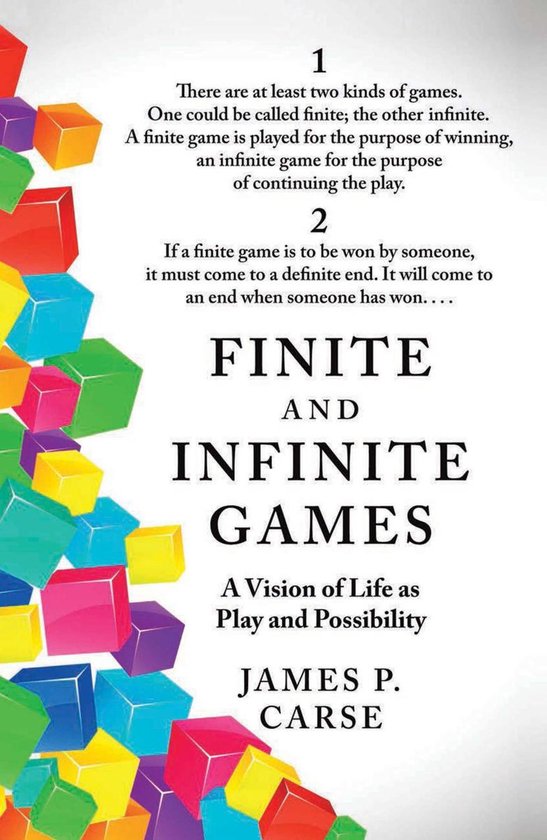
  • Finite and Infinite Games by James P Carse – Book Review & Summary

    Players Of The Game of Life

    Life can be viewed as one big game. James P Carse, in his ‘Finite and Infinite Games’ (1986) shows us how people live their lives in two contrasting ways, whether it is love, sex, or warfare. He discusses that finite games (ones where there is a definite end) and infinite games (that lead to never-ending possibilities) are defined by the choices one makes.

    He proposes the games of real life have real rules and goals, whereas some games don’t follow rules, nor have winners or losers. However, both finite and infinite games can have a resounding impact on our lives.

    All Of Life Is A Game

    Every part of life can be viewed as a game adults play. Let us delve into what finite and infinite games are.

    1. Finite Games – Finite games have a clear beginning and have very specific, spatial, numerical, and temporal rules. They also have a clear playing field and a definite number of people playing the game. Apart from these external rules, finite games have certain internal rules and restrictions too. The players, in the beginning, agree upon these rules and comply with them with the aim of winning the game. Once a player wins, the game is over.

      A general election is a classic example of a real-life finite game. The rules are pre-decided, and based on the number of votes; a candidate (or a player) wins. The general rules include only one candidate per party and clearly outline what practices are allowed and what is not.
    1. Infinite Games – These are the absolute opposite of finite games. Infinite games of life are played like one long continuous game. Thus, these do not have any internal or external restrictions, and anyone can participate, anytime, anywhere.

    For example, if we see the field of music, there are no definite numbers of players; anyone can participate, anytime, anywhere. Composers do not make music to win or be the best. Instead, one composer winning composition is often inspirations for others to write better music.

    More examples of finite and infinite games will help us see how life can be likened to a game.

    Defining Boundaries Of Games

    Finite games, along with the aforementioned spatial, temporal, and numerical rules, have certain set boundaries. Consider a case wherein the rules for a general election merely stated that two people can compete and the one with the most votes is the winner.  With this simple definition, even criminals could stand for elections, and the elections could be held on a daily basis!

    However, because finite games are regulated by an audience who decides the when and where of the game, and who the players will be, the players are bound by the rules bestowed by the audience. Moreover, they are under pressure to play and to finish the game.

    For example, a person writing an exam is a player, who needs to adhere to the timelines of learning and completing the exam on time.

    Infinite games, on the other hand, place no boundaries on players. Players, therefore, are the masters of their own time in the game. Infinite games also present the player’s new possibilities, with every moment – that is seen as a new beginning to a new range of possibilities.

    Players in infinite gameplay for as long as they wish to, invite others whenever they feel the need to, and play by any rules they create.

    Society Versus Culture

    Any game in life, whether finite or infinite, has others involved in the game. These other players can be on the same team as the player or opponents. However, how a player perceives others in the game differs on the basis of finite or infinite.

    For finite players, there is an end reward. Therefore, they perceive others as part of a society (or life) wherein there are smaller finite games – like school is a definitive finite game within another game. Finite games award titles to winners. For example, the title a finite player will assume for a priest is ‘Father’ (wherein the priest has won the title in a previous finite game).

    Titles are to be honored by the players of finite games and can be displayed via property and possession. For example, a player attends law school and opens his own prestigious law firm.

    Infinite players on the other hand perceive society as a constantly developing culture. Their focus lies on the future and they do not concern themselves with past achievements. It for this very reason, that infinite players involve others in the quest for the future. They do not seek an end solution.

    For example, infinite players would address the root cause of poverty, rather than to try and end it by helping the poor with some amount of charity.

    Winning Versus Cohesion

    Finite players are defined by the need to win, to take control over others in the game, to compete, and to dominate by winning. It is their end goal, whether it is a conversation with a friend or in the bedroom with their partners. They endeavor to overshadow their opponent and show their superiority. They perceive even the most basic conversation as a game that needs to be won. Their need for convincing others that their opinions are true becomes a title to be won – that is the title of knowledge.

    When it comes to sexual relations, finite players perceive them as a means of conquering their partners and at times, can even create elaborate rituals of courtship to emphasize and fulfill their needs of reaching their end goal of winning.

    Because infinite players give more weightage to the game itself rather than the end goal, they do not have the need to demonstrate superiority. They value both, listening and talking, and believe that life is about to give and take. For example, an infinite player will perceive a conversation as an opportunity to share knowledge than to explain the truth in their opinion. They prefer to offer their conversations as perspectives rather than the absolute truth.

    Furthermore, when it comes to sex, infinite players do not concern themselves with the outcome (of either bearing children or achieving physical pleasure) but see sexual relationships as a means to explore themselves and their partners.

    The Past Versus The Future

    Finite players feel the need to assume roles designed and defined in the past. They have a fixation on their past because they need to prove themselves. For example, if a finite player is the son of a wealthy family, they will feel the need to safeguard the reputation and the property of the family. Thus the finite player will naturally assume the role of the heir.

    A finite game is all about winning, yet, how often a finite player actually wins becomes irrelevant. This is because a finite player wouldn’t really be in a finite game if it wasn’t based on the past. A finite player, though fixated on winning, unfortunately, is a loser, simply because he dwells in the past. For example, a finite player who needs to prove himself to his office colleagues will aim towards winning the title of the best employee.

    However, once the achieved title becomes past history, they will set their sights on another achievement, because they consider their past winning selves as a loser, and need to win again. It is their motivation to keep moving ahead in life.

    Infinite players, on the other hand, focus on originality, uniqueness, and their own internal genius. Due to this they make peace with the past and focus on the future. The future for them is full of opportunities and endless possibilities, and they look forward to an open-ended game of life. Therefore an infinite player born in a wealthy family will consider it a new opportunity to opening a door full of unlimited possibilities, rather than be constricted by dwelling in the past of the family.

    It Is After All A Choice

    Life is complicated. Moreover, it could be a combination of finite or infinite games, or a finite game within an infinite game, or vice versa. How one perceives it is after all a choice.

    Participating in any game is voluntary, yet finite players feel compelled to participate and win. While being a finite player or playing a finite game requires one to abide by and adhere to certain set external rules, being in a finite game is after all a choice.

    For example, a lawyer needs to pass a bar exam and practice law in court regularly to be a successful lawyer. Yet being a lawyer itself is a choice. Sadly, it is often seen that finite players get trapped within the finite game and forget that they can choose to exit it altogether. They get too convinced themselves by the faces they need to adorn to abide by those external rules. For example, the CEO of a corporate forgets that he can take a break and go on vacation.

    Playing a finite or infinite game is a matter of choice, and players need to keep in mind that they can play any way they want to as long as they don’t hide behind their masks and don’t get fooled by the masks of other people.