January 2020

  • 6 Learnings About Fear From The Fear Factor by Abigail Marsh

    Most people look at fear as a negative emotion, as an emotion to overcome. This book looks at the complex role that the emotion ‘fear’ has on us. It looks at the link the emotion fear has with other virtues such as altruism and empathy. 

    This book delves into concepts such as – 

    • The link between fear and empathy
    • Physical defects in the brain affect how much we fear and how we respond to it
    • The relationship between altruistm and fear
    • Relationship of hormones and fear (parental instincts)
    • Literacy: the key to reducing violence?
    • Compassion, meditation, and fear

    The author Abigail Marsh cites many studies (including her own) that show fear is linked to certain behaviors, and that it can lead to acts of kindness. So how can our fear help us?

    1. The link between fear and empathy.

    Empathy is the ability of a person to recognize another person’s emotional state.  We naturally perceive others we meet as nice or not. The author discovered that empathy was strongly related to the ability to recognize when others feel fear. 

    The author cites an experiment conducted by Daniel Batson in 1978 that showed a relation between empathy and altruism, and a person’s ability to recognize fear in others.

    2. Physical deficits in the brain affect the emotion (psychopaths and altruists)

    The Fear Factor by Abigail MarshThe previous experiment led researchers to believe that fear and empathy are linked to the amygdala, an almond-shaped part of the brain that detects threats and brings about a response to fear. It creates a feeling of anxiety and hyper-awareness, releasing adrenalin into the bloodstream and elevating heart rate and blood pressure.

    Case Discussed: Robert Hare, a criminal psychologist interviewed a psychopath. This experiment showed that, an impaired or dysfunctional amygdala restricted the psychopath to experience and identify with fear. This showed that people with damaged amygdala found it difficult to experience fear.

    Case discussed: Kidney Donors of the United Network of Organ Sharing. Another case study conducted by the author on anonymous kidney donors showed that the amygdalae of altruistic people work differently in the presence of perceived fear, and they are able to empathize more profoundly with others in distress.

    3. Altruists and fear

    Altruists have a keen sense of recognizing fear in others. However, this doesn’t mean that altruists are less brave or, do not feel fear. In fact, they are normal, but only tend to overrule their fear when needing to help others. Those who can recognize fear well tend to me more altruistic.

    The author Abigail Marsh gives the example of the former mayor of Newark, Cory Booker. The recount of his fearless rescue of his neighbor from the fire, while was heroic and brave, was also terrifying for him.

    Case discussed: The kidney Donor study also showed that while the donors were not fearless and would avoid risky situations and dangers their empathy was strong enough to help someone. Such altruists also feel excitement or elation while risking themselves to help others. 

    4. Relationship of hormone Oxytocin and fear 

    Altruism isn’t seen as a result of the amygdala only. Other hormones in the body such as Oxytocin are also responsible for nurturing behaviors promoting altruism. Oxytocin also plays a part in helping humans identifying fear. However, it also stimulates them to face danger.

    Case discussed: 2016 experiment where rats were given small doses of Oxytocin. Due to the hormone, the rats showed physiological signs of fear, but they did not freeze or run away, unlike when they weren’t exposed to oxytocin. This shows that oxytocin stimulates rats to face dangerous situations and help others.

    5. Literacy: the key to reducing violence?

    Myanmar is at the top of the list of the World Giving Index. Surprisingly, this adds to the fact that Myanmar also has a 90 % literacy rate. The connection lies in literature, enabling an enthusiast to be unbiased while perceiving a story and creating an empathetic connection, working in a similar manner to how the brain works with empathy. This shows that literacy could be the answer to reducing violence world-over.

    Case discussed: Daniel Batson’s experiment that shows that empathy can boost cooperation with other individuals, simply by reading.

    6. Compassion meditation is a good way to move towards altruism

    Altruism is a trait that develops over time and with practice. It can become a long-lasting habit. A small experiment on mother rats shows that once altruistic behavior is experienced, it will eventually become a habit.

    The Buddhist practice of compassion meditation helps to develop empathy as a habit, even towards strangers. You can start doing it by focussing your attention on your breathing.

    The Key Takeaway

    Fear isn’t necessarily a negative emotion. It can bring out positive outcomes in people too. Where absolute lack of fear leads to psychotic behavior, it also enables people to empathize more and promotes altruism. Fear can be harnessed positively by reading positive books, at the same time, altruism can be encouraged by practicing meditation.
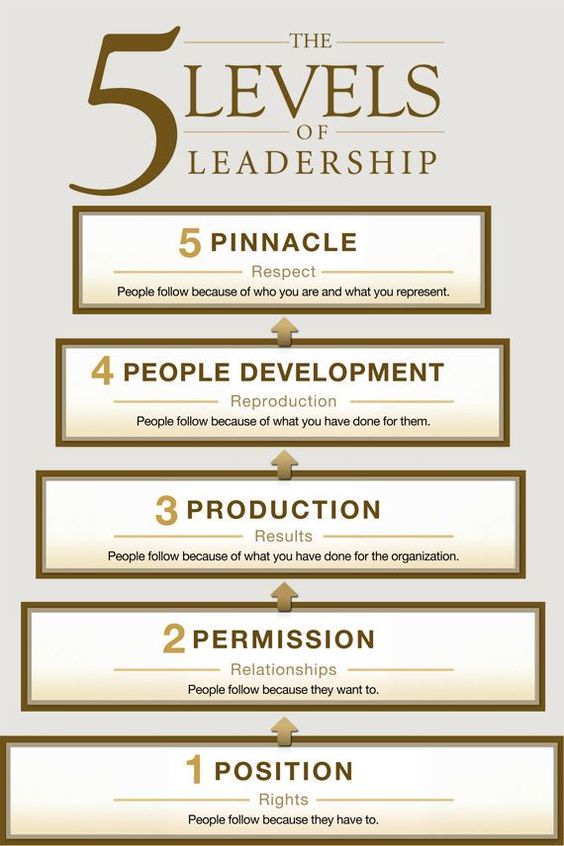
  • 5 Levels of Leadership by John C Maxwell – The Leadership Ladder

    Having a managerial title doesn’t make you a leader. It is, in fact, only the first step towards leadership. In The 5 Levels of Leadership, John C Maxwell points out the main pitfalls that often hold managers back from following the path to great leadership. At the same time, he also explains how we can overcome them.

    A leader is made, not born. It takes perseverance, vision, strategy, and relationship-building skills, and many more qualities to merely work well in a managerial role. 

    To become a good leader, one has to practice and master each of these skills (levels) to become a truly well rounded, inspiring leader on their climb to the top.

    Level 1: Defining Leadership Through Personality and Core Values

    Reaching managerial positions is the starting point of the leadership journey. Many consider managerial positions an end-goal and become complacent once they reach them. Additionally, some managers think that positions give them the power to command. 

    Such leaders called Positional Leaders, and never really understand the true purpose of the position. They busy themselves with trying to gather a big team, most often unable to do much for the team as a leader. Positional leaders are so obsessed with their positions that they cannot give their teams direction.

    Good leaders work towards creating a lasting impression on their subordinates. They need to choose their core values and principles based on who they truly are. Their core values should reflect in their personalities and in turn their leadership skills should be defined by their personalities.

    Level 2: Building Trust and Positive Relationships

    Leadership is always about what the manager can do for the team, and not about what he does for himself. Keeping this in mind, leaders should help create a work environment for the team that is conducive, fun, enjoyable, and most importantly comfortable.

    Good leaders build positive relationships. To build these, leaders need to seek permission from their team members. In order to get permission, they need to foster positive relationships, gain trust, and value people around, and to do that, a leader has to think about others first.

    For Example, the US Marines’ core value of not leaving anyone behind is clearly seen when he or she leaves his or her rank insignias behind before war. It helps level the relationships between ranks and created a feeling of camaraderie and belonging.

    Level 3: Mastering How To Produce Result

    Successful leaders are measured by the results they produce. A leader is able to generate successful results only with an effective team that helps him execute.

    Therefore producing results often relates to how the leader chooses and manages the team, to steer it towards efficacy and success. Leaders need to understand that a good effective team not only comprises of individual performers but also of individuals committed to collectively succeeding in reaching the goal, by exercising their specific talents and skills.

    The leader should know that the success of the team is a contribution of each individual as well as the success of an individual in the team is a collective effort of the entire team. Moreover, a good leader knows how to chart the team in the right direction. He, therefore, put efforts into building the team, in choosing the right person for the right role, according to their respective strengths and weaknesses.

    Finally, the leader should also know how to optimize a team member’s performance in matters beyond the business as well.

    Level 4: Creating A Wave Of Momentum By Leading With Example

    George Washington, during the Revolutionary War, rode towards a group of soldiers who were unable to lift up a beam. Their commanding officer was standing beside them, shouting words of encouragement. However, the group was unable to lift the beam. 

    George Washington, dismounted, approached them, and helped to lift the beam. His physical contribution not only added the additional force that was needed to lift the beam, but his act of help instilled a sense of confidence and provided motivation to the soldiers. He displayed enthusiasm and drive that motivated the group to lift the beam. He also led by example and capitalized on his victory to build momentum.

    In the words of Thomas Carlyle, “Nothing builds self-esteem and self-confidence like accomplishment.” A good leader knows that while inspiration to succeed is essential to success, capitalizing on that success to build a wave of momentum amongst the team is as important to uplift the team and generate even better results.

    Level 5: Creating A Legacy By Helping Other Succeed

    The final level of leadership is to be cognizant of two things – 

    • First, a truly great leader focuses on transforming the people around him for success.
    • Second, a truly great leader builds a legacy by mentoring others to become great leaders.

    Both these points work in tandem. A leader cannot build a legacy without helping others reach success, and similarly, he cannot help others reach their full potential without the knowledge and the empowerment of being able to mentor great leaders.

    A leader knows that his people are his greatest assets in today’s dynamic work environment. Therefore, for the company to grow and succeed, or for the leader to grow and succeed, the focus of growth and success has to be on the workforce. People-development is one of the most crucial aspects of good leadership.

    Yet a good leader knows where to pull back. He should be able to judge when to let the employee test the waters on his own. Empowering a team member to grow on his own is a mark of a truly transformative leader – a leader who puts 80% of his efforts in ensuring the productivity of their team.

    This huge amount of effort that a leader invests in the employees pays back in the form of creating a legacy. No organization can survive with monopoly leadership. Leadership needs continuity for the organization to be consistent and successful. Therefore, great leaders invest much of their effort into ensuring that there is a culture of leadership in the organization that is as dynamic as the work culture today.

    Leaders craft future leaders. And those leaders of the future carry the legacy of today’s leaders into infinity!

  • Turn the Ship Around – How David Marquet’s Leadership Turned Around A Nuclear-Powered Submarine’s Performance

    This is a story that can change the way we think about leadership. This story of a United States Navy Captain David Marquet who transformed a dissatisfied submarine crew into a formidable and respected team gives us insights about how strong leadership can make a big difference to an “underperforming” team.

    Turning Around The USS Santa Fe

    Turn The Ship Around - David MarquetThe USS Santa Fe, a nuclear-powered submarine, was infamous for its sub-par performance and crew retention rate. David Marquet, a U.S. Navy Officer captaining the USS Santa Fe, transformed it from being one of the fleet’s worst-performing teams into an efficient and effective team winning it many accolades. Encouraging the members of his team to lead, he empowered his whole team to perform better and succeed, making him a better leader in the process.
    For example, he moved the chain of power down the hierarchy to his chiefs. He ended many inefficient and time-consuming processes such as leave approvals that needed sign-offs from three different officers.

    With more power and responsibility in hand, the chiefs became more passionate about the performance of their team and boosted the crew’s competence levels. He changed the very structure of leadership using many different mechanisms to bring about a sea change in the functioning and the performance of the team. 

    How and what did he do to turn the ship around?

    Simple Changes Can Go A Long Way

    A recent Conference Board Survey showed worker satisfaction rates and overall productivity has hit an all-time low. The US economy is facing a leadership crisis. 

    Why?

    An age-old organization structure could be the reason for the alarming statistics. As David Marquet shows in the book, the current organizational structure needs to be examined. 

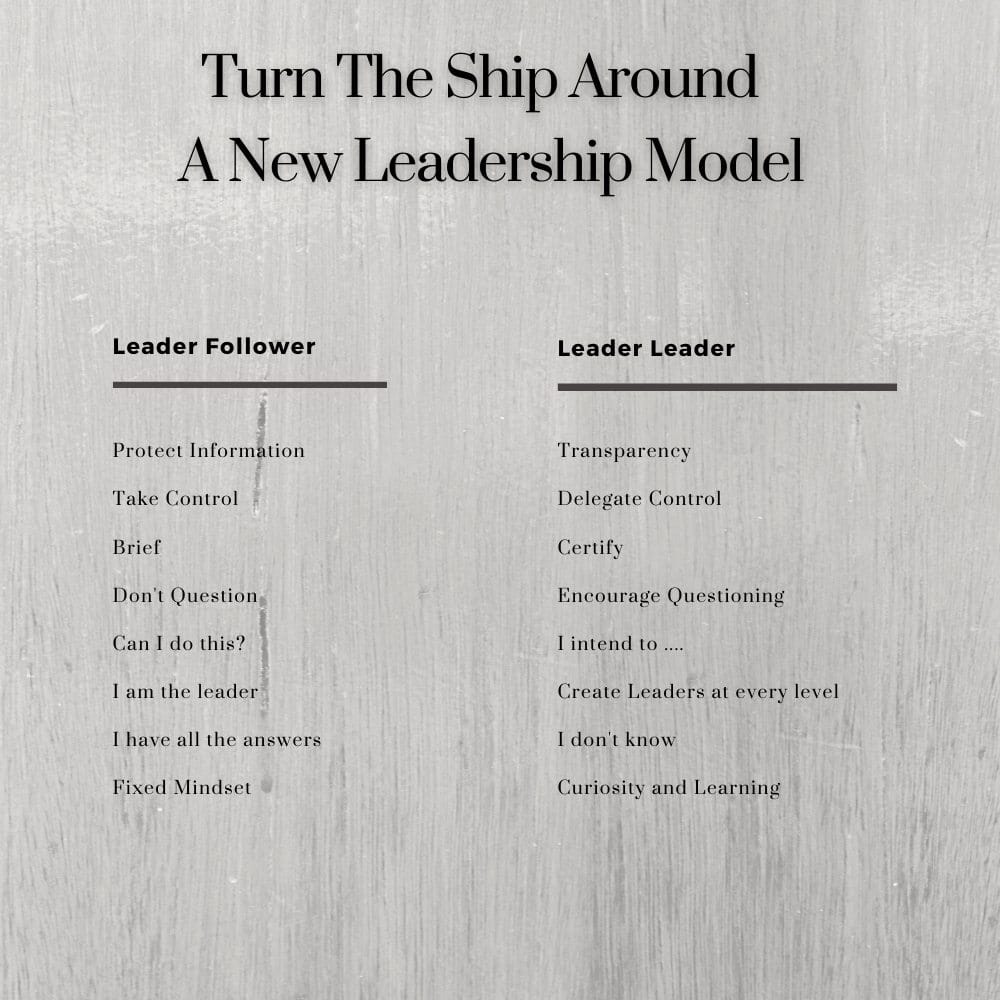
    Our organizations have used the leader-follower approach right since the times the Pyramids were built in Egypt, through the Industrial Revolution, until today. In this approach, the leader makes the decisions, and these are carried out by the follower. While this structure was suited for work needing physical labor and menial tasks, it does not suit today’s roles that need cognitive and decision-making skills. Today, we need a change in the way we perceive leadership.

    The age-old top-down leadership model does not tap into the natural leadership abilities of the workforce. A few simple changes and a re-evaluation of the way we look at leadership will lead to benefits not only for the employees but the organizations too. These changes were applied by David Marquet. And he saw some remarkable changes using his new model – The leader-leader model of leadership.

    The leader-leader approach is a radically different outlook on the leadership structure.

    • The difference between the two structures lies in the way decisions are made.
    • This new approach not only puts decision-making in the hands of more people but also empowers the workforce to recognize their leadership qualities.
    • Unlike the leader-follower chain-of-command, the power to make decisions is distributed throughout the chain-of-command in the leader-leader structure, where individuals can act on any newly received information.

    Implement by Decentralising Decision Making

    To implement the leader-leader approach, the deeply ingrained hierarchical organization structure itself needs change. It means that managers give up some amount of their decision-making control. They need to ensure that decision making involves the employees. David Marquet learned that his chiefs became more passionate about ensuring that their team succeeds and were more concerned about their overall efficiency than before. Simply because he made simple changes to the structure and handed leadership to his subordinates using the leader-leader approach.

    This can be done by identifying old processes and ways of doing things in the organization and changing them. Once people start to act differently, they will also start to think differently. For example – David Marquet had everyone inform him of their decisions with the phrase “I intend to…” instead of asking for permission to do something. This way he was aware of what people intend to do.

    The Pillars of Competence and Clarity

    Competence

    While giving additional responsibility, managers need to be sure that an employee can rise to the responsibility given. Mechanisms that ensure that the workforce builds and maintains their competence levels need to be used. This will empower them to make good decisions.

    Marquet emphasized on constant learning and delegated decision making as tools to improve competence in small steps. Every activity was seen as a chance to learn and do the tasks better. The leaders emphasized this message repeatedly to make sure people don’t revert back to old habits. Keep the communication flowing. Taking deliberate action – making your actions vocal and using gestures to deliberate actions – is one example.

    Clarity

    Not only managers have clarity of whether they can hand over more powers to the employees, but also when the employee can handle the task at hand. Leaders on Santa Fe ensured clarity by focussing on achieving excellent results, and not just to play safe and avoid errors. People were encouraged to question their peers and leaders if something was not clear. Everyone had long term goals and a desired end result, and the managers appreciated and recognized good performance whenever they saw it.

    These mechanisms can boost employee satisfaction and performance. The successful implementation of the leader-leader structure on the USS Santa Fe produced remarkable results.

    Common Goals And Shared Values

    For this strategy to succeed, all the employees of the organization need to be on the same page. If the decision-making power is to be shared by everyone, it is essential for all employees to work towards the same goal. The vital core values of the organization should be the focal point.

    This can be done by deriving inspiration from history, through the legacy and the founding story of the company. People need to be appreciated and rewarded for performance.

    Applying the leader-leader structure can result in achieving considerable success. And the lessons from the book are applicable to any organization or company.

    As David Marquet writes in the book, this new approach is for all those frustrated workers and bosses for whom the current leadership structure just isn’t working. We need to reject leader-follower as a model and view the world as a place for leaders everywhere to achieve this vision.

    Leader Leader Model by David Marquet
    The Leader Leader Model by David Marquet

  • Developing the Leader Within You by John C Maxwell – Moving Up The Leadership Levels

    Leaders play a crucial role in all possible walks of life, whether it is the boardroom, the courtroom, classroom, or even the battlefield. They are vital to the basic functioning of an organization and help bind the workforce to the values of the organizations and guide them along the path to success. Leadership is like a ladder. It has ascending levels that take time and practice to master, and moving up means to be able to balance between personal growth, the growth of the organization as a whole, and the success of subordinates.

    How does one, therefore, reach the pinnacle of this ladder? Developing the Leader Within You (1993) by John C Maxwell, shows the way to master the levels of leadership, imbibe the necessary qualities and traits needed to succeed as a leader, and how to take concrete steps to steadily, but surely reach the peak.

    The Five Levels Of Leadership

    To begin understanding leadership, it is essential to understand that it is a crucial quality that powerful people possess. Leadership is simply, the ability of a person to influence others or a group of people. That said, anyone who has the ability to make others follow them could be termed as a leader. JFK, Churchill, and even Hitler can be called a leader.

    Leadership has 5 levels of hierarchy. Every leader has to master each level and move up the ladder to the next one. The five levels of hierarchy are – 

    • Position – This is the first level of leadership. Those who are leaders at this level are leaders merely due to their titles in the organization.
    • Permission – Permission is all about being attuned to the needs of followers. It entails building and maintaining relationships with followers. At this level, if the leader neglects the needs of his followers, the followers will lose interest in the leader.
    • Production – At the production level, leadership becomes the product of the success of the followers (team). At this level, the leader works hard to ensure that the team works towards producing formidable results while being tuned to their needs at the same time.
    • People Development – The fourth level of people development entails focusing on mentorship. In this level, both the leader and the follower have a sense of loyalty; the follower towards following the guided path, and the leader towards guiding the follower towards success by helping them grow and acquire new skills.
    • Personhood – A leader who has attained personhood, has spent his entire life working for the success of their team members. They reach this level only because they have constantly strived to put the successes of their team members, organization, peers, and colleagues before their own. This final level requires constant perseverance. It is the level where a leader naturally commands respect, loyalty, and inspiration for others to follow.

    Now that we know the five levels of leadership, let us look into how we can master each of them, and reach the top of the ladder.

    Setting Priorities

    Setting priorities seems like a simple task. However, at the leadership level, it is much more than just known which task takes precedence and what to focus on. We all come across tasks that are important, tasks that are urgent, tasks that are neither important nor urgent, and tasks that are both, important and urgent.

    Apart from tasks, prioritizing also extends to other things such as time, energy, money, staff allocation, etc. in order to be able to successfully prioritize, one can use the 20/80 rule. The rule states that – 

    • 80% of the resources such as money and time should be allocated to the top 20% organizational priorities,
    • The top 20% of the most productive staff accounts for 80% of the organizational successes, therefore, 80% of the leader’s time should be dedicated to them.
    • Barring the top 20% organizational priorities, the remaining 80% should be delegated or outsourced.
    • And the top 20% of the organization should train new recruits.

    Put simply, a leader should be able to prioritize the most important tasks and invest time, money, and energy in the top employees to be productive and successful.

    Letting Integrity Be Your Compass

    What is integrity? Integrity is having a set of values that a leader adheres to, without wavering. This set of rules become the compass that guides the leader forwards. Integrity involves being consistent and true with words as well as actions.

    People get inspired to follow a leader’s actions. Therefore, if the leader leads by example, and follows his words with actions, he will be trusted and respected. Consistency in showing integrity will reinforce credibility and thereby help garner trust. Integrity makes the foundation of a long-lasting reputation that will endure.

    Creating Positive Change

    Adapting to change is one of the most important characteristics of a leader. With the work environment being fast-paced and dynamic, a leader has to be prepared to brace the changes in time. Inability to adapt and change can adversely affect the organization and most likely, the leader and/or his organization could succumb to competition.

    Apart from being able to adapt, a leader should be able to envisage the psychological changes that his employees will undergo as well as the challenges that they will face. Any form of change leads to insecurity and stress in the organization. The onus, therefore, lies on the leader to make sure that his team is aware in advance, of the changes that they should expect and the objectives those changes aim at achieving. This will lead to creating positive change in the organization.

    Self-Discipline 

    Self-discipline is an extremely crucial characteristic of good leaders. Without self-discipline, a leader cannot, and should not expect others to follow him or her.

    Self-discipline involves focus and practice on a daily basis. That is why it takes a lot of time to develop self-discipline. Additionally, without self-discipline and hard work, the growth of the leader, and thus, in turn, the growth of the organization gets stunted. 

    Leaders can use the following to inculcate a habit of self-discipline.

    • Start by making a list of five areas where you want to become more disciplined. 
    • Identify a mentor, peer, or colleague who is already disciplined in a particular area and ask them to monitor your progress.
    • Take fifteen minutes every morning to chart out your plan as to how you are going to work on the areas, and then revaluate for five minutes in the afternoon and five minutes in the evening to reflect on the daily progress.
    • Ideally, repetition of the same task help inculcating a habit. Cross the area of the list and move on to the next area.

    Having A Vision

    A leader should have a clear vision of their end goal in their mind. They need to envision where they plan to take the organization in terms of growth and success. Additionally, they should be able to have an idea of how they plan to persuade their team to reach the goal. The vision of the leader should fuel the daily working of the organization, the team, and the leader himself.

    Without a vision, a leader cannot lead others towards a goal, because, without a goal, a leader will not believe deeply enough to strive hard, to persevere, to add team spirit, or the drive-in his team to perform.

    However, not all leaders have a vision in place or a drive to leadership by a vision. Some need to build one. In such cases, leaders need to constantly keep questioning their dreams. They need to ask themselves, what keeps them going on day after day. Most importantly, they need to know if they can walk the talk and put their dreams into action.

    Final Message

    People follow leaders who have integrity. Moreover, they want to follow a leader with substance, self-discipline, and one who has the experience of driving his vision. They follow a leader who is open to change and is able to shift gears in the face of change. 

    Whatever level of leadership one stands at, they can move to the next level of leadership by keeping in mind the aforementioned practices.

  • How To Discover Your True North? And Other Key Lessons from Bill George

    Discover Your True North by Biill George (2007) is one of my all-time favorite leadership books. This book can help you discover one’s inner compass, develop authentic leadership skills, and uncover your values. It aids in becoming a better leader by keeping you on track and staying grounded.

    Finding Your True North

    The author of True North, Bill George interviewed 125 leaders, only to find that they are not very different from everyone else. He found that they know what the right issues are and give importance to them first. They focus on their True North – their inner compass that guides them to better hone their authentic leadership skills.

    1. Your own life story can inspire youDiscover Your True North - Bill George

    Leaders know and understand that their own life stories have true value. They learn from these experiences. A true leader is genuine, true to his beliefs, and uses his own experiences to motivate others. The key events in one’s life can be a guiding star to find one’s True North.

    Case 1: Howard Schultz, founder of Starbucks. Personal experience and memories of his father carried him along the path to authentic leadership.

    Case 2: Reatha Clark King, former president of the General Mills Foundation. Her struggles as a poor black woman from Georgia in 1940, showed her the way to create opportunities for the poor and to overcome racial and gender discrimination.

    2. Losing sight of your inner compass

    Money, success, acclaim, and rewards can lure leaders astray and lose sight of their inner compass. Bill George suggests that there are five archetypal leaders who get derailed from their path – 

    1. Imposters
    2. Rationalizers
    3. Glory seekers
    4. Loners
    5. Shooting stars

    Case 1: Phillip Purcell, the former CEO of Morgan Stanley. A true imposter archetype used manipulation to climb up the corporate ladder, only to lose his credibility and many talented employees. 

    3. It’s not about how you lead, but about who you help succeed

    Some leaders expect their followers to ‘follow their footsteps’. However, it’s not about gathering supporters to help you get ahead in life, but about motivating others to do their best to succeed and about realizing the true purpose of one’s leadership. Such realization often leads leaders to understand their greater calling through triggering experiences.

    Case 1: Oprah Winfrey’s pivotal interview with Trudy Chase. The interview was a transformation that led her to understand her true purpose in life – to help others along their journey to success.

    Case 2: Steve Rothschild, Vice President of General Mills. Dissatisfied with his leadership skills, he left his position to answer his true calling – helping underprivileged people become financially self-sufficient.

    4. Self-awareness guides the way

    Self-awareness keeps a true leader on track and helps in understanding shortcomings. You must know yourself, understand your strengths and weaknesses, and align them with your capabilities. A true leader can build strong teams with employees who have the skills that he lacks and learns from them. 

    Case1: Bruce Chizen, CEO of Adobe. He used his capabilities and skills to succeed in a role that he felt insecure about.

    Case 2: Ned Barnholt, former CEO of Agilent. He built his team with financially competent team members knowing he lacked accounting skills.

    Self-awareness has a downside too. It can be a blind spot for many leaders.

    Case 3: David Pottruck, former CEO of Charles Schwab. Lack of self-awareness led to others perceiving him as self-serving despite being a hard-working CEO. He had to work hard to face his shortcomings and change perceptions.

    5. Guiding principles and values to align with leadership

    Values and principles, along with self-awareness guide leadership. If a leader has firm values and principles, he will establish authentic leadership skills.

    It is always easier to stick to values and principles in easy times. The challenge is to stand by them even when careers are at stake. It is under extreme pressure that these values will be truly tested and could undergo metamorphosis. 

    Case 1: David Gergen, Presidential Advisor to Richard Nixon, Gerald Ford, Ronald Reagan, and Bill Clinton. Even at a time where his entire career was at stake, he did not stray and stood by his principles.

    Case 2: Narayana Murthy, Founder of Infosys. He stuck to his values of honesty and ethics and saw success without bowing down to corruption.

    6. Inspiration, purpose and, motivation

    Self-aware leaders have a purpose and a goal that is driven by values and principles. Though focused, and fuelled by their capabilities, without the right motivation even the best leaders can only get so far. Authentic leaders go beyond and dig deep into their life experiences for the inspiration to find their true north.

    Case 1: Bob Fischer, Chairman of The Gap. His concern for the well being of the environment was triggered during a fishing expedition on the Feather River that led to him joining the Natural Resources Defence Council (NRDC).

    Discover Your True North - Bill George

    7. The importance of a support system

    Whether it is a mentor, a support group, close relationships with supporting teams, or even close friends and family members, leaders understand that a solid support system is necessary. They understand that it is essential to nourish relationships. They know that their support system is not for making them feel good about themselves, but for challenges with a little bit of tough love.

    Case 1: Dave Dillon of Fry’s Supermarket. He found a mentor in Chuck Fry, the founder of Fry’s Supermarket after Chuck Fry himself decided to walk Dave through a Fry’s Store and hand priceless titbits of experience.

    Case 2: Bill George, the authors of the book, finds that his every Wednesday support group of 30 years is one of the most important sources of the most honest feedback.

    8. Staying grounded and being always integrated 

    True leaders know that they need to integrate their personal and professional life and be the same person at both places. One can be grounded by remembering one’s humble beginnings even during the high points in life. True leaders find a base point where they can return to strike balance and reclaim the perspective of their true goals.

    Case 1: Kris Johnson, former head of global business Medtronic. At the pinnacle of her career at Medtronic, she left and joined a mid-sized venture capitalist company because she was spending too much time away from her family. An essential sacrifice to strike balance.

    Case 2: Akshatha Murthy, Daughter of Infosys CEO Narayana Murthy. She finds her base point in her hometown, Bangalore. She returns regularly to meet her old friends and family to keep grounded.

    Conclusion

    There are many facets to becoming a truly authentic leader. All the great leaders of the world have their inner compass in focus that is guided by their firm values and principles, a sure sense of self-awareness, intrinsic motivation, a strong support system, and a keen sense of grounding.

    Tapping into these facets can make you a truly authentic leader!

brain care coaching commitment communication conflict conflicts conversation culture deployyourself deploy yourself emotional intelligence emotions empathy energy feedback freedom future gold habits hope john maxwell language leadership lessons listening performance perspective preparation productive productivity psychological safety purpose questions relationships resolution ryan holiday seth godin simon sinek strengths struggle team trust values words