team

  • 7 Steps To Build A Highly Effective Team

    Every team is different as human beings are complex. And organizations can be even more complex. If the team members do not gel and work together effectively, problems can arise very quickly or they can slowly simmer under the surface. Talk about missed deadlines, infighting, declining productivity, poor customer service, etc. All of these have a bearing on the team’s output and the company’s bottom line.

    Finding the right people is the first step in building a high-performing team. However, bringing several talented individuals together under one roof is not enough to make an effective team. So what can you do to ensure the group of people becomes an effective unit which works together? Here are 7 common attributes of highly effective teams, and how to build such a team?

    1. Good Leadership

    Leadership has less to do with positions and more to do with the ability to influence. Today, leadership is no longer reserved for those at the top. Everyone has within them the ability to become a leader in their own sphere.

    Effective teams don’t necessarily have one great leader. Instead, they promote a culture of leadership. That doesn’t mean multiple people competing to become leaders. It is about each individual playing their part and supporting each other for the benefit of the team.

    Every team needs a north star—a clear and shared vision. Each member should know the direction and purpose behind what they are doing. A team without a united vision is like a group of chickens with a lot of energy. They will continuously be busy running around but never make any progress. 

    Therefore, a team should first co-create the shared vision, objectives, and outcomes before undertaking a project. Moreover, the vision should be restated often. It is not enough to engrain it on the door or post it on the website.

    According to research by Rungway, 52% of employees don’t know their company’s vision. The same research shows employees want to be involved more in actualizing the company’s vision and values. Even when working on different facets of a project, team members should know the end goal. 

    When the team is involved in setting goals and objectives, they are more willing to rally behind them. As John F. Kennedy noted, “Effort and courage are not enough without purpose and direction”.

    It is hard to focus when multiple needs are competing for your attention. And when the team is overloaded with tasks, chances are that people will struggle with one thing or another. With so many buttons to push and levers to pull, the team can get easily frustrated.

    Highly effective teams navigate these muddy waters by focusing and prioritizing. Establishing priorities ensures that set goals are met on time. Unfortunately, it is human nature to want to accomplish everything at the same time. However, that is a surefire way of producing shoddy work.

    Instead, it is better to prioritize your tasks according to their importance and urgency. That will involve listing down all your goals, and then deciding how long you would like to spend on each goal. 

    However, keep in mind that goals are not the actual actions taken, but rather the metrics you intend on hitting. Those metrics are what allow you to know whether the team is moving in the right direction. As such, to get closer to achieving those metrics, you must determine what projects need to be fulfilled first to get there.

    So, how do you go about prioritizing projects?

    Simply choose the 3 most important priorities and start working on them. People work better with clear and attainable goals. Therefore, choose 3 projects that will allow you to make a significant advancement towards a longer-term goal, and then set deadlines for their completion. 

    By putting the team’s focus on a few defined priorities, you will evade the all-too-common syndrome of spreading yourself thin trying to accomplish everything at the same time. 

    A good leader also understands the critical role shared values, standards, and boundaries play in the development of a high-performing team. This is because it is impossible to sustain high-performance standards without shared values.

    Shared values ensure that your team does not always depend on you or policies to tell them what to do. Those values guide their behavior. The former EVP at Advanced Micro Devices, Tim McCoy, put it best, “values tell you what to do when you do not know what to do.”

    A good example of how shared values can have a monumental impact on a team’s success is the Mayo Clinic. During the Civil War, a group of individuals known as the “Mayo Family” formed a medical practice whose entire operation was guided by two primary values:

    • The only interest to be considered is the patient’s best interests
    • Nobody is big or good enough to be independent of others

    Guided by those values, the Mayo Clinic has gone on to become one of the world’s most reputable nonprofit hospital systems, with a net worth of around $17 billion. 

    Collaborate with your team to develop a set of values and standards to uphold. Those values should act as moral and operational compasses. In other words, they should guide the behaviors of the team. 

    In addition to shared values and standards, it is crucial to establish boundaries within the team. Boundaries prevent conflict within the team. Conflict (not disagreement, which is natural and healthy) is one of the biggest deterrents to productivity. With boundaries, everyone knows what is considered acceptable behavior, and what is not. 

    One of the most critical benefits of setting boundaries is the clear expectations that come with it. When everyone knows what is considered acceptable, they are more likely to uphold those standards.

    2. Working Together and Collaborating 

    It might look safe to work with people who don’t ask a lot of questions. Effective teams understand that such behavior hinders collaboration. Instead, successful teams embrace challenging each other in a space of trust and psychological safety. 

    Good teams focus on tackling the problems together. They share knowledge across different departments, which enables the organization to adopt a unified approach in handling issues.

    Collaboration brings unique skill sets and mindsets together to create a team that can overcome any obstacles together. A highly effective team understands and leverages each individual member’s strengths to create momentum. 

    Highly effective teams understand that friction is natural when working with others. They welcome the friction and use its energy to enhance relationships and improve productivity rather than the other way around. Strong teams work together rather than against each other.

    3. Performing Team Rituals 

    Outside the workplace, rituals are often used to unite, motivate and rally people behind a common cause. A good example is an annual family holiday that brings everyone together. Rituals also have a place in the organization.

    Apart from defining the team’s culture, they increase employee engagement and help create lasting bonds between individual members.

    Employees in an organization work together for more than eight hours a day. That means they see and spend more time with their colleagues than they do with friends and family. It is imperative that they build strong bonds when working and also in their social lives. 

    Celebrating rituals such as birthdays by bringing a cake and holding parties is a great way to create and foster long-lasting bonds.

    Many organizations insist that fun is ingrained in their culture. But many often struggle to create an environment where workers are truly happy. Like everything else, fun needs to be structured. Otherwise, it will get lost in the busyness of daily life. 

    Think about lunch outings, comedy nights, and beach days. A team that has fun together is more productive. That’s because work is likely to be less stressful and frustrating when you are having fun. Downtime decreases and job satisfaction and loyalty increases with fun. 

    Apart from celebrating wins and forging lasting relationships, some rituals also promote growth. For instance, having regular brainstorming or knowledge-sharing sessions enables each member to share their skills and talents. 

    Participating in weakly share-outs, team-bonding events, and daily scrums can also help the team become more productive, creative, and adaptable.

    4. Safe Environment 

    According to a study by Google, psychological safety is one of the most vital dynamics that sets effective teams apart. Employees should be free to be who they are. And they should share their ideas and opinions without feeling insecure or afraid.

    When a team member shares an idea in a meeting or opens up to a colleague about a bad experience, they are taking risks. Therefore, they need to feel safe enough to take the risk. If they can’t open up, they will end up putting a mask at work. Doing so drains a lot of productive energy which could otherwise be used for productive work.

    Individuals should be able to ask questions without feeling lost. Granted, it is natural to want to protect one’s personal image. After all, no one wants to look like a fool in front of colleagues. However, when there is psychological safety, everyone supports you. When everyone feels free to look like a fool, there is so much possibility of awareness about matters which are otherwise never spoken about.

    Even in the face of disagreements, everyone in an effective team knows they are on the same side. It is easier to share ideas, admit to mistakes, collaborate, and resolve any underlying conflicts. Consequently, it makes the team more productive.

    With technological growth and increasing pressure to perform, people are finding it hard to make personal connections and friendships in the workplace. In fact, there is growing disconnectedness. 

    The importance of meaningful connections and deep conversations cannot be overstated. Research has demonstrated that having high-quality connections in the workplace leads to more creativity and resilience. 

    5. Open, Honest, and Trust-Filled Communication

    Although the advent of technology has made communication faster, it has led to an information overload that has made it harder to communicate. Nowadays, you have to sift through countless emails and attend regular meetings to get information. 

    The annual total estimated cost of poor communication in the corporate scene is as high as $37 billion. Such losses can be mitigated by fostering honest communication. Open dialogue is the only way a team can achieve more than the sum of its parts.

    Open communication allows everyone to have a voice. When employees know their opinion counts, they feel a great sense of ownership. They are also more willing to positively contribute to the organization’s success. The manner and frequency of communication also matter. The more freely and often the team communicates the more comfortable people are in sharing their ideas and insights.

    It is through communication that ideas are birthed and nurtured. A team where members are not communicating encourages wrong assumptions. That’s because everyone is forced to join the dots alone. 

    As a result, many arrive at the wrong conclusions. For instance, when discussing growth, some may be thinking about market share while others may be referring to revenue. It is only through open communication that such differences can be brought to light.

    Sometimes communicating means offering constructive criticism. Highly effective teams create an environment that encourages members to offer honest feedback. Although nobody likes to be criticized, there is no learning without honest feedback. And in a safe environment, feedback doesn’t look like a threat. 

    6. They Embrace Empathy 

    A team that cares for each other performs better. And highly effective teams value empathetic listening and compassionate conversations. 

    Often in movies, when the ship goes down, the captain and crew are ready to sacrifice their lives to save others. That is only possible because they know they are part of something bigger than themselves.

    Likewise, in highly effective teams employees are willing to come together and take one for the team. They shelve their own self-interests and put the needs of the organization and their team ahead of their own. And that is only possible with empathy and care for others.

    Empathy is the ability to put yourself in someone else’s shoes. It is a deep and compassionate understanding of what others are going through.

    Without empathy, organizations and individuals run the risk of becoming too self-absorbed. This can affect all aspects of the business and the team’s productivity as well as their well-being. 

    According to a study by Google called Project Oxygen, employees prefer managers who care about their well-being than those with technical skills. When leaders and team members embrace empathy, everybody feels appreciated and valued. 

    Consequently, this creates trust and fosters high performance among individuals. Although it is not natural for most people to generate empathy, it is an emotional competence that anyone can learn.

    7. Diverse Team Composition

    One of the greatest advantages of working as a team is being around people with varying skills and talents. It doesn’t matter who does what, so long as the team has all the right skills. Highly effective teams include a diverse set of people who complement one another in talent, thinking, and personalities. 

    Diversity is not only about gender, ethnicity, and skin color. Real diversity is having people in the team who think and act differently. People who don’t just look different, but are so from the inside. When such people come together in a safe environment where they feel safe to speak up, wonders can happen. 

    A team’s main priority is to achieve the organization’s goals and objectives. Therefore, having someone who makes the team great is more valuable than a great individual. No matter how skilled a person is, they are not important if they don’t contribute to the overall strengths of the team.

    What exact roles belong on each team depends on what a team’s goals and purpose are. Highly effective teams create a platform where individuals can both absorb and teach. No matter how talented or experienced one is, there is always room for learning. 

    Working alongside other equally talented individuals in diverse fields is a great way to learn and share knowledge and skills. 

    Final Thoughts

    To create a high-performing team, good leadership is paramount. Without a clear and set-out vision, a team will only be groping in the dark. Collaboration is also key. The silo mentality fails to capitalize on the advantages of pooling different skill sets together to tackle problems. Honest communication, team rituals, and embracing empathy help create a fertile ground for such collaboration. But it takes a diverse team composition to make any meaningful impact.

    Building a successful team might sound simple, but implementing the above takes practice, which is not easy. To succeed, team members need to share and jointly own the team’s goals and objectives. They must also put the team’s needs ahead of their own. Moreover, everybody should be free to be who they are. They should feel safe to share their ideas and opinions without fear of judgment. As I said, simple, but not easy.


  • 8 Things Leaders Can Do To Create a High Trust, High Engagement, and High-Performance Team

    Many people have a rather simplistic view of how people and teams perform. People don’t perform based on their abilities alone. Any person’s performance is the sum total of their own abilities and effort plus the prevalent culture in the company (and team). A high-trust and high engagement culture can enhance performance just like bad culture can degrade performance

    Engagement and trust are incredibly important facets of a high-performance team yet according to Gallup, employee engagement is now at an all-time low. The benefits of high engagement at work are numerous. Here are some of the key advantages of an engaged workforce:

    • A more positive job outlook
    • Willingness to share opinions
    • Readiness to ask for help when needed
    • The inclination to offer alternative solutions
    • Eagerness to achieve more and improve on a personal level
    • Providing guidance for colleagues
    • Understanding the importance of their contributions

    Conversely, disengaged employees tend to :

    • Become easily frustrated
    • Develop unclear/unrealistic expectations
    • Feel undervalued and demotivated
    • Become complacent and disinterested
    • Fail to understand the importance of their contributions

    It is estimated that just over half of workers in America (and an even higher proportion worldwide) are not engaged in their jobs. The figure for engaged employees worldwide could be as low as 13% (Crabtree, 2013). Therefore, It is clear that it is within a company’s interests to increase engagement and trust in order to boost team performance.

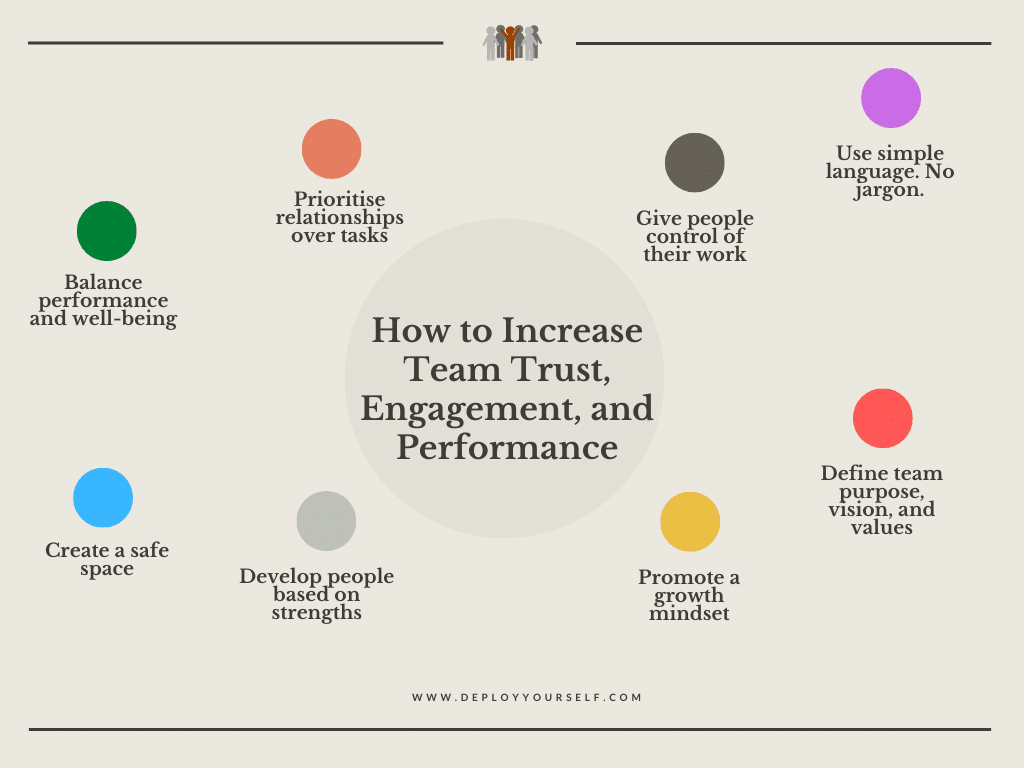
    8 Things Leaders Can Do To Increase Trust, Engagement, and Performance

    1.  Prioritise Trust and Relationships Over Tasks and Projects

    Too many companies believe people are interchangeable, and treat them as just resources to get work done. That is why most work conversations revolve around what we do – the tasks, projects, deadlines, budgeting, strategy, etc. I believe we are missing a trick here if only focus on the tasks, and ignore the relationships between people who do these tasks.

    Good leaders understand that it is the people and the relationships among them which decide the quality of work done. Hence they focus on building strong relationships and creating a culture where trust, honesty, and accountability are prioritized.

    Leaders build strong relationships by understanding people’s deepest beliefs and ambitions, by coaching them to figure out their values and empowering them by setting relevant milestones and then providing support along the way. This way the relationship becomes the bedrock of everything being done and the conversations shift from being project-based to relationship-based.

    Gallup found that people who have a good friend in the workplace are more likely to be satisfied. With good relationships, precious time and energy that would have been spent in fixing bad relationships and solving conflicts is now instead spent productively. This results not just in increased wellbeing but also increased business productivity.

    2.  Give People Control of Their Work

    Giving people more control over their day-to-day decisions and work is a fantastic way to improve engagement. Autonomy creates accountability and accountability leads to engagement (Saragih, 2011).

    Good leaders allow people to have a greater say in their work and they become more involved and engaged by extension. Nobody likes to be told what to do. Nobody likes to be micromanaged. We hire people after extensive interviews. I think we disrespect their skills when we don’t listen to them.

    Resisting the temptation to micromanage and involve yourself in every task can be difficult. Allowing your people to do what they do best without interference will, however, lead to better results in the long-run. Provide them the assurance and freedom they need and desire to do their job. Give them ownership, so the work is theirs, not yours. This makes their tasks, their projects, and their responsibilities more meaningful.

    3.  Promote a Growth Mindset

    Mistakes are unavoidable when chasing big goals but how you deal with them can make a world of difference. Instead of viewing mistakes as negative, strong leaders see them as an opportunity to learn. This begins by showing your own vulnerabilities as a leader. If you make a mistake, it’s important to admit it. Be willing to accept feedback on your performance and then use the information for positive change.

    Strong leaders promote a “growth mindset” among their people. This growth mindset is based on the belief that your basic qualities are things you can cultivate through your efforts. As Carol Dweck, who studies human motivation, says in her book Mindset : The New Psychology of Success, “The passion for stretching yourself and sticking to it, even (or especially) when it’s not going well, is the hallmark of the growth mindset. This is the mindset that allows people to thrive during some of the most challenging times in their lives.”

    With the growth mindset, people become students for life and see each success and failure as opportunities to learn. With this attitude, everything becomes a journey and people avoid getting stuck in defeating self-talk like “I can’t do this.”, or “This is beyond my abilities”.

    Strong leaders create a growth mindset by promoting a culture where people are not blamed for mistakes and failures, which will eventually happen. Instead these are seen as learning opportunities so that the same mistakes are not repeated in the future.

    4.  Develop People Based on Their Strengths

    Have you worked in a company or with a manager where every conversation focussed on what you are not doing well, and what you need to do to improve your weaknesses? Have you been asked to create measurable goals to show progress in an area where you have not been doing so well? How does it feel when your manager talks about your weakness in every 1-on-1?

    If you are like most people, you will find this experience extremely frustrating. As human beings, there are always skills that we do well and some skills where we don’t do as well. Focussing on weaknesses brings our fears, insecurity, and anxiety to the fore, and impairs learning and growth.

    In a massive study by Gallup involving 1.2 million employees across 22 organizations in seven industries and 45 countries, it was found that focussing on strengths leads to increased sales, profits, high engagement for employees, and safety. By focusing on weaknesses, the true potential of employees where they can shine and do their best work is often neglected.

    Researchers have also found that receiving praise releases dopamine, which is the chemical associated with rewards in our brain. Praise basically tells our brain “Do that again.” This is why, when good work is praised and recognized, people will tend to do more of the same in the future.

    Praise works best when it is specific and not vague. So instead of praising someone’s work as “brilliant” or “wonderful”, be more specific in appreciating the effort. Below are some specific examples of praise done well :

    • “I liked how you have used juxtapositions to add humor to your sentences.”
    • “I loved the report, especially the solid research you did and can be seen in the statistics you presented.”

    “If you focus on people’s weaknesses, they lose confidence.”

    ― Tom Rath

    5.  Balance Performance and Wellbeing

    Performance needs to be balanced with employees’ health and wellbeing for the best results. Overworking employees leads to a decline in engagement and performance over time. Instead, good leaders encourage days off, reduce overtime, and allow weekends off to ensure people get enough rest to recover and come back fresh to work every week.

    Overworking will have detrimental effects on your employees’ physical and mental health in the long-run (Wong, Chan & Ngan, 2019). It goes without saying that this is not a good outcome. Your people’s health and wellbeing should be your number one concern, as it can impact everything the business does.

    There are no winners when people are overworked and it is bad for the long-term success of your company. Managers should encourage people to focus on their health by providing and promoting adequate health insurance, healthy food, and sports facilities – whether inside or outside the physical space of organizations.

    Just like overplanting plants drain the soil of all its nutrients and lead to failed crops, overworking people leads to sick employees and poor work performance.

    6.  Create A Safe Space Where Employees Feel Comfortable

    The working environment you create is vital to the performance of your team. Employees should feel comfortable to voice concerns, open up, and make suggestions. They should not fear repercussions for taking initiative or speaking up. Everyone should be aware that they are working in a safe space absent of blame or retaliation.

    Organizational behavioral scientist Amy Edmondson defines psychological safety as “a shared belief held by members of a team that the team is safe for interpersonal risk-taking.” Psychologically safe teams understand and give the opportunity for people to stand out because of their uniqueness, rather than attempting to fit people in boxes (or roles, titles, etc).

    In a safe environment, you don’t have to wear a mask and can be completely honest about what you know and what you don’t. When you do that, others step in to help and close the gaps in skill and knowledge, leading to faster learning and better execution. This is leaps and bounds better than the alternative – when people fake knowing something they don’t, and this leads to mistakes or other faults down the line.

    Some ways in which you can create a safe and comfortable workspace include:

    • Listen to and take action based on inputs and feedback provided by your team.
    • Remove blame and punishing people from your culture. Instead, focus on learning from mistakes.
    • Delegate decision making and remove unnecessary processes and approvals. Let your team own their own decisions.
    • Lead by example by sharing your own vulnerabilities.
    • Ask for support from your team when you need help. Show them that this doesn’t make you weak. It only shows you are human.

    “Teamwork begins by building trust. And the only way to do that is to overcome our need for invulnerability.” – Patrick Lencioni

    7.  Define Team Purpose, Vision, and Values

    The ‘why’ is arguably more important than the ‘what’ and the ‘how’. In more specific terms, the purpose, vision, and values behind a project have the potential to influence its success as much as the details of the project itself.

    Continuously offering reminders of the bigger picture when working on daily tasks is key. People are motivated by meaning and this concept is perfectly illustrated by Dan Ariely. Research has shown that acknowledgment or meaning behind work, even in small quantities, is associated with more engagement and higher ownership.

    Ariely research indicated that not only are people motivated by meaning, but they are also aware of this. When asked to predict their output for two conditions of varying acknowledgment, participants correctly predicted a greater output in the meaning condition. Perhaps most interestingly, it has been suggested that even if you like something, you are still demotivated by a lack of meaning.

    Everyone wants to contribute to something bigger than themselves and make a difference. Strong leaders show people how their work impacts the customer and the wider benefits to the industry/society. A wonderful example of this is the below story –

    During a visit to the NASA space center in 1962, President John F. Kennedy noticed a janitor carrying a broom. He interrupted his tour, walked over to the man, and said, “Hi, I’m Jack Kennedy. What are you doing?”

    “Well, Mr. President,” the janitor responded, “I’m helping put a man on the moon.”

    “Coming together is a beginning, staying together is progress, and working together is success.” – Henry Ford

    8.  Use Simple Language to Make Expectations Clear

    Corporate language is known for being unnecessarily complicated and boring. Cutting down on corporate jargon increases engagement, transparency, and understanding. Often, simple and clear statements will get the point across. Corporate jargon is unpopular and often confusing, so use it sparingly, if at all. There is research to suggests that plain and simple language is effective in a business setting.

    Leaders should stop using complicated language or hiding behind jargon. Trust people and share information openly. Let people ask anything about everything. Transparent communication involves people in problem-solving and they see the team’s or the company’s problems as their own. And, you never know where a good solution to your biggest challenges might come from.

    A few simple tips for clearer language in the workplace are –

    • Use shorter sentences
    • Make your most important point first
    • Use headings and bullet points to make your message easier to skim
    • Keep your target audience in mind when communicating
    • Use visuals aids like graphs and chart to make it easier for people

    “When corporate executives get really excited, they leverage their learnings against comprehension to revolutionize English.”

    ― Tanya Thompson

    Conclusion

    Treating your employees as just employees will make them just employees. Treating them as people will unlock their full potential by creating more trust, higher engagement, and better performance.

    Finding out what your employees need and providing the opportunities to access them is one of your primary goals as a leader. Create stronger relationships, communicate transparently and regularly, and encourage participation. These are all key to an engaged and trusting workforce, that will perform better as a result.

    The single best way to increase performance is to create a culture that enables people to do their best work. Culture should enable performance, rather than stand in its way. By using the 8 things presented in this article, leaders can ensure people feel connected to the larger vision of the organization and supported by peers, subordinates, and leaders.

    References

    1. Historic Drop in Employee Engagement Follows Record Rise
    2. Worldwide, 13% of Employees Are Engaged at Work
    3. The “IKEA Effect”: When Labor Leads to Love Working Paper
    4. THE FUTURE WORKPLACE
    5. Inbound Recruiting: HubSpot’s Approach to Employer Branding
    6. The Effect of Long Working Hours and Overtime on Occupational Health: A Meta-Analysis of Evidence from 1998 to 2018
    7. How to Create Safe Spaces at Work
    8. If We All Hate Business Jargon, Why Do We Keep Using It?
    9. Why Plain Language is Good for Business –
    10. (PDF) The Effects of Job Autonomy on Work Outcomes: Self Efficacy as an Intervening Variable
    11. Trust Employees: 3 studies showing the power of trust in the workplace
  • What is Feedback? And The Benefits of Feedback for Your Team / Company You Never Knew?

    It is the end of the quarter. And it is feedback season again!

    Feedback is a word many people dread and it makes them uncomfortable, while for others it is a tool to reflect on and improve performance. Having been on both ends of the feedback spectrum over my career, I want to share today what I think feedback is, and how it can benefit people as well as organizations.

    What is feedback?

    Do you think feedback is an operational necessity that your organisation requires you to do? Do you think feedback is something “extra” you have to do in addition to your work? In the early days of my career, I saw feedback as a distraction that keeps me away from “real” work. I wanted to get done with the feedback cycles as soon as possible as it would make me anxious and nervous. After all, nobody ever told me the purpose of feedback, how to do it well, and how to make it a tool in my development.

    It was only through my own mistakes receiving and giving feedback (and a few trainings) that I realized that feedback is work itself and not something external to it. Feedback is as much a part of my (and everyone else’s) work duties as any other task I consider essential. Over time I came to see feedback as a tool to improve not just my own performance, but also of the people around me, and of my team/organization as a whole.

    Feedback can happen in a ‘day to day’ manner like any other task. It can be a simple comment on some work which was just completed, like :-

    • You handled that really well. Thank you for thinking about that specific case.
    • I loved how you presented your ideas in the meeting we just had.

    OR, Feedback can be a structured conversation with your manager or employee. For example :-

    • I see you doing really well in … , …
    • I would like to see you develop skills like … , etc

    “Feedback is the breakfast of champions.”
    – Ken Blanchard

    The Benefits of Feedback You Never Knew

    The most important and obvious benefit of feedback is that it shines a light on and reveal our blind spots. We all need feedback to reflect, learn, and grow. It helps us become aware of our strengths and weaknesses, and identify any actions required to address them and improve performance. Timely feedback is essential to creating a loop where we are constantly reflecting upon what we did in the past and how can we do better in the future.

    But apart from assisting in our own personal development, I believe feedback can be an important tool that can help our team/company in other ways. Some of these are :-

    1. Better Relationships

    A regular cycle of feedback, not just with our managers but also with our peers, helps us build better relationships at work. It helps us get comfortable with each other and develop friendships with our colleagues. Having strong relationships at work not just impacts business results, but also results in more smiles and satisfaction from what we do. Giving and receiving feedback builds trust and helps create a safe environment where people can be themselves without any pretensions.

    2. Clear Expectations

    Having regular feedback conversations with people help clear expectations about what we expect from each other. It brings out our implicit expectations in the open and irons out any disagreements. Doing this right avoids any future misunderstanding and conflicts, and even if they arise, are much easier to handle and resolve.

    3. Positive Reinforcement

    Giving appreciation of a task well done serves as a wonderful positive reinforcement for the kind of behaviors you want to nurture in your team and your organization. Giving people a pat on their back or an informal “whoop” or “cheers” can do wonders for their confidence and sets an example for everyone else.

    4. Culture of Feedback

    If people are comfortable giving and receiving feedback in a company, and if it becomes a part of people/teams working together, then you have what is called a “culture of feedback”. This can be a tremendous asset for any organization. This culture lets your employees know that you care about them as people and not just the business results they produce. The culture of feedback creates an environment that enables every team to take ownership and pride in going after and achieving their business goals, while also taking care of their personal well-being and growth.

    To sum it up, the benefits of continuous feedback far outweigh the cost of having a culture of feedback and the little awkwardness everyone feels while giving and sharing feedback, which can be easily mitigated with proper training and guidance. Having a culture of open communication and regular feedback empowers people to come to work and make a difference – to their own growth as well as to the company’s purpose.