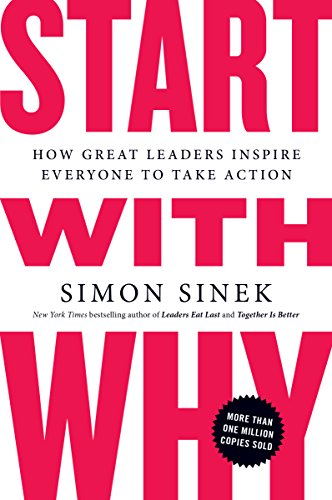
Simon Sinek, the author of this book is a motivational speaker and someone who looks at the world with great optimism. His Ted-talk is the third most viewed talk. Through this book and interactions with the public, he actively encourages you to think beyond the obvious, to go back to the root cause of starting your business or joining a job. He teaches leaders how to inspire the whole organization to think that it doesn’t matter what you do, it matters why you do it.
He says that famous leaders such as Martin Luther King, the Wright Brothers (who invented the first aeroplane), and Steve Jobs are all from very different fields but they had one common factor. They all began their research and their ambitious projects based on a single ‘why’.
“Inspiring leaders and companies…think, act and communicate exactly alike. And it’s the complete opposite of everyone else.”
His ideas have grabbed the attention of various industries, from small startups to Fortune 50 companies and from Hollywood to the Congress and to the Pentagon. Here are 5 Key Leadership Lessons from the book ‘Start With Why’ by Simon Sinek.
1. Understand the ‘Golden Circle’
The author looks at exceptional leaders who have always thought differently from common people and that is what has brought them success. He says it is important to understand how these great minds think. He shares in the book that inspirational leaders start by identifying their purpose, cause, or vision.
He defines the concept of a ‘Golden Circle’ in the book. It starts with a vision (the “Why”), then moves to implementation (the “How”), and then conquers the product or service (the “What”).
The ‘why’ factor is a justification for a company to exist, it explains how things are done in the company and how decisions are made.
2. Inspiration is the Key to Influence People
The author talks about how inspiration works better than manipulation.
Manipulation such as dropping the price, blinking texts, using fear, peer pressure, promotions – these lead to short term gains but cost more over a longer period of time. If people understand what truly inspires you and understand why you wish to sell a product that is the key to influence people, build an image, and make a close connection to your audience.
People should feel compelled to buy your product in the sense that they feel they really need it and genuinely resonate with the message behind it.
Great leaders…inspire people to act…Those who truly lead…create a following of people who act not because they were swayed, but because they were inspired. – Simon Sinek
3. Money or Profits Is Not A ‘Why’
Money is not a ‘why’ and is never the reason that leads to the success of a company. Innovation comes from thinking about the ‘why’ – which is the reason you get out of bed in the morning.
Often when organizations are on a downfall, they only look at making money and surviving. Profits are important but more important than that are the ethics, values, unique practices of a company that sets it apart and the same apply to people as well.
Simon Sinek shares the stories of Apple, Wal-Mart, Costco, Starbucks, Martin Luther King Jr, and a few others in the book.
“Imagine if every organization started with Why. Decisions would be simpler. Loyalties would be greater. Trust would be a common currency.”
4. The Power of Trust
When ‘what’, ‘how’ and ‘why’ come together, that builds trust in people and in organizations. People perform at their best when they are part of a culture that fits their values and beliefs.
“If there were no trust…no one would take risks. No risks would mean no exploration, no experimentation and no advancement of the society.” – Simon Sinek
He gives the example of Apple and the huge trust it has build with its customers who believe in the company’s philosophy. Other technology firms might make good products too, but Apple resonates with customers because people appreciate its vision.
5. Communication Begins with Listening
Listen to your audience. A simple thing like a logo can reflect a lot on the company and one must take note of how it is perceived. For example, the logo of Harley Davidson, the motorcycle company resonates with bikers and with adventure lovers so it has helped the company greatly.
Listening and observing your competition is very helpful.
The author poses a ‘Celery Test’ in which he gives the example that to grow what do humans need? A variety of good foods but you don’t need all of them. Similarly, when you observe your competition and listen to what your audience needs, you will come up with your own list of factors that your company should consider.
There is also a new form of competition that is when you work to improve yourself, individually. You are the best competition for yourself but you do need to listen to people around you to make better decisions.
I recommend this book to anyone looking to improve their relationships with others and recognize ways that good leaders can influence those around them.
How did hierarchies come to exist? Why do only a select few lead? Is there really much difference between how societies functioned in the pre-historic era and how they function now? And what do all these questions and topics have in common?
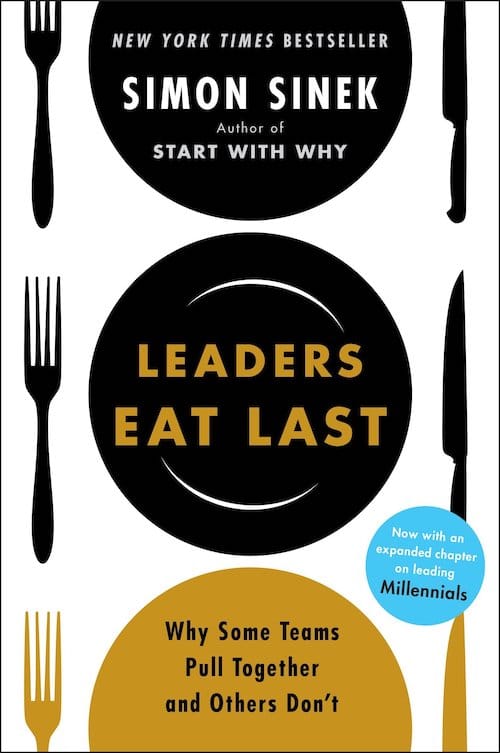
Leaders Eat Last, by Simon Sinek attempts to answer these questions by delving into the science of neurochemicals – our hormones vis. a vis. leadership! How are our behaviors affected due to the natural functioning of our biology? And how do these neurochemicals affect leadership qualities?
The Biology Of Leadership
Our bodies release about 50 different types of hormones. Yet, dopamine, oxytocin, serotonin, and endorphins are some of the most talked about. That is because these hormones can by-and-large affect the behavior of humans. Our hormones have evolved over time to adapt to the conditions that surrounded us, by controlling and moderating our behaviors. Hormones are responsible for that even today.
Dopamine is the hormone that makes a person feel happy and content on completion of a take. For example, the happy sense of accomplishment one gets when they reach their weight-loss goals or if we find a lost key, is caused by dopamine.
Serotonin and oxytocin are known as relationship hormones because they affect our behaviors when we need to make meaningful relationships. Endorphins are the body’s natural painkillers. These disguise the pain of exhaustion as physical pleasure, making us feel renewed after a strenuous workout.
Because hormones affect behavior they have also shaped the way human society is structured. For example, the hunter-gatherers needed to feel the rush of endorphins to push them towards finding a kill. On the other hand, others who could not participate, we considered the ‘weaker’ section and were given easier tasks such as fruit gathering. These differences were the first references to hierarchy.
Additionally, hormones were responsible for cohesion within the society as well. Affection towards a leader, respect for the hunter-gatherers, etc. were behaviors that the hormones serotonin and oxytocin were responsible for. It explains why the weaker men would look up to the hunters or leaders have respect for one another and not jealousy.
Based on this understanding, let us analyse the relation between leader, organization, and how humans respond to these.
Leaders Eat Last by Simon Sinek
Feeling Safe With A Leader
Humans, being social, were conditioned to live in groups and form social circles. When there were a number of dangers such as predators, diseases, natural disasters, and other people, this group offered safety and ensured survival.
The concept of living in a group helped us feel secure. With security taken care of, mankind was able to focus on other tasks such as making tools, etc. that helped us to advance as societies. The human brain has also evolved to give priority to security and safety. This reflects in some of our behaviors today. For example, due to the security that a job offers, a person would continue to do it even if the work environment is very bad.
However, when we look at groups, it is the leaders who draw the ‘safety-circle’, protecting the members of the group. The members within this group protect and trust each other, and share resources. The leader also determines how large or small is the safety circle and to whom it extends.
Bob Chapman of HayssenSandiacre, allowed employees free access to the services and goods of the company. This trusting work environment helps in strengthening the bonds between the employees, who extended a helping hand to those in need, even in personal matters.
This shows that it is the leader who can create a feeling of safety and foster a healthy environment in the group.
Leading By Manifesting Culture
An organization isn’t all about its profits, shareholders, amazing products and services, and infrastructure. Its workforce and the culture that prevails due to that workforce, how they interact, approach issues, work together, treat their clients and customers, and prioritize values, are equally important.
Therefore it extremely important that a leader not only has knowledge of how culture influences the organization but also how to craft its culture and maintain it. This is because the culture runs through the fabric of the organization – from the leadership down to its staff at the lowest level.
An extraordinary example can be seen in the employees of the Taj Mahal Palace Hotel. In the year 2008, terrorists attacked the hotel. While some of the employees had managed to flee, they returned to help the guests staying at the hotel. Some of them even made human shields to protect the guests while they were escaping. About half of the people who perished in the attack were the hotel staff.
The staff put their customers before their lives. A clear indication of how the values of the hotel, and the culture were ingrained in the staff.
Empathy and Responsibility As A Leader
A leader is responsible for the group he leads. Therefore, if there is a gap between the leader and his group, it can cause severe damage to the organization. Moreover, if a leader does not feel responsible for the group, he becomes uncaring.
It is essential that a leader is empathetic. Without it, a leader could become emotionally distant from his employees, and the situation could be worse if there is a physical distance between the leader and his team. The leader would then never be able to see and understand how gravely his actions affect his employees. This is called abstraction.
The Milgram Experiment is a good example of abstraction. Volunteers called Teachers were asked to administer electric shocks – in increasing intensity from mild to potentially lethal – to another group of volunteers called Learners. Teachers did not know that the Learners were all actors and that they weren’t really being shocked.
The experiment proved that though many Teachers expressed uneasiness at harming others, it was apparent that the more the distance between a Teacher and a Learner, the more likely the Teacher was willing to continue. The experiment also showed that in a group where the Teachers could neither see the Learners writhing nor hear their (false) screams ended up administering a lethal dose.
When abstraction occurs, a leader cannot look beyond his own interest and tends to make decisions for others, which can be extremely harmful for an organization.
Selfishness And Dehumanization Of A Leader
Just as being surrounded by people of one’s group offers a feeling of safety and progress, being alone can make a person selfish and dehumanize other people. The Baby Boomer generation is a classic example. Being the generation that was born after WWII, they grew up in a thriving economy, were spoilt by their parents and thus, grew to become critical of authority and were self-centered, unlike their parents who came together in solidarity during war times.
This sense of self-centredness was clear in their acceptance of Ronald Reagan’s managing of the 1981 air controllers’ strike, where he sided with profiting companies over the well being of the workers.
Once a leader prioritizes profits of the business, technology, advancement, and the sheer strength and scale at which the businesses operate it becomes dehumanizing in a manner where leaders tend to view customers, employees, shareholders as abstractions or as tools to fulfill a business goal. Leaders stop considering them as a living beings with wants, feelings, and needs of their own.
Do you know what makes you happy? Or sad?
Addiction To Advancement
Technology and advancement have brought us instant gratification, which releases dopamine in our body once we feel it. Since this advancement and technology helps us get better and faster with our work, thus enhancing our performance, we need to feel the satisfaction and the gratification again and again. We become addicted to advancement.
We forget the value of stability and long-term satisfaction. Because technology makes everything as instant as ‘clicking’ a button we become addicted to the quick fix, eventually losing the patience to wait for results.
This can be well explained with any human rights campaign on Facebook. The moment we click on it, we get elated for doing something worthwhile so soon. We get used to the ‘quick fix’ rather than actually going out to volunteer for a cause we believe in. The release of dopamine that we get on clicking a button and being part of any campaign becomes an empty addiction.
Integrity And Bonding
Humans put trust in their leaders. Therefore it is essential that leaders have integrity. We expect that our leaders are honest about their mistakes and take responsibility for their errors. In fact, the feeling of safety that a group develops towards their leader is built on the foundation of trust and the ability of the leader to bond with the group.
Ralph Lauren Corporation, in the year 2009, found out that their Argentinian Branch was involved in bribery. The leaders informed the authorities and even agreed to help them, rather than cover –up the incident. In due course, they had to pay huge fines in penalties. However, they safeguarded their integrity and deepened the trust their employees had for them.
Bonding with the group is another important responsibility a leader has. If we see the US Congress, we will find that most of the members live outside Washington and travel there for a few days or a week. This has resulted in the lowest approval ratings in history today, as compared to the 1990s, where close cooperation between the congressmen and women resulted in making laws that reflected the closeness and regular communication between the members.
Service Before Self
Why would any group vote and put their trust in a leader that is ordinary? Wouldn’t they prefer to have someone extraordinary who leads with a clear vision in mind? The group follows the leader towards a goal and mission in spite of having their own individual goals due to the focused vision they have, that aligns with the needs of the group.
Microsoft is able to maintain its place in the market despite having huge profits because of the singular vision of Bill Gates – to put a computer on every desk.
When a leader leads a group towards a goal with a vision, he actually does the employee service, and not the other way round. A person becomes a true leader if he can understand the fact that leaders serve the people. Privileges aside, leaders should be willing to use their personal resources in times of crisis.
The most senior member is the US Marine Corps eats his meal last. This is because they put the needs of their Marines before their own needs.
Conclusion
A leader should understand that the members of their group do not follow them only out of compulsion (because they are working in the organization), or due to some personal gain, but also because being part of the group is a biological, chemical reaction that makes them want to trust and follow the leader.
Therefore, to be a leader means to firstly, guide the group selflessly, without having the want of success and self-promotion. Leaders should in fact work towards ensuring that all the members of the group have a fair opportunity to succeed and they help them reach their goals.
Today’s work culture is fast-paced. Companies rise and fall like dominoes in a chaotic and dynamic business environment. The concept of a big, old company that has been stable for decades is a slowly fading concept. Not many young companies today have what it takes to convert a company into a stable and strong one that has been around for generations.
The Infinite Game (2019) by Simon Sinek shows that there are more attributes to the growth of a company, its strength, and its stability than finances, stock, share prices, and investors.
Today’s leaders need to look to the future and make plans that are ahead of their time. They need to inculcate the habit of long-term thinking and planning and enable their employees to dream into the future that will help them form strong bonds within teams and realize the long-term vision of the company.
The Infinite Mindset
To create an infinite mindset within a company, one has to first understand what it actually means. Let us consider a game of football. There is a definite start and stop time. There are rules surrounding the game such as how goals are made. How the winner is decided is also defined and fixed. Football is therefore a finite game.
Business on the other hand is an infinite game. Apart from the legalities that they need to follow, what players do within those rules is not specified and neither is the start and stop times. Moreover, there is no specified manner in which the winner is decided.
In an infinite game, the idea is to simply stay in the game for as long as one can. This requires planning different than that of a finite game. It requires an infinite mindset that will enable organizations to think beyond winning into creating an organization that focuses on lasting and on staying on top of the game long-term.
If we look at Microsoft, Bill Gates wanted to “empower every person and every organization on the planet to achieve more.” While this goal showed an infinite mindset, in the early 2000s, CEO Steve Ballmer applied a finite mindset and focussed on winning more market share. They tried to focus on beating Apple with products such as Zune, to compete with Apple’s iPod. While Apple became famous for innovation and creating new markets, Microsoft’s short-term goals led to a tunnel vision. Due to this they lost focus and were not able to make their mark as a company that innovates.
The Infinite Game Book by Simon Sinek
The Five Keys To Infinite Mindset
There are five important keys to creating an infinite mind-set. They are –
Having a just cause
Ensuring trusting teams
Understanding worthy rivals
Preparing for existential flexibility
Showing the courage to lead
Victorinox played the infinite game. Their Swiss Army Knives were a popular product and accounted for almost 95% of the sales of the company. However, after 9/11, the knives were banned from airline cabin luggage. This caused the sales to plummet.
In spite of the downfall of sales, CEO Carl Elsener understood that business has its ups and downs. Instead of thinking about the short-term downfall, the company boldly branched out into new markets. They ventured into fragrances, watches, and travel gear, with the Swiss Army Knives accounting for only 35 percent of the sales. This change was a success.
The company showed that though ups and downs are inevitable, companies have to focus on ‘thinking in generations’ like Victorinox did.
Having A Just Cause
A ‘Just Cause’ is an inspiration for the employees of the company to focus on the future. It defines the goals for employees and represents the benefit a business aims at. It is bold, inclusive, and idealistic, and is resilient in the face of change. Many companies mistake a ‘Just Cause’ for a mission to aim at the highest and the best position, in other words, a ‘moon shot’.
The GPS making company Garmin’s mission statement is, “We will be the global leader in every market we serve and our products will be sought after for their compelling design, superior quality, and best value.” While it seems like a valuable mission statement, talking about becoming a great company, it gives customers importance as an afterthought.
Since 2007, the company has been on a decline, and now has a third of the value it had in 2007. This happened because they refused to focus on the needs of their customers. While smartphone companies started offering GPS tracking services, Garmin chose to focus its efforts on making their own products, rather than venture into the smartphone market.
Capitalism: Then And Now
When we talk about ‘Just Cause’, one needs to keep in mind the concept and guiding principles of capitalism. Who is more important for the company, the customers, or the shareholders?
Adam Smith’s The Wealth Of Nations written in the mid 18th century put the interests of the consumer over those of the shareholders. Paving the foundation of capitalism for the next 200 years, the book stated the obvious principles of business – customers are the primary focus of any company.
In the Mid-20th century, Milton Friedman, a Nobel-Prize winning economist, wrote a highly influential article that moved the focus from customer to shareholder. The article stated that for any free-market enterprise, the primary focus is to make money, and that money belongs to the shareholders of the enterprise.
The shift of focus was seen more strongly in the 1980s and 1990s, when business plans centered around profit-making, focussing on short-term earnings. The primary focus of business plans revolved around making shareholders happy. And thus, it was not stability, longevity, and quality of service that decided the success of a company, but Wall Street’s numbers that became more important. Therefore, companies focused on boosting their ROI by cutting costs, layoffs, and cutting R&D budgets.
In the past few decades, however, capitalism has become imbalanced. Stock market investing is at a 20 year low. With the shift in focus from customer to shareholder, the CEO’s and owners are enjoying a 950% earning increase vis. a vis. a mere 11% earnings increase for the average employee. These numbers signify a dangerous trend implying catastrophic market crashes in the future. It seems that Adam Smith had the right idea back then.
Employees Before Earnings
If organizations have to focus on longevity and creating an infinite mindset, they have to focus on the will of the people (employees and customers) who are supporting the company. This has, since Friedman’s shareholder-centric capitalism, become virtually impossible. Companies have put so much into making their shareholder happy, that it will take massive changes to go back to Adam Smith’s idea of capitalism.
Companies need to put their faith back into their employees. This can be done with a strong ‘Just Cause’ of drawing employees into the company’s vision for the future. A company has to respect its employees along with their customers, an endeavor that can be highly rewarding for companies.
The will of the people of a company can be measured by their morale, and by how inspired and committed they are to the ‘Just Cause’ of the company. Let us look at the examples of Apple and The Container Store.
Apple made the bold move of giving its retail store employees the same benefits of health care and retirement as their corporate employees enjoyed. This move saw their employee retention rates skyrocket to 90%, while the average industry rate was at 20-30%. This enabled Apple to reduce recruitments costs and see motivated, loyal employees, delivering better services.
Similarly, The Container Store, after the 2008 recession, needed to find a way to reduce costs. Instead of lay-offs, the company employed an infinite mindset and announced a temporary salary freeze. In a time of people losing jobs, the employees of the company understood the decision and worked hard to find ways to reduce costs for the company.
Companies who invest int their people reap infinite rewards
Creating a Culture of Trust
Companies that focus on profits alone end up having an uninspiring ‘Just Cause’. This can lead to distrust amongst employees along with unethical business practices taking root, thereby reducing business longevity. Without trust, companies see an increase in poor performance and accidents.
The CEO of Ford Alan Mulally saw a distrusting culture in the company when he came on-board in 2006. The previous CEO was known to berate and fire employees who got him the bad news. Therefore it became the norm to bring only good news to the CEO.
Mulally knew he had to change the culture of the company and started encouraging employees to bring him all types of news – good and bad – to weekly meetings. He soon broke through the trend when an employee chose to trust him and share problems at the meeting. Mulally applauded the employee’s initiative.
Without a culture of trust, where the company is aligned with profits rather than its people, unethical business practices take root. In Wells Fargo, an investigation showed that more than 3 million fake bank accounts were created between 2011 and 2016. This had happened because CEO John Stumpf had created a high-pressure sales culture that was untrustworthy. Employees resorted to unethical practices out of the fear of getting fired.
Understanding Worthy Rivals And Preparing For Existential Flex
An infinite mindset encourages worthy rivalry. This essentially means, competing with opponents who (due to their superior skills) businesses are forced to improve their own skill levels and techniques.
Alan Mulally saw that Ford had spent fifteen years losing twenty-five percent of the market share. He was presented with a plan that was a finite-minded one. It involved cutting costs and increasing sales promotions. Mulally decided not to chase market share. Instead, he encouraged his senior management to drive cars made by Lexus and Toyota, to study and understand why these cars were preferred.
Also when the 2008 recession hit, he chose not to put other competitors in the market out of business. Though Ford was financially stable, he knew that out-competing his rivals meant putting vendors and suppliers (who Ford relied on too) out of business. He chose to support his vendors by supporting his rivals.
Learning from rivals goes beyond understanding their tips and tricks. At times, business leaders should perform an Existential Flex – a self-prescribed change or even a self-disruption – something that is extremely difficult for a finite minded company to do.
Steve Jobs, in 1979, saw Xerox’s graphical user interface (GUI) technology. He immediately changed plans and incorporated GUI in his computers. This introduced the point and click the mouse. It also gave users a desktop icon for folders, making it easier for his customers to use his products – without knowing any computer language. He stuck to his ‘Just Cause’ of making computers an empowering tool for as many people as possible, despite warnings that the drastic change could be detrimental. Four years after that, the first Macintosh was released. It took Microsoft four years after that to release Windows 2.0 with a GUI.
Bold And Courageous Decisions
A strong ‘Just Cause’ goes beyond just one leader or profits. This very ‘Just Cause’ guides a leader towards the specific purpose the just cause pursues. It takes courage to lead a company towards an infinite mind-set.
When a leader shows courage, it shows his commitment to the cause thereby setting an example for the employees. At times, this can prove to be a challenge because most CEO’s are promoted from COO (Chief Operating Officer) and CFO (Chief Financial Officer) designations. The day-to-day operations these executives are involved in are finite-minded. They are not prepared to step into the responsibilities of the CEO designation.
They need to understand that a CEO actually works in the capacity of a Chief Visionary Officer who is the guiding voice and guardian of the ‘Just Cause’. In action, this responsibility helps in alignment with the company’s ‘Just Cause’. For example, the long-running pharmacy and drugstore chain CVS Caremark decided to stop selling cigarettes in their stores despite a loss of cost predictions of about $2 million. This was done to align the company practices with their ‘Just Cause’ of helping people to better health. On the day the announcement was made, the stocks of the company dropped by 1%. However, after a year and a half, the price doubled to a record high. This happened because after they stopped selling cigarettes, the sales of nicotine patches and gum shot up. They even approached by health-focused vendors who had avoided them earlier. This led to a 70%increase in stockholder earnings-per-share over the next three years.
Conclusion
The infinite mindset completes a full circle. It begins with a ‘Just Cause’ and endures through creating trusting teams, being inspired by worthy rivals, preparing for the Existential Flex backed by bold and courageous decision-making. It takes companies through a process that helps them to stay in the game and succeed in the long run.
I use cookies on this website to give you the most relevant experience and for analytics purposes. Any personal data collected will never be shared with any third party, or used to spam you. That is my promise. - Sumit By clicking “Accept”, you consent to the use of ALL the cookies.
This website uses cookies to improve your experience while you navigate through the website. Out of these, the cookies that are categorized as necessary are stored on your browser as they are essential for the working of basic functionalities of the website. We also use third-party cookies that help us analyze and understand how you use this website. These cookies will be stored in your browser only with your consent. You also have the option to opt-out of these cookies. But opting out of some of these cookies may affect your browsing experience.
Necessary cookies are absolutely essential for the website to function properly. This category only includes cookies that ensures basic functionalities and security features of the website. These cookies do not store any personal information.
Any cookies that may not be particularly necessary for the website to function and is used specifically to collect user personal data via analytics, ads, other embedded contents are termed as non-necessary cookies. It is mandatory to procure user consent prior to running these cookies on your website.