relationships

  • 10 Powerful Connection Questions to Connect with Employees on a Deeper Level

    Do your conversations seem artificial and meaningless? Do you find it difficult to go beyond niceties and connect with your employees? What do you do when the answers you get are rote, scripted, and hide the “real” stuff underneath them?

    The innocuous “How are you?” at the start of a conversation often begets a rote and scripted response like “I am fine,” or “I am doing good.” which is more of a conversation stopper than a conversation starter. Let us get serious and ask deeper conversation questions that prompt reflection and make space for deeper connections with people we care about. We must always ask a question out of curiosity and care, and never out of obligation and norm.

    Every 2 weeks I share my most valuable learnings from living life fully in my Deploy Yourself Newsletter. Sign up now to download a workbook with 164 Powerful Questions which I use daily in my work and coaching. Allow these questions to transform your life and leadership.

    Research has shown that people with deep relationships are healthier, happier, and live longer. Conversely, a lack of good relationships is associated with worse physical and mental health. The famous author Brene Brown says, “A deep sense of love and belonging is an irresistible need of all people. We are biologically, cognitively, physically, and spiritually wired to love, to be loved, and to belong. When those needs are not met, we don’t function as we were meant to.”

    You owe it to yourself to break the logjam of meaningless conversations and connect with employees on a deeper level. You can do that by asking some powerful connection questions – that will add meaning, purpose, and joy to your relationships. The below questions will reveal something real about a person’s life, character, and beliefs. These questions can’t be answered with a one-word response (good, yes, busy, fine) and will spark a deep conversation and build strong connections and relationships.

    1. Would you like to be famous? How?
    2. Define what your perfect day would look like?
    3. What are you most grateful for?
    4. If you could have one ability, which ability would you choose to have?
    5. What have you been waiting to do? Is there an unfulfilled dream? What are you waiting for?
    6. What do you value most in a friend?
    7. What is your best experience in life so far? What is your worst?
    8. Share an embarrassing moment from your life?
    9. If your house is burning, and the firefighter can only get one item out for you, what would you ask him to salvage? Why?
    10. If you can have lunch with anyone, whom would you like to have lunch with?

    “The most important single ingredient in the formula of success is knowing how to get along with people.”―

    Theodore Roosevelt

    Life’s biggest lessons and opportunities often come out of deep relationships with others. We interact with many people daily, and isn’t it a wasted opportunity if we never get to know them deeply?

    Bonus – More Connection Questions To Build Strong Relationships

    If you liked the questions above, please find a more larger list of questions which I have collected from different people and sources over time.

    1. What’s your biggest struggle?
    2. What are you good at doing? What do you believe you are the best you? What have you gotten noticed for throughout your career?
    3. What do you enjoy? What do you look forward to doing? What energises you? What do you love about your work?
    4. What feels most useful? What kind of work makes you proud? Which of your tasks are most critical? What are your highest priorities in life? Where does work fit in?
    5. How has your life turned out differently than you expected it to?
    6. What do you feel most guilty about?
    7. How do you want to be remembered?
    8. What advice would you give yourself ten years ago?
    9. Where are you making a contribution to something bigger than yourself?
    10. What did you love to do most when you were 6 years old?
    11. Are you living a meaningful life?
    12. What’s the one thing you cannot live without?
    13. What inspires you the most?
    14. What is one dream you have yet to accomplish?
    15. What is your greatest fear?
    16. If you could change one thing about yourself what would it be?
    17. If you could tell your former self one thing right now what would it be?
    18. What did you really love doing as a kid but don’t really do anymore?
    19. What is stopping you from doing it now, and what would happen if you did?
    20. If you could, what is the one thing you would change about your past?
    21. What in your life has been on hold? What have you been waiting for?

    We all know the warm feeling of human embrace and connection when we feel heard and understood by another human being. Deeply connecting with another person builds trust and inspires us. Asking powerful questions (and sharing our own answers to them) helps to understand what people value and to glimpse life from someone else’s perspective. On various occasions, I have been surprised on finding out how someone I thought was very different shares his or her deepest values with me. And vice-versa.

    Asking these questions and listening to the answers often require practice and empathetic listening. But it can be very rewarding to establish deep connections with friends or colleagues. It makes working with them easier, joyful and leads to long-lasting relationships.
  • Understanding Conflicts Better – The First Step to Conflict Resolution

    CONFLICT!

    Is that a word that scares you? Is that something that makes you run in the opposite direction? Do you wish you had the skills to handle conflicts better?

    If you are like most people, you are no fan of conflicts and have often been caught up in the maze of a conflict. I certainly have, and I can honestly attest that conflict (or the fear of it) has given me many sleepless nights.

    In my 12 years of professional life, I have spent many a moment amidst conflicts, and many more reflecting upon them. Why do they happen? How can I best handle them? Can I still achieve my goals and enrich my relationships with conflict all around me? Can I beat the stress and anxiety which comes with conflict and still be happy and peaceful? Can I deal with conflict in a way that I can be proud of?

    There has been wise advice shared with me which I have ignored out of arrogance or ignorance, only to stumble upon and be humbled by the same realization later. Over time I have written down some notes which I have referenced later in times of conflict. This article is the first in a series of articles I am writing from these notes which revolve around the subject of handling conflict in our professional and personal lives.

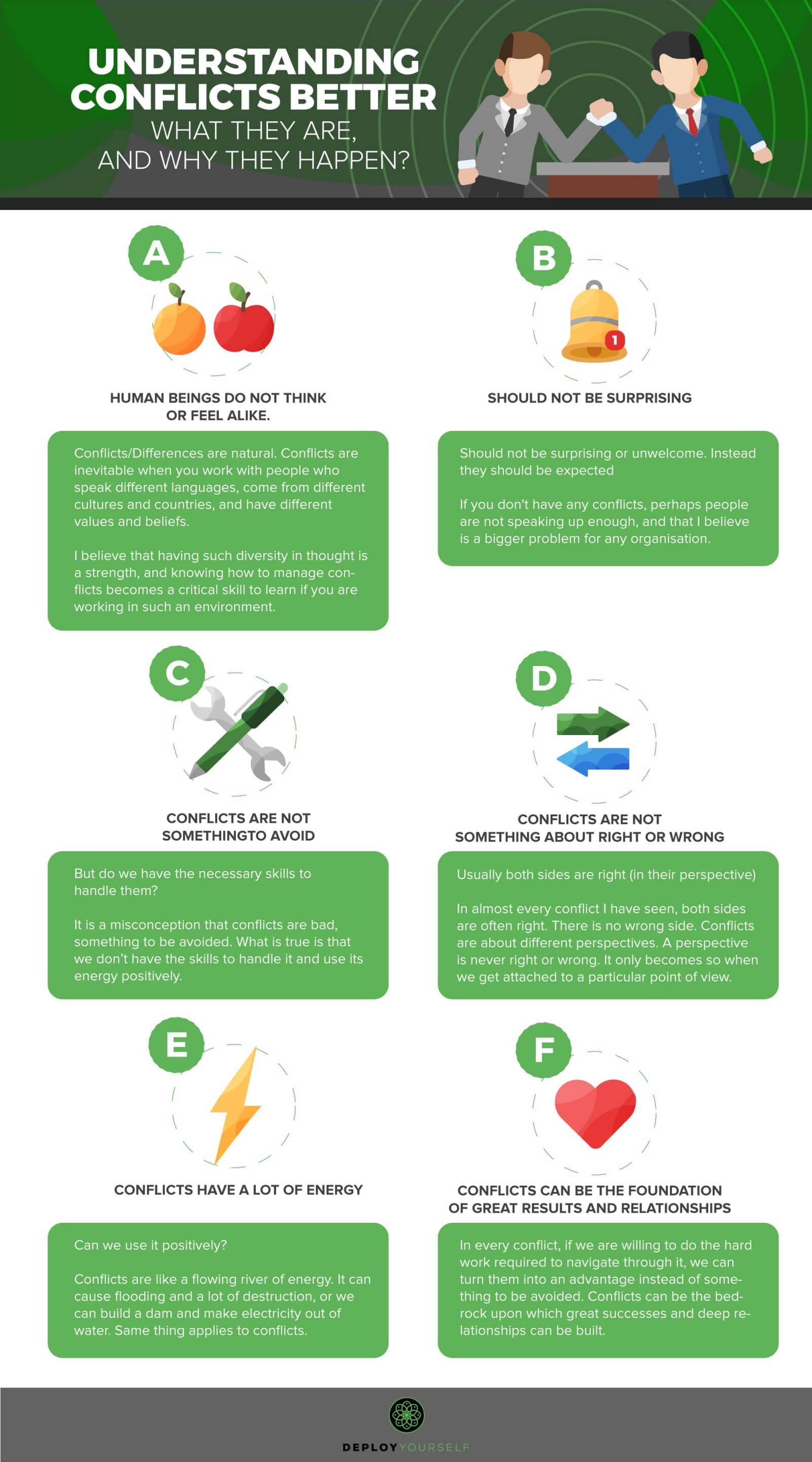
    Human Beings Do Not Think or Feel Alike. Conflicts are Natural.

    Wherever there is life, there is conflict. Every species on this planet experiences conflict in its fight for survival. Plants and animals strive for limited food, space, and mates in the wild, often giving rise to conflict. Humans are much more complex. In addition to food, space, and sex; we want power, fame, and money; giving rise to even more conflicts.

    Conflicts are a natural order of life, and if we step back and see the bigger picture, there is nothing unexpected around them. They are inevitable when we work with people who speak different languages, come from different cultures and countries, and have different values and beliefs.

    They Should Not Be Surprising. Instead They Should Be Expected.

    Today we live in a world driven by democratic and secular values (in most countries). If you don’t see any conflicts, perhaps people are not speaking up enough, and that I believe is a bigger problem for any society or organisation.

    In democratic societies, differences of opinion are not only expected but it is also a duty of each citizen to express himself without fear or hesitation. I believe that having diversity in thought is a strength, and knowing how to manage conflicts becomes a critical skill to learn if we are to live and work in such an environment.

    Understanding Conflicts Better Infographic
    Understanding Conflicts Better Infographic

    Are Conflicts Bad? Or Do We Lack The Skills To Handle Them?

    After facing and trying to avoid many conflicts over the years, I have come to believe that conflicts are not bad or something to be avoided. However, it is a common misconception and I have seen people do anything to avoid them.

    We have no choice or power over when a conflict is going to present itself. Our only choice is in responding to them. We find them undesirable or unproductive not because they are unpleasant but because we have no idea about how to handle them.

    Conflicts Are Not About Right or Wrong. Usually Both Sides Are Right.

    In almost every conflict I have seen, both sides are right. There is no wrong side. Conflicts are about different perspectives, and each perspective is valid for the one holding it. A perspective becomes right or wrong only when we get attached to a particular point of view.

    Can we see that we are all seeking to express the truth as we see it? Can we acknowledge that everyone sees the world differently and form their own perception of events? Conflicts happen not because of different perceptions, but because of our inability to acknowledge another’s point of view.

    Conflicts Have A Lot of Energy. Can We Use It Productively?

    Conflicts are like a flowing river. If left unchecked, they can cause flooding and destruction. But if we can build a dam and channel the water in the right direction, we can turn it into electricity.

    The same thing applies to conflicts. The only question is – Can we use the energy in conflict productively? Can we channel this energy into productive conversations that can lead to creative solutions and better results?

    However, if we can’t control the energy in a conflict, it can result in damage (stress, frustration, bad results) and lost opportunity.

    Conflicts Can Be The Foundation for Great Results and Relationships.

    Healthy disagreement creates friction and energy. If we look back at history we will find that every great accomplishment has come out of differing opinions of people who have found a way to work together.

    In every conflict, if we are willing to do the hard work required to navigate through it, we can turn them into an advantage instead of something to be avoided. Conflicts can be the bedrock upon which great successes and deep relationships can be built.

    “An enemy is a person whose story we have not heard.” – Gene Knudsen Hoffman

    In the next article, I will share a few things which most of us have done in the past amidst a conflict, but which I have learned that we MUST NOT DO when we encounter a conflict.

brain care coaching commitment communication conflict conflicts conversation culture deployyourself deploy yourself emotional intelligence emotions empathy energy feedback freedom future gold habits hope john maxwell language leadership lessons listening performance perspective preparation productive productivity psychological safety purpose questions relationships resolution ryan holiday seth godin simon sinek strengths struggle team trust values words