
feedback

  • Want To Improve Performance? Before Giving Feedback, Give People These Four Things

    Do you use feedback as a tool to improve performance? If your answer is yes, you are not alone. Most managers see (and use) feedback, most of which is negative or critical, as a tool to improve performance. If you give positive feedback too along with the negative (the sh*t sandwich), we all know that people tend to focus on the negative and ignore the positive. If it helps, remember the last time you received a mix of positive and negative feedback? How did it feel?

    There is a story about Abraham Lincoln in his biography by David Herbert Donald that captures the futility of negative feedback. Lincoln would write letters to those that he had strong feedback for (like a Civil War general who was failing). Rather than letting the heat of the moment get the best of him, he would never send these letters and instead keep them to himself. He would much later give a response that showed more empathy and was more effective.
    Feedback Has Its Place

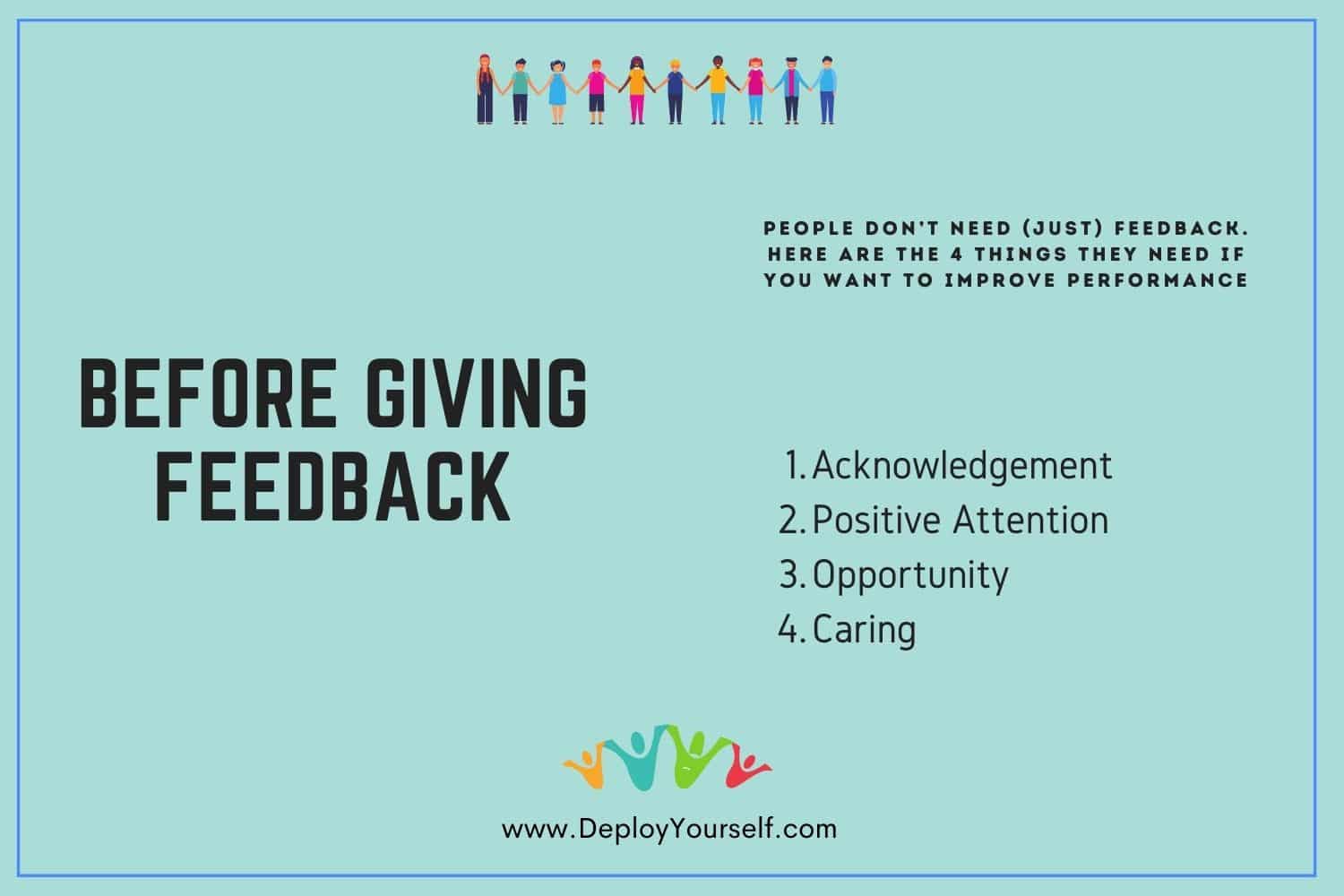
    In this article, I want to argue that feedback is important, but it has its place. There are more powerful tools any leader can use to improve performance and keep people motivated and engaged. These tools are acknowledgment, attention, opportunity, and caring.

    The four things mentioned below focus on the future, while feedback is glued to the past. And they must be done before and more often than giving feedback. People don’t need (just) feedback. Here are the 4 things they need if you want to improve performance:-

    “Too many companies believe people are interchangeable. Truly gifted people never are. They have unique talents. Such people cannot be forced into roles they are not suited for, nor should they be. Effective leaders allow great people to do the work they were born to do.” – Warren Bennis

    1. They Need Acknowledgement

      Good leaders see people for who they are (values), what they bring to the table (skills), and where they want to go (future ambitions). They understand and listen to them as human beings, and not just for the role they were hired for. This creates psychological safety, which is the first step needed for people to perform without fear and apprehensions. Good leaders trust people by default, and that creates a solid foundation for all future performances.

      As a leader, your biggest job is to create an environment where people can do their best work. By listening to people about their dreams, fears, and ambitions, leaders can sure people look forward to coming to work each day. In addition to helping with business productivity, it will also impact the well-being of employees.

      When leaders communicate transparently, authentically, and check in regularly to ask what people need, it deepens engagement and instills confidence as people know that their leaders have their back.

      “People change by feeling good, not by feeling bad.” – BJ Fogg
    2. They Need Positive Attention

      Strong leaders believe in their people and their abilities, often more than people themselves do. When someone does a job well, good leaders notice and let their people know. Research has repeatedly proven that positive attention is more powerful than negative attention to improving performance. Nobody shows up at work to do a job poorly, and if we only focus on moments of mistakes and failures, we are killing the enormous potential for good that people have.

      Good leaders understand that performance is not static, and everyone makes mistakes or fails to do a “perfect” job occasionally. Strong leaders focus on what people do well and not on their shortcomings, and understand that positive attention leads to engagement and exponential performance in the future.

      For example – A simple email showcasing major accomplishments or any behavior you want to encourage can go a long way in setting the right example.
    3. They Need Opportunity

      People need opportunities to contribute to something bigger than themselves. It is a common human desire to belong and contribute to a larger cause or mission. Leaders need to keep this in mind when they find and present work opportunities for people.

      If work doesn’t provide a way for your employees to belong and contribute, people will get bored and leave, or get used to mediocrity, which is even worse. The question every leader must ask themselves is – Can I give people the opportunity to do the work of their lives?
    4. They Need Caring

      Above everything else, people need caring. We all have a need to belong, to love, and to be loved by others. Good leaders know this and care for those around them like a fellow soldier. They enrich their relationship in every moment, by every word they say and every action they take.

      A caring leader notices small changes and inquires about people’s wellbeing and growth. Strong leaders demonstrate their care by coaching people to find their own way, which builds confidence and momentum as people take on and complete challenging projects. A good leader knows what their people care about, and she shows her care by taking care of that.

      For example – many companies offer the option for people to work flexible hours or to work from home, while others have an on-premises creche facility to better support employees who are parents.

    “Treat a man as he appears to be, and you make him worse. But treat a man as if he were what he potentially could be, and you make him what he should be.”

    — Johann Wolfgang von Goethe
    Conclusion

    Leading with care is a forward-looking and long term strategy to improve engagement and performance. Leaders need to focus on their people’s strengths and develop them, instead of “fixing” them with feedback.

    If you are a leader, focus on what people can do, versus what they can’t do, and you will see completely new opportunities for them. Spend your time and attention on what people do well, and that will give you the leverage to produce exponential results. Strong leaders understand that taking care of people is in alignment with (and not against) business results.

    Resources

    1. https://www.verywellmind.com/what-is-the-need-to-belong-2795393
    2. https://www.tonyrobbins.com/mind-meaning/do-you-need-to-feel-significant/
    3. https://globalleadershipfoundation.com/the-caring-leader/
  • How to Ask and Get the Feedback You Need Without Any Stress and Awkwardness?

    “I want to give you some feedback.”

    If you are like most people, once you hear the above statement, your heart will start to beat a little faster, your palms might begin to sweat, and in certain situations, you might even begin to shake. Feedback can make anyone anxious and stressed – not because there is something inherently negative or bad about it, but because most people have never been trained in giving and receiving feedback. If you give and get feedback only once a quarter at work (even worse if it is once a year), and without any preparation, obviously it will be a strange conversation.

    What I have learned over my career is that feedback can be an immensely valuable and insightful tool in our growth and progression, but only if we are ready and prepared to digest and use it for our benefit. Today I want to share via this article my thoughts on the value of feedback, what is the best way to receive it, and then what to do with it. I hope that after reading this article, instead of just waiting for feedback you actually start asking for it. If you are thinking why would anyone do that, let’s dive right in.

    Why Do You Need Feedback?

    Feedback is one of the easiest and most insightful tools to uncover your blind spots. A blind spot is anything that others know about you but you yourself don’t. For example – if you think you are confident but others find you arrogant and cocky, how the hell do you figure that out if nobody ever tells you that?

    Feedback is like a beam of light which shows you how others perceive you. It can be the simplest way to uncover your strengths and weaknesses, but it is often not easy to digest and process it. Feedback lets you know how others perceive you and your talent, skills, behaviour, and performance. And knowing them is a good thing. When used correctly, feedback can be a very useful tool to move in the right direction, change course if necessary, and grow in your career (and in life).

    “Criticism may not be agreeable, but it is necessary. It fulfils the same function as pain in the human body. It calls attention to an unhealthy state of things.”
    – Winston Churchill

    How Do You Ask For Feedback?

    Just like hearing feedback can be stressful for you, providing feedback can also be a stressful experience for the person on the other side. But there are a few ways you can make the feedback conversation a pleasant experience:-

    1. The best way to make the process easier for both sides is to actively and explicitly ask for it. When you invite feedback regularly, it removes the formality surrounding the process and makes the conversation more “normal”.
    2. Explain that you see feedback as a tool to learn and grow and that you welcome any negative or uncomfortable feedback. You can also go one step ahead and assure the person that the feedback will not have any negative impact on the relationship. Knowing this always puts the other person at ease and allows the conversation to continue more maturely.
    3. Know what you are looking for in feedback. Feedback is not always critical. You should also ask for acknowledgment or appreciation for a task well done. Positive feedback will help you understand your strengths, and gives you the confidence and assurance required to look objectively at your weaknesses.
    4. Be specific and ask for examples. Don’t let anyone get away with vague feedback. Always dig deeper and ask for specific events and evidence in support of the feedback you receive. Here are a few questions you can ask:-
      a) Can you explain what you mean?
      b) Can you give an example to support your point?
      c) Paraphrase the feedback and ask – Is that what you mean?
    5. Seek feedback from people all around you and not just your boss. Ask people above, below, and sideways in your organization. Multiple sources of feedback can eliminate any outliers and helps to surface any obvious blind spots immediately.


    Powerful Questions

    Whenever you are looking for some powerful and insightful answers, there are always corresponding powerful questions to go with them. Below are a few such questions you can ask to solicit deep and meaningful feedback about yourself:-

    1. If I were to wow you with my performance, what would that look like?
    2. What’s one thing I could improve?
    3. What would you have done differently had you been in my position?
    4. What’s your opinion about how I handled that conversation, presentation, task, etc?
    5. What specifically can I do to handle that task, conversation, project better?
    6. What is one thing you can always count on me for?
    7. What is one thing you will never count on me for?

    What To Do After Receiving The Feedback

    The worst thing that you can do with feedback is to do nothing with it. The feedback conversation is just the beginning on the road to learning and growth. So once you are done with the feedback, you can take the following steps to make the most of it.

    1. Thank the person for providing you feedback. Not only is feedback essential for your growth, it is also often a courageous step to provide it in the first place. Acknowledge the person for the conscious act of providing you feedback.
    2. Do not defend yourself during a feedback conversation. Do not get into a game of blame and justifications. Respond to the feedback, not react to it.
    3. If the feedback is critical, take responsibility (not blame) for what you hear. Let the other person know that you will evaluate the feedback and get back.
    4. Take time to introspect and evaluate the feedback. Does it resonate with feedback from others? Can you gather more data or feedback to validate it? If no, explain to others how you see it. If yes, let them know what you will change. Make certain promises and then do what you say.
    5. Take all the positive feedback and put it into a complements” document. Often we tend to focus too much on the negatives and ignore what we are doing well. Visiting this document regularly will give you motivation and positive reinforcement. Sometimes reading one little positive feedback can make your day.

    Following the above guidelines doesn’t mean that your feedback conversations will be painless, but they will certainly go more smoothly. Once you see feedback for the powerful tool it is in your learning and growth, you will fall in love with it. The more you seek and get feedback, the faster you can move to learn, adapt, and change course if necessary. To conclude I would like to leave you with the below quote by Ken Blanchard.

    “Feedback is the breakfast of champions.”
    – Ken Blanchard

  • How to Give Feedback Effectively? What to do Before, During and After a Feedback Conversation?

    Giving good quality feedback is an important skill to have in any organization. Doing so regularly with our peers gives everyone an accurate understanding of how they are doing at work, and what needs to change/improve. However, I have always felt that the importance of feedback and how to effectively deliver it is something that is rarely stressed and communicated within companies. In this article, I want to share some of the best practices I have learned from different people and mentors over the years about giving feedback.

    Why?

    The first step to giving good feedback is to realize the importance and reason behind doing so. I believe that the only reason to provide feedback is to improve performance while working together. The purpose of giving feedback is never to measure performance, blame, to prove yourself right, to make others wrong, or to put someone in his/her place.

    I believe this is the most important aspect of feedback which we often miss. I see feedback as a ‘gift’ given from one person to another, with the only purpose of improving how they work together. When we see feedback as a ‘gift’, the feedback conversations tend to be more natural and less awkward.

    Before (Preparation)

    “Give me six hours to chop down a tree and I will spend the first four sharpening the axe.”
    ― Abraham Lincoln

    Like most things in life, doing some groundwork before giving feedback is critical. Over time I have come up with a list of steps which helps me prepare for a feedback conversation.

    1. The first step is to collect data and evidence to back up your feedback and to make sure you have seen the situation from different angles and points of view. This might include gathering some tangible data like sales reports, code reviews, etc, or validating your feedback with a different set of people.
    2. Apart from remembering the why behind sharing the feedback, it is also very important to have an open mind going into the conversation. We must be willing to investigate/apologize if things turn out otherwise. If the person you are sharing the feedback with brings up new facts or information you weren’t aware of, make sure to acknowledge them and take a time out to investigate rather than thrusting your feedback upon the person.
    3. Create a comfortable space for providing feedback. Allow enough time so that none of you feel rushed. Depending on the type of feedback, choose an appropriate setting for the feedback. For example – do not choose a place that is overly conspicuous, and never give negative feedback in public.
      If the feedback is on a trivial issue, you can do it while walking back from a meeting, or in a vehicle driving to another destination to make it less formal. But if your conversation is more difficult, you might want to do it in a meeting room. The important thing to realise is that there is no one right place to deliver feedback, and you should choose based on the type of feedback.
    4. Sleep on it! If you feeling angry, upset, or feel an urge to provide feedback; it is often better to sleep on it. Giving feedback at the wrong time can often do more harm than good. Once your emotions are more settled and you have gathered your thoughts, you can then share the feedback as soon as possible.

    During (Process)

    While you can do all the preparation you want, receiving feedback can still be a stressful experience for people (especially if it is critical). To ensure that the conversation goes smoothly you can follow a few guidelines :-

    1. Criticize in Private, Praise in Public. Use this as a golden rule for any feedback conversation.
    2. Never attach adjectives to people. Start by stating why you are providing feedback, which is always to improve performance (of the person, team, organization). You demonstrate that by stressing the impact of the person’s actions (on the team and their performance) and not on the person themselves. For example – Instead of saying “you are a weak communicator”, say “your communication style can be refined to make a better impact in team meetings”.
    3. Be specific in your feedback. Give examples. Do not be vague in your statements.
    4. Be aware of the other person’s body language. Notice if they are getting defensive, angry, upset, and change course if necessary.
    5. Be prepared for an emotional reaction. But do not react yourself. Do not get into a game of arguments and justifications. Stay silent and let people vent out their emotions (if any).
    6. Listen and paraphrase what you hear to ensure there is no confusion and misunderstanding. Understand the situation from the other person’s point of view.
    7. Use non-conflicting language. Use “I” instead of “you”. For example – Say “I felt disappointed when you did that.” rather than “You disappointed me by doing that.”
    8. Don’t Push – When you push people, they will push back. Present your thoughts without trying to push them through. Give people a choice to accept or reject your feedback, as you cannot force them to your point of view anyway.
    9. Give more positive feedback than negative, and always be sincere when giving positive feedback. Remember that there are always positives about people to acknowledge.
    10. Thank them for listening to your feedback. End the conversation on a positive note, with the other person thinking about the next steps. He/she should see the feedback as a stepping stone, not as a stumbling block.

    “Criticism may not be agreeable, but it is necessary. It fulfils the same function as pain in the human body. It calls attention to an unhealthy state of things.”
    – Winston Churchill

    After (Follow Up)

    To make sure that the feedback is serving its intended purpose, i.e., to improve performance, it is important to take a few follow up steps after the feedback conversation :-

    1. Send a brief summation of your meeting if it was important and critical enough. Also, summarise any action points both of you agreed in a follow-up email.
    2. The other person might need some time to process what you discussed. Give them that space. Follow up after a few days for any additional thoughts. Ask for feedback about how you provided the feedback. Anything they would like you to do differently the next time? Let your people know it is ok for them to give you useful feedback.
    3. Make sure to act on your action points, or share your progress on them. If you don’t walk your talk, you lose trust. If that happens, you have bigger problems to worry about.
    4. Follow up and ask for progress on the other person’s action points. Offer your support and help in any way you can.
    5. Thank the person and commend him/her for any change in future behavior. Remember you can never give enough positive feedback.

    To conclude, feedback sharing sessions, when done well, are an incredible tool to build healthy relationships and make teams stronger. By listening and working on feedback, people can learn about themselves (self-awareness) and be more conscious of their choices and decisions (career development). When you encourage people to give and share feedback, it helps create a culture of feedback, which eventually increases the strength and effectiveness of teams in your organization.

  • What is Feedback? And The Benefits of Feedback for Your Team / Company You Never Knew?

    It is the end of the quarter. And it is feedback season again!

    Feedback is a word many people dread and it makes them uncomfortable, while for others it is a tool to reflect on and improve performance. Having been on both ends of the feedback spectrum over my career, I want to share today what I think feedback is, and how it can benefit people as well as organizations.

    What is feedback?

    Do you think feedback is an operational necessity that your organisation requires you to do? Do you think feedback is something “extra” you have to do in addition to your work? In the early days of my career, I saw feedback as a distraction that keeps me away from “real” work. I wanted to get done with the feedback cycles as soon as possible as it would make me anxious and nervous. After all, nobody ever told me the purpose of feedback, how to do it well, and how to make it a tool in my development.

    It was only through my own mistakes receiving and giving feedback (and a few trainings) that I realized that feedback is work itself and not something external to it. Feedback is as much a part of my (and everyone else’s) work duties as any other task I consider essential. Over time I came to see feedback as a tool to improve not just my own performance, but also of the people around me, and of my team/organization as a whole.

    Feedback can happen in a ‘day to day’ manner like any other task. It can be a simple comment on some work which was just completed, like :-

    • You handled that really well. Thank you for thinking about that specific case.
    • I loved how you presented your ideas in the meeting we just had.

    OR, Feedback can be a structured conversation with your manager or employee. For example :-

    • I see you doing really well in … , …
    • I would like to see you develop skills like … , etc

    “Feedback is the breakfast of champions.”
    – Ken Blanchard

    The Benefits of Feedback You Never Knew

    The most important and obvious benefit of feedback is that it shines a light on and reveal our blind spots. We all need feedback to reflect, learn, and grow. It helps us become aware of our strengths and weaknesses, and identify any actions required to address them and improve performance. Timely feedback is essential to creating a loop where we are constantly reflecting upon what we did in the past and how can we do better in the future.

    But apart from assisting in our own personal development, I believe feedback can be an important tool that can help our team/company in other ways. Some of these are :-

    1. Better Relationships

    A regular cycle of feedback, not just with our managers but also with our peers, helps us build better relationships at work. It helps us get comfortable with each other and develop friendships with our colleagues. Having strong relationships at work not just impacts business results, but also results in more smiles and satisfaction from what we do. Giving and receiving feedback builds trust and helps create a safe environment where people can be themselves without any pretensions.

    2. Clear Expectations

    Having regular feedback conversations with people help clear expectations about what we expect from each other. It brings out our implicit expectations in the open and irons out any disagreements. Doing this right avoids any future misunderstanding and conflicts, and even if they arise, are much easier to handle and resolve.

    3. Positive Reinforcement

    Giving appreciation of a task well done serves as a wonderful positive reinforcement for the kind of behaviors you want to nurture in your team and your organization. Giving people a pat on their back or an informal “whoop” or “cheers” can do wonders for their confidence and sets an example for everyone else.

    4. Culture of Feedback

    If people are comfortable giving and receiving feedback in a company, and if it becomes a part of people/teams working together, then you have what is called a “culture of feedback”. This can be a tremendous asset for any organization. This culture lets your employees know that you care about them as people and not just the business results they produce. The culture of feedback creates an environment that enables every team to take ownership and pride in going after and achieving their business goals, while also taking care of their personal well-being and growth.

    To sum it up, the benefits of continuous feedback far outweigh the cost of having a culture of feedback and the little awkwardness everyone feels while giving and sharing feedback, which can be easily mitigated with proper training and guidance. Having a culture of open communication and regular feedback empowers people to come to work and make a difference – to their own growth as well as to the company’s purpose.

brain care coaching commitment communication conflict conflicts conversation culture deployyourself deploy yourself emotional intelligence emotions empathy energy feedback freedom future gold habits hope john maxwell language leadership lessons listening performance perspective preparation productive productivity psychological safety purpose questions relationships resolution ryan holiday seth godin simon sinek strengths struggle team trust values words