culture

  • The Invisible Weight of Success: What Nobody Tells You About Making It

    You know what’s funny? When I quit my 16 years tech career to start on a totally new journey – to guide and work with the biggest changemakers & leaders on this planet, I thought the hard part was getting there.

    Landing the big CEO clients. Hitting the numbers and building a reputation. Being known for bringing people together and helping them go beyond even their own wildest dreams – both personally and professionally.

    Turns out, I had no idea.

    The real challenges of success? They’re the ones nobody talks about at conferences. They’re not in the Harvard Business Review case studies. They’re the 3 am thoughts, the conversations you can’t have with anyone, the slowly growing sense that you’re living someone else’s life while everyone congratulates you on yours.

    I’ve sat across from people who look like they have it all figured out—the title, the impact, the respect—and watched them break down because they finally found someone who wouldn’t judge them for admitting: “I don’t know if I can keep doing this.”

    Let me walk you through what success actually looks like from the inside. Not the Instagram version. The real one.

    When You Become a Role, Not a Person

    I’ll never forget this CEO I worked with—let’s call him Raj. Built an incredible company from scratch. 300 employees. Lives changed. Real impact. And he came to me completely burned out.

    “I can’t remember the last time someone asked me how I actually am,” he said. “Not how the company’s doing. Not how the quarter looks. Just… me.”

    Here’s what happens: You achieve something significant, and suddenly you’re not allowed to be human anymore. You’re “The CEO.” You’re “The Founder.” You become a symbol, an inspiration, a beacon—and all of that is beautiful except you’re still just a person who gets scared and tired and confused.

    Raj told me about going to a friend’s birthday party—people he’d known for years—and spending the whole evening answering questions about his company. Nobody asked about him as a father or about his painting hobby. Nobody noticed he’d lost weight from stress. The entire conversation was about his role, never about him.

    This is the identity prison. You get trapped in the character you’ve created, and the bars are made of other people’s expectations and your own success.

    I see this constantly. A leader can’t admit they’re struggling with a decision because “leaders are decisive.” They can’t show uncertainty because “leaders inspire confidence.” They can’t have a rough day because everyone’s watching.

    The exhausting part? You start believing it too. You internalize that you should always have answers. You should never waver. And slowly, you lose touch with the actual human underneath—the one who’s allowed to not know, to be tired, to need support.

    The Loneliness Nobody Warns You About

    Let me tell you about Priya. Brilliant executive. Everyone wanted to work with her. Her calendar was packed 7am to 8pm. And she was profoundly, achingly lonely.

    “I’m surrounded by people all day,” she told me. “But I can’t actually talk to any of them.”

    This is the cruel irony of success: The higher you go, the fewer people you can be real with.

    Your team needs you to be strong, so you can’t share your doubts. Your board wants confidence, so you can’t express fear. Your old friends feel distant because your life looks so different now. Your new “friends” might want access more than connection.

    I remember Priya describing a moment when she was in a meeting with her executive team, discussing a major strategic pivot. She was terrified it was the wrong call. Her stomach was in knots. But everyone was looking at her for certainty, so she projected it. The decision went through. It worked out. And she felt more isolated than ever because nobody knew how scared she’d been.

    Who do you talk to when you can’t talk to anyone?

    This is why our work together mattered so much. Not because I had magic answers, but because I was someone she could actually be honest with. Someone who didn’t need her to be anything other than human. Someone who could handle her uncertainty without panicking or judging.

    I remember one conversation where she spoke for 55 minutes of the 60-minute session. Internally, I was almost blaming myself because I didn’t get a chance to coach her or solve her problems. I was wondering if I added value because the only thing I did was I listened to her. At the end of the session, she said, “This was the best conversation I have had in a long time. Nobody has listened so deeply to me.” This feedback helped me understand the other side of success.

    The loneliness of success isn’t about being alone. It’s about being surrounded by people and still feeling like nobody sees you.

    When Success Stops Feeling Like Success

    Here’s something wild: I’ve worked with people who hit goals they’d been chasing for years—goals that would change their lives—and they felt… nothing. Or worse, they felt empty.

    There was this founder I coached who finally closed his Series B. Eight million dollars. Validation from top-tier investors. Everything he’d been working toward for three years.

    He called me the next day. “Is this it?” he asked. “I thought I’d feel different.”

    This is the moving goalpost syndrome, and it’s brutal. You think hitting the target will bring peace, satisfaction, that sense of “I made it.” Instead, it brings relief for about 48 seconds, and then your brain is already moving to the next thing.

    The Series B becomes “we need a Series C.” The VP title becomes “I need to be in the C-suite.” The successful exit becomes “but what’s my next thing?”

    You become addicted to the chase, to the achievement, to the validation—but you never actually feel satisfied. Success becomes this treadmill you can’t get off because stopping means facing the emptiness you’ve been running from.

    I see this with executives who work 80-hour weeks not because they have to, but because they don’t know who they are without the work. The hustle became their identity. The achievement became their drug. And now they’re trapped in a cycle that’s slowly killing them but they can’t imagine life without it.

    The Weight of Other People’s Lives

    At 2am one night, I got a text from a client—a CEO of a mid-sized company. Just two words: “Can’t sleep.”

    I called him first thing the next morning. He’d been lying awake thinking about a restructuring decision. Twenty people would lose their jobs. Twenty families. Kids. Mortgages. Dreams.

    “I know it’s the right business decision,” he said. “The numbers are clear. But these are real people. How do you sleep when you’re making choices that impact lives?”

    This is something most people never consider about success and leadership: Every decision carries weight that goes far beyond you.

    You’re not just responsible for results. You’re responsible for people’s livelihoods, their sense of security, sometimes their entire identity if they’ve wrapped it up in their job. One wrong strategic call and you’re not just missing a target—you’re affecting dozens or hundreds of lives.

    I’ve seen this weight crush people. The executive who can’t stop thinking about the single mom on their team who’s about to be laid off. The founder who feels guilty about every 5-star hotel stay because their employees can’t afford one. The leader who lies awake calculating how many people they’re affecting with each decision.

    The privilege of impact comes with the crushing burden of consequence. And you carry that alone because who else can understand it?

    When You Don’t Know Which Version of You Is Real

    I worked with a leader once—a woman who’d built an incredible reputation in her industry. Confident. Inspiring. The person everyone wanted to be.

    In our third session together, she said something that broke my heart: “I’ve been performing for so long, I don’t remember what I actually think or feel about anything. I don’t know who I am.”

    She’d spent years crafting the right image. Saying the right things. Showing up the right way. And somewhere along the line, the performance became the reality. Or rather, she lost track of which was which.

    This is the authenticity gap. The distance between who you are and who you show up as. And it grows every time you:

    • Project confidence you don’t feel in a meeting
    • Give an inspiring speech when you’re terrified inside
    • Act like you have it together when you’re falling apart
    • Smile and say “everything’s great” when it’s not

    The gap gets wider and wider until you feel like a fraud in your own life.

    I see this especially with introverts who’ve learned to perform extroversion. With people from cultures where showing vulnerability is seen as weakness. With anyone who’s had to “fake it till you make it” for so long that they forgot there’s a real person underneath the performance.

    The work we do together often starts with simply creating space to let the real person emerge. No performance. No image management. Just “what’s actually true for you right now?”

    When Everyone Wants Something From You

    “I don’t know who actually likes me anymore,” a client told me once. He’d just sold his company for a stupid amount of money, and suddenly he had more “friends” than ever.

    This is the trust deficit. When you’re successful, every relationship gets complicated. Is this person genuine or do they want funding? Want a job? Want to be associated with your success? Want to network through you?

    You start filtering every interaction through suspicion. It’s not paranoia—you’ve been burned. The person who seemed so supportive suddenly had an agenda. The friendship that felt real turned out to be transactional.

    I’ve watched this make people incredibly isolated. They want connection but they can’t trust it. They want friendship but they can’t tell if it’s real. And the sad part? Sometimes they’re right to be suspicious. Success attracts people who are more interested in what you can do for them than who you actually are.

    This is why finding people who knew you before, who don’t need anything from you, becomes so valuable. Or working with someone like me, where the relationship is clear and boundaried and there’s no hidden agenda.

    When You Have Everything Except Time

    The most painful irony of success: You finally have resources but no time to use them.

    You can afford the vacation but can’t take it. You can hire help but you’re too busy to let them help. You want to be present with your family but you’re always mentally somewhere else.

    I remember this executive—father of three—who realized he’d missed every single one of his daughter’s soccer games that season. He could afford front-row tickets to anything. But he couldn’t afford the three hours on a Saturday afternoon.

    Success promised freedom. Instead, it delivered a different cage—one made of opportunities you can’t say no to, obligations you can’t drop, expectations you can’t ignore.

    “I thought making it would mean I could finally relax,” he told me. “But I’m more trapped than ever.”

    The Imposter in the Room

    Here’s the wildest part: The more successful people become, often the more like an imposter they feel.

    You’d think it would be the opposite. You’d think results would build confidence. But what actually happens is this: The stakes get higher, the spotlight gets brighter, and that voice in your head gets louder: “When are they going to figure out I’m making this up?”

    I worked with a woman who’d been promoted to SVP. Huge company. Incredible opportunity. And she was terrified.

    “Everyone else seems to know what they’re doing,” she said. “I’m just figuring it out as I go.”

    The truth I shared with her? Everyone is figuring it out as they go. But at higher levels, you’re expected to hide it better.

    The imposter complex doesn’t go away with success. It just gets more sophisticated. More subtle. More isolating because you think you’re the only one who feels this way.

    What Actually Helps

    After years of sitting with people going through all of this, here’s what I’ve learned: The antidote to these challenges isn’t working harder or achieving more. It’s finding people and spaces where you can be fully human.

    Where you can admit you’re scared and it doesn’t shake anyone’s confidence in you.

    Where you can say “I don’t know” and it’s not a crisis.

    Where you can drop the performance and just be yourself, whatever that looks like today.

    This is why people come to me. Not because I have all the answers (I definitely don’t), but because I can hold space for the full reality of their experience. The fear and the confidence. The doubt and the vision. The exhaustion and the commitment. My promise to them is that I will never judge them (even when feedback is very honest and direct) and they can always count on me – for the rest of their lives.

    They come with their lights dim—frustrated, stuck, low on energy. And through our work together, something shifts. Not because I fix them (they’re not broken), but because they finally have space to be honest. To reconnect with themselves. To remember who they are underneath all the roles and expectations.

    They leave empowered, confident, ready—not because the challenges went away, but because they’re no longer carrying them alone.

    (All names have been changed and details in this article have been anonymised)

    The Real Conversation

    If you’re reading this and recognizing yourself, know this: What you’re experiencing is real. It’s valid. And you’re not alone in it, even though it feels like you are.

    The challenges don’t get easier with success—they just get more invisible and more isolating. And that’s exactly why finding someone who can see the real you, who won’t need you to be anything other than human, becomes absolutely critical.

    There are moments in every leader’s life when they need someone they know they can count on. Someone who gets it.

    Maybe that’s why you’re still reading this.

    If any of this resonated, send me a note. Better yet, record a voice note or a video msg. Let yourself be seen.

    Because here’s what I know for sure: You don’t have to carry all of this alone. And on the other side of being real about what’s actually happening? That’s where you let the burden of leadership go and acknowledge the privilege and grace of leadership. You deserve it.

  • From Blame Culture to Accountability – A 6 Step Framework for Teams

    Culture plays a key role in determining an organization’s overall performance.  It determines how employees interact with others within and outside the organization and give them a sense of direction. Ironically, executives rarely give culture the attention it deserves, and the consequences are always detrimental. If you fail to shape your culture, the culture will shape you and your business results.

    If your culture is working against your organization’s goals and objectives, you may need to change your style of doing things. One sign of a bad culture you should look out for is the tendency to assign blame. When something goes wrong, the default in blame culture for many is to point fingers. Instead of trying to understand the problem, they direct their attention to finding the culprit in an attempt to get the problem off their shoulders. However, the culture of blame only succeeds in sweeping the problem under the carpet and never at fostering accountability.

    Why Blame Doesn’t Work

    Accountability is taking responsibility for the outcome, whether positive or negative. On the other hand, blame only takes shortcuts by closing the mind and quashing the need to understand the system better and finding the root cause.  Such narrow thinking shifts focus away from the actual problem to the individual, failing to acknowledge the role the bigger system and culture played in what happened. 

    Blame culture is more about ego-pleasing and getting the weight off your shoulders (psychologically) instead of the accountability of the person being blamed. Assigning blame shifts the responsibility from yourself to others, boosting your ego. When you attribute a good outcome to your personal characteristics, you get a confidence boost. Also, by attributing a bad outcome to the failure of outside forces, you protect your self-esteem and absolve yourself.  

    Blame stops learning, as people get defensive and hold onto their positions. As a consequence, both the individual and the organization do not enjoy the benefits of learning from their mistakes. In a culture of blame, people start hiding mistakes, which is even worse.  On the other hand, accountability means recognizing that anybody can err and viewing mistakes as opportunities for learning and growing.

    Reducing the problem to the fault of one individual is trying to simplify a complex issue without seeing the bigger picture. This is what blame does. It focuses on the past and not on the future with the aim of punishing the offender in the hope that they will rectify their behaviour.  Conversely, accountability is forward-thinking.  It means taking responsibility for the successes and the failures and learning from the mistakes to better your results in the future.  

    Blame also destroys trust and psychological safety in the workplace and makes people recoil back to their cocoons. It makes people fear their leaders and each other, creating mistrust. The fear takes away an employee’s confidence making it harder for them to take any initiative. As a result, they lack the courage to handle obstacles. Additionally, when people spend their time defending their turf and pointing fingers, they waste valuable time and hinder cooperation. 

    A hallmark of a healthy creative culture is that its people feel free to share ideas, opinions, and criticisms. Lack of candor, if unchecked, ultimately leads to dysfunctional environments.

    — Ed Catmull, President of Pixar

    From Blame Culture to Accountability: How to Get There

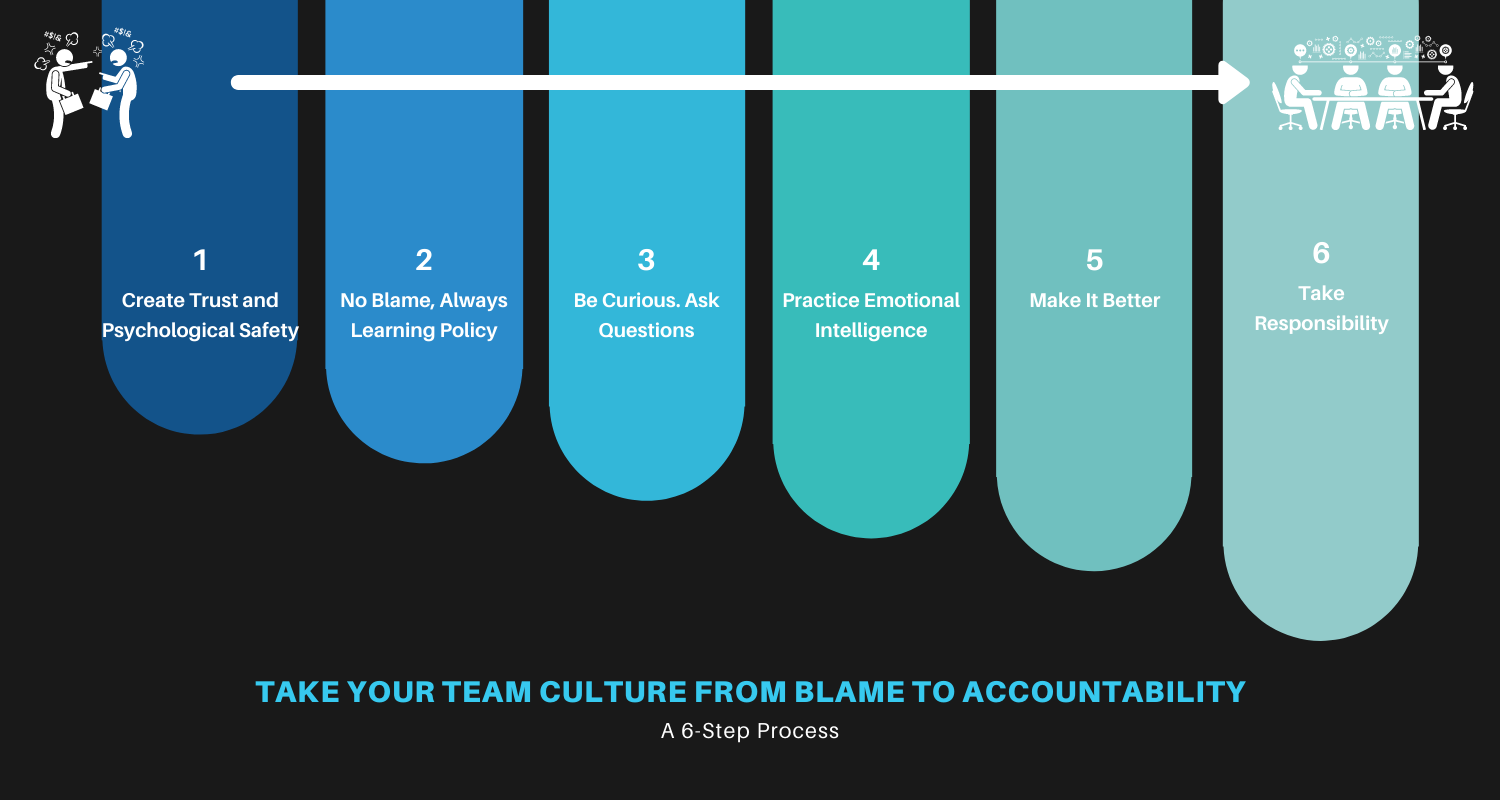
    As you must have realized by now, it is critical to creating a culture of accountability in any organization. The following are 6 steps to take your team culture from blame to accountability.

    1. Create Trust and Psychological Safety

    Creating a safe environment is the first step in creating trust and psychological safety. When people feel safe, trust builds, and people interact with each other without being suspicious. This interaction breeds cooperation, which is key to an organization’s success. Without trust, it is difficult to bring people together.

    Employees who enjoy psychological safety in the workplace will be more open about their mistakes and more willing to learn from them. They will perform their duties and responsibilities without fear and judgment, taking the organization a step closer to achieving its objectives.

    Gordon Bethune joined Continental Airlines when the company was losing hundreds of millions and successfully transformed it into a respectable leader in the airline business. He advises CEOs to take over the responsibility of creating a safe working environment for their employees. In his time at continental, Gordon always took the time to visit his employees in their crew room or the baggage room.

    Every 2 weeks I share my most valuable learnings from living life fully in my Deploy Yourself Newsletter. Sign up now to download a workbook with 164 Powerful Questions which I use daily in my work and coaching. Allow these questions to transform your life and leadership.

    2. Create a No-Blame, Always-Learning Policy

    Focusing on the person instead of the problem shifts attention away from the real issue and prevents learning. Once you identify the culprit, the next step is usually how to deal with them. As a result, further inquiry into the problem ceases, hampering effective problem-solving. Finger-pointing denies the organization information about the reality on the ground and makes decision making impossible.

    When you focus on accountability, you don’t assign blame to individuals. Instead, you view mistakes as opportunities to facilitate learning and growth and encourage constructive conversations that seek to find the root of the problem. People appreciate this and are more willing to share and discuss their mistakes and challenges in such an environment.

    Akio Morita was an innovator and co-founder of Sony. When speaking about his success at the company, he highlighted communication as one important ingredient for success. One of his popular quotes reads: “I believe one of the reasons we went through such a remarkable growth period was that we had this atmosphere of free discussion.” Morita also created a culture of accountability by trusting in his employees’ ability—he believed that everyone had creative abilities.

    3. Be Curious. Ask Questions To Figure Out Why The Problem Happened? 

    A blame culture will tempt people to ask, “Who did it?” but a culture of accountability encourages people to find out the root of the problem by asking more important questions related to the problem.  For example, they will ask, “Why did it happen?” “What did we ignore?’’ What could we have done to prevent this?’’

    You need to be constantly curious (and not jump to conclusions). Asking these questions encourages openness and inspires constructive engagement. Consequently, it spurs meaningful conversations and encourages a collective approach to addressing the problem from happening again in the future.

    Accountability focuses on addressing the problem from a system’s perspective that will enable you to identify flaws in the system, which may not be obvious at first glance. When holding accountability conversations, be clear about your intentions from the onset and remember to focus on inquiry rather than an inquisition. Also, encourage everyone to accept the role they played in the system.

    Pixar’s Ed Catmull attributes his company’s (Pixar) success to feedback.  The company makes films through a deeply collaborative process that hinges on productive feedback. Such feedback is based on trust and focuses on moving the project forward rather than expressing personal opinions.

    4. Build and Practice Emotional Intelligence

    Anger is a natural emotional response that you have when something goes wrong or when you experience unfairness and injustice. Although it is an involuntary response, you can always listen to what it has to say, and then respond in a way you can be proud of. Otherwise, the emotion can consume you, making you do things you will later regret. For instance, anger can make you lash out at others unfairly. 

    Instead of aggravating the problem, remain calm and focus your energy on addressing the problem. Always demonstrate this to set the right example for your team. It is important for them to know that assigning blame is destructive in the workplace. Coach them to deal with their anger and frustrations without blaming others. 

    When conflict situations arise in the workplace, people tend to justify their behaviour and point of view while failing to consider the other person’s side of the story to escape blame. However, it is your responsibility to discourage this trend in your organization. You can achieve this goal by creating a safe environment that values empathy over blame. Always encourage your team members to listen first, and then express their concerns without holding back.

    Alan Mulally exceeded expectations when he turned around Ford Motor from a company that was progressively going out of business to a giant that dominated the industry. He realized that teamwork was the only way out of the mess and led by example in appreciating everyone’s contribution. He also encouraged his team to open up about their failures and support each other.

    5. Make It Better

    After identifying the problem, you need to figure out what you can do to prevent it from recurring. Ask yourself what you could have done to prevent the problem? After looking inward, engage your team and work together to find what you can tweak in the processes, tools, and systems to prevent a similar problem in the future.

    Sometimes problems arise due to a lack of clear expectations. Take this opportunity to communicate your expectations clearly and concisely. If your team does not fully understand their roles and responsibilities, go through them again together. You also need to review their progress constantly and provide regular feedback.

    Steve Jobs, who co-founded Apple from his mother’s garage, faced an ouster in 1985. When he came back to Apple in 1997, the company was struggling to survive, and its stock prices had taken a dip. Instead of blaming others for his exit, he used his unique vision and ideas to turn the company around. By the time he died, Apple’s stocks had increased by more than 9,000%.

    6. As a Leader, Take Responsibility for Your Team’s Actions

    A good leader will accept blame when things go wrong and pass along the credit when things go right. When others face problems, they will learn by using each mistake as an opportunity. Before pointing fingers, they will ask themselves what they could have done differently.  If someone slips up, they will offer their support and create a more robust system. Instead of throwing people under the bus, they realize that everyone is human and can make a mistake.

    As a leader, the buck stops with you. If you lead by example, you can encourage your team not to fear mistakes but to view them as opportunities to learn and grow. You will also inspire them to emulate your actions, which will include taking responsibility for their mistakes. But if you are constantly pointing fingers, you will lose their trust and respect. You have to lead by example. 

    Blame Statements

    When blame is prevalent in your team culture, you will hear people make statements (either out loud or to themselves) like the below:

    • Who did this? This is wrong and should not have happened. Let’s find out who did it.
    • This is completely wrong. You should not have done this.
    • This is your fault and there will be consequences.
    • I made a mistake but I won’t say anything and try to hide it, otherwise, I might face repercussions.

    Accountability Statements

    When your team culture is one of accountability, you will hear people say:

    • How can we make sure that this kind of mistake doesn’t happen again? What processes/systems can be changed?
    • What can we learn from this situation?
    • What was really the cause of this? Do we know the root cause? How do we plan to fix the problem?
    • I made this mistake. I want to share with everyone so that no one makes this mistake and can learn from my experience.

    Conclusion

    Blame culture creates divisions and separates people and teams. It also causes mistrust between employees and creates an environment of fear. Consequently, it makes it harder for the organization to achieve its goals. Fear also paralyzes workers, making them reluctant to take new initiatives.

    Accountability culture brings everyone together as part of a bigger whole. It encourages people to take blows for each other as comrades and friends rather than as competitors.  Since it addresses mistakes from a systems point of view, identifying flaws and rectifying them becomes easier.

  • 5 Simple (But Not Easy) Steps Every Manager Can Take To Improve Work Culture

    If you are lucky enough to be someone’s employer, then you have a moral obligation to make sure people do look forward to coming to work in the morning. – John Mackey

    I have been leading teams for 12 years in companies such as Yahoo, Booking.com, etc in India and Europe. When I look over the last 12 years, I get a smile on my face on recalling how foolish I was to think that I had it all figured out. I used to believe management and leadership is only common sense, and that I do not need any special training or knowledge for it.

    Today, while I still believe that leadership is a lot of common sense, but I couldn’t be more wrong about how easy or hard would be. As it is said, the one thing about common sense is that it is not so common. One of my biggest learnings about leadership is that while the concepts behind it are simple and age-old, they are not easy to actually implement in real life. What I found is that even with all the leadership knowledge, these skills can desert you when you need it the most.

    What I learned is that human psychology and our evolution driven behavior patterns are hard to undo. Our ego, various cognitive biases, and our desire to look good in front of others can fool us easily. These very human traits can make us behave in ways that are diagonally opposite to our deepest held beliefs and values.

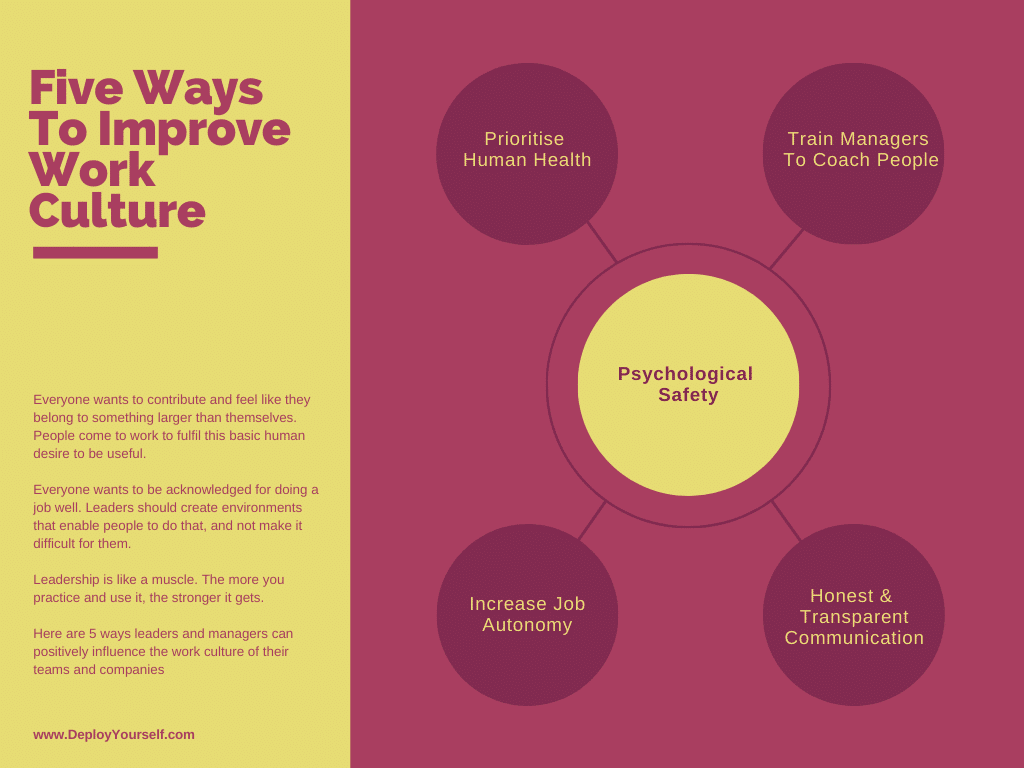
    Leadership is like a muscle. The more you practice and use it, the stronger it gets. Without practice, all the leadership knowledge is only as useful as the knowledge of nutrition while we keep on eating fast food. Below are 5 ways leaders and managers can positively influence the work culture of their teams and companies:-

    1. Make Human Health A Priority

    Good management starts with taking “care” of your people. As managers, we should all ask ourselves – how well do we know our people? Do we know what they “care” about? And then we should make it a priority to take care of what they care about. If we know that, we can match work projects and assignments to employees better. This leads to motivation, growth, and success for both the company and the employee.

    Managers should actively discourage bad practices like working late and on weekends, and encourage people to focus on their health by providing and promoting adequate health insurance, healthy food, and sports facilities – whether inside or outside the physical space of organizations.

    “Customers will never love a company until the employees love it first.” – Simon Sinek

    2. Create Psychological Safety

    No productive work is possible if people don’t feel safe at work. If you have to put a mask at work and are not free to say what you feel, it creates a lot of friction and stress. Thus creating an environment of psychological safety is very important for any manager. Your biggest job is to create an environment of respect and accountability, where people have fun and express themselves freely by continuously moving forward towards the team’s goals.

    3. Train Managers to Coach People

    If you are a manager, you are a coach by default. You don’t have a choice in being their coach as people will approach you anyways. When they are demotivated, when they have a conflict, or when they need help for any other reason; it is your responsibility to listen, understand their concerns, and then coach them to align their personal motivations with the team’s shared purpose and goals.

    How well you coach people will be directly proportional to the results the team produces. Investing in learning these skills and making coaching a priority can be your best investment ever.

    4. Increase Job Autonomy

    Nobody likes to be told what to do. Nobody likes to be micromanaged. We hire people after extensive interviews which test them on their skills. I think we disrespect the same skills when we don’t listen to them.

    As managers, it is important to give people a say in how they want to work. Once people have everything they need to do their job, managers should get out of their way and not stand over their shoulders.

    5. Honest and Transparent Communication

    Finally, we should treat our employees like adults. We should be honest and share what is going on in the company – even if it means sharing bad news. This builds trust and makes it more likely that people will stand by you in times of adversity.

    Leaders should stop using complicated language or hiding behind jargon. Share documents openly. Let people ask anything about everything. Transparent communication involves people in problem-solving and they see the team’s or the company’s problems as their own. And, you never know where a good solution to your biggest challenges might come from.

    Employees who believe that management is concerned about them as a whole person — not just an employee — are more productive, more satisfied, more fulfilled. Satisfied employees mean satisfied customers, which leads to profitability. — Anne M. Mulcahy

    Everyone wants to contribute and feel like they belong to a company. People come to work to fulfill this basic human desire to be useful. Everyone wants to be acknowledged for doing a job well. Leaders should create environments that enable people to do that, and not make it difficult for them.

    References

    1. https://rework.withgoogle.com/guides/understanding-team-effectiveness/steps/foster-psychological-safety/
    2. https://www.researchgate.net/publication/335690856_Work_Engagement_Trust_and_Respect_to_Engage_your_People
    3. https://hbr.org/2018/11/if-your-employees-arent-speaking-up-blame-company-culture
    4. https://www.researchgate.net/publication/255625175_Putting_People_First_for_Organizational_Success
    5. https://www.worldcat.org/title/which-comes-first-organizational-culture-or-performance-a-longitudinal-study-of-causal-priority-with-automobile-dealerships/oclc/5811616905&referer=brief_results
  • Busting The Myth of Individual Performance. A Radical New Equation For Improving Performance At Work

    What causes employees to put themselves between a customer and bullets from a terrorist attack?

    It is very difficult to imagine anybody valuing their work so much that they put their lives at stake to protect customers. Yet, that is what many employees of the Taj Mahal Palace Hotel in Mumbai did on 26 Nov 2008 when terrorists attacked the hotel with gunfire and grenades. Eleven hotel employees were killed, most while helping approximately 1,500 guests escape from harm. Many repeatedly guided guests to safety before they themselves were shot by the terrorists.

    We will come back to this story later, but let’s start with a simple question – Do you want to improve performance?

    This might seem like a lame question because everyone wants to improve performance. Individuals want to improve their own performance for better career prospects, pay, and growth. Managers want to improve the performance of their teams and individuals to achieve business goals and make their bonus targets. Companies want to improve performance to retain the best employees and increase value for both customers and shareholders. Similarly, countries want to improve the performance of their workforce to make their economies stronger, and their people more prosperous.

    When it comes to discussing performance at the workplace, most of it revolves around individual performance. We believe, both consciously and subconsciously, that an individual is in complete control of his or her performance. We assume that the individual holds the absolute responsibility of performance – good or bad. And that is why we reward or punish people based on their individual performance.

    But what if this is not the truth? What if we are missing a huge component of performance? After researching and reading about the role of neuroscience and psychology in performance and leadership, I want to present a radical new equation for understanding and improving performance at work.

    Taj Mahal Hotel, Mumbai, Which Was Attacked By Terrorists in 2008
    Taj Mahal Hotel, Mumbai, Which Was Attacked By Terrorists in 2008

    Performance = Ability + (Culture x Size of Company)

    After 15 years of working professionally across many companies and two continents, today I see ability as an important but incomplete condition for performance. The culture of the company plays a much bigger role in the performance of each individual, and this part gets bigger as the company gets bigger.

    For example – In a small startup of 5 people, the performance of an individual will mostly be determined by their ability. If they can work on improving their ability, their performance increases by a similar margin. However, as the company gets bigger, the culture component gets bigger and has a major impact on performance. In a hundred or a thousand-person company, the impact of culture will be huge compared to the impact of the individual’s ability.

    If you were wondering what caused the Taj Mahal Hotel’s employees to put themselves in front of bullets, it was the culture the Tata group has managed to form over the 150 odd years of its existence. It was certainly not a part of their job requirement that day, and everybody would have understood if they had cared for their own safety first.

    As the hotel’s general manager said, “Every team member at the Taj felt that their house was being attacked. When our house is attacked, what do you do? You defend it and whoever is there inside. The family values that we all believe in are part of our corporate culture in the Tatas… The Tatas truly exhibit that the organization has a soul. I am very very proud that I work for them.”

    “Culture eats strategy for breakfast”

    — Peter Drucker

    Importance of Culture

    People don’t perform based on their abilities alone. Any person’s performance is the sum total of their own abilities and effort plus the prevalent culture in the company (and team). A good culture can enhance performance just like bad culture can degrade performance. I have seen this firsthand when working in Yahoo at a difficult phase in the company’s existence. Before Google or Facebook, Yahoo was the king of the internet. But it stumbled and missed many opportunities – first to buy Google, and later on to compete with Google.

    I met the best and most talented people of my life while working in Yahoo, and while they were putting in their best effort, the results were not good enough to compete in the market. As Yahoo’s business was struggling, a string of new CEOs and a lack of leadership destroyed the culture in the company. Yahoo innovated and introduced some revolutionary products (briefcase, portal, email, Geocities, broadcast, Flickr) in the 1990s, but failed to capitalize on their own products as well as acquisitions in the 2000s.

    What Can A Good Culture Enable?

    1. Good company culture can turn your employees into passionate advocates for your way of doing business. They will go above and beyond what is expected of them on paper to serve each other and your customers.
    2. Good culture makes it easier to retain your best people as your culture becomes a key differentiator in the industry. People stay in companies longer if they have fun and share values with the people they work with.
    3. Culture has a direct impact not just on performance but also on health and well being. Good culture reduces stress and tension, and people look forward to Mondays as your colleagues become like an extended family.
    4. Culture creates brand loyalty and improves your branding without any additional spend as your people speak about the “culture” in your company wherever they go. On the other hand, reports of bad culture can create a PR nightmare.

    Any guess who creates and shapes the culture of a company – its leaders. Leaders shape the culture of a company through two things – conversations and processes. Let’s start with processes.

    Processes

    As a company grows, it is important to put certain processes in place, but they must always be for the right reasons – to make it easier for people to do their work with autonomy and collaboration. Processes should allow people to collaborate with honesty and transparency, not the other way round.

    Processes should never be but often are, put in place just to control things or to assert one’s leadership. As a leader, it always feels good to put a new process in place, but we must resist the temptation. Process and trust are inversely proportional to each other. We lose an opportunity for a personal connection when we put in a new process. The more processes a company has, the less trust it places on its employees, and vice versa.

    Processes put for the right reasons can clarify common company values and business goals, and acts like checks and balances against people going astray. Processes can determine some key aspects of running an organization, like :

    1. Recruitment and Onboarding of new employees
    2. Promotion criteria and opportunities for internal job moves.
    3. Flexibility in work timings and absence from work
    4. Compensation, Rewards, and Benefits
    5. Hierarchy and lines of communication in the company
    6. Training and learning possibilities
    7. Health insurance, sick leave, absence to take care of family
    8. Clarity on management styles and what is accepted and what is not.

    Leaders must always ask themselves – What processes can we remove? Anyone can create a new process and add to a mesh of existing processes, but it takes a brave leader to untangle the mesh and see through the web and simplify processes, increasing trust and performance as a result. Regularly updating processes also make sure everyone is focused on the real objective (of the organization) rather than focusing on what the processes say. If the time has come for a process to go, then it must be retired or adapted to the current situation.

    A hallmark of a healthy creative culture is that its people feel free to share ideas, opinions, and criticisms. Lack of candour, if unchecked, ultimately leads to dysfunctional environments.

    — Ed Catmull, President of Pixar

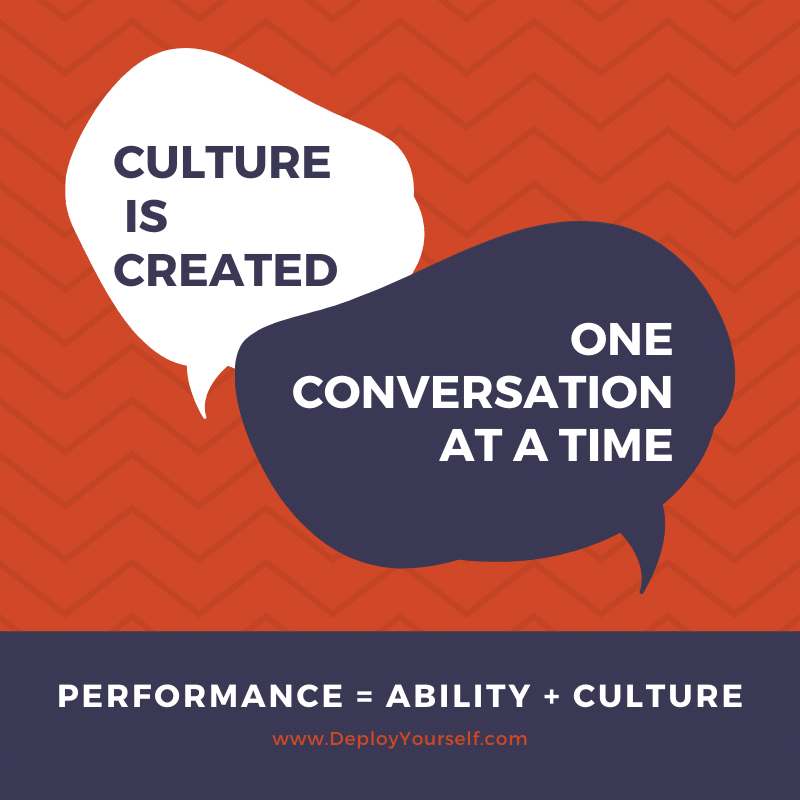
    Performance = Ability + Culture . A Radical New Equation For Improving Performance At Work
    Performance = Ability + Culture . A Radical New Equation For Improving Performance At Work

    Conversations

    Once leaders have done the groundwork and provided the platform for people to perform, they can step back and look at the big picture. They use conversations to align conflicting energies in a common direction. It is not uncommon for empowered people to run in different directions, or worse, to run into one another. That is why a leader must always engage in conversations with his/her people to align them with a common vision and direction.

    In most companies, there are hardly any trainings or resources to master the skill of engaging people in conversations. Most managers are never trained to deal with conflicting energies and inspiring people to act. Leaders do their best work when they are in touch with their values, and align them with the company’s values while going after their respective team’s goals. Isn’t it a shame that so many leaders today have no idea what their values are?

    Without this understanding of themselves, I often see people stepping up as managers without any knowledge of what to expect in their new roles. To make it worse, they have no idea where to go and seek help when they need it. Leaders should lead because they see it as a privilege to serve people and an opportunity to make an impact, not because it is one of the “career” options available. If a leader is leading his team only for his career goals, and without care for the people or the product, it will show in the team’s performance and culture.

    There are some important conversations every leader should master (or continuously improve) as they have a direct role in establishing culture. They are :

    1. Establishing the importance of company values by encouraging or discouraging certain types of behaviors or actions.
    2. Celebrating smalls wins and recognizing good performance can be the difference between a team and a group of people.
    3. Dealing with uncertainty and failure. Do your leaders engage in blame games? Or do they focus on fixing the mistake and ensuring it is not repeated without blaming the one who did it?
    4. Storytelling – We all listen and absorb concepts better in stories than abstractly. The stories leaders tell determine the level of trust and community in the organization.
    5. Making and communicating decisions. Honesty and transparency in communicating about the reasons behind taking any specific decision is a key element of any leader’s job.

    In the end, conversations reinforce the beliefs, values, and perceptions present in the culture of any organization.

    To come back to the Tata story, here is what the leaders of the company did after the terrorist attacks in 2008 which killed 164 people :

    1. The hotel didn’t fire even a single employee as the hotel was closed for 2 years due to the damage by the attack.
    2. Senior company leaders attended all eleven funerals and visited the families of all eighty employees who were killed or injured.
    3. The company assigned a mentor for every affected team member to serve as a single point of contact to ensure that the person received any help needed.
    4. They provided compensation to the families of every deceased member, ranging from $80,000 – $187,000
    5. Waived all loans and advances, regardless of amount.
    6. Committed to paying the employee’s last full salary for life.
    7. Took complete responsibility for the education of their children and dependents through college – anywhere in the world.
    8. Provided full healthcare coverage for all dependents for the rest of their lives.

    Conclusion

    As we have seen, culture plays a big role in shaping performance. In my experience, if the performance of people goes up or down significantly, the most important factor is the prevalent culture in the company. However, we often fail to see culture as a performance driver and put the impetus of performance only on the individual’s ability and efforts.

    To conclude, in this article we read about how the Taj Mahal hotel’s employees put themselves in front of bullets to save guests during the 2008 Mumbai terrorist attacks. We also found out what the Tata group did after the attacks to reinforce their culture, and the big but often ignored role culture plays in the employee’s performance. Then we looked at how leaders shape the culture of the organization through processes and conversations. And how important is to train our people to create a culture that enables performance, rather than stand in its way.

    Most of the work in organizations is done by teams, and not by individuals alone. And yet the entire performance measurement systems in organizations focus on the individual alone. I believe we (as an industry) are missing a trick here. And that trick is ‘culture’. When an individual’s performance changes from one year to another, we should focus on the culture, instead of just focusing on the individual. The single best way to increase performance is to create a culture that enables people to do their best work. Culture should enable performance, rather than stand in its way.

    Resources

    1. Conscious Capitalism: Liberating the Heroic Spirit of Business
    2. https://www.fastcompany.com/40544277/the-glory-that-was-yahoo
    3. https://www.forbes.com/sites/williamcraig/2017/08/03/8-ways-company-culture-drives-performance/#134149b46ce0
  • What is Feedback? And The Benefits of Feedback for Your Team / Company You Never Knew?

    It is the end of the quarter. And it is feedback season again!

    Feedback is a word many people dread and it makes them uncomfortable, while for others it is a tool to reflect on and improve performance. Having been on both ends of the feedback spectrum over my career, I want to share today what I think feedback is, and how it can benefit people as well as organizations.

    What is feedback?

    Do you think feedback is an operational necessity that your organisation requires you to do? Do you think feedback is something “extra” you have to do in addition to your work? In the early days of my career, I saw feedback as a distraction that keeps me away from “real” work. I wanted to get done with the feedback cycles as soon as possible as it would make me anxious and nervous. After all, nobody ever told me the purpose of feedback, how to do it well, and how to make it a tool in my development.

    It was only through my own mistakes receiving and giving feedback (and a few trainings) that I realized that feedback is work itself and not something external to it. Feedback is as much a part of my (and everyone else’s) work duties as any other task I consider essential. Over time I came to see feedback as a tool to improve not just my own performance, but also of the people around me, and of my team/organization as a whole.

    Feedback can happen in a ‘day to day’ manner like any other task. It can be a simple comment on some work which was just completed, like :-

    • You handled that really well. Thank you for thinking about that specific case.
    • I loved how you presented your ideas in the meeting we just had.

    OR, Feedback can be a structured conversation with your manager or employee. For example :-

    • I see you doing really well in … , …
    • I would like to see you develop skills like … , etc

    “Feedback is the breakfast of champions.”
    – Ken Blanchard

    The Benefits of Feedback You Never Knew

    The most important and obvious benefit of feedback is that it shines a light on and reveal our blind spots. We all need feedback to reflect, learn, and grow. It helps us become aware of our strengths and weaknesses, and identify any actions required to address them and improve performance. Timely feedback is essential to creating a loop where we are constantly reflecting upon what we did in the past and how can we do better in the future.

    But apart from assisting in our own personal development, I believe feedback can be an important tool that can help our team/company in other ways. Some of these are :-

    1. Better Relationships

    A regular cycle of feedback, not just with our managers but also with our peers, helps us build better relationships at work. It helps us get comfortable with each other and develop friendships with our colleagues. Having strong relationships at work not just impacts business results, but also results in more smiles and satisfaction from what we do. Giving and receiving feedback builds trust and helps create a safe environment where people can be themselves without any pretensions.

    2. Clear Expectations

    Having regular feedback conversations with people help clear expectations about what we expect from each other. It brings out our implicit expectations in the open and irons out any disagreements. Doing this right avoids any future misunderstanding and conflicts, and even if they arise, are much easier to handle and resolve.

    3. Positive Reinforcement

    Giving appreciation of a task well done serves as a wonderful positive reinforcement for the kind of behaviors you want to nurture in your team and your organization. Giving people a pat on their back or an informal “whoop” or “cheers” can do wonders for their confidence and sets an example for everyone else.

    4. Culture of Feedback

    If people are comfortable giving and receiving feedback in a company, and if it becomes a part of people/teams working together, then you have what is called a “culture of feedback”. This can be a tremendous asset for any organization. This culture lets your employees know that you care about them as people and not just the business results they produce. The culture of feedback creates an environment that enables every team to take ownership and pride in going after and achieving their business goals, while also taking care of their personal well-being and growth.

    To sum it up, the benefits of continuous feedback far outweigh the cost of having a culture of feedback and the little awkwardness everyone feels while giving and sharing feedback, which can be easily mitigated with proper training and guidance. Having a culture of open communication and regular feedback empowers people to come to work and make a difference – to their own growth as well as to the company’s purpose.

  • Five Things A Leader Must Do By Default

    In today’s corporate environment, after a few years of doing your job well enough, chances are that you will be asked to step up and lead a team. You trained and studied to be good at your job, and now getting to manage people seems like a reward for a job well done.

    By promoting the good performers to be managers and leaders, people have assumed for centuries that the skills that made you successful as an individual contributor would also make you successful as a manager. If you have led people for any considerable amount of time, you would know how false this assumption is. Yet in the business world, this continues to be the norm.

    Today I want to list down five things which you must do, or are expected to do by default, to be effective as a manager/leader. And it is likely that nobody told you this when you were promoted. I have only figured them out after leading teams for over a decade, and I believe I am on a continuous journey to learn and know more about leadership.

    1. Lead Yourself

    The first thing you must do to be effective as a leader is to lead yourself. Your relationship with your team will be determined more by your trustworthiness than by any other skill or talent you might possess. Trust is the foundation of leadership, and you build trust by leading yourself first – by holding yourself accountable for what you demand from your team. Like any worthwhile endeavor, it takes time, effort, and daily investments to build trust with your team.

    If you want your team members to honour their promises, honour your promises to them. If you ask them to be on time for meetings, you must be on time first. Or you will lose their trust. If you ask them to be respectful to each other, you must respect them first. Or you will lose their trust. If you want them to be humble, you need to exemplify that in your behaviour. If you need them to be honest and sincere, you need to acknowledge your mistakes publicly and make amends for them. You can not lead a team if you can’t lead yourself.

    2. Know Where You are Headed

    When you are leading a team, people will look up to you for providing direction. Having a well-defined purpose clarifies why the team exists in the first place. Coming up with the team’s purpose together with your team will empower them to take decisions that are in the best interest of the team.

    Listening to your team and engaging in a dialogue will allow the team to define and own its purpose. You need to spend time with the team regularly to discuss, revisit, or reshape the team’s purpose. Ensuring each member understands the team’s purpose and their role in the team will empower them to prioritize their tasks effectively.

    3. Be a Coach


    If you have people reporting to you, then you are their coach by default. You don’t have a choice in being their coach as people will approach you anyway. When they are demotivated, when they have a conflict, or when they need help for any other reason; it is your responsibility to listen, understand their concerns, and then coach them to align their personal motivations with the team’s shared purpose and goals. If you can’t do that effectively, it will impact the results the team intends to produce in the future.

    While I assert that you are a coach by default, the skills and conversations required to be a coach don’t come by default. You must invest time and effort in learning and practicing your coaching skills. How well you coach people will be directly proportional to the results the team produces. Investing in learning these skills and making coaching a priority will be your best investment ever.

    4. Demand Commitment and Accountability

    Just as every sport has a certain set of rules, each business team can come up with rules (or standards) which apply to their business and industry. These rules will govern how you work and define success and failure. Examples could be how you treat your colleagues, how complaints are handled, and what boundaries you set in matters important to the team. Once these standards are set, it frees up everyone to exercise their own creativity in making decisions. This gives shape to the ‘culture’ in the team.

    After you set up these standards together with your team, you have to demand them. Of course, for this to work, you have to exemplify them yourself. Holding your team accountable to these standards (or rules) will bring the team members together and set the team up for high performance. The intention behind it is not to punish or penalise people when they slip up, but to ensure an open, fair and supportive culture in the team.

    5. Serve Your People

    I believe that leadership is a privilege, and that each leader is a custodian of the company’s values, beliefs, and ambitions for the future. Leadership will require you to think beyond your own self-interest, and from your team or company’s point of view. In order to lead, you must be willing to serve – to put your team’s interest in front of any individual interests, which might lead you to make some difficult decisions from time to time.

    Leadership is not about power or authority, nor is it about popularity. Leadership is about character – which you will need to express yourself authentically, compassion – which you will need to grow and develop your people, and integrity – which you will need to serve your people with the respect and transparency they deserve.

    I believe that leadership is standing for something bigger than yourselves. You show your team the way, give it what it needs to do the job, and then get out of the way. Your biggest job is to create an environment of respect and accountability, where people have fun and express themselves freely by continuously moving forward towards the team’s goals.

    To sum it up, these five points above are not strategies or tactics which you can incorporate in your leadership style to get better results. These are the bedrock which will give rise to a myriad of strategies and tactics, which in turn will lead to those results. If you try to fake them, your people will call your bluff sooner or later, and you will lose all credibility and trust. An attitude of humble service will enable you to become a better leader, while taking care of your team and company’s needs.