sales

  • SALES – Three Levels of Communicating What You Do

    How shifting from “what you do” to “what it does for them” transforms sales, leadership, and trust

    A CEO I work with runs a successful industrial manufacturing company. His team knows the product inside out. They hit their numbers. But he kept running into the same problem: his salespeople couldn’t articulate value in a way that made customers lean in.

    “They’re technically competent,” he told me. “But when they talk to prospects, something falls flat. It sounds transactional. Forgettable.”

    I asked what they typically say. He laughed. “Exactly what we do. ‘We manufacture industrial pipes.’ Or ‘We provide piping solutions for commercial buildings.’ And the customer nods politely and moves on to the next vendor.”

    The issue wasn’t what they were saying—it was how they were saying it.

    What this CEO’s team lacked wasn’t product knowledge. It was communicative depth.

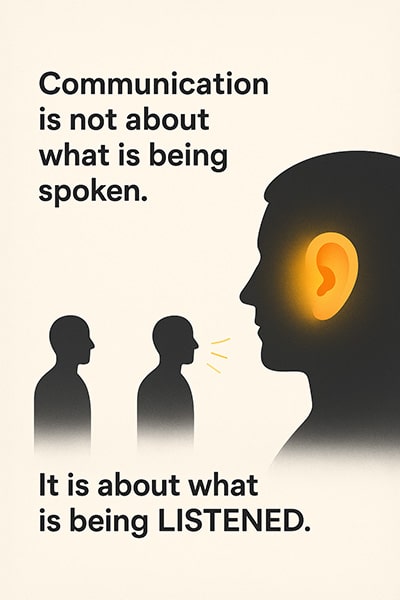
    Because communication is not about what is spoken. It is about what is being LISTENED.

    When two people are talking, all the power lies in the LISTENER. When you understand this, you understand communication.

    And it’s not just a sales problem. It’s a leadership problem. A human connection problem.

    Most professionals—whether they’re selling, leading, or just introducing themselves at a conference—operate at the surface level of communication. They describe what they do, not why it matters.

    But there’s a framework that changes this. Three levels of communication that, when mastered, transform how people perceive you, trust you, and choose to work with you.


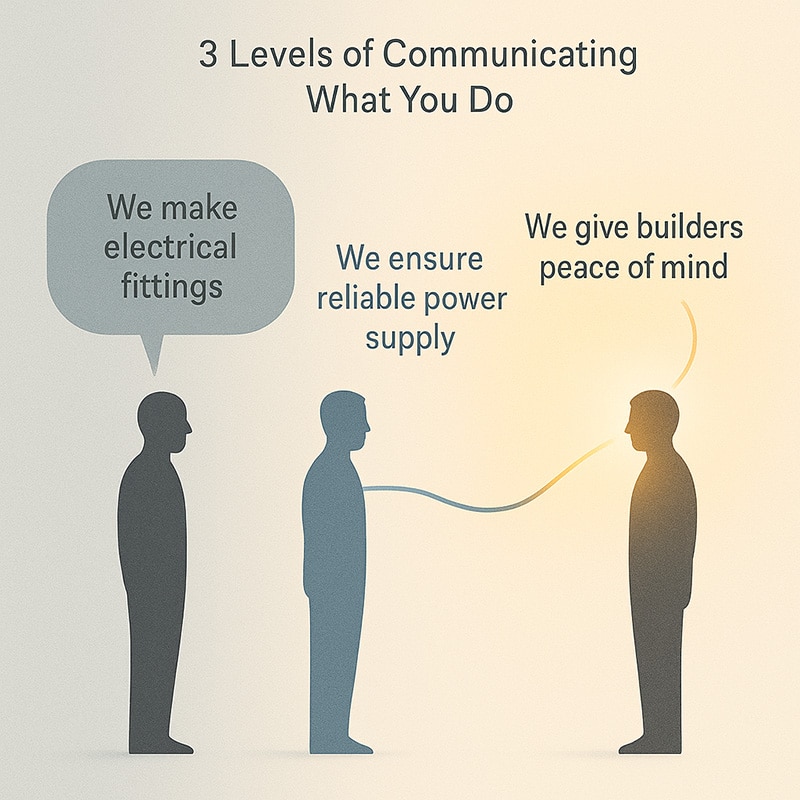
    Level 1: What You Do

    This is where most people stop.

    It’s the job title. The function. The category.

    • “I’m a financial advisor.”
    • “I run a marketing agency.”
    • “We manufacture components for the automotive industry.”

    It’s accurate. It’s safe. But it’s also invisible.

    When you communicate at Level 1, you sound like everyone else in your field. You’re describing the work, not the value. You’re naming the category, not the outcome.

    The problem? Categories don’t create differentiation. And they certainly don’t inspire action.

    The risk: You commoditize yourself before the conversation even begins.


    Level 2: What You Do For Them

    This is where things shift.

    Instead of talking about yourself, you pivot toward the person you’re speaking to. You introduce specificity and relevance.

    • “I help families plan their finances so they can retire comfortably.”
    • “We design marketing campaigns that help B2B companies generate qualified leads.”
    • “We provide end-to-end piping systems for commercial buildings—from design to installation.”

    Notice what changes: the listener can now see themselves in the picture. You’ve moved from describing a function to articulating an application.

    You’re no longer just a financial advisor—you’re someone who helps people grow their assets. You’re not just a marketer—you’re someone who solves a revenue problem.

    Why it works: People don’t buy what you do. They buy what it does for them.

    But even this isn’t enough.


    Level 3: What What-You-Do Does For Them

    This is the level where trust is built. Where emotional resonance happens. Where people stop seeing you as a vendor and start seeing you as a partner.

    It’s not just what you do for them—it’s what that outcome enables in their life or business.

    Let’s revisit those examples:

    • “I help families plan their finances so they can retire comfortably” becomes → “I help people sleep peacefully at night, knowing their future is secure.”
    • “We design marketing campaigns that generate qualified leads” becomes → “We help companies grow predictably, so leaders can stop worrying about where the next deal is coming from.”
    • “We provide end-to-end piping systems for buildings” becomes → “We make sure when you’re building something, you never have to worry about leaks, fittings, or supply delays—you can focus on delivering your project smoothly and confidently.”

    See the shift?

    You’re no longer selling pipes. You’re selling peace of mind.

    You’re not offering financial planning. You’re offering security.

    You’re not just generating leads. You’re creating predictability.

    This is where great communicators live. They understand that people don’t make decisions based on logic alone—they make them based on how something makes them feel.

    And feelings are born from outcomes, not features.

    Why Most Leaders Never Get Here

    Level 3 requires something most organizations don’t prioritize: empathy.

    It requires you to understand—deeply—what your customer, your team, or your stakeholder actually wants. Not what they say they want in a requirements doc. Not what’s in the RFP. But what they lie awake thinking about at 2 a.m.

    • A CFO doesn’t just want a financial forecast. They want confidence in the board meeting.
    • An operations manager doesn’t just want a vendor. They want someone who won’t let them down when it matters.
    • A new client doesn’t just want a consultant. They want someone who gets it without them having to explain everything.

    When you communicate at Level 3, you stop selling and start connecting and listening. And when you connect, selling happens naturally.


    Practical Application: Give It a Shot

    Here’s how to apply this in your own work:

    Step 1: Write down what you do. One sentence. That’s Level 1.

    Step 2: Ask yourself: What do I do for them? Rewrite it.

    Step 3: Go deeper. Ask: What does that do for them? What’s the real impact on their life, their team, their sleep, their confidence, their results? Rewrite again.

    You’ll end up with something that feels more alive. More human. Something that makes people stop scrolling, stop half-listening, and actually pay attention.


    Examples Across Industries

    A real estate agent:

    • Level 1: “I help people buy and sell homes.”
    • Level 2: “I help families find the right home for their budget and lifestyle.”
    • Level 3: “I help families find that one place where they’ll build memories, raise kids, and feel safe.”

    A SaaS company:

    • Level 1: “We sell project management software.”
    • Level 2: “We help teams manage tasks and deadlines more efficiently.”
    • Level 3: “We help teams stop drowning in chaos so they can focus on doing their best work.”

    A leadership coach:

    • Level 1: “I’m a leadership coach.”
    • Level 2: “I help executives develop their leadership skills.”
    • Level 3: “I help leaders rediscover confidence in who they are and what they’re capable of.”

    Every time you move up a level, you move closer to the heart of what people actually care about.


    What Changed for the CEO

    When I walk my clients through this framework, they often go quiet for a moment. And they see the simplicity and power of the framework – almost like an ‘aha’ moment.

    My client’s sales team wasn’t failing because they didn’t know the product. They were failing because they couldn’t translate what they did into something that mattered to the customer.

    Most of us make the same mistake.

    We get stuck in the “what.” We forget the “why.”

    But when you learn to climb these three levels—from what you do, to what you do for them, to what that enables for them—everything changes.

    People listen differently. Conversations open up. Trust builds faster.

    And honestly? It just feels better.

    Because deep down, we all want the same thing—to be understood.

    And that’s exactly what this kind of communication does.

    It makes you understood.

    And that’s where connection—and trust—begin.


    Give this a shot. Genuinely. Not as a tactic. You’ll see the difference.
  • Why everything you’ve been taught about selling is keeping you broke, desperate and anxious?

    Look, we need to talk.

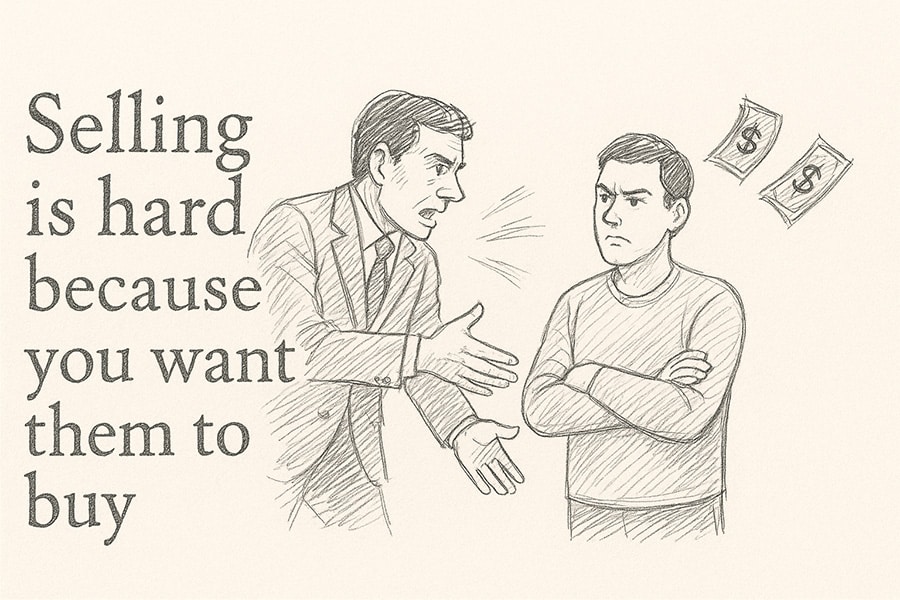
    You’ve been lied to about how sales really works. Every sales training, every “proven system,” every expert who told you to “always be closing” has been feeding you complete nonsense. And you’ve been following it like gospel.

    The result? You’re exhausted, you have long sales cycles, your pipeline is full of people who’ll never buy, and you’re competing with every other salesperson who learned the same useless tactics. It is not just killing your sales, it is killing your business from the inside-out.

    It’s time to wake up.

    What They Got Wrong

    Here’s what traditional sales training taught you:

    • Chase every lead
    • Never take no for an answer
    • The customer is always right
    • Give your time away for free in a long sales process
    • Solve and address people’s objections
    • More activity equals more results
    • Any other version of “this is how it works” specific to your industry or market

    Here’s the truth: This advice is designed to keep you small, desperate, stressed and easily replaced.

    Sales is a leadership skill.

    It is one of the most important aspects of being a leader. Sales leaders don’t beg. They don’t chase. They don’t slash prices. They don’t bend. They figure out what’s broken, tell you how to fix it, and get paid well for their expertise.

    And at all times, they hold their head high in pride.

    (before you read the below, I do not want you to treat my word as gospel either. I do not want you to believe or agree with anything below. All I suggest you do is deeply think about it, give it a chance in real conversations, and then make your own judgement call. whatever works for you, do that. I don’t care whether you believe this or not. I only care that you sell faster, with profit, and with your head held high with pride & honour)

    Stop Doing These Things Right Now

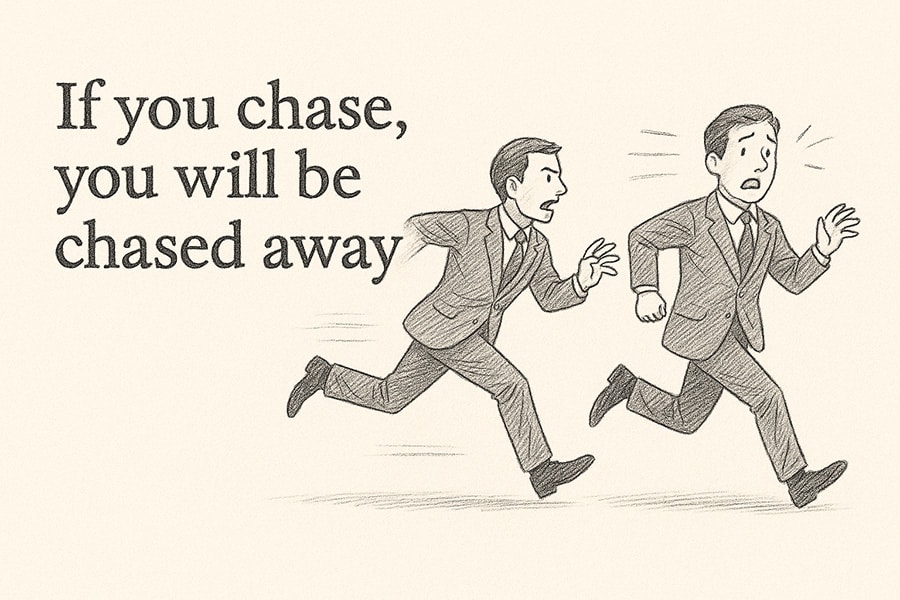
    Are you chasing people who can’t actually buy? Stop.

    Every minute you spend trying to convince someone who has no money or authority is a minute you could be talking to someone who actually needs what you’re selling.

    Do this instead: Ask the tough questions upfront. “What’s your budget for fixing this?” isn’t rude – it’s smart business.

    Are you jumping straight into your pitch or presentation? Stop.

    You’re not a walking product demo. You’re supposed to solve problems. But you’re talking about features and benefits before you even know what’s wrong.

    Do this instead: Get obsessed with understanding their problems. The person who asks the best questions runs the conversation. Once you ask questions, shut up and listen. Then ask another question.

    Are you competing on price? Stop.

    When you lead with how cheap you are, you’re telling everyone you’re just another commodity. Commodities get squeezed and replaced. Experts get respected and paid what they’re worth.

    Do this instead: Lead with what you know. Walk into every conversation as the person who fixes their specific kind of problem better than anyone else. I mean it. They should feel your presence and genuine (not fake) expertise before you open your mouth.

    Are you taking every meeting that comes your way? Stop.

    Your time isn’t free real estate. Every “yes” to the wrong meeting is a “no” to the right opportunity. Being busy doesn’t mean you’re being productive.

    Do this instead: Be picky about who gets your time. If they can’t tell you why they need to meet, they probably don’t.

    Are you giving away all your best ideas for free? Stop.

    Every time you solve their problem during the sales conversation, you’re showing them they don’t need to hire you. Your knowledge is what makes you valuable – stop handing it out like free candy.

    Do this instead: Figure out what’s wrong, confirm it hurts, then tell them what they need to buy to fix it.

    Here’s What Changes When You Start Showing Up as a Leader in Sales

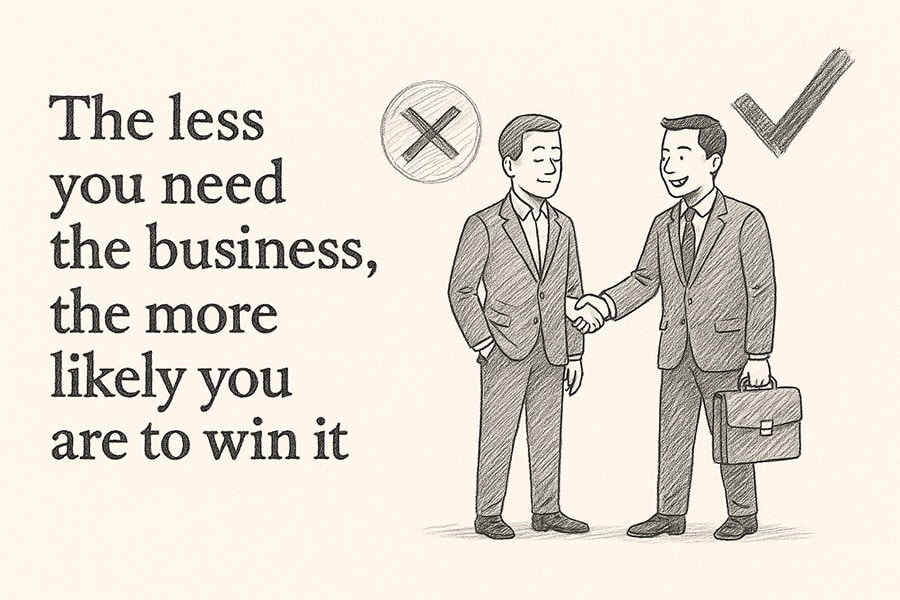
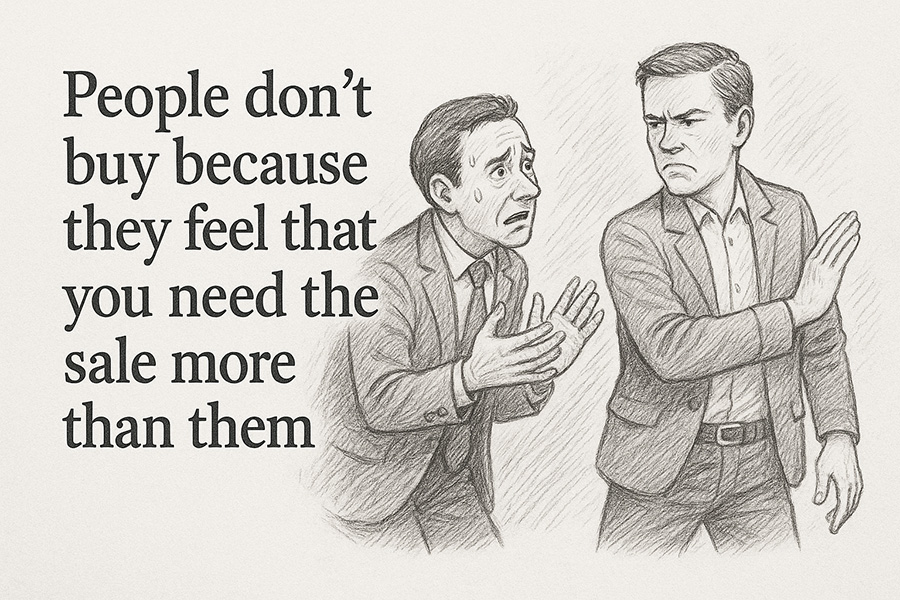
    You get better clients. When you’re selective, people think you must be good and respect you for that. When you’re desperate, they can smell it from a mile away.

    You make more money. Specialists always charge more than generalists. When you solve specific problems for specific people, price becomes way less important than results. The best buyers never care about paying more. They only care about getting their problem solved well so that they can focus on more valuable things for their business.

    People actually respect you. Clients who value expertise treat you like a partner, not just another vendor. They listen to what you recommend instead of telling you what to do.

    You close deals faster. People who actually need what you’re selling buy quicker than people who are just shopping around.

    The Real Subconscious & Paradoxical Reason This Works Better

    The old way was about convincing, persuading, and fighting through objections. There is no convincing required in sales. If you are convincing someone, you have already lost.

    The new way is about owning your worth fully, positioning yourself right, diagnosing problems (like a doctor), and prescribing solutions only if you can help them. Be willing to walk away (and actually walk away) in all other situations.

    Old thinking: “How can I talk them into buying?”

    New thinking: “Are they even the right fit for what I do?”

    Old approach: Present your stuff, send a proposal, pray they say yes.

    New approach: Figure out what’s broken, tell them how to fix it, expect them to buy because they need it.

    Old relationship: Vendor asking for business.

    New relationship: Expert solving real problems and setting clear terms to engage.

    Time to Respect Yourself

    This isn’t about being a jerk or acting superior. It’s about having some self-respect and owning your worth. You know how to solve problems. People with those problems should be happy you’re willing to help them.

    Stop apologizing for what you charge. Stop chasing people who don’t value what you do. Stop giving away your best thinking for nothing.

    Start seeing yourself as the person to call when they have this specific problem. And tell others that.

    Start asking better questions. Start walking away from deals that don’t make sense.

    The Hard Truth About Why Most Sales People Struggle

    Most salespeople fail because they’re scared to be choosy. They’re terrified of missing out, so they chase everything and end up with nothing good.

    The successful ones are picky. They know what they’re worth. They understand that saying no to bad opportunities makes room for good ones.

    Your income comes down to the problems you solve and who you solve them for.

    Solve big problems for good people, make good money. Solve small problems for anyone who’ll listen, stay broke.

    You Have a Choice

    You can keep playing by traditional sales rules – chasing, discounting, begging, competing with every other desperate salesperson who learned the same broken system.

    Or you can take back control, position yourself as someone who knows what they’re doing (because you do), and start admitting clients who value your work and pay you fairly. Say NO to everyone else – even if they are ready to pay.

    The world doesn’t need another order-taker. It needs problem-solvers who aren’t afraid to charge what they’re worth.

    Your future self is counting on you. Your company’s future is counting on you.

    To Summarise

    It takes courage to say no, to specialize, to charge what you’re worth. It takes discipline to protect your time and to nurture your relationships. But trust me, it’s worth it. When you focus on these things, business success becomes a natural byproduct, not a desperate chase.

    It boils down to this: there are things way more important than just making a quick buck or landing every single client.

    If you get the above things right, the sales and business success usually follows (paradoxically), and it feels a lot better too.

    If you ignore them, you might make some money, but it’ll be a constant struggle, and you’ll probably feel pretty miserable.

    So, next time you’re feeling the pressure to take on a bad project, or to lower your prices, or to give away your ideas for free, just ask yourself:

    • Is this going to help me maintain my self-respect?
    • Is it going to build my expertise?
    • Is it a good use of my time?
    • Is it going to strengthen my relationships?
    • And most importantly, is it going to contribute to my peace of mind?

    If the answer to any of those is no, then maybe, just maybe, it’s time to walk away.

    Because some things are just more important than business success.

    And when you realize that, you’ll find that true success, the kind that feels good and lasts, will start to find you.