
Communication Skills

  • How our Listening Filters Create our Reality and Limit Us

    One of my most vivid memories from my childhood is when my grandmother mistook me for my father. I first thought she had gone crazy, but I was relieved when it was diagnosed as cataract in her eyes. Within a few days and after a small surgery, I was back to being her grandson. That was an easy fix — I thought at that time.

    I had no idea that many years later, I was to discover a kind of cataract — in my vision and listening. The cataract which I am talking about are our listening filters. As I shared briefly in my article about Listening, these filters helps each one of us create our own perceived reality which helps us in making every decision — big or small — of our lives. However, unless we know the various listening filters at play, we don’t see our reality as a perception but as the absolute truth.

    Whenever we see or hear something, we select what to pay attention to and what to ignore, often subconsciously, based on a certain set of filters. A simple example could be someone speaking our name. Even if we are in a crowded room, we will instantaneously pay attention if someone utters our name, even if they are behind or far away from us. Our filters make us give more attention to our name than any other word.

    Similarly, other listening filters make us pay more attention to certain things and ignore others. They can make one of us cry and another laugh on hearing the same story. They allow us to make sense of the situation in front of us, which creates the foundation on which we base our decisions.
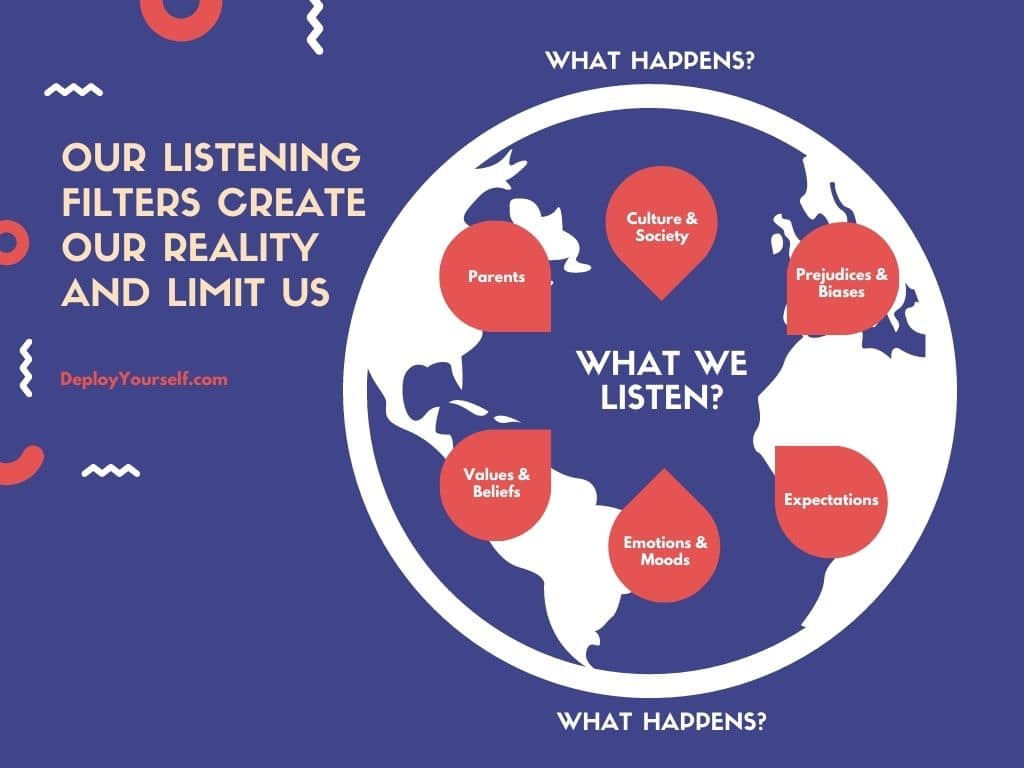
    What are these Listening Filters?

    1. Parents

    Our parents are our first contact with humanity. As we grow up, our parents influence us the most. As we try to understand the world around us, our parents tell us stories to make it easier for us to navigate it. Everything that we consider as our most basic self – our religion, language, values, our political affiliations — are shaped by our parents more than anyone else

    Subconsciously we learn to listen to the outside world through them. Depending on what our parents think, and how they act, we learn to make our own choices and judge other’s choices. We either end up see the world as they do or rebelling against them and view the world contrary to how they see it.

    2. Values and Beliefs

    We filter everything we see and listen through our values (how we define right & wrong), and political, religious and other strong beliefs. For example – If a person has suffered racial discrimination in the past, he is likely to filter all future interactions with suspicion and caution.

    If we hear what is in tune with our values and beliefs, we feel relaxed, joyful, and get an ego boost which can easily be seen in our body language. When we hear or see something contrary to our beliefs, we are surprised and might even feel pain and shock. We feel our muscles tightening, which can develop into stress, frustration, and anger. Again, this is visible in our body language.

    3. Culture – Language, Society, Religion

    We behave in the world according to the religion we follow (or not), the languages we speak and are spoken around us, and the norms of the society we live in. Whether we are direct or vague in our communication, whether we are disciplined in our daily dealings or not, whether it is polite to accept a gift or not, and other subtle things in our daily life — are shaped by the culture of the land we live in.

    4. Intentions, Expectations and Mood

    We enter every conversation with an expectation of the outcome. For example – my expectations are very different when I talk to my colleague at work compared to when I run into him over the weekend. Similarly, my expectations differ when my wife calls me up at our usual time, and when she calls up unexpectedly during the middle of the day. What we listen to in these different circumstances is shaped by what we expect to happen.

    Our listening is also shaped (or filtered) by our mood. At the end of a long day when we are tired, if we don’t get our expected response in a meeting, we might easily get frustrated and angry. But if we get the same response at the beginning of a day when we are fresh and energetic, we might respond in a totally different manner. The difference in both these cases is our mood impacting our listening.

    5. Personal Prejudices

    We all have certain personal prejudices, which can be racial, economical, or something even more subtle – like the way one dresses. We listen and treat people differently based on these prejudices, most often on a subconscious level. An example is considering one colleague more ambitious than another based on how they are dressed. Another example is how we listen when we are approached by a homeless person on a street. Do we trust them when they approach us for money or think about whether they are just going to use the money to get drunk?

    We all have such personal prejudices formed over the years which live in our subconscious and give us a filtered view of the world around us. We are likely to ignore anything that opposes these prejudices, and very likely to agree and bond with anyone who shares the same prejudice as us. For instance, if we have a personal dislike for a person, we are likely to be dismissive about his ideas. On the contrary, when we interact with people we admire, we might behave over-optimistically in situations which warrant more caution.

    Does everyone have the same filters?

    Absolutely not. Just like our fingerprints, each one of us has unique listening filters. Based on our past, we all filter how we experience the present and make meaning of what we see and hear. Furthermore, our listening filters are changing (or evolving) daily based on new people we meet, successes and failures we have, and prejudices we form.

    Our listening filters give each one of us a unique view of the world around us. These filters are almost like glasses through which we view the world. We put on our black glasses, and then complain the world around us is black. Not only that, we argue and fight with others wearing red glasses that the world is black and not red. Sounds silly, isn’t it! Yet we all do it.

    What can we do about them?

    Every decision we make, whether it is trivial or a life-changing one, depends on how we assess the situation. Our listening filters help us create this assessment, which in turn limits the options in front of us. If two people act differently in the same situation, the difference is in their assessment of it. Reality is the shaky foundation on which we all rest our decisions.

    As you read this article and understand it through your own filters, don’t be led to believe that there is something wrong with having them. Instead, they are very useful in giving us a set of options in each situation that help us navigate through life. However, we are normally blind to the fact that these filters give us our perspective of life in each moment. If more aware, we are likely to understand how others see things differently.

    Knowing that others may see the same situation differently can help us stay humble in challenging times. Being aware that our listening filters limit our available options can give us a big picture view and bring a smile on our face in stressful situations. In doing so, we don’t have to throw away our colored glasses through which we view the world, we just have to be aware of them. And perhaps, try different ones for a while.

    Making an attempt to sincerely view a situation from the other person’s point of view is what Real Listening is all about. If we can do so, we will make our conversations a bit more constructive, our days a bit more fun, and our relationships a bit more meaningful.
  • How to Listen Well and the Massive Difference It Can Make

    Listening is one of the most basic skills required in human communication. Then isn’t it strange that there is no formal training on how to listen in our school and professional system? The lack of emphasis on listening could be because we believe that listening comes naturally to us as human beings. But from what I have learned in life, listening is not a natural skill and it takes conscious effort to listen well. Below are my biggest learnings on how to listen well:-

    1. Why Do We Listen? 

    The first and the most obvious, question to ask when we are listening is “Why?” Are we listening because then we get our chance to speak up? Are we listening because we have an agenda in the conversation and are thinking about how can we achieve that? Or are we listening because we just want to be polite, and otherwise we couldn’t care less about what the other person is saying?

    More often than not, we listen because of one of the above reasons. And it is not because we are selfish or deliberately trying to be rude, but because this is our normal way of operating in most conversations in life. Speaking up and making others agree to what we have to say gives immense pleasure to all of us, and in most conversations, we unconsciously try to achieve that.

    I claim that the only objective of listening, whether it is your spouse, friend or a business colleague at the other end, is to get what the other person is communicating. Not what the other person is ‘saying’ but what he is ‘communicating’. And this requires conscious effort and continuous training in the act of listening because it is very natural to fall back into the default mode of listening.

    2. What Do You Listen For?

    Listening effectively is much more than hearing the sound and words coming out of the other person’s mouth. True listening happens when you ‘get’ the other person’s world – i.e. when you empathically see and feel about the situation just as the other person does. It is about getting the emotions – of joy, anger, frustration, resentment, etc – which are often hidden beneath the words actually being said.

    Can you feel the other person’s pain, fear, excitement, or happiness? True listening is about standing in the other person’s shoes and seeing the world from his point of view, and it takes a lot of effort to do this well. It is as much about hearing what is not being said as it is about what is being said. True listening requires patience to wait it out and the courage to go beyond our personal prejudices and see something from the other’s point of view.

    How to Listen Well

    3. How Do You Listen?

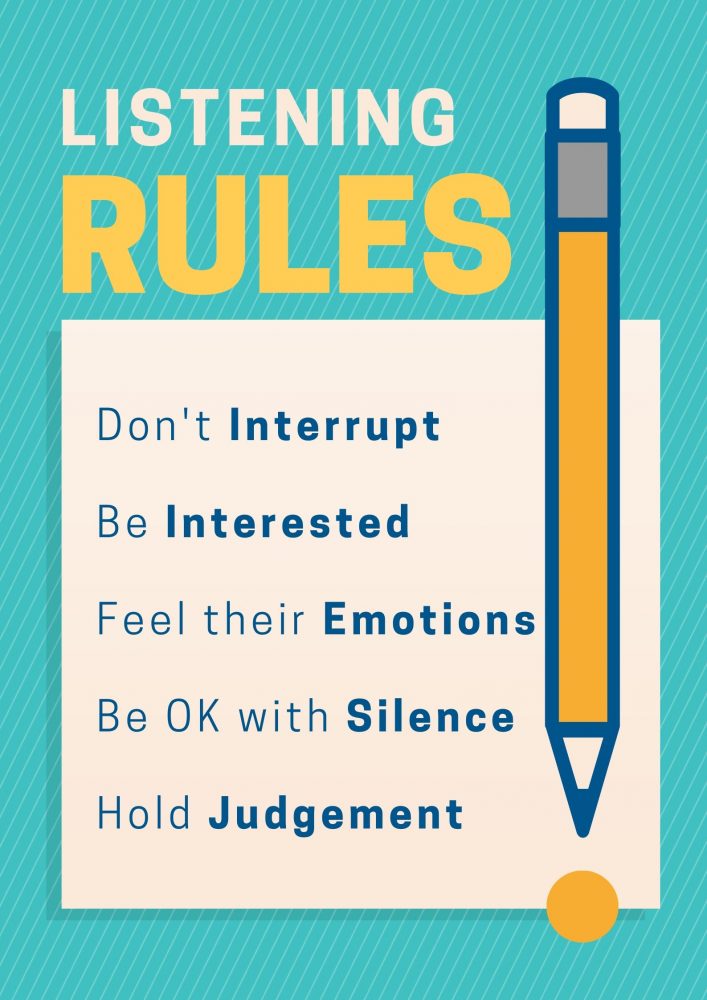
    So the next question is – how do you do that? Based on my experience, here are some guidelines which can help anyone to listen well:-

    Shut Up. Don’t interrupt the other person. Ever. Remember, you are supposed to be listening.

    Be attentive, alert, and interested. Remove any distractions like mobile phones from the scene. Let the other person know that he has your full attention through nonverbal behavior.

    Use filler words like “uhh”, “hmm” and body language to acknowledge what he is saying. Invite and encourage the other person to say more by saying “tell me more about it”, or “I am listening”.

    Be ok with silence. This often gives the other person time to gather his thoughts and speak up again.

    Listen for the emotions behind what is being said and sincerely attempt to step in the other person’s shoes and feel the same emotions yourself.

    Hold any judgment or advice if it comes up in your head. Do not try to comfort the speaker by saying words like “It is not that bad” or “Give it some time”. Don’t get angry or respond in any way. Just listen. And feel.

    “We have two ears and one mouth and we should use them proportionally.”
    ― Susan Cain

    4. Who Decides if You “Got it” or Not?

    The above guidelines are not a guaranteed way to listen to someone and don’t assume you have listened well because you think so. The speaker is the only person who gets to decide whether you “got” it or not. After the speaker has finished saying whatever he had to say, sum up whatever was said and how he feels. You don’t have to agree or disagree with the speaker at this point, you only need to paraphrase what you have understood and ask the speaker for validation.

    When the speaker says that you “got” it, make sure he is not just saying that to be nice or to avoid an uncomfortable environment. Only then can you be sure that you have listened to what was communicated. If the speaker says that you didn’t get it, ask him to explain more and repeat the process.

    5. Listening Creates our Perceived Reality

    When we listen to someone, we create our own perceived reality. This perception is unique to each person, and if 10 people were to listen to the same thing, you would agree that it is possible that they can create their own interpretations and perceive reality in 10 different ways. How we listen is determined by a certain set of filters like our culture, habits, values, beliefs, intentions, and expectations. Most often we unconsciously pay attention to certain things and omit certain others from our listening based on these filters. It is these filters, and the reality they create for us that help us make each and every decision in life.

    Realize that each one of us has our own set of listening filters which creates our own reality which is neither any truer or falser than anyone else’s. This is a big first step to work with people who see the world differently from us. True listening often requires the patience and courage to see and acknowledge how the speaker has perceived his reality. It requires the compassion to understand another’s reality, especially when it is different from our own.

    “Most people do not listen with the intent to understand; they listen with the intent to reply.” — Stephen R. Covey

    6. Listening Creates Connections

    When done well, listening creates deep understanding which leads to trust and respect among both parties, even if you were to disagree with the subject at hand. It enables the speaker to release his emotions and feel at ease, often even helping him to crystallize his own thoughts in the process. It reduces stress and helps to ease the situation which creates a foundation – a safe environment in which there are opportunities for collaboration and problem-solving. True listening leaves both parties with a stronger bond than when they started.

    Another way to look at listening is like an investment. If you spend 30 minutes truly listening to someone, it can create a connection that will make your relationship stronger. A strong bond with someone can help you avoid stressful situations and make decisions quickly in the future. Since this kind of listening is so rare in our ever distracted world of gadgets and notifications, it is all the more significant when it happens. To know that someone listened and understood what you said is a remarkable gift, and you should not miss a chance to gift it to others.

    What I have described above is not easy, and it is very tempting to hit back with your own accusations when someone is angry or frustrated with us. But it (listening) is a skill which can be mastered over time. Most of our time spent in communication involves listening, and hence I can’t stress enough on its importance. I also believe that the ability to see a situation from another’s point of view and to shift perspective is one of our most important abilities as human beings and one which can help us solve many of the problems we face today.