Book Review

  • Six Thinking Hats by Edward De Bono – Book Summary and Review

    We can’t stop thinking, can we? Therefore, thinking is a natural, on-going, uncontrollable process, isn’t it? 

    But is it really? Can one not train the brain to think in a better manner, think only of particular things, and take active steps to change the way one is thinking? Therefore, thinking can be classified as a skill that can be improved and enhanced. 

    During group discussions and debates, it is important that people think individually, yet cohesively enough to make winning decisions. Six Thinking Hats by Edward De Bono teaches us to be able to group different manners of thinking to bring out the best in those group debates, discussions, and brainstorming sessions. De Bono gives a method in which thinking can be compartmentalized and effectively give time to each thought to make thinking, especially when there are many thoughts vying for attention, extremely efficient.

    The Six Thinking Hats And Their Rules

    When too many thoughts crowd our mind, or there are many thinkers in the group, we need a process to de-clutter the mind and be able to think clearly, categorizing the emotional thoughts from the logical ones and the creative ones. The Six Thinking Hats are color-coded to make categorizing easier.

    How does one apply the concept of thinking hats? 

    Let us see how the ‘hats’ method comes in handy in an organizational setup. A manager in a group think tank wants to know how his team is emotionally reacting to some piece of information. Since he knows that they will be hesitant to show true emotions in public, the manager can say, ‘let us put on the red hat.’ It becomes a signal to the team that they can openly discuss emotional thoughts, etc.

    One has to keep some rules in mind while using the six thinking hats concept. Using the six thinking hats becomes easier when the people in the group become well versed with the terminology of the six thinking hats.

    The hats can be for single-use as well as be used in sequence. Single-use of hats denotes concentration or focus on one type of thinking. For example, if the leader of the group says, ‘we need to use green-hat thinking for this problem.’, the group will know that they need to use alternative ideas for their discussion.

    When it comes to sequential use, one should remember that only the leader of the group can decide the color of the hat that needs to be used, and in which sequence. The leader however must keep in mind that he should be able to understand clearly which hat needs to be used when. Moreover, hat-users need to be disciplined and avoid idle talk. Their focus should be the thinking hat and thoughts in question.

    Using the hat well is a matter of practice and gets better with time. Therefore it is important that all the members of a group get a chance, and spend at least a minute wearing the hat. Let us discuss each hat color individually.
     The Neutral White Hat

    If we imagine ourselves as a robot, applying algorithms and calculating outputs neutrally, without necessitating interpretation, we can actually visualize a robotic voice even!

    White Hat thinking is akin to the robotic manner of functioning. It deals with facts and figures rather than opinions. While donning the white hat, one works with the information that is available and identify any information that will be needed. White-hat thinking has no room for arguments.

    In white hat thinking, one also ascertains what information is missing and how to get it. Since white indicates neutrality, the aim is to be objective, neutral and stick to statistics and hard facts.

    White-hat thinking is best used right at the beginning of a discussion when the speaker provides the group with information. It is also used at the end when the speaker wants to debrief the group to confirm that everyone is on the same page. White-hat thinking works best when one wants to discuss strategies, scope, budget, etc.

    The Emotional Red Hat

    The emotional red hat is the absolute opposite of the objective, neutral white hat. It allows group members to be able to express emotions, feelings, and intuitions. Emotions such as dissatisfaction, satisfaction, enthusiasm, ambivalence, can be conveyed without needing to justify or explain. 

    When it comes to donning the red hat, one has to be careful, especially with intuition, because though it is an accumulated experience, it is not always correct. Additionally, one must also be careful of mixed feelings that do not fit any particular category.

    When in a group, donning the red hat is an opportunity that everyone must get, as it’s only fair to know what everyone feels about the topic. Just as everyone gets involved in expressing their emotions, it is essential that everyone’s emotions are truly respected. This is done when each and every person in the group actively listens to the speaker to avoid condescension.

    The Cautionary Black Hat

    Staying within, and keeping the group within the law, adhering to values, rules, and ethics, as well as keeping a vigilant eye on difficulties and problems, is the role of the black hat. This hat is all about being cautionary and warns against foreseeable dangers and any negative outcomes that one could face.

    The black hat enables one to scrutinize all available information and evidence to weed-out mistakes and to be prepared for any other errors. The black hat helps in finding elements in the policies, strategies, ethics, etc that could contradict each other and thus create a functional error.

    While the black hat makes one cautious, one has to be careful to not make finding errors an obsession. Just as too much of anything is not good, donning the black hat for too long and too often can be detrimental. At the same time, the black hat is essential for decision-making.

    The Optimistic Yellow Hat

    The yellow hat focuses on positivity, having an optimistic outlook, and potential benefits. Our brains are wired to be wary of danger and be on the lookout for trouble. Therefore it is difficult to naturally master the yellow hat.

    To master the use of the yellow hat requires one to develop value sensitivity that is, to see positivity even in the most futile idea. Positivity isn’t easily apparent, especially when the benefits of the idea aren’t clear to the group. That is why donning the yellow hat is most beneficial when thinking of marketing strategies for brand image, advertising strategies, etc.

    The yellow hat, however, can also be deluding. Keeping it on for too long can make one stay in a cocooned world of fantasy. Therefore, it is essential to remember to stay tied to reality and see the positive infeasible, achievable ideas. The yellow hat encourages and motivates teams to make things happen.

    The Creative Green Hat

    Donning the green hat allows a group to get creative, open their minds to new concepts and ideas, and look for alternatives to existing ideas. It is a free ticket to crazy, zany ideas where one can put faith in the most impossible ideas that one would otherwise never consider.

    The green hat opens doors to new possibilities that can create a vision for the future. Moreover, the green hat is a great change from the black hat difficulties the group could be facing. For example, if the black hat points out a big risk in the new marketing campaign, the green hat can help in coming up with new creative ideas or make creative improvements in the existing strategy.

    The creative hat, most importantly, encourages everyone in the group to be creative, even the ‘non-creative’ members. It helps bring out the most unexpectedly successful ideas!

    The Controlling Blue Hat

    The blue hat is the remote control of the thinking hats. It defines the aim of the session, helps gain perspective of how to conduct the thinking or brainstorming session, gives an overall perspective of a discussion, and is thus most commonly worn by the leader of the group or the facilitator. The blue hat is donned to understand or address the parameters of the session.

    Donning the blue hat enables one to chart out which other hats will be needed for the discussion. Furthermore, it is donned by the leader or facilitator throughout the discussion or session and is thus a permanent hat. Being a procedural hat, the blue hat announces the procedures of the discussion, changes of hat colors, and most importantly oversees the discipline in the group.

    The blue hat seeks an outcome, conclusion, decision, or solution at the end of a discussion and lays the course for what actions need to be taken after the session.

    Time, Money And Solution

    The Six Hats theory is successful due to 3 main reasons. Because it saves time, saves money, and most importantly leads to a solution. There are examples and testimonials of people who have benefitted by using the Six Hat theory. 

    1. A couple, after reading about the theory in the Financial Times, wrote a letter to the author about how the theory helped them sort out an argument they were having about buying a large country home. They compartmentalized each idea and thought, and came up with a mutual decision within ten minutes flat!
    1. The ABB Corporation was able to reduce their 20-day multinational project team discussion to only 2 days after they incorporated the Six Hat theory.
    1. Statoil, the Norwegian multinational oil and gas company had an issue with a $100,000-a-day oil rig that was sorted by a certified trainer in just 12 minutes with the Six Hat theory. It saved them a lot of money.
    1. The Six Hat theory offers solutions. For example, if four people in a car do not see eye-to-eye where the route is concerned, the Six Hat theory will help them choose the best route.

    The Six Hat theory is a formidable thinking tool that can point out solutions anytime group thinking or brainstorming is involved. It removes disorganized thought process and makes thinking more efficient. It is the solution to thinking about a solution!

  • The Advice Trap (2020) by Michael Bungay Stanier

    We often encounter situations where we feel it is our duty to give advice. We become compulsive at doling out free advice to people, often at the cost of ending up alienating others from us due to this compulsive habit and end up stifling curiosity and innovation amongst others. This inner voice, our advice monster, can do more harm than intended, especially to a leader who jumps up with solutions.

    The Advice Trap (2020) by Michael Bungay Stanier shows that listening to others’ problems and asking them questions about it, can have far better outcomes than immediately giving advice to them. Moreover, it shows that developing listening skills help in developing skills such as empathy and humility, values that are a must in leadership.

    Why Don’t We Find The Solution?

    Isn’t it good to offer solutions and help people who are facing problems? While the answer is resounding ‘Yes!’ there is a catch to it. Often, in our enthusiasm to share our advice and offer the solution, we tend to miss out on listening to important little details. Because, sometimes, it could be that the opposite person didn’t take enough time to really explain what the problem is, and jumping with the solution could result in giving wrong advice.

    On the other hand, if we do understand the problem, our eagerness to be the one to solve the problem could result in handing out mediocre advice, or solutions that could have been better with a little refinement. We end up giving a ‘quick fix’ rather than thinking of a few options and choosing the best fit.

    Additionally, no one likes to be at the receiving end of unsolicited advice. While giving out advice can mentally relieve the advisor, it can make the receiver feel incompetent and can even at times seem to undermine their ability to solve their own issues. 

    In all this eagerness, often, the actual solution is lost.

    Get That Monster Under Control

    Everyone has an advice monster lurking in the shadows of their thoughts. The monster is a part of one’s personality and it raises its head when one is stressed and wants to believe that they are in control of the situation.  These monsters were developed as defense mechanisms against stressful situations and difficult emotions. What people often do not realize is that this monster needs to be controlled.

    The advice monster has 3 personas, the Tell-It Type, the Save-It Type and the Control-It type.

    • Tell-It Monster – The Tell-it monster persona loves to hog the limelight. It convinces you that your opinion is the most important one and the correct one. It convinces you to be the leading authority.
    • Save-It Monster – While the Save-It’s are more subdued voices, they, like the Tell-it’s believe that they are the saving grace for all problems. Save-It’s don’t jump to give out their ideas, making them more difficult to recognize, however, feel that it’s their moral responsibility to give others advice.
    • Control-It Monster – This monster persona is most manipulative of the lot. According to the Control-It Monster, all is lost if you are not controlling things. It believes that others cannot be trusted and convinces you to take the lead on everything.

    All the monster types pose a big problem. They limit other’s capabilities and prevent us from being open to them. Moreover, they make us perceive ourselves as superheroes, capable of accomplishing anything and make us pile up an enormous amount of responsibilities on our shoulders. They make us think that we can save the world with our one piece of advice.

    Unfortunately, these monsters are part of our personalities and cannot be eliminated altogether. However, they can be controlled, tamed, and made to work in our favor, by understanding what triggers them.

    What Triggers The Monsters?

    To understand why the advice monster stir-up, we need to ascertain what in our minds triggers them. Most commonly, these monsters get triggered in stressful situations; yet, these situations, experiences, and events are unique to each individual.

    For example, for the author, his ‘Control-It’ monster gets triggered whenever he spends time with his younger brother. For others, the advice monster could rise in the presence of someone with lesser experience than him or her. Some get the compulsion to dole out advice at the workplace.

    Giving advice- solicited or unsolicited – gives us a reward and a feeling of instant gratification. Whether it is the feel-good factor, or sense of achievement and accomplishment, or simply feeling smarter, compulsive advising comes at a cost. The highest cost a person can pay for compulsive advising is losing one’s own credibility due to affected relationships at the workplace.

    To fix this compulsive advising, one should let go of the need for instant gratification and understand when they are doling out advice due to fear or as a reflex action. Controlling the compulsive habit can help in stopping one from ‘controlling the situation every time’.

    Questions Before Solutions

    While our childhood instinctively pushed us to ask a lot of questions, we lost our instinctive questioning habit, as we grew up. The need for questioning things around us morphed into the need for telling others what we thought. Over a period of time, this need becomes a habit and soon into a compulsive habit.

    Breaking this habit is essential, just as it is essential that we learn to ask more questions. Moreover, as leaders, it is better to give an employee a listening ear, rather than beginning with advice. It is better, to begin with questions such as, “What do you think?” or, ‘What’s on your mind?” Such questions give the other person more room to steer the conversation in any way they want, thus helping them to be open and true.

    At every stage in a conversation, where a person is trying to determine the solution to a problem, it will be natural for the advice monster to want to jump up and offer advice. This is the time to get the monster under control.

    Ideally, leaders should prod the employee with questions that will force them into thinking of the solution themselves. Nurturing curiosity and listening to people before giving them the solution are great qualities a leader can possess.

    Nobody Wants That Vulnerable Question

    Asking questions leads to a very important shift – the shift from advising to coaching. This makes a big difference in the larger scheme of things considering the fact that one becomes more inclined to help find the answer rather than just blurt it out all the time.

    However, there are exceptions even to the best of intentions. It could be possible that the answer to the challenge is elusive, and one lands in a conversation trap called a foggy-fire – a type of conversation akin to a fog that hides what should be in plain sight.

    At times, vulnerability is the culprit, because no one wants to have that uncomfortable conversation and people stay in shallow waters. As a manager, one could end up ‘coaching the ghost’, or get stuck in a ‘pop-corning’ session, or get distracted by ‘big picturing’ or ‘yarning’. These are different types of conversation traps one could encounter while trying to help someone face a challenge.

    • Coaching the ghost – Coaching the ghost refers to analyzing a person who is not even in the room. This happens when the person getting coached unconsciously deflects the problem by focusing on another person entirely. Here, as a manager, it is important to ask the person, “Why does this person really matter in the larger scheme of things?”
    • Pop-corning – Pop-corning happens when a team member comes in with a barrage of unrelated issues, confusing you about what the actual challenge is. Here managers should ask the person needing coaching, which problem is most important?
    • Big picturing – This refers to people talking in the abstract, not being clear about the issue at hand.
    • Yarning – Yarning refers to getting into long stories and detailed descriptions that could be a waste of time.

    As a coach, one should be able to identify these traps and guide the person towards the actual problem, by asking probing questions.

    Transformative coaching

    Once you move from advising to coaching, it is essential to understand that a coach should first make a person feel safe. Our human brains are wired to fight and survive against threats. It perceives vulnerability and an uncomfortable or challenging conversation as a threat too and can either go into the defensive ‘fight’ mode or completely shut down and go into a ‘freeze’ mode. 

    To ensure that the opposite person does not get on the defensive during a critical discussion about their challenges, managers need to make them feel safe. There are four tactics to make people feel safe during tough conversations.

    1. Be On Their Side – This entails being empathetic, and using gestures like nods, encouraging words, and positive language. Words such as ‘we’ and ‘us’ show support and tell the opposite person that you understand and feel the same, and are there to take on the challenge with them.
    2. Respect – Showing respect to the person facing a challenge is a very effective way to get them to open up. As a leader and a coach, giving up power to show the opposite person that you have vulnerabilities as well, and face your own insecurities, brings them closer and helps them open up.
    3. Autonomy – When it comes to facing challenges and being open about them, many people feel the need to be equal. That gives them a sense of autonomy. Being able to have their say in matters will make them ease up.
    4. Managing Expectations – It is rude to spring a surprise, especially with heavy conversations that expose a person’s vulnerability. Such conversations should be structured and pre-planned in order to succeed.

    As a coach, engaging these tactics will help people open up to you and share their challenges without raising defence mechanisms.

    Morphing The Advice Monster Into a Coach

    Finally, one realizes that the process of controlling the monster and learning to be a coach is a gradual process. No one gets it right in the first go.

    Coaching takes practice, and it can be practiced in any ‘every day’ situation and interaction using any medium – the phone, email, video call platforms, text messaging, etc. One simply needs the patience to listen to what the other person has to say and be curious by asking more questions. 

    Just as learning to coach is important, so is making oneself coachable. This means that coaches should take feedback and work on the feedback to make improvement, just as they should find a coach for themselves too. Taming the advice monster can at times be a life long process and also prove to be a life long boon as well.

  • The 22 Immutable Laws of Marketing by Al Reis and Jack Trout

    Contrary to prior belief about marketing being all about the USP of the product or service, marketing is all about how the customer perceives the product and the brand. In a bid to increase sales, they center their marketing strategies on upgrading a product when actually; they need to tweak people’s perceptions.

    The 22 Immutable Laws of Marketing (1994) by marketing gurus Al Reis and Jack Trout, shows us power-packed marketing strategies that can help organizations avoid redundant marketing mistakes, stay on top of the competition, create a steadfast brand and most importantly change people’s perceptions. It lists down 13 laws of marketing that companies should follow for branding success.

    1. Law Of Leadership

    For any product to be a leader in the market, it has to be in the top position in its category. The rule surrounding the Law of Leadership is that it has to the first of its kind in the market.

    For example, if we look at LinkedIn, it was the first of its kind that took a different spin on social networking. Rather than create a brand that focused on networking with friends, it chose professional networking. They are now the top brand in their category.

    2. Law Of Mind

    Some products might not be the first in the market. However, every brand should aim at being the first in the customer’s mind. Often, the product or brand that leads the market is the one that pops into a customer’s mind whenever they think of the product category.

    This means that the first impression is the most important. This is the reason why sometimes brand names become synonymous with the products. For example, every time a person says Xerox, they are actually referring to photocopying.

    Other factors that influence the Law of Mind is the name of the product. The name of a product should be short and catchy. For example, which product would one consider, MITS Altair 8800, or Apple? 

    3. Law Of Category

    It isn’t always possible to be the first product of its kind in the market, or, there could be an existing market leader already. Then, one can turn to create a new product category in the market altogether. Creating a new product category altogether gives a headstart in making the product a market leader. This means one doesn’t have to worry about competition in the market, at least for some time. 

    Charles Schwab, in 1971 ventured into the brokerage market when there were many players ruling the roost already. He, however, turned things around by creating a new category – the discount brokerage. His client base multiplied in a short span, making his product the market leader.

    4. Law of Opposites

    The Law of Opposites works wonders for companies that are stuck in the second position to the market leaders. The law states, that comparing a product with the market leader, while downplaying or showing the market leader’s strengths as their weaknesses, can attempt to knock down the market leader from its position.

    For example, Pepsi focussed on appealing to different, young, and hip generation of customers, by portraying Coca-Cola as one that was preferred by the oldies.

    They cleverly appealed to another customer base altogether who wouldn’t want to be cast in the same mold as their parents and grandparents.

    5. The Law Of Focus

    Companies, along with factories, machines, and logos, can also ‘own’ their own word. It means that if a customer thinks of a word, he associates the word with a brand name. In the U.S., for example, people associate the word ‘ketchup’ with Heinz. This is due to the fact that Heinz has made their brand name powerful enough that people automatically associate Ketchup with Heinz.

    The essence of the law lies in using one catchy, sticky way for customers to associate with. When a brand owns a word, it’s securing a place in the consumer’s mind. For example, Volvo is virtually synonymous with ‘safety’.

    6. Law Of Exclusivity

    Entrepreneurs need to keep in mind that not all words are always up for grabs. The Law of Exclusivity means that companies should steer clear of words used by other companies.

    While it makes no obvious sense to use another company’s ‘owned’ word, doing so can not only entangle companies into legal battles and cost them trips to the courts, but also make customers think of the company as an imposter. The attempt of Energizer to steal the perception of ‘long-lasting’ from Duracell with their pink, plush and funny Energizer Bunny Ads, they could not change their customer’s minds who associated ‘long-lasting’ with Duracell already.

    7. The Law Of Sacrifice

    In marketing, less is always more. While customers love choice, a decision to expand a company’s product line could prove to be detrimental, because then, the company has to divide their focus on all products in the line and the time to create one truly successful product reduces considerably.

    The Law of Sacrifice states that in marketing, one has to give something up because specializing in a few products helps in creating a stronger market profile. For example, the most successful companies in retail are the ones that focus on a specialty, like The Gap that sells casual clothes, and Foot Locker who specializes in athletic sport’s shoes. Retail department stores that specialize in selling everything are suffering in comparison.

    The law also states that companies should focus on one target market. In our earlier Pepsi example, we say how Pepsi changed the focus of its strategy and targetted young customers. Later on, however, when they switched their target base to everyone, they failed, because Coca-Cola was already leading the ‘generalist’ market.

    8. Law Of Division

    Sometimes companies decide to split and divide product lines for growth. In such cases, remembering the Law of Division can help maintain market dominance. The law states that eventually, every product category breaks into several different ones. In such times, how do a product and brand profile stay durable?

    The answer lies in giving each new product category its own distinct brand name. Consumers like choice and like to buy products and services from different brands. For example, General Motors, while diversifying its automobile lines, created several new brands that focussed on different customer categories with brands such as Cadillac, Pontiac, Chevrolet, and Oldsmobile, thus maintaining its position of the market leader in each new category.

    9. The Law Of Success

    Arrogance due to success is true to companies, products, and brands as well. Moreover, overindulging arrogance can spell doom for the most successful companies too. The Law of Success warns that arrogance can make a company blind, and can lead to making – and not making – decisions that can weaken a brand.

    At times a company can become overconfident that their successful brand name can sell anything, leading to haphazard product line expansions. Similarly, leaders can tend to shoot down creative path-breaking ideas due to their overconfidence.

    In the mid-1970s, the founder of Digital Equipment Corporation (DEC), Ken Olsen, got an opportunity to focus on a new product category – the personal computer. Unconvinced, and overly confident of his own market position, he refused the opportunity, leading to the decline of the company in the evolving personal computers market.

    10. The Law Of Unpredictability

    Mid or long-term predictions in marketing strategy are rarely effective. Therefore companies should avoid making costly marketing decisions on market predictions. Similarly, no company can predict the moves of their competitors in the future.

    The future is unknown and markets are highly dynamic, volatile entities that can swing in any direction. With prediction, companies stand the risk to extrapolate and jump to conclusions, severely affecting their brand and product in turn.

    11. The Law Of Failure

    The Law of Failure is a tough one to accept but one that companies have to deal with. The law warns that mistakes are inevitable. Most successful companies continue to pretend that they don’t make mistakes. This leads to making decisions such as the refusal to drop a bad project that can be detrimental.

    Even managers in any organization who hate to make mistakes avoid taking risks. Risk is a natural and essential element in the world of business, and trying to avoid it means potentially losing out on a great opportunity.

    12. Law Of Hype

    The Law of Hype states that too much publicity can be misleading. However, letting publicity and hype affect marketing decisions in haste is foolhardy. Just because there is a lot of hype about a competitor’s product in the market, does not mean that it’s on its way to becoming a marketing leader. Marketing strategists should keep in mind that a company holding many press conferences could be simply attempting to reverse their downward-spiraling sales. They should remember that performing products do not need marketing hype.

    For example, in 1948, there was a lot of hype in the media surrounding the launch of Tucker 48. It was said to be the first of a new generation of automobiles. However, the company managed to sell only 51 cars!

    13. The Law Of Candor

    Media hype, especially about competitor attacks on one’s product can give nightmares, yet the Law of Candor can guide a pained company into a semblance of comfort. Therefore if ever a competitor catches a mistake, it’s best to simply accept and admit it. It’s true that when a company admits its negative, it is often rewarded with a positive.

    Admitting a mistake often helps customers perceive the product and the brand as trustworthy, whereas denying it could question the company’s credibility. For example, Listerine was challenged by a competitor Scope in their ads that their mouthwash tasted bad. While they knew that they couldn’t dent the fact, they turned the taunt around with a slogan that said “The taste you hate twice a day.” This made customers perceive the bad taste as medicinal, and therefore a better product.

    Summary

    Companies that invest in understanding and applying these laws of marketing often craft out better strategies than simply adding more money into the marketing mix. It is essential to remember – successful marketing strategies focus on perceptions, not products.

  • How to Talk So Kids Will Listen & Listen So Kids Will Talk (1996) by Adele Faber and Elaine Mazlish

    As parents, we all have endured that tantrum bang in the middle of public space. Most often, we have snapped at children, ignored them, and at times, even yelled, resorting to threats and punishments for bad behavior. Or we have seen another child at the mall screaming and yelling, lying on the floor, throwing a tantrum, and leaving the parents in charge absolutely helpless not knowing how to control their child. Haven’t we all often thought, “Thank God that is not my kid!”

    What if there is a better way to manage children – rugrats and teens alike, without seeming like the enemy. How to Talk So Kids Will Listen & Listen So Kids Will Talk (1996) by Adele Faber and Elaine Mazlish is a clear and practical guide for parents to establish successful and improved communication with their children. They discuss real-life scenarios and offer tactics for coping with such situations, as well as beneficially turning the situation around.

    After all, all parents wish for harmonious communication with their children. 

    Acknowledging A Child’s Feelings

    Scenario: A five year old suddenly throws a tantrum in the super market, shrieking, “I want food now! Im hungry!” 

    While many parents would scold, snap, or even shout back, would such a reaction really get the child to calm down and see reason?

    In such a scenario, the child will not listen to the parent because his tantrum is a result of his hunger. A scolding parent will be unable to acknowledge how the child is feeling at that moment. Children behave according to how they feel, and most parents are unable to address this issue when they communicate with the child at that time. Snapping or shouting back ignores how the child actually feels and the child cannot understand why he should listen when he is feeling hungry.

    The best way and the only way to pacify a child is to address his feelings and show the child that the parent is listening. The parent could say, “I understand that you’re hungry and it’s been long since breakfast.” Or the parent could step into fantasy and say, “I wish I could wave my wand and get a burger here.”

    This will help in changing the child’s mood for that moment, calming him down enough to see reason.

    Key Communication Skills For Parents

    A child never listens to an angry parent. Instead, the child reciprocates to the parent with anger, yells, and ignores the parent, continuing to do whatever the parent is telling him/her not to do. Anger at a child often gets the better of parents. How should a parent get out of such a situation?

    Parents can use a few communication skills that can help create an atmosphere of understanding and respect. Establishing proper communication is vital to changing a child’s difficult behavior.

    Scenario: A child is throwing a temper tantrum to stay up beyond bedtime.

    Rather than being dismissive, parents can say, “If you don’t sleep on time, you’ll be tired all day tomorrow.” Provide some information to support the sentence like, “If you’re tired, you won’t be able to concentrate.”

    Providing explanations gives children the ability to think for themselves and make the decision themselves. Additionally, using this tactic regularly will create a habit, where the child will be able to make rational decisions and listen to parents.

    Compromise Is Better Than Punishment

    Getting through to a rebellious child can feel like banging one’s head to the wall. When things get out of hand repeatedly, parents resort to punishment.

    Punishment, however, leads to further anger, hinders future progress, and makes a child harbour bitter feeling towards parents. This can push the child further away from heeding the parent’s advice and the child will never understand why what they did was wrong.

    Scenario: A teen comes home late past curfew time repeatedly during school week.

    The classic reaction parents have to this scenario is to ground the child. However, stopping the child from going out will make the child feel angrier and misunderstood, will be unable to understand why staying out late is bad, and will only be able to see that the parents don’t approve of the child going out.

    In such a scenario, parents should address the child’s feelings. First, ask why the child comes late. Additionally, parents can express their own concern and care for the child, by telling the child that they were worried about the child’s safety.

    The parent can come to a mutual understanding and agreement, like sending the parent a text if they are getting late, with the child and try it out rather than resorting to punishment.

    Independence To Discover

    Parents often find it difficult to let their children ‘fly out of the nest’. Parents squirm with the idea that their children will eventually make their own choices as adults, will fail, and get back on their feet. It’s watching a child struggle that makes parents melt into making it easy for their children.

    Scenario: A child struggles to tie his or her own shoelace.

    Many parents simply do everything for their children, making them continually dependent. Helicoptering a child can make the child over-dependent and make it incapable of doing anything on their own, or can even work in the reverse direction, where the child starts feeling frustrated at being unable to do things on their own, leading to stubbornness and hostility.

    Parents should encourage a child’s autonomy. Let the child make some decisions on his own. For example, parents can give a child the autonomy of deciding when to complete their homework, as long as it’s within the deadline.

    Additionally, parents should encourage their children to seek help from friends and other adults such as teachers, grandparents, etc. Parents should also let their children explore and let them test the waters themselves. They will fail and struggle, but a parent swooping in to help will never teach the child the value of struggling and the child will never understand what it feels to succeed, even if they do.

    The Double-Edged Swords Of Praise And Labelling 

    Praising a child is easy, isn’t it?  However, it is much more complicated than we think because sometimes, well-intentioned praise can evoke feelings of anxiety or even denial. Therefore parents need to be careful and praising should be done in a helpful way.

    For example, rather than saying, “what a lovely poem,” one can say, “your poem is really moving. How creative of you.”

    Additionally, parents should avoid praise that talks of the child’s past weakness. Saying, “ This poem is better than the last one. That one was bad.” This will instead make the child feel demotivated simply because of the negative comments about the child’s earlier writing skills.

    Parents should absolutely avoid labelling children as stubborn, lazy, slow, snobbish, or bossy. Labelling makes a child retain that habit and they can take the label into adulthood as well. One should always steer clear of labelling.

    Conclusion

    Establishing good parent to child communication is all about acknowledging a child’s feelings, providing explanations for the rules they set, giving them the independence to ask questions, and test the waters themselves.

    Listening to what the child has to say before making judgments and passing down punishments will help in fostering better communication with the child and respecting the child’s feelings will help the child respect the parents more and see reason.

  • The Ride Of A Lifetime by Robert Iger from Disney

    From a small job in production services to becoming the CEO of Disney, Robert Iger has had quite the ride. Excerpts from his life experiences are valuable gems of vision, strategy, and leadership lessons for everyone.

    The Ride Of A Lifetime (2019) describes how Robert Iger saved Disney from the troubled waters it was in, to make it the stupendous success it is today. Iger’s leadership journey shows the importance of taking chances and going with your gut feeling, and that one cannot move ahead without innovation and reinventing oneself.

    The Early Years

    Iger came from humble beginnings. While Iger’s mother was a home-maker, his father was an ad-man and had served in World War II in the US Navy. Being, cleaver and gifted, he helped nurture curiosity in his son. Iger attributes his successes to the traits he inherited from his father. 

    Unfortunately, Iger’s father was diagnosed with manic depression triggered by self-doubt. Years later, when Iger became Disney’s CEO, he took his father to lunch thanking him for all that his father had done, and how grateful he and his mother were to him, in hopes that he would help his father come out of the belief that he had never achieved anything worthwhile. 

    Iger’s foray into the entertainment industry was a matter of luck. His uncle Bob, while recovering from a surgery in 1974, had shared a room with a small-time executive from ABC – the American Broadcasting Company. Bob mentioned to him that his nephew Robert was in search of a job.

    “True authority and true leadership come from knowing who you are and not pretending to be anything else.”
    ― Robert Iger

    The executive got Iger an interview at ABC. Iger got hired at $150/week for a job that required him to be whenever he was needed. That included odd working hours and running errands. He soon got assigned on Frank Sinatra’s The Main Event, a TV concert in New York, where the singer tipped him handsomely. The job offered similar perks and one day, impressed by Iger’s can-do attitude, he was hired at ABC Sports – the company’s most successful division – by an operations supervisor.

    At ABC Sports, Iger was exposed to a completely different work environment. Tailored suits, executive lunches at New York’s best restaurants, and opportunities to mingle with athletes and celebrities taught him a lot about lifestyle.

    It was in ABC Sports that Iger learned a lot from Roone Arledge, who pioneered new techniques in filming such as slow-motion replays and reverse-angle cameras. Iger got one of his life’s most important lessons from Arledge –staying a step ahead of the curve was the only way to survive in business!

    With hard work and smart work, Iger became the VP of ABC Sports at the young age of 34. However, his promotion coincided with Capital Cities Communication buying ABC network for $3.5 billion. Promotions surrounding a shaking event became a recurring pattern throughout Iger’s career.

    Smart Decisions And Trusting The Gut-Feeling

    Every individual comes to a point in life where they have to make decisions that will radically change the future. It is in these times where a person has to, at times, trust their gut feeling and make smart decisions. It is also during such times where one should heed advice that other experienced people give. Iger’s career at ABC after the Cap Cities takeover is proof.

    After the takeover, decisions surrounding expenses led to the stripping away of the expensive perks that the employees at ABC enjoyed. The limos and the first-class flights disappeared and spending accounts shrunk. While these new rules didn’t bother him much, Iger was more bothered by the fact that Dennis Swanson – an outsider, executive was hired to head his department. Iger decided to quit. However, Dan Burke (the then president of ABC) convinced him to stay on.

    Swanson proved to be an excellent boss. His amicable, optimistic, and energetic nature was perfect for Iger to thrive in. Swanson preferred delegation of work and allowed the senior executives to lead projects as long as the budgets were adhered to.

    Iger’s highpoint was the 1988 Calgary Winter Olympics, where he was in charge of the coverage of the event for ABC Sports. Unfortunately, after the first few days of smooth sailing, the Chinook warm winds raised the temperatures and melted the snow and ice on the ski slopes and bobsleigh runs.

    Cancellation of the Olympics could have spelled disaster for the channel without Iger’s improvisation strategy. His team began broadcasting stories of human interest, and America was exposed to different stories of human triumph like that of the eccentric British ski jumper Eddie ‘The Eagle’ Edwards and about the Jamaican bobsleigh team. His smart decision of improvisation earned the network high ratings throughout the event and Iger the presidency of ABC’s entertainment division.

    Taking Chances And Learning From Others Errors

    As the new President of ABC in Hollywood, Iger had more than just shaking off his reputation (as bothersome New York suit in the eyes of his creative team) on his plate. He needed to find the channel a hit that would give them an edge over their closest rival NBC.

    Iger commissioned David Lynch’s Twin Peaks to run on prime time, despite warnings from the creative executives. It was a tough decision, but Iger stood didn’t budge. He took the chance with the left-field murder mystery. The pilot episode saw 35 million viewers! Twin Peaks became one of the channel’s most successful shows after years. 

    It’s another thing that the show’s popularity meandered, as did its plot. However, it was the risk and gamble that focussed the light on Iger. Soon the likes of George Lucas and Steven Spielberg were calling Iger about future projects, cementing Iger’s reputation, making it his career-defining moment.

    As a leader, Iger knew that there are moments where he would need to take a chance and risk a little to succeed. He realized that the channel needed a bold move to shake out of its lull. His boldness won him a promotion to COO, Chief Operating Officer of ABC.

    “You must not let anyone define your limits because of where you come from. Your only limit is your soul.” — Gusteau, Ratatouille

    Disney, Pixar, And The Makings Of A Visionary

    A mere six months after Iger’s promotion, ABC and Disney struck a merger deal in Jan 1996. Despite a successful run in the late ’80s with The Little Mermaid, The Lion King, the Disney theme park and resorts, by the mid-’90s, Disney was in trouble with a bunch of expensive failures and a demotivated creative animation team. They needed a breakthrough.

    During the merger, Eisner insisted that Iger get a new five-year contract, putting him in charge of the Disney media division. Though it was a prestigious designation, Iger considers it as the most unproductive years in his career. 

    Accustomed to ABC’s decentralized culture of freedom within limitations, the absolute top-down hierarchy in Disney was uncomfortable. The other problem was Michael Ovitz, the founder of the Hollywood talent agency CAA. While Ovitz was a gifted agent, he had poor managerial skills. Ovitz’s negative behavior in the boardroom was a very important, instructive, and eye-opening leadership lesson for Iger. He learned what kind of manager he simply would not become.

    Robert Iger understood that learning opportunities present themselves in many ways and come from anywhere. Here, while he learned not to make the same leadership errors Ovitz did, he also understood that learning could also come from people one does not approve of.

    In 1999, Iger was fed-up with the corporate structure at Disney and was planning to quit. Eisner arranged a meeting with Iger; a meeting Iger was sure he was going to be fired in. However, contrary to his expectation, Eisner was promoting him to COO – the number-two position after Eisner in Disney and a position on the board of directors due to Iger’s consistency in work.

    Iger’s move to the number one position, however, happened sooner. Disney was struggling to keep up with the changing face of media and the entertainment world. The only silver lining saving grace was Disney’s partnership with Apple’s Steve Jobs – then the CEO of Pixar Animation Studios. 

    However, it was a relationship that soon soured due to differences between Jobs and Eisner over a five-movie co-production, marketing, and distribution agreement. The issue arose during the development of Toy Story 2. While Jobs counted Toy Story 2 as part of the five-movie agreement, Eisner did not on the basis of the fact that it was a sequel.

    As tensions between the two mounted, the 9/11 attacks caused the markets to crash, forcing Disney’s largest shareholders, the Bass family, to let go of their 135 million Disney shares. Simultaneously, the market crash began to show its effects on tourism affecting the theme park revenue.

    That put Disney in a crisis and led to Eisner making panicked decisions. In a bid to make the most of the Pixar contract, Eisner refused to budge and compromise with Steve Jobs. It led to a public announcement from Jobs that he would never work with Disney again. A few weeks later, Eisner lost the support of 43% of the shareholders, making their decisions quite clear.

    Iger, being second to Eisner was not in a favorable position to be in just when Eisner was ousted by the shareholders. Iger’s job became tough. He had to convince his harshest critics of his abilities. While the others were discussing bringing in a ‘change agent’, Iger consulted an old contact from ABC, a political consultant, and brand manager Scott Miller.

    Miller advised Iger to devise a road map of where the company stands, where Iger would like to take it, and how he wanted to do that as CEO. This led to Iger drafting out a strategy that would eventually help frame the decision-making for the board. He drafted a three-point strategy.

    Firstly, he wanted to prioritize creating memorable characters and movies. In a world where people get an array of choices in entertainment, churning out great branded content was the solution to getting viewers to prioritize spending their time and money on what Disney had to offer.

    Secondly, Iger planned on investing in cutting-edge technology. He wanted to integrate tech in every aspect from production to distribution, making Disney content available in a user-friendly, digital, and mobile manner.

    Finally, he planned to make Disney truly global. That meant, tapping into markets such as India and China, and creating region relevant content. This would help expand the creative horizons. He knew that continuously making content that caters to the same consumer leads to stagnation.

    Armoured with the new strategy, Robert Iger managed to persuade the board of directors and took over as the CEO of Disney in March 2005.

    The Way Ahead

    One of the first things that Bob Iger did as soon as he became the CEO was to call Steve Jobs and repair the relations with Pixar. However, Jobs’s demeanor was as frosty as the deal he offered – to give Disney only a 10% stake in Pixar in exchange for sequel rights of all Disney-Pixar movies. 

    While the deal was absolutely unacceptable, Iger had other plans in mind. He wanted to buy out Pixar. Valued at $6 billion the board members were not in line with the idea. Nevertheless, Iger opined that this was the only way forward.

    At the same time, during the launch of Disneyland in Hong Kong, Iger saw that while there were older Disney characters like The Little Mermaid and Lion King, and Disney-Pixar ones like Toy Story and Finding Nemo represented on floats, Disney characters from the nineties were missing from the picture.

    This disparity was visible in the numbers as well. While Disney lost $400 million during that decade, Pixar was raking in successes due to Ed Catmull and John Lasseter’s pioneering technology and creative content. Iger knew that for Disney’s animation studio to be revived, he needed their expertise.

    Iger approached Jobs about his views on buying out Pixar and expected to be laughed at. Instead, Jobs thought the idea held credibility and by 2006, Disney brought Pixar with the guarantee of Lasseter and Catmull’s creative independence, in return for the technological know-how Pixar had. It was the way ahead for the reinvention of the Disney animation studios and the foundation for some of Disney-Pixar’s highest-grossing family movies including The Incredibles, and Ratatouille.

    Iger’s vision for Disney was of growth and expansion. While Pixar was his first step in acquiring advanced technology and creative know-how, he knew Disney needed the next big adventure.

    Iger turned his sights on Marvel. He knew that Marvel was sitting on a treasure trove that would fit the TV, movies, theme park, and merchandize divisions like a glove. However, the controlling shareholder in Marvel, Ike Perlmutter was a tough nut to crack. Iger approached Steve Jobs for help and Disney bought Marvel in 2009 for $4billion, when Steve Jobs convinced Perlmutter of Iger’s integrity.

    The deal itself was surprising, as it didn’t cover some of Marvel’s well-known superheroes like Spiderman (owned by Columbia Pictures) or Incredible Hulk and X-Men (owned by Fox). Yet it was Iger’s belief that Marvel had enough comics to explore. The over $2 billion box office receipt success of Disney’s Avengers: Endgame is proof enough. It was Iger’s far-sighted decision-making that turned (what many thought to be) a not-so-lucrative deal, into a massive success!

    Today, Disney is changing the cultural face of entertainment. The release of Black Panther in 2018, gave the world an African Superhero and grossed more than a billion at the box office. It resonated culturally with the world. Oprah Winfrey said, “It makes me tear up to think that little black children will grow up with that forever.” 

    It is the mind of a visionary and bold leader that can help break cultural barriers, and create a landmark moment in the entertainment world. 

    It’s kind of fun to do the impossible. – Walt Disney

    Iger’s Love For Innovation

    Iger learned the importance of innovation from ABC’s Roone Arledge – a lesson that guided him when he became the CEO of Disney in 2006. With media content changing rapidly and the introduction of platforms and streaming services, Iger knew that to innovate and stay in business, Disney would have to either make a platform or buy one.

    Iger knew that creating a platform would take years and massive investment. Therefore buying was the only alternative left, and albeit an expensive one, it would enable Disney to venture into the platform markets immediately. 

    Therefore in 2016 August, Disney bought BAMTech Media, a baseball streaming company that had custom-designed the platform for HBO to stream 5 seasons of The Game Of Thrones. What began as a 33% stake has expanded to today’s 75% stake in the company. Iger’s thirst for innovation saw Disney’s own global sports streaming service ESPN+ in 2018 and Disney+ in 2019, Disney’s own on-demand, all Disney-owned, streaming service.

    While it seems like a big risk to pull-out Disney’s TV shows and movies and thereby risking hundreds of millions of dollars in annual licensing fees from streaming services such as Netflix, it is a long-term plan for innovation and reinvention of Disney, by doing away with intermediaries such as distributors and movie theatres. 

    Iger’s vision for Disney’s future profitability and cultural reassurance was sealed with the 21st Century Fox merger deal in March 2019. Disney now owns the rights to all the content of Pixar and Marvel, Fox’s most lucrative X-Men and Fantastic Four franchisesas well as the distribution rights to the famed Star Wars series! 

    For Iger and Disney, the future of entertainment is waiting with arms wide-open!

  • Leadership: In Turbulent Times (2018) by Doris Kearns Goodwin

    Leadership: In Turbulent Times (2018), by Doris Kearns Goodwin discusses the leadership secrets of four presidents who played a pivotal role in shaping the transformation of the United States of America.

    The author takes a look into the leadership qualities of four influential and transformational presidents – Abraham Lincoln, Theodore Roosevelt, Franklin Roosevelt, and Lyndon Johnson, and we learn what makes a great leader.

    1. Backgrounds Hardly Matter In The Path To Greatness

    Great leadership doesn’t always stem from one’s background or from the circumstances of a person. The difference between the backgrounds and upbringing of Abraham Lincoln and Theodore Roosevelt are proof.

    Abraham Lincoln was born in Illinois to an uneducated father, who took him out of school at the age of nine to help him in his work. However, Lincoln’s love for education made him borrow books from other people. As a young adult, it took him years of relationship building with townspeople in New Salem to earn a reputation good enough to earn a seat in the state assembly of Illinois.

    In contrast, Theodore Roosevelt was born in New York, a grandson to the fifth richest individual, with a trust fund bequeathed to him. His father was a philanthropist and gave his son access to the large family library at a young age. Theodore Roosevelt’s family name itself was enough to merit his entry into politics.

    With such stark differences in backgrounds, it is clear that the background and circumstances are not of much importance in the path to greatness. 

    2. Not All Leaders Have The Same Personal Traits

    Just as great leaders come from varied backgrounds, they do not have the same personality traits.

    Where Franklin Roosevelt had a loving, stable, and nurturing environment that resulted in a warm and optimistic demeanour, Lincoln, due to his tough upbringing, used to suffer from depression and melancholy. Even in terms of physical attributes, Lincoln was tall, healthy, strong, and athletic due to his laborious background. On the other hand, Theodore Roosevelt had fragile health and suffered from asthma.

    When we consider another aspect of personality, memory, we find that where Theodore Roosevelt had a photographic memory, Lincoln had to practice and memorize to be able to retain large amounts of information.

    The personalities of these four presidents were as different as chalk and cheese, even when it came to how they spent their free time. Out of the four, only Lyndon Johnson was a workaholic. Where Lincoln loved drama and poetry, Theodore Roosevelt loved novels and birds and Franklin Roosevelt played poker and sailed.

    3. They All Had Strengths And Associated Weaknesses

    It is easy to perceive great leaders as larger-than-life personas. However, in reality, while they did have remarkable strength and mettle as transformational presidents, their very strengths were also double-edged as weaknesses. Even these strengths and weaknesses are varied and do not point to any commonality among them. 

    Lincoln learned the ropes of politics through patiently observing, till he was confident to enter the fray. Conversely, Theodore Roosevelt’s approach to the presidency was aggressive and he had uncontained energy. While it proved to be a great asset, it also can be seen as a weakness, considering his interrogation and violation of rules would irritate his colleagues sometimes.

    Similarly, Franklin Roosevelt would willingly bend, bypass, and even at times, break rules if the end justified the means. This trait worked as a strength as well as a weakness.

    4. Ambition Is The Common Factor

    Once again, the backgrounds and upbringing of Theodore Roosevelt and Abraham Lincoln show that despite the contradictions, they had one factor that was common – ambition.

    Looking back at Lincoln’s early years, one would never guess that he would become a successful politician one day, let alone be the greatest presidents of history. His ambition is shown in his love and thirst for education, his independence in learning to read and write himself, his penchant for studying law by working day and night.

    At the same time, Theodore Roosevelt, one might say, had it all served on a platter. However, when his health prevented him from outdoor games, he cultivated voracity for reading and knowledge, which sparked his ambition.

    5. They All Had A Greater Purpose In Life

    All the presidents show that their climb towards great leadership can be attributed to the fact that they were able to blend their strengths, ambitions, and traits and align them to a greater purpose in life.

    Johnson can perhaps be cited as a classic example of having that greater purpose. His promotion of Civil Rights led to a number of reforms that led to programs such as eliminating poverty, racial injustice, and discriminatory voting laws. His greater purpose in life also guided him to founding Medicare for the elderly and passing of the Voting Rights Act. 

    6. The Uncertain Path To Leadership

    The path to great leadership has one thing for certain – uncertainty. While there are stories of strength, victories, and great thoughts and ideas being put into action, the stories of hardships, setbacks, and failures are also there.

    All four transformational presidents have had their fateful trysts with uncertainty at the brink of their political careers. While Franklin Roosevelt developed a polio-like condition at the age of 39, Lincoln lost in his first try at the Illinois state assembly. During his second run, his ambitious plans for a complete overhaul of state infrastructure at risk of his own reputation was sent crashing down by a multi-year recession. The following days brought him severe depression, where his friends hid all his razors fearing he would commit suicide.

    Theodore Roosevelt suffered an attack of acute depression after his mother and wife passed away on the same day. Lyndon Johnson too suffered from depression, however, a heart attack in the middle of a presidential run, which put a halt to his political ambitions was his tryst with uncertainty.

    7. Retreat, Reflect, and Rebuild In The Face Of Crisis

    It was these very difficult uncertain setbacks in the lives of the transformational four that propelled them towards greatness. While Lincoln returned to law, Theodore Roosevelt took time off at his Western ranch and dedicated his time to strengthening his physical self and transforming his timid demeanor into one of courage. 

    Johnson, after his heart attack, took time off to recuperate and spend time with family. He used his break to reevaluate his political goals by reconnecting with his political values. Franklin Roosevelt on the other hand took seven years to regain his strength. He built a formidable team of close confidants who kept his reputation alive in politics.

    8. Lessons In Crisis Management From Personal Crises

    The path to great leadership is strewn with crises, and the transformational four, each saw their fair share of personal crises. These personal crises helped them emerge stronger and leverage the learnings from their personal crises in their pursuit of the presidency. Yet, each of them also faced national crises in the White House.

    Abraham Lincoln had to deal with the Civil War, Theodore Roosevelt with the Coal Strike of 1902, Franklin Roosevelt faced the Great Depression, and Lyndon Johnson faced the assassination of President Kennedy.

    Case in point, President Franklin Roosevelt’s debilitating illness, and the debilitating national economic crisis helped him identify parallels and come up with strategies that eventually led to the formation of about 16 new innovative governmental agencies that helped the economy back on its feet.

    9. Great Leaders Build Diverse Teams

    It is Franklin Roosevelt’s illness that shows us the importance of a great team. Without his confidante surrogates, his political career would have died its death. Yet it helped him bounce back to become the governor of New York and eventually President.

    Similarly, Lincoln knew and thus assembled a supportive team to take on the Confederacy. Additionally, his cabinet included his rivals Edward Bates, Salmon Chase, and William Seward along with others who reflected diverse views. This diversity provided a range of opinions that Lincoln would view, review, and weigh before acting upon. 

    10. There Is No Mantra To Great Leadership

    The path towards great leadership of the transformational four shows us that great leadership isn’t a one-click mantra. It doesn’t rely on similar background and upbringing and neither can it be attributed to a common personality trait. Rather, it is a fusion of ambition, strengths, failure, accomplishment, personal crises, and most importantly a great team that propels them towards imbibing and exhibiting the great values of leadership that took the United States of America to greatness and power.

  • Learn About Growth Mindset from Carol Dweck’s Mindset: The New Psychology of Success

    A professor of Psychology at Stanford, Carol Dweck writes books that often make you see things from a larger perspective. 

    In her much loved and appreciated book ‘Mindset’, focusing on Decision Theory and General Systems Theory of Psychology, she talks about the importance of a growth mindset, how it can influence human behavior, and shows that behavior can also be changed over the time.

    Introduction: Fixed v/s Growth Mindset

    Now what really is a Mindset? It is a way of thinking, a way of perceiving a situation and basically the thought behind our actions. 

    A person with a fixed mindset believes that a person’s qualities cannot be changed and are solely based on natural talent.

    It’s like saying, “Dancing is just not my thing’’ But the real problem is that maybe you were just not trained enough for it.

    On other the other hand, a growth mindset believes that with your hard work and efforts, you can attain new qualities and skills.

    ’Be the change you wish to see in the world.’ – Mahatama Gandhi

     It is best to correct ourselves first and work on our growth before we expect this from everyone around us.

    More than intelligence and one’s abilities, one needs to be focused and willing to do the work and have the determination to not give up. A growth mindset can help us to achieve not only our professional goals but also meet our personal goals and ambitions.

    Failures are bound to happen at every stage of life. Growth Mindset is about how we can embrace resilience and learn from our hardships and live life to the fullest. It is actually the best friend you can have, it teaches you to face the unexpected, and to adjust in a dynamic work environment.

    This book very practically gives us 3 important life lessons:

    1. How A Fixed Mindset Holds Us Back?

    As kids, we are always curious about everything around us and have so many questions to ask but that fades away as we grow up. A major reason for it is that we start forming our opinions and notions about various things – what do we like, what do we don’t like, etc.

    Our family backgrounds and experiences in life also shape the way we think. A person with a fixed mindset believes that his/her capabilities are fixed and can even be changed. Such people restrict themselves to a few areas of interest and refrain from trying new things. 

    This makes us dependent on others for some of the simplest things, be it just making a work presentation or cooking a meal at home. 

    The author says that some typical mindsets that you might have observed around you are:

    • People often assuming either they are good at something or not, with no middle path.
    • People assuming it’s too late to learn.
    • People assuming there’s no point of trying if I’m going to fail

    It’s never too late to learn. We can always take out time, say on the weekends to learn something new or go back to something we had learned in college or school. It’s our ego that really stop us from doing that.

    2. The Growth Mindset Can Help Us Overcome Challenges & Achieve Our Biggest Goals

    If our mindset is too rigid, we seek approval and acknowledgment from others at every point in our life to gain confidence in our abilities. With an open, growth mindset we will be able to move ahead. We will also listen to our gut feeling and consciousness which will guide us in the right direction.

    We can channel all our positive energy simply by having a good frame of mind and using this growth mindset to make us stand strong amidst all the challenges that we may come across. The person with a positive and forward-looking mindset could be the last one standing.

    Having such an approach in life would also make sure you sustain your growth and don’t get exhausted in your mid 30’s when you have a whole life ahead of you. If at the age of 80 years, people could summit Everest, then nothing is impossible.

    At times, it’s all about taking a leap of faith and looking at the situation as ‘glass half empty or half full.’

    3. How Can We Develop A Growth Mindset?

    Our mindset is largely affected by who we look up to – our parents, our peers, and our role models. We aim to be like them one day and tend to shape our mindset like how they think.

    The book highlights the very important fact that every mindset has the capacity to change and become more of a growth-oriented one. It is also possible to change someone else’s mindset and encourage them more towards having a growth mindset by encouraging and motivating them.

    A good practice to imbibe a growth mindset is to meditate, sit, and think of your whole day and ponder on if you could have done something differently. You can also keep a small journal, listing the things that are not going your way and what can you do better.

    This books shows that Mindset defines how great parents, teachers, managers, and athletes can put this idea to use to create outstanding results in their lives.  Having a simple model like this is very useful if you understand the details behind it. This book will free you up to practice and improve without tying your identity to your skills.

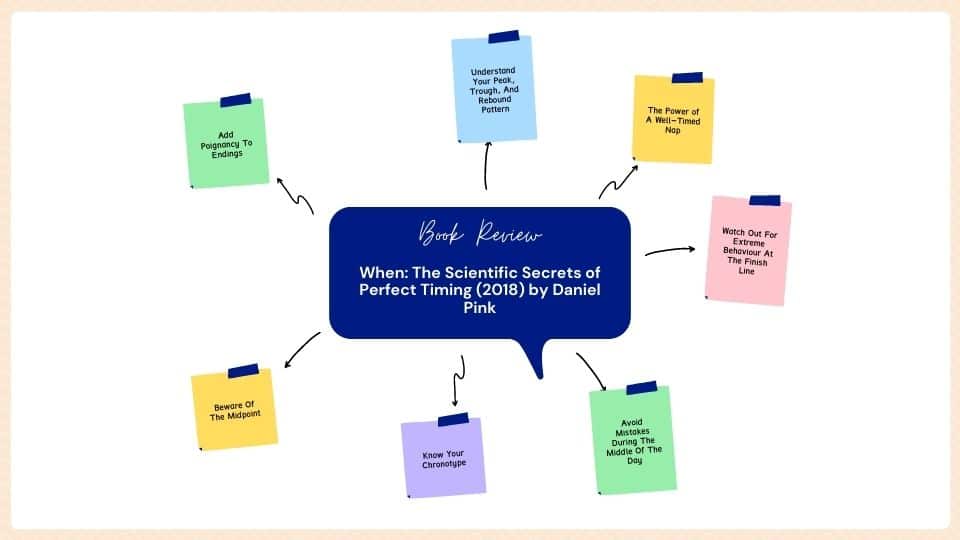
  • 7 Secrets Of Perfect Timing – A Summary of When by Daniel Pink

    We spend a good part of our life thinking about time. Right from when to wake up in the morning, to meeting work deadlines, to when is the right time to make a decision, we all know that timing plays a crucial role in our lives.

    In the words of Miles Davies, ‘Time isn’t the main thing, It’s the only thing’. His words are applicable to each one of us. When: The Scientific Secrets of Perfect Timing (2018) by Daniel Pink discusses the strong connection we share with time, how habituated we are to our routines, and why we do what we do when we do it.

    1. Understand The Peak, Trough, And Rebound Pattern

    We go through our days in a consistent routine. We get up, complete our chores, have breakfast, read the newspaper, get dressed, head to work, have lunch, head back home, spend time with family at dinner and go to bed. However, underneath these daily routines, our moods also follow a general time pattern.

    Researchers from Cornell University studied the mood trends of people on Twitter. They found a consistent pattern through the day where positive moods peak in the mornings, dip down in the afternoon and pick up again in the evenings. Apart from these studies, many behavioral scientists, using the Day Reconstruction Method (DRM) – a method of analyzing peoples’ day hour-by-hour, found that positivity levels follow the Peak, Trough, and Rebound pattern. Similarly, negativity levels peak in the afternoon and wane towards the evenings.

    Daniel Pink shows in the book that the peak, trough, and rebound pattern has a significant effect on our mood. Our moods affect the quality of the work we do in the afternoon’s trough time. Therefore, the most important calls, meetings, and deals are advised to be scheduled in the daytime when our mood is at its peak.

    2. Know Your Chronotype

    Along with the pattern our emotional state follows, each one of us has an internal clock or chronotype. While a majority of the people follow the same consistent pattern of morning peak, afternoon trough, and evening rebound, there are two other chronotypes that differ from the general type – the night owls and larks who consist of 20-25 percent of the general population.

    Night Owls

    Night owls experience their peak around 9:00 PM and rebound in the morning. These are usually creative people and tend to be a little more neurotic, depressive, and impulsive than the general group. Night owls should use their night-time peak to handle analytical tasks and use their morning rebound for creative work.

    Larks

    Larks (like I am) on the other hand experience their peak, trough, and rebound a few hours earlier than everyone else. They are the ‘early to bed early to rise’ people and have stable, happy, and introverted personality types. For larks, the reverse works. They should assign analytical tasks for their early morning and creative work for evenings.

    The author of the book gives various examples to show why it is important that we understand our chronotype to help schedule our day and maximize productivity.

    3. Avoid Mistakes During The Middle Of The Day

    Studies have shown that the elderly and small children tend to follow lark patterns, and we tend to change to the night owl pattern once we hit the teenage years. This is the reason why most teenagers suffer in analytical subjects such as math when schools start early in the morning.

    Another observation in hospitals has shown that standards of hygiene and care drop towards the afternoons. Moreover, the staff is more prone to medical mistakes during the trough period.

    Daniel Pink adds that these midday mistakes are avoidable by taking breaks. The University of Michigan Medical Centre has proven that taking ‘vigilance breaks’ shows improvements in the rate of medical errors. Similarly, the introduction of twenty-minute breaks before assessments in some Denmark schools has shown improvement in scores.

    Schools, colleges, hospitals, and other work organizations should take cognizance of this fact and introduce regular breaks for better productivity, and to avoid midday errors.

    4. The Power of A Well-Timed Nap

    It is important to understand why breaks are beneficial. Research on the usage of Desktime, a desktop productivity software company, revealed that for every fifty-two minutes of work, a person needs seventeen minutes of break time for maximum productivity. Sadly, in the previous ten years, the work culture is moving in the wrong direction by reducing the number of breaks.

    Studies have shown that a small 5-minute break can uplift mood, improve creativity, and motivate people. Moreover, chatting up with colleagues at the coffee machine, a walk in the outdoors without the smartphone constantly pinging, or even taking lunch outside amongst nature can improve emotional state and maximize productivity.

    Studies have also shown that taking a small twenty-minute nap can result in about three hours of increased information retaining capacity and improved focus. Additionally, a Nappuchino – a quick cup of coffee before that 20-minute nap – can give a better boost to focus and productivity. It takes about 20 minutes for caffeine to enter the bloodstream. Therefore, just as we wake up from the nap, the coffee keeps us awake and geared up for work.

    5. Beware Of The Midpoint

    Studies show that we tend to start a project (or any other task) with great gusto. However, if we hit an obstacle at mid-point – or even at the start – we tend to slack off. Most studies also show a rate of higher productivity at the start and at the end of a project. However, productivity is rarely consistent at the midpoint (when we tend to slow down).

    Connie Gersick, a researcher, coined the term the uh-oh effect. The uh-oh effect refers to the human behavior pattern where people would waste time as they reach the midpoint of a project. Later they realize that they haven’t got any work done and speed up towards the end to finish the job. This behavior pattern is seen in sports like basketball and football, where players who get a pep-talk at half-time to score a winning goal, play their best and emerge winners.

    Another way to boost midpoint productivity is to do a premortem. A premortem is an analysis of all the obstacles that one could encounter in the project, midpoint onwards. This pre-analysis helps in being prepared for any midpoint crises.

    6. Watch Out For Extreme Behaviour At The Finish Line

    Though behavior patterns suggest higher activity towards the end of any project or task, extreme finish-line behavior coupled with panic can prove to be disastrous.

    To avoid these, one can use the following tips – 

    • Establish a clear end goal individually and/or for the team. If the project falls behind schedule, these shared end goals help in establishing focus.
    • Avoid assigning new tasks or introducing new ideas at the midpoint. Reassert the end goal and brainstorm how to move ahead with the original plan.
    • Be aware of rash decisions towards the end. We tend to try and assign more meaning to the project towards the end. These added meanings could create more errors and additional work.

    7. Add Poignancy To Endings

    Humans place huge importance on a ‘happy ending’. Moreover, we place more value on achieving poignancy – a bittersweet, happy yet sad feeling – to a project or task that nears its end. This desire for poignancy is truly satisfying and one can take steps to achieve it.

    The end always symbolizes a period of change and a new beginning. Yet, the future is unseen, unknown, and therefore, there is uncertainty too.

    We should therefore attempt to bridge this gap, by creating relations between the past, present, and future. A good example would be to write a letter to your future self, describing the feelings of the past and the present, or plans for the future. When such letters are read after a few years, they can move a person in many ways and be a revelation. The feeling of poignancy can be thus achieved.

    “Ernest Hemingway published 15 books during his lifetime, and one of his favorite productivity techniques was one I’ve used myself (even to write this book). He often ended a writing session not at the end of a section or paragraph but smack in the middle of a sentence. That sense of incompletion lit a midpoint spark that helped him begin the following day with immediate momentum. One reason the Hemingway technique works is something called the Zeigarnik effect, our tendency to remember unfinished tasks better than finished ones.” — Daniel Pink

    The Final Message Of Time

    Our moods and performance oscillate during the day. Time waits for no one. It is up to us to make the most of it. Understand how the peak, trough, and rebound pattern affect us in a myriad of ways. Knowing one’s chronotype, avoiding midday mistakes, incorporating well-timed breaks and naps are some of the ways we can get ahead of time.

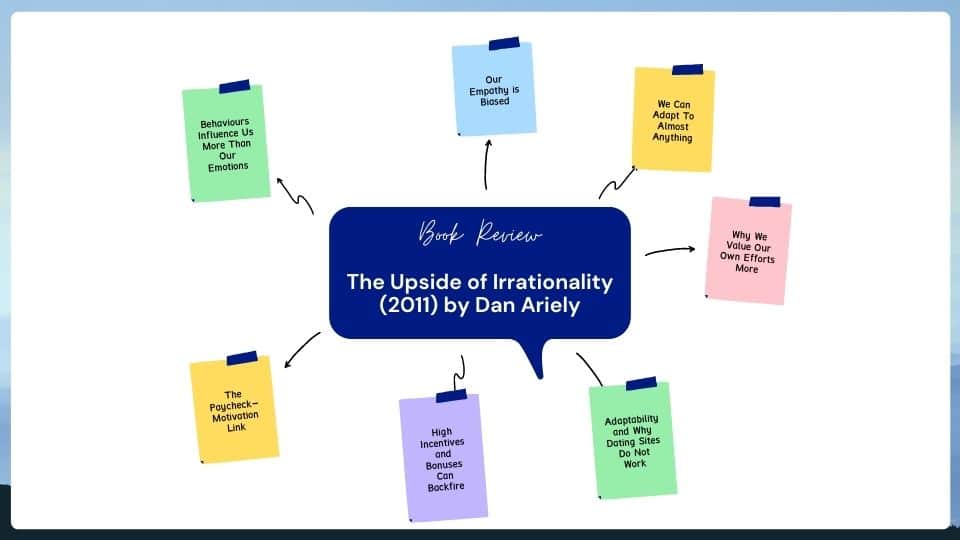
  • The Upside Of Irrationality – Dan Ariely Shares 7 Surprising Negative And Positive Effects Of Irrationality

    We all would love to be rational all the time, make sensible decisions, and act reasonably. However, Dan Ariely shows in his latest book that humans are rarely rational, and the truth is that our irrationality affects our decision-making our actions all the time.

    In The Upside of Irrationality (2011), Dan Ariely calls out our behaviors for being irrational, and the surprising positive and negative effects of the same.

    He discusses how to become aware of our behaviours in these situations and what we can do :-

    1. High Incentives and Bonuses Can Backfire

    Most of us look forward to that time in the year when we are about to receive our yearly bonuses. Most put in extra effort at work, burn the midnight oil and push themselves to the limits, to show that they deserve every penny of it. High incentives and hefty bonuses were introduced with a view to increasing employee output. However, recent studies show the opposite.

    High incentives and hefty bonuses put immense pressure on employees. It is a known fact that while a healthy amount of pressure can manifest better performance, it can also work negatively. Such pressure can become detrimental, especially when it comes to creative work, innovation, and problem-solving. The race ‘to be worth it’ results in hypermotivation – a state where one is so highly motivated to perform that they fail due to the extreme build-up of pressure and stress.

    For Example – The impact of pressure and stress can be seen in executives who are motivated and well prepared to give a high-impact speech but do not perform well in front of an audience.

    Bonuses and incentives that do not raise the stakes too high do not put pressure and extreme stress on individuals. An average incentive will still motivate performance, yielding better results.

    2. The Paycheck-Motivation Link

    The foregoing notion that a paycheck motivates people to perform is irrational. Animal psychologist Glen Jenson used the term contrafreeloading to describe a behavior exhibited by many animals such as monkeys, birds, and fish – that they prefer to earn their food as a reward for completing a task rather than to get it free.

    This concept is also true for human beings and their motivation to work. Internal motivators like meaning and recognition are important conditions for high performance and motivation. External motivators like the paycheck are never enough to motivate people to do their best work.

    Moreover, contrary to Adam Smith’s division of labor theory, it is found that people feel devalued and demotivated when assigned overly simple tasks. For Example, Workers involved in simple manual repetitive jobs such as screwing on bolts to metal in a car factory, do not feel involved in the end-product. 

    Since many employees today feel demotivated due to the lack of meaning in their work, organizations should acknowledge it and work harder in employee engagement programs and recognition of performance, rather than just using salary as a motivator.

    “Wouldn’t economics make a lot more sense if it were based on how people actually behave, instead of how they should behave?” — Dan Ariely

    3. Why We Value Our Own Efforts More

    Humans have a natural tendency to over-value their own work and feel pride in their work and effort. However, human beings do not need to put a huge amount of effort into a task to appreciate themselves. There is an irrational tendency to be biased toward one’s own work.

    We tend to be blind to the idea that we overvalue our work. If you have children, for example, you probably think of them as the best children on the planet. Well, most parents do! 

    Conversely, simply effort is not enough. Humans crave a sense of completion too, without which, their motivation for completion and positive bias towards their own work fades.

     4. We Can Adapt To Almost Anything

    Humans are shown to have high adaptability to their environment. We crave normalcy and our bodies as well as emotions have evolved to get back to normalcy soon after we experience any change in circumstances. Our adaptability is an excellent novelty filter and makes us sensitive to even the smallest of change in our surroundings.

    We experience hedonic adaptation, the tendency of emotionally leveling out and adapting to expectations, or to new experiences, both positive as well as negative. Example: Hedonic adaptation can be understood better when we look at shopaholics. They tend to adapt to their new purchases so fast that they get bored soon. Then they need to experience the excitement of a new purchase again, only to adapt to it again.

    The best way to use our natural adaptation to our advantage is to not interrupt our negative life experiences when they happen. This way, we can adapt to negative changes faster. Similarly, we should try to interrupt positive experiences to keep the excitement alive.

    5. Adaptability and Why Dating Sites Do Not Work

    Our ability to adapt to our surroundings is a major factor that affects our choices in dating. Moreover, as irrational as it sounds, it gives us insight into why dating sites do not work well.

    To begin with, when it comes to dating, people tend to choose partners who are like them, especially when physical attributes are concerned. Therefore, while someone with average looks will desire an attractive partner, he will naturally (or irrationally) end up choosing someone who has average looks. The person will place more value in some non-physical quality due to our human nature to adapt to what we have and level out our expectations.

    It is this adaptability that causes dating sites to fail. Irrationality impacts our decisions when it comes to love. Online dating sites that categorize people based on their attributes such as favorite movies, hair color, income, etc. using checklists and multiple-choice questions fail. In reality, dating works when two people get to know each other better and spend time together.

    I no longer idolize reason. I have come to accept that ninety percent of what we do is irrational and that we spend what little rational thought we have in justifying our irrationality. — Rita Mae Brown

    6. Our Empathy is Biased

    Humans are empathetically biased, especially when it comes to choosing to act or react to tragedies. The problem lies in the fact that we look for closeness, detailed information, vividness, and relatability to the tragedy for it to make an impact on us. This irrational tendency is known as the identifiable victim effect

    For Example: News about a child fallen down a well shaft will affect us more than then the news of a mass murder. It was Stalin who said “One man’s death is a tragedy, but a million deaths is a statistic.”

    At the same time being completely rational is not the answer either. Pure, unadulterated rationality discounts everything else that does not directly threaten, concern, or profit, and therefore will eliminate the aspect of empathy altogether. Some bit of irrationality is essential to make decisions we can live with and feel good about, in the future.

    7. Behaviours Influence Us More Than Our Emotions

    Humans tend to remember and take cues, from their past behaviors rather than from their past emotional states. We tend to believe that we had a reasonable reaction back then and that a new situation warrants the same reaction again. This tendency is called self-herding.

    Example:  Consider a situation where a person is on an important phone call and his children are making trouble. He scolds them and that makes the kids leave the room. The person will tend to remember that his negative reaction of yelling (and not his emotional state) at them caused the kids to keep quiet. That will get him to believe that scolding them is ok, making it a habit.

    It is therefore essential to be wary of how we react to certain situations, especially in negative reactions. The failure to recall our emotions when we swore at our friend prevents us from doing the same thing next time.

    In conclusion, human behavior is complex in nature. When we think that we are, or need to behave rationally and make objective decisions, we tend to give in to irrationality. In this book, the author Dan Ariely shows us both sides of the irrationality coin, and how biases influence our behavior and way of thinking. 

  • Benjamin Hardy Shares Why Willpower Doesn’t Work And What We Should Do Instead To Get Results

    Willpower Doesn’t Work (2018) draws on the premise that willpower isn’t the answer to success. Benjamin Hardy, the author, describes that focussing on changing the environment to achieve a goal rather than relying only on willpower is a better way of winning in life.

    It is a widely accepted belief that we need willpower to accomplish our goals. Many books have been written about the positives of willpower and how one must harness it to succeed in life. Having willpower is a good thing, no doubt about that. But exercising willpower is no easy task, and the author suggests other ways to make it easier to achieve your goals.

    Constantly reminding ourselves to exercise self-control is exhausting and it saps our energy. Before we know it, our willpower is weakened, and we give up. We must start the cycle of mustering willpower again, exercising self-control, and pushing harder than before. A cycle, that often leads to failure and giving in to short term temptations and instant gratifications.

    How do we break this cycle? What if there is a way to achieve goals without needing willpower? Benjamin Hardy gives the following examples in the book to explain the same.

    Example 1: The Obesity Epidemic

    What is causing the obesity epidemic all over the world? Statistics show that most people in the world will suffer from obesity by 2025. What was different, say about 50 years ago? How did the general population remain fit and healthy, and not have so many lifestyle diseases? Did they have the willpower?

    The answer is obviously not. What’s changed since then is our environment. Most of us sit at our desks all day and do work which hardly require any physical movement. And fast food and pre-packaged food is all the more available today, leading to convenience but also binging on unhealthy food. As the author puts it, it is our environment that has encouraged our weight gain, not a lack of willpower.

    Example 2: Darwin’s Theory of Natural Evolution and Domesticated Evolution

    Darwin’s theory of evolution states that we adapt to our environment to survive. He gives examples of natural evolution and domestic evolution. Natural evolution occurs when animals adapt to their environment in the wild.

    Domesticated evolution refers to creating environments to influence adaptation to what humans desire. We have designed environments to domesticate animals. For example, we use chemical hormones for fatter livestock and enhance their feed. Their bodies have now adapted to those environments. 

    Similarly, we have domesticated ourselves to adapt to a sedentary lifestyle. Moreover, our food habits have become unhealthy, and we have adapted ourselves – physically and mentally – to our current lifestyles.

    The author says we must focus on creating a healthy environment so that we have no choice but to adapt to it in a way we desire. When you change your environment, such as surrounding yourself with different people, your thoughts and emotions change. This can be applied to any area of our lives where we seek better results. Let us see how to do it.

    1. Create Separate Spaces For Work And Play

    Today, the lines separating work and play have blurred. Our offices have come into our homes. We don’t realize it, but it is a challenging task to keep ourselves from the distractions that are a result of such a mixed environment.

    It is important to have a clear differentiation between work and play environments, where the play environment is created for relaxation and having a stress-free time, and the work environment is devoid of any distractions and is dedicated to only work.

    Healthy levels of stress can have its fair share of benefits and can help one reach their full potential. Therefore, one should create a work environment that removes all distractions and enables one to perform and maximize productivity.

    2. Allowing For ‘Peak Experiences’

    We often get stuck in our environment and experience a mind-block. This can keep us from performing well, as well as achieving our goals. Changing the environment can lead to inspiration and a new sense of purpose. It has been proven that fresh ideas and creative breakthroughs come in the weirdest of places, like while taking a shower.

    A ‘peak experience’ is where one experiences a heightened sense of perception leading to clarity in thought. We can create these breakthrough moments by changing our environment and developing a habit of creating these experiences by taking regular breaks like going out to take a walk in nature or doing something else for a while.

    3. Remove Dead Weight And Acting Now

    What is deadweight? Deadweight is anything that shifts your focus and wastes your time from things that are needed to reach your goal. Often, we indulge ourselves in succumbing to the distractions of deadweight. These could be unimportant tasks that we give importance to or even games on our smartphones. Having too many choices at hand is also deadweight. It leads us to make uncertain decisions and focus unnecessarily on the details of all those choices.

    By making the decision to remove dead weight from our lives, we simply take away the temptation to succumb, and the need for willpower and self-control. To remove dead weight, it is essential to act now. Procrastinating in doing that will only throw us back into the vicious cycle of willpower, self-control, and failure.

    For example – Is there food in your fridge that you know is unhealthy? Throw it out now – it’s dead weight. When you do this, decision making becomes easier.

    4. Stay On Track With Implementation Intentions

    Implementation intentions (or premortems, as Daniel Kahneman calls them) is a strategy of foreseeing failure of a future goal to analyze what could cause it. Analyzing the causes of failure helps us to make better decisions and avoid failure.

    Implementation intentions can also help identify the threshold of quitting. If one can identify when they want to quit, they can try to push harder to achieve their goal until they reach that threshold.

    5. Changing The Environment By Use Of Forcing Functions

    Exercising willpower to achieve a goal requires forcing yourself, and nobody likes that. People prefer to do things voluntarily, and at their own pace. This leads to the vicious cycle of willpower, self-control, and failure. 

    Forcing functions are self-imposed changes in our environments to align us with our goals. They can be used positively to change the environment rather than requiring willpower. Forcing functions factor in non-negotiable changes in the environment that give us the push to achieve our goals rather than using willpower.

    The author Benjamin Hardy gives the example that if you want to be more present with your family after work, you should leave your phone in the car. That way, taking calls and answering texts isn’t even an option, and this is a forcing function.

    Key Message

    We can think creatively, use implementation intentions, forcing functions, and remove dead weight from our environment to bring about desirable changes. Changing our environment results in the effective and timely achievement of goals without needing willpower.

  • Lead With A Story (2012) by Paul Smith

    Since ancient times, storytelling has been a widely used art form not only as a tool of entertainment but also to impart information and to motivate and influence people. Many companies today, are harnessing the power of storytelling to motivate behavior and impart value systems among employees.

    Lead With A Story (2012) by Paul Smith emphasizes the importance that storytelling plays in today’s corporate world. It is a skill that is valuable for executives, managers, and leaders alike and useful for incorporating storytelling to enhance skills. It gives us examples of how stories can benefit organizations as well as what constitutes a good story.

    Why Storytelling?

    Storytelling for business is not a new concept. A number of successful organizations, right from Nike to Microsoft and Costco to FedEx use corporate storytelling to good use.

    Right from the beginning, stories have been used to share and impart knowledge. Before books and before the printing press was invented, the sharing of information was oral – in the form of stories. Storytelling has a number of advantages – 

    • Anybody can learn from stories
    • To learn from stories, one need not be educated
    • Age is not a barrier for storytelling
    • Stories are memorable means of imparting information
    • They help in retaining information better and faster
    • Stories can appeal to all types of people.

    There are three types of learners and everyone can be classified into at least one category – 

    1. Visual Learners – They need imagery for a story to appeal, about 40% of humans are visual learners.
    2. Auditory Learners – The vocabulary aspect of a story appeals to auditory learners. 40% of learners are auditory learners.
    3. Kinetic learners – The other 20% of learners are kinetic learners and the emotions and feelings conveyed by stories appeal to them.

    Stories, as we can see, can appeal to and influence all types of people. That makes it a wonderful universal tool for reaching the masses. Additionally, in the corporate world, stories can be strategically used to get information, principles, values, and much more across to employees. Further, we shall see how stories can influence.

    The Magic Of Customer Stories

    Let us begin with a story. 

    Ray Brook was visiting Portland for a series of meetings and needed to hire a vehicle from National Car Rental to get to his meetings. At the counter, he realized that his driving license had expired. The company would not be able to legally let him rent a vehicle.

    As he waited for his license renewal to come through the next day, the employees of National Car rental agreed to drive him from the meeting to the hotel and to the next meeting too! They also drove him to the DMV to get the license renewed.

    The quality of the service provided by the car rental company amazed him, prompting him to write a letter to the CEO of the company, appreciating the efforts and excellent services he received.

    The CEO, impressed and proud of his employees, started using the story as an example of exceptional customer service to his staff all over the country. Brook’s experience of customer service soon became the standard of service expected from employees.

    This demonstrates the power of a story in motivating employees to ensure great customer service time and again. It also shows why, as customers, it is important to provide feedback on service experiences. Leaders should be on the lookout for exceptional stories to turn into learning opportunities. Simply ensuring that customers have a place to provide feedback can work wonders.

    Values and Culture through Storytelling

    How many times have we seen the values of a company being hollow and restricted to a vision, mission, and motto on a presentation?

    Storytelling is an excellent medium, through which organizations can help employees understand the true worth of the values and the culture of the company. Additionally, it helps to imbibe, among the employees, a true sense of what is expected from them.

    The following P&G employee experience is an excellent example. 

    During the 2011 Egypt revolution, Rasoul Madidi and his family were stranded in Egypt, trying to leave the country. At the airport, flights were getting canceled due to instability. Madidi called P&G and told them his plight. P&G assured him and his family help and safety, and purchased tickets on five flights, ensuring that he would get to leave the country as soon as possible. They also provided accommodation and supplies post landing. The company put its employee first.

    The story shows how the P&G really ‘valued their employees’. P&G also shares stories on their website about new mothers who have benefitted by using the company’s flexible work policy. These stories demonstrate to others that flexibility is embedded in their work culture.

    Forging Diversity Through Stories

    Leaders and organizations often rack their brains with ‘how to build great working relationships within teams’, especially the ones with diversity and ones where diversity is needed. The answer lies in creating a platform where team members can share personal stories.

    The story of a person called Jamie is a classic example. Jamie, the leader of his team, was simply unable to bond with his team members and make friends with them. During one of the bonding sessions at work, Jamie shared the story of his bi-polar brother who had committed suicide. The story brought tears to almost everyone’s eyes and made them change their perceptions about their team leader. They started seeing Jamie as more than just a co-worker and made him more relatable.

    Stories can also help people in a team understand the differences in behavior, personality, culture, personal values, etc. of each team member and give them insight into their colleague’s cultures, behaviors, and personalities.

    ‘Story-fying’ The Company Policy 

    Have you ever read the entire company policy document that lays out the rules and regulations? It’s a fair possibility that more than 90 percent of the employees do not read this vital document. How does an organization, therefore, ensure that employees are aware of certain rules and regulations, and at least make an attempt to read them?

    The Answer: Through stories!

    Let’s take another example from P&G. During induction, P&G employees are told a story about two erstwhile employees who were fired due to the abuse of ‘free for training members’ cafeteria services. The two employees would eat free lunch meant for only for trainees on a regular basis. While their sneaking went unnoticed for some time, they finally got caught and were fired.

    The story helps outline some important company rules and prompts people to go through the company policy.

    Inspiration And Motivation Via Stories

    Storytelling is the perfect medium to inspire and motivate employees. Whether motivation and inspiration is needed to finish a tough project or to reinforce the values of perseverance, stories can help a leader cross that additional mile and give his team the needed push.

    The story of John Stephen Akhwari, a Tanzanian Olympic Marathon runner is a well known motivational story. Akhwari, in the 1968 Olympics suffered a dislocated knee during the run. Instead of giving up, he continued the agonizing run to the finish, reaching the stadium an hour after the winner. When he was asked why did he continue running despite his injury, he replied, “My country didn’t send me 5,000 miles to start this race, they sent me 5,000 miles to finish it.” 

    Inspirational and motivational stories of examples within the company can also be used as well. Nothing works like a story that is close to home.

    Context, Action, Result

    We have seen the ‘why’ and the ‘how’ storytelling is beneficial for corporates. However, what constitutes a good story?

    All through primary schooling, we learn that a story contains an introduction, a body, and a conclusion. In the corporate world, the same principles apply. Context, action, and the result are the three main ingredients of a good story.

    • Context – ‘Context’ refers to the introduction of the story – when and where does the story takes place – and helps the audience understand what is the story about, and whether it is true or hypothetical. The context introduces the protagonist and the antagonist (if any) and places the setting of the story. The context should be relatable and capture the attention of the audience.
    • Action – Essentially the body of the story, ‘action’ refers to the actual story. It describes the difficult path the protagonist takes to reach a goal or enumerates the failures encountered to finally succeed. The action is the journey of the story towards the finish.
    • The result – The ‘result’ of the story is its conclusion. The result of the actions of the protagonist has a verifiable outcome. The result always has learning or a moral that the audience learns from and can take home.

    Any story that follows a tight context, action, and result is a successful story. However, there are two more vital elements, without which any story will be ineffective.

    Elements Of A Good Story

    Context, result, and action form the framework of storytelling. However, the two elements of emotion and surprise can help grip the audience’s attention and help the message of the story hit home.

    A good, successful story always creates an emotional connection with the audience. However, the story has to appeal to the right emotions to make any impact. For example, a story about valor and bravery is of no use if the idea is to invoke cautiousness among employees, just as an emotional tearjerker will have no appeal if the outcome needed is bravery and candor. 

    Most emotional stories and their connections can be observed by going through customer surveys of feedback and experiences. These are an organization’s treasure trove of storytelling.

    Along with emotion, the element of surprise is very useful to wake-up an audience and to keep their attention in focus. Surprize can be used at the beginning of the story to make the start gripping, in the middle of the story to get the audience to focus, or even at the end to create a climaxing effect to the suspense. 

    Adding surprise to the end of a story helps in memory consolidation – a phenomenon where the memories are created in the moments following an experience. Storytellers often use memory consolidation by attaching memories to particular stimuli such as adrenalin. The element of surprise ensures that the story remains firmly planted in the audience’s mind.

    Conclusion

    Storytelling is extremely lucrative for businesses. Right from emphasizing the importance of the company policy to appealing to diverse team members, stories can help leaders and organizations share knowledge, motivate employees, and even build successful teams.

  • Trillion Dollar Coach – The Leadership Playbook of Silicon Valley’s Bill Campbell

    Trillion Dollar Coach (2019) is the story of Bill Campbell. It is an endeavor by Google’s Eric Schmidt, Jonathan Rosenberg, and Alan Eagle, to chart the course of Bill Campbell’s incredible journey as a coach, an excellent businessman, and mentor whose leadership skills; advice and guidance shaped many of Silicon Valley’s stars.

    The Story Of An Unorthodox Business Guru

    Before we begin with Bill’s exceptional ideas on leadership, management, and team building, let us begin with the simple story of the Silicon Valley Legend. Bill Campbell was born in Homestead, Pennsylvania in 1940 to a physical education teacher; Bill had the fire to make a name for him right from the beginning. He was intelligent and quick-witted and a die-hard football fan.

    He joined the Lions, the Columbia University football team when he moved to New York to study economics. He was never built to be a football player though. He is 165 pounds and a mere 5ft10”, which made him the smallest member of the team. However, he quickly earned a nickname ‘Ballsy’, due to his will and fearlessness. In 1961, his captaincy earned the Lions the Ivy League Championship.

    Over the next decade, after he moved to Boston College as a football coach, he became an established name in the football-coaching scene and started getting offers from some well-known names, including Joe Paterno from Penn State, one of the top college football coach. However, he gave up the opportunity because, at the same time, he was offered a job by his alma mater, and his loyalty took precedence over everything else.

    From The Field To The Valley

    He started a job at J. Walter Thompson and his fervor and enthusiasm were on display in the advertising industry as well. His clients loved him and one of them – Kodak managed to pull him out from the agency and place him as the head of consumer products in Europe.

    His foray into Silicon Valley began when his long time friend John Sculley, moved from Pepsi to become the CEO of a new start-up called Apple. Bill Campbell accepted the offer because he knew that in the corporate world, his unorthodox background wouldn’t let him climb the corporate ladder any further.

    His decision was a great one because, within nine months, he was made VP of Sales. Furthermore, it was in this role, that he made the smartest decision in the history of the company when he was to oversee the launch of Apple’s flagship product – the Macintosh. 

    He gave the go-ahead for an ad for the Super Bowl in 1984 that took on the dystopian novel by George Orwell – 1984, even though the Apple board did not approve it. His decision to approve the controversial ad paid off, making it a historical moment in the world of advertising by introducing the world to the concept of Super Bowl advertising.

    The Winds Of Change

    Things started taking a different direction in 1990 when Bill Campbell was chosen to head Claris, the spin-off software venture. However, when Apple decided not to make Claris public, Bill knew that it was time to move on. 

    He still managed a decade more in the industry before he moved on completely to coaching, mentoring, and business consulting. He lived by his own management rules. His years as a business coach are fondly remembered by some of the stalwarts of Silicon Valley. His coaching was significant in the success of Google and other companies. Here is how he did it!

    1. Returning To The Core

    Campbell joined Google in 2001 when the company was in the midst of an experiment, where Co-founder Larry Page had decided to do away with the concept of managers from the organization. Bill knew that the ‘disorg’, though successful, wasn’t a sustainable one. After much deliberation and arguments, he suggested that the opinions of those at the receiving end – the engineers – be taken into consideration. The response from the engineers was unanimous. They wanted managers!

    According to the engineers, while the freedom was great, they needed managers to resolve stalemates. Moreover, they needed someone with the authority to make tough calls. A 2005 American Journal Of Sociology states that though flat hierarchies work well to imbibe and foster creativity, they do not always result in the successful implementation of those very creative ideas.

    Bill Campbell’s answer to how to manage a balance between the two was simple. He suggested looking back at the first basic principles that define the mission and the values of the company. 

    2. Showing Emotions Help Build Relationships

    Bill Campbell understood that showing care and concern for the people you work with are signs of an effective leader, irrespective of the common notion that showing emotions at the workplace is a sign of weakness or incompetency.

    Sigal Barsade and Olivia O’Neill, in their 2014 study found that organizations that practice emotional openness have lower rates of absenteeism, higher employee satisfaction, and better team performance. Such openness breaks down barriers between personal and professional, creating a more accepting environment.

    Bill Campbell was warm and informal with his colleagues and was ever ready to help people in trouble. For example, he visited Steve Jobs every day in the hospital while he was riddled with cancer. In another example, Bill would make board members get out of their chair and clap for a presentation they liked, akin to how a parent appreciates a child, according to Phil Schiller.

    Bruce Chizen from Claris adds that Bill’s easygoing cafeteria or elevator conversations were a way to start forging lasting personal relationships with colleagues. While it wasn’t as easy for Bruce, he realized that it wasn’t a difficult habit to imbibe either.

    3. The Positives Of Loyalty

    Perhaps one of Bill Campbell’s most endearing qualities was his loyalty. Right from the beginning – his loyalty towards his alma mater when he joined as a coach or the fact that Bill was the only prominent leader at Apple who argued against the board’s decision to oust Steve Jobs in 1985 are examples that show how deep that quality ran within his personality.

    It was this very quality that got Jobs to hand him the position of Director at Apple from 1997 to 2014. Moreover, it strengthened their relationship. His involvement and loyalty to the company helped Apple bounce back from near bankruptcy on the way to becoming the Apple that we know today.

    Similarly, Bill’s words of wisdom and loyalty to friends during the famous Sunday afternoon walks at Palo Alto helped Eric Schmidt’s Google – then a start-up – reach the heights it has reached today.

    4. Bias Can Make Talented People Get Ignored

    Bill was at the front when it came to ensuring that the best talent always got an opportunity. Deb Biondollilo, the head of HR at Apple then, narrates an incident where Bill was instrumental in ensuring that women got equal opportunities to showcase their mettle.

    Bill had noticed that Deb would always take the backseat at the board meetings. One day he encouraged her to get to the front. When she finally plucked the courage to come up front, an executive Al Eisenstat was skeptical until he got the nod from Bill to accommodate her. That was just the beginning of helping women make it to the forefront in a male-dominated workspace.

    His views that hiring women translates to more productivity are supported by the 2010 study published in the journal Science. It found that teams having a higher collective IQ and emotional intelligence have more women.

    5. Trust Makes Boardrooms Tick

    What is trust?

    A 1998 Academy of Management Review journal states that trust is all about a willingness to take a chance because you have positive expectations for someone else’s behavior.’

    The fact that Al Eisenstat accepted Deb in the forefront of the board meeting, and Deb’s courage to come up front, are classic examples of the fact that both, Al and Deb, trusted Bill’s judgment.

    Bill earned people’s trust by simply listening to what they had to say, a method Al Eustace, Google’s computer scientist, calls free form listening. Additionally, he always asked questions. His way of respectfully asking questions made speakers feel a sense of belonging, and autonomy and feel competent. This is what made him a valuable and trustworthy conversation partner.

    Bill also understood that trust has the power to turn arguments into positive experiences rather than personal attacks. Trust brings objectivity to a conversation, enabling the people in an argument to give a fair hearing to what is being said.

    6. Not Dwelling On Negative Emotional Responses

    Eddy Cue, an Apple executive remembers that Bill had a great philosophy – to get emotional responses to setbacks out of the way as fast as possible and to get moving ahead in meetings. He never wasted his time in meetings lamenting about failures. 

    He employed a technique called problem-focused coping that involved utilizing one’s energy for constructive problem-solving. Essentially, Bill would keep the venting short and move on to finding a viable solution for the problem at hand.

    A Different Kind of Memoir

    Bill Campbell’s shooting star-like journey in Silicon Valley shows many leaders that the background of a person isn’t a yardstick to success. His insights into management, leadership, and his coaching strategies have helped make some of the world’s resounding successes what they are today.

    The authors’ admiration of Campbell and this book is a way to show gratitude – a moral, philosophical, and financial gratitude – is clearly visible in the many tales in the book.

  • To Sell Is Human by Daniel Pink – Book Summary and Review

    The lines between other traditional departments of an organization and the sales department have become blurred. The function of sales now overlaps the roles and responsibilities of each employee in an organization. Interaction with customers has become a vital role and thus, ensuring that the customers, clients, and vendors have a great experience has become important too.

    In fact, selling, or sales has been an integral part of every human life, since time immemorial. The erstwhile barter system has given way to full-fledged, complex sales, advertising, and marketing, and is today, one of the most important functions that are vital to the growth and sustainability of any business, entrepreneurship, and start-up, or corporate.

    To Sell Is Human by Daniel Pink is a perfect guide for everyone, arming them with techniques and tools to enhance their selling skills.

    The “We Are All In Sales” Ethos

    Considering that ‘sales’ is now everybody’s job, incorporating a “we are all in sales” ethos in any business is essential. For example, Atlassian, the enterprise software company, generated more than $100 million in revenues without having any dedicated sales force in the year 2011. How did they manage that?

    The answer lies in incorporating an attitude of “selling their business” during every interaction with clients, customers, and vendors. In the United States, entrepreneurs are slated to soon be the majority of the workforce. With this in mind and the fact that start-ups usually cannot afford a sales department, the responsibilities of sales fall on everyone’s shoulders.

    Today, the average employee spends 40% of their time convincing, influencing, and persuading others. This is also called non-sales selling, or moving people. In the Ed-Med (education and medical) industries, the largest job sectors in the US today, non-sales selling and moving people is a fast growing concept.

    The New Tenets Of Sales

    Salesmen have had, for some time now, a negative “slick, pushy, used-car salesman” image. Salespeople could get away with anything earlier, especially in the used-car dealerships. This happened just because salespeople had more information about the product than the buyer, and that not making a bad buying decision was the customer’s responsibility (a concept known as caveat emptor or buyer beware). 

    Today, the Internet has made information available at our fingertips and the ‘information asymmetry’ has reduced. Customers today, can even expose dishonest companies online, damaging their reputation and business.

    Today, honesty, transparency, and service have become the new tenets of sales, making customer satisfaction and experience vital to salespeople. This shift can be seen in non-sales selling as well. In the Ed-Med industry, with information easily available online, service is more important.

    The New ABC’s

    The age-old, ABC’s of selling (Always Be Closing) has given way to a new ABC of moving people – Attunement, Buoyancy, and Clarity.

    1. Attunement – Attunement refers to one’s ability to perceive things from others’ perspectives and then act. How can one, therefore, be attuned?

    Attunement does not include empathy, which refers to feeling. While empathy is important on should understand what the opposite person is thinking and apply ‘cognitive perspective-talking’. This implies, that contrary to the belief that ‘sales’ equals ‘extrovert’ behaviour, people should move towards being ambiverts – a blend of introvert and extrovert. This is because classic extroverts cannot se beyond their own perspectives, are not understanding of what the customer thinks, and can actually hurt sales. Ambiverts, however, have the ability to listen and then attune their perspectives to that of their customers.

    To be attuned, salespeople should always assume that they are in low-power position because power makes people oblivious to any perspective apart from their own making them stick to their own views. Additionally, subtly mimicking actions, behaviours, and postures of their customers increases the chances of closing deals.

    1. Buoyancy – Rejection in the field of sales isn’t uncommon. However, it is essential that every salesperson stays afloat for the next customer that comes in. Buoyancy is that continuous will to keep selling day-after-day despite rejection. How does a salesman, therefore, keep buoyant during, before, and after rejection?

    Interrogating self-talk or asking oneself the question, “Can We fix it?” is a better way to deal with a tough task such as sales, as averse to previously-famed self-motivational declarations like, “I am the greatest and I can do it!” Interrogative self-talk forces one to think of possible solutions and strategies during rejection. Buoyancy keeps a person positive, broadens one’s perspectives, and thus perceive the customers’ problems better. Such an outlook can even help a customer consider the alternative suggestion after an initial rejection.

    Buoyancy also implies that salespeople should stay positive even after rejection. It means adopting an attitude where one tells oneself that this rejection is simply temporary and not a permanent feature. One rejection isn’t a personal setback. Seeing the positive in a bad outcome helps people deal with the regular rejection that they face as salespeople.

    1. Clarity – Salespeople are no more the sole custodians of information. Therefore, sales and non-sales persuaders, have to find a new method of moving people.

    They need to work with clarity; which means that they should focus on making customers view their situations and needs in a new light. Help customers identify their problems by sifting through the vast amounts of information available to them, rather than seek solutions is more valuable as a sales service.

    Once the customers understand the information given, the salesperson should make their sales pitch while comparing their product with another, as comparison helps customers perceive the product they need in a better light. Additionally, giving customers fewer choices and limiting their options increase the chances of sales.

    Another way of adding clarity is by offering customers an experience rather than a product. This means that customers respond better to a sales pitch where they get first-hand reviews of the product being used. This means that the information given to customers should be clear and detailed.

    Short and Engaging Pitches

    We are bombarded with a lot of information from all directions all the time. Most of this information is in the form of advertising and marketing. If we look at Elisha Otis’ effective pitch for his invention in 1853, he cut the cable of an open elevator he was standing upon, at the height of at least 3 stories, in front of a captivated audience.

    As they gasped, he didn’t budge. His invention, the automatic safety brake was a success, as was his pith to his audience. If we consider sales pitches today, we know that they have to be faster and shorter than they were in 1853. Considering the modes of communication we have today, they have to be short enough to fit in a Twitter headline or fit an email subject line. For example, President Obama’s 2012 campaign slogan was just one word “Forward.”

    In addition to short, pitches need to be engaging, to stand out from the crowd of information we get. Pitches that get the customer involved in developing the pitch and contribute their ideas are often more successful. Such pitches mostly involve the customers answering a question; one that will make them think in favor and this move them. Another trick to make a pitch work is to use the concept of having a rhyme scheme. Rhyming appears to make statements look and feel symmetrical and accurate.

    Using Improv In Sales 

    Often, salespeople rely on scripts – designed to bring about the desired result from customers – to make their pitches. However, with the complexity of sales increasing and being more dynamic in nature, it is essential that salespeople be prepared for sudden changes.

    The unscripted ‘improve’ concept revolutionized classic theatre by creating an environment of open-minded interaction. Improv put the focus on listening to others, a skill that is most essential for salespeople to be able to know what their customers want and are thinking.

    There are two more vital components of using improv. The first one is to understand that moving people doesn’t happen in a vacuum. Therefore, in the case that a salesperson is working with a partner, they should always try to make the partner look better in from of the customer. This is called a ‘win-win’.

    The second component is to use, “Yes, and…” or “Yes, but…” while responding to one’s customer opinions and ideas. Adding an affirmation creates a positive tone and helps a customer understand that the salesperson understands likes their idea, but has a better one to offer.

    Personal And Purposeful

    Sales, today, is no longer an exchange of goods. It has become more personal and purposeful, and salespeople have to customize the personal experience for each customer. It involves adding a personal touch to the service that the salesperson is providing.

    For example, a restaurant owner who puts up his photograph with a contact number for complaints adds a personal touch to his restaurant’s service. It tells customers that he is open to suggestions for improvement. This attitude will make customers come back to the restaurant.

    Along with personal, adding purpose to the service and conveying it to customers is essential too. For example, in a study conducted to promote hand hygiene among doctors, it was found that they responded better to patient-oriented “Hand Hygiene Prevents Patients from Catching Diseases” rather than “Hand Hygiene Prevents You from Catching Diseases,” that put the focus on their own health. The first campaign matched the purpose of the doctors – to care for patients. Therefore when it comes to moving people both ‘personal’ and ‘purposeful’ are vital, as selling is after all, human.

    Conclusion

    Sales and selling have given way to the concept of  ‘moving people’. To move people, one has to redefine the ABC’s of sales into the ABC’s of moving people. Additionally, to truly move people in the sales business, as well as those engaging in non-sales selling (essentially everyone these days), can use short and engaging pitches, use improv in sales and ensure that their dealings are personal and purposeful to win over customers in this new era of sales!

  • Creativity, Inc. By Ed Catmull – 8 Leadership Lessons From Pixar

    Today, creativity has become an essential component in every facet of work. All organizations expect their employees to employ creative and innovative means to solve tasks at hand, at the time ensuring productivity and profitability. 

    Creativity, Inc. explores the journey of Ed Catmull, President and co-founder of Pixar, which was later acquired by Disney Animation Studios. He takes us through strategies that will help us understand how to maximize creative potential, achieve excellence in management while minimizing risk and achieving success and profits along the way. Below are my biggest 8 leadership lessons from the book:

    Give a good idea to a mediocre team, and they will screw it up. Give a mediocre idea to a great team, and they will either fix it or come up with something better.

    1. Get Honest Feedback From Employees

    Getting honest opinions and feedback from employees is essential to the successful functioning of any company. Feedbacks and opinions enable the management to understand the direction of the organization and the mood amongst employees. However, hierarchical structures in organizations cannot generate honest feedback from employees.

    Companies need to create open systems of feedback between hierarchies where employees can provide their honest opinions without the fear of backlash. For example, in 2013, Pixar started ‘Notes Day’, which enabled employees to share opinions about the company openly. On Notes Day, Pixar shuts down all work for a day to have brainstorming sessions throughout the entire company.

    I post one book summary every week. To not miss what I learn from the hundreds of books I read every year, subscribe to my bi-monthly Deploy Yourself newsletter and stay updated with the latest on leadership, culture change, and neuroscience.

    Open feedback systems are great, however, employees need to know that their valuable opinions and feedbacks are worked upon. Often, employees tend to either avoid giving feedback to leadership fearing that their opinions won’t be considered or will be treated with disdain. It is therefore essential that everyone takes ownership of their work. If people own their work, they will take pride in finding successful solutions for problems identified.

    Ed, therefore, makes it a point to meet his team members individually to understand the problems they face and makes them comfortable to share opinions with him.

    2. Embrace The Fear Of The Unfamiliar And Failure

    Some amount of risk-taking is necessary for any job. However, the fear of failure and mistakes makes people risk-averse, and they become reluctant to change or try something new. This fear eventually makes people proceed with caution while making decisions about the future and make them opt for the safer route. This holds true for every stage of life, whether it is for a student learning something new, or for an employee in an organization.

    The fear of uncertainty and inflexibility often makes employees and in turn, the organization lose out on unexpected opportunities. During the Pixar and Disney Animation Studios merger, Ed Catmull turned down a carefully conceived two-year plan for the future drafted by the HR of Disney. He knew planning future goals in a structured manner would limit the creative possibilities and opportunities could come their way. He decided to embrace uncertainty instead of structure and went with the Pixar culture – which embraced the unfamiliar and failure.

    3. Leaders Should Watch Out For Confirmation Bias

    It is a proven fact that we, as humans fall prey to confirmation bias. Confirmation bias refers to the behavior we display where we tend to prefer our own views and information that confirms our opinions. This makes us blind to any other alternatives, even if they are better or even at times, the correct decisions to make.

    Managers often tend to fall prey to confirmation bias over certain decisions, simply because of the hierarchy. Managers and leaders in an organization should be wary of confirmation bias and be open to listening to opinions and ideas from others as well.

    The norm at Pixar was for the animators to work parallel to the production processes. However, this system of working was time and resource-consuming, resulting in many edits. 

    The leaders at Pixar implemented an idea given by an employee that the management move animation work to after the production was completed. It proved to be a success and helped in saving the company time, effort, and thus money by reducing the hours per person put in for the job.

    When looking to hire people, give their potential to grow more weight than their current skill level. What they will be capable of tomorrow is more important than what they can do today.

    4. Go The Extra Mile

    Employees need the drive to go the extra mile to ensure consistent top-notch performance. This drive is often seen amongst employees who have an ambitious goal set that they want to achieve. This goal needs to be a goal that drives them to perform collectively.

    Moreover, when employees see that their passion for the goal is an important part of the entire process, the drive will push them to work harder and pursue success with fervor.

    During the production of Toy Story, some of the staff considered production managers a hindrance to their work. However, despite knowing that the rest of the team has this viewpoint, the production managers were able to ignore the co-workers and pursue their jobs with passion because they knew that their efforts were essential for a successful end result.

    5. Hire The Right Team

    No matter how great an idea the company has, it can only be successful if the company has the right people working on the idea. Moreover, even the best talent in the pool will be of no use if they cannot work well with each other.  

    Any organization, to be successful needs to place more importance on hiring a team of people that are able to work harmoniously with each other.  It is seen that teams with people from diverse backgrounds tend to be more successful.

    The truth is, the cost of preventing errors is often far greater than the cost of fixing them.

    6. Trust People To Do What They Are Hired For

    No one likes a helicopter manager. In fact, studies have proven that managers who tend to micromanage their teams end up killing creativity as well as the morale of the team.

    Pixar has an interesting team called the ‘Braintrust’. It is a team that comprises of Pixar’s film production experts, who review the production process of all films. Nevertheless, it is the decision of the director of the movie to take their advice or not.

    Managers should, to an extent allow employees to have the freedom to make necessary decisions. Managers also need to be able to trust their employees to act responsibly with the freedom given to them. The worst thing a manager can do after hiring someone is to tell them how to do their job. If you have hired correctly, leave your people alone and trust them to do their job. They will often end up surprising you with their performance.

    Ed Catmull follows a rule to hire only those people he thinks are talented enough. While conventionally, managers and leaders would be insecure to hire their own competition, he finds that it produces the best teams by constantly pushing the bar.

    7. Get Back Up Quickly After A Fall

    Mistakes are part of life and failures are important learning opportunities. It is therefore essential that organizations have recovery techniques in place to be able to bounce back soon. 

    Pixar has iterative processes in place that help them accept mistakes and weed them out after each iteration. Moreover, since mistakes are the responsibility of the entire team rather than just one individual, the entire team takes time to analyze and explore their mistakes early on to avoid serious expenses in correcting them at the later stage.

    Further, if there is fear in an organization, there is a reason for it—our job is (a) to find what’s causing it, (b) to understand it, and (c) to try to root it out.

    8. Create An Culture Of Creativity

    Leaders should help to create an environment that boosts creativity and fosters it. Things like incorporating creativity designs in the architecture and interiors of the workplace, giving each employee the freedom to creatively express themselves, and add personal touches to their desks are some ways leaders can create a culture of creativity

    Another way to foster creativity in the organization is to incorporate flexibility. Rigid routines lead to boredom and hence inhibit creativity. Organizations should give employees more freedom and flexibility in working in their own styles and pace.

    Ed’s Wisdom

    Creativity should be at the roots of an organization. Additionally, it should be part of the value system that the organization follows. Archaic strategies and systems of working should be discarded to invite new creative ways of working. Organizations can include more flexibility by ensuring their people function well as a team, by building trust with employees, giving them the freedom to express, and weaving a creative environment and atmosphere into the very fabric of the organization.

  • Amazon By Natalie Berg and Miya Knights: How the World’s Most Relentless Retailer will Continue to Revolutionize Commerce

    Keeping Up With Amazon

    The past two decades have seen one company emerge out of a Seattle garage and trail-blaze itself into the second most valuable company today. Breaking all barriers in the retail and e-commerce sectors, this company has set and broken records in the global business empire and revolutionized the very concept of retail. 

    Jeff Bezos’ Amazon dominates every aspect of the retail and e-commerce industry, with over five hundred million products on offer. Moreover, Amazon leads the market as the most popular ‘go-to’ destination for online shopping right from fashion and accessories, furniture, electronics, sporting products, and even groceries.

    Natalie Berg and Miya Knights, in their book Amazon: How the World’s Most Relentless Retailer will Continue to Revolutionize Commerce (2019) investigate the meteoric rise of Amazon, why and how the company dominates the markets, and what other retail companies can learn from their successful strategies and mechanisms. They delve into insider knowledge and industry data to show the evolution of retail in the digital age, the future of shopping, and what retailers need to do to succeed in a market that already seems saturated from A to Z with Amazon!

    More Than Just A Retailer

    Today, one thing is for sure, ‘If it exists, you can buy it on Amazon’. 

    Everything that one needs is just a click away. Amazon, today is more than just a retailer. It is a vendor that sells and handles a million products itself, it is a marketplace that third-party sellers use as a platform to sell their products, and it is adding more roles to its forte, perhaps even as we speak.

    Amazon has moved in production, having over a hundred in-house brands ranging from fashion to coffee, has its own electronics (the super successful Kindle and Echo), as well as its own payment services, credit card options, cloud storage, and much more.

    Why then, does Amazon need to expand its limits, especially when its retail division is already a resounding success?

    Amazon’s foray into multiple businesses is based on a simple strategy. They follow the flywheel principle where customers are attracted by lower pricing and good service, which in turn leads to higher sales. Higher sales attract more third-party sellers, which results in more business and money for the company. Amazon further reinvests this money to further reduce prices and provide better service. The flywheel strategy, thus, helps build momentum and pushes Amazon towards higher levels of success.

    Amazon feeds this flywheel strategy with innovation, thus broadening the boundaries of the traditional retail structure. Their foray into the entertainment sector with Amazon Prime and Video, and their storage and delivery solutions such as Fulfilment by Amazon (FBA) are great examples of innovation.

    However, getting their flywheel to finally spin skyrocketing profits has taken them time. Amazon patiently trudged through the first eight years of losses; a high cost of the flywheel strategy, and relied on the goodwill and patience of investors to get to where they are today.

    Dedication to Customers

    Amazon believes in its dedication to its customers. They put their customers at the center of their business strategy with Customer Obsession – the first principle in their book of fourteen leadership principles.

    This Customer Obsession is evident in their constant endeavors to make shopping more convenient, simpler, and faster with their new products and service strategies. In fact, they invest 6% of their annual profits into improving their online shopping experiences, six times more than the industry benchmark. In 2017, amazon invested about twenty million only on R&D.

    This constant investment has made them a pioneer in ‘one-click’ shopping. They even had the patent to this process for many years, giving them a massive advantage over the competition. Additionally, their ‘two-day’ shipping strategy is today an e-commerce norm. When they introduced two-day shipping in 2005, they forced other online and traditional retailers such as Tesco and Walmart to keep up with their delivery speeds.

    All these strategies stem from the fact that Amazon is dedicated to its customers. Any new product or service strategy they develop starts from understanding what their customers need and want. For example, for any new product or service meeting, Amazon employees present their ideas in the form of a mock press release, to be able to perceive the new product as customers would.

    Today, product searches begin on Amazon itself. Thus they use the vast amount of customer data they possess to deliver products and services tailored to the needs and wants of their customers. These customer-centric innovations and strategies have made Amazon indispensable to many online shoppers, building a veritable loyal customer base.

    The Amazon Prime Membership

    Amazon Prime, Amazon’s own loyalty and rewards membership program works on the traditional concept of retail incentives. However, Amazon has based this system on their principles of customer obsession and taken it to the next level.

    Since its launch in 2005, the Prime membership incentives and benefits have expanded far more than just providing free two-day shipping at $79 a year. Today, it includes a speedy, even same-day delivery of more than a hundred million products, special deals and offers, add-on services such as grocery, unlimited access to Prime Music and Video, all for a fee of $119 a year.

    The Prime membership and foray into an entertainment have been a resounding success as well. Yet, curiously enough, the cost of the membership does not cover the actual cost of all the benefits that come with it. In fact, it doesn’t even cover the cost of express delivery. To actually cover all costs of incentives, they would have to increase the Prime Membership cost to $200 a year.

    How do they sustain this model then?

    Amazon believes in investing in the long-term future benefits and in the bigger picture. They know that their Prime customers are loyal to them because of the high-quality service, entertainment options, and convenience that comes with the prime membership. They also offer members their own ‘Prime Day’ of shopping. 

    Statistics in fact show that Prime members spend 5 times more than any of their other customers. Considering ‘Prime Day’ takes place in the summers when sales are low, it is a great strategy to rake in profits by offering special deals and discounts. In 2014, Prime day generated over $2.4 billion in sales.

    The convenience of saving time and effort trumps the need to save money. Thus customers choose Amazon as their default for shopping. By 2018, Amazon had more than a hundred million Prime members the world over, and this number is surely on the rise.

    Merging Online And Offline Shopping

    The emergence of online shopping spelled doom for traditional retailers, with over twenty major retailers shutting stores and filing for bankruptcy in the past five years. However, contrary to this trend, Amazon began opening its physical stores such as the bookstore in Seattle in 2015, and the Amazon Go cashier-less supermarket pioneered in 2018. Why did Amazon invest in traditional, physical stores when online retail was clearly the booming future?

    There are a few ‘no-negotiation’ factors where traditional retail is concerned.

    1. Some physical aspects of store shopping cannot be replicated, nor fulfilled by online shopping.
    2. Industries such as fashion and clothing, groceries, etc. work on the principle of touch, feel, and try out products.
    3. The instant gratification that one gets by walking out of a store with a newly purchased item – in other words, the retail therapy effect – doesn’t accompany online shopping.
    4. Online stores do not provide brands the visibility that comes with physical store shopping.

    Amazon has the foresight to understand and provide solutions to some of these factors. They have been able to understand consumer habits in the new digital age. 

    Consider the following example. A person starts looking for a good pair of sports shoes online. Next, the person visits a physical store to try them on. Once the choice is made, the person uses his or her smartphone to research competitive prices in different online stores. If all the pre-requisites are checked, the person gets the right-sized shoe delivered to their home.

    Amazon’s foresight thus has enabled them to understand the fact that online or offline purchase isn’t as important as providing customers with a seamless and frictionless experience that finally leaves them satisfied. They have understood the importance of the brick-and-mortar traditional grocery store and how providing blended shopping experiences to customers will be the future of retail. With this foresight, Amazon purchased the Whole Foods supermarkets chain.

    Cementing The Future In Groceries

    Online retailing began with bookselling because people trusted buying commodities like books over the Internet. Though people got more comfortable with the idea of buying more product categories through online retail, food and groceries were still a very tough segment to crack into. The offline grocery market was as tough to crack as well.

    The real problems lie in hitting profit margins, and the added pressures on the supply chain of providing specialized storage and delivery. Nevertheless, since food is an essential commodity, payoffs are massive. It is for this reason that Amazon was keen to break into the grocery market that would not only firmly place them in the daily lives of customers, but also boost sales across the board. Amazon needed physical stores to compete in the grocery market.

    Amazon purchased the US supermarket chain Whole Foods In 2017, at a time when experiments in online grocery ventures had received bland reactions from consumers. This decision left business experts baffled. Even though they had begun testing grocery delivery service, AmazonFresh in Seattle in 2007, and have since expanded to other US cities and in Europe, the success and uptake of this venture have been relatively slower.

    Yet the decision to buy Whole Foods was a logical one. Firstly, they needed experience in handling perishables and organic goods, which the organic supermarket chain specializes in. Secondly, Amazon’s customer base is a loyal high-income one. Thirdly, having about 500 chains in the UK and US is not unmanageable for an experiment.

    Over the next few years, their Whole foods venture will enable them to provide offline and online blending. Their Prime membership already plays an important part in this strategy, providing Prime members Whole Foods products delivered within two hours with cashback options.

    They endeavour to make grocery shopping much simpler than before – globally!

    Using Technology And Innovation For Better Service

    Amazon’s understanding and use of technology to better their customer service experience is another feather in their successful cap. They have another principle of Invent and Simplify which already gives them a sound technological platform via robots, virtual reality, drones, AI, 3D Scanning, driverless cars, and much more.

    This strategy that started in 2012 is already paying off well. They purchased Kiva Systems, the main supplier of their warehouse robots. While earlier, robots made up only 20% of their workforce, investments in Amazon-specific robots will ensure an increase in the automated workforce.

    Other retailers are now trying to replicate the cashier-less Amazon Go’s ‘Just walk out’ system. Their Echo’s voice assistant Alexa is also a great example of their technological prowess in business strategy. In addition to these, their search and recommendation algorithms are constant updated to accommodate customer data. In 2017, recommended purchases amounted to about 35% of their product purchases.

    Amazon also provides cloud storage systems via Amazon Web Services – developed for their own infrastructure. Companies such as Netflix, Nordstrom, as well as NASA, use AWS, pushing their profit margins to almost par with Starbucks.

    Amazon has also seen its fair share of misses in technological innovations; however, it is their ability to learn from these failures that give them the edge. Their 2014 Amazon Fire phone is an example. Nevertheless, Amazon continues its juggernaut in retail with technology, innovation, and risks to ensure delivery and class customer experience.

    Amazon’s Logistic Infrastructure

    Amazon endeavors to keep meeting customer expectations with innovation. By pioneering one-click shopping and two-day delivery, as well as the launch of Prime Now in 2014, Amazon keeps raising the bar of meeting expectations and throwing challenges to other retailers. Prime Now promises a two-hour delivery of an increasing catalog of products in over 30 cities across, US, Europe, Japan, etc.

    The efficacy of Prime Now can be seen in the following testimonial. A customer in England’s Manchester placed an order for a PlayStation, jewelry, and a women’s perfume at 10:00 PM on Christmas Eve, shortly after Prime Now was launched. The order was promptly delivered to the customer at 11:00 PM.

    Amazon offers its customers a subscription offer on certain products available at reduced prices. While all these new strategic additions aim for a better customer experience, they pressurize the supply chain and strain their logistics. 

    The Amazon Fulfilment Centers or FC’s are warehouses that store products in bulk that get picked by either robots or workers. About half of the population of the United States lives within twenty miles of an FC. Moreover, the Sortation Centers pre-sort delivery packages for different carriers according to area codes. Smaller Prime Now Hubs manage storage for customers within metropolitan cities.

    Amazon uses about twenty third-party carriers, including the U.S. Postal Service, and FedEx. In 2015, Amazon launched the Amazon Flex app, enabling independent contractors to deliver Amazon goods to nearby customers, an endeavor to try and manage a part of the delivery chain themselves.

    In addition to all these logistic infrastructures, Amazon has Click & Collect – where customers can pick their delivery at participating nearby stores, Amazon Lockers that provide storage space, and drone delivery that augment Amazon’s fulfillment services.

    Their endeavours to refining logistics and bring in innovation to ensure speedy delivery will keep them on the path of growth.

    What Amazon Can’t Do

    Amazon has changed the face of retail in the digital age completely. Their range, depth, and flexibility along with customer-centric innovation might seem like an overwhelming juggernaut to other businesses in the retail and commerce industry. However, it could be the Amazon-induced changing face of retail and commerce that could pave the way for other businesses to carve out a niche for them.

    They need to tap into WACD, or ‘What Amazon Cant Do’. 

    Amazon is a pioneer in many aspects of retail and e-commerce, and the most convenient, fast-paced shopping platform. However, it does not provide customers with the fun experience that traditional shopping does. Moreover, the millennial generation of shoppers is more interested in an “experience” rather than just products. It is therefore essential that retailers understand this need and target their customers with a shopping experience that sets them apart.

    The focus could therefore be providing an in-store experience of intermingling activities such as shopping, learning, coworking, etc. all under one roof. John Lewis, the UK department store retailer gives customers a unique experience of living inside a purpose-built apartment within the store. Apple, on the other hand, is emphasizing community programs and classes in their stores.

    To put it honestly, these trends and changes were inevitable in the digital age. Amazon only accelerates the process and strives to pioneer many of the trends. Its ability to understand, capitalize and put into action what it learns about these trends make it the powerful success it is today.

    Retailers that can understand WACD, or adapt, innovate or collaborate with Amazon will succeed in future.