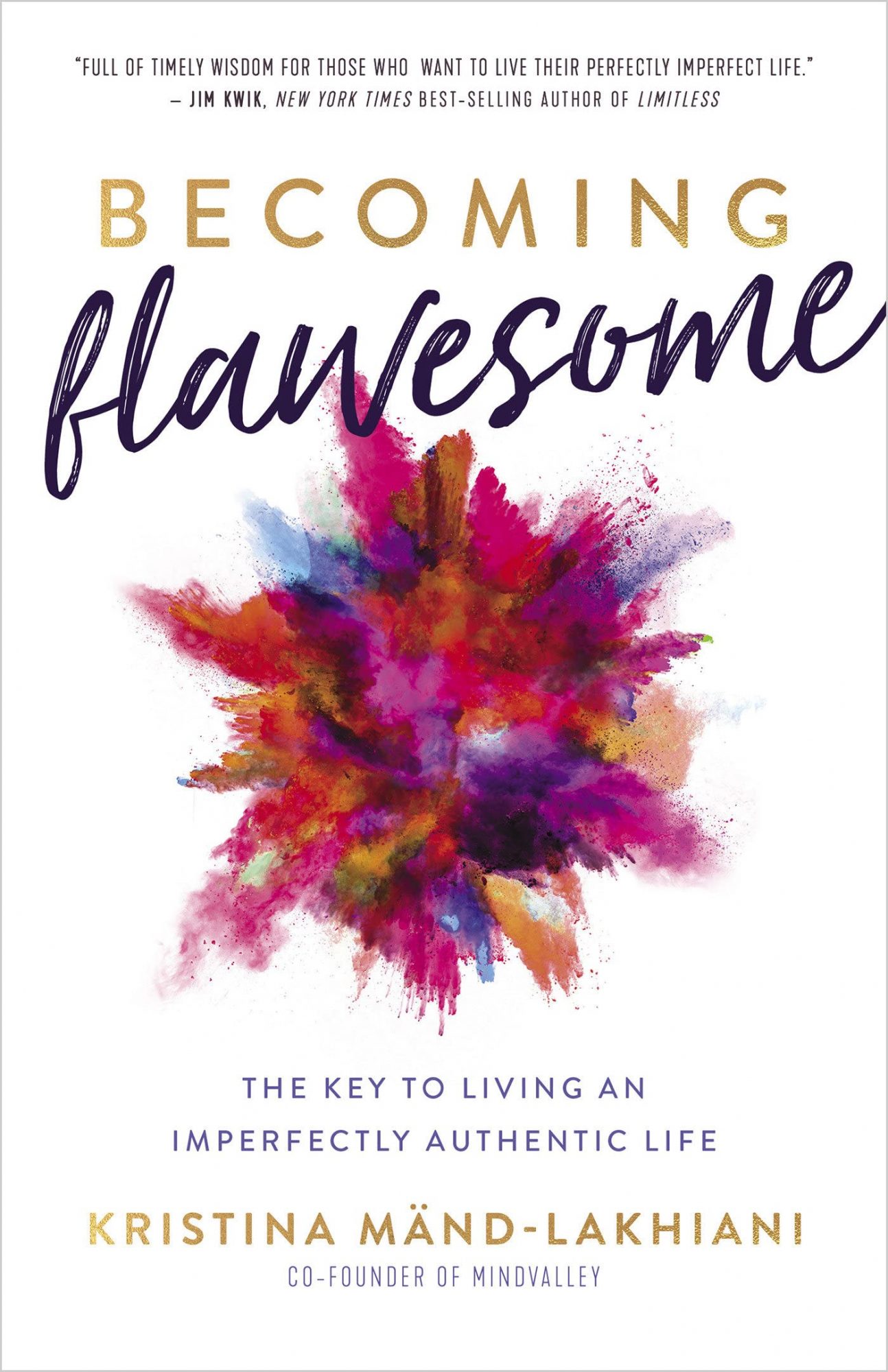
“Becoming Flawesome” by Kristina Mand-Lakhiani is a self-help book that encourages readers to embrace their authentic selves and strive for personal growth. It will help you become “flawesome”—a mash-up of the words “flawed” and “awesome.”
Through insightful teachings and practical advice in her own unique way, Kristina explores various aspects of life, including vulnerability, the illusion of hustling, breaking free from routine, the power of habits, imperfection, our defence mechanisms, honesty, self-care, overcoming fear, and living a fulfilling life.
In this book summary and review, we will delve into the key points and lessons covered in “Becoming Flawesome.”
Finding Your Way Back to YOU: Kristina Mand-Lakhiani emphasizes the importance of reconnecting with our authentic selves and embracing vulnerability. By being true to who we are and embracing our imperfections, we can build stronger relationships, deepen our understanding of ourselves, and foster personal growth.
Hustling vs. Surfing The author challenges the notion of hustling as the only path to success and happiness. Instead, she introduces the concept of “surfing,” which involves finding a state of flow, balance, and ease in our pursuits. By embracing a more mindful and relaxed approach, we can achieve sustainable success and true fulfillment.
Escaping the Rut: Mand-Lakhiani guides readers on how to break free from monotonous routines and escape the autopilot mode. By bringing conscious awareness to our actions and making intentional choices, we can infuse more excitement and purpose into our lives.
Transformation and the Power of Habits Understanding how transformation occurs is a crucial aspect of personal growth. The author explores the role of habits in shaping our lives and provides insights into how we can cultivate positive habits that align with our goals and values. By harnessing the power of habits, we can create lasting change and become the best versions of ourselves.
Embracing Imperfection: In a society obsessed with perfection, Mand-Lakhiani encourages readers to embrace imperfection and let go of unrealistic expectations. By accepting our flaws and focusing on progress rather than perfection, we can cultivate self-compassion, experience personal growth, and lead more fulfilling lives.
Uncovering Personal Defense Mechanisms The book explores the defense mechanisms we employ to protect ourselves from emotional pain and vulnerability. By recognizing and understanding these mechanisms, such as denial, projection, or avoidance, we can develop healthier coping strategies and foster deeper self-awareness.
The author challenges the conventional notion of happiness as a fleeting emotion and presents it as a skill that can be cultivated. This realization opens up a world of possibilities, allowing readers to actively work towards creating a more fulfilling and joyful life.
Honesty and Authenticity: The author emphasizes the importance of being honest with ourselves and others. By shedding the facade of fakeness, we can cultivate genuine relationships, build trust, and create a more fulfilling life based on authenticity.
Kindness, Self-Care, and Self-Love: Mand-Lakhiani highlights the significance of kindness, self-care, and self-love in our personal journeys. By practicing self-compassion, prioritizing self-care, and fostering a positive relationship with ourselves, we can nurture our well-being and develop the resilience needed to navigate life’s challenges.
One of the standout ideas conveyed in the book is the distinction between self-care and self-love. Mand-Lakhiani emphasizes that true self-love goes beyond indulging in treats or pampering ourselves; it involves nurturing our inner selves and cultivating positive self-talk. This fresh perspective encourages readers to develop a deeper understanding of self-love and its transformative power.
Overcoming Fear and Taking a Leap of Faith – The book addresses the paralyzing effects of fear and indecision. Mand-Lakhiani provides insights and strategies to overcome fear, step out of our comfort zones, and take courageous leaps toward our desired goals and aspirations.
Living Flawesomely: The author concludes by emphasizing that no one needs fixing. By embracing our flaws and choosing personal growth, we can live flawesomely—fully embracing who we are while continually striving for improvement. “Becoming Flawesome” serves as a guide to navigate the journey of personal development, self-acceptance, and a more meaningful life.
Kristina Mand-Lakhiani presents a holistic approach to well-being, emphasizing the importance of authenticity, vulnerability, and self-care. Her insights challenge conventional notions of success and highlight the significance of embracing imperfections as catalysts for growth.
Throughout the book, Mand-Lakhiani provides relatable anecdotes and thought-provoking questions that encourage readers to reflect on their own lives and make positive changes. Her writing style is engaging, conversational, and filled with warmth, making the book accessible to readers seeking personal transformation.
One of the book’s strengths lies in its exploration of defense mechanisms and the ways in which they hinder personal growth. By shedding light on these unconscious patterns, the author empowers readers to break free from self-limiting behaviors and foster healthier emotional landscapes.
The concept of “surfing” versus hustling offers a powerful alternative perspective on achieving success. The author convincingly argues that embracing a state of flow and balance allows for greater fulfillment and sustainable growth. This shift in mindset challenges the prevalent culture of burnout and serves as a much-needed reminder to prioritize well-being.
While “Becoming Flawesome” covers a wide range of topics, it remains cohesive and well-structured. Each chapter builds upon the previous one, creating a comprehensive guide to personal development. Each chapter concludes with thought-provoking reflection points that encourage readers to examine their own lives and behaviors.
In conclusion, “Becoming Flawesome” is an insightful and empowering self-help book that challenges societal norms and encourages readers to embrace their authentic selves. Through its exploration of vulnerability, imperfection, and self-care, the book offers a roadmap for personal growth and a more fulfilling life. Kristina Mand-Lakhiani’s warm and relatable writing style makes this book an engaging and valuable resource for anyone seeking to embark on a journey of self-discovery and transformation.
The book feels like an ongoing conversation between the author and the reader, making it accessible and relatable to a wide audience. If you are interested in self-help and advice books, this remarkable book deserves a place on your bookshelf.
Revolutions, throughout history have been the catalysts for change. Every time the world has seen oppression, tyranny, or even unfair rules – social, political or dictatorial – people have come together, started a social movement and fought for real change.
While revolutions have been bloody, devastating and inhumane, there are many examples of non-violent revolutions, such as Gandhi’s non-violent fight for independence from British rule, the overthrowing of Slobodan Milošević’s dictatorship, or even political activist Srdja Popovic’s non-violent strategies, speckled through history that prove that change can be brought about peacefully.
Blueprint for Revolution (2015) by Srdja Popovic and Matthew Miller outlines certain non-violent methods for a successful revolution and change.
Pick A Winning Battle
One of the most effective strategy for a successful battle is to pick small, winnable battles. Moreover, revolutions need a following. In infancy, any revolution is unknown to the public. It, therefore, needs a name before it can build that following.
Blueprint for Revolution by Srdja Popovic – Book Summary & Review
Consider Gandhi’s call for non-violent movement. It began in 1930 as a month-long march to the sea, opposing the salt tax placed by the British Empire in colonial India. Dubbed the Salt March, Gandhi had about 12,000 people joining him towards the end. Caught off-guard, the British had to drop the imposed tax. Gandhi’s non-violent march got his movement momentum and fame. It helped him win bigger revolutions later.
In another example, Harvey Milk was the first openly gay American politician to be elected to public office. While at the outset of his career, he believed that giving inspirational speeches about things that mattered to him would garner followers. However, when this didn’t work as well, he decided to change his strategy. He campaigned about something that the people in San Francisco cared about too – dog poop that desecrated the city’s parks. His campaign was widely successful and in 1977, he got elected to the local government.
Using Inspiring Visions Of The Future
Inspiring people is easier said than done. People need to be able to envision the future they are fighting for.
When communist Yugoslavia fell, Slobodan Milošević, rose to power installing an authoritarian rule in Serbia. Starting a propagandist campaign against all of Serbia’s neighbours, he banned foreign music. Thus the revolution Otpor! was born. It focussed on openness to the world, and the ability to enjoy other cultures as they had earlier. The group helped overthrow Slobodan Milošević in 2000.
Similarly, in the Maldives, a South Asian island, was preparing for its first democratic election after thirty years in 2008. The party opposing the dictatorship of Maumoon Abdul Gayoom was looking for a vision to get voters together.
A member of the party, Imran Zahir, took a trip around the island to get an idea of the vision that would motivate people. He saw that many of the islands were populated with elderly people, who had no jobs and were completely dependent. He realised that they needed financial independence and healthcare. He then mounted a campaign that called for a public welfare system with pensions and healthcare. The opposing party won the election when they presented the public with this vision and a free serving of rice pudding!
Overthrowing Dictatorship
A theory called the ‘pillars of power’ was introduced in 1973 by political science professor Gene Sharp. His theory stated that every regime stands firm due to a handful of supports called the ‘pillars of power’, and if even one of them has sufficient pressure applied to it, the regime will topple.
This theory can be applied to any institution. For example, a small African tribal village could consider the tribal elders as the pillars of power. Political parties will have favoured leaders or friendly news sources, whereas corporations would stand firm supported by the power of shareholders, or the media that influence stock pricing via reporting.
Dictatorships however are different. Dictatorships have a single important pillar of power – the economy. Finance is needed by the dictator for everything ranging from spreading propaganda to creating armies. If the source of finance is cut off, a dictator is unable to defend the regime and thus vulnerable.
Any movement that wishes to overthrow a dictator should hence, look for the dictator’s financial support and neutralize it. For instance, Syria’s Bashar al-Assad leaned on foreign investments for money. If these foreign firms were to close operations in the country, Assad’s regime would be vulnerable.
In fact, a few nonviolent activist groups did try to expose these businesses and their ties with the regime, hoping that the negative press would affect their profits and the firms would consider stopping their business in Syria. However, the effort was thwarted by the civil war that broke out.
The Power Of Humour
Humour and comedy are powerful tools that activists can help build resistance. When cleverly deployed, humour can counteract the fear of the people by ridiculing the regime.
The Otpor! Activists pulled a famous stunt by painting Milošević’s face on an oil barrel and a baseball bat in the middle of the street with “Smash his face for a dinar” written on a display beside it. As people lined up to take a swing, the police arrived.
Though the members of the group had vanished, the police had 2 choices – arrest the public waiting to take a swing at the barrel, or arrest the barrel itself! Funnily enough, they chose the latter and the very next day, Belgrade had pictures of 2 policemen arresting an oil barrel plastered around every street. They took the fear right out of Milošević’s policemen.
Humour works well as it is difficult for a regime to respond to it.
In October 1987, the Polish opposition group Solidarity decided to join the celebrations the communist Polish government had planned to celebrate the 70th anniversary of the Russian Revolution. Solidarity decided to hold a rally by displaying their ‘love’ of communism. People adorning red clothes appeared on streets with banners painted with bombastic communist language.
While the authorities were upset, they couldn’t arrest people for celebrating communism.
Why Oppressive Measures Backfire
History has shown that when authoritarian regimes force subjects to comply by intimidation, punishments, or shows of brute force, it can backfire.
The Saffron Revolution in Burma started after the Burmese military regime committed a brutal act of repression against 400 Burmese monks on 19th September 2007. Considered the highest moral authority in the country, no one thought that the army would open fire at them. They killed a dozen monks, and arrested and sentenced countless others in court.
Though the Burmese military was known for their violence, this act crossed the line. The people of the country then started the Saffron Revolution in protest. This protest too, was violently suppressed, but it did pave the way for open elections 8 years later.
Similarly, when Milošević was at his peak, a small Serbian town called Subotica was ruled by a sadistic officer called Ivan. Ivan was huge, built like a wrestler, and was famous for beating any Otpor! member he found. One day, the activists put up posters of Ivan all around the town which read, “This man is a bully! Call this man and ask him why he is beating our kids.” The outcome?
The people in town, including Ivan’s closest, started avoiding Ivan, his wife and his children. They were essentially outcasted by the people of the town. Eventually, the beatings stopped, and Ivan’s terrorizing was thwarted by a few homemade posters.
The Effectiveness Of Non-violent Movements
Revolutions, by virtue of history, bring up images of bloodbaths and violence. However, history also shows that non-violent revolutions are far more effective than violent ones at eliciting positive change.
A 2011 study by Erica Chenoweth and Maria J. Stephan, considered 323 revolutions between 1900 and 2006. The study showed that non-violent revolutions during these years had double the chances of success than violent ones. Moreover, not only were peaceful revolutions more likely to bring about the creation of vibrant democracies, they had a 40% higher chance that the democracies would prevail five years after the peaceful resistance.
The statistics dropped to just 5% for violent revolutions.
Non-violent revolutions are open to all, men, women, children and the elderly, while in violent revolutions only healthy, strong and fit people can participate. Furthermore, non-violence is more desirable as it inspires action amongst the people, whereas violence, armed rebels and thugs hardly evoke feelings of trust. People are also more likely to join ordinary people fighting for their rights peacefully, than an armed militant group.
Conclusion
Non-violent revolutions derive strong power from mass support, far more than violent revolutions do. In order to bring about a real positive change in the world, one can protest without violence. All one needs is creativity, a compelling vision of the future, and peaceful means that will appeal to the masses.
In the age of the Internet, delivering a great customer experience online is of prime importance. Without a well-designed website, achieving a good customer experience is impossible.
If one perceives the online world as an unfamiliar department store, without a clear and concise map to guide one through the store, one would essentially be lost! Moreover, not finding what one needs fast enough can make a customer even leave the store without a purchase.
A website works in a similar manner. A well-designed website enables a user to view or surf with ease, finding what the user needs, and perhaps if the website is interesting enough even browsing and exploring it further. A well-designed website is, in fact, a necessity for successful online sales. If a website is cluttered, poorly organized, or not user-friendly, losing a customer is as fast as a click of a button.
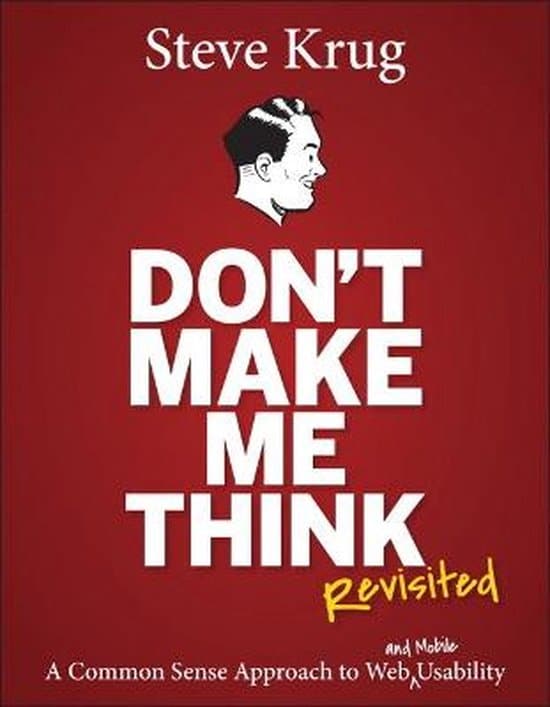
Don’t Make Me Think, Revisited (2014) by Steve Krug is a guide that explores user behaviour online, charts out basic principles of how a website can be well-designed to deliver a great experience, and also has a guide that shows how a website can be tested at each stage.
Default Internet Behaviour
Truthfully, a person who actually reads the user manual before using a gadget is a rare species! The majority simply open the packaging, starts figuring out the working of the gadget themselves, and go with what works best for them. The user manual is mostly, packed back in the box, or simply thrown away!
Similarly, the majority have no inkling of the mechanics of the Internet, yet, they have no problem navigating the online world. Most people search for a website URL directly, rather than use the browser’s URL bar. Such a strategy of common decision-making is called satisficing, a more typical approach, rather than rationally searching for information, identifying a solution, comparing and then choosing.
Don’t Make Me Think by Steve Krug – Book Summary & Review
Furthermore, if a web surfer simply clicks the back button if they click on an incorrect link by mistake. It’s not only easier but also more fun, to figure out things independently.
These ‘default’ internet behaviours have trained users to look for the first, fastest and simplest solution that catches their attention. And when they succeed they feel confident, comfortable and smart.
Catching A User’s Attention
People surf websites with a mission in mind. They look for the things they need and want to get done with it as soon as possible. Almost everyone skips the promotional corporate jargon on websites. No one wants to waste time on long texts. While online, people scan rather than read.
Hence, the ability to catch the attention of the user if the primary focus of a website. The key elements of good website content are headlines, short paragraphs and highlighted keywords. Moreover, in order to enable users to decide which areas to focus on, these elements should be organised using a visual hierarchy. According to eye-tracking studies, people make quick decisions choosing where to look and ignoring irrelevant information such as advertising blocks.
The same principle is used by newspapers. Headlines, text and images are placed carefully to enable the reader to look first at what is most important. Websites too should make the important obvious so that users can immediately find and click on them.
Keeping in mind default internet behaviour where users don’t mind clicking as long as the process is mindless and gets them a clear result, websites should have pathways that are easy to navigate and understand. Most importantly, websites should avoid annoying practices like hiding important information behind multiple clicks – such as shipping costs.
Building a website isn’t like making a product brochure to attract an interested user, as believed. It is more like making a billboard to catch the attention of cars zooming past at 60 miles an hour!
Consistent, Clear And Simple Navigation
Easy navigation lies at the core of creating a successful website. Unlike unfamiliar stores, users cannot stroll down aisles in search of what they need. Online, if people don’t find what they want, leaving the website is just a click away.
Scaling a website is another challenge. A user cannot ascertain the number of pages a website has, and hence it is vital that a website design is easily navigable. Ideally, every page of a website should include a ‘sections’ bar that clearly indicates what the website contains. Additionally, to make it easier for a user to move around, every page should have at least 4 additional navigation items. These include –
Search Bar – A search bar helps a user to quickly search the website for what they are looking for, without understanding its organization of it.
A ‘You are here’ Indicator – This small indicator, like the red dot in shopping malls helps a user understand how to navigate easily.
Link The Company Logo – Linking the company logo to the home page and making it available on each webpage enables users to ‘jump’ home faster.
Utilities – A utility section contains vital titbits that help one to easily use the website. This component includes a log-in space, a site map, an FAQ section, etc.
These navigational elements make it more comfortable to use the website effectively. A feeling of comfort, furthermore, builds trust.
Understanding Website Navigational Conventions
In addition to having easily accessible navigational components, these components should be self-evident. Thus to design a website that enables this, one should have an understanding of conventions.
While online, anything different from the usual, conventional style and design can be annoying. People have certain expectations when they visit a website. For instance, horizontally placed words along the top of a webpage commonly represent the main sections of the page.
It is often seen that web designers, in the pursuit of innovation, try to abandon conventions. They forget that conventions represent the best and most effective practices developed after years of fine-tuning. For example, internet users are familiar with the concept of tabs and immediately know how to use and navigate them. Hence, tab dividers are great navigational tools.
That said, innovation is important too, and creativity surely has its positives. Designers have to, however, simply keep in mind to make the innovation easily usable and prioritize user experience. In website designing, conventions, clarity, and consistency are best friends.
The First Impression – The Home Page
Most often, a link from Facebook or Twitter leads a user right in the middle of a website. It is commonly observed that users next click on the homepage button to ascertain where they have landed, or whether the content on the website is trustworthy or not. The home page is the first impression of a company, and hence a crucial component.
Since it is known that items linked from the home page of a website get more clicks, every stakeholder will have an opinion and an idea as to what should be included in it. Nodding to every opinion could lead to a cluttered home page.
The first priority of a home page is to create an accurate first impression. According to a web design study, the first impression of a website sticks with a user even after the user has navigated through other pages of the website.
This happens because when one encounters something new, one’s imagination goes into overdrive, creating a picture in the user’s mind about how this new thing works and trying to fit the new information into one’s preconceived notions. Hence if a home page is confusing, a user could misinterpret information, leading to more confusion and thus, disinterest.
In order to avoid confusion, a tagline or a short sentence that clearly communicates the goal of the website, placed near the logo is effective. This tagline should be personable and lively and convey the value of the site. For example, the news site The Daily Beast uses the tagline “Read this, skip that”.
Test, Test, Test Again
How does one test if a website fulfils the goals of easy comprehension and navigation?
Commonly, people turn to relatives and friends, or their own judgement to assess the objectives. However, while objectivity will be impossible with one’s own judgements as the features and usability will be obvious, friends and relatives tend to have wildly subjective opinions. Developers tend to prefer innovative features and designers like websites that offer a pleasant visual experience with subtle touches and lots of white space. And both assume that the world shares their views.
The truth is that almost everyone is like that. Most think that their opinions are correct, and there are very few people who view things from others’ points of view! Unfortunately, there are no ‘wrongs’ or ‘rights’ in website designing, and getting the opinions of a select few never helps.
The only thing that does work is testing – again and again. The best way to understand if a website is working as intended is to watch people use it and try to navigate it. With testing, the connotations of ‘right’ or ‘wrong’ are taken away and the focus moves to what works and what doesn’t. it additionally, shows and proves that every web user is different.
Getting Testers
Testing websites, however necessary, isn’t an exciting task for most people or developers – unless they are going to get paid for their time. Moreover, one needn’t be too restrictive in terms of the background of testers, as a website should be easily understandable and navigable for everyone.
Once a group of testers is selected, the facilitator should observe the group while they use the website and take notes. A facilitator’s goal is to keep the user group comfortable and focused.
Starting with the home page, a facilitator should get the testers to talk about what is visible by asking questions such as, ‘What are looking at?’ and ‘What do you think?’ These questions help to understand whether the tester is getting the main idea of the website or not. However, a facilitator should avoid influencing testers. If any tester asks for help, the facilitator can ask, ‘What would you do if you were alone?’
Facilitators have to get the test subjects to try every feature of the website – right from creating an account to logging in or buying or returning an item. If a test subject fails at any given task, the facilitator should observe the subject trying to resolve the issue, and let the subject keep clicking around till the subject either gets frustrated and gives up, or the facilitator cannot learn anything more.
Getting team members, managers, or even other stakeholders to observe the testing study is important, as they too will be able to understand the point of testing. Often when executives watch a tester fail, they understand the importance of usability.
The Pros Of Testing
Many believe that testing websites is time-consuming, expensive and requires expertise. However, testing simply enables one to understand whether a website works or not, is easily navigable or not and informs one’s decision-making.
Keeping that in mind, one needs to only test up to 3 regular web users, and have team members observe, and take notes on what problems the users face. According to the author, testing generally brings up more problems than what can be reasonably resolved, and hence, prioritizing between issues is important. Issues that a tester can quickly fix are not a priority.
Starting the testing process earlier in the web designing process is more effective, as the earlier problems are identified, the easier they are to change and implement. A beta site is far more easily adjustable than a live one.
Furthermore, one can even begin testing before a website is developed – by watching a testing group navigate a competitor’s site. The insights from competitor testing help while developing one’s own website, help with decision-making and save time and resources too.
Developing For The Smartphone
Apple revolutionized mobile web browsing. With practically everyone accessing websites on the smartphone platform, the downloadability of a website on the platform is important.
Today, users on smartphones read less and move faster. They are more likely to give up and exit a website if they encounter a hiccup. Hence a website has to load faster on a smartphone and be adjusted to be readable on smaller screens. Smaller screens translate to lesser space, which translates to more compromises. Hence a website should ensure that in-demand spaces are easily found. While information can require more taps, navigating to get to it should be easy.
Furthermore, users on smartphones should be able to access a website’s full menu of features. There’s no telling whether the user is surfing on the go, or is on the couch looking for information! This indicates that websites should have zoomability features, as well as a link to access the complete website.
Considering mobile computing is touted as the future, creating an amazing user experience is of the essence and is key!
Conclusion
The usability of a website is its most important feature. It puts a user front and centre, making it easy for users to find the information they are looking for. Navigability and simplicity are vital, whether the platform used is a smartphone or a laptop.
Most importantly, in order to ensure that a website is delivering a great user experience, testing it at every step is most important!
People find themselves stuck in a rut, unable to realise ideas into a finished product, or even dreams into a reality, more often than they like. When the flow of creativity or ideas, feels jammed, it is very difficult to get out of it. Many feel like they are unable to accomplish or realize their goals and tend to either give up or settle for less.
What stops people from achieving their goals? And how does one get out of inaction and realise goals and ambitions?
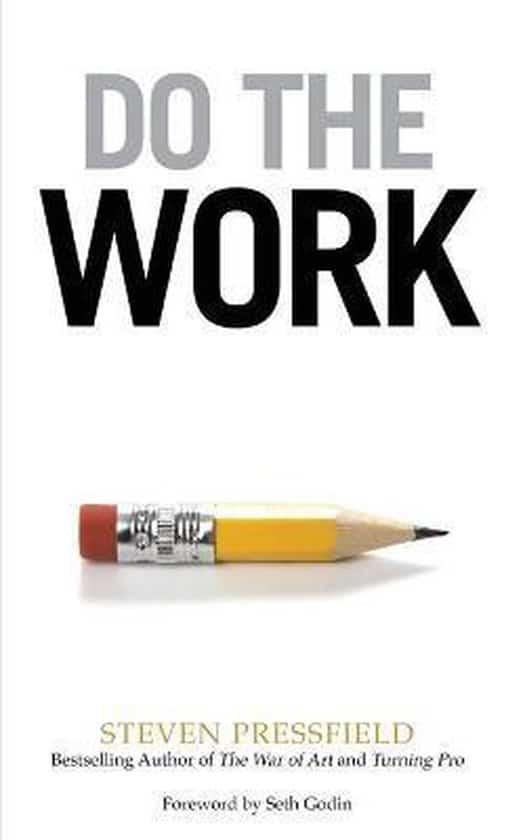
It is an inner negative force called resistance that causes people to get stuck in a rut. Steven Pressfield’s Do The Work (2011), explains how resistance is a thwarting force that stops one from the action. It helps identify causes, helps one conquer fears, stops procrastinating, and learns how resistance is one’s worst enemy. It delves into techniques that can help one to get back on track and finally move forward toward success.
Identifying Allies And Enemies
In life, there are things that can help one achieve a set goal and things that get in the way of achieving them. These are one’s allies and enemies. While self-awareness and ambition are one’s key allies, resistance is an enemy that constantly poses a threat to achieving goals.
Do The Work by Steven Pressfield – Book Summary & Review
Resistance, an internal negative force, manifests itself in different ways. For example, the self-doubt a person feels while trying to work on something meaningful, any activity that requires a lot of energy or takes time, can draw resistance too. In fact, the more important an activity is, the more one has to fight the resistance to achieve it.
When it comes to one’s allies, passion, dedication, and confidence are all positive allies that can strengthen one’s resolve to achieve a goal. However, there are certain negative traits like stubbornness, arrogance, ignorance, etc. that can end up being allies too. Stubbornness, though a negative trait can help keep one dedicated to work.
For instance, Charles Lindberg, the American aviator was ignorant about the difficulties of flying for 33 straight hours. However, his arrogance and stubbornness led him to believe that he could. He succeeded and accomplished great feats. Lindberg is in fact, the first man in history to be in New York one day and in Paris the next!
Apple’s Steve Jobs was known for his stubbornness. It led him to guide the company to become the world’s most successful technology company.
Creating Structures and Productive schedules
At times, rather than inaction, it is excessive preparation and overthinking that is counterproductive to getting things done. One has to be able to resist them.
Work is like meditating. One has to concentrate and focus and get into a mental state of being able to objectively assess one’s own feelings and thoughts. When self-doubt creeps in, one has to ignore it. Such thinking is a form of resistance and one should act on it first rather than waste time thinking and reflecting on it, or feelings of doubt.
For example, for a writer, action equals putting words down on paper, whereas reflection, is the evaluation of what was written the next day. Trying to write and reflect at the same time, will end in contradiction, and a waste of time.
One has to create structures and production schedules for oneself. The three-act structure is one of the useful structures that one can apply. In this, an idea is divided into three parts – the beginning, the middle, and the end.
For instance, if this structure were to be applied to the creation of Facebook, its beginning would be where Facebook as a digital meeting space wherein anyone could create their own page. The middle would refer to the creation of an interconnected web of contacts, where each could choose who is allowed access. The third part, the end, is a worldwide community of friends, where people can share and communicate whatever they want.
Confronting The Enemies Within
Creative blocks can lead to a loss of confidence. However, it is important to remember that these blocks can be overcome by recognizing the fact that there is an enemy working against the realization of dreams and goals.
This enemy lies inside one’s own head. It has to be defeated by oneself, and blaming external factors is futile. Additionally, one also has to recognize that this enemy, though inside oneself, isn’t the person itself. It is just internal resistance that is blocking the creativity inside, and there is no one to blame. Once a person understands this, fighting the enemy becomes possible.
When one encounters resistance, one has to answer two questions. These questions have only one answer, which will help one proceed in pursuing one’s goal. The questions are –
How badly do I want this?
The only answer to this question is, ‘Badly enough to be totally committed.” If one gets any other answer, such as I want this badly for the money, for fame, for power, etc., one will not succeed. Why? Because one needs to be totally committed to be able to push oneself to achieve a goal – no matter what!
Why do I want this?
The answer to this question should be, ‘Because I have no choice.’ It doesn’t matter whether one wants to achieve a goal for the fun of it, or because of its beauty of it. But because only having no choice will bring profound dedication and determination to achieve a goal.
Overcoming The Big Crash
A Big Crash is a major obstacle in the path of achieving a goal that one encounters. Everyone faces it at some point in their careers. Crashes are demanding and difficult to overcome. However, one has to keep in mind that these ‘Big Crashes’ too, are just another problem that one can overcome.
Big Crashes can also be beneficial. They can force one to work hard to figure out what in their plan or project isn’t working. The author, after he had finished writing his book, The Profession, which had taken him two years, experienced a Big Crash. His friends who read the book hated it. It took him another year of hard work, and long conversations with colleagues, to improve it.
People often experience crashes after reaching higher levels of work, often when they are close to crossing thresholds. However, it is imperative to keep in mind that every attempt to move ahead will bring courage to go on and persevere. In fact, even fearing advances and success can be a resistance. Fear is at the very core of resistance.
Resistance is, at its strongest when one is close to the finish line. However, when one does overcome resistance, and as one tastes the success of overcoming more resistance in life, overcoming resistance gets easier. After all, what doesn’t kill, makes one stronger!
Conclusion
People often face resistance in the final lap of achieving a goal. They tend to overthink their success or lack of it and fall prey to inner resistance.
One can overcome these inner resistances by identifying allies and enemies, creating structures and schedules, confronting inner enemies, and learning that big crashes can be overcome.
Any work that needs to be done requires the use of certain tools. For example, to write, one needs a pen, to fix a broken cup, one can use superglue, etc. Similarly, for decision-making, one needs to be equipped with the right tools. These tools are mental devices that one can use to make good decisions. While certain knowledge, ideas, and techniques can be used, one has to be able to understand which mental models can assure one of success.
These mental models help in upgrading one’s ability to think and handle the challenges that are thrown along the path of life. Humans have a whole toolbox of such mental models. The Great Mental Models (2019) by Shane Parrish and Rhiannon Beaubien, draws on a number of disciplines and gives the nine mental models that can boost one’s decision-making and thinking capacity.
The Map
Mental models can be considered like maps that help one navigate reality. While maps are navigational aids, they generally help one understand the benefits, basic features and limitations of mental models.
Maps represent the reality of the world around us in a more simplified manner. For example, the map of a city lines out its overall layout. Simple lines and squares representing roads, buildings, parks etc., are enough without having to include every detail. This simple representation is enough to get a person from point A to point B in the city.
In other words, maps are a simplified representation of the complex reality that surrounds us.
While a simple representation is enough, at times, one needs to include certain vital details in a map. For example, when a GPS device leads one to a closed road, one realises the importance of having an updated map. These details are equally vital to metaphorical maps that one uses. Instruction manuals, financial statements, and policy papers, all are simplified representations of reality.
These simplifications are meant to guide people through the complex world. Mental models need to be designed in the same way. They have to include the right details, leave out the clutter and need to be updated as well, as the world, and ones thinking changes.
The Circle of Competence
To navigate the complex world, one needs to use metaphorical maps. Let’s consider that that all the knowledge humans have about the world around them is a vast landscape, and one would need a map to navigate through it. Thus for cooking, one would need a cookbook, to manage and invest in a stick, one would need an investment manual, etc.
Great Mental Models by Shane Parrish and Rhiannon Beaubien – Book Summary and Review
While one would need a map for navigating some places in the metaphorical landscape, some places would be so familiar, that a map would be unnecessary. These places (or actions) would be the skills that have been mastered throughout one’s life. These familiar, mastered places fall within one’s circle of competence.
One can move with confidence within this circle of competence. One knows what to expect and can easily navigate through any challenges one faces. However, outside this circle of competence, one feels baffled. For example, a plumber can easily understand whether the problem lies with the faucet, the pipe, or the drainage system. Whereas, the plumber will find it difficult to work out whether the problem is in the engine of the car, or the automation system, as the work of a mechanic lies outside his circle of competence.
Everyone has an area of ignorance, and not everything is known to one person. Hence, it is vital that one has an idea as to where one’s circle of competence begins and ends. One simply has to be honest about one’s limitations in order to be able to focus on one’s strengths, and know when to seek help with areas in one is weak.
For example, if one wants to better finances, and is weak at numbers, hiring a personal financial consultant, or even reading up a bit on the subject could help one navigate around the basics. In this manner, even if one is outside one’s circle of competence, one won’t feel completely disoriented.
That said, it is essential that one understands when one is outside one’s circle of competence. It is unfortunate that human egos tend to make humans believe that one’s circle of competence is wider than it actually is. Due to this misguided perception, many tend to venture out of their comfort zones with confidence, totally clueless that they are out of depth. A stark reminder of this is the 200 or so frozen bodies that are dotting the landscape of Mount Everest! Each of those who perished probably felt confident about their abilities to conquer the mountain.
Creativity, And Reasoning From First Principles
There is more to success than just focusing on one’s circle of competence. In order to succeed, one also needs to be creative. Thinking out of the box is but an important cliché. Without it, one cannot break away from the common and will end up doing the same thing that everyone does. And this includes the mistakes!
One has to begin with digging deep and creatively reason from the first principles.
The first principles are the foundational facts that are the base of the knowledge of any field. For example, understanding the laws of thermodynamics is the first principle for an engineer who wants to build a refrigerator.
The first principles of any field can also be found in less obvious domains, which often lead to creative solutions. For example, a scientist trying to solve the environmental impact of livestock farming and overconsumption of meat will try to first go back to thinking about how can the consequences can be mitigated.
On the other hand, the scientist could also approach the matter differently, by asking, “What are the first principles of meat consumption?”
The scientists of the 1970s started with this very question. They learned that for consumers, it is the smell and the taste that matter more than whether the meat comes from an animal or not. They learned that these aspects of the meat depend on reactions and chemical properties that take place between the amino acids and sugars when meat is cooked. Thus they started experimenting with ways of creating artificial meat grown in labs, that not only replicate the smell and taste but also do away with the need to kill animals.
This realization has led to over 30 labs across the world that are developing artificial meat presently.
Approaching any problem by understanding the first principles – essentially, starting with the underlying cause, rather than trying to solve its effects – helps in preventing it from becoming a problem in the first place, creatively.
Practising Inversion
In the 1920s, Edward Bernays, an Austrian-American PR and propaganda pioneer, was faced with a question. How to sell more Lucky Strike cigarettes to women in an age where most smokers were men. Bernays used an effective mental model called inversion that involved approaching a problem by turning it upside-down.
In an inversion, the first trick is to assume that something is true, and then work backwards to prove what else could have to be true to arrive at the same truth. Bernays started by thinking, ‘Assuming women smoke as much as men, what else would have to be true?’
He arrived at the conclusion that women would need to feel that smoking was socially desirable and acceptable, and hence would be needed to link with other things that were socially desirable and acceptable. Bernays then advertised Lucky Strike cigarettes as an ‘after-dinner treat’ that would replace desserts – an elegant manner of keeping a slim figure. He further portrayed smoking as a way for women to show independence (as the women’s rights movement was on the march) and marketed cigarettes as ‘torches of freedom’.
The second trick in inversion is to assume the opposite of what one wants to achieve, and then see what needs to be proved true for the case to happen. For example, if one wants to get rich, one has to assume one is poor and then think backwards as to what actions lead to poverty. Thus, if one thinks that spending more than what one earns or taking high-interest loans will lead to poverty, these, and all other behaviours that one list could be avoided to get rich.
Thought Experiments
With all the creative ideas that one can conjure by using the aforementioned techniques, one has to have a clear idea of how these should be carried out in reality. In order to do this, one should first simulate them in one’s mind.
Simulating these experiments in one’s thoughts has a clear advantage over trying them out first. For starters, one can imagine taking risks without actually bearing the consequences. Moreover, these experiments can be conducted in one’s mind over and over again – without wasting time or resources. This enables one to think of the impossible or even the impractical!
For example, Einstein actually came up with the general theory of relativity using thought experiments. He thought if a person was put in an elevator with their feet glued to the floor, and the elevator was transported into space and pulled upwards at an accelerating rate, would the person be able to notice it, or would the person feel like being pulled by the gravitational force of the Earth? This thought, as absurd it may sound, helped him work out his ideas about gravity.
Similarly, thought experiments enable one to think of impossible ideas, and at the same time clarify ones thinking. Moreover, they help one understand the value of things.
Second Order-Thinking
Consider a person who has won a lottery. Let’s say this person thinks of using that money to buy a house. He next thinks of the consequences of buying the house. He might either need to spend more time cleaning., or hire house help.
Whatever, the person thinks, the person has gone from thinking about the consequence of winning the lottery, to thinking about the consequences (more cleaning time or hiring house help) of the consequence (winning the lottery). This is known as second order-thinking.
In second order-thinking, one looks at a problem by considering its absence. Now in livestock farming, , when dairy farmers first started using antibiotics, they focussed on the first-order consequences – which were better milk production and stronger cattle. However, as they eyed bigger profits, the second-order consequences started to show effect. Some bacteria resisted the antibiotics, and these drug-resistant bacteria entered the human food chain.
Though unintentional, had the farmers considered the potential second-order consequences, things would be different. Hence in decision-making, thinking about second-order consequences is vital, as they could have negative outcomes, and reassessment will be essential.
However, second-order consequences can also be positive, enabling one to use them to bolster arguments in favour of any decision. To make good decisions, one often needs to rope in other people, for example, to get a partner convinced to try a new parenting technique.
Mary Wollstonecraft, philosopher and the author of A Vindication of the Rights of Woman, argued in her book that giving women equal rights as men is not only morally correct but will also be beneficial for society later. She essentially used the positive second-order consequences to plead her case in the book.
Probabilistic Thinking
While weighing the pros and cons of the second-order consequences, one has to be careful to overthink or overreact by drawing extreme conclusions, or excessively guarding oneself against them. One can get paralysed with indecision.
For example, an overreaction to thinking about the second-order consequences of having a drink would be to think of alcoholism and advocate for prohibition. If one has to be rational while decision-making, one can use probability or probabilistic thinking.
To get better at probabilistic thinking, one can use the Bayesian updating approach. In this approach, one thinks that they have all the information about the world. Though it is limited, it could also be useful, and one should make the most of that information one has. Hence when one gets access to any new information, one has to comparatively assess it with the prior information before reaching a conclusion.
For example, a person sees a report in the newspaper, “Violent crimes are skyrocketing.” Rather than panic and vow to never go outside, if the person is a Bayesian thinker, the person will start tabulating the previous crime rate and compare it with the doubled rate of crime. So if the crime rate – which was declining in the past decade – was at 0.1%, at a doubled rate, it would be 0.2%. that would indicate that 2 out of every 10000 people would be probable victims of violent crime. The person would have a very slim chance of being a victim.
That said, one cannot dismiss the new information altogether. Change is a constant and one needs to keep updating oneself from time to time.
Thus, the word ‘skyrocketing’ should only diminish the person’s belief that the crime rate is low by little. It actually tells the person that the crime rate is only slightly higher than what the person earlier believed and that one has to only slightly adjust one’s belief.
Now in case, the person continues to see news reports that tell of increasing crime rates, the person will have to replace his belief about the crime rate being low altogether. The person should then, based on the new information, exercise caution while venturing outside.
Occam’s Razor
Consider a person waking up feeling sick. The person does a quick google search of the symptoms experienced and gets 2 results – flu or Ebola. Which result should the person believe? The answer is important, as it could be the difference between popping paracetamol and heading back to bed, or going into quarantine!
Such scenarios are different from probabilistic thinking where one has to weigh only one piece of information. Here, one has to decide between 2 explanations for the evidence in hand. In such scenarios, one can use Occam’s razor.
Occam’s razor tool, when given two explanations that equally account for the facts in hand, considers the simpler explanation to be true. The tool’s basic idea is that the explanation that is more complicated, has more variables attached for it to be true. With each additional variable, the explanation seems more unlikely to be true.
For example, if a friend hasn’t shown up at the time that was decided, one has two explanations – either the friend is running late, or has gotten into an accident. With the second explanation, many variables such as – did the friend leave his house, was driving, did the friend caused the accident or another driver, etc. – have to be accounted for it to be true. The first explanation that the friend is running late, is simpler and hence more likely to be true.
However, one cannot completely dismiss the second explanation as impossible. It is just the case that simpler explanations are true more often than complicated ones.
Hanlon’s Razor
While Occam’s razor is a great tool for decisions that have competing explanations, human behaviour is varied, needing another tool.
Hanlon’s razor, similar to Occam’s razor, believes that keeping all things equal, the simpler explanation is true, and thus the safer bet. However, it adds a small twist. It states that acts of wrongdoings or decisions are more an outcome of stupidity and mistakes than malicious intent.
For example, let’s consider a person driving a car gets speedily cut off by another person. Before the person actually speeds up to follow the other car and take revenge, the person should consider what could be the reason for the behaviour of the other driver.
There could be 2 explanations. Either the person acted in malice and had some evil intention, or it was just a stupid mistake.
With the first explanation, the other driver’s act would have to fulfil a host of conditions for it to be true. The person would have had to follow the car, had a desire to cut off, conjured up a plan to act on that desire, and then manoeuvres his own car dangerously to fulfil it. The second explanation is simpler to believe.
Mistakes are a lot easier to make and more common than detailed planning for intentional acts of wrongdoing. While people can be evil on purpose, thinking of it as a mistake, is simply a healthy way of remembering that wrongdoers are exceptions in a world of people who make mistakes. One shouldn’t jump to conclusions and assume the worst of others.
Conclusion
Mental models can be used to navigate the complicated reality that surrounds us. Every model, with its specific uses, limitations and strengths, can be applied to decision-making to sharpen ones thinking, develop knowledge, and have a better understanding of the world around, and in turn, enable people to make better decisions to succeed in life.
No matter what field of work, or which role in which company, everyone needs to work in teams at some point or another. Every company, club or even theatre group vies for a dream team. After all, there’s much to be appreciated in having a strong team of individuals. Everyone benefits from success.
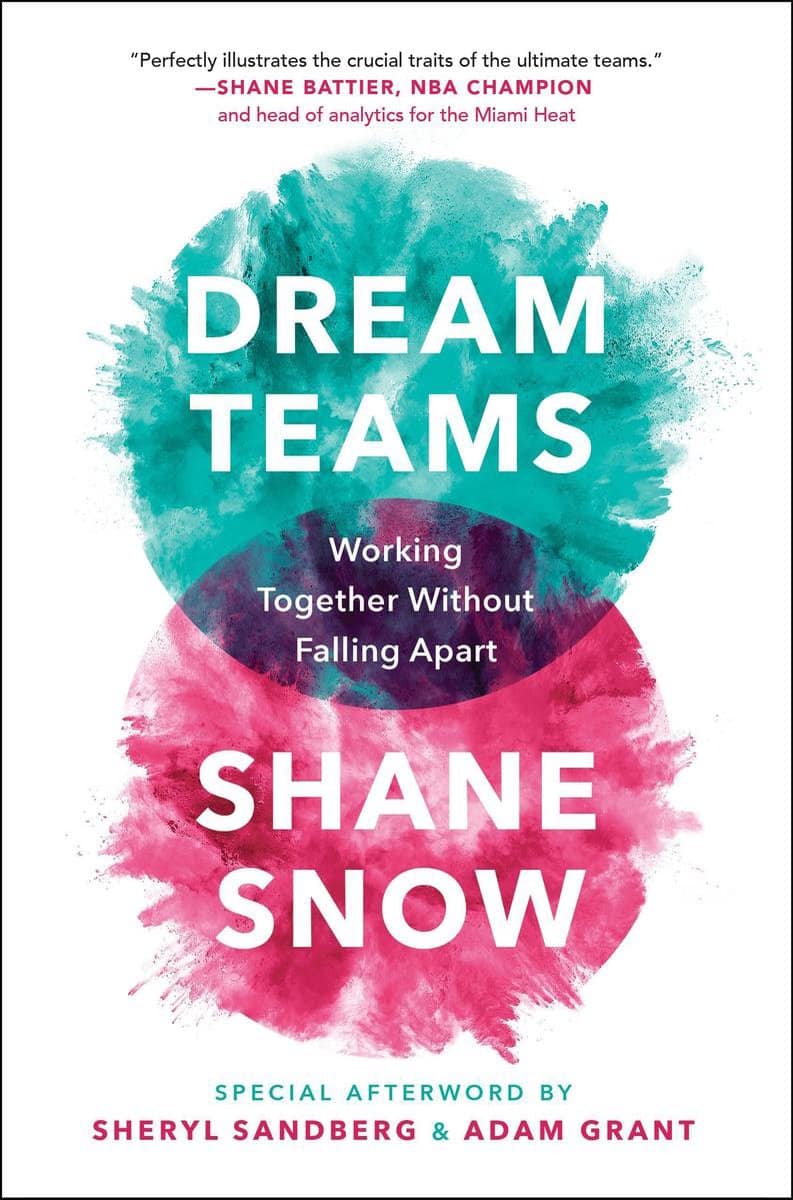
Shane Snow’s Dream Teams (2018), shows the science behind dream teams by highlighting examples from different industries and different times. He scrutinizes the strategies employed by many great teams in succeeding time and again. He charts the elements that make a dream team and how simple strategies and rules can be applied in creating one’s own dream team.
Diversity
In any team, diversity is a crucial element. It not only helps a team think in creative ways but also increases the chances of finding the right solutions.
Let’s look at a case in 1974, when the FBI was trying its best to subpoena a Newark, New Jersey based Mafia boss. The law then was clear. It was necessary for a person to obey a subpoena and appear in court only if it was delivered personally and directly to the person.
The Mafia boss, knowing this had surrounded himself with bodyguards to avoid the same, and not one FBI agent was able to come close to him to personally deliver the subpoena. Chris Jung, a young female agent came up with a plan. She went undercover to the mafia Boss’s daughter’s wedding and delivered the subpoena to the boss directly as he was welcoming guests.
Jung was successful because, in a male-dominated profession, she was a woman. No one suspected her. She proved to the agency that brawn and strength weren’t needed all the time and that successes could be won with clever manoeuvring, intrigue and disguise as well.
Diversity, racial, gender-based, or otherwise adds different perspectives to a team. The different lived experiences of different people add to the way they see, think and solve problems. Diversity helps in challenging people in a team to re-evaluate entrenched prejudices and perspectives.
Furthermore, diversity leads to decisions that are strength-tested for success. In 2013, four different universities in the US invited about 200, self-identified as Republicans or Democrats, people to participate in a murder mystery scenario.
Though the scene itself didn’t wasn’t politically oriented, the participants were told that they would be explaining the solution of the mystery to people of opposing party allegiances. The participants were then better prepared with stronger arguments, proving the benefits of diversity.
A Little Bit Of Tension
Conflict is a sign of preparedness to find solutions, whereas silence leaves issues unresolved. This is evident when one observes that couples who argue all the time, tend to stay together for longer. In fact, the researchers at the Gottman Institute show that when it comes to relationships, couples that stop talking to each other indicate long-term relationship issues, more than frequent arguments.
Dream Teams by Shane Snow – Book Summary and Review
The same is true of teams in organizations. Organizational silence is a clear indicator of problems down the line.
Detroit-based Chrysler and the German car manufacturer Daimler decided to merge in 1988, however, the venture was a massive failure only 3 years into the merger. DaimlerChrysler was worth only half of what the company was at the time of the merger.
What caused the problem?
DaimlerChrysler, unfortunately, didn’t become a fusion of the best practices of both culturally different companies. Surprisingly, the conflict was seen in the ways of working of the utility-oriented Chrysler workers and the quality-oriented Daimler employees. There was no discussion encouraged between the two parties, and they rarely interacted. This cognitive friction led to organizational silence.
Conflict isn’t always bad, though. If we look at one of the greatest hip-hop groups of all time, The Wu-Tang Clan which was formed in 1990, one can see that they used their differences – of musicians of different ages, characters and musical influences – to create ground-breaking beats and lyrics, and ended up moving the whole genre of hip-hop forward.
However, conflict always reaches a point where the tension doesn’t help stimulate ideas and discussion. It could even lead to toxic animosity. The Wright brothers knew and understood the risks of this well. They used an interesting strategy to avoid hostilities. They would swap sides and argue each other’s points. They were actually able to detach the argument points from the person and reassess their own stubbornness.
The Power Of Playing Together
While the strategy used by the Wright brothers was helpful, it doesn’t always work as well when applied to groups with more deep-seated animosities.
Around the turn of the century, many communities in Buenos Aires were at loggerheads. Perspectives were different, and swapping sides at a community scale was impossible. However, as the Argentinian nationality was evolving, dominated by pibes, or kids that played on the streets with a football, regardless of social class, race, religion, etc. soccer actually brought them together.
The explosion of the soccer scene in the country helped diminish the animosity between the different communities, as different people played together.
According to research, when individuals play together, they see each other as participants of an ‘in-group’, irrespective of which side they play on. They feel more empathetic towards opponents rather than feeling threatened.
Biologically, the brain divides people into ‘in-groups’, people who are similar and who can be trusted, or ‘out-groups’, people who one is more likely to have a suspicious feeling about. The amygdala in the brain is responsible for this feature, as it triggers levels of adrenalin to increase when suspicious people are identified. As adrenalin increases, blood pressure and heart rate increase as well. In fact, it takes a very small sign – even something as small as hearing a foreign language – to set this response off.
Playing together, helps one increasingly view others as ‘in-group’ participants, as the Argentinians did. Trust increases and people get along better.
Getting ‘Unstuck’
The saying, ‘don’t change a winning team’, is commonly believed among business circles. While the saying might hold some weight, the fact of the matter is that successful teams tend to get stuck with old ways, that have led to their successes. Innovation, in such teams, tends to get stagnant.
Consider a company ‘G-Corp’. It struck gold in the 1980s with its ‘blister cushion’ – a bandage that would release medication onto a blister over time. While it enjoyed initial success, its fresh ideas weren’t as good, the sales of the company began to decline, and it couldn’t attract new customers.
G-Corp was forced to reinvent its successful team. They hired Sense Worldwide, consultants who helped G-Corp to expand their markets. The company needed the shock to be able to move ahead.
To understand the customer base better, the consultants started by setting up focus groups of individuals who were particularly susceptible to blisters. They made the G-Corp executives draw a circle around the participants’ blisters and then discuss their needs.
This exercise resulted in a new line of plaster-type products varying in shape and thickness depending on the severity of the blisters. What Sense Worldwide did, was introduce someone, or something that challenged the view of the executives – one way to change the team.
Another experiment conducted in 2009, had American students teamed up in three’s to solve a murder mystery. After about 20 minutes, a fourth member – a devil’s advocate – was added to the team. The study revealed that after the addition of the fourth member, the chances of the teams succeeding doubled.
What worked for them was that group of three was forced to cross-examination by the fourth member and had to test their arguments and choices.
Bad Ideas Can Lead To Useful Solutions
The author once headed to the Tretyakov Gallery to see Kazimir Malevich’s ground-breaking Black Square painting. Painted at the beginning of the 20th century, the painting was actually just a small canvas painted black. However, it was the story behind the painting that was intriguing.
Before the Black Square, artists, Picasso included, would portray beauty and reality in their paintings. Black Square changed that tendency and the need for the portrayal of reality and reality alone. It freed art and showed that art could be a vehicle for cognitive expansion and enriched visual communication.
Inspired, El Lissitsky – one of Malevich’s students – put these ideas into action by designing propaganda posters for the Russian Communists. However, when the power of art to influence the masses proved to be too much, Lissitsky fled to Germany. It was these artists who founded the Bauhaus art movement that redefined the role of art in global advertising and industry.
This example proves that initial ideas, even when not liked, can still have a lasting impression and influence. It is unwise to completely dismiss an idea before it is fully formed.
Another example of city planners of Winooski, Vermont, wanted to reduce the freezing town’s heating expenses by building a large dome that covered the whole town with federal funding. As their crazy idea gained national coverage and intervention from President Jimmy Carter in 1979 to stop the building of the dome, it actually helped the town to secure funding for a hydroelectric plant nearby. The funding was, astonishingly, the second largest per-capita funding amount in the history of the US.
Winooski got its heating issues resolved. And it was because a bad idea got people taking!
Mutual Respect And Superordinate Goals
If we consider the allies of WWII, the authoritarian Communist Soviet Union and the western capitalist democracies were unusual allies. However, when Hitler’s Blitz proved to be an existential threat, both these ‘poles-apart’ ideologies put aside their differences and got together.
The lesson?
Superordinate goals get different people from varied backgrounds together.
In another example, when the British, during the war of 1812, tried to recapture a newly independent America and had planned to send military vessels up the Mississippi River, the New Orleans port stood in their way. Andrew Jackson, an American General found himself poorly matched against the British forces. He was forced to add pirates, African American militia, volunteers with hatchets, and even prostitutes to his own cavalry. Jackson hated his new troops and the feelings on the other side were mutual. However, with differences set aside, the unusual cavalry beat the British in 1815 and saves their country from an invasion.
However, post the battle, the animosities returned. The State of Louisiana attempted to reclaim pirate property. Despite the success of the war with the British, they couldn’t overcome their differences completely.
However, in a team, if mutual respect and a culture of teamwork are nurtured, one can avoid dissolution. For example, an experiment conducted at a boy’s camp in 1954 had the boys divided into two teams – the rattlers and the Eagles. Both the teams came to hate each other.
They were soon given certain challenges that forced them to compromise and work together. After the first challenge, they got back to loathing one another. However, as more and more challenges of working together were given to the two groups, they began trusting each other, began to empathize, and by the last day of the camp, all animosities were gone.
Intellectual Humility
Malcolm X, the famed civil rights activist had a lot that contributed to his beliefs that white and black communities should be kept separate. Not only was he a radical member of the Nation of Islam, but he also had unpleasant experiences with white people during his younger years. For him integration was impossible.
Research has shown that human opinions are the result of how the brain interpolates beliefs based on past experiences. However, as Malcolm X later found out, there is a way out.
When one is put in a strange environment, one tends to assess one’s own intellectual standpoint with humility. One starts becoming more receptive to new ideas if one immerses oneself completely in the different culture that surrounds one. Moving away from a comfort zone enables one to see things with a new perspective – one that is disassociated with one’s individual identity.
Malcolm X acquired a multicultural perspective when he travelled to Mecca in 1964 and in Africa after that. He saw different cultures and ethnicities all living in harmony. He started to believe that it was possible in the US too.
However, such reassessment isn’t easy. One has to be able to recognize one’s own prejudices and be prepared to approach intellectual arguments with humility. One then can value arguments and discussion on the basis of their rational merits alone.
Malcolm X was able to reassess and reconsider his entrenched opinions, and thus exemplifies intellectual humility. This lesson holds true for teams as well. How?
While the diversity of opinions in a group can increase its chances of finding a solution, it is not necessary that the right solutions will be settled upon. Here, if the members of the group are willing to reconsider their opinions, then a difference of opinions will result in a rational debate. Essentially people have to display intellectual humility, and if the debate is rational, there are more chances of the right solution will be chosen.
Increased Empathy By Sharing Stories
When people share their life stories with one another, they elicit empathy. Thus in a team, members are better equipped to understand each other.
Paul Zak of Claremont University conducted a series of experiments that studied the production of the hormone oxytocin in participants under certain conditions. Oxytocin is produced in the body when one experiences kindness or trust.
His experiments showed that the production of oxytocin in the body when participants were shown charity advertisements of cancer patients sharing their life stories, or of pets that suffered at animal shelters was more than when they were shown statistical adverts of the same. The story-based adverts also increased the participants’ chances of donating to the cause.
Stories help people relate to each other. It helps people put themselves in other shoes empathetically. Stories have also been central to some of the most important social justice milestones. For example, attitudes of people toward Asian Americans and the gay community have drastically changed in the past century, whereas earlier they were some of the most negatively stereotyped.
In fact during WWII, after the Japanese attacked Pearl Harbour, over 120,000 Asian Americans were put in prison camps. It positively portrayed characters on TV and in films that helped change people’s perceptions. For example, Hikaru Sulu in Star Trek challenged racial stereotypes and was eloquent.
Similarly, around the 1950s homosexuality was considered a crime. It was only when gay people started coming out and sharing their stories bravely, did perceptions change.
It can be difficult to assemble and to manage a dream team. However, provocation, diversity, compassion, empathy and intellectual humility can go a long way.
Conclusion
Great teams can often result in work that is greater than the efforts of an individual. However, building a great team can be frustrating too. Creating dream teams and maintaining them takes time and effort.
One has to be able to respect diversity, appreciate a little tension, play together, be willing to change, have patience with ideas and opinions, have mutual respect, have compassion and empathy, and above all be willing to face challenges together.
The world today is obsessed with looks. Media, in every form, exacerbates the importance of the “perfect look”. Definitions of size, shape, colour, hair, etc. have been blown out of proportion. Moreover, the compulsion to fit within others’ ideas of perfection has made body-shaming and self-hatred more common, leading to people having unhealthy relationships with their own bodies.
The Body Is Not An Apology (2018) by Sonya Renee Taylor calls out this unhealthy habit. It proposes the concept of radical self-love, a way to overthrow unhealthy relationships, understand the mental processes that encourage people to hate their bodies, accept and appreciate the uniqueness of one’s own body, and work towards reconstructing a society that accepts physical differences rather than shaming them.
Radical Self-Love
In order to understand radical self-love, one has to understand how different it is from self-esteem and self-acceptance.
Consider an analogy. Radical self-love can be perceived as a tropical island where self-esteem thrives. However, the two are not the same. For example, if self-esteem were to be a ship, it is pushed across the oceans by wins of ego and willpower. Such ideals can cause a ship of self-esteem to crash. While selfish and arrogant people have confidence and high levels of self-esteem, they don’t epitomize love.
Radical self-esteem differs from self-acceptance too. If one thinks back to any time in one’s life when one merely accepted something, one will find that the feelings weren’t inspiring or enjoyable. Self-acceptance is merely accepting oneself and is far placed from radical self-love. Anyone can do better than merely accepting oneself, especially when it comes to respecting and loving oneself.
In order to get closer to radical self-love, one has to learn how to better one’s attitudes toward oneself and towards others.
Acceptance And Celebration Of Oneself And Others
In radical self-love, loving oneself is primary. One’s body, (spiritual energies and soul aside) is physically present in the here and now. It is therefore sensible to direct one’s self-love towards it first.
The Body Is Not An Apology by Sonya Renee Taylor – Book Summary and Review
Judgements are external ideas. One needs to accept that any harmful thoughts one harbours about oneself aren’t one’s own. They are comments and ideas that others have made. These judgements are constructs that have entered one’s mind and aren’t based on truth.
Loving one’s own body is highly beneficial. It not only benefits an individual but also those around. For example, loving one’s own body and celebrating it teaches children, family and friends to respect and appreciate their own bodies too. Radical self-love is more than just acceptance f one’s own body. It is about acceptance and celebration of the uniqueness of others’ bodies too.
In 2015, Dr Deb Burgard, a specialist in eating disorders made a movie called The Danger Of Poodle Science. The satirical film highlights the crazy concept that a dog’s health is determined based on how closely it resembles a poodle. Considering this idea, a St. Bernard would be a very unhealthy dog. The film focuses on how the world views health, happiness and beauty as a one-size-fits-all concept.
A Body-shamer who claims to worry for the health of a friend is more likely to use the word ‘health’ as a means to justify his own critique of the friend’s body. This is a problem more concerning than it is made out to be. People who have disabilities, or those who live with illnesses do not need to change themselves for the benefit of others.
The Body-shaming Initiation
Body-shaming, for many, originates in childhood, or during early puberty. The adolescent years, when bodies undergo change and are typically vulnerable, is when most learn to feel ashamed of their bodies.
According to a yahoo health study conducted in 2016 on about 2000 adults and teens, Body-shaming starts around the ages of 13-14, and for younger generations, around the ages of 9-10! While girls are told that they are fat, ugly or are humiliated for their breasts, boys get called out for being skinny or small. Gender non-conforming children are admonished that their self-expressions are entirely wrong!
The author recalls that as a child, while she was playing with the kids in the neighbourhood, the parents called out a girl called Nia – who was just entering puberty – and asked her if she was “stung by a bee”. While the author was confused at first, she learned that adults were making fun of her friend. The result? Nia learnt that breasts were something to be ashamed of, and consequently stayed inside most of the summer.
Such Body-shaming that one encounter in childhood gets reinforced in adulthood.
The Reinforcement Of Body-shaming
The ideals of gender and beauty are flexible. Moreover, notions about the body are formed by political, economic and social landscapes. This makes the ideals of a perfect body a reflection of a society’s power structures.
That said anyone can be the face of beauty. It is not unrealistic. For example, in the 16th century, a fat body was a symbol of wealth and abundance, and hence, considered beautiful. Similarly, the perception of gender in society has also changed over generations. Queen Hatshepsut, in 1503, dressed like a man in a beard when she ascended the throne to show her subjects that she intended to rule like her male predecessors.
Today, it is unfortunate that the flexibility of gender and beauty do not conform to capitalism or media, and hence body-shaming is reinforced and emphasised. The sheer enormity of monetary incentives that are found in making people feel ashamed about their bodies is enticing. Products are advertised and sold, giving businesses and the advertising industry a boost.
The statistics say it all, while in 2015, EMarketer reported $513 billion were spent on advertising in the US alone, Business Wire reported that in 2014 global sales of beauty products hit a whopping $460 billion, that sky-rocketed to $675 billion in 2020.
Developing Radical-Self Love
Today, combating body-shaming and developing radical self-love can prove to be a daunting task – especially with the amount of media propagating body-shaming that is aimed at people.
Thus, it is vital to reduce one’s media intake. In fact, the average American adult, according to the technology company TiVo, spends about 12 hours consuming one or the other form of media. Reducing media intake becomes essential, as media tries to dictate how one should feel about one’s body.
Putting on radical self-love glasses, one will be able to see that everything, right from Netflix to YouTube to that favourite TV show, all portrays stereotypes about race, gender, disabilities, and body size in some way or another.
Often, the body is perceived merely as an accessory, whereas the mind is the identity. In order to develop radical self-love, one has to recognize that one is one’s body first.
In Eve Ensler’s TED Talk she too described how she felt not only disconnected and estranged from her body, but also felt unattached to it. She wrote The Vagina Monologues in an effort to reconnect with her body. She became sexually active too. Despite these efforts, she continued to feel detached from it and viewed it as a means to an end to sexual activity. It was only after she was diagnosed with cancer that she really began to view her body as her own, as something more and began to pay attention to it.
If one has to practice radical self-love, one has to reconcile with one’s own body.
Active Involvement With One’s Body
The voice of radical self-love will grow louder as one starts reducing media intake and starts reconciling with one’s own body. One has to be able to familiarize with one’s own body, and this requires practice.
One way is to learn about and get to know one’s own body intimately.
The body, for many years, has been perceived and associated with nasty features such as defecation and sweat. It is a conditioning that one needs to let go of. One should view the body as a miracle, and examine each and every part of the body, its structures, and how it performs simple as well as complicated functions. One has to get acquainted with it and then get active with it.
With radical self-love, one can rediscover the most beautiful thing about one’s body – movement. Sports, performing arts and even sex will then seem less like chores. One has to keep in mind that the movement of the body isn’t about losing weight or about changing it. It is about loving and enjoying what the body is capable of. That is what radical self-love aims to achieve.
Not Participating In Body-shaming
Everyone is involved in Body-shaming at some point in time. It is, in fact, easier to view Body-shamers as others who bully. Body-shaming, like mentioned above, is a deeply conditioned behaviour that sets in during childhood years – mainly through observation.
Social behaviours are learnt by watching grown-ups, and children learn that these are appropriate ways to act when they see the adults around them display these behaviours. Moreover, these behaviours are also reinforced at school. The Author recalls chants of ‘ Keisha, Keisha, bald spots’ directed toward a girl suffering from hair loss.
When there is no one to defend the person who is body-shamed, then these acts are encouraged in society. By not participating in defending, one indirectly participates in Body-shaming. The notion that differences in the body are to be felt ashamed of gets reinforced and internalized.
Hence it is vital that one recognized internal biases. One of the reasons this is difficult to do is because mostly, these behaviours are unconscious. This phenomenon is called implicit bias. Addressing implicit bias is vital to be able to accept one’s own as well as others’ bodies just as they are.
Practising Meditation
Mutual Body-shaming friendship is a common problem. For example, when one person tells a friend that the friend is actually beautiful, but they themselves are ugly is a mutual Body-shaming friendship.
It has to be stopped. People should start changing the way they talk about themselves. One has to understand the difference between vanity and self-appreciation. Society teaches one to be modest and never boast, but one should be able to recognize one’s place in society, and not hesitate to celebrate oneself.
Practising meditation is a great way to increase radical self-love. When one talks negatively about oneself, it reflects one’s own personal feelings. These feelings can be changed via mediation. A Carnegie Mellon University study in 2016 showed that meditation can increase one’s sense of well-being and reduce stress. Meditation can stimulate parts of the brain that process stress and the production of calm feelings.
Clearing one’s mind through meditation helps one to view one’s body in a positive light, and see it for what it’s worth. This can steer one on the path to radical self-love.
Conclusion
Radical self-love is unconditionally and unashamedly loving one’s own body. Moreover, it involves respecting others’ bodies for what they are. It has to be developed and practised.
Body shaming is an underrated social evil that is reinforced during one’s childhood. It is further fuelled by media and society’s perceptions of what beauty is. If one becomes aware of one’s own implicit biases, accepts and celebrates one’s own body, and gets actively involved in understanding one’s own body, one can work towards radical self-love.
The Western ways of living have made many realise the necessity of finding an inner steadying anchor. Due to the fast-paced lives, people lead today, many have turned to yoga to find happiness and inner peace, which are often lost in the race for success.
Inner Engineering (2016) by Sadhguru Jaggi Vasudev explains how yoga can be the means to find inner happiness, and how spiritual wisdom leads to lasting fulfilment. It shows how yoga is a philosophy that is more than just a form of physical exercise, and how it can help one rediscover spirituality, rather than just a ‘keep-fit’ class to get the body ready for the ongoing race for success.
Fulfilment Lies Within Oneself
Success is that shining star at the horizon that often makes people stray away from their true selves in its pursuit. While most blindly follow the path to success this way, it is only effective for a limited time. In the longer run, even the most successful people can’t find true happiness in life.
Inner Engineering (2016) by Sadhguru Jaggi Vasudev – Book Summary and Review
An Indian story explains this rather crudely. A pheasant once complained to the bull that its weak wings aren’t enough to take it to the top of the tree to enjoy the view. The bull advised the pheasant to eat a small bit of dung every day to strengthen its wings to reach the top.
The bull’s advice did indeed make the pheasant stronger, and one day it was able to reach the top of the tree. That day, a farmer saw the strong, juicy pheasant, and shot it out of the tree for his dinner. So much for the ‘bullshit’ advice!
The same goes for people too. Bullshit only ever gets one this far.
Fixating oneself to the outer world, convinced that that’s where all one emotions and experiences – positive and negative – lie, is simply an illusion. The key to finding fulfilment is to see the world from inside oneself.
For example, when one reads a book, where actually is the book that is being read? While rationally, it is the hands of the person, the script gets reflected by the light from the pages onto the retina of the person and is seen within.
Understanding this concept is vital. Just like everything else in the outside world is reflected within, fixating on the external prevents one from finding the fulfilment which lies within.
Emotions And Perceptions Are Self-Generated
Human experiences are often paradoxical. For instance, while one longs for a hug at one time, one gets irritated by the show of intimacy at another time. This proves that feelings, perceptions and emotions are completely self-generated. Just like the book, and other objects in the world can be perceived from within, feelings too work the same way.
Feelings such as anger and fear are reactions that are unconsciously produced by the body. Yet the human body-mind has the ability to make them conscious and control them. For example, when a person is yelled at, the person can choose a conscious response. This is the way humans create their own life experiences.
According to the Israeli chemist Raphael Mechoulam, people have the ability to create their own ‘bliss molecule’, rather than depend on alcohol and drugs that create temporary happiness within. The chemical, called anandamide can stimulate the nerves just like marijuana can.
When it is released into the body, it produces a sense of absolute pleasure, without side effects. One only needs to experience or exercise states of flow and ease while working to trigger the chemical.
Yogis, however, have the ability to produce anandamide simply through willpower and concentration, by learning to control their bodies to an incredible extent. The good news is, that everyone has a similar ability to control their own life experiences.
Respond Consciously Rather Than Compulsively
Painful experiences in life make people compulsively obsess over them. For example, a person going through a bitter breakup will compulsively tend to replay the experience of the partner cheating over and over again in the mind, until the mind fully identifies with the feeling of pain of the situation, and eventually makes the person incapable of trusting another lover.
However, there are more conscious and different ways to respond to experiences and events in life. The way involves learning from them by reflecting on them. Such an approach enables one to grow personally from adversity – big or small.
For example, the author knows a woman who, during her childhood was separated from her parents during World War II. Along with her brother, she was taken to the train station, where she realised her brother had lost his shoes while playing with the other boys in the group. She scolded her brother and called him an idiot. Unfortunately, she and her brother were immediately separated after that, and she never saw her brother again. She later learned that he died at a concentration camp. Her last words to her brother were unkind.
Despite the pain and anger she felt, she resolved to learn from the experience. She consciously made a choice to never say anything to anyone that she would regret later on. She made herself consciously aware that every conversation could be the last with any given person. This conscious decision changed her outlook, making her life more fulfilling.
This shows that holding grudges, and reliving memories of painful and shameful events never serves anyone. All one needs to do is break the cycle of compulsive reactions, and take the path of conscious responses.
Responsibility Increases Freedom
Just as consciously reacting to life events is an important concept in leading a fulfilling life, responsibility is another important concept. Responsibility is one’s ability to take a step back and consider the options one has while deciding the best way to respond to any situation.
For example, a round-the-journey, when considered responsibly opens up many options to choose from, as opposed to making decisions on a whim. One could choose to not go, take the family along, go alone, etc. Simply thinking or acknowledging, and considering one’s choices amounts to being responsible, increasing responsibility rather than diminishing it. Thus being responsible doesn’t even need one to take action. Responsibility gives freedom to act, and that choice depends on the person.
Consider how a responsible citizen gets affected by news on global warming. While it is impossible for the person to take action against all the problems of global warming, the person still feels incumbent to do something about it. Hence the person chooses to be responsible for all his actions that could affect global warming.
On the other hand, when an earthquake hits a country on the other side of the globe, the responsible reaction a person can have is to think how, sitting on the other side of the globe, help can be given to those affected. Does the person have the resources, money, skill, or even the drive to leave all responsibilities at hand and go to help? If not, then the decision of not helping is also being responsible.
Such conscious response, rather than turning a blind eye, amounts to being responsible too.
Alignment Of The Body, Mind, Emotion And Energy For Enlightenment
Just as teamwork lies at the crux of a successful organization, teamwork is vital within an organism. The different parts of the body have to work in sync for the organism to live and function well.
Similarly, to reach enlightenment, the body, mind, emotions and energy have to be in tight-knit cooperation with each other. The following Indian story explains this beautifully.
Four yogis, the first a believer of the power of physical yoga, the second a believer of the yoga of the mind, the third a believer of the yoga of prayer and the fourth a believer of the yoga of chakras (or energy centres), were walking through the forest. Each of them believed that their method of yoga was supreme.
As it started raining, they sought refuge in an ancient temple without walls. The deity was in the centre with a roof above that was supported by pillars. As the rain poured down harder, the yogis gathered around the deity, finally embracing it to shelter themselves from the rain.
Just at that moment, God appeared. The yogis questioned why God chose to appear now rather than earlier when they spent their lives working for and praying to him. God laughed at their question and replied that they had finally joined forces.
Similarly, achieving enlightenment requires the coming together or unity of the body, mind, emotions and energy. For instance, if the body is in balance, but the mind craves food, the body will fall out of balance. Similarly, an emotional state of mind disbalances the energy of the chakras. Yogic philosophy states that without this tandem working, the individual cannot achieve true balance. Thus one needs to pray, meditate, and practice yoga exercises, that keep the chakras in balance too.
Such alignment can be found when one rediscovers one’s place in the universe.
The Universe, The Earth, The Body
The body is made from the things that made the earth. We are all intimately connected with the earth, and anything affecting it affects the human body too.
If we widen the perspective, the earth is a part of the universe. Hence by extension, the body is too. It is why all cosmic events such as the alignment of the stars, and the positions of the moon and the sun, all affect the human body too.
Hence, the body is a part of the earth and the universe and can tune into them.
Once, the author hired a deaf man named Chikkegowda to tend his farm, who no one wanted to hire due to his disability. One day out of the blue, Chikkegowda took the plough to the fields. When asked why, he said it was going to rain, and the land should be ploughed. Sure enough, it rained that day.
Like Chikkegowda was, many country dwellers are attuned to the meteorological changes that take place around them. They can be felt within the body, and one can teach the body to become aware of these transitions.
The Limitations Of Science And Intellect
The present age is a scientific age. We have placed our beliefs in science, without realising that science too, has human limitations. This belief can prevent one from experiencing life to the fullest.
Once, Aristotle was walking along the sea shore, too lost in thought to even notice the beautiful sunset. Suddenly, he saw a man digging a hole with a spoon. When Aristotle asked him what he was doing, he said he was digging a hole to fit the ocean in it.
Aristotle laughed and asked how could the ocean fit into the hole. The man replied, “you make fun of me for wanting to fit the ocean into this small hole, but you’re big-headed enough to believe you can fit all the secrets of the universe into your brain, which is also basically a small hole. So, which of us is crazier?” The man was the philosopher Heraclitus.
In order to experience life, it is necessary to recognize how insignificant humans and their thoughts are as compared to the universe. Intellect always makes people believe that they can grasp the essence of life. However, in reality, it can never fathom how the complex universe, and the delicate balance of the cosmos functions.
Reality is much larger, and one should have the intellect to acknowledge it.
Spiritual Energetic Locations
Spirituality is a vast ocean, and one seeking it often gets lost. Where can one begin? Surprisingly, travel is a great way to begin one’s spiritual journey of exploration.
There are many places in the world that are stores of spiritual energy. These places are often high mountain summits, where yogis have practised yoga and attained spiritual knowledge, which is where that energy is stored. For example, Mount Kailash in Tibet, which is considered the home of the Gods by Hindus and Buddhists, or the Kedarnath temple in the Indian Himalayas, which is dedicated to Lord Shiva.
Such places have stores of energy, where one can find enlightenment and heal.
The author, in 2007, was suffering from a combination of malaria, typhoid and cancer. Doctors were baffled, and could not clearly diagnose the illness. However, upon reaching Mount Kailash he was able to reconnect his energy with the energy of the mountain. He immediately started feeling better and was recovering faster.
Such locations are the best place for spiritual seekers to start their journey. One has to simply find a guru who will guide their path.
Conclusion
The key to finding fulfilment lies within oneself. Everyone has the ability to control their own perception and experiences, and respond consciously rather than compulsively to them. By aligning one body, mind, emotions and energy, one can find enlightenment. Such a spiritual journey to finding happiness, joy and peace, can be guided by a guru.
Safi Bahcall’s Loonshots (2019) tackles a subject that has been at the crux of human progress for the past century – innovation. Right from today’s start-ups, to the mammoth organization of the 1990s, the US military, the numerous inventors of the 20th century, down to military planners of Hitler’s Blitzkrieg strategy, innovation isn’t the outcome of a single idea striking gold, but rather of out-of-the-box organizational thinking and planning.
Bahcall introduces the concept of Loonshots, ideas that seem downright crazy right up to the moment it becomes unthinkable that anyone ever did things differently. He taps into a host of historical examples that prove that there are a thousand ideas that fail before the idea that changes the way the world works.
He proves that experimentation is vital and that progress involves incurring expenses, taking risks and devoting a lot of time. These very factors spell dread for every efficiency-maximizing, risk-averse organization. Bahcall shows that there is a way, nevertheless, for these organizations to balance innovation with the concept of franchising ( by keeping the already successful parts of the organization ticking over), and keep the two separate.
Loonshots is the nursery for the creative. A protected and sheltered space for them to thrive!
Innovation Needs To Be Nurtured
Most organizations are afraid of spending time, money and resources on risky projects. While many start out with path-breaking ideas, they are left with nothing more than pipe dreams, because they are essentially risk-averse at heart. In other words, they fail at nurturing the loonshot nursery.
Loonshots by Safi Bahcall – Book Summary and Review
How can they foster innovation then?
Many consider culture or the informal rules of an organization that define innovation. However, that isn’t correct. For example, Nokia enjoyed undisputed success for three decades from the 1970s to the early 2000s, with the world’s first cellular network, the car phone, the GSM phone and the all-network analogue phone. Its innovations made it one of Europe’s most profitable businesses.
While many attributed this success to its culture, by 2004, nothing in the organization had changed culture-wise. But despite Nokia’s egalitarian ethos, the out-of-the-box thinking and fun culture, when engineers back then came up with the idea of a phone with a state-of-the-art camera infused, internet-ready touchphone, and an Appstore to boot, the leadership shot the idea down. Three years down the line Steve Jobs gave the world the iPhone, and the rest is history.
What had changed then? Well as part and parcel of growth in any organization, Nokia’s structure changed.
At the outset in most organizations, employees hold high stakes in success. Innovation and successful ideas make those employees heroes, whereas failures mean they lose their jobs! In such setups, promotions, big packages, and titles have less meaning. With growth, that changes, and while bonuses become bigger and more attractive, the individual stakes that employees hold in the company, reduce, breeding a conservative mindset. Companies then become franchise operations, focussing on protecting those parts of the organization that are already successful.
Innovation takes a backseat as leaderships start getting more risk-averse to loonshots. However, organizations can enjoy the best of both worlds.
The Unpreparedness Of the US Military In WWII
The Allies’ win over Hitler’s Germany was a historically defining moment. However, if prediction markets would have been there in 1939, the Germans would have still won. The Allies were, in fact, busy with their own ‘secret war’ as Winston Churchill named it. The race to develop more effective weapons.
While the Americans did, in fact, have the necessary naval and aerial means to win, they simply weren’t aware that they did. They weren’t at having breakthroughs while the Axis was busy strengthening new generations of tactics, subs, and planes.
Consider radar for example. Two American radio scientists, Hoyt Taylor and Leo Young, 1922, discovered that as a ship passes between a radio receiver and a transmitter, the strength of the radio signal doubles, enabling one to see that an enemy ship is on the move if they keep a watch on the strength of the receiver signal – a discovery that could potentially revolutionize naval warfare tactics. Unfortunately, the US Navy did nothing with the information that Young and Taylor gave them.
Young, eight years later, discovered that the same effect was seen while transmitting radio signals upwards into the sky. If the signal hit passing planes, it doubled when it returned, even up to an altitude of about 8000 feet. When Young asked the US Military for a grant of $500 to continue research on a prototype for an early warning system, it was again denied, because military planners opined that if a project doesn’t yield results within 2-3 years at least, it wasn’t worth it.
However, they did agree later on, but they were too late. While Young’s loonshot idea was under testing in 1941, 353 Japanese bomber planes attacked the Pearl Harbour Naval base, costing the US Military 2403 servicemen, a dozen battleships and hundreds of planes.
It was a shocking lesson about the costs of not pursuing innovation.
Vannevar Bush’s Innovative Military Planning
The reason the military planners couldn’t devote resources to Young’s radar was that they were producing more quantities of their tried-and-tested guns, bayonets and other infantry tools, or, conventional weaponry. They were, essentially, running a classic franchise organization, convinced that yesterday’s weapons would win tomorrow’s war.
Vannevar Bush has seen this very attitude at the US Navy during WWI. He believed that a civilian-run military research department, with free rein to explore and innovate, would help change the war. He is able to get exactly what he wanted after he met with President Roosevelt – The Office for Scientific Research and Development or OSRD. Vannevar understood that while he couldn’t change the culture, which was conservative, he could change its structure. Having the OSRD as a separate department would allow the Generals to continue with their strategies of war while letting the OSRD plan loonshots.
The OSRD went on to commission 19 industrial labs and 32 educational institutions for research by the end of 1940. The OSRD also got on board Alfred Lee Loomis, an eccentric investment banker who also did technological research. Loomis had gotten wind of Germany’s worrying war tactics from scientists – including Albert Einstein – who had been exiled from Europe. The moment he got a call from Bush, he dropped everything at hand and rounded up a team of physicists and engineers. The team developed a powerful radar using a microwave that could produce a wavelength that could detect objects and produce images from things as small as a submarine periscope.
Till the invention of that radar in 1943, America had lost almost 514,000 cargoes of supplies per month that were ferried across the Atlantic. These were vulnerable as German subs kept picking them off, causing the Allies worry.
The invention of the microwave radar reduced that number considerably, and as the German Admiral, Karl Dönitz admitted, Germany had “lost the Battle of the Atlantic.”
Loonshots In Business
The neglect of innovation and focus on franchise organization was turned on its heel by Vannevar Bush’s loonshots. However, loonshots can be vital in business too.
In 1907, JP Morgan bought AT&T (American Telephone and Telegraph Company). While AT&T had a glorious past being the direct descendant of the company that first gave the world the telephone, it had an uncertain future. Thousands of competitors were eating into its margins after their original patent for the telephone expired.
Morgan brought Theodore Vail, a boardroom pioneer, in to change the fate of the company. Vail had made big commitments to turn things around and pronounced that Americans would soon be able to make calls from anywhere to anywhere in the country. However, there was one big obstacle. The signal of long-distance calls would simply fade as they travelled down a line. It looked like Vail’s promises were going to soon fail.
At that time, quantum mechanics was still in its infancy as the electron had just been discovered. Vail then decided to establish a ‘fundamental research department’, and hired Frank Jewitt, an MIT physicist to head it.
It took 8 years for success, but AT&T did a public demonstration of a call from its headquarters in New York to San Francisco. The next 50 years gave Vail’s efforts a slew of successful breakthroughs such as solar cells, the transistor, The UNIX operating system as well as the C programming language. The AT&T researchers collected 8 Nobel Prizes along the way, making AT&T one of the most profitable companies!
The amazing part of this story is that during WWI Jewitt met Bush, and left a lasting impression. When Bush started the OSRD, Jewitt was one of his first and most indispensable recruits.
Bush and Vail’s ideas of balancing franchise and innovation are blueprints for many organizations even today.
The Bush-Vail Rules
Innovators are often stereotyped as loners with brilliant minds and visions of making their dreams real. However, every innovator needs champions to help carry out their ideas. These loonshot ideas need to take root and thrive. And to do that one can use the Bush-Vail rules – a few basic principles, as guides.
Rue 1: Those responsible for the early-stage ideas and high risks (the artists) should be protected from those who manage the already successful working of an organization (the soldiers). Loonshot ideas, in their nascent stages, aren’t always recognised as they aren’t often presented as obvious successful ideas. The soldiers – like the military planners – look for ready-to-roll projects and products, often ignoring these camouflaged loonshots.
For example, a prototype of Star Wars, The Adventures of Luke Starkiller, was passed on by a film studio. Star Wars went on to become one of the most successful movie franchises.
Rule 2: Soldiers are, however, as important as the artists. Apple’s Steve Jobs learnt this the hard way. While he nicknamed those working on the Mac as ‘pirates, he called the team working on the Apple II Home computer the ‘regular Navy’, as they were handling a lesser glamorous product. As tension between these 2 teams rose, both the products suffered, costing Jobs his job.
When Jobs returned to Apple 12 years later, he changed his strategy. He started supporting both the artists and the soldiers of the company. His approach gave Apple Jony Ive, the man behind the iPhone, and Tom Cook, the architect of Apple’s financial comeback!
Rule 3: Be the intermediary between the artists and the soldiers, and never micromanage the loonshots. Vail and Bush, both would keep away from the technicalities of any projects pursued by their departments. Instead, they focused on managing the weakest link in their breakthrough – the transition from creation to users.
When the OSRD developed the aircraft radar, the pilots ignored it as they found the radar boxes too complicated to use in the middle of a war. When Bush got the feedback, he immediately called for a redesign that gave way to a simpler display easy enough for pilots to use.
Changing Business Environment And Product-Driven Innovation
Changing business environments can often land product-driven innovative loonshots in trouble. At the same time, strategy is also an important factor that affects loonshot success.
Pan Am Airlines, founded by JT Trippe in 1920, started out as a taxi service, flying wealthy New Yorkers to Long Island. While it was a popular route, the repurposed WWI planes that Trippe used could seat only one passenger. As a solution, Trippe imported French engines and moved the fuel tanks outside the fuselage to add another seat to ferry couples – a tactic that he repeated over and over again.
By the 60s, Pan Am became the largest airline in the world, launching the Jet Age and the beginning of the cheap mass aviation era. Pan Am pioneered using the latest products, especially new types of aircraft engines.in 1965, Pan Am gave the world its first Boeing 747 fleet.
However, in 1965, when the US government deregulated the airline industry, the rates of everything from seats to cocktails served (which were once controlled by central authorities) were now set by the market. All of a sudden, there were competitors offering much more. While Pan Am had the best, no one wanted to fly in them. Pan Am went bust in 1991.
The business opportunities created by the deregulation gave birth to new strategies employed by other airlines. For example, American Airlines concentrated on strategic innovation rather than glam products. They introduced the two-tier pay system after the deregulation. The employees who were hired before 1978 were allowed to retain their salaries, whereas, those hired after fell into the lower ‘B-scale’ pay structure.
The amount they saved with this strategy allowed them to expand the company, buy new planes to make way for more jobs, and hence, keep unions placated. They leveraged their benefits of being a big company and closed gaps on start-ups with smaller overheads too.
The Risks Of Overweening Leadership
Another factor that can endanger the success of loonshots is leadership that refuses to take a backseat, and favour their loonshots over everything else. Such reliance on leaders is called the Moses Trap.
Polaroid established in 1937 was one of the companies that saw a series of advances in the field of photography. Edwin Land, after giving the world the sepia and black-and-white prints, instant colour printing, automatic exposure, and the SX-70 all-in-one foldable camera and sonar autofocus, enjoyed success for about 30 years. In 1977, Polaroid released the Polavision camera – a technical masterpiece that could produce high-detailed, 3-minute films in just 90 seconds, with beautifully rendered photos.
Polaroid started mass producing this crowning glory. Unfortunately, however, despite the technical genius of its make, it was silenced in the market. Why?
Firstly, the camera was expensive. As compared to the 2018 dollar, it cost $2500. Its single-use cassette films were priced at $30, proving Super 8 film and regular videotapes a much cheaper option. To add salt to the Polavision wounds, digital cameras hit the markets shortly after the Polavision launch.
According to a recently declassified US government document, Land, surprisingly knew the benefits of digital photography, and had persuaded President Nixon to use it for military purposes, as early as 1971! Why then did it take Polaroid a decade after Canon, Sony and Nikon to launch its first digital camera?
Well, that’s because Land never believed in cameras. He loved the film and pretty much flouted all the Bush-Vail rules! He literally kept the keys to the research labs and because soldiers didn’t mean much to him, never allowed an environment of encouraging the best ideas to thrive! His decisions practically overrode all team leaders’ decisions, causing Polavision to spectacularly fail!
Scientific Revolution – The Ultimate Loonshot
The rapid development of the West can be attributed to the biggest loonshot of all times – the Scientific Revolution. Just as loonshots work on a micro-organizational level, their effects can be seen on a macro level too.
Let’s go back to the Star Wars story to understand the context. How did ‘Sith’, ‘Lightsabre’, and ‘Jedi’ become household names, when there was a possibility that the franchise would never see the light of day?
The answer is simple. The scriptwriters kept going door-to-door until one opened. As long as there is a door to knock on, every loonshot idea has a chance. And this is why the context outside an organization is important.
The world is governed by universal laws which today, can be studied through experimentation and empirical research. Earlier, religious authorities and rulers defined what is ‘truth’. The change surrounding that happened when it was proved that the Earth and the other planets revolved around the sun. This kickstart to the scientific revolution can be attributed to 16th-century Danish astronomer Tycho Brahe and his assistant Johannes Kepler, and the text of his 1609 book ‘New Astronomy’.
Around half a century before, though, the Chinese scholar Shen Kuo had reached the same conclusion. However, China declined the theory, while the West made discovery after discovery.
How does context fit in here?
Both, Shen and Tycho, approached the ruling authorities for funds to support their research. Shen was, however, approaching an all-powerful ruler of an empire, whereas Tycho lived in a continent divided into smaller states, all competing with each other. When Shen’s ideas were rejected, they were quashed for good. On the other hand, Tycho simply had to knock on another door – King Rudolf II of Prague – to accept his loony ideas.
Thus, just as the internal environment is important to protect loonshots, the macro environment is as vital to ensure loonshots are nurtured.
Conclusion
Loonshots are ideas that seem too wild to work, but are those ideas that change the world. Such ideas have the ability to turn around the fates of nations and can show organizations success beyond the wildest dreams.
However, when organizations are risk-averse, they often miss out on game-changing loonshots because they focus on safer, already successful ideas and work to protect them. In order to thrive, loonshots need innovation and leadership that creates an environment to protect the creative, give equal importance to soldiers and trust the creatives and soldiers to steer towards success without meddling.
Women have made tremendous progress, especially career-wise. Where once women world-over were considered the inferior gender, many women have made their mark in the corporate world. However, despite many successes, women still face numerous challenges. They are often held to different standards, while men in the same positions are rewarded for being assertive and taking risks. Women on the other hand are often left with supporting roles – roles that are associated with gender-biased qualities – than leadership roles.
How Women Rise (2018), by Sally Helgesen and Marshall Goldsmith, calls out the many bad habits women have that hinder their progress in the corporate world. She points out unconscious learned behaviours that hold women back. She also shows how women can rise from their positions and pursue that coveted leadership position in any career.
The Struggle To Claim One’s Own Accomplishments
Sally Helgesen, with the aim of finding out what behaviours successful professional women saw in their younger counterparts, started interviewing a number of women successful in their respective careers. She learned from these interviews that most younger women struggled with the word ‘I’- a reluctance to take credit for personal achievements.
She learned that many younger female employees in law, accounting, and consulting were consistent, conscientious and had the ability to deliver high-standard work. They worked harder than their male counterparts. Yet, the problem was in drawing attention to their success, and their discomfort with taking credit for their work.
For instance, many would prefer to attribute success to everyone in their team, rather than acknowledge their own hard work to senior colleagues. This problem, Helgesen found, was evident in practically every industry at every level.
Politeness aside, being modest can be harmful to one’s career. In fact, both Hegelsen and Goldsmith have found that men tend to distrust women who downplay their success, viewing them as inauthentic.
Women in management roles with the tendency to be self-deprecating can also risk downplaying the achievements of their team. Any manager that fails to take credit on behalf of the team also fails to acknowledge their hard work, leading to resentment and demoralization among team members.
The Disease To Please
The ‘disease to please’ is a common affliction. While men are not taught to put others before themselves, the need to be thoughtful and pleasant, and to please everyone around is a behaviour that is associated with women.
How Women Rise (2018) by Sally Helgesen and Marshall Goldsmith – Book Summary and Review
Unfortunately, this conditioning begins in childhood. Girls, at a very young age, are praised when they defer to others. They are rewarded when they are obedient, agreeable and helpful. This expectation is carried out even in workplaces. The biggest example of this is that women are predominantly offered to assist roles in the entry and mid-levels. These roles are made with the idea to help others fulfil their needs. Assertiveness as quality isn’t appreciated in women.
Though being pleasing is a positive quality, it holds women back from achieving success.
This indoctrination of the ‘disease to please, makes women unconsciously fear letting others down. For example, it is often seen that women find it difficult to refuse certain jobs, roles, or tasks, even when they might not be beneficial. The ‘need to please’ attitude robs women of their ability to assert authority, making it tough, especially for women in leadership roles, where asserting authority is often a measure of performance.
Women, in order to be able to climb the corporate ladder of success, and hold successful leadership roles, have to be cured of the disease. They simply need to be more direct and decisive.
The Pitfalls Of Excessive Expertise
Women often feel the need to go above and beyond to be taken seriously in their professions, especially if they are in a male-dominated industry. They often feel the pressure of proving competence in a traditionally male-oriented role.
What unfortunately happens, is that such women end up putting in more work hours, or displaying excessive expertise, just to prove that they are as good as the boys in the team! Many women end up internalizing this attitude. For example, a software development women professional confessed that when she landed her first position, previous sexist comments influenced her to focus deeply on details. She worked hard to outperform others and prove that she deserved the position. She became the team’s most reliable hard-grafter.
However, as her career progressed, she realised that her need to perfect details in her assignments, wasn’t as valuable a skill as being able to nurture and forge valuable relationships with clients, especially when one is eyeing a leadership position.
Women need to focus on the roles that they aspire to rather than the ones they are currently in. Achieving perfection in just one role makes an individual indispensable. There are high chances that a manager could make an effort to keep an indispensable individual in that particular role, endangering one’s chances of a promotion.
The Tendency To Minimize Oneself
A few years ago, while attending a board meeting of a national women’s group, the author noticed that the men already seated in the room made no effort to make place for the newcomers. As the newcomers kept looking for places to sit, the women in the room moved around and shifted to make more places, and take up less space around the table.
Why did the women, as opposed to the men, try to make space for others?
This tendency of women comes down to the fact that women, unconsciously, have a tendency to minimize themselves in professional environments. They tend to make themselves physically smaller by pressing their arms closer to their bodies, crossing legs, or even keeping belongings closer. Men, on the other hand, spread as far as they can, with arms placed over the adjacent seats, spread out legs and scattered belongings.
This tendency to minimize is evident verbally as well. A Harvard Business School study shows that women are more inclined to use phrases of uncertainty such as, ‘It wouldn’t be correct, but…’ etc. These physical and verbal minimizing behaviours tend to hold women back.
Studies have shown that by drawing limbs inwards or physically shrinking oneself, one’s ability to undermine authority diminishes and is a sign of submissive behaviour, similar to how dogs tuck-in their tails in the presence of another bigger dog.
Additionally, these minimizing behaviours are perceived as signs of a lack of commitment by those in positions of power. Unconsciously, women end up projecting uncommitted, timid images of themselves at work.
How Ruminating Leads To Inaction And Depression
Women also have a classic tendency to ruminate. They regret mistakes and tend to mull over outcomes. They dwell on past events and ponder over how they could have done things differently.
While both, men and women can fixate on negative events, men are better able to move past them. Men deal with such thoughts by usually blaming external factors for perceived failures or by excusing themselves of the responsibility. They direct their regret outward, often expressing it in anger – an emotion they are most comfortable expressing. Women, on the other hand, direct regret inward and blame themselves for mistakes, in the form of rumination.
Excessive rumination has devastating consequences and is known to be detrimental to work. Rumination, if chronic, can lead to depression. Furthermore, it thwarts one’s ability to take action for whatever is causing one to ruminate. It depletes one’s mental energy level, leading to an inability to find solutions to problems.
When it comes to excessive rumination, ‘analysis leads to paralysis’, and women need to learn to let go of the past.
The Need To Be Perfect, Always!
Julie Johnson, an executive professional coach, notices that most of her clients struggle to overcome perfectionism. While striving for perfection is a positive attribute, obsessing over it isn’t. Why? Perfection is a utopian unrealistic goal. When those who strive for it fail to achieve perfection, it can lead to stress, a feeling of disappointment in oneself and eventually, depression.
Johnson also found that perfection is a problem that more commonly is a female issue. Women, from the time they are children, are expected to fit within societal gender norms. In most societies around the world, women are made to believe that they need to be perfect if they have to be of any value. If we think back to how children a rewarded, girls are praised when they are obedient, whereas boys are applauded for their free and daring behaviour. Even the concept of a ‘naughty boy’ is seen as endearing and charming. Girls, on the other hand, get penalised for being naughty.
Girls are taught and are expected to do everything ‘by the book’, avoid making mistakes, and never be aggressive or act out. Unfortunately, this indoctrination of the need to strive for perfection gets deep-rooted within the female at a very young age. As adults, this expectation is seen even in the workplace.
For instance, according to data analysed by executive coach Carlos Marin, male executives tend to get rewarded for behaviour that displays their willingness to take risks, whereas women executives get rewarded for accuracy and precision.
Such stereotypical expectation from women in the workplace keeps them from making even the smallest of mistakes or taking risks. And unfortunately, to get to the top of the corporate ladder, risks are necessary, inevitable even!
Sadly, women need to leave behind the need for perfection, or else they will build their own glass ceilings, in a bid to strive for it.
Conclusion
If women have to rise in the corporate world and make their mark at the top of the ladder, they need to shake off stereotypes that unconsciously shape their behaviours. They need to be able to openly speak their mind and claim their accomplishments proudly.
They need to eradicate the ‘disease to please’, and at the same time be wary of showing excessive expertise. This will make them indispensable and they could get passed over for promotions.
Women also need to stop physically and verbally minimising themselves and avoid ruminating over mistakes and past events. Finally, women should avoid striving for perfection always. They need to be realistic and take risks where needed.
A self-motivated, aggressive approach toward learning enables one to efficiently and quickly, master difficult skills. Such learning is called ultralearning. Ordinary people who are able to master skills at extraordinary speed are ultralearners. While their achievements and feats seem incomprehensible and intimidating at first, the strategies and techniques that enable these people to achieve them can be mastered by anyone with the determination to do so.
Scott H. Young analyses these techniques and strategies in his Ultralearning (2019), and shows how they can be implemented. He jots down the key principles that enable one to start one’s ultralearning project and see the results.
Personal Fulfilment And Professional Advantage
Ultralearner Benny Lewis, is a polyglot who has the ability to learn a new language in an average of 3 months. His self-directed learning skills enable him to master a new skill in a short timeframe with a strategic and aggressive approach to learning.
That said, ultralearning projects are often challenging and time-consuming. For instance, Eric Barone, an IT graduate working as a theatre usher, decided to start his own computer game project. While traditionally, it takes huge budgets, and a team of great professionals to make a successful computer game, Barone took 5 years to refine his game mechanics through rigorous trial and error.
Ultralearning (2019) by Scott H Young – Book Summary and Review
In due course, Barone taught himself music composition, story writing, pixel art and sound design. After completion, his game, Stardew Valley, sold over three million copies in 2016, the year of its release, and put Barone on the Forbes’ ’30 under 30’ list.
While not everyone can land oneself on the Forbes lists, one can surely bring ‘unrealistic’ goals within one’s reach. Ultralearning is a path toward personal fulfilment and can help hone one’s professional edge, especially in a time when professional competitiveness is the need of the hour.
People need to adapt, upskill, and retrain in order to keep themselves in the competitive market. Today, medium-skilled jobs have the threat of automation looming over them, and hybridized skill sets have become more important than ever. Roles such as librarian/data analyst, accountant/Mandarin speaker, or architect/textile designer, are dotting the professional landscape.
Ultralearners have the ability to diversify their skill sets without taking the time off their current job pursuits. How do ultralearners then, manage it all?
MetaLearning
Meta learning refers to the process of learning how to learn. It firstly involves establishing how the information in one’s chosen field of learning is structured, rather than starting to absorb information at random.
For instance, while learning how to write Mandarin Chinese, one has to pay attention to how the characters are organized by radicals – visual markers that show the relationship between the characters. Thus one would ideally begin with organizing principles such as radicals, rather than starting by memorizing the characters individually.
Metalearning, secondly involves looking at the bigger picture and then using that to devise an optimum learning strategy. Understanding the bigger picture is rather easier said than done, and it takes years for many to be able to see it. There are, however, some metalearning strategies that can be used as shortcuts.
The first strategy involves creating a metalearning map that breaks down the learning into 3 categories, namely,
Concepts – things that need to be understood,
Facts – things that need memorization, and
Procedures – things that need to be done.
Different projects use one, more than one or all three categories. Projects such as learning a new programming language have a mixture of these three, whereas, learning a tennis serve involves focusing on the procedure. One has to focus the energies on the most heavily-weighted category that will facilitate perfection.
The second strategy is to identify the challenges in the learning process and then brainstorm techniques for overcoming those challenges. For example, if one requires a lot of memorizing facts, one can use spaced-repetition software that produces randomized memory tests and help optimize memorization.
The third strategy is to establish how one will learn. The best way is to use benchmarking, identifying people who have learnt the same skill before or looking for institutions that offer accreditation in the chosen study. Once identified, one can replicate their methods, and further identify tools, texts, syllabi, or online course texts that are required to learn.
Investing about 10% of one’s total learning time in metalearning is found to bring success. Metalearning offers a roadmap for an ultralearning project. One can then work on focused ultralearning.
Strategizing For Focus And Defending Against Distractions
Our life today is full of distractions. Right from the ping of a WhatsApp message, a like notification on Facebook, to binge-watching that Netflix series, the temptation to get swayed is tremendous. There are, however, some simple strategies that can help one avoid distractions and strengthen one’s power of focus.
The first challenge to focussing is getting focused in the first place! To get focused in the first place, one can use a simple timer/alarm. One can trick their own mind by setting, say, a three-minute timer, telling oneself to focus till the timer goes off. Chances are, that once the timer goes off, the momentum needed to focus is already acquired.
Further, one can use the Pomodoro technique to build on this strategy. The technique involves setting a timer for 20 minutes and working for those 20 minutes without stopping. Then after a five-minute break, starting to work for another 20 minutes.
The second challenge, once focus is found, is to be able to sustain it. External interruptions are like concentration suckers. In order to avoid them, one can control the work environment. For example, turning off the WIFI, or placing one’s phone in aeroplane mode. These strategies help in getting into an ‘autopilot’ mode of working.
However, if one isn’t fully engaged with the task at hand, one is less like to be able to retain new material. Here, interleaving, or deliberately alternating between modes of learning and material can be used. This involves tackling the task at hand in regularly-spaced short sessions. For example, if one needs to devote 10 hours a week to learning Mandarin Chinese, one can devote five 2-hour sessions a day rather than trying to do 10 hours a day in one shot. Additionally, one can switch between learning vocabulary or grammar, that is to focus on a different skill set/aspect of learning the language in each session.
While finding focus, mental arousal – one’s level of alertness and energy – plays an important role. High mental arousal helps in achieving narrow and intense focus which is great for tasks that are repetitive such as practising musical scales. On the other hand, low arousal creates a more relaxed and wide-ranged focus that works best for forming connections and lateral thinking. Such focus is best for more creative tasks.
One has to learn to hone one’s focus and be able to match one’s mental arousal to the tasks at hand for optimal ultralearning.
Smooth Upskilling
In the process of learning, sometimes, one experiences a failure to transfer, or, the inability to transfer what is learnt into actuality. For example, a person who has learnt the French language finds it difficult to actually converse while on a holiday in France. Similarly, it is seen that more often than not, formal education fails to optimize transfer.
Formal education sets an indirect path between one’s target environment – where the learned concepts and skills are applied – and the learning context. That said, when one rote learns the vocabulary of a language, transferring it into conversation (such as, asking Parisian directions in French) is completely different.
Ultralearners understand how to keep the path between the target environment and learning direct. Thus they acquire a quality called directness and practice it.
Just doing something, is the most direct way to learn it. It works for languages and coding too. In order to learn a language or learn to code, one has to speak it or write it, respectively. This manner of learning, by doing it is called project-based learning. Project-based learning doesn’t need any form of transfer, as it places the learning directly in one’s target environment.
Immersive learning, one of the most extreme yet effective types of project-based learning, requires total immersion in one’s target environment. For instance, a person who spends 3 months in France to learn the language employs immersive learning. However, not everyone can dedicate time for immersive learning. Moreover, not all types of learning can use the immersive learning approach. Imagine pilots using the immersive learning approach on the first day of their training! That’s why they train on flight simulators.
The next type of learning, the flight simulator method, uses the concept of flight simulator, that is, replicates the pressure and conditions of the target environment. For example, not everyone can spend 3 months in France to just learn a language, so many opt for a tutor from France who teaches the language online.
Thus, using the above techniques, one can upskill their learning, by creating a direct path from their learning to the target environment.
Drilling
Once a path is established, one needs to drill down to perfect one’s technique. Drilling, is a honing technique that is effectively applied by ultralearners such as piano prodigies, elite athletes, etc, to perfect their skills.
Ideally, one starts with direct practice and then moves on to the drilling technique for the best results. For example, if a person is writing a code, one uses direct practice to identify the areas in learning that one wishes to drill. This direct-then-drill approach can continually be applied to hone a skill.
A rate-determining step in chemistry refers to the process that takes part in the chain reaction. In ultralearning, however, it refers to the step that unlocks the next level of knowledge. For instance, a person who has sound knowledge of accounting theory, but doesn’t have the skill in Excel to put them in practice, would apply drilling to learning Excel – the rate-determining step.
The design of one’s drilling depends on the area of learning that one wishes to apply the drilling technique to. One type of design is time-slicing – isolating one step from a more involved process, and then repeating that step until it is perfected. For example, one can drill their drive shot, if one wishes to perfect the golf game.
Another type of design is to separate one’s desired skills into cognitive components, and then drill each of them separately. Thus, while learning a language, one could drill vocabulary, grammar, pronunciation, or spelling separately.
It’s often difficult to drill while pursuing creative skills, or complex projects. Here one can try the third design, the copycat method, wherein one emulates someone’s tried and tested work, that one admires. For instance, if one is honing art skills, one could choose a painting that one admires and try to copy it as close as one can.
Retrieval
What is the point of all the aforementioned techniques if one isn’t able to recall or retrieve what is learnt quickly and efficiently?
Ultralearners mostly use two methods to improve their retrieval skills – reviewing, going over the material studied again, and recalling, recalling concepts and facts from memory.
According to a 2011 Purdue University study, recalling is more effective for long-term retention. However, most learners choose the reviewing strategy, due to the concept of the judgement of learning.
When one is able to understand something without difficulty, one judges that the concept is learned. Additionally, when one reads over something that is already learned, it creates the impression that the new information is grasped. Passive review strategies confirm the perception that learning is taking place successfully.
Perception, however, isn’t everything. When one struggles to recall any concept in the short term, one tends to remember the concept in the long term. This is known as desirable difficulty. The difficulty to recall a concept is desirable, and maximizes one’s chances of learned retention, proving the efficacy of recall.
There are a few methods to make learning more recall-focused.
One method is free to recall, wherein one tries to recall and write down all that one can remember, with as much detail as possible, after a study session.
The second method is to write questions, instead of making notes. For example, instead of writing, ‘The WWII started in 1939’, write, ‘When did the WWII start?’ Questions force recall better than notes.
The third concrete method involves setting a task that tests everything that is learned. This method helps to recall specific concepts and skills in a targeted manner.
Eliciting Feedback
In ultralearning, feedback is a very important component. One has to be able to get a progress report of how their learning is actually improving skills. Additionally, it is equally important to be able to differentiate between different types and levels of feedback, and how to use strategies to acquire feedback.
While all feedback is useful, not all are equal. Hence feedback needs to be divided into 3 categories – outcome feedback, informational feedback, and corrective feedback.
Outcome Feedback – It is the most basic form of feedback that helps determine whether one has achieved the desired outcome or not. Applause after a speech is an example of outcome feedback. While such feedback is encouraging, no information can be derived from it.
Informational Feedback – As the name suggests, informational feedback gives information. It is useful for highlighting mistakes and isolating problems. For example, if some people in the audience walk out in the middle of one’s speech, it is informational feedback that the speech isn’t engaging enough.
Corrective Feedback – This type of feedback is the best type because, in addition to notifying one of the problems, it tells how one can fix it. For instance, a professional speechwriter in the audience is able to give details to the person giving the speech as to what were the positives, what went wrong, and how to fix it.
Besides understanding types of feedback, one has to also ensure that one is receiving enough feedback. Failure for feedback is a strategy that helps in understanding if one is getting enough feedback. essentially, if one is not pushing oneself to the point of failure, one stops getting corrective or informational feedback. Pushing oneself to the limit generates helpful feedback, and acting on that feedback, in turn, helps one push oneself to the limits.
Meta-feedback is another strategy that helps understand whether one’s learning method is helpful or not. This is done by testing one’s rate of learning. For example, timing how long it takes to learn and write one code.
Eliciting corrective and informational feedback is vital to adjust learning methods and improve one’s performance.
Strategic Memorization Sessions
Nigel Richards won the World French Scrabble Championships in the year 2016. He was able to commit 386,000, and Scrabble approved French words to memory, despite not speaking the language.
While one’s project might not need such a level of ultralearning and memorization, ultralearning does involve memorizing facts, procedures, formulae, etc. How does one make information ‘stick’ to memory?
One of the most effective strategies includes settling down on one memorization strategy and applying it at regular, closely spaced intervals throughout the project. It is vital that one uses a memorization system that is both suited to the type of project and easy to integrate.
Memorizing everything in one shot and cramming results in short-term results only. For memorization sessions to be successful, one has to space them out, ideally, a few days per week.
For memorizing simple concepts and facts, one can use the Spaced Repetition System. Flash cards that randomly test ones knowledge of chunks of information are useful. For more complex concepts, the focus should lie on regular repetition of key processes, and to recall information here, one can switch the flashcards to a refresher project – by putting skills into regular practice – or, by overlearning – pushing oneself beyond one’s limits. According to an Ohio Wesleyan University, 1991 study, pushing oneself beyond one’s skill level not only challenges one’s abilities, it also helps sharpen one’s lower-level skills.
For projects that are procedural in nature, simply doing, or practising regularly helps in retention.
Cultivating Intuitive Brilliance
Richard Feynman, the Physicist, was known for his flashes of ideas and uncanny intuition. However, what others saw as mysterious intuition, was actually a result of his deep understanding of physics, which enabled Feynman to intuit patterns and unexpected connections.
Feynman’s ability to get answers to solutions out of thin air is known as intuitive expertise. Developing intuitive expertise takes time and patience. However, there are a few strategies that can be employed to speed up the rate of acquiring it.
One has to start at the basics. Feynman, for example, would frustrate his students by bombarding them with ‘stupid questions’ about basic concepts. Feynman understood that people can progress to complex concepts even if they only have a basic knowledge of foundational concepts. That said, it is also impossible to achieve intuitive expertise without having sound and thorough knowledge of foundational concepts.
When learning is challenging, one can get a deeper grasp of the subject. Embracing the struggle that challenges provide, by resisting shortcuts, and choosing the more involving route in learning, can help one develop a deeper understanding. For example, a deep study of the strategies in the chess game help with a deeper understanding than simply learning a few classic moves does.
Things are bound to get challenging at some point. However, it is important to not give up. In such times, one can implement a struggle timer – forcing oneself to try and solve the obstacle for at least ten minutes, before looking for an easier way out. Deepening one’s understanding of the core concepts in the chosen field of study, by proving those concepts oneself, helps in getting a thorough understanding of the underlying patterns.
Simply accepting the work of experts in the field leads to a shallow understanding of concepts. Working through basic concepts oneself is the path to intuitive expertise.
Strategic Experimentation
Vincent van Gogh was known in art school as quite ‘unremarkable’. He was an art school dropout. What drove him to create the masterpieces such as The Starry Night and Sunflowers? Van Gogh was relentless when it came to his practice. He would tirelessly try different techniques and styles till he mastered them. He then experimented with those till he found his own style.
In ultralearning, the secret ingredient is experimentation. It can make an accomplished practitioner an innovator. Experimentation is, however, overwhelming at the outset. To start off, one can try the ‘copy and create’ technique. It involves emulating an expert’s work, and using it as a stepping stone for one’s own unique ideas. For example, if one wants to learn to cook Chinese, one can choose a few classic dishes and follow the recipes exactly. Once the recipes are perfected, one can add their own improvisations to it.
Another method to boost experimentation is to limit it. While it might sound contradictory, setting limits can actually blossom creativity, as limitations can push one to try something new. For example, a painter can decide to paint only in shades of one colour.
The final strategy is to hybridize two techniques, skills, or materials, to get different results. For example, Scott Adams was an engineer who like to doodle, before he created the comic Dilbert. While he wasn’t exceeding great at either, he hybridized those skills to come up with a completely different and successful talent.
Conclusion
Ultralearning is a self-directed and aggressive learning style that can help in mastering any skills in a short span of time. Using strategies such as meta-learning, optimizing focus, directness, drilling, retrieval and feedback, one can start their own ultralearning project, and benefit from a hybridized skill set.
What do you get when you combine razor-sharp business acumen, a penchant for adventure and fearless risk-taking?
You get Richard Branson!
One of the world’s most imaginative, determined, self-made businessmen who have touched the skies of success. His endeavours to take on challenges and make the most out of failures, make him a unique personality and one of the world’s richest men on earth.
Losing My Virginity is his international best-seller autobiography that takes us through his unpredictable yet exciting life right from his childhood when he dropped out of school, to revolutionizing the airlines, railways and music business with his steely resolve, sense of fun and love for adventure.
The Wonder Years
Branson’s sense of adventure and pushing oneself to the limits of possibility comes from his family. The challenges that his family would present him gave him a taste of adventure early on.
For example, once, at the age of 11, his mother sent him on his bike more than 50 miles away to visit relatives, without directions. This exercise was meant to teach him orientation and stamina. When he returned, he was immediately sent to the Vicar’s house to chop logs, rather than receive any praise for his accomplishment.
Losing my Virginity by Richard Branson
Richard Branson was used to arduous challenges by then. In fact, when he was just 4, his aunt bet him 10 shillings that he wouldn’t be able to learn to swim, by the end of their holiday in Devon. He took up the challenge and spent hours in the sea trying to stay on top of the waves, without success. On their journey back home, he spotted a river. Not wanting to give up he asked his father to stop the car. He sprang out of the car, ripped his clothes off and ran full tilt towards the riverbank.
As soon as he jumped in, he sank. But he was determined, and slowly, kicking and flailing, he managed to make it to the surface. As he came out, he saw his family cheering, his aunt waving a 10 shilling note, and his father, dripping wet as he has jumped in after his son, giving him a big hug!
The Student
Branson was dyslexic, albeit with an independent attitude. This meant that while he struggled academically, failing to get recognition in university, he looked for alternative occupations. Along with his friend and fellow student Jonny Gems, Branson founded the magazine Student.
What started as a magazine for criticism of the school, soon became an outlet for the pop culture and contemporary issues. However, the magazine saw its first roadblocks when Branson and his buddy couldn’t find the funding (in the form of advertisers) to publish the magazine.
Branson, however, found a clever strategy to get those advertisers. He informed the National Westminster Bank that Lloyds Bank had purchased ad space in their publication and got his first check of 250 pounds.
As the writing and editing work for the Student took priority, Branson and Jonny moved into a London basement. Branson put more effort into writing and editing – despite his dyslexia – for the magazine than he did for his coursework.
Jonny and Branson were ambitious. They wanted to cover international events. They wanted to report on the wars in Vietnam and Biafra. They approached the Daily Mirror asking them if they were interested in the story of a young reporter going to Vietnam. When the publication showed interest and bought the story, they sent one of the Student’s staff to Vietnam. They had a similar arrangement for Biafra.
Their political interests aside, the Student’s main involvement was in the current music scene. It features news about concerts and club events, and exclusive interviews with the likes of Keith Richards, John Lennon and Yoko Ono.
The Virgin Mail Order
Branson’s keen business sense and his interest in the music scene made him realise that there was virtually no competition to record stores. People were willing to spend 40 shillings for a Beatles record at the store, mainly because they had no alternative. He saw the potential for a mail-order system, where people his own age would prefer to mail-order those records at a lower price than at retail prices.
Branson discussed the idea with his staff at the Student, and they suggested that the venture have a new appealing, eye-catching name. One of his staff suggested ‘Virgin’ since they were all virgins at business. Thus Virgin Mail Order was born.
Branson placed an ad for record mail-order in the last issue of the Student which received more enquiries and cash for advance orders. This cash was the capital for buying records, and it enabled them to build a large balance rather than having to wait for the money to come in. Branson then roped in his co-contributor from the Student, Nik as an accountant.
Nik and Branson would decide whom to buy records from and how to mail-order them. They made a deal with a local record shop that would obtain records directly from the record companies, enabling the Virgin team to sell records at a discount.
Virgin Mail order flourished through 1970, until January 1971, when the Post Office went on a strike, spelling disaster for them.
Virgin Music Stores
The 1971 postal strike impelled Branson to set up his own record store. Branson wanted to model the record store on the principles of the Student, where people would not only come to buy records, but also a place where people could exchange their views about their interests. They struck up a deal with a shop store owner who had free space above the shop.
Having no money to pay rent, Branson used his charm and business sense to convince the shoe store owner how a record store would increase footfall in his shop as well. They set up the first Virgin Music Store for free.
Riding on the success of the record store, Branson and his partners planned to open more outlets, while keeping the mail order intact, ready for business when the postal strike would cease.
The Virgin Music Store expanded into 14 more stores all over England by Christmas 1972.
As opposed to other record stores which had bland interiors and virtually no excitement as compared to the rock music scene then, Virgin stores were focused on creating an atmosphere where people could relax and hang out. However, while the entertaining atmosphere of the store got the customers in, people weren’t buying anything.
To rectify the problem, Branson installed brighter lights and moved the cash register closer to the window, to reduce the appearance of a club.
The idea worked and the sales improved.
Virgin Expansion
The wild rock and pop culture of the 1960s made Branson realise the potential and profits of owning a recording studio and label. He also saw that the existing record studios worked very formally, with minimal musical instruments, overbooked rooms and strictly appointed slots. This formality was in absolute contradiction to the musical culture brewing in the country.
Hence, at the young age of 21, Branson started looking for a country house that could turn into a recording studio. His search ended with a beautiful 17th-century manor, with iron gates and beautiful countryside, that would appeal to music bands to come and record their music in an attractive environment.
However, the manor was priced at 30,000 pounds, a price that was far expensive considering the sales that Branson’s other successful ventures were bringing in. He approached the British bank Coutts, who estimated a mortgage for the Virgin Music store and Virgin Mail Order at 20,000 pounds. His aunt lent him 7,500 pounds by re-mortgaging her house, and Branson was able to transfer the full amount to the estate agent.
Alongside, Branson founded Virgin Records, his own music label that integrated with the Virgin group, allowing them to sign on their own artists, offer and charge those artists for a place to record, publish and release those records, and promote and sell them at the Virgin Music Stores, all while making profits and retail profit margins as well!
Branson’s foray into skyrocketing success came with Mike Oldfield’s Tubular Bells, which was recorded at the manor through 1972 and 1973. It sold over 13 million copies.
The Sex Pistol Troubles
Towards the mid-’70s, Virgin Records was standing at the doors of trouble. Apart from the Mike Oldfield success, the label was losing money. The emergence of punk music made them desperate to sign on to a new band.
In 1977, Malcolm McLaren, the manager of the band the Sex Pistols signed the band to Virgin Records. He was hoping to get dropped from his contract due to their indecent behaviour, as they had with EMI and A&M. McLaren closed the deal with Virgin, just as they had staged a concert in from of the House of Commons, playing their ‘God Save The Queen’ for Queen Elizabeth’s 25th anniversary as Queen. The concert drew in large publicity, flak and the arrest of McLaren.
McLaren’s hopes of being dropped by the label were dashed as Virgin Records didn’t have any shareholders to protest their actions. In 1977, ‘Never Mind The Bollocks, Here are The Sex Pistols’, the album was widely advertised and released in Virgin stores all over the UK. A Nottingham store manager got arrested for publicly advertising the word ‘bollocks’, and the police threatened to injunct the album.
It was time for Branson to take action. He roped in linguist James Kinsley to fight the court case, who went on record to explain that ‘bollocks’ didn’t mean ‘testicles’ but were rather a nickname for priests. He further argues that not even the Church would get offended by the title, ‘‘Never Mind The Priests, Here are The Sex Pistols’.
When the prosecutor asked why was Kinsley so sure that the title wouldn’t be offensive to the Church, Kinsley simply folded his polo-shirt collar down revealing his clerical collar. Branson had found a Reverend to defend his case! The case was dismissed.
Love, A Tropical Island, And Virgin Airways
In 1978, while Branson was in New York, waiting for his future wife Joan’s divorce to come through, he was asked if he has named his company after the Virgin Islands. Though there was no connection whatsoever, Branson thought that the islands were a perfect getaway for Joan and himself.
Showing interest in buying an island in the Virgin Islands for artists to relax and record, Branson and Joan were put in a villa and were shown one of the remotest islands, Necker Island.
Priced at 3 million pounds, the island was far from Branson’s quote of 150,000 pounds. He was shown the door out!
Once back in London however, Branson learnt that the owner of the island, a British Lord, was desperate to make a quick sale. The lord needed to finance another building that would cost him 200,000 pounds. Branson upped his offer to 175,000 pounds, and the Lord agreed to settle at 180,000!
What started as a hunt for a free holiday ended up in Branson buying an island.
The Virgin Islands are important to Branson for another reason. It was during that trip that Branson came up with his Virgin Airways. The idea came about when Branson’s flight to Puerto Rico got cancelled and he chartered a plane for $2000. He wrote on a blackboard, ‘Virgin Airways: $39 Single Flight To Puerto Rico.’
The CD Era And More Artists
Despite signing the Sex Pistols and many other younger bands, Virgin Records was running at a loss of 900,000 pounds. Even so, Branson kept signing new artists and bands, some of which were Simple Minds, Phil Collins and The Human League.
The financial director, worried about the future of Virgin in the hands of unknown artists, sold his 40% share back to Branson and left, leaving Branson the 100% owner of the Virgin group, on the verge of going bust.
As luck would have it, with the success of the Compact Disc, and the popularity of music CD’s, people wanted to purchase them even though they had vinyl. Branson then resold his back catalogue on CDs. the first record of Mike Oldfield did exceptionally well on CD’s, helping restore Virgin’s cash balance.
Furthermore, the trust Branson had placed in Simon Draper, his musical scout and advisor, started paying off. Almost all the bands that he had roped in, like Human League, had their album dare shoot to the number one spot on the British Charts. It sold 1 million copies in Britain and 3 million worldwide.
The newcomers and young artists that Virgin had launched, like Boy George, Phil Colling, Heaven 17, Culture Club, XTC, Simple Minds, etc. all were making great music and success. Virgin went from a 2 million pounds profit in 1982 from a 50 million pound sales to a whopping 11 million pounds profit in 1983. It had become the undisputed independent label.
Getting Virgin Airways Off The Ground
In the late 1970s, Branson already had dreams of Virgin Airways and was toying with the idea. In 1984, when Randolph Fields, a US attorney came inquiring about Branson’s interest in a transatlantic airline, Branson jumped at the challenge.
Even though his senior management wasn’t keen on the idea, Branson argued his case. He said that by leasing just one aeroplane for a year, they could retreat from the project if it didn’t succeed, thereby limiting the money they could lose. After negotiating with Boeing for two tough months, Branson was able to lease one Jumbo for a year.
Branson’s work was cut out. There were permits to obtain, ticketing systems to be set, time slots to fit in and advertising to be taken care of. In order to obtain the permit, they had to conduct a test flight, with an official onboard. On the test flight, the plane flew into a flock of birds and one of the engines exploded. The plane unfortunately was uninsured due to a lack of license.
With Branson’s first commercial flight scheduled in two days’ time, no license and no engine, and a cost of 600,000 pounds for both, he was in trouble again. He realised that the cost had exceeded the company’s 3 million pounds overdraft. The bank was unwilling to extend, and Virgin was on the brink of insolvency.
Branson’s resolve and penchant for challenges saw him through this as well. He collected as much he could from his overseas stores to keep the airline operating. Under Branson’s watchful entrepreneurship, Virgin Atlantic became legitimate, and a resounding success.
Adventurous Sailing Across The Atlantic
Ted Toleman, in 1984, was seeking sponsors for a cross-Atlantic catamaran he was building that would set a new speed record and re-win the Blue Riband Trophy for Britain. Branson, realising that such a coveted trophy and world record would be just the kind of attention his trans-Atlantic airline needed.
The world record has been set at 3 days, 10 hours and forty minutes. Branson and Toleman, along with round-the-world yachtsman Chay Blyth, set out from New York to England with their sights firm on beating the record. However, three days later, with just 60 miles to cover, the hull of the catamaran was split open in a storm, and the Virgin Challenger sank.
They were rescued by a cruise ship, where Branson got news of the birth of his son from a copy of the Evening Standard, which one of the passengers was carrying. Determined to win the trophy, Branson and Chay decided to beat the record on a single-hulled boat rather than a catamaran. Thus, the Virgin Atlantic Challenger II left New York in 1986.
However, Branson and Chay had another mishap, when the fuel pump filters got clogged and choked the engine. The filters would be needed to get replaced every few hours, pushing their chances of beating the record further away.
Branson cunningly reached out to Downing Street and got an RAF plane to deliver new filters. The Virgin Atlantic Challenger II made the 3000-mile transatlantic journey in 3 days, 8 hours and 31 minutes, setting the new world record and winning the Blue Riband Trophy.
The Kuwait War
Saddam Hussein’s invasion of Kuwait in 1990, stumped the world. The prices of aviation fuel jumped from 75 cents a gallon to $1.50. More than 150,000 refugees had fled from Iraq into Jordan. Despite the help from the Red Cross for setting up the distribution of supplies such as water and blankets, the Jordanian government was still short of about 100,000 blankets for the refugees.
One day, just as Branson was about to take his children to school, he received a call from Queen Noor of Jordan, who was a close friend, seeking help. Branson and his staff got into the action of figuring out the logistics.
He contacted the Red Cross, The Foreign Office and the Overseas Development Office, and was able to gather around 30,000 blankets. UNICEF was to add more supplies to the number, and Sainsbury, a departmental supermarket chain in Britain donated many tons of rice.
In order to fit all these supplies and fly them to Jordan, Branson and his staff decided to take out all the seats from a Boeing 747. They loaded the plane with about 40,000 blankets, rice and medical supplies, and flew into Jordan. On the way back, they also picked up British nationals stranded in Jordan.
However, there were many British Nationals taken hostage in Baghdad. He called his friend the King of Jordan to help negotiate with Saddam Hussein, to release the women and children and the sick men in exchange for medical supplies.
On 23rd October, Branson and a Virgin volunteer crew set out for one of the most dangerous airspaces. While they arrived safely and were able to rescue most of the hostages, they were forced to leave the men at the airport, which was sadly devastated a few days later.
A Daring Hot-Air Balloon Adventure
True to his adventurous nature, Richard Branson had, along with Per Lindstrand, attempted to cross the Pacific in a hot-air balloon in 1989. However, the balloon had fallen apart just before they could lift off.
In 1990, Lindstrand and Branson met again in Japan to attempt to cross the Pacific and set the record for the first and the fastest to cross the ocean in a hot-air balloon. The goal was to reach California in 2 days. About 7 hours after take-off, they had to let off an empty fuel tank to lighten the load and fly faster.
However, a mechanical failure caused them to not only drop off the empty tank but 2 full tanks as well, leaving them with 6000 miles to cover with half the fuel aboard. If things could not get any worse, they lost contact with their control centre after learning of a massive storm below. While they managed to keep ahead in the 200 MPH jet stream at 170/mph, a propane leak caused a fire in the capsule.
Thankfully, their quick actions of taking the balloon to a height of 40,000 feet helped extinguish the fire. With the fire out they managed to recommunicate with their contact centre, only to receive more bad news. Their jet stream had pivoted. Unless they got the balloon to 18,000 feet into another stream that was blowing north towards the Arctic, they would be blown back to Japan. They landed in Canada about 48 hours later, at a speed faster than anyone had, covering 3000 miles more than their original destination.
Dirty Tricks And An Apology
Success always comes with its fair share of jealousy. By 1990, while Branson and Co. were enjoying unrivalled success, the traditional British carrier British Airways was getting increasingly envious of Virgin Airways.
They had started putting up several campaigns to put Branson out of business. Additionally, they had a whole team that was put together only to discredit Virgin Airways and were resorting to dirty tricks such as contacting VA customers and offering them flights at cheaper rates, or claiming that VA flights were cancelled or overbooked. They even went to the extent of hacking the Virgin database to get information. Their desperation reached heights when they contacted private detectives and a team of public relations representatives to investigate Branson’s family and his company to try to tarnish his image.
After viewing a documentary on TV, one customer contacted the Virgin office and reported that she had received a number of calls from people who claimed to work for Virgin. They told her that she had been bounced off her flight, and asked if she would be interested in taking the Concorde the next day.
British Airways denied their involvement, and the officials responsible for viable competition between the two airlines claimed Branson’s reports as unfounded, despite Branson having many BA officials willing to testify.
Finally, Branson received a drive containing logs of conversations of top BA executives, planning to discredit Virgin Atlantic. Branson and his lawyers decided to take BA to court. What ensued was a record for the highest uncontested libel payment, with an amount of £500,000 to Branson and £110,000 to Virgin Atlantic paid as compensation for corporate and personal libel, along with a full public apology.
Conclusion
To many, the business might seem boring. However, Richard Branson is proof that success is sweeter when one is willing to take challenges head-on and be adventurous enough to take risks.
A majority of the working class get stumped when asked, ‘When was the last time you felt passionate about work?’
It’s sad to see that most trudge through work daily, to simply get through the day, the week, the month, the year. Without realizing it, many wait for retirement to finally pursue passions and interests. However, is this approach to one’s work-life really helping?
The Fifth Discipline (1990) by Peter Senge shows the world that one can create an organization where creativity thrives, curiosity is encouraged, and where leaders and colleagues are supportive and motivating. It shows that companies that offer employees lifelong opportunities for learning are the ones that transform workplaces into successful organizations.
The book is a guide to creating organizations by applying five key disciplines that shift from being controlling to being learning organizations. It introduces the systems thinking method, a proactive method that helps identify underlying patterns that need change and helps generate innovative solutions to bring about that change.
Why The Workplace Quashes One’s Drive To Learn
If we observe a toddler, we can see learning at its efficient best. The toddler learns and gathers knowledge by observing; smelling, licking, touching, everything around it. It constantly tries to learn new skills – walking, babbling new words, or even learning to identify alphabets, numbers, etc.
This curious toddler lives inside every person. However, modern corporations with their rules surrounding hierarchy, incompetent managers, and limiting job descriptions quash the toddler out!
This begins with narrow job descriptions. Setting limitations to job descriptions greatly hampers learning and kill one’s sense of engagement. The result? Employees end up simply punching the clock, sticking to their specific tasks, never looking at broader perspectives to solve different problems.
They have a myopic view of their roles in the organization, often limited to their department. It is a lack of sense of ownership, the complacency that disallows them to be involved in the organization as a whole, that eventually leads them to apportion blame for things that go wrong to others, rather than to analyze how their actions could have contributed to the problem.
Companies are partially to blame for this. Employees often have no time to analyze their mistakes because they are too busy putting fires out. Such a reactive atmosphere too can kill learning opportunities.
The parable of the ‘boiled frog’ – where the frog complacently sits a pot of cold water on the stove, unable to realize that it will die as the water gradually heats, applies to what is happening to people stuck passionless in their jobs.
Incompetent managers, and often hierarchy too, stamp-out learning and creativity. Managers have no idea how to support subordinates with creative ideas, often because they have stopped developing.
Thankfully, all these issues can be tackled. There are five key disciplines that organizations can follow to develop a passionate, learning organization.
The Five Disciplines
In order to promote learning within organizations, the whole organization needs to change habits. While it is easier said than done, the five key disciplines, if applied diligently, across the organization, can greatly help. They are –
Promotion Of Personal Mastery
The author defines ‘promotion of personal mastery’ as being completely committed to growth and learning. It means to always do one’s best. Working like this, often gives one a deep sense of fulfilment, keeping one excited and motivated.
Mental Models Of The Organization
Every person views the world through filters. These filters, the mental models of perception comprise of life experiences, assumptions and judgments. Finding and understanding the mental models of the people in the organization will help understand the mood of the people, be more open-minded and question thought processes to find better solutions.
Team Learning
Team learning is the third discipline, that takes place once people become aware of their mental models. It happens when, as a team, employees begin to enter into dialogue with each other, questioning, critiquing, probing with questions, and most importantly, by examining their own assumptions and biases. It lays the foundation for the fourth discipline.
Shared Vision
Shared vision doesn’t necessarily mean following a charismatic leader, it involves all the employees of the organization having a sense of ownership towards the organization, towards the work they do, and what they contribute to the company.
Systems Thinking
The fifth, and most important discipline is systems thinking. Such thinking includes examining problems as a whole or taking into account all options and how one aspect affects the other while practising it. It integrates all the disciplines.
Let us discuss these in detail.
Work Motivates
On average, a person works for eight hours a day. However, when asked, ‘what was the last exciting that you did?’ most don’t even think of those eight hours. They think of those eight hours as part of the day they just have to survive and get through.
The Fifth Discipline (1990) by Peter Senge
A person feels excited when they can to develop personal mastery, a feeling of personal fulfilment. When one’s work gives the person an internal, deep purpose in life, one can work towards that vision and devote themselves to it. However, one also has to understand that reality does not measure up to that vision or purpose.
While the thought can be discouraging, one has to view it in the right way and make it motivating by understanding that there is a gap between where one stands, and where one wants to be that needs to be filled. When a person understands that, the creative tension created by the gap will propel and motivate one into action.
Earlier, many employers would consider the promotion of personal mastery among employees irrelevant, threatening, and a difficult task to do. However, the proof that promoting personal mastery works well for business is slowly but surely changing perceptions towards it.
For instance, Kyocera, the Japanese ceramics, electronics, and technology giant was actually a start-up that grew into achieving sales of $9 billion. They managed it by simply putting their employees first. Hanover, a property firm in the US also saw similar growth when the CEO announced to prioritize the well-being of the staff.
Promotion of personal mastery best takes place when the leaders themselves model their growth to the approach. The leaders should be the ones to demonstrate to employees that they too have a hunger for growth and learning while being honest about their limitations. The rest of the employees will follow their lead!
Blinded By Limiting Beliefs
If the story of the ‘Emperors New Clothes’ teaches us anything, it is the fact that people are blinded by their mental models. While the Emperor was blinded by his need to not appear stupid in front of his ministers and subjects, his subjects were blinded by their fear of the Emperor.
Similarly, organizations cling to their own mental models that eventually become stumbling blocks.
The American automobile industry in Detroit stuck to its models and refused to adapt to the changing reality around them. The success of the Japanese auto industry, coupled with the inability of the American industry to adapt to the change led to its downfall.
On the other hand, mental models can lead to innovation too. Consider the example of the oil company Shell. In 1970, a few strategists and senior planners at Shell predicted disruptions in the oil industry and warned managers of the problems to come. The managers, however, were unable to comprehend the forecasted upheaval due to their unprecedentedness.
The planners then offered those managers training, that enabled them to examine their own beliefs and in turn prepare for the changes that could have had a major impact on business for Shell, thus giving them tools to take apart their mental models themselves.
Organizations can offer their employees a ‘learning infrastructure’, a system that makes a conscious assessment of the presiding mental models an important part of the organization’s daily life. Additionally, managers need to create an environment that promotes critical thinking, and openness, where employees are not afraid to change their minds and challenge old methods.
Shared Visions Fuel Learning
The importance of shared vision can be seen in the historical event when America put a man on the moon.
John F. Kennedy, in 1961 promised America that they would send a manned spacecraft to the moon. While it sounded ludicrous then, in 1969 Neil Armstrong created history. Kennedy’s promise worked only because the teams of scientists in the US space program shared that vision.
shared vision energizes a learning organization, and gives employees the push they need when their tireless experimenting and working takes them through disappointments and failures. A shared vision can also be seen in successful companies such as Ford and Apple. For Apple, the vision of creating computers that bought joy to the users, and Ford’s vision of making affordable cars was shared by all the employees. These visions were so powerful that they took the companies to success. The belief, in not only making business profits and money or beating the competition but in working towards changing people’s lives was vital to their success.
While almost every company today has a vision statement, a genuine shared vision cannot be achieved if the vision is preached from the top of the ladder. The employees have to truly believe in it themselves. It cannot be forced upon.
Thus, to help every employee believe in the vision and to achieve a shared vision state, the vision itself has to be relevant to every employee. Organizations have to think and discuss with the employees how the vision fits in their lives, what personal value does it bring, and how it fits with each employee’s values. This dialogue has to begin at the top. Leaders have to be honest and open with employees about how the vision fits in their personal lives, and then give employees the freedom to develop their own inspiration from that vision.
Working Together
An orchestra is a great example of teamwork. While all musicians are engrossed in their own instruments, they are still aligned with and attuned to each other. Finding such alignment at the workplace is rare. One, more often, finds teams of talented individuals trying hard, but ending up nowhere.
the trick lies in practising new ways of communication. People are prone to maintaining and employing fixed behaviours in order to avoid threats. These, according to Harvard researcher Chris Argyris are called ‘defensive routines’. Trying to placate a colleague that challenges one’s thoughts, in order to avoid conflict is an example. On the other hand, one could end up launching a counter-attack to prove a point. Both these mechanisms, however, are against the principle of team learning, mainly because neither promotes genuine communication.
In order to deal with such defensive tactics, one needs to engage in creative dialogue – a type of communication where one works outside assumptions. When one challenges the mental model, one is training to engage in creative dialogue.
Another important necessity is deep listening skills, or simply actively taking the time to hear what team members have to say. This, however, needs a lot of practice. Conducting exercises in dialogue sessions (with clear ground rules) is a great way to implement it at the organizational level. Finally, organizations need to have an appetite for healthy reflection.
Thinking Systematically
The fifth discipline, systems thinking, is the most important discipline of all. Just like rivers have undercurrents, organizations too, have underlying processes that are at play. These processes, if ignored can wreak havoc in the organization, without people even knowing what is happening, or how to break free.
Systems thinking trains the employees of an organization to look at and analyse problems holistically.
Consider an organization with three departments – research, marketing, and manufacturing. The heads of each of the departments are exceptional at their work. They know their department like the back of their hands. However, each of them is not clearly aware of how the work in their department influences or affects the other departments.
In this situation, the organization as a whole will never be able to solve the underlying issues that it faces.
Systems thinking, additionally, focuses on learning and understanding cause and effect. Contrary to what most people believe, they tend to have a linear approach to thinking such as A causes B causes C. however systems thinking shows that cause and effect work, and affect each other in circular, or cyclical ‘feedback loops’.
When one master’s systems thinking, one starts to observe events over time and look for patterns. Such observations lead to understanding the fact that the immediate effects of actions today can be drastically different from what happens over longer periods of time. Additionally, systems thinking also takes into consideration geographical differences, where actions can have different effects over a local area and completely different effects globally.
Systems thinking is vital for learning organizations. It helps in understanding what drives peoples behaviours, gives managers tools that they can apply the five disciplines in a holistic manner, and promotes sophisticated analyses within the organization and across broader industries.
Redefining The Role OF The Leader
Traditionally, leadership is envisioned in a very hierarchical manner, where those holding senior ranks are considered the top management. Such a view however is limiting in nature for learning organizations.
It limits how people perceive the ability of any employee to bring about change. For instance, ‘only leader can make decisions, whereas the lower rungs can only follow their lead and implement those decisions. Such perceptions have done more harm than help.
Today, many organizations call themselves ‘non-hierarchical’. However, it doesn’t imply that there is no management, or that one isn’t needed. Instead, it implies that they have been able to reimagine leadership in a more positive sense.
For instance, perceiving leaders as designers would mean that these leaders are there to create a learning infrastructure, which could include innovative conference formats, virtual meeting spaces, open feedback sessions, etc.
Another way to reimagine leadership roles would be to perceive them as teachers who inspire learning; teachers who want to change lives by simply sharing their love for knowledge. Leaders can also show passion for personal mastery, be curious about what is around them and how they influence others, be courageous to experiment and be humble enough to accept mistakes.
Stewards perhaps, have one of the most powerful leadership roles in learning organizations. They preserve and protect things that are important. They check that the growth of the company is never more important than either the well-being of employees or the larger ideals of the company. They make change less scary by supporting innovation.
Thus, according to Senge, leaders should merge the skills of all three – stewards, teachers, and designers, to empower and support learning.
Conclusion
In order to create learning organizations, where creativity thrives, leaders are supportive and where employees are passionate about their work, organizations have to apply the five key disciplines of promotion of personal mastery, changing mental models of the organization, team learning, shared vision, and systems thinking.
In addition to these, organizations have to redefine the role of leadership where leader empower their employees to be passionate and support a learning environment, by leading by example.
The human brain is perhaps the most fascinating and wondrous machine there is. Its capacity to learn from its surroundings is unparalleled. That said, the machines conceived by the human brain and built by man are constantly evolving and getting more sophisticated than ever. These machines work on algorithms. Moreover, these algorithms influence every aspect of human life and could have the ability to surpass the human brain’s ability to comprehend and compute.
The Master Algorithm (2016) by Pedro Domingos dives into the algorithms that are currently in use, how these algorithms help, the problems they face, and solutions to those problems. It delves into understanding the implications these ever-evolving algorithms can have on the future.
Machine Learning And Algorithms
To begin with, algorithms are defined as, “sequences of precise instructions that produce the same result every time.” They are present everywhere – in the scheduling of flights, for delivery of online consumer products, etc.
Simple, standard algorithms are designed to work on inputs of information, perform a task and then produce and output. For example, for an algorithm designed to give directions, the input includes two destination points, and the output is the shortest route the algorithm computes between these two points.
The Master Algorithm by Pedro Domingos
However, machine learning algorithms are a little more abstract. They output other algorithms, that is, when given a number of input-output pairs, they find an algorithm to turn the inputs into outputs. For example, deciphering handwriting is something that can’t be precisely described. However, if a machine learning algorithm is given a number of handwritten texts as inputs, and the meaning of the text as outputs, the result will be an algorithm that can help decipher one algorithm with the help of another.
This algorithm is exactly how the post office is able to decipher pin codes in different handwritings.
Such machine learning, or ML, algorithms can be used for a number of tasks. What differs is the data collected and the problem that it is used to solve. For example, filtering spam, deciphering the best chess move, or running a medical diagnosis, while needing different algorithms, could use just one ML algorithm with the right type of data.
Hallucinating Patterns And Algorithm Validity
Surprisingly, hallucination is a problem one faces in the world of algorithms. A 1998 bestseller, The Bible Code, claimed that there were hidden predictions in the Bible that could be deciphered selectively skipping letters and lines. This claim was disproven in court when critics shoed that such patterns are seen in Moby Dick too.
These hallucinating patterns in ML context are called overfitting. Overfitting happens when an algorithm becomes powerful enough to learn anything. Thus when a data set like the Bible is the input, with the power of a computer to create complex models, one can always find patterns. However, the resultant model won’t work on any other data. Hence the power of an algorithm should have boundaries and be under control to ensure that the scope of the algorithm isn’t too big. This way results can be kept verifiable and consistent.
However, what does one do if the algorithm discovers a number of patterns that explain the data input, but disagrees on new data? In such cases, which result is accurate, and how does one determine that the results aren’t a fluke?
In such cases, one can use holdout data. A holdout set is data that is used to test the algorithm. Thus, one has to create 2 sets of data from the original data set, one is the training set which is used by the algorithm to learn from and the second is the holdout set for testing. This helps in double-checking patterns and their validity found in the data.
Thus one of the main roles of ML experts is to restrict the power of an algorithm by ensuring that the rules are not too flexible and that the test will perform well for both, the training and the holdout data sets.
Logical Thinking Using Deductive Reasoning And Decision Trees
Pedro Domingo writes that machine Learning experts have specialized branches, their own perspective and their own preferred styles of algorithms. For example, Symbolists create Artificial Intelligence by manipulating symbols and learning rules. Being the oldest branch in AI, symbolists are rationalists who perceive senses as unreliable and trust logic to learn intelligence.
Symbolists, hence, prefer the inverse deduction, that links separate statements. Thus, two statements, “Napoleon is human” and, “Therefore Napoleon is mortal”, linked by the inverse deduction algorithm, will arrive at broad statements such as, “humans are mortal.”
Such an algorithm is good for sorting and data mining, however, it is inefficient and costly for truly large databases. In cases of very large databases, the problem arises because all possible relationships between all variables in the data are considered, resulting in an exponentially increasing complexity.
Hence, decision trees can be used to reduce complexity. Decision trees branch off data into smaller sets by using questions or rules to narrow down the sets further.
For example to sift through a set of medical records data, and then use decision trees such as ‘healthy’, ‘leukaemia’, ‘cancer’, etc. the ML algorithm would then find rules that would result in the division.
Using decision trees prevents overfitting by putting restrictions on the number of questions asked by the decision trees, and ensures that only the most applicable, general rules are applied.
Decision trees are used in medical software that narrow down diagnosis on the basis of symptoms input.
Preventing Overfitting
Another popular branch of ML is Bayesianism. Bayesians are empiricists who opine that true intelligence comes from observation and experimentation, and that logical reasoning is flawed. They use the Bayesian inference that keeps a number of models and hypotheses open simultaneously. How much one believes any one of the hypotheses or models depends on the evidence found in the data.
The Bayesian approach helps in medical diagnosis. Thus, while keeping open to many hypothetical diseases and symptoms, the algorithm sifts through the patient’s record to find the best match. The more data is provided, the more diseases are ruled out leaving one match the statistical winner.
This algorithm prevents overfitting by limiting assumptions about causes and events. Thus to find out that a person having flu also has cough or fever, the algorithm classifies the flu as the cause and cough and fever as the event. The restriction is the assumption that the two events do not influence each other. Thus having a cough does not affect one’s chances of getting a fever. The algorithm focuses only on the cause and effect relationship, thus preventing the algorithm from overfitting.
This can be seen in voice recognition software such as Siri. The Bayesian inference, when a person says, “call the police”, keeps options open to consider the probability of the person saying “call the please”. While sifting through the database, it then checks the frequency of certain words following one another. Thus it becomes clear that the word ‘police’ follows ‘the’ more often than ‘please’.
Unsupervised Learning Algorithms
The human brain has the ability to filter out and focus on relevant information it sees and hears. It is for this reason that one can immediately hear their own name in a noisy crowd, even if it is uttered softly.
An unsupervised learning algorithm works in a similar way. While the previous examples of algorithms use labelled data, such as spam or non-spam, unsupervised learning algorithms are designed to work with raw and noise data.
Clustering algorithms, a type of unsupervised algorithm that works through large amounts of raw data, are often used in voice isolation, or image recognition software. They essentially identify meaningful structure by reducing the dimensionality of the data to its primary essentials.
For example, sketch artists use ten different variations of each facial feature – eyes, nose, ears, etc., narrowing down the options enough to generate a passable drawing based on the description and accurately reproducing faces. Additionally, facial recognition algorithms compare only a few hundred variables instead of a million pixels after pre-processing.
Another type of algorithm, theneural networks, effectively crunch massive amounts of data, processing multiple inputs at the same time, like the human brain. For instance, one neural network algorithm, the biggest ever created, used to sift through randomly selected YouTube videos took only 3 days to go through ten million videos. The program was even able to learn to recognize human faces and cats, without being told what to look for.
All the above-mentioned algorithms work in different ways and are useful for different things. However, what would happen if they were all combined to get one master algorithm?
The Unifying Master Algorithm
The question that arises with all these algorithms is, ‘Which algorithm works best?’
The fact of the matter is that there is no ‘one’ algorithm that is perfect, as all algorithms use different fundamental assumptions. To put this problem into perspective, if an algorithm comes up with something useful for any set of data, a devil’s advocate could spin the same algorithm on another data set, proving that the algorithm is nonsensical. Hence, it is vital to make the right fundamental assumptions about the applied data.
Thankfully, most of the difficult problems in computer science can be solved with one good algorithm, if they are fundamentally related.
Consider a few solved problems such as finding the shortest route in a new city, playing Tetris, controlling urban traffic flow, compressing data, laying out components on a microchip, etc. These were solved when one algorithm was used to find the solution to one of them. It was a wonder in computer science when one algorithm was able to address all these.
However, when it comes to the most pressing important issues that face humanity, one needs to find a more efficient and capable algorithm, which is unfortunately still unavailable. For example, finding a cure for cancer needs an algorithm that can factor in all previously acquired data, as well as keep pace with new scientific discoveries, all while considering the relevance of all the data and discerning and overarching structure that no one has seen yet.
There has been some progress in this field, despite the absence of a comprehensive algorithm. Adam, a research robot at the Manchester Institute of biology learns about genetics, design and carry out experiments, analyse results and thus, suggest hypotheses.
The Key To Success
In the modern business world, ‘data is the new oil’. This means that the business with the best algorithm is the one that will succeed.
In the pre-internet era, problems with reaching a target audience could be solved with better, comprehensive advertising campaigns. However, with the virtually unlimited choices that the internet brings to homes, decision making becomes difficult.
Amazon has, in this respect, been the leader in offering intelligent consumer-centric products and solutions in practically every market. However, it is an ongoing race, and the company with the best data can come up with the best algorithm. Hence, data today is a massive strategic asset. For example, a user’s data trail averages at $1200 per year for the online ad industry. While Google data sells for $20, Facebook’s sells for $5.
It is a gigantic business, and it is paving the way for data unions and data banks that will allow companies, as well as private citizens, to fairly negotiate the usage of their data. While a data bank could allow one to set terms and conditions around the usage and security of the data, data unions would operate like worker unions, where a regulating body of individuals could ensure that the data is being used fairly and responsibly – benefitting everyone.
The Digital Model Of The Individual
Imagine a master algorithm. It would have a vast database comprising of all human knowledge, personalised with all data every individual collects through their life – mails, web searches, phone records, GPD directions, health records, likes, photographs, etc.
Now imagine if all this data, one could download a learned-model digital version of oneself on a flash drive. This digital version could travel in one’s pocket, like a personal butler helping one run one’s life, saving time and reducing hassles.
This butler could file tax returns, send emails, pay credit card bills, plan vacations, etc. in addition to the simple things such as automating web searches or recommending movies. One could even have a conversation with it – exactly like talking to a digital version of oneself.
In an interactive society, it could interact with others on one’s behalf, or apply for jobs on LinkedIn based on learnings from inputs, etc. Imagine a digital personal model interacting with other digital personalities from other companies, applying for personal interviews. The final stage is simply accepting the personal interview, that one’s digital self has confirmed!
The possibilities are simply endless – as described by the author Pedro Domingos.
Conclusion
Using Machine Learning Algorithms that are compiled into one single master algorithm, would help advance humanity towards limitless possibilities. Even with currently available advanced algorithms, that are universal problem solvers, the world has advanced drastically. The sky would then be the limit!!
Somewhere during the latter half of the 1990s, the world of business saw a number of scrappy start-ups suddenly skyrocketing and ballooning into the big, world-conquering giants they are today. Apple, Google, Facebook, Amazon, Microsoft, and about 150 more tech companies of the Silicon Valley, today dominate the world economy. Adding to that list, Uber, Snapchat, Twitter, LinkedIn, and many others have replaced the earlier industrial age giants such as Coca-Cola, Royal Dutch Shell, General Electric, ExxonMobil, etc.
Blitzscaling (2018) by Reid Hoffman and Chris Yeh discusses the new and revolutionary model of growth that has taken the business world by storm.
What Is Blitzscaling?
The word ‘Blitzscaling’ was recently conjoined from the two words, ‘blitz’ meaning lightning, and ‘scaling’ which simply means ‘scaling up’.
The German word ‘blitz’ has been long used in English to describe anything with lighting speed. Thus, if we apply the word to any company’s full-throttle advertising campaign, it would be called ‘marketing blitz’. The word ‘scaling’ in the business sense refers to two things –
Proportionate growth of all parts of a company, and
Operation on a massive scale.
To understand these two clearly, let’s take an example of a kid selling lemonade on the street. If the child wants to sell more and expand the sales of lemonade, considering the word scaling ‘up’ would mean that the child will have to have more lemonade booths. In order to do this, the child will have to scale up raw material (lemon, sugar, water, cups, etc.), increase production (get a few friends or family to help out), and increase advertising (put up pamphlets in the neighbourhood). Expanding, or scaling up just one of these won’t work. All the parts of the business will have to grow simultaneously.
The second meaning of scaling up is then covered when growth in all aspects, leads to operation on a massive scale.
Hence, to sum it up, blitzscaling means rapidly growing a business, albeit proportionately, to sustain it over a period of time. However, there is a caveat in this definition. Considering the aim of all businesses is to grow and seek success, and blitzscaling means growing rapidly with sustainability, then there wouldn’t be more to it than a new word for impressive business success. However, there is much more to blitzscaling than just fast, sustainable growth.
Embracing Uncertainty And Risk
Blitzscaling (2018) by Reid Hoffman and Chris Yeh
The word ‘blitz’ comes from the German ‘blitzkrieg’, the ‘lightning war’ tactic the Germans used in WWII. The strategy completely shifted the tactics in warfare, which was later applied by the British and the other Allied militaries as well. Considering the speed of the strategy in warfare, ‘blitzkrieg’ involved risks. Yet the successes of the strategy often outweighed these risks.
Similarly, ‘blitzscaling’ too, involves taking risks and embracing uncertainty by throwing caution to the winds. Thus embracing risks and uncertainty is the third defining component of the word blitzscaling.
In traditional warfare, prior to the blitzkrieg strategy of the Germans, militaries would advance slowly into enemy territory, strong holding their positions, and securing safe retreat passages before attacking. Similarly, traditional business tactics too involved securing business positions before advancing or expanding. For example, an American company that wanted to expand overseas would first establish and successfully run an overseas branch in another country before expanding to another.
Blitzscaling works the other way. Companies charge ahead with all guns blazing. For example, Airbnb increased its international offices from 0 to 9 between 2011 and 2012. While it was a risky move for the company, a traditional approach was out of the question. Airbnb, had a German company called Wimdu, at their heels, copying their business model. Had Airbnb waited to establish offices internationally one-by-one, Wimdu would have conquered the international market before Airbnb.
Airbnb took the risk and nipped Wimdu in the bud. Their risk paid off as a ten-fold increase in their booking globally!
Prioritizing Speed Over Efficiency, Getting First-Scaler Advantage
In the blitzscaling strategy, businesses prioritize speed over efficiency, as opposed to the traditional methods of efficiently using capital. Let’s consider Uber as an example.
With its peer-to-peer, ridesharing plan, Uber rolled into the market with rock-bottom prices. They didn’t even cover costs.
Traditionally, any company looking at grabbing a share of a competitors market share, would reduce prices to an extent, and balance it by lowering production costs. While this strategy has proved itself time and again, it takes time and allows for a negligible price drop.
How did Uber manage it then?
Uber had its reserves in investment capitals, and used this capital to lose money at the start, simply to conquer the market with speed. Though a risk, the strategy paid off in the form of a first-scaler advantage.Thefirst-scaler advantage is the advantage a company gets by being the first company in the business ecosystem to scale up and dominate, making it tough for others to compete against it. Uber’s aggressive expansion and its preference for speed over efficiency got it dominance in the market.
Similarly, if we look at MySpace, Friendster and Facebook, we all know which of these accounts we are still using!
When a company is pursuing a first-scaler advantage in the blitzscaling strategy, there are four growth factors that need to be maximized – networks, market size, distribution, and high gross margins. Let us look at these in detail.
Growth Factors: Networks Give Access To Sizable Markets
‘Network Effects’ take place when the network’s value increases for users as more people use it. For Airbnb, network effects work when more people offer their properties, more people flock to the website to book homestays. And as more people use Airbnb to book homestays, more people put up property listing on it. It works like a loop giving positive feedback.
This feedback loop is what gives a company with a first-scaler advantage the insurmountable head start in making it to the top of the market, and simultaneously, makes it that much tougher for another competitor.
Wherever there is a network, there is potential for network effects to take place. Moreover, in today’s world, networks are everywhere! Amazon, Uber, eBay, Airbnb, are all networks connecting sellers and buyers, Facebook and Instagram are multibillion networks of connected users. And finally, there is the Internet, the grandmaster network of all! With more than 2 billion smartphone users worldwide, this massive network is available at a tap of a finger!
For many companies, especially tech companies, the internet is a 24×7 open and available marketplace, without the expense of a brick-and-mortar shop. Converting the potential customers on the internet into a sizable market is an important growth factor in the blitzscaling strategy.
Growth Factors: The Simple Concept Of High Growth Margins
Gross margins in a business are a measure of the money the business makes after costs are covered. While it is different from profits (since it can be used for other overheads like paying taxes, etc.), it is still an important component as it is a ready source of funding for any other business initiative, like developing a new product line, or expansion, the company might want to take up.
For example, a product costs a company $0.50 to produce and sell, that is its cost of goods sold (COGs). The product is then sold at $0.75 per unit. That becomes the company’s revenue. When the COGS is subtracted from the revenue, one gets the gross margin, in this case, $0,75 – $0.50 = $0.25.
This amount, available to the company after each sale, is usually represented in percentage, by dividing by the revenue. Hence, $0.25 divided by the revenue of $0.75 gives a gross margin of 33%.
For a company that wants to use the blitzscaling strategy and grow the company on a massive scale, it is crucial to have a high gross margin. For example, Google’s gross margin is at 61%, whereas, Facebook is at 87%. In fact, most tech giants have gross margins ranging between 60 to 90 per cent!
The higher the gross margins of a company, the more funds are available for expansion, and more investors take notice of the company. Similarly, if the company has more investment capital to spend, its ability to expand increases, thus making this another positive feedback loop.
Simply put, Company A with a 66% gross margin versus Company B with a 33% gross margin, will attract more investors.
Why?
Because Company B brings in half the money that Company A brings in will have to generate twice the amount in sales to break even with Company A. To do that, they will need more resources, more infrastructure than Company A will need. Company A will grow faster, more easily, which is exactly what investors look for.
Thus high gross margins allow for massive accumulation of capital, which enables equally massive growth and expansion, and thus a massive scale of blitzscaling.
Growth Factors: The Advantage Of Distribution In Growth
It might not matter if a company’s product is great and has a good market if the company doesn’t have a sound distribution plan. In fact, according to the blitzscaling strategy, distribution is another vital component for growth.
Distribution, as per the blitzscaling strategy, can take place in 2 ways.
Using an existing distribution network – An already existing, well-defined distribution network allows a company that is trying to scale-up reach out to their customer base faster.
For example, when Netflix launched its rent-a-DVD-by-mail service, it collaborated with the USPS – US Postal Service – to reach customers. Similarly, Amazon too, struck a deal with the USPS, allowing shipping of small packages for a low price of $1.
Viral Distribution – Viral distribution uses the concept of the spread of a viral infection. One customer infects a few, each of those few infect a few more, and so on. There are further, two types of viral distribution.
Organic Viral Distribution
Incentivized Viral Distribution
For example, in the early days of PayPal, the company used both organic and incentivized distribution methods. The results were astonishing. For example, every time a person wanted to send a payment via PayPal, the seller would have to set up a PayPal account in order to receive the money. Such organic distribution resulted in wide use of the service.
Additionally, PayPal also incentivized its distribution by offering a referrer and a referral of $10. With both these methods of distribution in play, the company saw a daily growth rate of 7-10 per cent.
The positives of not having to set up any distribution infrastructure, and still be able to reach customers in bulk, happens when the entire set-up is digital – the main reason why most tech companies benefit from blitzscaling, and why there are so many examples of tech companies being successful at blitzscaling.
The cost of doubling sales to meet doubled demands cost virtually nothing for a company that manages its business digitally. Products on a digital are easily scalable, as well as eligible for high gross margins. Such companies also have the Internet at their disposal, getting network effects and access to large markets within reach.
Thus the advantages of all the four growth factors of blitzscaling are within reach if a product or a service is digital.
Growth Limiters: Product-Market Fit And Operational Scalability
Everything has its pros and cons. While blitzscaling has growth factors that can help boost scalability, it also has growth limiters.
The first is being able to achieve a product-market fit within a short period of time which isn’t as easy as it seems. Often, companies have to adjust their product according to the demands of the market to achieve that fit. Making these quick adjustments becomes easier for tech companies when the product is digital. Introducing the new version of the software, or testing new app features will need lesser infrastructure than a physical non-tech product will need.
Additionally, it’s easier for tech companies to pivot, while trying to get one product or market to fit another. If we look at PayPal, it started out under the name Confinity, and pivoted 4 times, moving from cell phone encryption to cell phone payments to PalmPilot payment, to email payments, until it finally settled down to eBay transactions.
The second growth limiter of blitzscaling is operational scalability.
For example, if a company has a perfect product-market fit, and has generated a high demand in the market, without having the capability of mass-producing to fulfil the demand, it will not be able to achieve blitzscaling. Hence, to achieve the required levels of mass production, the company will have to scale up operations too.
While operational scalability can actually make or break companies, it isn’t as daunting for tech companies that do not rely as much on physical infrastructure. Nevertheless, whatever little bit of infrastructure that is there too has to be scaled up proportionately, or the company will still fail.
For example, in 2003, Friendster started its race for the social media network crown by gaining a million users in a matter of months. However, the load soon rendered the website slow, leaving users waiting for it to load for over 40 seconds. The computer servers just couldn’t keep up with the demand. Over the next 2 years, MySpace left Friendster eating dust!
Management Strategy And A Long-Term Growth Plan
As a company grows with the blitzscaling strategy, the challenges get complex.
A company that is run by three people is one where relationships are pretty informal. Including the relationship each person has with the organization itself, there are a total of 6 pairs of unique relationships. If just 2 more people are added to the company, the number of relationships goes up to 15. Adding 20 gives 325 one to one relationships. Now imagine a company like Facebook that has 25,000 employees. With 312 million relationships, the need and the challenges of a more formal organization increase.
Such growth then brings the question of needing more managers, submanagers, management philosophy, company culture, hierarchy, and so on. What makes it challenging is that in the midst of rapid growth, these questions become pressing and need immediate answering. Hence, having a management strategy in place during blitzscaling is vital.
These were some of the problems that hit Uber in 2016/2017, from which they are still recovering. A horde of management issues, turmoil, sexual harassment allegations, resignations of about 8 department heads and VP’s, in addition to exposing of fake accounts creating scheme with Lyft, just to name a few.
In addition to having a management strategy in place, a blitzscaling company will also need a secure long-term business plan.
While blitzscaling can afford a company to lose money for rapid growth, it can afford it only for a little while. Once the company has achieved dominance in the market, the profits need to start pouring in. Without this shift, the company stands to risk losing the investors backing that allows for those temporary losses.
This becomes a major challenge for companies with digital services and products. For instance, if users were charged a quarter every time they logged into Facebook, would they be checking their feeds every fifteen minutes?
A blitzscaled company with all growth factors maximized will reach for the stars in the initial days, but will still require a good business plan for long-term profits. Craigslist is a good example here. While it blitzscaled by optimizing growth factors of network effects and product-market fit, they don’t earn much.
How can companies then make money?
Patterns That Were Proven Successful
Blitzscaling doesn’t have a one-size-fits-all solution that converts a business plan into massive growth and success. Nevertheless, there are seven patterns that companies have followed and proved that they successfully work. Of these seven, three are directly advantageous for digital business. Let us understand these first.
A Purely Digital Product – A purely digital product that uses virtually no infrastructure to produce and sell has the ability to get a company almost 100% gross margins. Tech companies, especially those in the video game industry have benefitted from this lucrative advantage. For example, a gaming company that sells a purchasable ‘skin’ for a character, will have virtually no cost for upgrading and modifications.
Harnessing The Power Of Digital – The first is difficult for a physical product. However, there are ways to go digital and harness the advantages, even for physical products. For example, Amazon works with millions of physical products that can be purchased online. However, Amazon has cleverly and most efficiently used digital management systems to manage their inventory. Additionally, it has heavily invested in its software-as-a-service (SaaS) division Amazon Web Services that in 2016, it helped generate 150% of Amazon’s operational profit, enough to cover the losses in retail business.
SaaS – SaaS is the third pattern. It involves selling software on a subscription model rather than licensing or one-time-purchase models. Initially, software were sold using the licensing model, and was meant for organizations. It’s expensive nature meant that small and medium businesses couldn’t afford it, reducing the market size for software products.
The introduction of the SaaS model enabled companies like Salesforce to sell their software products at a lower cost to a wider market.
The potential of any business for outsized profits increases when they can conduct their business digitally. Moreover for digital companies, it is far more lucrative to facilitate the digital endeavours of other companies.
The Next Four Patterns: Leveraging Digital Advantages
Most companies in today’s age know and use digital platforms to conduct their businesses. This leveraging these digital advantages in the blitzscaling strategy comprise the next four of the seven tried-and-tested patterns for success.
The Power Of Platforms – Companies that leverage the power of digital platforms by establishing their service or product as the standard platform for any revenue-generating digital activity needed to run a business, can manage to capture a large share of that revenue itself. For example, Apple takes a 30% from products that are sold on iTunes.
Tapping The Potential Of Online Marketplaces – Online marketplaces have a massive growth potential. These platforms are not limited to just buying and selling, but also allow them to set their own prices depending on the supple and demand forces, and take a cut from those transactions. Airbnb and eBay have seen success by tapping into these.
Capturing Attention With Content Sharing Feeds – Facebook, Instagram and Twitter are content-sharing platforms that have the power to capture attention of users. These are used by advertisers to insert their sponsored content and ads into information and entertainment streams, at a premium price.
Advertising, Free Upgrades – Apart from the above six, many companies offer free services or products, free trials, and other forms of advertising, wherein users can upgrade to a premium service after availing the free one. DropBox, for instance, offers 2 gigabytes of free cloud-based storage. If users want more, they have to pay for it.
These seven patterns have been used by many successful companies in their blitzscaling strategy. They have led these companies to massive profits and growth, and outrageous success.
Conclusion
Blitzscaling the new business mantra. It is an ambitious strategy that involves speed over efficiency and taking big risks for a massive pay-off. Any company that looks at up-scaling with the blitzscaling strategy should use the four growth factors and navigate around the growth limiters.
Finding a veritable mix of patterns to apply to their blitzscaling, one can steer their company towards sustainability, growth and success.
I use cookies on this website to give you the most relevant experience and for analytics purposes. Any personal data collected will never be shared with any third party, or used to spam you. That is my promise. - Sumit By clicking “Accept”, you consent to the use of ALL the cookies.
This website uses cookies to improve your experience while you navigate through the website. Out of these, the cookies that are categorized as necessary are stored on your browser as they are essential for the working of basic functionalities of the website. We also use third-party cookies that help us analyze and understand how you use this website. These cookies will be stored in your browser only with your consent. You also have the option to opt-out of these cookies. But opting out of some of these cookies may affect your browsing experience.
Necessary cookies are absolutely essential for the website to function properly. This category only includes cookies that ensures basic functionalities and security features of the website. These cookies do not store any personal information.
Any cookies that may not be particularly necessary for the website to function and is used specifically to collect user personal data via analytics, ads, other embedded contents are termed as non-necessary cookies. It is mandatory to procure user consent prior to running these cookies on your website.