This is the Leadership Journey series on the Choosing Leadership Podcast.
I believe we all have a lot to learn from each other’s stories – of where we started, where we are now, and our successes and struggles on the way. With this series of interviews, my attempt is to give leaders an opportunity to share their stories and for all of us to learn from their generous sharing. If you know a leader whom you would like to see celebrated on the show, please send me a message on LinkedIn with their name.
What does it really take to walk away from comfort and step into the unknown as a leader?
In this episode, Lamar J Romero, founder and CEO of Hire Dragons, shares the gritty truth behind building a business from the ground up—Uber rides, failed experiments, and all.
He opens up about the internal battles every leader faces, especially the constant tug-of-war between comfort and greatness.
If you’ve ever wrestled with self-doubt, growing pains, or the pressure to scale without losing your soul, this conversation will hit home.
Tune in for a refreshingly honest take on leadership, resilience, and choosing impact over ego—every single day.
How childhood rewards for reliability can create an invisible cage around your boldest ambitions?
Let me paint a picture that might feel uncomfortably familiar. You’re sitting in your office, staring at a proposal that could transform your industry. Your team is waiting for your decision. The opportunity is real, the timing feels right, but there’s that familiar knot in your stomach – the one that whispers, “What if you can’t deliver on this? What if you let everyone down?”
This isn’t about incompetence or lack of vision. This runs much deeper. This is about a pattern that was wired into you decades ago, when being reliable wasn’t just appreciated – it was how you earned love, approval, and recognition.
The Golden Child Syndrome in Leadership
Think back to your childhood for a moment. Were you the kid who always followed through? The one adults could count on? The one who got praised, hugged, and celebrated specifically because you were so dependable? Maybe teachers loved you because you always turned in assignments on time. Maybe your parents bragged about how responsible you were. Maybe your family’s reputation in the community was partly built on having raised such a reliable child.
Here’s what happened in those formative moments: your developing brain learned a crucial equation. Reliability equals approval equals love. Keeping promises equals acceptance. Being dependable equals being worthy.
This learning was profound and positive in many ways. It shaped you into someone with integrity, someone others can count on, someone who understands the weight of commitment. These qualities likely propelled you into leadership positions and helped you build trust with teams, investors, and partners.
But here’s where the pattern gets trips you up. That same reward system that served you so well is now working against you in ways you might not even recognize.
Deep & Powerful Reflective Questions
What would you attempt if you knew that being loved had absolutely nothing to do with your ability to keep every promise perfectly?
What promise are you avoiding making right now because you’re more committed to protecting your image than serving your purpose?
Whose approval are you still trying to earn, even though they may not even be alive anymore or present in your current reality?
What would change about your leadership if you truly believed that your worthiness was never up for negotiation – not dependent on your performance, promises, or perfection?
What are you more afraid of: disappointing others or disappointing the person you were meant to become?
What stories about leadership did you inherit that were never actually yours to carry?
When Reliability Becomes Leverage Against Yourself
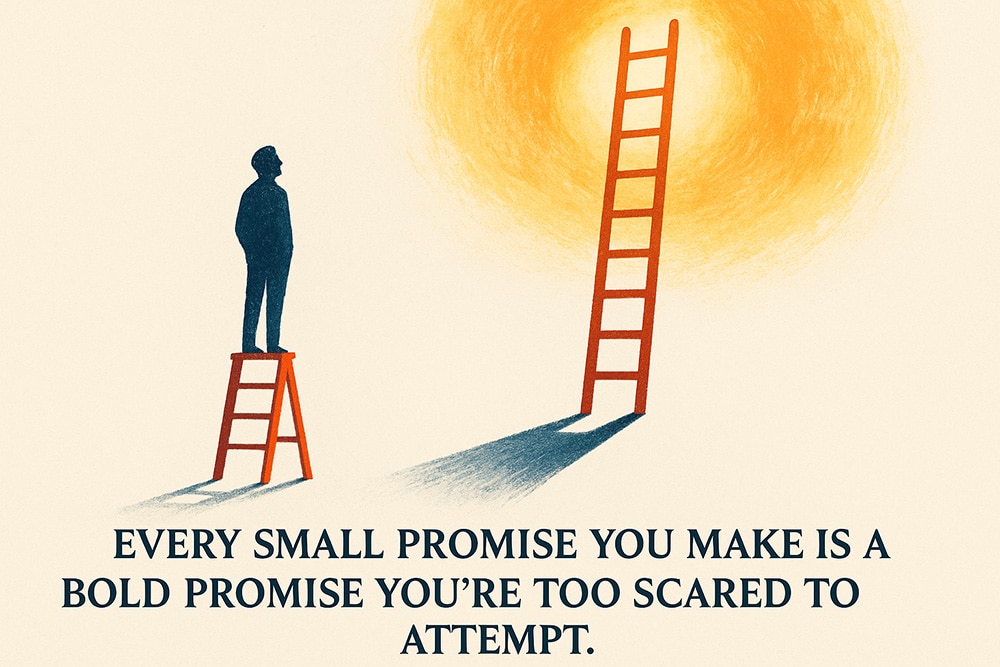
The child in you who learned that reliability equals worthiness is still operating your adult leadership decisions. Every time you consider making a bold promise – launching that innovative product, committing to that aggressive timeline, declaring that audacious vision – that child’s voice pipes up with a terrifying question: “What if you fail? What if people stop loving and respecting you?”
This creates what I call a “double bind.” You know that bold leadership requires taking calculated risks and making ambitious commitments. But your nervous system, trained from childhood, interprets any possibility of not delivering as a threat to your fundamental worthiness and belonging.
The result? You find yourself caught between two competing needs: the need to lead boldly and the need to maintain the love and acceptance that reliability has always brought you.
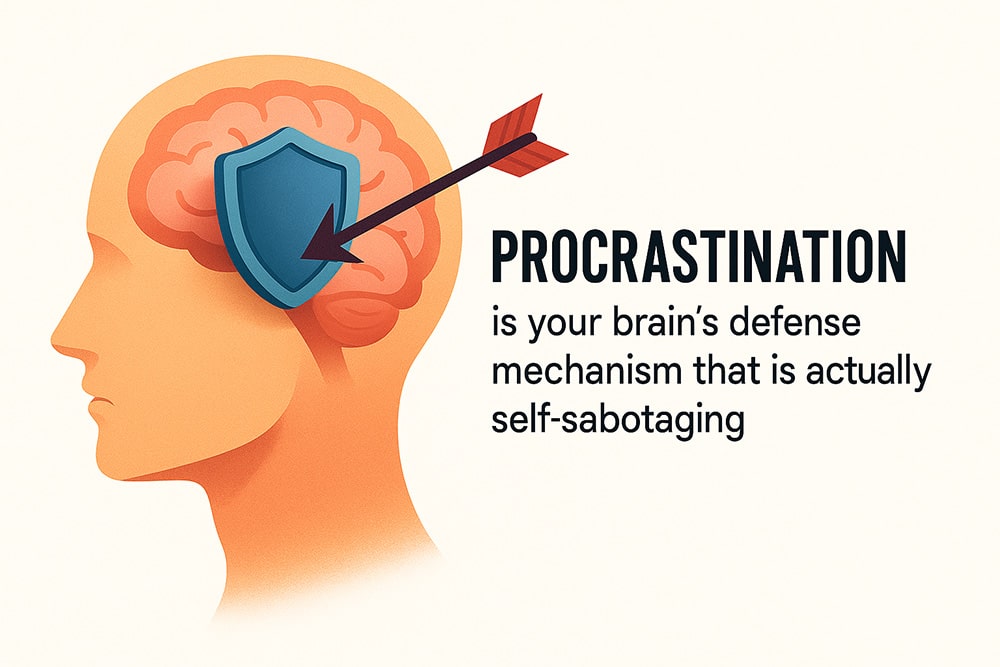
The Procrastination Defence Mechanism
When faced with this internal conflict, your brain does something that feels protective but is actually self-sabotaging: it procrastinates. You delay making those big commitments. You gather more data. You wait for “perfect” conditions. You make smaller, safer promises.
This delay feels like responsible leadership – after all, you’re being thoughtful and strategic, right? But what’s really happening is that your childhood programming is running a sophisticated avoidance pattern. By not making the big promise, you can’t break the big promise. By not declaring the bold vision, you can’t fail at the bold vision.
The cruel irony is that this “protective” procrastination actually makes you less reliable, not more. While you’re delaying decisions to avoid the risk of disappointing people, you’re creating a different kind of disappointment – the disappointment of a leader who won’t lead, a visionary who won’t declare the vision, a company that moves slowly while opportunities pass by.
Understanding the Emotional Math of Childhood
To break free from this pattern, you need to understand the emotional mathematics that your childhood brain calculated. It went something like this:
Reliable behavior + Positive reinforcement = Love and belonging
Unreliable behavior + Disappointment from others = Rejection and unworthiness
Your adult brain knows this equation is oversimplified and not always true. But your emotional system, particularly under stress, still operates as if this childhood math is absolutely accurate. When you consider making a promise you might not be able to keep perfectly, your emotional system rings alarm bells as if your fundamental belonging and worth is at stake.
This is why the fear of breaking promises feels so intense for leaders like you. It’s not just about professional reputation or team trust – though those matter. At an unconscious level, it feels like risking the very foundation of how you’ve always earned love, acceptance and importance.
The Hidden Cost of Playing It Safe
When you consistently choose safe promises over bold ones, you pay a price that extends far beyond missed business opportunities. You begin to experience what I call “leadership grief” – a deep sadness about the leader you know you could be but aren’t allowing yourself to become.
This grief shows up as that heavy feeling when you leave meetings where you know you should have spoken up more boldly. It’s the frustration when you see competitors taking risks you’ve been considering for months. It’s the quiet disappointment when your team starts looking elsewhere for the kind of visionary leadership they’re craving.
Perhaps most painfully, you start to lose touch with the very qualities that made you an effective leader in the first place. The confidence, the willingness to take calculated risks, the ability to inspire others with compelling visions – these begin to atrophy when they’re not exercised regularly.
Deep & Powerful Reflective Questions
What would you do if you truly believed that the right people will love you more for your authentic boldness than your inauthentic perfection?
If you only had 18 months left to lead, what would you do with this time that you’re not doing now?
What kind of leader would you become if you were willing to disappoint people in service of a cause bigger than their comfort?
If you were meant to be remembered for one courageous stand you took, not for how nice you were, what stand would that be?
If the person you were meant to become met the person you are today, what would they say?
What would you tell your own child if they came to you afraid to dream big because they might disappoint people?
Rewriting the Emotional Equation
The path forward requires what I call “creating yourself from the ground up” You need to consciously install new beliefs about the relationship between reliability, love, and leadership worthiness. This isn’t about positive thinking or affirmations – it’s about creating new experiences that teach your nervous system a different truth.
Consider this updated equation: Courageous leadership + Transparent communication + Learning from outcomes = Deeper trust and respect.
And refusing to any longer abdicate your worth, dignity, belonging and success to the outcome of your promises.
You are worthy. You belong. You matter. You are a visionary. and you are successful. Period (no more striving for it).
The leaders who earn the most authentic love and respect aren’t those who never fail – they’re those who are willing to fail forward, who communicate honestly about challenges, who learn publicly from their mistakes, and who stay committed to purposes bigger than their own comfort.
When you look at the leaders you most admire, I’d bet they’re not the ones with perfect track records. They’re the ones who were willing to make bold promises, adjust course when needed, and maintain their commitment to growth and learning throughout the process.
The Permission Practice
Here’s a practice that can help rewire this childhood programming. I want you to give yourself explicit permission to declare: I am worthy. I belong. I matter. I am a visionary. and I am successful. My results are not a proof of my success. They are the evidence of it.
This means permission to make promises that stretch you and your team. Permission to communicate early and often when those promises need to evolve. Permission to be loved and respected not because you’re perfect, but because you’re real, committed, and willing to grow.
Start small if you need to. Make one promise this week that feels slightly uncomfortable – not reckless, but ambitious enough that you can’t guarantee the outcome. Then practice managing that promise with the same level of care and communication you’d bring to a promise you were certain you could keep.
Notice what happens in your body when you make this kind of promise. Notice the fear, but also notice something else – the aliveness, the energy, the sense of possibility that comes with stepping into bigger leadership.
Your Team Is Waiting for Your Bold Leadership
Here’s something crucial to understand: your team doesn’t just respect you because you’re reliable in the traditional sense. They respect you because you care enough to carry responsibility, because you’re committed to outcomes that matter, and because you’re willing to navigate uncertainty in service of something important.
What they’re waiting for – what they’re hoping for – is not your perfect execution of safe promises. They’re hoping for your bold leadership on promises that matter. They want to be part of something bigger than what currently exists, and that requires leaders who are willing to declare ambitious visions even when the path isn’t completely clear.
Your childhood training in reliability is an asset, not a liability – when it’s channeled toward bold purposes rather than safe outcomes. The same care and commitment that made you a reliable child can make you a courageous leader, if you’re willing to apply it toward bigger promises.
The question isn’t whether you’ll face moments when your promises need to evolve. The question is whether you’ll let the fear of those moments prevent you from making the promises that could change everything for your team, your organization, and the people you’re ultimately serving.
Your reliability was never about perfection. It was about caring enough to show up fully, even when things get complicated. That’s exactly the kind of leadership your organization needs right now.
I watched Sarah fidget with her hands as she introduced herself to the room of investors. “I’m just a new business owner with a little idea that might not be very good, but…” Her voice trailed off, and I wanted to shake her. This wasn’t humility speaking—this was fear dressed up in modest clothing.
Sarah had just developed a revolutionary water purification system that could save millions of lives in developing countries. Her “little idea” had the potential to transform entire communities. Yet there she stood, shrinking herself down to the size of a pebble when she should have been standing tall like the mountain she was.
This is what fake humility looks like. And it’s everywhere.
I’ve coached founders with $100M companies and watched them hesitate to speak boldly in boardrooms. Not because they lacked conviction, but because they were afraid of being seen as “too much.”
I’ve seen CEOs dilute their vision because it made someone in HR uncomfortable.
The Epidemic of Playing Small
We live in a culture that’s confused about power. We’ve been taught that being humble means diminishing ourselves, that leadership requires constant self-deprecation, and that owning our strengths is somehow arrogant. So we develop this strange habit of preemptively cutting ourselves down before anyone else can.
“I’m probably wrong, but…” “This might be stupid, but…” “I don’t know if this makes sense, but…”
Sound familiar?
These aren’t humble statements—they’re shields. They’re ways of protecting ourselves from criticism by beating others to the punch. But here’s the brutal truth: when you consistently undermine your own credibility, people start to believe you.
Take Marcus, a brilliant software engineer I know. He built an app that could revolutionize how hospitals manage patient data. But every time he pitched it, he’d start with, “I know there are probably better solutions out there, and I’m sure someone smarter than me has thought of this already…”
Investors heard exactly what he was telling them: that he didn’t believe in his own product. They passed. Not because his idea wasn’t good, but because he convinced them it wasn’t.
The real kicker? Six months later, a competitor launched a nearly identical product with absolute confidence and raised $50 million in Series A funding. Same idea. Different energy. Completely different result.
The Arrogance of False Humility/Modesty
Marianne Williamson captured something profound when she wrote: “Our deepest fear is not that we are inadequate. Our deepest fear is that we are powerful beyond measure. It is our light, not our darkness that most frightens us. We ask ourselves, ‘Who am I to be brilliant, gorgeous, talented, fabulous?’ Actually, who are you not to be?”
Read that again. Who are you NOT to be?
This is where fake humility reveals its true face. When you have gifts, talents, and insights that could help others, and you choose to hide them behind a veil of false modesty, you’re not being humble—you’re being selfish.
Think about it. If you discovered a cure for cancer, would it be humble to say, “Oh, this little thing I stumbled upon probably won’t work”? Or would that be the height of arrogance—putting your own comfort with being seen as “modest” above the lives you could save?
Every time you downplay your abilities, you’re making a choice. You’re choosing your ego’s need to be liked over your calling to serve.
You’re choosing comfort over courage.
You’re choosing small over significant.
This isn’t humility. It’s self-betrayal dressed in virtue.
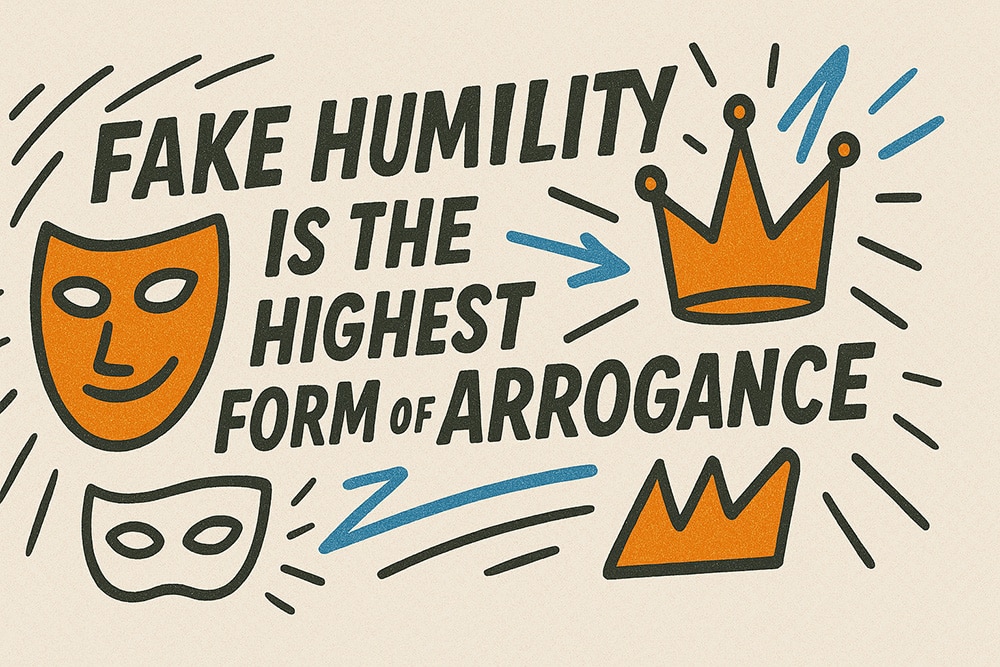
And let’s be honest: Fake humility is the highest form of arrogance.
Because what it really says is: “I believe my light is so powerful, so dangerous, that I need to hide it to keep the peace.”
No. You don’t.
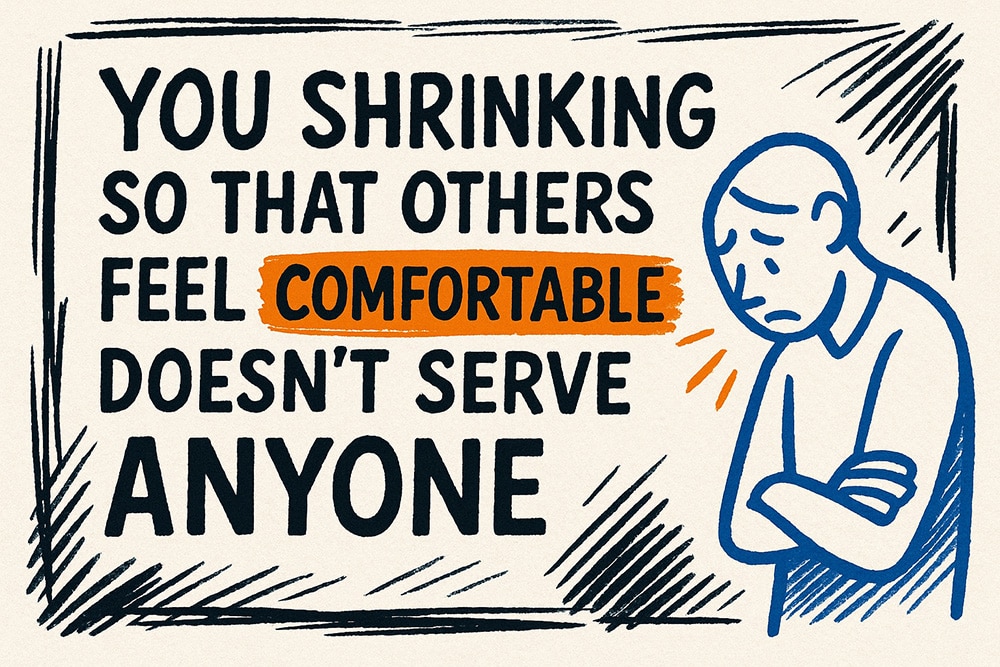
Your Shrinking Doesn’t Serve Anyone
Nature Doesn’t Negotiate Its Essence
Nothing in nature holds back its essence.
The mountain doesn’t shrink itself to be more likable. It doesn’t lower its peak to keep others comfortable.
It just is—majestic, raw, unapologetically itself.
The oak tree doesn’t apologize for blocking sunlight from smaller plants. The lion doesn’t dim its roar so other animals feel more comfortable. The sun doesn’t dim its light because it might be too bright for some.
Yet we, as human beings blessed with consciousness and choice, consistently choose to operate at a fraction of our capacity. We edit ourselves. We water down our truth. We dim our light so others won’t feel outshined.
We shrink. We dim our lights. We over-explain our successes until they sound like lucky accidents.
But here’s what we miss: when an oak tree stands in its full glory, it doesn’t diminish other plants—it creates an entire ecosystem. Birds nest in its branches. Animals find shelter in its shade. Other plants grow in the rich soil created by its fallen leaves.
Your full expression doesn’t diminish others—it gives them permission to rise.
The Stories We Tell Ourselves
One of my clients—we’ll call her Maya—was a brilliant product leader at a fast-growing AI company. In meetings, she would often defer to others, even when she had the sharpest insights.
Why?
Because someone once told her she was “too intense.”
So she dimmed. She made herself smaller. She filtered every sentence to sound softer, more agreeable.
Until one day, I asked her a simple question:
“What if your intensity is the very thing your company needs to break through?”
That flipped a switch.
She started showing up with her full force. Not louder, not bossier—but clearer. More present. More herself.
Three months later, she was promoted to VP.
Not because she worked harder—but because she stopped hiding.
The stories we tell ourselves about humility often stem from childhood programming. Maybe you were told not to be “too big.” Maybe you learned that drawing attention to yourself was dangerous. Maybe you watched someone you admired be torn down for their confidence, and you decided it was safer to stay small.
But those old stories are keeping you from your destiny.
The Difference Between Arrogance and Confidence
Let’s be clear: there’s a massive difference between arrogance and authentic confidence.
Arrogance says, “I’m better than you.” Confidence says, “I know what I’m capable of.”
Arrogance puts others down to lift itself up. Confidence lifts everyone by example.
Arrogance is insecure and needs constant validation. Confidence is secure and offers validation to others.
Arrogance is loud and flashy. Confidence is quiet and powerful.
True confidence doesn’t need to announce itself with fanfare. It’s the mountain that simply stands—no apologies, no explanations, no justifications. Just presence.
The Ripple Effect of Authentic Leadership
When you own who you are, something magical happens. You give others permission to do the same.
I think of Oprah, who never apologized for her curiosity, her emotions, or her success. By owning her full self, she created space for millions of others to explore their own depths.
I think of Steve Jobs, who never dimmed his vision to make others comfortable. His unwillingness to compromise on his standards pushed entire industries to excellence.
I think of Maya Angelou, who never apologized for the power of her words or the depth of her wisdom. She stood in her truth so fully that it gave others courage to find their own.
These aren’t people who were born different from you. They were people who made a choice—the choice to stop apologizing for their gifts and start using them fully.
Your Presence Is Your Leadership
Here’s what I’ve learned after years of working with leaders across every industry: your presence is your leadership. Not your title. Not your credentials. Not your network. Your presence.Your power.
And presence isn’t something you can fake or manufacture. It comes from one thing only: the willingness to show up as your full self.
When you walk into a room owning your worth without apology, people feel it. When you speak your truth without hedging or qualifying, people listen. When you lead from your authentic power rather than a watered-down version of yourself, people follow.
But when you shrink, when you dim, when you over-explain and soften the edges of your truth, you rob the world of your gifts. You withhold the very frequency the world needs from you.
The People Who Matter Will Rise to Meet You
“The people who are meant to walk with you won’t be intimidated by your height. They’ll rise to meet you there.”
This is perhaps the most important truth about authentic leadership. When you own your power, you naturally attract people who can match your energy. You repel those who need you to stay small for their own comfort.
And that’s exactly as it should be.
The right people—your true tribe, your real collaborators, your genuine supporters—they don’t want the diminished version of you. They want the real you. The powerful you. The you who stands in their full height without apology.
These are the people who will push you to grow instead of asking you to shrink. They’ll celebrate your wins instead of feeling threatened by them. They’ll challenge you to be even more of who you are instead of asking you to be less.
The Cost of Playing Small
But what about the cost of staying small? What about the price of fake humility?
Every time you undercut yourself, you train people to undervalue you. Every time you apologize for your expertise, you plant seeds of doubt about your capabilities. Every time you shrink to make others comfortable, you teach them that your comfort doesn’t matter.
The cost shows up in:
Opportunities that pass you by because you didn’t own your qualifications
Ideas that never see the light of day because you convinced yourself they weren’t good enough
Teams that don’t follow your leadership because you never gave them confidence in your direction
Relationships that stay surface-level because you never showed your true depth
Dreams that remain dreams because you never believed you deserved to achieve them
The world is full of brilliant people who never made their mark because they spent more energy hiding their light than shining it.
Your Full Expression Is Your Offering
Marianne Williamson’s quote continues: “Your playing small does not serve the world. There is nothing enlightened about shrinking so that other people won’t feel insecure around you.”
Your full expression is your offering to the world. When you hold back your power, you don’t just betray yourself—you deprive others of what you came here to give. You steal other’s growth.
The business idea you’re sitting on could employ hundreds of people. The book you’re not writing could change someone’s life. The leadership you’re not stepping into could guide your organization through its next breakthrough. The authentic self you’re hiding could give someone else permission to be real too.
Stop Asking for Permission to Be Powerful
So here’s your gentle invitation—no, your urgent call to action:
Stop apologizing for your height. Stop asking for permission to be powerful. Stop editing yourself to be more digestible.
The mountain doesn’t ask permission to reach toward the sky. The ocean doesn’t apologize for its depth. The sun doesn’t dim its light because some prefer shade.
You are not here to be a diluted version of yourself. You’re here to be the full expression of who you came to be. Raw, powerful, unapologetic, and real.
The Mountain Stands
Mountains don’t apologize for their height. They don’t shrink themselves to be more likable. They don’t lower their peaks to keep others comfortable. They just are—majestic, raw, unapologetically themselves.
And yet, as leaders, as human beings with something to offer this world, we so often do the opposite. We shrink. We dim. We over-explain. We soften the edges of our truth to make others feel more at ease.
But you were never meant to lead from a watered-down version of yourself.
True leadership doesn’t come from ego or dominance. It comes from presence. From standing fully in who you are. Rooted. Clear. Quietly powerful. Just like a mountain.
The people who belong in your life, who are meant to walk alongside you on this journey, who can truly appreciate what you have to offer—they won’t be intimidated by your height. They’ll be inspired by it. They’ll rise to meet you there.
And together, you’ll create something magnificent. Something that could only exist when authentic power meets authentic power. When real meets real. When mountain meets mountain.
So stand tall. Own your gifts. Speak your truth. Lead from your authentic power.
The world doesn’t need another diminished version of someone extraordinary.
The world needs you. All of you. In your full height. Without apology.
Because fake humility isn’t humble at all—it’s the highest form of arrogance. It says your comfort with being small matters more than the contribution you came here to make.
And you? You came here to be a mountain.
So stop apologizing for your height, and start reaching for the sky.
I still remember the moment that changed everything.
It was my first year of college when I discovered what my parents had been hiding from me. My mother had cancer—a battle she’d been quietly fighting while they took loans to send me to engineering school.
As the truth unfolded, I learned something that would forever alter my understanding of love and leadership: my parents had been redirecting money that could have funded my mother’s treatment to pay for my tuition instead.
I witnessed what’s possible when love outruns logic. My parents’ sacrifice wasn’t just about education or even family duty—it was a profound demonstration of what it means to approach life from a “bringing to” rather than a “getting from” mindset.
This distinction—between bringing to and getting from—has become the cornerstone of my life’s work. Everything I do now, and until I die, is to show people what is possible: not just tangible business success, but deeper human possibilities—loving boldly, caring deeply, speaking authentically, and standing unapologetically for their beliefs.
In this article, I’ll share how this fundamental shift in BEING can transform not only how you lead but how you live. Drawing from research, real-world examples, and personal experience, I’ll offer a roadmap for leaders who want to make a genuine difference in their organizations and beyond.
My message is simple but profound: Your dreams and ambitions are within reach; you do not have to wait to live them. And it begins with understanding the power of this DISTINCTION: bringing to versus getting from.
The Fundamental Distinction: Understanding Bringing To vs. Getting From
The Hidden Paradigm That Shapes Everything
Most of us have been conditioned to approach life—both personal and professional—with an unconscious focus on what we can get. We seek validation, recognition, satisfaction, and fulfillment from outside ourselves. When we don’t receive what we’re looking for, we often conclude there’s something wrong with the relationship itself.
This “getting from” state of BEING is so deeply ingrained that we rarely question it. It’s the water we swim in, the air we breathe. But what if there’s another way?
The “bringing to” state of BEING flips this paradigm entirely. Instead of asking “What can I get from this person, team, or situation?” you ask “What can I bring or contribute?” This isn’t about self-sacrifice or martyrdom.
It’s about recognizing that the most fulfilling and effective way to lead—and live—is to approach each interaction with a focus on contribution rather than taking.
The Research: Why This Matters
Wharton professor Adam Grant’s groundbreaking research confirms the power of this shift. In his extensive studies on workplace dynamics, Grant identified three reciprocity styles: givers, takers, and matchers. What he discovered was surprising—givers, those who contribute to others without expecting immediate returns, are found at both the bottom AND the top of success metrics across industries.
The difference? The most successful givers are strategic about how, when, and to whom they give. They don’t give indiscriminately or at the expense of their own well-being. Instead, they bring their best to each interaction while maintaining healthy boundaries.
This research aligns perfectly with my own experience. When my parents chose to redirect funds from cancer treatment to my education, they weren’t being martyrs. They were making a profound statement about what they valued most—the future they wanted to help create through me. Their giving wasn’t about self-denial; it was about self-expression of their deepest values.
The Personal Cost of Getting From
I’ve seen firsthand the toll that a “getting from” state of BEING takes on leaders. Early in my career, I worked with a CEO who approached every interaction with the question “What can I get here?” His leadership created a culture of fear, withholding, and ultimately, stagnation. Employees protected their ideas, hoarded resources, and focused on survival rather than innovation.
The irony was painful to watch: the more he tried to extract, the less value there was to extract. His company eventually lost market share to more innovative competitors, and he was replaced by the board. The personal cost was even higher—strained relationships, health issues from chronic stress, and a legacy defined by what he took rather than what he gave.
Contrast this with leaders like Satya Nadella, who took over as CEO of Microsoft when the company was struggling with internal competition and market challenges. Nadella instituted a fundamental shift from a “know-it-all” culture to a “learn-it-all” culture—essentially moving from a “getting from” to a “bringing to” paradigm.
This transformation wasn’t smooth; there were numerous setbacks and resistance. But Nadella’s persistence in modeling curiosity, empathy, and a growth mindset eventually transformed the company. Since this cultural shift, Microsoft’s market value has increased by over 600%.
The Journey: My Moment of Truth
My own journey from “getting from” to “bringing to” wasn’t a smooth one. After college, driven partly by my parents’ sacrifice, I pursued success with singular focus. I climbed the corporate ladder quickly, but something felt hollow about my achievements.
I remember the exact moment this paradigm shift became clear to me. I was leading a high-stakes project with an impossible deadline. The pressure was immense, and I found myself increasingly frustrated with my team. In my mind, I wasn’t getting the performance, the commitment, or the creativity I needed from them.
During one particularly tense meeting, I caught myself thinking, “Why aren’t they giving me what I need to succeed?” And then it hit me—I had been approaching leadership as a transaction where my role was to extract value from my team. I was coming to work each day focused on what I could get from others rather than what I could bring to them.
That night, I made a decision to flip the script. Instead of asking “What am I getting from my team?” I started asking “What am I bringing to my team?” The next morning, I walked in with a fundamentally different energy. I wasn’t there to extract performance—I was there to bring support, clarity, and genuine appreciation for each person’s unique contributions.
The transformation wasn’t immediate, but it was unmistakable. Within weeks, the same team that I had labeled as underperforming was exceeding expectations. The project that seemed doomed became our division’s greatest success story that year. But the most profound change wasn’t in my team—it was in me. I discovered that leadership satisfaction doesn’t come from what you get; it comes from what you give.
The Pain That Drives Purpose
It pains me deeply to meet people with a dream in their eyes who believe it’s impossible. I see in them the same potential my parents saw in me—possibilities that might never be realized if they remain trapped in a “getting from” mindset.
This pain has shaped everything I do today. My life is a stand for possibility—love, peace, ambition, meaning, full aliveness right now. Not someday. Not when conditions are perfect. Right now.
When I share my parents’ story, people often ask if I feel guilty about the sacrifice they made. The truth is more complex. I feel a profound responsibility to honor their gift by living fully and helping others do the same. Their sacrifice showed me what’s possible when love outruns logic, and that lesson has shaped every aspect of my leadership approach.
The B.R.I.N.G. Framework: A Practical Guide for Leaders
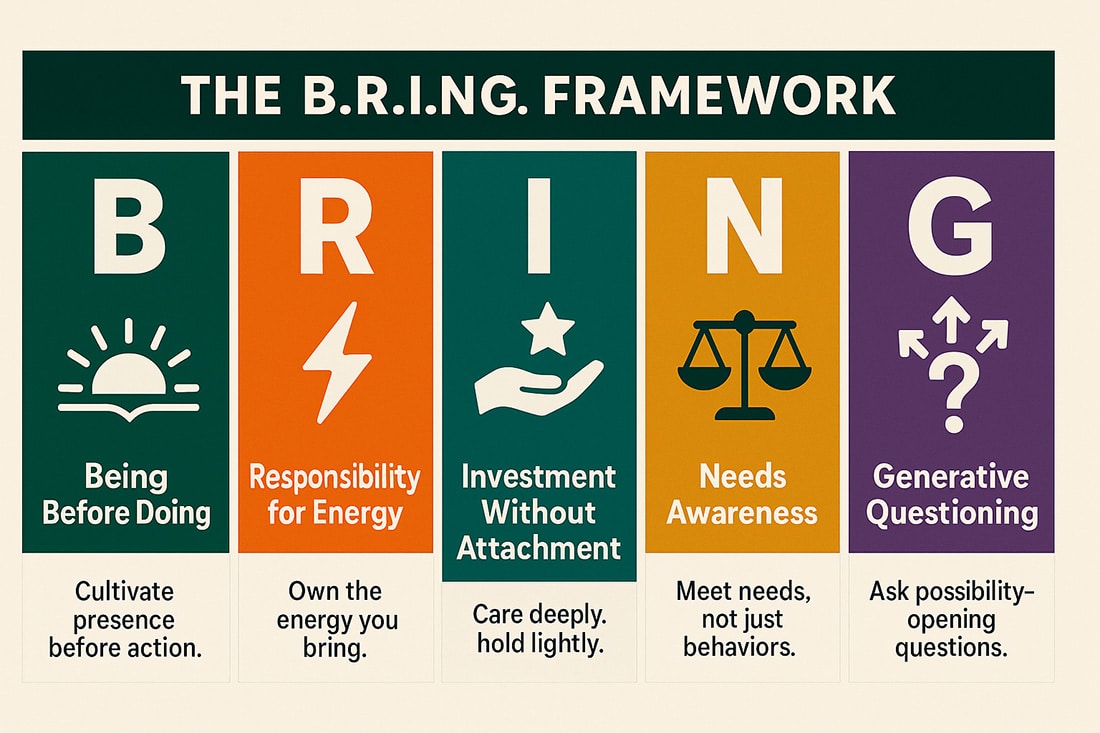
To help leaders practice this DISTINCTION and shift their BEING, I’ve developed the B.R.I.N.G. Framework—five practical dimensions of the “bringing to” leadership paradigm that you can implement starting today:
B – Being Before Doing
The “bringing to” BEING begins with who you are, not what you do. Before you can bring your best to others, you must cultivate your own internal BEING. This means developing self-awareness and knowing what you stand for.
Many leaders believe that “practice makes perfect,” but that’s an oversimplification. Mindless practice only reinforces existing patterns. The truth is that “conscious practice makes progress.” Daily reflection on how you’re showing up—not just what you’re getting done—is essential.
ACTIONABLE STEP: Begin each day with a 5-minute reflection on your leadership intention. Ask yourself: “Who do I want to be for my team today?” rather than just “What do I need to accomplish?”
PERSONAL EXAMPLE: After my mother passed away, I found myself going through the motions of leadership—present physically but absent emotionally.
After 8 years of her passing away and going through mild-depression, I created a morning ritual where I would look at her photo and ask myself, “How would she want me to show up today?” This simple practice transformed my presence as a leader, helping me quit my 16-year tech career and start the Deploy Yourself School of Leadership
R – Responsibility for Energy
Energy is contagious, and as a leader, yours sets the tone. The “bringing to” leader takes full responsibility for the energy they bring into every interaction. This doesn’t mean being artificially positive; it means being intentional.
Before every meeting, every conversation, ask yourself: “What energy am I bringing to this interaction? Is it aligned with my highest intentions for this relationship?”
ACTIONABLE STEP: Create an “energy check” ritual before important meetings. Take 30 seconds to assess your current emotional state and consciously choose the energy you want to bring. Studies from the Center for Creative Leadership show that teams whose leaders practice emotional regulation are 67% more likely to maintain high performance during stressful periods.
PERSONAL EXAMPLE: During a particularly challenging company restructuring while at Booking.com, I noticed my anxiety was affecting my team’s confidence. I started taking five deep breaths before entering any meeting, consciously releasing tension and connecting with my commitments. Team members later shared that my calm presence during that period was what enabled them to navigate the uncertainty productively.
I – Investment Without Attachment
Bring your full investment to relationships and outcomes, but practice non-attachment to specific responses or results. This paradoxical approach—caring deeply while holding lightly—creates space for others to step into their own power.
When you’re attached to getting a particular response, people sense it and often resist. When you bring your best without attachment, you create psychological safety that allows others to bring their best as well.
ACTIONABLE STEP: When delegating an important task, clearly communicate your investment in both the person and the outcome, then explicitly give them autonomy: “I trust your judgment on how to approach this.” McKinsey’s research shows that this combination of support and autonomy increases innovation by 41% and employee satisfaction by 53%.
PERSONAL EXAMPLE: I learned this lesson painfully when launching a new software revamp. I was so attached to the project that I micromanaged the team, creating resentment and stifling creativity. When I finally stepped back and said, “I trust you to make this great in your own way,” the team exceeded my original vision with innovations I never would have conceived.
N – Needs Awareness
Understand that all behavior—yours and others’—is an attempt to meet fundamental human needs. The “bringing to” leader develops literacy in identifying these needs and addresses them directly rather than reacting to surface behaviors.
When a team member is underperforming, instead of asking “How do I get better performance?” ask “What needs might be unmet that are affecting their ability to contribute fully?”
ACTIONABLE STEP: In your next one-on-one meeting with a team member, use the “needs conversation” approach. Ask: “On a scale of 1-10, how well do you feel your needs for autonomy, mastery, and purpose are being met in your current role?” Then explore specific ways you can help address any gaps. Google’s Project Aristotle research identified psychological safety as the #1 predictor of team effectiveness, and needs-based conversations are a primary builder of that safety.
PERSONAL EXAMPLE: One of my most valuable team members was becoming increasingly withdrawn in meetings. Rather than focusing on the behavior, I invited her to coffee and asked about her needs.
She revealed that she felt her expertise wasn’t being utilized in our current project. By restructuring her role to leverage her strengths, not only did her engagement return, but she delivered breakthrough insights that significantly improved our product.
G – Generative Questioning
The questions we ask shape the reality we create.
“Getting from” leaders ask: “What’s wrong?” “Who’s to blame?” “How do we fix this?”
“Bringing to” leaders ask generative questions that open possibilities: “What’s trying to emerge here?” “What would make this relationship thrive?” “How can I support your highest potential?”
The quality of your life is determined by the quality of the questions you habitually ask yourself and others.
ACTIONABLE STEP: Create a “question transformation” practice for your team. Identify the three most common problem-focused questions in your organization and reframe them as opportunity-focused questions. For example, change “Why are we behind schedule?” to “What would enable us to accelerate our progress?” Research from the Appreciative Inquiry field shows that this simple shift can increase solution generation by 300%.
Real-World Example: The Bringing To Mindset in Action
The Founder Who Built Giving Into Business
When Blake Mycoskie founded TOMS Shoes with his “One for One” model—giving a pair of shoes to a child in need for every pair purchased—he wasn’t just creating a charitable business. He was modeling a “bringing to” mindset that transformed consumer expectations across the retail industry.
This ripple effect has inspired hundreds of companies to adopt similar models, collectively bringing billions of dollars in resources to communities in need.
Mycoskie’s approach reminds me that the “bringing to” mindset isn’t just about individual interactions—it can be built into the very DNA of organizations and business models.
Just as my parents’ sacrifice wasn’t a one-time decision but a consistent expression of their values, truly transformative leadership embeds the “bringing to” philosophy into systems and structures.
The Science Behind the Shift
The Psychological Safety Connection
Research from McKinsey confirms the power of the “bringing to” approach. Their global survey found that only a small percentage of business leaders consistently demonstrate the positive behaviors that create psychological safety in their workforce—a critical foundation for innovation and adaptation.
Yet the same research shows that when leaders shift from authoritative styles to more consultative and supportive approaches, team performance dramatically improves.
This research resonates deeply with my experience. When I shifted from focusing on what I could get from my team to what I could bring, I wasn’t just changing my behavior—I was transforming the entire emotional climate of our work environment.
The Neurological Evidence
Recent neuroscience research provides fascinating insights into why the “bringing to” mindset is so powerful. A 2022 study using fMRI technology examined brain activity in leaders practicing different approaches to influence.
When leaders focused on what they could get from others (coercive influence), the brain’s threat response system was activated, triggering the release of cortisol and other stress hormones—not just in the leader, but also in those they were attempting to influence.
In contrast, when leaders focused on what they could bring to others (supportive influence), the brain’s reward system was activated, triggering the release of oxytocin and dopamine—again, in both the leader and those they were influencing.
This neurological evidence suggests that the “bringing to” mindset creates a virtuous cycle of positive brain chemistry that enhances creativity, collaboration, and well-being for everyone involved.
Transforming Teams
While individual leadership transformation is powerful, the true magic happens when entire teams embrace the “bringing to” mindset collectively. When everyone on a team shifts from asking “What can I get?” to “What can I bring?”, the result is exponentially greater than the sum of individual contributions.
The Pixar Example
Consider the remarkable transformation at Pixar Animation Studios. In the early days of developing Toy Story, the team faced numerous technical and creative challenges that could have derailed the project. Instead of focusing on individual credit or blame, they developed a culture of “plussing“—a practice where team members build on each other’s ideas by adding something positive rather than criticizing.
This collective “bringing to” approach not only saved Toy Story but established a creative process that has produced some of the most successful animated films in history.
What strikes me about Pixar’s approach is how it creates a culture where everyone feels both safe and challenged—safe to offer ideas without fear of ridicule, and challenged to continuously improve those ideas. This balance of psychological safety and high standards is the sweet spot where innovation thrives.
This research confirms what I’ve observed in my own teams: When people shift from protecting their individual interests to actively contributing to collective success, performance improves dramatically. But more importantly, work becomes more meaningful and fulfilling for everyone involved.
Actionable Steps for Team Transformation
1. Implement a “Bringing Ritual” at the beginning of team meetings. Have each person briefly share what they’re bringing to the team today—whether it’s a resource, an insight, or simply a supportive presence. Research from MIT’s Human Dynamics Laboratory shows that teams that practice such check-ins experience 30% higher productivity and 50% higher satisfaction.
2. Create a “Team Bringing Agreement” with your group. Together, identify 3-5 specific ways team members commit to bringing value to each other and to stakeholders. Review and renew this agreement quarterly.
3. Establish “Bringing Metrics” alongside traditional performance metrics. Measure and celebrate not just what team members achieve, but how they contribute to others’ success. This might include tracking instances of knowledge sharing, cross-functional support, or mentoring.
The Ripple Effect: Beyond Your Organization
The impact of the “bringing to” state of BEING extends far beyond your immediate team or organization. As you embody this approach, you create ripple effects that influence your industry, community, and even society at large.
My Personal Ripple Effect
When I think about the ripple effects of my parents’ sacrifice, I’m humbled and inspired. Their decision to prioritize my education over my mother’s treatment wasn’t just about me—it was about everything has happened in my life since then. They couldn’t have known exactly how their sacrifice would ripple outward, but they trusted that it would.
In the same way, when we lead from a “bringing to” mindset, we create ripples that extend far beyond what we can see or measure. Every person who experiences your leadership carries that experience into other relationships and contexts. Every team that thrives under your guidance becomes a model for other teams. Every organization that embodies this philosophy influences its industry and community.
Actionable Steps for Creating Positive Ripples
1. Identify one “bringing opportunity” beyond your organization’s boundaries. This could be mentoring emerging leaders in your industry, sharing best practices with peer organizations, or addressing a community need related to your expertise.
2. Create a “Bringing Beyond” initiative that encourages and supports employees in applying their skills to community or industry challenges. This could include paid volunteer time, skills-based volunteering programs, or collaborative projects with nonprofit organizations.
3. Share your “bringing to” journey openly with other leaders. By vulnerably discussing both the challenges and benefits of this shift in BEING, you inspire others to consider their own approach. Leadership transparency has been shown to accelerate positive cultural change across organizational boundaries, according to research from the MIT Sloan School of Management.
Overcoming Challenges: When Bringing To Gets Tough
The journey from “getting from” to “bringing to” isn’t always smooth. There are real challenges and potential pitfalls along the way. Acknowledging these challenges is essential for sustainable transformation.
The Challenge of Boundaries
One of the most common concerns about the “bringing to” mindset is the fear of being exploited or burning out. This is a legitimate concern—giving indiscriminately without boundaries can indeed lead to depletion and resentment.
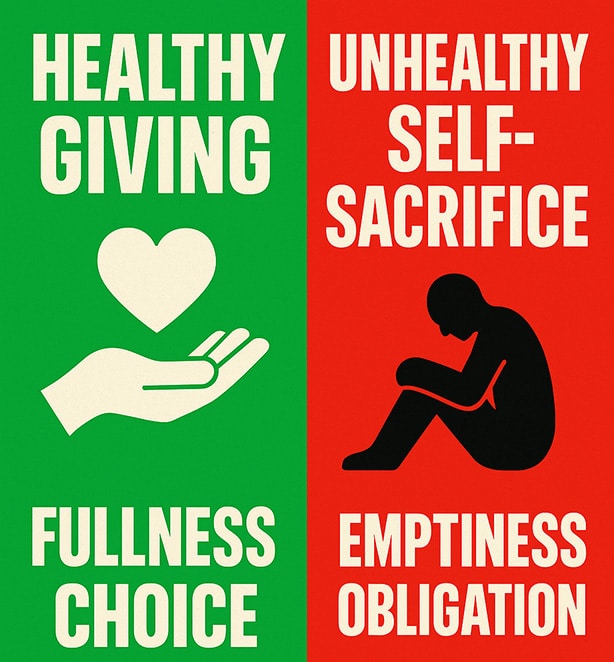
The key is to distinguish between healthy giving and unhealthy self-sacrifice. Healthy giving comes from a place of fullness and choice; unhealthy self-sacrifice comes from a place of emptiness and obligation.
PERSONAL EXAMPLE: After my mother’s passing, I initially honored her memory by saying yes to everyone who needed help, regardless of the cost to my own well-being. I was trying to replicate her sacrifice, but I was doing it from a place of grief and obligation rather than love and choice. The result was predictable: burnout, resentment, and diminished effectiveness as a leader.
The turning point came when I realized that true “bringing to” leadership requires self-care as a foundation. I couldn’t bring my best to others if I was depleted and resentful. Setting healthy boundaries wasn’t a betrayal of my mother’s legacy—it was the only way to truly honor it by sustaining my capacity to give over the long term.
When I put myself first, I can serve others best.
The Challenge of Organizational Culture
Another significant challenge arises when you’re attempting to embody the “bringing to” mindset within an organization that operates primarily from a “getting from” paradigm. This misalignment can create tension and even career risks.
PERSONAL EXAMPLE: Early in my career, I worked in an organization with a highly competitive, zero-sum culture. When I began shifting to a more generous, collaborative approach, I faced skepticism and even ridicule from peers who saw my behavior as naive or strategically unwise.
Rather than abandoning my approach or leaving immediately, I focused on creating a micro-culture within my team while strategically demonstrating the business value of the “bringing to” mindset. Over time, our team’s superior results spoke for themselves, and other leaders began to take notice and ask questions. What began as a small pocket of cultural change eventually influenced the broader organization.
ACTIONABLE STEP: Identify a “bringing to” ally within your organization—someone who shares your values or is open to this approach.
The Challenge of Consistency
Perhaps the most persistent challenge is maintaining consistency in the “bringing to” state of BEING, especially under pressure. When stakes are high, deadlines are looming, or resources are scarce, it’s easy to slip back into a “getting from” approach.
PERSONAL EXAMPLE: During a particularly stressful period, I found myself reverting to command-and-control leadership, focusing more on what I needed from my team than what I could bring to them. The impact was immediate and negative—trust eroded, creativity diminished, and progress slowed.
Recognizing this pattern, I created a simple practice: whenever I felt myself slipping into “getting from” mode, I would pause and ask, “What could I BRING TO this situation?” This question immediately reconnected me with my deeper values and shifted my focus back to contribution rather than extraction.
ACTIONABLE STEP: Create a personal “stress trigger plan” that identifies: 1) Early warning signs that you’re slipping into a “getting from” mindset, 2) A specific pause practice to interrupt this pattern, and 3) A reconnection question that brings you back to your core values.
The Ultimate Transformation: From Success to Significance
As powerful as the “bringing to” mindset is for achieving traditional success metrics, its greatest impact may be in transforming how we define success itself. When we shift from getting to bringing, we often experience a parallel shift from pursuing success to creating significance.
Redefining Success
For much of my early career, I defined success in conventional terms—advancement, recognition, financial rewards. These aren’t inherently negative goals, but they created a perpetual sense of striving without arriving. There was always another level to reach, another achievement to pursue.
My parents’ sacrifice taught me a different definition of success—one based on contribution rather than acquisition. They didn’t measure their lives by what they accumulated but by what they gave. Their success wasn’t visible on a balance sheet or resume, but it was profound and lasting.
As I’ve embraced the “bringing to” DISTINCTION more fully, my own definition of success has evolved. I still value achievement and results, but they’re no longer the primary metrics by which I measure my life and leadership. Instead, I ask questions like:
How have I helped others grow and thrive?
What positive impact have I created beyond myself?
Am I living in alignment with my deepest values?
Am I fully present and alive in this moment?
This shift doesn’t diminish ambition—it transforms it. My ambition now is not just for personal achievement but for collective flourishing. I want to succeed not just by conventional metrics but by creating meaningful value for others.
From Transaction to Transformation
The ultimate power of the “bringing to” mindset is its ability to transform relationships from transactional to transformational. When we approach interactions with a focus on what we can bring rather than what we can get, we create space for genuine connection and mutual growth.
PERSONAL EXAMPLE: In the aftermath of my mother’s passing, I initially approached my grief as something to “get through”—a challenge to overcome so I could get back to normal functioning. This “getting from” approach to grief left me feeling stuck and isolated.
The breakthrough came when I shifted to asking what I could bring to my grief—presence, compassion, patience, and eventually, meaning-making. This shift didn’t make the pain disappear, but it transformed my relationship with it. My grief became not just a burden to bear but a teacher that deepened my capacity for empathy and connection with others.
This same transformation is possible in all our relationships—with colleagues, team members, customers, and communities. When we shift from asking “What can I get from this relationship?” to “What can I bring?”, we create the conditions for genuine transformation.
The Legacy Question
Perhaps the most profound shift that occurs when we embrace the “bringing to” mindset is in how we think about legacy. Legacy isn’t something that begins at the end of our career or life—it’s being created in every interaction, every decision, every day.
My parents didn’t set out to create a legacy through their sacrifice. They were simply expressing their deepest values in a moment of difficult choice. Yet their decision has rippled outward in ways they couldn’t have fully imagined, touching countless lives through my work and the work of those I’ve influenced.
In the same way, your legacy as a leader is being written not primarily through your achievements but through your contributions—the value you bring to others and the positive impact you create. This legacy isn’t measured in quarters or even years but in generations.
ACTIONABLE STEP: Create a “legacy journal” where you regularly reflect on three questions:
What am I bringing to my relationships and work today?
How might these contributions ripple outward beyond what I can see?
What values do I want my actions to express and perpetuate?
A Call to Possibility: Your Dreams Are Within Reach
We stand at a critical inflection point in the evolution of leadership. The old paradigm of “getting from”—extracting value, maximizing personal gain, and measuring success by what we accumulate—has reached its limits. It’s creating burnout, disengagement, and a profound sense that something essential is missing from our work lives.
The “bringing to” paradigm offers not just a more fulfilling approach to leadership, but a more effective one. The research is clear: leaders and organizations that focus on contribution rather than taking outperform their peers on virtually every meaningful metric—from innovation and adaptability to talent retention and long-term financial performance.
But beyond the business case, there’s a deeper truth: we are at our best, most alive, and most fulfilled when we’re bringing our gifts rather than focused on what we’re getting. This isn’t just good leadership; it’s good living.
It pains me to meet people with a dream in their eyes who believe it’s impossible. I see in them the same potential my parents saw in me—possibilities that might never be realized if they remain trapped in a “getting from” mindset.
My life is a stand for possibility—love, peace, ambition, meaning, full aliveness right now. Not someday. Not when conditions are perfect. Right now.
Your dreams and ambitions are within reach; you do not have to wait to live them. The shift from “getting from” to “bringing to” is the key that unlocks not just greater success but deeper fulfillment and more meaningful impact.
As you leave this article, I invite you to take three specific actions and then reach out and share with me what happened:
Start with one relationship: Identify one important professional relationship and consciously shift from “What am I getting?” to “What am I bringing?” Notice what changes.
Transform your team: Introduce the B.R.I.N.G. Framework to your team and implement at least one of the actionable steps we’ve discussed. Measure the impact over 90 days.
Expand your influence: Share this paradigm shift with at least one peer leader. The more we spread this approach, the more we transform not just our organizations but our communities and society.
Remember, this journey isn’t about perfection—it’s about practice. You’ll have days when you slip back into old patterns. That’s not failure; it’s part of the process. What matters is your commitment to return, again and again, to the fundamental question: “What am I bringing today?”
The world is waiting for leaders who understand that true power comes not from what we take, but from what we give. Will you be one of them?
About Me (Sumit)
Everything I do—now and until I die—is to show people what is possible: not only tangible business success but deeper human possibilities: loving boldly, caring deeply, speaking authentically, standing unapologetically for their beliefs.
Today, I work with leaders and organizations to help them shift from a “getting from” to a “bringing to” mindset, unlocking greater success, fulfillment, and positive impact. My approach combines rigorous research, practical frameworks, and authentic personal narrative to create transformative learning experiences.
I believe that leadership is not primarily about position or power but about contribution and impact. The leaders who make the greatest difference are those who focus not on what they can get, but on what they can bring.
If you’d like to continue this conversation or explore how the “bringing to” mindset might transform your leadership and organization, please reach out. Together, we can create ripples of positive impact that extend far beyond what either of us might accomplish alone.
This is the Leadership Journey series on the Choosing Leadership Podcast.
I believe we all have a lot to learn from each other’s stories – of where we started, where we are now, and our successes and struggles on the way. With this series of interviews, my attempt is to give leaders an opportunity to share their stories and for all of us to learn from their generous sharing. If you know a leader whom you would like to see celebrated on the show, please send me a message on LinkedIn with their name.
What if your biggest leadership breakthrough came from breaking the rules of how things have always been done?
In this powerful conversation, Viktor Pryshlyak, CEO and co-founder of United Software, reveals how he walked away from traditional outsourcing models to build a global, trust-first tech company.
We explore what most founders miss about sales, why trust is non-negotiable, and how real leadership often means leaning into discomfort.
Whether you’re scaling a startup or leading a team through uncertainty, Viktor’s story is packed with real, relatable lessons on courage, clarity, and conviction.
Tune in to challenge your leadership assumptions—and walk away with practical tools to lead with more heart and impact.
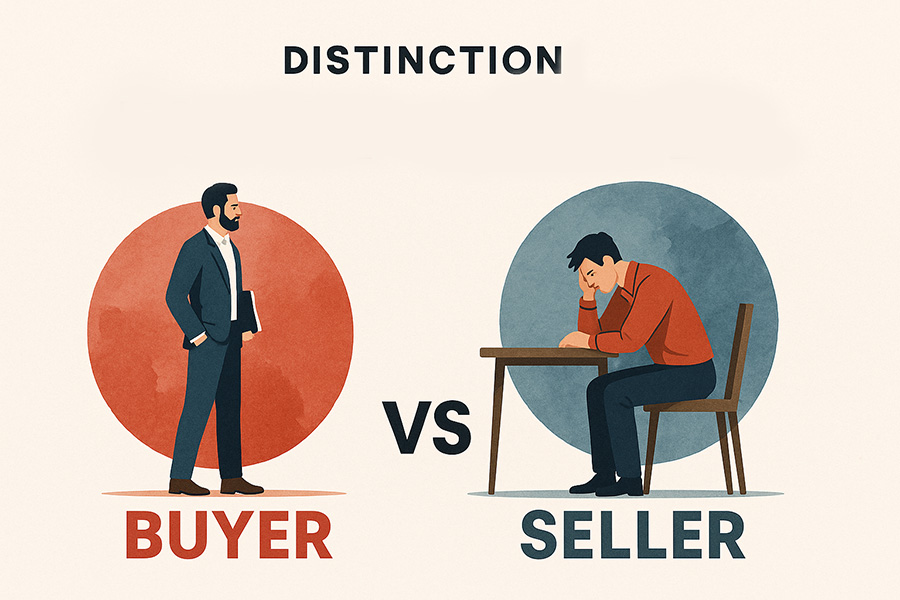
There exists a profound distinction in both business and personal life that shapes nearly every interaction, negotiation, and relationship we engage in. It’s not merely a strategy or technique but a fundamental state of being—either Being the Buyer or Being the Seller. Understanding and embodying this distinction can radically transform your effectiveness as a leader, your personal happiness, and your overall success in life.
Two States of Being: The Essence of Buyer and Seller
At its core, the distinction between Being a Buyer and Being a Seller represents two fundamentally different ways of existing in the world. This isn’t about what you do—it’s about who you are at the deepest level, which then naturally shapes everything you do.
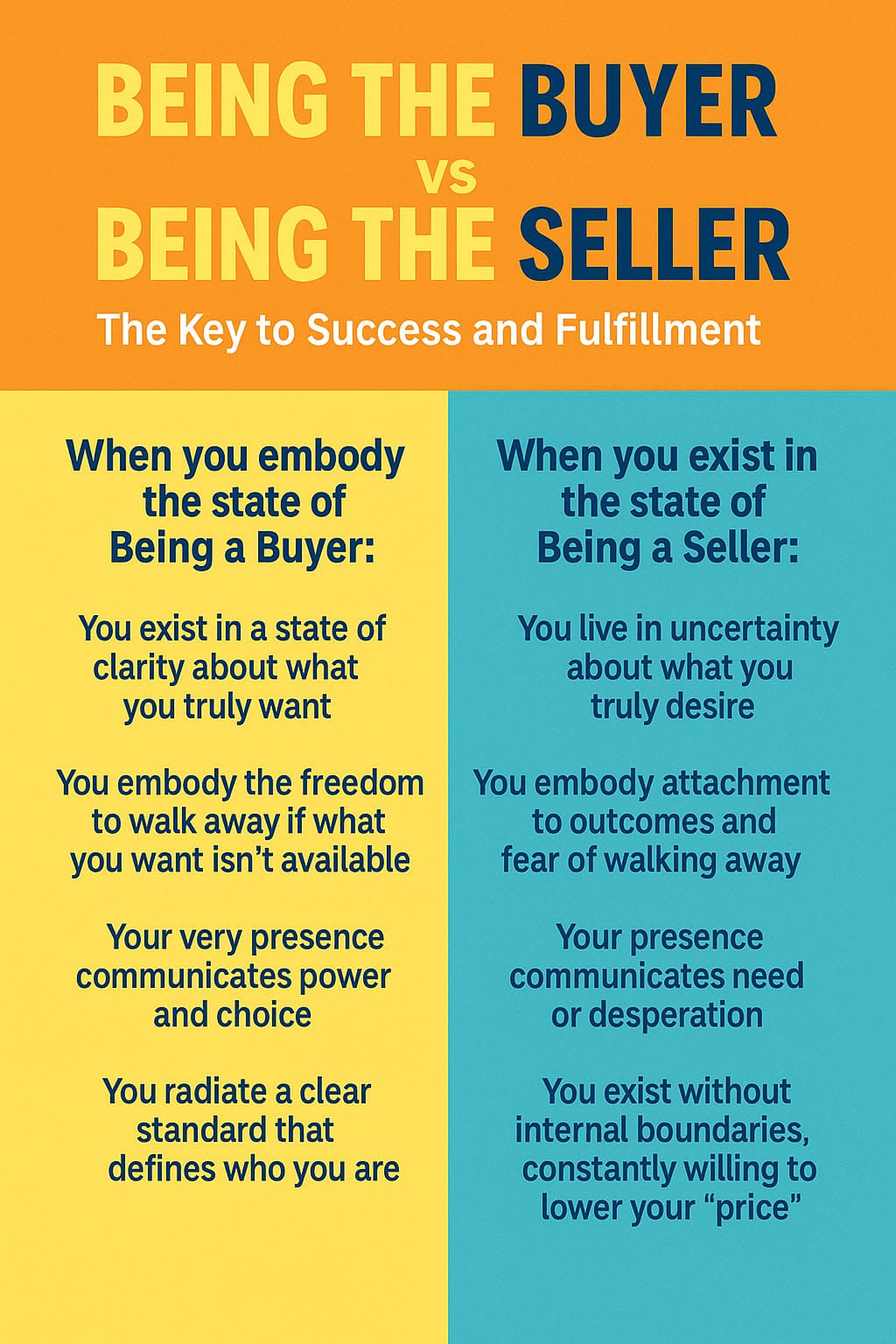
When you embody the state of Being a Buyer:
You exist in a state of clarity about what you truly want
You embody the freedom to walk away if what you want isn’t available
Your very presence communicates power and choice
You radiate a clear standard that defines who you are
When you exist in the state of Being a Seller:
You live in uncertainty about what you truly desire
You embody attachment to outcomes and fear of walking away
Your presence communicates need or desperation
You exist without internal boundaries, constantly willing to lower your “price”
The difference in outcomes between these two states of being is profound. The person who embodies Being a Buyer maintains their power, integrity, and self-respect while naturally attracting what they want. The person who embodies Being a Seller often gets worked over, manipulated, and feels diminished—sometimes without even getting the deal they were desperate to close.
The Executive’s Transformation: Why Leaders Must Be Buyers
For CEOs and senior leaders, shifting into the state of Being a Buyer isn’t just beneficial—it’s essential to authentic leadership. This is about who you are, not just what techniques you employ.
1. The Essence of Negotiation Power
When you exist as a Buyer in business negotiations, you naturally alter the energy dynamic of every interaction. Rather than existing in a state of trying to convince others to choose your product or service, you naturally screen them to determine if they’re a fit for what you offer. This fundamental shift in your state of being changes everything downstream.
As one of my clients once remarked: “If you’re the buyer, they’re lucky if you choose them. If you’re the seller, you’re lucky if they choose you.” This isn’t about tactics—it’s about identity.
2. The Embodiment of Standards Within Organizations
CEOs who exist in the Buyer state establish high standards that naturally permeate their entire organizations. By being clear about their minimum standards at the level of identity and comfortably walking away from opportunities that don’t meet them, they create a culture of excellence and intentionality.
One client shared how they turned down a speaking opportunity when the client tried to negotiate the fee down by $10,000. Instead of accepting the lower rate, they maintained their standard: “It’s this or nothing. I’m out.” The result? The client found a way to meet the original price. But importantly, even if they hadn’t, the leader was perfectly content to walk away—not as a strategy, but as a natural expression of who they are: a Buyer.
3. The Nature of Strategic Focus
Leaders who embody Being a Buyer aren’t scattered across a thousand initiatives. Their very nature understands that exponential results come from quality, not quantity. This state of being naturally translates into schedules that prioritize deep work and focused effort on the vital few projects that truly matter.
The Personal Transformation: Becoming a Buyer in Your Life
The Buyer vs Seller states of being extend far beyond the workplace. They fundamentally shape our personal relationships, our self-image, and our daily experiences from the inside out.
1. The Energy of Relationships
Many people unknowingly exist as sellers in their relationships—romantic, familial, and social. They emanate, sometimes subconsciously, that they’ll stay “at the table” regardless of how they’re treated (no boundaries or consequences of breaking them). This energetic dynamic invariably leads to imbalanced relationships where one party feels free to take advantage of the other or take the other for granted.
If you’re in an actual intimate relationship with someone that you know as a seller—like they’re just never gonna leave, you can do whatever you want to them—they will intuitively treat you as the seller.
The healthiest relationships occur when both parties exist as Buyers. Each person embodies clarity about why they’re there, radiates clear standards for the relationship, and naturally walks away if those standards aren’t met. This mutual state of being creates deeper connection and satisfaction.
2. Self-Worth and Mental Health
Constantly existing in the Seller state takes a severe toll on your mental health and self-image.
Conversely, when you exist as a Buyer—clear on your standards and willing to walk away—you naturally build self-respect. You embody self-value in how you treat your time, your work, and your contribution. This state of being is essential for mental wellbeing and sustainable performance.
3. Life Enjoyment Through Authentic Being
Being a Buyer means existing in a state of natural selectivity about where you invest your time, energy, and attention. This isn’t a strategy—it’s who you are, and it leads to higher quality experiences and relationships.
Most people go through life existing as perpetual Sellers, emanating desperation for any opportunity or connection. But those who embody Being a Buyer naturally engage only with what truly serves their goals and values. The result is a life of purpose, impact, and genuine satisfaction rather than scattered busyness.
The Inside-Out Transformation: Becoming the Buyer
Transitioning from Being a Seller to Being a Buyer requires an inside-out transformation—a shift in who you are, not just what you do. Here’s how this transformation unfolds:
For Leaders:
Define your standard as part of your identity: Know exactly what represents you and what doesn’t. Make this standard an expression of who you are, not just a tactical position.
Embody the capacity to walk away: Cultivate the inner freedom that allows you to turn down opportunities that don’t align with your identity, even when they seem attractive on the surface.
Exist in a state that values depth: Create multiple days per week with no meetings, allowing for the deep work that naturally produces breakthrough results when you value quality over quantity.
Embody different energies on different days: Like elite athletes, recognize that different days call for different states of being. Some days you embody performance, some days you embody deep focus, and some days you embody recovery.
For Individuals:
Recognize where you exist as the Seller: In which relationships or situations do you feel powerless or desperate? These are states where you’re Being the Seller.
Establish standards as expressions of your identity: For your relationships, your work, and how you spend your time, determine what aligns with who you truly are.
Replace “have to” with “get to”: As one leader shared, he naturally frames experiences optimistically: “Can you believe we get to do this? Isn’t this going to be awesome?” This isn’t just what he says—it’s who he is.
Align with those who embody your desired state of being: Surround yourself with people who naturally exist in the Buyer state you aspire to embody. Our state of being aligns with those we spend time with.
The Deeper Impact: From Transactional to Transformational Being
The Buyer vs Seller states of being ultimately represent a shift from transactional existence to transformational presence.
When you exist as the Seller, you emanate focus on the immediate transaction—getting the deal, maintaining the relationship, staying at the table. This short-term state of being leads to incremental results at best.
When you exist as the Buyer, you naturally focus on transformation—pursuing only what aligns with your highest standards and greatest goals. This long-term state of being leads to exponential results.
By existing as a Buyer, you naturally position yourself for these quantum leap improvements rather than the incremental gains that come from the desperate Seller state.
Conclusion: The Essential Choice of Being
In every interaction, negotiation, and relationship, you have a fundamental choice about who you will be: Will you embody the Buyer or the Seller?
The Seller exists in a state of desperation, constantly lowering their standards and price to stay at the table.
The Buyer exists in a state of clarity, embodying clear standards and the freedom to walk away.
One state leads to burnout, disappointment, and mediocre results. The other state leads to respect, fulfillment, and extraordinary impact.
The choice is not just about what you do—it’s about who you are at the deepest level. And it’s a choice you make in every moment of every day.
Choose wisely.
So ask yourself: In your current biggest challenge or opportunity, who are you being—the Buyer or the Seller? Your answer will determine not just the outcome, but how you feel about yourself along the way.
The most successful and fulfilled individuals—whether CEOs or everyday people—have embraced this truth: Life’s too short to exist as a Seller. Be the Buyer.
This is the Leadership Journey series on the Choosing Leadership Podcast.
I believe we all have a lot to learn from each other’s stories – of where we started, where we are now, and our successes and struggles on the way. With this series of interviews, my attempt is to give leaders an opportunity to share their stories and for all of us to learn from their generous sharing. If you know a leader whom you would like to see celebrated on the show, please send me a message on LinkedIn with their name.
What does it really take to lead with purpose in a fast-moving, high-stakes world?
In this episode, Kevin Kilty, CEO of Hub Pay, shares his bold journey from London’s finance world to launching a FinTech startup in Dubai—with zero startup experience and a lot of heart.
He opens up about the gritty realities of leadership, building culture across continents, and staying grounded when the pressure never lets up.
If you’re a leader navigating uncertainty, scaling a business, or simply craving more meaning in your work, this conversation delivers raw insight and practical inspiration.
Tune in to discover how impact and innovation can go hand in hand—without losing your sanity.
I use cookies on this website to give you the most relevant experience and for analytics purposes. Any personal data collected will never be shared with any third party, or used to spam you. That is my promise. - Sumit By clicking “Accept”, you consent to the use of ALL the cookies.
This website uses cookies to improve your experience while you navigate through the website. Out of these, the cookies that are categorized as necessary are stored on your browser as they are essential for the working of basic functionalities of the website. We also use third-party cookies that help us analyze and understand how you use this website. These cookies will be stored in your browser only with your consent. You also have the option to opt-out of these cookies. But opting out of some of these cookies may affect your browsing experience.
Necessary cookies are absolutely essential for the website to function properly. This category only includes cookies that ensures basic functionalities and security features of the website. These cookies do not store any personal information.
Any cookies that may not be particularly necessary for the website to function and is used specifically to collect user personal data via analytics, ads, other embedded contents are termed as non-necessary cookies. It is mandatory to procure user consent prior to running these cookies on your website.