This is the Leadership Journey series on the Choosing Leadership Podcast.
I believe we all have a lot to learn from each other’s stories – of where we started, where we are now, and our successes and struggles on the way. With this series of interviews, my attempt is to give leaders an opportunity to share their stories and for all of us to learn from their generous sharing. If you know a leader whom you would like to see celebrated on the show, please send me a message on LinkedIn with their name.
In this open and honest conversation, Shakun her personal story of living in the Netherlands and how that led her to start a company in an otherwise taboo industry. We also spoke about what gives her the confidence and grounding to lead her team, as well as the importance of slowing down and establishing clear boundaries.
One of the problem I had when I was starting my company was that it was difficult for me to go into an sex store and look around while asking questions.
I lost a lot of friends when I started my company because I come from a culture where talking about sex openly is a taboo
Demand is completely, nullified. Everybody has a demand, everybody wants it.
Due to the nature of my company, we started facing problems like banks would not allow us to have a bank account, PayPal and Stripe flagged us too.
Starting a company in an otherwise taboo industry led to the realization that this is not something bad or wrong, and then internally you feel okay, you feel more confident, you feel more open while otherwise.
After my 12 or 13 hours shift when I lie down in the bed, I have a smile on my face. I know that, we are onto something big and what we are building is like we are in a position to make it.
Welcome to the Deploy Yourself Newsletter, where I gently provoke you to show you your own power. This newsletter is an invitation to your leadership. You can also read this issue online.
Hey,
7 Deep & Provocative Quotes to Uplevel your Leadership
I love collecting one-liners and quotes to provoke my own thinking as I learn to be a better leader.
Here are 7 deep and provocative quotes from my collection that force me to stop and reflect to understand their depth.
In the last few weeks, I have kept these on different post-its on my desk, and I continue to get insights from them daily.
They are:
“Before I can tell my life what I want to do with it, I must listen to my life telling me who I am.” ― Parker J. Palmer
“If you are irritated by every rub, how will your mirror be polished?” ― Rumi
“We are all self-made, but only the successful will admit it.” ― Earl Nightingale
“Chains of habit are too light to be felt until they are too heavy to be broken.” – Warren Buffet
“They tried to bury us. They didn’t know we were seeds.” – Mexican proverb
“Do the difficult things while they are easy and do the great things while they are small. A journey of a thousand miles must begin with a single step.” — Lao Tzu
“Physics isn’t the most important thing. Love is.” ― Richard P. Feynman
Which one of the above stand out for you?
What do they provoke in you?
Reply back and share your reflections or your own favorite quote.I read and respond to every reply.
Fascinating Articles & Stories
One
Deepali Singh – “If a woman can give birth to a baby, then what else could be more challenging?”
I interviewed my first boss and serial entrepreneur Deepali Singh on the Choosing Leadership podcast. Deepali shares about being a risk taker and putting her heart and soul into everything she has done.
Timothy Golden – “Learn the job of the human above me and teach my job to the human below me”
I interviewed Tim Golden, CEO at compliancerisk.io and CTO of Vital Tech Services on the Choosing Leadership podcast. We talked about:
When dealing with humans cuz you can’t program them like you can program computers. Um, I really needed to learn some effective communication techniques.
I needed to learn compromise not always being right. In fact, one of the hardest lessons I had to learn was that, you know, there are way, there are people way smarter than me in some of these disciplines and I used that as a way for me to grow.
I have a core group of people that speak the truth and love to me and tell me where, you know, where I’m doing wrong, where I could improve, and I take their advice to heart and I try to make those changes along the way
one of the things I picked up on was initiative, right? Taking the initiative on oneself to not only better yourself, but better the person next to you,
That’s it for now. If you have any questions or feedback, or if you are new and want to introduce yourself, hit reply. I read and respond to every reply. All the best,
Sumit
P.S. – I am looking to interview more inspirational leaders on my podcast. If you know anyone I should interview, reply back with their name.
This is the Leadership Journey series on the Choosing Leadership Podcast.
I believe we all have a lot to learn from each other’s stories – of where we started, where we are now, and our successes and struggles on the way. With this series of interviews, my attempt is to give leaders an opportunity to share their stories and for all of us to learn from their generous sharing. If you know a leader whom you would like to see celebrated on the show, please send me a message on LinkedIn with their name.
In the interview, we talk about the importance of continuously learning and growing over time, and the challenges as you move from an IC to being a manager, and then a manager of managers. He shares the importance of EQ as well as IQ, the importance of self-awareness, and how he has learned to do performance management and feedback conversations very differently from most companies.
Different people have different motivations that drive them forward. For me, learning is one of those. So I always look for opportunities to be learning and growing,
Sometimes those challenges feel insurmountable in the moment, but when you look back, you can see. The amount of growth and development that’s happened in them
those inflexion points teach you a lot about how to think about your own time, how to think about the leverage effect of your time
The most humbling moments are the moments where I’ve. Let go of something and my team has done a much better job than I would’ve done with it.
The feedback that is gonna drive real performance is given as close to the incident where the feedback was generated as possible. So you can course correct as early as possible.
We are always smaller than we will be in the future, and so as a leader, that means that I will always have a larger and larger team to lead
This is the Leadership Journey series on the Choosing Leadership Podcast.
I believe we all have a lot to learn from each other’s stories – of where we started, where we are now, and our successes and struggles on the way. With this series of interviews, my attempt is to give leaders an opportunity to share their stories and for all of us to learn from their generous sharing. If you know a leader whom you would like to see celebrated on the show, please send me a message on LinkedIn with their name.
In the interview, Jose shared how coming from a family of immigrants meant that he had to be better than anybody else to be able to reach anywhere. We spoke about his views on computers, entrepreneurship, always being secure about himself, and how with a very good team, you can make the impossible happen. He shares the importance of a good night’s sleep and taking care of our bodies.
It’s never easy to be an immigrant, depending on the country where you are. But I always felt that I had to be better than anybody else because if I would not be, right? As an immigrant, you would not be able to reach anything. So there was a very big push for you to overperform always. And this definitely influenced my life later on.
I think entrepreneurs in general are also very creative people. they are solution providers, right? They are always thinking about something new, an idea, or solving a problem, right? So it’s a combination of an X amount of things. Uh, and definitely that was my case as well.
when you work for money, right, money is the most important thing. But when you work with a mission and with pleasure, money is something that comes in second place.
when you were younger, you. Are a little bit more stressed, I think this is the right word. You are a little bit more anxious to get things done right. When you get older, you become a calmer, uh, it’s, I think it’s a maturity process and you become because you are, you have more experience, you become more wiser in the decision that you make and how you handle it.
All my staff members are also stakeholders in the company, so I don’t have people in the company that HA are not a shareholder today. And this makes a huge difference because they know that whatever they’re building okay.
I would say that in every business, the most important thing in a business is your team. Without a proper team, you can not make miracles. But with a good, very good team, you can make the impossible. Okay. Even if your business is not so good.
every leader can make mistakes that make, that’s what makes us human
So your co-founders, I like to talk, say, talk about co-founders. Your co-founders are a very important piece of the whole puzzle. Even if a few things, uh, don’t go as planned, your co-founder is, right there to support you and help you to get out faster.
you cannot do it alone. You need to have people around you. So start building that team around you, as fast as possible. But you are also not the only knowledgeable person in the world, and I can tell you upfront that you definitely are not they’re always smart at people than ourselves.
This is the Leadership Journey series on the Choosing Leadership Podcast.
I believe we all have a lot to learn from each other’s stories – of where we started, where we are now, and our successes and struggles on the way. With this series of interviews, my attempt is to give leaders an opportunity to share their stories and for all of us to learn from their generous sharing. If you know a leader whom you would like to see celebrated on the show, please send me a message on LinkedIn with their name.
In the interview, Tim shares how programming came very naturally to him but the transition from programming to leadership and management meant he needed to learn to compromise and not always being right and what it means to effectively communicate. He also shares the importance of discipline and camaraderie which he learned from the military. He also shares the lesson of learning the job of the human above me and teaching my job to the human below me.
When dealing with humans cuz you can’t program them like you can program computers. Um, I really needed to learn some effective communication techniques.
I needed to learn compromise not always being right . In fact, one of the hardest lessons I had to learn was that, you know, there are way, there are people way smarter than me in some of these disciplines and I used that as a way for me to grow.
I have a core group of people that speak the truth and love to me and tell me where, you know, where I’m doing wrong, where I could improve, and I take their advice to heart and I try to make those changes along the way
learn from others, but give back twice as much as you can.
Being able to get that discipline, being able to get that sense of camaraderie, that sense. of Family, uh, which is kinda lacking nowadays in our world, We’re so disjointed
one of the probably single most important thing that I learned was learn the job of the human above me and teach my job to the human below me.
one of the things I picked up on was initiative, right? Taking the initiative on oneself to not only better yourself, but better the person next to you,
This is the Leadership Journey series on the Choosing Leadership Podcast.
I believe we all have a lot to learn from each other’s stories – of where we started, where we are now, and our successes and struggles on the way. With this series of interviews, my attempt is to give leaders an opportunity to share their stories and for all of us to learn from their generous sharing. If you know a leader whom you would like to see celebrated on the show, please send me a message on LinkedIn with their name.
In the interview, Deepali shares about being a risk taker and putting her heart and soul into everything she has done. We also spoke about the challenges of being a female leader, and how to deal with stereotypes and gender biases at work. We also reflected on the time when we worked together, the positive influence she has had on me, and how leadership is about continuously evolving and growth.
being a woman, you have to always stand up for yourself.
whenever I have had given interviews in the past, uh, I was always asked, what will you do? Will you continue to work after marriage? What will you do when you have kids? Will you continue to work? What’s going to happen to your career? Right or wrong, these kind of questions are never, ever going to be ever asked from a guy.
key is awareness. Standing up, asking for it, and if you, uh, you don’t know what to do, find a mentor, find a champion for your cause, but then you have to Be vocal about what you feel should be done with you and how exactly do you want your career or whatever it is.
you are categorized as somebody who always is a troublemaker because you’ll always stand up and always ask for something which is rightfully should be rightfully done to you
God has given this privilege to women to be able to bear kids right now. Organizations, I’ll not say organizations, but I’ve seen situations where, roles are withdrawn from women, but just because, you know, they, they’ve taken a break or they’re expecting, I mean, for God’s sake, they’re just delivering a baby. They haven’t becoming a, they haven’t become brain dead, right.
And the reasons they will give you that. Oh no. We want you to, uh, be relaxed, calm. We don’t want to give a stressful job. And you know that when once you are coming, when you come back after that break, you are never ever going to be given those prestigious projects or the job or the assignment that was yours earlier.
So you have to flag it, you have to take it to the concerned authorities and say that, see this.
you have to spend a lot of time with yourself and try and ask questions from yourself that what exactly do you want?
why I am doing this is also is a very difficult question to answer, and, um, because it’s difficult, you don’t want to answer it, you kind of always keep on running about it.
Welcome to the Deploy Yourself Newsletter, where I gently provoke you to show you your own power. This newsletter is an invitation to your leadership. You can also read this issue online.
Hey,
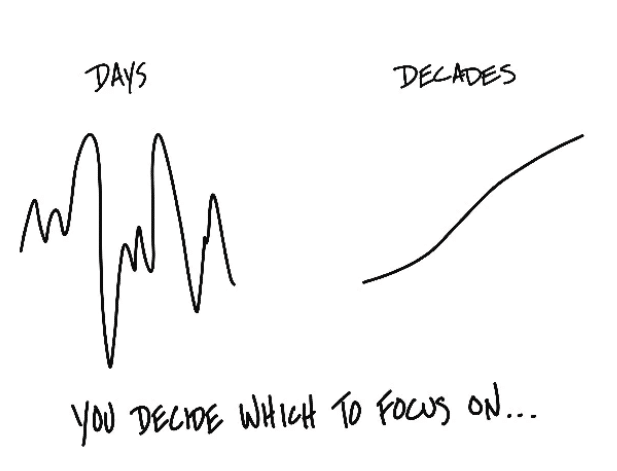
Short or long-term thinking? An image that says it all!
When you focus on the short term, you experience more fluctuations emotionally. It is turbulent.
When you focus on the long term, you experience less turbulence and smooth progress.
The external events or circumstances do not change with either. They are the same.
It is a mindset shift – two ways of looking at the same events and reality.
One gives you anxiety.
One leaves you calm and composed to deal with what you have to deal with.
The good news is – we have a choice in how we look at life – short-term or long-term?
Which one are you focusing on? Is it working for you?
If yes, great! But if not, what new results could be possible if you shift how you are looking at things?
Reply back and share what this is provoking for you.I read and respond to every reply.
Fascinating Articles & Stories
One
Eva Poppe – “When you get out of your comfort zone, you learn so much about yourself.”
I interviewed Eva Popee, Chief Growth Officer at ZeroLight on the Choosing Leadership podcast. Eva shares:
You learn so much about yourself as much as you learn about other cultures.
it’s crucially important that you can have a joke from time to time.
Getting out of your comfort zone, you learn so much about yourself, about others, about empathy. It makes you humble. Um, which I think is very important because You’re no better than others.
I think it is very important if you talk to people from, like other views who give you like an outside view on where you’re at because you’re in your own zone a lot of times you can, um, then not see left or right.
Nick McQuire – “Learn it all as opposed to know it all”
I interviewed Nick McQuire, Director of Product Management at Microsoft on the Choosing Leadership podcast. We talked about:
mindfulness works for me as long as I’ve got that structure and it’s communicated well with the team that and everyone understands and we’ve got a mutual respect for that, it works.
if you can have those transparent discussions and there’s flex on either side. I think it ultimately, that’s the place you want to get to and that transparency and respectful approach to your colleagues, I think is so important.
the big changes that happened in my life and career as a result of setbacks ultimately turned to be really good things.
The temptation and the visceral reaction is quite natural, is to be downbeat and to be a little bit oh my goodness, you know, what’s happening, type of, uh, reactions. But I think in the long run, kind of hold onto the point that actually these tend to be really positive events, cuz you’ll be able to, it’ll take you onto, you’ll either trampoline into another area.
That’s it for now. If you have any questions or feedback, or if you are new and want to introduce yourself, hit reply. I read and respond to every reply. All the best,
Sumit
P.S. – I am looking to interview more inspirational leaders on my podcast. If you know anyone I should interview, reply back with their name.
This is the Leadership Journey series on the Choosing Leadership Podcast.
I believe we all have a lot to learn from each other’s stories – of where we started, where we are now, and our successes and struggles on the way. With this series of interviews, my attempt is to give leaders an opportunity to share their stories and for all of us to learn from their generous sharing. If you know a leader whom you would like to see celebrated on the show, please send me a message on LinkedIn with their name.
In the heartfelt conversation, Nick shares about his unusual background and how that gives him an advantage. We talk about how he maintains a harmony between work, family, and health – while living in London and leading his team based on the west coast of the US. Listen to this one for some practical tactics on how to structure your day and when and where to draw boundaries.
my route through to where I’m at, uh, at the moment, has certainly been a kind of a meandering path through a number of different opportunities and challenges
mindfulness works for me is as long as I’ve got that structure and it’s communicated well with the team that and everyone understands and we’ve got a mutual respect for that, it works.
if you can have those transparent discussions and there’s flex on either side. I think it ultimately, that’s the place you want to get to and that transparency and respectful approach to your colleagues, I think is so important.
the big changes that happened in my life and career as a result of setbacks ultimately turned to be really good things.
The temptation and the visceral reaction is quite natural, is to be downbeat and to be a little bit oh my goodness, you know, what’s happening, type of, uh, reactions.
But I think in the long run, kind of hold onto the point that actually these tend to be really positive events, cuz you’ll be able to, it’ll take you onto, you’ll either trampoline into another area.
This is the Leadership Journey series on the Choosing Leadership Podcast.
I believe we all have a lot to learn from each other’s stories – of where we started, where we are now, and our successes and struggles on the way. With this series of interviews, my attempt is to give leaders an opportunity to share their stories and for all of us to learn from their generous sharing. If you know a leader whom you would like to see celebrated on the show, please send me a message on LinkedIn with their name.
Gerbert is the COO & co-founder of Venly.io based in Belgium. In the interview, we spoke about the importance of culture when working remotely. Gerbert shares the lessons they learnt when they went fully remote and the practical things they do to listen, share, and strengthen human relationships, even when they have employees from 15 different countries. We also talk the most difficult time for them when they had almost ran out of money, and how they persevered and come out on the other side of the struggle.
So we ran out of money while still building a company. We worked like nine months without any salary.
it was quite painful because after working two years together with these people, we were very close to them. We were fond of them. We went together on skiing trips. Um, so yeah, that was quite painful
if you believe in your vision and you have some proof of the market that, that your product fits the market, I think you just have to keep going and pushing and not give up because of some setback
I used to be involved in every aspect of the business. Um, I used to be much closer to technology and to product while I’m not really involved on that anymore. So the bigger the company grows, they’re less involved in every, um, department in nitty gritty detail.
my goal is to make me myself obsolete in the company,
I make sure I have enough sleep, so I’m well rested and I love to go to the golf club and hit some balls.
This is the Leadership Journey series on the Choosing Leadership Podcast.
I believe we all have a lot to learn from each other’s stories – of where we started, where we are now, and our successes and struggles on the way. With this series of interviews, my attempt is to give leaders an opportunity to share their stories and for all of us to learn from their generous sharing. If you know a leader whom you would like to see celebrated on the show, please send me a message on LinkedIn with their name.
In the interview, we talk about learning from different cultures, how people’s expectations from leaders have changed in the last few years, and how you can be both loving and empathetic towards your people while at the same time holding each other accountable for our responsibilities as a team/company.
experiences in a different country make you humble.
You learn so much about yourself as much as you learn about other cultures.
people are expecting different things from leaders
it’s crucially important that you can have a joke from time to time.
the good thing is that I’m a very positive person
I’ve been working in the tech industry for more than a decade now, and I’ve figured already that in the tech industry, there are not as many females.
Getting out of your comfort zone, you learn so much about yourself, about others, about empathy. It makes you humble. Um, which I think is very important because You’re no better than others.
I think it is very important if you talk to people from, like other views who give you like an outside view on where you’re at because you’re in your own zone a lot of times you can, um, then not see left or right.
So if someone is coming in and kind of puts a little bit into the right in into the right context. It helps tremendously.
I use cookies on this website to give you the most relevant experience and for analytics purposes. Any personal data collected will never be shared with any third party, or used to spam you. That is my promise. - Sumit By clicking “Accept”, you consent to the use of ALL the cookies.
This website uses cookies to improve your experience while you navigate through the website. Out of these, the cookies that are categorized as necessary are stored on your browser as they are essential for the working of basic functionalities of the website. We also use third-party cookies that help us analyze and understand how you use this website. These cookies will be stored in your browser only with your consent. You also have the option to opt-out of these cookies. But opting out of some of these cookies may affect your browsing experience.
Necessary cookies are absolutely essential for the website to function properly. This category only includes cookies that ensures basic functionalities and security features of the website. These cookies do not store any personal information.
Any cookies that may not be particularly necessary for the website to function and is used specifically to collect user personal data via analytics, ads, other embedded contents are termed as non-necessary cookies. It is mandatory to procure user consent prior to running these cookies on your website.