This is the Leadership Journey series on the Choosing Leadership Podcast.
I believe we all have a lot to learn from each other’s stories – of where we started, where we are now, and our successes and struggles on the way. With this series of interviews, my attempt is to give leaders an opportunity to share their stories and for all of us to learn from their generous sharing. If you know a leader whom you would like to see celebrated on the show, please send me a message on LinkedIn with their name.
In our conversation, we spoke about how moving from Macedonia to the UK has shaped her as a leader. We talked about resilience, persistence, and the difficult choice she had to make once she moved to the UK. We speak about how people are often surprised by her determination, and how she has learned to show vulnerability as well as be open to criticism.
Even if you are a successful person at what you did, There’s always something that you can train and do a little bit better.
If you have a passion, if you have ambition, don’t give up on it. It doesn’t matter when it’s gonna pan out, it will pan out in the end.
I also show that I’m vulnerable as well. I do mistakes and I honor them, and I also am open to criticism whether it’s negative, positive criticism. I’m open to it.
I am looking at everyone’s on a level that we are all people, whether we are leaders, whether we are all working together for someone’s objective.
If there is a friction. You need to work on that section. Never let it go. Never let it just under the carpet because at some point in your life or your working career will come back and bite you.
I guess the combination of my determination and openness to listen to other people in their opinion, I think that’s the combination that makes me a good leader.
And I think one of the key things is that also, even if you are in a boardroom and you’re talking to your board and you know that you want to say something, but you are fearing to say that, say it’s better to be said and done rather than keep it to yourself.
This is the Leadership Journey series on the Choosing Leadership Podcast.
I believe we all have a lot to learn from each other’s stories – of where we started, where we are now, and our successes and struggles on the way. With this series of interviews, my attempt is to give leaders an opportunity to share their stories and for all of us to learn from their generous sharing. If you know a leader whom you would like to see celebrated on the show, please send me a message on LinkedIn with their name.
In the interview, David shares how he grew up with a love for Math and Physics, and how that changed once he started managing people. We spoke about mentoring and coaching, and the important role of emotions and empathy in building strong relationships. He shared an example of how playing football led to a breakthrough in conversation which was not happening otherwise, and that led to an interesting conversation.
A lot of people who go into leadership for the first time still think they need to be firing on all cylinders as an individual contributor as well. And really, once you’ve got a team of three or four, that’s actually the minority of your time, the majority of your time is looking after your team.
And then, suddenly I’m looking after a team of three or four, and I’ve learned to that I’m supposed to be delegating a fair amount. I think that was helpful for me.
You need to be doing organizational impact work. And if that’s not there, you begin to feel a bit lost.
if you’re not involved, you just get isolated. There’s, it’s very difficult.
This is the Leadership Journey series on the Choosing Leadership Podcast.
I believe we all have a lot to learn from each other’s stories – of where we started, where we are now, and our successes and struggles on the way. With this series of interviews, my attempt is to give leaders an opportunity to share their stories and for all of us to learn from their generous sharing. If you know a leader whom you would like to see celebrated on the show, please send me a message on LinkedIn with their name.
In the interview, Jami shares about the people who have impacted his journey, the importance of clarity and self-leadership, and how that allows you to move forward with purpose and courage. We spoke about his dreams and ambitions, how he deals with change, and the power of choosing to do something instead of it being an obligation.
We have to have very good clarity. Clarity is very important and having core clarity helps us to understand who we are while we are, making choices.
Leadership is part of life, it is not only related to the business layer but also to the personal layer and on the social and civic and every aspect of it.
Leadership is not only from driving value, it’s also about the identity and also how you advocate your ideas and how you boldly take the decisions and how you stand for yourself and for others, and how you develop and hope you double up and drive the influence, not only with your connection, with your community, but also how you support to build trust, which will act as an enabler.
Multi-lateral communication is vital.
Leadership need two things. One is mind and heart, but now it is heart and mind together.
This is the Leadership Journey series on the Choosing Leadership Podcast.
I believe we all have a lot to learn from each other’s stories – of where we started, where we are now, and our successes and struggles on the way. With this series of interviews, my attempt is to give leaders an opportunity to share their stories and for all of us to learn from their generous sharing. If you know a leader whom you would like to see celebrated on the show, please send me a message on LinkedIn with their name.
Kevin spoke about the lessons he learnt from that experience, the value of transparency and honesty, and putting people first. He shares his vision for Nostra for the next 10-15 years, while at the same time expressing gratitude to his family and everybody he works with.
Our key strategy has been getting a customer, look after everything to do with it, including the supply of people, if they’re required and then keeping the customer for as long as you possibly can.
We very rarely lose a customer.
I’ve learned that my wife and kids are far more important than any of those things.
People’s happiness comes from the people that are around them. And one of the things, that I’m blessed with is having a great family, a very supportive wife, and amazing kids who are all flying.
Every business is about people and you have to get yourself in a place that you’re in a good place personally. And then you can grow a business
The number of times that the directors and the company had to have their salaries delayed for the following couple of years, it was very difficult, but the learning, it was, we learned. How to survive. We learned how to negotiate. We didn’t lose any people during that period. And, we even had some of the internal staff saying, listen, I’ve got a credit card. If we need to use it to buy things, I had unbelievable support from everybody.
One of the reasons our accounts were so bad was I wanted to look after the people. So at no point was I gonna let good people go that I cared about, we would carry everyone.
There are lots in companies that is left unsaid and left undone. And for me, it’s, if you’re not enjoying leadership, there’s something wrong. Go find it, figure it out, have the conversation and deal with things as they come up.
We said we would get through which we did. And then we’d move on. And that’s something I’m very proud of.
No matter what challenge or headwind comes out at an organization, there is always a way out.
Welcome to the Deploy Yourself Newsletter, where I share what impactful leadership looks like to show your own power. I also share the most insightful lessons and stories I encountered in the last two weeks. You can also read this issue online.
Hey,
Do you prioritise being liked more than growing those around you?
Your primary task as a leader is to create more leaders around you, not more followers.
You build followers when you prioritise being liked.
You build leaders when you challenge those on your team to learn and grow.
I get it. We all want to be liked. Especially by our team. But ask yourself –
Can you risk the possibility of not being liked for creating a better team and organisation?
Can you risk staying in the uncomfortable space of not knowing and not having full control?
The next time you are tempted to say or do something (usually a habit) because others will like you, stop yourself.
Turn it into a growth opportunity instead:
Remember to play the coach, instead of always playing the captain. Set clear expectations, listen for a full-body YES, and then give people what they need to do their job.
Ask the right questions – Instead of the temptation of providing answers and showing how much you know, acknowledge that your knowledge is holding your team back. Learn to ask questions that force others to think, introspect, and discover what you know for themselves.
Do not make yourself indispensable. Make yourself redundant. Your real success is when your team can do the job without you. That is what ultimately sets apart great leaders – they build great teams.
Ready to make a powerful start to 2023 and make it your best year ever?
I will be hosting a free public talk in December on how to make a powerful start to 2023.
You have to treat your employees as children in a right and you allow your children to make mistakes, and that’s how to learn to walk.
I want to understand what happened instead of coming to that employee and being, How could you have done this? The question is, what do you think went wrong? What could you have done differently?
If they take ownership, There are two things that happen. First of all, they see that you’re trying to help them grow. Second of all, they remember that lesson and it, they retain it in their mind. So the likelihood of the same issue occurring again decreases dramatically.
Ultimately your goal as a leader is to build that relationship with your team so that they come to you. It has nothing to do with fear of punishment or repercussion or anything like that.
So it’s my job to serve them, to empower them to then service our clients, which in turn helps me accomplish my goal of building a, larger and more successful organization.
I interviewed Ennio R. Neumann Senese on the Choosing Leadership podcast. We talk about nature vs nurture, how we are shaped as individuals, and how growing up in an entrepreneurial family shaped him. He shared a couple of serendipitous moments which have turned out to be instrumental in his journey. We touched upon the important role of meditation in helping him stay balanced as a leader, and how his leadership style has evolved over the years.
There are so many books about leadership. If you have read them all, the risk is that by the end, you still don’t know what leadership is.
So I’m very grateful for the fact that I’ve been able to fail. On a couple of occasions, which gave me the opportunity to learn and to see that there are better ways to move on.
In the end, you need to ask yourself, what am I doing? Is that what I’m contributing to? Is that really something that is contributing to, the better of mankind, to improve the world to have some, another type of gold than just purely commercial?
I always recommend also to people who work with me to do a bit of a retreat for a couple of days in complete silence and just think about, the purpose of life, things that you are grateful for, things that you have experienced, lessons learned, over a period of time.
In the end, it’s always about reflection and the ability to see how unimportant you really are at the end.
This is the 66th edition of this newsletter which I started 2.5 years ago. I hope it continues to add value. Please share any feedback when it does or does not.
As a show of gratitude, I want to share some research reports I often share with my coaching clients.
These reports have been a result of my experience and research leading teams, making mistakes, and slowly growing in my own leadership. I hope you will find these valuable as well. These are :
Care To Lead: Why There Is No Leading Without Caring(download here)
The Listening Habit: The One Habit Which Enables All Others(download here)
Fearless Feedback: Recognise Feedback For The Gift That It Is(download here)
That’s it for now. If you have any questions or feedback, or if you are new and want to introduce yourself, hit reply. I read and respond to every reply. All the best,
Sumit
P.S. – I am looking to interview more inspirational leaders on my podcast. If you know anyone I should interview, reply back with their name.
This is the Leadership Journey series on the Choosing Leadership Podcast.
I believe we all have a lot to learn from each other’s stories – of where we started, where we are now, and our successes and struggles on the way. With this series of interviews, my attempt is to give leaders an opportunity to share their stories and for all of us to learn from their generous sharing. If you know a leader whom you would like to see celebrated on the show, please send me a message on LinkedIn with their name.
In the interview, she talks about being a women in a male-dominated tech world, and how her mother inspired her to be her own self. We discussed how knowing who you are and trusting yourself first is the key to move forward in a world where you do not feel like you fit in or understand what you are permitted to do. She gave a powerful message of not giving anybody else the permission to make you upset, stressed, or impact your mental health. I loved interviewing her, and I am sure you – the listener – will take a lot away too from this interview.
I’ve continued to live my life from a very young age being a hybrid between I like to be involved in storytelling and impacting people’s life.
At the same time, I’m also very much a scientist at heart and to sit down and really nerd out the technologies. So I think I have always been balancing these two
The technology world is very male dominated and I’m also currently based now in Silicon valley and it’s also very male dominated.
I realized that there is a really big gap in how we communicate these fields to women.
I want more women in technology and especially more women in AI engineering
More women are working and more women are taking into leadership positions. And a lot of men are welcoming to it and some are less welcoming to it. But that’s part of the journey.
Unapologetically, be yourself because I think confidence comes up from within. And you can strongly believe that you are being your best self and at the same time also allow room for constructive criticism.
I cannot dictate what other people will say to me. I cannot dictate how people feel about me, but I can dictate how I react to it.
I don’t think it’s worth getting personal
You can control how things affect you. You can control what you want to hear, and if it doesn’t serve your purpose, if it doesn’t serve your growth, it’s not worth putting your energy in.
We become too sensitive as the generation sometimes. And if we consider everything to be a negative message, then we will not grow.
And if you trust a little bit more, I think you were able to do whatever you put your heart to.
You are also much more powerful than you think you are. I think a lot of women sometimes put themselves down and don’t think they’re good enough for the job or good enough to get into the engineering field or good enough to start their dream.
I can do whatever I want.
I think people don’t realize that I am a work in progress to get to this place. And there are moments where I feel insecure and where I’m like, I don’t know what I’m doing, where I’m going and it’s okay.
This is the Leadership Journey series on the Choosing Leadership Podcast.
I believe we all have a lot to learn from each other’s stories – of where we started, where we are now, and our successes and struggles on the way. With this series of interviews, my attempt is to give leaders an opportunity to share their stories and for all of us to learn from their generous sharing. If you know a leader whom you would like to see celebrated on the show, please send me a message on LinkedIn with their name.
In our conversation, we talk about nature vs nurture, how we are shaped as individuals, and how growing up in an entrepreneurial family shaped him. He shared a couple of serendipitous moments which have turned out to be instrumental in his journey. We touched upon the important role of meditation in helping him stay balanced as a leader, and how his leadership style has evolved over the years.
I believe that people have to be self-supportive. But if we can’t be, if they can’t be self-supportive, then we as a state or as a society needs need to help those people in moving along.
There are so many books about leadership. If you have read them all, the risk is that by the end, you still don’t know what leadership is.
Some bits of an ego you need to have in order to move on because otherwise, it becomes a very passive life,
So I’m very grateful for the fact that I’ve been able to fail. On a couple of occasions, which gave me the opportunity to learn and to see that there are better ways to move on.
I think it’s about balance first thing. So that’s a key word balance.
In the end, you need to ask yourself, what am I doing? Is that what I’m contributing to? Is that really something that is contributing to, the better of mankind, to improve the world to have some, another type of gold than just purely commercial?
Those types of existential questions. I think if people would dedicate more time without having their relatives or loved and dying around them but dedicate more time to think about those types of existential questions. I think, first of all, we would live in a better world for sure.
I always recommend also to people who work with me to do a bit of a retreat for a couple of days in complete silence and just think about, the purpose of life, things that you are grateful for, things that you have experienced, lessons learned, over a period of time.
I meditate but sometimes events happen. Also, unexpected events, which basically prevent you from, from staying calm because it’s easy to stay calm in a very calm environment where there is no pressure, et cetera, et cetera.
In the end, it’s always about reflection and the ability to see how unimportant you really are. at the end.
This is the Leadership Journey series on the Choosing Leadership Podcast.
I believe we all have a lot to learn from each other’s stories – of where we started, where we are now, and our successes and struggles on the way. With this series of interviews, my attempt is to give leaders an opportunity to share their stories and for all of us to learn from their generous sharing. If you know a leader whom you would like to see celebrated on the show, please send me a message on LinkedIn with their name.
In the interview, we speak about how starting JetRockets was not planned but accidental, and why she is running a TEAL self-managed organisation. We spoke about her views on leaders, some of the recent mistakes she had made, and her commitment to her employees was evident from how they moved their employees out of Russia because “it was the right thing to do”.
I had to take a step back and learn to delegate. And to learn to focus on working on the business, not in the business.
You can accomplish a lot more by being an empathetic leader as opposed to being a demanding manager
if a mistake is made, it’s okay. It’s a learning, it’s a learning opportunity and I actually encourage my people, my employees, to go outside of their box, their thinking box, to try new things because that’s what contributes to creativity and improvement over time.
You have to treat your employees as children in a right and you allow your children to make mistakes, and that’s how to learn to walk.
I’ve learned a lesson never to try and address the issue immediately. So if something were to happen, you gotta take a break of a few minutes, 15 minutes, 30 minutes, or even an hour is not going to change anything dramatically in terms of your response, but it will definitely, in terms of your response time, but it’ll definitely have a drastic effect and quality of your response.
I want to understand what happened instead of coming to that employee and being, How could you have done this? The question is, what do you think went wrong? What could you have done differently?
If they take ownership, There are two things that happen. First of all, they see that you’re trying to help them grow. Second of all, they remember that lesson and it, they retain it in their mind. So the likelihood of the same issue occurring again decreases dramatically.
Ultimately your goal as a leader is to build that relationship with your team so that they come to you. It has nothing to do with fear of punishment or repercussion or anything like that.
We’re business. We’re not an army.
So it’s my job to serve them, to empower them to then service our clients, which in turn helps me accomplish my goal of building a, larger and more successful organization.
Welcome to the Deploy Yourself Newsletter, where I share what impactful leadership looks like to show your own power. I also share the most insightful lessons and stories I encountered in the last two weeks. You can also read this issue online.
Hey,
Do you talk yourself out of your own dreams?
You can have and go for any dream if you don’t talk yourself out of it first.
If you have a dream, you want to be deeply grounded in that. You want to be sure that it is more than a fantasy or wish. For many people – Visualising their dream future and speaking it out loud works best to get their bodies & brains familiar with it.
Once you are sure that this is a dream that fills you up with passion, and you are willing to commit (not make it trivial) to the journey, you are in the game. You know that it matters to you deeply – and is not just superficially.
The next thing is to make sure you do not talk yourself out of the dream. It is so easy to talk yourself out of your dreams by thinking or saying, “I will never achieve that.”, “They will never pay me that.”, “He will never say YES to that.”, or “I do not have what it takes.” This applies to any dream or future vision you might have.
I am coaching an ex-SVP of Product from a tech unicorn who is currently a startup entrepreneur. He wanted to give back to the product manager community. However, he was talking himself out of his dream by thinking, “I have no time.” or “Why will they listen to me?”, or “I do not know public speaking” or “I am a nobody compared to this or that person”.
We worked on that unless he started showing up at conferences and networking events in a way that he was giving back to the communityjust by his presence, listening and speaking. Very soon organisers of conferences and other influential people started to notice and invite him to speak or present at their events. All of this happened because of a lot of preparation and practice on “not talking yourself out of your own dreams”.
Today, he is contributing and giving back to the product manager community, leaving him with a deep sense of satisfaction and meaning in his life. And every time I speak to him (he is still a client), I am amazed by how “light” he is and he often can’t stop smiling and blushing at the life he is living now – even though he is tackling much bigger challenges than ever before.
Ready to make 2023 your best year ever? What would need to happen for you to call 2023 your best year?
If you are ready to make your wildest dreams real, and willing to accept support and help in the process (as nobody does it alone), then, I want to be YOUR coach.
Reply back to find out my requirements from those I support.
Fascinating Articles & Stories
One
Don’t Focus on Your Job at the Expense of Your Career
In her book, Dorie Clark writes about how to simultaneously navigate two realities: meeting the short-term needs of the moment (i.e., doing your job to pay the bills) while positioning yourself for long-term success. Here are four principles:
New Inspiring Episodes on the Choosing Leadership Podcast
Below are the latest episodes where I have interviewed these amazing leaders. Listen to their story to know the choices they have made to be where they are now.
In the interview, Raymond shares about his journey of being 100k dollars in debt before becoming a teacher, coach, and successful businessman. He also shares that he only does what he loves to do, and spoke a bit about some of his crazy adventures – including a 350-mile foot race to the North Pole. We spoke about leadership, growth, commitment, and how to have more than 24 hours in a day.
Vinod shares in the interview how he and his wife started a coffee house in 2015 to provide a sip of happiness to every customer, and to enhance the experience around coffee. He shares how they navigated covid and are now looking to expand, and how they have leveraged technology during covid. He also talks about caring for people and building a team on a solid foundation of values.
In the interview, Tauseef opens up about the very personal loss of his mother and cousin and how that inspired him to start a company to make healthcare easier to access for people from their homes. The conviction in his voice, despite all his challenges, was very strong and decisive, and that is a lesson in the embodiment of a purpose for anybody listening.
That’s it for now. If you have any questions or feedback, or if you are new and want to introduce yourself, hit reply. I read and respond to every reply. All the best,
Sumit
P.S. – I am looking to interview more inspirational leaders on my podcast. If you know anyone I should interview, reply back with their name.
This is the Leadership Journey series on the Choosing Leadership Podcast.
I believe we all have a lot to learn from each other’s stories – of where we started, where we are now, and our successes and struggles on the way. With this series of interviews, my attempt is to give leaders an opportunity to share their stories and for all of us to learn from their generous sharing. If you know a leader whom you would like to see celebrated on the show, please send me a message on LinkedIn with their name.
In the interview, Tauseef opens up about the very personal loss of his mother and cousin and how that inspired him to start a company to make healthcare easier to access for people from their homes. The conviction in his voice, despite all his challenges, was very strong and decisive, and that is a lesson in the embodiment of a purpose for anybody listening.
We have a great mission. And that mission Is the only fuel that we have right now.
I am changing The culture and the standard of healthcare in, especially in my community. And I think I will continue to do that. No matter
Capital deprived? Yes, we are. Are we worried? No, we are not
My biggest fear is if you raise venture capital dollars, okay. And five years down the line, I will. I’m sure that we will be very valuable. Okay. And there would be times when people want to acquire us. People wanted to change the direction that we are presently in right now.
Revolutions, throughout history have been the catalysts for change. Every time the world has seen oppression, tyranny, or even unfair rules – social, political or dictatorial – people have come together, started a social movement and fought for real change.
While revolutions have been bloody, devastating and inhumane, there are many examples of non-violent revolutions, such as Gandhi’s non-violent fight for independence from British rule, the overthrowing of Slobodan Milošević’s dictatorship, or even political activist Srdja Popovic’s non-violent strategies, speckled through history that prove that change can be brought about peacefully.
Blueprint for Revolution (2015) by Srdja Popovic and Matthew Miller outlines certain non-violent methods for a successful revolution and change.
Pick A Winning Battle
One of the most effective strategy for a successful battle is to pick small, winnable battles. Moreover, revolutions need a following. In infancy, any revolution is unknown to the public. It, therefore, needs a name before it can build that following.
Blueprint for Revolution by Srdja Popovic – Book Summary & Review
Consider Gandhi’s call for non-violent movement. It began in 1930 as a month-long march to the sea, opposing the salt tax placed by the British Empire in colonial India. Dubbed the Salt March, Gandhi had about 12,000 people joining him towards the end. Caught off-guard, the British had to drop the imposed tax. Gandhi’s non-violent march got his movement momentum and fame. It helped him win bigger revolutions later.
In another example, Harvey Milk was the first openly gay American politician to be elected to public office. While at the outset of his career, he believed that giving inspirational speeches about things that mattered to him would garner followers. However, when this didn’t work as well, he decided to change his strategy. He campaigned about something that the people in San Francisco cared about too – dog poop that desecrated the city’s parks. His campaign was widely successful and in 1977, he got elected to the local government.
Using Inspiring Visions Of The Future
Inspiring people is easier said than done. People need to be able to envision the future they are fighting for.
When communist Yugoslavia fell, Slobodan Milošević, rose to power installing an authoritarian rule in Serbia. Starting a propagandist campaign against all of Serbia’s neighbours, he banned foreign music. Thus the revolution Otpor! was born. It focussed on openness to the world, and the ability to enjoy other cultures as they had earlier. The group helped overthrow Slobodan Milošević in 2000.
Similarly, in the Maldives, a South Asian island, was preparing for its first democratic election after thirty years in 2008. The party opposing the dictatorship of Maumoon Abdul Gayoom was looking for a vision to get voters together.
A member of the party, Imran Zahir, took a trip around the island to get an idea of the vision that would motivate people. He saw that many of the islands were populated with elderly people, who had no jobs and were completely dependent. He realised that they needed financial independence and healthcare. He then mounted a campaign that called for a public welfare system with pensions and healthcare. The opposing party won the election when they presented the public with this vision and a free serving of rice pudding!
Overthrowing Dictatorship
A theory called the ‘pillars of power’ was introduced in 1973 by political science professor Gene Sharp. His theory stated that every regime stands firm due to a handful of supports called the ‘pillars of power’, and if even one of them has sufficient pressure applied to it, the regime will topple.
This theory can be applied to any institution. For example, a small African tribal village could consider the tribal elders as the pillars of power. Political parties will have favoured leaders or friendly news sources, whereas corporations would stand firm supported by the power of shareholders, or the media that influence stock pricing via reporting.
Dictatorships however are different. Dictatorships have a single important pillar of power – the economy. Finance is needed by the dictator for everything ranging from spreading propaganda to creating armies. If the source of finance is cut off, a dictator is unable to defend the regime and thus vulnerable.
Any movement that wishes to overthrow a dictator should hence, look for the dictator’s financial support and neutralize it. For instance, Syria’s Bashar al-Assad leaned on foreign investments for money. If these foreign firms were to close operations in the country, Assad’s regime would be vulnerable.
In fact, a few nonviolent activist groups did try to expose these businesses and their ties with the regime, hoping that the negative press would affect their profits and the firms would consider stopping their business in Syria. However, the effort was thwarted by the civil war that broke out.
The Power Of Humour
Humour and comedy are powerful tools that activists can help build resistance. When cleverly deployed, humour can counteract the fear of the people by ridiculing the regime.
The Otpor! Activists pulled a famous stunt by painting Milošević’s face on an oil barrel and a baseball bat in the middle of the street with “Smash his face for a dinar” written on a display beside it. As people lined up to take a swing, the police arrived.
Though the members of the group had vanished, the police had 2 choices – arrest the public waiting to take a swing at the barrel, or arrest the barrel itself! Funnily enough, they chose the latter and the very next day, Belgrade had pictures of 2 policemen arresting an oil barrel plastered around every street. They took the fear right out of Milošević’s policemen.
Humour works well as it is difficult for a regime to respond to it.
In October 1987, the Polish opposition group Solidarity decided to join the celebrations the communist Polish government had planned to celebrate the 70th anniversary of the Russian Revolution. Solidarity decided to hold a rally by displaying their ‘love’ of communism. People adorning red clothes appeared on streets with banners painted with bombastic communist language.
While the authorities were upset, they couldn’t arrest people for celebrating communism.
Why Oppressive Measures Backfire
History has shown that when authoritarian regimes force subjects to comply by intimidation, punishments, or shows of brute force, it can backfire.
The Saffron Revolution in Burma started after the Burmese military regime committed a brutal act of repression against 400 Burmese monks on 19th September 2007. Considered the highest moral authority in the country, no one thought that the army would open fire at them. They killed a dozen monks, and arrested and sentenced countless others in court.
Though the Burmese military was known for their violence, this act crossed the line. The people of the country then started the Saffron Revolution in protest. This protest too, was violently suppressed, but it did pave the way for open elections 8 years later.
Similarly, when Milošević was at his peak, a small Serbian town called Subotica was ruled by a sadistic officer called Ivan. Ivan was huge, built like a wrestler, and was famous for beating any Otpor! member he found. One day, the activists put up posters of Ivan all around the town which read, “This man is a bully! Call this man and ask him why he is beating our kids.” The outcome?
The people in town, including Ivan’s closest, started avoiding Ivan, his wife and his children. They were essentially outcasted by the people of the town. Eventually, the beatings stopped, and Ivan’s terrorizing was thwarted by a few homemade posters.
The Effectiveness Of Non-violent Movements
Revolutions, by virtue of history, bring up images of bloodbaths and violence. However, history also shows that non-violent revolutions are far more effective than violent ones at eliciting positive change.
A 2011 study by Erica Chenoweth and Maria J. Stephan, considered 323 revolutions between 1900 and 2006. The study showed that non-violent revolutions during these years had double the chances of success than violent ones. Moreover, not only were peaceful revolutions more likely to bring about the creation of vibrant democracies, they had a 40% higher chance that the democracies would prevail five years after the peaceful resistance.
The statistics dropped to just 5% for violent revolutions.
Non-violent revolutions are open to all, men, women, children and the elderly, while in violent revolutions only healthy, strong and fit people can participate. Furthermore, non-violence is more desirable as it inspires action amongst the people, whereas violence, armed rebels and thugs hardly evoke feelings of trust. People are also more likely to join ordinary people fighting for their rights peacefully, than an armed militant group.
Conclusion
Non-violent revolutions derive strong power from mass support, far more than violent revolutions do. In order to bring about a real positive change in the world, one can protest without violence. All one needs is creativity, a compelling vision of the future, and peaceful means that will appeal to the masses.
This is the Leadership Journey series on the Choosing Leadership Podcast.
I believe we all have a lot to learn from each other’s stories – of where we started, where we are now, and our successes and struggles on the way. With this series of interviews, my attempt is to give leaders an opportunity to share their stories and for all of us to learn from their generous sharing. If you know a leader whom you would like to see celebrated on the show, please send me a message on LinkedIn with their name.
In the interview, he spoke about growing up in Iran and the importance of a multicultural approach to leadership today. We talked about the role of chance and serendipity in our journeys, the new skills required when any individual contributor grows to be a manager, and the importance of balance in life.
The balance between taking the opportunities as they unfold, But also planning your career properly is quite important in shaping a successful career.
You will never be a hundred per cent correct. Maybe you are only 50, 60% correct. But being able to assume how people perceive how people are seeing their own situation and what are their opportunities and challenges is quite important as an authentic leader.
Culture is like the operating system of our brain
On the other hand, the operating system, which is loaded in our body, which is our culture and the way we grow up and what we experience in life shapes most of who we become as a person, as a professional, but also as a leader.
But I think in, as a leader, if you want to be successful, maybe the exact opposite is the honest advice because you need to a bit dismantle yourself from the culture you belong to and analyze the situation with the different views you have.
And as a leader, you need to understand that and be flexible and allow people to basically express themselves properly.
In the age of the Internet, delivering a great customer experience online is of prime importance. Without a well-designed website, achieving a good customer experience is impossible.
If one perceives the online world as an unfamiliar department store, without a clear and concise map to guide one through the store, one would essentially be lost! Moreover, not finding what one needs fast enough can make a customer even leave the store without a purchase.
A website works in a similar manner. A well-designed website enables a user to view or surf with ease, finding what the user needs, and perhaps if the website is interesting enough even browsing and exploring it further. A well-designed website is, in fact, a necessity for successful online sales. If a website is cluttered, poorly organized, or not user-friendly, losing a customer is as fast as a click of a button.
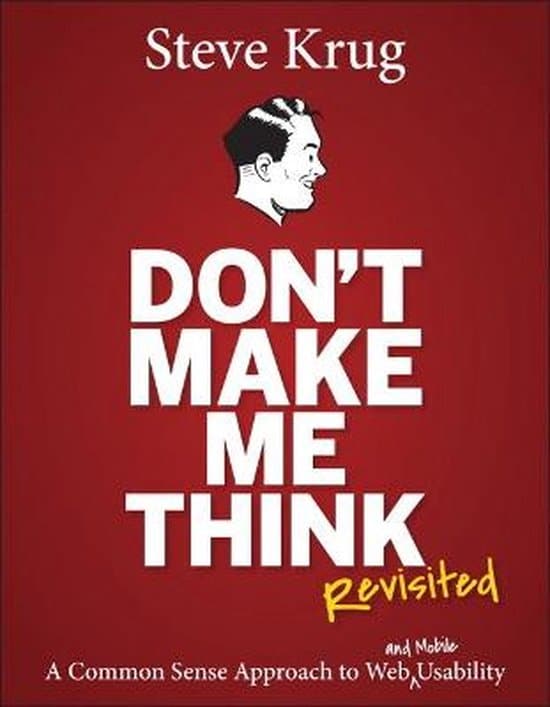
Don’t Make Me Think, Revisited (2014) by Steve Krug is a guide that explores user behaviour online, charts out basic principles of how a website can be well-designed to deliver a great experience, and also has a guide that shows how a website can be tested at each stage.
Default Internet Behaviour
Truthfully, a person who actually reads the user manual before using a gadget is a rare species! The majority simply open the packaging, starts figuring out the working of the gadget themselves, and go with what works best for them. The user manual is mostly, packed back in the box, or simply thrown away!
Similarly, the majority have no inkling of the mechanics of the Internet, yet, they have no problem navigating the online world. Most people search for a website URL directly, rather than use the browser’s URL bar. Such a strategy of common decision-making is called satisficing, a more typical approach, rather than rationally searching for information, identifying a solution, comparing and then choosing.
Don’t Make Me Think by Steve Krug – Book Summary & Review
Furthermore, if a web surfer simply clicks the back button if they click on an incorrect link by mistake. It’s not only easier but also more fun, to figure out things independently.
These ‘default’ internet behaviours have trained users to look for the first, fastest and simplest solution that catches their attention. And when they succeed they feel confident, comfortable and smart.
Catching A User’s Attention
People surf websites with a mission in mind. They look for the things they need and want to get done with it as soon as possible. Almost everyone skips the promotional corporate jargon on websites. No one wants to waste time on long texts. While online, people scan rather than read.
Hence, the ability to catch the attention of the user if the primary focus of a website. The key elements of good website content are headlines, short paragraphs and highlighted keywords. Moreover, in order to enable users to decide which areas to focus on, these elements should be organised using a visual hierarchy. According to eye-tracking studies, people make quick decisions choosing where to look and ignoring irrelevant information such as advertising blocks.
The same principle is used by newspapers. Headlines, text and images are placed carefully to enable the reader to look first at what is most important. Websites too should make the important obvious so that users can immediately find and click on them.
Keeping in mind default internet behaviour where users don’t mind clicking as long as the process is mindless and gets them a clear result, websites should have pathways that are easy to navigate and understand. Most importantly, websites should avoid annoying practices like hiding important information behind multiple clicks – such as shipping costs.
Building a website isn’t like making a product brochure to attract an interested user, as believed. It is more like making a billboard to catch the attention of cars zooming past at 60 miles an hour!
Consistent, Clear And Simple Navigation
Easy navigation lies at the core of creating a successful website. Unlike unfamiliar stores, users cannot stroll down aisles in search of what they need. Online, if people don’t find what they want, leaving the website is just a click away.
Scaling a website is another challenge. A user cannot ascertain the number of pages a website has, and hence it is vital that a website design is easily navigable. Ideally, every page of a website should include a ‘sections’ bar that clearly indicates what the website contains. Additionally, to make it easier for a user to move around, every page should have at least 4 additional navigation items. These include –
Search Bar – A search bar helps a user to quickly search the website for what they are looking for, without understanding its organization of it.
A ‘You are here’ Indicator – This small indicator, like the red dot in shopping malls helps a user understand how to navigate easily.
Link The Company Logo – Linking the company logo to the home page and making it available on each webpage enables users to ‘jump’ home faster.
Utilities – A utility section contains vital titbits that help one to easily use the website. This component includes a log-in space, a site map, an FAQ section, etc.
These navigational elements make it more comfortable to use the website effectively. A feeling of comfort, furthermore, builds trust.
Understanding Website Navigational Conventions
In addition to having easily accessible navigational components, these components should be self-evident. Thus to design a website that enables this, one should have an understanding of conventions.
While online, anything different from the usual, conventional style and design can be annoying. People have certain expectations when they visit a website. For instance, horizontally placed words along the top of a webpage commonly represent the main sections of the page.
It is often seen that web designers, in the pursuit of innovation, try to abandon conventions. They forget that conventions represent the best and most effective practices developed after years of fine-tuning. For example, internet users are familiar with the concept of tabs and immediately know how to use and navigate them. Hence, tab dividers are great navigational tools.
That said, innovation is important too, and creativity surely has its positives. Designers have to, however, simply keep in mind to make the innovation easily usable and prioritize user experience. In website designing, conventions, clarity, and consistency are best friends.
The First Impression – The Home Page
Most often, a link from Facebook or Twitter leads a user right in the middle of a website. It is commonly observed that users next click on the homepage button to ascertain where they have landed, or whether the content on the website is trustworthy or not. The home page is the first impression of a company, and hence a crucial component.
Since it is known that items linked from the home page of a website get more clicks, every stakeholder will have an opinion and an idea as to what should be included in it. Nodding to every opinion could lead to a cluttered home page.
The first priority of a home page is to create an accurate first impression. According to a web design study, the first impression of a website sticks with a user even after the user has navigated through other pages of the website.
This happens because when one encounters something new, one’s imagination goes into overdrive, creating a picture in the user’s mind about how this new thing works and trying to fit the new information into one’s preconceived notions. Hence if a home page is confusing, a user could misinterpret information, leading to more confusion and thus, disinterest.
In order to avoid confusion, a tagline or a short sentence that clearly communicates the goal of the website, placed near the logo is effective. This tagline should be personable and lively and convey the value of the site. For example, the news site The Daily Beast uses the tagline “Read this, skip that”.
Test, Test, Test Again
How does one test if a website fulfils the goals of easy comprehension and navigation?
Commonly, people turn to relatives and friends, or their own judgement to assess the objectives. However, while objectivity will be impossible with one’s own judgements as the features and usability will be obvious, friends and relatives tend to have wildly subjective opinions. Developers tend to prefer innovative features and designers like websites that offer a pleasant visual experience with subtle touches and lots of white space. And both assume that the world shares their views.
The truth is that almost everyone is like that. Most think that their opinions are correct, and there are very few people who view things from others’ points of view! Unfortunately, there are no ‘wrongs’ or ‘rights’ in website designing, and getting the opinions of a select few never helps.
The only thing that does work is testing – again and again. The best way to understand if a website is working as intended is to watch people use it and try to navigate it. With testing, the connotations of ‘right’ or ‘wrong’ are taken away and the focus moves to what works and what doesn’t. it additionally, shows and proves that every web user is different.
Getting Testers
Testing websites, however necessary, isn’t an exciting task for most people or developers – unless they are going to get paid for their time. Moreover, one needn’t be too restrictive in terms of the background of testers, as a website should be easily understandable and navigable for everyone.
Once a group of testers is selected, the facilitator should observe the group while they use the website and take notes. A facilitator’s goal is to keep the user group comfortable and focused.
Starting with the home page, a facilitator should get the testers to talk about what is visible by asking questions such as, ‘What are looking at?’ and ‘What do you think?’ These questions help to understand whether the tester is getting the main idea of the website or not. However, a facilitator should avoid influencing testers. If any tester asks for help, the facilitator can ask, ‘What would you do if you were alone?’
Facilitators have to get the test subjects to try every feature of the website – right from creating an account to logging in or buying or returning an item. If a test subject fails at any given task, the facilitator should observe the subject trying to resolve the issue, and let the subject keep clicking around till the subject either gets frustrated and gives up, or the facilitator cannot learn anything more.
Getting team members, managers, or even other stakeholders to observe the testing study is important, as they too will be able to understand the point of testing. Often when executives watch a tester fail, they understand the importance of usability.
The Pros Of Testing
Many believe that testing websites is time-consuming, expensive and requires expertise. However, testing simply enables one to understand whether a website works or not, is easily navigable or not and informs one’s decision-making.
Keeping that in mind, one needs to only test up to 3 regular web users, and have team members observe, and take notes on what problems the users face. According to the author, testing generally brings up more problems than what can be reasonably resolved, and hence, prioritizing between issues is important. Issues that a tester can quickly fix are not a priority.
Starting the testing process earlier in the web designing process is more effective, as the earlier problems are identified, the easier they are to change and implement. A beta site is far more easily adjustable than a live one.
Furthermore, one can even begin testing before a website is developed – by watching a testing group navigate a competitor’s site. The insights from competitor testing help while developing one’s own website, help with decision-making and save time and resources too.
Developing For The Smartphone
Apple revolutionized mobile web browsing. With practically everyone accessing websites on the smartphone platform, the downloadability of a website on the platform is important.
Today, users on smartphones read less and move faster. They are more likely to give up and exit a website if they encounter a hiccup. Hence a website has to load faster on a smartphone and be adjusted to be readable on smaller screens. Smaller screens translate to lesser space, which translates to more compromises. Hence a website should ensure that in-demand spaces are easily found. While information can require more taps, navigating to get to it should be easy.
Furthermore, users on smartphones should be able to access a website’s full menu of features. There’s no telling whether the user is surfing on the go, or is on the couch looking for information! This indicates that websites should have zoomability features, as well as a link to access the complete website.
Considering mobile computing is touted as the future, creating an amazing user experience is of the essence and is key!
Conclusion
The usability of a website is its most important feature. It puts a user front and centre, making it easy for users to find the information they are looking for. Navigability and simplicity are vital, whether the platform used is a smartphone or a laptop.
Most importantly, in order to ensure that a website is delivering a great user experience, testing it at every step is most important!
I use cookies on this website to give you the most relevant experience and for analytics purposes. Any personal data collected will never be shared with any third party, or used to spam you. That is my promise. - Sumit By clicking “Accept”, you consent to the use of ALL the cookies.
This website uses cookies to improve your experience while you navigate through the website. Out of these, the cookies that are categorized as necessary are stored on your browser as they are essential for the working of basic functionalities of the website. We also use third-party cookies that help us analyze and understand how you use this website. These cookies will be stored in your browser only with your consent. You also have the option to opt-out of these cookies. But opting out of some of these cookies may affect your browsing experience.
Necessary cookies are absolutely essential for the website to function properly. This category only includes cookies that ensures basic functionalities and security features of the website. These cookies do not store any personal information.
Any cookies that may not be particularly necessary for the website to function and is used specifically to collect user personal data via analytics, ads, other embedded contents are termed as non-necessary cookies. It is mandatory to procure user consent prior to running these cookies on your website.