Introverts are comfortable in being by themselves. Instead of getting energy from others, introverts draw it from solitude and quiet places. As a result, resolving conflicts and navigating tough conversations tend to be difficult and scary since it forces them to have conversations that they would rather not have. Unfortunately, avoiding conflict can be extremely limiting when it comes to leadership and producing results.
However, most introverts do not know that their introversion is a superpower when it comes to handling difficult conversations. That is because the nature of an introvert is to be thoughtful. That means you do not enter any situation without preparing for it.
The more you prepare, the more confident you will be. As you can imagine, that confidence will go a long way in helping you manage the nerves of handling difficult conversations and stepping out of your comfort zone as an introvert.
Another superpower introverts have is their excellent listening skills. Most conflicts result from one or both parties feeling like their grievances are being ignored. As you can imagine, listening goes a long way in diffusing the tension in a difficult conversation. Another benefit of being a good listener is that it allows you to understand not just people’s positions but also their underlying interests.
However, since you tend to get worn out quickly when you are around people, you will need to manage your energy appropriately. That means scheduling meetings when you have the most energy and avoiding back-to-back meetings.
Here is everything else you need to know about communicating effectively and handling difficult conversations as an introvert:
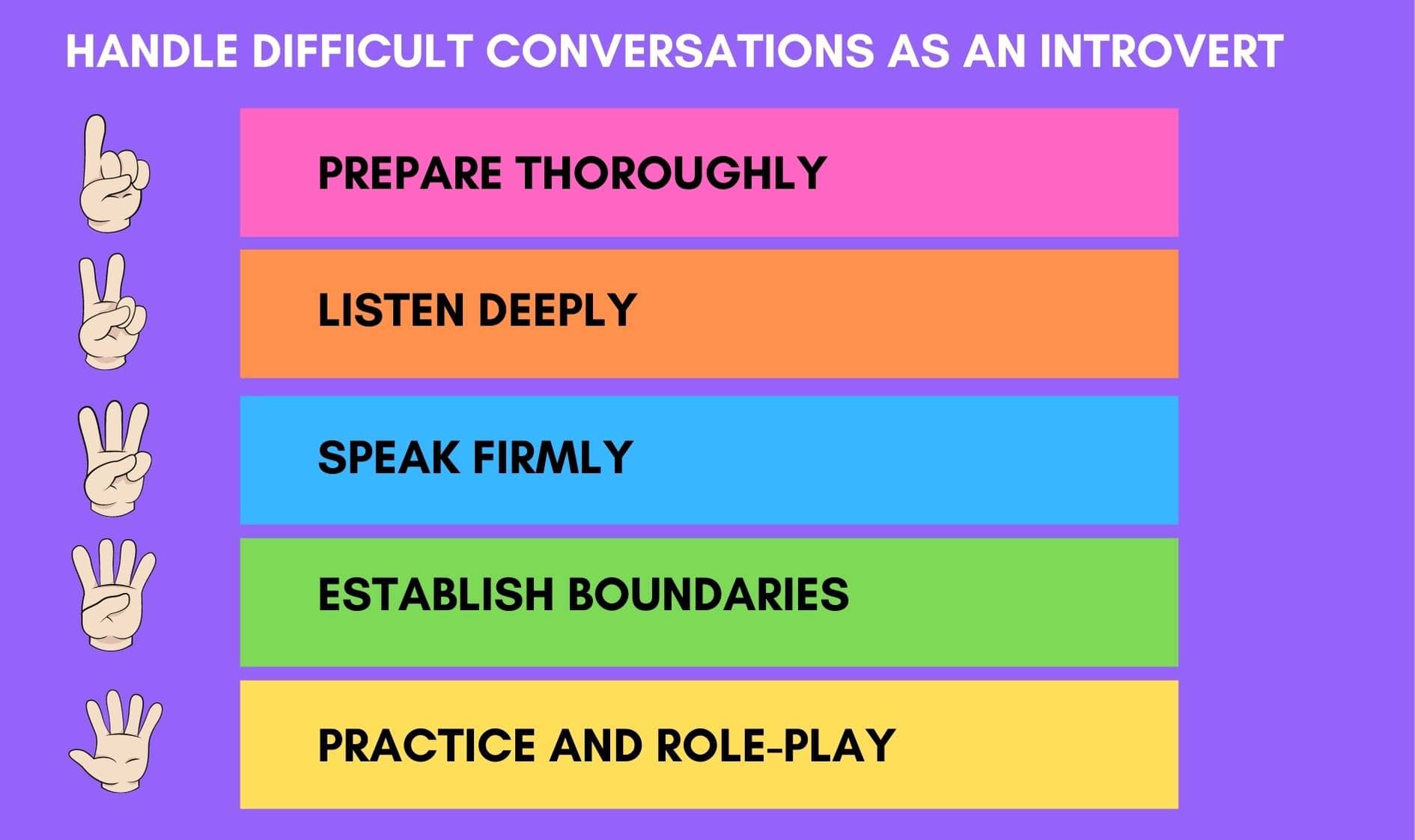
Prepare For Different People and Situations To Remove Uncertainty and Anxiety
Preparation is key to succeeding in anything in life. Fortunately, as an introvert, you excel at preparation due to your thoughtfulness. Here are some questions to ask to prepare yourself for difficult meetings.
- What is the meeting about? What material should I read before? Who are the participants in the meeting? What is my history and relationship with them? Can I know them better? What are their personality styles? How can I prepare for dealing with bullying, aggressive, or passive-aggressive comments?
As mentioned, introverts draw their power from within, which is why they do not like having the spotlight on them. Nonetheless, as a leader, you will need to be comfortable with the idea of speaking up.
As mentioned before, good preparation is the key to getting the confidence you need to control any situation. When it comes to meetings, research thoroughly about the topics you will be discussing. Doing that will ensure that any point you bring up will bring value to the conversation.
When people see that you are well-informed, they will be more willing to listen to what you have to say. You can also consider the different people in the meeting and have a plan on how to interact with them, especially if you find working with them challenging.
How should you deal with aggressive, loud, or bullying personalities? For starters, you do not need to be loud; just make sure you speak up when you have to. Here are a few more guidelines:
- Take control of the conversation by pulling everyone back to the topic once the conversation becomes derailed
- Make a hand gesture before you speak to get their attention
- Summarize people’s ideas and point them towards the data you have already prepared.
- Can I prepare and circulate my thoughts about the meeting topic before the meeting starts?
As an introvert, you excel at quiet reflection – use that strength to plan for your meeting. That will involve thinking about the topic of discussion and broadcasting them before the meeting. This will help you get a jump start and prevent having to wait for your turn to speak in the meeting.
- What are my values? How do I want myself to act? What are my standards and boundaries? What, if violated, I will not stay silent about?
Introverts often struggle with difficult conversations since they have a difficult time believing in their own authority and opinions. A leader is simply someone capable of speaking up for what they believe in strongly. And knowing what you stand for will make that easier for you.
The first step to identify your leadership lighthouse is determining your values. What do you believe in? What are your principles? What about the standards and boundaries you want to stick to? If someone gets out of line, how will you tell him or her that their behavior is not acceptable?
- What are my strategies if I get overwhelmed or triggered in the meeting? Can I take a time out; can I ask for time to think? Can I excuse myself for another reason?
You have to reconcile with the idea that things will not always go your way. Therefore, let go of the need to control the outcome of the meeting. Instead, trust your preparation.
Nevertheless, there is still a good chance you will still feel overwhelmed or triggered in the meeting. Pay attention to your breathing to stay centered throughout the conversation or meeting. Whenever you feel nervous or triggered, breathe in deeply and then exhale slowly. You will be surprised how calm you will feel immediately.
Additionally, breathe when you are speaking. This is because we tend to take shallow breaths when we are nervous. Therefore, by breathing normally, you will be letting your body know there is nothing to be afraid of.
Most importantly, fight the urge to speak fast. You have the right to be heard. Again, conscious breathing allows you to communicate calmly, giving you the chance to get your ideas heard effectively.

Use your keen listening skills to go a level deeper and listen to people’s concerns
As mentioned, the introvert’s ability to listen is a superpower. Here is how to use it effectively:
- Be curious about not just the topic of the conversation, but also the people involved.
Do not listen just for the sake of it; be curious about what the other person has to say. Doing that allows you to understand where people are coming from. If people feel understood, it builds trust and they are more likely to listen to your ideas.
Additionally, pay attention to the entire person you are talking to. That means not only listening to them but also observing their body language. Doing that gives you deeper insight into what they might not be communicating in words but still expressing otherwise via hand gestures, facial expressions, body posture, etc.
- Help people paraphrase each other by listening to people’s concerns. Act as a calming force in the meeting. Acknowledge and validate people’s emotions
The benefit of paraphrasing others is that it allows them to know and verify that you have listened to them. No one likes being ignored. You should also acknowledge the other person’s emotions as they drive most of our communication.
Emotions are the only way people convey what they feel inside and what is important to them. As such, by listening deeply and showing that you understand where they are coming from, you can be a tremendous calming force in the meeting.
- Ask questions with compassion to help people understand what is important to them.
Powerful questions can help people understand their point of view better. Being compassionate while doing that is arguably the best gift you can give to that individual.
Therefore, one of the best ways of handling difficult conversations is by allowing the other person to express fully by asking curious questions. That way, you will build trust, get to the heart of the matter, and reach an understanding sooner.
- Think about the core issue which needs to be solved. Keep the focus on the problem instead of colliding egos and arguments.
The human condition is prone to our egos getting in the way when communicating. Most times, when people disagree, their immediate response is to defend themselves. As an introvert, you can help people resist the urge to attack each other. Instead, you can help keep the focus on the issue instead of the conflicting egos.
- Remind people they are on the same team, and bring up the common desired goals if need be.
The best way to resolve conflict within a team is to remind everyone that they share the same goal. Additionally, remind each individual that their opinions are valued. It is not about massaging egos, but appreciating each person for what they bring to the table.
- Use humor or share a story to lighten the mood
When things get heated in conversations, you can use humor to lighten the mood. You can also share a story to lighten the mood and bring the attention of the group to the main point of importance.

Practice and Role-Play To Prepare Yourself if You need to
Needless to say, confrontations and public speaking are not what an introvert look forward to. You can prepare yourself for how various scenarios might play out through role-play with a coach or a trusted partner. You can also practice with a mirror. Consider role-playing the following scenarios:
- Practice replying back to aggressive people
As an introvert, nothing can frustrate you like loud and aggressive people. However, you will need to prepare for such behavior. As mentioned earlier, avoid the urge to engage an aggressive individual in their own game.
Instead, let them talk, and then state the facts calmly to them. Practice expressing yourself in alignment with your values while still making your point across clearly. While at it, practice proper breathing, as you will need to stay calm in real situations.
- Practice dealing with bullying or passive-aggressive behavior without doing the same
As the saying goes, when you engage a fool at their level, they will beat you with experience. Similarly, avoid engaging a bully at their level. Instead, practice using the guidelines offered earlier on how to deal with such behavior.
You can stand your ground and make your point without being aggressive. Also know that you can raise your voice without being aggressive or rude.
- Practice saying no politely but strongly. Be clear about what is non-negotiable for you
If there is one thing that introverts struggle with, it is saying no. However, as mentioned, you can prepare by identifying your values and enforcing your boundaries. The foundation of assertiveness is having the ability to say “NO”. Nothing good ever comes out of being a people pleaser and saying YES when you actually mean NO.
Conclusion
While being introverted comes with its fair share of challenges, it can also give you an edge in difficult conversations. Introversion allows you to be more calculative, prepared, and focused, all of which are important in keeping a cool head under stress and pressure.
Good leadership is characterized by the ability to stay calm and not lose focus in the heat of the moment. Wear your introversion with pride because that is probably what makes you unique and stand out.