We often encounter situations where we feel it is our duty to give advice. We become compulsive at doling out free advice to people, often at the cost of ending up alienating others from us due to this compulsive habit and end up stifling curiosity and innovation amongst others. This inner voice, our advice monster, can do more harm than intended, especially to a leader who jumps up with solutions.
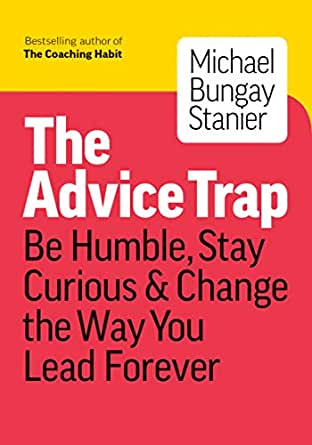
The Advice Trap (2020) by Michael Bungay Stanier shows that listening to others’ problems and asking them questions about it, can have far better outcomes than immediately giving advice to them. Moreover, it shows that developing listening skills help in developing skills such as empathy and humility, values that are a must in leadership.
Why Don’t We Find The Solution?
Isn’t it good to offer solutions and help people who are facing problems? While the answer is resounding ‘Yes!’ there is a catch to it. Often, in our enthusiasm to share our advice and offer the solution, we tend to miss out on listening to important little details. Because, sometimes, it could be that the opposite person didn’t take enough time to really explain what the problem is, and jumping with the solution could result in giving wrong advice.
On the other hand, if we do understand the problem, our eagerness to be the one to solve the problem could result in handing out mediocre advice, or solutions that could have been better with a little refinement. We end up giving a ‘quick fix’ rather than thinking of a few options and choosing the best fit.
Additionally, no one likes to be at the receiving end of unsolicited advice. While giving out advice can mentally relieve the advisor, it can make the receiver feel incompetent and can even at times seem to undermine their ability to solve their own issues.
In all this eagerness, often, the actual solution is lost.
Get That Monster Under Control
Everyone has an advice monster lurking in the shadows of their thoughts. The monster is a part of one’s personality and it raises its head when one is stressed and wants to believe that they are in control of the situation. These monsters were developed as defense mechanisms against stressful situations and difficult emotions. What people often do not realize is that this monster needs to be controlled.
The advice monster has 3 personas, the Tell-It Type, the Save-It Type and the Control-It type.
- Tell-It Monster – The Tell-it monster persona loves to hog the limelight. It convinces you that your opinion is the most important one and the correct one. It convinces you to be the leading authority.
- Save-It Monster – While the Save-It’s are more subdued voices, they, like the Tell-it’s believe that they are the saving grace for all problems. Save-It’s don’t jump to give out their ideas, making them more difficult to recognize, however, feel that it’s their moral responsibility to give others advice.
- Control-It Monster – This monster persona is most manipulative of the lot. According to the Control-It Monster, all is lost if you are not controlling things. It believes that others cannot be trusted and convinces you to take the lead on everything.
All the monster types pose a big problem. They limit other’s capabilities and prevent us from being open to them. Moreover, they make us perceive ourselves as superheroes, capable of accomplishing anything and make us pile up an enormous amount of responsibilities on our shoulders. They make us think that we can save the world with our one piece of advice.
Unfortunately, these monsters are part of our personalities and cannot be eliminated altogether. However, they can be controlled, tamed, and made to work in our favor, by understanding what triggers them.
What Triggers The Monsters?
To understand why the advice monster stir-up, we need to ascertain what in our minds triggers them. Most commonly, these monsters get triggered in stressful situations; yet, these situations, experiences, and events are unique to each individual.
For example, for the author, his ‘Control-It’ monster gets triggered whenever he spends time with his younger brother. For others, the advice monster could rise in the presence of someone with lesser experience than him or her. Some get the compulsion to dole out advice at the workplace.
Giving advice- solicited or unsolicited – gives us a reward and a feeling of instant gratification. Whether it is the feel-good factor, or sense of achievement and accomplishment, or simply feeling smarter, compulsive advising comes at a cost. The highest cost a person can pay for compulsive advising is losing one’s own credibility due to affected relationships at the workplace.
To fix this compulsive advising, one should let go of the need for instant gratification and understand when they are doling out advice due to fear or as a reflex action. Controlling the compulsive habit can help in stopping one from ‘controlling the situation every time’.
Questions Before Solutions
While our childhood instinctively pushed us to ask a lot of questions, we lost our instinctive questioning habit, as we grew up. The need for questioning things around us morphed into the need for telling others what we thought. Over a period of time, this need becomes a habit and soon into a compulsive habit.
Breaking this habit is essential, just as it is essential that we learn to ask more questions. Moreover, as leaders, it is better to give an employee a listening ear, rather than beginning with advice. It is better, to begin with questions such as, “What do you think?” or, ‘What’s on your mind?” Such questions give the other person more room to steer the conversation in any way they want, thus helping them to be open and true.
At every stage in a conversation, where a person is trying to determine the solution to a problem, it will be natural for the advice monster to want to jump up and offer advice. This is the time to get the monster under control.
Ideally, leaders should prod the employee with questions that will force them into thinking of the solution themselves. Nurturing curiosity and listening to people before giving them the solution are great qualities a leader can possess.
Nobody Wants That Vulnerable Question
Asking questions leads to a very important shift – the shift from advising to coaching. This makes a big difference in the larger scheme of things considering the fact that one becomes more inclined to help find the answer rather than just blurt it out all the time.
However, there are exceptions even to the best of intentions. It could be possible that the answer to the challenge is elusive, and one lands in a conversation trap called a foggy-fire – a type of conversation akin to a fog that hides what should be in plain sight.
At times, vulnerability is the culprit, because no one wants to have that uncomfortable conversation and people stay in shallow waters. As a manager, one could end up ‘coaching the ghost’, or get stuck in a ‘pop-corning’ session, or get distracted by ‘big picturing’ or ‘yarning’. These are different types of conversation traps one could encounter while trying to help someone face a challenge.
- Coaching the ghost – Coaching the ghost refers to analyzing a person who is not even in the room. This happens when the person getting coached unconsciously deflects the problem by focusing on another person entirely. Here, as a manager, it is important to ask the person, “Why does this person really matter in the larger scheme of things?”
- Pop-corning – Pop-corning happens when a team member comes in with a barrage of unrelated issues, confusing you about what the actual challenge is. Here managers should ask the person needing coaching, which problem is most important?
- Big picturing – This refers to people talking in the abstract, not being clear about the issue at hand.
- Yarning – Yarning refers to getting into long stories and detailed descriptions that could be a waste of time.
As a coach, one should be able to identify these traps and guide the person towards the actual problem, by asking probing questions.
Transformative coaching
Once you move from advising to coaching, it is essential to understand that a coach should first make a person feel safe. Our human brains are wired to fight and survive against threats. It perceives vulnerability and an uncomfortable or challenging conversation as a threat too and can either go into the defensive ‘fight’ mode or completely shut down and go into a ‘freeze’ mode.

To ensure that the opposite person does not get on the defensive during a critical discussion about their challenges, managers need to make them feel safe. There are four tactics to make people feel safe during tough conversations.
- Be On Their Side – This entails being empathetic, and using gestures like nods, encouraging words, and positive language. Words such as ‘we’ and ‘us’ show support and tell the opposite person that you understand and feel the same, and are there to take on the challenge with them.
- Respect – Showing respect to the person facing a challenge is a very effective way to get them to open up. As a leader and a coach, giving up power to show the opposite person that you have vulnerabilities as well, and face your own insecurities, brings them closer and helps them open up.
- Autonomy – When it comes to facing challenges and being open about them, many people feel the need to be equal. That gives them a sense of autonomy. Being able to have their say in matters will make them ease up.
- Managing Expectations – It is rude to spring a surprise, especially with heavy conversations that expose a person’s vulnerability. Such conversations should be structured and pre-planned in order to succeed.
As a coach, engaging these tactics will help people open up to you and share their challenges without raising defence mechanisms.
Morphing The Advice Monster Into a Coach
Finally, one realizes that the process of controlling the monster and learning to be a coach is a gradual process. No one gets it right in the first go.
Coaching takes practice, and it can be practiced in any ‘every day’ situation and interaction using any medium – the phone, email, video call platforms, text messaging, etc. One simply needs the patience to listen to what the other person has to say and be curious by asking more questions.
Just as learning to coach is important, so is making oneself coachable. This means that coaches should take feedback and work on the feedback to make improvement, just as they should find a coach for themselves too. Taming the advice monster can at times be a life long process and also prove to be a life long boon as well.