
john maxwell

  • 5 Levels of Leadership by John C Maxwell – The Leadership Ladder

    Having a managerial title doesn’t make you a leader. It is, in fact, only the first step towards leadership. In The 5 Levels of Leadership, John C Maxwell points out the main pitfalls that often hold managers back from following the path to great leadership. At the same time, he also explains how we can overcome them.

    A leader is made, not born. It takes perseverance, vision, strategy, and relationship-building skills, and many more qualities to merely work well in a managerial role. 

    To become a good leader, one has to practice and master each of these skills (levels) to become a truly well rounded, inspiring leader on their climb to the top.
    Level 1: Defining Leadership Through Personality and Core Values

    Reaching managerial positions is the starting point of the leadership journey. Many consider managerial positions an end-goal and become complacent once they reach them. Additionally, some managers think that positions give them the power to command. 

    Such leaders called Positional Leaders, and never really understand the true purpose of the position. They busy themselves with trying to gather a big team, most often unable to do much for the team as a leader. Positional leaders are so obsessed with their positions that they cannot give their teams direction.

    Good leaders work towards creating a lasting impression on their subordinates. They need to choose their core values and principles based on who they truly are. Their core values should reflect in their personalities and in turn their leadership skills should be defined by their personalities.

    Level 2: Building Trust and Positive Relationships

    Leadership is always about what the manager can do for the team, and not about what he does for himself. Keeping this in mind, leaders should help create a work environment for the team that is conducive, fun, enjoyable, and most importantly comfortable.

    Good leaders build positive relationships. To build these, leaders need to seek permission from their team members. In order to get permission, they need to foster positive relationships, gain trust, and value people around, and to do that, a leader has to think about others first.

    For Example, the US Marines’ core value of not leaving anyone behind is clearly seen when he or she leaves his or her rank insignias behind before war. It helps level the relationships between ranks and created a feeling of camaraderie and belonging.

    Level 3: Mastering How To Produce Result

    Successful leaders are measured by the results they produce. A leader is able to generate successful results only with an effective team that helps him execute.

    Therefore producing results often relates to how the leader chooses and manages the team, to steer it towards efficacy and success. Leaders need to understand that a good effective team not only comprises of individual performers but also of individuals committed to collectively succeeding in reaching the goal, by exercising their specific talents and skills.

    The leader should know that the success of the team is a contribution of each individual as well as the success of an individual in the team is a collective effort of the entire team. Moreover, a good leader knows how to chart the team in the right direction. He, therefore, put efforts into building the team, in choosing the right person for the right role, according to their respective strengths and weaknesses.

    Finally, the leader should also know how to optimize a team member’s performance in matters beyond the business as well.

    Level 4: Creating A Wave Of Momentum By Leading With Example

    George Washington, during the Revolutionary War, rode towards a group of soldiers who were unable to lift up a beam. Their commanding officer was standing beside them, shouting words of encouragement. However, the group was unable to lift the beam. 

    George Washington, dismounted, approached them, and helped to lift the beam. His physical contribution not only added the additional force that was needed to lift the beam, but his act of help instilled a sense of confidence and provided motivation to the soldiers. He displayed enthusiasm and drive that motivated the group to lift the beam. He also led by example and capitalized on his victory to build momentum.

    In the words of Thomas Carlyle, “Nothing builds self-esteem and self-confidence like accomplishment.” A good leader knows that while inspiration to succeed is essential to success, capitalizing on that success to build a wave of momentum amongst the team is as important to uplift the team and generate even better results.
    Level 5: Creating A Legacy By Helping Other Succeed

    The final level of leadership is to be cognizant of two things – 

    • First, a truly great leader focuses on transforming the people around him for success.
    • Second, a truly great leader builds a legacy by mentoring others to become great leaders.

    Both these points work in tandem. A leader cannot build a legacy without helping others reach success, and similarly, he cannot help others reach their full potential without the knowledge and the empowerment of being able to mentor great leaders.

    A leader knows that his people are his greatest assets in today’s dynamic work environment. Therefore, for the company to grow and succeed, or for the leader to grow and succeed, the focus of growth and success has to be on the workforce. People-development is one of the most crucial aspects of good leadership.

    Yet a good leader knows where to pull back. He should be able to judge when to let the employee test the waters on his own. Empowering a team member to grow on his own is a mark of a truly transformative leader – a leader who puts 80% of his efforts in ensuring the productivity of their team.

    This huge amount of effort that a leader invests in the employees pays back in the form of creating a legacy. No organization can survive with monopoly leadership. Leadership needs continuity for the organization to be consistent and successful. Therefore, great leaders invest much of their effort into ensuring that there is a culture of leadership in the organization that is as dynamic as the work culture today.

    Leaders craft future leaders. And those leaders of the future carry the legacy of today’s leaders into infinity!
  • Developing the Leader Within You by John C Maxwell – Moving Up The Leadership Levels

    Leaders play a crucial role in all possible walks of life, whether it is the boardroom, the courtroom, classroom, or even the battlefield. They are vital to the basic functioning of an organization and help bind the workforce to the values of the organizations and guide them along the path to success. Leadership is like a ladder. It has ascending levels that take time and practice to master, and moving up means to be able to balance between personal growth, the growth of the organization as a whole, and the success of subordinates.

    How does one, therefore, reach the pinnacle of this ladder? Developing the Leader Within You (1993) by John C Maxwell, shows the way to master the levels of leadership, imbibe the necessary qualities and traits needed to succeed as a leader, and how to take concrete steps to steadily, but surely reach the peak.

    The Five Levels Of Leadership

    To begin understanding leadership, it is essential to understand that it is a crucial quality that powerful people possess. Leadership is simply, the ability of a person to influence others or a group of people. That said, anyone who has the ability to make others follow them could be termed as a leader. JFK, Churchill, and even Hitler can be called a leader.

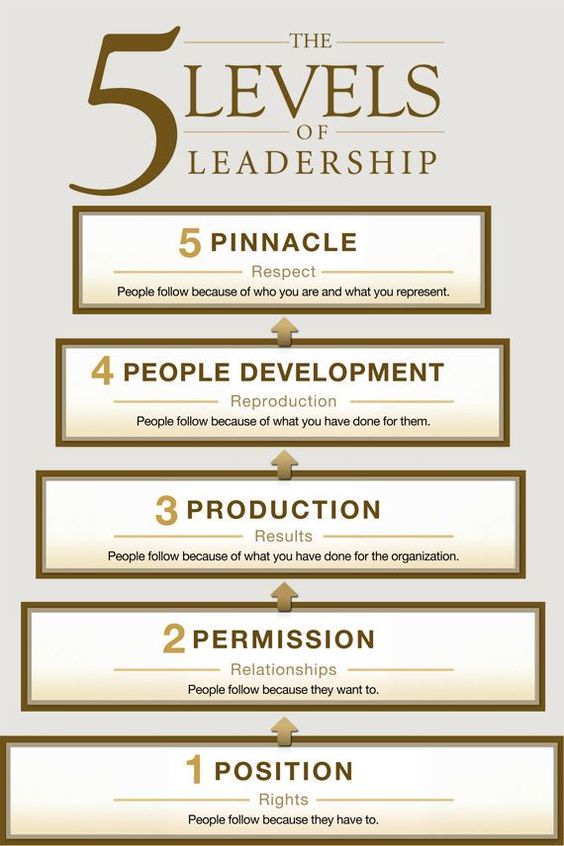
    Leadership has 5 levels of hierarchy. Every leader has to master each level and move up the ladder to the next one. The five levels of hierarchy are – 

    • Position – This is the first level of leadership. Those who are leaders at this level are leaders merely due to their titles in the organization.
    • Permission – Permission is all about being attuned to the needs of followers. It entails building and maintaining relationships with followers. At this level, if the leader neglects the needs of his followers, the followers will lose interest in the leader.
    • Production – At the production level, leadership becomes the product of the success of the followers (team). At this level, the leader works hard to ensure that the team works towards producing formidable results while being tuned to their needs at the same time.
    • People Development – The fourth level of people development entails focusing on mentorship. In this level, both the leader and the follower have a sense of loyalty; the follower towards following the guided path, and the leader towards guiding the follower towards success by helping them grow and acquire new skills.
    • Personhood – A leader who has attained personhood, has spent his entire life working for the success of their team members. They reach this level only because they have constantly strived to put the successes of their team members, organization, peers, and colleagues before their own. This final level requires constant perseverance. It is the level where a leader naturally commands respect, loyalty, and inspiration for others to follow.

    Now that we know the five levels of leadership, let us look into how we can master each of them, and reach the top of the ladder.

    Setting Priorities

    Setting priorities seems like a simple task. However, at the leadership level, it is much more than just known which task takes precedence and what to focus on. We all come across tasks that are important, tasks that are urgent, tasks that are neither important nor urgent, and tasks that are both, important and urgent.

    Apart from tasks, prioritizing also extends to other things such as time, energy, money, staff allocation, etc. in order to be able to successfully prioritize, one can use the 20/80 rule. The rule states that – 

    • 80% of the resources such as money and time should be allocated to the top 20% organizational priorities,
    • The top 20% of the most productive staff accounts for 80% of the organizational successes, therefore, 80% of the leader’s time should be dedicated to them.
    • Barring the top 20% organizational priorities, the remaining 80% should be delegated or outsourced.
    • And the top 20% of the organization should train new recruits.

    Put simply, a leader should be able to prioritize the most important tasks and invest time, money, and energy in the top employees to be productive and successful.

    Letting Integrity Be Your Compass

    What is integrity? Integrity is having a set of values that a leader adheres to, without wavering. This set of rules become the compass that guides the leader forwards. Integrity involves being consistent and true with words as well as actions.

    People get inspired to follow a leader’s actions. Therefore, if the leader leads by example, and follows his words with actions, he will be trusted and respected. Consistency in showing integrity will reinforce credibility and thereby help garner trust. Integrity makes the foundation of a long-lasting reputation that will endure.

    Creating Positive Change

    Adapting to change is one of the most important characteristics of a leader. With the work environment being fast-paced and dynamic, a leader has to be prepared to brace the changes in time. Inability to adapt and change can adversely affect the organization and most likely, the leader and/or his organization could succumb to competition.

    Apart from being able to adapt, a leader should be able to envisage the psychological changes that his employees will undergo as well as the challenges that they will face. Any form of change leads to insecurity and stress in the organization. The onus, therefore, lies on the leader to make sure that his team is aware in advance, of the changes that they should expect and the objectives those changes aim at achieving. This will lead to creating positive change in the organization.

    Self-Discipline 

    Self-discipline is an extremely crucial characteristic of good leaders. Without self-discipline, a leader cannot, and should not expect others to follow him or her.

    Self-discipline involves focus and practice on a daily basis. That is why it takes a lot of time to develop self-discipline. Additionally, without self-discipline and hard work, the growth of the leader, and thus, in turn, the growth of the organization gets stunted. 

    Leaders can use the following to inculcate a habit of self-discipline.

    • Start by making a list of five areas where you want to become more disciplined. 
    • Identify a mentor, peer, or colleague who is already disciplined in a particular area and ask them to monitor your progress.
    • Take fifteen minutes every morning to chart out your plan as to how you are going to work on the areas, and then revaluate for five minutes in the afternoon and five minutes in the evening to reflect on the daily progress.
    • Ideally, repetition of the same task help inculcating a habit. Cross the area of the list and move on to the next area.

    Having A Vision

    A leader should have a clear vision of their end goal in their mind. They need to envision where they plan to take the organization in terms of growth and success. Additionally, they should be able to have an idea of how they plan to persuade their team to reach the goal. The vision of the leader should fuel the daily working of the organization, the team, and the leader himself.

    Without a vision, a leader cannot lead others towards a goal, because, without a goal, a leader will not believe deeply enough to strive hard, to persevere, to add team spirit, or the drive-in his team to perform.

    However, not all leaders have a vision in place or a drive to leadership by a vision. Some need to build one. In such cases, leaders need to constantly keep questioning their dreams. They need to ask themselves, what keeps them going on day after day. Most importantly, they need to know if they can walk the talk and put their dreams into action.

    Final Message

    People follow leaders who have integrity. Moreover, they want to follow a leader with substance, self-discipline, and one who has the experience of driving his vision. They follow a leader who is open to change and is able to shift gears in the face of change. 

    Whatever level of leadership one stands at, they can move to the next level of leadership by keeping in mind the aforementioned practices.

  • John Maxwell’s Takes You From Leadership To Leadershift

    With the dynamic changes taking place all over the world in terms of the work culture, environment, and the shift in the roles and responsibilities of the working class, the need for a change in leadership has become crucial. While managers are sufficient for an organization in times of stability, dynamic changing times require strong leadership.

    This translates to two crucial necessities, firstly, the need for strong leaders is even more essential for organizations, and secondly, today’s leaders need to keep reinventing themselves to adapt for success in these times of change.

    Leadershift (2019) by John C Maxwell shows leaders and managers the way to adapt to this change by inculcating a strong desire and ability to succeed, to develop the right mindset and create positive up-to-date thinking to continue to be productive, not only for themselves but also for their team and the organization as a whole.

    John C Maxwell takes us through his own journey of leadership and shows how he charted his ‘leadershift’ to succeed and create an impact on the world.

    Leadershift – From Me to We

    Many managers consider a position of leadership as a step towards charting their own star-trails. They work keenly towards their own goals and aspirations, without realizing that leadership is not about their own success, but about how they can steer their teams, colleagues, and the organization towards success.

    Leadershift firstly requires a leader to change their focus from ‘me’ to ‘we’. Maxwell gives an example of how leaders should work more like the conductor of an opera, rather than a soloist. Just like a conductor uses opportunities to draw out potential from a group of musicians, a leader should first work towards understanding the needs of the people around him in order to draw out their best.

    Maxwell compared leadership to the dance tango, wherein it is the responsibility of the leader of the pair, to lead the team to a stellar performance. A leader, just as the lead of a tango dance, should not only understand what it means to lead but also be aware of what it means to be led.

    It is essential that a leader should focus on making others in his team shine, by developing positive relationships and by paying keen attention to the needs of subordinates. A leader creates a vision and invites his team to help achieve it.

    Leadershift – Moving From A Goal Mindset To A Growth Mind-Set

    Leaders need to set certain goals and strive to achieve them. While a goal mindset has been at the crux of leadership since the beginning, leaders need to shift the focus to a growth mindset.

    Maxwell realized the positives of a growth mindset during his days as a young church leader in Ohio. He began by setting a goal for himself to make his church the largest in the state. In a single year, he was able to double the size of his congregation making it the fastest-growing church in Ohio. He later realized, that his own achievements, personal growth, and his understanding of leadership were far more valuable than the numbers he achieved.

    He saw that a goal mindset led to personal achievement and status growth, however, a growth mindset led to the development of every shareholder in the congregation. 

    The key to a growth mindset is to inculcate a teaching spirit. A leader should not only have the need to learn but feel the need to ensure that he passes on his learning to help improve others. Passing on the knowledge to others entails a leader practicing what he has learned.

    Leadershift – From Climbing The Ladder To Building The Ladder

    Many leaders aim at being on top of the leadership ladder. They aim towards a goal and work towards achieving it. In the corporate world, it is essential for a leader to aim for the top of the corporate ladder. However, real success comes only when a leader helps to build ladders for others at the same time.

    Leaders should ideally aim at being within the top 10% of their chosen field to stand out. Once they reach the top 10%, they should start viewing their success as a means to help others reach their goals. For leaders to become a successful resource for helping others means to start mentoring others in their team.

    Mentoring isn’t an easy process. A leader should assess whom to mentor. They should be able to sift from the crowd to find those who are passionate not only about their own personal growth but those who reflect the values and principles of the leader himself. Additionally, leaders should look for those who are not only hungry for success but also who have a strong potential to carry on the legacy of leadership.

    Leadershift – Connection, Not Direction

    Shifting the focus of leadership does not only mean directing subordinates and telling them what to do. It entails creating a connection by helping them connect with their own way to success. 

    Maxwell understood this form of leadershift from Pat Summit, the coach of the University of Tennessee Lady Volunteers basketball team. At halftime, rather than giving the team a pep-talk about what had transpired on the field, she made them analyze their performance by asking 3 questions –What did we do right? What did we do wrong? and What should we change?’

    Only after the team had discussed these, Summit spoke to them. She heard the team out and then made a few observations before sending them out for the second half of the game.

    Maxwell understood that leadershift embraces connection rather than direction, collaboration instead of authority and that listening is far more valuable than talking. To be able to develop listening skills, leaders can follow a simple routine,

    • Use a notepad during meetings. Write a big ‘L’ on the top to remind yourself to listen first.
    • Use your growth mindset. Ask your peers, family members, and friends to rate your listening skills on a scale of 1 to 10.
    • Act on the feedback given by them.

    Shifting from direction to connection helps build better relationships by generating a two-way flow in communication as well as in ideas.

    Leadershift – Valuing Diversity

    As a young pastor in Ohio, Maxwell noticed that that within his environment, the community and the leaders of the protestant church were all white Americans. Everyone looked and behaved in a similar manner. However, he realized that the most important insights and lessons came from outside the ‘white’ group. 

    As a pastor, conformity and tradition were drilled into him. Later on, due to his discussions with another Catholic Priest, who helped him reinforce his faith, he moved to Atlanta, a city rich in African-American culture, completely different from where he grew up. He understood the difference that resulted from the diversity could bring out positive changes in the organizational structure as well.

    Leaders need to understand that diversity in teams can bring about different perspectives and effectively fill the gap of knowledge. A leader cannot possibly claim to know everything and manage it all. Additionally, if a leader is surrounded only by like people, the flow of knowledge becomes restricted. 

    Trusting diversity in a group is a lesson that is best shown in how Abraham Lincoln built his cabinet. His members were sworn political rivals, and this helped bring in different perspectives to Lincoln’s leadership.

    In order to bring in diversity, a leader should take a good look at his team, his friends, colleagues, and the people that surround him. Leaders should take efforts in learning from different groups, cultures, races, and ages, to be able to gain different perspectives.

    Leadershift – Moral Authority Over Positional Authority

    A title does not merely make a leader. Maxwell learned this important lesson as a young and fresh-out-of-college pastor. As the leader of his church, his first church board meeting started off with another respected member of the church, Claude, taking command of the meeting. Claude asked Maxwell to start off with a prayer and politely asked him to end the meeting with a prayer. Maxwell hadn’t said a thing in between during the meeting. It was a completely unexpected outcome.

    Reflecting on that particular meeting, Maxwell thought about what made Claude so influential? He realized that though Claude wasn’t rich, well-educated, or impressive in any way, he had a strong moral authority of being good, honest, and fair. Claude was never a leader, however, his values and consistent belief in them made him a leader in every way.

    Therefore, how does a leader truly become a leader? The answer lies in upholding one’s own moral authority by developing integrity. Integrity refers to the ability to stand by one’s values and principles consistently. Integrity makes a leader trustworthy and dependable. Additionally, if a leader is courageous to follow and lead with integrity, he will be able to successfully influence people and gain their trust to follow him.

    Leadershift – From Career To Calling

    Leadershift finally involves a person to shift focus from career to calling. This essentially means that leaders should find their calling in life. 

    How does one’s calling differ from a career goal? While a career goal is a personal end result for a leader, a calling focuses on finding something that is far larger to pursue. A calling means pursuing an enriching goal, that one could do forever, to help others succeed. A calling refers to a clear purpose and a reason for living, a way to find one’s own, yet be able to make a positive difference in others’ lives. 

    A calling also refers to something that one is passionate about. It entails giving, thinking, and serving others, passionately! Finding a calling in life enriches, and gives one’s personal career goals a true meaning of accomplishment.

    Final Summary

    Leaders today need to shift their focus from mere leadership to leadershift. They need to adapt to change around themselves to truly succeed. They need to show others the way forward, by helping them adapt to these changes. To be truly successful leaders they should direct others with connection, apply a growth mindset to help others succeed,  build opportunities, and ladders for others to grow, and finally exercise their calling with moral authority.