
Do you remember a time when you couldn’t ‘Google’ something? Or had to rely on a piece of paper to find your way to a location? Or when ‘social networking’ just meant meeting up with people in real life?
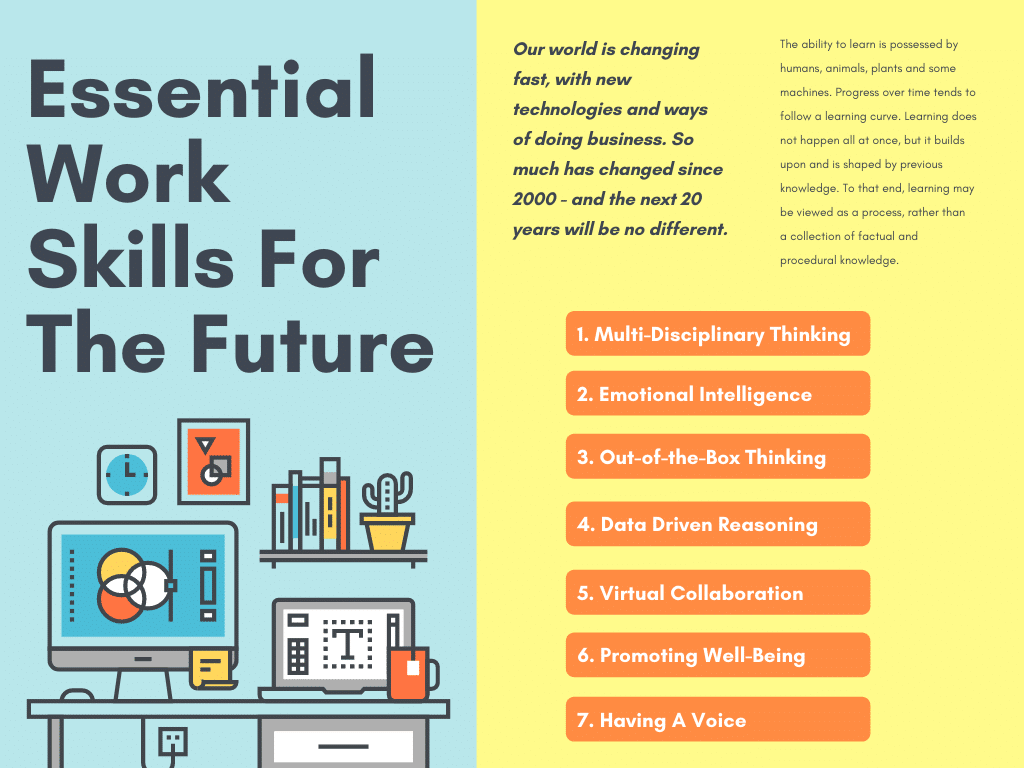
Our world is changing fast, with new technologies and ways of doing business. So much has changed since 2000 – and the next 20 years will be no different.
For instance, you probably cannot imagine carrying around a bulky mobile phone, camera, dictation machine, and PDA (personal digital assistant) all the time, but in 2000, this was commonplace for many professionals. Similarly in the next 20 years, things like 3D printing, Artificial Intelligence, 5G, Virtual and Augmented Reality, and Quantum Computing, will completely change how we work and the way we work.
Technologies like the internet, smartphones, and GPS changed the way we work and live. Apps like Whatsapp, Instagram, Netflix, and Google Maps have changed entire industries. Similarly, technological leaps in the next 20 years will not only change what we do but also how we do work, irrespective of which country or industry you work in.
The coronavirus pandemic has already accelerated this change and helped some technologies like video calling to come to the forefront. People will need to adapt to this constantly changing landscape to stay relevant and perform well.
Below are 7 workplace skills everyone will need in in the future – the 2020s and beyond that.
1. Multi-Disciplinary Thinking
What differentiates a smart machine from a human brain? It is the human brain’s ability to make sense of things. Multi-disciplinary thinking is the skill that enables us to make sense of things, make the connection between complex things, and foster a curiosity to learn new things.
Even with the advent of AI and with machines getting smarter, multi-disciplinary thinking, (or as a university from Phoenix puts it, ‘sense-making skills’) will always be critical in the workplace. And this is the one thing machines can’t do, at least not so far.
A multidisciplinary approach involves taking cues from different disciplines or areas, and making connections that most people might miss. You can use this skill to approach problems differently, redefine them, and come up with unique solutions.
For instance, if you work as an engineer, in a medical environment, you should have a working knowledge of medicine and health. This will help you plug the gaps between these disciplines, and make connections that others would miss.
A biomedical engineer may work with doctors, scientists, and researchers to come to a solution or complete a project. And even though people with different skill sets complement each other, and provide different parts of the jigsaw puzzle – you need someone who can take a multidisciplinary approach and make the connection between the scientific, medical, and technical ways of thinking.
Computing pioneer Jaron Lanier says, “if we ask what thinking is so that we can then ask how to foster it, we encounter an astonishing and terrifying answer: we don’t know.”
No one can know everything, but you can work to understand the big important models in each discipline at a basic level so they can collectively add value in a decision-making process.
– Charlie Munger

2. Emotional Intelligence
Emotionally intelligent people have an upper hand in the workplace because they can quickly understand the emotions of those around them, and act accordingly. This helps to de-escalate conflict, motivate your employees and coworkers, and stay on top of your own emotional responses.
Being able to regulate your emotions and be seen as an empathetic, sensitive coworker goes a long way towards building your worth as an employee or manager. And as the world grows more multicultural and diverse, empathy and emotional intelligence become even more important.
You could be working with people of different ethnicities, different nationalities and diverse cultures. If you are good at forming strong connections with people, it will go a long way towards cementing your position as a valued collaborator.
In addition, a high emotional quotient will help you see when one of your employees or coworkers seems angry, frustrated, or upset. This helps you ward off potential conflict by getting to the root of the situation and acting as a source of support and encouragement for your employee.
For instance, if you see a normally competent employee acting unreasonably, you could invite them for a quick chat over coffee or lunch, and try to understand why they’re upset. You could say, “I noticed you haven’t been yourself today, is something bothering you?”
“When dealing with people, remember you are not dealing with creatures of logic, but creatures of emotion.” – Dale Carnegie
3. Creative, Out-of-the-Box Thinking
Your ability to think out of the box and come up with creative solutions is a huge asset to any organisation. And you can be creative in any job – creativity isn’t just limited to artists, musicians and writers.
Creativity isn’t just about creating artsy designs or being inventive. If you are able to approach a problem differently from others and connect the dots between different processes to come up with a solution that works, you are creative. Problem-solving is an example of creativity, and so is the ability to arrive at win-win solutions.
According to the World Economic Forum, “creativity, innovation, and ideation will be key skills for the workforce of the future. These so-called soft skills, which sit alongside analytical thinking and problem-solving, will replace manual tasks that become automated”.
In the 2020s and beyond, it is very important for you to see your coworkers as valued collaborators, not as your competition, and work together to arrive at creative solutions.
“With the avalanche of new products, new technologies, and new ways of working, employees are going to have to become more creative in order to benefit from these changes. Robots may help us get to where we want to be faster, but they can’t be as creative as humans (yet).’
Alex Gray, World Economic Forum senior writer
For instance, in the 1800s, cars were considered expensive toys for the rich. They were expensive and time-consuming to produce. But a creative and innovative solution by an automobile company apprentice cut down production time from 12 hours to 2 and a half hours and the price of a car from $850 to $290.
This creative solution changed the face of the automobile industry and made the apprentice, a man named Henry Ford, a legend. From being a luxury item, cars became a necessity for the average American.
“Logic will get you from A to B. Imagination will take you everywhere.” – Albert Einstein
4. Logical and Data-Driven Reasoning
Critical thinking is a valued skill that very few people have. And it isn’t just about arriving at solutions. Critical thinking includes the ability to think logically, use facts and data to arrive at conclusions, and grasp numbers easily.
You can develop this skill by training your mind to solve problems and approach everything like a puzzle to be cracked. In addition to critical thinking skills, those who are good with technical skills like programming, building and understanding algorithms, statistics, probability, and machine learning, will also be in high demand in the workplace.
For instance, your company has just launched a new product, but you don’t have any buyers. Logical reasoning skills can help you figure out why – there could be similar products on the market at a better price, your potential buyers may not trust you, or your product could be missing a crucial element that makes it successful.
Here are some ways to enhance your logical and reasoning skills;
- Learn to think critically. You can do this by questioning ideas and assumptions rather than accepting everything you are told.
- Try paying attention to how you react in different situations. This will give you a deeper insight into your biases, and your emotional triggers. Analyze every situation and try understanding the reasoning behind your actions.
- Avoid judging people and making assumptions. Assumptions lead to unreasonable thinking. Watch out for the times you make assumptions based on flimsy reasons, and try to rely on cold, hard facts each time
“Logical thinking keeps you from wasting time worrying, or hoping. It prevents disappointment. Imagination, on the other hand, only gets you hyped up over things that will never realistically happen.” – Jodi Picoult
5. Virtual Collaboration
The importance of sharing knowledge and collaborating effectively via video calls, emails, and messages, is growing every day, even more so in 2020 – when we are all working from home.
Teach yourself how to share knowledge via the written word, and through videos. The workplace of 2020 demands that you be comfortable collaborating, brainstorming, working, and socializing over video calls, and emails.
Also, the way people consume information has changed. Many people, particularly of the millennial generation, get 100% of their news from social media, and primarily through videos. No matter what industry you work in, you need to have a decent understanding of how your potential audience consumes content, information, and news, and where they spend most of their time.
And it isn’t just to appeal to a target audience, you may have to master the skills of communicating through videos and video calls just to collaborate with your coworkers. Remote work has become the norm, and with good reason. According to a Global Workplace Analytics study, – 36% of workers would choose to work from home over a pay raise.
Being good at communicating digitally, and at expressing yourself well through videos, has become an essential modern-day workplace skill that everyone needs to have.
6. Designing a Holistic Environment That Promotes Wellbeing
Work isn’t just limited to productivity, effectiveness, and speed. The workplace is made up of human beings, and the more you look out for their emotional and physical wellbeing, their health, and their motivation levels, the faster and more efficient their work will be.
In fact, there is a clear link between happiness and productivity. A study by Oxford University found that happy workers are 13% more productive than others.
Work to build an environment where your employees’ and coworkers’ health and emotional wellbeing is prioritized. Check-in with them regularly, and show them that you care about them on a personal level.
One way you can do this is by creating helpful ‘nudges’. Nudges are notifications or reminders to remind someone – an employee, a coworker, a manager – of a particular behavior or to trigger an action.
For instance, if you are a manager and you hire a new employee, you could set up a nudge to be sent to you reminding you of her 6-month anniversary and make you schedule a check-in meeting. Something as simple as this could positively impact your organization, motivate your employee, and help you keep track of how things are going with all your employees.
7. Having a Voice
Having a voice simply means that you are able to express ideas, opinions and even disagree freely. According to a Salesforce survey, employees who have a voice at work, and feel their voice is heard, report feeling 4.6X more empowered to perform their best work.
So how exactly can you be confident, overcome your impostor syndrome, and find your voice at work?
Stand up for what you believe in. Be individualistic, brave, and never be afraid to speak your mind. In today’s world, courage and honesty are highly valued qualities in the workplace.
Here a few more ways you can have a strong voice and express yourself at work:
- Offer Solutions
Problem-solving is an important and valued skill in the workplace, and by offering solutions to problems, you can contribute in a meaningful way, while enhancing your value to the organization.
- Speak Up in Meetings
Whether it is asking a question, suggesting an idea or weighing in with your opinion, don’t hesitate to speak up in meetings when you have something to contribute.
- Ask Yourself How You Can Help
Try to think beyond the confines of your role, and see how you can make someone else’s job easier, or help to grow the company. Valuable ideas can come from anywhere, from an intern to the CEO. By going above and beyond, and sharing your best ideas, you make your voice stronger and build credibility.
Holding strong opinions and voicing them without fear shows that you are passionate about your work and are strongly committed to a positive outcome. More importantly, when you have a strong voice at work and are able to say what you think and believe, you can promote a more equal, kind, just, and inclusive workplace.
Adapting to a Changing World
The world is changing, and those who don’t adapt quickly will be left behind. You have seen how different 2020 was from the years right before it, and the future will be no different. As the world moves ahead in leaps and bounds, learning these crucial workplace skills will help you stay relevant and be an asset to your organization.
References