
daniel pink

  • 7 Secrets Of Perfect Timing – A Summary of When by Daniel Pink

    We spend a good part of our life thinking about time. Right from when to wake up in the morning, to meeting work deadlines, to when is the right time to make a decision, we all know that timing plays a crucial role in our lives.

    In the words of Miles Davies, ‘Time isn’t the main thing, It’s the only thing’. His words are applicable to each one of us. When: The Scientific Secrets of Perfect Timing (2018) by Daniel Pink discusses the strong connection we share with time, how habituated we are to our routines, and why we do what we do when we do it.

    1. Understand The Peak, Trough, And Rebound Pattern

    We go through our days in a consistent routine. We get up, complete our chores, have breakfast, read the newspaper, get dressed, head to work, have lunch, head back home, spend time with family at dinner and go to bed. However, underneath these daily routines, our moods also follow a general time pattern.

    Researchers from Cornell University studied the mood trends of people on Twitter. They found a consistent pattern through the day where positive moods peak in the mornings, dip down in the afternoon and pick up again in the evenings. Apart from these studies, many behavioral scientists, using the Day Reconstruction Method (DRM) – a method of analyzing peoples’ day hour-by-hour, found that positivity levels follow the Peak, Trough, and Rebound pattern. Similarly, negativity levels peak in the afternoon and wane towards the evenings.

    Daniel Pink shows in the book that the peak, trough, and rebound pattern has a significant effect on our mood. Our moods affect the quality of the work we do in the afternoon’s trough time. Therefore, the most important calls, meetings, and deals are advised to be scheduled in the daytime when our mood is at its peak.

    2. Know Your Chronotype

    Along with the pattern our emotional state follows, each one of us has an internal clock or chronotype. While a majority of the people follow the same consistent pattern of morning peak, afternoon trough, and evening rebound, there are two other chronotypes that differ from the general type – the night owls and larks who consist of 20-25 percent of the general population.

    Night Owls

    Night owls experience their peak around 9:00 PM and rebound in the morning. These are usually creative people and tend to be a little more neurotic, depressive, and impulsive than the general group. Night owls should use their night-time peak to handle analytical tasks and use their morning rebound for creative work.

    Larks

    Larks (like I am) on the other hand experience their peak, trough, and rebound a few hours earlier than everyone else. They are the ‘early to bed early to rise’ people and have stable, happy, and introverted personality types. For larks, the reverse works. They should assign analytical tasks for their early morning and creative work for evenings.

    The author of the book gives various examples to show why it is important that we understand our chronotype to help schedule our day and maximize productivity.

    3. Avoid Mistakes During The Middle Of The Day

    Studies have shown that the elderly and small children tend to follow lark patterns, and we tend to change to the night owl pattern once we hit the teenage years. This is the reason why most teenagers suffer in analytical subjects such as math when schools start early in the morning.

    Another observation in hospitals has shown that standards of hygiene and care drop towards the afternoons. Moreover, the staff is more prone to medical mistakes during the trough period.

    Daniel Pink adds that these midday mistakes are avoidable by taking breaks. The University of Michigan Medical Centre has proven that taking ‘vigilance breaks’ shows improvements in the rate of medical errors. Similarly, the introduction of twenty-minute breaks before assessments in some Denmark schools has shown improvement in scores.

    Schools, colleges, hospitals, and other work organizations should take cognizance of this fact and introduce regular breaks for better productivity, and to avoid midday errors.

    4. The Power of A Well-Timed Nap

    It is important to understand why breaks are beneficial. Research on the usage of Desktime, a desktop productivity software company, revealed that for every fifty-two minutes of work, a person needs seventeen minutes of break time for maximum productivity. Sadly, in the previous ten years, the work culture is moving in the wrong direction by reducing the number of breaks.

    Studies have shown that a small 5-minute break can uplift mood, improve creativity, and motivate people. Moreover, chatting up with colleagues at the coffee machine, a walk in the outdoors without the smartphone constantly pinging, or even taking lunch outside amongst nature can improve emotional state and maximize productivity.

    Studies have also shown that taking a small twenty-minute nap can result in about three hours of increased information retaining capacity and improved focus. Additionally, a Nappuchino – a quick cup of coffee before that 20-minute nap – can give a better boost to focus and productivity. It takes about 20 minutes for caffeine to enter the bloodstream. Therefore, just as we wake up from the nap, the coffee keeps us awake and geared up for work.

    5. Beware Of The Midpoint

    Studies show that we tend to start a project (or any other task) with great gusto. However, if we hit an obstacle at mid-point – or even at the start – we tend to slack off. Most studies also show a rate of higher productivity at the start and at the end of a project. However, productivity is rarely consistent at the midpoint (when we tend to slow down).

    Connie Gersick, a researcher, coined the term the uh-oh effect. The uh-oh effect refers to the human behavior pattern where people would waste time as they reach the midpoint of a project. Later they realize that they haven’t got any work done and speed up towards the end to finish the job. This behavior pattern is seen in sports like basketball and football, where players who get a pep-talk at half-time to score a winning goal, play their best and emerge winners.

    Another way to boost midpoint productivity is to do a premortem. A premortem is an analysis of all the obstacles that one could encounter in the project, midpoint onwards. This pre-analysis helps in being prepared for any midpoint crises.

    6. Watch Out For Extreme Behaviour At The Finish Line

    Though behavior patterns suggest higher activity towards the end of any project or task, extreme finish-line behavior coupled with panic can prove to be disastrous.

    To avoid these, one can use the following tips – 

    • Establish a clear end goal individually and/or for the team. If the project falls behind schedule, these shared end goals help in establishing focus.
    • Avoid assigning new tasks or introducing new ideas at the midpoint. Reassert the end goal and brainstorm how to move ahead with the original plan.
    • Be aware of rash decisions towards the end. We tend to try and assign more meaning to the project towards the end. These added meanings could create more errors and additional work.
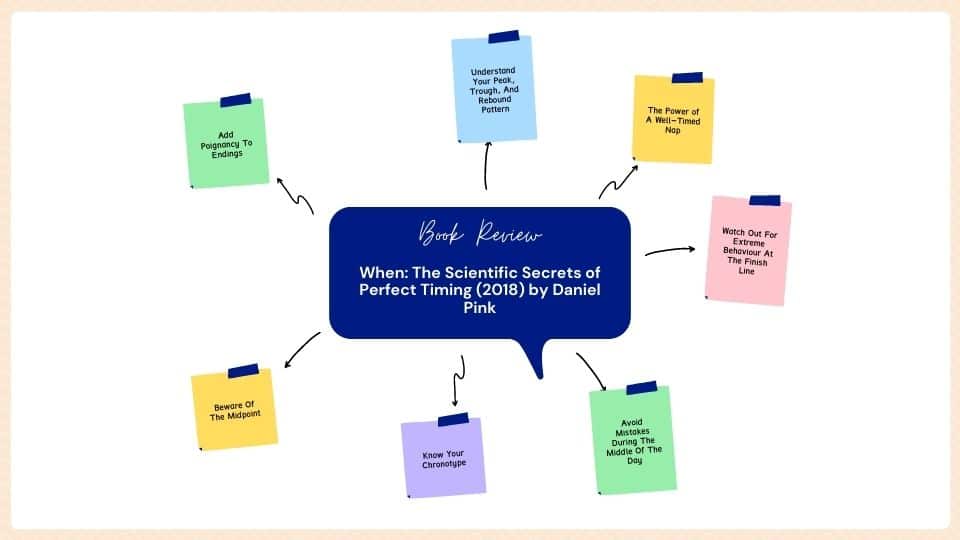
    7. Add Poignancy To Endings

    Humans place huge importance on a ‘happy ending’. Moreover, we place more value on achieving poignancy – a bittersweet, happy yet sad feeling – to a project or task that nears its end. This desire for poignancy is truly satisfying and one can take steps to achieve it.

    The end always symbolizes a period of change and a new beginning. Yet, the future is unseen, unknown, and therefore, there is uncertainty too.

    We should therefore attempt to bridge this gap, by creating relations between the past, present, and future. A good example would be to write a letter to your future self, describing the feelings of the past and the present, or plans for the future. When such letters are read after a few years, they can move a person in many ways and be a revelation. The feeling of poignancy can be thus achieved.

    “Ernest Hemingway published 15 books during his lifetime, and one of his favorite productivity techniques was one I’ve used myself (even to write this book). He often ended a writing session not at the end of a section or paragraph but smack in the middle of a sentence. That sense of incompletion lit a midpoint spark that helped him begin the following day with immediate momentum. One reason the Hemingway technique works is something called the Zeigarnik effect, our tendency to remember unfinished tasks better than finished ones.” — Daniel Pink

    The Final Message Of Time

    Our moods and performance oscillate during the day. Time waits for no one. It is up to us to make the most of it. Understand how the peak, trough, and rebound pattern affect us in a myriad of ways. Knowing one’s chronotype, avoiding midday mistakes, incorporating well-timed breaks and naps are some of the ways we can get ahead of time.

  • To Sell Is Human by Daniel Pink – Book Summary and Review

    The lines between other traditional departments of an organization and the sales department have become blurred. The function of sales now overlaps the roles and responsibilities of each employee in an organization. Interaction with customers has become a vital role and thus, ensuring that the customers, clients, and vendors have a great experience has become important too.

    In fact, selling, or sales has been an integral part of every human life, since time immemorial. The erstwhile barter system has given way to full-fledged, complex sales, advertising, and marketing, and is today, one of the most important functions that are vital to the growth and sustainability of any business, entrepreneurship, and start-up, or corporate.

    To Sell Is Human by Daniel Pink is a perfect guide for everyone, arming them with techniques and tools to enhance their selling skills.

    The “We Are All In Sales” Ethos

    Considering that ‘sales’ is now everybody’s job, incorporating a “we are all in sales” ethos in any business is essential. For example, Atlassian, the enterprise software company, generated more than $100 million in revenues without having any dedicated sales force in the year 2011. How did they manage that?

    The answer lies in incorporating an attitude of “selling their business” during every interaction with clients, customers, and vendors. In the United States, entrepreneurs are slated to soon be the majority of the workforce. With this in mind and the fact that start-ups usually cannot afford a sales department, the responsibilities of sales fall on everyone’s shoulders.

    Today, the average employee spends 40% of their time convincing, influencing, and persuading others. This is also called non-sales selling, or moving people. In the Ed-Med (education and medical) industries, the largest job sectors in the US today, non-sales selling and moving people is a fast growing concept.

    The New Tenets Of Sales

    Salesmen have had, for some time now, a negative “slick, pushy, used-car salesman” image. Salespeople could get away with anything earlier, especially in the used-car dealerships. This happened just because salespeople had more information about the product than the buyer, and that not making a bad buying decision was the customer’s responsibility (a concept known as caveat emptor or buyer beware). 

    Today, the Internet has made information available at our fingertips and the ‘information asymmetry’ has reduced. Customers today, can even expose dishonest companies online, damaging their reputation and business.

    Today, honesty, transparency, and service have become the new tenets of sales, making customer satisfaction and experience vital to salespeople. This shift can be seen in non-sales selling as well. In the Ed-Med industry, with information easily available online, service is more important.

    The New ABC’s

    The age-old, ABC’s of selling (Always Be Closing) has given way to a new ABC of moving people – Attunement, Buoyancy, and Clarity.

    1. Attunement – Attunement refers to one’s ability to perceive things from others’ perspectives and then act. How can one, therefore, be attuned?

    Attunement does not include empathy, which refers to feeling. While empathy is important on should understand what the opposite person is thinking and apply ‘cognitive perspective-talking’. This implies, that contrary to the belief that ‘sales’ equals ‘extrovert’ behaviour, people should move towards being ambiverts – a blend of introvert and extrovert. This is because classic extroverts cannot se beyond their own perspectives, are not understanding of what the customer thinks, and can actually hurt sales. Ambiverts, however, have the ability to listen and then attune their perspectives to that of their customers.

    To be attuned, salespeople should always assume that they are in low-power position because power makes people oblivious to any perspective apart from their own making them stick to their own views. Additionally, subtly mimicking actions, behaviours, and postures of their customers increases the chances of closing deals.

    1. Buoyancy – Rejection in the field of sales isn’t uncommon. However, it is essential that every salesperson stays afloat for the next customer that comes in. Buoyancy is that continuous will to keep selling day-after-day despite rejection. How does a salesman, therefore, keep buoyant during, before, and after rejection?

    Interrogating self-talk or asking oneself the question, “Can We fix it?” is a better way to deal with a tough task such as sales, as averse to previously-famed self-motivational declarations like, “I am the greatest and I can do it!” Interrogative self-talk forces one to think of possible solutions and strategies during rejection. Buoyancy keeps a person positive, broadens one’s perspectives, and thus perceive the customers’ problems better. Such an outlook can even help a customer consider the alternative suggestion after an initial rejection.

    Buoyancy also implies that salespeople should stay positive even after rejection. It means adopting an attitude where one tells oneself that this rejection is simply temporary and not a permanent feature. One rejection isn’t a personal setback. Seeing the positive in a bad outcome helps people deal with the regular rejection that they face as salespeople.

    1. Clarity – Salespeople are no more the sole custodians of information. Therefore, sales and non-sales persuaders, have to find a new method of moving people.

    They need to work with clarity; which means that they should focus on making customers view their situations and needs in a new light. Help customers identify their problems by sifting through the vast amounts of information available to them, rather than seek solutions is more valuable as a sales service.

    Once the customers understand the information given, the salesperson should make their sales pitch while comparing their product with another, as comparison helps customers perceive the product they need in a better light. Additionally, giving customers fewer choices and limiting their options increase the chances of sales.

    Another way of adding clarity is by offering customers an experience rather than a product. This means that customers respond better to a sales pitch where they get first-hand reviews of the product being used. This means that the information given to customers should be clear and detailed.

    Short and Engaging Pitches

    We are bombarded with a lot of information from all directions all the time. Most of this information is in the form of advertising and marketing. If we look at Elisha Otis’ effective pitch for his invention in 1853, he cut the cable of an open elevator he was standing upon, at the height of at least 3 stories, in front of a captivated audience.

    As they gasped, he didn’t budge. His invention, the automatic safety brake was a success, as was his pith to his audience. If we consider sales pitches today, we know that they have to be faster and shorter than they were in 1853. Considering the modes of communication we have today, they have to be short enough to fit in a Twitter headline or fit an email subject line. For example, President Obama’s 2012 campaign slogan was just one word “Forward.”

    In addition to short, pitches need to be engaging, to stand out from the crowd of information we get. Pitches that get the customer involved in developing the pitch and contribute their ideas are often more successful. Such pitches mostly involve the customers answering a question; one that will make them think in favor and this move them. Another trick to make a pitch work is to use the concept of having a rhyme scheme. Rhyming appears to make statements look and feel symmetrical and accurate.

    Using Improv In Sales 

    Often, salespeople rely on scripts – designed to bring about the desired result from customers – to make their pitches. However, with the complexity of sales increasing and being more dynamic in nature, it is essential that salespeople be prepared for sudden changes.

    The unscripted ‘improve’ concept revolutionized classic theatre by creating an environment of open-minded interaction. Improv put the focus on listening to others, a skill that is most essential for salespeople to be able to know what their customers want and are thinking.

    There are two more vital components of using improv. The first one is to understand that moving people doesn’t happen in a vacuum. Therefore, in the case that a salesperson is working with a partner, they should always try to make the partner look better in from of the customer. This is called a ‘win-win’.

    The second component is to use, “Yes, and…” or “Yes, but…” while responding to one’s customer opinions and ideas. Adding an affirmation creates a positive tone and helps a customer understand that the salesperson understands likes their idea, but has a better one to offer.

    Personal And Purposeful

    Sales, today, is no longer an exchange of goods. It has become more personal and purposeful, and salespeople have to customize the personal experience for each customer. It involves adding a personal touch to the service that the salesperson is providing.

    For example, a restaurant owner who puts up his photograph with a contact number for complaints adds a personal touch to his restaurant’s service. It tells customers that he is open to suggestions for improvement. This attitude will make customers come back to the restaurant.

    Along with personal, adding purpose to the service and conveying it to customers is essential too. For example, in a study conducted to promote hand hygiene among doctors, it was found that they responded better to patient-oriented “Hand Hygiene Prevents Patients from Catching Diseases” rather than “Hand Hygiene Prevents You from Catching Diseases,” that put the focus on their own health. The first campaign matched the purpose of the doctors – to care for patients. Therefore when it comes to moving people both ‘personal’ and ‘purposeful’ are vital, as selling is after all, human.

    Conclusion

    Sales and selling have given way to the concept of  ‘moving people’. To move people, one has to redefine the ABC’s of sales into the ABC’s of moving people. Additionally, to truly move people in the sales business, as well as those engaging in non-sales selling (essentially everyone these days), can use short and engaging pitches, use improv in sales and ensure that their dealings are personal and purposeful to win over customers in this new era of sales!

brain care coaching commitment communication conflict conflicts conversation culture deployyourself deploy yourself emotional intelligence emotions empathy energy feedback freedom future gold habits hope john maxwell language leadership lessons listening performance perspective preparation productive productivity psychological safety purpose questions relationships resolution ryan holiday seth godin simon sinek strengths struggle team trust values words