During a 3200 meter race in 2012, Arden McMath collapsed due to exhaustion. Instead of continuing past her and finishing one spot ahead, fellow runner Meghan Vogel stopped to give Arden a hand. Meghan draped Arden’s arm over her shoulders, and supported her the last 50 meters to the finish line. When they crossed, Meghan ensured Arden finished before her, and in the process, ensuring she finished last overall.
Despite being at the bottom of the standings, Meghan was a winner that day, she finished a champion. With the crowd watching the events unfold, Meghan’s sportsmanship won over many hearts. It’s a testament to how the first place is not the only way to triumph.

Winning Is Not The Only Thing That Matters
We all know that winning is important, be it in sports or life. It is, after all, the reward at the end of the race that initially attracts most competitors.
Today I want to highlight something beyond winning, something which is even more important—the journey. As you can see in the above story, winning is not the only thing that matters. Meghan was a winner that day despite finishing last.
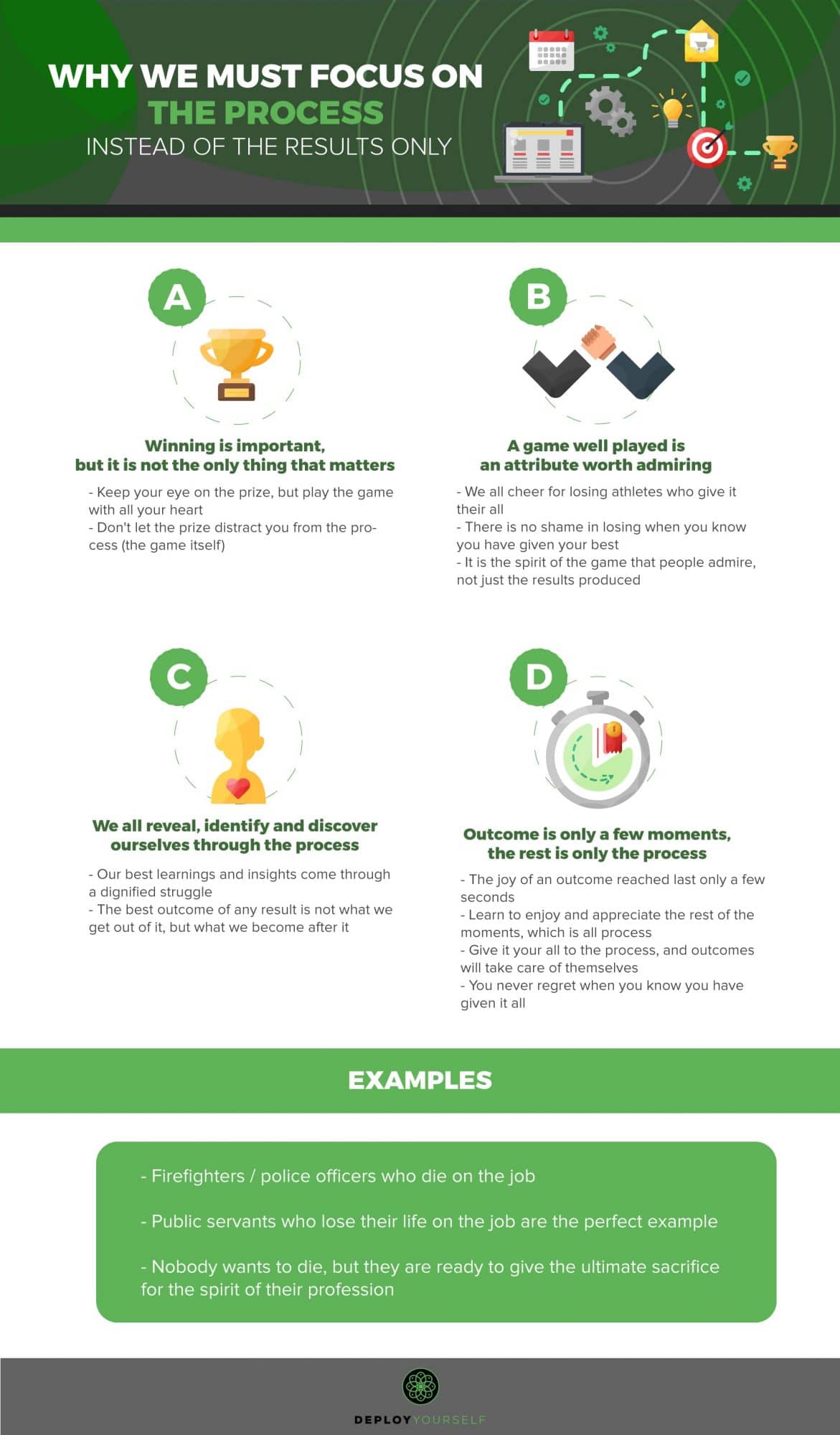
You can see this in all sports. You don’t only support the best players or teams. You don’t only cheer for the winners. You cheer for the people that play with integrity and give it their all. (See an infographic with the main points of this article at the end.)
Even those that come in last are cheered when they play the game with the right attitude. You’ll find that most sports have awards not only for winning but for many other aspects of the game. There are trophies and awards handed out for sportsmanship in almost every sport.
Sports stars are not only athletes. They are role-models. Apart from their performance, it is their attitude and behavior that makes them so.
It’s Not the Dog in the Fight, It’s the Fight In The Dog
Over 50 years before Meghan helped Arden to the finish line, a similar thing occurred in the 1956 Australian National Championships.
Runner Ron Clarke got in a tangle when another runner inadvertently clipped his heels. Clarke had been leading the race but at this point fell to the ground, and was leaped over by those runners just behind him.
One of those to initially jump over him was John Landy. Unfortunately in his attempt to avoid Ron, John’s shoe clipped and cut Ron’s arm. Rather than continue on, John—who was a favorite for the race and expected to appear in the nearing Olympic Games—stopped to check on Clarke. After helping him up, the two continued the race. John, even after stopping to help, made up the deficit and won the race.
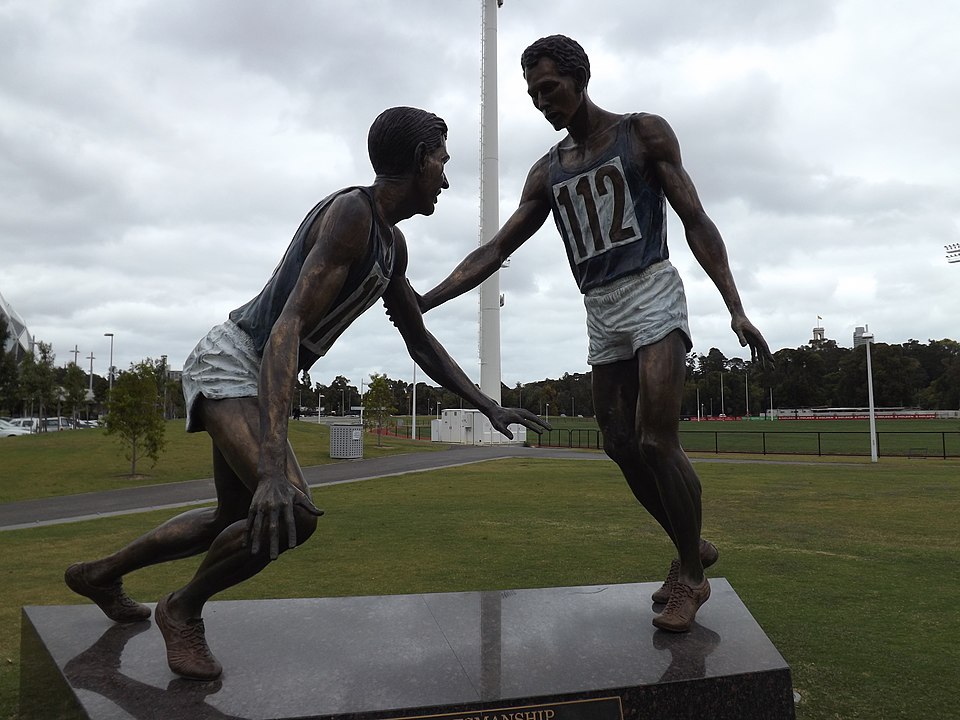
But it was not the win that John was remembered for. His gesture of sportsmanship was so well-received that a sculpture of the moment was made, and remains to this day in Olympic Park, Melbourne. Clarke, in his autobiography, wrote:
“Within seconds the whole field was jumping over me or running wide. Then John did a foolish, but a typically thoughtful thing – he came back to say he was sorry and see if I was alright. The mile title, his bid for the world record, even the approaching Olympics… all were forgotten as the champion made his spontaneous gesture to the raw stripling floundering in the cinders.”
We must always keep our eye on the prize, but play the game with all our hearts. The reward or goal at the end shouldn’t distract us from the process of playing the game itself. If John Landy or Meghan Vogel had been too focused on the white stripe at the end of the track, it’s unlikely they would be as well-remembered or respected as they are today.
A game well played is an attribute worth admiring in itself. And playing the game doesn’t happen in the moment of winning or losing, it happens in every moment before that. This is the reason we all cheer for an athlete who lost but gave it everything.
There Is No Shame In Losing When You Have Given Your Best
There is no shame in losing when you know you have given your best. In life as well as in sports, it is the spirit of the game that people admire, not just the results produced.
If we only focus on the result, it is easy to miss the process which leads to those results in the first place. We all reveal, identify, and discover ourselves through the process, as that is where we spent most of our time.
The finish line is a fraction of the total time we invest. When you switch from only enjoying the rewards at the end to relishing the entire process, more of your life becomes meaningful and enjoyable.
Growth is a continuous process, not something that happens only in brief moments of time. Most of our life is spent in between the wins and the losses, the ups and the downs, and the start and the finish. Happiness is fleeting, and if you only expect yourself to be happy when you reach certain goals, it will leave you disappointed and frustrated most of the time.
There are two reasons why our happiness from these moments quickly fades:
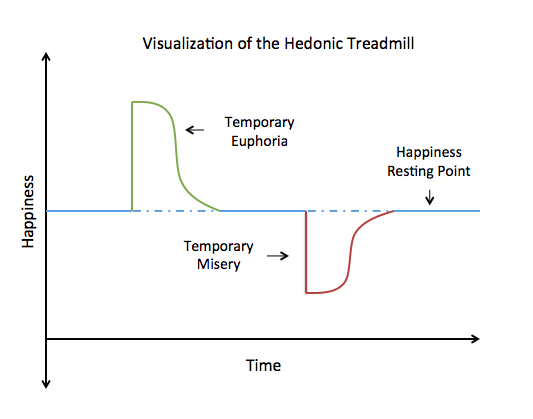
- The first is that positive emotions fade after the moment of success or victory. While we might be joyous and celebrate for a time, the shine wears off and we return to a baseline state.
- The second is that our aspirations continually grow. We don’t reach a goal and decide to completely stop. We soon turn our attention to something else. A new goal takes hold, and the struggle begins again.
The result is that after we achieve a goal, we enjoy it for a moment before moving onto the next thing. It is part of what psychologists call hedonic adaptation, and occurs for both positive and negative events—the emotions never last, you always return to the baseline.
Goals Don’t Create Or Sustain Happiness
They have value because they give us a direction, and they’re trackable and measurable. But only focusing on them places a lot of pressure on us. When we do achieve them, the positive effect is over all-too-soon. Then it’s on to the next thing, with the pressure back on.
This is not a healthy way to live or grow. However, there is an alternative, which is to give more of our attention to the journey instead of the destination.
For The Love Of The Challenge
If you are only focused on what you want, the process will be an obstacle. If you think of the process as a problem, you’ll do anything to find a short cut, and get straight to the prize, reward, or good feeling, without the challenge.
There are times when removing a challenge will help you. You use calculators and washing machines to achieve goals that you don’t want to waste your time and effort on. Because you want to save your effort for more important tasks.
But when it comes to our most important goals, there are no shortcuts. If there were, it would defeat the purpose. Growth happens and life derives its meaning in the process. It’s what happens when you respond to the challenge, not when you reach the end result.
Philosopher and mathematician Bertrand Russel wrote that removing challenges from life is a sure way to remove happiness, not increase it. You need the struggle, the obstacles, and the challenges to overcome. That’s how you improve and derive meaning and joy.
Our most significant lessons and outcomes in life do not come from winning, but from giving our best in a dignified struggle. The joy of a race won or a business victory lasts only a few seconds, while the satisfaction of discovering something deep and true about ourselves lasts a lifetime.
When you pour effort into an activity, you do so because of love for what you’re doing. When behavioral economist Dan Ariely and others had participants build IKEA products or origami, their creations were often of poor quality. But their creators loved them and expected to be paid much more for their products than anybody was willing to pay. From an outsider’s perspective, each person’s creation could be viewed as a failed attempt, especially when compared to expert creations. But to each individual, the time and effort that went into what they built ensured they held it in high regard.

When you’re not busy trying to compete with other people or claim a reward, and simply focus your energy on the task itself, the outcome will be positive and meaningful no matter your level of success.
How To Change Your Perspective
You don’t know who you will be in the future. You don’t know whether you will even reach the destination when you’re still on the journey. But you do know who you are now, the direction in which you want to go, and the kind of effort you want to put in. Setting your sights on the future can distract you from what happens in the here and the now. Every distant goal begins with taking action now, so it is important to focus on your present actions. Winning a race depends on taking action now.
World-class sports stars do not just walk out on the track and win, they practice day and night for years. There is a long and arduous process that happens behind the scenes. You need similar processes and habits driving you. And you need to cherish them, even when they get repetitive or painful.
This means changing your focus from your big goals to your system of daily habits and processes. Goals are something you go after, habits and processes define who you are. Goals are future bound, but processes are in the here and now.
By creating habits, you can make lasting changes in the way you show up for life. Instead of reverting back to your past self when you reach your goal, you will continue the behavior. Your goal becomes another point on a journey of continuous improvement.
Research suggests that a simple change of perspective can help us do this. In six studies by Szu-Chi Huang and Jennifer Aaker, of over 1600 people from different cultures and backgrounds, they found that construing goals as a journey led to continuing the behavior that attained the goal. They write that:
“The journey metaphor may have helped people think more about the actions they took during the journey, where they started out, and all the ups and downs along the way, leading to the feeling of growth. These thoughts could also contribute to an increased perception that the actions they took were instrumental and should be continued.”
If you want to lose weight, and you succeed, there’s little stopping you from falling back into old habits and putting the weight back on. Treating the process as the most important element ensures we don’t regress after a goal is achieved but continue on the journey.
There is another benefit to thinking in terms of a journey—the scale of the goal is less likely to deter you.
Before you start on your journey, a goal that seems insurmountable might stop you from acting at all. A goal that seems easy could have you put it off. By changing your perspective and focusing on what you can do now, and what processes will help, you win even when the goal is missed.
Hence you should learn to enjoy and appreciate each moment in the journey towards the destination. Relish the challenge. When we know we have given our best, we never regret it in the end. That is success beyond success. There is no better joy or satisfaction in life than knowing you did the best you could.
It Is The Journey, Not The Destination
Goals are just dots on a map and often miss the story of how you got there. And everybody cares deeply about their story. You don’t skip to the end of movies or books to read about the happy ending, because it’s the process that is most appealing. It’s the difficult stuff that reels you in, the trials and tribulations, the conflicts and resolutions.
In any story, there are unexpected twists and turns. If you’re too focused on the future, you’ll miss opportunities to do something good and meaningful now. When someone falls (like in the story I started this article with), you’ll be too concerned with your goal to stop and help them up.
Real winners are not identified by the medals hanging around their necks, or the plaques on their walls, or their names in the record books—real winners are embodiments of qualities like determination, sacrifice, grit, integrity, effort, and heart.
It’s how they respond to the challenge, not the final result. It’s their journey, not the destination. And right now, you’re on your journey. There will be good times and there will be tough times, and it’s what you do in each of those that count.
Watch the video of the story (Meghan and Arden) I started this article with below. Every time I watch it, it gives me goosebumps and leaves me a little teary-eyed. And as you can see, Meghan’s act of sportsmanship that day continues to inspire people even today.
If that is not what success is, then I don’t know what is.