care

  • Want To Improve Performance? Before Giving Feedback, Give People These Four Things

    Do you use feedback as a tool to improve performance? If your answer is yes, you are not alone. Most managers see (and use) feedback, most of which is negative or critical, as a tool to improve performance. If you give positive feedback too along with the negative (the sh*t sandwich), we all know that people tend to focus on the negative and ignore the positive. If it helps, remember the last time you received a mix of positive and negative feedback? How did it feel?

    There is a story about Abraham Lincoln in his biography by David Herbert Donald that captures the futility of negative feedback. Lincoln would write letters to those that he had strong feedback for (like a Civil War general who was failing). Rather than letting the heat of the moment get the best of him, he would never send these letters and instead keep them to himself. He would much later give a response that showed more empathy and was more effective.
    Feedback Has Its Place

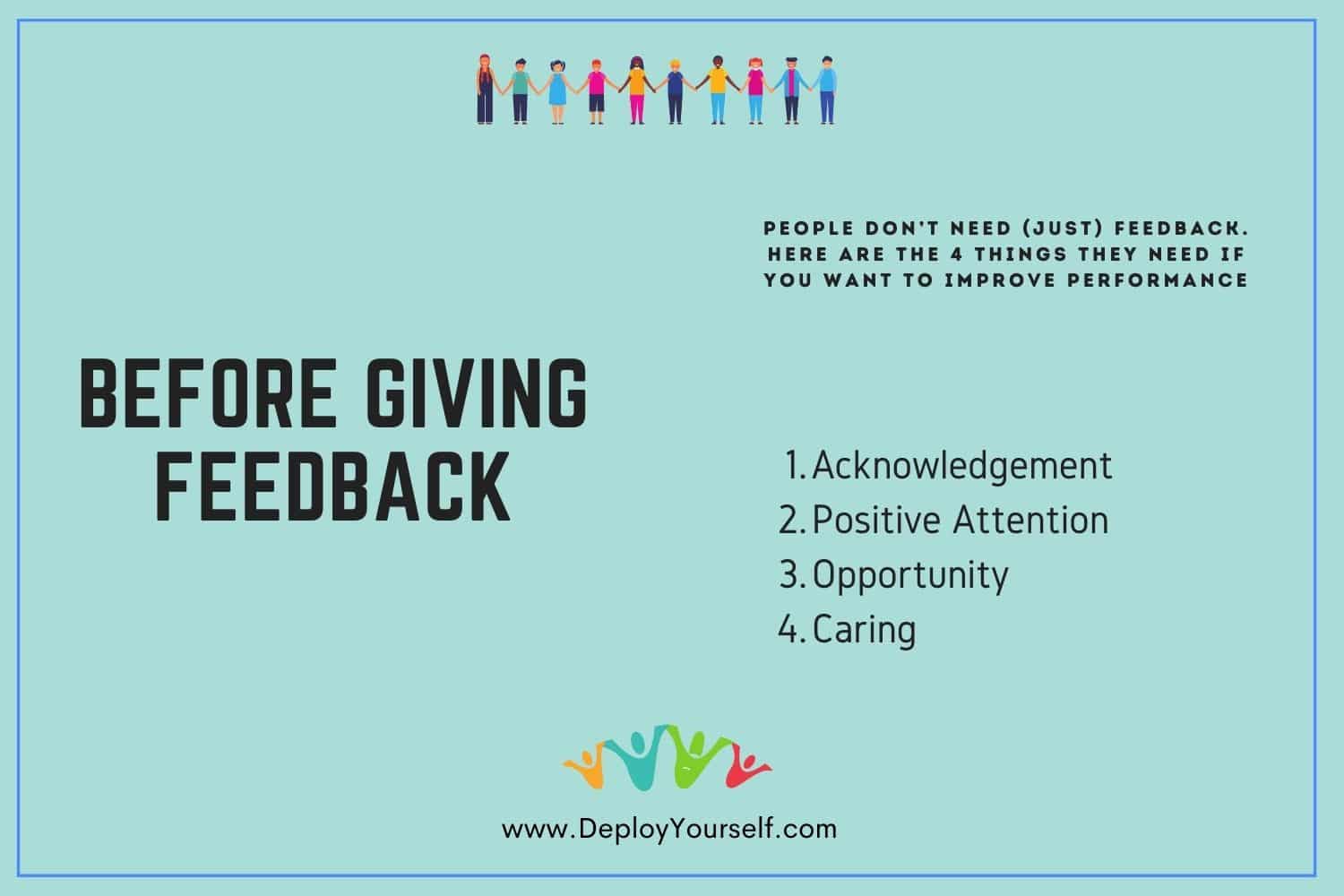
    In this article, I want to argue that feedback is important, but it has its place. There are more powerful tools any leader can use to improve performance and keep people motivated and engaged. These tools are acknowledgment, attention, opportunity, and caring.

    The four things mentioned below focus on the future, while feedback is glued to the past. And they must be done before and more often than giving feedback. People don’t need (just) feedback. Here are the 4 things they need if you want to improve performance:-

    “Too many companies believe people are interchangeable. Truly gifted people never are. They have unique talents. Such people cannot be forced into roles they are not suited for, nor should they be. Effective leaders allow great people to do the work they were born to do.” – Warren Bennis

    1. They Need Acknowledgement

      Good leaders see people for who they are (values), what they bring to the table (skills), and where they want to go (future ambitions). They understand and listen to them as human beings, and not just for the role they were hired for. This creates psychological safety, which is the first step needed for people to perform without fear and apprehensions. Good leaders trust people by default, and that creates a solid foundation for all future performances.

      As a leader, your biggest job is to create an environment where people can do their best work. By listening to people about their dreams, fears, and ambitions, leaders can sure people look forward to coming to work each day. In addition to helping with business productivity, it will also impact the well-being of employees.

      When leaders communicate transparently, authentically, and check in regularly to ask what people need, it deepens engagement and instills confidence as people know that their leaders have their back.

      “People change by feeling good, not by feeling bad.” – BJ Fogg
    2. They Need Positive Attention

      Strong leaders believe in their people and their abilities, often more than people themselves do. When someone does a job well, good leaders notice and let their people know. Research has repeatedly proven that positive attention is more powerful than negative attention to improving performance. Nobody shows up at work to do a job poorly, and if we only focus on moments of mistakes and failures, we are killing the enormous potential for good that people have.

      Good leaders understand that performance is not static, and everyone makes mistakes or fails to do a “perfect” job occasionally. Strong leaders focus on what people do well and not on their shortcomings, and understand that positive attention leads to engagement and exponential performance in the future.

      For example – A simple email showcasing major accomplishments or any behavior you want to encourage can go a long way in setting the right example.
    3. They Need Opportunity

      People need opportunities to contribute to something bigger than themselves. It is a common human desire to belong and contribute to a larger cause or mission. Leaders need to keep this in mind when they find and present work opportunities for people.

      If work doesn’t provide a way for your employees to belong and contribute, people will get bored and leave, or get used to mediocrity, which is even worse. The question every leader must ask themselves is – Can I give people the opportunity to do the work of their lives?
    4. They Need Caring

      Above everything else, people need caring. We all have a need to belong, to love, and to be loved by others. Good leaders know this and care for those around them like a fellow soldier. They enrich their relationship in every moment, by every word they say and every action they take.

      A caring leader notices small changes and inquires about people’s wellbeing and growth. Strong leaders demonstrate their care by coaching people to find their own way, which builds confidence and momentum as people take on and complete challenging projects. A good leader knows what their people care about, and she shows her care by taking care of that.

      For example – many companies offer the option for people to work flexible hours or to work from home, while others have an on-premises creche facility to better support employees who are parents.

    “Treat a man as he appears to be, and you make him worse. But treat a man as if he were what he potentially could be, and you make him what he should be.”

    — Johann Wolfgang von Goethe
    Conclusion

    Leading with care is a forward-looking and long term strategy to improve engagement and performance. Leaders need to focus on their people’s strengths and develop them, instead of “fixing” them with feedback.

    If you are a leader, focus on what people can do, versus what they can’t do, and you will see completely new opportunities for them. Spend your time and attention on what people do well, and that will give you the leverage to produce exponential results. Strong leaders understand that taking care of people is in alignment with (and not against) business results.

    Resources

    1. https://www.verywellmind.com/what-is-the-need-to-belong-2795393
    2. https://www.tonyrobbins.com/mind-meaning/do-you-need-to-feel-significant/
    3. https://globalleadershipfoundation.com/the-caring-leader/
  • How to Have Career Development Conversations With Your Employees? or How to Care for Your People?

    One of the most fundamental human needs we all share is to make meaningful progress in what we are doing. At the workplace this means knowing how does the road ahead looks, and how can we learn and grow to the next milestone on that road.

    If you lead people, you can coach and guide your people on the path of future success by having what I term as Career Development Conversations. Knowing that their career progression is being taken care of freeing up mental space for people, which in turn gives them the space to do well in their current roles.

    What They Are?

    Career Development Conversations are a set of coaching conversations a leader can have to help people understand, prioritize, and act on their long term career ambitions.

    People are mostly unaware of how they can grow in their careers, and as a coach, you can help them figure this out. These conversations help provide clarity on how best to make meaningful progress, within or outside the current organization.

    Every 2 weeks I share my most valuable learnings from living life fully in my Deploy Yourself Newsletter. Sign up now to download a workbook with 164 Powerful Questions which I use daily in my work and coaching. Allow these questions to transform your life and leadership.

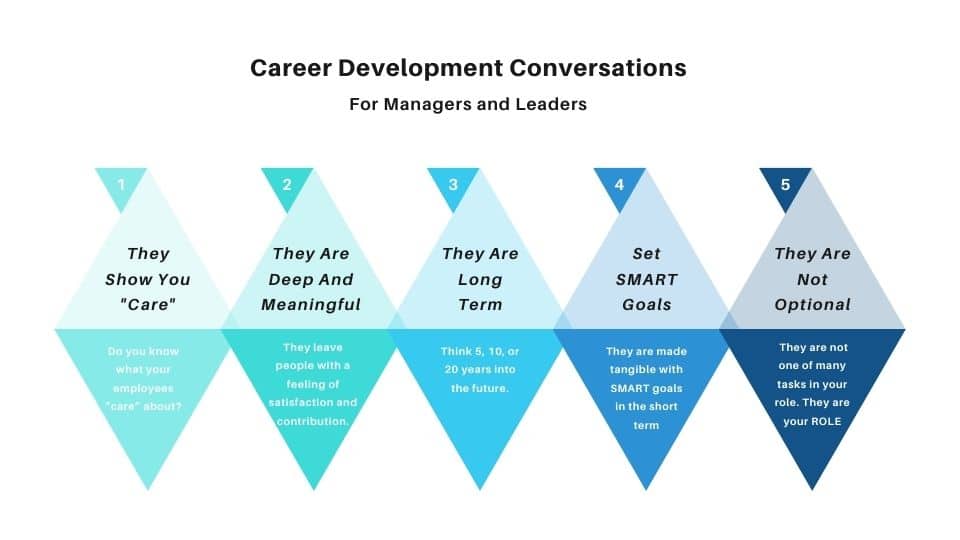
    1. Career Development Conversations show you “Care” for your people

    I believe one of the most important roles for a coach (and every manager is a coach by default) is to “care” for their people. And you do that by taking care of the “cares” of your people.

    Do you know what your employees “care” about, what they value or not value in life, and why? Do you know what motivates or drives them? Do you know what frustrates them?

    As a coach you can help people figure out what they “care” about. If we explore this simple yet powerful concept of “care” with our teams, it can open up a new world for them as individuals, and for us as a leader.

    2. They are Deep, Meaningful, and Long Term; but made Tangible with Short Term Goals and Milestones

    Working with various teams across continents over the last decade and a half, I have seen that people are often not aware what they “care” about, and what matters the most to them.

    Career Development Conversations are deep and meaningful to figure this out. They not only help people to be proactive in their career choices as they achieve important career milestones like promotions but also leave them with a feeling of satisfaction and contribution.

    3. They are the second-best opportunity to serve your people

    Leading by example is without doubt the primary way your people see and perceive your leadership. Any conversation or management practice will fall through if you don’t do what you talk about.

    The second best way is to continuously have these career development conversations with your people, which will create the context and form the background of everything else people do in their day to day jobs.

    These conversations can inspire people to cooperate in the face of business challenges. They help people align their own purposes with the larger collective purpose of the organization, leading to accountability and co-operation instead of conflict and self-destruction.

    “Treat a man as he appears to be, and you make him worse. But treat a man as if he were what he potentially could be, and you make him what he should be.” — Johann Wolfgang von Goethe

    What they are not?

    There are a lot of misconceptions around career development conversations since there are different definitions of them depending on the organisation you find yourself in. Let’s clear up what I mean when I say career development conversations.

    1. They are not Optional

    Most managers / leaders I have seen in different companies don’t have these conversations at all. Companies don’t realise its importance and it often takes a backseat with the focus mostly on driving business results.

    Even when they are, they are not regularly reinforced and leaders are not held accountable for them. Nobody told me about these conversations either. I have learned them the hard way – making numerous mistakes as a leader and only later stumbling upon these conversations from numerous trainings and books.

    2. They are not Performance Reviews.

    Many people and companies equate career development conversations with performance reviews, which happen on a quarterly or half yearly basis. However, what I mean by career development conversations is the total opposite of performance reviews.

    Performance reviews focus on the past. Career development conversations focus on the future.  Performance reviews focus on putting you in a box (of job expectations) and measuring you against the expectations of that box. Career development conversations encourage you to get out of any defined boxes (or job roles) and define for yourself the meaning of success and contribution.

    3. They are not Short Term.

    Career Development Conversations are long term. Think 5 to 10 years or even longer if you can. They help people envision what their career is (or can be) all about. They go beyond material milestones and successes; and empower each person to find their own meaning at work, and define the legacy they want to leave behind.

    Having said the above, and keeping that as the background context, Career Development Conversations then drop back to shorter time frames of one year and less. By working on tasks aligned with the long term context, people can find new meaning and joy in their work which wasn’t available before. Needless to say, all of this results in better business results too.

    4. They are not about the Next Promotion or Job Titles.

    Career Development Conversations can also be confused with promotion and the usual benefits that come along. I believe that while that might happen as an outcome of these conversations, they are not the end goal in themselves.

    The focus is on the continuous development of employees and their progression as professionals. The emphasis is on doing work which not only challenges people professionally but also leaves them with a deep sense of pride and purpose in your work.

    5. They are not just one of many “tasks” to be done

    Career Development Conversations should not be taken lightly by managers / leaders. They are not just one of many tasks in your role. Infact, they are your ROLE. If you are not having these conversation, you are leaving huge potential in people and your team untapped. When done well, they can cause careers to take off.

    Career development conversations should not be taken lightly. I believe every task your team member does should revolve around these conversations. These conversations will set the context of everything the team member does or does not achieve. They are to careers what oxygen is to life.

    Key Conversations

    Having gone over what career development conversations are and what they are not, let’s go over some of the key conversations :-

     1. Understand Them

    The intent of this conversation is to understand your people beyond their job descriptions. You can do so by asking and answering the below questions.

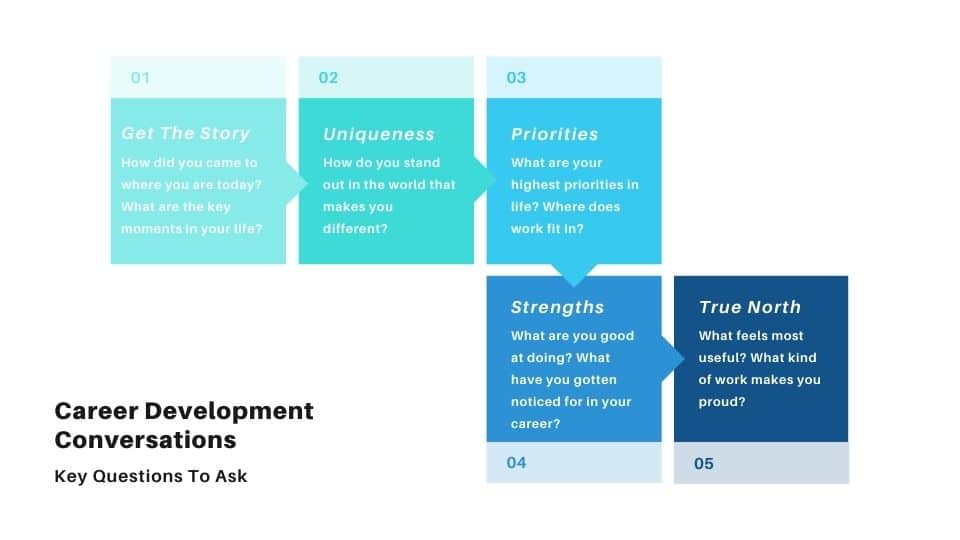
    • What is your story?
    • How did you come to where you are today?
    • What are the key moments in your life –  ups and downs, successes and failures, and how each of these events has shaped you?
    • Tell me something I don’t know about you. This question always amazes me as I find out something new about the person.

    If you think this can be hard, then you are absolutely right. Getting people to open up about their life can be a slow and gradual process as you build trust and go beyond personal barriers.

     2. Help them figure out their True North / Lighthouse

    • How do you stand out in the world that makes you different?
    • What are you good at doing? What do you believe you are the best at? What have you gotten noticed throughout your career?
    • What feels most useful? What kind of work makes you proud? Which of your tasks are most critical?
    • What bugs you? What makes you angry or frustrated?
    • What are your highest priorities in life? Where does work fit in?

    By asking some powerful questions like the above, you will help people identify their strengths and weaknesses, values, and motivations, and what makes them unique and special. For me, knowing someone as a human being is such a wonderful experience as I get exposed to the personality of the person which is normally hidden in workplace conversations.

    Helping people figure out their True North can help clear the fog of uncertainty and clearly distinguish the path or at least the direction, they can pursue in the future. This True North can be a lighthouse (of values) that can serve as a compass in difficult times.

    3. Empower Them by Preparing a Plan

    The next type of conversation is to build upon the above two and make it concrete in the form of a plan for where they want to go. Present them opportunities for future growth in the organisation based on their values and motivations, and not just on their talent and skills.

    Once you have identified opportunities that they can pursue with purpose and commitment,  support them to find training to acquire any skills they need, or in reaching the right people. Work with them to create SMART (Specific Measurable Attainable Relevant Timely) objectives, which are impactful for both the organization and the individual personally.

    Having clear objectives to achieve in the future, and also clarity about how will it help them individually as well as the organisation will empower them as they build up confidence and momentum once they start. Once they grow their wings and build up speed, get out of the way and give them space to fly. (which can be very difficult, especially in big organisations)

    In conclusion, I would also like to add that all the 3 kinds of conversations above never happens chronologically. You can jump between them as you feel fit, and it is a gradual process as you discover more and more about your people, and guide / support them on their way.

    As you discuss these questions, you also open up and answer these same questions for yourself too. These conversations are not a monologue but a dialogue. I have always found having these conversations very useful to me too, and you also end up building deeper relationships and friendships at work. And working with friends is always a breeze while working with strangers can be painful.  

  • How to Deal with Your Emotions In The Workplace And Make Them Work For You

    Fresh out of college, when I started to work professionally as a 21 year old, I dived into work passionately and emotionally. Not only did I do great work during that year, but I also had a lot of fun with my team, many of whom are still my good friends. I was emotionally attached to the work and the people around me, and I considered that a strength at that time.

    Not soon after, I had my first performance appraisal along with my friends (colleagues). Very soon, things weren’t as simple and fun as words like bonuses, promotions, and salary increments entered the vocabulary. Emotions flared, arguments ensued, and I had a hard time dealing with my emotions. I gave in to the temptation of reacting emotionally a few times and strained my relationships with some people.

    After a few such incidents, I started to consider my emotions a weakness and shut myself down, creating personal and professional boundaries in the workplace. I am glad that phase didn’t last very long.

    Today, after working for over 15 years in different companies and across continents, I consider emotions an integral part of the workplace, and they can be very powerful if we know what to do with them.

    Below are a few of my observations about dealing with our emotions at work :-

    Every Emotion Tells Us What We Care About

    When I formed great friends during my first year at work, my emotions (of joy) were telling me I care about trust and honesty. Later when I was angry and felt being wronged, my emotions were telling me I cared about everyone being treated fairly and respectfully. And when that expectation was not met, it gave rise to frustration and anger.

    The more attention we pay to our emotions, the more aware we can be of what they are trying to tell us. We can then reflect upon and listen to what they are telling us, and then still act in a way that is consistent with our values and long-term objectives.

    Emotions Are Always Valid. The Stories Behind Them Might Not Be

    There are no right and wrong emotions. There are no positive and negative emotions. Our emotions are always valid, and an inevitable part of being human. But we can examine the stories behind our emotions to separate the useful facts from false beliefs. Each emotion can tell us about something significant in our lives, but only if we are willing to examine the stories behind them objectively.

    For example – I felt angry and frustrated once when I didn’t get an expected bonus. In this case, I embraced the emotion without denial and examined the assessments behind it. I believed I had performed very well and shared the same with my manager. It was then that I got some feedback which made me aware of the gaps in my performance, and which I could improve upon. Thus I came to the realization that while my emotion was valid, the story behind it lacked evidence and was not well-grounded in facts.

    My manager understood my concerns and it strengthened our relationship. He also promised me to deliver any such feedback earlier the next time. In the end, it prevented me from reacting impulsively and judging others, which would have not done any good for both me and my team.

    I have learned that we can always witness our emotions as they arise instead of being sucked in their gravitational power and respond impulsively.

    Emotions Need To Be Expressed. Without Explosion or Repression

    According to Daniel Goleman, the capacity to subordinate immediate gratification to long-term objectives is the most important psychological skill. All emotions lead to one or the other impulse to act, which often are harmful to us in the long term. At such moments, we need to take the driver’s seat and prevent our emotions from taking over. Emotions are very good messengers but very bad masters.

    Just like tying a wild horse only infuriates him, repressing our emotions never works. When we do so, we end up suffering inside while putting up a brave face on the outside. By repressing, we are bound to explode sooner or later and it also results in stress which can end up impacting our health. Shouting at others (explosion), or sulking in silence (repression) never solves any problem. It often only makes it worse.

    Emotional Intelligence involves expressing our emotions, without repression or explosion. If we can understand our emotions and the stories behind them as a third-party observer, we can accept them fully without abdicating our responsibility to them. We can then choose to act according to our values – even in the face of failure and disappointment. We can’t always control our circumstances, but we can always act in ways congruent with our values.

    “To increase your effectiveness, make your emotions subordinate to your commitments.” -Brian Koslow

    Give Up Your Need to Be Right

    The reason we are so tempted to react impulsively to emotion is that it provides our ego instant gratification. When we shout and explode in anger, it makes us right and the other person wrong. Even if we know it is harmful to us in the long term, it gives us an immediate boost of righteousness. To handle our emotions well, we have to give up our need to be right all the time. We have to give up the temptation to “win” in every conversation and situation.

    I feel that we do our best work when we are emotionally engaged. We are our most creative and productive selves when we feel emotionally safe and don’t have to put on a mask at work. However, if we don’t know how to handle our emotions and give in to impulsive responses, we can do more harm than good.

    To sum it up :-

    • When we are happy with a successful result, an impulsive reaction could be to over-promise in excitement. But a conscious expression of happiness would be to just celebrate and acknowledge the hard work.
    • When we are sad about experiencing a loss, an impulsive reaction could be resignation and cynicism about the future. But a conscious expression of sadness would be to just grieve and acknowledge your loss.
    • When we are scared and fearful, an impulsive reaction could be to shut down and seek protection. But a conscious expression of fear would be to take a step back, assess the situation properly, and then act with courage.
    • When we feel anger and frustration, an impulsive reaction could be to explode or repress our feelings. But a conscious expression of anger would be to make a complaint and sharing our concerns.
    • When we feel guilt after a mistake, an impulsive reaction could be to beat ourselves up and sulking in shame. But a conscious expression of guilt would be to make a sincere apology and repair the broken trust with a new promise for the future.