body

  • How I Discovered My Body? And The 4 Body Dispositions

    I have always taken pride in my analytical and logic-driven reasoning skills. As a child, I remember myself not being physically strong. Sports was never a priority in the culture I grew up in, and we never had the finances to focus on any sports training anyways. As a natural corollary of that, I focussed on reading and studies. I vividly remember falling in love with mathematics, and I could sometimes solve complex problems in my head. That was probably when I started living in my head and forgot that I also had a body.

    This focus amplified when I stumbled into computer programming. The first time I used a computer, it was to program using BASIC and to play a game called DAVE. I must have been 13 years old back then. A few years later, my joy had no limits when my father bought a computer for me when I turned 15. It started a fascination with logic, reasoning, and programming that has shaped most of my work life.

    If I was not good at sports earlier, I totally stopped doing any physical activity once I had a computer at home. I spend my nights and days learning to program and making small and large projects – first for myself and then for some small companies. I carried this analytical mindset with great pride wherever I went and never bothered to consider that I also have a body – except as a vehicle for my head and thinking brain.

    Understanding Emotions Led Me To My Body

    My learning and research around emotional intelligence led me to focus and notice my body. Have you ever experienced having “cold feet” or a “hair raising” experience? If yes, you are not alone as every emotion brings with it a physiological response in your body.

    Our bodies react to external events first before our thinking brain has a chance to reflect on them. These responses might range from tension in your neck, back, or any other part of the body. For example – Sadness is associated with pain in the heart and numbness or stillness in the lower part of the body. Anger is associated with fast and shallow breathing and reddening of your face.

    Other ways your body reacts to external events include your heart beating faster, turning pale, smiling, sighing, sweating, getting goosebumps, and so on. These physiological responses show that emotions are not only in our brains but that they have a presence and origin in the entire human body.

    Noticing and becoming aware of our bodies becomes very relevant when it comes to communication skills as our words only constitute 7% of it. The rest of it is communicated via our tone of voice and our body. Do you notice small shifts in your and others’ bodies (gestures, hand movements, eye contact, facial expressions) while communicating? Do you notice the tone, volume, and fluency of voice change as different emotions play their part in the background?
    Discovering My Body At Newfield Network’s Coaching Program

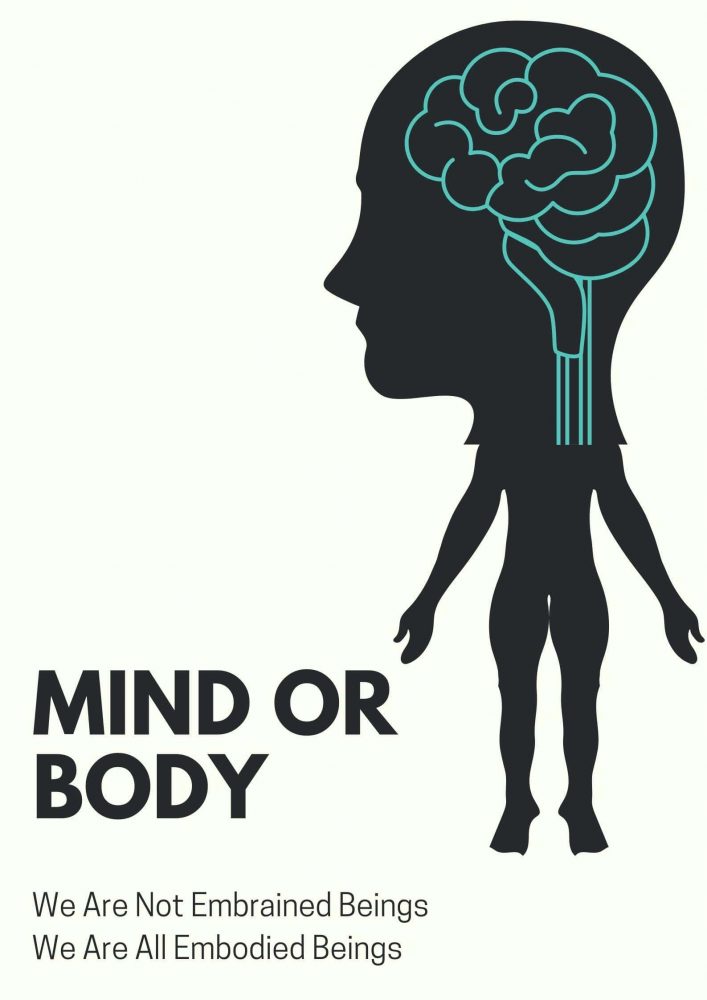
    In 2019, when I signed up for the Newfield Network’s Coaching Program, I discovered the role of our body in everything we do, and especially our leadership. Our body and associated physiology, our thoughts and language, and our emotions determine how we see the world, and every action we take henceforth.

    Our language, emotions, and body are the coloured glasses we all wear and through which we view the world. And making changes in our language, emotions, and body are our access to see the world differently and open up new possibilities. Modern neuroscience has shown that the body influences the brain just as much as the brain influences the human body. If we get into a posture of confidence and put a smile on our faces, it is impossible to feel depressed. Alternately, if we get into a slouched and depressive posture, it is impossible to be cheerful and joyful.

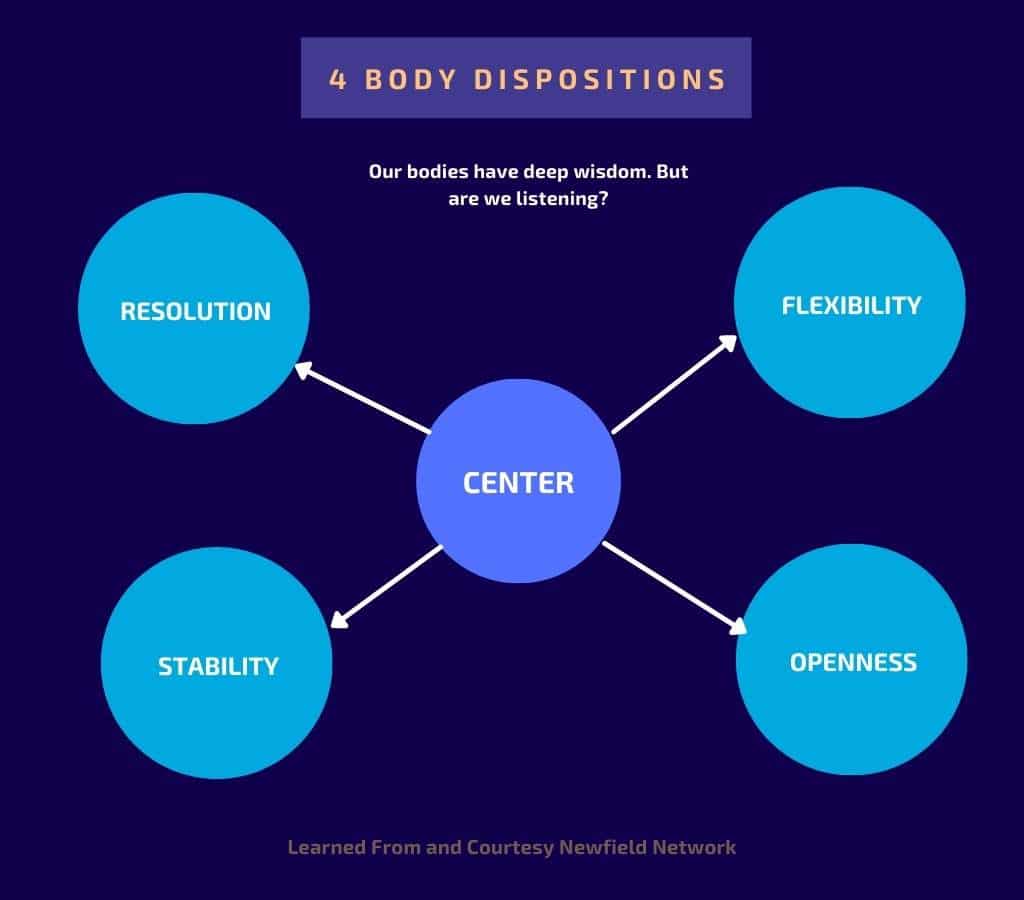
    It was at Newfield that I was introduced to the 4 body dispositions or archetypes. Before we talk about them, let’s understand the neutral state which is called the CENTER. Being in CENTER allows us to choose to move to any of the other 4 body dispositions. Being in CENTER is our foundational and grounded state as human beings. Center means we are aware of what is happening in our bodies. Are we tense or relaxed? Are we hot or cold? Are we balanced or not?

    “Life is always better in your body. Get out of your mind.”
    ― Lebo Grand

    The 4 Body Dispositions

    The 4 Body Dispositions (see them as choices) are different ways we can shape our bodies. With each body disposition, we see the world in a different way, and it shapes every conversation we have. Unless we are aware of them, we usually are comfortable in only a few of these body dispositions. These 4 body dispositions are Resolution, Flexibility, Stability, and Openness.

    Resolution is the body disposition when we are singularly focussed on getting something done. We feel tight and determined in our bodies, and are ready to take clear and decisive action. This is the disposition of a warrior.

    This is a position when you are ready to sprint. You place one foot in front of the other and are ready to move ahead and take decisive action. This disposition also keeps you away from distractions as your vision is focused. We all use this disposition in times of emergencies and crises situations.

    Flexibility is the body disposition when we are open to trying out new things and brainstorm new ideas. In this body disposition, we are moving our bodies, our hands and our feet as required. It can be said that in flexibility we are in a dance with what is happening around us. This is the disposition of a dancer or a magician.

    In this disposition, we are playful and open to trying different approaches and seeing different perspectives. We are ready and open to moving from one idea to the other. We can listen and speculate with others, even if their views are very different from ours.

    Stability is the body disposition when you feel grounded by the weight of your feet on the ground. Stability is standing in our own dignity, knowing what we stand for, and not be easily shaken or moved by what is happening around us. This is the disposition of a king or queen.

    In this body disposition, we align our head, shoulders, hips and legs in a straight vertical line. You speak firmly and confidently in this disposition and are aware of your own standards and boundaries.

    Openness is the body disposition when we open up our chests and arms in a warm embrace of what is in front of us. It is a disposition of vulnerability, tenderness, trust, and love. This is the disposition of a lover.

    In this disposition, your eyes are soft and you make eye contact with whom you are speaking. Your smile is genuine and your voice soft. It is as if when you are inviting someone to your world with open arms.

    These four body dispositions determine how we carry ourselves and how we use our bodies. By default, our body is shaped by our past life experiences and cultural influences. However, we all have the ability to change and shift our bodies, and with it the way we communicate and show up in the world.

    Some of us might spend most of our time in resolution, while for some of us it would be openness. For me, before I discovered this work, I realised that I used to spend most of my time in Stability and Openness without moving into Resolution and Flexibility, even when it was required. Ask yourself :

    • In what body disposition do you spend most of your time?
    • In what body disposition would you like to be more in?
    • What new possibilities could open up for you from those new body dispositions?
    The Relevance of Your Body To Leadership

    As leaders, we should be committed to our responsibilities and our commitments rather than the way we are used to being. If a leader identifies themselves as goals-focussed (resolute) and a situation demands them to listen and be open to ideas, can they bring forth an open body in that situation? Alternatively, if a leader is always empathetic and open by nature, can they switch to a more resolute posture when the situation demands so?

    Leaders need to think of themselves as not just their brains but the whole person – which includes all their emotions, conversations, and the foundation of it all – their body. Leadership presence is to be aware of your own body first and then of others around you.

    Having the view that my personality/identity is fixed and can’t change is an immature way of leadership. Imagine how effective it would be to learn to shift your body, and with it your emotions and communication to suit the situation. Instead of being “one type” of leader, you could show up as the leader which your team and organisation needs at any given point. The question is – will your personal style and comfort level limit your leadership, or will you transcend your default body dispositions towards one of your choice?

    Deepening My Awareness and Learning With Strozzi Institute

    In 2021 as I write this, I am continuing to know more about our own body (with relation to leadership) from the Strozzi Institute. I am slowly discovering the difference between academic knowledge and embodied knowledge. I am learning that leadership is a full-body contact sport, rather than just an analytical or rational one. I am discovering what Richard Strozzi has written in his book The Leadership Dojo, “The body we are will be the type of leader we are”.

  • 5 Ways to Influence & Impact Your Emotions

    Our emotions play a major role in determining the quality of our lives. Have you ever asked yourself why some people live a life full of joy and contentment while others struggle with anger and depression?

    It all comes down to how you cope with life’s stressors and unexpected events. No one is immune to emotions like cynicism, anger, and disappointment. While some people go into a frightful or depressive state when faced with stress, others see the same situation as an opportunity for growth. 

    In this article, let me share 5 research-backed ways to befriend your emotions so that you can navigate through life with choice rather than just being a spectator. Make your emotions work for you, rather than the other way round. 

    1. Get Good Sleep

    Sleeping is a biological function that is as necessary as eating. And when it comes to sleep, the quality does matter.

    Sleep deprivation alters the way both your body and brain function. Studies reveal that individuals with chronic sleep deprivation are more susceptible to a host of psychological and physiological issues such as anxiety and depression, memory loss, decreased brain function, weakened immune system, diabetes, obesity, hypertension, lower fertility rates, among others.

    How Does Sleep Affect the Brain?

    Sleeping allows your brain and body to do more than rest; it allows them to clear out waste byproducts of daytime activities, balance hormones, and repair tissues. Since all those processes are vital for brain health, sleep deprivation has a tremendous effect on brain chemistry and emotions.

    For example, neurons become slower at processing messages and transmitting signals, making you slower at processing information. This means that your reasoning abilities, reaction times, and decision-making skills suffer when you go for prolonged periods without sleep.

    How Lack of Sleep Affects Your Emotions

    Considering how sleep deprivation affects your brain chemistry, it does not come as a surprise that it affects your emotions too. It is the reason why most people tend to be irritable or more vulnerable to stress after a sleepless night, only to get back to normal after a good night’s sleep.

    Researchers from the University of Pennsylvania conducted a study on this subject where they had the subjects sleep for only 4.5 hours each night for one week. Findings from the study revealed that the subjects reported experiencing mental exhaustion, higher stress levels, as well as increased feelings of sadness and irritability. When the volunteers resumed regular sleep, they reported experiencing a drastic improvement in their mood, supporting the notion that lack of sleep affects emotions.

     According to the Journal of Sleep Research, people with sleep deprivation also tend to be less empathetic. That should not come as a surprise since you are less likely to be understanding when you are sad, irritable, or angry. This means that your lack of sleep will affect how you connect with others.

    Studies also reveal that insomnia is one of the core symptoms of depression. 20% of people diagnosed with insomnia end up developing major depression. However, scientists are still trying to determine which comes first between stress and insomnia. For example, it is hard to find sleep when you lose your job. Conversely, the stress is more likely to develop into depression the longer your sleep deprivation continues. 

    Address Sleep Issues

    Considering that lack of sleep has a direct link to higher levels of stress, developing healthier sleeping habits can help you curb your sleep-stress relationship. Therefore, even though your lack of sleep might be due to life’s stressors, you should try to put yourself in an environment that allows you to drift off to sleep without a lot of hassle. 

    Start with making your bedroom a sleep sanctuary. Consider the following tips:

    Comfortable Bedding 🛏

    For starters, get a comfortable mattress. A good mattress does not have dips or lumps, supports your preferred sleeping style, and does not overheat. Bedding made of linen or cotton is an excellent option since it is breathable, thus preventing overheating. 

    Keep Your Room Cool 🆒

    Cool rooms are more comfortable to sleep in. Consider keeping your bedroom’s temperatures between 16-19 degrees celcius.

    Keep the Room Dark

    The circadian rhythm – your sleep wake cycle – is controlled by light exposure. Light tells your brain that it is time to be up, while darkness lets your brain know that it is time to rest, thus resulting in the release of sleep hormones such as melatonin. Therefore, by keeping your bedroom dark, you will be allowing your body to follow that rhythm. Use heavy drapes or blackout curtains to keep outside light from entering the room.

    Do not Use Screens in Your Bedroom

    In the matter of keeping your room dark, you should also avoid using electronic devices when going to sleep. Unfortunately, most people are guilty of this habit. The blue light that electronic devices emit has the same effect as sunlight, thereby inhibiting your brain from releasing melatonin. If you are suffering from chronic insomnia, avoid using any devices at least two hours before bedtime. Read a book instead.

    Get Regular Exercise

    The fatigue that comes with physical exertion puts your body in a state where it desires to sleep. This is why physically active people are less prone to insomnia.

    Good sleep hygiene reduces your susceptibility to stress. Therefore, make sure to get at least seven hours of sleep every night. You will find yourself having better control over your emotions.

    2. Language – Thoughts and Words

    “Sticks and stones may break my bones, but words cannot hurt me.” While that saying sounds good when using it against naysayers, you must be very careful about how you interpret it.

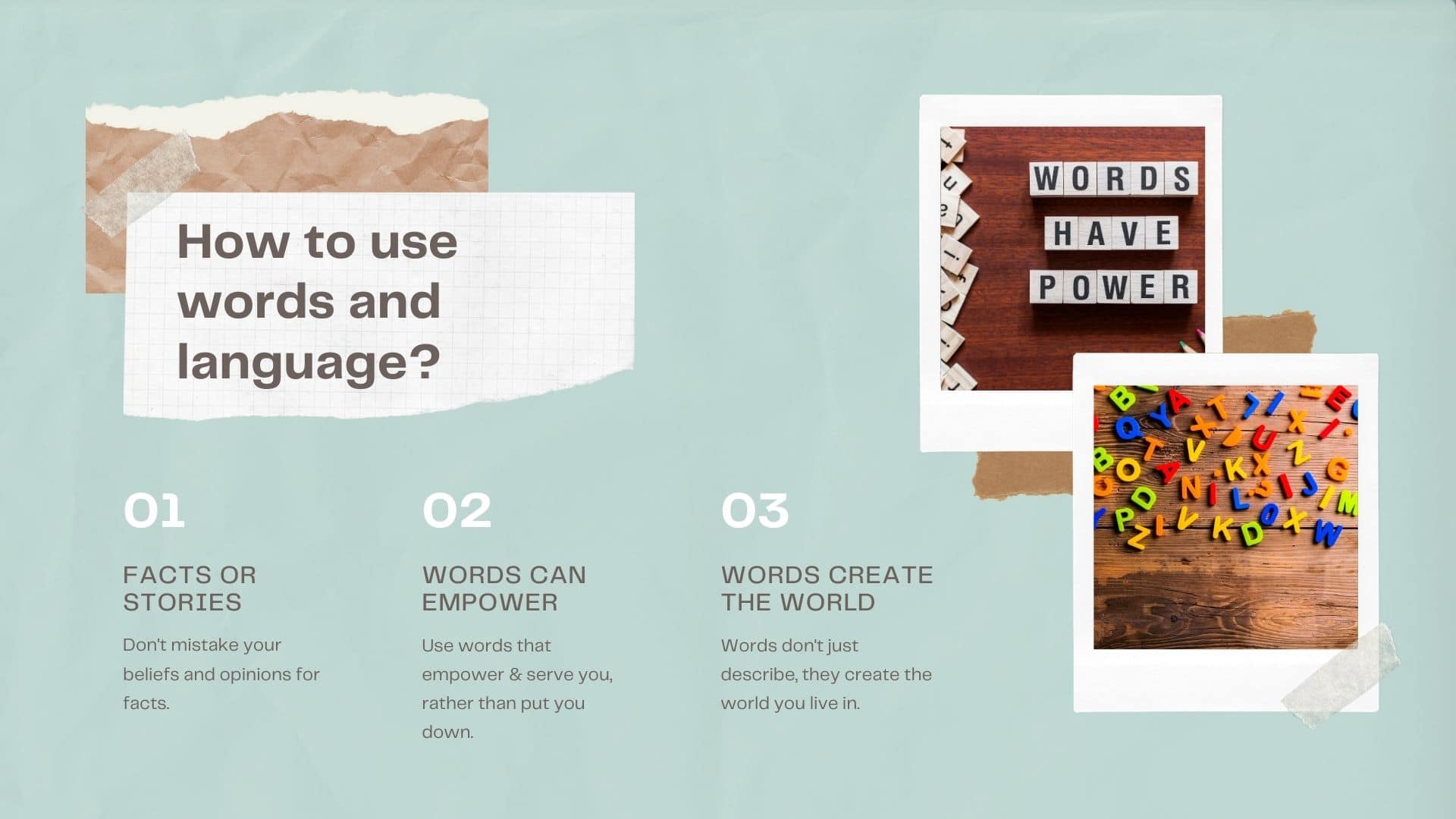
    Words are powerful. In fact, one could argue that words, and thus language, is the tool that made humans the most powerful species on the planet. Alone, a human is a puny creature that cannot stand its ground against most animals. However, as a team, it is a completely different ball game. Our ability to communicate effectively is what allows us to strategize and use the environment to our advantage.

    When used appropriately, words can engage, encourage, and persuade. In the same light, however, words can also dismiss, discourage, dissuade and cause damage. 

    Using words, therefore, you can plant the seeds of success or failure in your mind or that of another. The words and the language you use also end up defining you, as they reveal your thoughts and attitude.

    What are Words?

    “We translate experience into language and mistake the language as the actual experience.” – Joseph O’Connor.

    Words are labels or descriptions you give to your emotions or feelings. They allow you to express what you are feeling inside so that you can have a better understanding of your circumstances. However, just because you feel a particular way about something does not mean that that’s the reality; it is simply your perception of the situation, or better yet, your assumption.

    As such, words can also be described as your biased perceptions of both your internal and external environments. These perceptions or interpretations are biased since they are based on your history, values, beliefs, thoughts, rules, and more. 

    Therefore, words are simply psychological anchors for emotions. For example, by saying that you are afraid of something, you will fear whenever you come across that situation. Perhaps a past confrontation went bad, leaving you with a fear of confrontations. 

    However, that is no way to live life, as confrontations are part of everyday life. The problem lies in using certain unhelpful or disempowering words to describe your emotions.

    Changing Your Language Patterns

    Using positive language is linked to experiencing an uplift in emotions. In one study, the researchers had a group of volunteers write down at least three positive things about their day for three months. By the end of that period, they all revealed feeling happier and better about their lives. 

    If simply jotting down positive words makes you feel better, it means that you should start becoming conscious of your thoughts and the language you use daily. You will also need to identify how those affect your emotions and thus, your decisions, choices, and actions. It is only when you have a clear understanding of how your language patterns affect you that you will be motivated to make the necessary changes.  

    Consider the following examples:

    “I’m angry” vs “I’m disappointed”

    Simply admitting that you are angry will trigger your body to display the necessary neuromuscular response to match that emotion, thus ruining your mood. However, when you say that you are disappointed, your brain will interpret that you are not happy about the situation while not being particularly bothered by it. This means that you will not feel the same impact on your emotions, allowing you to handle the situation more effectively.

    “I can’t” vs “What if I could”

    Saying that you can’t do something is extremely dangerous, as you will be admitting that the challenge at hand is beyond your abilities. While there are challenges that you might not be equipped to handle, admitting defeat signals your subconscious that it is okay to quit.

    However, saying, “what if I could” is extremely empowering, as it is a refusal to accept defeat. 

    Your words influence your experience of reality. They influence your perceptions, thoughts, evaluations, beliefs, attitude, actions, patterns, behavior, body language, and more. This means that your language influences not only your emotions but also your actions and results. Choose your words wisely.

     “Words are, of course, the most powerful drug used by mankind.” – Rudyard Kipling.

    3. Breathing/Presence/Mindfulness

    How many times have you said to yourself, “I should never have said that or I should not have done that?” This happens to everyone, as you simply cannot live without emotions. However, as mentioned, there is a difference between how we perceive things and what they really are.

    Therefore, to avoid knee-jerk emotional reactions, you must learn how to calm yourself down in the heat of the moment so you can analyze the emotional-trigger logically.

    One of the best ways of retaining control of your emotions at all times is by practising mindfulness. 

    Mindfulness can be defined as ‘observing your emotions as they are with openness, curiosity, acceptance, and non-judgement.’ 

    This means that you must first accept that you are susceptible to emotions. Next, you must accept what you are feeling at that moment without judging yourself. Once you do that, you will be in a better position to reframe yourself into a more logical and positive state of mind.

    Tools for Mindfulness

    Taking control of your emotions, especially in charged moments, can be incredibly difficult. However, it is imperative that you do so to avoid making regrettable choices or decisions. The following tools will prove useful in that quest:

    Conscious Breathing

    When you find yourself in an emotionally charged state, immediately turn your focus to your breathing. You will find that it is shallow since you are tensed-up, which is a response to stress.

    By breathing, therefore, you will loosen yourself up and let go of that stress reaction in the process. You do not have to change how you breathe; simply breathe in slowly and deeply until you feel relaxed.

    The benefit of focusing on your breathing is that it allows you to lower your heart rate and release tension from the body. It should be your go-to tool when looking to regulate your emotions in an instant.

    Meditation

    Regular meditation allows you to take control of your emotions and thus, yourself. Unlike breathing, meditation is not a short-term solution; it requires you to practice it regularly. The biggest advantage meditating has over-breathing is that it puts you in a blissful state where you observe your emotions without even having to think about it.

    Meditation, therefore, allows you to escape the reactivity prison and become a conscious creator instead. The beauty of meditation is that you can perform it anywhere, anytime. As such, it will give you a tremendous psychological edge when going into a tense situation.

    If you have never meditated before, here is a simple meditation routine to get you started. Consider performing it at least twice a day for five minutes each:

    • Find a comfortable sitting position
    • Sit with your back and neck straight
    • Relax all your facial muscles including eyes, mouth, and jaw
    • Close your eyes
    • Pay attention to all the sounds you e.g. the AC, birds chirping, or cars going by
    • Gently shift your attention to your breath but do not attempt to alter it
    • Notice how your breath rises and falls 

    If your thoughts or emotions keep coming up, do not try to avoid them, as that is not the objective. The aim of meditation is to become mindful; to be present at the moment; to observe your thoughts and emotions, not to wallow in them.

    • Keep focusing on your breath
    • Allow your emotions and thoughts to be

    That’s it! You have meditated! While it sounds simple, it is crucial that you keep focus on your breath while observing any emotions and thoughts without judgment. 

    In the beginning stages, you might find it difficult. This is because it is not easy to observe one’s own emotions without having the urge to judge them. What’s more, your brain might trick you into thinking that you are being careless or losing your self-awareness by not judging every little thing you experience.

    Nevertheless, to achieve internal peace and, ironically, to heighten your self-awareness, you must learn to let go of the need to judge your emotions by letting them be. For instance, if a situation makes you experience emotions of anger, simply observe it without doing anything.

    The more you practice mindfulness, the less susceptible you will be to feel overwhelmed by your emotions.

    4. Environment

    Owing to the lack of large physical size, early humans were often on the menu of larger carnivores such as sabre-toothed tigers. As such, we evolved to be sensitive to our environments, as one never knew where a predator could be lurking. 

    Safety and security, therefore, are the primary attributes we look for in an environment so that we can be comfortable. In addition to physical comfort, we also want it to be psychologically comfortable to keep our stress levels low.

    Since your surroundings affect your mood, the environment where you live or work plays a big role in your emotions and thus, your mood and productivity.

    In today’s world, however, we have different preferences when it comes to the ideal environment. These differences result from factors such as personality, social status, education, cultural influences, professional or personal circumstances, and more.

    Common Stressors in Environments

    Nonetheless, while we may react differently to environments, there are certain elements in any environment that can stress almost everyone. They include:

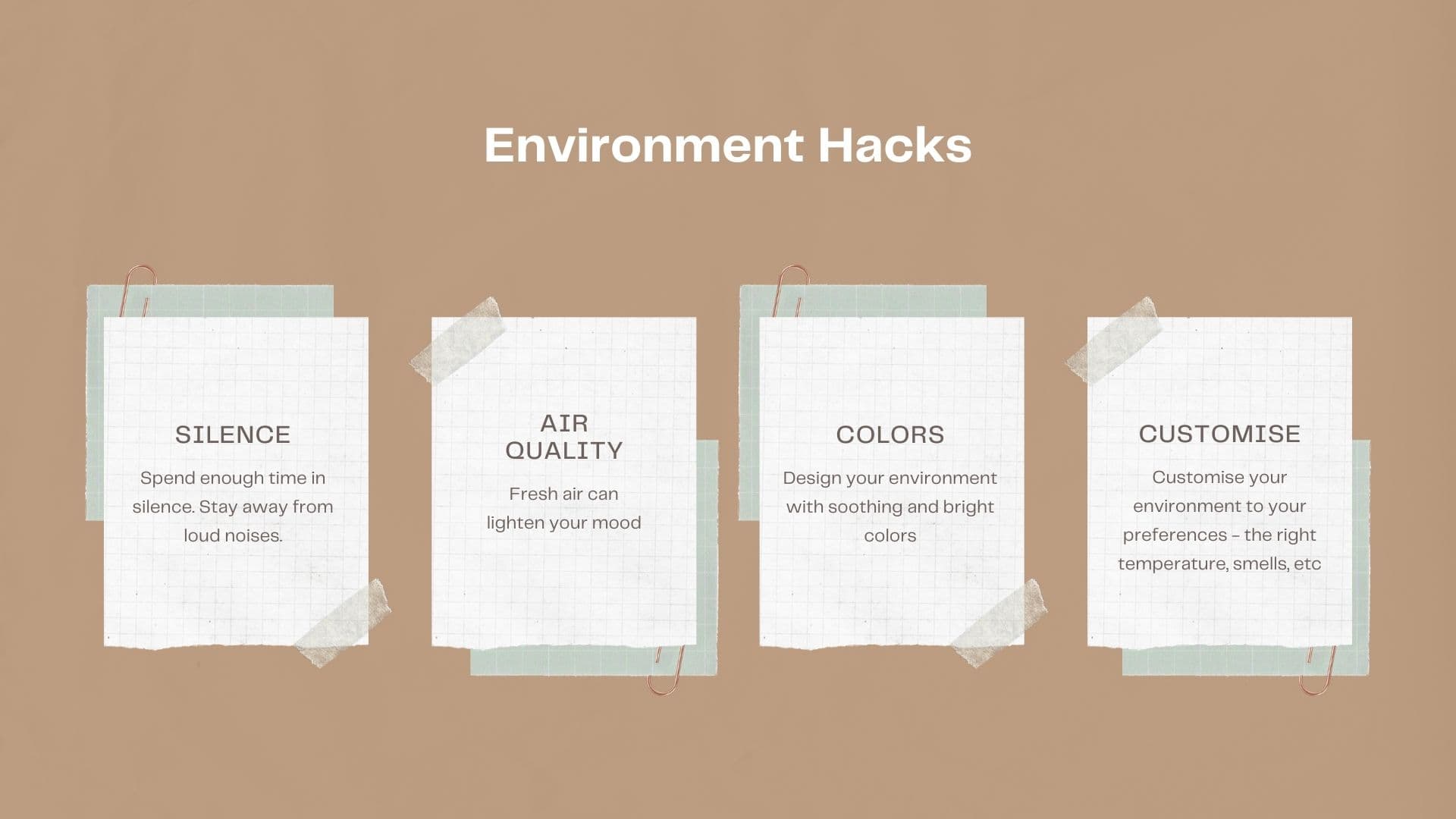
    • Loud noises
    • Low ceilings
    • Poor air quality
    • Glare
    • Unpleasant scents
    • Uncomfortable temperatures

    If you work or live in an environment with such stressors, you will always find yourself on edge. There is a reason monks choose to live in serene environments.

    Therefore, if you want to maintain control over your emotions, it is important to ensure that your immediate environment is not one of the causes of stress.

    4. Body – Gestures / Postures / Exercising

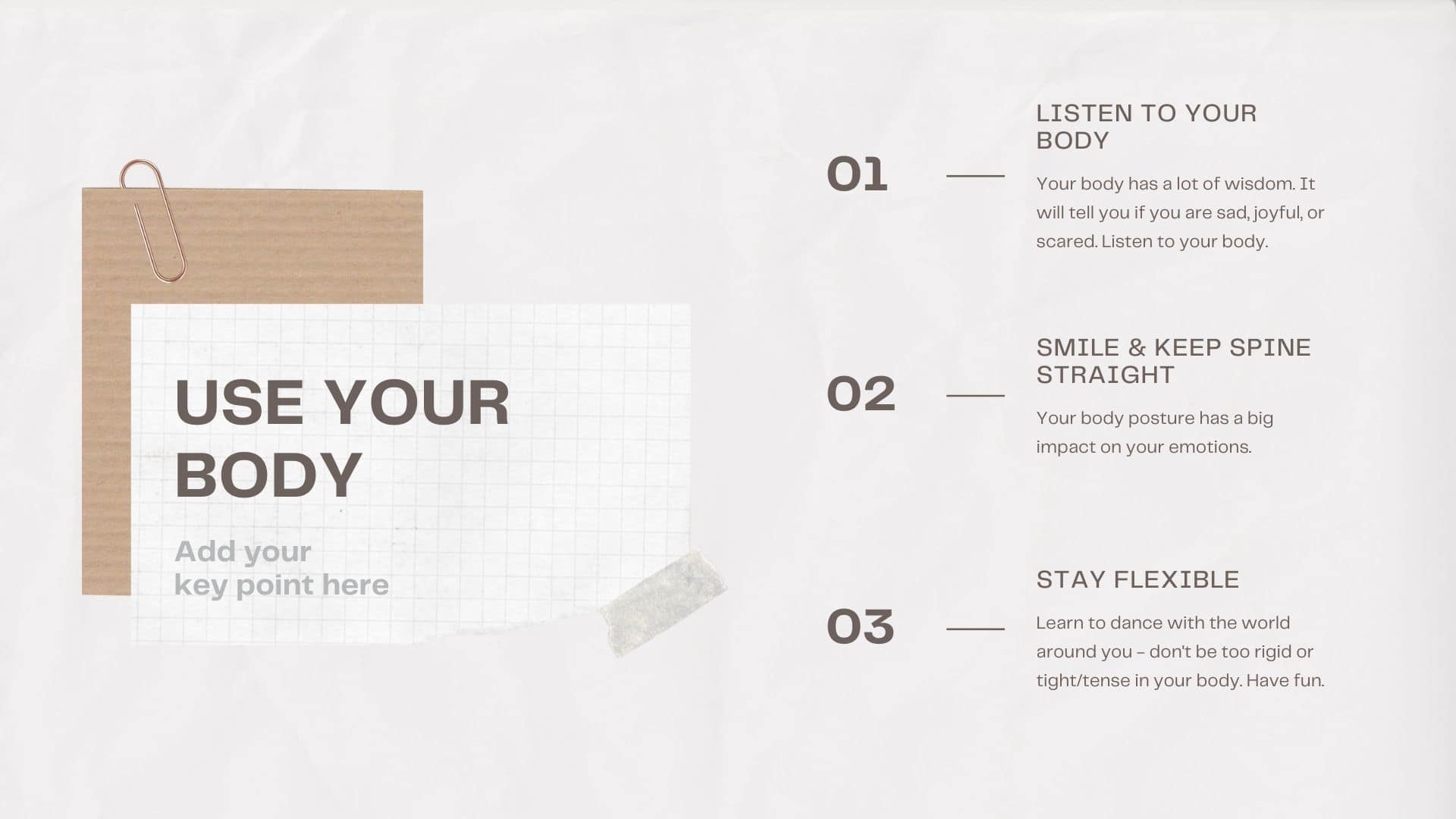
    Feeling moody? Try to smile. Believe it or not, it works. In one study, researchers had the subjects adopt a facial expression that mimicked a smile then asked them to fill a questionnaire. Findings revealed that the participants experienced higher levels of amusement than those that attempted other expressions.

    The facial feedback hypothesis says that the state of your facial muscles has a direct relationship with the emotions you feel. Variations of facial muscle contractions not only communicate what an individual is feeling to others but also to themselves.

    Therefore, the state of your facial expressions has a direct influence on your mood. 

    Try this experiment: alter your expression to mimic that associated with displeasure or anger. Do that by creating tension in the area between your eyebrows. It should result in your eyebrows being pulled down and a wrinkle forming on your forehead.

    How do you feel? A furrowed brow is a signal to your brain that you are displeased, which is why it is impossible to experience feelings associated with happiness when you are in that state. 

    The takeaway? Adopting a facial expression or a body posture associated with a particular emotion allows you to experience feelings associated with that emotion. Therefore, being mindful of your body language is a key element when it comes to influencing your emotions.

    Conclusion

    Emotions are the spark of lives. Think about how dull life would be if you did not experience any emotions. However, as much as they can create beautiful experiences, they can also be the cause for stress if you allow them to overwhelm you.

    By making use of what I have shared in this article, you can befriend your emotions, learn from them, and make them work in your favour rather than against you.

brain care coaching commitment communication conflict conflicts conversation culture deployyourself deploy yourself emotional intelligence emotions empathy energy feedback freedom future gold habits hope john maxwell language leadership lessons listening performance perspective preparation productive productivity psychological safety purpose questions relationships resolution ryan holiday seth godin simon sinek strengths struggle team trust values words