How to Make the Future Come to You Instead of Chasing After It
In 2020, I was not even confident enough to apply for a job at the companies of the CEOs I coach and support today.
Today (since 2023), I coach 8–12 CEOs at a time – each doing a business of $5-$100M annually. My work with them is not about fixing what’s broken. It’s about helping them dream bigger than even they thought possible — and then guiding their executive teams through all successes and challenges as they make the imagined future happen.
And here’s the thing: I did all of this without a single piece of formal education or training for this work. No MBA. No certification. No “20 years of experience” in a similar role.
And I am the person who has always been called and have been a person who is “shy” or “introvert” or “only sits behind a computer” my entire life.
I went from “not qualified” in my own mind to living what most of my life I thought was impossible. And it didn’t take 20 years. It happened in just three. Very literally, I am living an impossible life today.
The change didn’t come from working harder, gaining more knowledge, getting lucky, or suddenly becoming more skilled. It came from creating myself from the ground up (as a person) and shifting how I related to time, money, goals, commitment, and relationships.
That’s what this article is about — because once you understand this, your impossible future stops being a faraway dream and becomes something you live from, now.
Our Relationship with Time
Here’s something that’ll mess with your head: Everything you think you know about time is backwards.
Most leaders are trapped in what I call a “time prison”—letting their past vote on their future. We perceive time as moving from past to present to future linearly.
From this perspective, you look at last year’s numbers, assess current limitations and resources, and set “realistic” goals based on historical data.
When you set “realistic” goals, you’re essentially saying, Based on what happened before, here’s what seems achievable.
You’re essentially dragging your yesterday into your tomorrow.
But here’s what changes everything: Past and future are both created right now, in the present moment.
Time is not moving from past to present to the future. We are always in the “now” – the “present” – and always creating (& recreating) our past and our future – in this moment. (slow down, stop, and read it again before continuing if you do not get this)
The future is not fixed or limited or shaped by our past. The future is fully open to be created like a blank canvas – starting now.
The past is not fixed. We create it – and can recreate it – each moment. (based on the future we want to create)
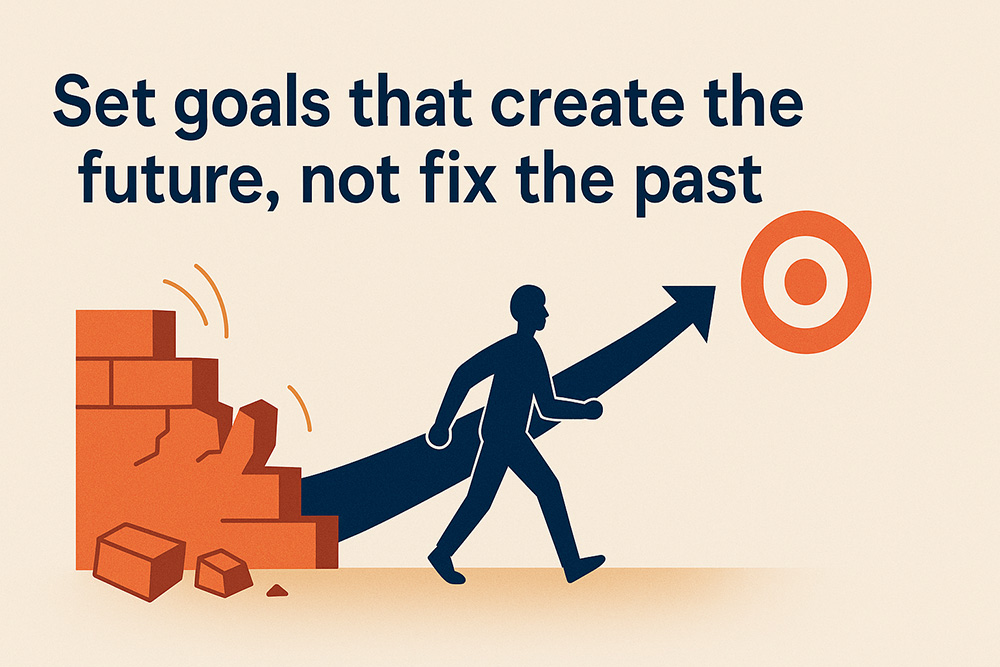
When you set impossible goals instead of realistic ones and commit to them, something magical happens—the future stops being a place you’re struggling to get to (because you stop using the past as an anchor) and becomes a place you’re coming back from.
You compress time and space. Like I did. Like my clients do.
And possibilities that seemed years away start showing up next week.
Let me show you how this works.
1. What You Care About Precedes the Goals
Let Your Future Pull You Forward
Before you can break free from the time prison (past->present->future), you need to get clear on what future you actually want to create. Not what you think you should create based on current problems or your definition of what is realistic or possible, but a future that takes care of what you care about.
The Difference Between Past-Problems and Future-Possibilities
Most goal-setting starts with: “What’s wrong that I need to fix?”
- “Our culture has issues”
- “I’m not making enough money”
- “We’re not growing fast enough”
- “I don’t have work-life balance”
This is problem-based thinking rooted in past disappointments. Instead, powerful creation starts with: “What future do I want to create?”
Your CARE Statement
Your CARE statement shouldn’t just answer what bothers you now—it should answer what you care about – deeply.
You are what you CARE about.
Examples of future-oriented CARE statements:
- “I care about a future where every workplace nourishes human potential”
- “I care about a future where leaders feel confident creating positive change”
- “I care about a future where business automatically serves both profit and purpose”
- “I care about a future where families are deeply connected despite busy lives”
Why Future-CARE Changes Your Relationship with Time
When your goals and commitment come from a future you CARE about instead of past problems:
- You have unlimited energy because you’re not fixing what’s broken—you’re creating what’s possible
- You attract people who connect with that future and want to help bring it into reality (missionaries over mercenaries)
- Your work today becomes a deep calling from the future, not just a reaction to the past
Real Example: I worked with a CEO who kept setting goals around “fixing our toxic culture.” Every initiative felt like pushing a boulder uphill.
When she shifted to “I care about creating a workplace where people can’t wait to do their best work,” everything changed. She stopped being someone who fixes problems and became someone who listens for and creates possibilities for others to do their best work. This meant different things to different people – but because she was listening for the possibility instead of just fixing a “toxic culture”, she implemented many ideas that would not even have surfaced earlier.
The culture shift happened in months, not years.
2. Who You Are Determines Your Possibility
Who do you think YOU are?
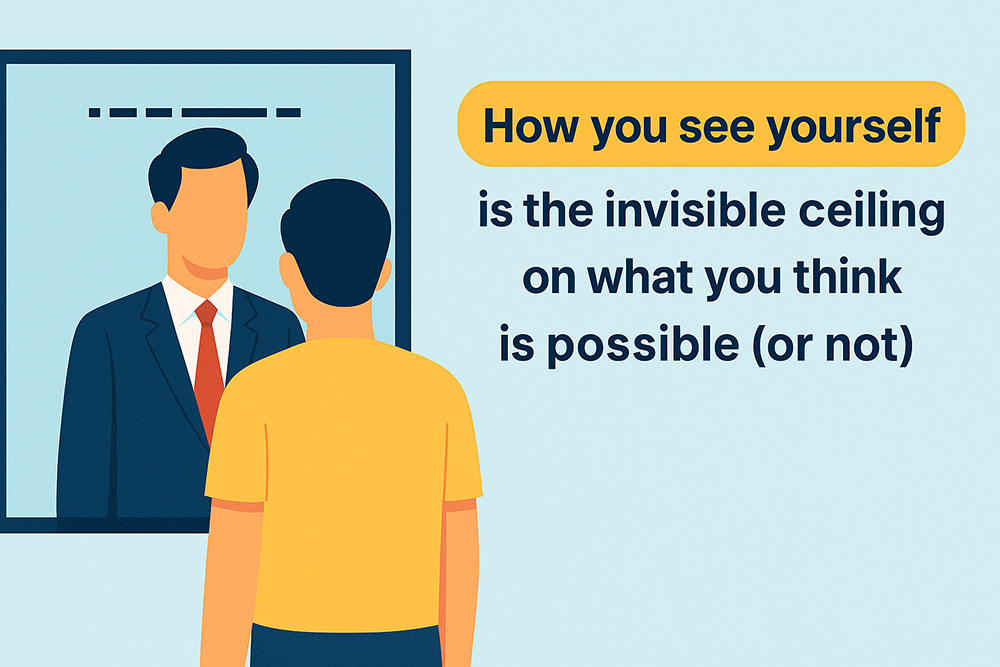
Your identity—how you see yourself right now—is the invisible ceiling on what future you can dream and commit to.
But here’s the secret: You can collapse that ceiling by recreating yourself as a future version of yourself immediately.
The Traditional Identity Trap
Most people think: “When I achieve X, then I’ll be the kind of person who has X.”
This keeps you trapped in current-identity limitations:
- “I’m not a salesperson” (so sales goals feel impossible)
- “I’m not good with money” (so financial goals feel unrealistic)
- “I don’t know how to scale” (so growth goals feel overwhelming)
Become Who You Have To Be In The Future Now
Powerful leaders do not just ask, “What do I need to DO?”
They ask, “Who do I need to BE?” and then they step into that new identity right now.
The “I Don’t Know” Mental Block
Every time you say “I don’t know,” you’re refusing to access information that your future self already has.
It’s not that you literally don’t know—it’s that you’ve decided to stay in current-identity limitations.
You don’t see what you don’t see not because it is not out there. But because your current identity (who you are) is not looking for it.
Once you shift your identity, you see new things in front of you because you are looking through a new lens and not because something new has appeared in front of me.
Instead of saying “I don’t know how to build a $10 million company,” say “I don’t know how yet, but I am someone who accesses that information as I need it.”
Read the above again. It can twist your brain so give it some time to sink in.
Examples of Future-Identity Shifts:
- From “I’m not a leader” to “I am someone who naturally inspires others toward shared vision”
- From “I’m not technical” to “I am someone who understands what I need to understand when I need to understand it”
- From “I don’t know if this will work” to “I am someone through whom breakthrough results happen”
Ask yourself: “Who would I need to BE for my impossible goal to be inevitable?”
Then start being that person now.
Not when you achieve the goal—now. Speak like that person. Walk like that person. Genuinely. Authentically.
Let your future identity collapse into this present moment.
Real Example: I had a client who wanted to work with Fortune 500 CEOs but kept saying “I don’t have experience with that level.”
When she shifted to “I am someone who creates value for leaders at every level,” she immediately started showing up differently.
Within six months, she had one Fortune 500 client. The future version of herself became present, and that future self started seeing and creating opportunities around her.
The more she spoke of herself as helping Fortune 500 CEOs, the more it became real in her world – one conversation at a time.

3. You Are Waiting for Readiness to Start While You Get Ready by Starting
The Future is Available Right Now
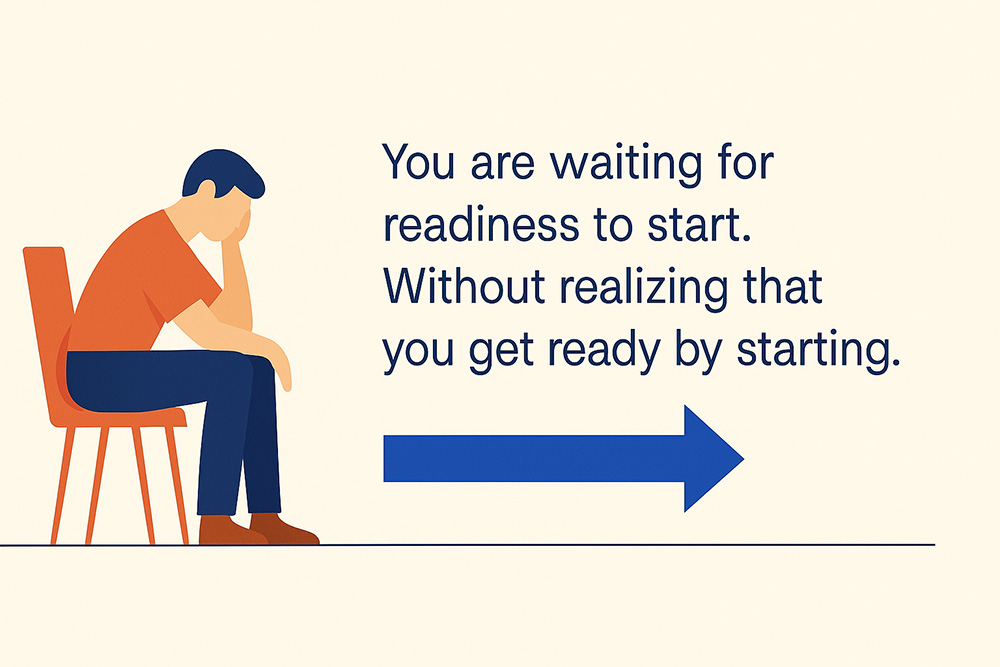
The biggest myth in goal-setting is that you need to be ready before you can start. But here’s what I’ve learned: You get ready by starting.
You access your CREATED FUTURE by starting now, not by waiting until you feel prepared.
Readiness is not about TIME.
Readiness is about COURAGE.
The Readiness Time Trap
Most leaders are waiting for:
- More experience (more past)
- More resources (better current circumstances)
- More certainty (more data about what’s already happened)
- Better timing (different present moment)
- Perfect conditions (different current reality)
But readiness is a myth. You get ready by starting, not by waiting to be ready.
When you’re about to declare something from your future self, resistance shows up as:
- Hesitation (“Let me think about this more”—staying in current identity)
- Vagueness (“I want something in that direction”—avoiding future specificity)
- Qualification (“I’d like to try, maybe, hopefully…”—hedging against future commitment)
The Power of Declaration
The moment you speak your impossible goal as certain (in the present tense) right now, time collapses.
You stop being someone who has ideas about the future and become someone through whom the future expresses itself.
You compress time and space not when you achieve the goal but when you declare from your future identity. The moment you say “I am committed to X. It is happening right now.”, you start:
- Thinking like someone for whom X is inevitable
- Noticing opportunities that serve that future
- Having conversations from that future identity
- Taking actions that move things forward in leaps – not just small increments.
It is simple. Though not easy. It takes courage to do the above.
Real Example: I worked with an entrepreneur who’d been “getting ready” to launch his big idea for two years. Research, planning, perfecting.
When he finally declared “I am someone who helps companies transform their industries, and my program launches next month,” everything shifted.
Not because he was suddenly ready, but because he started operating from the future. The launch happened, succeeded, and led to opportunities he never could have planned for. He made many mistakes as well. But he got feedback so fast that he improved on them. While earlier he was just waiting.
4. Language Creates Reality
Speaking from the Future, Not to the Future
The words you use to talk about your goals literally reshape your brain, your reality, and your relationship with time. This isn’t metaphysical fluff—it’s how time compression works.
The Problem with Uncertain Language
Listen to how most people talk about their goals:
- “I’ll try to…” (based on past attempts)
- “Hopefully we can…” (based on past disappointments)
- “I’m going to attempt to…” (based on previous failures)
- “If everything works out…” (based on past unpredictability)
This language keeps you in conversation with your history instead of your possibilities.
You’re speaking TO a future you hope to reach instead of FROM a future that’s already real.
Future-Present Declarative Language
Instead, try speaking as the future version of yourself:
- “I am committed to…” (the future leader speaking)
- “This is happening because…” (the future reality organizing itself)
- “I am the person who…” (future identity present now)
- “We are creating…” (future impact)
The Time Collapse Test
Here’s a mind-bending exercise: Say your biggest goal out loud, but speak as if you’re already the person who has achieved it, looking back at this moment.
Instead of: “I hope to build a $10M company” Try: “I am the leader of a $10M company, and this is the moment I committed to that reality”
Feel that shift? That’s time collapsing. You’re not reaching toward the future—you’re speaking from it.
Real-Life Time Compression Through Language
When you start speaking from the future:
- Your team stops seeing you as someone with hopeful ideas and starts seeing you as someone channelling an inevitable future
- You stop asking “Can this work?” and start asking “This is works. Tell me how?”
- You stop preparing for current limitations and start preparing for future possibilities
- Opportunities that seemed “lucky” start showing up because you’re broadcasting from the future frequency
Real Example: I had a client who kept saying, “One day I want to work with larger clients and not just small ones.”
Wishy-washy, past-based language. When she shifted to “Each client we work with contributes $1M to our revenues as we provide a minimum $10M of value to their business” everything changed.
She wasn’t hoping for a future “one day”—she was speaking from it. She started looking for the specific clients (without waiting for readiness), made requests to get connected with them, then made specific requests to support them, a within a year she had 3 clients at the new $1M level. The business doubled as a result, and profits increased by 4X.
5. Clarity and Specificity Are Non-Negotiable
Making the Future Real in Clear (not clever) Language
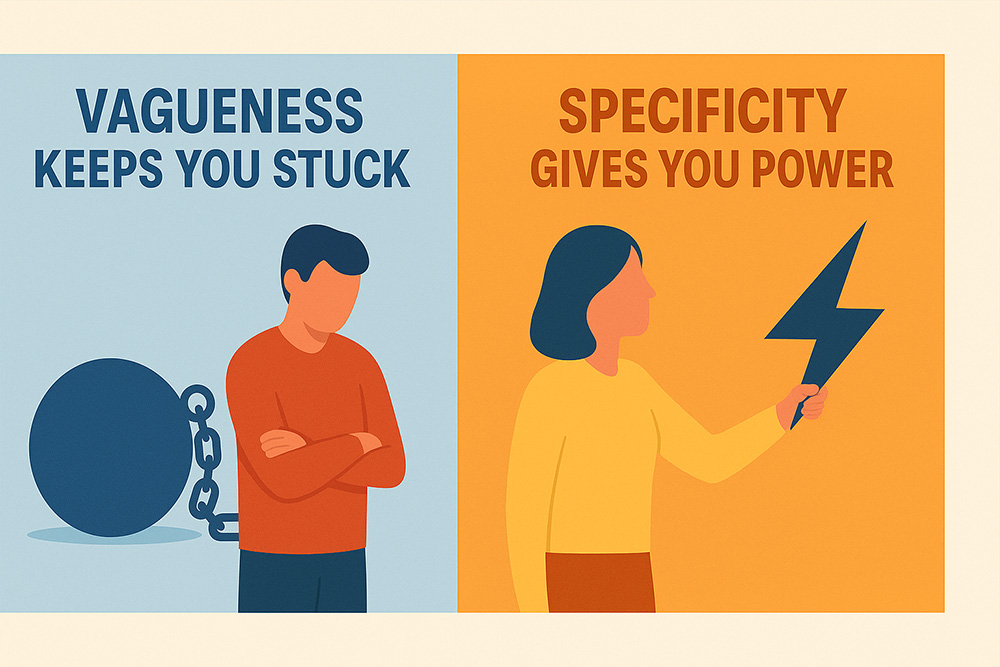
Vague goals are like trying to navigate through the world with a broken GPS. You might feel like you’re moving, but you have no idea if you’re going toward your past patterns or your future possibility. You also have no way to measure progress towards your end goal because the end goal is not clear in the first place.
The Problem with Fuzzy Language
I hear this constantly:
- “I want better work-life balance” (based on current dissatisfaction)
- “We need to improve our culture” (based on past problems)
- “I want to serve more people” (based on current limitations)
- “We should increase quality” (based on yesterday’s complaints)
This language is basically saying, “I have a feeling about wanting something different from what I’ve experienced, but I haven’t done the work to make that future clear and specific. I know what I don’t want but I am afraid to specify and act according to what I exactly want.”
The Power of Specificity
Powerful goals speak as if the future is already organizing itself around you:
- Instead of “better work-life balance”: “I operate as a leader who is fully present at work and fully present at home—leaving the office by 6 PM every day and taking zero work calls on weekends“
- Instead of “improve our culture”: “We are a company where every team member feels heard and valued, evidenced by 95% positive scores on our monthly engagement survey”
- Instead of “serve more people”: “We impact 10,000 families through our program by December 2026, and I am the leader who creates systems that make this inevitable”
Why Vagueness Keeps You in Time Prison
Here’s what nobody talks about: We stay vague because specificity makes the future real—and that feels scary. When you say “I am committed to $5 million this year,” you’re not just setting a goal. You’re declaring a future that you and others can hold you accountable for.
But vagueness keeps you trapped in current limitations. Specificity calls the future into the present.
The Specificity Challenge
Take your biggest, vaguest aspiration and make it ruthlessly specific. Not just what you want, but who you are as the person who has it, when it happens, and how you’ll know it’s real. What can people see and measure when it has happened?
Real Example: I worked with a client who said “I want to create a movie.” (without any experience in film making) After weeks of drilling down, her real declaration became: “My movie is out on 1 Jan 2027. It premiered in Venice and Toronto Film Festivals. XYZ directs the movie and ABC acts in it.” Specific. Measurable. Impossible. And it started happening immediately because the future became real enough to organize around.
Update Aug 2025 – just a few months in from the above declaration – the script is ready and the director has said yes to the movie.
6. Rejecting “Possible” as a Requirement
Breaking Free from the Prison of “Possible or Not”
Let me be provocative here: If your goal feels achievable based on your past experience, it’s not a goal—it’s just a really detailed to-do list based on historical data.
The Traditional Time Prison
Most goals are set like this:
- Look at past performance
- Assess current resources
- Project incremental improvement
- Call it “realistic”
This is linear time thinking: Past → Present → Future. You’re essentially letting your history vote on your possibilities.
The Difference Between Predictions and Creations
A prediction is: “Based on our growth rate, I’ll hire two more salespeople and increase our close rate by 3%.” A creation is: “We’re going to revolutionize how our entire industry thinks about customer experience. Our close rate will double – better than anyone else in the industry.”
See the difference? One is extrapolating from the past. The other is calling forth a future that doesn’t yet exist.
Why “Realistic” Keeps You Trapped
Every time someone tells you to “be realistic,” they’re asking you to let your past limit your future. They’re asking you to fit your dreams into the box of what’s already happened. But breakthrough results don’t come from historical precedent—they come from the willingness to create a future that has never existed before.
The Magic of Future-Based Thinking
Here’s what happens when you commit to something that seems impossible: You stop trying to get to the future and start coming from it. Instead of “How do I optimize what I’m already doing?” you start asking
“What would the future version of my business/leadership/impact look like, and how would that version operate right now?”
What do I need to say NO to?
What do I need to say YES to?
Real-Life Examples of Time Compression:
- Elon Musk didn’t extrapolate from car industry trends. He declared a future where transportation is electric and autonomous—then that future started organizing itself around him
- Netflix didn’t project from DVD rental patterns. They declared they’d change how humanity consumes entertainment—then built toward that future reality
- Your local gym owner who went from 50 members to 500 didn’t get there with realistic projections. They declared themselves a fitness leader in their community and started operating from that future identity
The Impossibility Test
Ask yourself: Does this goal require me to become a different person? If not, it’s probably just an optimization of who you already are. True goals force you to become a future version of yourself that doesn’t currently exist.

7. Goals You Set Reflect Your Self-Worth
What do you think your worth is?
Here’s the brutal truth about most goal-setting: You are only setting goals you think you are worthy of achieving. This acts like a subconscious filter on everything you dream, aim for, and commit to.
The Problem with “Realistic” Goals
When a CEO says, “Let’s aim for 10% growth this year,” they’re often really saying, “Based on what happened before and what I think I’m worth, 10% feels safe.” That goal isn’t coming from possibility—it’s coming from historical precedent filtered through current self-worth.
Think about it:
- The person who says “I want to lose 2 kgs” is speaking from their history with dieting, not their potential for transformation
- The entrepreneur who aims for “$100K revenue” is speaking from their track record, not their capacity for breakthrough
- The leader who targets “better team communication” is trying to fix yesterday’s problems instead of creating tomorrow’s possibilities
The “Not Enough” Loop
Limited goals come from what I call “not-enoughness”—and they create a loop:
- “We don’t have enough resources” (based on past experience)
- “I’m not experienced enough” (based on historical evidence)
- “The market isn’t ready” (based on previous attempts)
- “Our team isn’t big enough” (based on current capacity)
Goals that are derived from “not-enoughness” can not create joy, prosperity, flow, ease, and peace – whether you achieve them or not. They only create fear, worry, anxiety, pressure, highs and lows – whether you achieve them or not.
But here’s what changes everything: The most powerful creation happens when you start from “I am enough” and not from “I am missing this. I need more of it”. When you anchor in “I am enough. I have everything I need. I have infinite potential”—you’re speaking from possibility, not history.
Time Compression Through Self-Worth
When you set goals from future self-worth instead of past evidence:
- You stop asking “What can I achieve given my limitations?”
- You start asking “What wants to be created through me?”
- You stop managing scarcity and start channeling abundance
- You stop optimizing current reality and start manifesting future possibility
Real Example: I worked with a tech CEO who was stuck at $2M revenue for three years. Every goal was incremental—$3M, $4M—based on past performance and current self-worth.
When he declared “We’re going to $25M,” everything shifted. Not because the goal was realistic, but because he started operating from the self-worth of a $25M CEO.
That future version of himself became present, and time compressed around that new identity. He started sitting with CEOs of companies at a similar level, start engaging in conversations and making deals of the same 25M level, and very soon had cracked enough opportunities to grow his company 4x in 2 years after only managing to grow it by 2x in the previous 3 years.
8. Leadership Growth is the Main Objective, Not the Goals
Your Personal and Leadership Growth is the Main Prize
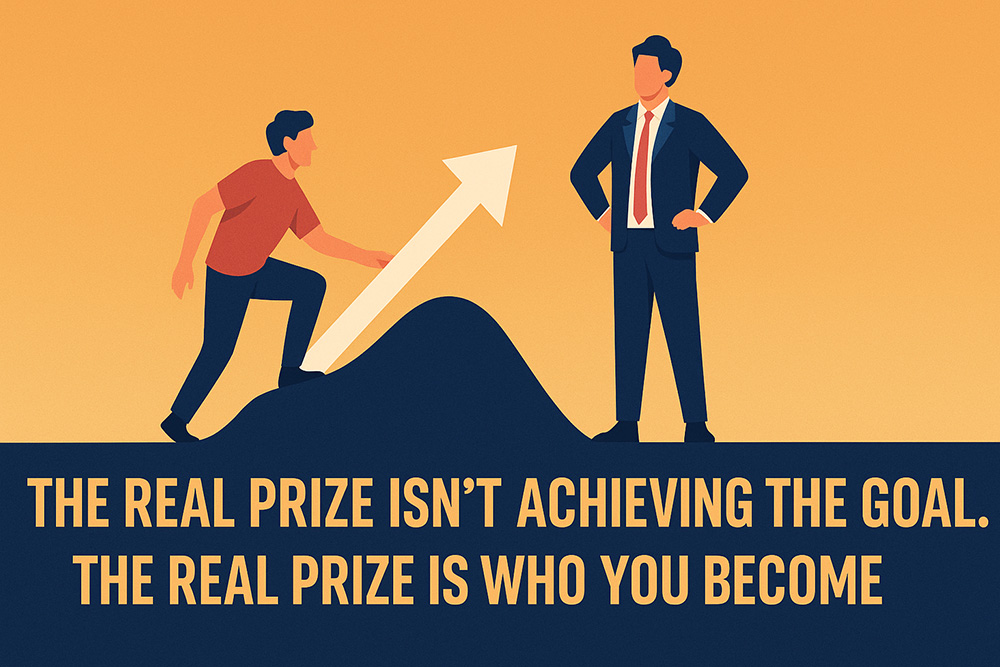
Here’s what most leaders miss about time and goals: The real prize isn’t achieving the goal in the future—it’s who you become in the process.
Why “Realistic” Results Keep You The Same
If you aim for 10% growth (based on past patterns) and get it, you’re still essentially the same leader operating from the same timeline. You optimized some processes, maybe hired a person or two, but your fundamental relationship with possibility hasn’t shifted.
You haven’t time-traveled. You’ve just inched forward.
But when you aim for something impossible, you become a new version of yourself – even if you fall short of the impossible goal.
Impossible goals force you to grow. They requires you to grow.
If not, you are still aiming too low and playing safe.
Real Examples
- My client Abhijit (former Indian Volleyball Captain) is raising 5x the money he is raising this year compared to last year, with more ease and joy than last year, because he is a very different person. He is also creating a movie in the coming years – a goal beyond all definitions of possible or not for him.
- My client Prabu reduced the time he spent in meetings in half, doubled the productivity of his team at the same time, and got raving reviews at the same time in just 12 months. These are three Impossible Outcomes stacked right one after another.
- I have become one of the most successful CEO coaches (both financially and in the kind of people that I work with) in just a few years after launching myself as a coach. This is unheard of in the industry. And given how I grew up and my history until 2020 (the first 37 years of my life) there are so many Impossibles that stack up I can’t even count.
The Ripple Effect
When you become your future self now, everyone around you gets pulled into that timeline. Your team rises to meet the future version of your leadership. Your organization becomes capable of future-level results because future-you is already showing up each day. This level of leadership is inspirational and infectious.
This is why impossible goals compress time—they don’t just change what you’ll achieve; they change who you’re being right now. And that shifts everything.
9. Play Begins Where Pressure Ends
When the Future Comes to You
Here’s a counterintuitive truth about time and goals: The bigger your impossible goal, the more playful you will become. Most people think impossible goals = more stress because they’re still trying to GET to the future. But when the future comes TO you, everything becomes play.
Why Realistic Goals Create Pressure
When you set a “realistic” goal, you’re essentially saying, “Based on past performance, this should be achievable if I optimize and push hard enough.” Your self-worth gets tied to bridging the gap between current reality and modest projection.
Every week behind schedule feels like personal failure. Every obstacle feels like evidence that you’re not good enough. The pressure is intense because the goal feels mandatory based on historical precedent.
The Liberation of Future-Present Thinking
But when you set an impossible goal, you’re saying, “I’m calling forth a future that has never existed before.” There’s no historical roadmap to feel pressure about following. You get to be in pure creation mode. You can’t fail no matter what.
When a startup founder aims to “make $100K this year” (based on past trajectory), every month behind target feels like failure against precedent. But when they aim to “revolutionize their industry and make 2M in the process,” they’re operating from a future that’s organizing itself through them. Every small win feels like evidence of that future becoming real.
Even when they are rejected, going for 2M instead of 100K, they grow and evolve. There is no failure when you go for the impossible.
When you’re operating from your future commitment:
- Everything becomes an experiment. Experiments never fail. You either move forward or you learn.
- “Failures” become course corrections from the future version of reality.
- Challenges become the future working out its details.
The pressure disappears because you’re not trying to achieve something—you’re already operating from that place.
10. Impossible Goals Serve the World
Don’t Keep the World Waiting: Impossible Goals is your Gift to those around You
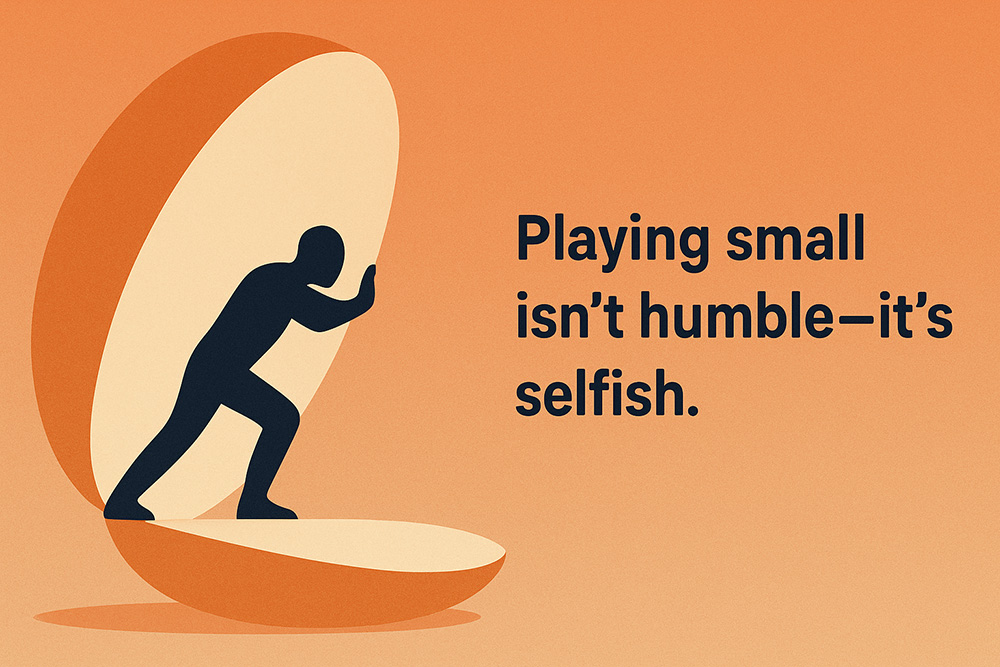
Let’s get real about something: Playing small isn’t humble—it’s selfish. You’re keeping your future contribution to those around you trapped in present limitations.
The Humility Trap
I see leaders constantly who disguise fear as humility:
- “I don’t want to seem arrogant” (staying in past identity)
- “There are already so many people doing this” (comparing to current reality)
- “I am happy growing small and taking things gradually”
- “Who am I to think I can make that big of a difference?” (speaking from historical self-worth)
But here’s the truth: Your future contribution to the world is waiting for you to commit to the impossible right now. The talents, vision, and impact you’re meant to create—they’re not waiting for you to be ready. They’re waiting for you to call them forth.
Goals as Future Service
When you set impossible goals, you’re not just creating your future—you’re serving those around you:
- You’re not doing it for your ego—you’re doing it because future problems need future solutions
- You’re not trying to prove you’re better than anyone—you’re trying to express what’s possible for everyone
- You’re not being reckless—you’re being responsible to the future that you care about
Your Future Dharma
In Sanskrit, dharma means your life’s purpose—or the sum of what you care about. But not just your current purpose. Your dharma includes the future version of your contribution that’s trying to emerge. Setting impossible goals isn’t about ambition; it’s about becoming a channel for the future the world needs.
The Service Question
Ask yourself: What future is trying to emerge through me?
What would be possible for others if I fully expressed my potential?
What contribution am I withholding by playing small?
When you answer these questions honestly, impossible goals stop being about you and start being about service.
And when goals are in service to something bigger than yourself, time and space bend to support them.
Future Is A Place To Come From, Not Get to
Here’s what changes everything: When you set impossible goals from future identity, you stop trying to get to the future and start operating from the future.
Instead of: Current Reality → Struggle → Hope → Future Achievement
You get: Future Identity → Present Action → Future Moving Towards You
The Mechanics of Time Compression
- Traditional Goal-Setting: You are here, goal is there, time is the distance you need to travel through struggle and effort. You act small and move slowly towards the future – many times never getting there.
- Impossible Goal-Setting: Future self is already achieved, present moment becomes the space where that future expresses itself. You take massive action and move in leaps and bounds towards the future.
Why This Works: The Science of Time
Your brain doesn’t distinguish between vividly inhabited future identity and present reality. When you fully embody your future self, your neural patterns shift immediately. You literally become someone who sees different opportunities, makes different decisions, and takes different actions.
But it’s bigger than neuroscience—it’s about recognizing that time isn’t actually linear. Past and future are both constructions happening right now.
Your Challenge
Here’s your challenge: Pick one area where you’ve been letting your past vote on your future. Set an impossible goal. But don’t just set it—declare it from the identity of someone who has already achieved it.
Say it out loud, from future-you, with certainty, without apology: “I am someone who [impossible goal].”
Notice what comes up. Notice the resistance. Notice how different it feels to speak from the future instead of to the future.
Then start operating from that identity immediately. Not when you feel ready. Not when you have a plan. Now.
Start doing what your FUTURE SELF would do. Scary. In the beginning, yes. Uncomfortable, probably. Worth it, absolutely. Regret it, never.
Because the world doesn’t need another leader trapped in the story of their limitations. The world needs you operating at your highest possibility—right now, in this present moment where all futures are created anyway.