Global Leadership

  • The Diversity Lie: How We Started Treating Adults Like Children (And Calling It Leadership)

    Here’s What I’ve Seen Working Across Four Continents

    I grew up in India, spent 16 years in tech, worked with companies across the US and UK for two decades, briefly experienced Japanese culture at Yahoo, and now live in the Netherlands.

    And everywhere I go, I see the same thing happening. Over the past few years, we’ve slowly drifted into something I no longer recognize as leadership. We started cushioning decisions, over-explaining expectations, softening feedback, adding rules instead of responsibility, and calling it “care.”

    We took three beautiful ideas—diversity, inclusion, and empathy—and turned them into excuses for treating capable adults like fragile children who can’t handle reality.

    I’ve watched it play out in a 70 year old organisation in Bangalore, a Fortune 500 in New York, a scale-up in Amsterdam, a consultancy in Dubai, and a tech giant in London.

    Different languages. Different cultures. Same problem.

    Let me tell you what I mean.

    What Actually Happened

    What it was meant to be: Teams with different perspectives making better decisions. Cultures where everyone can show up fully. Leaders who actually understand their people.

    What we got: Leaders terrified to give honest feedback to anyone who might be “different.” Teams where nobody can say anything uncomfortable.

    I’ve seen it everywhere. And I’m done pretending it’s working.

    The Ten Ways I’ve Seen Leaders Treat Adults Like Children

    Let me walk you through what this actually looks like. I’ve done some of these myself. I’ve watched others do all of them.

    1. The Layoff Dance

    What I’ve seen in the India, US and UK: CEOs know they need to cut 20% of the team. The numbers are clear. But they can’t pull the trigger because “people have families” and “it will devastate them.”

    So they burn through six more months of runway, hoping for a miracle. When they finally do the layoffs, it’s worse – the founder plunges into guilt, people are blindsided, trust is destroyed, and the company barely survives.

    What’s actually happening: You’re treating your team like children who can’t handle hard news. Adults with mortgages and kids? They can handle reality. What they can’t handle is you lying to them for six months.

    2. The Underperformer Nobody Will Name

    What I saw in India: There’s always that one person who’s been around “since the beginning.” They’re not performing. Everyone knows it. But because they’re “loyal” or because they’re a certain age or gender or background, nobody will say it directly.

    Instead, there are “check-ins” and “coaching conversations” where leaders hint around the issue but never actually say: “Your work isn’t good enough.”

    What I see in the Netherlands: Same thing, different excuse. Here it’s all about “giving people time to find their way.” Meanwhile, your best people are quietly updating LinkedIn because they’re tired of carrying dead weight.

    What’s actually happening: You’re denying someone the gift of honest feedback. You think you’re being kind. You’re actually stealing others’ growth by not telling people what they need to hear to grow – and you’re losing your best people in the process.

    3. The Brilliant Jerk Exception

    What I learned at Yahoo: In Japanese culture, there’s a strong value on harmony and respect. Beautiful, right?

    Except when there’s a technical genius who’s toxic to everyone around them. And because they’re so valuable, everyone just… works around them. Nobody confronts it directly.

    What I’ve seen in the US: Same pattern, louder version. The star engineer who makes people cry. The top salesperson who undermines everyone. Leaders tell me, “We can’t lose them. They’re too good.”

    What’s actually happening: You’re telling everyone else that performance matters more than being a decent human. You’re slowly bleeding your good people while protecting your toxic ones.

    4. The Endless Meeting Problem

    What I see in the Netherlands: The consensus culture here is real. Every decision requires input from everyone. Another meeting. Another workshop. Another brainstorming session. Meanwhile, decisions take forever and nothing moves.

    What I saw in the US: Different flavor, same problem. “Everyone needs to feel heard.” “We need buy-in.” “Let’s make sure we’re all aligned.”

    What’s actually happening: You’re avoiding your job as a CEO, which is to make decisions. Adults don’t need to agree with every decision. They need to know what the decision is and what’s expected of them.

    5. The Feedback Sandwich

    Everywhere I’ve worked: “You’re doing AMAZING work, truly incredible, but maybe there’s this tiny thing you could consider changing if you feel like it, but honestly you’re phenomenal!”

    Person walks away thinking everything’s fine. You think you gave feedback.

    What’s actually happening: You buried the message so deep, they didn’t get it. And you’ve trained them that your praise means nothing.

    6. The Never-Ending Accommodation

    What I’ve seen in India and the UK: Someone’s going through a hard time. So you adjust their workload. Then adjust again. And again. Six months later, the “temporary” accommodation is permanent, and their teammates are burning out picking up slack.

    What’s actually happening: You think you’re being supportive. You’re actually enabling them to stay stuck. And punishing everyone else for being capable.

    7. The Compensation Silence

    What I grew up with in India: Money discussions were considered rude, inappropriate, not done. You don’t ask about salary. You don’t discuss raises. It’s all very hush-hush.

    What I see globally now: Same pattern, different excuse. “We pay fairly” with no data. “Don’t discuss salaries” with no framework. People leave feeling disrespected because they have no idea where they stand.

    What’s actually happening: You’re treating adults like children who can’t handle conversations about money. They can. They need to.

    8. The “Unlimited Time Off” Nobody Takes

    What I see in the US: Companies proudly announce unlimited vacation. Sounds great!

    Except nobody knows what’s actually acceptable. The founder never takes time off. Anyone who takes more than two weeks gets weird looks.

    What’s actually happening: You gave fake freedom with real pressure. Adults need clear expectations, not guessing games.

    9. The “We’re All Equal” Lie

    What I see in startups everywhere: Founders want to be “one of the team.” They downplay their authority. “I’m not the boss, just a teammate!” They act like every decision is democratic.

    Meanwhile, everyone’s confused about who actually decides what.

    What’s actually happening: You DO have more power. Pretending you don’t just creates anxiety. Adults can handle clear hierarchies.

    10. The Vision Explanation Loop

    What I’ve done myself: Explained the strategy. People asked questions. Explained again. More questions. Created another deck. More doubts. Had 1-on-1s. Still more questions.

    I thought they weren’t getting it. I needed to explain better.

    What was actually happening: Some people were never going to be excited about the direction. That was fine. I needed commitment, not people to agree on everything. I was wasting time on explanation instead of moving forward.

    What I’ve Learned About Real Empathy
    Here’s what nobody told me when I left my engineering career to coach CEOs as they create multi-generational impact and wealth:

    Empathy isn’t taking on someone else’s feelings. Empathy is understanding their feelings AND trusting them to handle their own feelings.

    When I was in India, I learned to be “nice” which meant avoiding conflict, protecting feelings, keeping harmony.

    When I worked with people in the US, I learned to be “supportive” which meant managing emotions, creating comfort, being everyone’s cheerleader.

    When I got to the Netherlands, I learned to be “inclusive” which meant endless consensus and never making anyone uncomfortable.

    What nobody taught me: Sometimes the kindest thing you can do is refuse to rescue people from their own experience.

    Real empathy says: “I see you’re struggling. I believe you can handle this. What support do you actually need?”

    Fake empathy says: “You’re upset, so I’ll change everything to make you feel better because you clearly can’t handle discomfort.”

    One respects people. The other treats them like children.

    We All End Up Doing This Without Realising The Cost

    We avoid difficult conversations to maintain relationships. Until “relationship” becomes code for avoiding accountability.

    We preserve harmony at all costs. Until “harmony” means nobody can say what’s actually wrong.

    We build consensus endlessly. Until “consensus” means nothing ever gets decided.

    We want everyone to feel valued. Until “valued” means protected from any discomfort.

    We’re polite and indirect. Until “polite” means nobody knows where they actually stand.

    Different cultures. Different reasons and patterns. Same result: Leaders too scared to lead.

    What Leadership Actually Needs to Look Like

    I’ve learned this the hard way, in multiple countries, multiple companies, multiple failures:

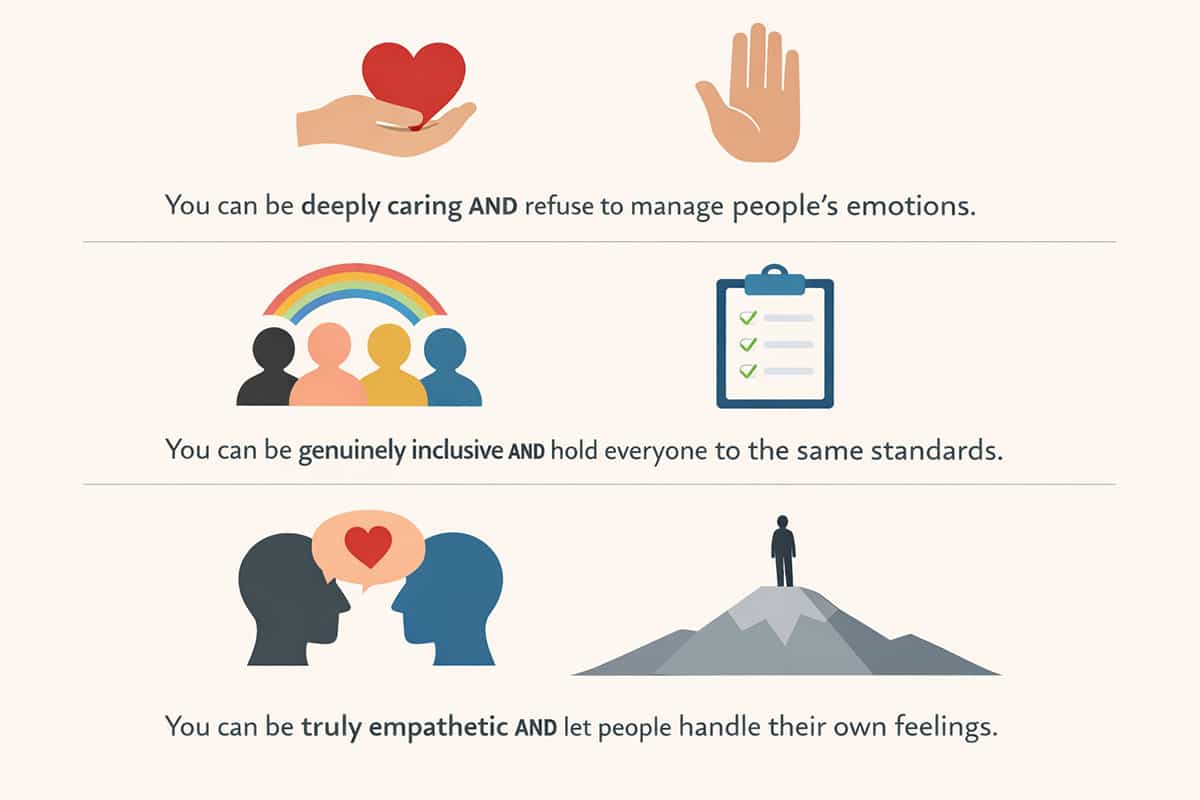
    You can be deeply caring AND refuse to manage people’s emotions.

    You can be genuinely inclusive AND hold everyone to the same standards.

    You can be truly empathetic AND let people handle their own feelings.

    Here’s what it actually sounds like:

    “I hear that you’re frustrated with this decision. That makes sense. It’s a big change. AND the decision stands. Here’s what I can offer: clarity on the reasoning and support in adapting to it. Here’s what I can’t offer: changing the decision or managing your feelings about it. How do you want to move forward?”

    That’s not cold. That’s respectful.

    You’re acknowledging their experience without taking it on. You’re holding your line while staying human. You’re treating them like an adult who can handle reality.
    The below is an email one CEO I coached sent to his entire company which led to explosive growth after a few years of stagnancy and slow growth:

    “From now on, personal responsibility in this company means:

    1. You own your role end-to-end.
      Not just the effort. Not just the intent. The result.
    2. You speak up early.
      If something isn’t working, say it before it becomes a problem. Silence is no longer neutral.
    3. You ask for clarity, not comfort.
      If expectations aren’t clear, ask. If feedback is hard, take it. Growth is not gentle.
    4. You keep your agreements.
      If you can’t, you say so—early—and renegotiate. Broken promises erode trust faster than mistakes.
    5. You manage yourself.
      Your energy, reactions, and professionalism are your responsibility—not your manager’s.

    Leaders, including me, are not stepping back. We are stepping up differently from now on.

    • We will be direct, not vague.
    • We will set clear standards, not moving goalposts.
    • We will give honest feedback, not emotional padding.
    • We will back people who take responsibility and challenge those who don’t.”

    The CEO was building something serious and they finally started demonstrating that commitment in action – with people who choose to act like it.

    The Truth Nobody Wants to Say

    When you stop managing people’s emotions, you actually create the most inclusive environment possible.

    Because you’re saying:

    • Everyone gets honest feedback (real equality)
    • Everyone is held to the same standards (true inclusion)
    • Everyone is trusted with difficult information (actual respect)
    • Everyone is seen as capable (genuine empathy)

    The “empathy” that means walking on eggshells and treating people differently based on their identity? That’s not inclusion. It’s condescending.

    What I Know Now

    After working across India, the US, Netherlands, UK, the middle-east and Japan, here’s what I know for sure:

    The world doesn’t need more leaders who make everyone comfortable.

    The world needs leaders who trust people enough to tell them the truth.

    Leaders who care enough to hold boundaries.

    Leaders who respect people enough to let them handle their own feelings.

    Leaders who love people enough to refuse to treat them like children.

    From Bangalore to Boston, from Amsterdam to London, from Tokyo to anywhere else – the challenge is the same.

    Stop protecting people from reality and calling it kindness.

    Start trusting their capability. That is your leadership.

    That’s what I’m committed to. That’s what I help leaders do.

    That’s what actually changes workplaces from places that make people sick to places that help people grow.

    And that’s what you and I both know needs to happen.

    The only question is: Are you ready to stop playing nice and start leading for real?
  • Why Action Is Its Own Greatest Reward (and how not needing anything unlocks your greatest power)

    Understand what Karma Yoga really means – for leaders in tangible day-to-day terms and not mystical terms


    Most people “reduce the present moment to a means to an end”. You’re building a business to become successful, so your eyes are always on the future result. You give the present moment “inferior status” because the future is more important.

    Ask yourself: When you’re in meetings, are you really there? Or are you thinking about what you need to get from this conversation?

    This creates problems:

    • You can’t give your full attention to what you’re doing now
    • Even when you succeed, you maintain the same pattern of needing the next moment
    • Your action “comes out of unhappiness and creates more unhappiness”
    • Echkart Tolle calls this “karmic action” – it creates more suffering

    Think about your last big achievement. Did it satisfy you, or did you immediately start wanting the next thing?

    The External Search: Looking Outside for What’s Already Inside

    We think getting things from outside will finally make us feel complete inside.

    The Body: You exercise to look good or powerful. You check mirrors constantly. You buy clothes to live up to an image. You think the perfect body will make you happy. But even when you get it, you worry about losing it.

    The Heart: You perform in relationships to get love. You collect approval from people. You chase experiences hoping to feel something. You think the right person will complete you. But love that needs something isn’t real love. The same goes for trust and connection when it comes to work relationships.

    The Mind: You accumulate knowledge to feel smart. You read endless books looking for answers. You analyze everything trying to control outcomes. You think understanding will set you free. But most thoughts just repeat the same patterns.

    Identity: You build an image through titles and achievements. You collect status symbols. You compare yourself to others constantly. You think success will prove your worth.

    Business: You chase promotions and bigger offices. You build companies and milestones to prove you matter (to yourself). You accumulate money for security. You make decisions based on how they appear to others or to feel safe and secure. But it is ever enough.

    Here’s the pattern: You achieve one goal and immediately need the next one. You get what you wanted and it doesn’t satisfy you.

    Now,what if the action itself was more valuable than whatever result it produces? (in other words, the means matter more than the end)

    I know, I know. We’ve been conditioned to believe that outcomes are everything—revenue growth, market share, investor approval, team performance. But stay with me here, because understanding this shift will change everything about how you ACT.

    Most leaders are exhausted because they’re using every action as a means to an end or to get something out of it for themselves.

    Every action becomes about getting something—recognition, validation, proof of worth, control over outcomes, or the outcome itself. The doing becomes this grinding effort toward some external reward that’s supposed to make you feel complete or happy or satisfied or successful.

    A different kind of action happens when you stop making now a stepping stone to later. Only when you no longer reduce this moment to a means to an end can you give your full attention to whatever it is that you are doing now.

    This looks different:

    • You’re totally present to what’s happening
    • Great artists and athletes do this – they’re completely in the now when performing
    • Your action has real power because all your attention is here
    • Tolle calls this “empowered action” or “non-karmic action”

    When did you last feel completely absorbed in what you were doing? How did that feel different?

    What if you didn’t need anything from your next board meeting, your next strategic decision, your next difficult conversation? What would leadership feel like then?

    What if nothing was missing and nothing to get from the situation in front of you?

    Think about your day today. Are you doing it to get somewhere else, or because it’s what the situation in front of you requires (that might be against your likes, habits, preferences, or even success)?

    Welcome to the deepest secret of powerful leadership: When you stop needing results to validate your worth or success or feel happy, action becomes intrinsically rewarding. And paradoxically, that’s often when you get your best results.

    The Body: You feel alive in your skin. Movement becomes play instead of work. You take care of your body because it feels good, not to impress others. You eat when hungry, rest when tired. Your body becomes your friend instead of your project.

    The Heart: Love flows naturally because you’re not needing anything back. You listen because listening is fulfilling. You care about people genuinely, not to get approval. You do not want anything, so you naturally focus on others and give.

    The Mind: Fresh thoughts arise instead of the same repetitive patterns. You think from spaciousness instead of anxiety. Creative and out of the box solutions appear naturally.

    Identity: You know who you are beyond your role, title or company. You don’t need to defend an image or prove your worth. You’re comfortable being nobody special. You realise that “who you are” (not who you think you are) – it never changes, no matter what happens.

    Business: Work becomes service instead of hustle and grind. You create because you care about what you’re building. Decisions come from clarity instead of fear. You commit fully to what’s in front of you without desperately needing specific outcomes.

    Relationships: You connect at a deeper level because you recognize the same presence in others that you’ve found in yourself. You’re not using people to fill your emptiness. You can be alone without loneliness.

    The key shift: instead of using the current ACTION you are doing to get to a better moment, you find you already have it all in this moment itself.

    From that fullness, action becomes what Michael Singer calls “Karma Yoga” – selfless service that happens naturally because you’re no longer operating from lack.

    Here’s the counterintuitive truth – when you stop desperately trying to force outcomes, you often achieve better outcomes.

    Think about it – when you’re anxious about a presentation, how much of your mental energy goes into worrying versus actually preparing?

    When you’re desperately networking to get something from people, how authentic and compelling are you?

    When you commit fully to the task in front of you without attachment to results, you bring your whole being to it.

    Athletes know this – their best performances happen when they’re completely absorbed in the game, not thinking about winning.

    The same applies to leadership.

    It’s not magic; it’s simply that undivided attention and authentic engagement are more powerful than scattered, needy effort.

    The Hidden Exhaustion of Transactional Leadership

    Let me ask you something: When was the last time you made a leadership decision without some part of you calculating what you’d get in return?

    I’m not talking about business ROI—that’s just good sense. I’m talking about the psychological payoff.

    The need for your team to think you’re brilliant. The desire for investors to see you as visionary or your company as being on the right path. The hunger for industry recognition or appearing like the credible expert. The desperate hope that this quarter’s results will finally prove you belong in the C-suite.

    This is what I call transactional leadership—every action is a transaction designed to get you something you think you need to feel okay about yourself.

    Here’s the brutal truth: It’s exhausting as hell. Because you’re never actually present to what you’re doing.

    You’re always projecting forward to some imagined payoff, some external validation that’s supposed to make you feel good about yourself.

    and you do the projection because you are coming from some past fear, worry, or story that is not true but real for you in this moment.

    But here’s what I’ve discovered working with hundreds of leaders: You can’t extract self-worth from external circumstances. It doesn’t work. You can hit every target, exceed every expectation, get every accolade, and still feel that gnawing sense that something’s missing.

    That’s because the thing that’s missing isn’t in your next achievement. It’s in your relationship with the action itself.

    When Action Becomes Its Own Reward

    Think about the last time you helped someone without any agenda. Maybe you saw a colleague struggling with a problem and just naturally offered a solution. Or you noticed your team was overwhelmed and quietly took something off their plate.

    How did that feel? There was something inherently satisfying about the action itself, wasn’t there? You weren’t calculating what you’d get in return. You saw what was needed and you provided it, and something in you felt fulfilled just from the doing.

    That’s action as its own reward. And it’s available to you in every moment of leadership, not just the obviously altruistic ones.

    Michael Singer, in his talks on Karma Yoga, describes this beautifully: When you’re not trying to extract something from each moment to fix your internal discomfort, you naturally become present to what the moment actually needs. And serving that need becomes inherently fulfilling, regardless of outcomes.

    This isn’t some spiritual bypass or feel-good philosophy. This is practical leadership wisdom that changes everything about how you operate.

    The Natural Leader in Action

    Let me show you what this looks like when leaders actually embody it.

    When the Action Itself Becomes the Reward

    Jyoti, a SaaS founder, was facing her toughest board meeting yet. Revenue was soft, and she knew her investors wanted to hear about aggressive expansion plans. Her old self would have crafted a presentation designed to manage their reactions and keep them happy.

    But something had shifted in Jyoti. She was aware of her relationship with validation and approval. She realized she was exhausted from using every interaction to prove her worth as a CEO.

    So she walked into that meeting with a different intention entirely. Instead of asking “How do I look good here?” she asked “What does this situation actually need from me?”

    The answer was uncomfortable: complete honesty about the challenges they were facing and her recommendation to focus on fundamentals instead of flashy growth metrics.

    “I know you want to see aggressive expansion,” she told her investors, “but I think that would actually hurt our long-term value. We haven’t solved retention yet in our home market.”

    As she spoke, something remarkable happened. She wasn’t nervous about their reaction. She wasn’t calculating how to spin the message. She was simply present to giving them what they actually needed to know, regardless of how it made her look.

    The reward wasn’t their approval (though they eventually came around). The reward was the integrity of the action itself—finally being able to show up as a leader who served the situation instead of her own psychological needs.

    Every time you act in integrity with your Dharma, values, or your commitment – you are teaching yourself and others that you are someone who can be counted upon to do what they say and live by their values.

    Every time you DO NOT act in integrity with your Dharma, values, or your commitment (irrespective of your reason or circumstances) – you are teaching yourself and others that you are someone who CAN NOT be counted upon to do what they say and live by their values.

    This is why INTEGRITY is everything.

    When Vulnerability Becomes Its Own Gift

    Steve, a first-time CEO, had been drowning in imposter syndrome for months. Every meeting was an elaborate performance designed to hide his inexperience. The stress was killing him, but he was afraid that showing any weakness would undermine his authority.

    Until one board meeting when something shifted. Instead of spending energy managing his image, he found himself genuinely curious about what the present situation needed from him.

    The answer was startling: it needed his honesty.

    “I have to tell you something,” he said, his heart pounding. “I’m terrified. This is my first time running a company at this scale, and half the time I have no idea what I’m doing. But I care about this mission too much to let my fears make our decisions.”

    As the words left his mouth, Steve felt something he hadn’t experienced in months: relief. Not because of how anyone reacted (he couldn’t even see their faces through his vulnerability), but because he was finally doing what felt true instead of what felt safe.

    The action of authentic leadership became its own reward. The fact that his team started trusting him more, that his investors appreciated his honesty, that his stress levels plummeted—those were just bonuses.

    When Saying No Becomes an Act of Service

    A consulting firm was offered a lucrative contract that would have solved their cash flow issues. The only problem? The client’s values completely contradicted everything the founder stood for. Easy money or integrity?

    Her old self would have rationalized it: “We need the money,” “Maybe I can influence them from the inside,” “Business is business.” But the founder had been journaling her own thoughts as an awareness exercise. So she wasn’t desperate for approval or financial security in the way she used to be as she was actively writing her insecure thoughts every day in a journal.

    So when she looked at the situation, the answer was obvious: “I can’t work with you. Your practices harm the exact people we’re trying to help.”

    The reward wasn’t the three new clients who reached out because of her public stance (though that was nice). The reward was the action itself—finally being able to operate from her values instead of her fears.

    Her team felt it immediately. They started working with a passion she’d never seen because they knew their leader was making decisions based on what mattered, not what paid.

    Your Dharma: The Commitment That Calls You

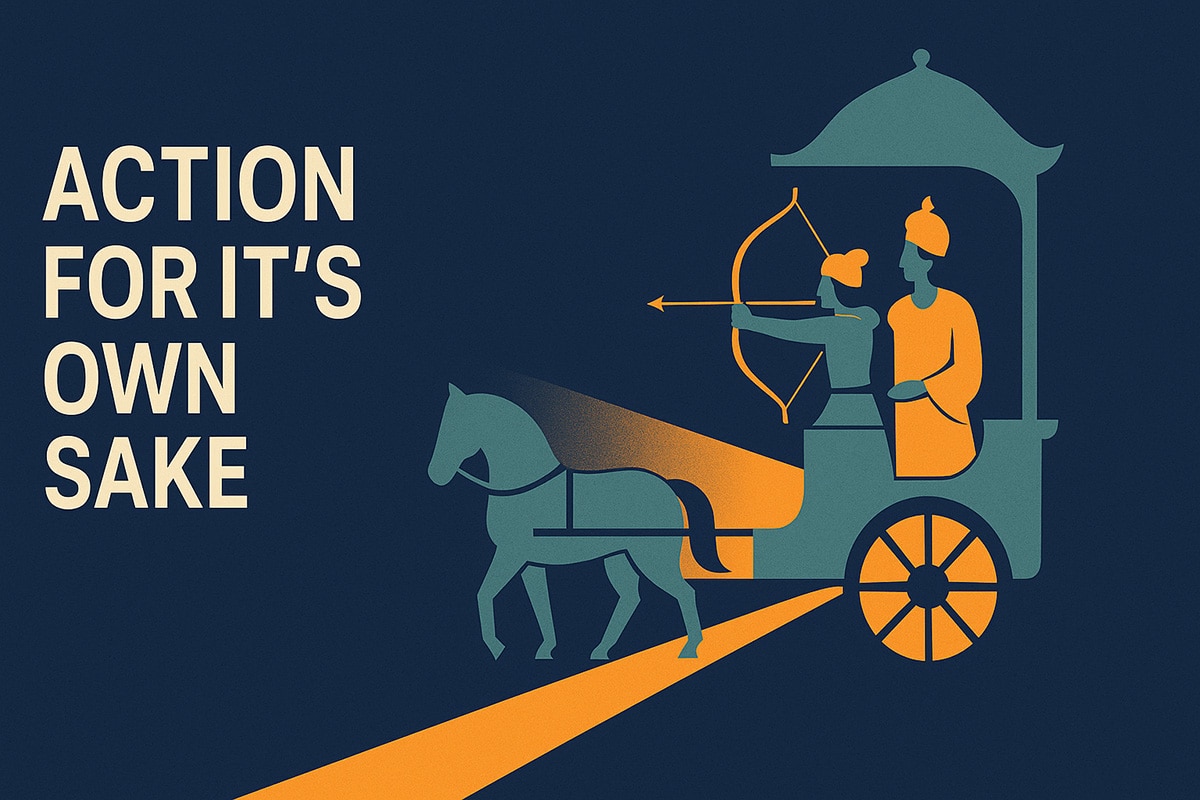
    The Bhagavad Gita, the ultimate text on this philosophy, tells the story of a warrior named Arjuna who’s having a complete meltdown right before the most important battle of his life. He’s questioning everything—his role, his qualifications, whether he deserves to be there.

    His guide Krishna gives him the most practical leadership advice ever: “Stop making this about your personal drama. You’ve trained your whole life for this moment. This situation needs your specific skills. The reward isn’t what you’ll get from fighting—the reward is the privilege of being able to serve in the way only you can.”

    Your dharma—your deepest commitment—isn’t something you do to get something else. It’s the thing you’re called to do because you’re uniquely positioned to do it and you have committed to it, and the doing itself is inherently meaningful.

    For me, this became clear when I left my tech career. I wasn’t trying to become a leadership coach to build some identity or prove anything to my family. In fact, it was the opposite as it looked like career suicide.

    I just looked at what was happening—brilliant people burning out, companies struggling with toxic cultures, leaders performing instead of leading—and realized I wanted to contribute to a different possibility. And I was actually good at it.

    The work itself became the reward. The fact that it’s also financially sustainable and personally fulfilling is gravy.

    The Paradox of Detached Yet Fully Committed Action

    Here’s where this gets really interesting for results-oriented leaders: When you stop being attached to specific outcomes, you often achieve better results than when you were desperately chasing them.

    Don’t try to make sense of it. Because it doesn’t make sense. It is a paradox.

    Why does that happen? Because your actions are finally aligned with reality instead of your psychological needs.

    You’re not distorting information to protect your ego. You’re not avoiding difficult decisions to manage your anxiety. You’re not pushing strategies that make you look good instead of strategies that actually work. You’re not saying what people want to hear instead of what they need to hear.

    When action becomes its own reward, you can afford to be completely honest about what each situation requires, because your self-worth isn’t riding on any particular outcome.

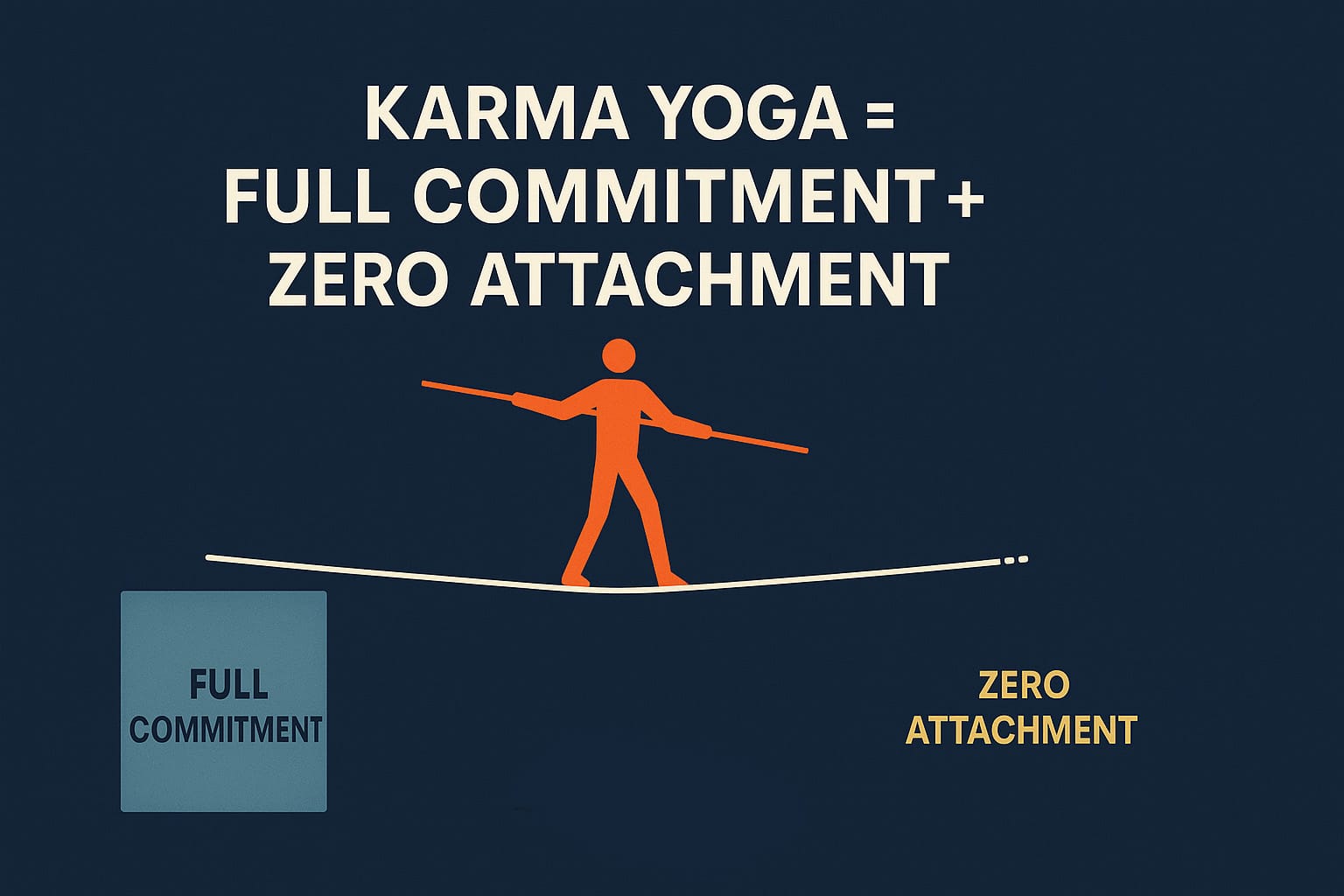
    This is the ultimate leadership superpower: the ability to act with complete commitment while being unattached to results. You care deeply about doing the right thing (based on your commitments), but your identity isn’t dependent on any specific outcome.

    The Practice: Finding the Reward in the Doing

    This isn’t about becoming some zen master who doesn’t care about results. In fact, your commitments are often derived from the future results that you want to see.

    It’s about changing your relationship with action so that you can actually be more effective.

    Here’s how to start:

    Before any leadership decision or interaction, pause and ask yourself: “What do I need from this moment?” Notice what comes up. Recognition? Control? Validation? Proof that you belong?

    Then ask: “What would I do here if the action itself was the only reward I could get?”

    OR

    “What would serve this moment and situation best given my Dharma and commitment?”

    That second question will show you what aligned action looks like – and what your real commitments (or Dharma) are.

    Sometimes it means having conversations that make people uncomfortable because that’s what serves the situation. Sometimes it means admitting you don’t know something because honesty serves better than pretense.

    Sometimes it means making decisions that look risky on paper because they align with your deeper values. Sometimes it means turning down opportunities that don’t feel authentic to who you’re becoming.

    None of this requires you to be selfless or sacrifice your needs. It just requires you to stop outsourcing your fulfillment to external circumstances and start finding it in the integrity of your actions.

    When Teams Feel the Difference

    Something beautiful happens when you start leading from this place: everyone around you relaxes.

    Your team stops managing your emotional reactions because you’re not using meetings to regulate your self-esteem. Your peers stop competing with you because you’re not trying to prove you’re better than anyone. Your investors trust your judgment more because your decisions serve the company instead of your image or just a relationship. Your family gets the real you because you’re not carrying the stress of constantly performing.

    People can feel when you’re not trying to extract something from every interaction. It creates psychological safety that allows everyone to focus on the actual work instead of managing these hidden dynamics.

    The Ultimate Leadership Freedom

    Here’s what I’ve learned from studying ancient wisdom and working with modern leaders: The most powerful thing you can do is stop needing your leadership role to provide you with anything other than the opportunity to serve.

    When you find fulfillment in the action itself – in the privilege of being able to contribute your gifts to something meaningful – you become unstoppable. Not because you don’t care about results, but because you’re no longer distorting your actions to achieve results that feed your ego.

    You can take bigger risks because failure doesn’t threaten your identity.

    You can have harder conversations because you don’t need everyone to like you. You can make unpopular decisions because your self-worth isn’t dependent on approval. You can be completely honest because you’re not protecting any image.

    This is what it looks like to lead from your natural power instead of your compensated weaknesses.

    The Bottom Line: The Doing Is the Reward

    Most leaders are waiting for some future result to make them feel fulfilled. The next funding round. The next promotion. The next acquisition. The next quarter that finally proves their worth.

    But what if fulfillment was available right now, in whatever action this moment is asking you to take?

    What if you could find the same satisfaction in a difficult conversation that serves your team’s growth as you do in hitting a revenue target?

    What if you could feel as rewarded by the integrity of turning down a bad opportunity as you do by landing a good one?

    What if the action of leadership itself—showing up fully, serving what’s needed, contributing your gifts—was enough?

    That’s not a philosophical concept. That’s a practical way of being that’s available to you in every moment of every day.

    The world doesn’t need more leaders who are performing for external validation. It needs leaders who are so fulfilled by the work itself that they can afford to do what actually serves, regardless of how it makes them look.

    You have everything you need to be that leader right now. The question is: Are you willing to stop using your role to fix your internal stuff and start using it to contribute what only you can give?

    The action that is aligned to your Dharma and commitment is waiting. And it’s its own reward.

  • Stop avoiding being wrong (you are addicted to being right)

    In 2000, Blockbuster’s leadership team had a meeting that would go down in business history as one of the most expensive examples of righteous stupidity ever.

    Netflix founders Reed Hastings and Marc Randolph flew to Dallas to pitch a partnership to Blockbuster CEO John Antioco. Netflix was struggling – they were losing money, had only 300,000 subscribers, and were desperate. They offered to sell Netflix to Blockbuster for $50 million and run Blockbuster’s online division.

    The Blockbuster executives literally laughed them out of the room.

    Why? Because they were “right.” They had 9,000 stores, 60 million customers, and $6 billion in revenue. They were the undisputed kings of home entertainment. These Netflix guys with their silly mail-order DVD service? Please.

    Blockbuster’s leadership was so committed to being right about their existing model that they couldn’t see the future coming. They were so attached to their righteousness – “We’re the biggest, we’re the best, we know this industry” – that they missed the greatest opportunity in entertainment history.

    By 2010, Blockbuster filed for bankruptcy. Netflix, the company they could have bought for $50 million, was worth $13 billion.

    The Blockbuster executives were technically “right” in 2000 – they were bigger, more profitable, and had more customers. But their need to be right, their attachment to their existing success, their inability to be wrong about their core assumptions, killed them.

    Being right is killing your momentum and sucking joy out of your life

    Here’s the brutal truth that most leaders won’t admit: you’re so terrified of being wrong that you’ve turned your entire leadership style into one giant hedge bet. And it’s absolutely destroying or slowing down everything you’re trying to build.

    But let’s zoom out for a second and look at the bigger picture. This isn’t just a business problem. This is a human epidemic. We live in a world where people are literally willing to get fired, resign from prestigious positions, lose promotions they’ve worked decades for, go to war, and even commit acts of violence – all to protect their righteousness and avoid looking wrong.

    Think about that for a moment. Our beings are so fragile, our egos so brittle, that we’ll sacrifice our happiness, our relationships, our success, even our lives, just to avoid the temporary discomfort of being incorrect about something.

    I see it everywhere. In boardrooms where leaders speak in corporate-speak instead of taking clear positions. In strategy meetings where everyone’s “testing the waters” instead of making bold calls. In conversations where executives say things like “we’ll see how it goes” or “let’s wait and see what the data shows” when what their company actually needs is someone to plant their flag and say “this is what we’re doing.”

    But it goes deeper than business. Look at the political landscape – politicians destroying their careers rather than admitting they were wrong about a policy. Look at international relations – nations sending their young people to die rather than backing down from a position. Look at corporate scandals where executives double down on obviously failing strategies because admitting error feels like death.

    You know what this really is? It’s not prudent leadership. It’s not being strategic. It’s cowardice dressed up in business casual, and it’s the same cowardice that’s tearing apart families, organizations, and entire countries.

    The Global Pandemic of Fake Righteousness

    Here’s what’s absolutely insane: we’d rather be right than happy. We’d rather be right than successful. We’d rather be right than loved. Left to our own devices, most of us would choose the bitter satisfaction of righteousness over the joy of actually getting what we want in life.

    And the most tragic part? Half the time, we’re not even actually right. We’re just committed to a position we took years ago that we can’t let go of because our entire identity has become wrapped up in it.

    I’ve watched CEOs tank their companies rather than admit their strategic vision was flawed. I’ve seen leaders in every industry – from tech to healthcare to government – choose career suicide over the simple phrase “I was wrong, let’s try something different.”

    We’ve created a world where being wrong is treated like a moral failing instead of what it actually is: information. Valuable, necessary information that helps us course-correct and improve.

    The Million-Dollar Lesson from an 80-Year-Old Badass

    Let me tell you about Mary Shakun, who didn’t start coaching until she was 65 and now charges over a million dollars a year. At 80 years old, she’s still cold-calling potential clients. But here’s what makes her extraordinary: when she sits across from someone with billion-dollar problems, she looks them in the eye and says, “I’m the only person in the world qualified to help you with this.”

    The kicker? She quietly admits that most of the time, that’s actually true.

    Think about that for a second. She shows up with 100% certainty while acknowledging she might be wrong some of the time. She’s not attached to being right – she’s committed to being certain.

    And that distinction is everything.

    While the rest of us are so terrified of that 1% chance of being wrong that we never show up powerfully at all, Mary has built a million-dollar business by being willing to be wrong occasionally in service of being powerful consistently.

    You are addicted to being right

    Most leaders have this completely backwards. They think certainty means you have to be right all the time. So they hedge. They qualify. They create escape routes in every sentence they speak.

    “Well, if the market conditions remain favorable…” “Assuming our projections are accurate…” “We’re cautiously optimistic that…”

    Stop it. Just stop.

    This hedging isn’t just killing your business momentum – it’s killing your soul. Every time you refuse to take a stand, every time you speak in maybes and possibles, you’re slowly dying inside. Because deep down, you know you’re capable of so much more than this watered-down, committee-approved version of leadership.

    Certainty isn’t about being right. It’s about taking a position and moving powerfully from that place. Certainty is about taking action and making shit happen.

    Being right is just the post-game analysis – it’s what happened after you already took action. Being right is only about looking good and posturing.

    When you’re obsessed with being right, you’re living in the future results instead of the present moment where all your power actually lives. You’re so busy protecting yourself from the possibility of being wrong that you never fully commit to anything. And uncommitted leadership? That’s not leadership at all.

    Kodak

    In 1975, a Kodak engineer named Steve Sasson invented the world’s first digital camera. He presented his toaster-sized, 0.01-megapixel creation to company executives. Their reaction was not excitement, but fear. Kodak was a company built on film, paper, and chemicals—a highly profitable “razor and blades” business model. The executives were addicted to the “rightness” and profitability of this model.

    They asked Sasson, “Why would anyone ever want to look at their pictures on a television set?” Their entire worldview was based on physical prints. Admitting that Sasson’s invention was the future would mean admitting that their entire business model was, eventually, going to be wrong. So they did the unthinkable: they buried the technology. They told Sasson to keep his invention quiet, convinced that they could control the transition and protect their film empire forever.

    The Damage: Kodak’s addiction to being right about the supremacy of film was a corporate death sentence. While they sat on the patent, other companies like Sony, Canon, and Fuji developed their own digital cameras. When the digital wave finally crested, Kodak was woefully unprepared. They were too slow, too attached to their legacy, and too convinced of their own infallibility. The company that had once been a symbol of American innovation filed for bankruptcy in 2012.

    Your Rightness Addiction Is Costing You Everything

    Let’s get brutally honest about what this addiction to being right is actually costing you – because it’s not just professional, it’s existential:

    Your team’s respect. They can smell your uncertainty from a mile away. When you hedge every decision, speak in maybes, and constantly cover your bases, your people lose confidence in your ability to lead them anywhere worth going. They’d rather follow someone who’s wrong occasionally but decisive than someone who’s never wrong because they never actually say anything.

    Your company’s momentum. Momentum requires decisive action. When you’re always waiting for more data, more proof, more certainty that you’ll be right, opportunities slip by. Your competitors – the ones willing to be wrong sometimes – are eating your lunch while you’re still in analysis paralysis.

    Your own joy and aliveness. Think about the last time you felt truly alive as a leader. I bet it wasn’t during a meeting where you carefully managed everyone’s expectations. It was probably when you took a bold stand, made a big bet, or fought for something you believed in. That’s what certainty feels like – and you’ve been starving yourself of it.

    Your capacity to inspire. People don’t follow hedge bets. They follow vision, conviction, and leaders who are willing to put their reputation on the line for something bigger than themselves. When you’re more committed to being right than being powerful, you become utterly uninspiring.

    Your relationships. This doesn’t stop at work. How many marriages have been destroyed by the need to be right? How many friendships have ended because someone couldn’t just say “you know what, I was wrong about that”? Our addiction to righteousness is literally destroying our capacity for love and connection.

    The Global Cost of Our Fragile Beings

    Look around at the world we’ve created with this pathology. Political leaders who would rather watch their countries burn than admit their policies aren’t working. Business leaders who would rather see their companies fail than acknowledge their strategies are flawed. Religious and ideological leaders who would rather see their followers suffer than question their doctrines.

    We’re living in a world where people are willing to die – and kill – for the right to be right. Where entire industries collapse because no one in leadership has the courage to say “we got this wrong, let’s pivot.” Where families are torn apart over political disagreements that, in the grand scheme of things, matter far less than love and connection.

    This isn’t strength. This is the ultimate fragility – beings so terrified of being seen as fallible that they’ll sacrifice everything real and meaningful to maintain the illusion of infallibility.

    John McEnroe was a tennis genius, a player of sublime touch and creativity. But he was equally famous for being pathologically addicted to being right. For McEnroe, every line call he disagreed with wasn’t a judgment call—it was a clear and obvious error by an incompetent official. This conviction fueled his legendary on-court tantrums. His cry of “You cannot be serious!” to an umpire at Wimbledon in 1981 became his global catchphrase.

    Throughout his career, he refused to accept an official’s verdict if it contradicted his own. This wasn’t just theatrics; it was a core part of his psyche. He was so certain of his own perception that he couldn’t mentally proceed until he had raged against the injustice of being proven “wrong.” He berated umpires, smashed rackets, and argued endlessly, believing he was the sole arbiter of truth on the court.

    The Damage: McEnroe’s addiction to being right cost him dearly. His tirades led to countless point penalties, game penalties, and fines that lost him momentum and matches at crucial moments. Most famously, it led to him being defaulted from the 1990 Australian Open, a Grand Slam he had a real chance of winning.

    The Hedge Fund Life (And Why It’s Killing You)

    You know what a hedge fund is? It’s a financial instrument that pays off when everyone else is wrong. It’s literally designed to profit from other people’s failures.

    And that’s exactly how most leaders are living their lives – like one big hedge fund. Always positioning themselves to be able to say “I told you so” if things go south, always creating plausible deniability, always having an out.

    But here’s the thing about hedge fund thinking: it might protect you from being spectacularly wrong, but it also prevents you from being spectacularly right. It keeps you playing small, playing safe, playing not to lose instead of playing to win.

    Your people don’t need another hedge fund manager. They need a leader who’s willing to be wrong in service of something greater. They need someone who values progress over perfection, results over righteousness.

    The Courage to Be Wrong in Service of Being Powerful

    I’m not suggesting you become reckless or stop using your brain. I’m suggesting something far more radical: that you become willing to be wrong in service of being powerful.

    This is perhaps the most counterintuitive leadership principle of all time, but it’s also the most liberating. When you’re willing to be wrong, you can:

    • Make decisions faster while others are still gathering data
    • Communicate with clarity and conviction instead of corporate speak
    • Inspire others to follow your vision instead of your hedge bets
    • Take the risks that create breakthrough results
    • Learn and adapt quickly when things don’t go as planned
    • Actually enjoy the process of building something instead of constantly protecting yourself

    The best leaders I know aren’t right more often than everyone else. They’re just more willing to be wrong, which paradoxically makes them more powerful and, ultimately, more successful.

    They’ve learned that being wrong occasionally is the price of admission to playing a big game. And they’ve decided that price is worth paying.

    What Your Team Actually Needs From You

    Your team doesn’t need you to be right all the time. They need you to be certain about the direction you’re going, even when you don’t know exactly how you’ll get there.

    They need you to say things like:

    • “This is what we’re doing.”
    • “I’m confident we’ll figure it out.”
    • “We’re going to make this work.”
    • “I believe in this vision completely.”

    Not because you have a crystal ball, but because someone has to plant the flag. Someone has to say “we’re going this way” so everyone else can stop looking around wondering what the plan is.

    Your people are drowning in uncertainty. They don’t need more analysis or more hedging. They need someone willing to take a stand, point in a direction, and say “follow me” – even if there’s a chance that direction might need to change later.

    The Daily Practice of Certainty

    So how do you break this addiction to being right and start living from certainty? Start small, but start today:

    In your next meeting, instead of saying “I think maybe we should consider…” try “Here’s what we’re going to do…”

    When someone asks for your opinion, give it without hedging. Not “Well, there are pros and cons to both approaches…” but “My recommendation is X because…”

    In your personal life, practice certainty in low-stakes situations. “It’s going to be a great day.” “We’ll get a good table at the restaurant.” “This project is going to work out perfectly.”

    With your team, communicate vision and direction as certainties, not possibilities. Instead of “If everything goes according to plan, we might be able to…” try “When we achieve this goal…”

    When you’re wrong, practice saying “I was wrong about that” without immediately explaining why you were wrong or how it wasn’t really your fault. Just own it, learn from it, and move on.

    The Liberation of Letting Go

    Here’s what happens when you stop needing to be right all the time: you become free. Free to take bigger swings. Free to communicate with power and conviction. Free to inspire others. Free to fail spectacularly and learn rapidly. Free to change your mind when new information comes in. Free to be human.

    You know what the most successful entrepreneurs and CEOs have in common? They’ve all been wrong. A lot. Publicly. Expensively. And they kept going anyway.

    Jeff Bezos was wrong about the Fire Phone. Steve Jobs was wrong about the Lisa computer. Elon Musk has been wrong about Tesla production timelines approximately 47,000 times. But they’re all still willing to make bold predictions and take big stands.

    Because they understand what you’re learning right now: being wrong occasionally is the price of admission to playing a big game. And playing it safe? That’s not safety – that’s just a slow death.

    Your Certainty Challenge

    Here’s your challenge for the next 30 days: Practice showing up with certainty in at least one interaction every day. Not because you know you’ll be right, but because someone needs to take a stand.

    Make predictions. Give recommendations without qualifiers. Take positions. Communicate your vision as if it’s inevitable, not just possible.

    And when you’re wrong – because you will be sometimes – practice taking that with grace and moving on. Don’t let the fear of those moments keep you from the power and joy that comes from living with certainty.

    Your company needs a leader, not a hedge fund manager. Your team needs someone with conviction, not someone who’s always covering their bases. Your family needs someone who values relationship over righteousness. And you deserve to experience the aliveness that comes from playing full out, even when you can’t guarantee the outcome.

    Stop saving your certainty for when you know you’ll be right. By then, it’s too late. The opportunity, the moment, the chance to lead – it’s all passed you by.

    The world is waiting for what you have to offer. But it needs you to offer it with certainty, not hesitation. It needs leaders who are more committed to creating results than protecting their image. It needs people who would rather be happy than right, successful than righteous, powerful than perfect.

    Your being is not as fragile as you think. You can survive being wrong. You might not survive never trying.


  • Fake humility is the highest form of arrogance. Own who you are

    Mountains don’t apologize for their height.

    Why should you?

    I watched Sarah fidget with her hands as she introduced herself to the room of investors. “I’m just a new business owner with a little idea that might not be very good, but…” Her voice trailed off, and I wanted to shake her. This wasn’t humility speaking—this was fear dressed up in modest clothing.

    Sarah had just developed a revolutionary water purification system that could save millions of lives in developing countries. Her “little idea” had the potential to transform entire communities. Yet there she stood, shrinking herself down to the size of a pebble when she should have been standing tall like the mountain she was.

    This is what fake humility looks like. And it’s everywhere.

    I’ve coached founders with $100M companies and watched them hesitate to speak boldly in boardrooms. Not because they lacked conviction, but because they were afraid of being seen as “too much.”

    I’ve seen CEOs dilute their vision because it made someone in HR uncomfortable.

    The Epidemic of Playing Small

    We live in a culture that’s confused about power. We’ve been taught that being humble means diminishing ourselves, that leadership requires constant self-deprecation, and that owning our strengths is somehow arrogant. So we develop this strange habit of preemptively cutting ourselves down before anyone else can.

    “I’m probably wrong, but…” “This might be stupid, but…” “I don’t know if this makes sense, but…”

    Sound familiar?

    These aren’t humble statements—they’re shields. They’re ways of protecting ourselves from criticism by beating others to the punch. But here’s the brutal truth: when you consistently undermine your own credibility, people start to believe you.

    Take Marcus, a brilliant software engineer I know. He built an app that could revolutionize how hospitals manage patient data. But every time he pitched it, he’d start with, “I know there are probably better solutions out there, and I’m sure someone smarter than me has thought of this already…”

    Investors heard exactly what he was telling them: that he didn’t believe in his own product. They passed. Not because his idea wasn’t good, but because he convinced them it wasn’t.

    The real kicker? Six months later, a competitor launched a nearly identical product with absolute confidence and raised $50 million in Series A funding. Same idea. Different energy. Completely different result.

    The Arrogance of False Humility/Modesty

    Marianne Williamson captured something profound when she wrote: “Our deepest fear is not that we are inadequate. Our deepest fear is that we are powerful beyond measure. It is our light, not our darkness that most frightens us. We ask ourselves, ‘Who am I to be brilliant, gorgeous, talented, fabulous?’ Actually, who are you not to be?”

    Read that again. Who are you NOT to be?

    This is where fake humility reveals its true face. When you have gifts, talents, and insights that could help others, and you choose to hide them behind a veil of false modesty, you’re not being humble—you’re being selfish.

    Think about it. If you discovered a cure for cancer, would it be humble to say, “Oh, this little thing I stumbled upon probably won’t work”? Or would that be the height of arrogance—putting your own comfort with being seen as “modest” above the lives you could save?

    Every time you downplay your abilities, you’re making a choice. You’re choosing your ego’s need to be liked over your calling to serve.

    You’re choosing comfort over courage.

    You’re choosing small over significant.

    This isn’t humility. It’s self-betrayal dressed in virtue.

    And let’s be honest: Fake humility is the highest form of arrogance.

    Because what it really says is: “I believe my light is so powerful, so dangerous, that I need to hide it to keep the peace.”

    No. You don’t.

    Your Shrinking Doesn’t Serve Anyone

    Nature Doesn’t Negotiate Its Essence

    Nothing in nature holds back its essence.

    The mountain doesn’t shrink itself to be more likable. It doesn’t lower its peak to keep others comfortable.

    It just is—majestic, raw, unapologetically itself.

    The oak tree doesn’t apologize for blocking sunlight from smaller plants. The lion doesn’t dim its roar so other animals feel more comfortable. The sun doesn’t dim its light because it might be too bright for some.

    Yet we, as human beings blessed with consciousness and choice, consistently choose to operate at a fraction of our capacity. We edit ourselves. We water down our truth. We dim our light so others won’t feel outshined.

    We shrink.
    We dim our lights.
    We over-explain our successes until they sound like lucky accidents.

    But here’s what we miss: when an oak tree stands in its full glory, it doesn’t diminish other plants—it creates an entire ecosystem. Birds nest in its branches. Animals find shelter in its shade. Other plants grow in the rich soil created by its fallen leaves.

    Your full expression doesn’t diminish others—it gives them permission to rise.

    The Stories We Tell Ourselves

    One of my clients—we’ll call her Maya—was a brilliant product leader at a fast-growing AI company. In meetings, she would often defer to others, even when she had the sharpest insights.

    Why?

    Because someone once told her she was “too intense.”

    So she dimmed. She made herself smaller. She filtered every sentence to sound softer, more agreeable.

    Until one day, I asked her a simple question:

    “What if your intensity is the very thing your company needs to break through?”

    That flipped a switch.

    She started showing up with her full force. Not louder, not bossier—but clearer. More present. More herself.

    Three months later, she was promoted to VP.

    Not because she worked harder—but because she stopped hiding.

    The stories we tell ourselves about humility often stem from childhood programming. Maybe you were told not to be “too big.” Maybe you learned that drawing attention to yourself was dangerous. Maybe you watched someone you admired be torn down for their confidence, and you decided it was safer to stay small.

    But those old stories are keeping you from your destiny.

    The Difference Between Arrogance and Confidence

    Let’s be clear: there’s a massive difference between arrogance and authentic confidence.

    Arrogance says, “I’m better than you.” Confidence says, “I know what I’m capable of.”

    Arrogance puts others down to lift itself up. Confidence lifts everyone by example.

    Arrogance is insecure and needs constant validation. Confidence is secure and offers validation to others.

    Arrogance is loud and flashy. Confidence is quiet and powerful.

    True confidence doesn’t need to announce itself with fanfare. It’s the mountain that simply stands—no apologies, no explanations, no justifications. Just presence.

    The Ripple Effect of Authentic Leadership

    When you own who you are, something magical happens. You give others permission to do the same.

    I think of Oprah, who never apologized for her curiosity, her emotions, or her success. By owning her full self, she created space for millions of others to explore their own depths.

    I think of Steve Jobs, who never dimmed his vision to make others comfortable. His unwillingness to compromise on his standards pushed entire industries to excellence.

    I think of Maya Angelou, who never apologized for the power of her words or the depth of her wisdom. She stood in her truth so fully that it gave others courage to find their own.

    These aren’t people who were born different from you. They were people who made a choice—the choice to stop apologizing for their gifts and start using them fully.

    Your Presence Is Your Leadership

    Here’s what I’ve learned after years of working with leaders across every industry: your presence is your leadership. Not your title. Not your credentials. Not your network. Your presence. Your power.

    And presence isn’t something you can fake or manufacture. It comes from one thing only: the willingness to show up as your full self.

    When you walk into a room owning your worth without apology, people feel it. When you speak your truth without hedging or qualifying, people listen. When you lead from your authentic power rather than a watered-down version of yourself, people follow.

    But when you shrink, when you dim, when you over-explain and soften the edges of your truth, you rob the world of your gifts. You withhold the very frequency the world needs from you.

    The People Who Matter Will Rise to Meet You

    “The people who are meant to walk with you won’t be intimidated by your height. They’ll rise to meet you there.”

    This is perhaps the most important truth about authentic leadership. When you own your power, you naturally attract people who can match your energy. You repel those who need you to stay small for their own comfort.

    And that’s exactly as it should be.

    The right people—your true tribe, your real collaborators, your genuine supporters—they don’t want the diminished version of you. They want the real you. The powerful you. The you who stands in their full height without apology.

    These are the people who will push you to grow instead of asking you to shrink. They’ll celebrate your wins instead of feeling threatened by them. They’ll challenge you to be even more of who you are instead of asking you to be less.

    The Cost of Playing Small

    But what about the cost of staying small? What about the price of fake humility?

    Every time you undercut yourself, you train people to undervalue you. Every time you apologize for your expertise, you plant seeds of doubt about your capabilities. Every time you shrink to make others comfortable, you teach them that your comfort doesn’t matter.

    The cost shows up in:

    • Opportunities that pass you by because you didn’t own your qualifications
    • Ideas that never see the light of day because you convinced yourself they weren’t good enough
    • Teams that don’t follow your leadership because you never gave them confidence in your direction
    • Relationships that stay surface-level because you never showed your true depth
    • Dreams that remain dreams because you never believed you deserved to achieve them

    The world is full of brilliant people who never made their mark because they spent more energy hiding their light than shining it.

    Your Full Expression Is Your Offering

    Marianne Williamson’s quote continues: “Your playing small does not serve the world. There is nothing enlightened about shrinking so that other people won’t feel insecure around you.”

    Your full expression is your offering to the world. When you hold back your power, you don’t just betray yourself—you deprive others of what you came here to give. You steal other’s growth.

    The business idea you’re sitting on could employ hundreds of people. The book you’re not writing could change someone’s life. The leadership you’re not stepping into could guide your organization through its next breakthrough. The authentic self you’re hiding could give someone else permission to be real too.

    Stop Asking for Permission to Be Powerful

    So here’s your gentle invitation—no, your urgent call to action:

    Stop apologizing for your height. Stop asking for permission to be powerful. Stop editing yourself to be more digestible.

    The mountain doesn’t ask permission to reach toward the sky. The ocean doesn’t apologize for its depth. The sun doesn’t dim its light because some prefer shade.

    You are not here to be a diluted version of yourself. You’re here to be the full expression of who you came to be. Raw, powerful, unapologetic, and real.

    The Mountain Stands

    Mountains don’t apologize for their height. They don’t shrink themselves to be more likable. They don’t lower their peaks to keep others comfortable. They just are—majestic, raw, unapologetically themselves.

    And yet, as leaders, as human beings with something to offer this world, we so often do the opposite. We shrink. We dim. We over-explain. We soften the edges of our truth to make others feel more at ease.

    But you were never meant to lead from a watered-down version of yourself.

    True leadership doesn’t come from ego or dominance. It comes from presence. From standing fully in who you are. Rooted. Clear. Quietly powerful. Just like a mountain.

    The people who belong in your life, who are meant to walk alongside you on this journey, who can truly appreciate what you have to offer—they won’t be intimidated by your height. They’ll be inspired by it. They’ll rise to meet you there.

    And together, you’ll create something magnificent. Something that could only exist when authentic power meets authentic power. When real meets real. When mountain meets mountain.

    So stand tall. Own your gifts. Speak your truth. Lead from your authentic power.

    The world doesn’t need another diminished version of someone extraordinary.

    The world needs you. All of you. In your full height. Without apology.

    Because fake humility isn’t humble at all—it’s the highest form of arrogance. It says your comfort with being small matters more than the contribution you came here to make.

    And you? You came here to be a mountain.

    So stop apologizing for your height, and start reaching for the sky.

  • A New Vision for European Leadership: Learning from Entrepreneurs

    We’re at a pivotal moment in European history. The leadership approach that served Europe so well after World War II – focused on stability, consensus, and careful progress – has created remarkable prosperity and peace across our continent. We should be proud of what we’ve accomplished.

    For me, as an Indian who grew up reading about and seeing constant wars between India and its neighbours, seeing a borderless continent where the biggest wars of human existence we fought just 70 years ago, is nothing more than a miracle. If you have forgotten it, you have no idea what a privilege crossing country borders without ever being stopped or frisked or killed is.

    Yet the world is rapidly transforming, and despite our tremendous achievements, we risk falling behind in the global world for the coming decades.

    Our Post-War Leadership Legacy

    After the devastation of World War II, our continent needed leaders who could build consensus, create stability, and restore faith in institutions. Leaders like Konrad Adenauer in Germany and Jean Monnet in the European project excelled at methodical rebuilding and careful integration. They were exactly what Europe needed then.

    Together, Europeans have rebuilt shattered economies, created unprecedented prosperity, and constructed a peaceful continent from the ashes of conflict. This remains one of humanity’s greatest accomplishments.

    But the world has changed dramatically. The leadership qualities that rebuilt our continent aren’t the same ones needed to keep us competitive in an era of technological transformation and global competition.

    Warming Up to Change and Discomfort – Or Risk Oblivion

    Let’s be candid about what we face: the coming decades will bring unprecedented technological and economic transformation. Artificial intelligence, synthetic biology, quantum computing, and technologies we can’t yet imagine will reshape every industry and institution. This transformation will be uncomfortable, disruptive, and at times alarming – but it’s inevitable.

    We in Europe have developed a leadership culture that prioritizes comfort and stability. This was understandable after the chaos of the mid-20th century. But our aversion to discomfort now threatens our future relevance.

    Consider Nokia’s fall from dominance. In 2007, the Finnish company controlled nearly 50% of the global smartphone market. When Apple introduced the iPhone, Nokia’s engineers reportedly created a touchscreen prototype that matched or exceeded Apple’s capabilities. But Nokia’s leadership rejected this innovation, considering it too disruptive to their existing business model. By 2013, their market share had collapsed to just 3%, and the company sold its phone business to Microsoft.

    This isn’t just a story about one company – it’s a warning about European institutional resistance to uncomfortable change. While our American and Asian competitors embrace creative destruction as necessary for progress, we often try to protect existing structures even when they’ve become obsolete.

    The consequences of continued reluctance to embrace discomfort will be profound. We’re already seeing the early signs:

    • Our declining share of global patents in frontier technologies like artificial intelligence and quantum computing
    • The migration of our most ambitious entrepreneurs to more dynamic ecosystems abroad
    • Our growing dependence on foreign platforms for digital infrastructure
    • The declining global influence of European universities and research institutions

    If these trends continue for another two decades, we won’t just be economically disadvantaged – we risk becoming irrelevant in shaping humanity’s future. Our social models, democratic values, and cultural heritage will have diminishing influence in a world increasingly shaped by those willing to embrace disruptive change.

    But there’s good news: discomfort is a skill we can develop. Just as athletes train their bodies to perform under physical stress, leaders can train themselves to function effectively amid uncertainty and change. When we repeatedly expose ourselves to controlled discomfort – taking calculated risks, experimenting with new approaches, facing potential failure – we build the capacity to thrive in changing conditions.

    Examples from our own continent show this is possible. When Sweden faced a banking crisis in the early 1990s, its leaders made the uncomfortable decision to nationalize failing banks, force shareholders to take losses, and fundamentally restructure the financial system. The short-term pain was significant, but this willingness to embrace discomfort enabled Sweden to emerge stronger, with a more resilient financial system that weathered the 2008 global crisis better than most European counterparts.

    We need to cultivate this capacity for productive discomfort throughout our institutions:

    • In government, by rewarding officials who challenge comfortable but outdated processes
    • In education, by teaching students to value problems as opportunities rather than threats
    • In business, by celebrating leaders who cannibalize their own successful products to create better ones
    • In finance, by developing better mechanisms to fund disruptive innovation

    The choice before us is clear: we can continue prioritizing comfort and gradually fade into global irrelevance, or we can embrace the productive discomfort that drives renewal and reinvention. The former path leads to a comfortable decline; the latter offers the possibility of European renaissance.

    What We Can Learn from American Entrepreneurs

    When I look at American entrepreneurial success, it’s not about abandoning European values – it’s about adapting our approach while maintaining our core principles. America is not perfect by any chance – especially when it comes to quality of life and European values. At the same time, that doesn’t mean we can’t learn from American businesses, where it excels.

    Consider how differently leadership operates in American innovation ecosystems. In 2008, when European leaders were managing the financial crisis through careful coordination, Airbnb launched despite the economic downturn. While our financial institutions were understandably tightening lending in response to systemic risks, American venture capitalists were still funding bold ideas that have since transformed industries.

    Being transparent about risk while pursuing ambitious visions is something our European leadership culture often discourages.

    During the COVID pandemic, we saw how Moderna’s leadership made bold decisions quickly, commenced production at risk, and moved with urgency that many European companies struggled to match. The result wasn’t just business success – it helped save lives.

    We don’t need to abandon our thoughtful approach, but we do need to be more decisive with taking action than currently – even if it means going outside our comfort zone or taking bigger risks. American entrepreneurs don’t succeed because they’re reckless – they succeed because they make calculated bets and execute with urgency while still managing risk.

    What We Can Learn from Indian Entrepreneurs

    India offers us equally valuable lessons in entrepreneurial leadership. Nandan Nilekani’s work with India’s Aadhaar digital identity system shows what’s possible with entrepreneurial leadership in governance. In just a few years, he helped create the world’s largest biometric ID system used by over 1.3 billion people. Meanwhile, our digital identity initiatives, while well-designed, have produced less real-world impact despite greater resources.

    Byju Raveendran built BYJU’S from a small tutoring service into a global education technology company by focusing on solving real problems with available resources rather than waiting for perfect conditions – an approach we could benefit from in our European context.

    Indian entrepreneurs typically face greater constraints than we do – less capital, weaker infrastructure, more bureaucracy. Yet they’ve built world-class companies by adapting to these limitations rather than being paralyzed by them.

    When Falguni Nayar left her investment banking career at age 50 to found beauty retailer Nykaa, she faced skepticism from all sides. But she saw an opportunity and executed her vision decisively. Eight years later, her company went public at a valuation of nearly $13 billion. Her story reminds us that entrepreneurial leadership can emerge at any age and from any background – something we need to encourage more actively in Europe.

    A New European Leadership Approach

    We don’t need to abandon our European values or social models. We need to apply them differently for a changing world. Here’s what our new leadership approach might embrace:

    Balancing Consensus with Action

    We excel at building consensus, but sometimes this comes at the cost of timely action. When France’s Xavier Niel disrupted the telecommunications market with Free Mobile, he didn’t wait for industry-wide agreement. He moved decisively with consumer-friendly pricing that ultimately benefited millions. We need more of this willingness to act decisively, even before achieving perfect consensus.

    We might ask ourselves: How many opportunities have we missed while seeking unanimous agreement? How might we preserve our collaborative spirit while moving more quickly on critical priorities?

    Embracing Thoughtful Risk-Taking

    Daniel Ek’s founding of Spotify in Sweden shows both our potential and our challenges. The conventional wisdom said digital music services couldn’t work legally or profitably. While European financial institutions understandably hesitated given the risks, American investors backed his vision. The result? A European-founded company that ultimately went public in New York.

    We need to reconsider how we evaluate and approach risk. Not all risks are reckless – some are necessary for progress. How might we better distinguish between reckless gambles and calculated risks worth taking?

    Focusing on Outcomes Alongside Process

    Estonia’s example shows what’s possible when European governance adopts more entrepreneurial approaches. Their e-Residency program allowing anyone worldwide to establish an EU-based business digitally has created new economic opportunities while strengthening Estonia’s global position. Leaders like Taavi Kotka didn’t get caught in endless feasibility studies – they launched, learned, and improved based on real-world feedback.

    For our policy initiatives, we should continue valuing thorough processes while placing greater emphasis on measurable outcomes and real-world impact.

    Steps We Can Take Together

    1. Create Entrepreneur-in-Residence Programs in Government: Let’s bring successful entrepreneurs into our ministries and EU institutions for meaningful exchanges. Their approach to problem-solving could greatly enrich our policymaking while helping entrepreneurs better understand governance challenges.
    2. Establish Ambitious Moonshot Challenges: We could set bold, specific goals with clear deadlines – like making Europe the world leader in green hydrogen production by 2030 – and empower leaders to pursue these goals with appropriate urgency and flexibility.
    3. Reconsider How We Handle Failure: We might review how our political and administrative systems respond to failure. When an ambitious public initiative fails for understandable reasons, do we recognize the courage it took to try, or do we penalize the attempt itself?
    4. Create Fast-Track Decision Pathways: For strategic priorities, we could develop mechanisms that preserve necessary oversight while enabling faster action when needed.
    5. Develop Leadership Development Programs: Establish leadership development programs specifically designed to help executives and officials build their capacity to function effectively amid uncertainty and change.

    Our European Promise

    Europe has everything needed to lead in the 21st century – world-class education, strong infrastructure, and tremendous talent. What we need is an evolution of our leadership approach to meet the demands of rapid change and technological transformation.

    The leaders who rebuilt Europe after World War II were exactly right for their time. They created stability and prosperity from chaos, and we honor their legacy. Now we face different challenges that require us to adapt while maintaining our core values.

    We don’t need to become America or India – or anybody else. We need to learn from their leadership and entrepreneurial approach while preserving what makes Europe special.

    Together, we can create a new European leadership model that combines thoughtful analysis with decisive action, careful planning with appropriate risk-taking, and consensus-building with the courage to move when the moment demands it. We need to become the best version of Europe.

    Our future depends not on abandoning our European identity, but on evolving it to meet the needs of our time.

    Let’s begin that transformation today.