This is the Leadership Journey series on the Choosing Leadership Podcast.
I believe we all have a lot to learn from each other’s stories – of where we started, where we are now, and our successes and struggles on the way. With this series of interviews, my attempt is to give leaders an opportunity to share their stories and for all of us to learn from their generous sharing. If you know a leader whom you would like to see celebrated on the show, please send me a message on LinkedIn with their name.
This episode pulls back the curtain on what it really takes to lead with integrity in a world obsessed with shortcuts.
Prashant Issar shares how purpose, grit, and an almost stubborn commitment to his values helped him build businesses that actually change lives—not just balance sheets.
If you’re wrestling with culture, scaling, or staying true to your word when the pressure is suffocating, this conversation will feel like a breath of fresh air.
You’ll hear how inclusivity, long-term thinking, and courageous leadership can become your unfair advantage.
Tune in and walk away with the kind of clarity that makes you rethink what you’re building—and why it matters.
This is the Leadership Journey series on the Choosing Leadership Podcast.
I believe we all have a lot to learn from each other’s stories – of where we started, where we are now, and our successes and struggles on the way. With this series of interviews, my attempt is to give leaders an opportunity to share their stories and for all of us to learn from their generous sharing. If you know a leader whom you would like to see celebrated on the show, please send me a message on LinkedIn with their name.
In this episode, Mark Rampolla pulls back the curtain on what it really takes to leave the comfort of corporate life and build a business—and a life—on your own terms.
He shares the unfiltered truth about dancing with bankruptcy, rediscovering purpose, and learning that freedom isn’t a future milestone but a present-moment choice.
Together, we explore how self-awareness, curiosity, and intentional living can transform not just your work, but your entire relationship with leadership.
Mark’s journey from Zico Coconut Water to becoming an investor reveals the mindset shifts that separate leaders who feel trapped from those who feel truly liberated.
If you’re ready to rethink success and design a life you don’t need an escape from, this conversation is exactly what you’ve been needing.
This is the Leadership Journey series on the Choosing Leadership Podcast.
I believe we all have a lot to learn from each other’s stories – of where we started, where we are now, and our successes and struggles on the way. With this series of interviews, my attempt is to give leaders an opportunity to share their stories and for all of us to learn from their generous sharing. If you know a leader whom you would like to see celebrated on the show, please send me a message on LinkedIn with their name.
In this episode, Hanim Dogan Jain takes you on a journey from humble beginnings across two cultures to building a multimillion-dollar company grounded in purpose, grit, and heart.
She breaks down the difference between self-confidence and self-worth—and why most leaders mix the two up at their own expense.
You’ll hear how embracing her roots, trusting her inner voice, and leading with authenticity reshaped not just her career, but her entire identity.
Hanim also opens up about blending spirituality with business, and why inner peace might just be your most underrated leadership advantage.
If you’ve ever questioned your value, your path, or what leadership really demands, this conversation will recharge you and challenge you in all the right ways.
This is the Leadership Journey series on the Choosing Leadership Podcast.
I believe we all have a lot to learn from each other’s stories – of where we started, where we are now, and our successes and struggles on the way. With this series of interviews, my attempt is to give leaders an opportunity to share their stories and for all of us to learn from their generous sharing. If you know a leader whom you would like to see celebrated on the show, please send me a message on LinkedIn with their name.
In this episode, Tom Alexander flips the script on what modern leadership really demands, showing why the old “command-and-control” playbook keeps failing today’s workforce.
We dive into the mindset shift leaders must make if they want to build organizations where people feel energized, purposeful, and proud of the work they do.
Tom shares hard-earned wisdom from moving between government, entrepreneurship, and fatherhood—and how those experiences shaped his belief that action beats perfection every time.
You’ll hear why optimism is a practical leadership tool, not a fluffy one, and how embracing uncertainty can actually unlock your team’s potential.
If you’re ready to lead with more courage, clarity, and heart, this conversation will give you the spark you’ve been looking for.
This is the Leadership Journey series on the Choosing Leadership Podcast.
I believe we all have a lot to learn from each other’s stories – of where we started, where we are now, and our successes and struggles on the way. With this series of interviews, my attempt is to give leaders an opportunity to share their stories and for all of us to learn from their generous sharing. If you know a leader whom you would like to see celebrated on the show, please send me a message on LinkedIn with their name.
In this episode, you’ll meet Dr Julian Nesbitt, a GP-turned-tech-entrepreneur who refused to accept the broken state of mental healthcare and decided to rebuild it from the inside out.
He shares how spotting a simple but painful gap in patient access led him to create a platform that’s now transforming mental health support across entire countries.
Leaders will appreciate his raw honesty about resilience, hiring the right people, and learning to step back so the vision can scale.
His story is a masterclass in reinventing yourself, embracing discomfort, and using technology to solve real human problems.
If you’re navigating growth, change, or the weight of big decisions, this conversation will give you both clarity and courage.
This is the Leadership Journey series on the Choosing Leadership Podcast.
I believe we all have a lot to learn from each other’s stories – of where we started, where we are now, and our successes and struggles on the way. With this series of interviews, my attempt is to give leaders an opportunity to share their stories and for all of us to learn from their generous sharing. If you know a leader whom you would like to see celebrated on the show, please send me a message on LinkedIn with their name.
In this episode, Mallika Kapur pulls back the curtain on what leadership actually looks like when you stop chasing approval and start focusing on impact.
She shares her unexpected leap from medicine into health tech and how that shift forced her to think bigger, lead bolder, and reinvent herself at every stage.
Mallika talks openly about the loneliness of being a woman leader, the pressure of carrying an entire organization through COVID, and the courage required to keep choosing effectiveness over comfort.
Her insights on prioritization, delegation, and building a team that thinks beyond the small stuff will hit home for anyone feeling stretched thin.
If you’re navigating growth, battling overwhelm, or figuring out how to lead without losing yourself, this conversation will give you a refreshing dose of clarity and fire.
Here’s What I’ve Seen Working Across Four Continents
I grew up in India, spent 16 years in tech, worked with companies across the US and UK for two decades, briefly experienced Japanese culture at Yahoo, and now live in the Netherlands.
And everywhere I go, I see the same thing happening. Over the past few years, we’ve slowly drifted into something I no longer recognize as leadership. We started cushioning decisions, over-explaining expectations, softening feedback, adding rules instead of responsibility, and calling it “care.”
We took three beautiful ideas—diversity, inclusion, and empathy—and turned them into excuses for treating capable adults like fragile children who can’t handle reality.
I’ve watched it play out in a 70 year old organisation in Bangalore, a Fortune 500 in New York, a scale-up in Amsterdam, a consultancy in Dubai, and a tech giant in London.
Different languages. Different cultures. Same problem.
Let me tell you what I mean.
What Actually Happened
What it was meant to be: Teams with different perspectives making better decisions. Cultures where everyone can show up fully. Leaders who actually understand their people.
What we got: Leaders terrified to give honest feedback to anyone who might be “different.” Teams where nobody can say anything uncomfortable.
I’ve seen it everywhere. And I’m done pretending it’s working.
The Ten Ways I’ve Seen Leaders Treat Adults Like Children
Let me walk you through what this actually looks like. I’ve done some of these myself. I’ve watched others do all of them.
1. The Layoff Dance
What I’ve seen in the India, US and UK: CEOs know they need to cut 20% of the team. The numbers are clear. But they can’t pull the trigger because “people have families” and “it will devastate them.”
So they burn through six more months of runway, hoping for a miracle. When they finally do the layoffs, it’s worse – the founder plunges into guilt, people are blindsided, trust is destroyed, and the company barely survives.
What’s actually happening: You’re treating your team like children who can’t handle hard news. Adults with mortgages and kids? They can handle reality. What they can’t handle is you lying to them for six months.
2. The Underperformer Nobody Will Name
What I saw in India: There’s always that one person who’s been around “since the beginning.” They’re not performing. Everyone knows it. But because they’re “loyal” or because they’re a certain age or gender or background, nobody will say it directly.
Instead, there are “check-ins” and “coaching conversations” where leaders hint around the issue but never actually say: “Your work isn’t good enough.”
What I see in the Netherlands: Same thing, different excuse. Here it’s all about “giving people time to find their way.” Meanwhile, your best people are quietly updating LinkedIn because they’re tired of carrying dead weight.
What’s actually happening: You’re denying someone the gift of honest feedback. You think you’re being kind. You’re actually stealing others’ growth by not telling people what they need to hear to grow – and you’re losing your best people in the process.
3. The Brilliant Jerk Exception
What I learned at Yahoo: In Japanese culture, there’s a strong value on harmony and respect. Beautiful, right?
Except when there’s a technical genius who’s toxic to everyone around them. And because they’re so valuable, everyone just… works around them. Nobody confronts it directly.
What I’ve seen in the US: Same pattern, louder version. The star engineer who makes people cry. The top salesperson who undermines everyone. Leaders tell me, “We can’t lose them. They’re too good.”
What’s actually happening: You’re telling everyone else that performance matters more than being a decent human. You’re slowly bleeding your good people while protecting your toxic ones.
4. The Endless Meeting Problem
What I see in the Netherlands: The consensus culture here is real. Every decision requires input from everyone. Another meeting. Another workshop. Another brainstorming session. Meanwhile, decisions take forever and nothing moves.
What I saw in the US: Different flavor, same problem. “Everyone needs to feel heard.” “We need buy-in.” “Let’s make sure we’re all aligned.”
What’s actually happening: You’re avoiding your job as a CEO, which is to make decisions. Adults don’t need to agree with every decision. They need to know what the decision is and what’s expected of them.
5. The Feedback Sandwich
Everywhere I’ve worked: “You’re doing AMAZING work, truly incredible, but maybe there’s this tiny thing you could consider changing if you feel like it, but honestly you’re phenomenal!”
Person walks away thinking everything’s fine. You think you gave feedback.
What’s actually happening: You buried the message so deep, they didn’t get it. And you’ve trained them that your praise means nothing.
6. The Never-Ending Accommodation
What I’ve seen in India and the UK: Someone’s going through a hard time. So you adjust their workload. Then adjust again. And again. Six months later, the “temporary” accommodation is permanent, and their teammates are burning out picking up slack.
What’s actually happening: You think you’re being supportive. You’re actually enabling them to stay stuck. And punishing everyone else for being capable.
7. The Compensation Silence
What I grew up with in India: Money discussions were considered rude, inappropriate, not done. You don’t ask about salary. You don’t discuss raises. It’s all very hush-hush.
What I see globally now: Same pattern, different excuse. “We pay fairly” with no data. “Don’t discuss salaries” with no framework. People leave feeling disrespected because they have no idea where they stand.
What’s actually happening: You’re treating adults like children who can’t handle conversations about money. They can. They need to.
8. The “Unlimited Time Off” Nobody Takes
What I see in the US: Companies proudly announce unlimited vacation. Sounds great!
Except nobody knows what’s actually acceptable. The founder never takes time off. Anyone who takes more than two weeks gets weird looks.
What’s actually happening: You gave fake freedom with real pressure. Adults need clear expectations, not guessing games.
9. The “We’re All Equal” Lie
What I see in startups everywhere: Founders want to be “one of the team.” They downplay their authority. “I’m not the boss, just a teammate!” They act like every decision is democratic.
Meanwhile, everyone’s confused about who actually decides what.
What’s actually happening: You DO have more power. Pretending you don’t just creates anxiety. Adults can handle clear hierarchies.
10. The Vision Explanation Loop
What I’ve done myself: Explained the strategy. People asked questions. Explained again. More questions. Created another deck. More doubts. Had 1-on-1s. Still more questions.
I thought they weren’t getting it. I needed to explain better.
What was actually happening: Some people were never going to be excited about the direction. That was fine. I needed commitment, not people to agree on everything. I was wasting time on explanation instead of moving forward.
What I’ve Learned About Real Empathy
Here’s what nobody told me when I left my engineering career to coach CEOs as they create multi-generational impact and wealth:
Empathy isn’t taking on someone else’s feelings. Empathy is understanding their feelings AND trusting them to handle their own feelings.
When I was in India, I learned to be “nice” which meant avoiding conflict, protecting feelings, keeping harmony.
When I worked with people in the US, I learned to be “supportive” which meant managing emotions, creating comfort, being everyone’s cheerleader.
When I got to the Netherlands, I learned to be “inclusive” which meant endless consensus and never making anyone uncomfortable.
What nobody taught me: Sometimes the kindest thing you can do is refuse to rescue people from their own experience.
Real empathy says: “I see you’re struggling. I believe you can handle this. What support do you actually need?”
Fake empathy says: “You’re upset, so I’ll change everything to make you feel better because you clearly can’t handle discomfort.”
One respects people. The other treats them like children.
We All End Up Doing This Without Realising The Cost
We avoid difficult conversations to maintain relationships. Until “relationship” becomes code for avoiding accountability.
We preserve harmony at all costs. Until “harmony” means nobody can say what’s actually wrong.
We build consensus endlessly. Until “consensus” means nothing ever gets decided.
We want everyone to feel valued. Until “valued” means protected from any discomfort.
We’re polite and indirect. Until “polite” means nobody knows where they actually stand.
Different cultures. Different reasons and patterns. Same result: Leaders too scared to lead.
What Leadership Actually Needs to Look Like
I’ve learned this the hard way, in multiple countries, multiple companies, multiple failures:
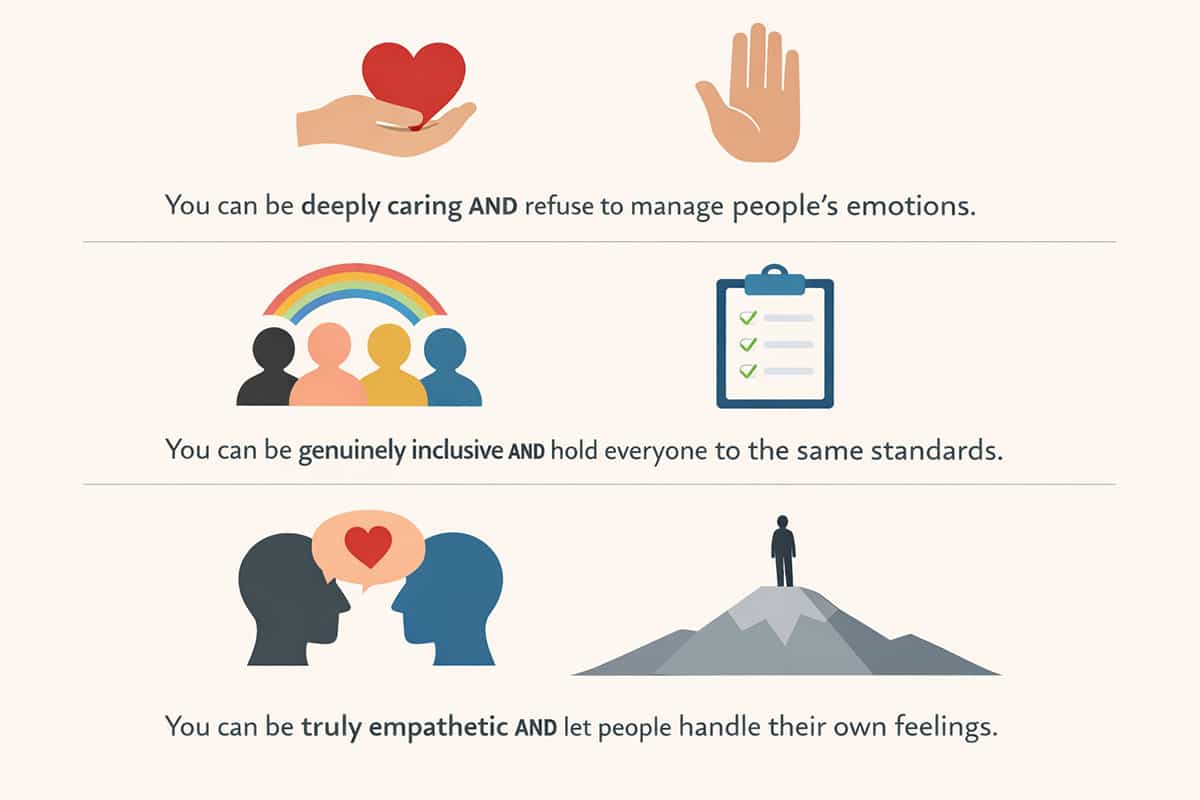
You can be deeply caring AND refuse to manage people’s emotions.
You can be genuinely inclusive AND hold everyone to the same standards.
You can be truly empathetic AND let people handle their own feelings.
Here’s what it actually sounds like:
“I hear that you’re frustrated with this decision. That makes sense. It’s a big change. AND the decision stands. Here’s what I can offer: clarity on the reasoning and support in adapting to it. Here’s what I can’t offer: changing the decision or managing your feelings about it. How do you want to move forward?”
That’s not cold. That’s respectful.
You’re acknowledging their experience without taking it on. You’re holding your line while staying human. You’re treating them like an adult who can handle reality.
The below is an email one CEO I coached sent to his entire company which led to explosive growth after a few years of stagnancy and slow growth:
“From now on, personal responsibility in this company means:
You own your role end-to-end. Not just the effort. Not just the intent. The result.
You speak up early. If something isn’t working, say it before it becomes a problem. Silence is no longer neutral.
You ask for clarity, not comfort. If expectations aren’t clear, ask. If feedback is hard, take it. Growth is not gentle.
You keep your agreements. If you can’t, you say so—early—and renegotiate. Broken promises erode trust faster than mistakes.
You manage yourself. Your energy, reactions, and professionalism are your responsibility—not your manager’s.
Leaders, including me, are not stepping back. We are stepping up differently from now on.
We will be direct, not vague.
We will set clear standards, not moving goalposts.
We will give honest feedback, not emotional padding.
We will back people who take responsibility and challenge those who don’t.”
The CEO was building something serious and they finally started demonstrating that commitment in action – with people who choose to act like it.
The Truth Nobody Wants to Say
When you stop managing people’s emotions, you actually create the most inclusive environment possible.
Because you’re saying:
Everyone gets honest feedback (real equality)
Everyone is held to the same standards (true inclusion)
Everyone is trusted with difficult information (actual respect)
Everyone is seen as capable (genuine empathy)
The “empathy” that means walking on eggshells and treating people differently based on their identity? That’s not inclusion. It’s condescending.
What I Know Now
After working across India, the US, Netherlands, UK, the middle-east and Japan, here’s what I know for sure:
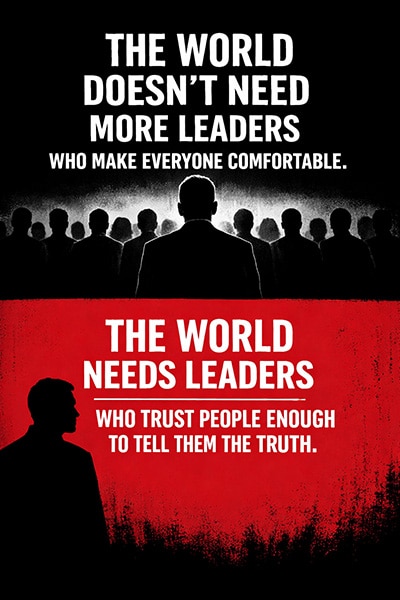
The world doesn’t need more leaders who make everyone comfortable.
The world needs leaders who trust people enough to tell them the truth.
Leaders who care enough to hold boundaries.
Leaders who respect people enough to let them handle their own feelings.
Leaders who love people enough to refuse to treat them like children.
From Bangalore to Boston, from Amsterdam to London, from Tokyo to anywhere else – the challenge is the same.
Stop protecting people from reality and calling it kindness.
Start trusting their capability. That is your leadership.
That’s what I’m committed to. That’s what I help leaders do.
That’s what actually changes workplaces from places that make people sick to places that help people grow.
And that’s what you and I both know needs to happen.
The only question is: Are you ready to stop playing nice and start leading for real?
This is the Leadership Journey series on the Choosing Leadership Podcast.
I believe we all have a lot to learn from each other’s stories – of where we started, where we are now, and our successes and struggles on the way. With this series of interviews, my attempt is to give leaders an opportunity to share their stories and for all of us to learn from their generous sharing. If you know a leader whom you would like to see celebrated on the show, please send me a message on LinkedIn with their name.
In this conversation with Hussein Hallak, you’ll hear a raw, honest look at what it really takes to reinvent yourself when life keeps throwing you into the deep end.
He breaks down how cities, cultures, and circumstances can shape you—and why the courage to keep choosing who you want to become is the real leadership edge.
You’ll walk away with a reminder that resilience isn’t a personality trait but a muscle you build by showing up for the hard moments.
Hussein’s blend of ambition, grounded wisdom, and radical authenticity will challenge you to rethink what “success” actually means.
If you’re navigating change, craving clarity, or trying to lead with more depth and intention, this episode is going to hit home.
Here’s what they don’t teach you in business school: The hardest part of leadership isn’t strategy, finance, or operations. It’s staying calm and responding powerfully when you’re surrounded by emotionally triggered, defensive, or manipulative people who desperately want you to join them in the chaos.
Every single day, leaders face situations that can pull them off center, make them defensive, or force them into arguments they can’t win. The person setting the trap usually isn’t even aware they’re doing it – they’re just acting out their own triggers, insecurities, and immature coping mechanisms.
Most people spend their whole lives trying to bring everyone along, convince everyone, get everyone’s approval. This article is about refusing to be held hostage by someone else’s need to fight. That’s leadership. That’s integrity. That’s you standing in your power without making anyone wrong.
Here’s what I learned after years of trying to manage everyone’s emotions: Other people’s emotional immaturity is not your responsibility.
You can be compassionate without being consumed. You can be kind without being compliant. You can lead with love without taking on everyone’s emotions.
The most powerful thing you can say, in a thousand different ways, is: “I see you’re upset. I’m not joining you there. Here’s what I’m willing to do. Yes or no?”
This guide is your playbook for staying centered, retaining your power, and leading with integrity even when everyone around you is melting down.
The 10 Most Common Conversational Traps (And Your Ninja Responses)
TRAP
WHAT IT LOOKS LIKE
THE TRAP MOST FALL INTO
NINJA MOVE #1
NINJA MOVE #2
NINJA MOVE #3
WHY IT WORKS
#1: The Emotional Hostage Situation
Someone’s melting down, spiraling, dumping their emotions on you. Crying, raging, venting, or going totally silent with the unspoken expectation that you’ll fix their feelings.
You jump into rescue mode, trying to solve their emotional state. You absorb their feelings, offer solutions, become their therapist. Now you own their emotional life.
“I can see you’re really upset. I’m not the right person to process this with you right now. What do you actually need from me that I can provide?”
“I hear you’re struggling. I can’t take that on for you, but I can [specific action you’re willing to do]. Does that work?”
“You’re having a lot of feelings about this. That’s valid. I’m not available to manage them for you. What’s the practical issue we need to solve?”
You acknowledge their reality without becoming responsible for it. You redirect from emotional dumping to actionable conversation. You refuse to be their emotional support person.
#2: The Guilt Trip Express
“After everything I’ve done for you/this company…” or “I guess my contributions don’t matter…” or “Must be nice to [whatever privilege they think you have].”
You apologize profusely, justify your decisions, over-explain to prove you’re not the bad guy. You defend yourself against charges you never committed.
“I’m not doing the guilt thing. If there’s something you need to say directly, say it. Otherwise, we’re done here.”
“I appreciate what you’ve contributed. That doesn’t change [the decision/boundary/reality]. What else?”
“Guilt doesn’t work on me. If you have a legitimate concern about something I’ve done, let’s discuss that specifically. If you’re just trying to make me feel bad, that’s not happening.”
You refuse to accept guilt that isn’t legitimately yours. You short-circuit the manipulation by not taking the bait. You call out the dynamic without being cruel.
#3: The Urgency Ambush
“I need an answer RIGHT NOW!” or “This is a crisis!” or “If you don’t respond immediately, everything will fall apart!” Manufactured urgency designed to force a rushed decision.
You react to their panic, drop everything, make a rushed decision you’ll regret. Their emergency becomes your emergency.
“What’s the actual deadline—not the emotional one? I’ll respond by [your timeline], not [their timeline].”
“I hear this feels urgent to you. I’m going to take [amount of time] to think about it. I’ll get back to you by [specific time].”
“Interesting. This isn’t urgent for me. I’ll address it when I have bandwidth. If that doesn’t work for you, you’ll need to find another solution.”
You refuse to let someone else’s panic dictate your priorities. You lead with your own timeline and sense of urgency, not theirs.
#4: The Personal Attack Wrapped in “Feedback”
“You’re so [dismissive/arrogant/out of touch/uncaring]…” disguised as “I’m just being honest” or “Can I give you some feedback?” Character assassination dressed up as helpfulness.
You defend your character, explain your intentions, try to prove they’re wrong about you. You give them all your power by making your identity up for debate.
“I’m not interested in character assessments. If there’s a specific behavior or action you want to discuss, I’m listening. Otherwise, we’re done.”
“Interesting take. I see myself differently. Moving on – what’s the actual issue we need to solve here?”
“Cool. Thanks for sharing.” [Then literally say nothing else and wait]
You don’t defend what doesn’t need defending. Your identity isn’t up for negotiation. You redirect to observable behavior, not personality attacks.
#5: The Hypothetical Spiral
“But what if [disaster]?” You answer. “But then what if [more disaster]?” Endless loop of worst-case scenarios that will never happen, designed to paralyze you with fear and uncertainty.
You try to address every hypothetical scenario, proving you’ve thought everything through. You end up in anxiety-land with them, planning for 0.001% probabilities.
“We could play ‘what if’ all day. I’m not doing that. Here’s what we know, here’s what we’re doing. If something changes, we’ll adapt then.”
“That’s not the scenario we’re planning for. If you want to discuss real risks with real mitigation strategies, I’m in. Otherwise, I’m out.”
“You’re making stories. I’m staying with what’s factual. When you’re ready to discuss reality, let me know.”
You refuse to live in fantasy fear-land. You stay grounded in what’s real and actionable. You don’t let anxiety become the decision-maker.
#6: The “You Don’t Care” Accusation
“You don’t care about [me/the team/this issue/people’s feelings]!” Usually deployed when you’ve made a decision they don’t like or held a boundary they want you to drop.
You scramble to prove you DO care, listing all the ways you’ve shown care, trying desperately to convince them of your good intentions and compassion.
“I do care. And I’m still making this decision. Both things are true.”
“You can think that if you want. Doesn’t change what needs to happen here.”
“Caring and agreeing aren’t the same thing. I care about you AND I’m not changing my position. Both of these are true at once.”
You don’t let accusations about your character change your course of action. You can care deeply AND still hold your line. You refuse to prove your worth.
#7: The Gossip Game
“Well, [other person] thinks you’re wrong too” or “Everyone’s talking about how you [whatever]” or “I’m not the only one who feels this way.” Bringing other people into the conversation. (gossip)
You defend yourself against the invisible accusers, try to figure out who said what, become paranoid about office gossip. You’re now fighting ghosts.
“I’m talking to you, not everyone else. If someone else has something to say, they can come to me directly. What’s YOUR issue?”
“Not interested in the group chat version of this conversation. If others have concerns, they know where to find me. What do YOU need?”
“Anonymous complaints don’t count. Either bring me specific people who want to have a direct conversation, or we’re done with this topic.”
You refuse to litigate invisible complaints. You deal with what’s actually in front of you, not shadows and rumors. You force accountability.
#8: The Historical Grievances Archive
“And another thing – two years ago you also…” Proceeds to list every past wrong, real or imagined, going back to the dawn of time. The greatest hits album of your failures.
You try to address every historical complaint, apologizing for ancient history, relitigating the past, defending decisions from years ago. Death by a thousand cuts.
“We’re not doing the greatest hits of everything I’ve ever done wrong. If there’s something current that needs addressing, let’s talk about that. Everything else stays in the past.”
“I hear you have a lot of stored-up frustration. I’m not the person to process that with. What’s the ONE thing we need to resolve today?”
“Pick one. You get to bring up one issue from the past that’s still relevant today. Choose wisely because that’s all I’m discussing.”
You refuse to be put on trial for ancient history. You stay present. You force them to prioritize what actually matters instead of unloading their emotional backlog.
#9: The “You Made Me Feel” Blame Game
“You made me feel [stupid/small/unimportant/angry]!” with the implicit expectation that you’re responsible for their emotional state and must now fix it or apologize for it.
You apologize for their feelings, try to make them feel better, explain that wasn’t your intention. You become responsible for their emotional life.
“I don’t make you feel anything. You have feelings about what happened – that’s fair. What do you need to do with those feelings that doesn’t involve me managing them?”
“I hear you felt [emotion]. That wasn’t my intention, AND I’m not responsible for your feelings. What do we need to do to move forward?”
“Your feelings are yours to manage, not mine to fix. I’m not available to be your emotional caretaker. What else?”
You establish that everyone owns their own emotional experience. You can acknowledge their feelings without taking ownership of them. Boundaries around emotional labor.
#10: The Catastrophic Interpretation
You say something neutral. They hear the worst possible interpretation. “So what you’re saying is [completely insane extrapolation you never said]!” They argue with their own made-up version of your words.
You spend 20 minutes explaining what you actually meant, trying to unwind their catastrophic interpretation, getting more and more frustrated as they refuse to hear you.
“Nope, that’s not what I said. Here’s what I said: [repeat verbatim]. If you want to discuss what I actually said, I’m here. If you want to argue with what you made up, I’m out.”
“That’s a creative interpretation. Not accurate, but creative. Do you want to hear what I actually meant, or are you good with your version?”
“You’re putting words in my mouth. Stop. Here’s what I said. Here’s what I meant. If you want to discuss that, great. If not, we’re done.”
You don’t chase their narrative. You stay with your actual words. You force them to deal with reality, not their fear-based story about reality.
A Framework To Tie It All Together
The responses above might seem like isolated tactics, but they’re actually all built on the same underlying framework. Master this framework, and you’ll be able to respond in real-time, adapted to any situation.
THE FIVE-STEP FRAMEWORK
STEP 1: NAME THE GAME (Silently or Aloud)
Before you can refuse to play, you have to see the game being played. This is the hardest step because these patterns are often invisible until you learn to spot them.
Silently (in your head):
“Oh, this is the guilt trip game.”
“Ah, they’re trying to make their urgency my urgency.”
“Got it – they need me to be wrong so they can be right.”
This tiny moment of recognition creates space between stimulus and response. You’re observing the dynamic instead of drowning in it. You’ve moved from participant to witness.
Aloud (when appropriate):
“I notice we’re heading into a debate about who’s right and who’s wrong. I’m not interested in that conversation.”
“It sounds like you’re trying to make me responsible for your feelings. That’s not something I’m going to do.”
“We seem to be moving from problem-solving into personal attacks. I’m stepping out of that.”
Naming the game aloud is advanced-level stuff. Use it sparingly, with people who can handle direct feedback, and only when you genuinely want to break the pattern (not just win the fight).
STEP 2: REFUSE TO PLAY
This is where most leaders get stuck. They see the trap, they even know they shouldn’t engage, but they engage anyway because:
They want to be nice
They don’t want to seem uncaring
They’re afraid of conflict
They think they can reason with the person
They need the person to understand their perspective
Let me be blunt: You don’t need anyone to understand you. You need to lead. (read that again)
Refusing to play means:
Not defending yourself
Not justifying your position
Not convincing them you’re right
Not managing their emotions
Not taking on guilt that isn’t yours
Not arguing with their interpretation
It means saying, in a thousand different ways: “I’m not doing this dance.”
This is very important because defence is the first act of war. The refusal must be clean – no attitude, no contempt, and no defensiveness. Just clear, boundaried, unmovable.
STEP 3: STATE WHAT YOU’RE WILLING TO DO/DISCUSS
This is the part most people forget. You can’t just refuse as that makes you seem dismissive or checked out. You have to redirect to what IS available.
Structure: “I’m not available for [the game], AND I am available for [productive alternative].”
Examples:
“I’m not debating this decision, and I am available to discuss how we implement it effectively.”
“I’m not managing your emotions about this, and I am available to problem-solve the practical issues.”
“I’m not defending my character, and I am available to hear specific concerns about specific actions.”
“I’m not entertaining hypothetical disasters, and I am available to discuss real risks with real mitigation plans.”
This keeps you in leadership. You’re not just saying no. You’re saying “here’s what yes looks like.”
STEP 4: GIVE THEM THE CHOICE
This is the power move that most people miss. After you’ve stated what you’re willing to do, you put the ball in their court.
“Are you in or out?”
“Does that work for you, or not?”
“Do you want to have that conversation, or are we done here?”
“You can choose: [option A] or [option B]. What’s it going to be?”
The choice forces them to step up or step back. It removes you from the middle. They’re now responsible for their next move.
Critical point: You must be genuinely okay with either choice they make. If you secretly need them to choose or respond a certain way, they’ll feel it, and your power evaporates. (your subconscious communicated more loudly than your words – always)
STEP 5: BE GENUINELY OKAY WITH EITHER OUTCOME
This is the difference between manipulation and leadership.
If you’re “giving them a choice” but secretly hoping they’ll make the “right” choice (the one you want), you’re not leading – you’re manipulating. And they’ll sense it. This article is not a trick or a tactic – it is for genuine leaders who want to stay powerful in leadership without denying others their own power and choice.
True power comes from being genuinely unbothered by their choice:
They choose to engage productively? Great.
They choose to stay stuck in their pattern? Also fine.
They walk away? Totally okay.
They escalate? You’ve got boundaries for that too.
This doesn’t mean you don’t care about the outcome. You do. In fact, you are committed to it. It just means you’re not attached to controlling their response. You’ve said what’s true, offered what’s available, and now you trust both yourself and them to handle whatever comes next.
This is the zen state everyone talks about but few achieve: Non-attachment to outcome while remaining fully committed to your values.
THE ENERGY BEHIND THE WORDS: WHY DELIVERY IS EVERYTHING
Here’s what nobody tells you: The same words can land as powerful leadership or petty defensiveness depending entirely on your energy when you say them.
The Energy That Makes It Work:
✅ Calm, not reactive
Your nervous system is regulated
Your breath is steady
Your body is relaxed
Your voice is even
✅ Clear, not defensive
You know what you’re saying and why
You’re not second-guessing yourself mid-sentence
You’re not over-explaining or justifying
Your message is simple and direct
✅ Boundaried, not cruel
You’re firm without being harsh
You’re saying no without making them wrong
You’re protecting your energy without punishing theirs
You’re drawing a line, not building a wall
✅ Present, not checked out
You’re actually there, not dissociating
You’re making eye contact (if in person)
You’re genuinely listening, even as you refuse to engage
You’re human, not robotic
✅ Powerful, not dominating
Your power comes from centeredness, not force
You’re standing in your authority, not wielding it as a weapon
You’re confident without being arrogant
You’re unshakeable without being rigid
The Energy That Makes It Backfire:
❌ Condescending or contemptuous
Eye rolls, smirks, patronizing tone
“Let me explain this to you like you’re five” energy
Superior, looking down on them
This creates enemies, not boundaries
❌ Tight, defensive, reactive
Clenched jaw, raised voice, aggressive body language
Speaking too fast, interrupting, getting louder
This signals you’re triggered – they win
❌ Scared or uncertain
Apologetic tone, weak voice, avoiding eye contact
Adding “maybe” or “I don’t know” unnecessarily
This invites them to push harder
❌ Detached or cold
Robotic, no emotional inflection, distant
This reads as not caring (which might be accurate, but it damages relationships you might want to keep)
THE PHYSICAL HACK: REGULATE YOUR BODY FIRST
You cannot have powerful energy if your body is in fight-or-flight. Before you respond to any conversational trap, do this:
The 3-Second Reset:
Feel your feet on the ground. Actually sense the floor beneath you. This drops you out of your head and into your body.
Take one slow belly breath. In through the nose, down into your belly (not your chest), slow exhale. This resets your nervous system from panic to presence.
Soften your jaw and drop your shoulders. We hold defensive tension here. Release it consciously.
That’s it. Three seconds. Do it while they’re still talking. Do it before you respond. Do it mid-sentence if you need to.
This isn’t woo-woo nonsense – this is neuroscience. Your body state dictates your brain state. Change your physiology, change your psychology.
COMMON QUESTIONS ABOUT THE FRAMEWORK
Q: “What if they get more upset when I refuse to engage?”
A: They might. That’s not your problem to solve. Their upset is information about their emotional state, not a command for you to change your behavior.
You can acknowledge it: “I see this is frustrating for you” and still hold your line: “And I’m still not doing [the thing].”
Their escalation is them testing whether your boundary is real. If you cave when they escalate, you’ve just taught them that escalation works. Hold steady.
Q: “What if I need them to buy in or cooperate?”
A: Then the “in or out” ultimatum might not be your best move. If you genuinely need their engagement, you might need to find other ways to create it.
But be honest: Do you actually need their buy-in, or do you just want it? There’s a huge difference. Often we think we need consensus when we really just need to make a decision and move forward.
Q: “What if they’re my boss/board member/someone I can’t just dismiss?”
A: The framework still applies, but the wording adjusts. You’re not dismissing them. You’re redirecting the conversation.
“I respect that you see it differently. I’m not interested in defending my position. We could debate/argue this all day. What I am interested in is understanding what outcome you actually want here, and whether there’s a path forward. Is that a conversation you want to have?”
Q: “Isn’t this kind of… cold? Unfeeling?”
A: No. It’s boundaried. There’s a huge difference.
Being warm and human doesn’t mean absorbing everyone’s chaos.You can be deeply compassionate AND refuse to rescue people from their own emotional experience.
In fact, the kindest thing you can do for emotionally immature people is refuse to enable their patterns. When you stop managing their feelings, you force them to develop their own emotional capacity.
Q: “What if I mess it up and get defensive anyway?”
A: You will. Often. We all do.
The goal isn’t perfection – it’s catching yourself faster each time. Maybe today you spend 20 minutes defending yourself before you notice. Next time maybe it’s 10 minutes. Then 5. Then you catch it in real-time.
This is a practice, not a destination. Be patient with yourself.
Q: “How do I practice this when I’m not in the moment?”
A: Replay past conversations in your mind. Think of a time you fell into one of these traps. Now replay it with a different response. Feel what it would be like in your body to hold your ground. Rehearse the words out loud if you need to.
Your brain doesn’t know the difference between a real experience and a vividly imagined one. Mental rehearsal builds the neural pathways so the response is available when you need it.
THE DEEPER TRUTH: WHY THIS MATTERS FOR LEADERSHIP
Here’s what this is really about: Your ability to stay centered and powerful in chaos is the single most important leadership skill you can develop.
People don’t follow titles or positions – they follow your energy and then your words. They follow people who are unshakeable when everything else is falling apart. They follow people who can stay calm when everyone else is losing their minds. That kind of presence is magnetic.
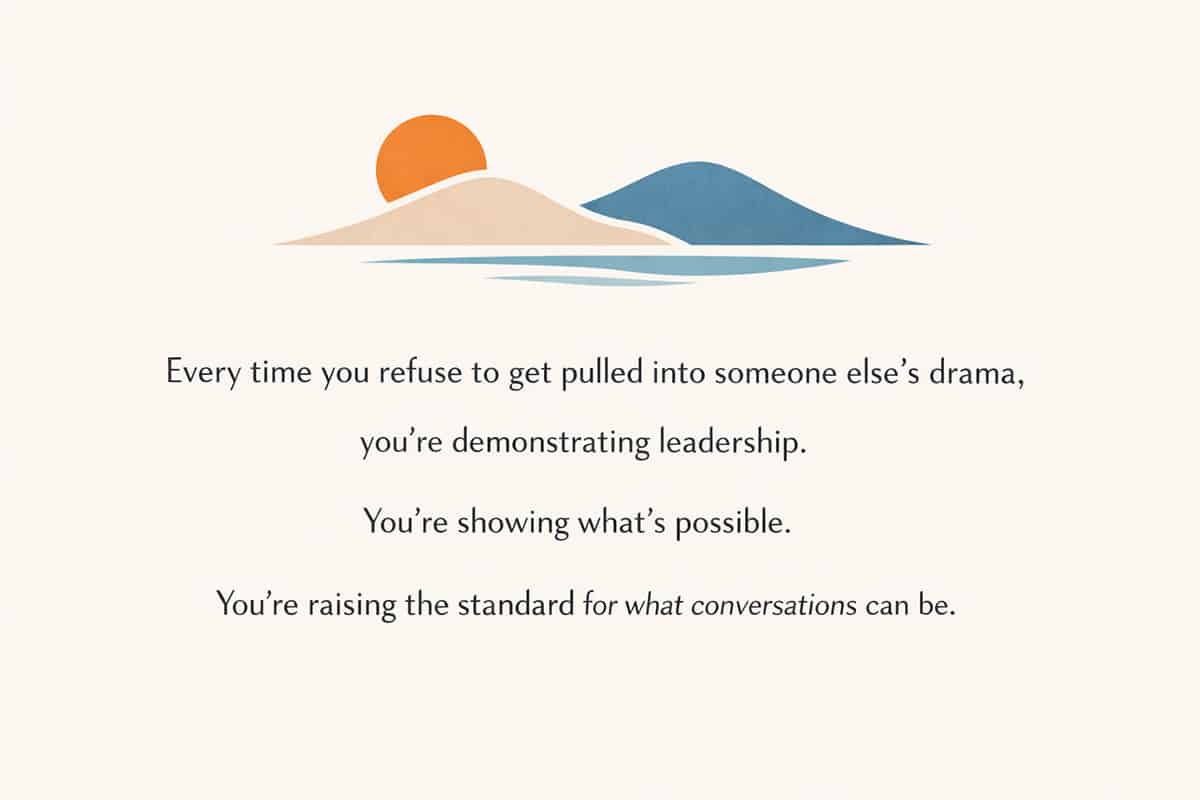
Every time you refuse to get pulled into someone else’s drama, you’re demonstrating leadership. You’re showing what’s possible. You’re raising the standard for what conversations can be.
And here’s the beautiful irony: When you stop trying to convince people, manage their emotions, or win arguments, you become infinitely more influential. Because you’re no longer reactive. You’re generative. You’re not responding to their chaos. You’re responding from your own center.
This isn’t about being cold or detached. It’s about loving people enough to refuse to enable their dysfunction. It’s about caring enough to hold boundaries. It’s about being powerful enough to stay yourself no matter what energy is swirling around you.
I use cookies on this website to give you the most relevant experience and for analytics purposes. Any personal data collected will never be shared with any third party, or used to spam you. That is my promise. - Sumit By clicking “Accept”, you consent to the use of ALL the cookies.
This website uses cookies to improve your experience while you navigate through the website. Out of these, the cookies that are categorized as necessary are stored on your browser as they are essential for the working of basic functionalities of the website. We also use third-party cookies that help us analyze and understand how you use this website. These cookies will be stored in your browser only with your consent. You also have the option to opt-out of these cookies. But opting out of some of these cookies may affect your browsing experience.
Necessary cookies are absolutely essential for the website to function properly. This category only includes cookies that ensures basic functionalities and security features of the website. These cookies do not store any personal information.
Any cookies that may not be particularly necessary for the website to function and is used specifically to collect user personal data via analytics, ads, other embedded contents are termed as non-necessary cookies. It is mandatory to procure user consent prior to running these cookies on your website.