October 2025

  • Why People Are Not Getting Your Strategy (And How to Fix It)

    The three levels of internal communication that turn confusion into alignment


    A CEO I’ve been working with recently told me something that I have heard too many times.

    “I’ve explained our strategy at least five times this quarter,” she said. “Town halls. Leadership meetings. Email updates. But when I ask people what we’re doing and why, I get five different answers.”

    She wasn’t angry. She was exhausted.

    “I don’t know how to say it any clearer,” she said.

    Here’s what I told her: You’re probably being perfectly clear. You’re just not being meaningful.

    And there’s a big difference.


    Most leaders communicate strategy the way they’d present a quarterly business review—lots of what, not much why, and almost no so what.

    They talk about initiatives, KPIs, market positioning, and organizational priorities.

    All important. All necessary.

    And all completely forgettable.

    Because here’s the truth: people don’t align around strategy. They align around meaning.

    And meaning doesn’t come from telling people what you’re doing. It comes from helping them understand what it does—for them, for the customer, for the mission they signed up for.

    The same three levels of communication that transform how you talk to customers? They’re even more powerful when you use them internally.

    Let me show you how.


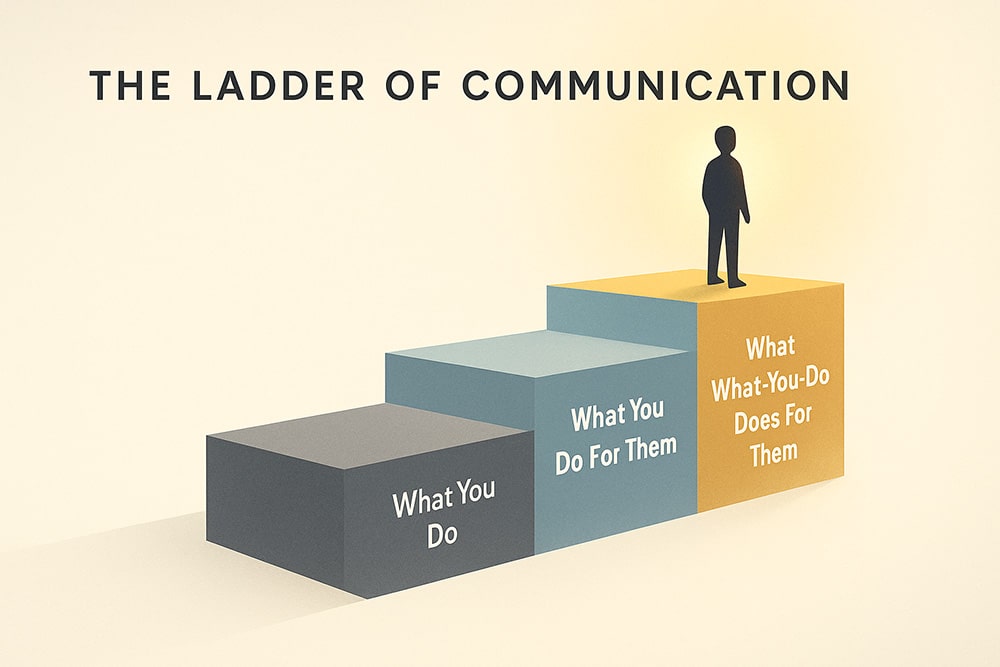
    Level 1: What We’re Doing

    This is where most internal communication lives.

    It’s the initiative. The project name. The reorganization. The new system rollout.

    • “We’re launching a digital transformation initiative.”
    • “We’re restructuring the sales org.”
    • “We’re implementing a new CRM.”
    • “We’re focusing on operational excellence this year.”

    It’s accurate. It’s what’s happening.

    But it doesn’t tell anyone why they should care.

    When you communicate at Level 1 internally, you get compliance, not commitment. People nod in the meeting. They add it to their task list. But they don’t feel connected to it.

    The result? Passive execution. Minimal discretionary effort. And when things get hard, people quietly disengage.

    Because you’ve told them what to do. You haven’t told them why it matters.


    Level 2: What We’re Doing For Them

    This is where leaders start to create relevance.

    Instead of just announcing the initiative, you connect it to the people executing it. You make it personal.

    • “We’re launching a digital transformation so teams can spend less time on manual processes and more time on work that actually moves the needle.”
    • “We’re restructuring the sales org so reps have clearer territories and more support from leadership.”
    • “We’re implementing a new CRM so you’re not juggling three different systems just to update a customer record.”
    • “We’re focusing on operational excellence so we can deliver faster, reduce firefighting, and stop working weekends.”

    See what changed?

    You’ve given people a reason to care. You’ve shown them what’s in it for them.

    Suddenly, it’s not just another corporate initiative. It’s something that could make their day-to-day better.

    Why it works: People support what they understand. And they understand what connects to their reality.

    But even this isn’t enough to create true alignment.


    Level 3: What What-We’re-Doing Does For Them

    This is where strategy becomes a shared mission.

    It’s not just what you’re doing for them. It’s what that outcome enables in their work, their impact, their sense of purpose.

    Let’s push those examples deeper:

    • “We’re launching a digital transformation so teams can spend less time on manual processes” becomes → “We’re doing this so you can focus on the work that made you want to join this company in the first place—solving real problems for customers, not wrestling with spreadsheets.”
    • “We’re restructuring the sales org so reps have clearer territories” becomes → “We’re doing this so you can build real relationships with your accounts, win deals you’re proud of, and finally feel like you’re building something—not just hitting a number.”
    • “We’re implementing a new CRM so you’re not juggling systems” becomes → “We’re doing this so you can serve customers the way you’ve always wanted to—fast, informed, and without having to put them on hold while you dig through three different databases.”
    • “We’re focusing on operational excellence so we can deliver faster” becomes → “We’re doing this so you can go home at a reasonable hour, trust that your work won’t unravel overnight, and feel proud of what we’re building together.”

    This is the level where people stop seeing strategy as a thing being done to them and start seeing it as something they’re part of.

    This is where discretionary effort lives. Where people go the extra mile. Where teams rally during tough moments.

    Because you’ve connected the what to the why—and the why to something they actually care about.

    Why This Matters More Than Ever

    Here’s what I see all the time: CEOs pour energy into crafting the perfect strategy. They workshop it with their leadership team. They refine the slides. They get the messaging just right.

    And then they roll it out like a product launch.

    They present it once. Maybe twice. And then they move on.

    And six months later, they’re frustrated because “people just don’t get it.”

    But here’s the thing: clarity isn’t a one-time event. It’s a drumbeat.

    And the drumbeat has to be meaningful, not just informative.

    People don’t align around a deck. They align around a story they can see themselves in.

    When you communicate at Level 3, you’re not just explaining strategy. You’re giving people a reason to care. A reason to show up. A reason to stay when things get hard.


    How to Do This in Practice

    Here’s how to apply this framework to your internal communication:

    1. Start with the announcement (Level 1)

    State what you’re doing clearly and concisely. Don’t skip this. People need to know the what.

    “We’re launching a new performance management system.”

    2. Add the practical benefit (Level 2)

    Connect it to their day-to-day. Make it relevant.

    “This system will replace the clunky process we’ve been using, so reviews are faster and less painful for everyone.”

    3. Go to the emotional core (Level 3)

    Paint the picture of what this enables.

    “We’re doing this so people actually get the feedback they need to grow—not just once a year in a stressful meeting, but ongoing, in real time, in a way that feels supportive. So you can build your career here, not just survive it.”


    Real Examples from Leaders Who Got It Right

    A manufacturing CEO announcing a safety initiative:

    • Level 1: “We’re implementing new safety protocols across all facilities.”
    • Level 2: “These protocols will reduce accidents and protect you and your teammates.”
    • Level 3: “We’re doing this so every single person here goes home to their family every night—no exceptions, no close calls. Because nothing we build is worth more than that.”

    A tech CEO rolling out a new customer service platform:

    • Level 1: “We’re adopting Zendesk for customer support.”
    • Level 2: “This will give you better tools to respond to customers faster and track issues more easily.”
    • Level 3: “We’re doing this so you can finally give customers the experience you’ve always wanted to give them—where nothing falls through the cracks and you’re the hero who actually solved their problem.”

    A nonprofit executive director announcing a strategic pivot:

    • Level 1: “We’re shifting our focus from direct services to advocacy.”
    • Level 2: “This means we’ll be working on systemic change rather than individual case management.”
    • Level 3: “We’re doing this so the work you do doesn’t just help one person today—it changes the system so thousands of people get the support they deserve, for years to come. So your effort compounds.”

    In every case, the leader took the same journey: from what do we do to what that does for them.

    And in every case, people leaned in.

    What Changed for My CEO Client

    When I walked that CEO through this framework, something clicked.

    She realized she’d been communicating like a strategist when her team needed her to communicate like a leader.

    She wasn’t lacking clarity. She was lacking connection.

    So she tried something different.

    At her next town hall, she didn’t just explain the strategy. She explained what it would do—for customers, for the team, for the mission they’d all signed up for.

    She didn’t just talk about growth targets. She talked about what growth would enable: more investment in people, better tools, less chaos, more impact.

    And for the first time in months, she said, people didn’t just nod politely.

    They asked questions. They pushed back. They engaged.

    Because for the first time, they understood not just what they were doing—but why it mattered.


    The Bottom Line

    If your strategy isn’t landing, it’s probably not because people don’t understand it.

    It’s because they don’t feel it.

    And feelings don’t come from org charts or initiative names.

    They come from meaning. From connection. From understanding what this does for me, for us, for the work we care about.

    When you master these three levels of internal communication—from what we’re doing, to what we’re doing for you, to what that enables—you stop managing and start leading.

    You stop explaining and start inspiring.

    And you stop wondering why people aren’t aligned.

    Because they finally are.


    give it a go in your next all-hands. You’ll feel the difference.
  • Leadership Journeys – Steven Meersman – “ You can never achieve balance because then you’re standing still and you die”

    This is the Leadership Journey series on the Choosing Leadership Podcast.

    I believe we all have a lot to learn from each other’s stories – of where we started, where we are now, and our successes and struggles on the way. With this series of interviews, my attempt is to give leaders an opportunity to share their stories and for all of us to learn from their generous sharing. If you know a leader whom you would like to see celebrated on the show, please send me a message on LinkedIn with their name.

    What does it really take to lead in the climate tech space—beyond the buzzwords and boardrooms?

    In this candid conversation, Steven Meersman, co-founder of Zenobi Energy, shares how he went from resisting entrepreneurship to leading a company that’s transforming energy infrastructure across 11 countries.

    You’ll hear hard-won lessons on scaling with purpose, building a culture of ownership, and navigating the messy middle of leadership.

    Steven’s insights on balancing innovation with financial viability are gold for any leader trying to do work that actually matters.

    If you’re building something bold and want to stay grounded while growing fast, this episode is for you.


    You can find Steven Meersman at the below links

    In the interview, Steven shares

    • “Leadership is a pendulum—you don’t want perfect balance, you want movement. Knowing when to push back is key.” 
    • “We don’t just hire startup veterans—we hire passionate people who care deeply about our mission. Ownership can be taught.” 
    • “If sustainability isn’t financially viable, it won’t scale. Our job is to make green solutions make business sense.” 
    • “My journey into entrepreneurship was reluctant at first, but purpose pulled me in—climate tech gave me a reason to build.” 
    • “Lessons from oil and gas—like managing risk and optimizing cost—are surprisingly useful when scaling clean tech.” 
    • “I don’t make decisions based on labels. I look at the opportunity, the timing, and the impact we can make.” 
    • “A good leader supports without micromanaging and communicates without creating silos.” 
    • “We’re solving the first mile, the last mile, and everything in between to make renewable energy work at scale.” 
    • “We’ve repurposed EV batteries to replace diesel generators—real innovation happens where the grid doesn’t reach.” 
    • “Culture isn’t just values on a wall—it’s what people do when no one’s looking. That’s what drives innovation.”
  • Leadership Journeys [247] – Jag Dhanda – “Great teams grow from passion, clear vision, and strong communication.”

    This is the Leadership Journey series on the Choosing Leadership Podcast.

    I believe we all have a lot to learn from each other’s stories – of where we started, where we are now, and our successes and struggles on the way. With this series of interviews, my attempt is to give leaders an opportunity to share their stories and for all of us to learn from their generous sharing. If you know a leader whom you would like to see celebrated on the show, please send me a message on LinkedIn with their name.

    Professor Jag Dhanda’s journey from surgeon to tech educator is a masterclass in courage, vision, and relentless innovation.

    In this episode, he shares how leaving home at 17, working his way through medical school, and pioneering virtual reality in surgical training shaped his belief that true leadership is about service, not status.

    You’ll hear how he’s breaking down barriers in global healthcare education, empowering doctors in low-resource settings to save more lives.

    His insights on balancing ambition, well-being, and impact will challenge you to rethink what’s really possible in your own leadership journey.

    If you’ve ever wondered how to turn bold ideas into real-world change, this conversation is your blueprint.

    You can find Professor Jag Dhanda at the below links

    In the interview, Professor Jag shares

    • “Resilience and innovation aren’t separate paths—they’re the same road when you refuse to accept limits.”
    • “Leaving home at 17 taught me that courage often comes before clarity.”
    • “Virtual reality isn’t about replacing surgeons—it’s about equipping them to save more lives.”
    • “Education should not be bound by geography, privilege, or language.”
    • “Empathy in medicine starts long before you pick up a scalpel.”
    • “Balancing surgery, entrepreneurship, and family is less about time management and more about energy management.”
    • “Technology is only powerful when it levels the playing field for those who need it most.”
    • “The next generation of leaders must value significance over hierarchy.”
    • “If you want to create global impact, start by serving one person really well—and then scale that love.”
  • SALES – Three Levels of Communicating What You Do

    How shifting from “what you do” to “what it does for them” transforms sales, leadership, and trust


    A CEO I work with runs a successful industrial manufacturing company. His team knows the product inside out. They hit their numbers. But he kept running into the same problem: his salespeople couldn’t articulate value in a way that made customers lean in.

    “They’re technically competent,” he told me. “But when they talk to prospects, something falls flat. It sounds transactional. Forgettable.”

    I asked what they typically say. He laughed. “Exactly what we do. ‘We manufacture industrial pipes.’ Or ‘We provide piping solutions for commercial buildings.’ And the customer nods politely and moves on to the next vendor.”

    The issue wasn’t what they were saying—it was how they were saying it.

    What this CEO’s team lacked wasn’t product knowledge. It was communicative depth.

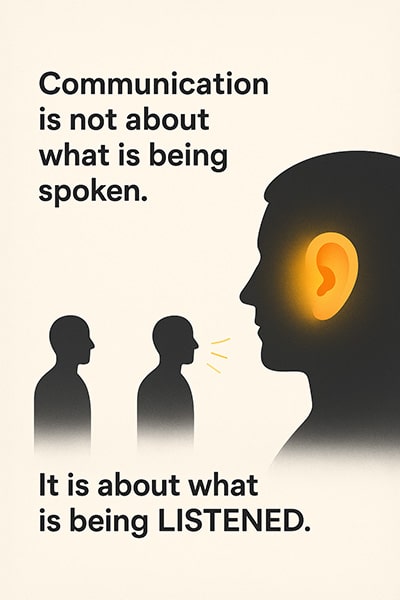
    Because communication is not about what is spoken. It is about what is being LISTENED.

    When two people are talking, all the power lies in the LISTENER. When you understand this, you understand communication.

    And it’s not just a sales problem. It’s a leadership problem. A human connection problem.

    Most professionals—whether they’re selling, leading, or just introducing themselves at a conference—operate at the surface level of communication. They describe what they do, not why it matters.

    But there’s a framework that changes this. Three levels of communication that, when mastered, transform how people perceive you, trust you, and choose to work with you.


    Level 1: What You Do

    This is where most people stop.

    It’s the job title. The function. The category.

    • “I’m a financial advisor.”
    • “I run a marketing agency.”
    • “We manufacture components for the automotive industry.”

    It’s accurate. It’s safe. But it’s also invisible.

    When you communicate at Level 1, you sound like everyone else in your field. You’re describing the work, not the value. You’re naming the category, not the outcome.

    The problem? Categories don’t create differentiation. And they certainly don’t inspire action.

    The risk: You commoditize yourself before the conversation even begins.


    Level 2: What You Do For Them

    This is where things shift.

    Instead of talking about yourself, you pivot toward the person you’re speaking to. You introduce specificity and relevance.

    • “I help families plan their finances so they can retire comfortably.”
    • “We design marketing campaigns that help B2B companies generate qualified leads.”
    • “We provide end-to-end piping systems for commercial buildings—from design to installation.”

    Notice what changes: the listener can now see themselves in the picture. You’ve moved from describing a function to articulating an application.

    You’re no longer just a financial advisor—you’re someone who helps people grow their assets. You’re not just a marketer—you’re someone who solves a revenue problem.

    Why it works: People don’t buy what you do. They buy what it does for them.

    But even this isn’t enough.


    Level 3: What What-You-Do Does For Them

    This is the level where trust is built. Where emotional resonance happens. Where people stop seeing you as a vendor and start seeing you as a partner.

    It’s not just what you do for them—it’s what that outcome enables in their life or business.

    Let’s revisit those examples:

    • “I help families plan their finances so they can retire comfortably” becomes → “I help people sleep peacefully at night, knowing their future is secure.”
    • “We design marketing campaigns that generate qualified leads” becomes → “We help companies grow predictably, so leaders can stop worrying about where the next deal is coming from.”
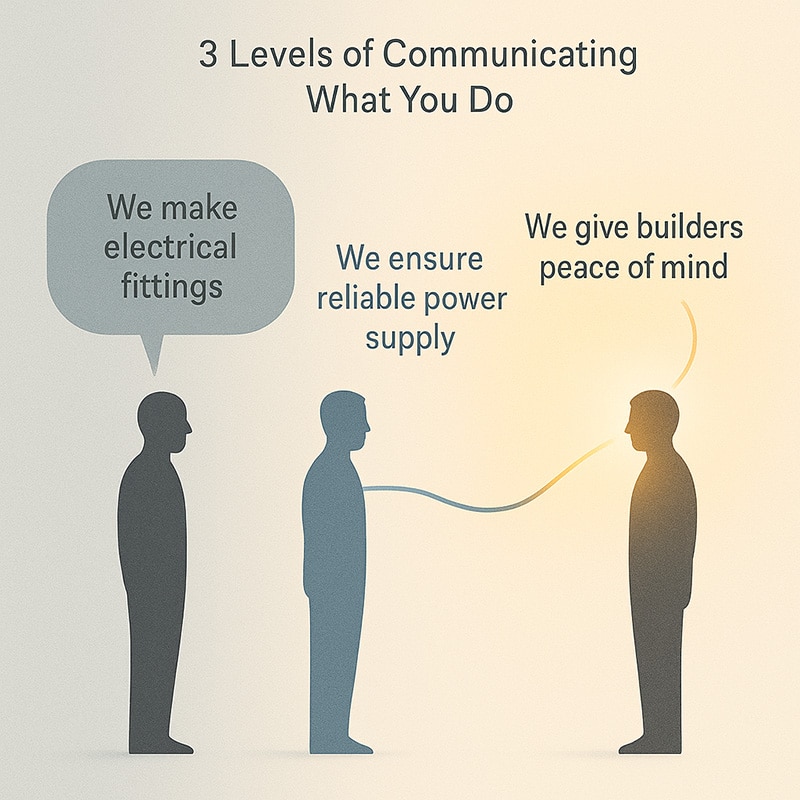
    • “We provide end-to-end piping systems for buildings” becomes → “We make sure when you’re building something, you never have to worry about leaks, fittings, or supply delays—you can focus on delivering your project smoothly and confidently.”

    See the shift?

    You’re no longer selling pipes. You’re selling peace of mind.

    You’re not offering financial planning. You’re offering security.

    You’re not just generating leads. You’re creating predictability.

    This is where great communicators live. They understand that people don’t make decisions based on logic alone—they make them based on how something makes them feel.

    And feelings are born from outcomes, not features.


    Why Most Leaders Never Get Here

    Level 3 requires something most organizations don’t prioritize: empathy.

    It requires you to understand—deeply—what your customer, your team, or your stakeholder actually wants. Not what they say they want in a requirements doc. Not what’s in the RFP. But what they lie awake thinking about at 2 a.m.

    • A CFO doesn’t just want a financial forecast. They want confidence in the board meeting.
    • An operations manager doesn’t just want a vendor. They want someone who won’t let them down when it matters.
    • A new client doesn’t just want a consultant. They want someone who gets it without them having to explain everything.

    When you communicate at Level 3, you stop selling and start connecting and listening. And when you connect, selling happens naturally.


    Practical Application: Give It a Shot

    Here’s how to apply this in your own work:

    Step 1: Write down what you do. One sentence. That’s Level 1.

    Step 2: Ask yourself: What do I do for them? Rewrite it.

    Step 3: Go deeper. Ask: What does that do for them? What’s the real impact on their life, their team, their sleep, their confidence, their results? Rewrite again.

    You’ll end up with something that feels more alive. More human. Something that makes people stop scrolling, stop half-listening, and actually pay attention.


    Examples Across Industries

    A real estate agent:

    • Level 1: “I help people buy and sell homes.”
    • Level 2: “I help families find the right home for their budget and lifestyle.”
    • Level 3: “I help families find that one place where they’ll build memories, raise kids, and feel safe.”

    A SaaS company:

    • Level 1: “We sell project management software.”
    • Level 2: “We help teams manage tasks and deadlines more efficiently.”
    • Level 3: “We help teams stop drowning in chaos so they can focus on doing their best work.”

    A leadership coach:

    • Level 1: “I’m a leadership coach.”
    • Level 2: “I help executives develop their leadership skills.”
    • Level 3: “I help leaders rediscover confidence in who they are and what they’re capable of.”

    Every time you move up a level, you move closer to the heart of what people actually care about.


    What Changed for the CEO

    When I walk my clients through this framework, they often go quiet for a moment. And they see the simplicity and power of the framework – almost like an ‘aha’ moment.

    My client’s sales team wasn’t failing because they didn’t know the product. They were failing because they couldn’t translate what they did into something that mattered to the customer.

    Most of us make the same mistake.

    We get stuck in the “what.” We forget the “why.”

    But when you learn to climb these three levels—from what you do, to what you do for them, to what that enables for them—everything changes.

    People listen differently. Conversations open up. Trust builds faster.

    And honestly? It just feels better.

    Because deep down, we all want the same thing—to be understood.

    And that’s exactly what this kind of communication does.

    It makes you understood.

    And that’s where connection—and trust—begin.


    Give this a shot. Genuinely. Not as a tactic. You’ll see the difference.

  • The Stone in Your Shoe: Why Commitment Comes Before Everything Else

    Let’s talk about that thing that’s been bugging you. That goal that feels perpetually out of reach. We’ve all been there, feeling stuck and spinning our wheels.

    It’s like having a tiny, sharp stone in your shoe. At first, it’s just a little annoying. You can limp along, telling yourself, “It’s not that bad. I’ll deal with it later.”

    But with every step, that stone grinds away. Eventually, what was a minor nuisance wears a raw, painful hole in your foot. You’re now injured, all because you didn’t take a moment to dump the stone out.

    You know that moment when you’re trying to solve a problem, and you keep circling back to the same reasons? “I don’t know how.” “I can’t figure it out.” “I need more information first before starting.”

    You want something. You know that you are meant for more.

    You know that you are more capable than what your current level of success shows.

    And yet you hold back, you wait, you hesitate – instead of moving forward boldly and unapologetically.

    That is like living with a stone in your foot.

    This is what happens when we avoid the things we know we need to do. We think we’re saving time and energy by ignoring the discomfort, but we’re actually creating a much bigger, more painful problem down the road.

    So, why do we do it? Why do we live with the stone in our shoe?

    When I talk to people who feel stuck, they almost always give me the same reasons, in this exact order:

    1. “I don’t know how to fix it.” (The plan)
    2. “I don’t really believe I can fix it.” (The confidence)
    3. “I guess I’m just not that committed to fixing it.” (The commitment)

    This sounds logical, right? It makes sense.

    “Of course I’m not committed! I don’t know what I’m doing, and I’m not even sure it’ll work! So how can I commit?”

    Here’s what nobody tells you: you’re looking at it backwards.

    The real order, the one that actually runs the show, is this:

    1. “I’m not committed to fixing it.” (The commitment)
    2. “So, I don’t believe I can fix it.” (The confidence)
    3. “And that’s why I never figure out how to fix it.” (The plan)

    I see this constantly with leaders who come to me stuck, frustrated, and running on empty. They’re brilliant people. They’ve built careers, led teams, created value. But they’re grinding against the same obstacles over and over, like there’s an invisible wall they can’t get past.

    In every case, the person lays out their evidence: “No plan, no surety, no confidence.” And then they draw what feels like an inevitable conclusion: “Therefore, I cannot commit.

    The Moment of Power

    Understanding this backwards flip is everything. The “how” is findable. The “belief” is buildable through action. But you will never access them if you haven’t made the foundational choice – to commit.

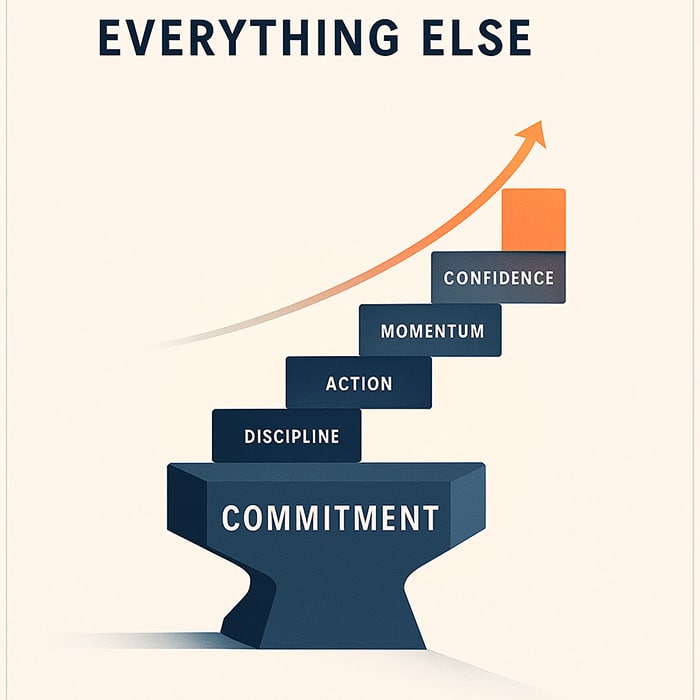
    Commitment is the engine. Everything else is just cargo. You can have all the maps and fuel in the world (“the how” and “the belief”), but if the engine is off, you’re going nowhere.

    The moment you make a real, internal commitment—a “I AM doing this, period”—your brain stops being a problem-finder and becomes a solution-finder.

    The commitment creates the first step. The first step creates a result. The result builds belief. And belief fuels the next step. The “how” reveals itself one piece at a time.

    So, ask yourself: what’s the “stone in your shoe”? And are you using “I don’t know how” and “I don’t believe I can” as a comfortable excuse to avoid the one thing that has always been in your power?

    The power to choose. The power to commit.

    The Trap of “How” and “Belief”

    We’ve been taught to wait. We think, “First, I need a detailed map. Then, I need to feel super confident. Then, and only then, will I start the journey.”

    It’s like wanting to learn to cook a fantastic meal. If you use the backwards logic, you’d say: “I can’t start cooking because a) I don’t know the recipe, and b) I don’t believe I’m a good cook.” So you never turn on the stove. You never chop a vegetable. You just stare at the kitchen, feeling helpless, and order takeout again.

    But what’s the real problem? It’s not the lack of a recipe—you can find a million recipes online! It’s not the lack of belief—belief comes from practice! The real problem is that you never made a firm commitment to cook the meal.

    The “how is out there for the finding. You can learn just about anything. And “belief”? Belief isn’t a magic feather that you’re given. It’s a seed. You can’t wait for it to grow before you plant it. You have to plant it first—by taking action—and then it grows.

    But commitment? That’s different. That’s the one thing no one can give you. That’s the one thing you can’t google. It’s a choice that happens entirely inside you. Nobody else can make that choice for you.

    Commitment isn’t the final prize you get after everything is easy and figured out. It’s the first step you take when everything is hazy.

    The real order—the one that actually creates all results—is:

    1. Get clear and commit to what it is that you want (nothing else required)
    2. Commitment creates the courage and belief that you need to start
    3. Learn how to adapt and stay committed on the way – building confidence and momentum

    Commitment comes first. Not eventually. Not “once I figure things out.” First.

    because Commitment creates everything else.

    The Power Move: Commitment Creates Everything Else

    Here’s the thing about commitment that most people miss: commitment doesn’t follow results. Results follow commitment.

    You don’t wait until you have clarity to commit. You commit, and clarity emerges.

    You don’t wait until you believe it’s possible to commit. You commit, and belief builds.

    You don’t wait until you know how to commit. You commit, and the how reveals itself.

    You don’t wait until you have all the resources to commit. You commit, and then get resourceful to make it happen.

    This isn’t some positive thinking nonsense. This is how reality works.

    When you genuinely commit—not “try” or “hope” or “see what happens”—everything changes. Resources appear (because of your actions – not because of some magical “secret”).

    You speak and share your commitment with others wherever you go. Opportunities show up. Solutions that were invisible become obvious. People start helping.

    Why? Because commitment changes you. It changes what you notice, what you prioritize, what you’re willing to do. It changes what you say yes to and what you say no to. Commitment reorganizes your entire operating system as a human BEING.

    I’ve watched this happen hundreds of times. A client comes in stuck on something they’ve been “working on” for months or years. We get clear on what they actually want. They make a real commitment—not a wish, not a goal, a commitment—and within weeks, sometimes days, what seemed impossible starts moving.

    Not because they suddenly got smarter or learned some secret technique. Because commitment unlocked everything else.

    From Standstill to Creation

    Let’s make this practical. Pull out that mental list of “Things I Need to Change.” Now, ask yourself a more pointed question: which one of these, if accomplished, would have the greatest impact on my life, business, career, or family?

    Prioritize your top one or two. Are they important? You know they are. They are the stones in your shoe that you’ve been ignoring.

    Now, instead of asking, “Do I know how to do this?” or “Do I truly believe I can?” ask only this: “Am I willing to make a commitment to this, right now?”

    This commitment is not a vague wish. It is a definitive, internal contract. It is the decision that, no matter what, you are in the game. This commitment immediately changes your orientation. The “how” that once seemed invisible suddenly becomes visible. You notice relevant information, you are drawn to the right people, and you begin to see pathways where before there were only walls.

    Your belief begins to grow, not from thin air, but from the evidence of your own actions. Each step you take, fueled by your commitment, becomes a brick in the foundation of your self-confidence. The clarity you longed for emerges from the process of engagement, not from passive contemplation.

    Commitment creates the action. Action creates results and builds belief. Belief fuels more commitment and bigger actions. This is the virtuous cycle that commitment initiates. It is the force that creates everything else—the clarity, the capability, the confidence, and ultimately, the tangible results you desire.

    The power to move past standstill was never outside of you. It was never hidden in a secret formula or contingent on the right circumstances. It resides in the most fundamental choice you can make: the choice to commit.

    Stop waiting for the path to appear. Choose where you want to go, and the very act of commitment will start carving the path for you.

    Creating Commitment Is Always In Your Power

    The beautiful, sometimes terrifying truth is this: creating commitment is always available to you.

    You might not have the skills yet. You might not have the resources. You might not have the evidence that it’s possible.

    You always have the power to commit.

    You can commit to learning. You can commit to believing. You can commit to finding the way.

    You can create a commitment to something you don’t have, and then create it.

    This is where real power lives. Not in having all the answers. Not in being certain. In being willing to commit anyway. And then move from that commitment.

    Commitment is how you stop, take off the shoe, and remove the stone. Not someday. Not when you figure out the perfect way to do it. Now.

    Everything you want is on the other side of a real commitment.

    Not a try. Not a hope. Not an “I’ll see.”

    A commitment.

    And creating that commitment? That’s always, always in your power.

    So what are you going to commit to?

  • Leadership Journeys [246] – Tom Gegax – “The consultant said the problem was me—and after cancer, divorce, and a failing business, I was finally ready to hear it.”

    This is the Leadership Journey series on the Choosing Leadership Podcast.

    I believe we all have a lot to learn from each other’s stories – of where we started, where we are now, and our successes and struggles on the way. With this series of interviews, my attempt is to give leaders an opportunity to share their stories and for all of us to learn from their generous sharing. If you know a leader whom you would like to see celebrated on the show, please send me a message on LinkedIn with their name.

    In this powerful episode of Choosing Leadership, Tom Gegax shares how a harsh truth—that he was the problem in his own company—sparked a complete transformation in his leadership.

    From building Tires Plus into a thriving enterprise to facing cancer, divorce, and near business collapse, Tom reveals how vulnerability and spirit reshaped his life and business philosophy.

    He challenges leaders to rethink corporate culture, nurture the whole person—intellectual, spiritual, physical, and emotional—and lead with both heart and accountability.

    Through his film Confessions of a CEO, Tom calls for leaders to question whether their decisions truly align with their mission and serve all stakeholders.

    If you’re ready to trade burnout and fear for meaning and impact, this conversation will inspire you to lead differently—starting now.

    You can find Tom Gegax at the below links

    In the interview, Tom shares

    • “The hardest truth I ever heard was this: I was the problem in my own company—and that truth set me free.”
    • “Leadership isn’t about driving harder; it’s about leading with heart, spirit, and service.”
    • “When you nurture the intellectual, spiritual, physical, and emotional sides of people, you don’t just build better leaders—you build better workplaces.”
    • “If people live for Fridays and dread Mondays, your culture is broken—and it’s your job to fix it.”
    • “Servant leadership is not being a dictator or a doormat; it’s being warm-hearted and tough-minded at the same time.”
    • “I put the customer at the top of our org chart—and myself at the very bottom, serving everyone else.”
    • “Vulnerability isn’t weakness; it’s the birthplace of real, lasting leadership.”
    • “Question every decision: does it align with your mission and truly serve all stakeholders?”
    • “Even when my voice gave out, I kept spreading the message—because better leadership is worth the fight.”
    • “Choosing leadership is a commitment to live with joy, meaning, and impact—not just to run a business.”
  • Don’t Wait for Inspiration or Motivation. Create It Like Winners Do.

    Let me tell you something that’ll piss off a lot of people: You don’t need to feel anything to do the thing.

    I know, I know. The self-help industrial complex has sold us this fairy tale that we need to “find our passion” or “wait for the right energy” or “feel confident first” before we take action.

    Bullshit.

    The 6 AM Gym Test

    Here’s the simplest example in the world: Your alarm goes off at 6 AM. You promised yourself you’d hit the gym. But guess what? You don’t feel like it. Your bed is warm. Your body is tired. Zero motivation. Zero confidence. Zero inspiration.

    So here is my question to you – Can you still go to the gym even if you are tired, do not feel motivated or inspired when you get up?

    Is it still possible for you literally move your body from the bed to the gym without the feeling of motivation or inspiration?

    If you are being honest with yourself, the answer is YES.

    No feeling stops you from doing anything. And that is what WINNERS do.

    Winners put on their shoes and go anyway.

    Losers scroll Instagram for 45 minutes reading motivational quotes about how they need to “wait until they feel ready.” Then they wonder why nothing changes.

    The paradox that champions understand and losers refuse to accept: Action produces momentum. Not the other way around.

    Motivation doesn’t create action. Action creates motivation.

    Confidence doesn’t create results. Results create confidence.

    Inspiration doesn’t fuel movement. Movement fuels inspiration.

    Stop Waiting for Feelings

    We’ve been sold this romantic nonsense that we need to feel a certain way before we can act.

    Let me destroy this myth right now:

    Feelings are irrelevant to action.

    You can act without feeling ready. You can act without feeling confident. You can act without feeling motivated. You can act without feeling inspired.

    Winners do it every single day.

    I’ll give you my own example: I stopped myself from coaching CEOs full-time for 8 years because I kept saying “I’m not confident.”

    Like I needed some magical confidence certificate before I could help people. The regret of those 8 years almost killed me – I was living, though I was not really alive in those 8 years.

    You know what happened in 2021? I stopped waiting and started coaching leaders anyway.

    More than 2500 hours of coaching leaders and teams since 2021 (as of Oct 2025).

    And guess what showed up AFTER I took action? The confidence I thought I needed BEFORE.

    I had it backwards. Most people do.

    Confidence is an outcome of taking action, not a prerequisite.

    This is what I get paid to tell champions and winners. And yes, when I say this stuff, losers rise up in arms. They’ll tell me I’m being insensitive. Not honoring their “process.”

    Cool. Let them stay stuck.

    The Language That Keeps You Weak

    Listen to how people (including me) trap themselves with words:

    • “I’m waiting for confidence to show up”
    • “I don’t feel ready yet”
    • “When I’m motivated, I’ll start”
    • “I need to feel inspired first”

    Every single one of these phrases is a delay tactic. You’ve just give the power away to the feelings of your life.

    Now listen to how winners talk:

    • “I’m doing it no matter what happens”
    • “I’m starting before I’m ready”
    • “I’m acting regardless of how I feel”
    • “I’m moving, and momentum will follow”
    • “I am willing to look like a fool, but I am not waiting”

    See the difference? One group waits for permission from their feelings. The other group understands that feelings follow action, not the other way around.

    Your language creates your reality.

    When you speak like someone waiting to feel good enough, you’ll spend your life waiting.

    When you speak like someone who acts first and lets results speak, you become unstoppable.

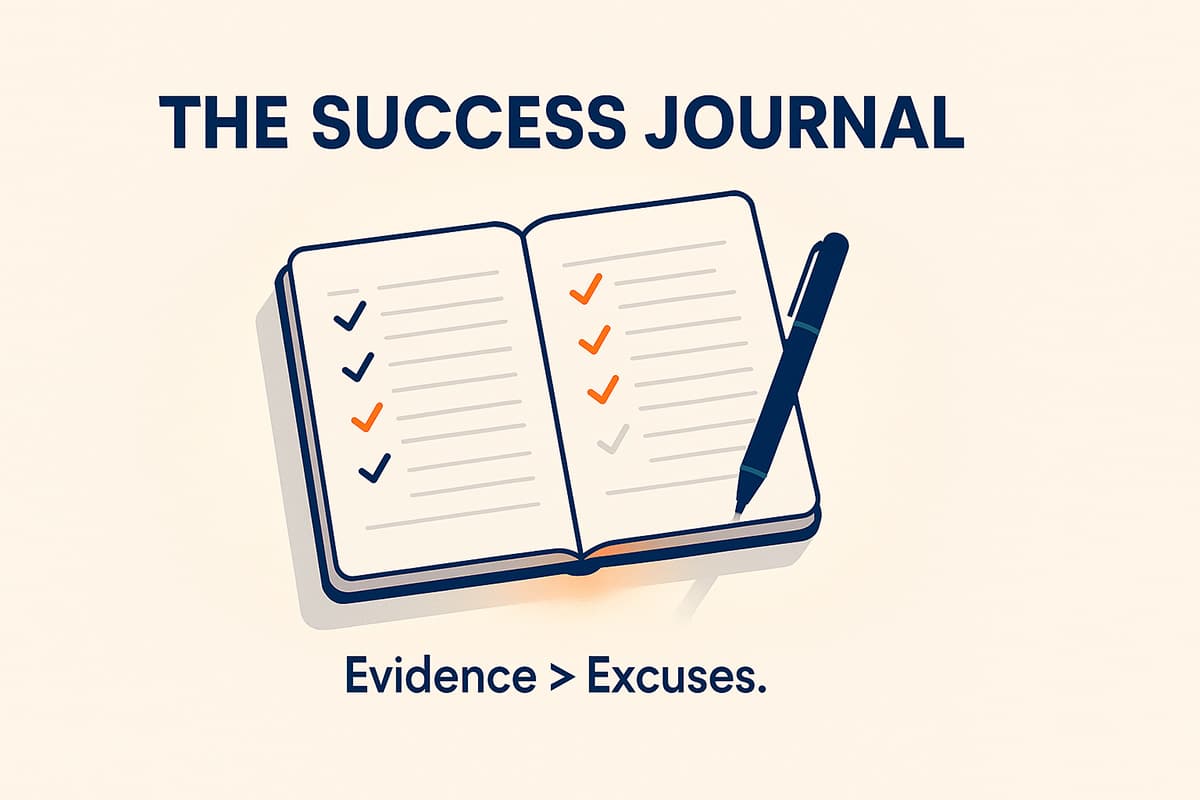
    The Success Journal: Your Evidence File

    Here’s a tactical move that separates amateurs from professionals:

    Create a Success Journal.

    Not to track your feelings. Not to journal about your “journey.” But to document the evidence that you’re already powerful.

    What Goes In Your Success Journal:

    • Every time you acted despite not feeling ready
    • Every win—big or small—where you delivered results
    • Every problem you solved that you thought you couldn’t
    • Every promise you kept to yourself
    • Every moment you chose action over comfort
    • Every proof point that you’re capable
    • Every praise, appreciation or acknowledgement you received.

    Why This Works:

    Most people forget their own power. They forget what they’ve already accomplished. They dismiss their wins and obsess over their gaps.

    (this is not wrong. this is natural. the number one purpose of the brain is to keep us safe – and it does by focusing on the negatives – the failures; instead of the positives – the successes)

    Your Success Journal is your evidence file. It reminds you of a simple truth:

    You’re already powerful. You’ve already done hard things. You can do them again.

    When you’re about to delay on something important, open that journal. Don’t read it to “get motivated.” (that’s a trap)

    Read it to remember who you actually are.

    Action First. Always.

    Here’s the uncomfortable truth that champions embrace:

    Action comes first. Everything else follows.

    You don’t act AFTER you feel ready. You act, and readiness shows up later.

    You don’t act AFTER you feel confident. You act, and confidence builds with each rep.

    You don’t act AFTER you feel motivated. You act, and motivation appears as momentum builds.

    Think about the last time you crushed something. Did the good feelings come before or after?

    After. Always after.

    So when you’re lying in bed at 6 AM, here’s what you do:

    1. Notice the absence of feeling without obeying it. “I notice I don’t feel like going. And I’m going anyway.”
    2. Open your Success Journal. Read one entry. Remember you’ve done harder things.
    3. Move immediately. Sit up. Stand up. Put on your shoes. Small actions create momentum.
    4. Keep the promise you made. Not because you feel like it. Because you said you would. (otherwise you are teaching yourself that you can not count on yourself)

    That’s integrity. That’s power. That’s how winners operate.

    “Ready” Will Never Come

    Let me be brutally honest with you:

    “Ready” is a lie.

    You will never feel ready. You will never feel confident enough. You will never feel motivated enough.

    Because those feelings aren’t prerequisites. They’re outcomes.

    As Matthew McConaughey writes in his autobiography Greenlights (one of my favorite books): “If you have jumped into the arena, you are already a winner.”

    Not when you feel good about jumping. Not when you’re confident about jumping. Not when you’re motivated to jump.

    The moment you jump—regardless of how you feel—you’ve won.

    Winners Act. Losers Delay.

    Some people will read this and get angry. They’ll say I don’t understand their situation. That it’s not that easy.

    You’re right. I never said it was easy.

    Simple? Yes. Easy? Hell no.

    The principle is simple: Act first, feelings follow.

    But doing it? That’s hard. That’s why most people don’t.

    They wait for confidence that never arrives.

    They wait for motivation that comes and goes.

    They wait for inspiration that depends on their mood.

    Meanwhile, winners are moving. Building. Shipping. Failing. Learning. Winning.

    Not because they feel better. Because they act better.

    The Math Is Simple

    Every time you act despite not feeling like it, you:

    • Build proof of your capability
    • Generate actual momentum
    • Create real results
    • Develop genuine confidence (as a byproduct)
    • Get closer to what matters

    Every time you delay because you don’t feel ready, you:

    • Reinforce the lie that feelings matter more than action
    • Stay stuck in the same place
    • Prove to yourself that you can’t be trusted
    • Give away your power to your emotions
    • Get further from what matters

    The people I work with—CEOs leading purpose-driven companies, leaders transforming organizations, humans chasing bold ambitions—they’ve all learned this truth:

    You don’t need to feel anything to do everything.

    Your Move

    So here’s what you do today:

    Start your Success Journal. Right now. Not when you feel like it.

    Write down 25 things you’ve already done that were hard (all my clients do this). Times you acted despite your feelings.

    Then tomorrow when you don’t feel like doing the thing you committed to do, open that journal and remember:

    You’ve already proven you can act without feeling ready. You’ve done it before. You’ll do it again.

    Because here’s the final truth:

    The gap between where you are and where you want to be isn’t about feelings.

    It’s about action.

    Winners understand this. Losers fight it.

    Which one are you?


    This is the kind of message I get paid to deliver to the champions and winners I work with. If you’re a leader who’s done waiting for “ready” and prepared to act regardless of how you feel, get in touch.

  • Leadership Journeys [245] – Syed Ahmed – “What people wouldn’t know around me is i prefer solitude”

    This is the Leadership Journey series on the Choosing Leadership Podcast.

    I believe we all have a lot to learn from each other’s stories – of where we started, where we are now, and our successes and struggles on the way. With this series of interviews, my attempt is to give leaders an opportunity to share their stories and for all of us to learn from their generous sharing. If you know a leader whom you would like to see celebrated on the show, please send me a message on LinkedIn with their name.

    What does it take to walk away from corporate success and step into purpose-driven leadership?

    In this inspiring episode, Syed Ahmed shares his journey from the safety of a thriving corporate career to launching a mission-led vaccine company that’s reshaping global health access.

    He opens up about the inner shifts, tough choices, and cultural foundations that helped him build a company grounded in integrity and impact.

    Whether you’re a leader considering a bold move or simply seeking deeper alignment in your work, Syed’s story offers both a roadmap and a reminder of what truly matters.

    Tune in to discover how real leadership starts with a powerful choice—and the courage to follow it through.

    You can find Syed Ahmed at the below links

    In the interview, Syed shares

    • “Leadership is not a title—it’s a choice to stand for something bigger than yourself.”
    • “Leaving corporate comfort wasn’t easy, but purpose gave me the courage to jump.”
    • “Access to innovative vaccines should not be the privilege of the affording.”
    • “True leadership emerges when strategy meets a culture of integrity and unity.”
    • “We weren’t just building a business—we were building trust, equity, and access.”
    • “The vaccine gap isn’t just a healthcare issue; it’s a social justice issue.”
    • “My growth as a leader came from learning to accept what I can’t control—and owning what I can.”
    • “People-first leadership isn’t just moral—it’s the only sustainable path forward.”
    • “I’m an introvert leading with extroverted clarity—because my silence fuels my strength.”
    • “Leadership isn’t about scaling heights alone—it’s about creating ripples that uplift communities.”
  • The Invisible Weight of Success: What Nobody Tells You About Making It

    You know what’s funny? When I quit my 16 years tech career to start on a totally new journey – to guide and work with the biggest changemakers & leaders on this planet, I thought the hard part was getting there.

    Landing the big CEO clients. Hitting the numbers and building a reputation. Being known for bringing people together and helping them go beyond even their own wildest dreams – both personally and professionally.

    Turns out, I had no idea.

    The real challenges of success? They’re the ones nobody talks about at conferences. They’re not in the Harvard Business Review case studies. They’re the 3 am thoughts, the conversations you can’t have with anyone, the slowly growing sense that you’re living someone else’s life while everyone congratulates you on yours.

    I’ve sat across from people who look like they have it all figured out—the title, the impact, the respect—and watched them break down because they finally found someone who wouldn’t judge them for admitting: “I don’t know if I can keep doing this.”

    Let me walk you through what success actually looks like from the inside. Not the Instagram version. The real one.

    When You Become a Role, Not a Person

    I’ll never forget this CEO I worked with—let’s call him Raj. Built an incredible company from scratch. 300 employees. Lives changed. Real impact. And he came to me completely burned out.

    “I can’t remember the last time someone asked me how I actually am,” he said. “Not how the company’s doing. Not how the quarter looks. Just… me.”

    Here’s what happens: You achieve something significant, and suddenly you’re not allowed to be human anymore. You’re “The CEO.” You’re “The Founder.” You become a symbol, an inspiration, a beacon—and all of that is beautiful except you’re still just a person who gets scared and tired and confused.

    Raj told me about going to a friend’s birthday party—people he’d known for years—and spending the whole evening answering questions about his company. Nobody asked about him as a father or about his painting hobby. Nobody noticed he’d lost weight from stress. The entire conversation was about his role, never about him.

    This is the identity prison. You get trapped in the character you’ve created, and the bars are made of other people’s expectations and your own success.

    I see this constantly. A leader can’t admit they’re struggling with a decision because “leaders are decisive.” They can’t show uncertainty because “leaders inspire confidence.” They can’t have a rough day because everyone’s watching.

    The exhausting part? You start believing it too. You internalize that you should always have answers. You should never waver. And slowly, you lose touch with the actual human underneath—the one who’s allowed to not know, to be tired, to need support.

    The Loneliness Nobody Warns You About

    Let me tell you about Priya. Brilliant executive. Everyone wanted to work with her. Her calendar was packed 7am to 8pm. And she was profoundly, achingly lonely.

    “I’m surrounded by people all day,” she told me. “But I can’t actually talk to any of them.”

    This is the cruel irony of success: The higher you go, the fewer people you can be real with.

    Your team needs you to be strong, so you can’t share your doubts. Your board wants confidence, so you can’t express fear. Your old friends feel distant because your life looks so different now. Your new “friends” might want access more than connection.

    I remember Priya describing a moment when she was in a meeting with her executive team, discussing a major strategic pivot. She was terrified it was the wrong call. Her stomach was in knots. But everyone was looking at her for certainty, so she projected it. The decision went through. It worked out. And she felt more isolated than ever because nobody knew how scared she’d been.

    Who do you talk to when you can’t talk to anyone?

    This is why our work together mattered so much. Not because I had magic answers, but because I was someone she could actually be honest with. Someone who didn’t need her to be anything other than human. Someone who could handle her uncertainty without panicking or judging.

    I remember one conversation where she spoke for 55 minutes of the 60-minute session. Internally, I was almost blaming myself because I didn’t get a chance to coach her or solve her problems. I was wondering if I added value because the only thing I did was I listened to her. At the end of the session, she said, “This was the best conversation I have had in a long time. Nobody has listened so deeply to me.” This feedback helped me understand the other side of success.

    The loneliness of success isn’t about being alone. It’s about being surrounded by people and still feeling like nobody sees you.

    When Success Stops Feeling Like Success

    Here’s something wild: I’ve worked with people who hit goals they’d been chasing for years—goals that would change their lives—and they felt… nothing. Or worse, they felt empty.

    There was this founder I coached who finally closed his Series B. Eight million dollars. Validation from top-tier investors. Everything he’d been working toward for three years.

    He called me the next day. “Is this it?” he asked. “I thought I’d feel different.”

    This is the moving goalpost syndrome, and it’s brutal. You think hitting the target will bring peace, satisfaction, that sense of “I made it.” Instead, it brings relief for about 48 seconds, and then your brain is already moving to the next thing.

    The Series B becomes “we need a Series C.” The VP title becomes “I need to be in the C-suite.” The successful exit becomes “but what’s my next thing?”

    You become addicted to the chase, to the achievement, to the validation—but you never actually feel satisfied. Success becomes this treadmill you can’t get off because stopping means facing the emptiness you’ve been running from.

    I see this with executives who work 80-hour weeks not because they have to, but because they don’t know who they are without the work. The hustle became their identity. The achievement became their drug. And now they’re trapped in a cycle that’s slowly killing them but they can’t imagine life without it.

    The Weight of Other People’s Lives

    At 2am one night, I got a text from a client—a CEO of a mid-sized company. Just two words: “Can’t sleep.”

    I called him first thing the next morning. He’d been lying awake thinking about a restructuring decision. Twenty people would lose their jobs. Twenty families. Kids. Mortgages. Dreams.

    “I know it’s the right business decision,” he said. “The numbers are clear. But these are real people. How do you sleep when you’re making choices that impact lives?”

    This is something most people never consider about success and leadership: Every decision carries weight that goes far beyond you.

    You’re not just responsible for results. You’re responsible for people’s livelihoods, their sense of security, sometimes their entire identity if they’ve wrapped it up in their job. One wrong strategic call and you’re not just missing a target—you’re affecting dozens or hundreds of lives.

    I’ve seen this weight crush people. The executive who can’t stop thinking about the single mom on their team who’s about to be laid off. The founder who feels guilty about every 5-star hotel stay because their employees can’t afford one. The leader who lies awake calculating how many people they’re affecting with each decision.

    The privilege of impact comes with the crushing burden of consequence. And you carry that alone because who else can understand it?

    When You Don’t Know Which Version of You Is Real

    I worked with a leader once—a woman who’d built an incredible reputation in her industry. Confident. Inspiring. The person everyone wanted to be.

    In our third session together, she said something that broke my heart: “I’ve been performing for so long, I don’t remember what I actually think or feel about anything. I don’t know who I am.”

    She’d spent years crafting the right image. Saying the right things. Showing up the right way. And somewhere along the line, the performance became the reality. Or rather, she lost track of which was which.

    This is the authenticity gap. The distance between who you are and who you show up as. And it grows every time you:

    • Project confidence you don’t feel in a meeting
    • Give an inspiring speech when you’re terrified inside
    • Act like you have it together when you’re falling apart
    • Smile and say “everything’s great” when it’s not

    The gap gets wider and wider until you feel like a fraud in your own life.

    I see this especially with introverts who’ve learned to perform extroversion. With people from cultures where showing vulnerability is seen as weakness. With anyone who’s had to “fake it till you make it” for so long that they forgot there’s a real person underneath the performance.

    The work we do together often starts with simply creating space to let the real person emerge. No performance. No image management. Just “what’s actually true for you right now?”

    When Everyone Wants Something From You

    “I don’t know who actually likes me anymore,” a client told me once. He’d just sold his company for a stupid amount of money, and suddenly he had more “friends” than ever.

    This is the trust deficit. When you’re successful, every relationship gets complicated. Is this person genuine or do they want funding? Want a job? Want to be associated with your success? Want to network through you?

    You start filtering every interaction through suspicion. It’s not paranoia—you’ve been burned. The person who seemed so supportive suddenly had an agenda. The friendship that felt real turned out to be transactional.

    I’ve watched this make people incredibly isolated. They want connection but they can’t trust it. They want friendship but they can’t tell if it’s real. And the sad part? Sometimes they’re right to be suspicious. Success attracts people who are more interested in what you can do for them than who you actually are.

    This is why finding people who knew you before, who don’t need anything from you, becomes so valuable. Or working with someone like me, where the relationship is clear and boundaried and there’s no hidden agenda.

    When You Have Everything Except Time

    The most painful irony of success: You finally have resources but no time to use them.

    You can afford the vacation but can’t take it. You can hire help but you’re too busy to let them help. You want to be present with your family but you’re always mentally somewhere else.

    I remember this executive—father of three—who realized he’d missed every single one of his daughter’s soccer games that season. He could afford front-row tickets to anything. But he couldn’t afford the three hours on a Saturday afternoon.

    Success promised freedom. Instead, it delivered a different cage—one made of opportunities you can’t say no to, obligations you can’t drop, expectations you can’t ignore.

    “I thought making it would mean I could finally relax,” he told me. “But I’m more trapped than ever.”

    The Imposter in the Room

    Here’s the wildest part: The more successful people become, often the more like an imposter they feel.

    You’d think it would be the opposite. You’d think results would build confidence. But what actually happens is this: The stakes get higher, the spotlight gets brighter, and that voice in your head gets louder: “When are they going to figure out I’m making this up?”

    I worked with a woman who’d been promoted to SVP. Huge company. Incredible opportunity. And she was terrified.

    “Everyone else seems to know what they’re doing,” she said. “I’m just figuring it out as I go.”

    The truth I shared with her? Everyone is figuring it out as they go. But at higher levels, you’re expected to hide it better.

    The imposter complex doesn’t go away with success. It just gets more sophisticated. More subtle. More isolating because you think you’re the only one who feels this way.

    What Actually Helps

    After years of sitting with people going through all of this, here’s what I’ve learned: The antidote to these challenges isn’t working harder or achieving more. It’s finding people and spaces where you can be fully human.

    Where you can admit you’re scared and it doesn’t shake anyone’s confidence in you.

    Where you can say “I don’t know” and it’s not a crisis.

    Where you can drop the performance and just be yourself, whatever that looks like today.

    This is why people come to me. Not because I have all the answers (I definitely don’t), but because I can hold space for the full reality of their experience. The fear and the confidence. The doubt and the vision. The exhaustion and the commitment. My promise to them is that I will never judge them (even when feedback is very honest and direct) and they can always count on me – for the rest of their lives.

    They come with their lights dim—frustrated, stuck, low on energy. And through our work together, something shifts. Not because I fix them (they’re not broken), but because they finally have space to be honest. To reconnect with themselves. To remember who they are underneath all the roles and expectations.

    They leave empowered, confident, ready—not because the challenges went away, but because they’re no longer carrying them alone.

    (All names have been changed and details in this article have been anonymised)

    The Real Conversation

    If you’re reading this and recognizing yourself, know this: What you’re experiencing is real. It’s valid. And you’re not alone in it, even though it feels like you are.

    The challenges don’t get easier with success—they just get more invisible and more isolating. And that’s exactly why finding someone who can see the real you, who won’t need you to be anything other than human, becomes absolutely critical.

    There are moments in every leader’s life when they need someone they know they can count on. Someone who gets it.

    Maybe that’s why you’re still reading this.

    If any of this resonated, send me a note. Better yet, record a voice note or a video msg. Let yourself be seen.

    Because here’s what I know for sure: You don’t have to carry all of this alone. And on the other side of being real about what’s actually happening? That’s where you let the burden of leadership go and acknowledge the privilege and grace of leadership. You deserve it.

  • Leadership Journeys [244] – Conor McGowan Smyth – “I have a deep hunger to explore—both the world and my spiritual side.”

    This is the Leadership Journey series on the Choosing Leadership Podcast.

    I believe we all have a lot to learn from each other’s stories – of where we started, where we are now, and our successes and struggles on the way. With this series of interviews, my attempt is to give leaders an opportunity to share their stories and for all of us to learn from their generous sharing. If you know a leader whom you would like to see celebrated on the show, please send me a message on LinkedIn with their name.

    What happens when a CEO stops chasing titles and starts chasing truth?

    In this powerful episode, Conor McGowan Smyth, CEO of Brava Solutions, opens up about how fatherhood, spirituality, and cultural curiosity transformed his leadership journey.

    From making gut-based decisions to navigating global teams, Conor shares raw and relatable lessons on leading with heart and clarity.

    Whether you’re feeling stuck, burned out, or just seeking a deeper sense of purpose, this conversation will spark reflection and growth.

    Tune in to discover how real leadership begins the moment you choose to lead yourself first.

    You can find Conor McGowan Smyth at the below links

    In the interview, Conor shares

    “Leadership isn’t about titles—it’s about showing up authentically, especially when things fall apart.”
    “Becoming a father changed everything. It taught me that leadership starts at home.”
    “Real leadership emerges in crisis—not when things are going well, but when they’re falling apart.”
    “Intuition is just as important as data. Some of my best decisions came from listening to my gut.”
    “You can’t lead effectively without cultural awareness—leadership looks different across borders.”
    “Spirituality helped me find clarity in chaos. It made me a better leader, husband, and human.”
    “If you want to scale your company, start by scaling your people.”
    “The most powerful leaders I’ve met weren’t the loudest in the room—they were the most authentic.”
    “I dream of taking a year off—not to escape, but to go deeper into who I am and what I want to give back.”
    “Choosing leadership is choosing growth. Every day, every decision, it’s a path you walk consciously.”

  • The Leadership Loops Nobody Talks About (But Everyone Keeps The Drama Going)

    There’s a meeting happening right now, in every country, where a leader is saying something they don’t mean, making a promise they won’t keep, or avoiding a conversation that actually matters.

    And everyone in the room knows it.

    Including the leader.

    But the show (or drama) goes on. The performance continues. The loop keeps looping.

    Here’s what nobody wants to admit: Most of what we call leadership is theater. Not the inspiring kind—the kind where everyone’s pretending not to notice that the emperor has no clothes, the strategy has no substance, and the “transformation” is just rearranging deck chairs on the titanic.

    We’re not leading. We’re performing safety. We are repeating the same “drama” on repeat. And calling it business or leadership.

    What These Loops Actually Are

    These patterns aren’t conscious choices. They’re what happens when your nervous system learns to prioritize safety over truth. A self-blame loop like “there’s something wrong with me” isn’t a conclusion you’ve reached through careful analysis. It’s a pattern that organizes chaos around a painful but familiar center. It hurts, yes. But it’s more durable than ambiguity.

    The victim loop—“nothing ever works out for me”—isn’t giving up. It’s making chaos make sense by creating a story where you’re at least the protagonist of your own suffering.

    “All I want to do is be helpful” sounds virtuous. Strip away the performance and you’ll often find self-preservation disguised as service. Being helpful means you’re needed. Being needed means you’re safe.

    Carl Jung saw this clearly: “Until you make the unconscious conscious, it will direct your life and you will call it fate.”

    Let’s look at the loops we’re all running but pretending we’re not.

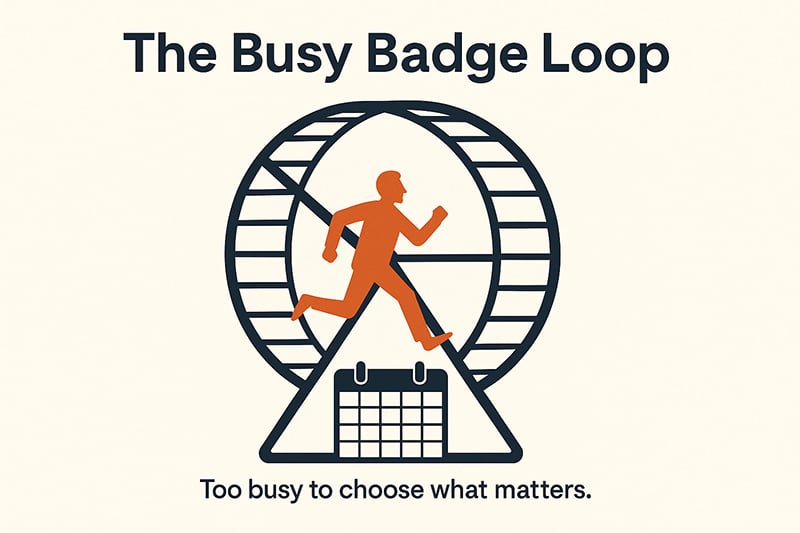
    The Busy Badge Loop

    “I’m so busy.”

    It’s the most acceptable humble-brag in business. Said with exhaustion, sometimes pride, always as explanation for why something else isn’t happening.

    But busyness isn’t productivity. It’s a shield against prioritization. Because choosing what matters means risking being wrong about what matters. If everything is urgent, nothing has to be important. The calendar stays full. The inbox stays overwhelming. And underneath runs quiet relief that you never have to face the question: “What would I do if I actually had space to think?”

    Ask yourself: What dream or bold move have I been too “busy” to pursue for the last year, and what will my life look like in five years if I’m still too busy?

    The Perfectionism Postponement

    “We’ll launch when it’s ready.”

    How many world-changing ideas have died in that sentence?

    Perfectionism isn’t about high standards. It’s about never having to face judgment. If you never ship, you never fail. The preparation becomes the point. You get to be the person who could do something amazing rather than the person who did something imperfect.

    Steve Jobs understood this trap: “Real artists ship.” Not perfect artists. Real ones.

    Ask yourself: What would I have already created, launched, or become if “good enough” had been acceptable, and who might have already been helped by it?

    The Certainty Collector

    “I need more data before I decide.”

    That is paralysis in a business suit.

    Every decision involves loss. Choose one path and you lose the others. More information doesn’t change that—it just gives you more sophisticated ways to avoid choosing. Analysis becomes the thing you do instead of deciding.

    Jeff Bezos famously distinguished between one-way and two-way doors. Most decisions are two-way doors (reversible). But we treat them like one-way doors because that justifies the delay.

    Ask yourself: What decision have I been “gathering information” about for months, and what momentum, opportunity, or possibility dies with each day I wait?

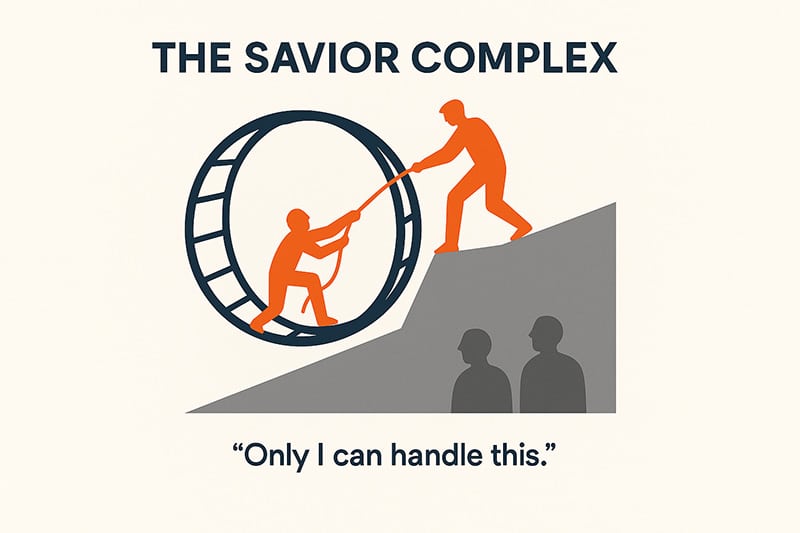
    The Savior Complex

    “I’m the only one who can handle this.”

    Listen closely and you’ll hear relief underneath. Because being indispensable means never being challenged to grow beyond your current identity. The martyr and the tyrant are the same pattern in different clothes. Both say: “The world needs me to be exactly who I am right now.” Both are terrified of what happens when that stops being true.

    Lao Tzu wrote, “A leader is best when people barely know he exists.” That’s not about invisibility. It’s about leaders who’ve stopped needing to be the hero of every story.

    Ask yourself: Who on my team isn’t growing because I keep swooping in to save the day, and what leader could they become if I stepped back?

    The Cynicism Shield

    “Nothing will really change anyway.”

    Corporate cynicism sounds like sophistication. It’s actually exhausted hope wearing a suit.

    Cynicism is what happens when you’ve been disappointed enough times that pre-emptive disappointment feels safer than staying open. You can’t be hurt if you expect nothing. The leader who says “that’s just how it is” isn’t being realistic—they’re protecting themselves from caring enough to be wrong.

    Marianne Williamson nailed it: “We ask ourselves, ‘Who am I to be brilliant, gorgeous, talented, fabulous?’ Actually, who are you not to be?” The same applies to hope. Who are you to be cynical when the world needs leaders who still believe change is possible?

    Ask yourself: What possibility am I no longer even allowing myself to imagine because I’ve decided it’s naive, and what kind of world am I creating by giving up before I start?

    The Comparison Trap

    “At least our numbers are better than our competitors’.”

    Using others as your reference point means never having to look directly at whether you’re actually building what matters. Comparison stabilizes the ego by making identity relational rather than examined.

    The most dangerous version? “At least I’m not like that CEO.” Every critique of someone else’s leadership style is an opportunity to avoid examining your own.

    Theodore Roosevelt said, “Comparison is the thief of joy.” In leadership, it’s also the thief of vision.

    Ask yourself: If no one else existed to compare myself to, what would I actually want to create, and how far am I from that right now?

    The Authenticity Performance

    “I’m just being honest.”

    Honesty without kindness isn’t authenticity—it’s cruelty seeking permission. The leader who prides themselves on “telling it like it is” often confuses brutality with truth. Real authenticity admits “I don’t know.” It says “I was wrong.” It doesn’t perform transparency—it is transparent, even when uncomfortable.

    Brené Brown reminds us: “Vulnerability is not winning or losing; it’s having the courage to show up and be seen when we have no control over the outcome.”

    Ask yourself: Who have I hurt or pushed away with my “honesty,” and what deeper truth am I avoiding by staying on the surface of brutal?

    The Potential Prisoner

    “We could scale to $100M if we wanted to.”

    Living in the hypothetical is seductive. Unrealized potential can never fail. It’s the gap between what you are and what you could be that lets you avoid ever having to be anything specific.

    The entrepreneur who’s always “between ventures.” The executive who’s “considering opportunities.” The leader who talks about vision but never takes the first step.

    Goethe understood: “Whatever you can do or dream you can do, begin it. Boldness has genius, power and magic in it.”

    Ask yourself: What am I sacrificing by staying in the realm of “could” instead of “did,” and what will I regret not attempting when I look back at this moment in ten years?

    The Gratitude Bypass

    “I should just be grateful for what we’ve achieved.”

    Gratitude is beautiful. Using it to silence legitimate ambition? That’s self-betrayal with a spiritual bow on it.

    This loop weaponizes thankfulness against desire. You can’t want more if you should be happy with what you have. It sounds humble. It’s actually a way to avoid the vulnerability of admitting you want something you might not get.

    Ask yourself: What do I genuinely want that I’m pretending not to want by hiding behind gratitude, and what becomes impossible when I silence my own desires?

    The Learning Loop

    “I’m still learning. It’s a journey.”

    Permanent student status is a brilliant defense mechanism. Growth language used to avoid ever being accountable as someone who knows. The journey never ends because arrival means responsibility.

    There’s a difference between genuine humility and hiding behind “I’m still figuring it out” when people are actually waiting for you to lead.

    Ask yourself: What am I qualified to teach or lead right now that I’m avoiding by staying in “student” mode, and who’s waiting for me to step up?

    The Boundary Softness

    “I don’t want to upset anyone.”

    You’re not keeping the peace. You’re trading your needs for the mirage of harmony. But there’s no peace—just resentment accumulating while you pretend avoiding conflict is the same as connection.

    Every unexpressed boundary is a future explosion waiting to happen. Every “yes” that should have been “no” is integrity leaking out.

    Ask yourself: What boundary have I failed to set that’s now costing me my energy, time, or self-respect, and what relationship is actually suffering because I won’t be honest?

    The Delegation Theater

    “I’ve empowered my team.”

    But have you? Or have you just created a system where they need your approval for everything while you maintain the illusion that you’re not a bottleneck?

    Real delegation is scary because it means genuinely letting go of control. Fake delegation lets you keep control while looking collaborative. One builds leaders. The other builds dependency you can complain about.

    Ask yourself: What’s not getting done or scaled because everything has to go through me, and what leader am I preventing from emerging by holding all the strings?

    The Vision Vagueness

    “We’re building something transformational.”

    Vague vision isn’t inspiring—it’s a smoke screen. If your strategy can mean anything, it means nothing. But specificity is scary because it can be wrong. Vagueness can never fail because it never really commits.

    The leader who speaks in inspiring abstractions but can’t answer “What does success look like next quarter?” isn’t visionary. They’re avoiding accountability.

    Ask yourself: What am I avoiding committing to by keeping my vision vague, and how is my team’s confusion or misalignment the direct result of my lack of clarity?

    The Consensus Cage

    “Let’s make sure everyone’s aligned before we move forward.”

    Sometimes that’s wisdom. Often it’s decision-making abdication disguised as inclusion. You’re not building buy-in—you’re distributing blame in advance.

    Real leadership sometimes means making the call that not everyone agrees with and being willing to be wrong. The consensus loop means no one’s really leading.

    Ask yourself: What bold decision have I been avoiding by waiting for everyone to agree, and what opportunity is dying while I run another alignment meeting?

    The Optimism Bypass

    “Everything happens for a reason.”

    This isn’t faith. It’s a structure that turns randomness into reassurance. It’s a way to avoid grief, anger, and the messy reality that sometimes terrible things happen and there’s no lesson, no silver lining, no cosmic plan.

    Toxic positivity in leadership looks like: “This layoff is actually an opportunity for those affected to find their true calling.” No. It’s a layoff. Let it be hard.

    Ask yourself: What painful reality am I spiritually bypassing instead of facing, and who am I failing to truly support by forcing positivity onto their struggle?

    The Meeting About Meetings

    “We need better processes.”

    Process improvement is legitimate. But sometimes “we need better systems” is a way to avoid addressing the actual problem: people aren’t having honest conversations.

    No amount of process will fix a culture where people are afraid to tell the truth. The meeting about the meeting about the meeting is theater. The real issue is usually relational, not procedural.

    Ask yourself: What difficult conversation am I avoiding by focusing on process improvements, and what would change if I just addressed the human issue directly?

    The Awareness Paradox

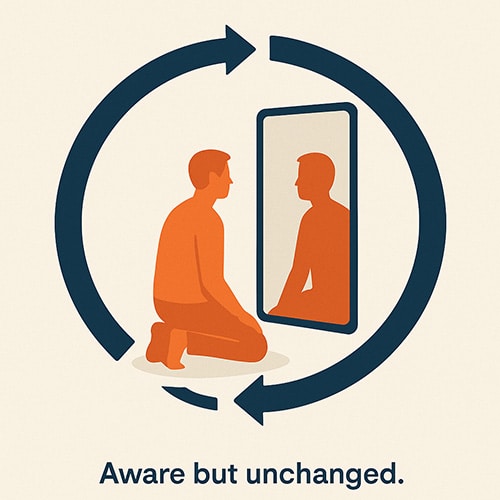
    “I’m aware of my patterns now.”

    Here’s the most sophisticated loop of all: awareness that doesn’t lead to change. You’ve read the books. Done the workshops. Know your triggers. And yet… the same patterns persist.

    Because awareness outside the loop is often just the loop preserving itself by imagining a vantage point not bound by its own constraints. Real awareness lives in the moment of choice, not in the reflection after.

    Ask yourself: What pattern have I been “aware” of for years without changing, and what am I getting from knowing about it without doing anything about it?

    Why The Drama Continues

    These patterns persist because they work—not at creating results, but at creating coherence and safety of familiarity. They emerged because at some point, they kept you safe. They made chaos manageable. They gave you a role when you didn’t know who to be.

    The trap isn’t that they exist. It’s that they persist long after the threat has passed, running on autopilot because familiarity feels like truth.

    They’re not you—they’re weather patterns you learned to live in. And like weather, they can change.

    But first you have to stop calling them “just how things are” or “just how I am.”

    The Real Work

    Leadership isn’t about eliminating these patterns. It’s about recognizing them in real-time and choosing differently. Not perfectly. Not always. But consciously.

    Read that again. It is that I call “Constant Conscious Creation”. Choosing consciously in real-time.

    The next time you hear yourself say “I’m too busy,” pause. Ask: “What am I avoiding by staying busy?”

    When you catch yourself collecting more data, ask: “What decision am I afraid to make?”

    When you feel indispensable, ask: “What would become possible if I weren’t?”

    When you’re performing authenticity, ask: “What truth am I avoiding by being so ‘honest’?”

    This is the work. Not creating a perfect self, but creating a conscious one. A leader who can see their own loops and choose—even occasionally—to step outside them.

    That’s when leadership stops being theater and boring drama and starts being transformation and fulfilling.

    That’s when the drama ends and the real work begins.


brain care coaching commitment communication conflict conflicts conversation culture deployyourself deploy yourself emotional intelligence emotions empathy energy feedback freedom future gold habits hope john maxwell language leadership lessons listening performance perspective preparation productive productivity psychological safety purpose questions relationships resolution ryan holiday seth godin simon sinek strengths struggle team trust values words