This is the Leadership Journey series on the Choosing Leadership Podcast.
I believe we all have a lot to learn from each other’s stories – of where we started, where we are now, and our successes and struggles on the way. With this series of interviews, my attempt is to give leaders an opportunity to share their stories and for all of us to learn from their generous sharing. If you know a leader whom you would like to see celebrated on the show, please send me a message on LinkedIn with their name.
In this episode of Choosing Leadership, Anders Jones, CEO of Facet, shares the hard-won lessons of scaling a disruptive FinTech company while navigating the challenges of modern leadership.
From overcoming imposter syndrome to building a high-performing remote team, Anders reveals why the strategies that got you here won’t take you to the next level.
He opens up about breaking outdated industry norms, fostering innovation, and the personal routines that keep him sharp.
Whether you’re a founder, executive, or aspiring leader, this conversation will challenge you to rethink growth, resilience, and success.
Tune in for actionable insights that will help you lead with clarity, adaptability, and impact.
How the Quality of Your Questions Shapes the Quality of Your Life
Have you ever noticed how some people seem to move through life with purpose and clarity, while others stay stuck in the same patterns year after year?
I want to share a story that changed how I see everything.
Sarah (name changed) was a talented marketing manager who felt constantly overwhelmed. Every morning, she’d wake up asking herself: “How will I get through all this work today?” Her days were a blur of stress and rushing. She was good at her job but felt like she was drowning.
Then one day, during a workshop, I asked her a simple question: “What if instead of asking how you’ll get through your work, you asked: ‘How can I create the most value today?’”
That single question shift changed everything. Sarah started focusing on impact rather than just activity. She began delegating low-value tasks, saying no to projects that didn’t align with key goals, and prioritizing work that truly mattered. Within months, she was promoted, felt more fulfilled, and—surprisingly—had more free time.
All from changing one question.
The truth is, your life today is largely an answer to the questions you’ve been asking yourself—often without even realizing it.
Think about it. The person who constantly asks “Why does this always happen to me?” experiences life very differently from someone who asks “What can I learn from this?” The questions we ask ourselves act like invisible filters, shaping what we notice, how we feel, and the actions we take.
Here’s what you’ll discover below:
Why the quality of your life directly reflects the quality of your questions
How to identify the unconscious questions that might be holding you back
Simple techniques to transform limiting questions into empowering ones
Specific question frameworks for different areas of your life
Practical ways to make asking better questions a daily habit
This isn’t just about positive thinking. It’s about fundamentally changing how your brain processes your experiences and makes decisions.
The best part? You don’t need special skills, expensive tools, or years of practice. You just need to become aware of the questions you’re already asking and learn how to ask better ones.
Part 1: Understanding the Power of Questions
Have you ever noticed how two people can experience the same event completely differently? One person sees an opportunity while another sees only problems. One feels excited while another feels afraid.
What makes the difference? Often, it’s the questions they’re asking themselves.
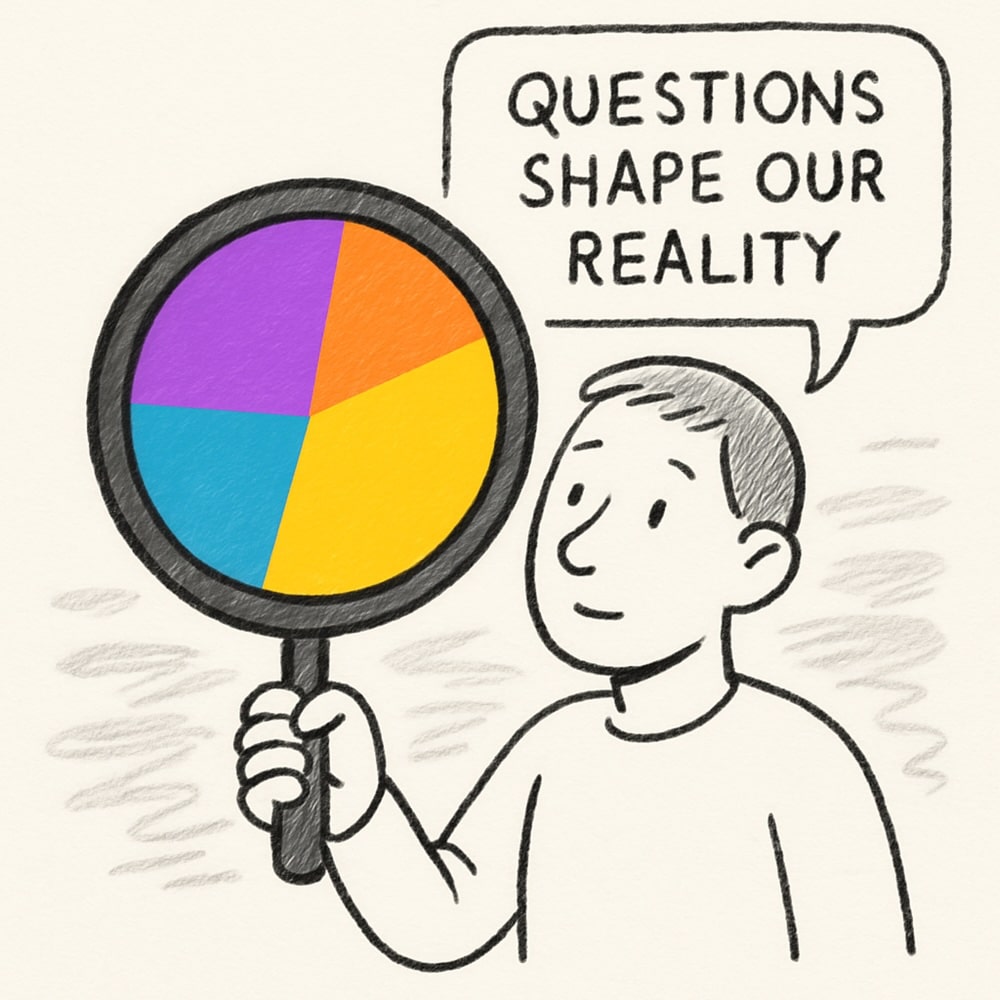
How Questions Shape Your Reality
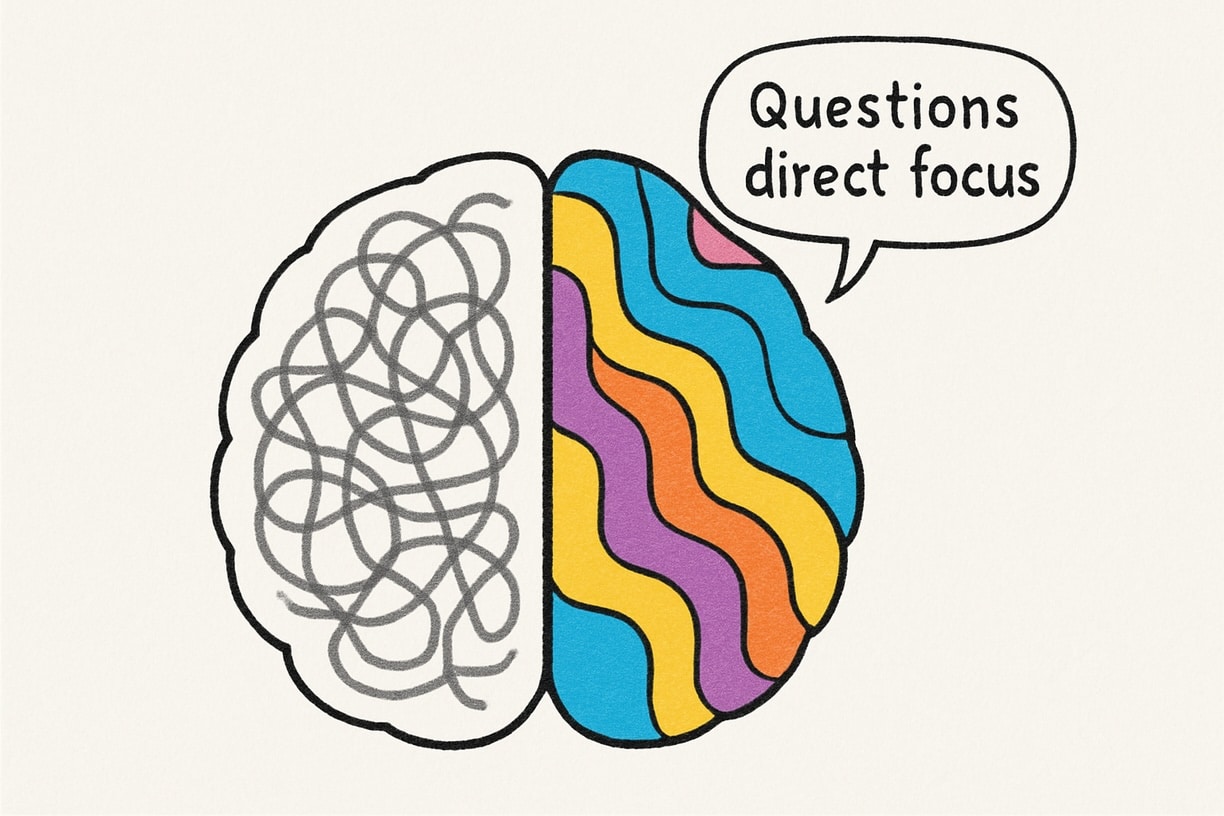
Your brain is constantly trying to make sense of the world. It takes in millions of pieces of information every second, but you only become aware of a tiny fraction of them. How does your brain decide what to pay attention to?
It looks for answers to the questions you’re asking.
Think about it like this: imagine you’re at a party. If you’re asking yourself “Why am I so awkward?” your brain will search for evidence of your awkwardness. You’ll notice every stumbled word and uncomfortable silence.
But what if you asked “Who here might be interesting to talk to?” Your brain would scan for different information entirely. You’d notice people’s expressions, conversations, and potential connections.
Same party. Completely different experience. All because of the question you asked.
This happens in every area of your life:
When you wake up asking “Why am I so tired?” you feel more tired
When you approach work asking “How can I just get through this day?” you merely survive
When you look at challenges asking “Why is this happening to me?” you feel like a victim
But when you change your questions, you change your focus, your emotions, and ultimately your actions.
The Science Behind Questions
When you ask a question, your brain treats it like a command to find an answer. This activates your Reticular Activating System (RAS), the part of your brain that filters information.
It’s like when you buy a new car and suddenly see that same model everywhere. Those cars were always there, but now your brain is tuned to notice them.
Questions work the same way. They tell your brain what to look for and what to ignore.
Even more fascinating, research shows that questions trigger different brain activity than statements. When you hear or think a statement, your brain processes it passively. But when you encounter a question, your brain actively engages to find an answer.
This is why questions are so much more powerful than statements. Saying “I am confident” might feel good momentarily, but asking “How can I approach this situation with confidence?” engages your problem-solving abilities and creates real change.
Why Most People Ask the Wrong Questions
Most of us don’t choose our questions consciously. We inherit them from:
Parents and family (“Why can’t you be more like your sister?”)
Past experiences (“How do I avoid getting hurt again?”)
Cultural messages (“How can I look successful to others?”)
Emotional habits (“What might go wrong here?”)
These questions become so automatic that we don’t even realize we’re asking them. They run in the background of our minds, shaping our perceptions and decisions without our awareness.
And here’s the problem: many of these unconscious questions are limiting rather than empowering. They focus on:
What’s wrong instead of what’s possible
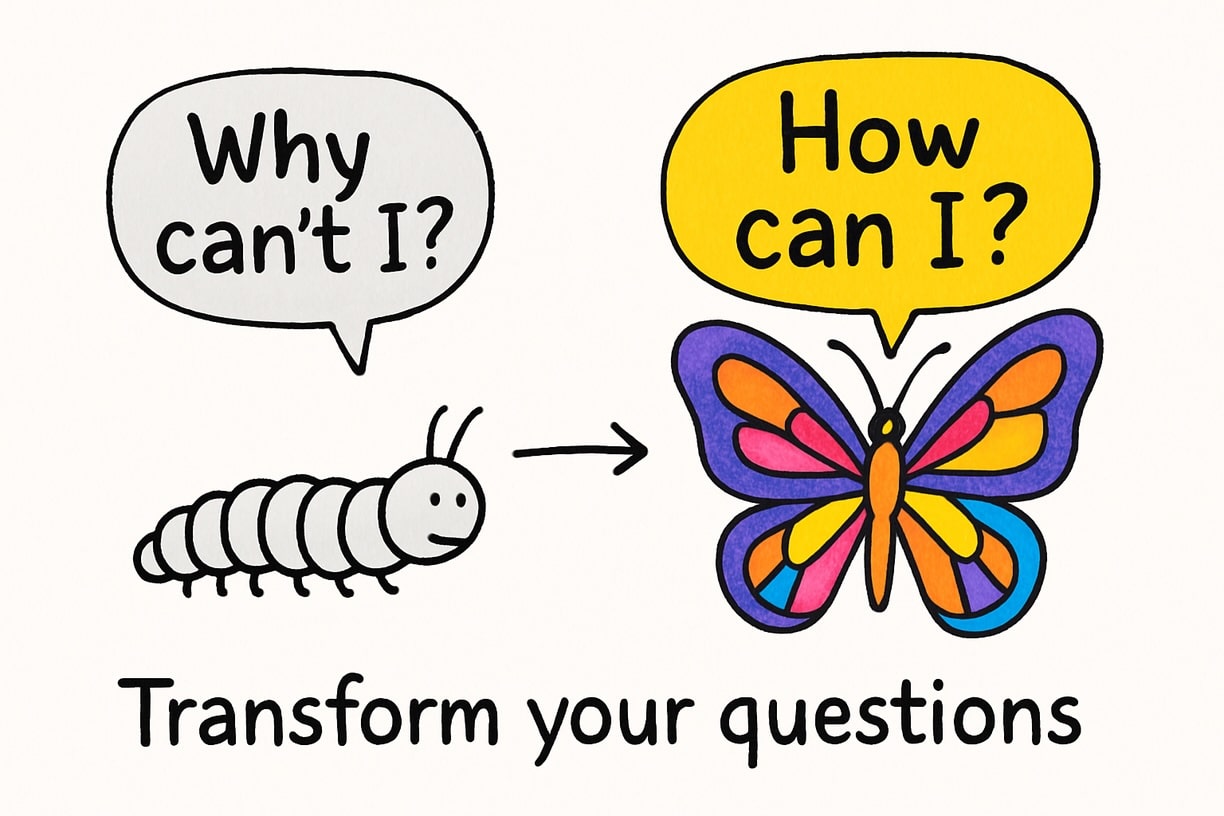
Why we can’t instead of how we can
What we should fear instead of what we could create
Who to blame instead of what to learn
The good news? Once you become aware of these questions, you can change them.
Limiting vs. Empowering Questions
Let’s look at the difference between these two types of questions:
Limiting Questions:
Why am I so bad at this?
What if I fail?
Why don’t people appreciate me?
How can I avoid looking foolish?
Why is this happening to me?
These questions assume problems, focus on the negative, and often have no useful answers. They drain your energy and confidence.
Empowering Questions:
What can I learn from this?
How can I use this situation to grow?
What’s one small step I could take?
How might I approach this differently?
What am I grateful for right now?
These questions assume possibilities, focus on solutions, and lead to helpful insights. They energize you and expand your thinking.
The difference isn’t just positive versus negative thinking. Empowering questions are practical tools that direct your brain toward useful answers.
Consider this example:
Limiting question: “Why am I so disorganized?” Your brain’s likely answers: “Because you’re lazy. Because you’ve always been this way. Because you can’t focus.”
Empowering question: “What’s one small way I could be more organized today?” Your brain’s likely answers: “You could spend 10 minutes clearing your desk. You could use that calendar app. You could handle each piece of mail once.”
See the difference? The first question leads to self-criticism. The second leads to action.
In the next section, we’ll explore how to identify the core questions that are currently guiding your life—often without your awareness. Once you recognize them, you’ll be ready to transform them into questions that serve you better.
Part 2: Identifying Your Core Questions
Have you ever wondered why you keep facing the same challenges or feeling the same emotions over and over again? The answer might be hiding in the questions you unconsciously ask yourself every day.
How to Recognize the Unconscious Questions Guiding Your Life
Your mind is always asking questions, even when you’re not aware of it. These questions are like a GPS system for your brain—they determine where you focus, how you feel, and what actions you take.
But how do you discover questions that operate below your awareness? Here are some practical ways to bring them into the light:
1. Notice Your Emotional Patterns
Your emotions are excellent clues to your underlying questions. When you feel:
Anxious: You might be asking “What could go wrong?” or “What if I’m not prepared?”
Frustrated: You might be asking “Why does this always happen to me?” or “Why don’t people understand?”
Overwhelmed: You might be asking “How will I get everything done?” or “What if I can’t handle this?”
Stuck: You might be asking “Why can’t I figure this out?” or “Why is everyone else moving forward except me?”
The next time you experience a strong emotion, pause and ask yourself: “What question might be creating this feeling?”
2. Listen to Your Self-Talk
The way you talk to yourself reveals your underlying questions. Pay attention to phrases like:
“I always mess this up.” (Hidden question: “How will I mess up this time?”)
“No one appreciates what I do.” (Hidden question: “Why don’t people value my contribution?”)
“I’ll never be good enough.” (Hidden question: “How can I prove I’m worthy?”)
Try keeping a small notebook handy. When you catch yourself in negative self-talk, write it down. Then ask: “What question am I really asking myself here?”
3. Examine Your Recurring Problems
The challenges that keep showing up in your life often reflect your core questions. If you:
Repeatedly feel taken advantage of, you might be asking “How can I please others?”
Often feel overwhelmed with responsibilities, you might be asking “How can I do it all myself?”
Frequently feel unappreciated, you might be asking “What must I do to be valued?”
Think about a problem that keeps appearing in your life. Then ask: “What question might I be asking that keeps creating this situation?”
4. Reflect on Your Decisions
Your choices reveal your underlying questions. When making decisions, are you primarily asking:
“What’s the safest option?” “What will others think?” “How can I avoid discomfort?” “What’s the fastest solution?”
Or are you asking:
“What aligns with my values?” “What would help me grow?” “What feels meaningful?” “What’s the best long-term approach?”
The next time you face a decision, notice which questions naturally arise for you.
Common Limiting Questions Most People Live By
Many of us are guided by questions we didn’t consciously choose. This includes you and me.
Here are some of the most common limiting questions people live by:
The Approval Seeker
“What will others think of me?” “How can I get everyone to like me?” “What if they reject me?”
These questions make others’ opinions more important than your own wisdom. They lead to people-pleasing, fear of standing out, and loss of authenticity.
The Perfectionist
“What if I make a mistake?” “How can I avoid failure?” “Why am I never good enough?”
These questions create paralyzing standards, fear of trying new things, and constant self-criticism.
The Controller
“How can I make sure nothing goes wrong?” “What might I be missing?” “How do I stay in charge?”
These questions lead to micromanaging, anxiety about the future, and difficulty trusting others.
The Victim
“Why does this always happen to me?” “Who’s to blame for this?” “Why is life so unfair?”
These questions create feelings of helplessness, resentment, and a focus on problems rather than solutions.
The Comparer
“Why are others doing better than me?” “How can I prove I’m special?” “What if I’m falling behind?”
These questions lead to constant dissatisfaction, envy, and tying your worth to external achievements.
Do any of these sound familiar? Most of us have several of these question patterns running in our minds. The key is to recognize them without judgment. Remember, you didn’t consciously choose these questions—they developed based on your experiences and what seemed to keep you safe or help you succeed.
Practical Exercises to Uncover Your Personal Question Patterns
Now let’s get practical about discovering your own core questions. Try these simple exercises:
For the next week, take five minutes each morning to ask yourself:
What am I worried about today?
What am I hoping for today?
What am I assuming will happen today?
Write down your answers, then look for the questions hiding behind them. For example, if you’re worried about a presentation, the hidden question might be “What if I embarrass myself?” If you’re hoping your partner notices your efforts, the question might be “What must I do to be appreciated?”
Each evening for a week, reflect on:
When did I feel most stressed or upset today?
What was I saying to myself in those moments?
What questions might have been running through my mind?
Write these down and look for patterns across different days and situations.
The Body Scan
Our bodies often know our questions before our minds do. Try this:
Sit quietly and close your eyes
Notice any tension or discomfort in your body
Gently ask that area: “What are you trying to tell me?”
Then ask: “What question am I holding that’s creating this tension?”
You might be surprised by the insights that emerge.
The Trusted Friend Method
Sometimes others can see our patterns more clearly than we can. Ask a trusted friend:
What do I seem to worry about most?
What do I frequently complain about?
What do I seem to be striving for?
Their observations can reveal questions you might not recognize in yourself.
Signs That Your Current Questions Are Holding You Back
How do you know if your questions are limiting rather than empowering you? Look for these signs:
You feel the same emotions repeatedly- If you’re constantly anxious, frustrated, or disappointed, your questions may be trapping you in these emotional states.
You can predict your reactions – If you know exactly how you’ll respond to certain situations (with worry, defensiveness, or resignation), you’re likely asking the same old questions.
You see the same problems recurring – Different circumstances but similar issues suggest your questions are creating consistent patterns.
You feel stuck or on autopilot – A sense of going through the motions often comes from questions that narrow rather than expand your possibilities.
Your solutions aren’t working – If you keep trying to solve problems the same way with limited success, your underlying questions may be directing you to ineffective approaches.
Remember, recognizing your limiting questions isn’t about criticizing yourself. It’s about awareness. These questions served a purpose in your life—perhaps they helped you cope, stay safe, or meet expectations. But now you have the opportunity to choose questions that better serve who you want to become.
Part 3: Transforming Your Questions
Now that you’ve identified the questions that might be holding you back, it’s time for the exciting part—transforming them into questions that empower and inspire you.
The Anatomy of Powerful, Life-Changing Questions
Not all questions are created equal. Powerful questions have specific qualities that make them effective at changing how you think, feel, and act.
They’re Open-Ended
Powerful questions can’t be answered with a simple “yes” or “no.” They invite exploration and discovery.
Limiting: “Can I handle this challenge?” Empowering: “What strengths can I bring to this challenge?”
They Assume Possibilities
Powerful questions presuppose that solutions exist and that you have the resources to find them.
Limiting: “Why is this so hard for me?” Empowering: “How might I approach this differently?”
They Focus Forward
Rather than dwelling on the past or analyzing problems, powerful questions direct your attention toward solutions and future actions.
Limiting: “Why did I fail?” Empowering: “What can I learn from this experience?”
They Evoke Emotion
Questions that touch your heart as well as your head create deeper motivation and more lasting change.
Limiting: “What’s wrong with my life?” Empowering: “What kind of life do I truly want to create?”
They’re Specific and Actionable
The best questions lead naturally to concrete steps you can take.
Limiting: “Why am I so disorganized?” Empowering: “What’s one small step I could take today to feel more organized?”
Step-by-Step Process for Reframing Limiting Questions
Transforming your questions isn’t complicated, but it does take practice. Here’s a simple process you can use:
Step 1: Catch the Limiting Question
Notice when you’re asking yourself a question that makes you feel stuck, anxious, or powerless. Write it down exactly as it comes to mind.
Example: “Why can’t I ever stick to my goals?”
Step 2: Identify What Makes It Limiting
Is it focused on the past? Does it assume failure? Is it blaming or judgmental? Does it have a useful answer?
Example: This question assumes I never stick to goals (which isn’t true), focuses on what’s wrong with me, and doesn’t lead to helpful answers.
Step 3: Flip the Assumption
Take the limiting assumption in your question and flip it to a more empowering one.
Example: Instead of assuming “I can’t stick to goals,” I’ll assume “I can find ways to achieve my goals.”
Step 4: Redirect the Focus
Shift from problems to solutions, from past to future, from blame to responsibility, or from fear to possibility.
Example: Instead of focusing on why I fail, I’ll focus on what helps me succeed.
Step 5: Craft Your New Question
Create a question that embodies the new assumption and focus.
Example: “What conditions help me stay committed to my goals, and how can I create more of those conditions?”
Step 6: Test It
A good empowering question should:
Make you feel more energized and hopeful
Lead to useful insights and ideas
Point toward specific actions you could take
If your new question doesn’t do these things, keep refining it.
Let’s practice with a few more examples:
Limiting Question: “Why am I so bad at relationships?” Empowering Alternative: “What have I learned from past relationships that can help me create healthier connections now?”
Limiting Question: “How can I stop feeling so overwhelmed?” Empowering Alternative: “What’s the most important thing for me to focus on right now?”
Limiting Question: “Why don’t people respect my boundaries?” Empowering Alternative: “How can I communicate and maintain my boundaries more effectively?”
Specific Question Frameworks for Different Life Situations
Different situations call for different types of questions. Here are some powerful frameworks you can adapt to your specific circumstances:
When Facing a Challenge
“What’s the opportunity hidden in this difficulty?”
“How would my future self want me to handle this?”
“What strengths can I bring to this situation?”
“What would this look like if it were easy?”
When Making a Decision
“What matters most to me in this situation?”
“What would I advise someone I love to do?”
“How will this choice affect who I’m becoming?”
“What am I not seeing or considering?”
When Feeling Stuck
“What’s one small step I could take right now?”
“What would make this more enjoyable or meaningful?”
“Who has solved a similar problem, and what can I learn from them?”
“If I knew I couldn’t fail, what would I do?”
When Experiencing Conflict
“What might the other person be feeling or needing?”
“What’s more important: being right or maintaining the relationship?”
“How might we both get what we need?”
“What haven’t I expressed or asked for clearly?”
When Setting Goals
“What would make this goal deeply meaningful to me?”
“How will I know I’ve succeeded beyond just the numbers or outcomes?”
“What habits or systems would support this goal?”
“Who do I need to become to achieve this?”
When Feeling Negative Emotions
“What is this feeling trying to tell me?”
“How can I show myself compassion right now?”
“What’s one thing I can appreciate despite this difficulty?”
“What would help me feel even 10% better?”
How to Make Asking Better Questions a Daily Habit
Knowing about empowering questions isn’t enough—you need to make them part of your daily thinking. Here’s how:
Create Question Triggers
Link the practice of asking better questions to specific situations in your day:
When you wake up: “What’s one thing I’m looking forward to today?”
Before meetings: “How can I add the most value here?”
When facing a setback: “What can I learn from this?”
Before bed: “What went well today, and what would I do differently?”
Use Visual Reminders
Place sticky notes with your favorite empowering questions where you’ll see them regularly:
On your bathroom mirror
On your computer monitor
In your planner or journal
As lock screen wallpaper on your phone
Practice Question Substitution
When you catch yourself asking a limiting question, immediately substitute an empowering alternative. With practice, this becomes automatic.
Limiting: “Why am I so stressed?” Empowering: “What’s one thing I can do to feel more calm right now?”
Create a Question Journal
Keep a small notebook or digital note where you collect powerful questions that resonate with you. Review and add to it regularly.
Find a Question Partner
Share this practice with a friend, family member, or colleague. Check in with each other about the questions you’re asking and help each other reframe limiting ones.
Celebrate Question Wins
Notice when a powerful question leads to a breakthrough or positive change. Acknowledging these successes reinforces the habit.
Remember, transforming your questions isn’t about being perfectly positive all the time. It’s about becoming aware of the questions that guide your life and consciously choosing ones that serve you better.
In the next section, we’ll explore specific question frameworks for different areas of your life, from career and relationships to health and personal growth.
Part 4: Questions for Specific Life Areas
The quality of your questions matters in every area of your life. In this section, we’ll explore powerful questions tailored to different aspects of your life that can help you create breakthroughs where you need them most.
Career and Purpose Questions
Many of us spend more time at work than anywhere else, yet we often ask questions that make our work feel draining rather than fulfilling.
Instead of asking:
“How can I get through this day?”
“Why don’t I get the recognition I deserve?”
“When will I finally get promoted?”
Try asking:
“How can I bring more of my unique strengths to my work today?”
“What part of my work feels most meaningful, and how can I do more of that?”
“How might I serve or contribute in a way no one else can?”
“What skills would I love to develop that would also add value here?”
“If I were designing my ideal role, what would it look like?”
For Career Transitions:
“What work would I do even if I didn’t need the money?”
“What problems do I feel genuinely motivated to solve?”
“When have I lost track of time because I was so engaged in what I was doing?”
“What do people thank me for or come to me for help with?”
“What feels like play to me but work to others?”
For Leadership:
“How can I help my team feel both challenged and supported?”
“What might my team need from me that they’re not expressing?”
“How can I create more opportunities for others to shine?”
“What conversations am I avoiding that need to happen?”
“How can I better align our daily work with our larger purpose?”
Relationship Questions
Our connections with others are fundamental to our happiness, yet we often ask questions that create distance rather than closeness.
Instead of asking:
“Why don’t they understand me?”
“How can I get them to change?”
“What’s wrong with this relationship?”
Try asking:
“How can I better understand what matters to them?”
“What might they be feeling or needing right now?”
“How can I show up as my best self in this relationship?”
“What am I not seeing from their perspective?”
“How can we create a win-win in this situation?”
For Family Relationships:
“What traditions or experiences would create meaningful memories for us?”
“How can I show each family member I value their unique qualities?”
“What boundaries would help our family relationships stay healthy?”
“How can I be more present when we’re together?”
“What unspoken expectations might be causing friction in our family?”
For Romantic Relationships:
“How can we bring more play and joy into our relationship?”
“What makes my partner feel truly seen and appreciated?”
“How can we support each other’s growth while growing together?”
“What shared vision would inspire both of us?”
“How can we turn conflicts into opportunities for deeper connection?”
For Friendships:
“Which friendships energize me, and how can I nurture them?”
“How can I be a better friend to the people who matter most to me?”
“What kind of friend do I want to be known as?”
“How can I expand my circle to include more diverse perspectives?”
“What old friendships might be worth reconnecting with?”
Health and Wellbeing Questions
Our physical and mental wellbeing forms the foundation for everything else, yet many of us ask questions that make health feel like a burden rather than a gift.
Instead of asking:
“Why can’t I stick to a diet?”
“How can I lose weight fast?”
“Why am I always tired?”
Try asking:
“How can I make healthy choices feel good in the moment?”
“What foods make my body feel energized and strong?”
“What type of movement brings me joy?”
“How can I design my environment to make healthy choices easier?”
“What would a sustainable, enjoyable healthy lifestyle look like for me?”
For Mental Health:
“What activities help me feel calm and centered?”
“How can I build more moments of rest and recovery into my day?”
“What boundaries would protect my mental energy?”
“What negative thought patterns do I need to question or release?”
“How can I respond to stress with more self-compassion?”
For Sleep:
“What evening routine would help my body and mind prepare for rest?”
“How can I create a sleep environment that supports deep sleep?”
“What worries or thoughts keep me awake, and how can I address them earlier in the day?”
“What would a truly restorative morning routine look like?”
“How might I honor my body’s natural rhythms more fully?”
Personal Growth Questions
Personal development can become another source of pressure if we ask questions that focus on fixing what’s “wrong” with us rather than expanding our potential.
Instead of asking:
“Why can’t I change?”
“What’s wrong with me?”
“How can I fix my weaknesses?”
Try asking:
“What strengths can I build on?”
“What matters most to me at this stage of my life?”
“What kind of person am I becoming, and what kind of person do I want to become?”
“What would stretch me without breaking me?”
“What new perspective could transform how I see this situation?”
For Learning:
“What am I curious about right now?”
“How can I apply what I’m learning to my daily life?”
“What skill would be both enjoyable to learn and valuable to have?”
“Who could mentor or guide me in this area?”
“How can I create a sustainable learning habit?”
For Creativity:
“What would I create if I knew no one would judge it?”
“How can I bring more playfulness to my creative process?”
“What unique perspective or experience can I bring to my creative work?”
“How might constraints actually enhance my creativity?”
“What small creative project could I start today?”
Financial Questions
Money matters can trigger some of our most limiting questions, yet this area especially benefits from more empowering alternatives.
Instead of asking:
“Why am I always broke?”
“How can I afford this?”
“Why is money so stressful?”
Try asking:
“How can I increase the value I create for others?”
“What skills could I develop that people would gladly pay for?”
“How can I align my spending more closely with my true values?”
“What financial habits would give me more peace of mind?”
“How can I view money as a tool rather than a source of stress?”
For Saving and Investing:
“What am I really saving or investing for, and why does that matter to me?”
“What small, consistent actions would improve my financial future?”
“How can I make saving feel rewarding in the present?”
“What financial knowledge would empower me to make better decisions?”
“How can I balance enjoying today while preparing for tomorrow?”
For Earning:
“What problems am I well-positioned to solve that others would value?”
“How might I create multiple streams of income?”
“What untapped opportunities exist in my current role or business?”
“How can I provide so much value that money becomes a natural byproduct?”
“What limiting beliefs about earning money do I need to challenge?”
Remember, the questions in this section are starting points. The most powerful questions are the ones that resonate with your specific situation and values. Experiment with these, adapt them, and create your own questions that spark insight and inspiration in each area of your life.
Part 5: Creating Your Question Practice
Knowing about powerful questions is one thing. Living them daily is another. In this section, we’ll explore how to make empowering questions a natural part of your everyday life.
Morning and Evening Question Rituals
The beginning and end of your day are powerful times to shape your mindset with intentional questions.
Morning Question Ritual
How you start your day sets the tone for everything that follows. Instead of reaching for your phone or immediately thinking about your to-do list, try starting with empowering questions.
Here’s a simple 3-minute morning ritual:
Gratitude Question: “What am I truly grateful for in my life right now?” Take a moment to feel the gratitude, not just think about it.
Purpose Question: “What’s one thing I could do today that would matter most?” This helps you prioritize what’s truly important, not just what’s urgent.
Strength Question: “What quality or strength can I bring to today’s challenges?” This activates your inner resources before you face the day’s demands.
You can write your answers in a journal or simply reflect on them as you get ready. The key is consistency—even a minute of intentional questions can shift your entire day.
Evening Question Ritual
The questions you ask before sleep influence not only how you process the day but also how your unconscious mind works while you rest.
Try this 5-minute evening practice:
Reflection Question: “What went well today, and why did it go well?” This trains your brain to notice and reinforce positive patterns.
Learning Question: “What would I do differently if I could live this day again?” This creates growth without self-judgment.
Release Question: “What do I need to let go of before I sleep?” This helps prevent worries from disturbing your rest.
Tomorrow Question: “What am I looking forward to tomorrow?” This plants seeds of anticipation and positive expectation.
These rituals are simple but powerful. They bookend your day with intentional thinking rather than reactive habits.
Using Questions in Challenging Moments
Life’s difficulties are when we most need empowering questions, yet they’re also when we’re most likely to fall back on limiting ones.
Here’s how to use questions as tools in tough situations:
The Pause Practice
When you feel triggered, overwhelmed, or stuck:
Pause: Take a deep breath and create a moment of space.
Notice: What limiting question is running through your mind?
Choose: What more empowering question could you ask instead?
For example:
When criticized at work:
Limiting question: “Why am I always messing up?”
Empowering alternative: “What can I learn from this feedback?”
When facing a setback:
Limiting question: “Why does this always happen to me?”
Empowering alternative: “How can I respond to this in a way I’d be proud of?”
When feeling overwhelmed:
Limiting question: “How will I get through all of this?”
Empowering alternative: “What’s the next right small step I can take?”
The Question Emergency Kit
Create a personal list of go-to questions for your most common challenging situations. Keep them in your phone, wallet, or somewhere easily accessible.
For example:
For anxiety:
“What’s the worst that could realistically happen, and how would I handle it?”
“What’s one small thing I can control right now?”
“How have I successfully handled similar situations before?”
For conflict:
“What might they be feeling beneath their words or actions?”
“What do I really want from this interaction?”
“How can I respond rather than react?”
For decision paralysis:
“What would I advise my best friend to do?”
“Which option aligns best with who I want to become?”
“What would my future self thank me for choosing?”
Having these questions ready means you don’t have to create them in the moment when your thinking is already stressed.
How to Help Others Ask Better Questions
The quality of your questions doesn’t just impact your life—it can transform your interactions with others too.
With Friends and Family
When someone comes to you with a problem, your instinct might be to offer advice. Instead, try offering a powerful question:
“What have you tried so far, and what did you learn from that?”
“What outcome are you really hoping for?”
“What would make this situation better from your perspective?”
“What part of this do you have control over?”
These questions show respect for the other person’s wisdom while helping them see new possibilities.
With Children
Children naturally ask lots of questions, but they also learn questioning patterns from adults. Help them develop empowering question habits by:
Modeling good questions yourself
Responding to their limiting questions with better alternatives
Asking them questions that assume capability: “How might you solve this?” instead of “Do you need help?”
Celebrating their questions and showing that curiosity is valued
In Teams and Workplaces
If you lead others, the questions you ask shape your team’s culture and thinking:
Replace “Who’s to blame?” with “What can we learn from this?”
Replace “Why can’t we meet our targets?” with “What would enable us to exceed our targets?”
Replace “Do you have any questions?” with “What questions do you have?”
Replace “Can you do this?” with “How might we approach this?”
Notice how the second question in each pair creates more psychological safety and invites more thoughtful responses.
Measuring Your Progress Through Question Quality
How do you know if your question practice is working? Look for these signs:
Emotional Indicators
You recover more quickly from setbacks
You feel more curious and less judgmental
You experience more moments of insight and possibility
You feel more agency and less victimhood
Behavioral Indicators
You try new approaches rather than repeating old patterns
You listen more deeply to others
You make decisions with more clarity and confidence
You take more inspired action and less reactive action
Relationship Indicators
Your conversations have more depth and discovery
You resolve conflicts more creatively
Others seem more open and less defensive with you
You connect more authentically with people
Results Indicators
You make progress on long-standing challenges
You notice opportunities you might have missed before
You create outcomes that exceed your initial expectations
Your actions align more consistently with your values
Remember, the goal isn’t to ask perfect questions all the time. We all have moments of doubt, fear, and limitation. The goal is to become aware of your questions and gradually shift toward ones that serve you better.
As you practice, you’ll find that better questions become more automatic. What once required conscious effort eventually becomes your natural way of thinking.
Conclusion: The Question Revolution
Recap of Key Insights
we’ve discovered that:
The quality of your life directly reflects the quality of your questions. The questions you ask—consciously or unconsciously—shape your focus, emotions, decisions, and ultimately your results.
Most people live by unconscious questions they didn’t choose. These questions often come from past experiences, cultural messages, and emotional habits that may no longer serve who you want to become.
You can identify your core questions by noticing your emotional patterns, listening to your self-talk, examining recurring problems, and reflecting on your decisions.
Transforming limiting questions into empowering ones is a learnable skill with a simple process: catch the limiting question, identify what makes it limiting, flip the assumption, redirect the focus, and craft a new question.
Different life areas benefit from specific types of questions. Whether in your career, relationships, health, personal growth, or finances, intentional questions can create breakthroughs where you need them most.
Making better questions a daily habit through morning and evening rituals, challenging moment practices, and consistent awareness can transform your default thinking patterns over time.
But perhaps the most important insight is this: You have more power than you realize to shape your experience of life through the questions you ask.
The Ripple Effect of Better Questions
When you change your questions, you don’t just change your own life. Your new way of thinking creates ripples that extend far beyond you:
In Your Relationships
As you ask more empowering questions, you listen differently. You become more curious and less judgmental. Your conversations deepen. Conflicts become opportunities for understanding rather than battles to win. The people around you feel more seen, heard, and valued.
In Your Work
Your questions spark innovation and possibility thinking. You focus on solutions rather than problems. You inspire others to think more expansively. Your contributions become more valuable because you see opportunities others miss.
In Your Community
You bring a different energy to every interaction. You help others reframe their challenges. You model a way of engaging with life that’s more curious, creative, and compassionate. Your presence alone can shift the quality of thinking in a group.
In Our World
Imagine if more people asked questions like:
“How can we create solutions where everyone wins?”
“What kind of world do we want to create for future generations?”
“How can we use our differences as strengths rather than sources of division?”
“What might be possible if we approached this challenge with fresh eyes?”
The quality of our collective questions determines the quality of our shared future.
Your Question Journey Begins Now
Do not read this once and set it aside. It’s a companion for an ongoing practice of questioning your questions.
Here are some ways to continue this journey:
Review regularly. Come back to different sections of this guide as you need them. Different parts will resonate at different times in your life.
Start small. Choose just one area of your life and experiment with new questions there before expanding to others.
Be patient with yourself. You’ve had years of practice with your current questioning patterns. New habits take time to develop.
Celebrate progress. Notice and appreciate when you catch yourself in a limiting question and successfully shift to a more empowering one.
Share what you learn. Teaching others about the power of questions will deepen your own practice.
Remember, the goal isn’t perfection. We all have moments of doubt, fear, and limitation. The goal is awareness and choice—becoming conscious of the questions that guide your life and intentionally choosing ones that lead to growth, connection, and meaning.
One Powerful Question Can Transform Your Life
A Final Question
As we conclude, I’d like to leave you with two questions to carry forward:
“What question, if I held it in my heart each day, would most transform my life?”
“How would you like to use your precious life? How do you want the world to be different because you were here?”
Take a moment to sit with this. The answer might not come immediately. When it does, write it down somewhere you’ll see it often. Let it be your companion and guide.
Your life is shaped by many forces, some within your control and some beyond it. But in every moment, you have the power to choose the questions you ask. And in that choice lies the potential for transformation.
Thank you for joining me on this exploration of the power of questions.
The next chapter of your story begins with the next question you ask.
This is the Leadership Journey series on the Choosing Leadership Podcast.
I believe we all have a lot to learn from each other’s stories – of where we started, where we are now, and our successes and struggles on the way. With this series of interviews, my attempt is to give leaders an opportunity to share their stories and for all of us to learn from their generous sharing. If you know a leader whom you would like to see celebrated on the show, please send me a message on LinkedIn with their name.
In this episode of Choosing Leadership, we dive into the unconventional leadership journey of Kjetil Kriken—founder and CEO of Paldo—who went from organizing festivals to building an AI-powered competitive intelligence company.
Kjetil shares how embracing uncertainty, tackling tough questions early, and staying adaptable have been key to his success.
We explore the role of sports in developing resilience, why leaders must anticipate market shifts instead of reacting to them, and how startups can avoid being blindsided by change.
If you’ve ever faced the challenge of navigating unpredictability as a leader, this conversation will give you practical insights and inspiration to stay ahead.
Tune in and discover how choosing leadership—every single day—can transform your business and your life.
This is the Leadership Journey series on the Choosing Leadership Podcast.
I believe we all have a lot to learn from each other’s stories – of where we started, where we are now, and our successes and struggles on the way. With this series of interviews, my attempt is to give leaders an opportunity to share their stories and for all of us to learn from their generous sharing. If you know a leader whom you would like to see celebrated on the show, please send me a message on LinkedIn with their name.
In this episode of Choosing Leadership, James O’Sullivan, CEO of Project One Consulting, shares hard-won insights on navigating complex transformations with authenticity and resilience.
He challenges the traditional pursuit of profit, advocating instead for meaningful, sustainable change that truly serves clients.
James opens up about the dual layers of leadership—balancing project execution with company-wide vision—and how transparency builds lasting trust.
If you’ve ever struggled with leading through uncertainty or questioned how to scale without losing your core values, this conversation is for you.
Tune in to discover how seasoned leaders cut through complexity, embrace their individuality, and drive real impact.
I was born and raised in India, an introverted child who thought deeply about the world. Like many others, I followed the “safe” path. I became an engineer. I built a successful 16-year career in tech. I relied on structure, planning, and logic.
But something was missing.
I felt a pull toward making a greater impact as far as I can remember. The safe path wasn’t enough.
First, I started two startups and then a social impact NGO in India. Later, I moved to the Netherlands. Finally, after 16 years of stability, I finally walked away from my high-paying job. I took a leap into the unknown to do what I do today.
There was no roadmap. No guarantees. Just a deep commitment to bringing people together and to bring meaning, joy and fulfilment back to workplaces.
The Discomfort of Saying “No”
The most challenging part of making a bold commitment is the willingness to eliminate everything that can’t grow exponentially with you—even if that means letting go of what brought you success so far. This creates significant discomfort that most people avoid.
When you say “no” to opportunities that once seemed valuable, you’ll feel the pain of potential loss. When you step away from projects that interested you but don’t serve your core focus, you’ll question your decision. When you distance yourself from relationships that drain rather than energize you, you’ll feel guilty. These uncomfortable feelings are natural and inevitable.
The discomfort comes from several sources:
Fear of missing out: Each “no” feels like closing a door that might have led somewhere good.
Identity confusion: Saying “no” to things you’ve always done challenges your sense of self.
Social pressure: Others won’t understand your choices and may try to pull you back to your old ways.
Uncertainty: The path of bold commitment doesn’t offer guarantees, while the familiar path feels safer.
Yet this discomfort is precisely what drives your growth.
Leaving my career wasn’t easy. It meant saying “no” to security. It meant disappointing current and past colleagues who didn’t understand. It meant facing my own fears of failure.
Every “no” felt uncomfortable. When I turned down consulting opportunities to focus on my coaching practice, my bank account suffered. When I declined social invitations to develop my methods, friendships were tested. When I set boundaries with clients who wanted the old way of leadership, I risked rejection.
Each “no” was painful. But each “no” was necessary.
I discovered something powerful in this discomfort. Each difficult “no” strengthened my commitment. Each uncomfortable choice clarified my vision. Each time I disappointed others to honor my deeper purpose, I became more authentic.
The discomfort didn’t just lead to better results. It transformed me.
Focusing on What Truly Matters
I became obsessed with understanding momentum. I studied what makes leaders grow fast versus stay stuck. I did deep inner work through silence, meditation, and coaching. I faced my fears head-on.
This obsessive focus required eliminating distractions. I couldn’t be everything to everyone anymore. I had to concentrate on what truly mattered: transforming leadership.
Within four years, I built a coaching practice that stood out. I began working with top entrepreneurs and CEOs, helping them scale beyond €100M. I ran transformational retreats and experiences for leadership teams – 1 in 2022, 2 in 2023 and 9 in 2024 alone. I had never done anything like that ever before.
None of this would have happened if I had kept saying “yes” to everything.
How Discomfort Transforms You
The discomfort of saying “no” doesn’t just lead to better results—it transforms you as a person. This transformation happens in several ways:
Increased self-awareness: When saying “no” is difficult, you’re forced to examine why. This examination reveals your fears, attachments, and hidden motivations.
Greater emotional resilience: Each time you face the discomfort of saying “no,” you build emotional muscles. The discomfort never disappears completely, but your capacity to bear it grows substantially.
Clearer values: Saying “no” requires knowing what you’re saying “yes” to. This process forces you to clarify what truly matters to you.
Authentic relationships: When you say “no” to activities and relationships that don’t align with your core focus, you create space for deeper connections with those who truly support your vision.
Increased confidence: Each time you make a difficult choice that honors your commitment, your confidence grows. You begin to trust yourself more deeply.
The person who left that engineering job is not the same person writing these words today. The transformation goes far beyond my professional achievements.
I developed greater self-awareness. Each difficult “no” forced me to examine my motives. Why was saying “no” so hard? What attachments were holding me back?
I built emotional resilience. The discomfort of disappointing others never disappeared completely. But my capacity to bear this discomfort grew substantially.
My values became clearer. Saying “no” required knowing what I was saying “yes” to. This process forced me to clarify what truly mattered to me.
My confidence grew. Each difficult choice that honored my commitment built trust in myself. I began making decisions more quickly and with greater conviction.
Pushing Beyond Comfort Zones
Today, I push leaders beyond their comfort zones. I challenge them to take bold, high-stakes action NOW.
I see myself in them. The hesitation. The attraction to the safe path. The fear of saying “no.” I recognize it because I’ve lived it.
When a CEO struggles to let go of a product line that’s holding their company back, when a founder hesitates to raise their prices, or when a leadership team clings to outdated processes, it all sounds so familiar today. Because I have been there. I know how that feels.
These stories resonate because they’re real. The discomfort is real. The transformation is real.
Why Bold Commitments Are Easier Than Small Improvements
Surprisingly, bold commitments are often easier to achieve than small improvements for several reasons:
Less Competition: When you aim for extraordinary results, you enter a space with fewer competitors. Everyone is fighting for small improvements, but few have the vision or courage to pursue bold exponential results.
Deeper Focus: Bold commitments require you to focus on very few things rather than many. Research shows that constantly switching tasks makes deep work and high performance nearly impossible. By eliminating distractions and focusing deeply, you can achieve breakthroughs that would be impossible with divided attention.
Creative Thinking: Bold commitments force you to think differently. You can’t achieve extraordinary results with ordinary thinking. This necessity drives innovation and creativity, leading to novel solutions that can leapfrog the competition.
Team Building: Bold commitments push you beyond what you can accomplish alone. They require building teams and systems that multiply your impact. This shift from doing everything yourself to leading others creates growth that small improvements rarely demand.
The Power of Being Different
This meant standing out. While other coaches offered incremental improvements, I focused on transformation. While others promised stress management, I delivered momentum and exponential business growth.
Being different wasn’t always comfortable. It meant challenging traditional leadership models that CEOs were familiar with. It meant pointing out that most executives were stuck in stress rather than scaling with clarity.
But being different created a unique space. I didn’t need to be dramatically better than every other coach. I just needed to be slightly better and notably different. This combination produced outsized results.
How Quality Creates Outsized Rewards
When you commit to exceptional quality in a focused area, the returns don’t simply double—they can multiply many times over. This happens because making a bold commitment isn’t about working harder; it’s about taking a completely different approach that leads to mastery and freedom.
Most productivity advice focuses on efficiency—doing more in less time. But bold thinking flips this idea. It’s not about doing more; it’s about doing less, but at a much higher level of quality. This shift creates a snowball effect that can lead to dramatically greater outcomes.
Simple Steps for Your Bold Commitment
If you’re considering a bold new commitment, start here:
Ask yourself: What small portion of my work creates most of my results?
Consider: What would happen if I focused exclusively on this area?
Reflect: What activities or commitments are holding me back? My stable engineering career was both a blessing and a limitation.
Face the truth: What uncomfortable “no” decisions am I avoiding? Saying “no” to security was my biggest challenge.
These questions will reveal uncomfortable truths. Activities you’ve invested years in might be holding you back. Relationships you value might be incompatible with your vision. Habits you’ve developed might belong to your past, not your future.
Embracing Discomfort for Growth
The path to extraordinary growth isn’t complicated. It requires clarity, commitment, and courage to eliminate everything that doesn’t align with your highest potential.
My mission is to change how organisations are led. No more hesitation. No more stress. Just momentum, impact, and exponential growth.
This mission demanded bold commitment. It required saying “no” to the safe path. It meant embracing discomfort again and again.
The question isn’t whether you can make a bold commitment. The question is whether you have the courage to embrace the discomfort of saying “no” to everything holding you back.
Conclusion: The Courage to Make a Bold Commitment
The path to extraordinary growth isn’t easy, but it’s simpler than most people realize. It doesn’t require superhuman abilities or endless hours of work. It requires clarity, commitment, and the courage to eliminate everything that doesn’t align with your highest potential.
By committing fully to the few areas where you can truly excel and saying “no” to everything else—despite the discomfort—you create the space for exponential growth. You free yourself from the trap of incremental thinking and open the door to breakthrough results.
Remember: How you approach one thing reflects how you approach everything. When you commit to high standards in one area of your life, that commitment will naturally spread to other areas. The result is not just better outcomes, but a better you—defined by mastery, purpose, and the joy that comes from living at your highest potential.
The question isn’t whether you can make this bold commitment. The question is whether you have the courage to embrace the discomfort of saying “no” to everything that’s holding you back. If you do, you’ll discover that bold commitments are not only more rewarding but also more achievable than you ever imagined.
I’ve spent most of my life trying to get it right.
Get what right? Everything. My relationships. My career. My parenting. My software. My presentation. My trip. My very existence.
For the longest time, I thought that was the point—to master the game called life by figuring out the rules and following them better than anyone else.
It took me almost 4 decades to realize a simple truth: There is no “right way” to live. There’s only your way.
The Painter Who Failed His Way to Success
One of my failures as a coach was with a client who was successful as an engineer but dreamed of becoming a painter. During our first meeting, he told me, “I’ve tried and failed with multiple coaches before.”
Talk about pressure.
What followed were months of argumentative sessions, during which nothing I offered seemed to help. He rejected and dismissed my questions and was unwilling to self-reflect and take action. Eventually, after three months of coaching, we decided to part ways.
I did the only thing I could do—I bowed out gracefully, feeling like an absolute failure.
Less than a year later, I stumbled across an interview with this same client about his paintings being displayed in a gallery. The interviewer asked how he managed to move from engineering to becoming an artist.
His answer stunned me.
“I finally realized that nothing was wrong or missing,” he said. “And that no one could help me unless I helped myself first. I needed to find my own way and stop relying on others or a ‘perfect answer, strategy, coaching or skillset’ to sort my life out for me.”
That’s when it hit me. My failure was his catalyst for success. Our coaching failure was just a milestone on his journey to explore outside options before realising the answer was within himself.
The Backwards Approach to Responsibility
This pattern isn’t unique to my former client. I’ve seen it repeatedly in myself and in hundreds of people I’ve worked with:
We try everything possible to get others to help us succeed
We exhaust all external resources and guidance
We feel abandoned or let down by the world
We finally say “f*ck it—I’ll do it my way”. After all, what’s there to lose as nothing is working in my life anyway.
We discover our own power and start paving the path forward. The path doesn’t become any easier. We just stop being the biggest obstacle in the way. We deal with the path as it is rather than from the frustration of “this should not be happening to me”.
Taking ownership isn’t our go-to strategy—it’s our last resort. It’s not Plan A. It’s barely Plan B. It’s more like Plans C through Z when nothing else works.
What would happen if we flipped this sequence and start with complete ownership – like nothing is wrong with us or with others or with life?
My Personal Ownership Cycle
Let me get vulnerable for a moment. My own cycle of ownership looks something like this:
I work tirelessly to make everyone around me happy
I put in the hours and do all the “right things”
At least I get the satisfaction and consolation prize of struggling and working hard.
Life still doesn’t work out as I think it should
I become resentful and feel victimized. I blame myself (I am not courageous, I am not an extrovert). I blame others (they do not understand me, they are making a mistake), or life (this is not fair, why is it so hard on me?)
Eventually, I get so fed up that I declare “f*ck all rules, processes, strategies and how to’s—I’m just going to do what I want”
Almost immediately, I begin to feel better
I start listening to myself and doing things my way – with complete choice and no obligation.
Life begins to feel light, friendly and enjoyable again. Results start to happen. and even when they don’t happen, it doesn’t bother me a bit.
I start feeling guilty about my “selfish” approach – “I can’t live this way. My luck is going to run out. This is selfish”
Without noticing, I slip back into seeking external validation and trying to “figure it out” and “get it right”
The cycle repeats
The pattern is clear. I feel worst when I’m abdicating responsibility for my happiness to others, and I feel best when I take ownership of my choices, regardless of circumstances or things working my way or not.
The Hidden Cost of Blame (including blaming oneself)
When we blame others for our circumstances—even subtly—we hand over our power. Each time I point a finger at something or someone else for my unhappiness, I’m saying, “You hold the key to my wellbeing.”
This isn’t just disempowering—it’s exhausting.
Consider what happens when we blame:
We position ourselves as victims rather than creators
We focus on what’s wrong instead of what’s possible
We wait for others to change before we can be happy
We put our life on hold, waiting for perfect conditions
We miss opportunities that are directly in front of us
We get the consolation prize of feeling sorry about ourself
A client of mine, a successful executive, spent three years blaming her boss for blocking her career advancement. During one session, I asked her what would happen if she stopped waiting for her boss’s approval and created her own path forward.
“But it’s his fault,” she insisted. “He’s the obstacle.”
“Maybe,” I said. “But who’s suffering because of that?”
The question hung in the air between us. Two months later, she had launched a department initiative that eventually led to her promotion—without her boss’s initial support.
She later told me, “I realized I was using him as an excuse to play small. The moment I took ownership, everything shifted.”
I have seen the same pattern play out differently for other clients:
A frustrated artist stopped waiting for gallery validation and created her own exhibition opportunities, building direct relationships with collectors and establishing her own successful path.
A struggling startup founder who shifted from blaming a better-funded competitor to identifying an underserved niche, repositioning his company to serve it exceptionally well, resulting in tripled user retention and valuable partnerships – all without falling into the narrative of “struggle and stress is inevitable”.
A struggling parent who shifted from blaming his ex-wife and trying to control his teenagers to focusing on how he showed up as a father, resulting in rebuilt trust and improved relationships.
An unfit, busy mom who moved beyond blaming her genetics and schedule to taking ownership of her wellbeing through small, consistent changes, finding both physical improvements and emotional freedom.
A three-time divorcee who recognized his pattern of choosing partners who confirmed his negative beliefs about love, and did the internal work that eventually led to a healthy relationship.
A third-generation family business owner who moved beyond blaming market forces, senior family members and honoring tradition at all costs to make tough decisions—streamlining product lines, modernizing operations, and closing legacy facilities—ultimately returning the business to profitability.
The Frustrated Team Leader who discovered her micromanagement was causing the very lack of initiative she complained about, and transformed her approach to emphasize outcomes over methods, leading to increased team creativity and leadership.
The CEO who stopped blaming industry changes and economic factors for stagnation and instead reimagined his service offerings and pricing structure, implementing value-based pricing and performance compensation that reignited growth.
The Moment of Power
There’s a specific moment in our leadership journeys that I’ve come to recognize as the turning point. It’s that instant when we say “f*ck it” and decide to do things our way. We are saying, “I am no longer ok that _____”. When we say that, we are drawing a line in the sand and turning a page in our life – forever.
In that moment, several things happen simultaneously:
We stop seeking external validation or approval or understanding or appreciation
We reconnect with our inner wisdom
We feel a surge of energy and clarity
We begin taking action from authentic motivation
We experience an immediate boost in wellbeing
For me, there was a time after I lost my mother to cancer when life became so dull that there was a day when I said, “This Sumit is dead. This is a fresh start for me. Right now. Right here. This is day 1 of my life.”
After that, everything about life was different (without anything being different)
The paradox is striking: the moment we stop trying to feel better is often when we start feeling better.
But here’s the question that changed everything for me:
What if I made doing life my way into my Plan A, instead of waiting until I’m fed up to implement it?
The Ownership Experiment
Since 2021, I’ve been conducting an experiment. Instead of waiting until I’m at my breaking point to take ownership, I’m making it my first response.
When faced with challenges, I ask myself:
What makes sense to ME in this situation?
What would I do if I wasn’t worried about getting it “right”?
What aspects of this situation am I treating as personal problems rather than part of the human condition?
What do I actually want to do, beyond my ideas about what I’m “supposed” to do?
The results have been nothing short of transformative. Not because I always follow through perfectly—I don’t—but because the very act of asking these questions shifts my perspective from victim to leader andfrom a spectator to being a player.
Let me be clear: taking ownership doesn’t mean blaming yourself when things go wrong. In fact, it’s the opposite. It means releasing the entire concept of blame—whether directed at yourself or others—and stepping into the simple power of choice.
The Telltale Sign
How do you know when you’re living YOUR life YOUR way? It feels good to YOU.
Not “good” in the sense of constant pleasure or absence of challenge. Rather, it feels right. Aligned. True. Even when it’s difficult.
When my painter client finally took ownership of his path, he didn’t suddenly find painting or earning money from it easy. What he found was purpose. Meaning. Direction that came from within rather than without.
Your Invitation
I invite you to join me in this experiment. Over the next few days, check in with yourself regularly:
What would you do right now if you weren’t trying to get it right?
What aspects of your current challenges are you treating as personal failings rather than part of being human?
What would taking radical ownership of your life—without blame—look like in this moment?
Don’t worry about perfection. In my experience, simply asking these questions creates momentum. The answers will come, and with them, a sense of clarity that no external guidance could provide.
Remember: this is your one life. No one else can live it for you. And paradoxically, the moment you truly accept that fact is often the moment life begins to flow with unexpected ease.
Taking ownership isn’t about carrying the weight of the world. It’s about releasing the weight of expectations and stepping into the freedom of authentic choice.
That’s not Plan B. That’s the only plan that ever really works.
This is the Leadership Journey series on the Choosing Leadership Podcast.
I believe we all have a lot to learn from each other’s stories – of where we started, where we are now, and our successes and struggles on the way. With this series of interviews, my attempt is to give leaders an opportunity to share their stories and for all of us to learn from their generous sharing. If you know a leader whom you would like to see celebrated on the show, please send me a message on LinkedIn with their name.
In this episode of Choosing Leadership, I sit down with Kaushik Burman, CEO of Spiro, to explore his extraordinary journey from engineer to global leader.
Kaushik shares powerful insights on building resilience, making tough choices, and leading with integrity in an ever-changing world.
We discuss how to foster innovation from the ground up, embrace distributed leadership, and align personal values with professional impact.
If you’re navigating leadership challenges or striving to inspire your team, this conversation is packed with actionable wisdom to help you thrive.
Tune in to discover how to lead with purpose and create meaningful change—no matter where your journey begins.
This is the Leadership Journey series on the Choosing Leadership Podcast.
I believe we all have a lot to learn from each other’s stories – of where we started, where we are now, and our successes and struggles on the way. With this series of interviews, my attempt is to give leaders an opportunity to share their stories and for all of us to learn from their generous sharing. If you know a leader whom you would like to see celebrated on the show, please send me a message on LinkedIn with their name.
In this inspiring episode of the *Choosing Leadership* podcast, I sit down with Grant Ballard-Tremeer, founder of Eco, to uncover the transformative power of empathy in leadership.
Drawing wisdom from his personal encounter with Nelson Mandela, Grant shares how embracing multiple truths and diverse perspectives can drive collaboration and innovation.
We dive into the challenges leaders face when transitioning from hands-on control to empowering their teams and staying aligned with purpose.
Grant also reveals his secrets to intentional living, slow productivity, and leading with balance in a world driven by busyness.
If you’re looking for actionable insights to elevate your leadership and create meaningful impact, this conversation is one you can’t afford to miss!
You can find Grant Ballard-Tremeer at the below links
The Truth About Why Some Founders Thrive While Others Just Survive
Have you ever wondered why some entrepreneurs seem to generate unstoppable momentum while others stay stuck in endless cycles of hard work with little progress?
I’ve spent years working with founders and discovered something remarkable: success isn’t about working harder or even smarter. It’s about momentum – that magical force that makes progress feel almost effortless once you have it.
But here’s the painful truth many founders face: You can work incredibly hard and still have zero momentum.
You know the feeling. You’re putting in the hours. You’re making the calls. You’re building the product. Yet somehow, success still feels just out of reach – like you’re pushing a boulder uphill that never quite reaches the top.
If that sounds familiar, you’re likely making one (or all) of the three critical momentum-killing mistakes that plague even the smartest entrepreneurs – including me.
Let me walk you through them – and show you exactly how to start fixing them.
Momentum-Killing Mistake #1: Your Dreams Are Too Safe
“Most people don’t set goals based on what they truly desire. Instead, they set goals based on what feels achievable.”
Here’s a question that changed everything for one of my clients: Who decides what’s possible for you?
Is it:
Your current circumstances?
What you think you can achieve?
Your available resources?
Your past experiences?
What others have told you is “realistic”?
If you answered yes to any of these, you’ve found your first momentum-killer.
The Painful Reality:
When you set “reasonable” goals based on what feels achievable right now, you’re actually programming yourself for mediocrity. Your brain and your team will only generate enough energy to reach that “reasonable” target.
I worked with a founder who kept setting “ambitious but realistic” revenue goals of 15% growth year-over-year. His team always hit those targets… and never exceeded them.
When I pushed him to set a goal that actually scared him (tripling revenue in 18 months), something remarkable happened. His team immediately began thinking differently. They stopped tweaking their existing approach and started completely reimagining their business model.
The result? They hit that “unrealistic” goal in 24 months.
The Quick Fix:
Ask yourself this question: “If I knew I couldn’t fail, what would I actually want to create?”
Write down that answer without filtering it through the lens of your current resources, skills, or circumstances.
Then ask: “What would need to be true for this to become reality?”
This simple shift puts you back in the driver’s seat. Instead of letting current limitations dictate your future, you’re declaring what you want and then figuring out how to get there.
Remember: Elon Musk didn’t wait until he had all the resources to revolutionize space travel. He declared his vision first, then figured out how to make it happen.
Momentum-Killing Mistake #2: You’ve Become a Spectator in Your Own Story
“Why does a pen fall? You could say, ‘Because of gravity.’ And you’d be right, but that answer leaves you as a spectator in your own life.”
Let me ask you something uncomfortable: When things don’t go as planned in your business, what’s your first explanation?
“The market conditions changed.”
“The economy is tough right now.”
“Our competitors undercut us.”
“The team just isn’t executing.”
These explanations might be technically true. But they’re also the exact reason you’re stuck.
The Painful Reality:
Every time you explain results using factors outside your control, you mentally position yourself as a powerless spectator rather than an active creator of your circumstances.
I worked with a founder who constantly blamed “slow decision-making processes in enterprise clients” for missed sales targets. His explanation was perfectly reasonable – and completely useless for creating change.
When we shifted his perspective to “I haven’t created enough urgency in our sales process,” everything transformed. He developed a new approach that compressed the sales cycle by 64% and achieved their MRR goal in just 6 weeks – which initially he wanted to achieve in 1 year.
The circumstances hadn’t changed. His relationship to them had.
The Quick Fix:
Next time something doesn’t go as planned, ask yourself:
“How am I creating or allowing this result?”
This isn’t about blaming yourself. It’s about reclaiming your power.
For every challenge you’re facing, find the part you own:
Revenue down? “I haven’t found the right message for the current market.”
Team not performing? “I haven’t created clear enough promises they have given freely to me.”
Product not selling? “I haven’t truly connected with what customers need right now.”
This simple reframing transforms you from spectator to player – from someone watching life happen to someone making it happen.
Me hosting my flagship 3-day Choosing Leadership Experience in 2024
Momentum-Killing Mistake #3: Your Communication Lacks Crisp Clarity
“Imagine walking into a restaurant and telling the waiter, ‘I want healthy food.’ What are they supposed to do with that?”
Here’s a brutal truth many founders miss: Vague communication kills momentum faster than almost anything else.
If you regularly use phrases like:
“As soon as possible”
“Best quality”
“Good results”
“More growth”
“Better performance”
…then you’ve identified your third momentum-killer.
The Painful Reality:
When you communicate in fuzzy, imprecise language, you create three devastating problems:
Team misalignment: Everyone interprets your words differently, creating confusion and conflicting efforts.
Wasted energy: Your team spends precious time trying to figure out what success actually looks like.
Frustration cycles: Work gets redone multiple times because the target keeps shifting.
I worked with a founder who kept telling his product team to make their app “more user-friendly.” After three months and countless revisions, everyone was frustrated.
When we got specific – “Reduce the steps to complete a purchase from 7 to 3 by April 15th” – the team delivered in just two weeks.
The difference? Crystal clear communication that left no room for interpretation.
The Quick Fix:
Imagine every word costs you $100. How would that change what you say?
For every goal or request, apply this three-part test:
Specific outcome: What exactly should be different when complete?
Clear timeline: By when precisely?
Success measure: How will we know we’ve succeeded?
Instead of “increase engagement,” say “increase daily active users from 3,000 to 5,000 by March 31st.”
Instead of “improve quality,” say “reduce customer-reported bugs by 75% by the end of Q2.”
This level of clarity creates immediate momentum because everyone knows exactly where they’re going and when they need to arrive.
The Momentum Transformation
When you fix these three mistakes, something remarkable happens. Instead of pushing harder for incremental gains, you create a momentum engine that pulls you forward.
One founder I worked with implemented these three shifts and saw more progress in 90 days than in the previous two years. His words: “It feels like we finally have the wind at our backs instead of in our faces.”
Ready to create unstoppable momentum in your business? Here’s your 7-day plan:
Day 1: Write down your boldest, most exciting vision without filtering it through current limitations.
Day 2: For your biggest current challenge, identify how you’re creating or allowing it.
Day 3: Rewrite your top three business goals using the specific outcome/timeline/measure format.
Days 4-6: Share these with your team and refine them together.
Day 7: Commit to one “unreasonable” action that could create a breakthrough.
What Happens Next?
Founders who complete this 7-day process typically experience:
Greater team alignment and energy
Faster decision-making
Clearer priorities
And most importantly – momentum that makes each week more productive than the last
Will it be easy? No. Will it be worth it? Absolutely.
Remember, the difference between thriving and merely surviving isn’t how hard you work – it’s whether you have momentum working for you or against you.
Which will you choose?
Ready to create unstoppable momentum in your business? This is just the beginning. For a deeper dive into creating momentum, join our5-day Immediate Momentum Challenge where we’ll work through these principles in detail. Sign up now and get immediate access to simple and immediately actionable bonuses and goodies even before the Challenge starts.
I use cookies on this website to give you the most relevant experience and for analytics purposes. Any personal data collected will never be shared with any third party, or used to spam you. That is my promise. - Sumit By clicking “Accept”, you consent to the use of ALL the cookies.
This website uses cookies to improve your experience while you navigate through the website. Out of these, the cookies that are categorized as necessary are stored on your browser as they are essential for the working of basic functionalities of the website. We also use third-party cookies that help us analyze and understand how you use this website. These cookies will be stored in your browser only with your consent. You also have the option to opt-out of these cookies. But opting out of some of these cookies may affect your browsing experience.
Necessary cookies are absolutely essential for the website to function properly. This category only includes cookies that ensures basic functionalities and security features of the website. These cookies do not store any personal information.
Any cookies that may not be particularly necessary for the website to function and is used specifically to collect user personal data via analytics, ads, other embedded contents are termed as non-necessary cookies. It is mandatory to procure user consent prior to running these cookies on your website.