
September 2024

  • The Trap of “How” & “How to” Questions for Leaders

    *“How to”* questions focus on tactical, surface-level solutions rather than deep transformation. These questions imply that there’s a specific formula or step-by-step guide to solving complex leadership challenges. leadership isn’t about following a manual—it’s about shifting perspectives, developing emotional intelligence, and leading with authenticity in situations that are unpredictable and nuanced.

    *Here’s why “how” questions miss the mark:*

    *They Assume There’s One Right Way* : When you ask “how,” you’re looking for a fixed answer or a quick-fix solution. leadership is deeply personal. What works for one leader might not work for another because each leader’s context, personality, and challenges are unique. Asking “how” oversimplifies this complexity.

    *They Avoid Self-Reflection:* True leadership growth comes from looking inward, identifying your values, strengths, blind spots, and mindset shifts. “How” questions bypass this inner exploration by seeking an external solution. For example, instead of asking, “How do I motivate my team?” a more powerful question is, “What is it about my leadership that may not be inspiring my team right now?”

    *They Can Create Dependency:* “How” questions often reinforce the idea that someone else has all the answers, which can make a leader dependent on someone else’s guidance rather than trusting their own judgment and instincts. There is no handbook of leadership, even though everyone will give you theirs when you ask “how” questions.

    *They Close Off Possibility:* Leadership is about navigating ambiguity and complexity. Asking “how” limits thinking to one route or solution – to what is already known or achieved in the past. It keeps us in the realm of incremental improvements rather than opening the door to disruptive, exponential growth.

    In contrast, open-ended questions like “What’s possible?” or “What’s standing in my way?” expand thinking and open up a world of possibilities. aThese types of questions lead you into the realm of “what you do not know that you do not even know.” In leadership, this is the fertile ground where breakthroughs happen.

    *They Focus on the Symptoms, Not the Root Cause:* “How” questions often address the immediate problem rather than exploring the deeper issue that’s causing it. If a CEO asks, “How do I improve team communication?” they can instead explore, “What beliefs or behaviors are currently hindering communication in the team?” This leads to more lasting change.

    Many of the world’s greatest innovators, like Steve Jobs or Elon Musk, didn’t ask “how.” They asked questions like, “What if?” or “Why not?” These questions break the mold and allow creativity and visionary thinking to thrive.

    Examples

    Here’s a table that contrasts weak “how” questions with more powerful, expansive questions that unlock greater possibilities:

    Weak “How” QuestionsPowerful, Expansive Questions
    How can I grow my business by 10% this year?What’s possible if I remove all current limits on my business growth?
    How do I get my team to meet their goals?What would it take for my team to consistently exceed their goals?
    How can I solve this problem?What am I not seeing that could transform this situation entirely?
    How do I become a better leader?Who do I need to become to lead in ways that create exponential impact?
    How do I scale my company?What new markets or opportunities could 10x my company’s growth?
    How can I motivate my team?What kind of leader do I need to be to inspire my team to self-motivate?
    How do I manage this challenge?What’s standing in my way, and how can I leverage it as an advantage?
    How can I improve my product?What could I create that revolutionizes my industry?
    How do I get more customers?What untapped audience could I serve that I haven’t even considered?
    How do I increase my efficiency?What systemic changes would allow us to operate on a whole new level?
    How do I handle this conflict?What deeper issue or opportunity is this conflict revealing?
    How can I make time for everything?What truly matters, and how can I focus on that to maximize impact?
    How do I manage my workload?What am I doing that no longer serves me or the bigger vision?
    How do I deal with competition?What new paradigm can I create that makes competition irrelevant?
    How do I prepare for next quarter’s results?What bold moves can I make now that would disrupt next quarter’s expectations?

    This contrast shows that while weak “how” questions tend to focus on specific, immediate tasks or problems, powerful questions invite broader thinking, challenge existing assumptions, and open up pathways to exponential growth.

    Who Not How

    The phrase “Who Not How” is a powerful mindset shift popularized by Dan Sullivan. This concept emphasizes the importance of focusing on who can help you achieve your goals rather than getting bogged down in the how of accomplishing them.

    How ” questions can indeed become a trap in certain situations, particularly when they focus too much on the process rather than the people involved.

    “How” questions often lead to:

    The Trap of “How” Questions

    • Overthinking : They can cause people to get bogged down in details and processes.
    • Limiting creativity : By focusing on the “how,” we may miss innovative solutions.
    • Overwhelm : Complex “how” questions can paralyze action due to perceived difficulty.
    • Individual burden : They can imply that the person being asked must solve the problem alone.

    The Limitations of “How” Questions
    “How” questions can hinder leadership and growth in several ways:

    1. Promotes Micromanagement : “How” questions often focus on specific processes or methods, which can lead leaders to become overly involved in day-to-day operations.
    2. Limits Creativity : By focusing on the “how,” leaders may inadvertently restrict innovative thinking and problem-solving approaches.
    3. Creates Dependency : When leaders constantly provide answers to “how” questions, it can create a culture of dependency where team members always look to the leader for solutions.
    4. Narrows Perspective : “How” questions tend to focus on immediate solutions rather than encouraging broader, strategic thinking

    The Power of “Who” Questions
    In contrast, “who” questions can unlock unlimited growth for leaders:

    1. Encourages Delegation : By asking “who” questions, leaders shift their focus from processes to people, promoting effective delegation and empowerment.
    2. Fosters Collaboration : “Who” questions naturally involve others in problem-solving, leading to more diverse perspectives and innovative solutions.
    3. Develops Team Members : By identifying the right people for tasks, leaders can provide growth opportunities and develop their team’s skills.
    4. Expands Networks : “Who” questions encourage leaders to look beyond their immediate circle, potentially uncovering valuable connections and resources.
    5. Promotes Strategic Thinking : Instead of getting bogged down in details, “who” questions allow leaders to focus on high-level strategy and vision

    Examples

    Weak “How” QuestionsPowerful “Who” Questions
    How can I grow my business by 10% this year?Who can help me achieve 10x growth this year?
    How do I build a marketing strategy?Who is the best marketing strategist I can partner with?
    How can I scale my team without burnout?Who can help me design a scalable and sustainable team structure?
    How do I create more time in my schedule?Who can I delegate tasks to that free up my time for higher value activities?
    How can I improve my leadership skills?Who can mentor me to become a more effective leader?
    How do I solve this technical problem?Who has the expertise to solve this technical problem quickly?
    How can I motivate my team?Who can provide insights on how to inspire and lead my team effectively?
    How do I manage all these projects?Who can take over managing these projects so I can focus on the big picture?
    How do I get more sales leads?Who is the best at generating high-quality leads that I can work with?
    How can I raise capital for my business?Who can connect me with investors or help me with fundraising?
    How do I handle conflict in my team?Who can help mediate and resolve conflicts effectively within my team?
    How can I improve my product design?Who is a product design expert that I can collaborate with?
    How do I expand into new markets?Who has experience in these markets that can guide our expansion?
    How do I improve team communication?Who is the right person to help implement better communication systems?
    How can I innovate in my industry?Who are the top innovators that I can learn from or partner with?
    How do I manage my time better?Who can help streamline my schedule and manage non-essential tasks for me?

    This table illustrates how focusing on “who” instead of “how” allows leaders to leverage the strengths of others, enabling faster growth, more efficiency, and bigger breakthroughs.

  • Leadership Journeys [194] – André Schneider – “Change is always scary” (From Orchestras to Airports)

    This is the Leadership Journey series on the Choosing Leadership Podcast.

    I believe we all have a lot to learn from each other’s stories – of where we started, where we are now, and our successes and struggles on the way. With this series of interviews, my attempt is to give leaders an opportunity to share their stories and for all of us to learn from their generous sharing. If you know a leader whom you would like to see celebrated on the show, please send me a message on LinkedIn with their name.

    In this episode of *Choosing Leadership*, we dive into the remarkable journey of André Schneider, CEO of Geneva Airport, who transitioned from being a professional musician to leading through complex challenges in global organizations. 

    André shares how his curiosity and willingness to embrace daunting changes have driven his success, offering powerful insights on balancing comfort with innovation and overcoming the fear of change. 

    You’ll learn how he connects seemingly unrelated fields, navigates career shifts, and leads with authenticity, staying deeply connected to his team. 

    Whether you’re facing uncertainty or looking for inspiration to make bold choices, André’s story will inspire you to lean into discomfort and lead with courage. 

    Tune in to discover how resilience, curiosity, and genuine connection can transform your leadership journey.

    You can find André Schneider at the below links

    In the interview, André shares

    • “Leadership is a choice. Each episode of ‘Choosing Leadership’ celebrates those who make bold, sometimes uncomfortable decisions that propel them forward.”
    • “André Schneider’s journey from musician to CEO illustrates that adaptability and curiosity can drive incredible career transformations.”
    • “From IT research to sustainable development consulting, André Schneider’s career is a testament to connecting diverse fields through relentless curiosity.”
    • “Embracing change isn’t just about making conscious decisions; it’s also about seizing serendipitous opportunities.”
    • “André’s leap from a stable career as a musician to studying computer science was driven by fear—and that fear fueled his extraordinary work ethic.”
    • “Every new challenge brings discomfort, but André Schneider shows us that diving in fully can lead to resilience and tremendous growth.”
    • “Balancing comfort with innovation is key. André continues to explore new projects with the same energy and curiosity he’s always had.”
    • “Staying connected to your team, whether through daily interactions or occasional acknowledgments, is crucial for fostering a positive work environment.”
    • “Honest communication, even with higher-ups, combined with a touch of humor, can effectively address unrealistic demands and ease tension.”
    • “André Schneider’s commitment to decarbonizing aviation and giving back showcases how leaders can use their experiences to drive broader impact and positive change.”
  • The Power of Commitment: Transforming Promises into Reality

    In a recent conversation with the leadership team of a company, the core of our discussion centered on the essence of commitment and how it shapes our actions, defines our results, and ultimately, steers our lives. The conversation shed light on different aspects of commitment, the difference between promises and commitments, and the profound impact of living an intentional life.

    Understanding Commitments vs Promises

    Commitments and promises are often used interchangeably, but they hold distinct meanings. A promise is an assurance that one will do something or that a particular thing will happen. It’s specific with clear conditions of satisfaction. However, a promise can be conditional or even made without full sincerity. On the other hand, commitment is the energy and determination behind a promise – it’s the unwavering intention to fulfill the promise no matter what.

    Types of Promises

    We explored three types of promises:

    1. Criminal Promise: A promise made with no intention of fulfillment.
    2. Conditional Promise: A promise with hidden conditions that might prevent its fulfillment.
    3. Committed Promise: A promise made with full dedication, where the person ensures its fulfillment, overcoming any obstacle.

    Commitment in Action

    Our session vividly illustrated how commitment is the driving force behind achieving tangible results. Here are key takeaways and real-life applications that were highlighted:

    • Result-Oriented Mindset: Your results reflect your true commitments. If you consistently show up late, it indicates you are committed to other priorities more than being on time. Altering your mindset to focus on desired outcomes can dramatically change your productivity and effectiveness.
    • No Conditions: Commitments is always with the mindset of “no matter what.” Whether it’s committing to a project deadline, a personal goal, or a promise to a client, approaching it with an unwavering resolve is commitment.
    • Clear Communication and Renegotiation: Life is unpredictable, and unforeseen circumstances arise. A key component of commitment is clear communication and the willingness to renegotiate terms to preserve trust and integrity. For example, if you cannot adhere to a promised timeline due to an unavoidable delay, informing the concerned party and proposing a new timeline is crucial.

    Transformative Practice of Creating Yourself

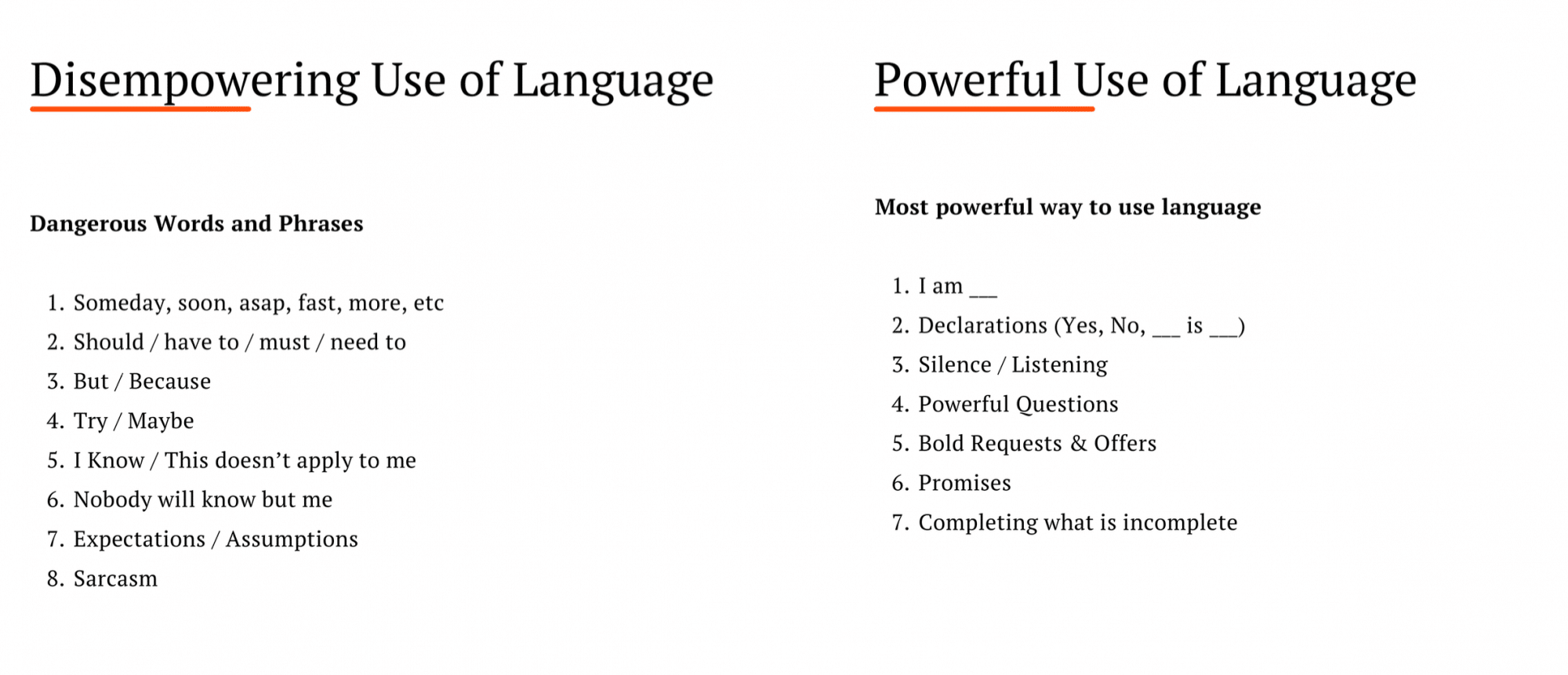
    The session emphasized the power of “I Am” declarations in creating one’s own BEING. Statements like “I am fearless,” “I am resourceful,” and “I am committed” aren’t just declarations; they shape our BEING and influence our actions and results. And we use such language to our detriment all day – examples are “I am weak”, “I am not ready”, “I am not enough”, etc.

    Real-Life Applications of Commitment

    Here are some anecdotal reflections from the session:

    1. Professional Accountability: One participant shared their practice of daily goal-setting and reflection. This habit ensured they stayed on track with their professional commitments and communicated transparently with clients about any delays, thereby building trust.
    2. Personal Integrity: Another participant reflected on how their commitments influenced their personal life, particularly with family. A commitment to spend a quality hour daily with their daughter became non-negotiable, highlighting the power of prioritizing commitments over excuses.

    Why Are You Here? Discovering Your Mission

    A thought-provoking part of the discussion was exploring our overarching mission in life. Questions like “Why are you here?” and “What is your mission?” are profound and pivotal. They invite us to align our daily actions with a larger purpose, enabling us to live a more meaningful and fulfilled life.

    Steps to Embrace Commitment

    • Identify Key Commitments: Determine what you are genuinely committed to both professionally and personally. Write them down.
    • Make Unconditional Promises: Start differentiating between conditional promises and committed promises. Where possible, eliminate conditions and fully commit.
    • Communicate Clearly: Ensure all parties involved in your commitments are aware of your intentions. This maintains trust and clarity.
    • Reflect and Adjust: Regularly reflect on your commitments and adjust as necessary to stay aligned with your goals and values.
    • Practice “I Am” Statements: Daily speaking of your commitment and BEING will create who you are in each moment.

    Conclusion

    Commitment is a powerful catalyst for transforming intentions into reality. By recognizing the true essence of commitment, practicing clear communication, and aligning our actions with our values and goals, we can achieve remarkable results. Transform your promises into committed actions today and witness the extraordinary impact on your personal and professional life.

  • Why “Try & Hope” Is Weak & Not a Strategy

    Why “Try & Hope” Is Weak & Not a Strategy: Turn Wishful Thinking Into Actionable Results by Speaking Committed Language

    Many leaders fall into the trap of saying, “I’ll try,” or “I hope this works.” It feels harmless, but these words are weak. They give you an easy out, allowing you to escape responsibility. Here’s the truth: hope is not a strategy, and trying is not committing. It’s time to ditch the wishful thinking and start using language that drives results.

    The Problem with “Hope” and “Try”

    When you say, “I’ll try to meet the deadline,” you leave yourself wiggle room. You’re already signaling that failure is an option. And when failure comes, you can shrug and say, “I tried.”

    It’s like hoping your car will make it to the destination on an empty tank. Sure, you might get lucky, but chances are, you’re going to stall. And in business, stalling costs time, money, and trust.

    Hope is a dangerous crutch. When you rely on hope, you’re giving up control. You’re handing over responsibility to chance instead of taking action. And guess what? Hope doesn’t pay your bills. Results do.

    Similarly, saying “I hope we hit our numbers this quarter” is passive. You’re handing over control to fate, waiting for the stars to align instead of taking charge. This attitude creates a culture where no one is truly accountable.

    Example:

    Imagine your sales team saying, “We hope to close this deal next week.” What happens if they don’t? You’ve already set the expectation that hope was your plan all along. Instead, if the team says, “We will close this deal,” the energy shifts. There’s ownership. There’s action.

    Why Committed Language Changes Everything

    To create momentum and real results, you need to replace hope and try with committed language. When you commit, you’re saying, “I will make this happen, no matter what.” If obstacles come up, you deal with them. If delays happen, you communicate them immediately. Commitment removes the backdoor and puts you in control.

    What Committed Language Sounds Like:

    • “I will deliver this project by Tuesday.”
    • “We will hit our targets by implementing these three actions.”
    • “I commit to having a solution by the end of the week.”

    Stop Hoping—Start Acting

    Wishing and hoping give you nothing. They’re words of inaction. You’ve been conditioned to use them because they feel safer. But they’re a lie. True leaders don’t hope; they act. They commit to their word and make sure it’s kept.

    When you eliminate “hope” and “try” from your vocabulary, something amazing happens. You take control. You own your results. And your team follows your lead.

    Take Action Now:

    • Review your recent promises. Did you say, “I’ll try”? Change it to, “I will.”
    • Stop your team from saying, “We hope.” Ask them, “What will you commit to?”
    • Create a culture where committed language is the only language.

    When you stop trying and hoping and start committing, you’ll see immediate results. Integrity and commitment breed trust, drive momentum, and lead to real outcomes.

    Your results are waiting for you. They don’t care about your hope. They care about your action. Turn wishful thinking into committed action, and watch how everything changes.

  • Integrity Isn’t Just a Value—It’s the Foundation for Success

    Leaders in every growing company face a common challenge: creating momentum and increasing revenue while maintaining integrity. The key isn’t in adding more strategies or increasing complexity—it’s about aligning actions with promises and ensuring that integrity is the foundation of every step. Without integrity, nothing works. Here’s how leaders can use it to create immediate momentum, increase profits, and cut costs.

    Step 1: Challenge Vague Commitments

    One of the biggest reasons teams fail is because their commitments are too soft. Leaders need to challenge vague agreements and hold people accountable for their “yes.” When a team member says “yes,” it must be a firm commitment, not a way to end a conversation or avoid conflict.

    One of the most overlooked issues in companies is when team members say “yes” out of politeness or a desire to please their bosses or clients, without fully committing. Leaders must challenge these “polite yeses” to ensure that what’s being promised can actually be delivered.

    Politeness and humility often come in the way here. We don’t want to seem rude or incapable, so we nod and agree. But these half-hearted commitments are the cracks in your team’s integrity. When politeness gets in the way, your team ends up overpromising and underdelivering.

    Example:

    Imagine a project where the marketing department promises to deliver a campaign by the end of the month. Everyone assumes it’s a done deal, but the marketing lead hasn’t nailed down all the resources. By the time the deadline approaches, the campaign isn’t ready, and the sales team scrambles to fill the gap. That “yes” was never solid. If leadership had challenged it, asking for clarity on available resources and potential bottlenecks, this could have been avoided.

    Action: Make sure every “yes” is backed by clear, actionable steps. Ask follow-up questions like:

    • “Do you have the resources?”
    • “Are there any risks we need to know?”
    • “How confident are you in delivering this on time?”
    • “What do you need to make this happen?”
    • “What risks might prevent you from completing this?”

    This way, you challenge ambiguity and turn it into concrete, dependable action. It’s uncomfortable, but integrity requires it.

    Step 2: Stop Relying on Hope

    Hope is not a strategy. Yet many leaders allow their teams to rely on hope when there’s uncertainty. Hope may give a temporary sense of comfort, but it doesn’t create results. You cannot build a business on “I hope this works.” Replace hope with action and certainty.

    Example:

    A tech company hopes its new product launch will meet customer expectations, but the feedback channels are weak. Instead of hoping the product works, they could have set up a structured feedback loop early on. By not relying on hope, they would have caught user concerns faster, saving them from bad reviews and a costly relaunch.

    Action: In every meeting, challenge your team to stop using “hope” and focus on real actions. Ask:

    • “What are the concrete steps we’re taking to ensure this happens?”
    • “How are we monitoring progress?”
    • “What’s the backup plan if this doesn’t go as expected?”

    This approach reduces risk and prevents costly surprises down the road. It forces your team to be accountable and proactive.

    Step 3: Track Every Promise—Even the Small Ones

    Promises get forgotten in the chaos of growing a business. One missed commitment can derail a project, frustrate a client, or cause unnecessary rework, which costs time and money. Leaders must implement a simple system to track promises made across teams and departments.

    Example:

    A software development company promises a client they’ll deliver a new feature by a certain date. But there’s no system in place to track this promise internally. When the deadline arrives, the feature is nowhere near ready. The client is angry, the team scrambles, and costly overtime hours are put in. If that promise had been properly tracked and followed up, this entire mess could have been avoided.

    Action: Use a simple tool—whether it’s a spreadsheet, project management software, or even email—to track every commitment. Make sure there’s clear visibility on who is responsible, what the deadline is, and what needs to be done to follow through.

    This keeps the team accountable and ensures that nothing slips through the cracks. The result? Less rework, happier clients, and reduced costs.

    Step 4: Encourage Open Conversations About Overcommitment

    Teams often overcommit, thinking it shows dedication or ambition. But overcommitting only leads to missed deadlines, burnt-out employees, and projects that don’t deliver results. Leaders need to create an environment where it’s okay to say, “I can’t take this on right now.”

    Example:

    A startup was on the verge of launching its new service, and the CEO asked everyone to pitch in. The head of operations took on additional tasks despite already being overloaded. As a result, mistakes were made, the launch was delayed, and the team had to fix costly errors. If there had been an open conversation about capacity, these mistakes could have been avoided.

    Action: Create a culture where team members feel safe to speak up when they are overcommitted. Encourage honesty, and ask them questions like:

    • “Do you have the capacity to take this on?”
    • “What can we remove from your plate so you can focus on this?”

    When you allow your team to have these conversations, you prevent burnout and ensure that projects are completed efficiently, saving both time and money.

    Step 5: Model Integrity by Following Through on Your Commitments

    As a leader, the quickest way to build momentum and drive performance is to model integrity yourself. This means keeping every commitment you make, or addressing it immediately if you can’t. When leaders are consistent in following through, it sets the tone for the entire organization. This is the cornerstone of trust.

    Example:

    Consider a CEO who makes big promises in all-hands meetings but rarely follows up on them. Over time, employees start to doubt his word, and morale plummets. But imagine if that same CEO was known for always keeping his word or directly addressing when he couldn’t. Trust would be built, teams would work harder, and the company would save time and energy spent on unnecessary follow-ups.

    Action: As a leader, always keep your promises. If something changes and you can’t follow through, be transparent and clean up the situation. Say:

    • “I promised this, but things have changed. Here’s what I’m going to do to make it right.”

    This builds trust and makes people more willing to give their best effort, which increases efficiency and productivity.


    Questions to gently provoke you to see blind spots that are currently producing results in your life that you want to avoid:

    1. Have I said “yes” to any requests because I didn’t want to seem incapable, even though I knew I couldn’t follow through?
    2. Have I ever agreed to a timeline just to avoid confrontation, knowing that I had no intention of meeting it?
    3. Have I ever said “I’ll try” instead of giving a clear commitment, leaving myself an escape route if things get tough?
    4. Am I allowing myself to back out of commitments when a “better” opportunity comes along?
    5. In what situations do I agree to things knowing I’ll probably back out or delay without communicating it clearly?
    6. Am I spending more time fixing problems caused by broken promises than I would if I communicated openly from the start?
    7. What opportunities have I lost because I failed to fully commit, opting instead to make conditional promises that I later dropped?
    8. How much stress, anxiety, or guilt do I experience because of promises I’ve made but can’t or won’t keep?

    In Conclusion: Integrity = Performance

    Integrity isn’t just a nice-to-have value—it’s the foundation for success in any business. Without integrity, teams waste time, money, and energy. By challenging vague commitments, replacing hope with action, tracking promises, encouraging honest conversations about workload, and modeling integrity as a leader, you can generate immediate momentum, increase profits, and cut costs.

    Integrity is not about being perfect. It’s about making clear, actionable promises and following through on them. When your team sees that integrity is non-negotiable, they will rise to the challenge. Performance will skyrocket, and your business will thrive.

    Take Action Now:

    • Challenge the next “yes” you hear.
    • Eliminate hope from your team’s vocabulary.
    • Start tracking every promise, even the small ones.
    • Create a space for open conversations about overcommitment.
    • Model integrity in your own actions.

    When integrity drives your decisions, everything else falls into place. Without it, nothing works.


    If Your Hand Went Rogue? (an example I share often)

    Imagine if your hand had a mind of its own. It moves when it wants, does what it feels like, and ignores your commands. You try to drink a glass of water, but the hand grabs a pen instead. You reach to shake someone’s hand, but it fumbles into your pocket.

    This hand isn’t bad, but it’s no longer useful. It’s unpredictable. You can’t trust it. In fact, it causes more harm than good. Soon, you’d have no choice but to tie it down or, in extreme cases, consider removing it to stop the chaos it causes. The hand is no longer in integrity with the purpose it was designed for.

    Now think of promises in your organization like that hand. When people make promises but don’t follow through, it’s like having a rogue hand. It’s not about being bad, but it makes the team or organization unworkable. A promise is a tool—when it’s out of integrity, the whole system starts to fail.

    Just like you wouldn’t trust that hand, you can’t trust promises that aren’t kept. Deadlines get missed, projects fall apart, and trust erodes. The organization becomes less effective, like a body trying to function with a hand it can’t rely on.

    When promises are out of integrity, the entire organization becomes less usable to the extent its promises are out of integrity. Productivity drops, frustration rises, and trust erodes. Just like the rogue hand, things fall apart.

    To fix this, you don’t need to punish the person or cut them off from the team. You need to restore integrity. Have an honest conversation about what went wrong. Clear up the mess, and get back on track.

  • Leadership Journeys [193] – André Vanyi-Robin – “Be humble, but also confident in presenting your value and terms.”

    This is the Leadership Journey series on the Choosing Leadership Podcast.

    I believe we all have a lot to learn from each other’s stories – of where we started, where we are now, and our successes and struggles on the way. With this series of interviews, my attempt is to give leaders an opportunity to share their stories and for all of us to learn from their generous sharing. If you know a leader whom you would like to see celebrated on the show, please send me a message on LinkedIn with their name.

    In this episode, André Vanyi-Robin, founder and CEO of Plastiks.io, shares his journey from bank analyst to pioneering tech entrepreneur tackling global plastic waste. 

    André opens up about the delicate balance between humility and confidence in leadership, the power of short wins, and the importance of learning from failure. 

    He also talks about building a strong team that complements his weaknesses, and how his vision for sustainability is shaping the future of plastic consumption. 

    If you’re a leader facing tough decisions or striving to make a meaningful impact, André’s insights will resonate deeply. 

    Tune in to discover how his personal practices—like drawing inspiration from nature and martial arts—fuel his business success and leadership growth.

    You can find André Vanyi-Robin at the below links

    In the interview, André shares

    • “Leadership is about balancing ego with humility—knowing your worth while recognizing where you need support.”
    • “Plastiks.io aims to make plastic consumption fully transparent by 2029, with all plastic waste tracked for sustainable accountability.”
    • “The burning of the Amazon rainforest in 2018 led André Vanyi-Robin to ask, ‘What can I do to fight climate change?’ This question sparked the creation of Plastiks.io.”
    • “Transitioning from a bank analyst to a tech entrepreneur, André Vanyi-Robin’s 30-year journey is filled with both failures and triumphs.”
    • “André believes in the power of short wins—sometimes tough decisions like downsizing are necessary steps toward success.”
    • “Surround yourself with passionate, smart people who complement your weaknesses and share your vision.”
    • “Recognizing and learning from failure is a crucial part of growth—this mindset helped André shape his entrepreneurial journey.”
    • “André finds inspiration in nature and physical exercise—Jiu-Jitsu and walking in nature help him gain perspective and make sound business decisions.”
    • “With fewer than 100 employees, Plastiks.io seeks to revolutionize global plastic waste management through blockchain technology and rigorous data tracking.”
    • “Raising capital remains one of the biggest challenges, but with perseverance, Plastiks.io aims to create a profitable, impactful software business for environmental sustainability.”
  • 10 Harsh Truths You Need to Hear Again & Again

    Let’s face it—there are things we all need to hear that nobody wants to say. As leaders, entrepreneurs, and high achievers, we like to think we’ve got it all figured out, but the truth is, we often get in our own way. This isn’t about blame, judgment, or criticism. It’s about waking you up to your own potential.

    I’m not here to sugarcoat reality or tell you what you want to hear. I’m deliberately using language that’s provocative and direct (I guess I am becoming more and more Dutch by the day) because sometimes, that’s the only way to cut through the noise. This is not about me or arrogance—it’s about getting you to see what’s possible for you when you step up and own your role as a leader. So buckle up, and take these truths to heart.

    And if one or all of the below truths doesn’t apply to you, ignore it and let it go. I am not here to convince, justify or prove anything. Consider the below as gentle provocations to help you see something of value that you might be missing. And if not, that’s already amazing.

    1. Your Employees Aren’t Unmotivated—You’re Uninspiring.

    When was the last time you made your team feel something beyond the grind? Motivation doesn’t come from forcing people to work harder; it comes from making them believe in a vision worth working for. If your team is dragging, ask yourself: are you leading with energy, passion, and a purpose they can rally around?

    Personal Story: Early in my career, I used to think I had to be the toughest guy in the room. I’d push, push, push, and then wonder why my team wasn’t matching my intensity. It hit me one day when a team member said, “We don’t even know why we’re working this hard.” That was a wake-up call. I realized I was driving them but not leading them toward something meaningful. When I began sharing the bigger purpose and inviting them into the vision, everything changed. Suddenly, they weren’t just working hard—they were inspired to build something with me.

    2. Your Team Isn’t Overworked—You’re Underleading.

    The number of hours your team works doesn’t define their success. But if they’re burning out, constantly overwhelmed, and unclear on priorities, it’s not because they have too much work—it’s because you haven’t given them enough guidance. Leadership isn’t just delegating tasks; it’s about providing the clarity, direction, and support needed to make the load feel manageable.

    Client Example: I was coaching a CEO who believed her team was on the verge of collapse from overwork. But when we dove deeper, it wasn’t the workload itself that was the issue. The team didn’t know where to focus their energy. They felt scattered, not overworked. Once she shifted her leadership to provide clear priorities and restructured the workload, the team started to thrive. It wasn’t about reducing tasks—it was about providing direction.

    3. Your Customers Aren’t Demanding—You’re Underdelivering.

    If your customers are constantly unsatisfied, they’re not the problem (unless you have the wrong customers you know you should say NO to). You are. Customers demand what they need. It’s your job to exceed those needs. Are you consistently showing up for them, or are you falling short? Don’t blame the market when you can control how you show up in it.

    I once worked with a company that was getting frustrated with their clients for what they felt were “unreasonable” demands. But the truth was, the company had stopped innovating. Their product was behind the times, and the customers were just pushing for what should have been the standard. It took some hard reflection, but once the company stepped up its game, the complaints turned into praise.

    4. Your Meetings Aren’t Pointless—You’re Making Them That Way.

    We’ve all been in those mind-numbing meetings that suck the life out of us. But here’s the kicker: if your meetings are a waste of time, it’s because you haven’t made them purposeful. Every meeting should have a clear goal and leave people feeling more empowered, not drained. Otherwise, what’s the point?

    Client Example: One of my clients, a founder, had meetings that always ran long, felt scattered, and frustrated everyone involved. When I asked him why he thought the meetings were necessary, he couldn’t give a concrete answer. We restructured his meetings around clear objectives with action items at the end of each one. The result? Meetings were cut in half, and productivity soared.

    5. Your Business Isn’t Stagnating Because of the Market—It’s Because of Your Inaction.

    Stop blaming the economy, competitors, or timing. If your business is stuck, it’s because you’re stuck. Growth doesn’t happen by waiting for the right conditions; it happens when you take bold, decisive action regardless of the external factors. The market will always have its ups and downs, but how you navigate it is entirely up to you.

    Personal Story: I remember when I first left my tech career to start my coaching business, I was terrified. I found myself waiting for “the right time” to launch, blaming the market and my own doubts for the delay. But eventually, I realized I was the one holding myself back. Once I stopped waiting and took action, even imperfect action, my business started to take off. And guess what? The market didn’t change—I did.

    6. Your Employees Don’t Resist Change—They Resist Poor Leadership.

    People aren’t afraid of change—they’re afraid of chaos. If your team is pushing back on new initiatives, it’s not because they’re set in their ways. It’s because you haven’t communicated the why behind the change or made them feel safe during the transition. Change without leadership is just disruption.

    Client Example: A tech company I worked with was rolling out a major software update, and their development team was resisting the change. The leadership thought it was just the team’s resistance to doing more work, but the real issue was a lack of understanding. Once the CEO sat down with the team to explain the vision and addressed their concerns, the team embraced the change wholeheartedly. The resistance wasn’t about the work—it was about the unknown.

    7. Your Team’s Innovation Isn’t Lacking—Your Support Is.

    Innovation doesn’t happen in a vacuum. If your team isn’t coming up with new ideas, it’s not because they’re not capable—it’s because they don’t feel supported. Are you fostering a culture where risk-taking is rewarded, or are people too afraid to fail because they don’t feel backed up by leadership?

    Personal Story: I’ve seen this firsthand with my own teams in the past. Early on, I would give them a lot of autonomy but rarely provide the support or encouragement they needed. It wasn’t until one of my team members said, “We’re not sure what you expect from us,” that I realized I had failed to support their innovation. Once I started engaging more directly, their creativity and initiative flourished.

    8. Your Projects Aren’t Failing Due to Complexity—They’re Failing Due to Your Lack of Clarity.

    Complexity is part of the game, especially as your business grows. But if your projects are failing, it’s because you haven’t been clear about expectations, timelines, or outcomes. Don’t let complexity become an excuse for disorganization. Leaders thrive on complexity by bringing clarity into the chaos. Make things simple. Then multiply. You can not multiply a complex system.

    9. Your Company Culture Isn’t Toxic Because of Them—It’s Toxic Because of You.

    Toxic cultures don’t just happen. They’re the result of a lack of leadership. If your team is full of backstabbing, finger-pointing, and negativity, look in the mirror. You set the tone for the culture, whether you realize it or not. The good news? You also have the power to change it.

    10. Your Goals Aren’t Unreachable—You’re Just Not Reaching.

    Dreams don’t die because they’re too big; they die because you stop chasing them. If your goals feel unattainable, it’s because you’ve stopped pushing yourself. You’re more capable than you think. The only thing holding you back from achieving greatness is your willingness to go after it relentlessly.


    This is not about blame—this is about waking you up to your potential. Every challenge you face has a solution, and that solution starts with you. You are the leader, the visionary, the one who sets the tone.

    Once again, if one or all of the above truths don’t apply to you, ignore it and let it go. I am not here to convince, justify or prove anything to you. Consider the above as gentle provocations to help you see something of value that you might be missing. And if not, that’s already amazing.

  • Leadership Journeys [192] – Matti Nevala – “We need to be genuinely invested in understanding the challenges our customers are facing.”

    This is the Leadership Journey series on the Choosing Leadership Podcast.

    I believe we all have a lot to learn from each other’s stories – of where we started, where we are now, and our successes and struggles on the way. With this series of interviews, my attempt is to give leaders an opportunity to share their stories and for all of us to learn from their generous sharing. If you know a leader whom you would like to see celebrated on the show, please send me a message on LinkedIn with their name.

    In this episode of “Choosing Leadership,” we dive into the inspiring journey of Matti Nevala, CEO of QOCO Systems, as he shares how he went from running a student painting company to leading innovations in the aviation industry. 

    Matti reveals his transparent leadership style, grounded in teamwork, accountability, and a relentless focus on customer satisfaction. 

    Discover how he tackles industry challenges like the skilled mechanic shortage with digital solutions, while also prioritizing personal well-being and fostering a supportive, energized team. 

    If you’re looking to level up your leadership game, Matti’s insights on aligning personal fitness, mental clarity, and business growth are exactly what you need. 

    Tune in to learn how you can lead with vision, purpose, and a bold commitment to improvement!

    You can find Matti Nevala at the below links

    In the interview, Matti shares

    • “Leadership is a continuous journey filled with choices. Celebrate your courage, embrace challenges, and always strive for improvement.” 
    • “From a student painter to a SaaS specialist, Matti Nevala’s journey showcases his relentless pursuit of growth and innovation.” 
    • “At QOCO Systems, our mission is clear: increase efficiency in aircraft maintenance through digital solutions, ensuring sustainable aviation operations.” 
    • “Matti’s leadership style is rooted in transparency and empowerment, with clearly defined goals and KPIs to engage and inspire his team.”
    • “Fitness, well-being, and leadership go hand in hand. Staying physically active and mentally strong are cornerstones of Matti’s leadership philosophy.”
    • “QOCO Systems tackles the aviation industry’s skilled mechanic shortage by leveraging digital solutions for tool handling and data flow.”
    • “In leadership, personal well-being is just as important as company direction. Matti sets an example with his commitment to fitness, sleep, and nutrition.”
    • “We stay ahead by focusing on the future of technology, including AI’s potential to transform industries and deliver value to customers.” 
    • “Understanding and solving customer challenges is the foundation of Matti’s leadership, driving QOCO’s customer-centric approach.”
    • “Supporting employees’ well-being through flexible work, gym access, and social activities is key to fostering a strong and motivated team at QOCO Systems.”