May 2019

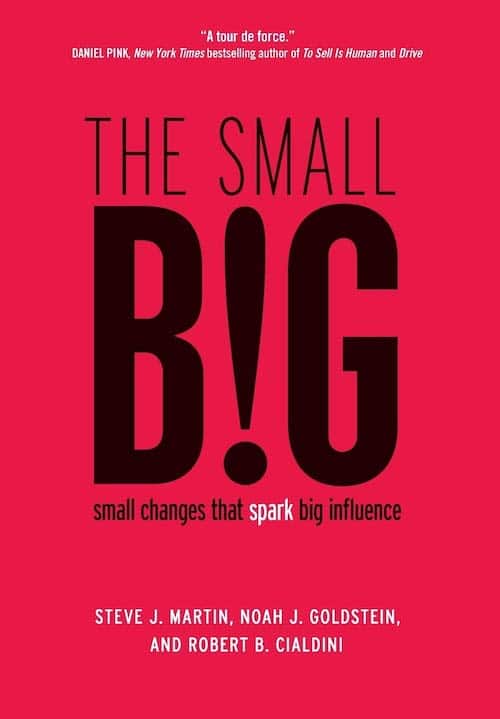
  • The Small Big by Steve J Martin, Noah J Goldstein, and Robert B Cialdini

    Negotiation and persuasion are part of our lives, whether it is as a parent negotiating with a child, or negotiations with a prospective client. Winning the opposite person over doesn’t require more than exercising persuasion tactics that one can easily learn to make a big difference. 

    The Small Big by Steve J Martin, Noah J Goldstein, and Robert B Cialdini, gives us small changes to incorporate in our behaviors for more confidence and success.

    Persuasion Can Impact Commitment

    Persuasion is very important. A small change in persuasive tactics can hugely change behaviours for the better. 

    A lack of persuasion can have expensive consequences, especially when we lose a lot of revenue as a society. For example, in the health care industry DNA, meaning ‘Did Not Attend’ refers to all the patients who have an appointment but do not show up. DNA issues amount to about 800 million pounds of revenue loss in the UK itself. Simply persuading patients to show up for appointments can save the economy a lot of revenue loss. 

    Similarly, late, or absent payments are the reason heavy charges are paid by governments, companies, and consumers alike. Even slight persuasion in the form of detailed information can help change the approach of people.

    Another example is persuading employees in an organization to switch off the light that is not needed. This can impact electrical costs for a company and help the environment at the same time.

    Unfortunately, as simple as these rational measures seem, they fail. However, the science of persuasion believes that a small change in how people are persuaded to follow these simple rules can lead to a big change for the better.

    Therefore, to get employees to remember to switch lights off, a garbage bin can be placed below the lights. This will predispose employees to switch off the lights at the end of the day as they empty the bins.

    The idea is to change the way people perceive their commitments and how they go about acting on them.
    How Changing Environment Can Change Behaviour

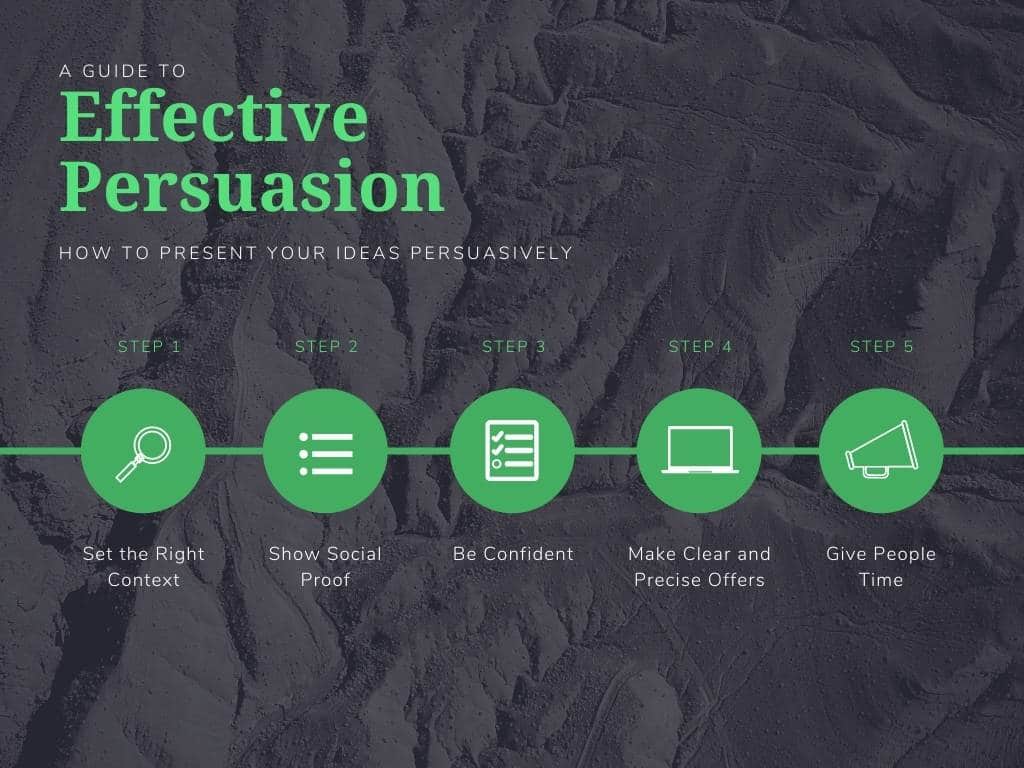
    The environment that exists during any negotiation or persuasion makes a big difference to the success of the persuasion. Environments can also affect how responsible a person is depending on the situation.

    An experiment conducted by Keizer of placing advertisements on the bikes of customers in front of a shopping mall showed how people’s behaviors changed depending on the surrounding environment.

    When graffiti was present on the walls of the adjacent alleyway, about 69% of the people threw the pamphlets on the floor. When there was no graffiti, only 33 % threw the pamphlets on the floor and littered the space.

    Another experiment showed that seating arrangements during a group discussion changed the results of the discussion. They found that discussions that focused on what outcome is best and ideal for the group as a whole took place in circular seated groups, whereas square, rectangular or L-shaped arrangements led to discussions where outcomes were influenced more by self-oriented decisions and proposals.

    Similar to seating arrangements and surroundings, different venues can affect negotiations differently. For example, in sports competitions, the home advantage plays an important role. A study conducted on decisions, outcomes, and performance showed that a group with home advantage (the group that was allowed to tailor the negotiation room to suit their needs and comfort), performed better in negotiations than the visitor group.

    Majority Wins!

    When it comes to what influences our thoughts, actions, and behaviors, we have to consider how people we identify with, and the influence of the people around us have (on us). This tendency to get influenced is called social proof.

    The idea used by the UK based company Influence At Work to address the problem of people not paying taxes is a good example of social proof. They decided to include a single sentence in the government reminder letters that many citizens from the same area were paying their taxes on time. The rate of response gathered from the reminders rose from 67% to 79%, and subsequently rose to 83% when the name of the town was included.

    Research on neuroscience has shown that when people make decisions that are in conflict with the consensus, certain parts of the brain that are associated with emotions get activated.

    On the other hand, people tend to distance themselves from groups that don’t like or approve of. An experiment conducted on students showed that about 32% of the student group were more likely to stop following a trend of wearing bracelets when an unpopular group of ‘nerds’ were sporting the trend. There was only a 6% drop in bracelet wearing without the influence of the ‘nerd group’.

    If one needs to influence and bring out desired behaviour, they need to use qualities that the focus group considers good and identifies with.

    Others’ Mistakes Are As Important As One’s Own

    One way to persuading oneself to improve is to keep an eye out for mistakes. By noting and analyzing our own as well as others’ mistakes, we can use these mistakes to our advantage.

    If a leader wants to succeed and better his organization, he should look at the mistakes his competitors made that led to failure, rather than analyze the triumphs. Charlie Munger, Warren Buffet’s investment advisor analyzed and avoided the failed decision of other companies, and made a list of errors and mistakes of others called the inanities list. 

    While it may go against all we have been conditioned to  – that is to learn from others’ successes – Prof. Roy Baumeister and colleagues learned that people focus more on negative information and learn more from it.

    One should understand that mistakes are the stepping-stones to success and that mistakes should never be ignored. Organizational Scientists propounded the EMT – Error Management Model – is more effective than the error avoidance slant. This model, being similar to the Inanities List involves understanding one’s own mistakes, analyzing others’ failures, and then responding appropriately to them. This model is known to improve customer services as well.

    Persuasion and Self-Confidence

    The persuader itself is equally important to changing and influencing behaviors. Making small, yet effective changes in how a persuader portrays oneself can work wonders too. For example, if a person is able to persuade the opposite person that he is an expert, he is 50% closer to be successful at persuasion.

    That is the reason why we tend to listen to the advice given by a financial expert like an economist when we do not have enough knowledge of the subject. This tendency was seen in recent brain-imaging studies, as well as the fact that the areas connected with counter-arguments and critical thinking remained inactive when the expert factor ruled.

    Self-confidence plays a big role in persuasion. This was seen in an experiment conducted on two groups who were going to attend a job interview. The first group was asked to note experiences that made them feel powerful, and the other group was asked to note experiences that made them feel powerless. It was seen that the first group outperformed the second, simply because their confidence levels were elevated.

    At times, however, insecurities, especially articulated insecurity can be very persuasive too. The restaurant review of a food critic that articulated insecurity was more persuasive than another review that said the critic was 100% positive that the restaurant was good. The study showed that people tend to pay more attention when experts are insecure about their topic, making the message delivered more persuasive.
    Motivation and Commitment

    When people get demotivated, they start feeling detached from their jobs. For managers in organizations who need to motivate their team members, they need to understand that people don’t achieve their full potential when they start believing that their contributions are not significant enough.  They need to help their teams be personally committed and introduce the concept of ‘implementation intentions’.

    If we consider the DNA issues faced in the healthcare industry, a simple solution of making patients write their own preferred dates of appointments, made DNA rates fall by 18%. This happened because people were forced to make commitments themselves. It was the perfect use of an ‘implementation intentions’ plan.

    Another good example of an implementation intention plan at work is seen in a study in which some households filled out a voting plan, with details of time and location of voting, and some households not filling any voting plan. The results showed that those who filled out a voting plan were more likely to be present on voting day.

    Intention plans can help us carryout, reinforce, and change behaviour because they make people find motivation in making a commitment.

    Making An Offer Successful

    During any negotiation, along with the environment and the manner of negotiation, making a clear and precise offer first is also a sign of good negotiation skills. Let us take the example of making an offer to a customer. Customers tend to base their negotiations and deals on the first offer that is made to them. They tend to adjust their expected figures even though the first offer exceeds their expectations.

    For example, research has shown that a buyer will tend to finalize a deal closer to the first higher bid a salesman makes. So for example, if a car salesman makes a customer an offer of $5000 when the prospective customer is prepared to pay $2000, the final offer that the customer will settle on will be closer to $5000, due to the anchor effect.

    This also happens because people tend to believe that salesmen are experts in their field and attribute higher pricing to product values that they do have knowledge about.

    Another way to make customers see the value in the first offer is to partner it with an unappealing offer. For example, the chef Antonio Carlucci had a Vespa Scooter for sale along with the pasta and salads on the menu. This is called a perceptual contrast that affects negotiations.

    Giving People Time

    Apart from all the aforementioned tactics, there is one factor that affects negotiations and often tends to result in failure. That factor is time. People sometimes need time to make decisions. Negotiations and persuasion should always take the time factor into account.

    When one thinks of making decisions for or in the future, they involve abstract thinking and take time to consider how one’s own morals and values fit in with the decision making. If the decision fits in, the person is more likely to agree to the negotiation.

    Therefore, if one has to make plans with friends to go out on a particular day, it is better to ask them as early as possible. They will more likely to agree to make a plan if they dint have definite plans in place.

    This concept also works in the opposite. Essentially, for influencing negotiations that are time-bound, giving more time for decision-making could result in failed negotiations.

    Conclusion

    Persuasion is a powerful tool in changing behaviors and impacting commitment. It depends on and is influenced by the environment, by the influences of the majority, by paying keen attention to one’s own and other mistakes, by portraying confidence, by fostering motivation and encouraging commitment, and manipulating the time given to people to make decisions.

    People who want to improve their negotiation skills should focus on making those small yet essential changes in their behaviours.
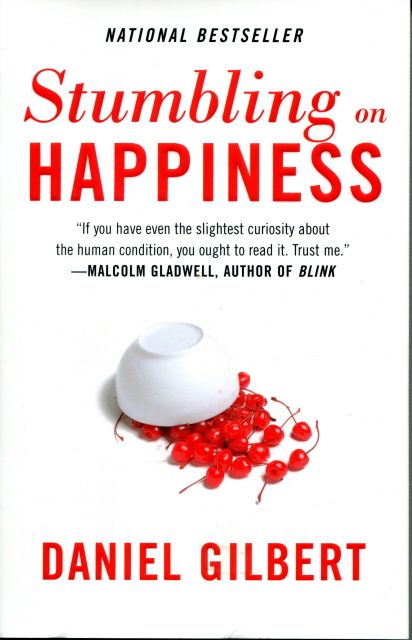

  • Stumbling On Happiness – Daniel Gilbert Shows Why We Have No Idea How To Make Ourselves Happy

    Why do we make choices and decisions about our future that makes us unhappy? 

    Stumbling on Happiness (2007) by Daniel Gilbert shows the complex manner in which our brain processes information and influences our decision-making process. Through everyday examples, the author explains how we can understand ourselves better and make decisions for happier outcomes.

    The Brain Can Visualize What We Didn’t Saw

    Our brain is wired in a way that it can fill in the missing details that lie beyond what we actually saw. It has the capability of creating the missing picture and construct a complete story through imagination.

    It works in similar ways when it needs to remember past events. The information stored in our memory is so vast, that it only remembers key events. Therefore, our ability to recall the past is always a mix of imagination and reality and not the reality that we have experienced. 

    Example: If we try to recall a memory of a bad experience in a restaurant, the brain will bring forth only key details like an argument with the restaurant manager, the manager apologizing, etc. It will fabricate the rest of the event, like the general set-up of the table, the manager’s facial expressions, etc.

    The brain does this so fast, that we are often unaware that the brain has made up these details.

    Our Brain Predicts Futures

    The brain perceives the immediate future on the basis of past experiences and general knowledge. Once the future is predicted, we cannot see any other alternative to that future. Moreover, we set our mind to believe and trust that it is a good prediction, without considering any other outcome.

    Example: If we are going to visit a friend’s house we have never been to, the brain will fabricate a picture of us enjoying the evening with the set of friends. It will then create images and fill in details of a glass of wine, laughter, etc.  But it will not consider a possibility of heavy rain canceling the visit, or say, a flat tire on the way.

    This happens because we tend to trust the brain’s visuals of a good evening and leave out the negative outcomes. Our brain has the habit of making positive predictions for all our futures, making us blind to any other possibility. We trust our predictions of the future when they are merely a single scenario among many.

    “If you are like most people, then like most people, you don’t know you’re like most people.” — Daniel Gilbert

    Mistakes Happen Because of Emotions

    We tend to believe that our predictions of the future are rational. What we do not realize is that these predictions are largely influenced by our emotional states at that time. 

    The brain has evolved over time to focus on the present (for survival) rather than the future, and our present emotional states influence even our future predictions. Therefore, the future predictions of the brain are rarely reliable.

    Example: If a person wants to create a presentation for work in an angry mood, the brain will be unable to conjure a good outcome. The person will tend to focus on other negative factors such as getting anxious while presenting, mixing up important numbers, etc., and the pessimism may even lead to the person postponing or canceling the work.

    Due to this influence of our emotional states, we tend to make mistakes while making decisions about the future.

    The Brain Places Undue Importance On Price Rather Than Satisfaction

    When it comes to the value of anything, our brain is wired to focus on the value of its price rather than the value of the satisfaction gained. This tendency is true for all commodities and products. However, it is a narrow view that can lead to errors in judgment.

    Example: If we are buying a cup of coffee that costs a dollar more than it used to, we think it is overpriced. We place more value on the increase in price rather than the satisfaction we gain from it. If we compare all the things (like a parking space for five minutes or a pack of gum), that we can get for the same price of coffee of $2.5, we would perceive its value it differently. The brain uses the yardstick of the past value of any product to decide whether it is overpriced or not.

    This applies to many other purchases too. Due to this natural tendency, we make simple errors when money is concerned.

    “Most of us appear to believe that we are more athletic, intelligent, organized, ethical, logical, interesting, open-minded, and healthy-not to mention more attractive than the average person.” — Daniel Gilbert

    Unique Experiences Become Stronger Memories

    The brain is conditioned to memorize unique and strange experiences over the regular and mundane ones. The brain tends to filter out regular happenings in our lives and remembers unique experiences with detail. 

    The brain has evolved to believe that these memories, which we can recall with ease, happen often. The brain makes inferences based on the better, unusual experiences, rather than the whole experience – which might not have been as great as our mind makes us believe. 

    Example: If we spend a week camping in uncomfortable conditions, and towards the end of the trip, we find a $100 bill, the mind will focus on the uniqueness of finding the money rather than the total unpleasant camping experience.

    Therefore, we cannot only trust our memory while making crucial decisions, especially while deciding if we should do the same thing again.

    We Believe Something More If It Benefits Us

    The brain has a tendency to believe information if it is beneficial for us or the society, even if it is untrue.

    Example: Everyone believes that if they have more money, they will be happier. However, this belief is relatively inaccurate. While having more money does make people happy (if they are raising themselves out of poverty), but looking at the larger picture, money does not bring infinite happiness.

    Yet, people believe (and have been believing) in the false myth that more money equals happiness, simply because it is beneficial for not only an individual but for society and the economy as a whole.

    We Often Refrain From Taking Advice From Others

    Our brains are wired to think that we are truly unique individuals. It tends to make us believe that our experiences are unique to us. Therefore, the brain does not think that advice from others will be useful.

    In reality, people have similar experiences and also react to these experiences in a similar manner. Therefore, it is quite possible that solutions can be sought by listening to other people’s experiences and opinions.

    Example: A person planning to quit their job and go on a world tour will tend to keep thinking about the pros and cons of their possible decision. However, if a friend offers advice about traveling, the person will tend to disregard the advice thinking that their situation is different, and the advice irrelevant.

    This tendency can be detrimental to making good decisions.

    “Among life’s cruellest truths is this one: wonderful things are especially wonderful the first time they happen, but their wonderfulness wanes with repetition.” — Daniel Gilbert

    The Brain Regrets Inaction

    The human brain is designed to learn from bad decisions. It has a defense mechanism to look for positive learnings from unpleasant experiences in hindsight.  Additionally, the mind is also wired to regret inaction. This is because, the mind cannot comprehend, and therefore come up with a valid explanation to events that it does not have information for.

    Example: A person will regret not marrying a noble prize winner whereas, will consider marriage to a murderer as a bad decision. The person will, in hindsight, think that they learned something from the bad decision of marrying the murderer, whereas, because he cannot draw conclusions from past experience of marrying a noble prize winner, will regret the decision.

    We often do not know that our brain works in this manner. Therefore, it is better to decide and learn from the mistakes rather than not make the decision at all, and to be stuck in inaction.

    We Have A Built-In Defence Mechanism Against Trauma

    The brain sets in action a peculiar defense mechanism in the event of devastatingly traumatic experiences. It psychologically numbs us from pain to a certain extent, so that we do not get mentally crushed with the grief. This mechanism, however, does not engage for trivial experiences.  It is due to this trait of the brain that we cannot imagine how we will react to extremely traumatic events.

    Example: A person who has just gone through a divorce would start accepting the situation and bounce back faster than expected. At the same time, the same person will fret for days if they lost a phone.

    We are often unaware of this defence mechanism and can make behaviours and decisions that seem strange.

    The Paradox of Choice

    The phrase, ‘being spoilt for choice…’ holds true for our brain. The moment the brain knows that there are alternatives, it is conditioned to explore those alternatives further. On the other hand, not having a choice at all makes our thoughts and decisions unidirectional, forcing the brain to see them in a positive light.

    Example: If we receive a T-shirt as a gift from a friend and know that we have the option of exchanging it, we tend to start looking for reasons to exchange it. However, if there is no choice at all, we will not even think of why we don’t like it. The focus will be on the positive aspects of the gift.

    We do not know that the brain reacts in this manner. Therefore, a lack of choice makes us happier rather than having multiple choices at hand.

    “The bottom line is this: the brain and the eye may have a contractual relationship in which the brain has agreed to believe what the eye sees, but in return the eye has agreed to look for what the brain wants.” ― Daniel M. Gilbert

    The Mystery In The Unexplained Appeals To Our Brain

    There is a special appeal in the unexplained. Not knowing the cause behind anything, compels the brain to try and solve the mystery. The brain gets attracted to these rare, unexplained events eliciting a stronger emotional reaction.

    When we get an explanation for the mystery, the brain loses the appeal. If the mystery is a negative one, then the explanation becomes beneficial, as the brain stops pondering over it and its impact lessens, however, if positive, then the excitement diminishes, robbing us of the happiness of that experience.

    Example: If we receive a mysterious gift from an admirer, we tend to find excitement and happiness in the mystery of it. However, once we know who the admirer is, the excitement dies out. 

    We All Live In Our Own Echo Chambers

    Our minds are conditioned to selective perception and retention. It has a tendency to only retain information which we already believe, ignoring the rest. This is evident in a person’s choice of friends. We tend to make friends with people who are similar to us. 

    Keeping this in mind, seeking advice and opinions from our friends could be biased due to the fact that it will most likely be similar to our own views. Without knowing this trait, we tend to put our faith in these opinions.

    Example: One often finds that they share similar tastes in music with their friends. Therefore if they seek validation of their taste in music, it will be more likely that their friends will give advice that is biased due to these similarities.

    The decisions we make about our future often cause us unhappiness because we are not fully aware of these unconscious processes that the brain is conditioned to follow. Unknowingly, we are susceptible to make errors in decisions leaving us unhappy with the results. 

    We need to pay attention to our cognitive biases in order to understand the way the brain functions. In ‘Stumbling on Happiness’ Professor and author Daniel Gilbert combines psychology, neuroscience, economics and philosophy to show how our imagination is really bad at telling us how we will think when the future finally comes. This book will help you eliminate a lot of noise with some powerful insights drawn from psychological studies.

  • The Infinite Game (2019) by Simon Sinek

    Today’s work culture is fast-paced. Companies rise and fall like dominoes in a chaotic and dynamic business environment. The concept of a big, old company that has been stable for decades is a slowly fading concept. Not many young companies today have what it takes to convert a company into a stable and strong one that has been around for generations.

    The Infinite Game (2019) by Simon Sinek shows that there are more attributes to the growth of a company, its strength, and its stability than finances, stock, share prices, and investors. 

    Today’s leaders need to look to the future and make plans that are ahead of their time. They need to inculcate the habit of long-term thinking and planning and enable their employees to dream into the future that will help them form strong bonds within teams and realize the long-term vision of the company.

    The Infinite Mindset

    To create an infinite mindset within a company, one has to first understand what it actually means. Let us consider a game of football. There is a definite start and stop time. There are rules surrounding the game such as how goals are made. How the winner is decided is also defined and fixed. Football is therefore a finite game.

    Business on the other hand is an infinite game. Apart from the legalities that they need to follow, what players do within those rules is not specified and neither is the start and stop times. Moreover, there is no specified manner in which the winner is decided.

    In an infinite game, the idea is to simply stay in the game for as long as one can. This requires planning different than that of a finite game. It requires an infinite mindset that will enable organizations to think beyond winning into creating an organization that focuses on lasting and on staying on top of the game long-term.

    If we look at Microsoft, Bill Gates wanted to “empower every person and every organization on the planet to achieve more.” While this goal showed an infinite mindset, in the early 2000s, CEO Steve Ballmer applied a finite mindset and focussed on winning more market share. They tried to focus on beating Apple with products such as Zune, to compete with Apple’s iPod. While Apple became famous for innovation and creating new markets, Microsoft’s short-term goals led to a tunnel vision. Due to this they lost focus and were not able to make their mark as a company that innovates.

    The Five Keys To Infinite Mindset

    There are five important keys to creating an infinite mind-set. They are – 

    • Having a just cause
    • Ensuring trusting teams
    • Understanding worthy rivals
    • Preparing for existential flexibility
    • Showing the courage to lead

    Victorinox played the infinite game. Their Swiss Army Knives were a popular product and accounted for almost 95% of the sales of the company. However, after 9/11, the knives were banned from airline cabin luggage. This caused the sales to plummet. 

     In spite of the downfall of sales, CEO Carl Elsener understood that business has its ups and downs. Instead of thinking about the short-term downfall, the company boldly branched out into new markets. They ventured into fragrances, watches, and travel gear, with the Swiss Army Knives accounting for only 35 percent of the sales. This change was a success.

    The company showed that though ups and downs are inevitable, companies have to focus on ‘thinking in generations’ like Victorinox did.

    Having A Just Cause

    A ‘Just Cause’ is an inspiration for the employees of the company to focus on the future. It defines the goals for employees and represents the benefit a business aims at. It is bold, inclusive, and idealistic, and is resilient in the face of change. Many companies mistake a ‘Just Cause’ for a mission to aim at the highest and the best position, in other words, a ‘moon shot’.

    The GPS making company Garmin’s mission statement is, “We will be the global leader in every market we serve and our products will be sought after for their compelling design, superior quality, and best value.” While it seems like a valuable mission statement, talking about becoming a great company, it gives customers importance as an afterthought.

    Since 2007, the company has been on a decline, and now has a third of the value it had in 2007. This happened because they refused to focus on the needs of their customers. While smartphone companies started offering GPS tracking services, Garmin chose to focus its efforts on making their own products, rather than venture into the smartphone market. 

    Capitalism: Then And Now

    When we talk about ‘Just Cause’, one needs to keep in mind the concept and guiding principles of capitalism. Who is more important for the company, the customers, or the shareholders?

    Adam Smith’s The Wealth Of Nations written in the mid 18th century put the interests of the consumer over those of the shareholders. Paving the foundation of capitalism for the next 200 years, the book stated the obvious principles of business – customers are the primary focus of any company.

    In the Mid-20th century, Milton Friedman, a Nobel-Prize winning economist, wrote a highly influential article that moved the focus from customer to shareholder. The article stated that for any free-market enterprise, the primary focus is to make money, and that money belongs to the shareholders of the enterprise.

    The shift of focus was seen more strongly in the 1980s and 1990s, when business plans centered around profit-making, focussing on short-term earnings. The primary focus of business plans revolved around making shareholders happy. And thus, it was not stability, longevity, and quality of service that decided the success of a company, but Wall Street’s numbers that became more important. Therefore, companies focused on boosting their ROI by cutting costs, layoffs, and cutting R&D budgets.

    In the past few decades, however, capitalism has become imbalanced. Stock market investing is at a 20 year low. With the shift in focus from customer to shareholder, the CEO’s and owners are enjoying a 950% earning increase vis. a vis. a mere 11% earnings increase for the average employee. These numbers signify a dangerous trend implying catastrophic market crashes in the future. It seems that Adam Smith had the right idea back then.

    Employees Before Earnings

    If organizations have to focus on longevity and creating an infinite mindset, they have to focus on the will of the people (employees and customers) who are supporting the company. This has, since Friedman’s shareholder-centric capitalism, become virtually impossible. Companies have put so much into making their shareholder happy, that it will take massive changes to go back to Adam Smith’s idea of capitalism.

    Companies need to put their faith back into their employees. This can be done with a strong ‘Just Cause’ of drawing employees into the company’s vision for the future. A company has to respect its employees along with their customers, an endeavor that can be highly rewarding for companies.

    The will of the people of a company can be measured by their morale, and by how inspired and committed they are to the ‘Just Cause’ of the company. Let us look at the examples of Apple and The Container Store.

    Apple made the bold move of giving its retail store employees the same benefits of health care and retirement as their corporate employees enjoyed. This move saw their employee retention rates skyrocket to 90%, while the average industry rate was at 20-30%. This enabled Apple to reduce recruitments costs and see motivated, loyal employees, delivering better services.

    Similarly, The Container Store, after the 2008 recession, needed to find a way to reduce costs. Instead of lay-offs, the company employed an infinite mindset and announced a temporary salary freeze. In a time of people losing jobs, the employees of the company understood the decision and worked hard to find ways to reduce costs for the company. 

    Creating a Culture of Trust

    Companies that focus on profits alone end up having an uninspiring ‘Just Cause’. This can lead to distrust amongst employees along with unethical business practices taking root, thereby reducing business longevity. Without trust, companies see an increase in poor performance and accidents.

    The CEO of Ford Alan Mulally saw a distrusting culture in the company when he came on-board in 2006. The previous CEO was known to berate and fire employees who got him the bad news. Therefore it became the norm to bring only good news to the CEO.

    Mulally knew he had to change the culture of the company and started encouraging employees to bring him all types of news – good and bad – to weekly meetings. He soon broke through the trend when an employee chose to trust him and share problems at the meeting. Mulally applauded the employee’s initiative.

    Without a culture of trust, where the company is aligned with profits rather than its people, unethical business practices take root. In Wells Fargo, an investigation showed that more than 3 million fake bank accounts were created between 2011 and 2016. This had happened because CEO John Stumpf had created a high-pressure sales culture that was untrustworthy. Employees resorted to unethical practices out of the fear of getting fired.

    Understanding Worthy Rivals And Preparing For Existential Flex

    An infinite mindset encourages worthy rivalry. This essentially means, competing with opponents who (due to their superior skills) businesses are forced to improve their own skill levels and techniques.

    Alan Mulally saw that Ford had spent fifteen years losing twenty-five percent of the market share. He was presented with a plan that was a finite-minded one. It involved cutting costs and increasing sales promotions. Mulally decided not to chase market share. Instead, he encouraged his senior management to drive cars made by Lexus and Toyota, to study and understand why these cars were preferred.

    Also when the 2008 recession hit, he chose not to put other competitors in the market out of business. Though Ford was financially stable, he knew that out-competing his rivals meant putting vendors and suppliers (who Ford relied on too) out of business. He chose to support his vendors by supporting his rivals.

    Learning from rivals goes beyond understanding their tips and tricks. At times, business leaders should perform an Existential Flex – a self-prescribed change or even a self-disruption – something that is extremely difficult for a finite minded company to do.

    Steve Jobs, in 1979, saw Xerox’s graphical user interface (GUI) technology. He immediately changed plans and incorporated GUI in his computers. This introduced the point and click the mouse. It also gave users a desktop icon for folders, making it easier for his customers to use his products – without knowing any computer language. He stuck to his ‘Just Cause’ of making computers an empowering tool for as many people as possible, despite warnings that the drastic change could be detrimental. Four years after that, the first Macintosh was released. It took Microsoft four years after that to release Windows 2.0 with a GUI.

    Bold And Courageous Decisions

    A strong ‘Just Cause’ goes beyond just one leader or profits. This very ‘Just Cause’ guides a leader towards the specific purpose the just cause pursues. It takes courage to lead a company towards an infinite mind-set.

    When a leader shows courage, it shows his commitment to the cause thereby setting an example for the employees. At times, this can prove to be a challenge because most CEO’s are promoted from COO (Chief Operating Officer) and CFO (Chief Financial Officer) designations. The day-to-day operations these executives are involved in are finite-minded. They are not prepared to step into the responsibilities of the CEO designation.

    They need to understand that a CEO actually works in the capacity of a Chief Visionary Officer who is the guiding voice and guardian of the ‘Just Cause’. In action, this responsibility helps in alignment with the company’s ‘Just Cause’. For example, the long-running pharmacy and drugstore chain CVS Caremark decided to stop selling cigarettes in their stores despite a loss of cost predictions of about $2 million. This was done to align the company practices with their ‘Just Cause’ of helping people to better health. On the day the announcement was made, the stocks of the company dropped by 1%. However, after a year and a half, the price doubled to a record high. This happened because after they stopped selling cigarettes, the sales of nicotine patches and gum shot up. They even approached by health-focused vendors who had avoided them earlier. This led to a 70%increase in stockholder earnings-per-share over the next three years.

    Conclusion

    The infinite mindset completes a full circle. It begins with a ‘Just Cause’ and endures through creating trusting teams, being inspired by worthy rivals, preparing for the Existential Flex backed by bold and courageous decision-making. It takes companies through a process that helps them to stay in the game and succeed in the long run.

  • 5 Negotiation Lessons From Never Split The Difference (Even If You Think You Are Not Good At Negotiating)

    Negotiations are everywhere. They don’t just take place in courtrooms and board rooms. Negotiations also take place when we want our children to spend less time watching TV or try to get a business partner to see our point of view. We are continuously negotiating in life. 

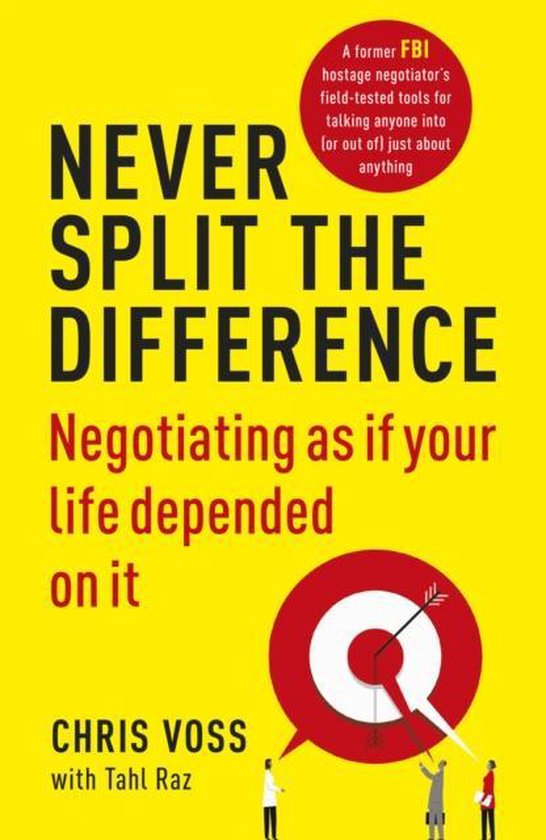
    Never Split The Difference (2016), authored by Chris Voss and Tahl Raz is extensively based on Chris Voss’s experience with negotiation in the FBI. The book highlights many practical skills one needs and can learn for successful negotiation in all walks of life.

    What Is Negotiation?

    Negotiation begins with wanting a desired specific outcome. When two or more people need something from each other, negotiation takes place. But how does one master negotiation and apply it to every aspect of life? 

    Convincing others and dealing with human emotions is an art that needs practicing and developing over time. It requires more than keen intellect, rationality, and logic. The challenge arises because human beings do not make decisions rationally. We are known to act spontaneously and unpredictably due to our primitive instincts and emotions.

    Psychologist Daniel Kahneman’s and economist Amos Tversky’s extensive research found that (contrary to earlier belief stating that humans act in a rational manner and to their own advantage) humans are predisposed to cognitive biases, leading to subconscious irrationalism. They derived more than 150 biases that could affect negotiation abilities due to the complexity of the human mind. 

    In short, all of us make decisions and negotiate based on our emotions much more than we realize. That is why it is very difficult to negotiate with people using only the facts. Chris Voss shows us in his book that everyone, regardless of whether they are your colleague or a bank robber, has a human desire to be heard, to belong, and to feel safe and important.

    Below are 5 of my biggest negotiation takeaways from the book :-

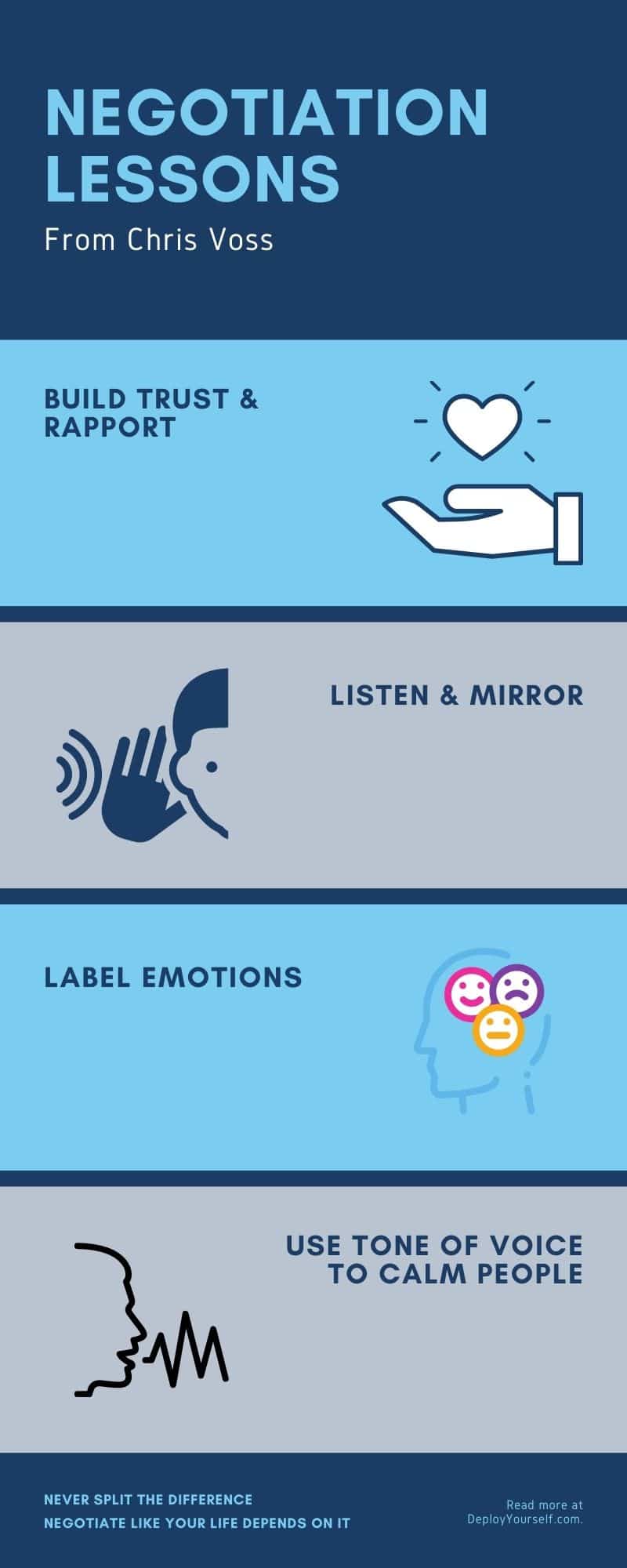
    1. Build Trust & Rapport To Get Information

    To be good at negotiation, one must be adept at procuring accurate information. Without having enough information about the opposite person or the situation, one is likely to lose. Moreover, new information can completely change the equation, therefore one must be able to process the new information and play their cards accordingly.

    To gain more information, a negotiator must gain the opponent’s trust. This must be done tactfully by building rapport and getting the opposite person to divulge information through empathetic conversation rather than interrogative methods.

    The author worked with 24 years with the FBI and was the main kidnapping negotiator for many of these years. Chris Voss discusses a 1993 bank hostage case where the robber fed them wrong information. He informed the police that he and four partners were in the bank, when in fact he was alone. His partners robbed an ATM, while he took the bank hostage and confused the police.

    That’s why you need to establish rapport with your counterpart. One way to do that is to get the other party to talk a lot. As they do, you’ll be able to figure out what they want.

    2. Listen, Mirror, Listen, Repeat

    In negotiations, listening skills are essential. When one pays attention to what the opposing party is saying, it makes the opposite party feel important. Employing ‘active listening’ is important to show empathy and connect at a personal level.

    A technique called mirroring (simply repeating what the person says but with an inquisitive tone) builds rapport. The opposite person feels a sense of importance and makes them feel that their needs are understood and this creates trust. Mirroring helps trust-building and getting vital information from the opponent that the negotiator can use to his advantage.

    In the previous 1993 bank robbery case, when the robber divulged that his driver had bolted, the author kept mirroring to the robber, “Your driver was chased away?” This led the robber to divulge vital information that enabled Voss’ team and the NYPD to apprehend the driver, helping the case.

    The adversary is not the person across the table; the adversary is the situation. — Chris Voss

    3. Use Your Tone of Voice As A Tool

    During negotiations, our tone of voice and body language plays a vital role. The tone of voice that a negotiator uses can determine and guide the direction in which the negotiation heads. Using a slow and soft, but deep voice (also known as the Late-night DJ Voice), seems reassuring to the opponent, and helps the opponent to calm down and in turn share titbits of information. 

    The author, while taking over the bank robbery case from his colleague used this voice to calm down the robber. It prevented the robber from getting unnerved by the change in negotiators and talk further.

    However, different situations need different tones. Unlike negotiations with criminals, closer-to-home situations (like negotiating with a partner or children) require a playful and positive tone, that emanates an easy-going attitude, empathy, and encouragement.  Smiling is an easy way to disarm the opponent and make any conversation more pleasant. When one smiles while talking, the pleasantness of the smile extends naturally to the tone.

    4. Label Emotions To Force Empathy

    A good negotiator understands that the opponent’s emotional state is valid and real for them, even if you don’t agree with it. Essentially, one should try to look at the situation from the perspective of the opponent with empathy. While one does not need to agree with the opponent, using the technique of labeling – telling the opponent the exact emotion they feel and that you understand them. Labeling builds trust and makes the other person listen and communicate better.

    A classic example of labeling can be seen in a 1998 case, when four fugitives, armed, were hiding in an apartment. The author told them that he understood what they were feeling (afraid, scared) and understood their worry about going back to prison. After a few hours, the fugitives surrendered. Through labeling, the author had managed to calm them down enough to think about their situation rationally.

    “Unexpressed negative emotions never die. They fester like an infection” — Chris Voss

    5. Never Rush, Never Push People, Never Compromise

    It is natural to want to reach the end of a negotiation soon. However, rushing through negotiations can result in clouded judgments and a dissatisfying result. When an opponent sets deadlines, good negotiators take their time, digging deeper for more information. It is crucial to remember that most deadlines are relatively random and flexible.

    Negotiators should also avoid accepting a bad deal in haste and should never compromise. This is also known as splitting the difference. Often, deadlines and demands do not necessarily reflect the exact needs and thoughts of the opponent. Therefore, giving in or compromising might not always solve the issue at hand. 

    For example, if a kidnapper has taken a politician as a hostage and demanded a ransom, he might not necessarily be after money. If his intent is to make a political impact, there is no telling if compromising or accepting the terms will lead to release.

    In conclusion…

    One has to be patient during negotiations. The key is to understand the opponent’s needs, situation, and thought process. Negotiators should build trust and listen with empathy. They should use a calm yet empathetic tone to build trust. Finally, never compromise and split the difference, as there is usually a better way which can work for both parties better than the compromise.

brain care coaching commitment communication conflict conflicts conversation culture deployyourself deploy yourself emotional intelligence emotions empathy energy feedback freedom future gold habits hope john maxwell language leadership lessons listening performance perspective preparation productive productivity psychological safety purpose questions relationships resolution ryan holiday seth godin simon sinek strengths struggle team trust values words