March 2019

  • How to Have Career Development Conversations With Your Employees? or How to Care for Your People?

    One of the most fundamental human needs we all share is to make meaningful progress in what we are doing. At the workplace this means knowing how does the road ahead looks, and how can we learn and grow to the next milestone on that road.

    If you lead people, you can coach and guide your people on the path of future success by having what I term as Career Development Conversations. Knowing that their career progression is being taken care of freeing up mental space for people, which in turn gives them the space to do well in their current roles.

    What They Are?

    Career Development Conversations are a set of coaching conversations a leader can have to help people understand, prioritize, and act on their long term career ambitions.

    People are mostly unaware of how they can grow in their careers, and as a coach, you can help them figure this out. These conversations help provide clarity on how best to make meaningful progress, within or outside the current organization.

    Every 2 weeks I share my most valuable learnings from living life fully in my Deploy Yourself Newsletter. Sign up now to download a workbook with 164 Powerful Questions which I use daily in my work and coaching. Allow these questions to transform your life and leadership.

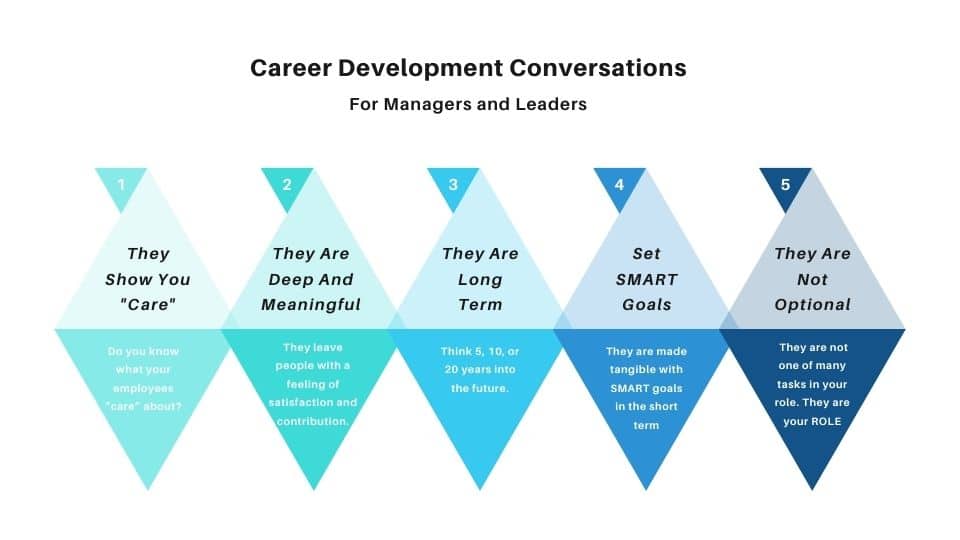
    1. Career Development Conversations show you “Care” for your people

    I believe one of the most important roles for a coach (and every manager is a coach by default) is to “care” for their people. And you do that by taking care of the “cares” of your people.

    Do you know what your employees “care” about, what they value or not value in life, and why? Do you know what motivates or drives them? Do you know what frustrates them?

    As a coach you can help people figure out what they “care” about. If we explore this simple yet powerful concept of “care” with our teams, it can open up a new world for them as individuals, and for us as a leader.

    2. They are Deep, Meaningful, and Long Term; but made Tangible with Short Term Goals and Milestones

    Working with various teams across continents over the last decade and a half, I have seen that people are often not aware what they “care” about, and what matters the most to them.

    Career Development Conversations are deep and meaningful to figure this out. They not only help people to be proactive in their career choices as they achieve important career milestones like promotions but also leave them with a feeling of satisfaction and contribution.

    3. They are the second-best opportunity to serve your people

    Leading by example is without doubt the primary way your people see and perceive your leadership. Any conversation or management practice will fall through if you don’t do what you talk about.

    The second best way is to continuously have these career development conversations with your people, which will create the context and form the background of everything else people do in their day to day jobs.

    These conversations can inspire people to cooperate in the face of business challenges. They help people align their own purposes with the larger collective purpose of the organization, leading to accountability and co-operation instead of conflict and self-destruction.

    “Treat a man as he appears to be, and you make him worse. But treat a man as if he were what he potentially could be, and you make him what he should be.” — Johann Wolfgang von Goethe
    What they are not?

    There are a lot of misconceptions around career development conversations since there are different definitions of them depending on the organisation you find yourself in. Let’s clear up what I mean when I say career development conversations.

    1. They are not Optional

    Most managers / leaders I have seen in different companies don’t have these conversations at all. Companies don’t realise its importance and it often takes a backseat with the focus mostly on driving business results.

    Even when they are, they are not regularly reinforced and leaders are not held accountable for them. Nobody told me about these conversations either. I have learned them the hard way – making numerous mistakes as a leader and only later stumbling upon these conversations from numerous trainings and books.

    2. They are not Performance Reviews.

    Many people and companies equate career development conversations with performance reviews, which happen on a quarterly or half yearly basis. However, what I mean by career development conversations is the total opposite of performance reviews.

    Performance reviews focus on the past. Career development conversations focus on the future.  Performance reviews focus on putting you in a box (of job expectations) and measuring you against the expectations of that box. Career development conversations encourage you to get out of any defined boxes (or job roles) and define for yourself the meaning of success and contribution.

    3. They are not Short Term.

    Career Development Conversations are long term. Think 5 to 10 years or even longer if you can. They help people envision what their career is (or can be) all about. They go beyond material milestones and successes; and empower each person to find their own meaning at work, and define the legacy they want to leave behind.

    Having said the above, and keeping that as the background context, Career Development Conversations then drop back to shorter time frames of one year and less. By working on tasks aligned with the long term context, people can find new meaning and joy in their work which wasn’t available before. Needless to say, all of this results in better business results too.

    4. They are not about the Next Promotion or Job Titles.

    Career Development Conversations can also be confused with promotion and the usual benefits that come along. I believe that while that might happen as an outcome of these conversations, they are not the end goal in themselves.

    The focus is on the continuous development of employees and their progression as professionals. The emphasis is on doing work which not only challenges people professionally but also leaves them with a deep sense of pride and purpose in your work.

    5. They are not just one of many “tasks” to be done

    Career Development Conversations should not be taken lightly by managers / leaders. They are not just one of many tasks in your role. Infact, they are your ROLE. If you are not having these conversation, you are leaving huge potential in people and your team untapped. When done well, they can cause careers to take off.

    Career development conversations should not be taken lightly. I believe every task your team member does should revolve around these conversations. These conversations will set the context of everything the team member does or does not achieve. They are to careers what oxygen is to life.
    Key Conversations

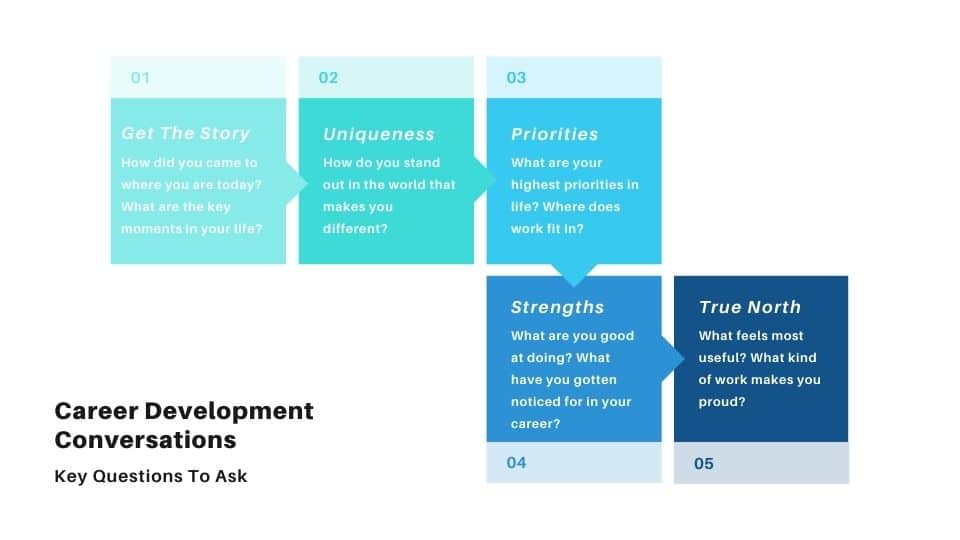
    Having gone over what career development conversations are and what they are not, let’s go over some of the key conversations :-

     1. Understand Them

    The intent of this conversation is to understand your people beyond their job descriptions. You can do so by asking and answering the below questions.

    • What is your story?
    • How did you come to where you are today?
    • What are the key moments in your life –  ups and downs, successes and failures, and how each of these events has shaped you?
    • Tell me something I don’t know about you. This question always amazes me as I find out something new about the person.

    If you think this can be hard, then you are absolutely right. Getting people to open up about their life can be a slow and gradual process as you build trust and go beyond personal barriers.

     2. Help them figure out their True North / Lighthouse

    • How do you stand out in the world that makes you different?
    • What are you good at doing? What do you believe you are the best at? What have you gotten noticed throughout your career?
    • What feels most useful? What kind of work makes you proud? Which of your tasks are most critical?
    • What bugs you? What makes you angry or frustrated?
    • What are your highest priorities in life? Where does work fit in?

    By asking some powerful questions like the above, you will help people identify their strengths and weaknesses, values, and motivations, and what makes them unique and special. For me, knowing someone as a human being is such a wonderful experience as I get exposed to the personality of the person which is normally hidden in workplace conversations.

    Helping people figure out their True North can help clear the fog of uncertainty and clearly distinguish the path or at least the direction, they can pursue in the future. This True North can be a lighthouse (of values) that can serve as a compass in difficult times.

    3. Empower Them by Preparing a Plan

    The next type of conversation is to build upon the above two and make it concrete in the form of a plan for where they want to go. Present them opportunities for future growth in the organisation based on their values and motivations, and not just on their talent and skills.

    Once you have identified opportunities that they can pursue with purpose and commitment,  support them to find training to acquire any skills they need, or in reaching the right people. Work with them to create SMART (Specific Measurable Attainable Relevant Timely) objectives, which are impactful for both the organization and the individual personally.

    Having clear objectives to achieve in the future, and also clarity about how will it help them individually as well as the organisation will empower them as they build up confidence and momentum once they start. Once they grow their wings and build up speed, get out of the way and give them space to fly. (which can be very difficult, especially in big organisations)

    In conclusion, I would also like to add that all the 3 kinds of conversations above never happens chronologically. You can jump between them as you feel fit, and it is a gradual process as you discover more and more about your people, and guide / support them on their way.

    As you discuss these questions, you also open up and answer these same questions for yourself too. These conversations are not a monologue but a dialogue. I have always found having these conversations very useful to me too, and you also end up building deeper relationships and friendships at work. And working with friends is always a breeze while working with strangers can be painful.  
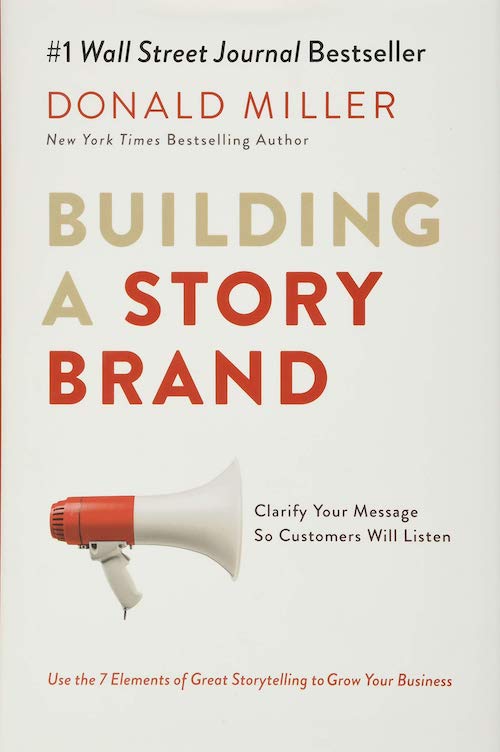
  • Building a StoryBrand by Donald Miller – Book Review & Summary

    Storytelling has been an intrinsic part of the basic social construct of humanity. Since time immemorial, stories have been at the very crux of communication. They have been used for the purpose of entertainment, imparting cultural values and most importantly they were used to share information.

    Since our childhood, stories shape our minds and therefore shape the people we become. Whether is the much loved Disney movies such as Cinderella or reading books of Sherlock Holmes, Roald Dahl, and Agatha Christie, right down to today’s web series that we all love to binge-watch and podcasts we love to hear, stories have the power to influence our thinking and thus the decisions we make in life.

    Stories are everywhere, in poems, ballads, and even in the 30-second adverts that we watch on TV. Storytelling has been an integral part of marketing and brand building, however, the challenge most people face is to use storytelling effectively.

    Building a StoryBrand (2017) by Donald Miller is a guiding seven-part framework of storytelling that companies can effectively use in their branding and marketing strategies. He emphasizes the word ‘StoryBrand’, a concept of appealing to customers by telling them a story about the brand or product, that they can connect with and create a meaningful relationship with them.

    He focuses on the importance of sending out a clear message to customers. While creating a StoryBrand, it is essential to communicate four important messages to customers – 

    • Who you are?
    • What are you here for?
    • Why should a customer choose your brand or product over any other?
    • How will your product help them flourish and survive?

    Without clearly communicating the answers to these questions, a brand or product will never hit home. Customers should be able to see how your brand or product will help them satisfy their needs, via the communication of your StoryBrand.

    The Seven-Part StoryBrand Framework

    A good story is one that manages to catch the listener’s attention in fleeting seconds. That is the reason why a StoryBrand has to be catchy, especially considering the fact that often, in advertising, a brand or a product gets only seconds to convey the message. Therefore if the consumer gets bombarded with a hodgepodge of news feeds, ads, video clips, and tweets in addition to the regular adverts, they are going to get confused and lose interest. A Story Brand should provide organized information to make it memorable for the consumer.

    The seven-part StoryBrand framework helps making a branding or advertising campaign organised and thus making it a memorable one. The framework includes the following seven parts.

    • Character
    • Problem
    • Guide
    • Plan
    • Call to action
    • Failure 
    • Success

    Loosely put, these seven modules translate into the following summary. 

    The character desires something that is difficult to obtain. This difficulty becomes the problem. As the character tries and wants to give up, a guide enters his life. The guide gives the character a plan to follow and requires a call to action from the character. The character follows the guide’s plan to avoid failure and finally finds success. Any StoryBrand that follows this story format has a BrandScript in place. Let us look at each of these modules individually.

    The Character

    Every story told has a hero in it. Only, in a StoryBrand, the hero or the character isn’t the brand, it is the customer. The story focuses on the needs of the customer, and thus the customer will be able to recall your product and brand when they feel that need.

    Why should one make the customer the character and not the product? This example explains why. A luxury resort chose to focus their story on the hotel rather than the customer. Their website included a long write-up about the hotel’s story. In addition, it included photos of the reception and the restaurant. What failed to focus on was how does the hotel provides luxury service to guests. Therefore, it didn’t tell their customers how their service would fulfill their needs and wants. 

    Then again, simply listing all the services is futile, as it can confuse the customers about what they want. Instead, a great Story Brand should be able to understand that one desire that customers need fulfilling.

    The luxury hotel, for example, realized its error when they were able to understand what was the one thing that their customers wanted. They wanted a place to relax. With this knowledge, they redesigned their website to focus on what about their luxury hotel fulfills the customer’s desire to relax in luxury. They shortened the long text on the website and changed the photographs to show a relaxing massage and spa service, an inviting bath, and tasteful and luxurious linen.

    The Problem

    The next module, the problem, deals with how your product or service is able to solve the customers’ problems. People want to feel understood. In fact, when they look to buy products or choose a service, and they find a product that becomes a solution to their problem, they will immediately choose it. Additionally, even if the StoryBrand mentions the problem itself, customers feel that your service or product attempts to understand them.

    In the StoryBrand, the problem should be the villain of the story. Just as in every story, the hero vanquishes the villain, so will your hero, the product of the story vanquish the villain, the problem that the customers seek a solution to.

    Problems can be internal or external.  An internal problem, for example, a customer not finding time, can be a pressing enough problem, just as an external problem is important. Often, marketing strategies tend to focus on external problems only. Therefore, it is essential that companies, while claiming to solve external problems, appeal to customers by giving solutions, telling them that internal problems can be solved as well.

    For example, a company selling a service of house painting addresses an external problem, that of painting the house. But how will solely focus on the external problem help in the customer choosing the company’s services over their competitors?

    To achieve this, the company can then focus on internal problems of giving the customer information that tells them that their painting services are easy on the budget, or that they specialize in the speed of the job with no mess at all, etc. Once the company is able to appeal to the customers’ internal issues that will be able to stand ahead of the competition.

    The Guide

    Next in the StoryBrand, is the role of the guide. 

    Every hero in practically every story gets in trouble (the problem). Frodo of the Lord Of The Rings had to bear the weight of the One Ring and was tasked with taking it to Mordor. His guide in the story was Gandalf the Grey Wizard who guided him through perils on his path.

    Similarly, in the brand story, the guide is the company, the friend-philosopher-guide who shows the hero (the customer) the right path to success. However, unlike movies and storybooks, where the guide simply appears at the right time; the guide in the StoryBrand has to present himself to the hero at the right time. Additionally, the guide has to be able to effectively and convincingly present for the character. 

    As a guide, there are two values that are of utmost importance – empathy and authority. Showing empathy tells the customer that you, the company, and guide understands the pain of the problem that the customer experiences. Empathy is at the basis of building a foundation of trust. Most importantly, empathy will make customers take your word and advice seriously.

    Authority doesn’t mean being overpowering and condescending. For a guide to have authority, it means that the guide shows competence in guiding the character in the right direction towards success. Moreover, the guide (your company) should be able to prove itself competent time and again for the character (the customer) to put in their trust.

    For example, the company Infusionsoft, includes statistics such as, ‘125,000 customers are satisfied with their service.’ It also mentions the number of awards its marketing software has won. Such statistical and testimonial information enables their customers to see their competence, thereby allowing them to be the authority on the field.

    The Plan

    The next component of the StoryBrand framework is the plan. There are two types of plans that a company can employ to win over customers.

    • The Process Plan: The process plan is the process by which a company shows the customer what to do. the information that the customer receives helps them in eliminating any risk while purchasing. It reduces confusion and helps in retaining the customer.

    An online storage-selling venture needs to give instructions to the customer visiting their website, about how to gauge and identify what storage to buy. For example, they can mention, ‘measure your space, choose the right equipment needed as per your space choice, and build/assemble the storage unit with minimum efforts.’ 

    Such clear process information clears the confusion of the customer without needing them to dig to deep for the information.

    • The Agreement Plan: The agreement plan includes an offering of an agreement to the customer. It is this agreement that will help the customers make their purchase decision.

    For example, a used car dealer CarMax wanted to be able to help customers avoid haggling with difficult salesmen. The company simplified the solution by ensuring that there would be no haggling needed at all and that no buyer would end up with a product that doesn’t meet their expectations.

    The Call-To-Action

    We get bombarded with at least 3000 advertisements on a daily basis. Moreover with online marketing and customer experience becoming more personal, standing out of the crowd is ever more important. The age of sending out your adverts into the world and waiting for customers to pour in is long gone.

    Companies and brands need to seek their customers’ attentions. They have to be able to draw their customers’ attention towards themselves from the hoard of other adverts. How does a product or a brand ensure this?

    This is where the module of call-to-action comes in use.  To make the StoryBrand successful, the customers need to challenges into action. There are two types of call-to-actions – 

    • Direct Call-to-action –  A direct call-to-action is a bold and clear message to customers to come and purchase their products. Advertisements, especially those online and on websites that read, “Purchase Now!” or, “Register Now!” are examples. Such direct call-to-actions are extremely effective and should be used well on websites, so that the customers are kept interested and keep exploring more about the company, brand, product, or service.
    • Transitional Call-to-action: Transitional call-to-actions are the opposite of a direct call-to-action. Such action calls aim at maintaining a friendly relationship with the customer when they choose not to make a purchase. Often, transitional action calls offer a memorable free product or service, for example, a free invitation to attend a webinar on cooking, etc. These action calls aim at creating brand recognition and brand recall when the next the customer needs your product, company or brand to solve their problem again.

    Failure (Or The Fear Of Failure)

    In a framework that is looking towards a positive end for the hero, where and how does failure feature?

    So far we have understood the characters in our story – the hero, the villain, the guide, additionally, we have also seen how the plan and call to action work in the StoryBrand. We have also read earlier, that failure is an inevitable part of the story that will push the hero to succeed. 

    In fact, without the fear of the hero failing in his endeavors, a story doesn’t feel complete. This fear of failure is what makes a story exciting, nail-biting, suspenseful, feel-good, climax, etc. Essentially, without seeing the hero in peril, and waiting for the hero to triumph, a story will never be exciting or enticing.

    Similarly, in the StoryBrand framework, it helps to motivate customers by showing them what they going to lose if they do not buy the product. It is therefore important to list-out the disadvantages (the failure) of not making the purchase.

    When it comes to parting with money, the dissatisfaction of losing money is more than the satisfaction of gaining it. This was an important statement that was proved by behavioral economist, Daniel Kahneman, in his 1979 paper on what drives purchasing behavior.

    Therefore for example, what is the point of a life insurance company that does not list down the losses one faces if they do not buy their insurance? Their advertising often focuses on the negative impact (failure) not buying their services will have, thus playing on the purchase behavior of customers – showing them the failure in order to succeed.

    The Success

    The finale. The “The End!” of the movie, the “…and they happily lived ever after!” of the story. The last module of the StoryBrand framework is a success.

    After dangling the climax of failure over the heads of customers, it is time to use the leveraged feeling of failure to drive the customer towards success. Success is the happy ending that a customer sees when they will make the purchase. Nike, for example, shows its customers a lifestyle of glory, inspiration, and drive to perform – all while selling shoes and athletic gear.

    Showing customers their successful ending requires three strategies towards creating the vision for them – 

    • The Strategy of Status – This strategy works on showing customers how their status will increase with the purchase of the product. For example, the nerdy college boy who transforms into the coolest dude in town after drinking cola.

    Most narratives that show customers how they can up their status, or be a part of a higher status group work towards tantalizing the customer to purchase.

    • The strategy of Completeness – The strategy of completeness focuses on finding fulfillment or, completeness in the end. Every love story where the hero and the heroine triumph and live ‘happily ever after’, works on the strategy of completeness.

    Therefore, for example, as a company that sells skincare products, the focus should be on showing the customer how their lives will be complete by using their skincare products on daily basis.

    • The Strategy of Self-Acceptance and Reaching Potential – The clothing company, American Eagle used normal people, instead of using models wearing their brand all photo-shopped and airbrushed. This move was a step towards self-acceptance. Using this strategy encourages people to use products that help them in understanding what their potential truly is by moving towards self-acceptance.

    Conclusion

    The StoryBrand Framework uses the components of narrative storytelling to create a strategic framework for making their marketing and branding strategies a success time and again. It helps in keeping the customers engaged, creating a feeling of trust with the brand, and maintaining customer loyalty.

  • How To Make Smarter Decisions – Lessons From Poker Champion Turned Author of Thinking In Bets

    Life is like a game of poker. Every decision in life has several factors that influence it, with luck playing its part too. The best decisions in life may not always lead to a desirable outcome. Similarly, decisions that seem totally wrong can turn out to be some of the best decisions in life. 

    But how do we control these variables and make winning decisions in life? In Thinking in Bets, Annie Duke, poker champion turned author, shows

    • how the human mind is wired to outcomes
    • that outcomes are a combination of skill, luck, and unknown information
    • that belief is a developed habit leading to absolute statements
    • that changing habituated decision-making can help perceive outcomes objectively
    • how to improve decision-making skills by enlisting in decision-examining groups
    • the concept of CUDOS
    • how to make decisions by analyzing the past, present, and future

    The Human Mind is Wired to Outcomes

    No one can predict outcomes, just as no one has complete control over all the variables that affect the decisions we make. How does one, therefore, see and analyze mistakes?

    No one can claim to have made 100% correct decisions in life, because variables such as luck and unknown information affect outcomes too. Decision-making is, in fact, more like poker bets, where in spite of unknown variables, we make decisions based on, or bet on, outcomes that have a probability to succeed.

    The human mind is wired to focussing on outcomes. It confuses the decision made with the resulting outcome. Additionally, it attributes the quality of the outcome to the quality of the decision made – a habit that needs examination and change.

    Outcomes are a Combination of Skill, Luck and Unknown Information

    Outcomes are a combination of skill, unknown information, and luck. They are subject to self-serving bias. While one can do nothing about unknown information and luck, one can analyze the outcomes resulting from one’s own decisions – both good and bad.

    Bad decisions are necessary for improvement too. They help us re-assess and utilize our learnings from those decisions. They help in preventing the same errors in future outcomes. This process of learning from previous outcomes and re-assessment of mistakes in decision-making is called outcome fielding.

    Belief is a Developed Habit

    Everybody wants to have good outcomes. For that, we need to, at least, be sure that the decision-making involved is good. We need to believe that we are making decisions that could lead to good outcomes. Over time, our beliefs around decision-making lead to certain ways of reasoning and rejection of anything that contradicts these habits. We start making absolute statements about those beliefs.

    However, one needs to change this habit. This requires questioning and truth-seeking, a practice that is contrary to how humans are wired from evolutionary times. It is naturally difficult for humans to objectively analyze anything that contradicts their beliefs, even if it will lead to a good outcome. Questioning, keeping an open mind, and truth-seeking help in forming objective perceptions and reduces the resistance to change. 

    Changing Decision-Making Habits Can Help Us See Outcomes Objectively

    The necessity for changing decision-making habits, and to derive good outcomes is similar to how we react to bets. When our decisions and resulting outcomes are challenged, we can start by objectively analyzing our decisions and move beyond self-serving bias that limits our perceptions and resists habit-changing. 

    Working on understanding that luck also affects outcomes, we can move beyond the resistance of habituated beliefs. This also helps us perceive the mix of luck and skill more objectively and accept that the quality of decisions not necessarily dictates the quality of outcomes.

    Improve Decision-Making By Seeking The Wisdom Of Crowds

    Changing habits, improving decision-making, and accepting outcomes objectively are not easy tasks. Seeking the help and opinion of a group about decisions made makes habit-changing easier and decision-making better.

    When one seeks help from groups for making decisions, it is easier to be objective and open-minded because one can view others’ decisions more objectively. Continuous feedback from a focus group can lead to us seeing beyond our own resistance or self-serving bias.

    CUDOS

    Seeking the help of decision-examining groups can help only if it is the right group. The working of the group should be clearly defined. Sociologist Merton R. Schkolnick derived a template of guidelines – CUDOS, ideal for a truth-seeking group. 

    • C is for Communism – All the members in the group examining decisions together must share all information – the good and the bad and strive for transparency. Withholding information increases self-serving bias.
    • U is for Universalism – Everyone must use the same standard of evaluation of all information. All decisions, one’s own and others should be viewed objectively to understand and learn how they affect outcomes. Even a bad decision can have valuable lessons for future outcomes.
    • D is for Disinterestedness – Disinterest in the outcome helps in focussing on evaluation of decisions. During the evaluation of decisions, if the focus lies on the outcome, then it is easy to form a bias. Bias leads to habit-forming, diluting the need to analyse decisions objectively and as a result, dilutes the learning.
    • O and S are Organised Scepticism – This includes holding non-confrontational and organised, sceptical arguments during decision evaluation. Organised scepticism helps us improve our decision-making skills.

    Make Decisions by Analysing the Past, Present, and Future

    Sometimes, our present decisions often tend to be made at the expense of our future decisions. While one does not do it all the time, one needs to train the mind to consider the impact our present decisions have on future ones. Training to focus on the long term impact of our decisions can be done by – 

    • Plan future outcomes in the present by evaluating decisions made in the past.
    • Think about how our decisions will make us feel in the future. The evaluation of the present decision makes us feel accountable for future outcomes, motivating us to avoid errors in decision-making.
    • Think backwards. That is, think of a desirable future outcome to make present decisions, keeping in mind uncertainties. We already know the winning outcome. What must we do today to reach the future we want?
    • Pre-mortems are a powerful way to identify potential pitfalls. Premortems imagine failed outcomes and analyze obstacles that could have caused them. This helps in identifying incorrect decisions before they cause a problem in the future.
    • Visual contrasting – the process of visualizing obstacles that keep us from meeting the end goal also help us make better decisions.

    Key Lessons from Thinking in Bets 

    Poker bets might not be everyone’s cup of tea; however, they have a very valuable lesson to teach us. Once we start seeing our decisions as mental bets, we can objectively analyze them. Our decision-making habits get easier to change and we start accepting the fact that decisions are not the only yardstick to measure outcomes.

  • The Science Of Why (2015) by David Forbes – Book Review & Summary

    What is it that makes a consumer choose a particular product over others in the market? This is a question that many in the world of marketing have been trying to answer. While some have theorized and come up with possible answers, many others have been eluded by this question.

    The Science Of Why (2015) by David Forbes, provides guidance to understanding consumers, their buying habits, and provides tools that can help gauge what motivates different types of customers to choose. It is a guide to many who want to rethink their marketing strategies and focus on understanding marketing with a greater depth and perspective.

    The MindSight Matrix

    The MindSight Matrix is a problem-solving marketing tool that enumerates the different motivational factors that drive consumers to buy. It helps marketers understand what is wrong with their strategies and what should they do to ensure that their products get chosen.

    The MindSight Matrix has one main force that drives action, viz. a desire for change. It points out to what kind of change a customer desires when they make a purchase, whether it is a person looking for a gym membership, or an elderly lady looking for comfortable shoes.

    Desired change has 3 main categories – experience, expectation, and outcome.

    • Experience – An experience refers to the desired change a customer looks for in the present moment.
    • Expectation – Expectation refers to the desired change a customer seeks for their future. Marketers need to give customers a vision of how their product will open up new opportunities for them in the future.
    • Outcome – Outcome is the degree of satisfaction a customer gets with their past buying decisions.

    In addition to the desired change, the MindSight Matrix also identifies three types of motivations – Interpersonal motivation, instrumental motivation, and intrapsychic motivation. To understand what motivates customers to buy, marketers have to specify where the change occurs.

    For example, change is either internal, which focuses on how a customer feels about or perceives themselves, and outward-directed change refers to a change that a customer desires in their outward appearance or physical surroundings. 

    Intrapsychic motivation drives all internal change, whereas outward-directed change depends on instrumental or interpersonal motivation. Let us delve deeper into the types of motivations.

    Intrapsychic, Intrapersonal, And Interpersonal Motivation

    To begin with, the three types of desired change interconnect the three types of motivations. Therefore, we can get nine different motivation-change combinations that drive buying behavior.

    1. Intrapsychic Motivation

    Intrapsychic motivation propels purchases that reflect on how a person feels about himself or herself and what they want to say about themselves. 

    For example, if we look at a target market of single mothers managing careers as well as children. Their focus lies in wanting to make healthy food choices for children, as well as enjoy stress-free fast cooking, without resorting to unhealthy fast food. Therefore, a company selling frozen food should target its marketing campaign on the healthy and stress-free characteristics of its product.

    Intrapsychic motivating factors that focus on internal feelings make customers difficult to satisfy. This is because only the customers know what their personal internal desires are. Marketers should respond to the intrapsychic motivations of making the mother feel good when she makes her decision to buy their healthy, yet stress-free products. They should focus on how their customers will feel about their products.

    There are three types of customers that are driven by intrapsychic motivation – security-oriented, identity-oriented, and mastery-oriented.

    • Security-oriented Customers – Security-oriented customers seek safe, reliable, and secure relationships with the products and brands they choose. These customers are not affected by changes in price or quality and focus on the fact that their chosen brand always delivers and provides the safety and security they seek. For example, mothers who buy a particular brand of baby food make their choices based on the safety they feel of that brand.
    • Identity-oriented customers – Identity-oriented customers make buying choices based on the prestige and social status that brands confer upon them. They make identity associations with brands. For example, women who only buy cosmetic products from a Gucci, or men who drive Lamborghinis, make their purchases because the brands reflect who they want to be.
    • Mastery-oriented Customers – For mastery-oriented customers, brands are as important as they are for identity-oriented customers. However, the difference is that they make buying decisions to please themselves, irrespective of the fact that the brand gets then social recognition or not. These customers buy certain brands to master themselves, their hobbies, or their passions. They choose products that of high quality, professional-grade, and innovative. For example, chefs swear by certain brands of utensils because they are the best in the market and help them make professional-grade food.
    1. Instrumental Motivation

    Instrumental motivations are shaped by outcomes and thus affect buying behavior. These customers look for the best products in their category; the ones that are most effective and efficient. Such customers will spend time researching a product before making their buying decision. They will get irritated if the product wastes their time by not providing what the box claims. These customers are also the ones who will go through the efforts of leaving bad reviews if they are not satisfied.

    On the other hand, instrumentally motivated customers appreciate precise information and respond best to honest, simple, and authentic marketing campaigns. The success of dove’s ‘real beauty’ campaign appealed most to instrumentally motivated customers. The campaign appealed to women that there is beauty in simplicity. It made women realize that they don’t need luxury cosmetics to realize that they were beautiful just they were.

    The three types of customers that are driven by instrumental motivation are – empowerment-oriented customers, engagement-oriented customers, and achievement-oriented customers.

    • Empowerment-oriented Customers – Empowerment-oriented customers buy products only when they are sure that they will help them perform better. Their focus lies on improvement and success and gets most influenced by campaigns that use encouraging slogans.

    For example, slogans such as “Unlock your true potential” can help such customers know that their range of skills can improve with the help of the product.

    • Engagement-oriented Customers – While these customers focus on improvement as well, their wants and needs are dictated by innovation, and whether a product wins them the race of owning the best, advanced product before others.

    For example, ads and marketing campaigns that stimulate senses by putting new sounds, experiences, and sensations on show attract engagement-oriented customers. Such customers are drawn to the overall, great experience that a product offers them. Customers who are loyal to certain brands of smartphones such as Apple’s iPhone are examples.

    • Achievement-oriented Customers – These customers are the most difficult to influence and entice. They are competitive by nature and need a product to be challenging rather than simply entertaining. Such customers need to be targeted subtly, yet with a hard-hitting slogan that makes them feel proud to be associated with the product. Maybelline’s “because you’re worth it” slogan achieved this effect.
    1. Interpersonal motivation

    Interpersonally oriented customers thrive on fostering strong relationships with brands, products, stores, or even the salesperson. Their need for loyal relationships and a sense of community and inclusion in brands drives them to make buying decisions. Therefore marketers who wish to tap into interpersonally oriented customers should focus on making them feel valued, like a part of the family. Once they feel that loyalty, nothing can deter them from choosing that product.

    Some interpersonally oriented customers seek nurturance and look for brands that show care for their wellbeing. On the other hand, some interpersonally oriented customers seek to be a part of a reference group in society. They don’t care much for brand names. For example, bikers will tend to spend more on gear and products that will help them identify with serious bikers in their community.

    Such customers often have low self-esteem motivations and buy products to fit within their community. Contrary to low self-esteem customers, high self-esteem customers choose products that enable them to be role models within their reference groups. Therefore, slogans such as “Be the example” will appeal to their strong values, making them buy the product.

    Conclusion

    Marketers and brands should focus on evaluating the types of customers they want to appeal to. Applying the MindSight Matrix and understanding what motivates their target markets will help them craft out truly successful marketing campaigns, ensuring that their products fly off the shelves!