“It was dark and quiet, and it took me a few seconds to stand steady on my feet. Well, that’s what happens when you have to get up at 2am to go to the bathroom. But things were going to get worse.
Just as I began to walk, I suddenly jumped and screamed. Something was crawling on my feet. It felt like a spider and I reached for the light switch. When the light turned on it turned out to be a piece of thread that had been lying on the floor. Apart from the disappointment of jumping for no reason, I was wide awake now!”
“Reality is merely an illusion, albeit a very persistent one.” – Albert Einstein.
Taking this notion forward, this article of mine is going to dwell upon why life itself is a myth, and how each one of us is driven by some ‘absolute‘ truths that are nothing more than widely accepted myths. These myths drain the life out of our days and take us onto paths of mediocrity and obscurity.
Below are the three such myths I think we all encounter in everyday life. (Give them some time to sink in, as they very well might be absolute truths for you.)
1. You Have to Work to Survive
The biggest myth of our times is ‘having to work‘ to earn a living for surviving. Right from our birth, everything is setup to create this illusion. Our education system, the economic system, all the news and shows on TV and the movies we watch. As we grow up, this myth becomes very ‘real‘ for us. The only thing from our childhood which we term as illusions are the cartoons we watch. Did you ever wonder why everyone loves cartoons?
There is a common misconception that work is necessary. Over decades and centuries, every rock is chipped away into sand and dust. Work can do the same to our lives and souls. Day by day, hour by hour, our work can chip us away into disintegration.
If someone tells you they are “making a living”, they can’t be more wrong. They are “making a dying“, and most probably fast spending whatever little time they have doing things out of compulsion rather than the pure desire of doing it.
Instead, what we can all do is PLAY. Go out and do what you want. Find something you love doing, something you are passionate about.
Disclaimer – Work and Play don’t have to be mutually exclusive. If you can find a way to play while at work, nothing could be better.
Many people say they don’t know their passion or hobbies, or they have not discovered them yet. Here is a formula – Look into your life, and the things you do for which you pay others are your hobbies and passions, and for which you get paid and compelled to do is work.
DO NOT spend the vast majority of your life working so that you can play in the end. That end might never come, or which might be tomorrow itself, for all you know.
2. Planning and Living for the Future
We live in a world where insurance and pension policies, investments, education, business, almost everything is done with an objective to achieve something in the future. While planning for the future has its benefits, I believe we often take it too far and miss the only time we really have, which is “now”, or this very moment.
Who gave you the guarantee that you will not die tomorrow, next week or next month? What made you believe that you are going to die at 70 or 80, and not at 20 or 30 or 40. If you don’t believe it, read and watch the news. People are dying every day at all ages. The average age might be 70 or 80, but ask yourself – Do you really want to live your life based on a statistic?
Instead, LIVE NOW. Enjoy whichever phase of life you are in. Be in each day fully, rather than counting the days. Live your life in a way that you are satisfied even if you die tomorrow or the next second. Make every breath count. Don’t wait for tomorrow if you want to fall in love, travel to your dream destination, or eat that favorite ice-cream of yours. Do it NOW (or at least pick a date in the calendar and book tickets now).
The next big myth we base our lives on is aiming for control and consistency. We plan and build systems, and we make rules and processes to make our lives more comfortable and smooth. But the very fact that we can control life is the biggest lie that we tell ourselves.
Life, by its very nature, is messy and unpredictable. It is not fair and nobody is entitled to get anything out of it. In school, if you study more, you get better grades and vice versa.
The same doesn’t hold true in life, as there are so many other factors at play other than your efforts. The sooner we realise this the better. Good and bad things will happen to you. Your education, job, the country you live in, or any other reason which gives you the illusion of safety, is a very bad armor against life.
Instead, be FREE from these controls. Embrace the uncertainty of life and experience real FREEDOM. Go out and play. Learn a new language. Take a new job, or live in different cities/countries and soak in different cultures. Write, paint, or do anything else that makes you experience life rather than draining the life out of you.
Don’t try to be nice or do what is expected. Don’t live for the gallery. Be authentic. For a change, LIVE for YOURSELF. Let yourself be misunderstood, hated, judged, or whatever, but live by your convictions. It is better to be assassinated by another human being than being assassinated by death.
Conclusion
Our thoughts (and perception of reality) shape our decision and in turn our circumstances. It is like watching the same movie again and again. If we want to play a different movie in our life, we have to change the tape.
And rejecting the above myths might be the first step. Thoughts arise in the mind, and we become aware of them. But over time, we stop seeing them as thoughts and see them as reality. Therefore, we should never stop to question our thoughts and the reality they form.
Life is a mirage. An earring and a bangle are both made out of gold. But our thoughts make one an earring and another a bangle, but in essence, both are only gold. Yet we only term what we see while asleep as dreams and not what we see while awake. In essence, both are illusions created by our senses. We must never lose sight of that.
Traditional perceptions about sales place prejudices upon salespeople. Whenever we think of a salesman, we think of a slick, suited man at the door, with the gift of gab, vying for the attention and the money of the innocent buyer.
Today, sales and marketing are completely different. Entrepreneurs are more invested in the needs of the customer and are willing to tailor products to meet those needs. Additionally, the conversations surrounding sales have changed their focus to finding solutions that work for both, the customer, and the seller.
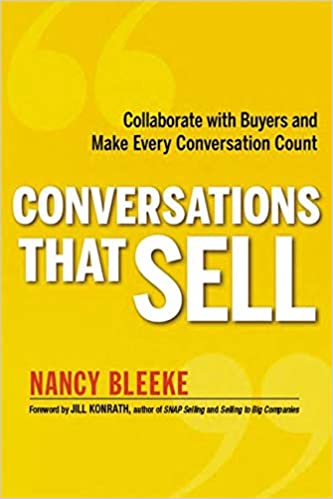
Conversations That Sell (2013) by Nancy Bleeke discusses this shift of focus in sales and shows the right sales gab that will guide a strong sales career.
It’s About You!
Today’s market is an extremely competitive one, with almost identical products and similar prices. This makes the traditional one-to-one sales approach redundant. Customers have easy access to information and are looking for more than just knowing what a product’s features are.
The stakes in today’s marketplace are definitely higher and clients want to know how your product can make the necessary changes and give ‘forever’ solutions to their problems. The sales world today needs differentiators, rather than salespeople.
There are three vital features of good differentiators.
Preparation
Transparency
Self-Confidence
Differentiators focus on preparation. They are able to understand the needs of their clients clearly, not only before the process begins but also throughout the sales process. Differentiators seldom consider their job as only pitching to their clients. They guide the sales process, by constantly making efforts to learn more about their customers, understand their obstacles, and provide opportunities to their clients.
Differentiators believe solely in solving their client’s problems. In order to do that, they have to be transparent, open, and honest with their clients. They have a high level of self-confidence that enables them to strengthen their relationship with their client, by showing them that they are the priority, rather than simply crunching sales numbers.
The author, during her early days as a salesperson, found that when she was open and honest with her clients, putting her true personality and intentions on display won her client’s trust rather than focusing on using sales jargon, as her mentor has recommended.
Collaboration With Clients
Traditionally, a sales strategy involved a client describing their problem and the salesperson providing solutions that could either be accepted or rejected. Today, sales are all about collaborating with clients to develop a tailor-made solution for their problems.
Collaborative selling at the outset involves understanding all the aspects of the client’s problems. For example, a client is unable to process the huge number of customer service requests it is getting. To provide a solution to this problem, the salesperson could offer a systemized solution of expanding the customer service base.
However, the salesperson should also think about why does the client receives so many customer service requests in the first place. Maybe the solution lies in providing better customer service training to the employees of the company, as the customer service department of the client might not be good at solving issues in the first place.
Collaborative sales also include changing the language that salespeople use. Rather than think of the clients ‘problems’ that need a solution, the focus could be providing them with ‘opportunities’ that help meet the demand of their wants and needs. In this context, asking ‘What’s in it for them?’ could give the answer to what opportunities will suit their needs and wants, thus providing a profitable solution for the salesperson, his client, and his company too.
Therefore, in the above example, if the salesperson identifies that the client has a problem of inadequate customer service training, they could pitch a new training system within their product to address the issue. This will show the customer that the salesperson is truly invested in creating opportunities for them and is focused on providing long-term solutions. This will not only help the client, but also help in enhancing the customer’s relationship with the salesperson, and his company.
Conversations That Sell (2013) by Nancy Bleeke
Developing The Collaborative Sales Strategy
Let us look at the basic principles of a good collaborative strategy.
Research And Preparation
The first aspect of devising a successful collaborative sales strategy is preparation. And to be well prepared, one has to incorporate a lot of research.
The research includes knowing every single detail about the client, right from knowing the surface details such as the client’s industry, the size of the company, their business prospects, their underlining philosophy, etc., to knowing what issues they have faced in the past, their quarterly results, management changes, and even the general work culture.
The salesperson should also know who they are going to be dealing with and understand that person’s personality, their style of working, and lastly, know clearly what issues they face and what solutions they seek. All this information should be put in a fact file that can be referred to as and when needed.
Appearances And Impression
Once the fact file is made, the salesperson should focus on presenting himself and his conducted research. This includes taking care of appearances like dressing up well for a meeting, ensuring a neat and tidy look, and even using a mild deodorant.
In terms of the research conducted, the salesperson should check every small detail such as having a tight presentation, putting papers in order, having a clean laptop, etc.
Just as you prepare for appearances, it is also important to be sure that you are mentally prepared for the presentation. This includes knowing the presentation well, rechecking the features of the product, and being ready for any kind of questions that the client will ask.
It takes very little to create a bad impression. Therefore ensuring a good impression with a solid presentation and appearance is essential.
Conversation
After once creates a good first impression with appearances, the focus moves on to a conversation with the client. The way a salesperson begins a conversation could shape the relationship with the client in the future. The three most important elements of a good conversation are – introduction, the reason for contact and the subject to be is discussed.
Many sales pitches start on the wrong foot because salespeople dive into their pitch once they are done introducing themselves. The conversation post-introduction should have a smooth flow. Thus, the next thing that sales should focus on is letting the client know about any previous contacts made, let them know who has referred them if any, and then enumerate any of the general issues that are known.
Keep in mind ‘What’s in it for them?’ The salesperson should then begin to introduce their product or service by telling the client how it can help resolve any of the previously mentioned issues. For example, mentioning how their product has helped another company in the same industry by reducing production costs, etc.
Connection Questions
Post introduction, connection questions will help tie in the conversation and guide it towards a natural flow. Connection questions should be personally engaging and refer to a relevant issue that puts the focus on them. For example, ‘you have worked with many vendors in the recent past. What were the best approaches in dealing with the issue in your opinion?’ Connection questions open the doors for asking more questions about the issues the client faces.
Through the conversation, a salesperson should focus on the tone of the client’s voice and their body language to gauge their emotional state. For example, if the client seems distracted and keeps looking at the watch, it is a signal to shorten and end the conversation.
Gathering Information With Right Questions
All through the conversation, the aim of a salesperson should be to gather more information. This is achieved by asking the right questions, and there are certain do and don’ts that surround it.
Never ask a client something that should be already known or that you know already.
Use open-ended questions rather than close-ended ones that are related to their perceptions of the problem, emotions, and motivations.
Questions should be about the current situation of the client, the risks associated, the opportunities present and the future.
Questions should be prepared beforehand.
Asking The Questions In The right Way
Once the list of questions is prepared, the salesperson should know how to ask them. To ensure a smooth flow of conversation, the questions should engage the client. This is achieved by follow-up questions. Another way to successfully guide a conversation is to paraphrase what the client says, to show them that they have been clearly understood and that both the parties are on the same page.
Throughout the conversation, the salesperson should be mindful of body language, maintain eye contact, and even use affirmation sounds.
At the end of the conversation, the salesperson should address all the details of the conversation, discuss the working of the decision-making process, clarify the people who will be involved, the budget, and the timeframe needed.
It is essential to get these questions right; therefore one can practice these questions with a colleague and see if they work.
Focus On The Buyers While Presenting
Sometimes, in the midst of a presentation, one finds that a client has completely lost track of the presentation and isn’t really listening to what is being presented anymore. While this is every presenter’s nightmare, it is fortunately preventable.
Clients aren’t truly interested in what features a product has, but in what solutions the product offers and whether it is able to solve the client’s problem. To avoid lack of interest and to keep the client engaged, sales presenters need to change their language down to how they construct their sentences. Every line said should catch the attention of the client, and in order to do this, the focus should be on the client.
Another way of keeping a client connection is to tell them stories. Stories of how the product has successfully helped other companies will give them a hands-on understanding of what the product does. Keeping examples and prototypes for them to ‘see for themselves’ work well too.
Dealing With Objections And Disagreements
Clients are bound to object or disagree with something or the other that is presented. In such cases, salespeople have to be prepared and answer them as soon as possible.
While challenging a client’s objection, you have to be careful to show the client that their concerns are taken seriously and that there is a way to solve them together, demonstrating to the client that you have a problem resolving capability. This will moreover, prove to the client that you are interested in more than just selling and have the ability to flexibly offer long-term solutions for any issue that arises in due process.
Closing The Conversation
Towards the end of the meeting or presentation, it is important to reiterate everything that’s been discussed. All points discussed, all the processes that have been laid out, etc. should be clearly mentioned, along with a mention of the successful future of how things will be when the work is complete.
During the close of the conversation, it is imperative to ask a client if you have missed any detail. Clarification always helps in clearing out possibilities of any future misunderstandings and shows clients that you are thorough with your work.
Finally, aim for a commitment to something or try to get a decision from the client. For example, one can ask, ‘what should be the next steps, how many meetings can be expected net, when is the next meeting scheduled, what will be the aim of the next meeting and what can be expected in the next meeting?’
Such questions show eagerness and hint at transparency, a virtue that clients appreciate. Remember to end the meeting as partners. Using subservient language or gushing grateful gestures will only show desperation and mark you down on impressions. It is best to simply reiterate commitment.
Now that we know how to develop a collaborative strategy, especially while meeting with clients, there are a few necessary points to keep in mind to ensure the success of a collaborative sales strategy.
Have The Will With The Skill
There is one important factor that differentiates a good salesperson from a great one. It is will.
Every person’s will is the inner driving factor that pushes them towards successfully meeting their goals. Without having the skills, one can never be a good seller, and credibility will take a hit. However, without the will to perform, one can never meet any goals set.
Firstly, to have the will to succeed, one needs to have confidence – in oneself as well as in the product or service they sell. Secondly, one should be transparent about their goals – to themselves as well as to anyone else connected, such as clients and one’s team. Thirdly, one needs to have strong emotional intelligence. Sales is a tough job, and one needs to be able to control their emotions during the ups and downs that one encounters during the process.
Finally, all of these require practice. Focussing on the sense of will itself will give you a push to take on any challenge thrown at you.
Setting Goals
With skill and will in your armor, you could be well on the path of success at sales. Yet without ensuring that your goals are measurable, flexible, and revisable, you still will have a long, long way to go.
Ask yourself, ‘Can you clearly define a timeframe to achieve a set goal?’ or ‘Do I need to redefine the goals?’ or ‘ What can be done to revise them?’ staying realistic while defining and redefining goals is important.
Writing down goals is a great way to keep them in perspective. Additionally, never hesitate to ask friends and colleagues for help. For example, ask a colleague to go through your presentation or check if your goals are aligned with the project at hand. If you need practice in presentation skills or speaking, join a class or a workshop!
Keeping a list of what hurdles or problems you could encounter also keeps you prepared if they do come in your way. And finally, keep a track of the progress you make towards those goals.
Conclusion
Today, salesmanship has changed by leaps and bounds. The focus no longer lies on the product that one offers but lies on solving the problems that clients face. Sales, today, emphasizes aligning or tailoring solutions to what clients want and need in order to solve their problems.
Understanding the value of collaborative sales and how one can steer their sales conversation to incorporating its principles is vital. Right from managing and mastering appearances, focusing on the right conversations, right questions, etc. to knowing how to close conversations and focussing on willpower and goal-setting, collaborative sales strategy is the best tool to succeed in the world of selling!
If you are like most people, once you hear the above statement, your heart will start to beat a little faster, your palms might begin to sweat, and in certain situations, you might even begin to shake. Feedback can make anyone anxiousandstressed – not because there is something inherently negative or bad about it, but because most people have never been trained in giving and receiving feedback. If you give and get feedback only once a quarter at work (even worse if it is once a year), and without any preparation, obviously it will be a strange conversation.
What I have learned over my career is that feedback can be an immensely valuable and insightfultool in our growth and progression, but only if we are ready and prepared to digest and use it for our benefit. Today I want to share via this article my thoughts on the value of feedback, what is the best way to receive it, and then what to do with it. I hope that after reading this article, instead of just waiting for feedback you actually start asking for it. If you are thinking why would anyone do that, let’s dive right in.
Why Do You Need Feedback?
Feedback is one of the easiest and most insightful tools to uncover your blind spots. A blind spot is anything that others know about you but you yourself don’t. For example – if you think you are confident but others find you arrogant and cocky, how the hell do you figure that out if nobody ever tells you that?
Feedback is like a beam of light which shows you how others perceive you. It can be the simplest way to uncover your strengths and weaknesses, but it is often not easy to digest and process it. Feedback lets you know how others perceive you and your talent, skills, behaviour, and performance. And knowing them is a good thing. When used correctly, feedback can be a very useful tool to move in the right direction, change course if necessary, and grow in your career (and in life).
“Criticism may not be agreeable, but it is necessary. It fulfils the same function as pain in the human body. It calls attention to an unhealthy state of things.” – Winston Churchill
How Do You Ask For Feedback?
Just like hearing feedback can be stressful for you, providing feedback can also be a stressful experience for the person on the other side. But there are a few ways you can make the feedback conversation a pleasant experience:-
The best way to make the process easier for both sides is to actively and explicitly ask for it. When you invite feedback regularly, it removes the formality surrounding the process and makes the conversation more “normal”.
Explain that you see feedback as a tool to learn and grow and that you welcome any negative or uncomfortable feedback. You can also go one step ahead and assure the person that the feedback will not have any negative impact on the relationship. Knowing this always puts the other person at ease and allows the conversation to continue more maturely.
Know what you are looking for in feedback. Feedback is not always critical. You should also ask for acknowledgment or appreciation for a task well done. Positive feedback will help you understand your strengths, and gives you the confidence and assurance required to look objectively at your weaknesses.
Be specific and ask for examples. Don’t let anyone get away with vague feedback. Always dig deeper and ask for specific events and evidence in support of the feedback you receive. Here are a few questions you can ask:- a) Can you explain what you mean? b) Can you give an example to support your point? c) Paraphrase the feedback and ask – Is that what you mean?
Seek feedback from people all around you and not just your boss. Ask people above, below, and sideways in your organization. Multiple sources of feedback can eliminate any outliers and helps to surface any obvious blind spots immediately.
Powerful Questions
Whenever you are looking for some powerful and insightful answers, there are always corresponding powerful questions to go with them. Below are a few such questions you can ask to solicit deep and meaningful feedback about yourself:-
If I were to wow you with my performance, what would that look like?
What’s one thing I could improve?
What would you have done differently had you been in my position?
What’s your opinion about how I handled that conversation, presentation, task, etc?
What specifically can I do to handle that task, conversation, project better?
What is one thing you can always count on me for?
What is one thing you will never count on me for?
What To Do After Receiving The Feedback
The worst thing that you can do with feedback is to do nothing with it. The feedback conversation is just the beginning on the road to learning and growth. So once you are done with the feedback, you can take the following steps to make the most of it.
Thank the person for providing you feedback. Not only is feedback essential for your growth, it is also often a courageous step to provide it in the first place. Acknowledge the person for the conscious act of providing you feedback.
Do not defend yourself during a feedback conversation. Do not get into a game of blame and justifications. Respond to the feedback, not react to it.
If the feedback is critical, take responsibility (not blame) for what you hear. Let the other person know that you will evaluate the feedback and get back.
Take time to introspect and evaluate the feedback. Does it resonate with feedback from others? Can you gather more data or feedback to validate it? If no, explain to others how you see it. If yes, let them know what you will change. Make certain promises and then do what you say.
Take all the positive feedback and put it into a “complements” document. Often we tend to focus too much on the negatives and ignore what we are doing well. Visiting this document regularly will give you motivation and positive reinforcement. Sometimes reading one little positive feedback can make your day.
Following the above guidelines doesn’t mean that your feedback conversations will be painless, but they will certainly go more smoothly. Once you see feedback for the powerful tool it is in your learning and growth, you will fall in love with it. The more you seek and get feedback, the faster you can move to learn, adapt, and change course if necessary. To conclude I would like to leave you with the below quote by Ken Blanchard.
“Feedback is the breakfast of champions.” – Ken Blanchard
I use cookies on this website to give you the most relevant experience and for analytics purposes. Any personal data collected will never be shared with any third party, or used to spam you. That is my promise. - Sumit By clicking “Accept”, you consent to the use of ALL the cookies.
This website uses cookies to improve your experience while you navigate through the website. Out of these, the cookies that are categorized as necessary are stored on your browser as they are essential for the working of basic functionalities of the website. We also use third-party cookies that help us analyze and understand how you use this website. These cookies will be stored in your browser only with your consent. You also have the option to opt-out of these cookies. But opting out of some of these cookies may affect your browsing experience.
Necessary cookies are absolutely essential for the website to function properly. This category only includes cookies that ensures basic functionalities and security features of the website. These cookies do not store any personal information.
Any cookies that may not be particularly necessary for the website to function and is used specifically to collect user personal data via analytics, ads, other embedded contents are termed as non-necessary cookies. It is mandatory to procure user consent prior to running these cookies on your website.