April 2017

  • How To (and not to) Deal with an Emotional Employee

    As I wrote previously, every human emotion is valid. However, the story behind them might not be, and we always have the choice of how to respond to an emotion. If we want to master how to deal with others’ emotions, our own emotional mastery is the prerequisite.
    Studies have shown that emotions like frustration, cynicism, enthusiasm, etc are as contagious as germs. I believe each human being acts like a tuning fork. Every emotion is like a wave, which when reaches others, either accentuates or dies down depending on whether the frequencies match or not.
    When two people are emotionally reactive, even a small argument can quickly escalate into a fight. When we learn to master our own emotions, it gives us an opportunity to deal with any situation confidently. It will dampen any emotional waves and allows collaboration, even in the face of disagreement. We can strengthen our relationships with others, even in the most stressful and difficult situations.

    1. Learn to Notice Emotional Build Up
    Emotions are like storms. Just as we can forecast most weather storms before they strike, we can always notice and predict “emotional” storms too. If an emotional outburst of an employee is a surprise, then there were some signs we missed.
    Emotional reactions don’t come out of anywhere. Just like storms, they build up over time. There are always signs, physical and behavioral, which we can observe and watch out for. If we notice these signs, we can get advance notice of emotional build-up in people.
    For example – If we notice tightening of muscles and a red face, the person might be getting angry or frustrated. If we notice a trembling voice, sweating, and defensive body language, someone might be feeling scared or anxious. If we notice smiles, laughter, and relaxed body language, the person might be happy about something in his/her life.
    2. Act Early. Validate What You Notice
    When we notice physical signs of an emotional build-up in others, we must act early and validate our assumptions. Obviously, we can’t read another’s mind so whatever we assume about another’s emotional state might or might not be true. So the most prudent way is to state our assumption as just that and ask the other person for validation.
    For example – If your colleague has been quiet and detached for a few days, you can approach them and say – “I see that you have been quiet lately. You seem a bit tensed too. Am I right? Is there something which I don’t know, or can help with?” Never walk up to someone and pass a judgment, “Why are you sad? What’s upsetting you?”
    Remember our assessments about others’ emotional states are just that – assessments. Mistaking them for truth could trigger an emotional reaction and make them defensive, which we don’t want to. What works for me is to state my assessment tentatively, and to always ask for verification.
    3. Listen And Acknowledge. Don’t Judge And React
    It is only human to be emotional. When someone opens up about their emotions to you, it is an act of courage. Don’t dishonor that act by rushing to judgment or suggestion. Just like our own emotions, acknowledge them by listening and understanding their point of view. Try to stand in their shoes and sympathetically feel what they feel.
    Challenging others’ emotions is often counter-productive and makes them feel alienated and disrespected. If their emotion is directed at you or they feel your behavior led to the emotion, you might be tempted to justify yourself. But that never helps anyone. If you can stay calm and relaxed, any emotional attack will eventually diffuse itself.

    Emotions are the result of an internal fire. Reacting emotionally only adds fuel to that fire. Instead, let we can let it run out of fuel by allowing others to express themselves fully while we listen empathically.

    Remember, mastering your own emotions is a prerequisite before handling others' emotions
    Remember, mastering your own emotions is a prerequisite before handling others’ emotions

    4. Let The Storm Pass. Take A Time Out
    When there is damage due to a weather-related storm, we don’t rush out to do repairs while the storm is still on. We wait for the storm to pass before assessing the damage, and doing any repairs. Similarly, if we notice an emotional storm, it is always best to wait for it to pass before jumping in to help.
    There have been many instances when I have been sucked in to respond to an emotional employee. I have always regretted it later as it only made the situation worse. Taking a time out often works for me. A few moments to breathe often allows both parties to stay with their emotions and come to peace with them.
    I believe the best way to understand someone else’s emotions is to observe our own. Becoming aware of our own emotions can help us empathize with others. When we feel compassion for others’ emotional states, regardless of whether we agree with their reasons or not, then we are ready to take the next step — which is asking the right questions and coaching them.
    5. Coach. Inquire. Ask the Right Questions
    The next step is to ask coaching questions and help them understand their own emotions. By genuinely inquiring and listening to others, we can help them clarify their thoughts.

    Coaching via asking open questions is about respecting people as individuals, and giving them a free choice to act in a way that is consistent with their values.

    Coaching someone doesn’t mean fixing other’s problems. We don’t get to be a superhero through coaching. Coaching is about letting others find their own answers – ones they already know but have become masked behind their stirred emotions. Coaching begins with genuine care for your employees and colleagues. It is a skill that requires practice, and you get better at it with each conversation.
    Depending on the emotion, the coaching questions you can ask will differ. Here are a few examples –
    Sadness – What are you sad about? What did you lose? Why did that matter so much for you? How could you grieve or mourn for your loss? Is there something I can do for you to support you?
    Fear – What is scaring you? What are the chances of that happening? How does that impact you? How can you prepare better for it to minimize the damage? What else can you do to feel at peace?
    Anger – Who hurt you? What boundaries did they cross? How can you express your complaint and act in a way consistent with your values? How can you put the issue behind? What would it take for you to forgive them, or let go?
    Guilt – What did you do? What damage did it cause? Who have you hurt? How can you make amends? Have you apologized? How can you be at peace? Can you forgive yourself?
  • Don’t Allow Yourself to Use the Word TIRED

    Recently I was talking to a friend of mine, who has been a state-level Taekwondo Champion for the state of California. She was telling me about her strenuous training program which she used to follow when she was training. Among other things, the one thing which she told me was that she was not allowed to use the word “tired” even if the trainer asked her to do 300 push-ups. She said “tired” was the word which they could use only after they turned 80.

    The Role of Language in Shaping Our World

    Language plays a very important role in how we feel and go about our daily lives. The way we use language can determine the results we produce in the near and distant future. Researchers at Stanford University have proved that the way we use language shape how we see the world.

    It is often said that what you say is what you get. Saying that you are tired will actually make you feel tired and you will have all the symptoms to prove that. But we don’t realize that it was our word which caused it in the first place.

    So when someone asks you “How are you doing?” and you reply with, “I am tired” or “You know how Mondays’ are.“, we are actually contributing towards the impending tiredness or exhaustion by saying these words. The same goes for all the negative thoughts that come into our mind and out of our mouth, like “I don’t have enough money“, “I am not lucky” and so on.

    Language Creates and Generates Too

    Most people understand language to be descriptive and see it as a tool for communication. They are blind to the generative power of language. It is in language that people create their future and their present. Our mental models and unique assessments of the world determine the narrative we create for ourselves, which in turn determine the world we observe, and every action we take thereafter.

    For example – Every time you said yes or no to a request, you were not just communicating, but also creating a future. Your life would be different if you had said No instead of Yes to the various opportunities you said Yes to previously in your life.

    Chalmers Brothers and Vinay Kumar share this story in their book Language and the Pursuit of Leadership Excellence: How Extraordinary Leaders Build Relationships, Shape Culture and Drive Breakthrough Results.

    Two baseball umpires were sitting around talking, and one says, “Old Joe, he’s a great umpire. There’s balls and there’s strikes, and he calls ‘em like they are.” The second umpire then says, “Yeah, Joe’s a great umpire… there’s balls and there’s strikes, but he calls ‘em like he sees ‘em.” Just then Joe walks up and says, “You’re both wrong… there’s balls and there’s strikes, but they ain’t nothin’ till I call ‘em!”

    They add,

    Language conveys commitment, not just information. By understanding your organization as a network of conversations, relationships, and commitments (human beings making and managing commitments), you can open dramatically new possibilities for intervening and improving performance in a wide variety of areas.

    “I am always in conversation. And sometimes other people are involved” – Mark Twain

    Words can Take Power away, or they can Give Power

    Whenever we say something, we increase our belief in it. We give power to outside situations, individuals, and circumstances which is always disempowering. Athletes, like my friend in the example above, are not allowed to use such language because the trainers are aware of this fact.

    On the other hand, when somebody asks you, “How are you doing?” and you reply, “I am doing great!!“, you will actually feel a smile on your face and some adrenaline rushing through your body. It is impossible to say I am doing great without actually feeling good.

    If you are stretching your limits while doing a task, instead of saying “I am tired“, next time try saying, “Let me check my physical limits.“, and you will gain the strength to go that extra mile and achieve the impossible.

    Do you see a connection between what you have been saying and how your life is turning out?

    One of the quickest ways to improve your way of being is to change the words you use, to others and to yourself. When I say words, it includes the spoken words and the unspoken thoughts too.

    Just by changing the words we use, we can release a lot of tension and create joy. So the next time you speak, be aware of the words that come out of your mouth. Be aware of how others’ negative words make you speak out negative words too, and vice versa. Try to catch yourself when in negative emotion and speak powerful words instead.

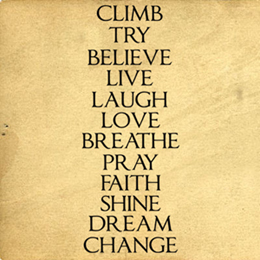
    Speak words that profit others, depict hope, courage, and inspiration and which create positive images. Then notice the difference in how your surroundings and people react.

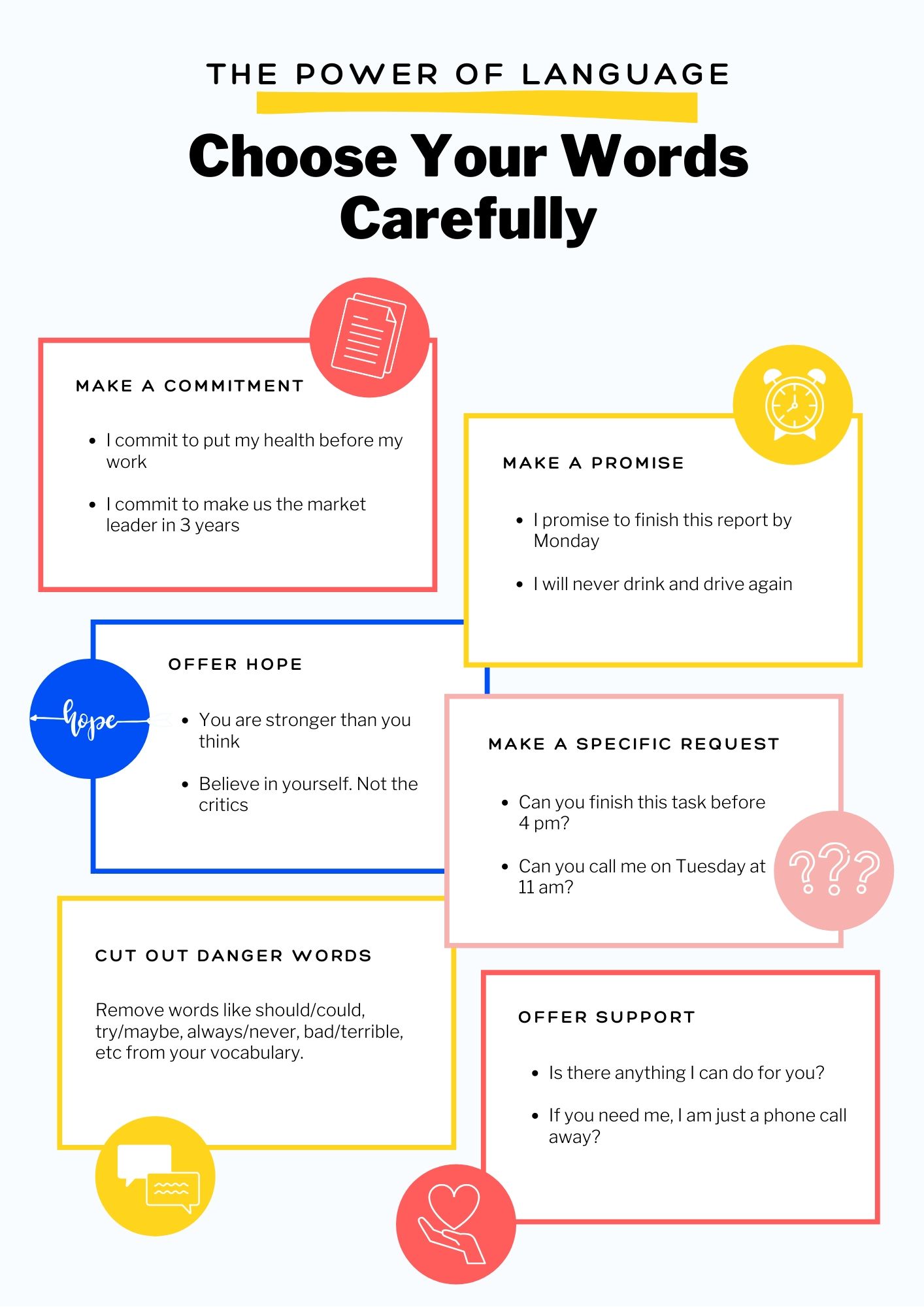
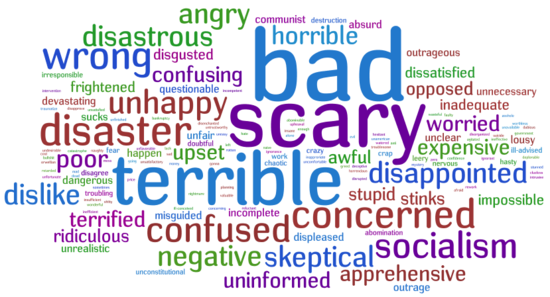
    Some of the danger words which we should cut from our vocabulary are –

    1. Should / Could – These words, spoken for ourselves or for others, implies judgment and makes people defensive and tense.
    2. Try / Maybe – These words leave ambiguity and leave an option for you or another to escape commitment in case things get difficult.
    3. Always / Never / Nobody  / Everybody – These words generalize opinions which are rarely the case and can cause people to react unexpectedly.
    4. Bad / Disastrous / Terrible – These words spread panic and can lead to more mistakes, stress, and confusion.
    5. Nothing is gonna change / That’s how it is done here – Using such phrases creates a culture of resentment and cynicism which ends up killing all enthusiasm and creativity in people.

    Instead, you can use powerful words and make them work for you :-

    1. Declare a Commitment. 
      1. I commit to exercising 30 minutes daily.
      2. Let us commit together to make this company the best place to work for.
    2. Make a Promise
      1. I promise to finish this report in two days.
      2. I promise to never drink and drive again.
    3. Make a Specific Request
      1. Can you finish this report before Friday or not?
      2. If you like it, can you share this article on Facebook today?
    4. Offer Support
      1. Is there anything I can do to help you with this task?
      2. I am just a phone call away if you need me.
    5. Offer Hope
      1. You will make it through it. You are stronger than you think.
      2. Believe in yourself, not the critics. I know you will prove them wrong.

    Watch your thoughts, for they become words. Watch your words, for they become actions. Watch your actions, for they become habits. Watch your habits, for they become character. Watch your character, for it becomes your destiny. – Lao Tzu

    So the next time, instead of saying –

    • “I can’t exercise more, I am tired.”, say, “I am not tired, let me do one more round.”
    • “I can’t work outside because I have asthma”, say, “I will work to prove I am bigger than my asthma”
    • “I can’t do this because I don’t have enough money”, say, “How can I earn enough money to start doing this?”
    • “I am not feeling good, it is going to be a bad day”, say, “Today is going to be a great day and I am raring to go”
    • “My life sucks”, say, “Today is a new day. Let’s make the most of it!!”

    Do this and you will see that your days will get brighter and dreams will turn into reality. Break the pattern of using words that suck power out of you, and instead form a new habit of using words that give power to you and the people around you.