
There’s a meeting happening right now, in every country, where a leader is saying something they don’t mean, making a promise they won’t keep, or avoiding a conversation that actually matters.
And everyone in the room knows it.
Including the leader.
But the show (or drama) goes on. The performance continues. The loop keeps looping.
Here’s what nobody wants to admit: Most of what we call leadership is theater. Not the inspiring kind—the kind where everyone’s pretending not to notice that the emperor has no clothes, the strategy has no substance, and the “transformation” is just rearranging deck chairs on the titanic.
We’re not leading. We’re performing safety. We are repeating the same “drama” on repeat. And calling it business or leadership.

What These Loops Actually Are
These patterns aren’t conscious choices. They’re what happens when your nervous system learns to prioritize safety over truth. A self-blame loop like “there’s something wrong with me” isn’t a conclusion you’ve reached through careful analysis. It’s a pattern that organizes chaos around a painful but familiar center. It hurts, yes. But it’s more durable than ambiguity.
The victim loop—“nothing ever works out for me”—isn’t giving up. It’s making chaos make sense by creating a story where you’re at least the protagonist of your own suffering.
“All I want to do is be helpful” sounds virtuous. Strip away the performance and you’ll often find self-preservation disguised as service. Being helpful means you’re needed. Being needed means you’re safe.
Carl Jung saw this clearly: “Until you make the unconscious conscious, it will direct your life and you will call it fate.”
Let’s look at the loops we’re all running but pretending we’re not.
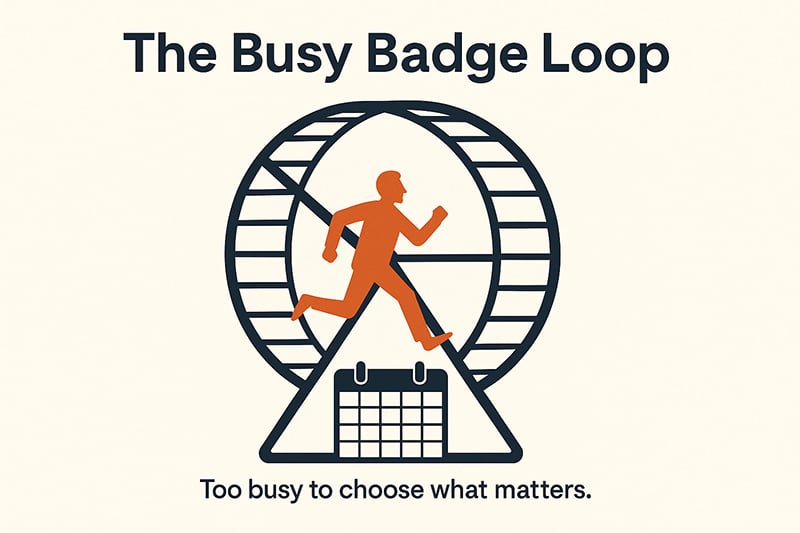
The Busy Badge Loop
“I’m so busy.”
It’s the most acceptable humble-brag in business. Said with exhaustion, sometimes pride, always as explanation for why something else isn’t happening.
But busyness isn’t productivity. It’s a shield against prioritization. Because choosing what matters means risking being wrong about what matters. If everything is urgent, nothing has to be important. The calendar stays full. The inbox stays overwhelming. And underneath runs quiet relief that you never have to face the question: “What would I do if I actually had space to think?”
Ask yourself: What dream or bold move have I been too “busy” to pursue for the last year, and what will my life look like in five years if I’m still too busy?
The Perfectionism Postponement
“We’ll launch when it’s ready.”
How many world-changing ideas have died in that sentence?
Perfectionism isn’t about high standards. It’s about never having to face judgment. If you never ship, you never fail. The preparation becomes the point. You get to be the person who could do something amazing rather than the person who did something imperfect.
Steve Jobs understood this trap: “Real artists ship.” Not perfect artists. Real ones.
Ask yourself: What would I have already created, launched, or become if “good enough” had been acceptable, and who might have already been helped by it?
The Certainty Collector
“I need more data before I decide.”
That is paralysis in a business suit.
Every decision involves loss. Choose one path and you lose the others. More information doesn’t change that—it just gives you more sophisticated ways to avoid choosing. Analysis becomes the thing you do instead of deciding.
Jeff Bezos famously distinguished between one-way and two-way doors. Most decisions are two-way doors (reversible). But we treat them like one-way doors because that justifies the delay.
Ask yourself: What decision have I been “gathering information” about for months, and what momentum, opportunity, or possibility dies with each day I wait?
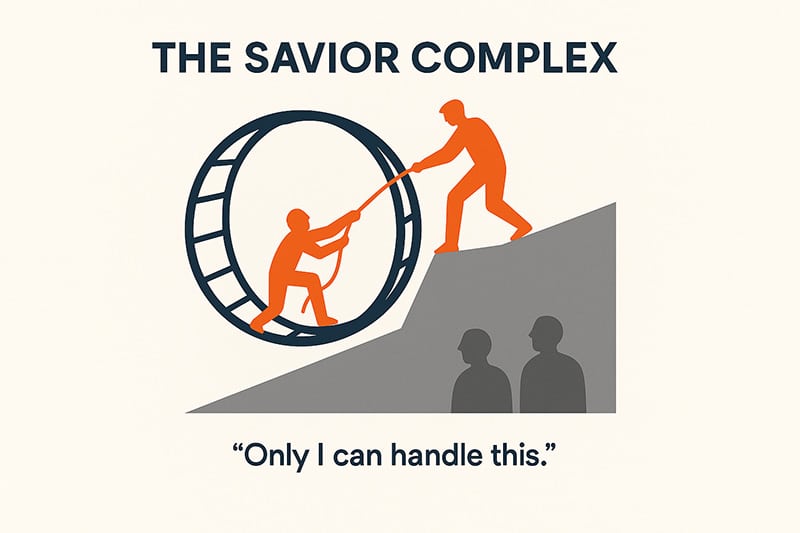
The Savior Complex
“I’m the only one who can handle this.”
Listen closely and you’ll hear relief underneath. Because being indispensable means never being challenged to grow beyond your current identity. The martyr and the tyrant are the same pattern in different clothes. Both say: “The world needs me to be exactly who I am right now.” Both are terrified of what happens when that stops being true.
Lao Tzu wrote, “A leader is best when people barely know he exists.” That’s not about invisibility. It’s about leaders who’ve stopped needing to be the hero of every story.
Ask yourself: Who on my team isn’t growing because I keep swooping in to save the day, and what leader could they become if I stepped back?
The Cynicism Shield
“Nothing will really change anyway.”
Corporate cynicism sounds like sophistication. It’s actually exhausted hope wearing a suit.
Cynicism is what happens when you’ve been disappointed enough times that pre-emptive disappointment feels safer than staying open. You can’t be hurt if you expect nothing. The leader who says “that’s just how it is” isn’t being realistic—they’re protecting themselves from caring enough to be wrong.
Marianne Williamson nailed it: “We ask ourselves, ‘Who am I to be brilliant, gorgeous, talented, fabulous?’ Actually, who are you not to be?” The same applies to hope. Who are you to be cynical when the world needs leaders who still believe change is possible?
Ask yourself: What possibility am I no longer even allowing myself to imagine because I’ve decided it’s naive, and what kind of world am I creating by giving up before I start?

The Comparison Trap
“At least our numbers are better than our competitors’.”
Using others as your reference point means never having to look directly at whether you’re actually building what matters. Comparison stabilizes the ego by making identity relational rather than examined.
The most dangerous version? “At least I’m not like that CEO.” Every critique of someone else’s leadership style is an opportunity to avoid examining your own.
Theodore Roosevelt said, “Comparison is the thief of joy.” In leadership, it’s also the thief of vision.
Ask yourself: If no one else existed to compare myself to, what would I actually want to create, and how far am I from that right now?
The Authenticity Performance
“I’m just being honest.”
Honesty without kindness isn’t authenticity—it’s cruelty seeking permission. The leader who prides themselves on “telling it like it is” often confuses brutality with truth. Real authenticity admits “I don’t know.” It says “I was wrong.” It doesn’t perform transparency—it is transparent, even when uncomfortable.
Brené Brown reminds us: “Vulnerability is not winning or losing; it’s having the courage to show up and be seen when we have no control over the outcome.”
Ask yourself: Who have I hurt or pushed away with my “honesty,” and what deeper truth am I avoiding by staying on the surface of brutal?
The Potential Prisoner
“We could scale to $100M if we wanted to.”
Living in the hypothetical is seductive. Unrealized potential can never fail. It’s the gap between what you are and what you could be that lets you avoid ever having to be anything specific.
The entrepreneur who’s always “between ventures.” The executive who’s “considering opportunities.” The leader who talks about vision but never takes the first step.
Goethe understood: “Whatever you can do or dream you can do, begin it. Boldness has genius, power and magic in it.”
Ask yourself: What am I sacrificing by staying in the realm of “could” instead of “did,” and what will I regret not attempting when I look back at this moment in ten years?
The Gratitude Bypass
“I should just be grateful for what we’ve achieved.”
Gratitude is beautiful. Using it to silence legitimate ambition? That’s self-betrayal with a spiritual bow on it.
This loop weaponizes thankfulness against desire. You can’t want more if you should be happy with what you have. It sounds humble. It’s actually a way to avoid the vulnerability of admitting you want something you might not get.
Ask yourself: What do I genuinely want that I’m pretending not to want by hiding behind gratitude, and what becomes impossible when I silence my own desires?
The Learning Loop
“I’m still learning. It’s a journey.”
Permanent student status is a brilliant defense mechanism. Growth language used to avoid ever being accountable as someone who knows. The journey never ends because arrival means responsibility.
There’s a difference between genuine humility and hiding behind “I’m still figuring it out” when people are actually waiting for you to lead.
Ask yourself: What am I qualified to teach or lead right now that I’m avoiding by staying in “student” mode, and who’s waiting for me to step up?
The Boundary Softness
“I don’t want to upset anyone.”
You’re not keeping the peace. You’re trading your needs for the mirage of harmony. But there’s no peace—just resentment accumulating while you pretend avoiding conflict is the same as connection.
Every unexpressed boundary is a future explosion waiting to happen. Every “yes” that should have been “no” is integrity leaking out.
Ask yourself: What boundary have I failed to set that’s now costing me my energy, time, or self-respect, and what relationship is actually suffering because I won’t be honest?
The Delegation Theater
“I’ve empowered my team.”
But have you? Or have you just created a system where they need your approval for everything while you maintain the illusion that you’re not a bottleneck?
Real delegation is scary because it means genuinely letting go of control. Fake delegation lets you keep control while looking collaborative. One builds leaders. The other builds dependency you can complain about.
Ask yourself: What’s not getting done or scaled because everything has to go through me, and what leader am I preventing from emerging by holding all the strings?

The Vision Vagueness
“We’re building something transformational.”
Vague vision isn’t inspiring—it’s a smoke screen. If your strategy can mean anything, it means nothing. But specificity is scary because it can be wrong. Vagueness can never fail because it never really commits.
The leader who speaks in inspiring abstractions but can’t answer “What does success look like next quarter?” isn’t visionary. They’re avoiding accountability.
Ask yourself: What am I avoiding committing to by keeping my vision vague, and how is my team’s confusion or misalignment the direct result of my lack of clarity?
The Consensus Cage
“Let’s make sure everyone’s aligned before we move forward.”
Sometimes that’s wisdom. Often it’s decision-making abdication disguised as inclusion. You’re not building buy-in—you’re distributing blame in advance.
Real leadership sometimes means making the call that not everyone agrees with and being willing to be wrong. The consensus loop means no one’s really leading.
Ask yourself: What bold decision have I been avoiding by waiting for everyone to agree, and what opportunity is dying while I run another alignment meeting?
The Optimism Bypass
“Everything happens for a reason.”
This isn’t faith. It’s a structure that turns randomness into reassurance. It’s a way to avoid grief, anger, and the messy reality that sometimes terrible things happen and there’s no lesson, no silver lining, no cosmic plan.
Toxic positivity in leadership looks like: “This layoff is actually an opportunity for those affected to find their true calling.” No. It’s a layoff. Let it be hard.
Ask yourself: What painful reality am I spiritually bypassing instead of facing, and who am I failing to truly support by forcing positivity onto their struggle?
The Meeting About Meetings
“We need better processes.”
Process improvement is legitimate. But sometimes “we need better systems” is a way to avoid addressing the actual problem: people aren’t having honest conversations.
No amount of process will fix a culture where people are afraid to tell the truth. The meeting about the meeting about the meeting is theater. The real issue is usually relational, not procedural.
Ask yourself: What difficult conversation am I avoiding by focusing on process improvements, and what would change if I just addressed the human issue directly?
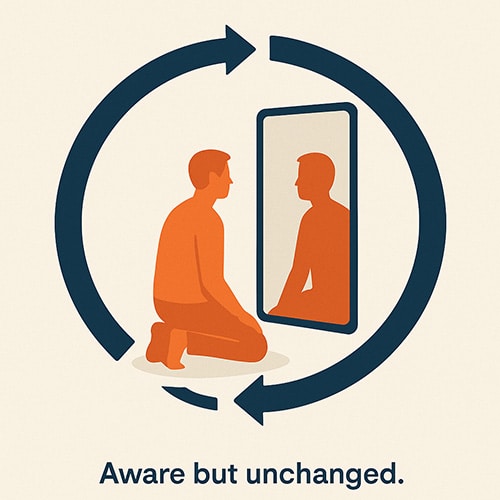
The Awareness Paradox
“I’m aware of my patterns now.”
Here’s the most sophisticated loop of all: awareness that doesn’t lead to change. You’ve read the books. Done the workshops. Know your triggers. And yet… the same patterns persist.
Because awareness outside the loop is often just the loop preserving itself by imagining a vantage point not bound by its own constraints. Real awareness lives in the moment of choice, not in the reflection after.
Ask yourself: What pattern have I been “aware” of for years without changing, and what am I getting from knowing about it without doing anything about it?
Why The Drama Continues
These patterns persist because they work—not at creating results, but at creating coherence and safety of familiarity. They emerged because at some point, they kept you safe. They made chaos manageable. They gave you a role when you didn’t know who to be.
The trap isn’t that they exist. It’s that they persist long after the threat has passed, running on autopilot because familiarity feels like truth.
They’re not you—they’re weather patterns you learned to live in. And like weather, they can change.
But first you have to stop calling them “just how things are” or “just how I am.”
The Real Work
Leadership isn’t about eliminating these patterns. It’s about recognizing them in real-time and choosing differently. Not perfectly. Not always. But consciously.
Read that again. It is that I call “Constant Conscious Creation”. Choosing consciously in real-time.
The next time you hear yourself say “I’m too busy,” pause. Ask: “What am I avoiding by staying busy?”
When you catch yourself collecting more data, ask: “What decision am I afraid to make?”
When you feel indispensable, ask: “What would become possible if I weren’t?”
When you’re performing authenticity, ask: “What truth am I avoiding by being so ‘honest’?”
This is the work. Not creating a perfect self, but creating a conscious one. A leader who can see their own loops and choose—even occasionally—to step outside them.
That’s when leadership stops being theater and boring drama and starts being transformation and fulfilling.
That’s when the drama ends and the real work begins.
Leave a Reply