
The Leadership Trinity: The 3 Essential States of Being for any Leader
Picture this: You’re sitting in your office at 10 pm, staring at a mountain of unfinished tasks while your phone buzzes with urgent messages from three different time zones. Your head of sales is demanding clearer targets, your engineering team needs inspiration for the next breakthrough, and your newest hire just submitted their resignation because they felt “unsupported.”
Sound familiar?
Here’s what nobody will tell you: You’re not failing because you lack skills or knowledge. You’re struggling because you’re trying to be everything to everyone while being unclear about which version of yourself to show up as in each moment.
After working with hundreds of leaders who’ve gone from feeling like they’re drowning in their own success to becoming unstoppable forces of positive change, I’ve discovered that every business owner must master not just one but three essential states of being: Leader, Manager, and Coach.
The Problem
Let me share Sonia’s story. She built a startup from her garage to a $50M valuation in four years. Impressive, right? But when I met her, she was burned out, her team was confused, and her company culture was toxic despite all their external success.
The problem? Sonia was switching between being a leader, manager, and coach without understanding the distinction. In Monday morning meetings, she’d inspire her team with grand visions (Leader), then immediately micromanage their daily tasks (Manager), before asking them to figure out their own solutions (Coach) – all within the same conversation.
Her team was getting whiplash. They didn’t know which Sonia would show up, so they learned to wait for instructions instead of taking initiative. Innovation stopped. Engagement went down.
Sonia’s mistake is the same one I see everywhere: treating leadership as a single skill instead of recognizing it as three distinct states of being, each with its own purpose, energy, and impact.
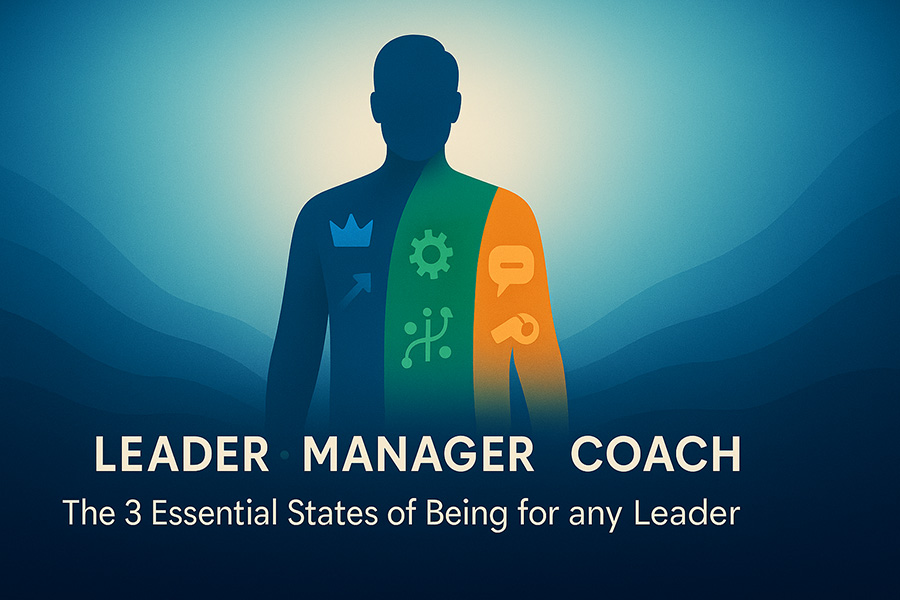
The Three States of Being: Your Leadership Trinity
Think of these three states like instruments in an orchestra. Each has its unique sound, purpose, and moment to shine. A symphony fails when the violins try to be drums, just like your organization fails when you bring the wrong energy to each situation.
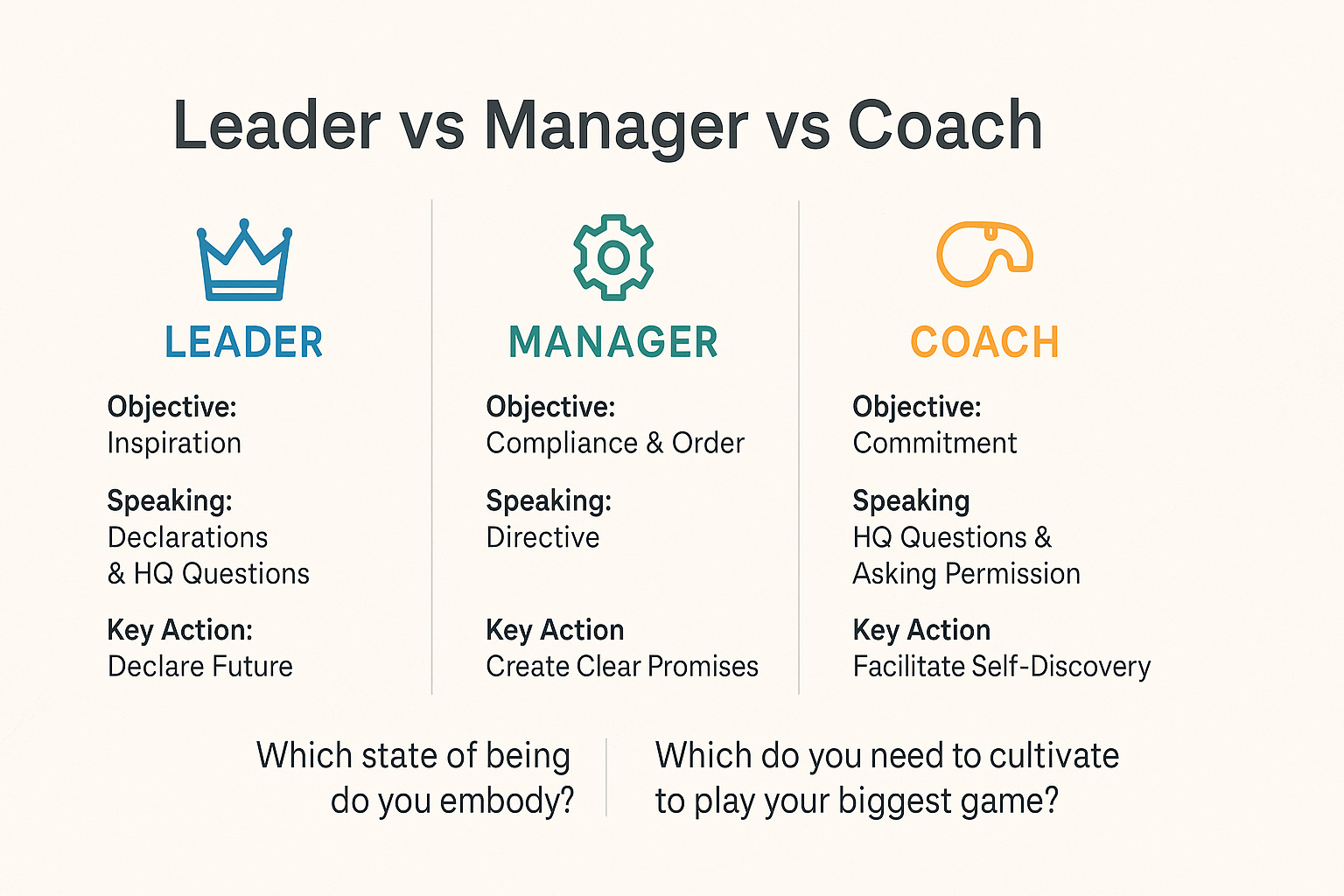
State 1: The Leader – The Visionary Who Ignites Possibility
Objective: Inspiration
Speaking Style: Declarations, Asking High-Quality Questions
Listens for: Points of View
Body Disposition: Flexible
Core Distinction: Player vs Spectator
When you embody the Leader state, you’re not managing what is – you’re creating what could be. You’re the person who walks into a room and shifts the energy simply by declaring a possibility that didn’t exist before.
I think of Hitesh, a CEO who inherited a struggling manufacturing company from his father. The business was bleeding money, morale was at rock bottom, and everyone expected him to announce layoffs. Instead, Hitesh stood before his 200 employees and declared: “In 18 months, we’re going to be the most innovative, employee-loved manufacturing company in our region, and every person in this room is going to be proud to tell their family where they work.”
Crazy? Maybe. But he wasn’t predicting the future – he was creating it through his declaration. That’s what Leaders do. They don’t manage reality; they create the future.
Key Actions of a Leader:
Declare a Future: Paint a vivid picture that makes people’s hearts race. Not goals, not targets – futures that feel inevitable once spoken. When Elon Musk declared we’d colonize Mars, he wasn’t setting a goal. He was creating a future that thousands of brilliant minds could step into.
Ask Insightful Questions: The right question can change everything. Instead of “How do we cut costs?” ask “What would we do if money wasn’t the constraint?” Instead of “Why is this taking so long?” ask “What would make this project irresistible to work on?”
Engage Perspectives: Leaders listen to different viewpoints without agreeing to disagreeing with any. They know that breakthrough thinking emerges from the collision of different perspectives. They ask “What am I not seeing?” and actually listen to the answers.
Example: “What would our ideal customer experience look like in five years if we had unlimited resources and complete customer trust?” Notice how this question immediately expands thinking beyond current limitations.
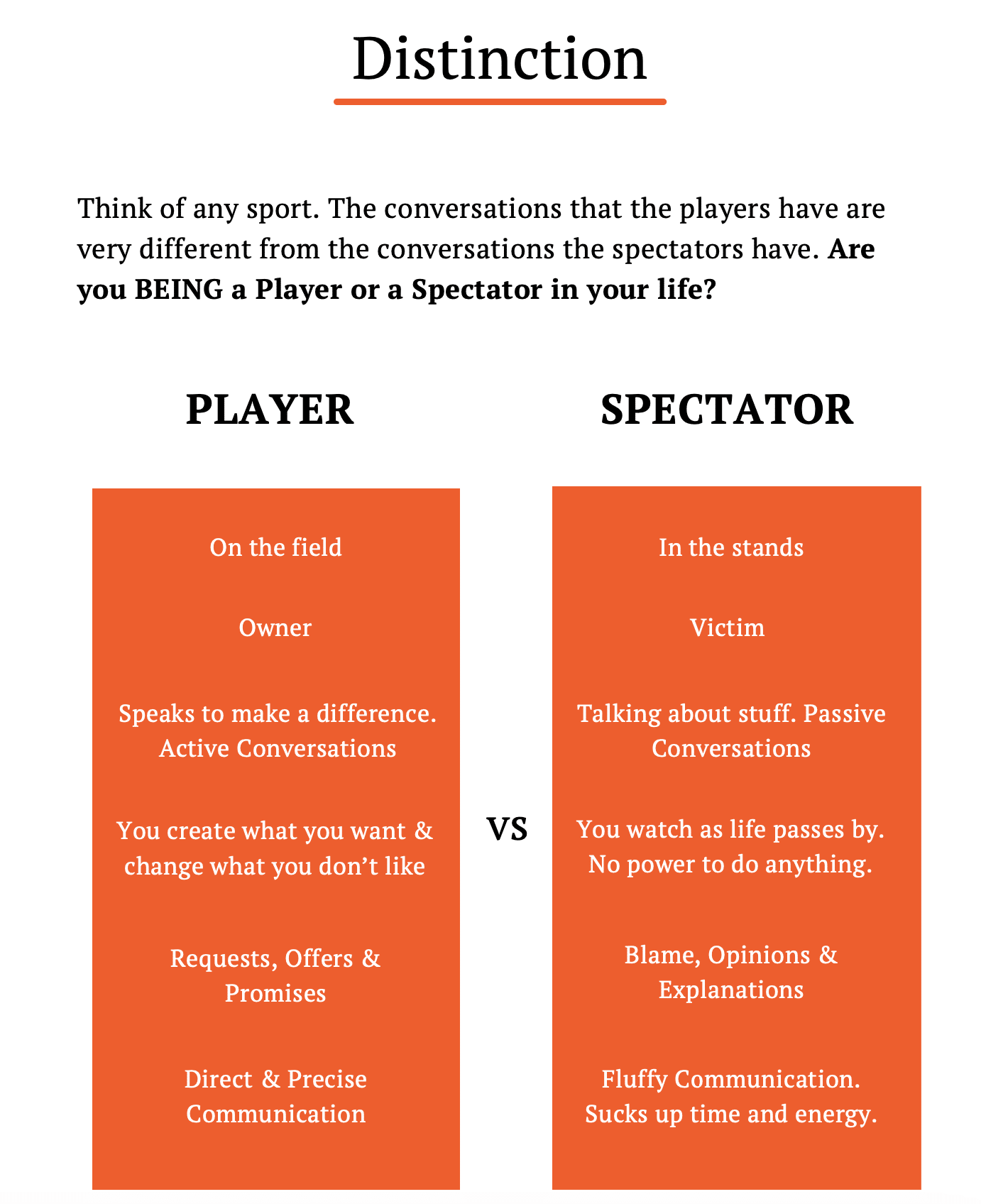
Being a Leader requires you to be a Player, not a Spectator.
Spectators observe, explain and comment.
Players step onto the field and influence outcomes through their presence and actions (requests and promises).
State 2: The Manager – Coordinating Human Behaviour And Creating Order
Objective: Compliance, Order, Coordinating Action
Speaking Style: Directive (Do this, not that)
Listens for: Right and Wrong / Information
Body Disposition: Resolution
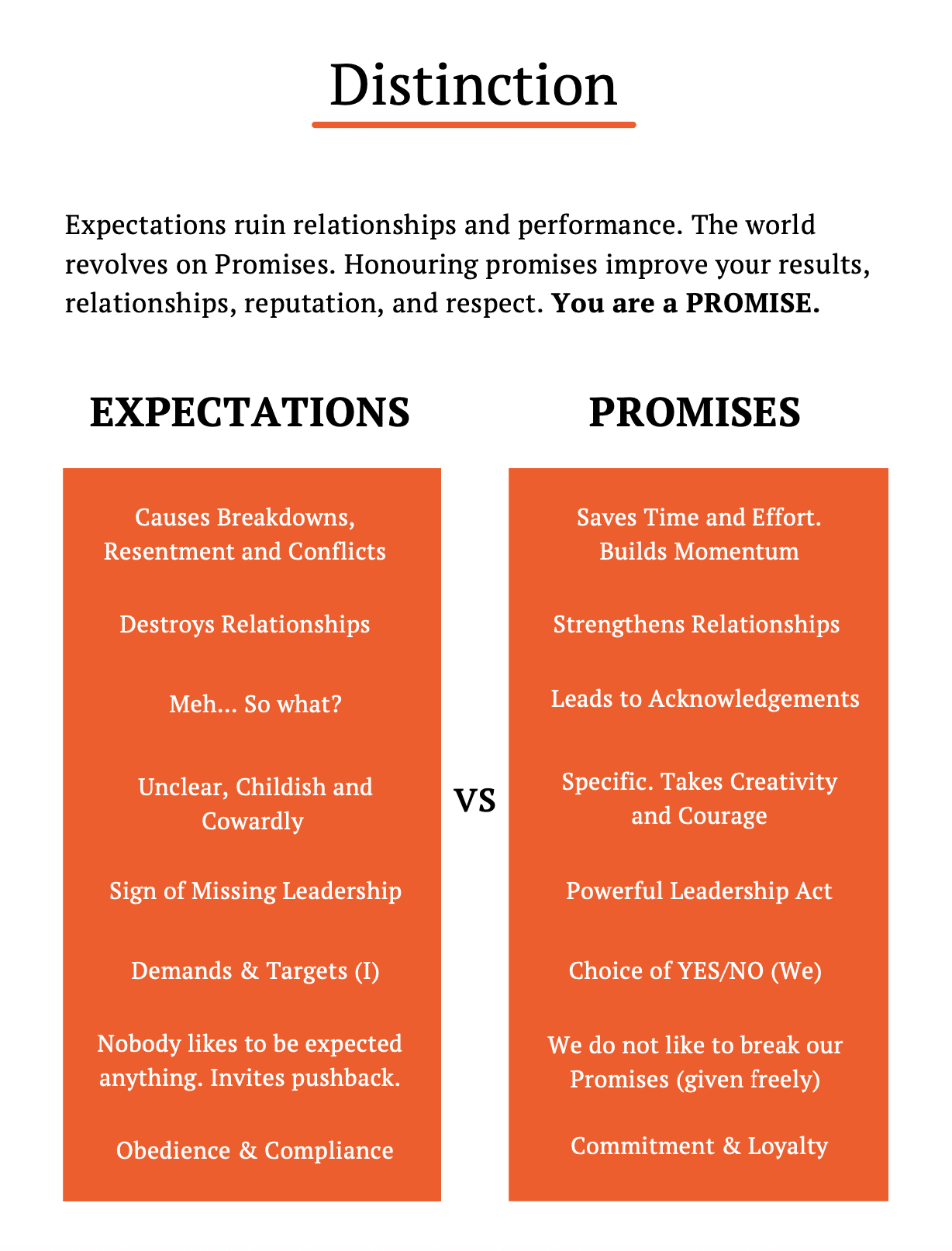
Core Distinction: Promises vs Expectations
If the Leader creates the vision, the Manager makes it real. This is where inspiration meets execution, where dreams get translated into deliverable actions.
I worked with Alex, a brilliant visionary who could inspire a team to climb mountains but couldn’t get them to complete a simple project on time. His company was full of motivated people going in seventeen different directions. Alex had mastered the Leader state but was afraid to be a Manager, thinking it would make him “controlling” or “micromanaging.”
Here’s what I told him: “Alex, your team doesn’t need another inspiring speech. They need clarity. They need to know exactly what success looks like and when it’s done. That’s not controlling – that’s caring.”
The Manager state isn’t about being a dictator. It’s about creating the structure that allows brilliance to flourish. Think of it like being a conductor – you don’t play every instrument, but you ensure everyone plays in harmony and on time. It is about coordinating human behaviour and actions so that who will do what by when is clear to everyone involved.
Key Actions of a Manager:
Create Clear Promises: This is where most leaders fail. They create expectations instead of promises. An expectation is something you hope will happen. A promise is something you can count on. “I expect you to improve customer satisfaction” is weak. “Can you reduce customer complaint resolution time to under 24 hours by month-end?” is a promise when responded to by a clear YES or NO.
Provide Directives: Be specific. Be clear. Be unambiguous. “Complete the quarterly report by Friday following the outlined template, including the three scenario analyses we discussed, and send it to me and the board by 5 PM EST. Can you do that?” No guessing. No interpretation needed.
Monitor Compliance: This isn’t about micromanaging – it’s about caring enough to ensure promises are kept. Set up systems that make success visible and failure impossible to ignore.
Accountability Conversations: While being a manager includes holding others accountable, if you create PROMISES properly, people will hold themselves accountable on their own – as progress would be self-evident, measured and visible – leaving nothing to guessing.
The Manager state requires understanding the distinction between Promises and Expectations. Promises are commitments with specific deliverables and timelines. Expectations are wishes disguised as requirements. Which one do you think gets results?
State 3: The Coach – The Developer Who Unleashes Potential
Objective: Creating Commitment
Speaking Style: Asking High-Quality Questions / Asking Permission
Listens for: Insight
Body Disposition: Open
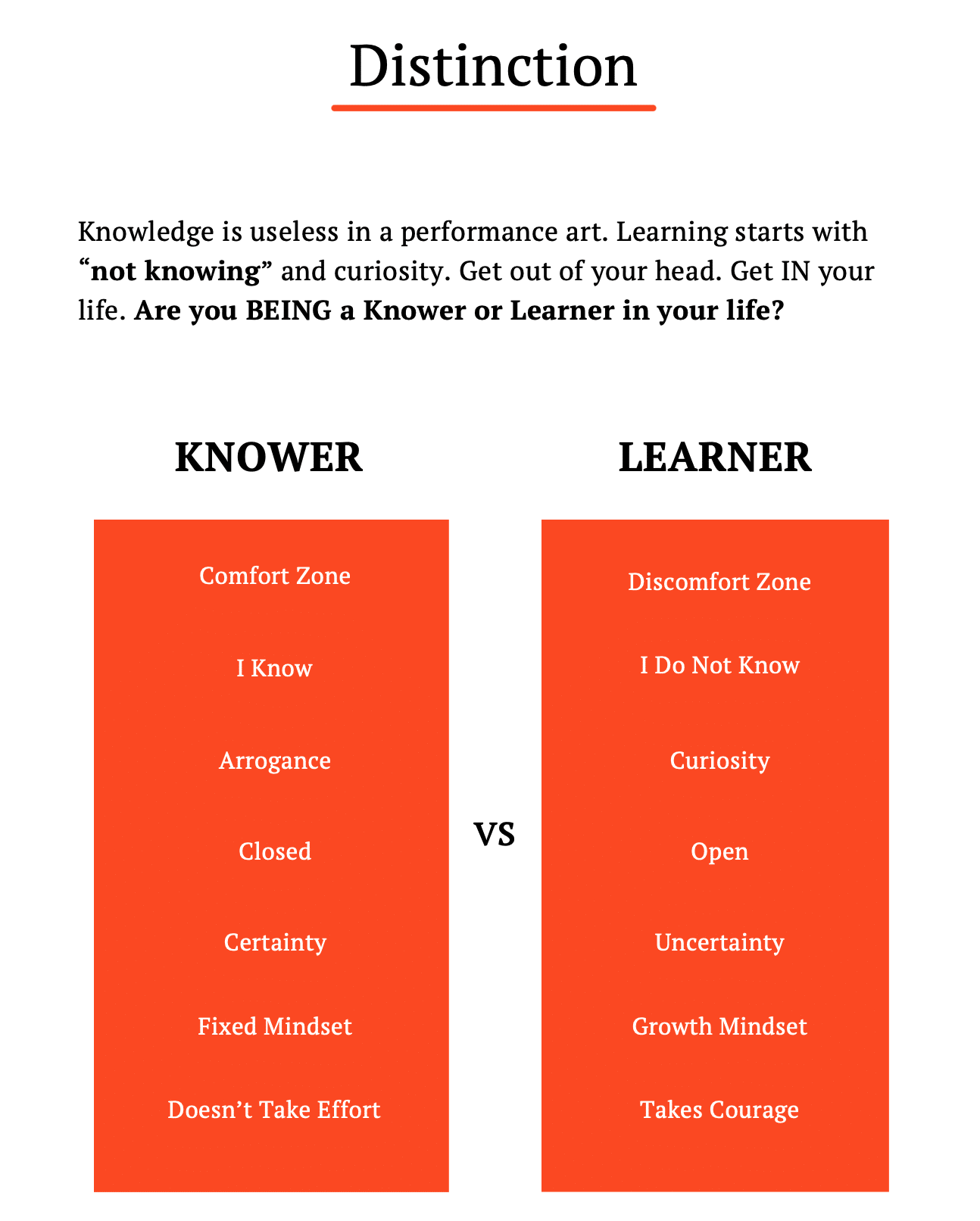
Core Distinction: Learner vs Knower
The Coach state is perhaps the most misunderstood of the three. It’s not about being nice or supportive (though those can be byproducts). It’s about creating an environment where people discover their own answers and commit to the way forward.
Lisa, a VP of Engineering, came to me frustrated because her team kept coming to her with problems instead of solutions. “I’ve tried everything,” she said. “I’ve given them frameworks, sent them to training, even hired consultants. Nothing works.”
“Have you tried asking them what they think?” I asked.
“Of course I—” she stopped mid-sentence. “Actually, no. I tell them what I think they should think.”
That’s the difference between a Knower and a Learner. Knowers have all the answers (or pretend to). Learners have all the questions.
A leader creates, a manager knows, and a coach is always open to learning about themselves and the person in front of them.
The next week, Lisa tried something different. Instead of solving her team’s problems, she asked: “What do you think is the best approach here? What would need to be true for this to work? What support do you need from me?”
Magic happened. Not only did her team come up with better solutions than she would have provided, but they also became committed to implementing them because the ideas were theirs.
(if coaching is not familiar to you, it is never as easy as the above example – though it can be)
Key Actions of a Coach:
Facilitate Self-Discovery: Your job isn’t to have all the answers – it’s to ask the questions that help others find their answers. “What would you do if you knew you couldn’t fail?” “What’s the smallest step you could take today?” “What would success look like to you?”
Encourage Growth: Create psychological safety where people can experiment, fail, and learn without judgment. Celebrate attempts as much as achievements. Growth happens at the edge of comfort zones. Stay in your center and make sure the person in front of you stays in theirs.
Support Autonomy: Give people ownership of their development. Ask permission before giving advice: “Would you like my perspective on this?” “Are you looking for solutions or just someone to listen?” Respect their autonomy to choose.
Coaching is not manipulation. Coaching is treating the other person as an equal with complete autonomy – even if the topic of discussion is incompetence, confusion, or failure.
Example in action: “What do you think is the best way to tackle this challenge, and how can I support you?” Notice how this question puts ownership squarely on their shoulders while offering support.
The Coach state requires being a Learner, not a Knower. Learners are curious, open, and comfortable with not having all the answers. Knowers are rigid, closed, and need to be right.
The Art of State Switching: When to Be What
Here’s where most leaders crash and burn: they don’t know when to switch states. They bring Leader energy to operational meetings, Manager energy to coaching conversations, and Coach energy to crisis situations.
Let me paint you some scenarios:
Crisis Management: Your biggest client just threatened to leave unless you fix a critical bug by tomorrow. This is Manager time – clear directives, specific timelines, no ambiguity. “Sachin, drop everything and focus on the authentication module. Leslie, you’re handling client communication every two hours with updates. Everyone else, clear their calendar until this is resolved.”
Strategic Planning: You’re designing the company’s five-year vision. This is Leader territory – declarations, questions, possibility. “What if we could make our industry irrelevant? What would we build if we started from scratch today? What future are we most excited to create?”
Performance Development: An employee is struggling with confidence after a failed project. Coach mode activated – questions, permission, insight. “What did you learn from this experience? What would you do differently next time? What support would help you feel more prepared for similar challenges?”
The key is reading the room and the moment. What does this situation call for? What does this person need right now? What state of being will serve the highest good?
Your Leadership Audit
Now comes the uncomfortable truth-telling moment. Most leaders have a dominant state – one they default to because it feels safe or familiar. But your default might be exactly what’s limiting your impact.
Take a moment and honestly assess yourself:
Which state do you most easily embody?
Are you naturally the visionary who paints compelling futures but struggles with follow-through? The organized executor who gets things done but rarely inspires? The supportive developer who coaches everyone but never makes tough decisions?
I was naturally a Coach – I loved asking questions and helping people discover their own answers. But I was afraid of being directive (Manager) because I thought it made me controlling. And I avoided making bold declarations (Leader) because I was scared of being wrong and responsible.
My breakthrough came when I realized that serving others sometimes means being the Manager who sets clear boundaries or the Leader who declares an uncomfortable truth. My natural Coach state was actually a limitation when it prevented me from giving people the clarity or inspiration they needed.
Being a coach allowed me to become one of the best at coaching.
Being a manager allowed me to create a thriving coaching business.
Being a leader allowed me to inspire the best of the best – both the CEOs and other coaches I work with today.
The last two – I had to learn. It was the tough pill and learning I needed to do what I do today.
Which state do you need to cultivate to win at your biggest game?
This question will reveal your growth edge. Maybe you’re brilliant at execution but your team is uninspired because you never paint the bigger picture. Maybe you’re amazing at inspiring people but projects fail because you avoid creating clear accountability.
The fintech CEO I mentioned earlier, realized she was avoiding the Coach state because she equated it with being “soft.” She thought successful CEOs had to be always-on, always-directive. But her team needed space to think, to contribute, to feel heard. When she learned to ask instead of tell, magic happened.
The visionaries and coaches often have to embrace their inner Manager. They have to learn that structure isn’t the enemy of creativity – it’s creativity’s best friend. Clear agreements frees teams to innovate within defined boundaries.
The Ripple Effect: How Being Centered Transforms Everything
When you are Centered, you can choose Who to BE – Leader, Manager or Coach.
When you can choose these three states of being, something profound happens. Your organization stops being dependent on your mood, your energy level, or your latest management book. Instead, it becomes a living system that can handle complexity because everyone knows what to expect and when.
Your team stops walking on eggshells, wondering which version of you will show up. They learn to recognize the states and respond appropriately. When you’re in Leader mode, they bring their biggest thinking. When you’re in Manager mode, they focus on execution. When you’re in Coach mode, they open up and share their real challenges.
But here’s the deeper transformation: you stop being exhausted by leadership. Instead of trying to be everything to everyone, you become exactly what each moment requires.
Read the above again. One more time. You stop fighting your natural state and start leveraging all three.
The manufacturing CEO told me six months after we worked together: “I used to dread Monday mornings because I never knew what crisis I’d have to solve. Now I look forward to them because I know I have three different ways to approach any situation. I’m not just reacting anymore – I’m responding from center and choice.”
Your Next Move
So here’s my challenge to you: For the next week, before every important interaction, center yourself & ask: “What does this situation call for? What state of being will serve the highest good right now?”
Don’t try to be perfect. Don’t try to master all three states at once. Just become conscious of which one you’re in and whether it’s serving you and others.
Start with your natural state and get even better at it. Then gradually expand into the other two. Remember, this isn’t about becoming someone you’re not – it’s about becoming all of who you are.
The world needs leaders who can hold all three states with equal mastery. Leaders who can inspire the impossible, create order from chaos, and develop others to exceed their own potential.
The question isn’t whether you have the capacity for this – you do. The question is whether you’re willing to stop being comfortable and embrace the full spectrum of your leadership power.
Which state of being will you choose to step into in your next conversation?
Leave a Reply